Article

An Integrated Approach to Municipal Solid Waste Recycling Performance Evaluation by Incorporating Local Demographic Features

1
Department of Environmental Engineering and Management, Chaoyang University of Technology, No. 168, Jifeng E. Rd, Wufeng District, Taichung 413310, Taiwan
2
Department of Applied Chemistry, Chaoyang University of Technology, No. 168, Jifeng E. Rd, Wufeng District, Taichung 413310, Taiwan
*
Author to whom correspondence should be addressed.
Sustainability 2021, 13(18), 10446; https://doi.org/10.3390/su131810446
Submission received: 17 August 2021 / Revised: 11 September 2021 / Accepted: 15 September 2021 / Published: 19 September 2021

Abstract

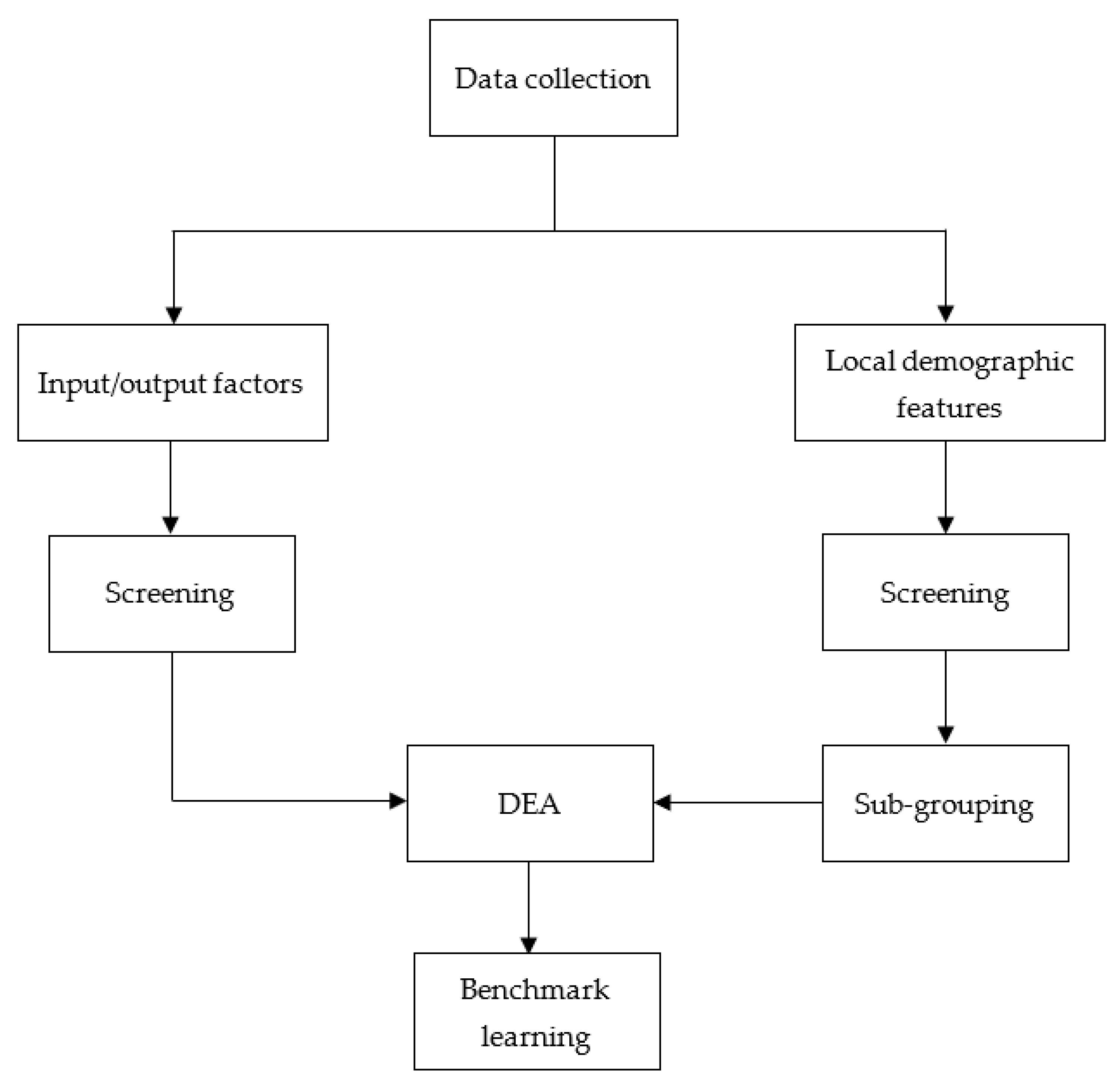
Recycling municipal solid waste has become a challenging task for municipalities. Appropriate recycling efficiency evaluations are, thus, essential to find practical benchmark learning targets for inefficient municipal solid waste authorities (MSWAs). This study developed a recycling performance evaluation procedure by subgrouping MSWAs with prominent local demographic features, such as population density, ratio of senior citizens, tourism index etc. Principal recycling relevant factors for MSWAs in each group were then collected, and data envelopment analysis (DEA) was applied for efficiency evaluation and benchmark learning targets. A case study of 181 MSWAs in Taiwan demonstrated the suitability of the proposed procedures. An assessment of the required efforts for efficiency improvements revealed that, in an unsegregated scenario, inefficient MSWAs representing a rural subgroup required maximum efforts to fulfill the efficiency targets, which was on average 61% higher than that determined in their respective subgroup. Furthermore, the unsegregated scenario revealed proximal efficiency results for the urban subgroup. The results indicated that consideration of local demographic features was essential for a fair assessment of recycling efficiency. Additionally, evaluating MSWAs with similar local demographic features was superior in obtaining appropriate benchmark learning targets for the inefficient MSWAs and, consequently, exhibited practicality for improving walkthroughs to achieve the efficiency goal.
Keywords: local demographic features; data envelopment analysis; municipal solid waste authorities; recycling; subgrouping local demographic features; data envelopment analysis; municipal solid waste authorities; recycling; subgrouping