Article

Optimal Synergy between Photovoltaic Panels and Hydrogen Fuel Cells for Green Power Supply of a Green Building—A Case Study


by
Raluca-Andreea Felseghi
1,2,
Ioan Așchilean
2,
Nicoleta Cobîrzan
2,*,
Andrei Mircea Bolboacă
3 and
Maria Simona Raboaca
3,4,*
1
Faculty of Electrical Engineering and Computer Science, Ștefan cel Mare University of Suceava, Universităţii Street, No. 13, 720229 Suceava, Romania
2
Faculty of Civil Engineering, Civil Engineering and Management Department, Technical University of Cluj-Napoca, C-tin Daicoviciu Street, No. 15, 400020 Cluj-Napoca, Romania
3
Faculty of Building Services Engineering, Technical University of Cluj-Napoca, Bd. 21 Decembrie 1989, No. 128-130, 400604 Cluj-Napoca, Romania
4
National Research and Development Institute for Cryogenic and Isotopic Technologies—ICSI Rm. Valcea, Uzinei Street, No. 4, P.O. Box 7 Raureni, 240050 Valcea, Romania
*
Authors to whom correspondence should be addressed.
Sustainability 2021, 13(11), 6304; https://doi.org/10.3390/su13116304
Submission received: 9 May 2021 / Revised: 25 May 2021 / Accepted: 27 May 2021 / Published: 2 June 2021
(This article belongs to the Special Issue Next Energy Efficiency Solutions for Sustainable Buildings)

Abstract

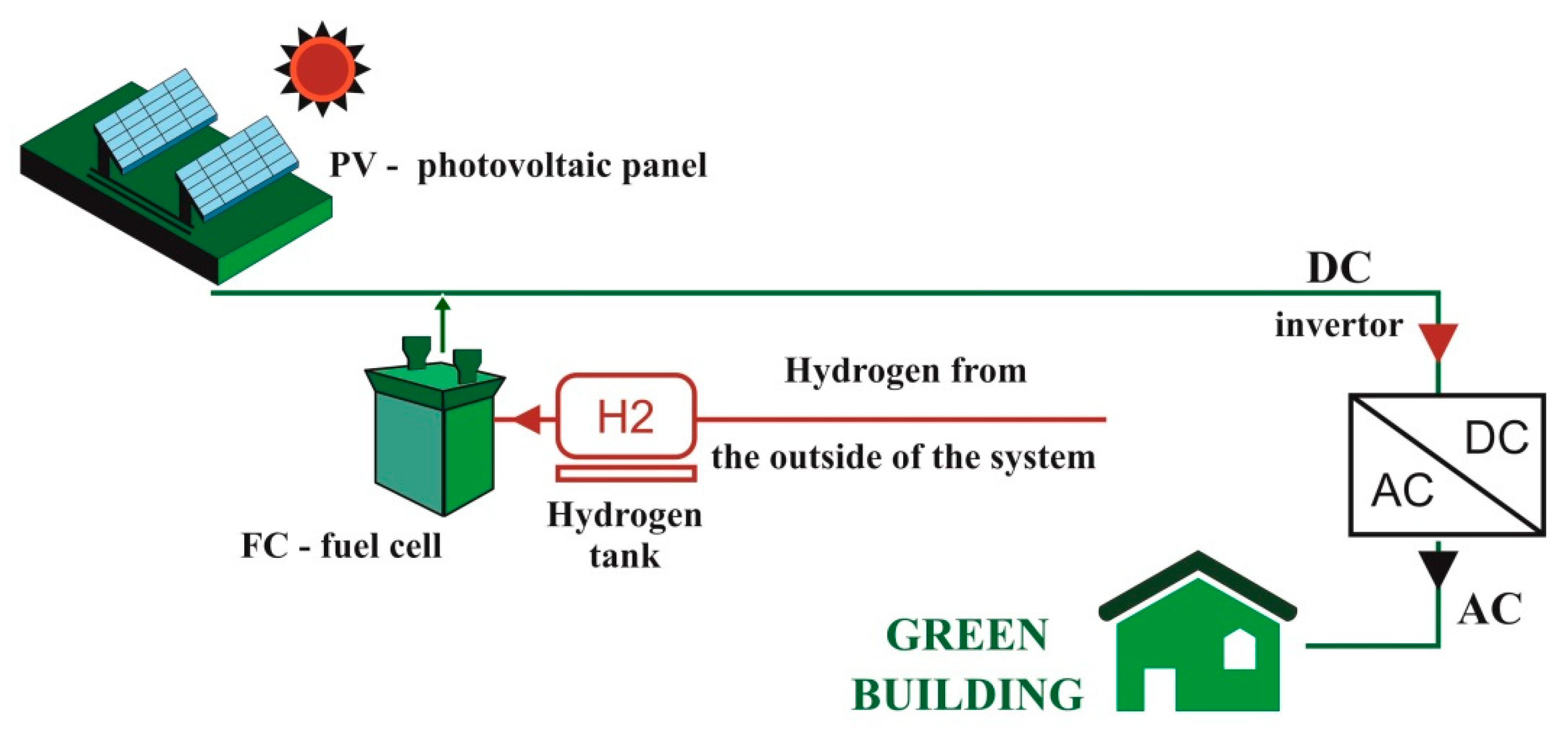
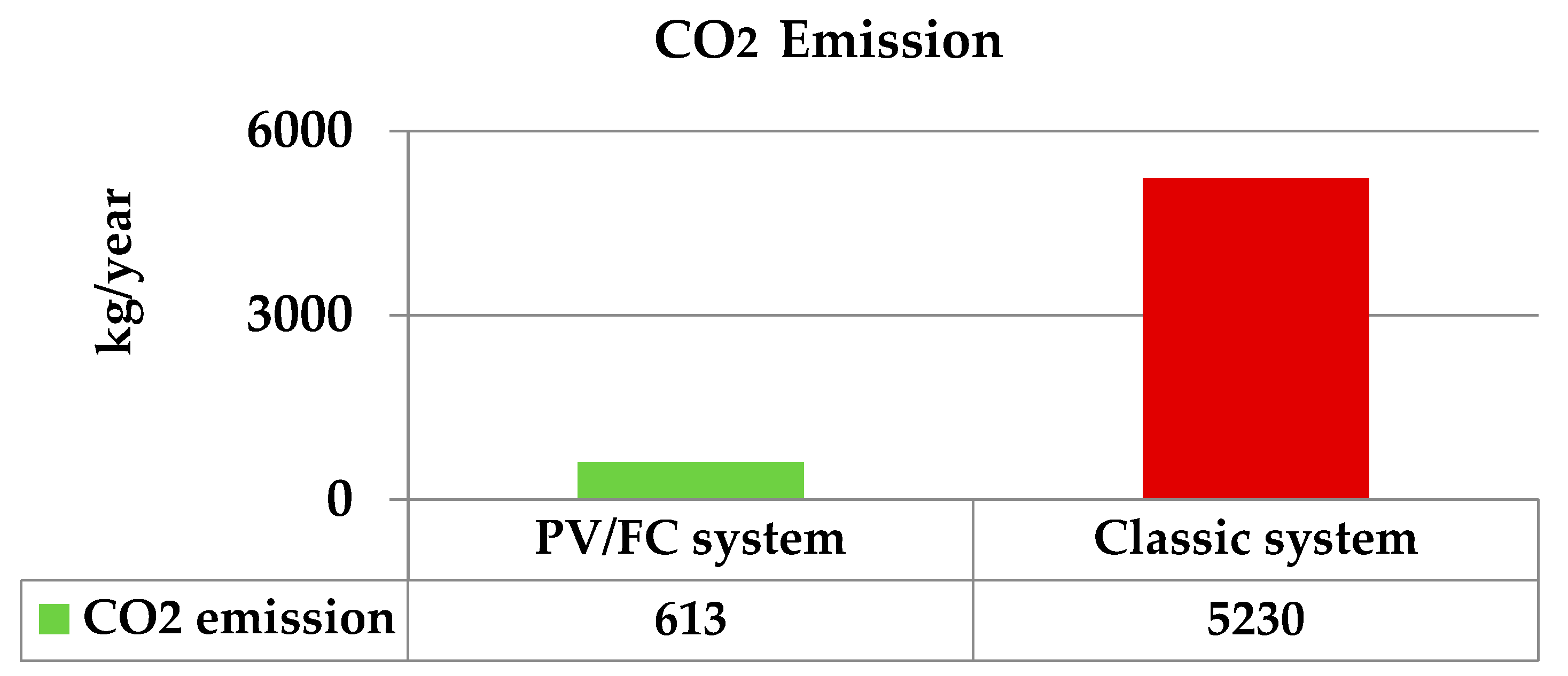
Alternative energy resources have a significant function in the performance and decarbonization of power engendering schemes in the building application domain. Additionally, “green buildings” play a special role in reducing energy consumption and minimizing CO2 emissions in the building sector. This research article analyzes the performance of alternative primary energy sources (sun and hydrogen) integrated into a hybrid photovoltaic panel/fuel cell system, and their optimal synergy to provide green energy for a green building. The study addresses the future hydrogen-based economy, which involves the supply of hydrogen as the fuel needed to provide fuel cell energy through a power distribution infrastructure. The objective of this research is to use fuel cells in this field and to investigate their use as a green building energy supply through a hybrid electricity generation system, which also uses photovoltaic panels to convert solar energy. The fuel cell hydrogen is supplied through a distribution network in which hydrogen production is outsourced and independent of the power generation system. The case study creates virtual operating conditions for this type of hybrid energy system and simulates its operation over a one-year period. The goal is to demonstrate the role and utility of fuel cells in virtual conditions by analyzing energy and economic performance indicators, as well as carbon dioxide emissions. The case study analyzes the optimal synergy between photovoltaic panels and fuel cells for the power supply of a green building. In the simulation, an optimally configured hybrid system supplies 100% of the energy to the green building while generating carbon dioxide emissions equal to 11.72% of the average value calculated for a conventional energy system providing similar energy to a standard residential building. Photovoltaic panels account for 32% of the required annual electricity production, and the fuel cells generate 68% of the total annual energy output of the system.
Keywords: fuel cell; green building; hybrid energy system; hydrogen energy; optimal synergy; photovoltaic panel; power supply; solar energy fuel cell; green building; hybrid energy system; hydrogen energy; optimal synergy; photovoltaic panel; power supply; solar energy