


Abstract
This paper is dedicated, both theoretically and conceptually, to a methodical approach towards the efficiency evaluation of proposed smart city solutions. The implementation of smart solutions in proposed projects and activities is supported by a complex assessment of benefits and costs as part of a cost benefit analysis (CBA) with the goal of maximizing the efficiency of such a solution, especially in the case of public activities for which it is typical to lack a market evaluation. A smart solution can be defined as an innovative and functional approach towards solving situations in a responsible way and with positive consequences for society. These smart solutions represent the core of the smart city concept, which together with the smart region concept presents a new economic domain where new markets or market segments offering innovative and intelligent (tangible and intangible) solutions for said cities and regions can be developed. CBA and feasibility analyses represent suitable tools for evaluation of socially and economically acceptable projects and their implementation in real life. The efficiency of these solutions is then proved by benefit and cost comparisons under the condition that these outcomes are acceptable for all stakeholders. Methodically, the paper is structured inductively. The detailed literature review provides the basis for a formulation of general principles of using a CBA for innovative smart city solution efficiency evaluations based on chosen cases, for example, from the Moravia Silesian region. Due to the originality of each submitted project, it is possible to use this proposed methodical approach of CBA applications as a primary analytical frame and it is necessary to add the specific attributes of each solution that is being evaluated.
1. Introduction
“Smart cities” is a topic the key importance of which is increasingly being recognized across both academic disciplines and urban planning. The idea of a smart city is a dream of urban planners all over the world, and a subject of many research and business initiatives as well as policy debates [1].
Recently the smart city concept has developed; it is a frequently emphasized term that we would like to use to refer to the use of highly sophisticated analytical methods, approaches, communication methods and techniques for proposing aims, approaches and plans involving the whole field of transfer of smart solutions into tangible and intangible innovations in a particular locality. The smart cities and regions concept tries to appropriately utilize modern technology to create synergies between different sectors (transport, logistics, security, energy, building management, etc.) with regard to energy intensity and quality of life for a city or region [2]. To be precise, “smart city” represents the concept of a developed city on the basis of its sustainable economic development, and on the basis of its quality of life underpinned by effective usability of human and social capital as well as modern information and communication technologies [3]. A city is smart when it uses participatory governance and invests in human resources, social capital and both traditional and modern infrastructure, thus ensuring sustainable economic growth, a high quality of life and the efficient use of natural resources [4]. A smart city is a city that takes particular care of the quality of life of its inhabitants, and where citizens are actively involved in public affairs [5]. In this context, we deal with territorial implementation of individual smart solutions that represent an innovative and working approach to developing solutions for various situations in an appropriate and socially positive way [6,7]. Smart solutions must make cities more humane and not just technologically advanced [2]. From the definition already mentioned above, we can suggest that smart solutions must provide economic and social efficiency as part of their implementation in real public life. However, not every innovative solution is attractive and economically rational for the public. The ideas of the smart city (or sometimes also a smart village or smart region) will not be “smart” if the society-wide costs accrued in the introduction and employment of these ideas exceed their objective and subjective benefits for the subjects involved.
One of the tools commonly applied in assessing the efficiency of planned activities is the so-called cost–benefit analysis (CBA). CBAs are also used to assess proposed smart solutions, meaning CBA is the most suitable method [8] for developing a ratio approach in decision-making processes [9]. The employment methods of a CBA and its practical applications are relatively broad, and this is the reason why the CBA will be used in this article to assess smart activities, elements and solutions, especially involving the public sector and its institutions. The assessment of public projects is a crucial element in public policy decisions regarding the distribution of finances. An appropriate allocation of public costs is one of the main aims of smart governments as far as the three Es are concerned (the economy, effectiveness and efficiency) [2,10]. In line with this idea, all smart solutions must be allocated as efficiently as possible [11]. The appropriateness of employing a CBA for making decisions regarding a project’s efficiency has also been declared by the European Union, which considers it to be a useful analytical tool for assessing investment decisions [12].
The aim of this article, based on a wide range of available sources, is to express general elements and principles of CBA applications when assessing the efficiency of innovative solutions that fall within the smart city concept. We try to suggest a primary analytical framework, given the uniqueness of each smart solution, which would offer an all-purpose platform suitable for further specification of each assessed solution.
The article focuses on the theoretical description of the CBA method as well, which serves as an overview of practical CBA applications using good practice examples. The synthesis of both theoretical and practical CBA problems is used to develop CBA solutions and a universally applicable design as a primary tool for assessing the efficiency of proposed smart solutions. The real employment of this methodical framework is verified as a part of an experiment involving the projects’ activities from CZ.02.1.01/0.0/0.0/17_049/0008452 “SMART Technologies to Improve the Quality of Life in Cities and Regions”.
2. Cost–Benefit Analysis
CBA is an analytical tool and comparative approach [13] which is particularly commonly used for the assessment of public infrastructure developments. In the public sector, the profit of the public rather than the profits of investors is crucial. CBA is established on the analysis of all implicit as well as explicit costs and benefits, which quantifies the investments’ impacts on society. The assessment criterium is the net socio-economic surplus of the society or at least a part of it. On the one hand, there are all economic and social costs (harm, negative effects resulting from investment, all negative impacts on society) expressed in finances and on the other hand, there are all the benefits (positive effects of investment, all positive impacts on society) contributing to the prosperity of the society. By the aggregation of both forms of impacts, negative and positive, and by comparison of individual options among one another, we decide to choose such an option that maximizes the difference between the costs and benefits of the analyzed activity, or else the activity is implemented if the supposed benefits exceed the supposed costs. The aim of the CBA is to support a more effective allocation of sources and to demonstrate the appropriateness of the company [9,11,12]. The CBA creation is related to the creation of public activities and projects and their valuation (Flood Control Act, 1936) and this is what distinguishes the CBA from other analyses that emerged during the second half of the 20th century [14].
The prerequisite of CBA employment is the fact that the value of all the negative and positive impacts is both directly and indirectly measurable as far as finances are concerned. By achieving the prerequisite, expressing all the benefits and negative impacts in cash flow, it can be stated that it represents an advantage and thus the CBA can be applied to almost any activity. At the same time, however, the analysis itself is also disputable as plenty of input and output effects do not have material or financial structure, or because it is difficult to determine the individual effects. It should be also noted here that indirect effects are usually represented by externalities. An externality is an indication of activity when entities are causing involuntary costs or profits to other entities without compensation through the market [15]. Negative externalities associated with an activity create additional costs for other stakeholders, while positive externalities bring additional benefits for them to increase usefulness and satisfaction. Therefore, it is necessary to identify and evaluate for the CBA these indirect or intangible effects if it is possible [16]. Spillow effects are not practically determined or are confused with externalities. Both the definition and financial expression of the effects are closely related to the determination of the subjects that are to be affected in a certain way by the represented supposed activity (solution).
We distinguish between the two basic types of CBA, that is to say ex-ante analysis and ex-post analysis. The ex-ante CBA is conducted within the period preceding the activity itself. This type of analysis is a tool which helps with the decisions regarding the realization of a particular activity. On the other hand, the ex-post CBA is done right after the implementation of the solution or after the end of the activity and it is used to assess the given policy or project. Nevertheless, one of the disadvantages regarding the ex-post CBA is that the analysis is conducted after allocating all of the means. It can be stated that the latter type of CBA analysis is applied in order to specify the real impacts of the given activity in comparison with the assumed values and declared conclusions done before the implementation [17].
In its broader sense, the CBA (ex-ante) encompasses (1) the introduction, (2) the definition of the aims and research results of feasibility (the analysis of demand and technical description), (3) financial and economic analysis, (4) sensibility analysis and risk assessment and (5) the final assessment of the activity [8]. An extended CBA adds these elements such as description, or situational analysis which means that a particular activity is to be analyzed with the situation which, on the other hand, is not to be analyzed at all and as a result, the state remains unchanged, the so-called zero option. This approach can be narrowed to a particular part of CBA which is connected directly with the particular analysis of costs and benefits. In this sense, the CBA contains (1) benefits and costs analysis while a chosen activity (solution) is being implemented in practice and (2) the analysis of benefits which emerge after the realization of the activity (solution) itself [17]. It must be stated that the costs related to the preparation of the realized activity (solution; costs associated with the preparation of project documentation, administrative costs associated with the preparation of the implementation of the activity or the cost of the analysis itself, etc.) can be considered as the so-called sunk costs.
The significance of the planned realization of any activity or innovative solution needs to be based on two assumptions: (1) The existence of social demand for the specific activity or solution (demand limits) and (2) the declaration that the given activity or solution can be realized in a presented and required form (limitations of the offer).
The key component of the CBA is the financial and economic analysis. In order to express the time value of money, it is necessary to determine the level of social (“right”) discount rate with based on the concept of the so-called golden principle of intergenerational justice. The principle is established on the assumption that the rate of capital return (together with the interest rate) is the same as the economic growth which equals the population growth [18]. Theoretically speaking, it is recommended to distinguish between nominal and real discount rate taking into consideration the discount of nominal flows or real flows and inflation. The issue of setting the right interest rate is usually viewed as difficult [19] and that is the reason why we work with an officially set discount rate, which is lower than the market interest rate and at the same time, it reflects the social demand that prefers sustainable economic development to the granting of future incomes [20,21]. Following the recommendations of the European Commission in the programming period 2014–2020, the real discount rate is set to be 4% as a referential parameter for long term investment projects (values may be adjusted on the basis of Member States’ macroeconomic performance, the nature of the investment and the industry sector. From the point of view of time, the medium-term convention is used to determine financial flows in the sense that all cash flows are considered as having occurred in the middle of the financial year [12]). Furthermore, a significant time fluctuation of the discount rates discussed above is a reflection of the economic instability which indirectly affects the CBA as well and thus the CBA becomes inaccurate.
The financial analysis aims to define the financial efficiency of the project. The financial analysis mainly encompasses investment quantification, calculation of costs and benefits of the project, a planned project’s cash flow and quantification of the project’s financial efficiency indicators [12]. The analysis must have explicit financial costs and benefits. Efficiency, however, has a significant role, too.
Economic analyses view the activities from the society-wide point of view and they are assessed by indicators which can be compared with those of financial analysis (Slavík (2017) recommends adjusting the cash flows calculated in the financial analysis by (1) the part that is returned to public budgets (indirect taxes, levies, etc.); (2) wage distortions caused by the malfunctioning labor market and the grey economy; (3) non-market-wide influences expressed in monetary units (externalities)). Moreover, justice and primarily the influence on the overall benefit of the society belong among the basic criteria for assessing whether the activity is suitable or not. In this context, accounting profit is not a key indicator of the appropriateness of the activity [22], which is predetermined by the growth of assets and a society that is able to produce economic benefits in the future. The assessed activity should contribute to the growth of society-wide prosperity [23]. It is also important that other aspects of social responsibility, i.e., social, environmental and economic, are also taken into account when assessing the suitability of the activity [24].
Among the main financial as well as economic analysis indicators belong (1) net present value, or also economic net present value (NPV or also ENPV); (2) internal rate of return, or also economic rate of return (IRR or ERR); and (3) benefit-cost ratio (BCR or B/C).
The CBA is further complemented by sensitivity and risk analysis. The sensitivity analysis of the projects defines the factors which have the biggest influence on the activity’s efficiency and it deals with the influence of unsure assumptions of the activity regarding its financial efficiency. Risk assessment, on the other hand, assesses events which may negatively influence the activity’s realization in terms of its size, impact and probability of the risk.
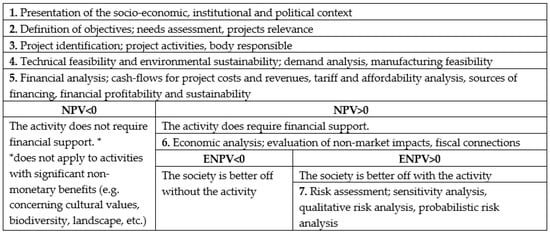
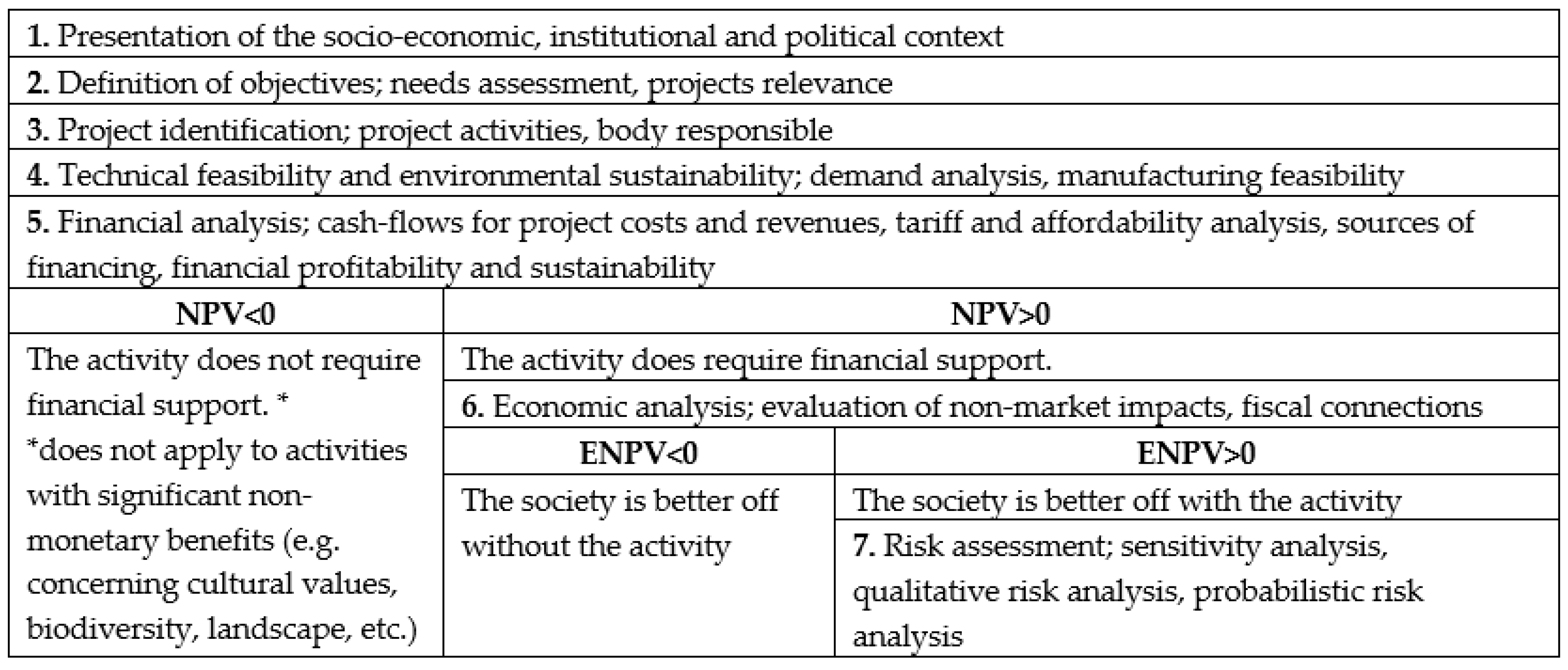
In its Manual [12], the European Union determines the following of the CBA procedure, see Figure 1. Boardman et al. (2006), Sieber (2004), Nas (1996), Kunreuther et al (2001), Lee et al. (2009) or Mishan and Quah (2007) [17,18,25,26,27,28] propose other methods. The recommended approach when analysing the CBA by other authors differs in the number of methods as some of the authors join more partial phases into one or, on the other hand, divide them into individual parts.
Figure 1.
The steps of the cost–benefit analysis (CBA) [12], simplified by authors.
Combining the proposed procedure CBA by the EU and the information provided above, the authors´ article defines partial methodical steps which are to be further observed using content analysis or relevant sources. As a result of this, it will be possible to shape and specify the key elements and the principles of CBA application when assessing the efficiency of the innovative solutions concerning the smart city concept. Furthermore, we will study the extension of the individual CBA parts in relation to good practice. Within the field of the research, the individual methodical steps are formulated into the questions below:
- Is specification/the basis of the intention stated in socio-economic, institutional and political contexts? Is there any social demand for the stated solution?
- Are there any alternative possibilities or are they analyzed (including zero option)?
- Are the groups of subjects and economic sectors identified?
- Speaking of direct and indirect, implicit and explicit costs and benefits, are they defined? Which indirect costs are expressed in monetary units? What are the financial sources? Are the non-market impacts taken into consideration? Moreover, are taxes and donations also taken into consideration?
- Do they work with interest rates? If so, which interest rate is it? Are time dynamics of the project and length of the project with its impact taken into consideration? Which method was chosen to assess the intentions?
- Were sensitivity analysis and risk assessment done?
- What decision was made as far as the intention’s acceptability and funding are concerned or what option was chosen?
The proposed primary analytical framework will reflect the particular CBA elements which were realized when assessing smart activities and solutions within the selected research of available specialised sources.
3. Analysis of Realized Smart Activities and Smart Solutions
In this part of the contribution, the chosen case studies for the implemented smart solutions will be analyzed, the objective of which will be to identify the key stages and moments of the applied CBA in practice. Based on the research of generally accessible sources, 25 studies have been chosen in which the CBA method is applied and which are looking for the answers to the above-mentioned questions (see Figure 1).
The analyzed CBAs were randomly searched on the Web of Science (in some case on the Internet) based on a combination of words such as smart city, CBA, case study, smart solution and the studies were from the year 2000 and earlier. In the outcomes of the report, studies containing the CBA that corresponded to the aim of this paper were selected.
The choice of the selected indicators in each CBA refers to the Manual [12]. Given the complete diversity of the individual CBAs analyzed and the lack of information on some of the standard CBA elements, there was devoted considerable space for cost and benefit in Table A1 (in Appendix A), their determination and possible quantification of which is crucial for the compilation of the relevant CBA. There are a lot of authors that do not distinguish between indirect costs or benefits and only use the category of external effects or use not always understandable self-classification.
All of the information presented in Table A1 in the Appendix A is based on specific studies and reflects these factors and the CBA methods contained therein [29,30,31,32,33,34,35,36,37,38,39,40,41,42,43,44,45,46,47,48,49,50,51,52,53]. The data in the table is sorted by smart solution area (mobility (six smart solutions), energy (9 smart solutions), agriculture (three smart solutions), environment (two smart solutions) and other (five smart solutions)). This ensures better orientation in the categories of costs and benefits, which are crucial in the creation of the CBA.
Unlike in the theoretical concept of the CBA, the research of the practically applied CBA regarding the smart city showed several simplifications, which are sufficient for the general construction of the simplified procedure for the pilot evaluation of smart solutions. There is no need for information such as the financial sources, the types of costs or benefits, the sensitivity analysis and the risk analysis. The characteristics of the society-wide contribution get explicitly reflected in the demand. The analysis of the alternatives can be done parallelly, yet separately, with subsequent comparison of the proposed solutions against each other. The indirect benefits and costs are most often stated in the form of positive and negative externalities without any specific relation to the individual subjects. Only the ones which can be financially evaluated are mentioned. Generally, society is considered as a whole, in a narrower sense we speak about households (citizens).
The most frequently used method is the NPV method, which takes into consideration all quantifiable costs, i.e., direct and indirect, by which the known and expected direct and indirect benefits are reduced. In practice, the financial analysis is interconnected with the economic analysis, and the NPV and ENPV methods are considered the same.
4. The Primary Analytical Framework for CBA in the Context of Smart City
The research of the above-mentioned CBA regarding the smart solutions and activities within the concept of smart city enabled us to synthetize and specify their significant part related to CBA, which is the subject of the research. These findings are confronted with the theoretical definition of CBA and subordinated to the conditions of logic, comprehensibility, transparency and practicality. The objective is to formulate general elements and principles for the use of CBA when evaluating the efficiency of innovative solutions within the concept of smart city, and propose a primary analytical framework which would provide a universal platform suitable for the primal verification of the smart solutions. This general platform has also its parallel in the construction of questions, the answers of which will provide basic input data for the formation of the pilot version of CBA for a specific solution (or project) [54].
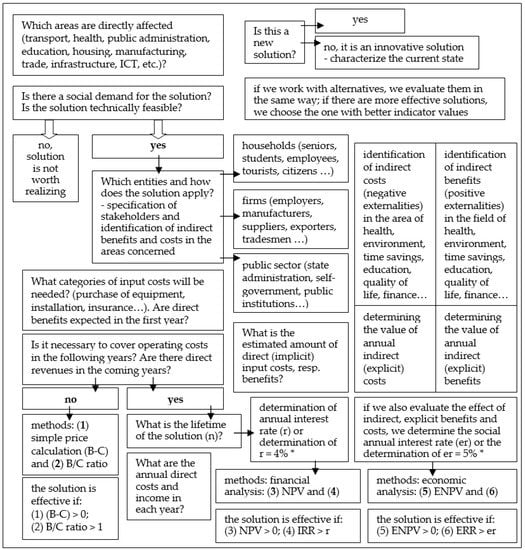
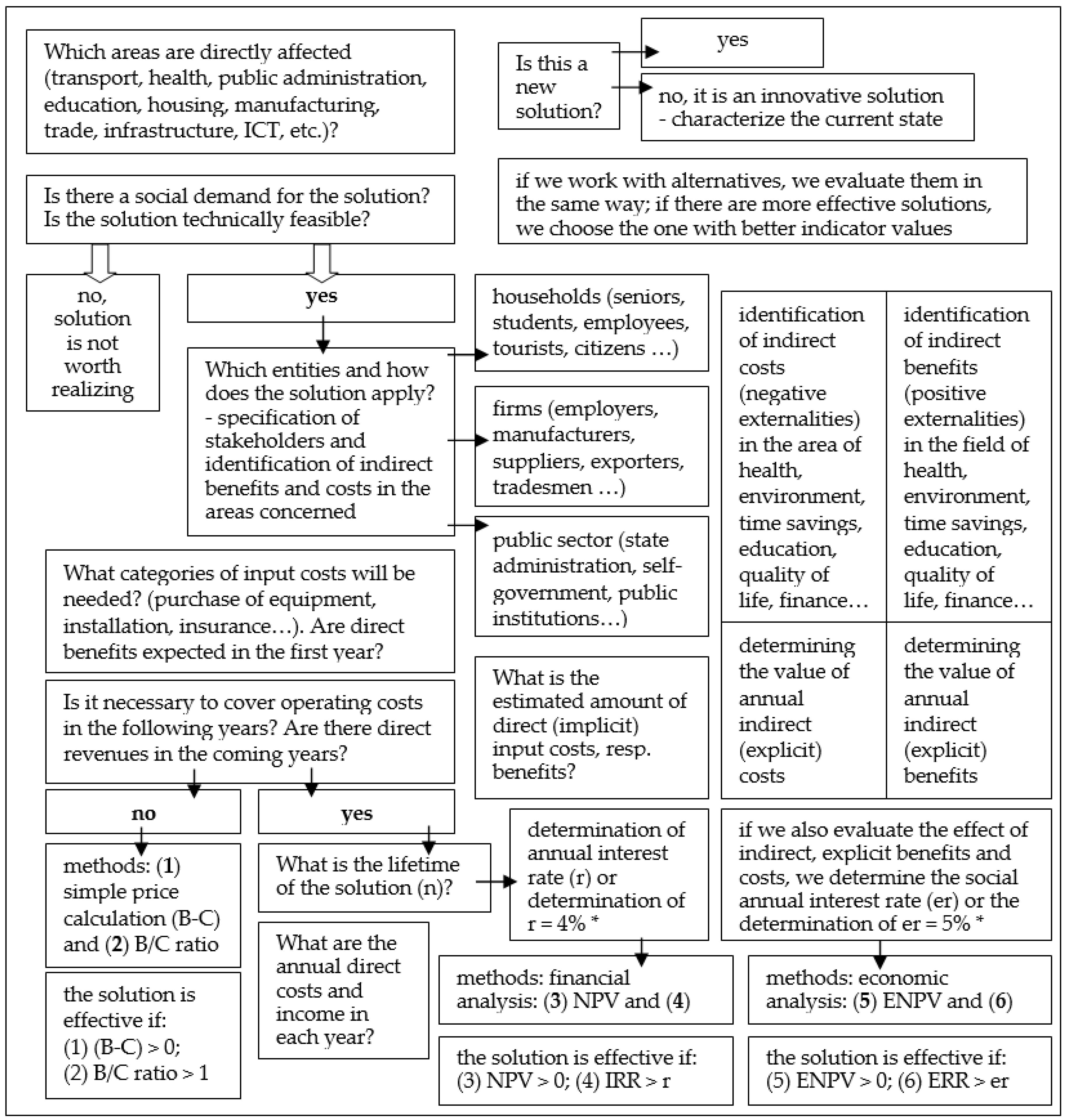
Figure 2 schematically depicts the key elements and relations that need to be determined or quantified in order to define the content of the specific CBA. This primary analytical framework is a simplified model of CBA designed by us, which abstracts away from the extensive textual part and accentuates merely the substantial features in relation to the determination of ex ante efficiency of the given specific smart solution.
Figure 2.
The primary analytical framework for building a pilot version of CBA (2019). Note: * as recommended by the EC for the 2014–2020 programming period.
Using the analysis of the implemented CBA, we can define a set of several questions, clearly stated, which will provide us with the key answers necessary for the pilot formation of CBA:
- What does the proposed smart solution concern? Provided that it is an innovative solution, what is the current state (starting point), or will there be any alternative solutions? What is the contribution of the solution to the society (what is the added value?) or to the individual subjects (why are we doing it?)
- Did the subjects mention the necessity of the solution? How is (was) it detected?
- What input (direct) costs are expected and what is their amount (investment costs, service purchases, tangible property and material, intangible property, etc.)?
- Will it be necessary to finance the solutions in the following years, too? If yes, what will be the estimated direct operating costs in the individual years (energy, repairs, maintenance, personal expenses, service purchases, reinvestment expenses, etc.)?
- Are any direct benefits in the course of the solution expected? If yes, which and what amount and in which years? What is the number of users that the benefits will concern?
- What indirect social, utility and other benefits and costs and at what amount can we expect (positive and negative externalities) with the solutions will concern the households, firms and the public sector as well?
Based on the discovered data, the implementer of CBA will consider which method of evaluating the efficiency of the solution will be used, taking into consideration whether the solution is realised and evaluated in the course of one year or in the course of several years. The expert on indirect socio-economic effects will evaluate the relevance of the defined explicit costs and benefits and will adjust their number if need be (it is necessary to realize that often the categorization of one or another effect on the desired and undesirable (positive and negative) is determined by the judge’s point of view and the specific situation (sometimes barking dog warns us about thieves, sometimes it doesn’t let us sleep). At the same time, they will determine specific measurable indicators and will define their value for their financial formulation. The next step is to determine the total cost and benefit flows in the individual years and define the proportionate interest rate, on the basis of which the suitable indicator will be calculated.
The comparison of the value of the indicator with its referential value will eventually determine the primary efficiency of the realized smart solution. The pilot revised efficiency of the solution forms ex ante relevant initial stage of the properly processed CBA.
5. Discussion and Conclusions
The criterion of efficiency (satisfaction of the society-wide welfare) when deciding about the implementation of any new solution or method into the current system of social-economic relations is crucial and it becomes a tool for improvement of the allocation of sources. When comparing the financial and economic analysis of benefits and costs, the economic analysis unequivocally shows to be a more suitable tool, inherently accepting the implicit, indirect effects. CBA, for which the economic, or financial analysis, is crucial, is a widely acknowledged method that has long been used to compare the effects of planned solutions and alternatives in a range of areas of human actions [12,55].
Concluding from the research of expert resources as well as specific case studies, the aim of the article was to stipulate the key elements of CBA, which are relevant with respect to the general methodical approach of evaluation of pilot efficiency of the suggested solutions realized within the perception of the concept of smart city. It was intended to create general analytical framework of CBA, a primary tool which may be transferrable across disciplines, well-arranged and intelligible, and which determines the basic method when evaluating ex ante the suitability of any proposed solution (within the project of the solved experimental evaluations).
This methodical procedure that we have created can be included in other especially practically oriented CBA creation procedures focused specifically on the solution within the smart city concept and based on real practice.
By reviewing the practically applied solutions and projects in the context of the elements of smart city, several simplifications of the theoretically presented CBA emerged, which may be summarized into the following points: (1) A wider description of socio-economic sectors and concerned subjects is not necessary; (2) financial and economic analysis is not distinguished; (3) the most frequent method how to evaluate the efficiency is NPV, in which the total costs and benefits are dealt with directly without classifying them into direct and indirect; (4) the risk analysis and sensitivity analysis are minimally included in the empirical CBA, yet their significance cannot be underestimated regarding the emphasis on the minimalization of the difference of the evaluated efficiency (ex ante) from the real one (ex post); (5) the number of categories of implicit and explicit costs and benefits makes the evaluation of the entire efficiency for the society more accurate, yet their quantification may logically create a barrier of the efficiency of the implemented CBA itself. To have an adequate CBA, the deliberate choice of the number and types of costs and benefits is crucial.
The primary analytical framework of CBA designed by us fully reflects in its decisive features the scientifically and practically set content of CBA. On a general level, CBA contains three mains steps. These are identification, quantification and evaluation of the benefits and costs [35]. The theoretical foundation of CBA defines benefits as increases in human well-being and costs as reductions in human well-being [56]. Individuals’ well-being depends on market goods and services as well as nonmarket goods and services, such as health and environmental quality [37]. The most difficult part of the entire CBA is the financial quantification of non-market benefits and costs into the form of monetary units and the choice of suitable indicators that characterise these indirect (non-market) effects [57]. The total costs and benefits that are usually included within CBA are the grand total of these explicit and implicit effects, and it is uncommon to separate them in practice. At the same time, it is necessary to become aware of the fact that all ex ante implemented CBA are not exact by their nature, yet they can be expected and predicative. Despite all that, CBA is considered to be the most suitable tool for evaluating the efficiency of new solutions, projects and activities; all this due to its relative simplicity, clear arrangement, transferability, intelligibility and conceptual character, see, for example, [10,19,24,36,58,59]. With the development of the concept of smart city, the method of CBA may be considered as the key tool for the relevant estimate of the suitability of the chosen smart solution, or for its ex ante primary, pilot evaluation.
Author Contributions
All the authors conceived and designed the research, analyzed the data, and wrote the paper. All authors have read and agreed to the published version of the manuscript.
Funding
This paper was supported by the project CZ.02.1.01/0.0/0.0/17_049/0008452 „SMART technologies to improve the quality of life in cities and regions” co-funded by the European Union.
Conflicts of Interest
The authors declare no conflict of interest. The founding sponsors had no role in the design of the study; in the collection, analyses, or interpretation of data; in the writing of the manuscript; or in the decision to publish the results.
Appendix A
Table A1.
CBA research on selected Smart City solutions (author´s adjustment, 2019).
References
- Borsekova, K.; Koróny, S.; Vaňová, A.; Vitálišová, K. Functionality between the size and indicators of smart cities: A research challenge with policy implications. Cities 2018, 78, 17–26. [Google Scholar] [CrossRef] [Scilit]
- Vybrané Kapitoly z Veřejné Správy a Regionální Rozvoje; Professional Publishing: Praha, Czech Republic, 2018.
- Turečková, K.; Nevima, J. SMART approach in regional development. In Proceedings of the 16th International Scientific Conference Economic Policy in the European Union Member Countries, Karviná, Czech Republic, 12–14 September 2018. [Google Scholar]
- Caragliu, A.; Del Bo, C.; Nijkamp, P. Smart cities in Europe. J. Urban Technol. 2011, 18, 65–82. [Google Scholar] [CrossRef] [Scilit]
- Dominici, G. Why does systems thinking matter? Bus. Syst. Rev. 2012, 1, 1–2. [Google Scholar]
- Turečková, K.; Nevima, J. SMART CITY concept in the Czech. Republic. In Proceedings of the 29th EBES Conference, Lisbon, Portugal, 10–12 October 2019; pp. 1039–1048. [Google Scholar]
- Borseková, K.; Vaňová, A.; Vitálišová, K. Smart Specialization for Smart Spatial Development: Innovative Strategies for Building Competitive Advantages in Tourism in Slovakia. Socio-Econ. Plan. Sci. 2017, 58, 39–50. [Google Scholar] [CrossRef] [Scilit]
- Slavík, J. Smart City v Praxi: Jak Pomocí Moderních Technologií Vytvářet Město Příjemné k Životu a Přátelské k Podnikání; Profi Press: Praha, Czech Republic, 2017. [Google Scholar]
- Sieber, P. Finanční A Socioekonomické Hodnocení Projektů (Metodická Příručka). Available online: https://www.ropstrednicechy.cz/ (accessed on 13 December 2019).
- Schindlerová, V.; Šajdlerová, I. Influence tool wear in materiál flow. Adv. Sci. Technol. Res. J. 2017, 11, 161–165. [Google Scholar] [CrossRef] [Scilit]
- Ochrana, F. Hodnocení Veřejných Zakázek a Veřejných Projektů, 2nd ed.; ASPI publishing: Praha, Czech Republic, 2001. [Google Scholar]
- European Union. European Commisssion, Guide to Cost-Benefit Analysis of Investment Projects; European Union: Luxembourg, 2015. [Google Scholar] [CrossRef]
- Organisation for Economic Co-operation and Development. Cost–benefit analysis and the environment: Recents developments. In Executive Summary; OECD: Paris, France, 2006. [Google Scholar]
- Marešová, P. Měření ve Znalostním Management—Aplikace Metody Cost Benefit Analysis; Gaudeaumus: Hradec Králové, Czech Republic, 2012. [Google Scholar]
- Samuelson, P.A.; Nordhaus, W.D. Ekonomie; NS Svoboda: Praha, Czech Republic, 2007. [Google Scholar]
- Suster, G.A.; Sirb, N.M.; Iancu, T.; Manescu, C. Externalities role in compiling cost–benefit analysis of projects financed from structural funds. In Proceedings of the 13th International Multidisciplinary Scientific Geoconference, Albena, Bulgaria, 16–22 June 2013; pp. 155–160. [Google Scholar]
- Boardman, A.E. Cost-Benefit Analysis: Concepts and Practice, 3rd ed.; Pearson Prentice Hall: Upper Saddle River, NJ, USA, 2006. [Google Scholar]
- Sieber, P. Metodická Příručka, Analýza Nákladů a Přínosů; Ministerstvo Pro Místní Rozvoj: Praha, Czech Republic, 2004. [Google Scholar]
- Romančíková, E. Effectiveness of the environmental investments. Ekonomický Časopis 2004, 52, 1262–1274. [Google Scholar]
- Hueting, R. The use of the discount rate in a cost–benefit analysis for different uses of a humid tropical forest area. Ecol. Econ. 1991, 3, 43–57. [Google Scholar] [CrossRef] [Scilit]
- Szekeres, S. Discounting in cost–benefit analysis. Soc. Econ. 2011, 33, 361–385. [Google Scholar] [CrossRef] [Scilit]
- Pakšiová, R. The Critical analysis of profit for its allocation decision-making. Sci. Ann. Econ. Bus. 2017, 64, 41–56. [Google Scholar] [CrossRef] [Scilit]
- Fuguitt, D.; Shanton, J. Cost-Benefit Analysis for Public Sector Decision Makers; Quorum Books: Westport, CT, USA, 1999. [Google Scholar]
- Horváth, P.; Pütter, J.M.; Haldma, T.; Lääts, K.; Dimante, D.; Dagilienė, L.; Kochalski, C.; Ratajczak, P.; Wagner, J.; Petera, P.; et al. Sustainability Reporting in Central and Eastern European Companies: Results of an International and Empirical Study; Springer: Cham, Switzerland, 2017. [Google Scholar]
- Nas, T.F. Cost-Benefit Analysis. Theory and Application, 2nd ed.; Lexington Books: Lanham, MD, USA, 2016. [Google Scholar]
- Kunreuther, H.; Cyr, C.; Grossi, P.; Tao, W. Using Cost-Benefit Analysis to Evaluate Mitigation for Lifeline Systems; National Science Foundation: Buffalo, NY, USA, 2001. [Google Scholar]
- Lee, J.; Kang, S.; Kim, C. Software architecture evaluation methods based on cost benefit analysis and quantitative decision making. Empir. Softw. Eng. 2009, 14, 453–475. [Google Scholar] [CrossRef] [Scilit]
- Mishan, E.J.; Quah, E. Cost-Benefit Analysis; Routledge: London, UK, 2007. [Google Scholar]
- Gössling, S.; Choi, A. Transport transitions in Copenhagen Comparing the cost of cars and bicycles. Ecol. Econ. 2015, 113, 106–113. [Google Scholar] [CrossRef] [Scilit]
- Dekker, K. The Dollars and Cents of Driving and Cycling: Calculating the Full Costs of Transportation in Calgary, Canada; Department of Earth Sciences, Uppsala University: Uppsala, Sweden, 2016. [Google Scholar]
- Xiong, X. Cost-Benefit Analysis of Smart Cities Technologies and Applications. Available online: http://udspace.udel.edu/bitstream/handle/19716/23818/Xiong_udel_0060M_13359.pdf?sequence=1&isAllowed=y/ (accessed on 19 December 2019).
- Studie Proveditelnosti E-car Sharing v Hlavním Městě Praha. Available online: https://www.smartprague.eu/projekty#mobilita-budoucnosti (accessed on 19 December 2019).
- Guidelines for Conducting A Cost-Benefit Analysis of Smart Grid Projects. Available online: https://ec.europa.eu/jrc/en/publication/reference-reports/guidelines-conducting-cost-benefit-analysis-smart-grid-projects (accessed on 19 December 2019).
- Cost-Benefit Analysis (CBA) for a National Gas. Smart Metering Rollout in Ireland. Available online: https://www.cru.ie/wp-content/uploads/2011/07/cer11180c.pdf (accessed on 19 December 2019).
- Social Costs and Benefits of Smart Grid Technologies. Available online: http://swedishsmartgrid.se/globalassets/publikationer/social_costs_and_benefits_of_smart_grid_technologies.pdf (accessed on 21 December 2019).
- Sjöstrand, K.; Lindhe, A.; Söderqvist, T.; Rosén, L. Cost-Benefit Analysis for Supporting Intermunicipal Decisions on Drinking Water Supply. J. Water 2019, 145, 04019060. [Google Scholar] [CrossRef] [Scilit]
- Soares, A.L.; Rego, F.C.; McPherson, E.G.; Simpson, J.R.; Peper, P.J.; Xiao, Q. Benefits and costs of street trees in Lisbon, Portugal. Urban For. Urban Green. 2011, 10, 69–78. [Google Scholar] [CrossRef] [Scilit]
- Masera, M.; Bompard, E.F.; Profumo, F.; Hadjsaid, N. Smart (Electricity) Grids form Smart Cities: Assessing roles and societal impacts. Proc. IEEE 2018, 106, 613–625. [Google Scholar] [CrossRef] [Scilit]
- Smart Metter Roll-out Cost-Benefit Analysis. Available online: https://assets.publishing.service.gov.uk/government/uploads/system/uploads/attachment_data/file/831716/smart-meter-roll-out-cost-benefit-analysis-2019.pdf (accessed on 21 December 2019).
- Smart Grid and Renewables A Cost-Benefit Analysis Guide for Developing Countries. Available online: https://www.irena.org/-/media/Files/IRENA/Agency/Publication/2015/IRENA_PST_Smart_Grids_CBA_Guide_2015.pdf (accessed on 21 December 2019).
- Ekologizace Veřejné Dopravy-Ostrava Poruba. Available online: http://novatramvajporuba.cz/wp-content/uploads/2017/03/Zprava_Poruba_faze_II_2014-07-30_verze_2014-08-18.pdf (accessed on 22 December 2019).
- Podpora Veřejné Hromadné Dopravy ve Středočeském Kraji s Cílem Její Postupné Ekologizace Přechodem na Alternativní Druh Paliva, Resp. Pohonu. Available online: http://m.mesto-podebrady.cz/assets/File.ashx?id_org=12349&id_dokumenty=2181 (accessed on 22 December 2019).
- Mutenje, M.J.; Farnworth, C.R.; Stirling, C.; Thierfelder, C.; Mupangwa, W.; Nyagumbo, I. A cost–benefit analysis of climate-smart agriculture options in Southern Africa: Balancing gender and technology. Ecol. Econ. 2019, 163, 126–137. [Google Scholar] [CrossRef] [Scilit]
- Becchio, C.; Corgnati, S.; Dell’Anna, F.; Bottero, M. Cost Benefit Analysis and Smart Grids Projects. In Proceedings of the Sustainable Built Environment Conference—Towards Post-Carbon Cities, Turin, Italy, 18–19 February 2016. [Google Scholar]
- Smart Production of Biofuel for Small Communities. Available online: https://www.researchgate.net/profile/Albara_Mustafa/publication/312037541_Smart_production_of_biofuel_for_small_communities/links/5b07b48e4585157f8712f4cf/Smart-production-of-biofuel-for-small-communities.pdf (accessed on 27 December 2019).
- Sain, G.; Loboguerrero, A.M.; Corner-Dolloff, C.; Lizarazo, M.; Nowak, A.; Martínez-Barón, D.; Andrieu, N. Costs and benefits of climate-smart agriculture: The case of the Dry Corridor in Guatemala. Agric. Syst. 2017, 151, 163–173. [Google Scholar] [CrossRef] [Scilit]
- Adamec, M.; Pavlatka, P.; Stary, O. Costs and Benefits of Smart Grids and Accumulation in Czech. Distribution System. Available online: https://reader.elsevier.com/reader/sd/pii/S1876610211018376?token=FBF76E27263450B2484BE1BA8B26ED605F502493085F39AEC6601AEE8929C4840B67919FF2043886BC5D5FBCD4B4CF48 (accessed on 28 December 2019).
- Lan, L.; Sain, G.; Czaplicki, S.; Guerten, N.; Shikuku, K.M.; Grosjean, G.; Läderach, P. Farm-level and community aggregate economic impacts of adopting climate smart agricultural practices in three mega environments. PLoS ONE 2018, 13, e0207700. [Google Scholar] [CrossRef] [Scilit] [PubMed]
- Plavecký Areál Klíše. Available online: https://www.usti-nad-labem.cz/files/usti-nad-labem/zadosti106/import/f1538253-a3ce-4f98-a602-6186dd961de2.pdf (accessed on 29 December 2019).
- Ekonomická Analýza Přírodě Blízkých Adaptačních Opatření ve Městě. Available online: http://www.ieep.cz/wp-content/uploads/2017/09/Ekonomick%C3%A1-anal%C3%BDza-p%C5%99%C3%ADrod%C4%9B-bl%C3%ADzk%C3%BDch-adapta%C4%8Dn%C3%ADch-opat%C5%99en%C3%AD-ve-m%C4%9Bst%C4%9B-2017.pdf (accessed on 29 December 2019).
- Zefektivnění Činnosti Klastrů v Oblasti Spolupráce a Jeho Řízení. Available online: http://www.btklastr.cz/files/2017/04/Studie-proveditelnosti-BTK_b%C5%99ezen_2017.pdf (accessed on 29 December 2019).
- Finanční A Ekonomické Hodnocení Projektu Freetime Park Stromovka. Available online: https://www.c-budejovice.cz/sites/default/files/import/cz/rozvoj-mesta/nastenka-iprm/obecne-informace-k-iprm/formulare/Documents/FEHP_FTP%20Stromovka.pdf (accessed on 28 December 2019).
- Dehdarian, A. Scenario-based system dynamics modeling for the cost recovery of new energy technology deployment: The case of smart metering roll-out. J. Clean. Prod. 2018, 178, 791–803. [Google Scholar] [CrossRef] [Scilit]
- Melecky, L.; Stanickova, M. Cost Efficiency of EU Funded Projects: Case of Selected SMEs in the Moravian-Silesian Region. In Proceedings of the 12th International Conference on Strategic Management and its Support by Information Systems (SMSIS), Ostrava, Czech Republic, 25–26 May 2017. [Google Scholar]
- Johansson, P.O.; Kriström, B. Cost-Benefit Analysis for Project Appraisal; Cambridge Unviersity Press: Cambridge, UK, 2016. [Google Scholar]
- Pearce, D.; Atkinson, G.; Mourato, S. Cost-Benefit Analysis and the Environment, Recent Developments; OECD Publishing: Paris, France, 2006. [Google Scholar]
- Freeman, A.M.; Herriges, J.A.; Kling, C.L. The Measurement of Environmental and Resource Values: Theory and Methods; RFF Press: Washington, DC, USA, 2014. [Google Scholar]
- Markanday, A.; Galarraga, I.; Markandya, A. A critical review of cost–benefit analysis for climate change adaptation in cities. Clim. Chang. Econ. 2019, 10, 1–31. [Google Scholar] [CrossRef] [Scilit]
- Ward, W.A. Cost-Benefit Analysis Theory versus Practice at the World Bank 1960 to 2015. J. Benefit Cost Anal. 2019, 10, 124–144. [Google Scholar] [CrossRef] [Scilit]
© 2020 by the authors. Licensee MDPI, Basel, Switzerland. This article is an open access article distributed under the terms and conditions of the Creative Commons Attribution (CC BY) license (http://creativecommons.org/licenses/by/4.0/).