

Weak or Strong Sustainability in Rural Land Use Planning? Assessing Two Case Studies through Multi-Criteria Analysis



Abstract
1. Introduction
2. Integrating Sustainability in Rural Land Use Planning
3. Case Studies and Methodology
3.1. Case Studies: Contetxt and Methods
3.1.1. Case Study 1: Garate-Santa Barbara (GSB)
3.1.2. Case Study 2: Mutriku Municipality
3.2. Methodology
- (i)
- Variations in the compensation index (parameter γ) and the credibility index (parameter α)
- (ii)
- Variations in preference and indifference thresholds
- (iii)
- Trade-off analysis
4. Analysis and Results
4.1. Sustainability Analysis of Case Study 1: GSB
- (i)
- Variations of the parameter γ and of the parameter α
- (ii)
- Variations in preference and indifference thresholds
- (iii)
- Trade-off analysis
4.2. Sustainability Analysis of Case Study 2: Mutriku Municipality
- (i)
- Variations of the parameter γ and of the parameter α
- (ii)
- Variations in preference and indifference thresholds
- (iii)
- Trade-off analysis
4.3. Overall Results
5. Discussion
6. Conclusions
Author Contributions
Funding
Acknowledgments
Conflicts of Interest
Appendix A
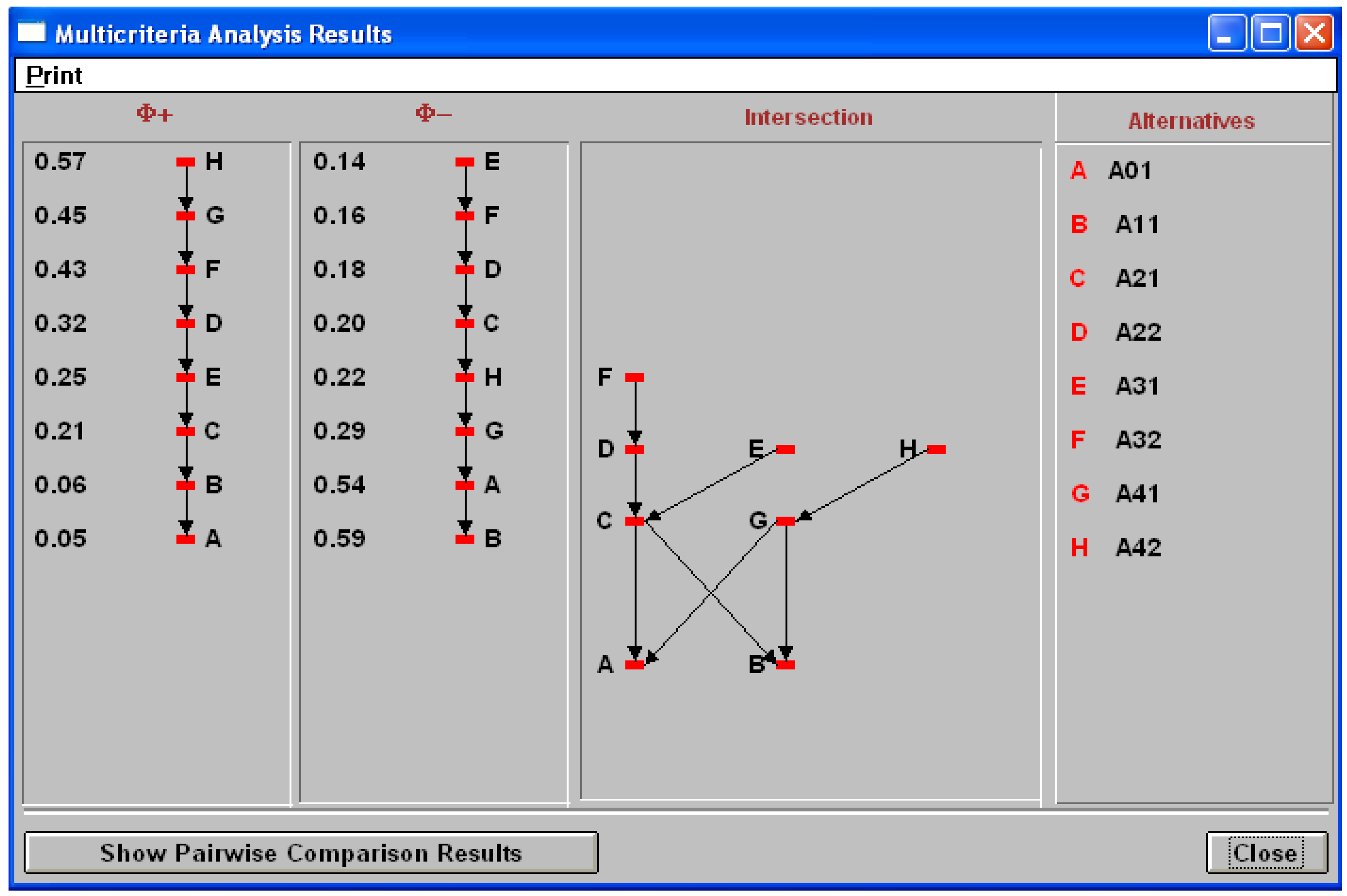

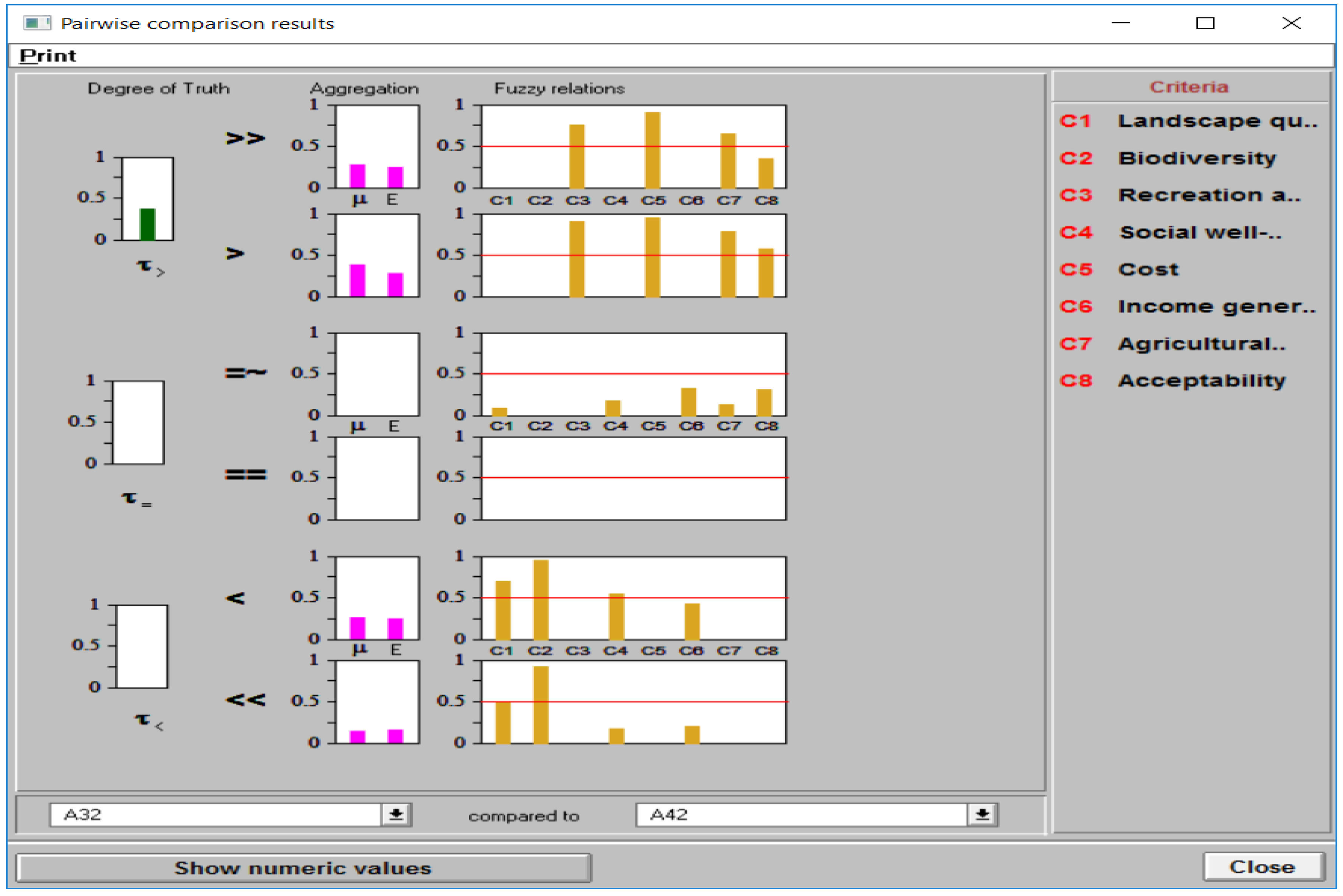
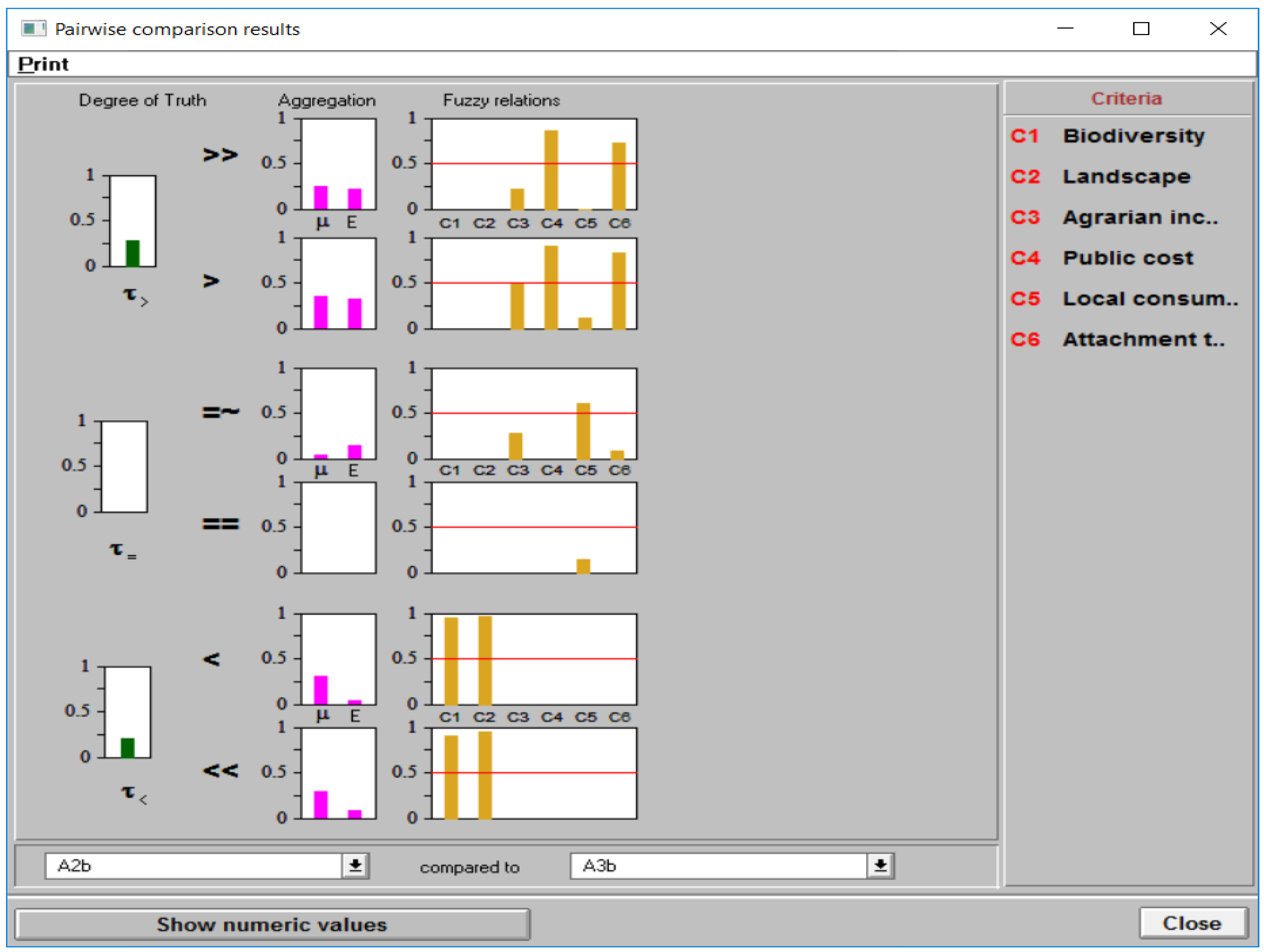
Appendix B

| α = 0.3 | α = 0.5 | α = 0.7 | |||||||
|---|---|---|---|---|---|---|---|---|---|
| ф+ | ф- | Ranking | ф+ | ф- | Ranking | ф+ | ф- | Ranking | |
| γ = 0.1 | A42 A32 A22 A41 A31 A21 A11 A01 | A32 A21 A22 | 1st–A32 2nd–A42 3rd–A22 4th–A31 4th–A21 4th–A41 5th–A11 6th–A01 | A42 A32 A22 A41 A31 A21 A11 A01 | A32 A31 A22 A21 A42 A41 A11 A01 | 1st–A32 2nd–A22 3rd–A42 3rd–A31 4th–A21 4th–A41 5th–A11 6th–A01 | A42 A32 A22 A41 A31 A21 A11 A01 | A31 A21 A32 | 1st–A32 2nd–A42 2nd–A31 2nd–A22 3rd–A21 3rd–A41 4th–A11 5th–A01 |
| γ = 0.5 | A42 A32 A22 A41 A31 A21 A11 A01 | A32 A21 A31 A22 A42 A11 A41 A01 | 1st–A32 2nd–A42 2nd–A22 3rd–A31 3rd–A21 4th–A41 4th–A11 5th–A01 | A42 A32 A22 A41 A31 A21 A11 A01 | A31 A21 A32 A22 A42 A41 A11 A01 | 1st–A32 2nd–A42 2nd–A22 2nd–A31 3rd–A21 3rd–A41 4th–A11 5th–A01 | A42 A32 A22 A41 A31 A21 A11 A01 | A31 A21 A22 A32 | 1st–A42 1st–A32 1st–A31 1st–A22 2nd–A21 2nd–A41 3rd–A11 4th–A01 |
| γ = 0.9 | A42 A32 A31 A41 A22 A21 A11 A01 | A21 A32 A31 A22 A42 A11 A41 A01 | 1st–A32 2nd–A42 3rd–A31 4th–A21 4th–A22 5th–A41 5th–A11 6th–A01 | A42 A32 A41 A22 A31 A11 A21 A01 | A31 A21 A32 A22 A11 A42 A41 A01 | 1st–A32 2nd–A31 3rd–A42 3rd–A22 4th–A21 4th–A41 4th–A11 5th–A01 | A42 A41 A32 A22 A11 A31 A21 A01 | A31 A21 A22 A32 A11 A42 A41 A01 | 1st–A42 1st–A32 1st–A31 1st–A22 2nd–A41 2nd–A21 2nd–A11 3rd–A01 |
| α = 0.3 | α = 0.5 | α = 0.7 | |||||||
|---|---|---|---|---|---|---|---|---|---|
| ф+ | ф- | Ranking | ф+ | ф- | Ranking | ф+ | ф- | Ranking | |
| γ = 0.1 | A3b A3a A2b A2a A1 | A2a A2b A3b A3a A1 | 1st–A3b 2nd–A2b 2nd–A2a 2nd–A3a 3rd–A1 | A3b A3a A2b A2a A1 | A2b A2a A3b A3a A1 | 1st–A2b 1st–A3b 2nd–A2a 2nd–A3a 3rd–A1 | A3b A3a A2b A2a A1 | A3a A2b A2a A3b A1 | 1st–A3a 2nd–A2b 3rd–A3b 3rd–A2a 4th–A1 |
| γ = 0.5 | A3b A3a A2b A2a A1 | A2a A2b A3b A3a A1 | 1st–A3b 2nd–A2b 2nd–A2a 2nd–A3a 3rd–A1 | A3b A3a A2b A2a A1 | A2b A2a A3b A3a A1 | 1st–A2b 1st–A3b 2nd–A2a 2nd–A3a 3rd–A1 | A3b A3a A2b A2a A1 | A2b A2a --- --- --- | 1st–A2b 2nd–A3b 2nd–A3a 2nd–A2a 3rd–A1 |
| γ = 0.9 | A3b A3a A2b A2a A1 | A2a A2b A3b A3a A1 | 1st–A3b 2nd–A2b 2nd–A2a 2nd–A3a 3rd–A1 | A3b A3a A2b A2a A1 | A2b A2a --- --- --- | 1st–A2b 1st–A3b 2nd–A2a 2nd–A3a 3rd–A1 | A3b A3a A2b A2a A1 | A2b A2a A3b A3.a A1 | 1st–A2b 1st–A3b 2nd–A2a 2nd–A3a 3rd–A1 |
References
- Neumayer, E. Weak Versus Strong Sustainability: Exploring the Limits of Two Opposing Paradigms; Edward Elgar Publishing: Cheltenham, UK, 2010. [Google Scholar]
- Solow, R.M. Intergenerational equity and exhaustible resources. Rev. Econ. Stud. 1974, 41, 29–45. [Google Scholar] [CrossRef]
- Hartwick, J.M. Intergenerational equity and the investing of rents from exhaustible resources. Am. Econ. Rev. 1977, 67, 972–974. [Google Scholar]
- Neumayer, E. Global warming: Discounting is not the issue, but substitutability is. Energy Policy 1999, 27, 33–43. [Google Scholar] [CrossRef]
- Beckerman, W. ‘Sustainable development’: Is it a useful concept? Environ. Values 1994, 3, 191–209. [Google Scholar] [CrossRef]
- Pearce, D.W.; Atkinson, G.D. Capital theory and the measurement of sustainable development: An indicator of “weak” sustainability. Ecol. Econ. 1993, 8, 103–108. [Google Scholar] [CrossRef]
- Solow, R. An Almost Practical Step Toward Sustainability; RFF Press: New York, NY, USA, 2014; pp. 11–28. [Google Scholar]
- Martínez-Alier, J.; Munda, G.; O’Neill, J. Weak comparability of values as a foundation for ecological economics. Ecol. Econ. 1998, 26, 277–286. [Google Scholar] [CrossRef]
- Howarth, R.B. Sustainability as opportunity. Land Econ. 1997, 73, 569–579. [Google Scholar] [CrossRef]
- Daly, H.E. Steady-state economics: Concepts, questions, policies. Gaia Ecol. Perspect. Sci. Soc. 1992, 1, 333–338. [Google Scholar] [CrossRef]
- Daly, H.E. Toward some operational principles of sustainable development. Ecol. Econ. 1990, 2, 1–6. [Google Scholar] [CrossRef]
- Daly, H.E.; Cobb, J.B. For the Common Good; Beacon Press: Boston, MA, USA, 1994. [Google Scholar]
- Costanza, R.; Daly, H.E. Natural capital and sustainable development. Conserv. Biol. 1992, 6, 37–46. [Google Scholar] [CrossRef]
- Pelenc, J.; Ballet, J. Strong sustainability, critical natural capital and the capability approach. Ecol. Econ. 2015, 112, 36–44. [Google Scholar] [CrossRef]
- Ekins, P.; Simon, S.; Deutsch, L.; Folke, C.; De Groot, R. A framework for the practical application of the concepts of critical natural capital and strong sustainability. Ecol. Econ. 2003, 44, 165–185. [Google Scholar] [CrossRef]
- Barbier, E.B.; Burgess, J.C.; Folke, C. Paradise Lost?: The Ecological Economics of Biodiversity; Routledge: New Yor, NY, USA, 2019. [Google Scholar]
- Butchart, S.H.; Walpole, M.; Collen, B.; Van Strien, A.; Scharlemann, J.P.; Almond, R.E.; Baillie, J.E.; Bomhard, B.; Brown, C.; Bruno, J.; et al. Global biodiversity: Indicators of recent declines. Science 2010, 328, 1164–1168. [Google Scholar] [CrossRef] [PubMed]
- Rockström, J.; Steffen, W.; Noone, K.; Persson, Å.; Chapin III, F.S.; Lambin, E.F.; Lenton, T.M.; Scheffer, M.; Folke, C.; Schellnhuber, H.J. A safe operating space for humanity. Nature 2009, 461, 472. [Google Scholar] [CrossRef] [PubMed]
- Brand, F. Critical natural capital revisited: Ecological resilience and sustainable development. Ecol. Econ. 2009, 68, 605–612. [Google Scholar] [CrossRef]
- Garmendia, E.; Prellezo, R.; Murillas, A.; Escapa, M.; Gallastegui, M. Weak and strong sustainability assessment in fisheries. Ecol. Econ. 2010, 70, 96–106. [Google Scholar] [CrossRef]
- Dalmas, L.; Geronimi, V.; Noël, J.; Sang, J.T.K. Economic evaluation of urban heritage: An inclusive approach under a sustainability perspective. J. Cult. Herit. 2015, 16, 681–687. [Google Scholar] [CrossRef]
- Janeiro, L.; Patel, M.K. Choosing sustainable technologies. Implications of the underlying sustainability paradigm in the decision-making process. J. Clean. Prod. 2015, 105, 438–446. [Google Scholar] [CrossRef]
- Rosén, L.; Back, P.; Söderqvist, T.; Norrman, J.; Brinkhoff, P.; Norberg, T.; Volchko, Y.; Norin, M.; Bergknut, M.; Döberl, G. SCORE: A novel multi-criteria decision analysis approach to assessing the sustainability of contaminated land remediation. Sci. Total Environ. 2015, 511, 621–638. [Google Scholar] [CrossRef]
- De Mare, G.; Granata, M.F.; Nesticò, A. Weak and strong compensation for the prioritization of public investments: Multidimensional analysis for pools. Sustainability 2015, 7, 16022–16038. [Google Scholar] [CrossRef]
- West, P.C. Redesigning planning, governance, and policies to achieve multiple sustainable development goals. One Earth 2019, 1, 303–304. [Google Scholar] [CrossRef]
- Cerreta, M.; Monno, V. Making Strategies in Spatial Planning: Knowledge and Values; Springer Science & Business Media: London, UK, 2010; Volume 9. [Google Scholar]
- Garmendia, E.; Gamboa, G. Weighting social preferences in participatory multi-criteria evaluations: A case study on sustainable natural resource management. Ecol. Econ. 2012, 84, 110–120. [Google Scholar] [CrossRef]
- Prato, T. Evaluating land use plans under uncertainty. Land Use Policy 2007, 24, 165–174. [Google Scholar] [CrossRef]
- Lamorgese, L.; Geneletti, D. Sustainability principles in strategic environmental assessment: A framework for analysis and examples from Italian urban planning. Environ. Impact Assess. Rev. 2013, 42, 116–126. [Google Scholar] [CrossRef]
- Aubry, C.; Ramamonjisoa, J.; Dabat, M.; Rakotoarisoa, J.; Rakotondraibe, J.; Rabeharisoa, L. Urban agriculture and land use in cities: An approach with the multi-functionality and sustainability concepts in the case of Antananarivo (Madagascar). Land Use Policy 2012, 29, 429–439. [Google Scholar] [CrossRef]
- Jonsson, B.G.; Svensson, J.; Mikusiński, G.; Manton, M.; Angelstam, P. European Union’s last intact forest landscapes are at a value chain crossroad between multiple use and intensified wood production. Forests 2019, 10, 564. [Google Scholar] [CrossRef]
- Pinto-Correia, T.; Guiomar, N.; Guerra, C.A.; Carvalho-Ribeiro, S. Assessing the ability of rural areas to fulfil multiple societal demands. Land Use Policy 2016, 53, 86–96. [Google Scholar] [CrossRef][Green Version]
- Rounsevell, M.; Ewert, F.; Reginster, I.; Leemans, R.; Carter, T. Future scenarios of European agricultural land use: II. Projecting changes in cropland and grassland. Agric. Ecosyst. Environ. 2005, 107, 117–135. [Google Scholar] [CrossRef]
- Munroe, D.K.; Van Berkel, D.B.; Verburg, P.H.; Olson, J.L. Alternative trajectories of land abandonment: Causes, consequences and research challenges. Curr. Opin. Environ. Sustain. 2013, 5, 471–476. [Google Scholar] [CrossRef]
- Verburg, P.H.; Overmars, K.P. Combining top-down and bottom-up dynamics in land use modeling: Exploring the future of abandoned farmlands in Europe with the Dyna-CLUE model. Lands. Ecol. 2009, 24, 1167. [Google Scholar] [CrossRef]
- De Groot, R.S.; Wilson, M.A.; Boumans, R.M. A typology for the classification, description and valuation of ecosystem functions, goods and services. Ecol. Econ. 2002, 41, 393–408. [Google Scholar] [CrossRef]
- Schulp, C.J.; Nabuurs, G.; Verburg, P.H. Future carbon sequestration in Europe—Effects of land use change. Agric. Ecosyst. Environ. 2008, 127, 251–264. [Google Scholar] [CrossRef]
- Pimm, S.L.; Raven, P. Biodiversity: Extinction by numbers. Nature 2000, 403, 843. [Google Scholar] [CrossRef]
- Portela, R.; Rademacher, I. A dynamic model of patterns of deforestation and their effect on the ability of the Brazilian Amazonia to provide ecosystem services. Ecol. Model. 2001, 143, 115–146. [Google Scholar] [CrossRef]
- Schroter, D.; Cramer, W.; Leemans, R.; Prentice, I.C.; Araujo, M.B.; Arnell, N.W.; Bondeau, A.; Bugmann, H.; Carter, T.R.; Gracia, C.A.; et al. Ecosystem service supply and vulnerability to global change in Europe. Science 2005, 310, 1333–1337. [Google Scholar] [CrossRef] [PubMed]
- Rounsevell, M.D.; Pedroli, B.; Erb, K.; Gramberger, M.; Busck, A.G.; Haberl, H.; Kristensen, S.; Kuemmerle, T.; Lavorel, S.; Lindner, M. Challenges for land system science. Land Use Policy 2012, 29, 899–910. [Google Scholar] [CrossRef]
- Crossman, N.D.; Bryan, B.A.; De Groot, R.S.; Lin, Y.; Minang, P.A. Land science contributions to ecosystem services. Curr. Opin. Environ. Sustain. 2013, 5, 509–514. [Google Scholar] [CrossRef]
- Baumgartner, R.J. Sustainable development goals and the forest sector—A complex relationship. Forests 2019, 10, 152. [Google Scholar] [CrossRef]
- Ezquerro, M.; Pardos, M.; Diaz-Balteiro, L. Sustainability in forest management revisited using multi-criteria decision-making techniques. Sustainability 2019, 11, 3645. [Google Scholar] [CrossRef]
- Seppelt, R.; Lautenbach, S.; Volk, M. Identifying trade-offs between ecosystem services, land use, and biodiversity: A plea for combining scenario analysis and optimization on different spatial scales. Curr. Opin. Environ. Sustain. 2013, 5, 458–463. [Google Scholar] [CrossRef]
- Pearson, L.J.; Park, S.; Harman, B.; Heyenga, S. Sustainable land use scenario framework: Framework and outcomes from peri-urban South-East Queensland, Australia. Landsc. Urban Plann. 2010, 96, 88–97. [Google Scholar] [CrossRef]
- Munda, G.; Nijkamp, P.; Rietveld, P. Qualitative multicriteria methods for fuzzy evaluation problems: An illustration of economic-ecological evaluation. Eur. J. Oper. Res. 1995, 82, 79–97. [Google Scholar] [CrossRef]
- Munda, G. Social Multi-Criteria Evaluation for a Sustainable Economy; Springer: Heilderberg, Germany, 2008; Volume 17. [Google Scholar]
- Langemeyer, J.; Gómez-Baggethun, E.; Haase, D.; Scheuer, S.; Elmqvist, T. Bridging the gap between ecosystem service assessments and land-use planning through Multi-Criteria Decision Analysis (MCDA). Environ. Sci. Policy 2016, 62, 45–56. [Google Scholar] [CrossRef]
- Gamper, C.D.; Turcanu, C. On the governmental use of multi-criteria analysis. Ecol. Econ. 2007, 62, 298–307. [Google Scholar] [CrossRef]
- Jeffreys, I. The use of compensatory and non-compensatory multi-criteria analysis for small-scale forestry. Small Scale For. Econ. Manag. Policy 2004, 3, 99–117. [Google Scholar] [CrossRef]
- Oikonomou, V.; Dimitrakopoulos, P.G.; Troumbis, A.Y. Incorporating ecosystem function concept in environmental planning and decision making by means of multi-criteria evaluation: The case-study of Kalloni, Lesbos, Greece. Environ. Manag. 2011, 47, 77–92. [Google Scholar] [CrossRef]
- Bagheri, M.; Sulaiman, W.; Vaghefi, N. Land use suitability analysis using multi criteria decision analysis method for coastal management and planning: A case study of Malaysia. J. Environ. Sci. Technol. 2012, 5, 364–372. [Google Scholar] [CrossRef]
- Singh, S.J.; Smetschka, B.; Grima, N.; Ringhofer, L.; Petridis, P.; Biely, K. Social multi-criteria evaluation (SMCE) in theory and practice: Introducing the software OPTamos. Soc. Ecol. Work. Pap. 2016, 160, 1–91. [Google Scholar]
- Etxano, I.; Garmendia, E.; Pascual, U.; Hoyos, D.; Díez, M.; Cadiñanos, J.A.; Lozano, P.J. A participatory integrated assessment approach for Natura 2000 network sites. Environ. Plan. C Gov. Policy 2015, 33, 1207–1232. [Google Scholar] [CrossRef]
- Etxano, I.; Barinaga-Rementeria Zabaleta, I.; García Alonso, O. Conflicting values in rural planning: A multifunctionality approach through social multi-criteria evaluation. Sustainability 2018, 10, 1431. [Google Scholar] [CrossRef]
- Munda, G. Social multi-criteria evaluation: Methodological foundations and operational consequences. Eur. J. Oper. Res. 2004, 158, 662–677. [Google Scholar] [CrossRef]
- Funtowicz, S.O.; Ravetz, J.R. The worth of a songbird: Ecological economics as a post-normal science. Ecol. Econ. 1994, 10, 197–207. [Google Scholar] [CrossRef]
- O’Neill, J. Representing people, representing nature, representing the world. Environ. Plan. C Gov. Policy 2001, 19, 483–500. [Google Scholar] [CrossRef]
- Greco, S.; Figueira, J.; Ehrgott, M. Multiple Criteria Decision Analysis; Springer: New York, NY, USA, 2016. [Google Scholar]
- Munda, G. Multicriteria Evaluation in a Fuzzy Environment: Theory and Applications in Ecological Economics; Physica-Verlag: Heidelberg, Germany, 1995. [Google Scholar]
- Joint Research Centre of the European Commission. NAIADE: Manual and Tutorial; Joint Research Centre: Istra, Italy, 1996. [Google Scholar]
- Acosta, M.; Corral, S. Participatory multi-criteria assessment of forest planning policies in conflicting situations: The case of Tenerife. Forests 2015, 6, 3946–3969. [Google Scholar] [CrossRef]
- Iojă, I.; Hossu, C.; Niţă, M.; Onose, D.; Badiu, D.; Manolache, S. Indicators for environmental conflict monitoring in Natura 2000 sites. Proc. Environ. Sci. 2016, 32, 4–11. [Google Scholar] [CrossRef]
- Ruiz Urrestarazu, E.; Galdos-Urrutia, R. La perdida de los espacios agrarios y la artificialización del suelo y forestacion en España y en el Pais Vasco. Lurralde Investig. Espac. 2013, 36, 121–133. [Google Scholar]
- Cavallaro, F.; Ciraolo, L. A multicriteria approach to evaluate wind energy plants on an Italian island. Energy Policy 2005, 33, 235–244. [Google Scholar] [CrossRef]
- Benetto, E.; Dujet, C.; Rousseaux, P. Integrating fuzzy multicriteria analysis and uncertainty evaluation in life cycle assessment. Environ. Model. Softw. 2008, 23, 1461–1467. [Google Scholar] [CrossRef]
- Shmelev, S.E.; Rodríguez-Labajos, B. Dynamic multidimensional assessment of sustainability at the macro level: The case of Austria. Ecol. Econ. 2009, 68, 2560–2573. [Google Scholar] [CrossRef]
- Monterroso, I.; Binimelis, R.; Rodríguez-Labajos, B. New methods for the analysis of invasion processes: Multi-criteria evaluation of the invasion of Hydrilla verticillata in Guatemala. J. Environ. Manag. 2011, 92, 494–507. [Google Scholar] [CrossRef]
- Kolinjivadi, V.; Gamboa, G.; Adamowski, J.; Kosoy, N. Capabilities as justice: Analysing the acceptability of payments for ecosystem services (PES) through ‘social multi-criteria evaluation’. Ecol. Econ. 2015, 118, 99–113. [Google Scholar] [CrossRef]
- Vallejo, M.C.; Burbano, R.; Falconí, F.; Larrea, C. Leaving oil underground in Ecuador: The Yasuní-ITT initiative from a multi-criteria perspective. Ecol. Econ. 2015, 109, 175–185. [Google Scholar] [CrossRef]
- Tarrason, D.; Ortiz, O.; Alcaniz, J.M. A multi-criteria evaluation of organic amendments used to transform an unproductive shrubland into a Mediterranean dehesa. J. Environ. Manag. 2007, 82, 446–456. [Google Scholar] [CrossRef] [PubMed]
- Russi, D. Social Multicriteria Evaluation and Reneweable Energy Policies. Ph.D. Thesis, Universidad de Barcelona, Bellaterra, Spain, 2007. [Google Scholar]
| Scenario 0 | Scenario 1 | Scenario 2 | Scenario 3 | Scenario 4 | ||||
|---|---|---|---|---|---|---|---|---|
| Status Quo (%) | Business As Usual (%) | Ecological Values Strength Moderate (%) | Ecological Values Strength High (%) | Ecological Values Strength Maximum (%) | ||||
| Alternatives | A01 | A11 | A21 | A22 | A31 | A32 | A41 | A42 |
| Cork oak | 16.6 (11.6) | 16.6 (11.6) | 21.1 (14.7) | 28.3 (19.8) | 51.7 (36.1) | |||
| Indigenous Woodland | 18.7 (13.1) | 18.7 (13.1) | 21.6 (15.1) | 24.4 (17.0) | 41.8 (29.2) | |||
| Heather land | 24.5 (17.1) | 24.5 (17.1) | 24.5 (17.1) | 26.5 (18.5) | 3.0 (2.1) | |||
| Forest plantation | 22.9 (16.0) | 21.3 (14.9) | 15.5 (10.8) | 3.5 (2.5) | 0.0 (0.0) | |||
| Pasture, allotments and crops | 44.4 (31.0) | 42.1 (29.4) | 44.4 (31.0) | 44.4 (31.0) | 34.1 (23.8) | |||
| Vineyard | 16.1 (11.2) | 19.9 (13.9) | 16.1 (11.2) | 16.1 (11.2) | 12.6 (8.8) | |||
| Criteria | Unit | Alternatives | |||||||
|---|---|---|---|---|---|---|---|---|---|
| Status Quo | Business As Usual | Ecological Values Strength Moderate | Ecological Values Strength High | Ecological Values Strength Maximum | |||||
| A01 | A11 | A21 | A22 | A31 | A32 | A41 | A42 | ||
| Landscape | Index | 10,527 | 10,590 | 11,092 | 11,092 | 11,928 | 11,928 | 15,073 | 15,073 |
| Biodiversity | Index | 199 | 200 | 218 | 218 | 247 | 247 | 345 | 345 |
| Recreation and cultural value | Million € | 0 | 0 | 3.51 | 3.51 | 3.51 | 3.51 | 0 | 0 |
| Social well-being | Million € | 0 | 1.13 | 17.34 | 17.34 | 30.19 | 30.19 | 145.44 | 145.44 |
| Cost | € | 0 | 0 | 3583 | 29,361 | 9389 | 36,328 | 11,106 | 67,671 |
| Income generation | € | 115,838 | 134,616 | 118,222 | 144,000 | 121,936 | 148,875 | 98,547 | 155,111 |
| Agricultural activity | ordinal | 5 | 6 | 4 | 2 | 3 | 1 | 5 | 4 |
| Acceptability | ordinal | 5 | 6 | 3 | 2 | 4 | 1 | 5 | 3 |
| Scenarios | Scenario 1 | Scenario 2 | Scenario 3 | ||
|---|---|---|---|---|---|
| Alternatives | A1 | A2a | A2b | A3a | A3b |
| Mixed Atlantic woodland Holm oak woodland Forest plantation Pasture and scrubland Meadows and farmland Urban land Total | 290.26 (10.7) 459.64 (16.9) 1176.60 (43.2) 191.75 (7.0) 524.51 (19.3) 77.71 (2.9) 2720.47 (100.0) | 290.26 (10.7) 459.64 (16.9) 1176.60 (43.2) 139.85 (5.1) 576.41 (21.2) 77.71 (2.9) 2720.47 (100.0) | 290.26 (10.7) 459.64 (16.9) 1156.60 (42.5) 139.85 (5.1) 596.41 (21.9) 77.71 (2.9) 2720.47 (100.0) | 590.16 (21.7) 459.64 (16.9) 876.7 (32.2) 139.85 (5.1) 576.41 (21.2) 77.71 (2.9) 2720.47 (100.0) | 667.96 (24.5) 459.64 (16.9) 798.9 (29.4) 139.85 (5.1) 576.41 (21.2) 77.71 (2.9) 2720.47 (100.0) |
| Dimensions | Criteria | Unit of Measurement | Trend | Alternatives | ||||
|---|---|---|---|---|---|---|---|---|
| Business As Usual | Promote New Agricultural Activities | Promote Native Species Forests | ||||||
| A1 | A 2a | A 2b | A 3a | A 3b | ||||
| Ecological | Biodiversity | Index | Max | 245,383 | 246,732 | 247,992 | 268,025 | 273,549 |
| Landscape | Index | Max | 3,387,206 | 3,392,183 | 3,397,733 | 3,774,555 | 3,873,750 | |
| Economic | Agricultural income | € | Max | 367,028€ | 459,295€ | 461,120€ | 440,515€ | 435,643€ |
| Public cost | € | Min | 379,429€ | 416,259€ | 426,565€ | 561,801€ | 599,444€ | |
| Social | Local consumption | Qualitative | Max | Quite bad | Quite good | Good | Quite good | Quite good |
| Attachment to the land | Qualitative | Max | Average | Good | Good | Bad | Bad | |
| Preference Thresholds | |||||
|---|---|---|---|---|---|
| Criterion | Indicator | Much Better (≥); Much Worse (≤) | Better (>); Worse (<) | Almost the Same (~=) | Same (=) |
| Landscape | Index | 3000 | 2000 | 1000 | 100 |
| Biodiversity | Index | 40 | 30 | 10 | 0 |
| Recreational value | Million € | 2 | 1 | 0.5 | 0 |
| Social welfare | Million € | 140 | 100 | 50 | 0 |
| Public cost | € | 10,000 | 6000 | 3000 | 0 |
| Income generation | € | 10,000 | 7000 | 4000 | 2000 |
| Agricultural activity | Qualitative | ≥; ≤ 0.375 | >; < 0.6 | ~= 0.32 | = 0.0 |
| Acceptance | Qualitative | ≥; ≤ 0.375 | >; < 0.6 | ~= 0.32 | = 0.0 |
| Preference Thresholds | |||||
|---|---|---|---|---|---|
| Criterion | Indicator | Much Better (≥); Much Worse (≤) | Better (>); Worse (<) | Almost the Same (~=) | Same (=) |
| Biodiversity | Index | 8000 | 5000 | 4000 | 1000 |
| Landscape | Index | 10,000 | 6000 | 4000 | 400 |
| Profitability | € | 40,000 | 25,000 | 15,000 | 1000 |
| Public cost | € | 70,000 | 50,000 | 25,000 | 5000 |
| Local consumption | Qualitative | ≥; ≤ 0.375 | >; < 0.6 | ~= 0.32 | = 0.0 |
| Attachment to the land | Qualitative | ≥; ≤ 0.375 | >; < 0.6 | ~= 0.32 | = 0.0 |
© 2020 by the authors. Licensee MDPI, Basel, Switzerland. This article is an open access article distributed under the terms and conditions of the Creative Commons Attribution (CC BY) license (http://creativecommons.org/licenses/by/4.0/).
Share and Cite
Barinaga-Rementeria, I.; Etxano, I. Weak or Strong Sustainability in Rural Land Use Planning? Assessing Two Case Studies through Multi-Criteria Analysis. Sustainability 2020, 12, 2422. https://doi.org/10.3390/su12062422
Barinaga-Rementeria I, Etxano I. Weak or Strong Sustainability in Rural Land Use Planning? Assessing Two Case Studies through Multi-Criteria Analysis. Sustainability. 2020; 12(6):2422. https://doi.org/10.3390/su12062422
Chicago/Turabian StyleBarinaga-Rementeria, Itziar, and Iker Etxano. 2020. "Weak or Strong Sustainability in Rural Land Use Planning? Assessing Two Case Studies through Multi-Criteria Analysis" Sustainability 12, no. 6: 2422. https://doi.org/10.3390/su12062422
APA StyleBarinaga-Rementeria, I., & Etxano, I. (2020). Weak or Strong Sustainability in Rural Land Use Planning? Assessing Two Case Studies through Multi-Criteria Analysis. Sustainability, 12(6), 2422. https://doi.org/10.3390/su12062422



