Review

Five Basic Cornerstones of Sustainability Education in the Arctic

Faculty of Education, University of Lapland, P.O. Box 122, FI-96101 Rovaniemi, Finland
*
Author to whom correspondence should be addressed.
Sustainability 2020, 12(4), 1431; https://doi.org/10.3390/su12041431
Submission received: 17 January 2020 / Revised: 13 February 2020 / Accepted: 13 February 2020 / Published: 14 February 2020
(This article belongs to the Special Issue Educational Psychology for Sustainable Development)

Abstract

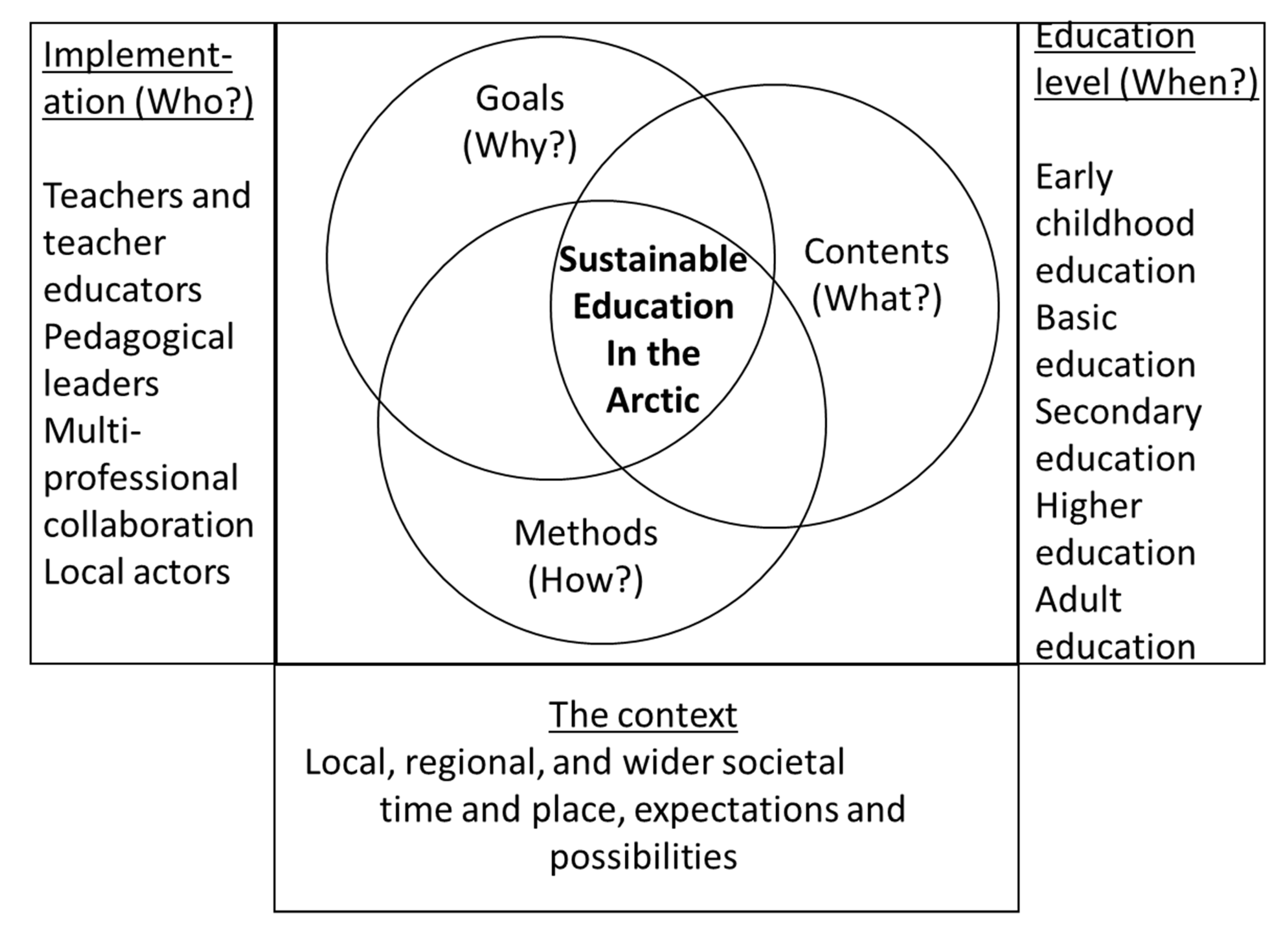
The Arctic region faces many threats but also opportunities due to economic, climate, environmental, cultural, social, professional, educational, and institutional changes, which also necessitate new perspectives on sustainable education. When implementing sustainable education in the Arctic, it is important to increase knowledge and understanding of the special features of Arctic areas—their opportunities and vulnerabilities. In this article, the model of Arctic sustainable education (ASE) has been introduced. It is based on a new kind of lifestyle that illustrates respectful and responsible attitudes toward other people and nature. What are the special features of the teaching and learning of ASE and how to organize it? In this theoretical article, we have discussed the challenges and goals, and possibilities and significance of ASE by leaning on the five cornerstones, concerning learning and teaching of SE in schools and organizations: why, what, how, who, and when. The ASE may provide new ideas to develop sustainable education not just in the Arctic region but also elsewhere as it gets its special opportunities and expectations in a context- and time-bound manner. In conclusion, the role of educational psychology in ASE has been viewed and discussed.
Keywords: learning; teaching; sustainability; sustainability education; Arctic learning; teaching; sustainability; sustainability education; Arctic