Impacts of Climate Change and Different Crop Rotation Scenarios on Groundwater Nitrate Concentrations in a Sandy Aquifer



Abstract
1. Introduction
2. Materials and Methods
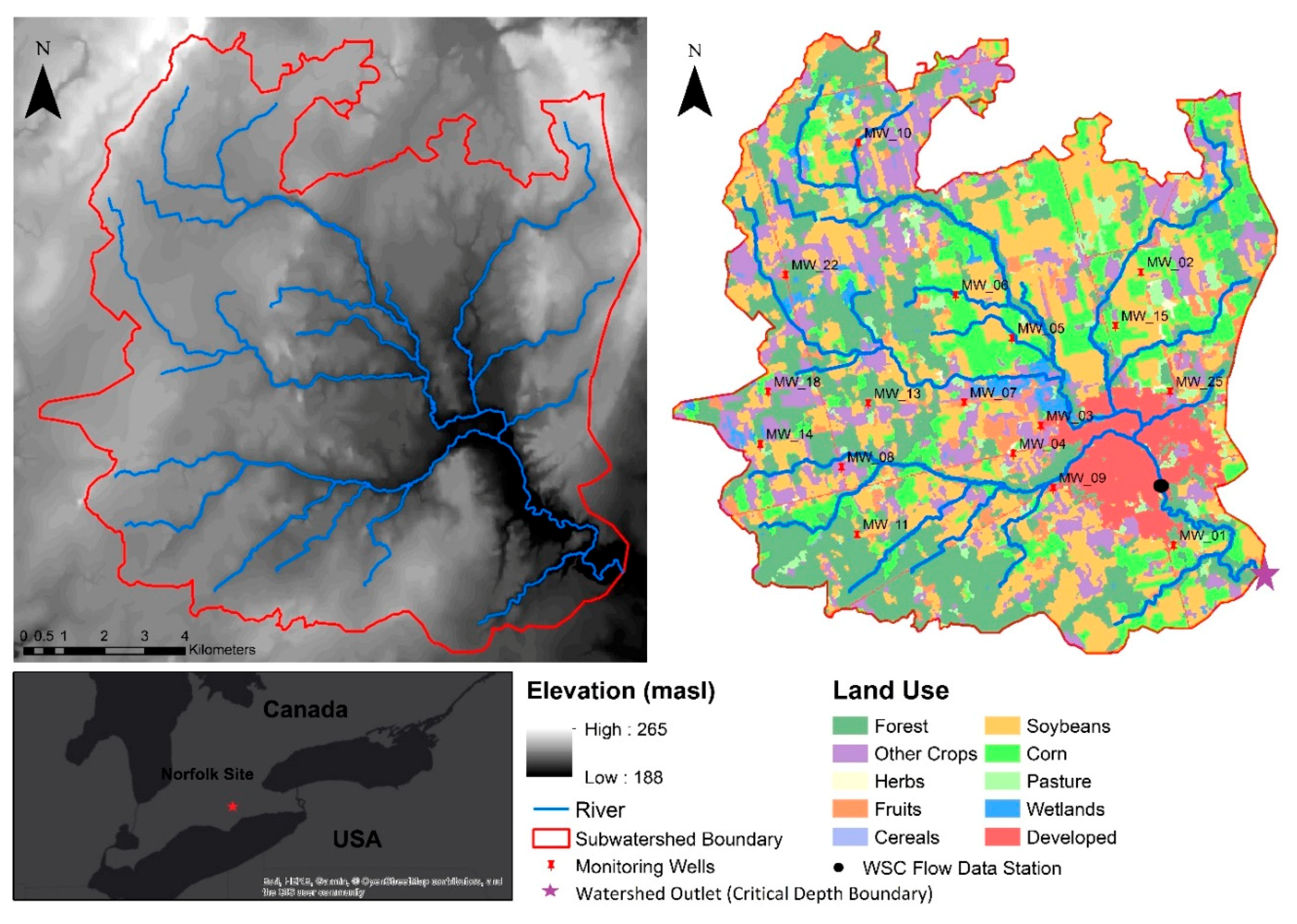
2.1. Study Site
2.2. Hydrogeological Modeling
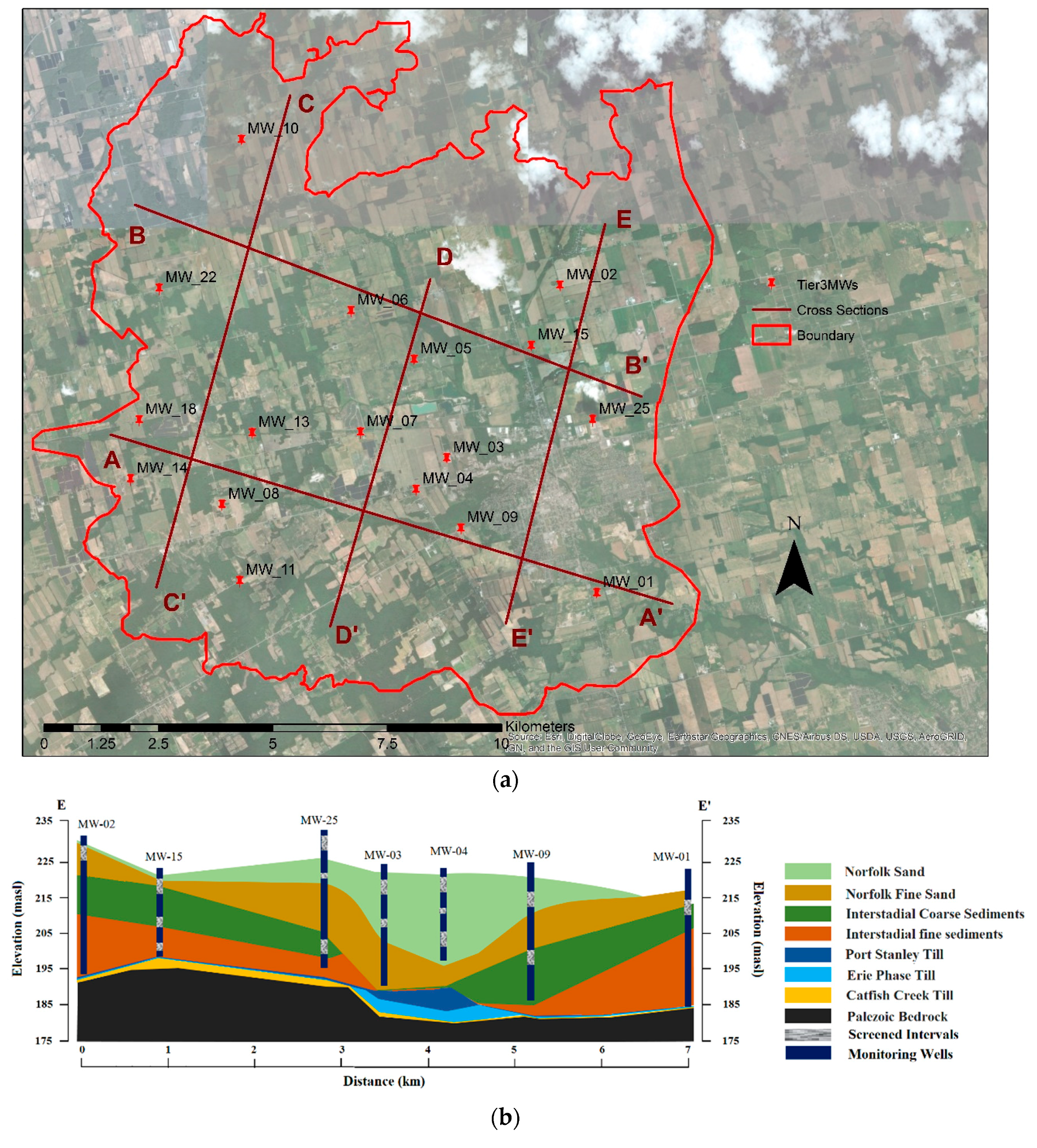
2.2.1. Geological and Hydrogeological Framework
2.2.2. Numerical Modeling
2.2.3. Data Collection
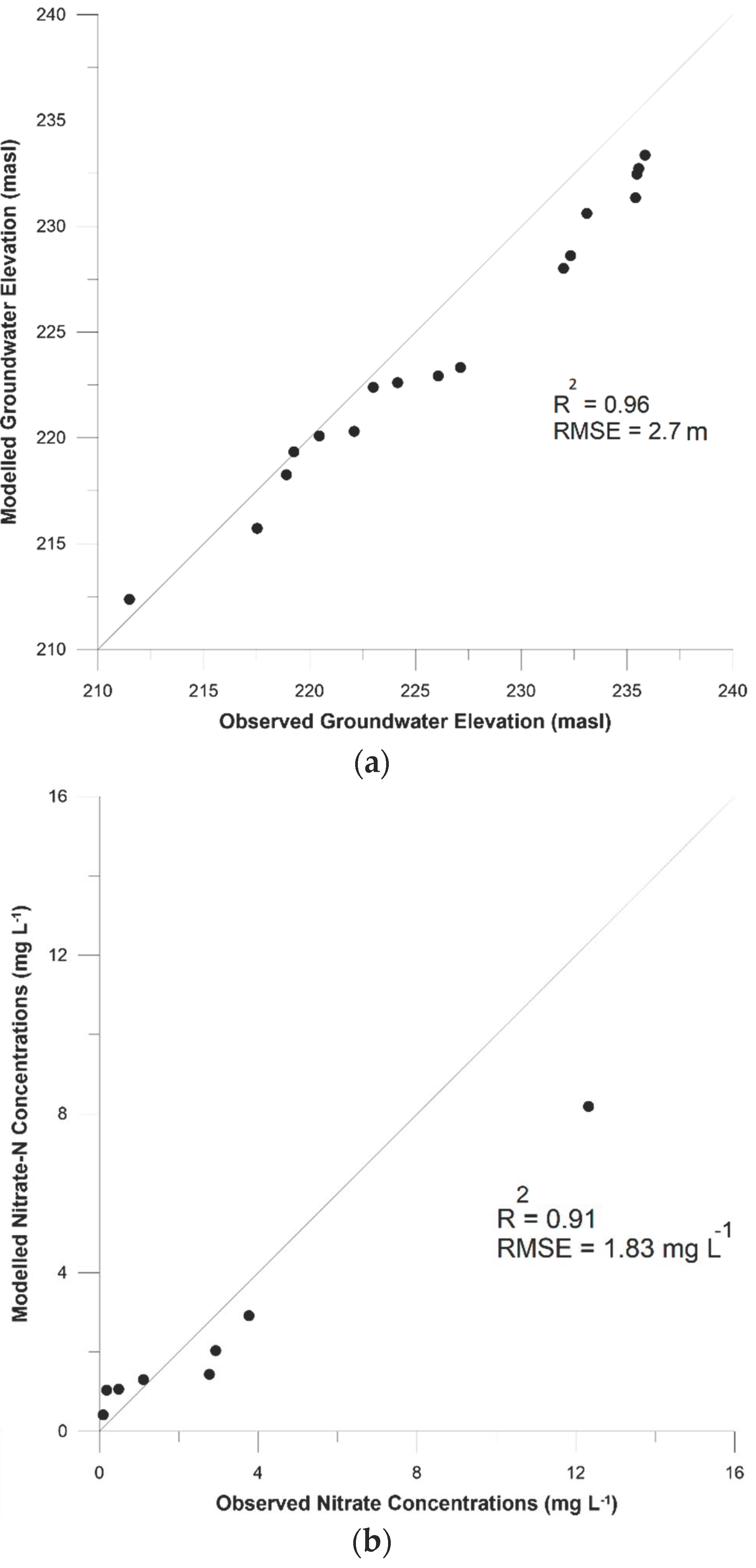
2.2.4. Model Calibration and Validation.
2.2.5. Sensitivity Analysis
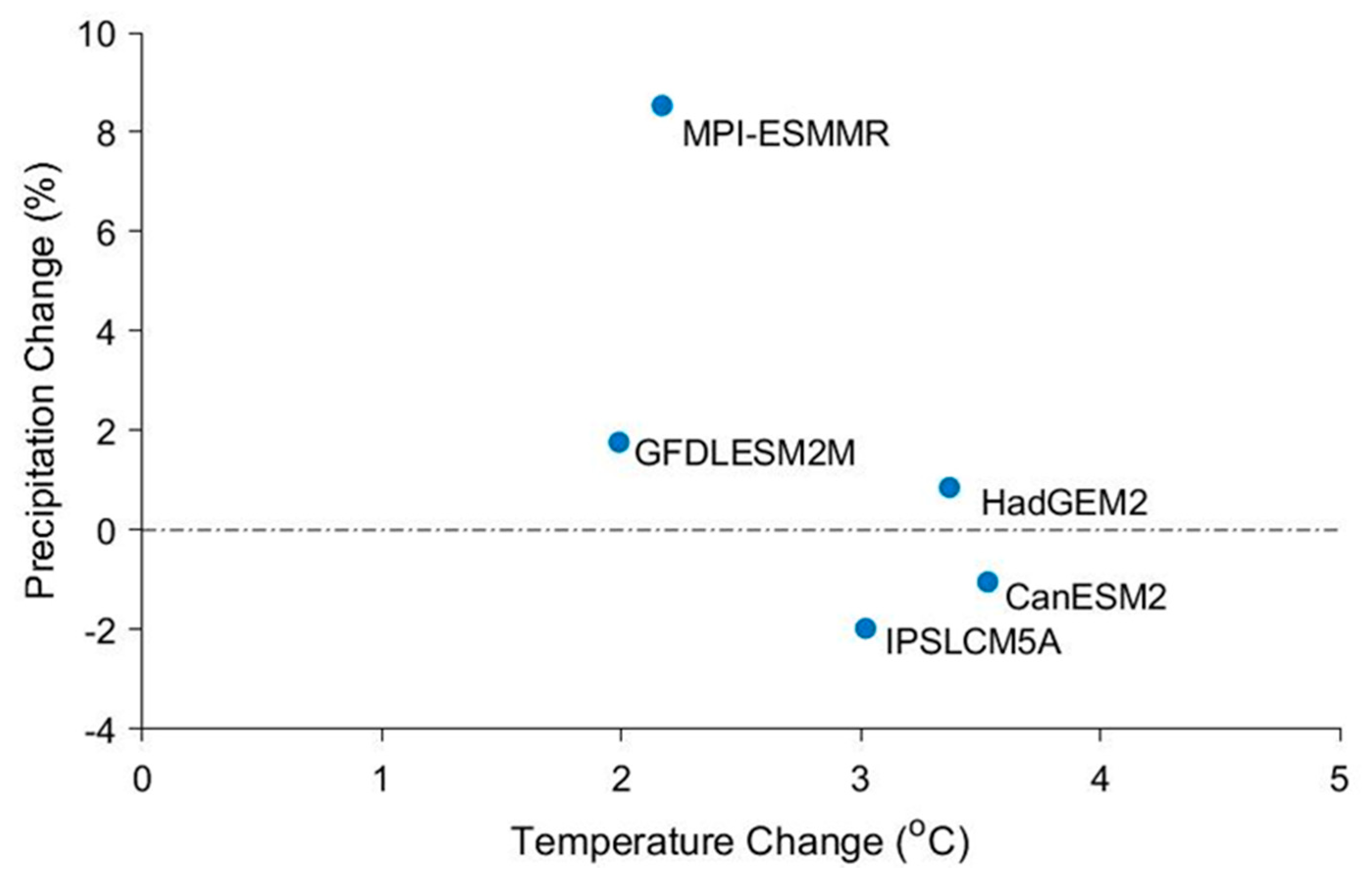
2.3. Future Climate Projections
2.4. Crop Rotation Scenarios
2.5. Statistical Evaluation
3. Results
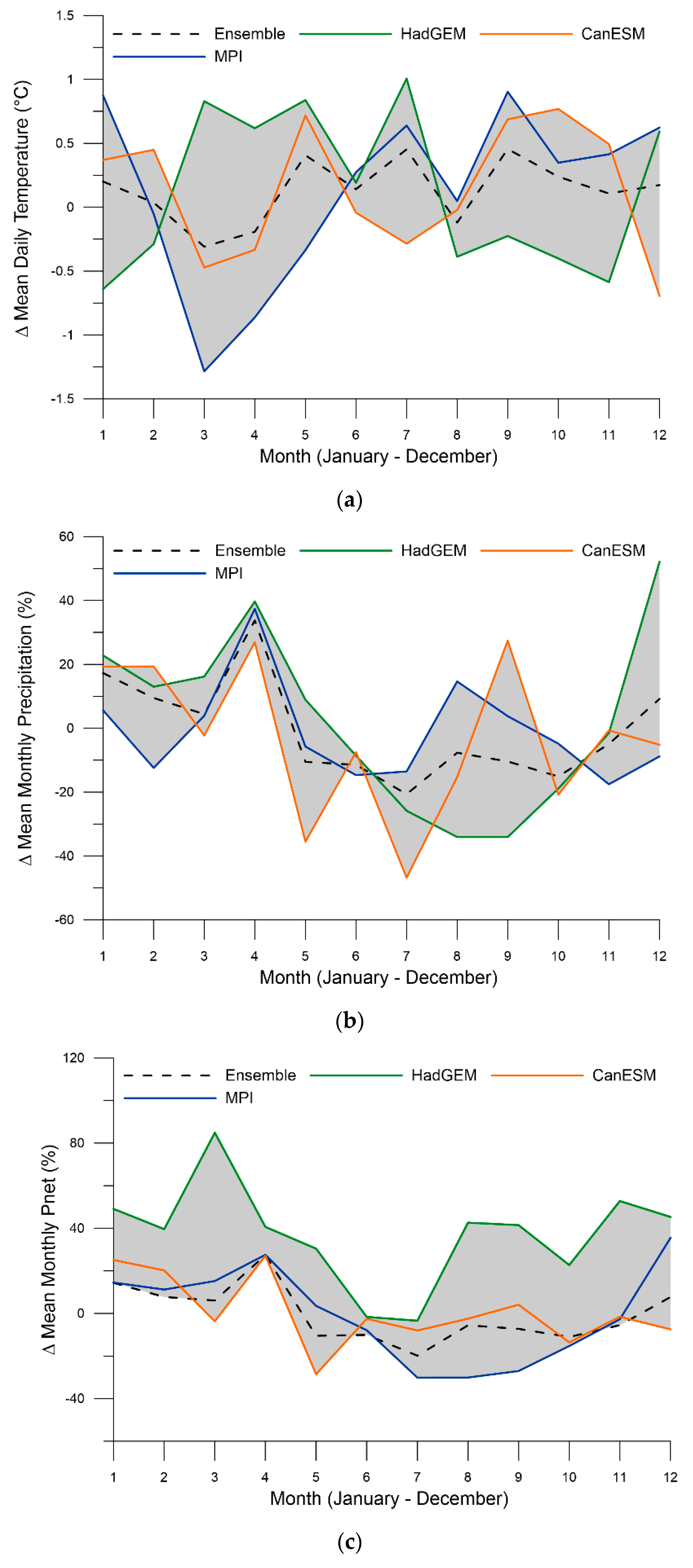
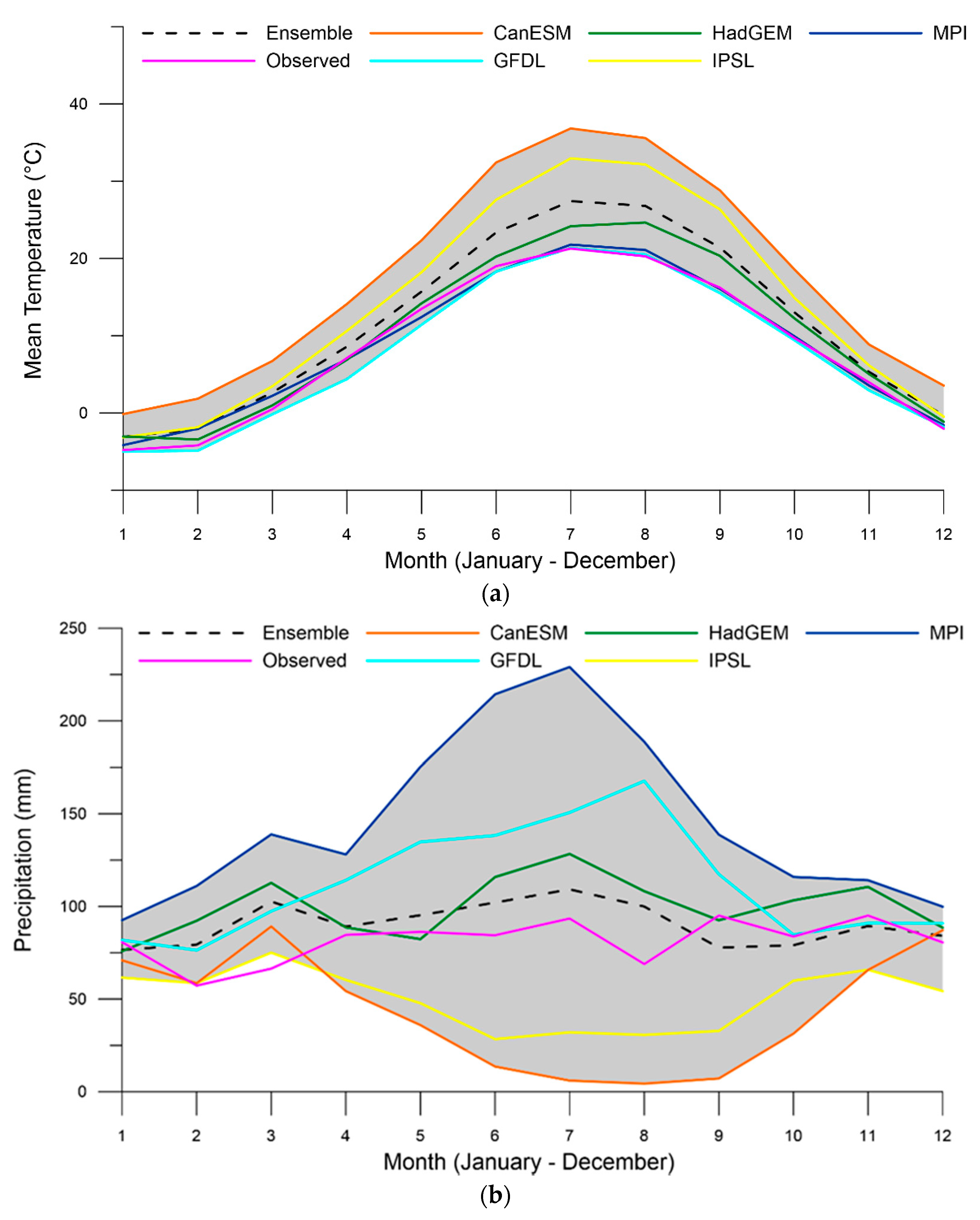
3.1. Climate Projections
3.2. Numerical Modeling Results
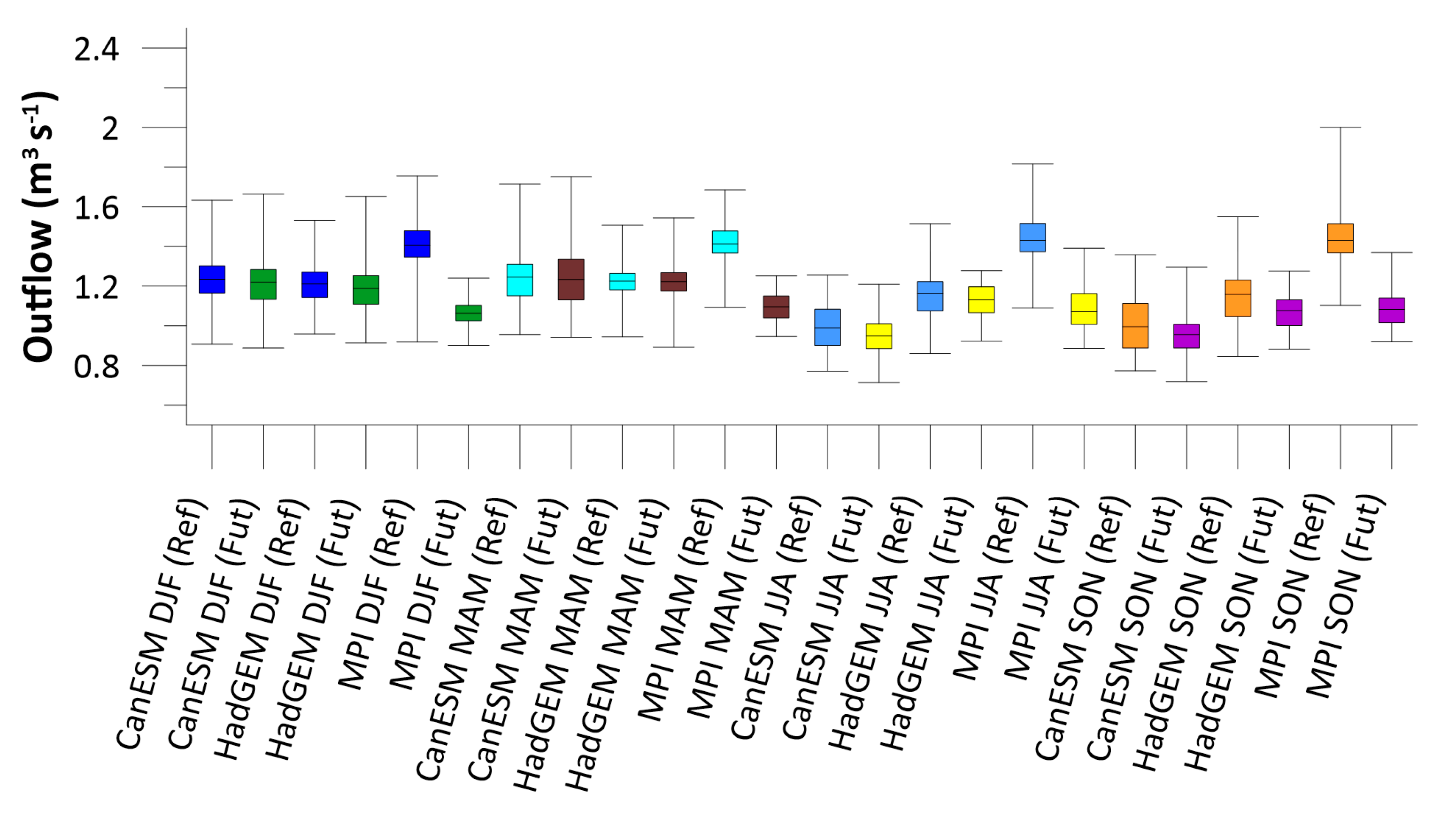
3.2.1. Outflow
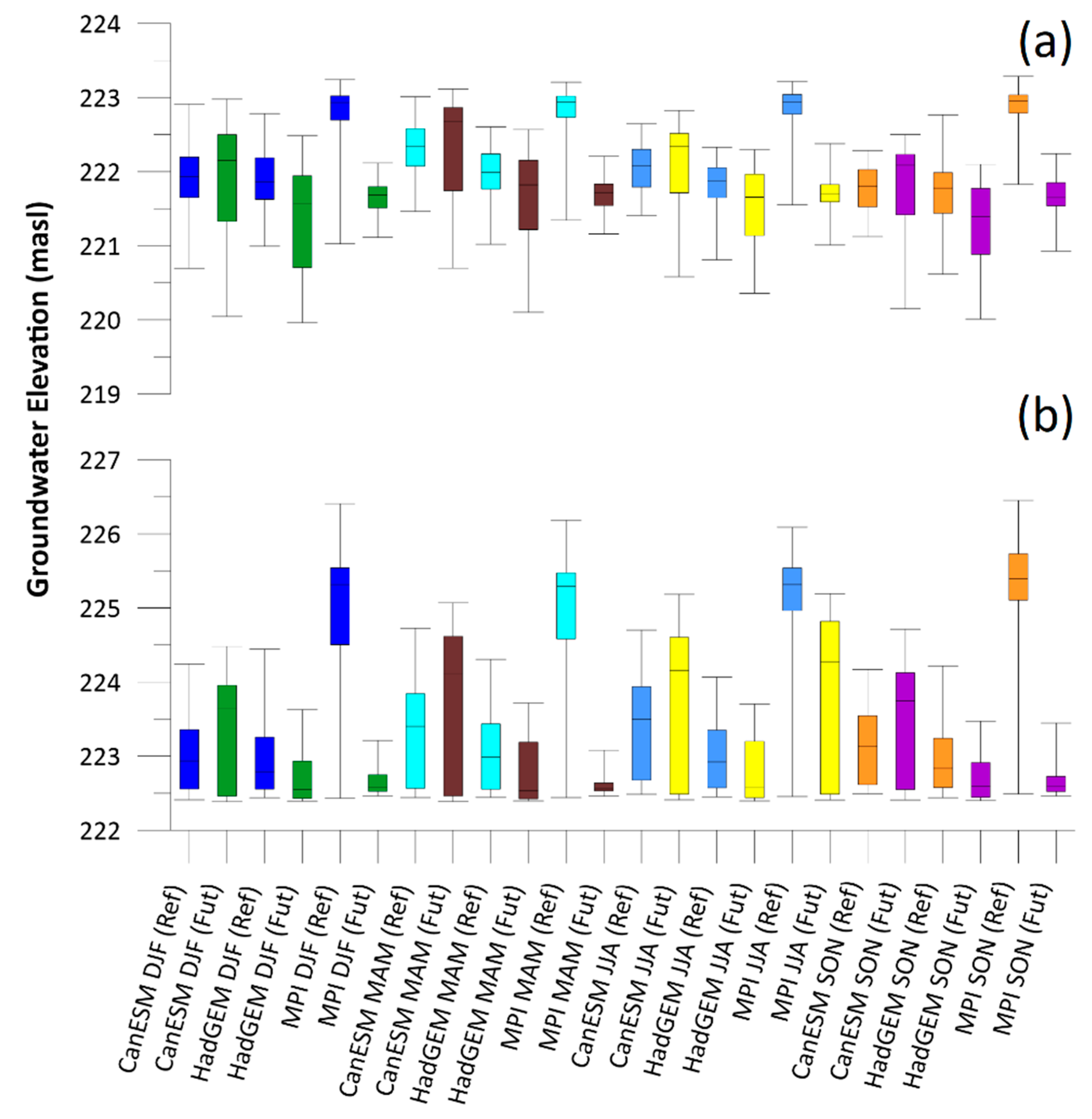
3.2.2. Groundwater Elevation
3.2.3. Groundwater Nitrate-N Concentrations
4. Discussion
5. Conclusions
Author Contributions
Funding
Acknowledgments
Conflicts of Interest
References
- Powlson, D.S.; Stirling, C.M.; Jat, M.L.; Gerard, B.G.; Palm, C.A.; Sanchez, P.A.; Cassman, K.G. Limited potential of no-till agriculture for climate change mitigation. Nat. Clim. Chang. 2014, 4, 678. [Google Scholar] [CrossRef]
- Rosenzweig, C.; Elliott, J.; Deryng, D.; Ruane, A.C.; Müller, C.; Arneth, A.; Boote, K.J.; Folberth, C.; Glotter, M.; Khabarov, N. Assessing agricultural risks of climate change in the 21st century in a global gridded crop model intercomparison. Proc. Natl. Acad. Sci. 2014, 111, 3268–3273. [Google Scholar] [CrossRef] [PubMed]
- Adams, R.M.; Hurd, B.H.; Lenhart, S.; Leary, N. Effects of global climate change on agriculture: An interpretative review. Clim. Res. 1998, 11, 19–30. [Google Scholar] [CrossRef]
- Risbey, J.; Kandlikar, M.; Dowlatabadi, H.; Graetz, D. Scale, context, and decision making in agricultural adaptation to climate variability and change. Mitig. Adapt. Strateg. Glob. Chang. 1999, 4, 137–165. [Google Scholar] [CrossRef]
- Pulido-Velazquez, M.; Peña-Haro, S.; García-Prats, A.; Mocholi-Almudever, A.F.; Henriquez-Dole, L.; Macian-Sorribes, H.; Lopez-Nicolas, A. Integrated assessment of the impact of climate and land use changes on groundwater quantity and quality in the Mancha Oriental system (Spain). Hydrol. Earth Syst. Sci. 2015, 19, 1677. [Google Scholar] [CrossRef]
- Danvi, A.; Giertz, S.; Zwart, S.J.; Diekkrüger, B. Comparing water quantity and quality in three inland valley watersheds with different levels of agricultural development in central Benin. Agric. Water Manag. 2017, 192, 257–270. [Google Scholar] [CrossRef]
- Carr, P.M.; Carlson, G.R.; Jacobsen, J.S.; Nielsen, G.A.; Skogley, E.O. Farming soils, not fields: A strategy for increasing fertilizer profitability. J. Prod. Agric. 1991, 4, 57–61. [Google Scholar] [CrossRef]
- Schumann, A.W.; Miller, W.M.; Zaman, Q.U.; Hostler, K.H.; Buchanon, S.; Cugati, S. Variable rate granular fertilization of citrus groves: Spreader performance with single-tree prescription zones. Appl. Eng. Agric. 2006, 22, 19–24. [Google Scholar] [CrossRef]
- Saleem, S.R.; Zaman, Q.U.; Schumann, A.W.; Madani, A.; Farooque, A.A.; Percival, D.C. Impact of variable rate fertilization on subsurface water contamination in wild blueberry cropping system. Appl. Eng. Agric. 2013, 29, 225–232. [Google Scholar] [CrossRef]
- Giller, K.E.; Tittonell, P.; Rufino, M.C.; Van Wijk, M.T.; Zingore, S.; Mapfumo, P.; Adjei-Nsiah, S.; Herrero, M.; Chikowo, R.; Corbeels, M. Communicating complexity: Integrated assessment of trade-offs concerning soil fertility management within African farming systems to support innovation and development. Agric. Syst. 2011, 104, 191–203. [Google Scholar] [CrossRef]
- Wu, W.; Ma, B. Integrated nutrient management (INM) for sustaining crop productivity and reducing environmental impact: A review. Sci. Total Environ. 2015, 512, 415–427. [Google Scholar] [CrossRef] [PubMed]
- Zingore, S.; Murwira, H.K.; Delve, R.J.; Giller, K.E. Influence of nutrient management strategies on variability of soil fertility, crop yields and nutrient balances on smallholder farms in Zimbabwe. Agric. Ecosyst. Environ. 2007, 119, 112–126. [Google Scholar] [CrossRef]
- Carpenter, S.R.; Bolgrien, D.; Lathrop, R.C.; Stow, C.A.; Reed, T.; Wilson, M.A. Ecological and economic analysis of lake eutrophication by nonpoint pollution. Aust. J. Ecol. 1998, 23, 68–79. [Google Scholar] [CrossRef]
- Powlson, D.S.; Addiscott, T.M.; Avery, A.A.; Van Kessel, C.; Davis, C. When Does Nitrate Become a Risk for Humans? J. Environ. Qual. 2008, 37, 291–295. [Google Scholar] [CrossRef]
- Van Drecht, G.; Bouwman, A.F.; Knoop, J.M.; Beusen, A.H.W.; Meinardi, C.R. Global modeling of the fate of nitrogen from point and nonpoint sources in soils, groundwater, and surface water. Glob. Biogeochem Cycles 2003, 17. [Google Scholar] [CrossRef]
- ECCC. Water Sources: Groundwater. Available online: https://www.canada.ca/en/environment-climate-change/services/water-overview/sources/groundwater.html (accessed on 15 September 2017).
- Gleeson, T.; Richter, B. How much groundwater can we pump and protect environmental flows through time? Presumptive standards for conjunctive management of aquifers and rivers. River Res. Appl. 2018, 34, 83–92. [Google Scholar] [CrossRef]
- Kurylyk, B.L.; MacQuarrie, K.T.B.; Linnansaari, T.; Cunjak, R.A.; Curry, R.A. Preserving, augmenting, and creating cold-water thermal refugia in rivers: Concepts derived from research on the Miramichi River, New Brunswick (Canada). Ecohydrology 2015, 8, 1095–1108. [Google Scholar] [CrossRef]
- Rhodes, K.A.; Proffitt, T.; Rowley, T.; Knappett, P.S.K.; Montiel, D.; Dimova, N.; Tebo, D.; Miller, G.R. The importance of bank storage in supplying baseflow to rivers flowing through compartmentalized, alluvial aquifers. Water Resour. Res. 2017, 53, 10539–10557. [Google Scholar] [CrossRef]
- ECCC. Canada at A Glance, Environment Edition: Water. Available online: https://www150.statcan.gc.ca/n1/pub/12-581-x/2017001/sec-1-eng.htm (accessed on 5 January 2018).
- Hutson, J.L.; Wagenet, R.J. Simulating nitrogen dynamics in soils using a deterministic model. Soil Use Manag. 1991, 7, 74–78. [Google Scholar] [CrossRef]
- Harbaugh, A.W.; Banta, E.R.; Hill, M.C.; McDonald, M.G. MODFLOW-2000, The U. S. Geological Survey Modular Ground-Water Model-User Guide to Modularization Concepts and the Ground-Water Flow Process; Open-File Report; U.S. Geological Survey: Reston, VA, USA, 2000. [CrossRef]
- Simunek, J.; Van Genuchten, M.T.; Sejna, M. The HYDRUS-1D software package for simulating the one-dimensional movement of water, heat, and multiple solutes in variably-saturated media. Univ. Calif.-Riverside Res. Rep. 2005, 3, 1–240. [Google Scholar]
- Youssef, M.A.; Skaggs, R.W.; Chescheir, G.M.; Gilliam, J.W. The nitrogen simulation model, DRAINMOD-N II. Trans. ASAE 2005, 48, 611–626. [Google Scholar] [CrossRef]
- Therrien, R.; McLaren, R.G.; Sudicky, E.A.; Panday, S.M. HydroGeoSphere: A three-dimensional numerical model describing fully-integrated subsurface and surface flow and solute transport; University of Waterloo: Waterloo, ON, Canada, 2010. [Google Scholar]
- Ma, L.; Ahuja, L.R.; Nolan, B.T.; Malone, R.W.; Trout, T.J.; Qi, Z. Root zone water quality model (RZWQM2): model use, calibration, and validation. Trans. ASABE 2012, 55, 1425–1446. [Google Scholar] [CrossRef]
- Paradis, D.; Vigneault, H.; Lefebvre, R.; Savard, M.M.; Ballard, J.; Qian, B. Groundwater nitrate concentration evolution under climate change and agricultural adaptation scenarios: Prince Edward Island, Canada. Earth Syst. Dyn. 2016, 7, 183–202. [Google Scholar] [CrossRef]
- Diersch, H.-J.G. FEFLOW: Finite Element Modeling of Flow, Mass and Heat Transport in Porous and Fractured Media; Springer Science & Business Media: Berlin, Germany, 2013. [Google Scholar] [CrossRef]
- Wagenet, R.J.; Hutson, J.L. LEACHM, a process-based model of water and solute movement, transformations, plant uptake and chemical reactions in the unsaturated zone. Contin 1989, 2. [Google Scholar]
- Graham, D.N.; Butts, M.B. Flexible, integrated watershed modelling with MIKE SHE. In Watershed Model; CRC Press: Boca Raton, FL, USA, 2005; pp. 245–272. [Google Scholar]
- Hansen, A.L.; Christensen, B.S.B.; Ernstsen, V.; He, X.; Refsgaard, J.C. A concept for estimating depth of the redox interface for catchment-scale nitrate modelling in a till area in Denmark. Hydrogeol. J. 2014, 22, 1639–1655. [Google Scholar] [CrossRef]
- Frey, S.K.; Hwang, H.; Park, Y.; Hussain, S.I.; Gottschall, N.; Edwards, M.; Lapen, D.R. Dual permeability modeling of tile drain management influences on hydrologic and nutrient transport characteristics in macroporous soil. J. Hydrol. 2016, 535, 392–406. [Google Scholar] [CrossRef]
- Praamsma, T.W. Rock Outcrops in the Canadian Shield: An Investigation of Contaminant Transport from Surface Sources in Fractured Rock Aquifers. Ph.D. Thesis, Queen’s University, Kingston, ON, USA, 2016. [Google Scholar]
- Wang, S.; Zhang, M.; Chen, F.; Che, Y.; Du, M.; Liu, Y. Comparison of GCM-simulated isotopic compositions of precipitation in arid central Asia. J. Geogr. Sci. 2015, 25, 771–783. [Google Scholar] [CrossRef]
- Allen, D.M.; Mackie, D.C.; Wei, M. Groundwater and climate change: A sensitivity analysis for the Grand Forks aquifer, southern British Columbia, Canada. Hydrogeol. J. 2004, 12, 270–290. [Google Scholar] [CrossRef]
- Levison, J.; Larocque, M.; Fournier, V.; Gagné, S.; Pellerin, S.; Ouellet, M.A. Dynamics of a headwater system and peatland under current conditions and with climate change. Hydrol. Processes 2014, 28, 4808–4822. [Google Scholar] [CrossRef]
- De Jong, R.; Qian, B.; Yang, J.Y. Modelling nitrogen leaching in Prince Edward Island under climate change scenarios. Can. J. Soil Sci. 2008, 88, 61–78. [Google Scholar] [CrossRef]
- Jiang, Y.; Somers, G. Modeling effects of nitrate from non-point sources on groundwater quality in an agricultural watershed in Prince Edward Island, Canada. Hydrogeol. J. 2009, 17, 707–724. [Google Scholar] [CrossRef]
- Colautti, D. Modelling the Effects of Climate Change on the Surface and Subsurface Hydrology of the Grand River Watershed. 2010. [Google Scholar]
- Sulis, M.; Paniconi, C.; Rivard, C.; Harvey, R.; Chaumont, D. Assessment of climate change impacts at the catchment scale with a detailed hydrological model of surface-subsurface interactions and comparison with a land surface model. Water Resour. Res. 2011, 47. [Google Scholar] [CrossRef]
- Sultana, Z.; Coulibaly, P. Distributed modelling of future changes in hydrological processes of Spencer Creek watershed. Hydrol. Process. 2011, 25, 1254–1270. [Google Scholar] [CrossRef]
- Dayyani, S.; Prasher, S.O.; Madani, A.; Madramootoo, C.A. Impact of climate change on the hydrology and nitrogen pollution in a tile-drained agricultural watershed in Eastern Canada. Trans. ASABE 2012, 55, 389–401. [Google Scholar] [CrossRef]
- Bourgault, M.A.; Larocque, M.; Roy, M. Simulation of aquifer-peatland-river interactions under climate change. Hydrol. Res. 2014, 45, 425–440. [Google Scholar] [CrossRef]
- Levison, J.; Larocque, M.; Ouellet, M.A. Modeling low-flow bedrock springs providing ecological habitats with climate change scenarios. J. Hydrol. 2014, 515, 16–28. [Google Scholar] [CrossRef]
- Bonton, A.; Bouchard, C.; Rouleau, A.; Rodriguez, M.J.; Therrien, R. Calibration and validation of an integrated nitrate transport model within a well capture zone. J. Contam. Hydrol. 2012, 128, 1–18. [Google Scholar] [CrossRef]
- Olesen, J.E.; Børgesen, C.D.; Hashemi, F.; Jabloun, M.; Bar-Michalczyk, D.; Wachniew, P.; Zurek, A.J.; Bartosova, A.; Bosshard, T.; Hansen, A.L. Nitrate leaching losses from two Baltic Sea catchments under scenarios of changes in land use, land management and climate. Ambio 2019, 48, 1252–1263. [Google Scholar] [CrossRef]
- Akbariyeh, S.; Pena, C.A.G.; Wang, T.; Mohebbi, A.; Bartelt-Hunt, S.; Zhang, J.; Li, Y. Prediction of nitrate accumulation and leaching beneath groundwater irrigated corn fields in the Upper Platte basin under a future climate scenario. Sci. Total Environ. 2019, 685, 514–526. [Google Scholar] [CrossRef]
- ECCC. Delhi Climate Station, Ontario. Available online: http://climate.weather.gc.ca (accessed on 3 January 2017).
- AAFC. Argiculture and Agri-Food Canada Annual Crop Inventory. Available online: https://open.canada.ca/data/en/dataset/ba2645d5-4458-414d-b196-6303ac06c1c9 (accessed on 6 May 2017).
- ONMNRF. Ontario Ministry of Natural resources and Forestry Provincial Digital Elevation Model (PDEM). Available online: https://www.javacoeapp.lrc.gov.on.ca/geonetwork/srv/en/main.home?uuid=012e3632-22a2-49d8-bbaf-ad8fbc0d0ceb (accessed on 4 June 2017).
- AquaResource, I. Long Point Region, Catfish Creek and Kettle Creek Integrated Water Budget. Report prepared for the Lake Erie Source Protection Region; AquaResources Inc.: Waterloo, ON, USA, 2009. [Google Scholar]
- Marich, A.S. An assessment of subsurface sediments in the Central Norfolk Sand Plain, Norfolk and Oxford Counties, Southern Ontario. Ont. Geol. Surv. Groundw. Resour. Study 2014, 14, 132. [Google Scholar]
- Karrow, P.F.; Dreimanis, A.; Barnett, P.J. A proposed diachronic revision of late Quaternary time-stratigraphic classification in the eastern and northern Great Lakes area. Quat. Res. 2000, 54, 1–12. [Google Scholar] [CrossRef]
- Singer, S.N.; Cheng, C.K.; Scafe, M.G. The hydrogeology of southern Ontario; Environmental Monitoring and Reporting Branch, Ministry of the Environment: Toronto, ON, Canada, 2003.
- Gardner, S. Groundwater Nitrate in Three Hydrogeologic Settings Throughout Southwestern Ontario. MASc Thesis, University of Guelph, Guelph, ON, Canada, 2017. [Google Scholar]
- Aravena, R.; Mayer, B. Isotopes and processes in the nitrogen and sulfur cycles. In Environmental Isotopes in Biodegradation and Bioremediation; CPC Press: Boca Raton, FL, USA, 2009; pp. 203–246. [Google Scholar]
- Saleem, S.R. Impacts of Future Climate and Agricultural Land Use Changes on Groundwater Nitrate Concentrations in Southern Ontario. Ph.D. Thesis, University of Guelph, Guelph, ON, Canada, 2018. [Google Scholar]
- Viessman, W.; Lewis, G.L. Introduction to Hydrology, 4th ed.; Harper Collins College Publisher: New York, NY, USA, 1996. [Google Scholar]
- HydroAlgorithemics Pty Ltd. What is AlgoMesh? HydroAlgorithemics Pty Ltd: Melbourne, Australia, 2017. [Google Scholar]
- Aquanty Inc. HydroGeoSphere Manual; Waterloo, ON, Canada, 2015. [Google Scholar]
- Richards, L.A. Capillary conduction of liquids through porous mediums. Physics 1931, 1, 318. [Google Scholar] [CrossRef]
- Kristensen, K.J.; Jensen, S.E. A model for estimating actual evapotranspiration from potential evapotranspiration. Hydrol. Res. 1975, 6, 170–188. [Google Scholar] [CrossRef]
- WSC. Daily Discharge Data Availability for LYNN RIVER AT SIMCOE (02GC008). Available online: https://wateroffice.ec.gc.ca/report/data_availability_e.html?type=historical&station=02GC008¶meter_type=Flow+and+Level (accessed on 24 January 2017).
- Stackhouse, P.W.; Westberg, D.; Hoell, J.M.; Chandler, W.S.; Zhang, T. Prediction Of Worldwide Energy Resource (POWER)—Sustainable Buildings Methodology—(1.0 o Latitude by 1.0 o Longitude Spatial Resolution). Available online: https://power.larc.nasa.gov/ (accessed on 9 June 2017).
- Doherty, J.E.; Hunt, R.J. Approaches to Highly Parameterized Inversion: A Guide to Using PEST for Groundwater-Model calibration; US Geological Survey: Washington, DC, USA, 2010.
- Chow, V.T. Open-channel hydraulics; McGraw-Hill: New York, NY, USA, 1959; Volume 1. [Google Scholar]
- Cochand, F. Impact des changements climatiques et du développement urbain sur les ressources en eaux du bassin versant de la rivière Saint-Charles. Ph.D. Thesis, Université Laval, Quebec City, QC, Canada, 2014. [Google Scholar]
- Goderniaux, P.; Brouyère, S.; Fowler, H.J.; Blenkinsop, S.; Therrien, R.; Orban, P.; Dassargues, A. Large scale surface–subsurface hydrological model to assess climate change impacts on groundwater reserves. J. Hydrol. 2009, 373, 122–138. [Google Scholar] [CrossRef]
- Scurlock, J.M.O.; Asner, G.P.; Gower, S.T. Worldwide historical estimates of leaf area index, 1932–2000; Oak Ridge National Laboratory: Oak Ridge, TN, USA, 2001. [Google Scholar] [CrossRef]
- Cornelissen, T.; Diekkrüger, B.; Bogena, H.R. Using high-resolution data to test parameter sensitivity of the distributed hydrological model HydroGeoSphere. Water 2016, 8, 202. [Google Scholar] [CrossRef]
- Canadell, J.; Jackson, R.B.; Ehleringer, J.B.; Mooney, H.A.; Sala, O.E.; Schulze, E.-D. Maximum rooting depth of vegetation types at the global scale. Oecologia 1996, 108, 583–595. [Google Scholar] [CrossRef]
- Li, Q.; Unger, A.J.A.; Sudicky, E.A.; Kassenaar, D.; Wexler, E.J.; Shikaze, S. Simulating the multi-seasonal response of a large-scale watershed with a 3D physically-based hydrologic model. J. Hydrol. 2008, 357, 317–336. [Google Scholar] [CrossRef]
- Andersen, J.; Dybkjaer, G.; Jensen, K.H.; Refsgaard, J.C.; Rasmussen, K. Use of remotely sensed precipitation and leaf area index in a distributed hydrological model. J. Hydrol. 2002, 264, 34–50. [Google Scholar] [CrossRef]
- Mercier, V.; Bussi, C.; Lescourret, F.; Génard, M. Effects of different irrigation regimes applied during the final stage of rapid growth on an early maturing peach cultivar. Irrig. Sci. 2009, 27, 297–306. [Google Scholar] [CrossRef]
- McCuen, R.H. The role of sensitivity analysis in hydrologic modeling. J. Hydrol. 1973, 18, 37–53. [Google Scholar] [CrossRef]
- Wang, X. Ontario Climate Change Data Portal. Available online: http://www.ontarioccdp.ca/ (accessed on 9 January 2018).
- Wang, G.; Yu, M.; Pal, J.S.; Mei, R.; Bonan, G.B.; Levis, S.; Thornton, P.E. On the development of a coupled regional climate–vegetation model RCM–CLM–CN–DV and its validation in Tropical Africa. Clim. Dyn. 2016, 46, 515–539. [Google Scholar] [CrossRef]
- Piani, C.; Haerter, J.O.; Coppola, E. Statistical bias correction for daily precipitation in regional climate models over Europe. Theor. Appl. Climatol. 2010, 99, 187–192. [Google Scholar] [CrossRef]
- Gutjahr, O.; Heinemann, G. Comparing precipitation bias correction methods for high-resolution regional climate simulations using COSMO-CLM. Theor. Appl. Climatol. 2013, 114, 511–529. [Google Scholar] [CrossRef]
- Wang, X.; Huang, G. Technical Report: Development of High-Resolution Climate Change Projections under RCP 8.5 Emissions Scenario for the Province of Ontario; IEESC, University of Regina: Regina, SK, Canada, 2015; pp. 1–90. [Google Scholar]
- Wang, L.; Ranasinghe, R.; Maskey, S.; van Gelder, P.H.A.J.M.; Vrijling, J.K. Comparison of empirical statistical methods for downscaling daily climate projections from CMIP5 GCMs: A case study of the Huai River Basin, China. Int. J. Climatol. 2016, 36, 145–164. [Google Scholar] [CrossRef]
- N’Tcha M’Po, Y.; Lawin, E.A.; Yao, B.K.; Oyerinde, G.T.; Attogouinon, A.; Afouda, A.A. Decreasing past and mid-century rainfall indices over the Ouémé River Basin, Benin (West Africa). Climate 2017, 5, 74. [Google Scholar] [CrossRef]
- Allen, R.G.; Pereira, L.S.; Raes, D.; Smith, M. Crop evapotranspiration-Guidelines for computing crop water requirements-FAO Irrigation and drainage paper 56. FaoRome 1998, 300, D05109. [Google Scholar]
- Golmohammadi, G.; Rudra, R.; Prasher, S.; Madani, A.; Mohammadi, K.; Goel, P.; Daggupatti, P. Water Budget in a Tile Drained Watershed under Future Climate Change Using SWATDRAIN Model. Climate 2017, 5, 39. [Google Scholar] [CrossRef]
- Dayyani, S.; Madramootoo, C.A.; Enright, P.; Simard, G.; Gullamudi, A.; Prasher, S.O.; Madani, A. Field evaluation of drainmod 5.1 under a cold climate: Simulation of daily midspan water table depths and drain outflows. J. Am. Water Resour. Assoc. 2009, 45, 779–792. [Google Scholar] [CrossRef]
- Juntakut, P.; Snow, D.D.; Haacker, E.M.K.; Ray, C. The long term effect of agricultural, vadose zone and climatic factors on nitrate contamination in the Nebraska’s groundwater system. J. Contam. Hydrol. 2019, 220, 33–48. [Google Scholar] [CrossRef]




| Data Type | Spatial Resolution | Temporal Resolution | Measurement Station | Data Source |
|---|---|---|---|---|
| Norfolk Site | ||||
| Climate Data | Weather Station | Daily | Simcoe | [48] |
| Solar Radiation Data | 0.5° × 0.5° | Daily | POWER Project | [64] |
| DEM | 1 m × 1 m | - | - | GRCA |
| Subsurface Geology | Local | - | Monitoring wells (borehole logs) | [51] |
| Outflow | Outflow Station | Daily | Lynn River | [63] |
| Hydrostratigraphic Units | Calibrated Kxy (m s−1) | Calibrated Kz (m s−1) | Field Data Range K (m s−1) |
|---|---|---|---|
| Top Soil | 3.60 × 10⁻⁶ | 4.10 × 10⁻⁷ | 3.60 × 10⁻⁷ to 5.50 × 10⁻⁴ |
| Norfolk Sand | 2.98 × 10⁻⁶ | 4.20 × 10⁻⁶ | |
| Norfolk Fine Sand | 5.26 × 10⁻⁶ | 9.60 × 10⁻⁷ | |
| Interstadial Coarse Sediments | 1.32 × 10⁻⁶ | 1.00 × 10⁻⁶ | 9.80 × 10⁻⁸ to 1.70 × 10⁻³ |
| Interstadial Fine Sediments | 1.89 × 10⁻⁶ | 9.60 × 10⁻⁷ | |
| Port Stanley Till | 2.80 × 10⁻⁷ | 2.80 × 10⁻⁷ | |
| Erie Phase Till | 1.35 × 10⁻⁷ | 1.35 × 10⁻⁷ | |
| Catfish Creek Till | 1.35 × 10⁻⁸ | 1.35 × 10⁻⁸ | |
| Palezoic Bedrock | 2.00 × 10⁻⁹ | 2.00 × 10⁻⁹ |
| Parameter | Value | Source |
|---|---|---|
| Manning roughness coefficient, n (s m−1/3) | 0.025 | [66] |
| Rill storage height, Hd (m) | 0.01 | [67] |
| Coupling length | 0.01 | [68] |
| Parameter | Evapotranspiration | ||||||
|---|---|---|---|---|---|---|---|
| Crop type | |||||||
| Cereals | Corn | Forest | Other Crops | Soybeans | Wetlands | Developed | |
| Land use (%) (e.g. 2012) | 0.05 | 16.3 | 28.3 | 21.7 | 25.3 | 2.0 | 6.5 |
| Evaporation Depth (m) | 0.2 1 | ||||||
| LAI | Daily (RZWQM2) | 3.0 2 | Daily (RZWQM2) | 6.34 2 | 25.0 3 | ||
| Root Depth (m) | 1.2 5 | 1.8 5 | 3.0 4 | 1.3 5 | 1.2 5 | - | - |
| Transpiration Fitting Parameters (c1, c2, c3) | 0.3 7, 0.15 7, 5.9 7 | 0.3 6, 0.2 6, 20.0 6 | 0.3 8, 0.4 8, 10 8 | 0.3 7, 0.2 7, 10.0 7 | 0.3 6, 0.2 6, 20.0 6 | 0.3 7, 0.2 7, 1.0 7 | 0.3 6, 0.2 6, 20.0 6 |
| Transpiration Limiting Saturations (θwp, θFC, θo, θao) | 0.04, 0.19, 0.6 1, 0.8 1 | 0.04, 0.19, 0.76 9, 0.9 9 | 0.04, 0.19, 0.6 1, 0.8 1 | 0.04, 0.19, 1.0, 1.0 | |||
| Evaporation Limiting Saturations (min, max) | 0.04, 0.19 | ||||||
| Canopy Storage (mm) | 0.056 | 2.5 3 | 0.8 3 | 0.05 6 | 1.5 3 | 15.0 3 | 15.0 3 |
| Hydrostratigraphic Units | Longitudinal Dispersivity (m) | Transverse Dispersivity (m) | Tortuosity | Porosity | Specific Storage (m−1) |
|---|---|---|---|---|---|
| Top Soil | 20.0 | 1.23 | 0.067 | 0.19 | 0.000328 |
| Norfolk Sand | 23.63 | 2.00 | 0.022 | 0.25 | 0.000321 |
| Norfolk Fine Sand | 8.49 | 0.9 | 0.019 | 0.35 | 0.000164 |
| Interstadial Coarse Sediments | 30.0 | 0.9 | 0.5 | 0.25 | 0.000298 |
| Interstadial Fine Sediments | 30.0 | 2.0 | 0.5 | 0.45 | 0.000192 |
| Port Stanley Till | 10.0 | 1.0 | 0.2 | 0.4 | 0.000164 |
| Erie Phase Till | 10.0 | 1.0 | 0.2 | 0.4 | 0.000164 |
| Catfish Creek Till | 10.0 | 1.0 | 0.2 | 0.4 | 0.000164 |
| Palezoic Bedrock | 10.0 | 1.0 | 0.2 | 0.001 | 0.000164 |
| Parameter | Groundwater Elevation Sr | Outflow Sr | Nitrate-N Sr |
|---|---|---|---|
| Low K (Layer 1–3) | 1.2 × 10⁻³ | 5.9 × 10⁻⁶ | 3.2 × 10⁻¹ |
| High K (Layer 1–3) | 8.4 × 10⁻⁴ | 2.2 × 10⁻¹ | 9.8 × 10⁻¹ |
| Low K (Layer 4–5) | 2.9 × 10⁻⁴ | 6.6 × 10⁻⁶ | 5.8 × 10⁻⁷ |
| High K (Layer 4–5) | 6.7 × 10⁻⁷ | 9.7 × 10⁻⁷ | 5.9 × 10⁻⁷ |
| Low Precipitation | 1.5 × 10⁻² | 9.0 × 10⁻¹ | 1.5 × 100 |
| High Precipitation | 2.2 × 10⁻² | 8.2 × 10⁻¹ | 8.9 × 10⁻¹ |
| Low PET | 8.9 × 10⁻⁴ | 4.8 × 10⁻² | 3.5 × 10⁻¹ |
| High PET | 5.5 × 10⁻⁴ | 3.5 × 10⁻² | 8.1 × 10⁻² |
| Period | Outflow (m3 s−1) | % Change |
|---|---|---|
| 1986–2005 | 1.12 a | −2.86 |
| 2040–2059 | 1.09 b |
| Parameter | 1986–2005 | 2040–2059 | % Change | % Change between Land Uses | |
|---|---|---|---|---|---|
| (1986–2005) | (2040–2059) | ||||
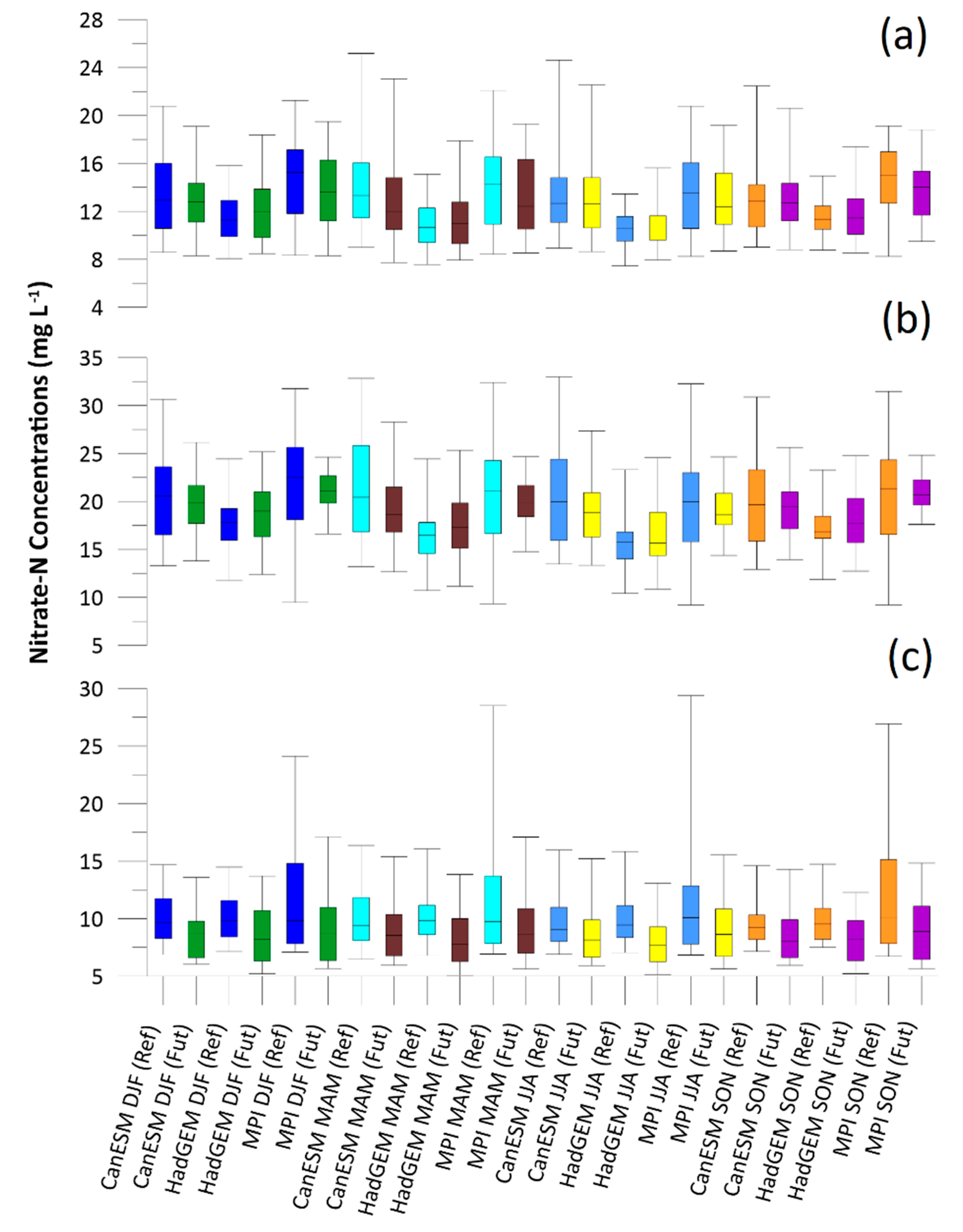
| Groundwater elevation (masl) | 222.00 a | 222.05 b | +0.02 | - | |
| Corn-soybean (mg L−1) | 13.00 a | 12.67 b | −2.55 | ||
| Continuous corn (mg L−1) | 19.19 a | 19.16 b | −0.14 | +47.56 | +51.21 |
| Corn-soybean-winter wheat-red clover (mg L−1) | 10.56 a | 8.68 b | −17.78 | −18.79 | −31.49 |
| Parameter | 1986–2005 | 2040–2059 | % Change | % Change between Land Uses | |
|---|---|---|---|---|---|
| (1986–2005) | (2040–2059) | ||||
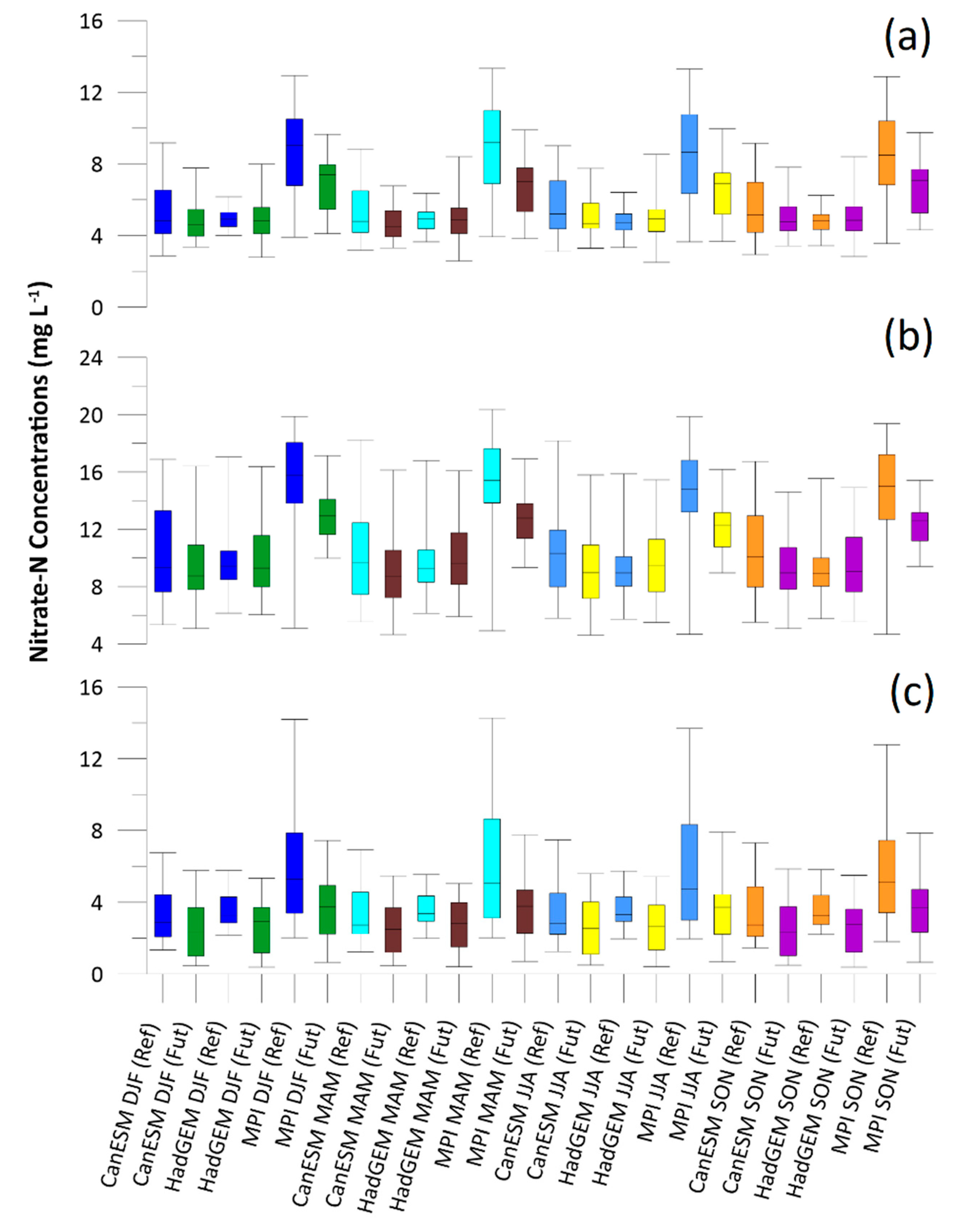
| Groundwater elevation (masl) | 223.24 a | 223.60 b | +0.16 | - | - |
| Corn-soybean (mg L−1) | 6.30 a | 5.51 b | −12.45 | ||
| Continuous corn (mg L−1) | 11.30 a | 10.45 b | −7.53 | +79.43 | +89.52 |
| Corn-soybean-winter wheat-red clover (mg L−1) | 4.26 a | 2.90 b | −31.93 | −32.29 | −47.36 |
© 2020 by the authors. Licensee MDPI, Basel, Switzerland. This article is an open access article distributed under the terms and conditions of the Creative Commons Attribution (CC BY) license (http://creativecommons.org/licenses/by/4.0/).
Share and Cite
Saleem, S.; Levison, J.; Parker, B.; Martin, R.; Persaud, E. Impacts of Climate Change and Different Crop Rotation Scenarios on Groundwater Nitrate Concentrations in a Sandy Aquifer. Sustainability 2020, 12, 1153. https://doi.org/10.3390/su12031153
Saleem S, Levison J, Parker B, Martin R, Persaud E. Impacts of Climate Change and Different Crop Rotation Scenarios on Groundwater Nitrate Concentrations in a Sandy Aquifer. Sustainability. 2020; 12(3):1153. https://doi.org/10.3390/su12031153
Chicago/Turabian StyleSaleem, Shoaib, Jana Levison, Beth Parker, Ralph Martin, and Elisha Persaud. 2020. "Impacts of Climate Change and Different Crop Rotation Scenarios on Groundwater Nitrate Concentrations in a Sandy Aquifer" Sustainability 12, no. 3: 1153. https://doi.org/10.3390/su12031153
APA StyleSaleem, S., Levison, J., Parker, B., Martin, R., & Persaud, E. (2020). Impacts of Climate Change and Different Crop Rotation Scenarios on Groundwater Nitrate Concentrations in a Sandy Aquifer. Sustainability, 12(3), 1153. https://doi.org/10.3390/su12031153