

Adopting Environmentally Friendly Farming Practices and the Role of Quality Labels and Producer Organisations: A Qualitative Analysis Based on Two European Case Studies

 , and
, and 
Abstract
1. Introduction
2. Materials and Methods
2.1. Background of French Pig Farming and Cretan Olive Production
2.2. Methodology
3. Results
3.1. Environmentally Friendly Practices in Quality Labels
3.1.1. Identification of the Environmentally Friendly Practices Implemented in Quality Labels
3.1.2. Some Stakeholders in Food Supply Chains opt for Existing Quality Labels
3.1.3. Other Stakeholders Choose to Develop Their Own Quality Labels
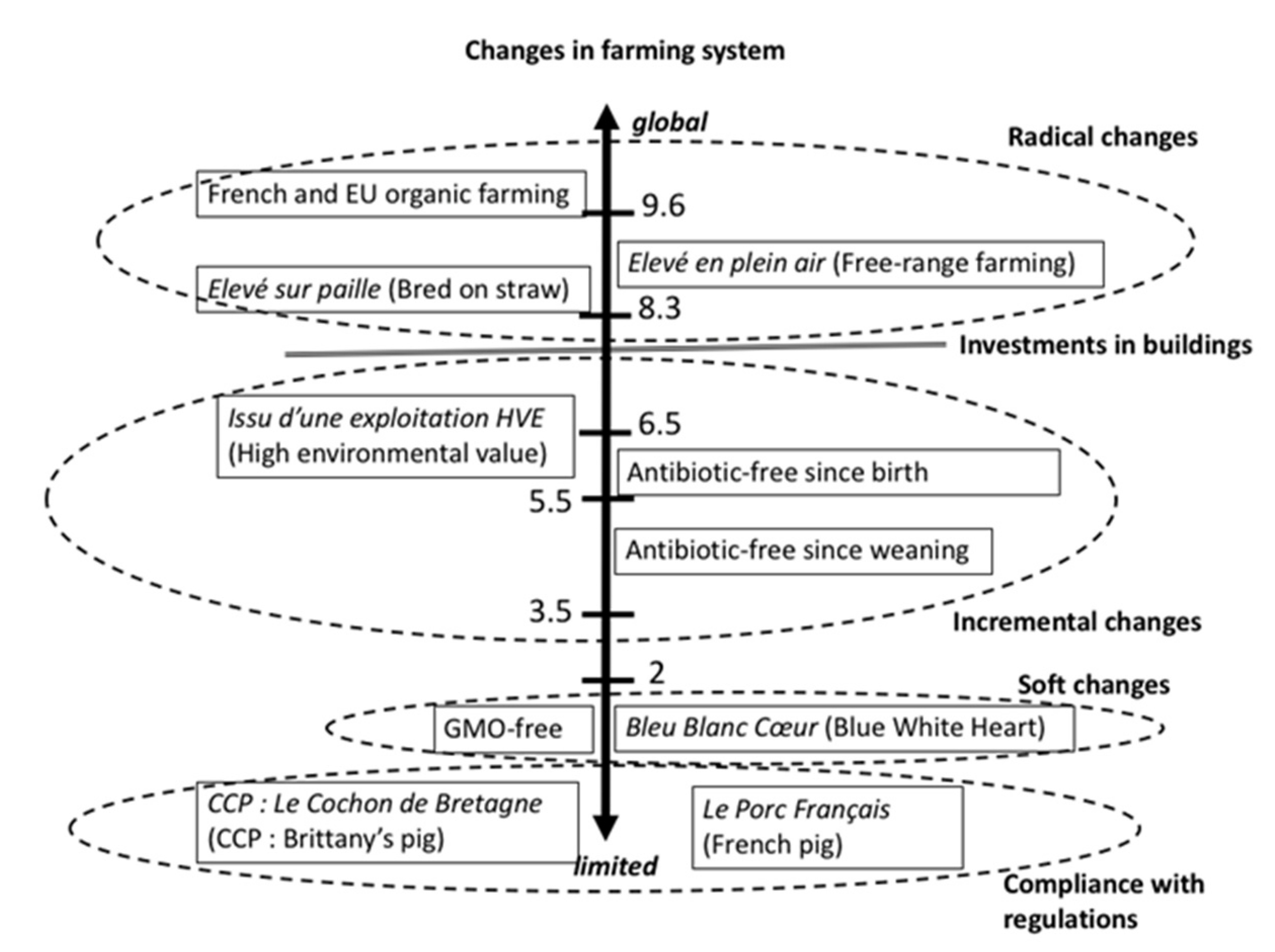
3.1.4. Changes Induced by Quality Labels in Farming Systems
3.2. Environmentally Friendly Practices Supported by Producer Organisations
3.2.1. Environmentally Friendly Practices Developed in Producer Organisations
3.2.2. Producer Organisations’ Advice and Support
3.2.3. Reasons for Producer Organisations Supporting Environmentally Friendly Practices
4. Discussion and Conclusions
Author Contributions
Funding
Acknowledgments
Conflicts of Interest
References
- Sessego, V.; Hébel, P. Consommation durable: l’engagement de façade des classes supérieures. CREDOC Consomm. Modes Vie 2019, 303, 1–4. [Google Scholar]
- Eurobarometer. Special Eurobarometer 501—Attitudes of European Citizens Towards the Environment; European Union: Brussels, Belgium, 2020. [Google Scholar]
- Challies, E. The limits to voluntary private social standards in global agri-food system governance. Int. J. Soc. Agric. Food 2012, 20, 175–195. [Google Scholar]
- Henson, S.; Humphrey, J. The Impacts of Private Food Safety Standards on the Food Chain and on Public Standard-Setting Processes; FAO: Rome, Italy; WHO: Geneva, Switzerland, 2009; 59p. [Google Scholar]
- Hobbs, J. Heterogeneous consumers and differentiated food markets: Implications for quality signaling in food supply chains. Can. J. Agric. Econ. 2019, 67, 1–13. [Google Scholar] [CrossRef]
- Fulponi, L. Private voluntary standards in the food system: The perspective of major food retailers in OECD countries. Food Policy 2006, 31, 1–13. [Google Scholar] [CrossRef]
- Von Schlippenbach, V.; Teichmann, I. The strategic use of private quality standards in food supply chains. Am. J. Agric. Econ. 2012, 94, 1189–1201. [Google Scholar] [CrossRef]
- Hennessy, D.A.; Roosen, J.; Miranowski, J.A. Leadership and the Provision of Safe Food. Am. J. Agric. Econ. 2001, 83, 862–874. [Google Scholar] [CrossRef]
- Bazoche, P.; Giraud-Héraud, E.; Soler, L.-G. Premium Private Labels, Supply Contracts, Market Segmentation and Spot Prices. J. Agric. Food Ind. Organ. 2005, 3. [Google Scholar] [CrossRef]
- Goodhue, R.E.; Heien, D.M.; Lee, H.; Sumner, D.A. Contracts and Quality in the California Winegrape Industry. Rev. Ind. Organ. 2003, 23, 267–282. [Google Scholar]
- Goodhue, R.E. Food quality: The design of incentive contracts. Annu. Rev. Resour. Econ. 2011, 3, 119–140. [Google Scholar] [CrossRef]
- Cei, L.; Defrancesco, E.; Stefani, G. From geographical indications to rural development: A review of the economic effects of European Union policy. Sustainability 2018, 10, 3745. [Google Scholar] [CrossRef]
- Cañada, J.S.; Vázquez, A.M. Quality certification, institutions and innovation in local agro-food systems: Protected designations of origin of olive oil in Spain. J. Rural Stud. 2005, 21, 475–486. [Google Scholar] [CrossRef]
- Likudis, Z. Olive oils with protected designation of origin (PDO) and protected geographical indication (PGI). In Products from Olive Tree; Boskou, D., Clodoveo, M., Eds.; IntechOpen: Munich, Germany, 2016; pp. 175–190. [Google Scholar]
- Mattas, K.; Baourakis, G.; Tsakiridou, E.; Hedoui, M.A.; Hosni, H. PDO Olive Oil Products: A Powerful Tool for Farmers and Rural Areas. J. Int. Food Agribus. Mark. 2019, 32, 313–336. [Google Scholar] [CrossRef]
- Saitone, T.L.; Sexton, R.J. Optimal Cooperative Pooling in a Quality-Differentiated Market. Am. J. Agric. Econ. 2009, 91, 1224–1232. [Google Scholar] [CrossRef]
- Pennerstorfer, D.; Weiss, C.R. Product quality in the agri-food chain: Do cooperatives offer high-quality wine? Eur. Rev. Agric. Econ. 2013, 40, 143–162. [Google Scholar] [CrossRef]
- Hendrikse, G.; Bijman, J. On the emergence of new growers’ associations: Self-selection versus countervailing power. Eur. Rev. Agric. Econ. 2002, 29, 255–269. [Google Scholar] [CrossRef]
- Zago, A.M. Quality and self-regulation in agricultural markets: How do Producer Organisations make the rules? Eur. Rev. Agric. Econ. 1999, 26, 199–218. [Google Scholar] [CrossRef]
- Karantininis, K.; Sauer, J.; Furtan, W.H. Innovation and integration in the agri-food industry. Food Policy 2010, 35, 112–120. [Google Scholar] [CrossRef]
- Menozzi, D.; Fioravanzi, M.; Donati, M. Farmer’s motivation to adopt sustainable agricultural practices. Bio-Based Appl. Econ. J. 2015, 4, 125–147. [Google Scholar] [CrossRef]
- Giannakas, K.; Fulton, M. Process innovation activity in a mixed oligopoly: The role of cooperatives. Am. J. Agric. Econ. 2005, 87, 406–422. [Google Scholar] [CrossRef]
- Drivas, K.; Giannakas, K. The Effect of Cooperatives on Quality-Enhancing Innovation. J. Agric. Econ. 2010, 61, 295–317. [Google Scholar] [CrossRef]
- Hansson, H.; Thompson, B.; Manevska-Tasevska, G.; Toma, L.; Leduc, G.; Vranken, L. Drivers of Farmers’ Up-Take of Ecological Approaches—A Conceptual Framework with a Behavioural Focus; H2020 Project LIFT, Deliverable 2.1; LIFT Consortium: Rennes, France, 2019. [Google Scholar]
- Hooks, T.; Macken-Walsh, A.; McCarthy, O.; Power, C. The impact of a Values-Based Supply Chain (VBSC) on farm-level viability, sustainability and resilience: Case study evidence. Sustainability 2017, 9, 267. [Google Scholar] [CrossRef]
- Van Herck, C. Assessing Efficiencies Generated by Agricultural Producer Organisations; Report for the Directorate-General for Competition; European Commission: Brussels, Belgium, 2014. [Google Scholar]
- Hooks, T.; Macken-Walsh, A.; McCarthy, O.; Power, C.; Henchion, M. Co-operation among Irish beef farmers: Current perspectives and future prospects in the context of new producer organisation (PO) legislation. Sustainability 2018, 10, 4085. [Google Scholar] [CrossRef]
- Agreste. Chiffres et Analyses—Orientations Technico-Economiques; Données en Ligne; Ministry of Agriculture: Paris, France, 2019.
- Agreste Bretagne. Filière Porcine—Edition 2017; Ministry of Agriculture: Paris, France, 2017.
- IFIP. Le Porc par les Chiffres, La Filière Porcine en France, dans l’UE et dans le Monde; IFIP-Institut du Porc: Paris, France, 2016; 44p. [Google Scholar]
- INAPORC. Plan de la Filière Porcine Française; Interprofession Nationale Porcine: Paris, France, 2017; 40p. [Google Scholar]
- Hellenic Statistical Authority. Statistics for Agriculture and Livestoc; Hellenic Statistical Authority: Athens, Greece, 2017. [Google Scholar]
- Greek Ministry of Rural Development and Food; Directorate of Food Exploitation and Technology, Olive, Olive Oil and Table Olives Sector. Personal communication, 2020.
- Hellenic Agricultural Organization (HAO). Demeter. System of Integrated Management in Agricultural Production; Hellenic Agricultural Organization: Athens, Greece, 2019. [Google Scholar]
- Greek Ministry of Rural Development and Food. Statistics for Organic Agriculture; Greek Ministry of Rural Development and Food: Athens, Greece, 2017. [Google Scholar]
- Hellenic Agricultural Organization (HAO)—Demeter; Directorate of Certification. Personal communication, 2019.
- Belletti, G.; Marescotti, A.; Vakoufaris, H. Linking protection of geographical indications to the environment: Evidence from the European Union olive-oil sector. Land Use Policy 2015, 48, 94–106. [Google Scholar] [CrossRef]
- Roselli, L.; Casieri, A.; De Gennaro, B.; Medicamento, U. Olive oils protected by the EU geographical indications: Creation and distribution of the value-adding within supply chains. In Proceedings of the 113 Seminar of the European Association of Agricultural Economists, Chania, Crete, Greece, 3–6 September 2009. [Google Scholar]
- Berg, H.; Maneas, G.; Salguero Engström, A. A Comparison between Organic and Conventional Olive Farming in Messenia, Greece. Horticulturae 2018, 4, 15. [Google Scholar] [CrossRef]
- Konstantidelli, V.; Koutsouris, A.; Karanikolas, P.; Tsiboukas, K. Setting-up a farm advisory network in the agricultural university of Athens: An exploratory analysis. Int. J. Agric. Ext. 2018, 6, 105–116. [Google Scholar]
- Koutsouris, A. AKIS and Advisory Services in Greece; Report for the AKIS inventory (WP3) of the PRO AKIS Project; James Hutton Institute: Dundee, UK, 2014. [Google Scholar]
- Ecorys and Wageningen Economic Research. Study on Producer Organisations and Their Activities in the Olive Oil, Beef and Veal and Arable Crops Sectors; European Commission: Brussels, Belgium, 2018; 185p. [Google Scholar]
- Vandecandelaere, E.; Arfini, F.; Belletti, G.; Marescotti, A. Linking People, Places and Products. A Guide for Promoting Quality Linked to Geographical Origin and Sustainable Geographical Indications; FAO: Rome, Italy, 2009. [Google Scholar]
- Michalopoulos, G.; Kasapi, K.A.; Koubouris, G.; Psarras, G.; Arampatzis, G.; Hatzigiannakis, E.; Kavvadias, V.; Xiloyannis, C.; Montanaro, G.; Malliaraki, S.; et al. Adaptation of Mediterranean Olive Groves to Climate Change through Sustainable Cultivation Practices. Climate 2020, 8, 54. [Google Scholar] [CrossRef]
- Inman, A.; Winter, M.; Wheeler, R.; Vrain, E.; Lovett, A.; Collins, A.; Jones, I.; Johnes, P.; Cleasby, W. An exploration of individual, social and material factors influencing water pollution mitigation behaviours within the farming community. Land Use Policy 2018, 70, 16–26. [Google Scholar] [CrossRef]
- Sabatini, F.; Modena, F.; Tortia, E. Do cooperative enterprises create social trust? Small Bus. Econ. 2014, 42, 621–641. [Google Scholar] [CrossRef]
- Labarthe, P. AKIS and Advisory Services in France; Report for the AKIS inventory (WP3) of the PRO AKIS project; James Hutton Institute: Dundee, UK, 2014. [Google Scholar]
- Ingram, J.; Mills, J. Are advisory services “fit for purpose” to support sustainable soil management? An assessment of advice in Europe. Soil Use Manag. 2019, 35, 21–31. [Google Scholar] [CrossRef]

| Environmentally Friendly Practices | Pig Sector (Brittany) | Olive Oil Sector (Crete) |
|---|---|---|
| Constraints imposed by public policies |
| |
| Disease/pest management |
| Control of Dacus oleae:
|
| Input management |
|
|
| By-product management |
| |
| Water and energy consumption |
|
|
| Waste management |
|
| Environmentally Friendly Practices | Pig Sector (Brittany) | Olive Oil Sector (Crete) |
|---|---|---|
| Constraints imposed by public polices | (8/9 responses)
| (1/11 responses)
|
| Disease/pest management | (8/9 responses)
| (4/11 responses)
|
| Input management | (9/9 responses)
| (4/11 responses)
|
| By-product management | (7/9 responses)
| (8/11 responses)
|
| Water and energy consumption | (7/9 responses)
| (3/11 responses)
|
| Energy production | (4/9 responses) Biogas plant, solar energy, and/or wind energy | |
| Waste management | (3/9 responses) Recycling, veterinary waste management | (3/11 responses)
|
Publisher’s Note: MDPI stays neutral with regard to jurisdictional claims in published maps and institutional affiliations. |
© 2020 by the authors. Licensee MDPI, Basel, Switzerland. This article is an open access article distributed under the terms and conditions of the Creative Commons Attribution (CC BY) license (http://creativecommons.org/licenses/by/4.0/).
Share and Cite
Duvaleix, S.; Lassalas, M.; Latruffe, L.; Konstantidelli, V.; Tzouramani, I. Adopting Environmentally Friendly Farming Practices and the Role of Quality Labels and Producer Organisations: A Qualitative Analysis Based on Two European Case Studies. Sustainability 2020, 12, 10457. https://doi.org/10.3390/su122410457
Duvaleix S, Lassalas M, Latruffe L, Konstantidelli V, Tzouramani I. Adopting Environmentally Friendly Farming Practices and the Role of Quality Labels and Producer Organisations: A Qualitative Analysis Based on Two European Case Studies. Sustainability. 2020; 12(24):10457. https://doi.org/10.3390/su122410457
Chicago/Turabian StyleDuvaleix, Sabine, Marie Lassalas, Laure Latruffe, Vasilia Konstantidelli, and Irene Tzouramani. 2020. "Adopting Environmentally Friendly Farming Practices and the Role of Quality Labels and Producer Organisations: A Qualitative Analysis Based on Two European Case Studies" Sustainability 12, no. 24: 10457. https://doi.org/10.3390/su122410457
APA StyleDuvaleix, S., Lassalas, M., Latruffe, L., Konstantidelli, V., & Tzouramani, I. (2020). Adopting Environmentally Friendly Farming Practices and the Role of Quality Labels and Producer Organisations: A Qualitative Analysis Based on Two European Case Studies. Sustainability, 12(24), 10457. https://doi.org/10.3390/su122410457

