Toward a New Way for the Valorization of Miscanthus Biomass Produced on Metal-Contaminated Soils Part 1: Mesocosm and Field Experiments

 and
and 
Abstract
1. Introduction
2. Materials and Methods
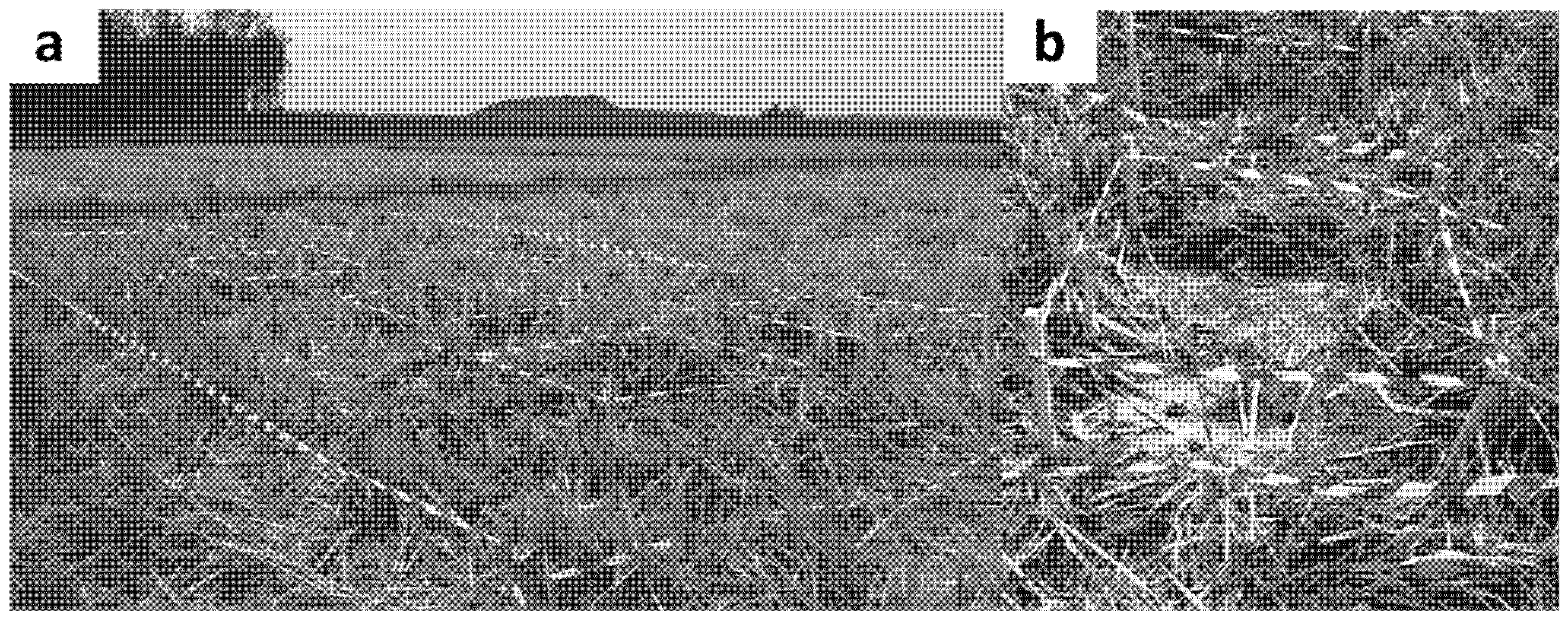
2.1. Experimental Setup in the Field
2.2. Experimental Setup in Mesocosms
2.2.1. Soil Sampling
2.2.2. Rhizomes Preparation for Transplanting and Mesocosm Trial
2.3. Soil Analyses
2.3.1. Physicochemical Parameters and Metal Concentrations
2.3.2. Potential Availability of Metals
2.3.3. Soil Biology
2.4. Plant Analysis
2.4.1. Growth Parameters
2.4.2. Concentration of Metals
2.5. Statistical Analysis
3. Results and Discussion
3.1. Soil Characteristics
3.2. Change in Soil Physical, Chemical and Biological Parameters of Amended Soils
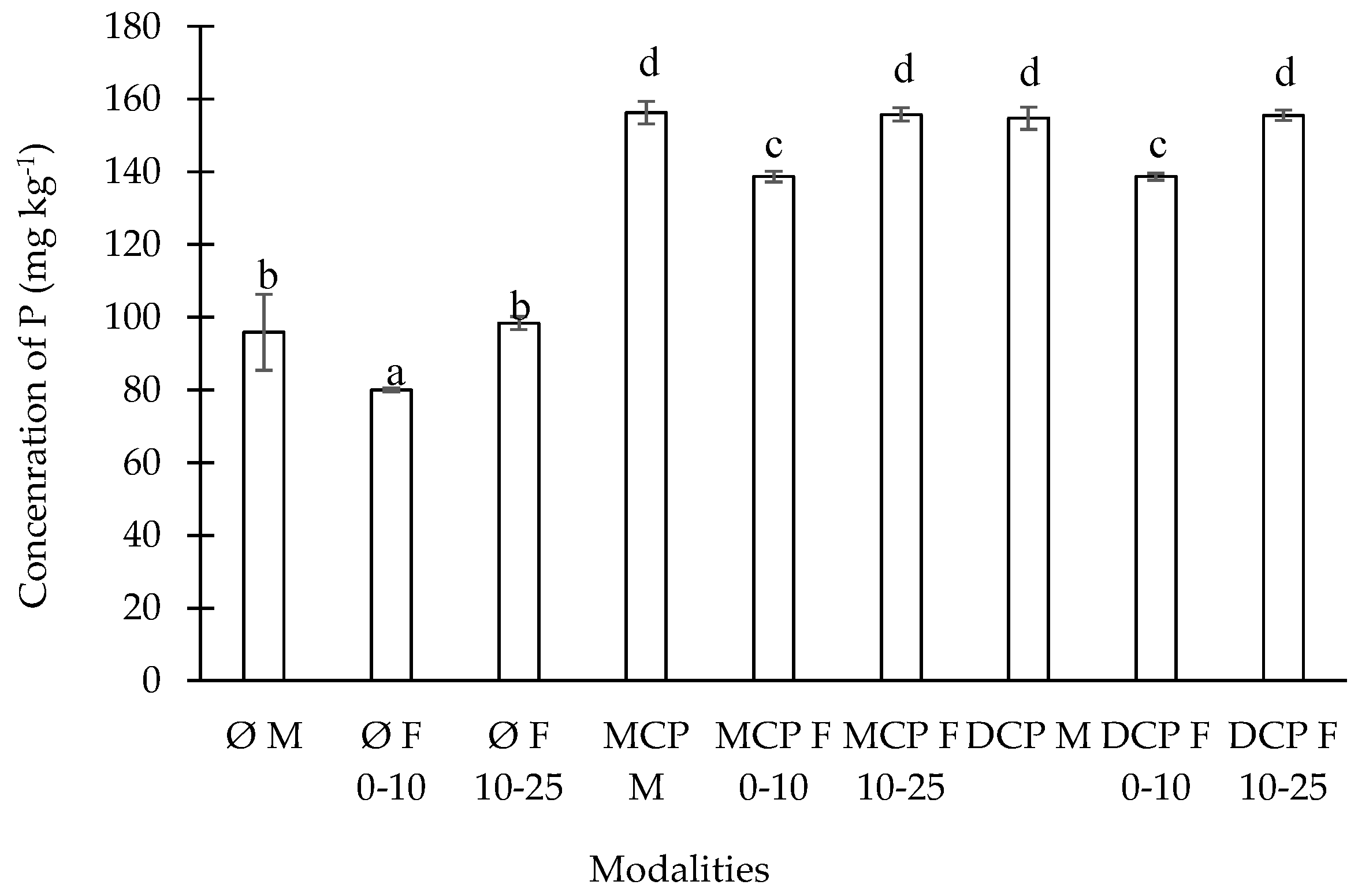
3.3. Effects of Phosphates on the Extractable Concentrations of Metals in Soil
3.4. Concentration of Metals in the Aerial Parts of Miscanthus × Giganteus
3.5. Effects of Phosphates on the Biomass of Miscanthus and the Bioconcentration Factor
4. Conclusions
Author Contributions
Funding
Conflicts of Interest
References
- Greiner, L.; Keller, A.; Grêt-Regamey, A.; Papritz, A. Soil function assessment: Review of methods for quantifying the contributions of soils to ecosystem services. Land Use Policy 2017, 69, 224–237. [Google Scholar] [CrossRef] [Scilit]
- Koch, A.; McBratney, A.; Adams, M.; Field, D.; Hill, R.; Crawford, J.; Minasny, B.; Lal, R.; Abbott, L.; O’Donnell, A.; et al. Soil Security: Solving the Global Soil Crisis. Glob. Policy 2013, 4, 434–441. [Google Scholar] [CrossRef] [Scilit]
- McBratney, A.; Field, D.J.; Koch, A. The dimensions of soil security. Geoderma 2014, 213, 203–213. [Google Scholar] [CrossRef] [Scilit]
- Kidd, P.; Mench, M.; Álvarez-López, V.; Bert, V.; Dimitriou, I.; Friesl-Hanl, W.; Herzig, R.; Janssen, J.O.; Kolbas, A.; Müller, I.; et al. Agronomic Practices for Improving Gentle Remediation of Trace Element-Contaminated Soils. Int. J. Phytoremediat. 2015, 17, 1005–1037. [Google Scholar] [CrossRef] [Scilit] [PubMed]
- Touceda-González, M.; Prieto-Fernández, Á.; Renella, G.; Giagnoni, L.; Sessitsch, A.; Brader, G.; Kumpiene, J.; Dimitriou, I.; Eriksson, J.; Friesl-Hanl, W.; et al. Microbial community structure and activity in trace element-contaminated soils phytomanaged by Gentle Remediation Options (GRO). Environ. Pollut. 2017, 231, 237–251. [Google Scholar] [CrossRef] [Scilit] [PubMed]
- Vangronsveld, J.; Herzig, R.; Weyens, N.; Boulet, J.; Adriaensen, K.; Ruttens, A.; Thewys, T.; Vassilev, A.; Meers, E.; Nehnevajova, E.; et al. Phytoremediation of contaminated soils and groundwater: Lessons from the field. Environ. Sci. Pollut. Res. 2009, 16, 765–794. [Google Scholar] [CrossRef] [Scilit]
- Mench, M.; Lepp, N.; Bert, V.; Schwitzguébel, J.-P.; Gawronski, S.W.; Schroeder, P.; Vangronsveld, J. Successes and limitations of phytotechnologies at field scale: Outcomes, assessment and outlook from COST Action 859. J. Soils Sediments 2010, 10, 1039–1070. [Google Scholar] [CrossRef] [Scilit]
- Nebeská, D.; Trögi, J.; Pidlisnyuk, V.; Popelka, J.; Dáňová, P.V.; Ust’ak, S.; Honzík, R. Effect of growing Miscanthus × giganteus on soil microbial communities in post-military soil. Sustainability 2018, 10, 4021. [Google Scholar] [CrossRef] [Scilit]
- Jones, M.; Walsh, M. Miscanthus: For Energy and Fibre, 1st ed.; Routledge: Abingdon, UK, 2000; p. 204. [Google Scholar]
- Moreno, M.; Rios, C.D.L.; Rowe, Z.O.; Charnley, F. A Conceptual Framework for Circular Design. Sustainability 2016, 8, 937. [Google Scholar] [CrossRef] [Scilit]
- Geissdoerfer, M.; Savaget, P.; Bocken, N.M.P.; Hultink, E.J. The circular economy—A new sustainability paradigm? J. Clean. Prod. 2017, 143, 757–768. [Google Scholar] [CrossRef] [Scilit]
- Janus, A.; Pelfrêne, A.; Sahmer, K.; Heymans, S.; Deboffe, C.; Douay, F.; Waterlot, C. Value of biochars from Miscanthus × giganteus cultivated on contaminated soils to decrease the availability of metals in multicontaminated aqueous solutions. Environ. Sci. Pollut. Res. 2017, 24, 18204–18217. [Google Scholar] [CrossRef] [Scilit] [PubMed]
- Korhonen, J.; Nuur, C.; Feldmann, A.; Birkie, S.E. Circular economy as an essentially contested concept. J. Clean. Prod. 2018, 175, 544–552. [Google Scholar] [CrossRef] [Scilit]
- Lewandowski, I.; Clifton-Brown, J.; Kiesel, A.; Hasting, A.; Iqbal, Y. Miscanthus. In Perennial Grasses for Bioenergy and Bioproducts: Production, Uses, Sustainability and Markets for Giant Reed, Miscanthus, Switchgrass, Reed Canary Grass and Bamboo; Academic Press: Cambridge, MA, USA, 2018; pp. 35–59. [Google Scholar]
- Nsanganwimana, F.; Pourrut, B.; Mench, M.; Douay, F. Suitability of Miscanthus species for managing inorganic and organic contaminated land and restoring ecosystem services. A review. J. Environ. Manag. 2014, 143, 123–134. [Google Scholar] [CrossRef] [Scilit] [PubMed]
- Anderson, E.; Arundale, R.; Maughan, M.; Oladeinde, A.; Wycislo, A.; Voigt, T. Growth and agronomy of Miscanthus × giganteus for biomass production. Biofuel 2011, 1, 71–87. [Google Scholar] [CrossRef] [Scilit]
- Christian, D.G.; Riche, A.B.; Yates, N.E. Growth, yield and mineral content of Miscanthus × giganteus grown as a biofuel for 14 successive harvests. Ind. Crop. Prod. 2008, 28, 320–327. [Google Scholar] [CrossRef] [Scilit]
- Fang, Y.; Cao, X.; Zhao, L. Effects of phosphorus amendments and plant growth on the mobility of Pb, Cu, and Zn in a multi-metal-contaminated soil. Environ. Sci. Pollut. Res. 2011, 19, 1659–1667. [Google Scholar] [CrossRef] [Scilit]
- Waterlot, C.; Pruvot, C.; Ciesielski, H.; Douay, F. Effects of a phosphorus amendment and the pH of water used for watering on the mobility and phytoavailability of Cd, Pb and Zn in highly contaminated kitchen garden soils. Ecol. Eng. 2011, 37, 1081–1093. [Google Scholar] [CrossRef] [Scilit]
- Nsanganwimana, F.; Pourrut, B.; Waterlot, C.; Louvel, B.; Bidar, G.; Labidi, S.; Fontaine, J.; Muchembled, J.; Lounès-Hadj Sahraoui, A.; Fourrier, H.; et al. Metal accumulation and shoot yield of Miscanthus × giganteus growing in contaminated agricultural soils: Insights into agronomic practices. Agric. Ecosyst. Environ. 2015, 213, 61–71. [Google Scholar] [CrossRef] [Scilit]
- Pelfrêne, A.; Kleckerova, A.; Pourrut, B.; Nsanganwimana, F.; Douay, F.; Waterlot, C. Effect of Miscanthus cultivation on metal fractionation and human bioaccessibility in metal-contaminated soils: Comparison between greenhouse and field experiments. Environ. Sci. Pollut. Res. 2014, 22, 3043–3054. [Google Scholar] [CrossRef] [Scilit]
- Nsanganwimana, F.; Waterlot, C.; Louvel, B.; Pourrut, B.; Douay, F. Metal, nutrient and biomass accumulation during the growing cycle of Miscanthus established on metal-contaminated soils. J. Plant Nutr. Soil Sci. 2016, 179, 257–269. [Google Scholar] [CrossRef] [Scilit]
- Al Souki, K.S.; Liné, C.; Louvel, B.; Waterlot, C.; Douay, F.; Pourrut, B. Miscanthus x giganteus culture on soils highly contaminated by metals: Modelling leaf decomposition impact on metal mobility and bioavailability in the soil–plant system. Ecotoxicol. Environ. Saf. 2020, 199, 110654. [Google Scholar] [CrossRef] [Scilit] [PubMed]
- Chen, S.-Y.; Ou, S.-F.; Teng, N.-C.; Kung, C.-M.; Tsai, H.-L.; Chu, K.-T.; Ou, K.-L. Phase transformation on bone cement: Monocalcium phosphate monohydrate into calcium-deficient hydroxyapatite during setting. Ceram. Int. 2013, 39, 2451–2455. [Google Scholar] [CrossRef] [Scilit]
- Ma, Q.Y.; Traina, S.J.; Logan, T.J.; Ryan, J.A. In situ lead immobilization by apatite. Environ. Sci. Technol. 1993, 27, 1803–1810. [Google Scholar] [CrossRef] [Scilit]
- AFNOR. Soil Quality—Determination of pH; NF ISO 10390; Association Française de Normalisation: Paris, France, 1994. [Google Scholar]
- Heiri, O.; Lotter, A.F.; Lemcke, G. Loss on ignition as a method for estimating organic and carbonate content in sediments: Reproducibility and comparability of results. J. Paleolimnol. 2001, 25, 101–110. [Google Scholar] [CrossRef] [Scilit]
- Waterlot, C. Alternative approach to the standard, measurements and testing programme used to establish phosphorus fractionation in soils. Anal. Chim. Acta 2018, 1003, 26–33. [Google Scholar] [CrossRef] [Scilit]
- Murphy, J.; Riley, J. A modified single solution method for the determination of phosphate in natural waters. Anal. Chim. Acta 1962, 27, 31–36. [Google Scholar] [CrossRef] [Scilit]
- Feng, M.-H.; Shan, X.-Q.; Zhang, S.-Z.; Wen, B. Comparison of a rhizosphere-based method with other one-step extraction methods for assessing the bioavailability of soil metals to wheat. Chemosphere 2005, 59, 939–949. [Google Scholar] [CrossRef] [Scilit]
- Green, V.; Stott, D.; Diack, M. Assay for fluorescein diacetate hydrolytic activity: Optimization for soil samples. Soil Biol. Biochem. 2006, 38, 693–701. [Google Scholar] [CrossRef] [Scilit]
- U.S. EPA. EPA Method 3050B: Acid Digestion of Sediments, Sludges, and Soils; Revision 2; U.S. EPA: Washington, DC, USA, 1996.
- Al Souki, K.S.; Louvel, B.; Douay, F.; Pourrut, B. Assessment of Miscanthus − giganteus capacity to restore the functionality of metal-contaminated soils: Ex situ experiment. Appl. Soil Ecol. 2017, 115, 44–52. [Google Scholar] [CrossRef] [Scilit]
- Firmin, S.; Labidi, S.; Fontaine, J.; Laruelle, F.; Tisserant, B.; Nsanganwimana, F.; Pourrut, B.; Dalpé, Y.; Grandmougin, A.; Douay, F.; et al. Arbuscular mycorrhizal fungal inoculation protects Miscanthus × giganteus against trace element toxicity in a highly metal-contaminated site. Sci. Total. Environ. 2015, 527, 91–99. [Google Scholar] [CrossRef] [Scilit]
- Hromádko, L.; Vranová, V.; Techer, D.; Laval-Gilly, R.; Rejšek, K.; Formánek, P.; Falla, J. Composition of root exudates of Miscanthus × giganteus Greef et Deu. Acta Univ. Agric. Silvic. Mendel. Brun. 2010, 58, 71–76. [Google Scholar] [CrossRef] [Scilit]
- Técher, D.; Laval-Gilly, P.; Henry, S.; Bennasroune, A.; Formanek, P.; Martinez-Chois, C.; D’Innocenzo, M.; Muanda, F.; Dicko, A.; Rejšek, K.; et al. Contribution of Miscanthus × giganteus root exudates to the biostimulation of PAH degradation: An in vitro study. Sci. Total. Environ. 2011, 409, 4489–4495. [Google Scholar] [CrossRef] [Scilit] [PubMed]
- Técher, D.; D’Innocenzo, M.; Laval-Gilly, P.; Henry, S.; Bennasroune, A.; Martinez-Chois, C.; Falla, J. Assessment of Miscanthus × giganteus secondary root metabolites for the biostimulation of PAH-utilizing soil bacteria. Appl. Soil Ecol. 2012, 62, 142–146. [Google Scholar] [CrossRef] [Scilit]
- Shelford, V.E. Some Concepts of Bioecology. Ecology 1931, 12, 455–467. [Google Scholar] [CrossRef] [Scilit]
- Beauregard, M.S.; Hamel, C.; Nayyar, A.; St-Arnaud, M. Long-Term Phosphorus Fertilization Impacts Soil Fungal and Bacterial Diversity but not AM Fungal Community in Alfalfa. Microb. Ecol. 2009, 59, 379–389. [Google Scholar] [CrossRef] [Scilit]
- Nihorimbere, V.; Ongena, M.; Smargiassi, M.; Thonart, P. Beneficial effect of the rhizosphere microbial community for plant growth and health. Biotechnol. Agron. Soc. Environ. 2011, 15, 327–337. [Google Scholar]
- Feng, X.; He, Y.; Fang, J.; Fang, Z.; Jiang, B.; Brancourt-Hulmel, M.; Zheng, B.; Jiang, D. Comparison of the growth and biomass production of Miscanthus sinensis, Miscanthus floridulus and Saccharum arundinaceum. Span. J. Agric. Res. 2015, 13, e0703. [Google Scholar] [CrossRef] [Scilit]
- Pavel, P.B.; Puschenreiter, M.; Wenzel, W.W.; Diacu, E.; Barbu, C.H. Aided phytostabilization using Miscanthus × giganteus on heavy metal-contaminated soils. Sci. Total Environ. 2014, 479–480, 125–131. [Google Scholar] [CrossRef] [Scilit]
- Laval-Gilly, P.; Henry, S.; Mazziotti, M.; Bonnefoy, A.; Comel, A.; Falla, J. Miscanthus × giganteus composition and potassium after culture on polluted soil and its use a bioluel. BioEnergy Res. 2017, 10, 846–852. [Google Scholar] [CrossRef] [Scilit]
- Ruf, T.; Schmidt, A.; Delfosse, P.; Emmerling, C. Harvest date of Miscanthus × giganteus affects nutrient cycling, biomass development and soil quality. Biomass Bioenergy 2017, 100, 62–73. [Google Scholar] [CrossRef] [Scilit]
- Adrees, M.; Ali, S.; Rizwan, M.; Zia-Ur-Rehman, M.; Ibrahim, M.; Abbas, F.; Farid, M.; Qayyum, M.F.; Irshad, M.K. Mechanisms of silicon-mediated alleviation of heavy metal toxicity in plants: A review. Ecotoxicol. Environ. Saf. 2015, 119, 186–197. [Google Scholar] [CrossRef] [Scilit] [PubMed]
- White, D.A.; Hafsteinsdóttir, E.G.; Gore, D.B.; Thorogood, G.; Stark, S.C. Formation and stability of Pb-, Zn- & Cu-PO4 phases at low temperatures: Implications for heavy metal fixation in polar environments. Environ. Pollut. 2012, 161, 143–153. [Google Scholar] [CrossRef] [Scilit] [PubMed]
- Hechelski, M.; Ghinet, A.; Louvel, B.; Dufrénoy, P.; Rigo, B.; Daïch, A.; Waterlot, C. From Conventional Lewis Acids to Heterogeneous Montmorillonite K10: Eco-Friendly Plant-Based Catalysts Used as Green Lewis Acids. ChemSusChem 2018, 11, 1249–1277. [Google Scholar] [CrossRef] [Scilit] [PubMed]
- Pidlisnyuk, V.; Erickson, L.E.; Trögl, J.; Shapoval, P.Y.; Popelka, J.; Davis, L.C.; Stefanovska, T.R.; Hettiarachchi, G.M. Metals uptake behavior in Miscanthus × giganteus plant during growth at the contaminated soil from the military site in Sliac, Slovakia. Pol. J. Chem. Technol. 2018, 20, 1–7. [Google Scholar] [CrossRef] [Scilit]
- Escande, V.; Olszewski, T.K.; Grison, C. Preparation of ecological catalysts derived from Zn hyperaccumulating plants and their catalytic activity in Diels-Alder reaction. C. R. Chim. 2014, 17, 731–737. [Google Scholar] [CrossRef] [Scilit]
- Grison, C.M.; Velati, A.; Escande, V.; Grison, C. Metallophytes for organic synthesis: Wards new bio-based selective protection/deprotection procedures. Environ. Sci. Pollut. Res. 2015, 22, 5686–5698. [Google Scholar] [CrossRef] [Scilit]
- Adepetu, J.A.; Corey, R.B. Organic phosphorus as a predictor of plant-available phosphorus in soils of Southern Nigeria. Soil Sci. 1976, 122, 159–164. [Google Scholar] [CrossRef] [Scilit]
- Sattell, R.R.; Morris, R.A. Phosphorus Fractions and Availability in Sri Lankan Alfisols. Soil Sci. Soc. Am. J. 1992, 56, 1510–1515. [Google Scholar] [CrossRef] [Scilit]
- Thien, S.J.; Myers, R. Determination of Bioavailable Phosphorus in Soil. Soil Sci. Soc. Am. J. 1992, 56, 814–818. [Google Scholar] [CrossRef] [Scilit]
- Paul, E.A. Soil Microbiology, Ecology and Biochemistry; Elsevier BV: Amsterdam, The Netherlands, 2015; pp. 171–190. [Google Scholar]
- Stevenson, F.J. Humus Chemistry: Genesis, Composition, Reactions; Wiley Interscience: New York, NY, USA, 1982; pp. 93–113. [Google Scholar]



| Before the Experimention (T = 0) | After the Experimentation (T = F) | ||||||||||||||||||
|---|---|---|---|---|---|---|---|---|---|---|---|---|---|---|---|---|---|---|---|
| pH | OM (%) | FDAH (mg kg−1) | pH | OM (%) | FDAH (mg kg−1) | ||||||||||||||
| Mesocosm experiment | Ø * | 7.7 | ± | 0.0 | 4.9 | ± | 0.6 | 0.03 | ± | 0.00 a | 7.9 | ± | 0.1 | 4.7 | ± | 0.2 | 0.13 | ± | 0.02 d |
| MCP ** | 7.7 | ± | 0.1 | 4.3 | ± | 1.6 | 0.02 | ± | 0.00 a | 7.8 | ± | 0.1 | 3.5 | ± | 0.9 | 0.14 | ± | 0.02 d | |
| DCP *** | 7.7 | ± | 0.1 | 4.4 | ± | 0.9 | 0.02 | ± | 0.00 a | 7.9 | ± | 0.1 | 4.6 | ± | 1.3 | 0.16 | ± | 0.02 d | |
| Field experiment (0–10 cm) | Ø * | 7.3 | ± | 0.4 | 4.5 | ± | 1.0 | 0.15 | ± | 0.04 bc | 7.4 | ± | 0.2 | 4.3 | ± | 0.3 | 0.13 | ± | 0.06 d |
| MCP ** | 7.4 | ± | 0.1 | 4.7 | ± | 0.5 | 0.14 | ± | 0.02 bc | 7.2 | ± | 0.1 | 4.2 | ± | 0.6 | 0.10 | ± | 0.01 d | |
| DCP *** | 7.3 | ± | 0.1 | 4.2 | ± | 1.0 | 0.13 | ± | 0.01 b | 7.3 | ± | 0.1 | 4.6 | ± | 0.2 | 0.10 | ± | 0.01 d | |
| Field experiment (10–25 cm) | Ø * | 7.7 | ± | 0.1 | 5.2 | ± | 1.1 | 0.15 | ± | 0.02 bc | 7.8 | ± | 0.1 | 5.2 | ± | 0.9 | 0.12 | ± | 0.05 d |
| MCP ** | 7.8 | ± | 0.1 | 4.7 | ± | 0.4 | 0.16 | ± | 0.01 bc | 7.6 | ± | 0.1 | 5.7 | ± | 0.8 | 0.09 | ± | 0.01 e | |
| DCP *** | 7.7 | ± | 0.0 | 5.0 | ± | 0.7 | 0.17 | ± | 0.01 c | 7.8 | ± | 0.0 | 4.5 | ± | 0.8 | 0.08 | ± | 0.00 e | |
| Metal Concentration (mg kg−1) | ||||||||||
|---|---|---|---|---|---|---|---|---|---|---|
| Ø * | MCP ** | DCP *** | ||||||||
| Mesocosm experiment | Cd | 13.9 | ± | 0.3 | 14.4 | ± | 1.5 | 14.7 | ± | 0.7 |
| Pb | 693 | ± | 16 | 722 | ± | 49 | 732 | ± | 20 | |
| Zn | 1093 | ± | 51 | 1164 | ± | 80 | 1219 | ± | 41 | |
| Cu | 33 | ± | 2 | 34 | ± | 2 | 34 | ± | 1 | |
| Mn | 344 | ± | 41 | 373 | ± | 78 | 392 | ± | 45 | |
| Fe | 11,399 | ± | 612 | 12,068 | ± | 885 | 11,908 | ± | 480 | |
| K | 1830 | ± | 81 | 1937 | ± | 185 | 1925 | ± | 101 | |
| Ca | 5197 | ± | 442 | 5097 | ± | 497 | 4114 | ± | 1824 | |
| Mg | 1466 | ± | 65 | 1552 | ± | 148 | 1542 | ± | 81 | |
| Field experiment (0–10 cm) | Cd | 13.4 | ± | 0.6 | 13.6 | ± | 0.3 | 14.3 | ± | 1.5 |
| Pb | 695 | ± | 29 | 720 | ± | 8 | 741 | ± | 110 | |
| Zn | 1087 | ± | 141 | 1133 | ± | 65 | 1065 | ± | 147 | |
| Cu | 32 | ± | 1 | 31 | ± | 0 | 33 | ± | 5 | |
| Mn | 302 | ± | 31 | 316 | ± | 22 | 315 | ± | 27 | |
| Fe | 12,726 | ± | 308 | 12,649 | ± | 380 | 13,561 | ± | 1198 | |
| K | 1751 | ± | 255 | 1676 | ± | 131 | 1804 | ± | 275 | |
| Ca | 4530 | ± | 556 | 4778 | ± | 394 | 5160 | ± | 269 | |
| Mg | 1643 | ± | 239 | 1572 | ± | 123 | 1693 | ± | 258 | |
| Field experiment (10–25 cm) | Cd | 13.9 | ± | 0.2 | 13.1 | ± | 1.1 | 13.2 | ± | 0.6 |
| Pb | 710 | ± | 12 | 677 | ± | 57 | 690 | ± | 42 | |
| Zn | 1072 | ± | 91 | 1022 | ± | 19 | 1049 | ± | 42 | |
| Cu | 31 | ± | 1 | 29 | ± | 3 | 30 | ± | 1 | |
| Mn | 331 | ± | 33 | 317 | ± | 29 | 313 | ± | 24 | |
| Fe | 12,882 | ± | 692 | 12,734 | ± | 564 | 12,703 | ± | 180 | |
| K | 1531 | ± | 102 | 1458 | ± | 78 | 1538 | ± | 49 | |
| Ca | 6031 | ± | 25 | 4948 | ± | 572 | 5631 | ± | 434 | |
| Mg | 1436 | ± | 96 | 1368 | ± | 73 | 1443 | ± | 46 | |
| Extractable Metal Concentrations before Planting (mg kg−1) | Extractable Metal Concentrations after Harvest (mg kg−1) | ||||||||||||||||||
|---|---|---|---|---|---|---|---|---|---|---|---|---|---|---|---|---|---|---|---|
| Ø * | MCP ** | DCP *** | Ø * | MCP ** | DCP *** | ||||||||||||||
| Mesocosm experiment | Cd | 1.8 | ± | 0.1 | 1.8 | ± | 0.1 | 1.9 | ± | 0.1 | 1.9 | ± | 0.0 | 1.8 | ± | 0.0 | 1.9 | ± | 0.0 |
| Pb | 5.3 | ± | 1.0 | 5.0 | ± | 0.5 | 5.0 | ± | 0.4 | 6.5 | ± | 0.5 | 6.0 | ± | 0.1 | 6.7 | ± | 0.1 | |
| Zn | 172 | ± | 13 | 153 | ± | 20 | 168 | ± | 24 | 172 | ± | 6 | 163 | ± | 7 | 163 | ± | 22 | |
| Cu | 1.1 | ± | 0.0 | 1.0 | ± | 0.1 | 1.0 | ± | 0.0 | 1.2 | ± | 0.1 | 1.2 | ± | 0.0 | 1.2 | ± | 0.0 | |
| Mn | 27 | ± | 3 a | 27 | ± | 1 a | 28 | ± | 2 a | 31 | ± | 1 b | 32 | ± | 1 b | 29 | ± | 2 b | |
| Fe | 191 | ± | 20 b | 190 | ± | 15 b | 201 | ± | 20 b | 196 | ± | 14 b | 185 | ± | 19 b | 152 | ± | 20 a | |
| K | 8.6 | ± | 0.4 | 8.2 | ± | 0.4 | 8.2 | ± | 0.4 | 6.0 | ± | 0.4 | 6.3 | ± | 0.3 | 5.4 | ± | 0.7 | |
| Na | 8.7 | ± | 1.8 | 7.7 | ± | 1.7 | 9.0 | ± | 0.9 | 8.7 | ± | 1.8 | 7.7 | ± | 1.7 | 9.0 | ± | 0.9 | |
| Ca | 85 | ± | 8 ab | 77 | ± | 6 a | 74 | ± | 9 a | 78 | ± | 4 a | 86 | ± | 3 b | 97 | ± | 11 b | |
| Mg | 1.5 | ± | 0.1 a | 1.9 | ± | 0.6 ab | 1.6 | ± | 0.2 a | 1.8 | ± | 0.2 ab | 2.1 | ± | 0.1 b | 2.3 | ± | 0.2 b | |
| Field experiment (0–10 cm) | Cd | 2.0 | ± | 0.2 | 2.0 | ± | 0.0 | 1.9 | ± | 0.3 | 1.9 | ± | 0.1 | 1.9 | ± | 0.1 | 1.9 | ± | 0.1 |
| Pb | 7.0 | ± | 0.5 | 6.8 | ± | 1.3 | 7.1 | ± | 1.4 | 5.2 | ± | 0.7 | 5.7 | ± | 0.6 | 6.1 | ± | 0.2 | |
| Zn | 198 | ± | 24 | 218 | ± | 38 | 209 | ± | 52 | 163 | ± | 56 | 204 | ± | 16 | 198 | ± | 9 | |
| Cu | 1.0 | ± | 0.2 | 1.0 | ± | 0.1 | 1.0 | ± | 0.3 | 1.0 | ± | 0.3 | 0.9 | ± | 0.1 | 1.1 | ± | 0.2 | |
| Mn | 42 | ± | 3 | 37 | ± | 4 | 39 | ± | 3 | 29 | ± | 9 | 32 | ± | 2 | 30 | ± | 6 | |
| Fe | 181 | ± | 68 | 190 | ± | 58 | 184 | ± | 15 | 207 | ± | 64 | 163 | ± | 12 | 144 | ± | 7 | |
| K | 6.6 | ± | 3.1 | 5.4 | ± | 2.0 | 6.2 | ± | 1.2 | 5.0 | ± | 2.7 | 4.5 | ± | 0.7 | 5.3 | ± | 2.1 | |
| Na | 1.1 | ± | 0.2 | 0.9 | ± | 0.1 | 1.0 | ± | 0.2 | 1.1 | ± | 0.2 | 1.2 | ± | 0.1 | 1.3 | ± | 0.2 | |
| Ca | 65 | ± | 14 ab | 63 | ± | 5 a | 75 | ± | 5 b | 64 | ± | 9 ab | 68 | ± | 2 ab | 70 | ± | 8 ab | |
| Mg | 1.7 | ± | 0.3 b | 1.3 | ± | 0.0 a | 1.7 | ± | 0.3 b | 1.6 | ± | 0.2 b | 1.5 | ± | 0.0 b | 1.6 | ± | 0.3 b | |
| Field experiment (10–25 cm) | Cd | 1.9 | ± | 0.1 | 1.9 | ± | 0.1 | 1.9 | ± | 0.1 | 1.7 | ± | 0.1 | 1.8 | ± | 0.1 | 1.7 | ± | 0.1 |
| Pb | 5.1 | ± | 1.4 | 6.7 | ± | 0.8 | 6.6 | ± | 0.3 | 5.5 | ± | 0.8 | 5.1 | ± | 0.5 | 4.0 | ± | 0.7 | |
| Zn | 124 | ± | 17 ac | 176 | ± | 34 b | 153 | ± | 51 ac | 159 | ± | 25 b | 168 | ± | 39 b | 103 | ± | 11 a | |
| Cu | 1.2 | ± | 0.1 | 1.3 | ± | 0.0 | 1.2 | ± | 0.1 | 1.1 | ± | 0.0 | 1.1 | ± | 0.1 | 1.2 | ± | 0.1 | |
| Mn | 29 | ± | 2 b | 29 | ± | 1 b | 26 | ± | 6 b | 25 | ± | 1 b | 25 | ± | 6 ab | 19 | ± | 2 a | |
| Fe | 85 | ± | 14 a | 126 | ± | 7 b | 125 | ± | 1 b | 115 | ± | 3 b | 127 | ± | 34 b | 75 | ± | 11 a | |
| K | 2.9 | ± | 0.3 | 2.4 | ± | 0.4 | 2.9 | ± | 0.4 | 3.0 | ± | 0.8 | 3.1 | ± | 0.3 | 2.9 | ± | 0.4 | |
| Na | 1.4 | ± | 0.2 | 1.1 | ± | 0.1 | 1.1 | ± | 0.1 | 1.3 | ± | 0.1 | 1.2 | ± | 0.1 | 1.2 | ± | 0.1 | |
| Ca | 98 | ± | 6 b | 83 | ± | 11 a | 80 | ± | 10 a | 89 | ± | 6 b | 82 | ± | 9 a | 94 | ± | 4 b | |
| Mg | 1.3 | ± | 0.1 | 1.2 | ± | 0.1 | 1.5 | ± | 0.4 | 1.4 | ± | 0.0 | 1.4 | ± | 0.0 | 1.4 | ± | 0.1 | |
| Metals Concentration of Metals in the Leaves of Miscanthus (mg kg−1) | Metals Concentration of Metals in the Stems of Miscanthus (mg kg−1) | ||||||||||||||||||
|---|---|---|---|---|---|---|---|---|---|---|---|---|---|---|---|---|---|---|---|
| Ø * | MCP ** | DCP *** | Ø * | MCP ** | DCP *** | ||||||||||||||
| Mesocosm experiment (n = 6) | Cd | 2.1 | ± | 0.6 | 2.5 | ± | 0.4 | 2.6 | ± | 0.6 | 4.4 | ± | 0.8 | 4.8 | ± | 1.1 | 5.2 | ± | 1.0 |
| Pb | 2.0 | ± | 0.5 | 2.4 | ± | 0.4 | 2.4 | ± | 0.6 | 4.3 | ± | 0.7 | 4.7 | ± | 1.0 | 5.1 | ± | 1.0 | |
| Zn | 47 | ± | 4 | 49 | ± | 4 | 51 | ± | 4 | 117 | ± | 19 | 119 | ± | 16 | 139 | ± | 9 | |
| Cu | 5.6 | ± | 0.2 | 5.7 | ± | 0.3 | 5.7 | ± | 0.1 | 4.4 | ± | 0.2 | 4.4 | ± | 0.3 | 4.4 | ± | 0.3 | |
| Mn | 7.8 | ± | 1.7 | 8.8 | ± | 0.7 | 9.8 | ± | 2.0 | 10.6 | ± | 2.5 ab | 10.4 | ± | 1 a | 13.6 | ± | 2.0 b | |
| Fe | 44 | ± | 7 | 63 | ± | 20 | 53 | ± | 12 | 42.7 | ± | 6.5 | 33.9 | ± | 7.7 | 55.5 | ± | 12.5 | |
| K | 7015 | ± | 673 | 7561 | ± | 909 | 7592 | ± | 1116 | 12,080 | ± | 2518 | 12,014 | ± | 744 | 11,798 | ± | 1747 | |
| Na | 30 | ± | 8 a | 16 | ± | 1 b | 15 | ± | 1 b | 21.8 | ± | 2.8 | 20.5 | ± | 3.7 | 23.6 | ± | 4.9 | |
| Ca | 7452 | ± | 1251 | 7976 | ± | 528 | 7946 | ± | 1033 | 2313 | ± | 91 | 2525 | ± | 489 | 2754 | ± | 637 | |
| Mg | 387 | ± | 71 | 391 | ± | 58 | 417 | ± | 70 | 348 | ± | 24 | 390 | ± | 38 | 404 | ± | 54 | |
| Si | 120 | ± | 36 | 82 | ± | 9 | 88 | ± | 34 | 115 | ± | 29 | 133 | ± | 27 | 134 | ± | 24 | |
| Al | 20.6 | ± | 5.5 | 25.4 | ± | 9.3 | 20.8 | ± | 8.5 | 9.2 | ± | 4.6 | 6.5 | ± | 2.3 | 10.3 | ± | 4.3 | |
| Field experiment (n = 3) | Cd | 1.0 | ± | 0.1 | 0.9 | ± | 0.2 | 0.9 | ± | 0.2 | 1.5 | ± | 0.2 | 1.5 | ± | 0.1 | 1.5 | ± | 0.3 |
| Pb | 0.9 | ± | 0.1 | 0.9 | ± | 0.2 | 0.9 | ± | 0.2 | 1.5 | ± | 0.2 | 1.5 | ± | 0.1 | 1.4 | ± | 0.2 | |
| Zn | 43 | ± | 4 ab | 38 | ± | 1 a | 43 | ± | 2 b | 42 | ± | 3 | 38 | ± | 8 | 38 | ± | 5 | |
| Cu | 7.1 | ± | 0.3 | 6.9 | ± | 0.3 | 7.0 | ± | 0.5 | 5.4 | ± | 0.7 | 4.9 | ± | 0.3 | 4.9 | ± | 0.2 | |
| Mn | 17 | ± | 2 | 17 | ± | 2 | 20 | ± | 4 | 13 | ± | 5 | 9 | ± | 1 | 9 | ± | 0 | |
| Fe | 58 | ± | 4 b | 53 | ± | 3 ab | 51 | ± | 2 a | 22 | ± | 4 | 25 | ± | 6 | 26 | ± | 6 | |
| K | 12,765 | ± | 943 | 14,435 | ± | 1503 | 13,982 | ± | 2811 | 11,904 | ± | 1179 | 13,149 | ± | 491 | 13,961 | ± | 1691 | |
| Na | 31 | ± | 3 | 33 | ± | 4 | 35 | ± | 7 | 23 | ± | 5 | 20 | ± | 1 | 21 | ± | 2 | |
| Ca | 6816 | ± | 879 | 5715 | ± | 559 | 6779 | ± | 778 | 1 053 | ± | 256 | 1031 | ± | 56 | 1100 | ± | 227 | |
| Mg | 582 | ± | 90 | 591 | ± | 141 | 644 | ± | 179 | 259 | ± | 57 | 272 | ± | 20 | 246 | ± | 19 | |
| Si | 170 | ± | 27 | 150 | ± | 10 | 171 | ± | 34 | 186 | ± | 26 | 196 | ± | 23 | 157 | ± | 60 | |
| Al | 8.8 | ± | 1.6 | 9.2 | ± | 0.9 | 9.1 | ± | 1.5 | 8.6 | ± | 2.8 | 7.0 | ± | 1.3 | 6.9 | ± | 3.6 | |
| Bioconcentration Factor BFleaves | Bioconcentration Factor BFstems | ||||||
|---|---|---|---|---|---|---|---|
| Ø * | MCP ** | DCP *** | Ø * | MCP ** | DCP *** | ||
| Mesocosm experiment | Cd | 0.15 | 0.18 | 0.18 | 0.31 | 0.33 | 0.36 |
| Pb | 0.00 | 0.00 | 0.00 | 0.01 | 0.01 | 0.01 | |
| Zn | 0.04 | 0.04 | 0.04 | 0.11 | 0.10 | 0.11 | |
| Cu | 0.17 | 0.17 | 0.17 | 0.13 | 0.13 | 0.13 | |
| Mn | 0.02 | 0.02 | 0.02 | 0.03 | 0.03 | 0.03 | |
| Fe | 0.00 | 0.01 | 0.00 | 0.00 | 0.00 | 0.00 | |
| K | 3.83 | 3.90 | 3.94 | 6.60 | 6.20 | 6.13 | |
| Ca | 1.43 | 1.56 | 1.93 | 0.44 | 0.50 | 0.67 | |
| Mg | 0.26 | 0.25 | 0.27 | 0.24 | 0.25 | 0.26 | |
| Field experiment (0–10 cm) | Cd | 0.07 | 0.07 | 0.06 | 0.11 | 0.11 | 0.10 |
| Pb | 0.00 | 0.00 | 0.00 | 0.00 | 0.00 | 0.00 | |
| Zn | 0.04 | 0.03 | 0.04 | 0.04 | 0.03 | 0.04 | |
| Cu | 0.23 | 0.22 | 0.21 | 0.17 | 0.16 | 0.15 | |
| Mn | 0.06 | 0.05 | 0.06 | 0.04 | 0.03 | 0.03 | |
| Fe | 0.00 | 0.00 | 0.00 | 0.00 | 0.00 | 0.00 | |
| K | 7.29 | 8.62 | 7.75 | 6.80 | 7.85 | 7.74 | |
| Ca | 1.50 | 1.20 | 1.31 | 0.23 | 0.22 | 0.21 | |
| Mg | 0.35 | 0.38 | 0.38 | 0.16 | 0.17 | 0.15 | |
Publisher’s Note: MDPI stays neutral with regard to jurisdictional claims in published maps and institutional affiliations. |
© 2020 by the authors. Licensee MDPI, Basel, Switzerland. This article is an open access article distributed under the terms and conditions of the Creative Commons Attribution (CC BY) license (http://creativecommons.org/licenses/by/4.0/).
Share and Cite
Hechelski, M.; Louvel, B.; Dufrénoy, P.; Ghinet, A.; Waterlot, C. Toward a New Way for the Valorization of Miscanthus Biomass Produced on Metal-Contaminated Soils Part 1: Mesocosm and Field Experiments. Sustainability 2020, 12, 9370. https://doi.org/10.3390/su12229370
Hechelski M, Louvel B, Dufrénoy P, Ghinet A, Waterlot C. Toward a New Way for the Valorization of Miscanthus Biomass Produced on Metal-Contaminated Soils Part 1: Mesocosm and Field Experiments. Sustainability. 2020; 12(22):9370. https://doi.org/10.3390/su12229370
Chicago/Turabian StyleHechelski, Marie, Brice Louvel, Pierrick Dufrénoy, Alina Ghinet, and Christophe Waterlot. 2020. "Toward a New Way for the Valorization of Miscanthus Biomass Produced on Metal-Contaminated Soils Part 1: Mesocosm and Field Experiments" Sustainability 12, no. 22: 9370. https://doi.org/10.3390/su12229370
APA StyleHechelski, M., Louvel, B., Dufrénoy, P., Ghinet, A., & Waterlot, C. (2020). Toward a New Way for the Valorization of Miscanthus Biomass Produced on Metal-Contaminated Soils Part 1: Mesocosm and Field Experiments. Sustainability, 12(22), 9370. https://doi.org/10.3390/su12229370