Valorisation of Natural Resources and the Need for Economic and Sustainability Assessment: The Case of Cocoa Pod Husk in Indonesia


 ,
,  ,
,
Abstract
1. Introduction
2. Materials and Methods
2.1. Economic Viability Assessment
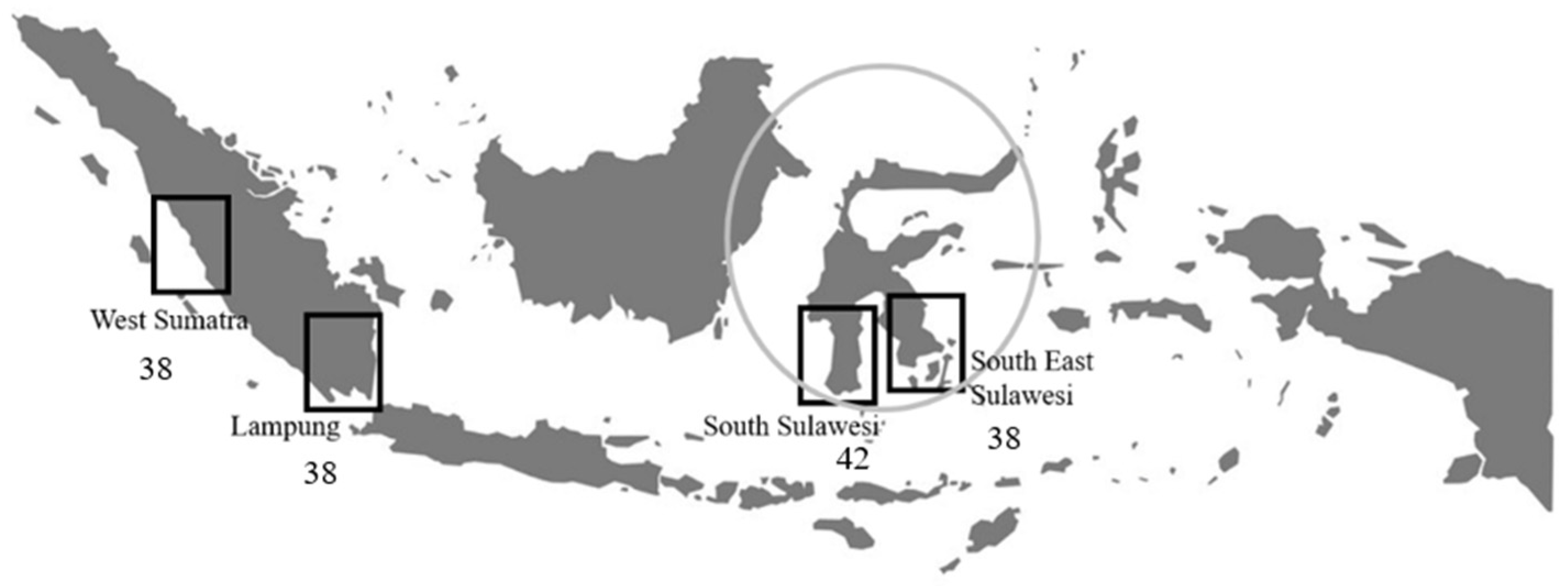
- Exploratory survey, designed and administered to a small sample of the farmers to provide an initial understanding of CPH practices in Sulawesi, which informs the design of the DCE;
- Focus Group Discussions to identify compensation levels to process CPH;
- Design and deployment of DCE survey.
2.1.1. Exploratory Survey
2.1.2. Focus Group Discussions (FGD)
2.1.3. Design and Deployment of DCE
- (a)
- Collect;
- (b)
- Collect and Transport;
- (c)
- Collect and Chop;
- (d)
- Collect, Chop and Transport;
- (e)
- Collect, Chop and Dry;
- (f)
- Collect, Chop, Dry and Transport.
2.2. Soil Quality Assessment
2.2.1. Field Trial Design and Assessment Methods
2.2.2. Harvesting and Sample Collection
2.2.3. Assessment of C and Nutrient Cycling in Soil
3. Results
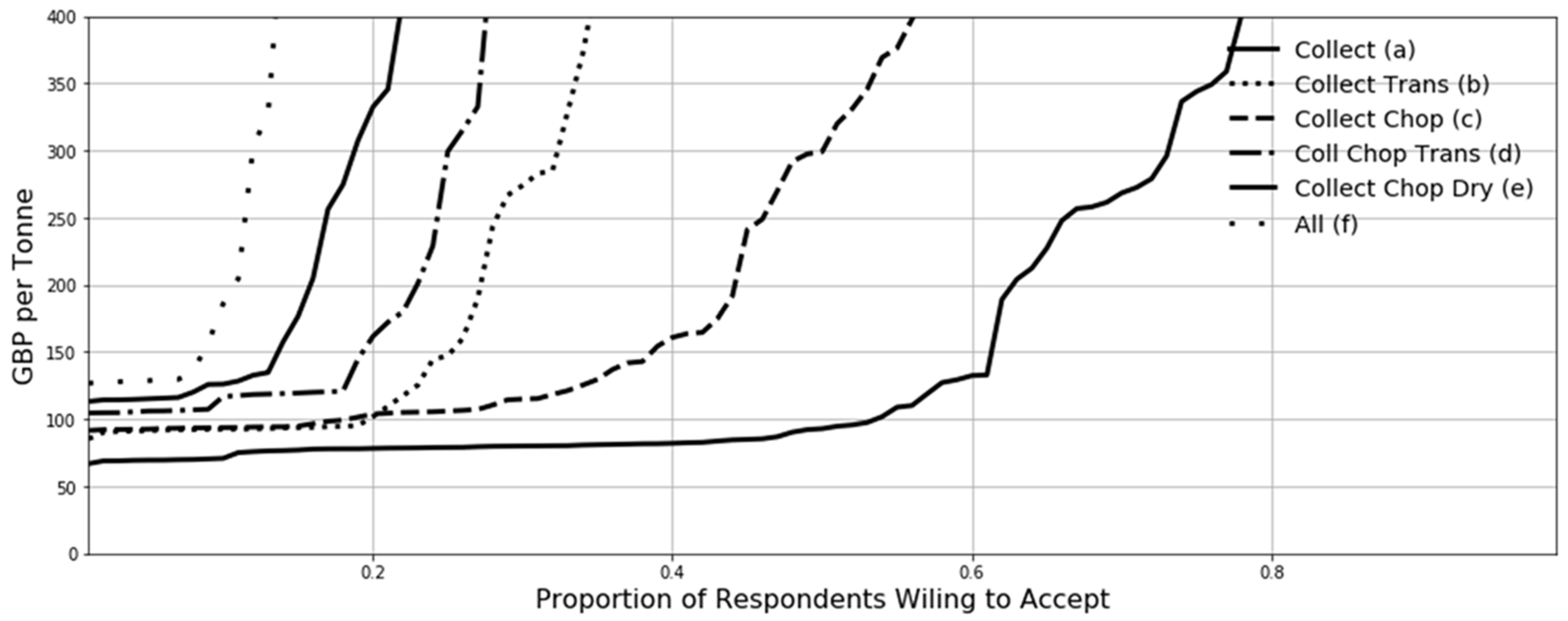
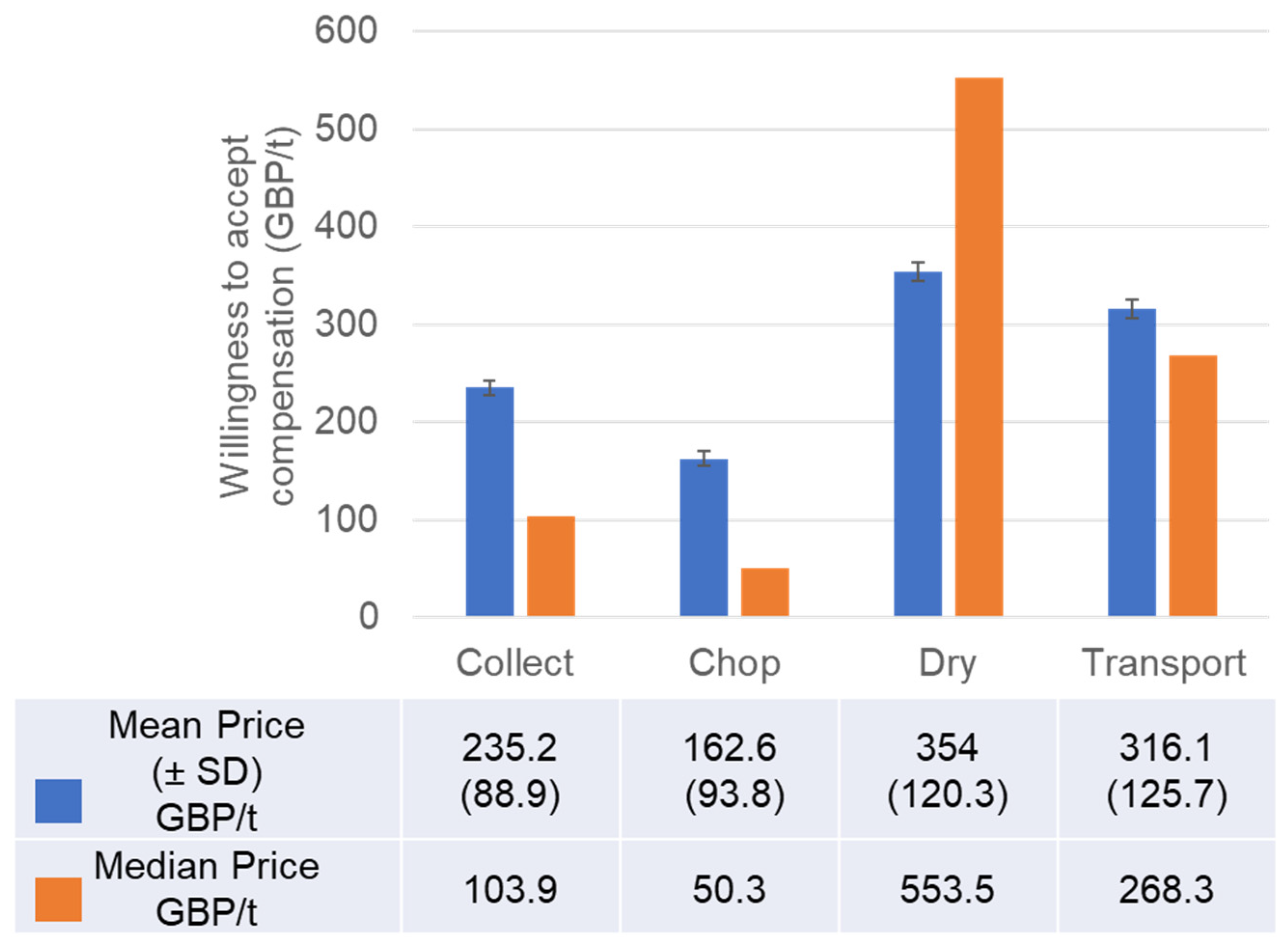
3.1. Economic Viability Assessment
3.2. Soil Quality Assessment
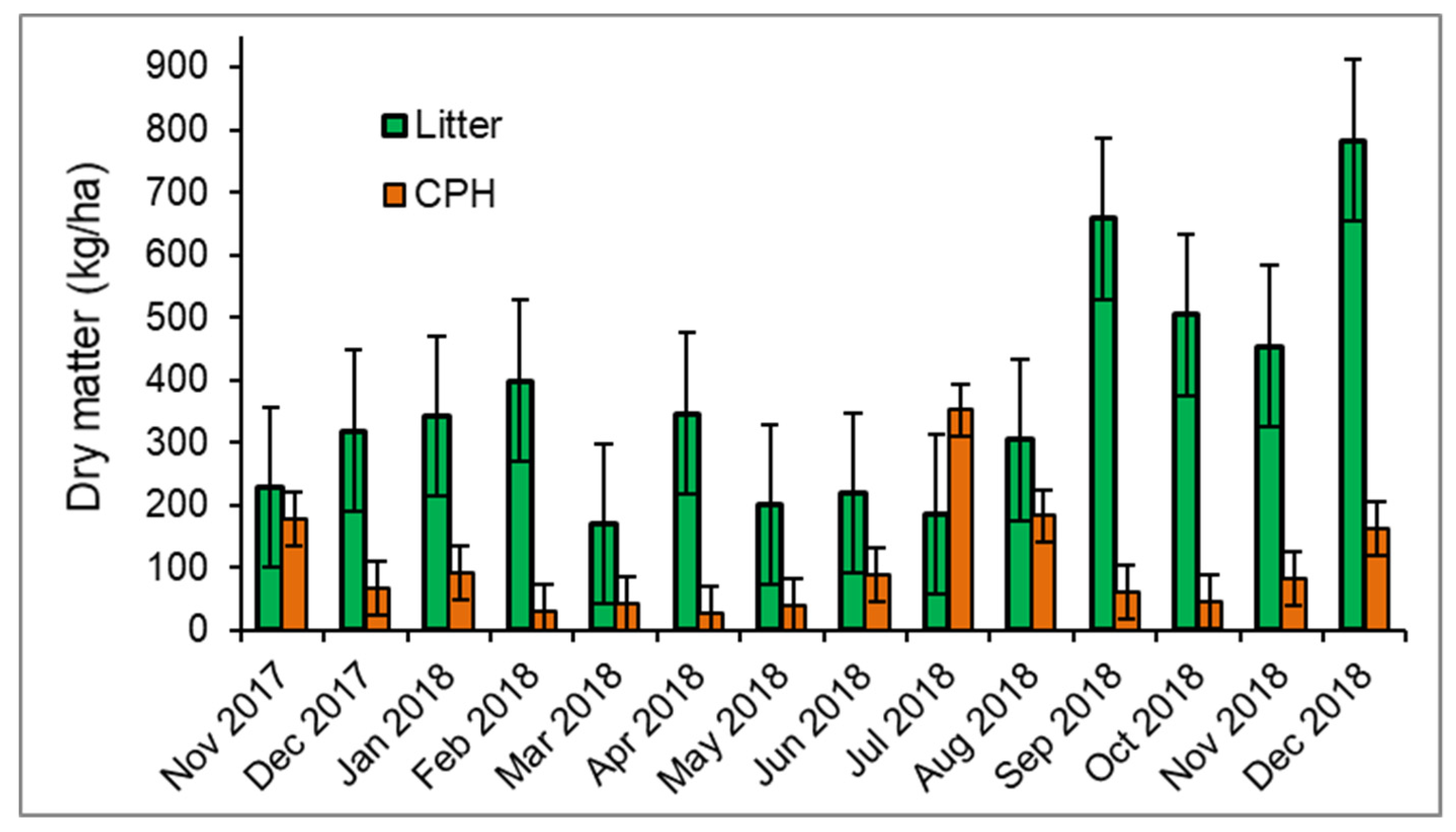
3.2.1. Crop Performance
3.2.2. Nutrient Cycling and Sustainability
4. Discussion and Conclusions
Supplementary Materials
Author Contributions
Funding
Acknowledgments
Conflicts of Interest
Appendix A
Appendix B
Appendix C
Appendix C.1. Nutrient Cycling Materials and Methods
Appendix C.2. Litter Contributions by Cocoa and Shade Trees

| C | N | P | K | Ca | Mg | |
|---|---|---|---|---|---|---|
| Cocoa litter | 332 | 9.60 | 0.78 | 3.88 | 18.28 | 4.27 |
| Shade litter | 505 | 19.88 | 1.33 | 6.35 | 13.80 | 3.42 |
| CPH | 301 | 6.71 | 0.69 | 28.46 | 4.09 | 2.46 |
| (SD) | 160 | 5.6 | 0.32 | 3.55 | 4.67 | 1.17 |
References
- Babulo, B.; Muys, B.; Nega, F.; Tollens, E.; Nyssen, J.; Deckers, J.; Mathijs, E. Household livelihood strategies and forest dependence in the highlands of Tigray, Northern Ethiopiao. Agric. Syst. 2008, 98, 147–155. [Google Scholar] [CrossRef]
- Cavendish, W. Empirical regularities in the poverty–environment relationship of rural households: Evidence from Zimbabwe. World Dev. 2000, 28, 1979–2003. [Google Scholar] [CrossRef]
- Davis, B.; Winters, P.; Carletto, G.; Covarrubias, K.; Quinõnes, E.J.; Zezza, A.; Digiuseppe, S. A cross-country comparison of rural income generating activities. World Dev. 2010, 38, 48–63. [Google Scholar] [CrossRef]
- Ellis, F. Household strategies and rural livelihood diversification. J. Dev. Stud. 1998, 35, 1–38. [Google Scholar] [CrossRef]
- de Sherbinin, A.; VanWey, L.K.; McSweeney, K.; Aggarwal, R.; Barbieri, A.; Henry, S.; Hunter, L.M.; Twine, W.; Walker, R. Rural household demographics, livelihoods and the environment. Glob. Environ. Chang. 2008, 18, 38–53. [Google Scholar] [CrossRef] [PubMed]
- Garcia-Garcia, G.; Stone, J.; Rahimifard, S. Opportunities for waste valorisation in the food industry—A case study with four UK food manufacturers. J. Clean. Prod. 2019, 211, 1339–1356. [Google Scholar] [CrossRef]
- IES Feeding the Nine Billion; The Institution of Environmental Sciences: London, UK, 2017.
- Nasirumbi Sanya, L.; Birungi Kyazze, F.; Sseguya, H.; Kibwika, P.; Baguma, Y. Complexity of agricultural technology development processes: Implications for uptake of new hybrid banana varieties in Central Uganda. Cogent Food Agric. 2017, 3, 1–18. [Google Scholar] [CrossRef]
- Fei, L.; Rodriguez-Garcia, J.; Van Damme, I.; Westwood Nicholas, J.; Shaw, L.; Robinson, J.S.; Warren, G.; Chatzifragkou, A.; McQueen Mason, S.; Gomez, L.; et al. Valorisation strategies for cocoa pod husk and its fractions. Green Sustain. Chem. 2018, 14, 80–88. [Google Scholar] [CrossRef]
- Garb, Y.; Friedlander, L. From transfer to translation: Using systemic understandings of technology to understand drip irrigation uptake. Agric. Syst. 2014, 128, 13–24. [Google Scholar] [CrossRef]
- Hartemink, A.E. Nutrient stocks, nutrient cycling, and soil changes in cocoa ecosystems: A review. Adv. Agron. 2005, 86, 227–253. [Google Scholar]
- van Vliet, J.A.; Giller, K.E. Mineral nutrition of cocoa: A review. Adv. Agron. 2017, 141, 185–270. [Google Scholar] [CrossRef]
- Turmel, M.S.; Speratti, A.; Baudron, F.; Verhulst, N.; Govaerts, B. Crop residue management and soil health: A systems analysis. Agric. Syst. 2015, 134, 6–16. [Google Scholar] [CrossRef]
- Fontes, A.G.; Gama-Rodrigues, A.C.; Gama-Rodrigues, E.F.; Sales, M.V.S.; Costa, M.G.; Machado, R.C.R. Nutrient stocks in litterfall and litter in cocoa agroforests in Brazil. Plant. Soil 2014, 383, 313–335. [Google Scholar] [CrossRef]
- FAO Cocoa Production Statistics. Available online: http://www.fao.org/faostat/en/#home (accessed on 21 April 2019).
- Witjaksono, J. Cocoa farming system in indonesia and its sustainability under climate change. Agric. For. Fish. 2016, 5, 170. [Google Scholar] [CrossRef][Green Version]
- Hoffmann, M.P.; Cock, J.; Samson, M.; Janetski, N.; Janetski, K.; Rötter, R.P.; Fisher, M.; Oberthür, T. Fertilizer management in smallholder cocoa farms of Indonesia under variable climate and market prices. Agric. Syst. 2020, 178, 102759. [Google Scholar] [CrossRef]
- Wood, G.A.; Lass, R.A. Cocoa, 4th ed.; Longman: London, UK, 1986. [Google Scholar]
- Hertel, D.; Harteveld, M.A.; Leuschner, C. Conversion of a tropical forest into agroforest alters the fine root-related carbon flux to the soil. Soil Biol. Biochem. 2009, 41, 481–490. [Google Scholar] [CrossRef]
- Sokol, N.W.; Kuebbing, S.E.; Karlsen-Ayala, E.; Bradford, M.A. Evidence for the primacy of living root inputs, not root or shoot litter, in forming soil organic carbon. New Phytol. 2019, 221, 233–246. [Google Scholar] [CrossRef]
- Xu, S.; Liu, L.L.; Sayer, E.J. Variability of above-ground litter inputs alters soil physicochemical and biological processes: A meta-analysis of litterfall-manipulation experiments. Biogeosciences 2013, 10, 7423–7433. [Google Scholar] [CrossRef]
- Leff, J.W.; Wieder, W.R.; Taylor, P.G.; Townsend, A.R.; Nemergut, D.R.; Grandy, A.S.; Cleveland, C.C. Experimental litterfall manipulation drives large and rapid changes in soil carbon cycling in a wet tropical forest. Glob. Chang. Biol. 2012, 18, 2969–2979. [Google Scholar] [CrossRef]
- Dawoe, E.K.; Isaac, M.E.; Quashie-Sam, J. Litterfall and litter nutrient dynamics under cocoa ecosystems in lowland humid Ghana. Palnt Soil 2010, 330, 55–64. [Google Scholar] [CrossRef]
- Tondoh, J.E.; Kouamé, F.N.G.; Martinez Guéi, A.; Sey, B.; Wowo Koné, A.; Gnessougou, N. Ecological changes induced by full-sun cocoa farming in CÔte d’Ivoire. Glob. Ecol. Conserv. 2015, 3, 575–595. [Google Scholar] [CrossRef]
- Veldkamp, E.; Purbopuspito, J.; Corre, M.D.; Brumme, R.; Murdiyarso, D. Land use change effects on trace gas fluxes in the forest margins of Central Sulawesi, Indonesia. J. Geophys. Res. 2008, 113. [Google Scholar] [CrossRef]
- Köhler, S.; Jungkunst, H.F.; Gutzler, C.; Herrera, R.; Gerold, G. Atmospheric ionic deposition in tropical sites of central sulawesi determined by ion exchange resin collectors and bulk water collector. Water. Air. Soil Pollut. 2012, 223, 4485–4494. [Google Scholar] [CrossRef] [PubMed]
- Petry, J.F.; Sebastião, S.A.; Martins, E.G.; de Barros, P.B.A. Innovation and the Diffusion of Technology in Agriculture in Floodplains in the State of Amazonas. RAC Rev. Adm. Contemp. 2019, 23, 619–635. [Google Scholar] [CrossRef]
- Hall, A.; Bockett, G.; Taylor, S.; Sivamohan, M.V.; Clark, N. Why research partnerships really matter: Innovation theory, institutional arrangements and implications for developing new technology for the poor. World Dev. 2001, 29, 783–797. [Google Scholar] [CrossRef]
- Klerkx, L.; Leeuwis, C. Establishment and embedding of innovation brokers at different innovation system levels: Insights from the Dutch agricultural sector. Technol. Forecast. Soc. Chang. 2009, 76, 849–860. [Google Scholar] [CrossRef]
- van Mierlo, B.; Leeuwis, C.; Smits, R.; Woolthuis, R.K. Learning towards system innovation: Evaluating a systemic instrument. Technol. Forecast. Soc. Chang. 2010, 77, 318–334. [Google Scholar] [CrossRef]
- Pigford, A.A.E.; Hickey, G.M.; Klerkx, L. Beyond agricultural innovation systems? Exploring an agricultural innovation ecosystems approach for niche design and development in sustainability transitions. Agric. Syst. 2018, 164, 116–121. [Google Scholar] [CrossRef]


| Collect | Chop | Dry | Transport | |
|---|---|---|---|---|
| GBP/t | ||||
| Median Lower Limit | 36.4 | 25.5 | 52.4 | 52.0 |
| Median Upper Limit | 59.7 | 26.0 | 78.0 | 70.2 |
| Mean | SD | |
|---|---|---|
| Age of respondents (years) | 48.8 | (11.87) |
| Household size | 4.45 | (1.59) |
| Number of adults (>15 years old) | 3.36 | (1.34) |
| Number of children (<=15 years old) | 1.09 | (1.07) |
| Total land holding (ha) | 1.67 | (1.67) |
| Total size of cocoa farm (ha) | 1.07 | (0.96) |
| Age of cocoa trees (years) | 12.91 | (7.63) |
| Distance from nearest market (km) | 7.63 | (8.74) |
| Cocoa beans produced last year (dry, kg) | 366.28 | (472.72) |
| Percentage of: | ||
| Male respondents | 61% | |
| Farmers using CPH as fertilizer | 50% | |
| Farmers using CPH as animal feed | 16% | |
| Number of households | 156 |
| Element | Nutrient cycle Component | Scenario | |||||||
|---|---|---|---|---|---|---|---|---|---|
| Litter | Prunings | Fertilizer | CPH | Bean | 1 | 2 | 3 | (SD) | |
| C | 1791 | 935 | 0 | 504 | n/a | 3230 | 2726 | 2726 | 369 |
| N | 58 | 26 | 82 | 11 | 27 | 56 | 45 | −38 | 3.2 |
| P | 4 | 3 | 92 | 1 | 6 | 86 | 85 | −8 | 0.3 |
| K | 21 | 35 | 155 | 46 | 14 | 141 | 94 | −61 | 5.0 |
| Ca | 75 | 27 | 330 | 7 | 1 | 328 | 322 | −8 | 1.0 |
| Mg | 18 | 10 | 115 | 4 | 4 | 111 | 107 | −8 | 0.4 |
Publisher’s Note: MDPI stays neutral with regard to jurisdictional claims in published maps and institutional affiliations. |
© 2020 by the authors. Licensee MDPI, Basel, Switzerland. This article is an open access article distributed under the terms and conditions of the Creative Commons Attribution (CC BY) license (http://creativecommons.org/licenses/by/4.0/).
Share and Cite
Picchioni, F.; Warren, G.P.; Lambert, S.; Balcombe, K.; Robinson, J.S.; Srinivasan, C.; D. Gomez, L.; Faas, L.; Westwood, N.J.; Chatzifragkou, A.; et al. Valorisation of Natural Resources and the Need for Economic and Sustainability Assessment: The Case of Cocoa Pod Husk in Indonesia. Sustainability 2020, 12, 8962. https://doi.org/10.3390/su12218962
Picchioni F, Warren GP, Lambert S, Balcombe K, Robinson JS, Srinivasan C, D. Gomez L, Faas L, Westwood NJ, Chatzifragkou A, et al. Valorisation of Natural Resources and the Need for Economic and Sustainability Assessment: The Case of Cocoa Pod Husk in Indonesia. Sustainability. 2020; 12(21):8962. https://doi.org/10.3390/su12218962
Chicago/Turabian StylePicchioni, Fiorella, Geoffrey P. Warren, Smilja Lambert, Kelvin Balcombe, J. Steve Robinson, Chittur Srinivasan, Leonardo D. Gomez, Laura Faas, Nicholas J. Westwood, Afroditi Chatzifragkou, and et al. 2020. "Valorisation of Natural Resources and the Need for Economic and Sustainability Assessment: The Case of Cocoa Pod Husk in Indonesia" Sustainability 12, no. 21: 8962. https://doi.org/10.3390/su12218962
APA StylePicchioni, F., Warren, G. P., Lambert, S., Balcombe, K., Robinson, J. S., Srinivasan, C., D. Gomez, L., Faas, L., Westwood, N. J., Chatzifragkou, A., Charalampopoulos, D., & Shaw, L. J. (2020). Valorisation of Natural Resources and the Need for Economic and Sustainability Assessment: The Case of Cocoa Pod Husk in Indonesia. Sustainability, 12(21), 8962. https://doi.org/10.3390/su12218962