Abstract
Consumers are paying close attention to green products to reduce the environmental impact on health issues. As the scope of this research, this current study focuses on determining consumers’ purchase decisions regarding green products using a survey conducted in a fast-growing developing country. This research was descriptive and considered a conceptual framework for extending the Theory of Planned Behavior (TPB), which was selected as the primary theoretical model. The significant contributions and main objectives of this study are as follows—to explore the present scenario of green marketing in Bangladesh with previous studies, and to fill a research gap regarding green purchase decisions by applying the TPB model with adding additional constructs, such as environmental concerns, green perceived quality, and future green estimates. A range of qualitative and quantitative techniques were adopted to collect data from the target groups, where a sample of young educated Bangladeshi consumers (n = 638) was used to consider the measurement and structural models by applying a partial least squares-structural equation modelling (PLS-SEM) method. The empirical findings show that consumers’ environmental concern (EC), green perceived benefits (GPB), green awareness of price (GAP), green willingness to purchase (GWP), and future estimation of green marketing (GFE) have a strong positive influence on consumer’ green purchase decision (GPD). Still, the green perceived quality (GPQ) has a negative influence on green purchase decisions (GPD). To inform consumers about green or eco-friendly products, this study provides valuable suggestions to companies, marketers, and policymakers for designing green marketing tools such as green advertising, green branding, and eco-labels. Based on these findings, it gives some managerial insights for the promotion of green products and green marketing.
1. Introduction
It is well-known that ever-increasing business activities and production are globally polluting the natural environment (e.g., damage to people, wildlife, and crops). In this world, human needs are unlimited, but resources are limited. Thus, it is inevitable that marketers need to utilize limited resources efficiently and effectively so that individual and organizational goals can be achieved without spoiling many resources. Green marketing recommends using eco-friendly products, e.g., refillable, ozone friendly, healthy food, phosphate-free and recyclable products. Moreover, green marketing can be applied in environmentally friendly ways to satisfy the customers’ needs, wants, and demands by protecting the environment and society [1,2].
In the twenty-first century, some environmental issues, such as global warming, the effects of greenhouse gases, pollution, and global climate change are directly connected to the agricultural and manufacturing industries, which have a devastating impact on human actions. These emerging environmental issues can only be solved if consumers are responsible for reducing the hazardous effects on the environment by using a larger quantity of green products. Therefore, many companies have begun to apply green production and marketing strategies to meet customer preferences to achieve long-term business profits [3,4,5]. Green marketing has become one of the key developments in modern business, which is more applied in developed countries than lower and middle-income countries [6,7]. Due to the growing importance of environmental sustainability, green marketing is becoming more popular [3,8,9]. United Nations set out 17 sustainable development goals (SDGs), including “poverty, hunger, health, education, gender equality, water, sanitation, energy, environment, climate change, and social justice”. Green marketing strongly supports the second goal among the SDGs, which indicates “achieving food security & improving nutrition and promoting sustainable agriculture”. Bangladesh was a relatively late adopter of the Green Revolution for political reasons [10]. Bangladesh’s government is trying to achieve the SDGs before 2030. Therefore, environmental marketing is one part of achieving SDGs, such as ensuring sustainable food production, attaining food security, and improving nutrition. In the least developed countries (LDCs) and new developing countries such as Bangladesh, green evaluation is an emerging issue as it ensures better products or food quality, especially for health and the environment.
Nevertheless, in the last decade, the GDP growth rate in Bangladesh increased from 5.05 in 2009 to 7.86 in 2019. Therefore, the quality of life, income, and expenditure are growing, and the lifestyle is changing day by day. So, people are conscious of the environment and are becoming interested in buying environmentally friendly or green products.
Bangladesh is trying to embrace the green production and organic food farming culture while targeting specific class segments if not in the mass-market [11,12]. It is blessed with a lot of potentials to produce all varieties of organic foods due to the favorable agricultural climate regions. The number of green product producers is not very large in Bangladesh, but the trend is increasing in both sectors. The Bangladesh Organic Products Manufacturers Association (BOPMA) is playing an essential role in strengthening the growth of organic trade nationally and internationally. Bangladeshi organic producers produce foods, including vegetables, fruits, dairy, dried vegetables, fruit juices, fishes, etc. In addition, many industries in Bangladesh, especially the textile industry, leather industry, agriculture industry, food manufacturing industry, plastics industry, cosmetics industry, etc., are producing green products to meet the needs of specific customer groups. Companies are adding green products to their product lines progressively. During the past few decades, environmental awareness of consumers has increased, and they demand so-called “green” or “environment-friendly” products or services [13].
Younger consumers show more interest in buying green products, but older consumers are the main buyers [14]. Family eating habits are changing dramatically as new parents tend to buy more organic food and products for their children [15]. Regular consumers of organic food in Bangladesh are upper class and educated people who follow green consumption practices [16]. Therefore, the production of green products and green consumption habits is increasing day by day, especially in city areas. To realize the antecedents of consumers’ green-purchase intentions [17], it is essential for marketers, academicians, and researchers because it supports appropriate developing strategies for green products. Previously, several marketing scholars addressed consumer purchase intention on green products in the developed countries, e.g., Europe, USA, Australia, Canada [18,19,20,21,22,23,24,25,26,27,28,29,30]. Still, there is an absence of empirical research in fast-growing developing countries such as Bangladesh. Yet, Bangladesh is in the early stages of research on environmental issues, green products, and green purchasing decisions compared to other developing countries [18,19,20,21,22,23,24,25,26,27,28,29,30]. Few studies (Hossain and Khan, 2018; Adrita, 2020) have examined the marketing mix in developing Bangladesh linked to consumer attitudes towards green marketing. There has been no study on green purchasing decisions applying the Theory of Planned Behavior (TPB) in Bangladesh [30,31].
This study focuses on well-educated young people in Bangladesh because the views and attitudes of young people had primarily been ignored since the beginning of the environmental movement [32]. According to UNFPA, 30 percent (47.6 million) of the total population in Bangladesh are young (10–24 years) [33]. Moreover, the World Bank collection of development indicators stated that about 1.2167% of Bangladesh’s population is comprised of graduates [34]. It is crucial to understand the attitude of young, educated people towards environmental behavior and green purchasing decisions due to the fact they are the future customers, representatives of society, and have a more pressing concern for social and natural problems [35]. Hence, the current research tries to investigate the young, educated consumers’ purchase decisions of a green product in a newly developing country, Bangladesh. In addition, it examines the emerging factors affecting consumers’ purchase decisions on environmentally friendly products and compares the relationship with the proposed variables.
The main notable contributions of this current study are to explore green marketing with previous studies and fill a research gap regarding green purchase decisions through applying the Theory of Planned Behavior (TPB) with adding additional constructs, such as environmental concerns, green perceived quality, and future green estimates as a theoretical framework. The present study is the first empirical survey that explains to consumers a comprehensive view of their green purchasing decisions about green products in Bangladesh focusing on the young and educated generation. This segment of the population will formulate the future strategy on a national and business level as well, so their knowledge, belief, attitude, and purchasing behavior toward green products are the key to sustainable development. Our empirical research was started by exploring the factors affecting consumer behavior toward greening production and consumption and determining their effect size using the Likert scale. Our research serves to fulfill this information gap by constructing a model including the explored factors influencing young consumer behavior and test the significance of that using partial least square-based structural equation modeling (PLS-SEM).
However, this research answers the following questions: what are the main factors of green marketing that are affecting the young consumers’ purchase decision of a green product in a newly developing country? What is the current market situation of green products in Bangladesh? What are the relationships among the variables of the proposed model for a green purchase decision?
Hence, understanding the youth’s attitude and behavioral intention towards green purchases would support marketers and producers to be more concerned about consumer’s needs or demands, thus providing a better, safer, and healthier product. Nevertheless, both policymakers and business leaders need to know and deeper understand the factors affecting the sensitivity and behavior of the young generation.
The key practical implication of this research is to implement environmental marketing strategy, marketing mix, and marketing tools based on the green purchase decision of young consumers. Moreover, the company, marketer, and policymaker can redesign the marketing tools such as green branding, green advertising, and eco-labels based on the knowledge of the young consumers and the results of our research. The results of our research presented in this paper are expected to give more new insights to the strategy managers and marketing managers to frame new marketing strategies and tools to improve profitability in the green market, formulating strategies for maximizing sustainable value creation and increasing the number of environmentally aware young consumers, The young and educated consumers can be used as influencers or brand ambassadors of new green products and the behavior toward them. The results can also provide ideas for policymakers to frame better legal directives to promote green technology initiatives and educational programs, helping to change the minds and behavior of the young generation as business leaders and consumers towards the protection of the environment.
This current study, firstly, focuses on a literature review, differentiating the present research from past studies. Secondly, the methodology and data analysis techniques discussed consist of a descriptive analysis of green marketing and hypothesis testing with a model fit. Finally, a summary of the results, the conclusion, the recommendations, future research of environmental marketing, and green products are discussed.
2. Literature Review and Hypothesis Development
2.1. Why Green Marketing?
Green marketing is a combination of ecological marketing and environmental marketing. It started its journey in the late 1980s and early 1990s. The American Marketing Association (AMA) in 1975 stated that “marketing of products that are assumed to be environmentally safe and friendly is called green marketing”. In general, there is no universal definition of green marketing (also similarly termed as environmental marketing, eco-marketing, social marketing, organic marketing, and sustainability marketing), but ecological awareness is a common component of the definitions [2,36] where business organizations are committed to promoting, designing, distributing, and pricing products that do not negatively impact the environment [37]. In the recent past, many authors defined green marketing [3,9,38,39,40,41,42,43,44]. “Green marketing also ties closely with issues of industrial ecology and environmental sustainability, such as extended producer liability, life-cycle analysis, material use, resource flows and eco-efficiency” [39] (p. 285). The key goal of green marketing is to present the importance of protecting the environment to consumers while consuming the product [45]. In addition, green marketing generates environmental advantages through consumer awareness [46].
Preliminary studied by renowned marketing scholars identified the benefits of green marketing, e.g., offers some eco-advantages, brings competitive advantages of positive environmental impact, raises awareness on environmental social issues, ensures the sustainable long-term growth with profitable, ensures energy use, efficiency or recyclability and promotes corporate social responsibility (CSR) [3,45,47,48,49]. Green marketing also supports countries to achieve sustainable development (SDGs) goals and indicators, especially for LDCs countries. Most of the people in Bangladesh suffer from malnutrition due to a lack of quality food. Green marketing can provide some solutions to this malnutrition by providing green foods.
2.2. Green Consumer
The green consumer is a vital emerging force behind green marketing and strategy [4,50]. Green consumers consume the products willingly, or actively seek out those are not harmful to the environment and satisfy consumers’ needs [5,38]. A green customer always avoids products that can harm a living organism, involves immoral experiments in animal or human affairs, and consumes a lot of renewable energy. Likewise, green consumerism is linked with green consumption, which involves consuming in an environmentally friendly and sustainable way. In developed countries, consumers are changing their behavior and start to adopt green use to diminish the negative effect of consumption practices on the environment [2]. Thus, green consumption could help to improve environmental sustainability [51].
2.3. Green Product and Green Food
The green product is made in a way that has no side effects on nature. Many marketing scholars have attempted to define green products. The terms green products and environmental products refer to products which are used naturally, and which are made from non-toxic, recycled materials, or with less packaging/eco-packaging [52,53,54,55,56,57]. Moreover, Peattie defined a product as ‘green’ “when its environmental and societal performance, in production, use, and disposal, is significantly improved and improving in comparison to conventional or competitive product offerings” [58] (p. 181). Green products are regularly considered healthier and safer than other regular products [59,60,61], and they reduce the utilization of natural assets and the negative impact on the product’s life-cycle [62,63]. Repair, recondition, re-manufacture, reuse, recycle, and reduce are developing processes of green products [39,64].
Meanwhile, Teng et al. argued that several green foods are not organic foods, and green foods consist of two categories, including the use of a specific range of chemicals and organic foods [65]. Thus, the first category lays a good foundation for developing the second group. “Green food encompasses natural food items which are free from artificial chemicals such as fertilizers, herbicides, pesticides, antibiotics, and genetically modified organisms” [66] (p. 158). Green food is generally considered as superior to food products [56], and is better for health and the environment than general products.
2.4. Environmental Concern
According to Bickart and Ruth, “environmental concern can be defining consumers’ appearance of problems about the importance of the environment for the benefits in the welfare of the nation [67]”. Customers who are worried about environmental issues are positive about green products and highly motivated to buy eco-friendly products to maintain a good healthy lifestyle [68,69,70]. Earlier scholars found in their study that environmental concern affects the consumer’s purchasing decision process, especially for green products [17,23,61,71,72]. At present, young, educated consumers are anxious about the environment. They are highly emotional or sensitive to the level of investment needed to protect the situation, with a strong affection for their country.
Nevertheless, Xu et al. claimed that environmental consciousness could not have any significant direct impact on purchase intention. Still, it can have an indirect effect on the purpose of purchase through perceived behavioral control [28]. Likewise, people’s mental states regarding purchasing green products affect their green investment [23]. Similarly, prior researchers observed that environmental concerns had a significant correlation with ecological purchase behavior and environmental–social benefits (attitudes) that have a positive impact on their green purchasing behavior [73,74]. Therefore, we assume the following hypothesis:
Hypothesis 1 (H1).
Environmental concern has a significant positive influence on the green purchase decision in young, educated consumers.
2.5. Green Perceived Benefit
Perceived benefits are beliefs about the positive results related to behaviors in response to perceived risk and include six characteristics: monetary economy, convenience, value, quality, expression, and entertainment [75]. Previous research highlighted that the perceived benefits correlate with sustainable building design. In particular, the benefits of economic and environmental aspects appear to be the most influential [76]. Consumers’ perceived benefits of green products will lead to a positive attitude towards purchase intent and higher satisfaction, but without adding benefits will have a negative relationship with greenwashing [2]. Perceived benefits mean that customers would like to obtain accurate and useful quality products by reducing uncertainty. Consumers always think that if they get several perceived benefits from a green product, then they will be influenced to purchase those products. Similarly, green foods have perceived benefits such as being good for health, good for the environment, pleasant to taste and preventing diseases [77,78]. Thus, the following hypothesis is proposed:
Hypothesis 2 (H2).
Green perceived benefit has a positive influence on the green purchasing decision in young, educated consumers.
2.6. Green Perceived Quality
According to Zeithaml, perceived quality describes consumer judgment about the overall superiority of a product compared to an alternative [79]. It is a significant factor that influences consumers in making buying decisions [79,80,81,82], and measures customer satisfaction [83,84]. In addition, the green perceived quality was referred to as ‘the consumers’ decision about the overall environmental excellence of the brand’ [85]. Most of the customers believed that green products have reliable quality, standards of quality, and value for money [86]. Perceived quality has a positive effect on behavior intention [82]. This empirical study specifies that the consumer green perceived quality (GPQ) has a positive influence on consumers’ green purchase decision and puts forward the following hypothesis:
Hypothesis 3 (H3).
Green perceived quality has positively influence on the green purchase decision in young, educated consumers.
2.7. Green Awareness of Price
Many researchers highlighted that price is the most vital factor that influences consumers’ purchase decisions while purchasing any product or service. The pricing of green products is a crucial issue for the company. Companies’ management faces the pricing issue of their products with an appropriate choice of reasons related to procurement and marketing. Selling price, corporate social responsibility (CSR), and carbon emissions index are the key price competition between green and non-green producers [5].
Green pricing means “Pricing for green products that offset consumers’ sensitivity to price against their interest in paying more for the environmental performance of the products” [87]. Previous studies acknowledged that price is a strategic barrier deterring consumers from purchasing green products [88,89,90]. The price-conscious consumer does not agree to pay a premium price for green products; thus, it has a negative correlation between price awareness and attitudes toward purchasing green products or green foods [91]. Nevertheless, Essoussi and Linton argued that consumers are interested in paying premium prices for green products [92]. Indeed, the combination of perceived benefits and product types is affecting the interest of paying extra. In general, organic food price is higher than conventional food [5], whereby organic foods are 16–50% more costly than traditional foods [91]. Even though the positive attitude towards organic foods is increasing in developing countries, the high price and lack of rules and regulations play a vital role in pursuing it further [93]. According to the previous literature review, we hypothesize the following:
Hypothesis 4 (H4).
Young, educated consumers’ green awareness of the price of green products has positively impact on green purchase decisions.
2.8. Green Willingness to Purchase
Green willingness to purchase depends on consumers’ positive and negative perceived value. Consumers with a positive perceived value of organic products are highly interested in buying a natural product [91]. When consumers feel negative value, they are less interested in purchasing a natural product. The price of green products is higher than traditional products. Earlier research indicated that consumers are willing to pay for products by judgments variety criteria including being eco-friendly [57], food quality and safety [94], and health [95]. Positive attitudes for green products concern the interest in paying extra for green products or services [96]. Green willingness to purchase is an essential variable for measuring customers’ current and future purchase decisions on green or environmentally friendly products. It also helps to estimate consumer green demand. Thus, we predict the following hypothesis:
Hypothesis 5 (H5).
Young, educated consumers’ green willingness to purchase influences on the green purchase decisions.
2.9. Green Future Estimation
Future estimation depends on consumers’ present demand for products or services. If consumers have a positive response in the current market, it will increase in the future. If green products are environmentally friendly and suitable for their health, consumers want to get all green foods or products. Green marketing is viral in a more developed and high-income country. So, green marketing will be effective for a lower and middle-income country. Consumers of underdeveloped and developing countries are also interested in purchasing green products, and the popularity of green marketing is increasing among the young generation day by day. Consumers who already have good experience in eco-friendly products with satisfactory levels are eager to repeat purchases of green products. Thus, it predicts the following hypothesis:
Hypothesis 6 (H6).
Green future estimation of a product has a significant positive influence on green purchase decisions in young, educated consumers.
2.10. Green Purchase Decision
Previous research linked consumers’ green food consumption and behavioral attitudes such as health awareness, the trust of organic food demand, environmental consciousness, and the appeal of natural food attributes [28,97,98]. The Theory of Planned Behavior (TPB) was established by Ajzen, who recommended: “a person who has a positive attitude towards a particular behavior has a greater intention to involve in this behavior [99]”. The green purchase decisions are described as purchasing green products, supporting green companies, approving sustainable consumption practices [100,101], and spending extra for green products [92]. Two aspects mainly affect green consumers’ purchasing decisions. One is intrinsic to the consumer, e.g., environmental responsibilities, self-interest, gaining knowledge and willingness to resource conservation, and reducing the environmental impact. In addition, another extrinsic factor relates to the social image of consumers and product attributes (e.g., products’ pricing, quality performance, safety, and promotion). Prior researchers explored some factors of green purchase intentions [23,29,56,72,102], such as attitude [103], purchase intention, problems, responsibility, human-oriented, affectionate, cognitive responses and collectivism, which are focused on promoting green purchase behavior. In developing countries, perceived deterioration is a reliable prediction for consumer green purchase decisions [98].
According to the theory of consumption value, green products have a significant social value that can reach green purchasing behavior. Paying extra to buy green products is currently hindering green purchase decisions. Moreover, earlier research professed that organic food is natural, nutritious, good for health, and eco-friendly. The positive attitude of the consumer towards organic food is an additional aspect to demonstrate positive purchase intentions and behavior [56,104].
Similarly, green purchase intentions, green products, organic food, and green purchase behaviors in previous research have not been studied in the context of Bangladesh. The consumers of Bangladesh reacted very positively towards green marketing [77]. Young, educated consumers are mostly like to purchase green products in developing countries [105]. Even the young generation of Bangladesh can take play a suitable role in affecting climate change and protecting the environment by adapting green purchase decisions. The people of Bangladesh are exceedingly sensitive to purchase products—for example, consumers’ loyalty about green products, quality of products, environmental safety, and global warming, luxury alarm about the high price, and environmental awareness. Table 1 illustrates the previous ten years’ research variables of consumers’ behavior towards organic foods and green products.
Table 1.
Previous ten years’ research on essential variables of green marketing or green foods/products (2009–2020).
2.11. Theory of Planned Behavior (TPB) and Research Model
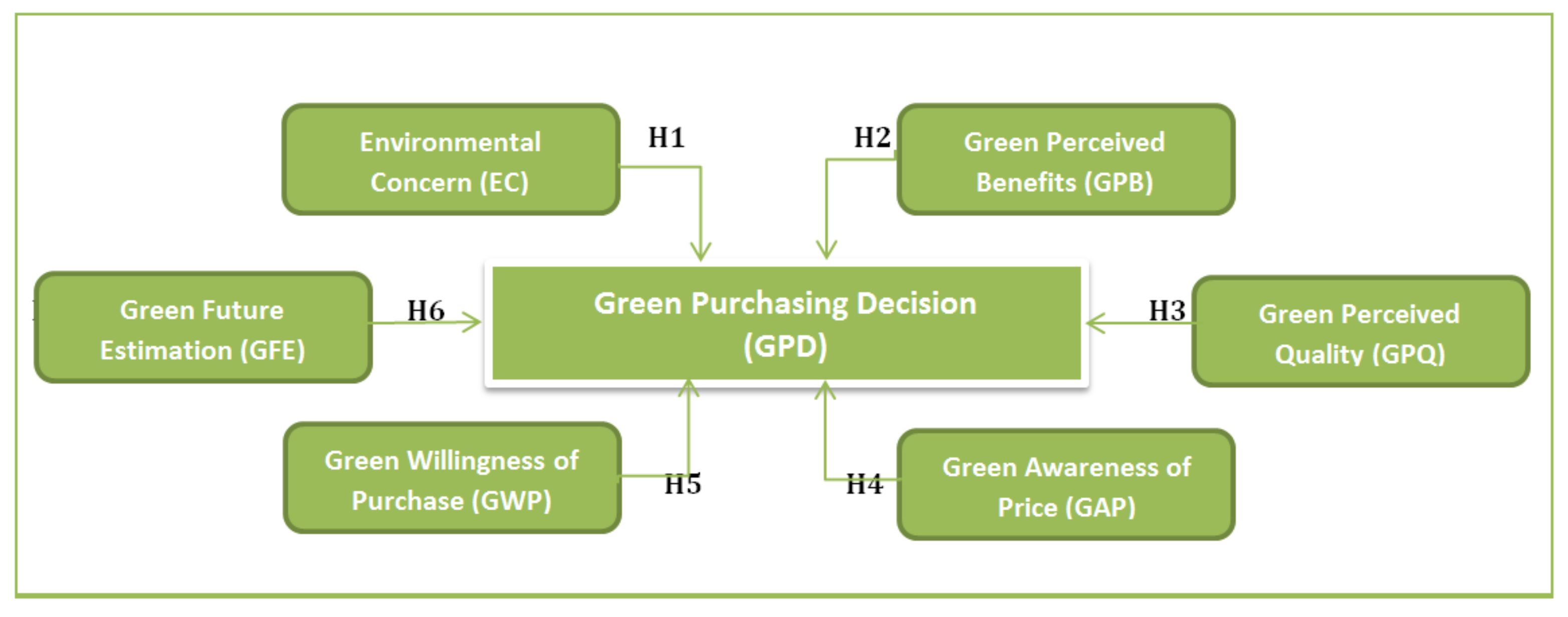
The concept of the Theory of Planned Behavior (TPB) was developed by Icek Ajzen to expand the predictive power of the Theory of Reasoned Action (TRA) [121,122]. TPB has been demonstrated to give an excellent scheme for conceptualizing, estimating, and identifying determinants that influence behavioral intention and to provide a systematic strategy to information campaign establishment [123]. There are three variables in TPB theory, including (1) attitude, (2) subjective norms, and (3) perceived behavioral control, which are cooperative, leading to the development of a person’s behavioral intention [99]. TPB effectively implemented a wide range of customer intentions and behaviors [17,82,124]. Scholars have applied TPB in anticipating food and product choice. For instance, researchers used TPB to predict consumers’ intention to purchase green food or organic food [24,56,101,124,125,126] and green products [24,28,29]. Attitude is the total evaluation of the consumer involvement response in green marketing strategy for Bangladesh. Therefore, to better understand the clarification of young educated consumer’s intentions to buy green products, this study attempts to extend TPB by adding other separate variables (environmental concern, green perceived benefits, green perceived quality, awareness of price, green willingness to purchase, and green future estimate) to get proper outcomes in the context of a developing country, Bangladesh. TPB provided an alternative model that gave the customer a deeper understanding of the intention of purchasing green products. Thus, the conceptual model proposes that attitudinal factors (environment concern, which connected to the attitude of TPB), green perceived benefits, green perceived quality, awareness of price, and green willingness to purchase can predict the intention behaviors of the purchase of green products. However, in this current study, we do not consider the subjective norms in the context of Bangladesh because the usefulness of subjective norms in clarifying consumer food preferences is still disputed by researchers; several studies, therefore, did not consider the subjective norms of investigation [56,127]. Nevertheless, we studied the previous ten years’ (2009–2019) research variables of environmental marketing or green marketing and green products (see Table 1); therefore, we propose a conceptual research framework for lower and middle-income countries, especially for Bangladesh. Figure 1 exhibits the conceptual model which can help to measure the current young, educated consumer’s purchasing decision on green products and future evaluation of green or environmental marketing concepts.
Figure 1.
Proposed conceptual model of the green purchase decision.
3. Methodology
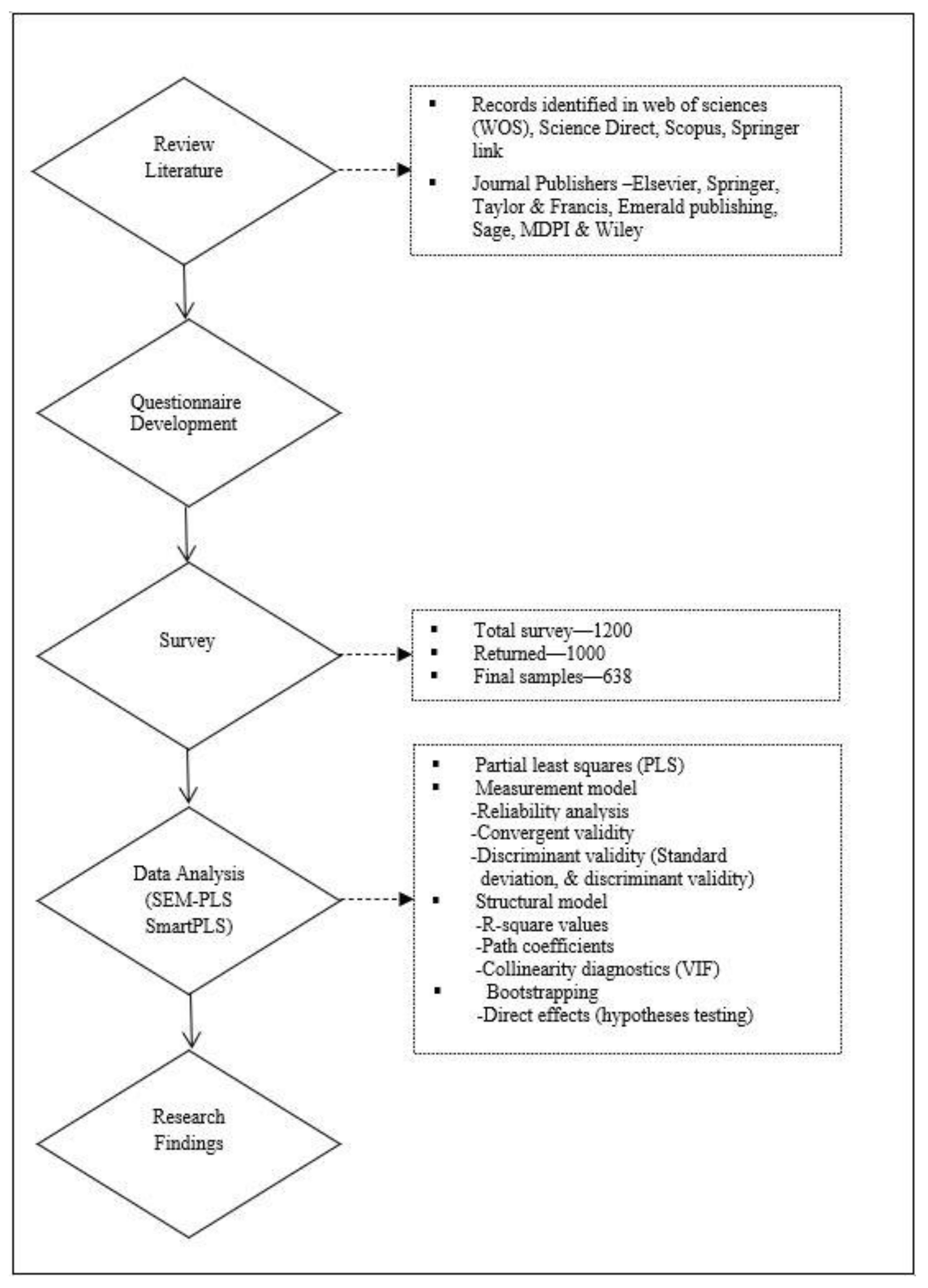
This study tried to investigate the young, educated consumers’ purchase decisions on green products and the current condition of green marketing in Bangladesh. The analysis was multi-layered, and both quantitative and qualitative data were adopted to understand the overall consumers’ situation, and personal experiences were used to better understand the primary data and assessment of the research outcome. Figure 2 exhibits the flow chart of the research methodology.
Figure 2.
The flow chart of research methodology (source: authors’ illustration).
3.1. Participants and Procedure
To accomplish this study, a mixture of primary and secondary data was used. Convenience sampling was adopted, and a total of 1200 self-administrated questionnaires were distributed directly to young educated consumers. Respondents were current students and those employed in various organizations in Bangladesh, such as universities, banks, hospitals, hotels, and manufacturing firms. Young, educated customers were chosen because they are the key to bringing about the desired change in green product purchases.
Here, we targeted those young consumers who had previous experience purchasing green products or eco-friendly products, e.g., natural soap, recycled toilet paper, reusable shopping polybag/plastic or bottles, rechargeable batteries, LED lights, solar panels, energy efficiency products, or energy-saving TVs, refrigerators, laundry, and daily organic vegetables or food at least once a month at grocery stores and local market. There was no mass consumer group; that is why we asked the questions in general. This research was a pilot project for a newly developing country Bangladesh.
After the responses had been screened, a whole of 1000 respondents returned the filled out questionnaires as samples for analysis among the 1200. We asked the respondents about the survey. Did they have previous experience in purchasing green products? If yes, then they could access further questions. We considered only those young respondents who had experience in buying green products. Two hundred (200) respondents filled out the questionnaires and did not have experience in purchasing green products.
Due to respondent’s lack of ability, unconsciousness, and disproportionate missing values, 162 questionnaires were excluded. Therefore, finally, 638 samples were obtained for this research. This sample size is considered to apply for analysis, as indicated by earlier studies [128]. Moreover, Kline and Hair et al. mentioned that the size of the sample should be, as a minimum, ten times the indicators [129,130]. Here, 21 indicators were considered; thus, a minimum sample size of 210 was required. So, finally, 638 samples were obtained for data analysis, where the response rate was 74%. Descriptive analysis was carried out to obtain figures about the socio-demographic profile of respondents, and Table 2 exhibits that 62.4% (n = 398) were male and 37.6% (n = 240) were female. In Bangladesh, men usually used to go shopping more than women. Society does not prefer women to go shopping, but this social system is changing with women’s empowerment and development. To illustrate the reality of this study, the behavior of male customers purchasing green products is much higher than the number of females
Table 2.
The socio-demographic profile of respondents.
Sixteen percent of the respondents were less than 20 years of age (n = 102), 26.0 percent were 20–25 years old (n = 170), 32.0 percent were 25–30 years old (n = 204), and 26 percent were 30–35 years old (n = 162). Here, all respondents were well educated, with 47.6 (n = 304) percent of respondents having a Masters degree, 23.8 percent being graduates, 12.2 (=78) percent having higher secondary education, and the rest of them being undergraduates and others/Ph.D. Young people with an educational degree (graduates) in Bangladesh are more likely to buy green products because they are more aware of the environment and green products.
The random sampling technique was applied to select respondents from Bangladesh over two months, from November to December 2019.
3.2. Questionnaire Development and Instrument
The questionnaire was conducted in Bangla and then transcribed verbatim and translated into English. The questionnaire was considered in three subdivisions. The first identified respondents’ specific demographic criteria (age, gender, education, and income) to obtain a real understanding of the research results. The second section included three questions for evaluating the previous consumer awareness of green marketing and experience of purchasing green products with mention of green products; we selected those young respondents who had experience purchasing green or environmentally friendly products. The final section covered 25 measurement questions. The questionnaire formulated the questions on six constructs of independent variables, which are environmental concern (EC), green perceived benefits (GPB), green perceived quality (GPQ), green awareness of price (GAP), and green willingness to purchase (GWP), green future estimation (GFE) and one dependent variable is green purchase decision (GPD) through a literature survey and focus group discussion (see Table 2 and Table A1 in the Appendix A for the questionnaire constructs). Before administering the study, a pilot test was performed among 30 respondents through an online survey, using the social media platform Facebook to pre-test the content and readability. A few changes were made to the final questionnaire to make it more understandable from the respondent’s point of view, considering the recommendations of the pilot study.
After constructing the reliability and validity test, we excluded four items (GPB3, GPQ2, GAP1, and GPW1) in which the value of the external loading was lower than 0.7. Consequently, 21 measurement items were taken for the final analysis. To ensure the reliability, the constructs for independent variables of environmental concern [100,131,132,133], green perceived benefit and green perceived quality [77], green awareness of price [134] and dependable variable green purchase decision, were adapted from [113,135,136,137] previous similar studies to fit into the framework of the research. The other two variables, green willingness to purchase and green future evaluation, were adapted from the focused group discussion (FGD), and a 5-point Likert scale was applied for designing measurement-related questions for both independent variables and dependent variable (1 = strongly disagree to 5 = strongly agree). However, two issues used a dichotomous item. There are only two response options in a dichotomous question: yes or no, and so on [138].
3.3. Statistical Technique
The partial least square-structural equation modelling (PLS-SEM) model was used for data analysis, and it is a variance-based path modelling method for analyzing the structural equation modeling, hypothesis testing, and measurement model by using Smart-PLS 3.2.0 version [139]. Moreover, IBM SPSS 20.0 (version 20.0, IBM Corp., Armonk, NY, USA) versions used for data input and frequency distribution for the demography profile. A recent development in the PLS-SEM is called the fully-fledged SEM method [140,141]. This covariance-based method, compared to multivariate data analysis SEM, is more flexible usually when working with distributed data, and the proposed method reaches higher statistical power with the smaller sample size [142]. Research statistics do not always use multivariate normal distribution because it is less complex to sample measurement than different methods such as AMOS and LISREL [143]. Despite this, “SEM overcomes the barriers of bivariate analyses through the simultaneous analysis of all the complex relationships between the constructs [144] (p. 147)”.
Moreover, “SEM is most applicable when there are multiple constructs in the research, each representing the use of some measurable variables and allowing estimating all relationships simultaneously” [128] (p. 641). A bootstrapping of 300 sub-samples applied for analysis assumptions. Moreover, statistical experts noted that there are enormous advantages of PLS-SEM as a nonparametric; such as the fact that normally distributed data are not required, the small sample size is applicable, and type II errors can reduce with efficiently managing formative measurements [142,143,145,146]. Moreover, PLS-SEM supports analyzing a structural model including multiple items and direct and indirect paths, defining the predictor variant. Regarding the objectives of this study, PLS-SEM is most suitable for explaining how underlying key drivers predict purchase intention [147].
3.4. Partial Least Squares
“The PLS was performed, which uses quantitative and structural models, namely the two stages of analysis because this approach has been supported to be effective for theoretical model structures with high complexity but low theoretical data” [148] (p. 270).
The main important reasons for applying PLS-SEM applications are to use low sample sizes, non-normal data, and structural indicators, and examine more complex model structures or variations, for example, heterogeneity [130].
3.5. Measurement Model
In the measurement model, the latent constructs’ inconsistency and validity, e.g., internal consistency reliability, discriminant validity, and measurement of the convergent construction validity, were observed in this stage.
3.6. Reliability Analysis
The study calculated the reliability, which was measured via Cronbach’s coefficient alpha and t composite reliability for testing the internal consistency of the constructs. There was no problem with the reliability of all constructs that exceeded the Cronbach’s alpha values of 0.700 [149,150]. Cronbach’s alpha is widely applied in the social sciences and business areas, providing a conservative result, and as a result, researchers have recommended composite reliability as an alternative measure [108]. Table 3 illustrates that the calculated values of the Cronbach alpha values for all constructs exceeded the threshold value of 0.700, except for GPQ 0.605, which means that data are good and reliable. Composite reliability is between 0.791 and 0.918, all of which exceed the boundary of 0.70 [130], indicating strong reliability between processes. Cronbach’s alpha value of the GPQ construct is 0.650, which is lower than 0.70, but composite reliability is 0.791. A satisfactory, reliable value would be between 0.60 and 0.95 [151,152]. Thus, the survey instrument is consistent with measuring all construction and random errors regularly.
Table 3.
The measurement model (reliability, validity, and variance inflation factor (VIF)) analysis.
3.7. Convergent Validity
Convergent validity was measured by composite reliability, standardized factor loadings, and average variance extracted (AVE). In this study, the standardized loadings of all measurement items were revealed by a bootstrapping analysis of 300 subsamples. In Table 3, the convergent validity was accomplished with factor item loadings exceeding 0.60, composite reliability exceeding 0.70, and AVE above 0.50 [130]. All were significant (p < 0.001) with strong confirmation of convergent validity and the items of measurement loaded well upon their constructs. Fornell and Larcker mentioned that the minimum cut-off value of 0.50 is for a reliable construct [153]. Before that, four items were removed for failing to meet these loading standard criteria, which is lower than 0.50, these being: an item of green perceived benefit (GPB3: “green product prevent diseases and increase immunity” with loading 0.652), green perceived quality (GPQ2: “green products have consistent quality concerning the environmental concern” with loading 0.565), green awareness of price (GAP1: “the green product is expensive” with loading 0.063) and green purchase willingness (GPW2: “I am willing to purchase green products if these provide better quality products than traditional or regular products with loading 0.618”). According to Fornell and Larcker, the convergent validity used to be additionally reached when the AVE values of each item in the model was determined to be greater than 0.50 [153].
3.8. Discriminant Validity
Campbell and Fiske [154] introduced the concept of discriminant validity, which was indicated as the degree to which latent variables are distinct from each other [152,155]. Discriminant validity is recognized when the square root of the average variance extracted (AVE) for each construct is greater than the correlations of all other constructs [153,156,157]. Table 4 illustrates that discriminant validity has been accomplished considering on-diagonal values (AVE) which are higher than the off-diagonal values (correlations of all other constructs). Green willingness to purchase green products was found to be the strongest correlation with the purchase decision (r = 0.802, p < 0.05), and conforms to awareness of price (r = 0.774, p < 0.05), environmental consciousness and green benefit (r = 0.838, p < 0.05), green future estimation (r = 0.737, p < 0.05), and finally green perceived quality (r = 0.641, p < 0.05).
Table 4.
Discriminant validity.
The variance inflation factor (VIF) values of this analysis ranged from 2.085 (green perceived quality) to 3.252 (environmental consciousness), which are below the reference value of 5 [142], indicating that the structural mode result does not have a negative effect and no multicollinearity among the items or predictor constructs. Therefore, each factor was statistically discrete from the other and explained evidence of satisfactory discriminant validity.
3.9. Structural Model
Generally, the structural model is used to test the research hypothesis, and this is the second step in the PLS analysis. Moreover, PLS uses a method for measuring predictive capability, which is known as the blindfolding method. Based on the blindfolding procedure, an analytical relevance was determined in the model (Stone–Geiger test, Q2) with the interdisciplinary variable cross-validation data redundancy result is 0.589, which is larger than 0 [143]. Moreover, “The R2 value of the endogenous variable was 0.871, which exceeds the recommended minimum value level of 10%” [158]. Notably, 87.1% of the variance in young educated consumers’ green purchasing decisions is described by the independent variables that reflect reliable clarifying power for the model. Rasoolimanesh et al. reported that R-2 values that exceed 20% were considered as high for consumer behavior studies [159]. In this research, a bootstrapping resampling technique was applied via the 95% bias-corrected and bootstrap confidence intervals (BCa) with 500 sub-samples to measure the effect of six exogenous determinates (GPQ, GPB, GAP, GFE, GPW) on the endogenous variable GPD (green product purchasing decision) which was applied to define standard errors estimates, and to investigate the value of path coefficients through t-tests [160].
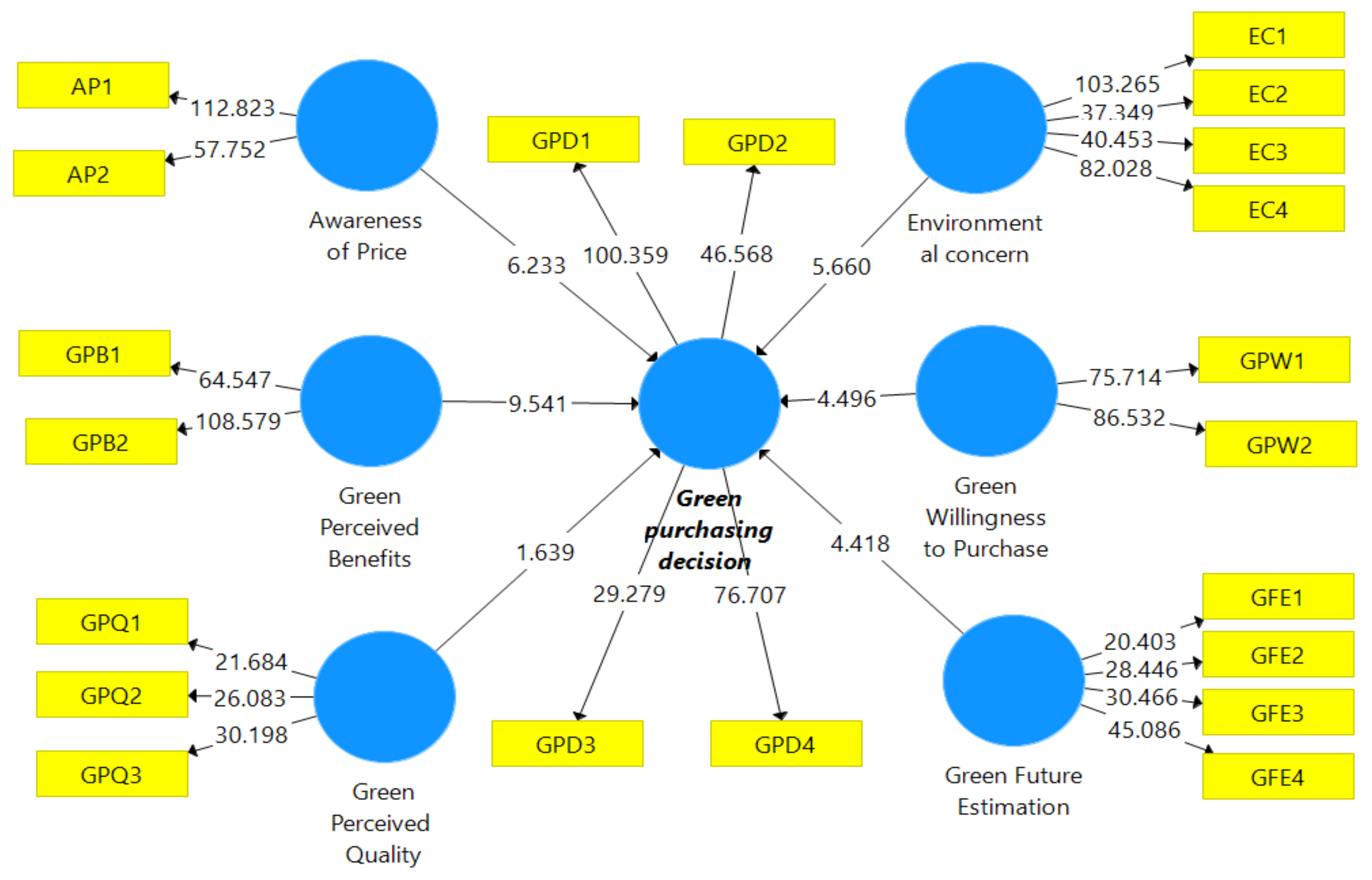
Hair et al. clarified that “the coefficient of the path will be significant if the value is not zero without the confidence interval” [142] (p. 156). Table 5 and Figure 3 demonstrate the outcomes of the path coefficients and t values were indicators, as defined in, whereby environment concern (EC) seems to have a positive relationship with a green purchasing decision, which is useful in prospect (bootstrap t-value = 5.710, p < 0.05). Therefore, Hypothesis H1 is supported. Similarly, the standardized beta coefficients reveal that green perceived benefits (GPB) are found to significantly influence young, educated consumers’ purchasing decisions regarding green products (bootstrap t-value = 8.686, p < 0.05). So, it is supposed that H2 is supported. The path estimates noted that green awareness of price (GAP) has a significant and positive relationship with the green purchasing decision (bootstrap t-value = 5.710, p < 0.05); as a result, H3 is supported. Nevertheless, young, educated consumer green perceived quality (GPQ) has an insignificant influence on purchase decisions on the green product (CPD) in Bangladesh (t-value = 1.511 p > 0.05). So, this acts as evidence to prove that green perceived quality p-value is 0.131, which exceeds the value of 0.05. Thus, H4 is not accepted, signifying the negative correlation between GPQ and GPD. Furthermore, as projected, green willingness to purchase (GWP) has a positive influence and significantly affects young, educated consumers’ purchase decision on the green products (CPD) in Bangladesh and revealed a positive result (t-value = 4.717; p < 0.05); thus, H5 is accepted. In a similar vein, consumer future estimation of green marketing (GFE) positively influences purchasing decisions on green products in Bangladesh and revealed a significant outcome (t-value = 4.077; p < 0.05); thus, H6 is retained.
Table 5.
Statistical results of the structural model and coefficient of determination (R2).
Figure 3.
Structural model results, path coefficients (t-values, with the level of significance) and R-square values.
4. Discussions
This study investigates which factors influence young, educated consumers’ purchase decisions on green products in a developing nation, and what are the associations among the hypotheses of the proposed model. The empirical result of PLS-SEM indicates that environmental concern (EC) has a strong influence on young, educated consumers’ green purchasing decisions in Bangladesh, and therefore, Hypothesis (H1) is supported. These findings support those obtained in the previous foreign survey in developed countries [2,17,20,23,24,28,29,71,72,74]. They also prove that environmental concern (EC) has a positive impact on ecological purchasing decisions on green foods [72,112]. The results imply that young consumers who describe them as environmentally responsible and are concerned about wasting the resources of the earth had a positive attitude toward the purchase of green products.
Next, the second hypothesis explored whether green perceived benefits strongly significantly influenced young consumers’ purchasing decisions regarding a green product. Thus, H2 is supported, implying that the significant relationship between GPB and GPD has been observable. The result is reliable, in that a positive impact on perceived benefits supports previous research [28,161,162,163]. However, perceived behavioral controls, such as perceived benefits, could not have an apparent, direct effect on customers’ purchasing intention. Still, it is the driving factor that affects consumer purchase attitudes in China [164]. The young generation believes that green products are organic and chemical-free, and green products are suitable for health and prevent diseases and increase immunity. Consumers’ green behavior is the cause of repurchasing green or organic products.
This result is obtained by mentioning the standardized beta coefficient of the SEM—young consumer green perceived quality (GPQ) has a significant negative influence on purchase decision on the green product (GPD). Nevertheless, high-quality green products were reported to moderate the relationships between the attitude towards eco-social benefits and green purchase behavior [23]. Thus, H3 is not supported and this indicates a significant negative correlation between GPA and GDP in Bangladesh. This outcome demonstrates that companies do not provide a standard of quality products, and it has inconsistent quality for the environmental concern in Bangladesh. Young consumers in Bangladesh are not satisfied with green product quality because of unethical practices. On the contrary, companies offer an environmental friendly and standard quality of products or services in developed countries. Nevertheless, the perceived quality of green products has been positively associated with purchasing intentions towards the green brand [108], green trust, and green satisfaction [83]. Previous studies hypothesized that there is a negative association between perceived risk and perceived quality [81,82,108,165,166].
Price is an essential factor for developing countries. The PLS-SEM approach revealed that well- educated young consumers’ awareness of price on environmental friendly products emerges as the four vital variables, which affect the consumer green purchasing decision and make visible a positive relationship, thus supporting the postulated H4. This result is reliable with past research in developed countries [89,90,167,168] that showed that consumers exposed their willingness to pay a higher premium for eco-labeled green products. The outcomes describe that most of the young consumers are interested in buying green products and agree to change their lifestyle if the price of the product is the same or lower than the regular product. Therefore, they are willing to purchase green products at actual prices.
Furthermore, Hypothesis H5 is supported, implying that consumers’ green willingness to purchase (GWP) has a strong positive relationship with purchasing decisions for green products. The reason for this considerable connection is that young, educated consumers in Bangladesh are fascinated with buying eco-friendly products or services if green products are available and provide better quality products than regular products. Moreover, in developing countries, consumers who have awareness about the Earth and environment are highly interested in paying extra for eco-friendly products. In addition, behavioral controls such as willingness to pay have the most significant impact on customer purchasing decisions [28]. The young scholar Lim et al. stated that consumers who have realized a good value in organic foods are highly motivated to buy organic foods [91]. Finally, the quantitative method found the acceptability of H6, where it has been noted that young, educated consumers’ future estimation (GFE) of green marketing has a positive influence on purchasing decisions regarding the green product.
5. Conclusions and Recommendations
Human beings are highly concerned about environmental and health issues. People want to buy environmental friendly products and organic foods. After completing the research, knowing these research outcomes, we can say that Bangladeshi peoples are no exception—the young and educated are interested in buying environmental products, and they support green or environmental marketing. The current research aimed to explore the young, educated consumers’ purchase decisions of a green product and the present scenario of green marketing in Bangladesh. Moreover, we investigated the emerging factors which are affecting young consumers’ purchase decisions regarding eco-friendly products. This research tried to prove the application of the TPB model, along with including additional variables (environmental concerns, green perceived quality, and future green estimates) for predicting the young, educated consumers’ green purchasing decisions in the Bangladesh context. The theoretical framework and PLS-SEM have revealed that EC, GPB, GAP, GWB, and GFE have shown a direct positive significant influence in green purchase decisions. Here, only one predictor, named green perceived quality, showed a direct negative and insignificant impact on consumer purchasing decisions on green products. The results confirm that the proposed extended TPB is a helpful model for understanding the consumers’ green purchase decisions.
Bangladeshi consumers suppose that green products are very beneficial for health and the environment, and green products do not have any harmfulness and side effects for health. Although the consumers argued, the prices of green products are higher than conventional products. The outcomes indicate that if the green product is less expensive, then a consumer will strongly agree to buy green products and change their lifestyle. Bangladeshi consumers believed that green marketing would be an excellent idea, and it will be accessible in Bangladesh. Moreover, green marketing is part of the sustainable development goals (SDGs). According to the survey results, 100% of consumers have faith in green marketing, which will be more effective than regular marketing, and 60% of people strongly prefer green products. An average of 40% prefers green products than non-green products. Indeed, purchase intentions do not always correspond to actual purchase. Consumers do not always do what they say. In addition, the research has contributed to filling a research gap of green purchase decisions through applying the TPB in Bangladesh by adding constructs; environmental concerns, green perceived quality, and green future estimates, instead of subjective norms in the original TPB model.
Several significant managerial implications could be used by marketers to make an appropriate marketing strategy for green products. In Bangladesh, most consumers are not concerned about green marketing, but they are aware of eco-friendly products. When they know that green products are also an eco-friendly product, their interest in buying green products increases a lot. Based on these results, the marketer needs to move forward to develop the market for green products. Further, marketers are encouraged to provide consumers with appropriate information on how they can consume nature’s eco-friendly products. So, the company and marketer should launch suitable campaigns to promote green marketing. The company and marketer can inform consumers about green products by using green marketing tools such as green branding, green advertising, and ecolabels. Additionally, it is time to apply the effectiveness of green advertising while emphasizing the environmental benefits of the green product, promoting a sustainable lifestyle, improving the green image of the brand, and reducing the characteristic imperfections of green products [169,170]. Most consumers respond positively to green ads (e.g., print and television ads) [171,172] that predict customer purchase intention. Dangelico and Vocalelli remarked that producers and supply need to provide complete, accurate, and easy-to-understand information about a lifelong environment [3]. Ecolabels are also an essential marketing promotional tool [173] that can improve the sales and brand quality of a product, encourage manufacturers to comprise the environmental impact of their products, and create consumers who are more aware of environmental issues [174].
A study found that 70% of consumers are affected by eco-friendly messages from advertising and product labeling on purchasing decisions [175]. Additionally, eco-branding also aids in the development of the green market and the challenge of transforming the production [3,170,176]. Therefore, marketers should highlight the clear and correct information regarding green products or services with ecolabels that supports encouraging consumers’ adoption of green products and increase the knowledge of green products or services.
Farmers and suppliers of our country can produce green food without using the pesticide formalin and mixed chemical food. Different types of shops such as supermarkets can start the trend of selling green products. A company could show its high involvement and support through effective environment-related campaigns, for example, energy conservation for a better sustainable environment to expand consumer awareness of green products. Direct persuasion through the different communication media or tools such as publicity can be used by the government, health, or environment associations to promote eco-friendly products that are free from danger to the environment. Continuous information about eco-friendly products can undoubtedly give positive encouragement to purchase green products to the consumers’ minds that encourage changing from conventional food products. There is no doubt that the key to sustainable and green consumption is the consumer itself and conscious consumer behavior. However, the contribution of all economic actors is also essential—sustainable consumption is unimaginable without education or governmental regulations and political measures, especially in such a fast-growing developing country like Bangladesh. The government can create pressure also on the company and marketer to produce green products that will be eco-friendly. In Bangladesh, there is a huge responsibility from the sides of both policy decision-makers and producers in handling the continuously increasing consumption and production and effectively steering them towards sustainability. Currently, consumers are aware of food security and environmental protection. Therefore, improving public consciousness and positive word of mouth and green consumerism will increase green purchasing behavior and green purchasing decisions. This empirical quantitative study would help marketers and producers to understand the consumer’s present perception, needs, or demands for safer, better, and healthier production of products. Thus, at the same time, it ensures achieving relevant SDGs and targets, providing reduced pollution, and conserving the environment, which is a dangerous element in all production. To accomplish these targets, farmers, manufacturers, retailers, and government agencies must work together to ensure green production to catch the consumers’ attention.
6. Limitations and Further Research
There are certain limitations to this study that should be noted. Firstly, the data collection of the research was only engrossed in the newly developing country in Bangladesh. The result may differ between a developed country and a newly developing country. Secondly, the sample size was smaller, according to the population. So, the researcher should take more sample sizes to justify the research. Thirdly, this research did not select for specific green products. Therefore, buying green products is not the same experience. Thus, certain types of green products should be further classified as research targets to create the right strategy for market segmentation.
Given that consumers have a profound understanding of the worsening environmental issues, thus it might also reflect on consideration to examine the demographic moderating variables, e.g., income, gender, age, or other custom features. We recommend extending the study to other consumer categories, such as Generation X, in the future. In addition, we recommend considering testing the moderating effects of consumer characteristics such as peer influence, self-identitying as a green consumer, self-image, recycling, and cultural facts for future research. Additionally, we suggest a study from developing and developed countries in some parts of the world by using cross-cultural analysis that can reflect the implications of consumer green purchase decisions, green marketing and sustainability of green markets.
Author Contributions
Conceptualization, M.N., M.F.-F.; data curation, M.N.; formal analysis, M.N.; investigation, M.N.; methodology, M.N.; software, M.N.; supervision, M.F.-F.; writing—original draft, M.N. The authors discussed the results and implications and commented on the manuscript at all stages. All authors have read and agreed to the published version of the manuscript.
Funding
This research was supported by Funding Stipendium Hungaricum Scholarship Programme and Doctoral School of Management and Business Administration, Szent Istvan University, Hungary
Acknowledgments
We wish to acknowledge to reviewers and editor for their valuable comments to enrich the quality of this article. We are thankful to the respondents who participated in this research survey, and also grateful to all the others who directly and indirectly helped during this journey.
Conflicts of Interest
The authors declare no conflict of interest.
Abbreviations
| EC | Environmental Concern |
| GPB | Green Perceived Benefits |
| GAP | Green Awareness of Price |
| GWP | Green Willingness to Purchase |
| GFE | Green Future Estimation |
| GPQ | Green Perceived Quality |
| GPD | Green Purchasing Decision |
| TPB | Theory of Planned Behavior |
| PLS-SEM | Partial Least Squares-Structural Equation Modelling |
Appendix A

Table A1.
Measuring items for all variables.
Table A1.
Measuring items for all variables.
| Determinants | Items |
|---|---|
| Environmental Concern | I am a strong believer in the preservation of nature and wildlife |
| I am pleased to purchase green products | |
| I consider the potential environmental impact of my purchase when making many of my decisions | |
| I would describe myself as an environmentally responsible person | |
| Green Perceived Benefits | I think green products are good for health. |
| Green products have well to test and flavor | |
| Green Perceived Quality | Green products have an acceptable standard of quality. |
| The green products appear to be durable | |
| The green products appear to be reliable | |
| Green Awareness of Price | I would choose environmentally friendly goods and services, campaigns or companies if the price were the same |
| If the price of green products is less expensive, I’m willing to change my lifestyle by purchasing Green products | |
| Green Willingness to Purchase | I am interested in purchasing a green product if these will be available in Bangladesh |
| I’m willing to pay more for environmentally friendly products | |
| Green Future Estimation | I think that green marketing will be an excellent idea for our country |
| I think that green product will be popular in our country | |
| I think that green marketing will be more effective and give a better product than regular marketing | |
| I think a consumer will accept the green products in the future | |
| Green Purchasing Decision | I prefer to buy environmentally friendly products than non-green products |
| I would like to increase the purchase/use of green products for me | |
| I buy green products even if they are more expensive than the non-green ones. | |
| I would recommend the green products to my friends and others |
References
- Welford, R. Hijacking Environmentalism; Earthscan: London, UK, 2000. [Google Scholar]
- Martínez, M.P.; Cremasco, C.P.; Filho, L.G.; Junior, S.S.B.; Bednaski, A.V.; Quevedo-Silva, F.; Correa, C.M.; Da Silva, D.; Padgett, R.C.M.L.; Gabriel, C.P.C. Fuzzy inference system to study the behavior of the green consumer facing the perception of greenwashing. J. Clean. Prod. 2020, 242, 116064. [Google Scholar] [CrossRef]
- Dangelico, R.M.; Vocalelli, D. “Green marketing”: An analysis of definitions, strategy steps, and tools through a systematic review of the literature. J. Clean. Prod. 2017, 165, 1263–1279. [Google Scholar] [CrossRef]
- Polonsky, M.J. Transformative green marketing: Impediments and opportunities. J. Bus. Res. 2011, 64, 1311–1319. [Google Scholar] [CrossRef]
- Sana, S.S. Price competition between green and non green products under corporate social responsible firm. J. Retail. Consum. Serv. 2020, 55, 102118. [Google Scholar] [CrossRef]
- Kassaye, W.W. Green dilemma. Mark. Intell. Plan. 2001, 19, 444–455. [Google Scholar] [CrossRef]
- Hasan, M.; Nekmahmud, M.; Yajuan, L.; Patwary, M.A. Green business value chain: A systematic review. Sustain. Prod. Consum. 2019, 20, 326–339. [Google Scholar] [CrossRef]
- Vafaei, S.A.; Görgényi-Hegyes, E.; Fekete-Farkas, M. The role of social media and marketing in building sustainability orientation. In Management 2016: International Business and Management, Domestic Particularities and Emerging Markets in the Light of Research; Stefko, R., Frankovsky, M., Fedorko, R., Eds.; University of Prešov: Presov, Slovakia, 2016; pp. 433–439. [Google Scholar]
- Lam, J.S.L.; Li, K.X. Green port marketing for sustainable growth and development. Transp. Policy 2019, 84, 73–81. [Google Scholar] [CrossRef]
- Headey, D.D.; Hoddinott, J. Agriculture, nutrition and the green revolution in Bangladesh. Agric. Syst. 2016, 149, 122–131. [Google Scholar] [CrossRef]
- Sarker, M.A.; Itohara, Y. Organic farming and poverty elimination: A suggested model for Bangladesh. J. Org. Syst. 2008, 3, 68–79. [Google Scholar] [CrossRef]
- Nekmahmud, M.; Rahman, S. Measuring the competitiveness factors in telecommunication markets. In Competitiveness in Emerging Markets; Springer: Cham, Switzerland, 2018. [Google Scholar] [CrossRef]
- Han, H.; Hsu, L.T.; Sheu, C. Application of the Theory of Planned Behavior to green hotel choice: Testing the effect of environmental friendly activities. Tour. Manag. 2010, 31, 325–334. [Google Scholar] [CrossRef]
- Magnusson, M.K.; Arvola, A.; Hursti, U.K.K.; Aberg, L.; Sjödén, P.O. Choice of organic foods is related to perceived consequences for human health and to environmentally friendly behaviour. Appetite 2003, 40, 109–117. [Google Scholar] [CrossRef]
- Hughner, R.S.; McDonagh, P.; Prothero, A.; Shultz, C.J.; Stanton, J. Who are organic food consumers? A compilation and review of why people purchase organic food. J. Consum. Behav. 2007, 6, 94–110. [Google Scholar] [CrossRef]
- Lockie, S.; Lyons, K.; Lawrence, G.; Mummery, K. Eating ’Green’: Motivations behind organic food consumption in Australia. Sociol. Rural. 2002, 42, 23–40. [Google Scholar] [CrossRef]
- Yadav, R.; Pathak, G.S. Young consumers’ intention towards buying green products in a developing nation: Extending the theory of planned behavior. J. Clean. Prod. 2016, 135, 732–739. [Google Scholar] [CrossRef]
- Akehurst, G.; Afonso, C.; Gonçalves, H.M. Re-examining green purchase behaviour and the green consumer profile: New evidences. Manag. Decis. 2012, 50, 972–988. [Google Scholar] [CrossRef]
- Anisimova, T.; Sultan, P. The Role of Brand Communications in Consumer Purchases of Organic Foods: A Research Framework. J. Food Prod. Mark. 2014, 20, 511–532. [Google Scholar] [CrossRef]
- Lee, H.J. Individual and situational determinants of U.S. consumers’ buying behavior of organic foods. J. Int. Food Agribus. Mark. 2016, 28, 1–15. [Google Scholar] [CrossRef]
- Anisimova, T. Integrating multiple factors affecting consumer behavior toward organic foods: The role of healthism, hedonism, and trust in consumer purchase intentions of organic foods. J. Food Prod. Mark. 2016, 22, 809–823. [Google Scholar] [CrossRef]
- Ko, S.B.; Jin, B.E. Predictors of purchase intention toward green apparel products. J. Fash. Mark. Manag. Int. J. 2017, 21, 70–87. [Google Scholar] [CrossRef]
- Cheung, M.F.Y.; To, W.M. An extended model of value-attitude-behavior to explain Chinese consumers’ green purchase behavior. J. Retail. Consum. Serv. 2019, 50, 145–153. [Google Scholar] [CrossRef]
- Kautish, P.; Paul, J.; Kautish, P. The moderating influence of environmental consciousness and recycling intentions on green purchase behavior. J. Clean. Prod. 2019, 228, 1425–1436. [Google Scholar] [CrossRef]
- Nagy-Pércsi, K.; Fogarassy, C. Important influencing and decision factors in organic food purchasing in Hungary. Sustainability 2019, 11, 6075. [Google Scholar] [CrossRef]
- Vafaei, S.A.; Azmoon, I.; Fekete-Farkas, M. The impact of perceived sustainable marketing policies on green customer satisfaction. Pol. J. Manag. Stud. 2019, 19, 475–491. [Google Scholar] [CrossRef]
- Fogarassy, C.; Nagy-Pércsi, K.; Ajibade, S.; Gyuricza, C.; Ymeri, P. Relations between circular economic “principles” and organic food purchasing behavior in Hungary. Agronomy 2020, 10, 616. [Google Scholar] [CrossRef]
- Xu, X.; Hua, Y.; Wang, S.; Xu, G. Determinants of consumer’s intention to purchase authentic green furniture. Resour. Conserv. Recycl. 2020, 156, 104721. [Google Scholar] [CrossRef]
- Tong, Q.; Anders, S.; Zhang, J.; Zhang, L. The roles of pollution concerns and environmental knowledge in making green food choices: Evidence from Chinese consumers. Food Res. Int. 2020, 130, 108881. [Google Scholar] [CrossRef]
- Hossain, A.; Khan, Y.H. Green marketing mix effect on consumers buying decisions in Bangladesh. Mark. Manag. Innov. 2018, 4, 298–306. [Google Scholar] [CrossRef]
- Adrita, U.W. Consumers’ actual purchase behaviour towards green product: A study on Bangladesh. Int. J. Bus. Innov. Res. 2020, 21, 311–323. [Google Scholar] [CrossRef]
- Wray-Lake, L.; Flanagan, C.A.; Osgood, D.W. Examining trends in adolescent environmental attitudes, beliefs, and behaviors across three decades. Environ. Behav. 2009, 42, 61–85. [Google Scholar] [CrossRef]
- UNFPA. Annual Report: A Year of Renewal. 2014. Available online: https://www.unfpa.org/annual-report-2014 (accessed on 20 March 2020).
- World Bank. World Development Indicators 2017; World Bank: Washington, DC, USA, 2017; Available online: https://openknowledge.worldbank.org/handle/10986/26447 (accessed on 23 September 2020).
- Joshi, Y.; Rahman, Z. Predictors of young consumer’s green purchase behaviour. Manag. Environ. Qual. Int. J. 2016, 27, 452–472. [Google Scholar] [CrossRef]
- Zhu, Q.; Sarkis, J. Green marketing and consumerism as social change in China: Analyzing the literature. Int. J. Prod. Econ. 2016, 181, 289–302. [Google Scholar] [CrossRef]
- Pride, W.M.; Ferrell, O.C. Marketing, 8th ed.; Houghton Mifflin: Boston, MA, USA, 1993. [Google Scholar]
- Peattie, K. Golden goose or wild goose? The hunt for the green consumer. Bus. Strat. Environ. 2001, 10, 187–199. [Google Scholar] [CrossRef]
- Prakash, A. Green marketing, public policy and managerial strategies. Bus. Strat. Environ. 2002, 11, 285–297. [Google Scholar] [CrossRef]
- Peattie, K.; Crane, A. Green marketing: Legend, myth, farce or prophesy? Qual. Mark. Res. Int. J. 2005, 8, 357–370. [Google Scholar] [CrossRef]
- Polonsky, M.J.; Rosenberger, P.J., III. Reevaluating green marketing: A strategic approach. Bus. Horiz. 2001, 44, 21–30. [Google Scholar] [CrossRef]
- Mishra, P.; Sharma, P. Green marketing: Challenges and opportunities for business. BVIMR Manag. Edge 2014, 7, 78–86. [Google Scholar]
- Wymer, W.; Polonsky, M.J. The limitations and potentialities of green marketing. J. Nonprofit Public Sect. Mark. 2015, 27, 239–262. [Google Scholar] [CrossRef]
- Papadas, K.K.; Avlonitis, G.J.; Carrigan, M.; Piha, L. The interplay of strategic and internal green marketing orientation on competitive advantage. J. Bus. Res. 2019, 104, 632–643. [Google Scholar] [CrossRef]
- Moravcikova, D.; Krizanova, A.; Majerova, J.; Rypakova, M. Green marketing as the source of the competitive advantage of the business. Sustainability 2017, 9, 2218. [Google Scholar] [CrossRef]
- Fliegelman, J.E. The next generation of greenwash: Diminishing consumer confusion through a national eco-labeling program. Fordham Urb. LJ 2010, 37, 1001. [Google Scholar]
- Kotler, P.; Armstrong, G. Principles of Marketing; Pearson Education: London, UK, 2010. [Google Scholar]
- Davari, A.; Strutton, D. Marketing mix strategies for closing the gap between green consumers’ pro-environmental beliefs and behaviors. J. Strat. Mark. 2014, 22, 563–586. [Google Scholar] [CrossRef]
- Ranaei Kordshouli, H.; Ebrahimi, A.; Allahyari Bouzanjani, A. An analysis of the green response of consumers to the environmentally friendly behaviour of corporations. Iran. J. Manag. Stud. 2015, 8, 315–334. [Google Scholar]
- Peattie, K.; Charter, M. Green marketing. Mark. Book 2003, 5, 726–755. [Google Scholar]
- Bonini, S.; Oppenheim, J. Cultivating the green consumer. Stanf. Soc. Innov. Rev. 2008, 6, 56–61. [Google Scholar]
- Ottman, J.; Books, N.B. Green marketing: Opportunity for innovation. J. Sustain. Prod. Des. 1998, 60, 136–667. [Google Scholar]
- Sharma, A.; Iyer, G.R. Resource-constrained product development: Implications for green marketing and green supply chains. Ind. Mark. Manag. 2012, 41, 599–608. [Google Scholar] [CrossRef]
- Singh, G. Green: The new colour of marketing in India. ASCI J. Manag. 2013, 42, 52–72. [Google Scholar]
- Scott, L.; Ellis, D. Consumer understanding, perceptions and behaviours with regard to environmentally friendly packaging in a developing nation. Int. J. Consum. Stud. 2014, 38, 642–649. [Google Scholar] [CrossRef]
- Qi, X.; Ploeger, A.; Angelika, A.P. Explaining consumers’ intentions towards purchasing green food in Qingdao, China: The amendment and extension of the theory of planned behavior. Appetite 2019, 133, 414–422. [Google Scholar] [CrossRef]
- Katt, F.; Meixner, O. A systematic review of drivers influencing consumer willingness to pay for organic food. Trends Food Sci. Technol. 2020, 100, 374–388. [Google Scholar] [CrossRef]
- Peattie, K. Environmental Marketing Management: Meeting the Green Challenge; Financial Times Management: Harlow, UK, 1995. [Google Scholar]
- Luchs, M.G.; Naylor, R.W.; Irwin, J.R.; Raghunathan, R.; Reczek, R.W. The Sustainability liability: Potential negative effects of ethicality on product preference. J. Mark. 2010, 74, 18–31. [Google Scholar] [CrossRef]
- Hong, Z.; Li, M.; Han, X.; He, X. Innovative green product diffusion through word of mouth. Transp. Res. Part. E Logist. Transp. Rev. 2020, 134, 101833. [Google Scholar] [CrossRef]
- Nekmahmud, M. Environmental marketing: Tourists purchase behavior response on green products. In Tourism Marketing in Bangladesh: An Introduction; Hassan, A., Ed.; Routledge: London, UK, 2020. [Google Scholar] [CrossRef]
- Albino, V.; Balice, A.; Dangelico, R.M. Environmental strategies and green product development: An overview on sustainability-driven companies. Bus. Strat. Environ. 2009, 18, 83–96. [Google Scholar] [CrossRef]
- Janssen, M.A.; Jager, W. Stimulating diffusion of green products. J. Evol. Econ. 2002, 12, 283–306. [Google Scholar] [CrossRef]
- Charter, M. Greener Marketing: A Greener Marketing Approach to Business; Taylor & Francis: Sheffield, UK, 1992. [Google Scholar]
- Teng, P.K.; Rezai, G.; Mohamed, Z.; Shamsudin, M.N. Consumers intention to purchase green foods in Malaysia. In Proceedings of the 2011 International Conference on Innovation, Management and Service, IPEDR, Singapore, 16–18 September 2011; Volume 14, pp. 112–118. [Google Scholar]
- Rana, J.; Paul, J. Consumer behavior and purchase intention for organic food: A review and research agenda. J. Retail. Consum. Serv. 2017, 38, 157–165. [Google Scholar] [CrossRef]
- Bickart, B.A.; Ruth, J.A. Green eco-seals and advertising persuasion. J. Advert. 2012, 41, 51–67. [Google Scholar] [CrossRef]
- Magnier, L.; Crié, D. Communicating packaging eco-friendliness. Int. J. Retail. Distrib. Manag. 2015, 43, 350–366. [Google Scholar] [CrossRef]
- Paul, J.; Modi, A.; Patel, J. Predicting green product consumption using theory of planned behavior and reasoned action. J. Retail. Consum. Serv. 2016, 29, 123–134. [Google Scholar] [CrossRef]
- Tompa, O.; Lakner, Z.; Oláh, J.; Popp, J.; Kiss, A. Is the sustainable choice a healthy choice?—Water footprint consequence of changing dietary patterns. Nutrients 2020, 12, 2578. [Google Scholar] [CrossRef]
- Chen, A.; Peng, N. Green hotel knowledge and tourists’ staying behavior. Ann. Tour. Res. 2012, 39, 2211–2216. [Google Scholar] [CrossRef]
- Bashir, S.; Khwaja, M.G.; Turi, J.A.; Toheed, H. Extension of planned behavioral theory to consumer behaviors in green hotel. Heliyon 2019, 5, 02974. [Google Scholar] [CrossRef] [PubMed]
- Kim, Y.; Choi, S.M. Antecedents of green purchase behavior: An examination of collectivism, environmental concern, and PCE. Adv. Consum. Res. 2005, 32, 592–599. [Google Scholar]
- Arısal, I.; Atalar, T. The exploring relationships between environmental concern, collectivism and ecological purchase intention. Procedia Soc. Behav. Sci. 2016, 235, 514–521. [Google Scholar] [CrossRef]
- Chandon, P.; Wansink, B.; Laurent, G. A benefit congruency framework of sales promotion effectiveness. J. Mark. 2000, 64, 65–81. [Google Scholar] [CrossRef]
- Ries, R.; Bilec, M.; Gokhan, N.M.; Needy, K.L. The economic benefits of green buildings: A comprehensive case study. Eng. Econ. 2006, 51, 259–295. [Google Scholar] [CrossRef]
- Islam, M.S.; Zabin, I. Consumer’s attitude towards purchasing green food. Eur. J. Bus. Manag. 2013, 5, 35–43. [Google Scholar]
- De Silva, M.; Wang, P.; Kuah, A.T. Why wouldn’t green appeal drive purchase intention? Moderation effects of consumption values in the UK and China. J. Bus. Res. 2020. [Google Scholar] [CrossRef]
- Zeithaml, V.A. Consumer perceptions of price, quality, and value: A means-end model and synthesis of evidence. J. Mark. 1988, 52, 2–22. [Google Scholar] [CrossRef]
- Brucks, M.; Zeithaml, V.A.; Naylor, G. Price and brand name as indicators of quality dimensions for consumer durables. J. Acad. Mark. Sci. 2000, 28, 359–374. [Google Scholar] [CrossRef]
- Snoj, B.; Korda, A.P.; Mumel, D. The relationships among perceived quality, perceived risk and perceived product value. J. Prod. Brand Manag. 2004, 13, 156–167. [Google Scholar] [CrossRef]
- Wang, J.; Tao, J.; Chu, M. Behind the label: Chinese consumers’ trust in food certification and the effect of perceived quality on purchase intention. Food Control 2020, 108, 106825. [Google Scholar] [CrossRef]
- Parasuraman, A.; Zeithaml, V.A.; Berry, L.L. Servqual: A multiple-item scale for measuring consumer perc. J. Retail. 1988, 64, 12. [Google Scholar]
- Kim, C.; Zhao, W.; Yang, K.H. An empirical study on the integrated framework of e-CRM in online shopping. J. Electron. Commer. Organ. 2008, 6, 1–19. [Google Scholar] [CrossRef]
- Chen, Y.S.; Chang, C.H. Towards green trust: The influences of green perceived quality, green perceived risk, and green satisfaction. Manag. Decis. 2013, 51, 63–82. [Google Scholar] [CrossRef]
- Mahesh, N. Consumer’s perceived value, attitude and purchase intention of green products. Manag. Insight 2013, 9, 37–43. [Google Scholar]
- Grove, S.J.; Fisk, R.P.; Pickett, G.M.; Kangun, N. Going green in the service sector. Eur. J. Mark. 1996, 30, 56–66. [Google Scholar] [CrossRef]
- Henryks, J.; Cooksey, R.; Wright, V. Organic food at the point of purchase: Understanding inconsistency in consumer choice patterns. J. Food Prod. Mark. 2014, 20, 452–475. [Google Scholar] [CrossRef]
- Dewald, B.; Bruin, B.J.; Jang, Y.J. US consumer attitudes towards “green” restaurants. Anatolia 2013, 25, 171–180. [Google Scholar] [CrossRef]
- Ghosh, S.; Datta, B.; Barai, P. Modeling and promoting organic food purchase. J. Food Prod. Mark. 2016, 22, 623–642. [Google Scholar] [CrossRef]
- Lim, W.M.; Yong, J.L.S.; Suryadi, K. Consumers’ perceived value and willingness to purchase organic food. J. Glob. Mark. 2014, 27, 298–307. [Google Scholar] [CrossRef]
- Essoussi, L.H.; Linton, J.D. New or recycled products: How much are consumers willing to pay? J. Consum. Mark. 2010, 27, 458–468. [Google Scholar] [CrossRef]
- Rehber, E.; Turhan, S. Prospects and challenges for developing countries in trade and production of organic food and fibers. Br. Food J. 2002, 104, 371–390. [Google Scholar] [CrossRef]
- Hasselbach, J.L.; Roosen, J. Consumer Heterogeneity in the Willingness to Pay for Local and Organic Food. J. Food Prod. Mark. 2015, 21, 608–625. [Google Scholar] [CrossRef]
- Smed, S.; Jensen, J.D. Demand for Low Fat Dairy Products–Demand for Healthiness or Taste; Edwards Elgar Publishing: Cheltenham, UK, 2003. [Google Scholar]
- Morel, M.; Kwakye, F. Green Marketing: Consumers’ Attitude towards Eco-Friendly Products and Purchase Intention in the Fast Moving Consumer Goods (FMCG) Sector. Master’s Thesis, Umeå University, Umeå, Sweden, 2012. [Google Scholar]
- Teng, C.C.; Wang, Y.M. Decisional factors driving organic food consumption. Br. Food J. 2015, 117, 1066–1081. [Google Scholar] [CrossRef]
- Suki, N.M.; Suki, N.M. Examination of peer influence as a moderator and predictor in explaining green purchase behaviour in a developing country. J. Clean. Prod. 2019, 228, 833–844. [Google Scholar] [CrossRef]
- Ajzen, I. The theory of planned behavior. Organ. Behav. Hum. Decis. Process. 1991, 50, 179–211. [Google Scholar] [CrossRef]
- Schlegelmilch, B.B.; Bohlen, G.M.; Diamantopoulos, A. The link between green purchasing decisions and measures of environmental consciousness. Eur. J. Mark. 1996, 30, 35–55. [Google Scholar] [CrossRef]
- Carfora, V.; Catellani, P.; Caso, D.; Conner, M. How to reduce red and processed meat consumption by daily text messages targeting environment or health benefits. J. Environ. Psychol. 2019, 65, 101319. [Google Scholar] [CrossRef]
- Feil, A.A.; Cyrne, C.C.D.S.; Sindelar, F.C.W.; Barden, J.E.; Dalmoro, M. Profiles of sustainable food consumption: Consumer behavior toward organic food in southern region of Brazil. J. Clean. Prod. 2020, 258, 120690. [Google Scholar] [CrossRef]
- Schiffman, L.G.; Kanuk, L.L. Consumer Behavior, 4th ed.; Prentice-Hall: Englewood Cliffs, NJ, USA, 1994. [Google Scholar]
- Lin, J.; Guo, J.; Turel, O.; Liu, S. Purchasing organic food with social commerce: An integrated food-technology consumption values perspective. Int. J. Inf. Manag. 2020, 51, 102033. [Google Scholar] [CrossRef]
- Lee, K. Predictors of Sustainable Consumption among Young Educated Consumers in Hong Kong. J. Int. Consum. Mark. 2014, 26, 217–238. [Google Scholar] [CrossRef]
- Sobhanifard, Y.; Griffith, C. Hybrid modelling of the consumption of organic foods in Iran using exploratory factor analysis and an artificial neural network. Br. Food J. 2018, 120, 44–58. [Google Scholar] [CrossRef]
- Nguyen, N.; Lobo, A.; Nguyen, B.K. Young consumers’ green purchase behaviour in an emerging market. J. Strat. Mark. 2017, 26, 1–18. [Google Scholar] [CrossRef]
- Wang, H.-J. Determinants of consumers’ purchase behaviour towards green brands. Serv. Ind. J. 2017, 37, 896–918. [Google Scholar] [CrossRef]
- Bossle, M.B.; De Barcellos, M.D.; Vieira, L.M. Why food companies go green? The determinant factors to adopt eco-innovations. Br. Food J. 2016, 118, 1317–1333. [Google Scholar] [CrossRef]
- Misra, R.; Singh, D. An analysis of factors affecting growth of organic food. Br. Food J. 2016, 118, 2308–2325. [Google Scholar] [CrossRef]
- Uddin, S.M.F.; Khan, M.N. Exploring green purchasing behaviour of young urban consumers. S. Asian J. Glob. Bus. Res. 2016, 5, 85–103. [Google Scholar] [CrossRef]
- Cheung, R.; Lau, M.M.; Lam, A.Y. Factors affecting consumer attitude towards organic food: An empirical study in Hong Kong. J. Glob. Sch. Mark. Sci. 2015, 25, 216–231. [Google Scholar] [CrossRef]
- Khare, A. Antecedents to green buying behaviour: A study on consumers in an emerging economy. Mark. Intell. Plan. 2015, 33, 309–329. [Google Scholar] [CrossRef]
- Kumar, P.; Ghodeswar, B.M. Factors affecting consumers’ green product purchase decisions. Mark. Intell. Plan. 2015, 33, 330–347. [Google Scholar] [CrossRef]
- Wang, S.T. Consumer characteristics and social influence factors on green purchasing intentions. Mark. Intell. Plan. 2014, 32, 738–753. [Google Scholar] [CrossRef]
- Tang, Y.; Wang, X.; Lu, P. Chinese consumer attitude and purchase intent towards green products. Asia-Pac. J. Bus. Adm. 2014, 6, 84–96. [Google Scholar] [CrossRef]
- Chen, J.; Lobo, A. Organic food products in China: Determinants of consumers’ purchase intentions. Int. Rev. Retail. Distrib. Consum. Res. 2012, 22, 293–314. [Google Scholar] [CrossRef]
- Chen, Y.S.; Chang, C.H. Enhance green purchase intentions. Manag. Decis. 2012, 50, 502–520. [Google Scholar] [CrossRef]
- Suh, B.W.; Eves, A.; Lumbers, M. Consumers’ attitude and understanding of organic food: The case of South Korea. J. Foodserv. Bus. Res. 2012, 15, 49–63. [Google Scholar] [CrossRef]
- Quah, S.H.; Tan, A.K.G. Consumer purchase decisions of organic food products: An ethnic analysis. J. Int. Consum. Mark. 2009, 22, 47–58. [Google Scholar] [CrossRef]
- Ajzen, I. From intentions to actions: A theory of planned behavior. In Action Control; Kuhl, J., Beckmann, J., Eds.; Springer: Berlin, Germany, 1985; pp. 11–39. [Google Scholar]
- Fishbein, M.; Ajzen, I. Belief, Attitude, Intention, and Behavior: An. Introduction to Theory and Research; Addison-Wesley: Reading, MS, USA, 1975. [Google Scholar]
- Montano, D.E.; Kasprzyk, D.; Taplin, S.H. The theory of reasoned action and theory of planned behavior. In Health Behavior and Health Education: Theory, Research, and Practice; Glanz, K., Lewis, F.M., Rimer, B.K., Eds.; John Wiley & Sons: Hoboken, NJ, USA, 1997. [Google Scholar]
- Choi, D.; Johnson, K.K.P. Influences of environmental and hedonic motivations on intention to purchase green products: An extension of the theory of planned behavior. Sustain. Prod. Consum. 2019, 18, 145–155. [Google Scholar] [CrossRef]
- Mkhize, S.; Ellis, D. Creativity in marketing communication to overcome barriers to organic produce purchases: The case of a developing nation. J. Clean. Prod. 2020, 242, 118415. [Google Scholar] [CrossRef]
- Sultan, P.; Tarafder, T.; Pearson, D.; Henryks, J. Intention-behaviour gap and perceived behavioural control-behaviour gap in theory of planned behaviour: Moderating roles of communication, satisfaction and trust in organic food consumption. Food Qual. Prefer. 2020, 81, 103838. [Google Scholar] [CrossRef]
- Stranieri, S.; Ricci, E.C.; Banterle, A. Convenience food with environmentally-sustainable attributes: A consumer perspective. Appetite 2017, 116, 11–20. [Google Scholar] [CrossRef]
- Hair, J.F.; Black, W.C.; Babin, B.J.; Anderson, R.E. Multivariate Data Analysis: A Global Perspective, 7th ed.; Pearson Education Inc.: Upper Saddle River, NJ, USA, 2010. [Google Scholar]
- Kline, P. The New Psychometrics: Science, Psychology, and Measurement; Routledge: New Fetter Lane, London, UK, 1998. [Google Scholar]
- Hair, J.F.H., Jr.; Sarstedt, M.; Hopkins, L.; Kuppelwieser, V.G. Partial least squares structural equation modeling (PLS-SEM). Eur. Bus. Rev. 2014, 26, 106–121. [Google Scholar] [CrossRef]
- Wimmer, F. Environmentally conscious consumer behaviour. In Vahlen’s Big Marketing Dictionary; Diller, H., Ed.; Vahlen: Munich, Germany, 1992; pp. 1167–1169. [Google Scholar]
- Sharma, K.; Bansal, M. Environmental consciousness, its antecedents and behavioural outcomes. J. Indian Bus. Res. 2013, 5, 198–214. [Google Scholar] [CrossRef]
- Mishal, A.; Dubey, R.; Gupta, O.K.; Luo, Z. Dynamics of environmental consciousness and green purchase behaviour: An empirical study. Int. J. Clim. Chang. Strat. Manag. 2017, 9, 682–706. [Google Scholar] [CrossRef]
- Suki, N.M. Young consumer ecological behaviour. Manag. Environ. Qual. Int. J. 2013, 24, 726–737. [Google Scholar] [CrossRef]
- Ha, H.Y.; Janda, S. Predicting consumer intentions to purchase energy-efficient products. J. Consum. Mark. 2012, 29, 461–469. [Google Scholar] [CrossRef]
- Coleman, L.J.; Bahnan, N.; Kelkar, M.; Curry, N. Walking the walk: How the theory of reasoned action explains adult and student intentions to go green. J. Appl. Bus. Res. (JABR) 2011, 27, 107–116. [Google Scholar] [CrossRef]
- Mostafa, M.M. Antecedents of Egyptian consumers’ green purchase intentions: A hierarchical multivariate. J. Int. Consum. Mark. 2006, 19, 97–126. [Google Scholar] [CrossRef]
- Kahle, L.R.; Malhotra, N.K. Marketing Research: An Applied Orientation; Pearson Education: London, UK, 2010; Volume 834. [Google Scholar]
- Becker, J.M. SmartPLS 3, SmartPLS GmbH, Boenningstedt. 2015. Available online: www.smartpls.com/faq/documentation/how-to-cite-smartpls (accessed on 15 November 2019).
- Valaei, N.; Jiroudi, S. Job satisfaction and job performance in the media industry. Asia Pac. J. Mark. Logist. 2016, 28, 984–1014. [Google Scholar] [CrossRef]
- Henseler, J.; Hubona, G.; Ray, P.A. Using PLS path modeling in new technology research: Updated guidelines. Ind. Manag. Data Syst. 2016, 116, 2–20. [Google Scholar] [CrossRef]
- Hair, J.F.; Hult, G.T.M.; Ringle, C.; Sarstedt, M. A Primer on Partial Least Squares Structural Equation Modeling (PLS-SEM); Sage Publications Ltd.: London, UK, 2017. [Google Scholar]
- Chin, W.W. The partial least squares approach to structural equation modeling. Mod. Methods Bus. Res. 1998, 295, 295–336. [Google Scholar]
- Harris, L.C.; Goode, M.M. The four levels of loyalty and the pivotal role of trust: A study of online service dynamics. J. Retail. 2004, 80, 139–158. [Google Scholar] [CrossRef]
- Rigdon, E.E. Choosing PLS path modeling as analytical method in European management research: A realist perspective. Eur. Manag. J. 2016, 34, 598–605. [Google Scholar] [CrossRef]
- Sarstedt, M.; Ringle, C.M.; Hair, J.F. Treating unobserved heterogeneity in PLS-SEM: A multi-method approach. In Partial Least Squares Path Modeling; Springer Science and Business Media LLC: Cham, Switzerland, 2017; pp. 197–217. [Google Scholar]
- Coelho, P.S.; Henseler, J. Creating customer loyalty through service customization. Eur. J. Mark. 2012, 46, 331–356. [Google Scholar] [CrossRef]
- Jöreskog, K.G.; Herman, O.A.W. The ML and PLS techniques for modeling with latent variables: Historical and comparative aspects. In Systems under Indirect Observation, Part I; Herman, O.A.W., Karl, G., Jöreskog, K.G., Eds.; North-Holland: Amsterdam, Holland, 1982; pp. 263–270. [Google Scholar]
- George, D. SPSS for Windows Step by Step: A Simple Study Guide and Reference, 17.0 Update (10/e); Allyn & Bacon: Boston, MA, USA , 2003. [Google Scholar]
- Hair, J.F.; Black, W.C.; Babin, B.J.; Anderson, R.E.; Tatham, R.L. Multivariate Data Analysis, 5th ed.; Prentice Hall: Upper Saddle River, NJ, USA, 1998; pp. 207–219. [Google Scholar]
- Bagozzi, R.; Yi, Y. On the evaluation of structural equation models. J. Acad. Mark. Sci. 1988, 16, 74–94. [Google Scholar] [CrossRef]
- Hair, J.F.; Ringle, C.M.; Sarstedt, M. Partial least squares structural equation modeling: Rigorous applications, better results and higher acceptance. Long Range Plan. 2013, 46, 112. [Google Scholar] [CrossRef]
- Fornell, C.; Larcker, D.F. Structural Equation Models with Unobservable Variables and Measurement Error: Algebra and Statistics. The University of Michigan: Ann Arbor, MI, USA, 1981. [Google Scholar]
- Campbell, D.T.; Fiske, D.W. Convergent and discriminant validation by the multitrait-multimethod matrix. Psychol. Bull. 1959, 56, 81–105. [Google Scholar] [CrossRef]
- Churchill, G.A., Jr. A paradigm for developing better measures of marketing constructs. J. Market. Res. 1979, 16, 64–73. [Google Scholar] [CrossRef]
- Gefen, D.; Straub, D.; Boudreau, M.C. Structural equation modeling and regression: Guidelines for research practice. Commun. Assoc. Inf. Syst. 2000, 4, 7. [Google Scholar] [CrossRef]
- Kling, J.R. Interpreting instrumental variables estimates of the returns to schooling. J. Bus. Econ. Stat. 2001, 19, 358–364. [Google Scholar] [CrossRef]
- Falk, R.F.; Miller, N.B. A Primer for Soft Modeling; University of Akron Press: Akron, OH, USA, 1992. [Google Scholar]
- Rasoolimanesh, S.M.; Dahalan, N.; Jaafar, M. Tourists’ perceived value and satisfaction in a community-based homestay in the Lenggong Valley World Heritage Site. J. Hosp. Tour. Manag. 2016, 26, 72–81. [Google Scholar] [CrossRef]
- Yi, M.Y.; Davis, F.D. Developing and validating an observational learning model of computer software training and skill acquisition. Inf. Syst. Res. 2003, 14, 146–169. [Google Scholar] [CrossRef]
- Flynn, J.; Slovic, P.; Mertz, C.K. Gender, race, and perception of environmental health risks. Risk Anal. 1994, 14, 1101–1108. [Google Scholar] [CrossRef] [PubMed]
- Williams, P.R.D.; Hammitt, J.K. Perceived risks of conventional and organic produce: Pesticides, pathogens, and natural toxins. Risk Anal. 2001, 21, 319–330. [Google Scholar] [CrossRef] [PubMed]
- Wang, Y.; Li, Y.; Zhang, J.; Su, X. How impacting factors affect Chinese green purchasing behavior based on Fuzzy Cognitive Maps. J. Clean. Prod. 2019, 240, 118199. [Google Scholar] [CrossRef]
- Wang, Y.; Wiegerinck, V.; Krikke, H.; Zhang, H. Understanding the purchase intention towards remanufactured product in closed-loop supply chains. Int. J. Phys. Distrib. Logist. Manag. 2013, 43, 866–888. [Google Scholar] [CrossRef]
- Sweeney, J.C.; Soutar, G.N.; Johnson, L.W. The role of perceived risk in the quality-value relationship: A study in a retail environment. J. Retail. 1999, 75, 77–105. [Google Scholar] [CrossRef]
- Chen, T.Y.; Chang, H.S. Reducing consumers’ perceived risk through banking service quality cues in Taiwan. J. Bus. Psychol. 2005, 19, 521–540. [Google Scholar] [CrossRef]
- Loureiro, M.L.; Lotade, J. Do fair trade and eco-labels in coffee wake up the consumer conscience? Ecol. Econ. 2005, 53, 129–138. [Google Scholar] [CrossRef]
- Lung, S. Green Consumerism-the Way to Effectively Differentiate Your Products in Asia-Pacific Market. 2010. Available online: https://ezinearticles.com/?Green-Consumerism---The-Way-to-Effectively-Differentiate-Your-Products-in-Asia-Pacific-Market&id=4875312 (accessed on 21 January 2020).
- D’Souza, C.; Taghian, M.; Lamb, P.; Peretiatko, R. Green decisions: Demographics and consumer understanding of environmental labels. Int. J. Consum. Stud. 2007, 31, 371–376. [Google Scholar] [CrossRef]
- Peano, C.; Baudino, C.; Tecco, N.; Girgenti, V. Green marketing tools for fruit growers associated groups: Application of the Life Cycle Assessment (LCA) for strawberries and berry fruits ecobranding in northern Italy. J. Clean. Prod. 2015, 104, 59–67. [Google Scholar] [CrossRef]
- Huq, S.M.; Alam, S.M.S.; Nekmahmud, M.; Aktar, M.S. Customer’s attitude towards mobile advertising in Bangladesh. Int. J. Bus. Econ. Res. 2015, 4, 281–292. [Google Scholar] [CrossRef]
- Huq, S.M.; Nekmahmud, M.; Aktar, M.S. Unethical practices of advertising in Bangladesh: A case study on some selective products. Int. J. Econ. Finance Manag. Sci. 2016, 4, 10–19. [Google Scholar] [CrossRef]
- Rex, E.L.C.; Baumann, H. Beyond ecolabels: What green marketing can learn from conventional marketing. J. Clean. Prod. 2007, 15, 567–576. [Google Scholar] [CrossRef]
- Grundey, D. Eco-marketing and eco-labelling: Does it ensure customer loyalty in Lithuania? Transform. Bus. Econ. 2009, 8, 152–179. [Google Scholar]
- Chase, D.; Smith, T.K. Consumers keen on green but marketers don’t deliver. Advert. Age 1992, 38, 163–197. [Google Scholar]
- Chkanikova, O.; Lehner, M. Private eco-brands and green market development: Towards new forms of sustainability governance in the food retailing. J. Clean. Prod. 2015, 107, 74–84. [Google Scholar] [CrossRef]
© 2020 by the authors. Licensee MDPI, Basel, Switzerland. This article is an open access article distributed under the terms and conditions of the Creative Commons Attribution (CC BY) license (http://creativecommons.org/licenses/by/4.0/).