Multi-Criteria Decision Making Process in Metropolitan Transport Means Selection Based on the Sharing Mobility Idea




Abstract
1. Introduction
- the presence of a large number of traffic generators and thus a large number of optional or mandatory needs,
- transport behavior of a highly mobile society,
- a wide range of travel options using various means of transport.
- ensuring the possibility of starting and ending a travel when a transport need arises (without waiting and thus wasting time), with a high level of so-called “temporary availability,”
- ensuring the possibility of starting and ending the travel at the place where the transport need arose and where it ends, with a high level of so-called “spatial accessibility,”
- the need to ensure the highest level of flexibility, even in the context of sharing this mode of transport with other users, and also in the context that the transport means of must provide the possibility of traveling in a multimodal way.
2. Literature Review
- the hierarchy of travel needs [74], which defines characteristics of those needs, motivations, or intentions and attributes of alternatives that are of importance during travel decision-making, usually divided into five groups: feasibility [75,76], accessibility [77], safety and security [78], cost [79], and pleasure [80].
- sociodemographic, socioeconomics [81], influencing the process due to poverty, elder citizens
- the problem of choice (optimization): the decision-maker determines a subset of decisions (action, options) considered the best ones in terms of the considered family of criteria,
- the problem of classification (sorting): the decision-maker splits a set of decisions (activities, and action variants) into subsets (classes, categories), under the accepted standards,
- the problem of ranking: the decision-maker aims to put the variants in order from the best to the worst one.
3. Materials and Methods
4. Model of Metropolitan Transport Means Selection
- —a set of characteristics related to transport safety aspects describing features for available metropolitan transport modes , defined as:
- —a set of characteristics related to quality aspects describing features for available metropolitan transport modes , defined as:
- —a set of characteristics related to financial aspects describing features for available metropolitan transport modes , defined as:
- —a set of characteristics related to ecological aspects describing features for available metropolitan transport modes , defined as:
- —criteria vector for metropolitan transport means selection, depending on transport safety aspects, in the following form: ,
- —criteria vector for metropolitan transport means selection, depending on quality aspects, in the following form: ,
- —criteria vector for metropolitan transport means selection, depending on financial aspects, in the following form:,
- —criteria vector for metropolitan transport means selection, depending on ecological aspects, in the following form: .
- —criteria rating weight vector for metropolitan transport means selection, depending on transport safety aspects, in the following form: ,
- —criteria rating weight vector for metropolitan transport means selection, depending on quality aspects, in the following form: ,
- —criteria rating weight vector for metropolitan transport means selection, depending on financial aspects, in the following form:,
- —criteria rating weight vector for metropolitan transport means selection, depending on ecological aspects, in the following form: .
- —a vector containing the values of the function reflecting the limitations and conditions relating to transport safety aspects of the available metropolitan transport means , influencing decisions about travel behavior, defined as:
- —a vector containing the values of the function reflecting the limitations and conditions relating to quality aspects of the available metropolitan transport means , influencing decisions about travel behavior, defined as:
- —a vector containing the values of the function reflecting the limitations and conditions relating to financial aspects of the available metropolitan transport means , influencing decisions about travel behavior, defined as:
- —a vector containing the values of the function reflecting the limitations and conditions relating to ecological aspects of the available metropolitan transport means , influencing decisions about travel behavior, defined as:
- number of road accidents involving means of transport is less than or equal to the minimum level of transport safety for the variable :
- number of damaged means of transport is less than or equal to the minimum level of transport safety for the variable :
- number of available means of transport is less than or equal to the maximum number of available means of transport for the variable :
- average waiting time for means of transport is less than or equal to the maximum waiting time for the means of transport for the variable :
- the comfort level of transport use is greater than or equal to the adequate level of quality to price of means of transport for the variable :
- value of the transport means operating costs is less than or equal to the maximum level of operating costs for means of transport for the variable :
- value of transport costs per 1 km is less than or equal to the maximum level of traveling costs for the variable :
- CO2 emissions from means of transport are less than or equal to the maximum CO2 emissions from means of transport for the variable :
- the ratio of alternative fuels supplying means of transport is greater than or equal to the minimal share of alternative fuels supplying means of transport for the variable :
- —the matrix containing the measurement values of the criteria for selecting metropolitan transport means, depending on transport safety aspects, defined as:
- —the matrix containing the measurement values of the criteria for selecting metropolitan transport means, depending on quality aspects, defined as:
- —the matrix containing the measurement values of the criteria for selecting metropolitan transport means, depending on financial aspects, defined as:
- —the matrix containing the measurement values of the criteria for selecting metropolitan transport means, depending on ecological aspects, defined as:
5. Transport Means Selection among Transport-Sharing Services in Silesian Metropolis
- mtm = 1—city bike,
- mtm = 2—electric kick scooter,
- mtm = 3—electric scooter,
- mtm = 4—electric car.
- lower prices of the service,
- promotions for regular customers and students,
- scooter availability in a larger area,
- a larger area of operating range for scooters and electric scooters,
- more electric cars offered,
- a lack of necessity to connect with a bank card to a user account.
- stimulant (for the maximized criterion)—the greater , the more favorable the result,where: —the value of the ratings of the given considered variant for each criterion ,
- destimulant (for the minimizes criterion)—the smaller , the more favorable the result,where: —the value of the ratings of the given considered variant for each criterion .
6. Conclusions
- set of characteristics for the available metropolitan transport means ,
- set of criteria K for selecting means of transport in the metropolis,
- rating weight set W, which allows differentiation of the importance of given criteria in the decision-making process,
- set of functions for the available metropolitan transport means related to limitations and conditions,
- criteria function with optimal measurement values of the criteria for selecting metropolitan transport means, depending on transport safety, quality, financial, and ecological aspects.
Author Contributions
Funding
Conflicts of Interest
References
- United Nations. World Urbanization Prospects: The 2018 Revision, Key Facts; Technical report; United Nations: New York, NY, USA, 2018. [Google Scholar]
- Agureev, I.; Elagin, M.; Pyshnyi, V.; Khmelev, R. Methodology of substantiation of the city transport system structure and integration of intelligent elements into it. Transp. Res. Procedia 2017, 20, 8–13. [Google Scholar] [CrossRef]
- Solecka, K. Integration of public transport in Polish and EU documents and examples of solutions for integration of public transport in Poland and in the world. Transp. Probl. 2011, 6, 23–34. [Google Scholar]
- Poliak, M.; Mrnikova, M.; Jaskiewicz, M.; Jurecki, R.; Kaciakova, B. Public transport integration. Commun. Sci. Lett. Univ. Zilina 2017, 19, 127–132. [Google Scholar]
- Jacyna, M.; Kotylak, P. Decision-making problems of collective transport development in terms of sustainable urban mobility. J. KONBiN 2020, 50, 359–375. [Google Scholar] [CrossRef]
- Vuchic, V. Transportation for Livable Cities; Routledge: London, UK, 2017. [Google Scholar]
- Caves, R.W.; Wagner, F. (Eds.) Livable Cities from a Global Perspective; Routledge: London, UK, 2018. [Google Scholar]
- Leby, J.L.; Hashim, A.H. Liveability dimensions and attributes: Their relative importance in the eyes of neighbourhood residents. J. Constr. Dev. Ctries. 2010, 15, 67–91. [Google Scholar]
- Ruth, M.; Franklin, R.S. Livability for all? Conceptual limits and practical implications. App. Geogr. 2014, 49, 18–23. [Google Scholar] [CrossRef]
- Jacyna, M. The Urban Logistic Service Model in the Aspect of the Domestic Logistic System. In WIT Transactions on the Built Environment; WIT Press: Southampton, UK, 2011; Volume 116. [Google Scholar]
- Kwee, M. From Liveable to Lovable City. In 50 Years of Urban Planning in Singapore; World Scientific: Singapore, 2017; pp. 315–316. [Google Scholar] [CrossRef]
- Simon, D.; Arfvidsson, H.; Anand, G.; Bazaz, A.; Fenna, G.; Foster, K.; Nyambuga, C. Developing and testing the Urban Sustainable Development Goal’s targets and indicators—A five-city study. Environ. Urban. 2016, 28, 49–63. [Google Scholar] [CrossRef]
- Willis, K. Viewpoint: International development planning and the Sustainable Development Goals (SDGs). Int. Dev. Plan. Rev. 2016, 38, 105-11. [Google Scholar] [CrossRef]
- Rahman, M.M.; D’Este, G.; Bunker, J.M. Problems and prospects of non-motorized public transport integration in developing cities. In Proceedings of the 30th Conference of the Australian Institutes of Transport. Research, Perth, WA, Australia, 10–12 December 2008; Olaru, D., Ed.; QUT: Perth, WA, Australia, 2008; pp. 1–12. [Google Scholar]
- Mitullah, W.V.; Vanderschuren, M.; Khayesi, M. (Eds.) Non-motorized Transport Integration into Urban Transport Planning in Africa; Routledge: London, UK, 2017. [Google Scholar]
- Saliara, K. Public transport integration: The case study of Thessaloniki, Greece. Transp. Res. Procedia 2014, 4, 535–552. [Google Scholar] [CrossRef]
- Roumboutsos, A.; Kapros, S. A game theory approach to urban public transport integration policy. Trans. Policy 2008, 15, 209–215. [Google Scholar] [CrossRef]
- Preston, J. What’s so Funny about Peace, Love and Transport Integration? Res. Transp. Econ. 2010, 29, 329–338. [Google Scholar] [CrossRef]
- Xiu-cheng, Y.Y.D.G.; Yan, K.Z.L. Integrated Public Transport System in Singapore. Mod. Urban. Res. 2012, 4, 13. [Google Scholar]
- Donaghy, K.; Rudinger, G.; Poppelreuter, S. Societal trends, mobility behaviour and sustainable transport in Europe and North America. Trans. Rev. 2004, 24, 679–690. [Google Scholar] [CrossRef]
- Rudinger, G.; Donaghy, K.; Poppelreuter, S. Societal trends, mobility behaviour and sustainable transport in Europe and North America. Eur. J. Transp. Infrastruct. Res. 2006, 6, 61–76. [Google Scholar] [CrossRef]
- Rudinger, G.; Donaghy, K.; Poppelreuter, S. Societal trends, mobility behaviour and sustainable transport in Europe and North America: The European Union network STELLA. Eur. J. Ageing 2004, 1, 95–101. [Google Scholar] [CrossRef][Green Version]
- Banister, D. Unsustainable Transport. In City Transport in the New Century; Routledge: London, UK, 2005. [Google Scholar]
- Musso, A.; Corazza, M.V. Improving urban mobility management: Case study of Rome. Transp. Res. Rec. 2006, 1956, 52–59. [Google Scholar] [CrossRef]
- Ezeibe, C.C.; Nzeadibe, T.C.; Ali, A.N.; Udeogu, C.U.; Nwankwo, C.F.; Ogbodo, C. Work on wheels: Collective organising of motorcycle taxis in Nigerian cities. Int. Dev. Plan. Rev. 2017, 39, 249–273. [Google Scholar] [CrossRef]
- Mulley, C. Promoting social inclusion in a deregulated environment: Extending accessibility using collective taxi-based services. Res. Transp. Econ. 2010, 29, 296–303. [Google Scholar] [CrossRef]
- Ciari, F.; Balmer, M.; Axhausen, K.W. Large scale use of collective taxis: A multi-agent approach. Arb. Verk. Raumplan. 2009, 594. [Google Scholar] [CrossRef]
- Kepaptsoglou, K.; Meerschaert, V.; Neergaard, K.; Papadimitriou, S.; Rye, T.; Schremser, R.; Vleugels, I. Quality management in mobility management: A scheme for supporting sustainable transportation in cities. Int. J. Sustain. Transp. 2012, 6, 238–256. [Google Scholar] [CrossRef]
- Balfaqih, M.; Ismail, M.; Nordin, R.; Balfaqih, Z. Fast handover solution for network-based distributed mobility management in intelligent transportation systems. Telecommun. Syst. 2017, 64, 325–346. [Google Scholar] [CrossRef]
- Lin, Y.W.; Hsiao, Y.K.; Yeh, Z.S. A new mobility management scheme for intelligent transportation systems. Wirel. Pers. Commun. 2017, 96, 3081–3112. [Google Scholar] [CrossRef]
- Keimer, A.; Laurent-Brouty, N.; Farokhi, F.; Signargout, H.; Cvetkovic, V.; Bayen, A.M.; Johansson, K.H. Information patterns in the modeling and design of mobility management services. Proc. IEEE 2018, 106, 554–576. [Google Scholar] [CrossRef]
- Enoch, M. Sustainable Transport, Mobility Management and Travel Plans; Routledge: London, UK, 2016. [Google Scholar]
- Correia, G.; Viegas, J.M. Carpooling and carpool clubs: Clarifying concepts and assessing value enhancement possibilities through a Stated Preference web survey in Lisbon, Portugal. Transp. Res. Part. A 2011, 45, 81–90. [Google Scholar] [CrossRef]
- Vanoutrive, T.; Van De Vijver, E.; Van Malderen, L.; Jourquin, B.; Thomas, I.; Verhetsel, A.; Witlox, F. What determines carpooling to workplaces in Belgium: Location, organisation, or promotion? J. Transp. Geogr. 2012, 22, 77–86. [Google Scholar] [CrossRef]
- Galland, S.; Knapen, L.; Gaud, N.; Janssens, D.; Lamotte, O.; Koukam, A.; Wets, G. Multi-agent simulation of individual mobility behavior in carpooling. Transp. Res. Part. C: Emerg. Technol. 2014, 45, 83–98. [Google Scholar] [CrossRef]
- Hartman, I.B.A.; Keren, D.; Dbai, A.A.; Cohen, E.; Knapen, L.; Janssens, D. Theory and practice in large carpooling problems. Procedia Comput. Sci. 2014, 32, 339–347. [Google Scholar] [CrossRef]
- Jorge, D.; Correia, G. Carsharing systems demand estimation and defined operations: A literature review. Eur. J. Transp. Infrastruct. Res. 2013, 13, 201–220. [Google Scholar] [CrossRef]
- Firnkorn, J.; Müller, M. What will be the environmental effects of new free-floating car-sharing systems? The case of car2go in Ulm. Ecol. Econ. 2011, 70, 1519–1528. [Google Scholar] [CrossRef]
- Firnkorn, J.; Müller, M. Free-floating electric carsharing-fleets in smart cities: The dawning of a post-private car era in urban environments? Env. Sci. Policy 2015, 45, 30–40. [Google Scholar] [CrossRef]
- Blynn, K.; Attanucci, J. Accelerating Bus Electrification: A Mixed Methods Analysis of Barriers and Drivers to Scaling Transit Fleet Electrification. Transp. Res. Rec. 2019, 2673, 577–587. [Google Scholar] [CrossRef]
- Quak, H.; De Koster, R. The impacts of time access restrictions and vehicle weight restrictions on food retailers and the environment. Eur. J. Transp. Infrastruct. Res. 2006, 6, 131–150. [Google Scholar]
- Anand, N.; Quak, H.; van Duin, R.; Tavasszy, L. City logistics modeling efforts: Trends and gaps—A review. Procedia Soc. Behav. Sci. 2012, 39, 101–115. [Google Scholar] [CrossRef]
- Kitchin, R. The real-time city? Big data and smart urbanism. GeoJ. 2014, 79, 1–14. [Google Scholar] [CrossRef]
- Boitor, M.R.; Antov, D.; Iliescu, M.; Antso, I.; Mäe, R. Sustainable urban transport planning. Rom. J. Transp. Infrastruct. 2013, 2, 39–50. [Google Scholar] [CrossRef]
- Zhang, S.; Wu, Y.; Zhao, B.; Wu, X.; Shu, J.; Hao, J. City-specific vehicle emission control strategies to achieve stringent emission reduction targets in China’s Yangtze River Delta region. J. Environ. Sci. 2017, 51, 75–87. [Google Scholar] [CrossRef]
- Giles-Corti, B.; Vernez-Moudon, A.; Reis, R.; Turrell, G.; Dannenberg, A.L.; Badland, H.; Owen, N. City planning and population health: A global challenge. Lancet 2016, 388, 2912–2924. [Google Scholar] [CrossRef]
- Chen, T.D.; Kockelman, K.M. Management of a shared autonomous electric vehicle fleet: Implications of pricing schemes. Transp. Res. Rec. 2016, 2572, 37–46. [Google Scholar] [CrossRef]
- Montoya-Torres, J.R.; Muñoz-Villamizar, A.; Vega-Mejía, C.A. On the impact of collaborative strategies for goods delivery in city logistics. Prod. Plan. Control 2016, 26, 443–455. [Google Scholar] [CrossRef]
- Macioszek, E. The application of HCM 2010 in the determination of capacity of traffic lanes at turbo roundabout entries. Transp. Probl. 2016, 11, 77–89. [Google Scholar] [CrossRef]
- Macioszek, E. The influence of motorcycling and cycling on small one-lane roundabouts capacity. In International Conference on Transport. Systems Telematics; Springer: Berlin/ Heidelberg, Germany, 2011; pp. 291–298. [Google Scholar]
- Au, T.-C.; Zhang, S.; Stone, P. Autonomous intersection management for semi-autonomous vehicles. Handb. Transp. 2015, 88–104. [Google Scholar]
- Koopman, P.; Ferrell, U.; Fratrik, F.; Wagner, M. A safety standard approach for fully autonomous vehicles. In International Conference on Computer Safety, Reliability, and Security; Springer: Cham, Switzerland, 2019; pp. 326–332. [Google Scholar]
- Bischoff, J.; Maciejewski, M. Simulation of city-wide replacement of private cars with autonomous taxis in Berlin. Procedia Comput. Sci. 2016, 83, 237–244. [Google Scholar] [CrossRef]
- Deb, S.; Strawderman, L.J.; Carruth, D.W. Investigating pedestrian suggestions for external features on fully autonomous vehicles: A virtual reality experiment. Transp. Res. Part. F Traffic Psychol. Behav. 2018, 59, 135–149. [Google Scholar] [CrossRef]
- Deb, S.; Strawderman, L.; Carruth, D.W.; DuBien, J.; Smith, B.; Garrison, T.M. Development and validation of a questionnaire to assess pedestrian receptivity toward fully autonomous vehicles. Transp. Res. Part. C Emerg. Technol. 2017, 84, 178–195. [Google Scholar] [CrossRef]
- Al Haddad, C.; Chaniotakis, E.; Straubinger, A.; Plötner, K.; Antoniou, C. Factors affecting the adoption and use of urban air mobility. Transp. Res. Part A Policy Pract. 2020, 132, 696–712. [Google Scholar] [CrossRef]
- Sutherland, B.R. Flying cars for green transportation. Joule 2019, 3, 1187–1189. [Google Scholar] [CrossRef]
- Kasliwal, A.; Furbush, N.J.; Gawron, J.H.; McBride, J.R.; Wallington, T.J.; De Kleine, R.D.; Keoleian, G.A. Role of flying cars in sustainable mobility. Nat. Commun. 2019, 10, 1–9. [Google Scholar] [CrossRef]
- Duarte, F.; Ratti, C. The impact of autonomous vehicles on cities: A review. J. Urban Technol. 2018, 25, 3–18. [Google Scholar] [CrossRef]
- Gandia, R.M.; Antonialli, F.; Cavazza, B.H.; Neto, A.M.; Lima, D.A.D.; Sugano, J.Y.; Zambalde, A.L. Autonomous vehicles: Scientometric and bibliometric review. Transp. Rev. 2019, 39, 9–28. [Google Scholar] [CrossRef]
- Macioszek, E. Changes in values of traffic volume-case study based on general traffic measurements in Opolskie Voivodeship (Poland). In Scientific and Technical Conference Transport. Systems Theory and Practice; Springer: Cham, Switzerland, 2018; pp. 66–76. [Google Scholar]
- Schneider, R.J. Theory of routine mode choice decisions: An operational framework to increase sustainable transportation. Transp. Policy 2013, 25, 128–137. [Google Scholar] [CrossRef]
- Sierpiński, G. Model of incentives for changes of the modal split of traffic towards electric personal cars. In International Conference on Transport. Systems Telematics; Springer: Berlin/Heidelberg, Germany, 2014; pp. 450–460. [Google Scholar]
- Esson, J.; Gough, K.V.; Simon, D.; Amankwaa, E.F.; Ninot, O.; Yankson, P.W. Livelihoods in motion: Linking transport, mobility and income-generating activities. J. Transp. Geogr. 2016, 55, 182–188. [Google Scholar] [CrossRef]
- Hiller, F.; Lieberman, G. Introduction to Operations Research; McGraw-Hill: New York, NY, USA, 2001. [Google Scholar]
- Poliak, M.; Krizanova, A.; Semanova, S.; Gajanova, L. The influence of contract form choice of the transport services ensuring on performance contracting entity requirement. Transp. Probl. 2014, 9, 153–161. [Google Scholar]
- Nosal, K.; Solecka, K. Application of AHP method for multi-criteria evaluation of variants of the integration of urban public transport. Transp. Res. Procedia 2014, 3, 269–278. [Google Scholar] [CrossRef]
- Jacyna, M.; Wasiak, M. Multicriteria Decision Support in Designing Transport Systems. In Tools of Transport Telematics; Mikulski, J., Ed.; Springer: Berlin, Germany, 2015; pp. 1–13. [Google Scholar] [CrossRef]
- Rao, S.S. Engineering Optimization: Theory and Practice; John Wiley & Sons: Hoboken, NJ, USA, 2019. [Google Scholar]
- Oluwaseyi, A.; Adegbayi, H. Behavioral pattern of commercial public transport passengers in Lagos metropolis. J.Sustain. Dev. Transport. Logist. 2017, 2, 40–50. [Google Scholar]
- Pikora, T.; Giles-Corti, B.; Bull, F.; Jamrozik, K.; Donovan, R. Developing a framework for assessment of the environmental determinants of walking and cycling. Soc. Sci. Med. 2003, 56, 1693–1703. [Google Scholar] [CrossRef]
- Yang, Y. A dynamic framework on travel mode choice focusing on utilitarian walking based on the integration of current knowledge. J. Transp. Health 2016, 3, 336–345. [Google Scholar] [CrossRef]
- Alfonzo, M.A. To walk or not to walk? The hierarchy of walking needs. Environ. Behav. 2005, 37, 808–836. [Google Scholar] [CrossRef]
- Sierpiński, G.; Staniek, M.; Celiński, I. Travel behavior profiling using a trip planner. Transp. Res. Procedia 2016, 14, 1743–1752. [Google Scholar] [CrossRef]
- Zheng, F.; Van Zuylen, H.; Xia, L.; Chen, Y. Investigating the feasibility of urban link travel time estimation based on probe vehicle data. In Proceedings of the International Conference on Transportation Engineering, Chengdu, China, 25–27 July 2009; ASCE Press: Reston, VA, USA, 2009; pp. 3387–3392. [Google Scholar]
- Van Acker, V.; Van Wee, B.; Witlox, F. When transport geography meets social psychology: Toward a conceptual model of travel behaviour. Transp. Rev. 2010, 30, 219–240. [Google Scholar] [CrossRef]
- Tal, G.; Handy, S. Measuring nonmotorized accessibility and connectivity in a robust pedestrian network. Transp. Res. Rec. 2012, 2299, 48–56. [Google Scholar] [CrossRef]
- Singleton, P.A.; Wang, L. Safety and security in discretionary travel decision making: Focus on active travel mode and destination choice. Transp. Res. Rec. 2014, 2430, 47–58. [Google Scholar] [CrossRef]
- Kölbl, R.; Bauer, D.; Rudloff, C. Travel Behavior and Electric Mobility in Germany: Is the Problem the Driving Range, Costs, or Both? Transp. Res. Rec. 2013, 2385, 45–52. [Google Scholar] [CrossRef]
- Zarabi, Z.; Gerber, P.; Lord, S. Travel Satisfaction vs. Life Satisfaction: A Weighted Decision-Making Approach. Sustainability 2019, 11, 5309. [Google Scholar] [CrossRef]
- Antipova, A.; Wang, F.; Wilmot, C. Urban land uses, socio-demographic attributes and commuting: A multilevel modeling approach. App. Geogr. 2011, 31, 1010–1018. [Google Scholar] [CrossRef]
- Lu, Q.C.; Zhang, J.; Peng, Z.R.; Rahman, A.S. Inter-city travel behaviour adaptation to extreme weather events. J. Transp. Geogr. 2014, 41, 148–153. [Google Scholar] [CrossRef]
- Chung, N.; Koo, C. The use of social media in travel information search. Telemat. Inform. 2015, 32, 215–229. [Google Scholar] [CrossRef]
- Kamargianni, M.; Li, W.; Matyas, M.; Schäfer, A. A critical review of new mobility services for urban transport. Transp. Res. Procedia 2016, 14, 3294–3303. [Google Scholar] [CrossRef]
- Stopka, U. Identification of user requirements for mobile applications to support door-to-door mobility in public transport. In International Conference on Human-Computer Interaction; Springer: Cham, Switzerland, 2014; pp. 513–524. [Google Scholar]
- Tomanek, R. Sustainable mobility in smart metropolis. In Happy City-How to Plan and Create the Best Livable Area for the People; Springer: Cham, Switzerland, 2017; pp. 3–17. [Google Scholar]
- Ehrgott, M. Multicriteria Optimization; Springer: Berlin, Germany, 2005. [Google Scholar]
- Vincke, P. Multicriteria Decision-aid; John Wiley & Sons.: Chichester, UK, 1992. [Google Scholar]
- Karoń, G. Kształtowanie Ruchu w Miejskich Sieciach Transportowych z Wykorzystaniem Inżynierii Systemów; Wydawnictwo Politechniki Śląskiej: Gliwice, Poland, 2019. [Google Scholar]
- Statistics Poland. Statistical Yearbook of the Republic of Poland 2018; Statistical Publishing Establishment: Warsaw, Poland, 2019.
- Wyszomirski, O. Transport miejski. In Ekonomika i Organizacja; Wydawnictwo Uniwersytetu Gdańskiego: Gdańsk, Poland, 2007. [Google Scholar]
- Jacyna, M.; Lewczuk, K. Projektowanie systemów logistycznych; Wydawnictwo Naukowe PWoN: Warszawa, Poland, 2016. [Google Scholar]
- Cieśla, M.; Orzech, P. Impact of alternative individual means of transport development on decisions of urban residents among travel planning. Autobusy Tech. Eksploat. Syst. Transp. 2019, 235, 229–232. [Google Scholar]
- Franssen, M. Arrow’s theorem, multi-criteria decision problems and multi-attribute preferences in engineering design. Res. Eng. Des. 2005, 16, 42–56. [Google Scholar] [CrossRef]
- Walesiak, M. The choice of normalization method and rankings of the set of objects based on composite indicator values. Stat. Transit. New Ser. 2018, 19, 693–710. [Google Scholar] [CrossRef]
- Kozik, R.; Leśniak, A.; Majka, M. Application of multi-criteria analysis method for thermal insulation solutions selection. In AIP Conference Proceedings; AIP Publishing LLC: College Park, MD, USA, 2019. [Google Scholar] [CrossRef]
- Jacyna, M.; Wasiak, M.; Lewczuk, K.; Karoń, G. Noise and environmental pollution from transport: Decisive problems in developing ecologically efficient transport systems. J. Vibroeng. 2017, 19, 5639–5655. [Google Scholar] [CrossRef]


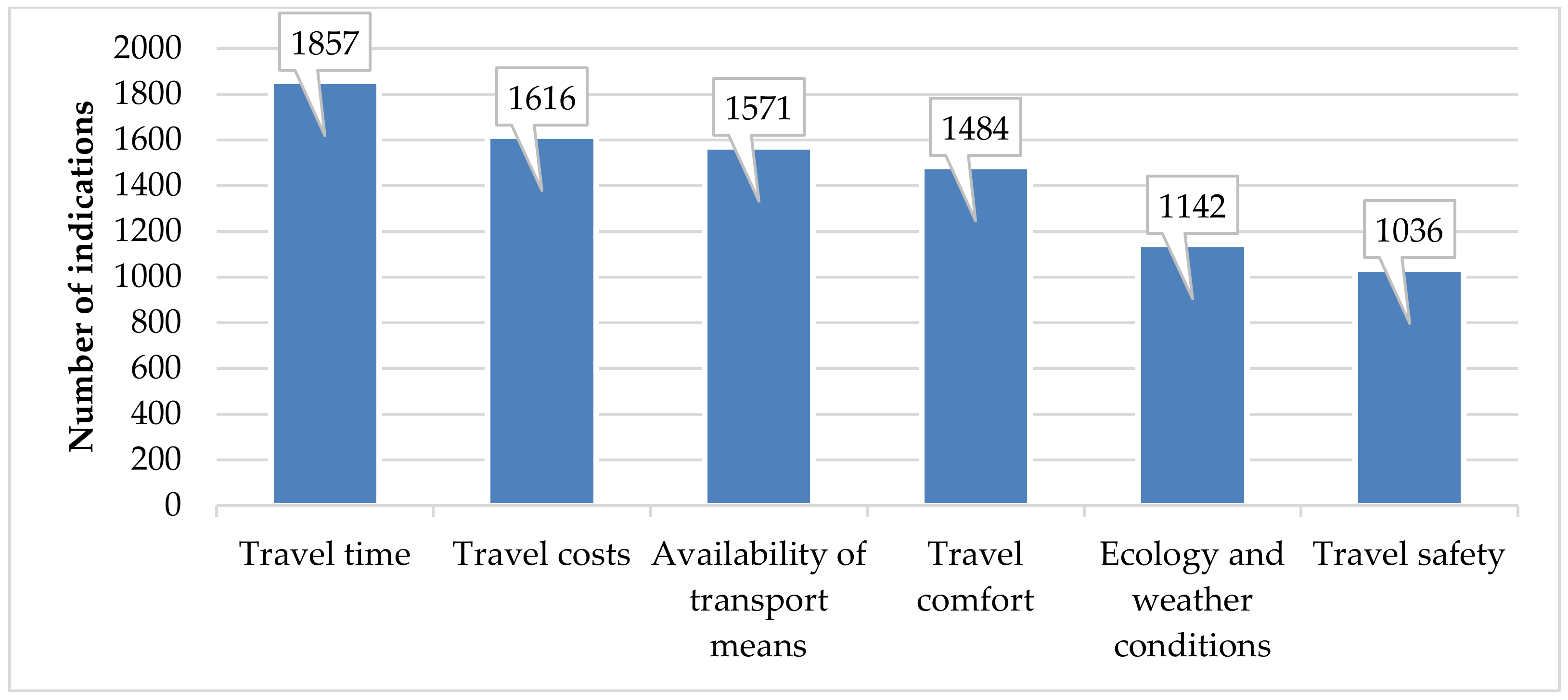


| Research Area | Characteristics |
|---|---|
| transport safety | —number of road accidents involving means of transport —number of fatalities involving means of transport —number of people injured involving means of transport —number of damaged means of transport |
| quality | —number of available means of transport —average waiting time for means of transport —comfort level of transport use |
| financial | —value of the transport means operating costs —value of the transport means infrastructure costs —value of transport costs per 1 km |
| ecological | —average travel speed of a given means of transport —CO2 emissions from means of transport —ratio of alternative fuels supplying means of transport |
| Research Area | Characteristics |
|---|---|
| transport safety | —safety level of driving a given means of transport |
| quality | —level of quality of transport services —the comfort of using a given means of transport |
| financial | —costs of operating and maintaining transport infrastructure —traveling costs |
| ecological | —environmental pollution resulting from the use of transport means —utilization of alternative fuels to power transport means |
| Research Area | Functions |
|---|---|
| transport safety | —minimum level of transport safety |
| quality | —maximum number of available means of transport —maximum waiting time for the means of transport —an adequate level of quality to price of means of transport |
| financial | —maximum level of operating costs for means of transport —maximum level of maintaining the infrastructure costs of means of transport —maximum level of traveling costs |
| ecological | —maximum CO2 emissions from means of transport —minimal share of alternative fuels supplying means of transport |
| Research Area | Criteria | Criteria Measures | Weight Rate |
|---|---|---|---|
| transport safety | —travel safety | —number of road incidents with mtm per 100 thousand inhabitants per year | |
| quality | —travel time —availability of mtm —travel comfort | —mtm driving speed [km/h] —number of vehicles per km2 [vehicle/km2] —comfort level of using mtm | |
| financial | —travel costs | —mtm cost travel [PLN/min] | |
| Ecological | —ecology and weather conditions | —mtm weather resistance indicator |
| Research Area | ||||
|---|---|---|---|---|
| 12.4 | 22.9 | 6.93 | 82.5 | |
| 15.00 | 25.00 | 35.00 | 50.00 | |
| 3.78 | 0.99 | 0.53 | 0.07 | |
| 3.58 | 3.50 | 3.53 | 3.29 | |
| 0.02 | 0.49 | 0.69 | 1.00 | |
| 20.00 | 40.00 | 40.00 | 100.00 | |
| Research Area | ||||
|---|---|---|---|---|
| 0.067 | 0.036 | 0.120 | 0.010 | |
| 0.063 | 0.105 | 0.147 | 0.210 | |
| 0.180 | 0.047 | 0.025 | 0.003 | |
| 0.170 | 0.166 | 0.168 | 0.156 | |
| 0.190 | 0.008 | 0.006 | 0.004 | |
| 0.026 | 0.052 | 0.052 | 0.130 | |
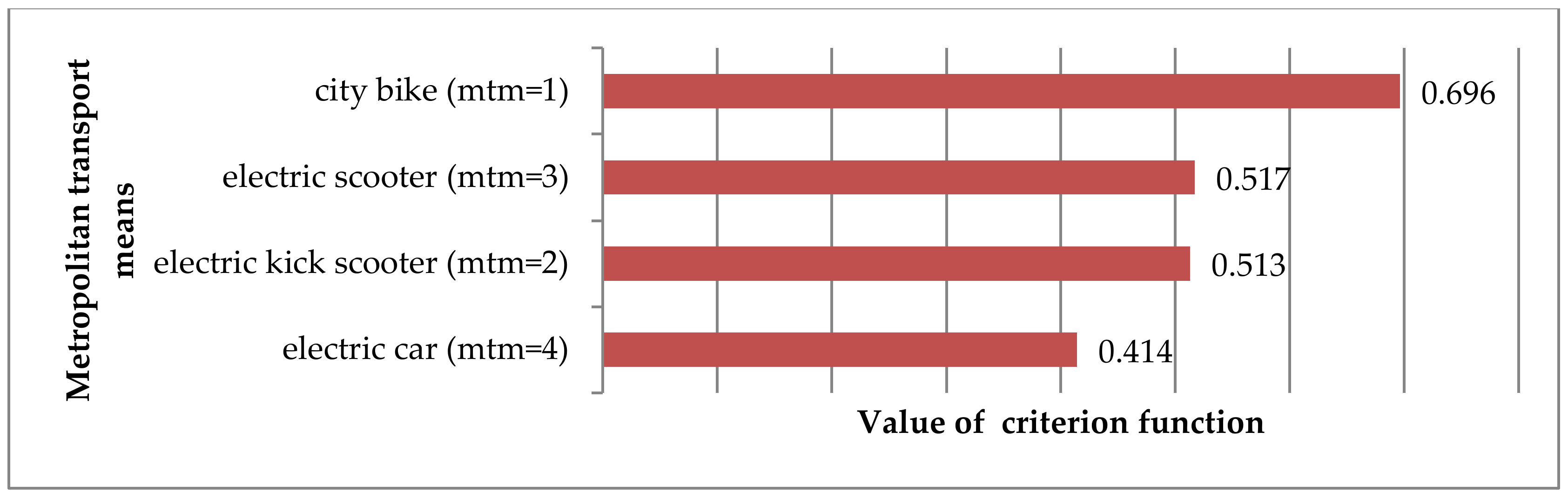
| total | 0.696 | 0.414 | 0.517 | 0.513 |
© 2020 by the authors. Licensee MDPI, Basel, Switzerland. This article is an open access article distributed under the terms and conditions of the Creative Commons Attribution (CC BY) license (http://creativecommons.org/licenses/by/4.0/).
Share and Cite
Cieśla, M.; Sobota, A.; Jacyna, M. Multi-Criteria Decision Making Process in Metropolitan Transport Means Selection Based on the Sharing Mobility Idea. Sustainability 2020, 12, 7231. https://doi.org/10.3390/su12177231
Cieśla M, Sobota A, Jacyna M. Multi-Criteria Decision Making Process in Metropolitan Transport Means Selection Based on the Sharing Mobility Idea. Sustainability. 2020; 12(17):7231. https://doi.org/10.3390/su12177231
Chicago/Turabian StyleCieśla, Maria, Aleksander Sobota, and Marianna Jacyna. 2020. "Multi-Criteria Decision Making Process in Metropolitan Transport Means Selection Based on the Sharing Mobility Idea" Sustainability 12, no. 17: 7231. https://doi.org/10.3390/su12177231
APA StyleCieśla, M., Sobota, A., & Jacyna, M. (2020). Multi-Criteria Decision Making Process in Metropolitan Transport Means Selection Based on the Sharing Mobility Idea. Sustainability, 12(17), 7231. https://doi.org/10.3390/su12177231