Unveiling Cacao Agroforestry Sustainability through the Socio-Ecological Systems Diagnostic Framework: The Case of Four Amazonian Rural Communities in Ecuador



Abstract
1. Introduction
2. Materials and Methods
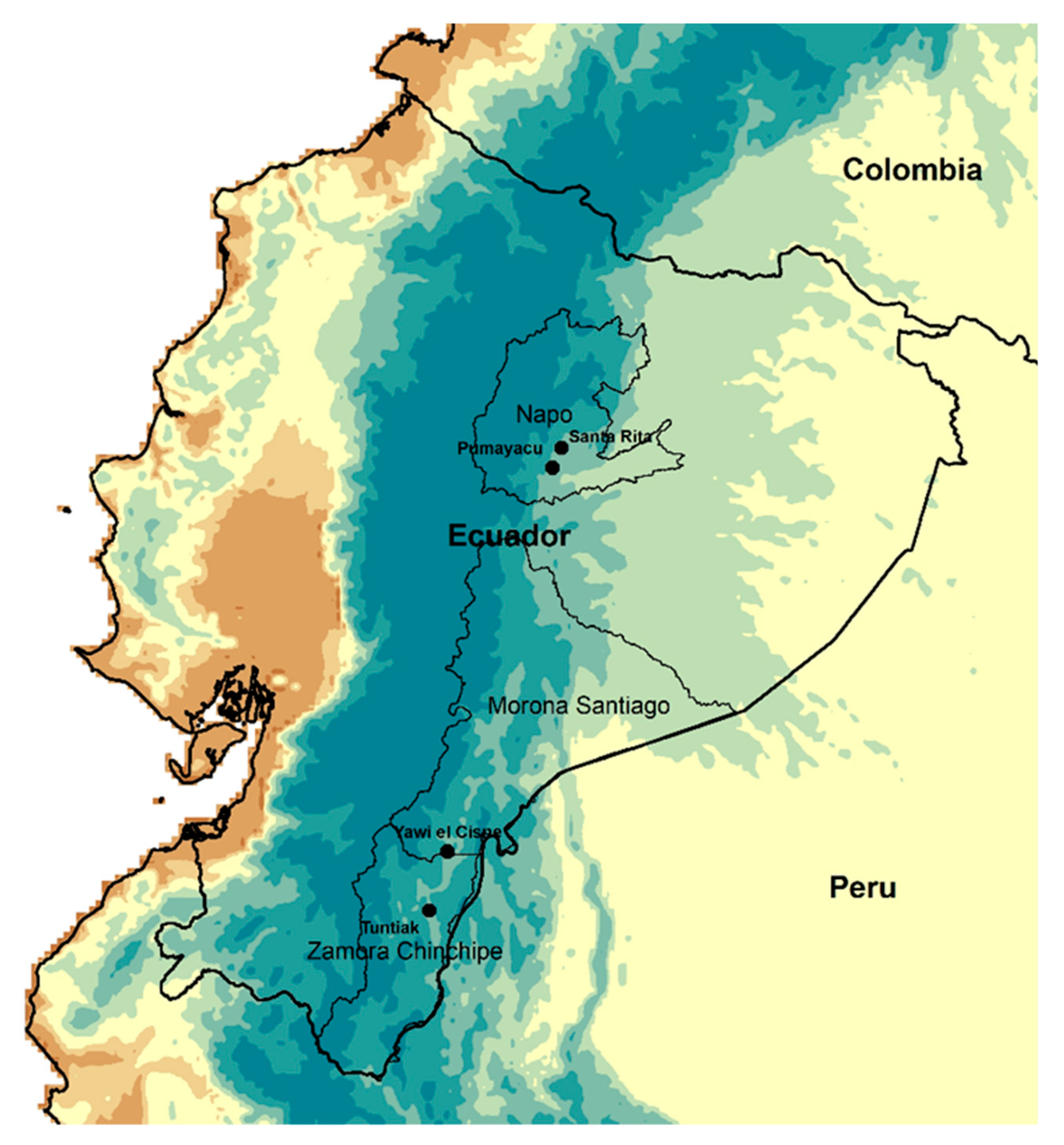
2.1. Study Sites
2.2. Data Collection and Survey Design
3. Results
3.1. Social, Economic and Political Settings (S)
3.2. Resource Units (RU), Resource Systems (RS) and Users (S)
“…here, we didn’t have that many trees of cacao before, but when the coffee market prices reached 1 cent the pound, we said that’s it, and we cut all the trees… then we had people coming here telling us to plant cacao trees…”.cacao producer in Santa Rita (our own translation)
3.3. Governance System (GS) of Amazonian Shaded Cacao Agroforestry
“…in my opinion, the cacao policies are just cheap policies from the central government… but how else are we going to earn 60 or 70 dollars to pay for basic needs?”Independent cacao producer in Pumayacu
“… each time they lower the price of the cacao beans by the pound they say it is because the international market prices have dropped…”.Independent cacao producer in Santa Rita
“…we cannot live from cacao alone, it is seasonal…, we rely on charcoal production in our own parcels…”.Woman and husband from the same household in Pumayacu
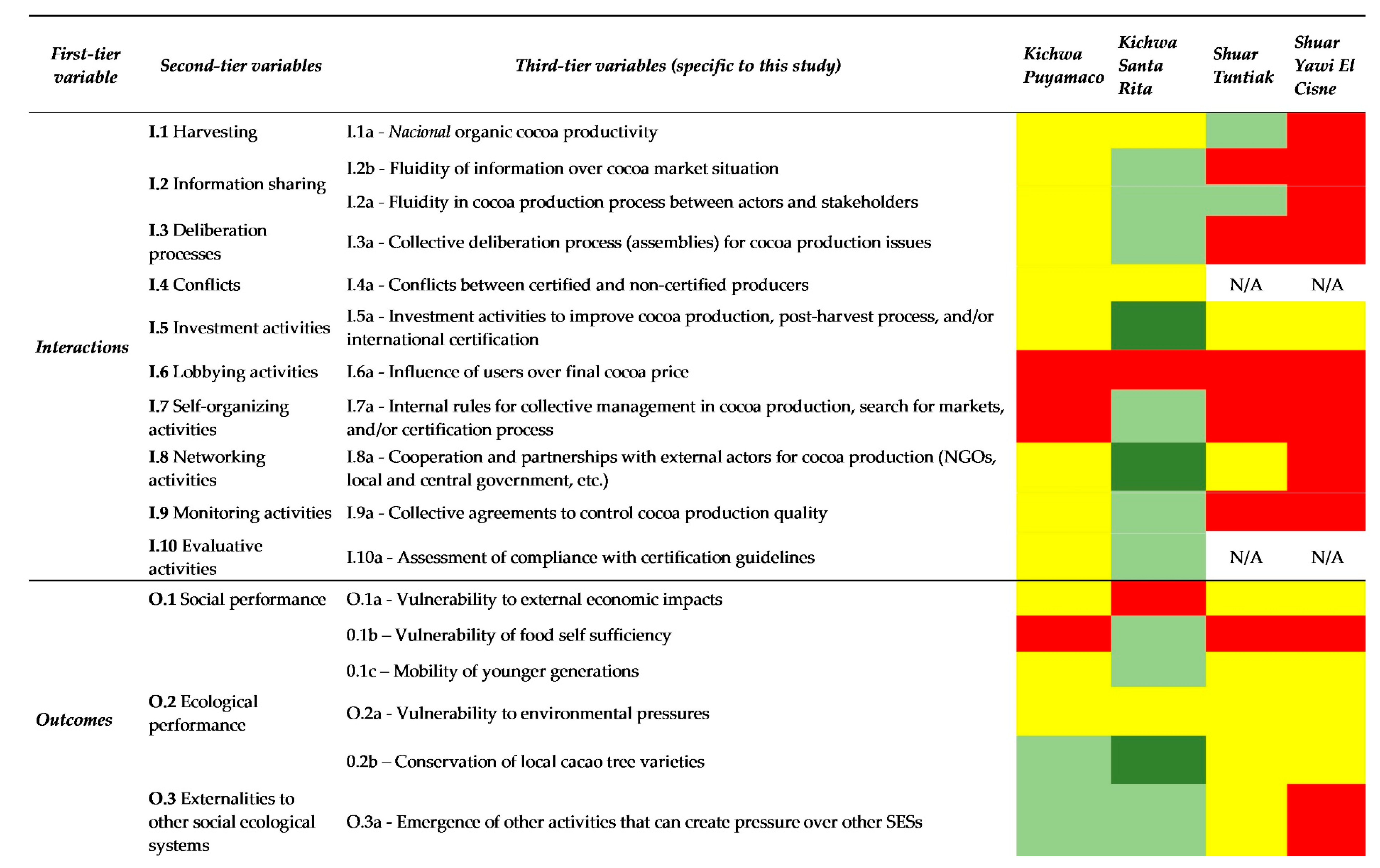
3.4. Interactions (I) and Outcomes (O)
“…our heritage is more on giving the means for studying than in giving lands to our children… I have six children and seven hectares,… after they finish high school, I will give each one, one hectare to build their own house, that is all what I can offer…”.Associated producer to the cooperative in Santa Rita
3.5. Related Ecosystems
4. Discussion
5. Conclusions
Supplementary Materials
Author Contributions
Funding
Acknowledgments
Conflicts of Interest
References
- Maezumi, S.Y.; Alves, D.; Robinson, M.; de Souza, J.G.; Levis, C.; Barnett, R.L.; Almeida de Oliveira, E.; Urrego, D.; Schaan, D.; Iriarte, J. The legacy of 4500 years of polyculture agroforestry in the eastern Amazon. Nat. Plants 2018, 4, 540–547. [Google Scholar] [CrossRef] [Scilit] [PubMed]
- McNeil, C.L. Deforestation, agroforestry, and sustainable land management practices among the Classic period Maya. Quat. Int. 2012, 249, 19–30. [Google Scholar] [CrossRef] [Scilit]
- Stahl, P.W.; Pearsall, D.M. Late pre-Columbian agroforestry in the tropical lowlands of western Ecuador. Quat. Int. 2012, 249, 43–52. [Google Scholar] [CrossRef] [Scilit]
- Voeks, R.; Greene, C. God’s healing leaves: The colonial quest for medicinal plants in the Torrid Zone. Geogr. Rev. 2018, 108, 545–565. [Google Scholar] [CrossRef] [Scilit]
- FAO. Agroforestry Definition. Available online: http://www.fao.org/forestry/agroforestry/80338/en/ (accessed on 1 March 2020).
- Somarriba, E.; Beer, J.; Alegre-Orihuela, J.; Andrade, H.J.; Cerda, R.; DeClerck, F.; Detlefsen, G.; Escalante, M.; Giraldo, L.A.; Ibrahim, M.; et al. Mainstreaming Agroforestry in Latin America. In Agroforestry—The Future of Global Land Use; Nair, P.K.R., Garrity, D., Eds.; Springer: Dordrecht, The Netherlands, 2012; pp. 429–453. [Google Scholar] [CrossRef] [Scilit]
- WorldBank-Group. Future of Food: Shaping a Climate-Smart Global Food System; World Bank: Washington, DC, USA, 2015; p. 32. [Google Scholar]
- FAOSTAT. Available online: http://www.fao.org/faostat/en/#data/Qc (accessed on 1 March 2020).
- Diaz-Montenegro, J.; Varela, E.; Gil, J.M. Livelihood strategies of cacao producers in Ecuador: Effects of national policies to support cacao farmers and specialty cacao landraces. J. Rural Stud. 2018, 63, 141–156. [Google Scholar] [CrossRef] [Scilit]
- Viteri Salazar, O.; Ramos-Martín, J.; Lomas, P.L. Livelihood sustainability assessment of coffee and cocoa producers in the Amazon region of Ecuador using household types. J. Rural Stud. 2018, 62, 1–9. [Google Scholar] [CrossRef] [Scilit]
- Acevedo, V.L.; Ulloa, J.; Osejo, J.A. Cartografía Histórica de Áreas Naturales Protegidas y Territorios Indígenas de la Amazonía Ecuatoriana; FLACSO: Calle, Guatemala, 2016. [Google Scholar]
- Zarrillo, S.; Gaikwad, N.; Lanaud, C.; Powis, T.; Viot, C.; Lesur, I.; Fouet, O.; Argout, X.; Guichoux, E.; Salin, F.; et al. The use and domestication of Theobroma cacao during the mid-Holocene in the upper Amazon. Nat. Ecol. Evolut. 2018, 2, 1879–1888. [Google Scholar] [CrossRef] [Scilit]
- Loor, R.G.; Lachenaud, P.; Fouet, O.; Argout, X.; Peña, G.; Macias, J.C.; Puyutaxi, A.; Marcelo, F.; Valdez, F.; Hurtado, J. Rescue of cacao genetic resources related to the nacional variety: Surveys in the Ecuadorian Amazon (2010–2013). Rev. ESPAMCiencia 2015, 6, 7–15. [Google Scholar]
- Salazar, E. An Indian Federation in Lowland Ecuador; IWGIA: Copenhagen, Danmark, 1977; Volume 28. [Google Scholar]
- Ostrom, E. A diagnostic approach for going beyond panaceas. Proc. Natl. Acad. Sci. USA 2007, 104, 15181–15187. [Google Scholar] [CrossRef] [Scilit]
- Ostrom, E. A General Framework for Analyzing Sustainability of Social-Ecological Systems. Science 2009, 325, 419–422. [Google Scholar] [CrossRef] [Scilit]
- Ratajczyk, E.; Brady, U.; Baggio, J.; Barnett, A.; Perez-Ibarra, I.; Rollins, N.; Rubiños, C.; Shin, H.; Yu, D.; Aggarwal, R.; et al. Challenges and opportunities in coding the commons: Problems, procedures, and potential solutions in large-N comparative case studies. Int. J. Commons 2016, 10. [Google Scholar] [CrossRef] [Scilit]
- De Zaldivar, V.B.S. From agrarian reform to ethnodevelopment in the highlands of Ecuador. J. Agrar. Chang. 2008, 8, 583–617. [Google Scholar] [CrossRef] [Scilit]
- Schaefer, T. Engaging modernity: The political making of indigenous movements in Bolivia and Ecuador, 1900–2008. Third World Q. 2009, 30, 397–413. [Google Scholar] [CrossRef] [Scilit]
- Berkes, F.; Colding, J.; Folke, C. Rediscovery of traditional ecological knowledge as adaptive management. Ecol. Appl. 2000, 10, 1251–1262. [Google Scholar] [CrossRef]
- Caballero-Serrano, V.; Onaindia, M.; Alday, J.G.; Caballero, D.; Carrasco, J.C.; McLaren, B.; Amigo, J. Plant diversity and ecosystem services in Amazonian homegardens of Ecuador. Agric. Ecosyst. Environ. 2016, 225, 116–125. [Google Scholar] [CrossRef] [Scilit]
- Descola, P. In the Society of Nature: A native Ecology in Amazonia; Cambridge University Press: Cambridge, UK, 1994; Volume 93, p. 372. [Google Scholar]
- Valdez, F. Ressources anciennes et enjeux contemporains. In Une Archéologie pour le Développement; Galipaud, J.-C., Guillaud, D., Eds.; Les Editions La Discussion: Marseille, France, 2014; pp. 119–130. [Google Scholar]
- Barrezueta-Unda, S.; Paz-Gonzalez, A. Indicators of sustainability social and economic: Case cocoa farmers of El Oro, Ecuador. Ciencia Unemi 2018, 11, 20–29. [Google Scholar] [CrossRef] [Scilit]
- Perdomo, C.; Barzola, W.J.F.; Acosta, O.N.R. Open innovation, an alternative for the strengthening of Ecuadorian agriculture. Rev. Univ. Soc. 2018, 10, 263–269. [Google Scholar]
- Nelson, V.; Tallontire, A.; Collinson, C. Assessing the benefits of ethical trade schemes for forest dependent people: Comparative experience from Peru and Ecuador. Int. For. Rev. 2002, 4, 99–109. [Google Scholar] [CrossRef] [Scilit]
- Purcell, T.F.; Fernández, N.; Martínez, E. The uneven geographical development of cacao commodity chains in Ecuador: From differential to monopoly ground-rent. CENEDET Working Paper #6 2016, 1–20. [Google Scholar]
- Purcell, T.F. “Hot chocolate”: Financialized global value chains and cocoa production in Ecuador. J. Peasant Stud. 2018, 45, 904–926. [Google Scholar] [CrossRef] [Scilit]
- Cummins, I.; Alavarado, E.; Andi, B. Actualización del Plan de Manejo de Comunidad Santa Rita 2016–2026; Runa Foundation: New York, NY, USA, 2016; p. 33. [Google Scholar]
- Larrauri, O.D.; Neira, D.P.; Montiel, M.S. Indicators for the Analysis of Peasant Women’s Equity and Empowerment Situations in a Sustainability Framework: A Case Study of Cacao Production in Ecuador. Sustainability 2016, 8, 1231. [Google Scholar] [CrossRef] [Scilit]
- Rueda, X.; Paz, A.; Gibbs-Plessl, T.; Leon, R.; Moyano, B.; Lambin, E.F. Smallholders at a Crossroad: Intensify or Fall behind? Exploring Alternative Livelihood Strategies in a Globalized World. Bus. Strategy Environ. 2018, 27, 215–229. [Google Scholar] [CrossRef] [Scilit]
- Dulcire, M. From passivity to collaboration: Changes in the links between cocoa farmers and a manufacturer in Ecuador. Cah. Agric. 2010, 19, 249–254. [Google Scholar] [CrossRef] [Scilit]
- Useche, P.; Blare, T. Traditional vs. modern production systems: Price and nonmarket considerations of cacao producers in Northern Ecuador. Ecol. Econ. 2013, 93, 1–10. [Google Scholar] [CrossRef] [Scilit]
- Melo, C.J.; Hollander, G.M. Unsustainable development: Alternative food networks and the Ecuadorian Federation of Cocoa Producers, 1995–2010. J. Rural Stud. 2013, 32, 251–263. [Google Scholar] [CrossRef] [Scilit]
- Coq-Huelva, D.; Higuchi, A.; Alfalla-Luque, R.; Burgos-Moran, R.; Arias-Gutierrez, R. Co-Evolution and Bio-Social Construction: The Kichwa Agroforestry Systems (Chakras) in the Ecuadorian Amazonia. Sustainability 2017, 9, 1920. [Google Scholar] [CrossRef] [Scilit]
- Mohebalian, P.M.; Aguilar, F.X. Additionality and design of forest conservation programs: Insights from Ecuador’s Socio Bosque Program. For. Policy Econ. 2016, 71, 103–114. [Google Scholar] [CrossRef] [Scilit]
- FAO. Advancing Agroforestry on the Policy Agenda: A Guide for Decision-Makers; Food and Agriculture Organization of the United Nations: Rome, Italy, 2013; p. 37. [Google Scholar]
- Ceddia, M.G.; Gunter, U.; Corriveau-Bourque, A. Land tenure and agricultural expansion in Latin America: The role of Indigenous Peoples’ and local communities’ forest rights. Global Environ. Chang. 2015, 35, 316–322. [Google Scholar] [CrossRef] [Scilit]


| Language-Speaking Group | Amazonian Kichwa | Shuar Chicham | ||
|---|---|---|---|---|
| Name of the Community | Pumayacu | Santa Rita | Yawi el Cisne | Tuntiak |
| Geographical region in Ecuador | Northern Amazon | Northern Amazon | Southern Amazon | Southern Amazon |
| Province | Napo | Napo | Morona Santiago | Zamora Chinchipe |
| Locality (canton) | Tena | Archidona | Gualaquiza | Centinela del Condor |
| Altitude above sea level | 620 m | 805 m | 837 m | 823 m |
| Population in 2017 (approximate) | 150–200 | 748 (147 families) | 43 | 600 (250 families) |
| Year of foundation | 1991 | 1967 | 1997 | 1999 |
| Surface of the collective community property | 40 Ha | 252 Ha | 50 Ha | 100 Ha |
| Surface of associated lands | 1200 Ha | 1400 Ha of primary forest | 3120 Ha of Chumpias property | No additional lands |
| Main source of revenue | Cacao, fishing, mixed farming (crop, livestock), and recently charcoal as a complement | Cacao, heritage tourism (lodge, theme park) | Self-sufficient economy, marginal cacao, and land selling for mining | Fishing, livestock, artisanal mining, and charcoal production |
| Accessibility | 5 h trip by public bus from Quito to Tena plus 45 min-walk | 5 h trip by public bus from Quito to Tena, plus 30 min bus by unpaved road | 15 h trip by public bus from Quito and 45 min in private 4 × 4 taxi | 18 h away by public bus from Quito. |
| Telephone and internet | No | Yes | No | Yes |
| Speaking Group | Province | Type of Organization | Type of Actor | |
|---|---|---|---|---|
| Kichwa | Napo | Pumayacu | Community-based organization of cacao farmers and chocolate producers | Manager and legal representative (1) |
| Amazonian Indigenous Community | Independent Small cocoa producers (3), commercial member of the local association (3), Small cocoa producers for the local association (2) | |||
| Santa Rita | Amazonian Indigenous Community | Small cocoa producers (5) | ||
| Other | Community-based Association | Manager and legal representative (1), Small cocoa producers (2) | ||
| Independent producer | Small cocoa producer (1) | |||
| Shuar | Morona Santiago | Yawi el Cisne | Amazonian Indigenous Community | Small cocoa producers (6) |
| Zamora-Chinchipe | Tuntiak | Amazonian Indigenous Community | Small cocoa producers (5) | |
| Other | Provincial government | Prefect of the province (1) | ||
| Provincial municipality Government | Employee (1) | |||
| Public enterprise for agricultural development | Agronomist (1) | |||
| Federation of small organic agricultural | Manager, Tree nursery manager (1) | |||
| Enterprise at the Centinela del Condor Municipality | Manager and legal representative (1) | |||
| Private export enterprise at El Pangui | Manager and legal representative (1) |
| Language-Speaking Group | Amazonian Kichwa | Shuar Chicham | ||
|---|---|---|---|---|
| Name of the Community | Pumayacu | Santa Rita | Yawi el Cisne | Tuntiak |
| Governmental program known as “fino de aroma” reactivation project (2012) | Yes | Yes, with additional funding from the FAO and local government | No | Yes for the plant provisions, but alternative programs exist with the provincial government |
| Date of cacao development | 15 years | More than 15 years | Not known by the interviewed people | Not known by the interviewed people |
| Cacao producer’s collective association | Yes (community-based cooperative) | Yes, community-based cooperative | None, but one person started a Criollo nursery at the time of the interview | incipient cooperation of few families |
| Cacao varieties | Mainly Nacional intermixed with CCN51, Criollos, mountain, and other native varieties | Mainly Nacional, with some Criollos and native varieties | Mainly old “ancestral” Criollos, a few Nacional and CCN51 | Mainly Nacional, with a high presence of native varieties. A few CCN51 in community plantations |
| Plantation type | 1–3 ha, 300–600 trees maximum | 3–7 ha, 600 trees | 1–4 ha with heterogeneous plantations | High-density Nacional with 800–1000 trees; use of natural fertilizers, disease control, and technical assistance |
| Technical assistance | Local cooperative | Local cooperative | None | Agronomist paid by the provincial government |
| Production issues | Disease on cacao pods observed, but no management | Well-managed cacao plantations | Disease on cacao pods observed, but no management | Basic management of disease on cacao pods |
| Language-Speaking Group | Amazonian Kichwa | Shuar Chicham | ||
|---|---|---|---|---|
| Name of the Community | Pumayacu | Santa Rita | Yawi el Cisne | Tuntiak |
| Plantation location in the communities | 15–60 min walk | Close to the community | Close to the community | Close to the community |
| Technical guidelines for harvesting | Defined by local cooperative: beans collected and dried for one night before being collected by truck | Specific requirements of cooperative 1: 3–5 days in advance without opening under the trees, then pod opening and bean harvesting. Cooperative 2 is less rigid | No specific guidelines, local know-how practices | No specific guidelines, local know-how practices |
| Purchase planning | Every 2 weeks for 4–5 months by local cooperative | Close coordination with cooperative 1 and local cooperative 2 | None | None |
| Post-harvesting facilities | Association facilities | In association with cooperative 1 | None | None |
| Cacao marketing | Fresh beans with pulp (USD 0.45): local cooperative (80%) and intermediaries (20%). “Dried bad cacao” all types confounded: sold to intermediaries (USD 0.20–0.60) | Fresh beans with pulp sold to cooperatives 1 (USD 0.35) and 2 (USD 0.45) for organic beans only. Market for dried beans all types confounded (30 min bus with prices of USD 0.35–0.60) | Dried beans sold to intermediaries in marketplaces (40 min walk, 20 min by bus). Trading prices unknown but probably not different from other places | Dried beans sold to intermediaries; no price difference for organic beans (USD 0.55) |
| Language-Speaking Group | Amazonian Kichwa | Shuar Chicham | ||
|---|---|---|---|---|
| Name of the Community | Pumayacu | Santa Rita | Yawi el Cisne | Tuntiak |
| Main sources of disputes or debates | Cacao prices | Cacao prices. Disagreement about how to manage cacao trees and harvest | Cacao prices. Disputes about land selling for mining, clearing for cattle ranching, or cutting trees for charcoal production | Cacao prices. Disputes about land selling for mining, clearing for cattle ranching, or cutting trees for charcoal production |
| Alternative sources of revenue to cacao | Increasing charcoal production, because a 50 kg bag is worth $7–8 at the nearest market | A few people employed in cacao-related ecotourism | Land selling for mining activities | Agriculture and livestock supported by the local prefecture; artisanal mining |
© 2020 by the authors. Licensee MDPI, Basel, Switzerland. This article is an open access article distributed under the terms and conditions of the Creative Commons Attribution (CC BY) license (http://creativecommons.org/licenses/by/4.0/).
Share and Cite
Castañeda-Ccori, J.; Bilhaut, A.-G.; Mazé, A.; Fernández-Manjarrés, J. Unveiling Cacao Agroforestry Sustainability through the Socio-Ecological Systems Diagnostic Framework: The Case of Four Amazonian Rural Communities in Ecuador. Sustainability 2020, 12, 5934. https://doi.org/10.3390/su12155934
Castañeda-Ccori J, Bilhaut A-G, Mazé A, Fernández-Manjarrés J. Unveiling Cacao Agroforestry Sustainability through the Socio-Ecological Systems Diagnostic Framework: The Case of Four Amazonian Rural Communities in Ecuador. Sustainability. 2020; 12(15):5934. https://doi.org/10.3390/su12155934
Chicago/Turabian StyleCastañeda-Ccori, Jilmar, Anne-Gaël Bilhaut, Armelle Mazé, and Juan Fernández-Manjarrés. 2020. "Unveiling Cacao Agroforestry Sustainability through the Socio-Ecological Systems Diagnostic Framework: The Case of Four Amazonian Rural Communities in Ecuador" Sustainability 12, no. 15: 5934. https://doi.org/10.3390/su12155934
APA StyleCastañeda-Ccori, J., Bilhaut, A.-G., Mazé, A., & Fernández-Manjarrés, J. (2020). Unveiling Cacao Agroforestry Sustainability through the Socio-Ecological Systems Diagnostic Framework: The Case of Four Amazonian Rural Communities in Ecuador. Sustainability, 12(15), 5934. https://doi.org/10.3390/su12155934