

An Innovative GIS-Based Territorial Information Tool for the Evaluation of Corporate Properties: An Application to the Italian Context





Abstract
1. Introduction
2. Background on Mass Appraisal Techniques
- -
- The Hedonic Price method;
- -
- Artificial Neural Networks;
- -
- Fuzzy logic methods;
- -
- ARIMA (autoregressive integrated moving average) models;
- -
- Spatial analysis methods.
3. Outlines of Evolutionary Polynomial Regression and Geographically Weighted Regression
3.1. Evolutionary Polynomial Regression (EPR)
3.2. Geographically Weighted Regression (GWR)
4. Application
4.1. Case Studies
4.2. Variables
- -
- : the units’ average selling price provided by the Real Estate Market Observatory (OMI) of the Italian Revenue Agency, relating to the semester in which the sale occurred, the specific market micro-zone and the intended use of the property;
- -
- : the units’ average rent provided by the OMI, clustered as the variable C;
- -
- : the resident population per unit surface relative to the year of sale, built starting from the Italian Institute of Statistics (ISTAT) surveys, processing the data through a grid modeling that considers the subdivision of the municipal territory into grids of 90 meters on each side [142];
- -
- : the saleable surface of the property;
- -
- : the architectural quality of the property. In particular, the variable is a dummy set equal to ‘0’ if there is no evident architectural quality; vice versa, it is set to ‘1’. The importance of identifying this variable is connected to the market appreciation for trophy buildings;
- -
- : the representative coefficient of the presence of public green areas (and their size) around the property. For the assessment of the influences connected to the public green areas, the parks, gardens and historic villas within two kilometers of the property were considered, and the surface extension of the green area and the distance of the -th property estate from the green areas were simultaneously determined. The green index is obtained through the sum of the ratios of the root of the areas and the distance of the property from the green area: ;
- -
- : the representative coefficient of the subways around the property [143,144]. A maximum distance of 2 km was considered, in order to limit the computational burdens. Note the distance of the -th property from the -th subway within the 2 km radius; the value of the proximity coefficient from the subway will be: .
4.3. EPR Implementation
4.4. GWR Implementation
4.5. Comparison of the Results Obtained by the Implementation of the Two Techniques
5. Conclusions
Author Contributions
Funding
Conflicts of Interest
References
- Pajarskas, V.; Jociene, A. Subprime mortgage crisis in the united states in 2007-2008: Causes and consequences (Part I). Ekonomika 2014, 93, 85–118. [Google Scholar] [CrossRef] [Scilit]
- Pajarskas, V.; Jočienė, A. Subprime mortgage crisis in the united states in 2007-2008: Causes and consequences (Part II). Ekon. Econ. 2015, 94, 7–41. [Google Scholar] [CrossRef] [Scilit]
- Lewis, M.K. The origins of the sub-prime crisis: Inappropriate policies, regulations, or both? Acc. Forum 2009, 33, 114–126. [Google Scholar] [CrossRef] [Scilit]
- D’Amato, M.; Kauko, T. Appraisal methods and the non-agency mortgage crisis. In Advances in Automated Valuation Modeling; Springer: Cham, Switzerland, 2017; pp. 23–32. [Google Scholar]
- Downie, M.L.; Robson, G. Automated valuation models: An international perspective. In Proceedings of the RICS Automated Valuation Models Conference: AVMs Today and Tomorrow, London, UK, 4 November 2008. [Google Scholar]
- Bitner, R. Confessions of a Subprime Lender: An Insider’s Tale of Greed, Fraud, and Ignorance; John Wiley & Sons: Hoboken, NJ, USA, 2008. [Google Scholar]
- Mooya, M. Of mice and men: Automated valuation models and the valuation profession. Urban Stud. 2011, 48, 2265–2281. [Google Scholar] [CrossRef] [Scilit]
- Taylor, J.B. The Financial Crisis and the Policy Responses: An Empirical Analysis of What Went Wrong; Working Paper No. 14631; National Bureau of Economic Research: Cambridge, MA, USA, 2009. [Google Scholar]
- Gilbertson, B.; Preston, D. A vision for valuation. J. Prop. Val. Invest. Financ. 2005, 23, 123–140. [Google Scholar] [CrossRef] [Scilit]
- Nicola, M.; Alsafi, Z.; Sohrabi, C.; Kerwan, A.; Al-Jabir, A.; Iosifidis, C.; Agha, M.; Agha, R. The socio-economic implications of the coronavirus and COVID-19 pandemic: A review. Int. J. Surg. 2020. [Google Scholar] [CrossRef] [Scilit]
- Ozili, P.K.; Arun, T. Spillover of COVID-19: Impact on the Global Economy. Available at SSRN 3562570. 2020. Available online: http://dx.doi.org/10.2139/ssrn.3562570 (accessed on 25 April 2020).
- Ramelli, S.; Wagner, A. What the stock market tells us about the consequences of COVID-19. In Mitigating the COVID Economic Crisis: Act Fast and Do Whatever it Takes; Baldwin, R., di Mauro, W.B., Eds.; CEPR Press: London, UK, 2020; p. 63. [Google Scholar]
- Il Sole 24Ore. Available online: www.ilsole24ore.com (accessed on 16 April 2020).
- Dealing with Valuation Uncertainty at Times of Market Unrest a Letter from the IVSC’s Technical Standards Boards—March 2020. Available online: www.ivsc.org (accessed on 27 April 2020).
- Del Giudice, V.; De Paola, P.; Del Giudice, F.P. COVID-19 Infects Real Estate Markets: Short and Mid-Run Effects on Housing Prices in Campania Region (Italy). Soc. Sci. 2020, 9, 114. [Google Scholar] [CrossRef] [Scilit]
- Harvey, J. Urban Land Economics: The Economics of Real Property Markets; Macmillan: London, UK, 1996. [Google Scholar]
- Antipov, E.; Pokryshevskaya, E.B. Mass appraisal of residential apartments: An application of Random forest for valuation and a CART-based approach for model diagnostics. Expert Syst. Appl. 2012, 39, 1772–1778. [Google Scholar] [CrossRef] [Scilit]
- Morano, P.; Tajani, F.; Locurcio, M. GIS application and econometric analysis for the verification of the financial feasibility of roof-top wind turbines in the city of Bari (Italy). Renew. Sustain. Energy Rev. 2017, 70, 999–1010. [Google Scholar] [CrossRef] [Scilit]
- Pagourtzi, E.; Assimakopoulos, V.; Hatzichristos, T.; French, N. Real estate appraisal: A review of valuation methods. J. Prop. Invest. Financ. 2003, 21, 383–401. [Google Scholar] [CrossRef] [Scilit]
- European AVM Alliance: Standards for Statistical Valuation Methods for residential properties in Europe. London (UK). 2017. Available online: http://www.europeanavmalliance.org/ (accessed on 25 May 2020).
- Rosato, P.; Alberini, A.; Zanatta, V.; Breil, M. Redeveloping derelict and un-derused historic city areas: Evidence from a survey of real estate developers. J. Env. Plan. Manag. 2010, 53, 257–281. [Google Scholar] [CrossRef] [Scilit]
- Singh, A.; Sharma, A.; Dubey, G. Big data analytics predicting real estate prices. Int. J. Syst. Assur. Eng. Manag. 2020. [Google Scholar] [CrossRef] [Scilit]
- Juan, Y. The precise marketing based on big data in the real estate enterprises. J. Mark. Wkly 2013, 9, 66–67. [Google Scholar]
- Fischer, M.M.; Stumpner, P. Income distribution dynamics and cross-region convergence in Europe. J. Geogr. Syst. 2008, 10, 109–139. [Google Scholar] [CrossRef] [Scilit]
- Fingleton, B. A Multi-equation spatial econometric model, with application to EU manufacturing productivity growth. In Handbook of Applied Spatial Analysis: Software Tools, Methods and Application; Springer: Berlin/Heidelberg, Germany, 2010; pp. 629–649. [Google Scholar]
- Fischer, M.M.; Bartkowska, M.; Riedl, A.; Sardadvar, S.; Kunnert, A. The Impact of Human Capital on Regional Labor Productivity in Europe. Lett. Spat. Res. Sci. 2009, 2, 97–108. [Google Scholar] [CrossRef] [Scilit]
- Yang, Y.; Sun, Y.; Li, S.; Zhang, S.; Wang, K.; Hou, H.; Xu, S. A GIS-Based Web Approach for Serving Land Price Information. ISPRS Int. J. Geo-Inf. 2015, 4, 2078–2093. [Google Scholar] [CrossRef] [Scilit]
- Greenhalgh, P.; King, H.; Muldoon-Smith, K.; Adebayo, A.; Ellis, J. Using GIS to Explore the Potential of Business Rating Data to Analyse Stock and Value Change for Land Administration: A Case Study of York. ISPRS Int. J. Geo-Inf. 2020, 9, 321. [Google Scholar] [CrossRef] [Scilit]
- Morano, P.; Locurcio, M.; Tajani, F. Cultural Heritage Valorization: An application of AHP for the Choice of the Highest and Best Use. Procedia Soc. Behav. Sci. 2016, 223, 952–959. [Google Scholar] [CrossRef] [Scilit]
- Adebayo, A.A.; Greenhalgh, P.; Muldoon-Smith, K. Investigating retail property market dynamics through spatial accessibility measures. J. Eur. Real Estate Res. 2019, 12, 155–172. [Google Scholar] [CrossRef] [Scilit]
- McCluskey, W.; Deddis, W.; Mannis, A.; McBurney, D.; Borst, R. Interactive application of computer assisted mass appraisal and geographic information systems. J. Prop. Valuat. Invest. 1997, 15, 448–465. [Google Scholar] [CrossRef] [Scilit]
- Lentz, G.; Wang, K. Residential appraisal and the lending process: A survey of issues. J. Real Estate Res. 1998, 15, 11–39. [Google Scholar]
- Wang, W. A knowledge-based decision support system for measuring the performance of government real estate investment. Expert Syst. Appl. 2005, 29, 901–912. [Google Scholar] [CrossRef] [Scilit]
- Morano, P.; Rosato, P.; Tajani, F.; Manganelli, B.; Di Liddo, F. Contextualized Property Market Models vs. Generalized Mass Appraisals: An Innovative Approach. Sustainability 2019, 11, 4896. [Google Scholar] [CrossRef] [Scilit]
- International Association of Assessing Officers. Standard on Mass Appraisal of Real Property; IAAO: Chicago, IL, USA, 2013. [Google Scholar]
- Stillwell, J.; Graham, C. Applied GIS and Spatial Analysis; Wiley: Chichester, UK, 2004. [Google Scholar]
- Apprasial Institute. Available online: www.appraisalinstitute.org/ (accessed on 30 April 2020).
- Locurcio, M.; Tajani, F.; Morano, P. Computational Methods Applied to Data Analysis for Modeling Complex Real Estate Systems. Complexity 2020. [Google Scholar] [CrossRef] [Scilit]
- Wang, D.; Li, J. Mass Appraisal Models of Real Estate in the 21st Century: A Systematic Literature Review. Sustainability 2019, 11, 7006. [Google Scholar] [CrossRef] [Scilit]
- Lancaster, K.J. A New Approach to Consumer Theory. J. Polit. Econ. 1966, 74, 132–157. [Google Scholar] [CrossRef] [Scilit]
- Rosen, S. Hedonic Prices and Implicit Markets: Product Differentiation in Pure Competition. J. Polit. Econ. 1974, 82, 34–55. [Google Scholar] [CrossRef] [Scilit]
- Capello, R. Una valutazione di accessibilità e qualità urbana: Una stima di prezzi edonici nella città di Trento. In Metodologie nelle Scienze Regionali; Franco Angeli: Milano, Italy, 2004. [Google Scholar]
- Ridker, R.G.; Henning, J.A. The Determinants of Residential Property Values with Special Reference to Air Pollution. Rev. Econ. Stat. 1967, 49, 246. [Google Scholar] [CrossRef] [Scilit]
- Wilkinson, R.K. House Prices and the Measurement of Externalities. Econ. J. 1973, 83, 72. [Google Scholar] [CrossRef] [Scilit]
- Corielli, F.; Frigieri, P.; Messori, A.; Tedeschi, P. Applicazione della teoria dei prezzi edonici al mercato immobiliare milanese. In Economia e Pianificazione Della Città Sostenibile; Camagni, R., Ed.; Mulino: Bologna, Italy, 1996; pp. 123–144. [Google Scholar]
- Sheppard, S. The Welfare Economics of Land Use Regulation; London School of Economics, Department of Geography: London, UK, 1997. [Google Scholar]
- Bowes, D.R.; Ihlanfeldt, K.R. Identifying the Impacts of Rail Transit Stations on Residential Property Values. J. Urban Econ. 2001, 50, 1–25. [Google Scholar] [CrossRef] [Scilit]
- Fletcher, M.; Gallimore, P.; Mangan, J. The modelling of housing submarkets. J. Prop. Invest. Financ. 2000, 18, 473–487. [Google Scholar] [CrossRef] [Scilit]
- Janssen, C.; Söderberg, B.; Zhou, J. Robust estimation of hedonic models of price and income for investment property. J. Prop. Invest. Financ. 2001, 19, 342–360. [Google Scholar] [CrossRef] [Scilit]
- Morancho, A.B. An hedonic valuation of urban green areas. Landsc. Urban. Plan. 2003, 66, 35–41. [Google Scholar] [CrossRef] [Scilit]
- Brander, L.M.; Koetse, M.J. The value of urban open space: Meta-analyses of contingent valuation and hedonic pricing results. J. Environ. Manag. 2011, 92, 2763–2773. [Google Scholar] [CrossRef] [Scilit] [PubMed]
- Czembrowski, P.; Kronenberg, J. Hedonic pricing and different urban green space types and sizes: Insights into the discussion on valuing ecosystem services. Landsc. Urban Plan. 2016, 146, 11–19. [Google Scholar] [CrossRef] [Scilit]
- Andersson, D.E.; Shyr, O.F.; Fu, J. Does high-speed rail accessibility influence residential property prices? Hedonic estimates from southern Taiwan. J. Transp. Geogr. 2010, 18, 166–174. [Google Scholar] [CrossRef] [Scilit]
- Netusil, N.R.; Levin, Z.; Shandas, V.; Hart, T. Valuing green infrastructure in Portland, Oregon. Landsc. Urban Plan. 2014, 124, 14–21. [Google Scholar] [CrossRef] [Scilit]
- Netusil, N.R. Urban environmental amenities and property values: Does ownership matter? Land Use Policy 2013, 31, 371–377. [Google Scholar] [CrossRef] [Scilit]
- Lutzenhiser, M.; Netusil, N.R. The Effect of Open Spaces on a Home’s Sale Price. Contemp. Econ. Policy 2001, 19, 291–298. [Google Scholar] [CrossRef] [Scilit]
- Limsombunc, V.; Gan, C.; Lee, M. House Price Prediction: Hedonic Price Model vs. Artificial Neural Network. Am. J. Appl. Sci. 2004, 1, 193–201. [Google Scholar] [CrossRef] [Scilit]
- Cechin, A.; Souto, A.; González, M.A. Real estate value at Porto Alegre City using artificial neural networks. In Proceedings of the Sixth Brazilian Symposium on Neural Networks Proceedings, Rio de Janeiro, Brazil, 25–25 November 2000; pp. 237–242. [Google Scholar]
- Ge, X.J.; Runeson, G.; Lam, K.C. Forecasting Hong Kong housing prices: An artificial neural network approach. In Proceedings of the International Conference on Methodologies in Housing Research, Stockholm, Sweden, 22–24 September 2003. [Google Scholar]
- Gallego, J. La inteligencia Artificial Aplicada a la Valoración de Inmuebles. Un Ejemplo paravalorar Madrid. Revista CT Catastro 2004, 50, 51–67. [Google Scholar]
- Hamzaoi, Y.E.; Hernández, J.A. Application of artificial neural networks to predict the selling price in the real estate valuation. In Proceedings of the 10th Mexican International Conference on Artificial Intelligence, Puebla, Mexico, 26 November–4 December 2011; pp. 175–181. [Google Scholar]
- Morano, P.; Tajani, F. Bare ownership evaluation. Hedonic price model vs. artificial neural network. Int. J. Bus. Intell. Data Min. 2013, 8, 340–362. [Google Scholar] [CrossRef] [Scilit]
- Kauko, T.; Hooimeijer, P.; Hakfoort, J. Capturing Housing Market Segmentation: An Alternative Approach based on Neural Network Modelling. Hous. Stud. 2002, 17, 875–894. [Google Scholar] [CrossRef] [Scilit]
- Islam, K.S.; Asami, Y. Housing market segmentation: A review. Rev. Urban Reg. Dev. Stud. 2009, 21, 93–109. [Google Scholar] [CrossRef] [Scilit]
- Fanning, K.; Cogger, K.O. Neural Network Detection of Management Fraud Using Published Financial Data. Soc. Sci. Res. Net. 1996, 7, 21–41. [Google Scholar] [CrossRef]
- Zimmermann, H.-J. Fuzzy Set Theory—and Its Applications; Springer Science and Business Media LLC: Berlin, Germany, 1991. [Google Scholar]
- Chen, S.-J.; Hwang, C.-L. Fuzzy multiple attribute decision making methods. In Fuzzy Multiple Attribute Decision Making. Lecture Notes in Economics and Mathematical Systems; Springer Science and Business Media LLC: Berlin, Germany, 1992; Volume 375, pp. 289–486. [Google Scholar]
- Kosko, B. Il Fuzzy-Pensiero: Teoria e Applicazioni Della Logica Fuzzy; Baldini & Castoldi: Milano, Italy, 1996. [Google Scholar]
- Ross, T.J. Fuzzy Logic with Engineering Applications; John Wiley & Sons: Hoboken, NJ, USA, 2009. [Google Scholar]
- Seo, F.; Sakawa, M. Multiple Criteria Decision Analysis in Regional Planning: Concepts, Methods and Applications; Reidel: Ede, The Netherlands, 1988. [Google Scholar]
- Krol, D.; Lasota, T.; Trawinski, B.; Trawinski, K. Comparison of mamdani and TSK fuzzy models for real estate appraisal lecture notes in computer science. In Knowledge-Based Intelligent Information and Engineering Systems; Springer: Berlin/Heidelberg, Germany, 2007. [Google Scholar]
- Lasota, T.; Telec, Z.; Trawinski, B.; Trawinski, K. Investigation of the eTS Evolving Fuzzy Systems Applied to Real Estate Appraisal. J. Mult. Valued Log. Soft Comput. 2011, 17, 229–253. [Google Scholar]
- Kuşan, H.; Aytekin, O.; Özdemir, I. The use of fuzzy logic in predicting house selling price. Expert Syst. Appl. 2010, 37, 1808–1813. [Google Scholar] [CrossRef] [Scilit]
- Del Giudice, V.; De Paola, P.; Cantisani, G.B. Valuation of Real Estate Investments through Fuzzy Logic. Buildings 2017, 7, 26. [Google Scholar] [CrossRef] [Scilit]
- D’Amato, M.; Siniak, N. Using fuzzy numbers in mass appraisal: The case of belorussian property market. In Mass Appraisal an International Perspective for Property Valuers; Blackwell Publishing Ltd.: Hoboken, NJ, USA, 2008; pp. 91–107. [Google Scholar]
- Sarip, A.G.; Hafez, M.B. Fuzzy Logic Application for House Price Prediction. Int. J. Prop. Sci. 2015, 5, 1–7. [Google Scholar] [CrossRef] [Scilit]
- Renigier-Biłozor, M.; Janowski, A.; D’Amato, M. Automated Valuation Model based on fuzzy and rough set theory for real estate market with insufficient source data. Land Use Policy 2019, 87, 104021. [Google Scholar] [CrossRef] [Scilit]
- Terano, T.; Asai, K.; Sugeno, M. Fuzzy Systems Theory and Its Applications; Academic Press Inc.: Cambridge, MA, USA, 1992. [Google Scholar]
- Veronesi, M.; Visioli, A. Logica Fuzzy. Fondamenti Teorici e Applicazioni Pratiche; Franco Angeli Editore: Milan, Italy, 2003. [Google Scholar]
- Zhang, G.P. Time series forecasting using a hybrid ARIMA and neural network model. Neurocomputing 2003, 50, 159–175. [Google Scholar] [CrossRef] [Scilit]
- Jadevicius, A.; Huston, S. ARIMA modelling of Lithuanian house price index. Int. J. Hous. Mark. Anal. 2015, 8, 135–147. [Google Scholar] [CrossRef] [Scilit]
- Abidoye, R.B.; Chan, A.; Abidoye, F.A.; Oshodi, O. Predicting property price index using artificial intelligence techniques. Int. J. Hous. Mark. Anal. 2019, 12, 1072–1092. [Google Scholar] [CrossRef] [Scilit]
- Li, C.; Chiang, T.-W. Complex Neurofuzzy ARIMA Forecasting—A New Approach Using Complex Fuzzy Sets. IEEE Trans. Fuzzy Syst. 2012, 21, 567–584. [Google Scholar] [CrossRef] [Scilit]
- Wang, F.; Zou, Y.; Zhang, H.; Shi, H. House price prediction approach based on deep learning and ARIMA model. In Proceedings of the 7th International Conference on Computer Science and Network Technology (ICCSNT), Dalian, China, 19–20 October 2019; pp. 303–307. [Google Scholar]
- Jadevicius, A.; Sloan, B.; Brown, A. Development of a Sesma model for short-term investment decisionmaking. In Proceedings of the 4th Annual Conference of the Global Chinese Real Estate Congress (GCREC), Macao, China, 3–5 July 2012. [Google Scholar]
- Chen, N.-K.; Chen, S.; Chou, Y.-H. House prices, collateral constraint, and the asymmetric effect on consumption. J. Hous. Econ. 2010, 19, 26–37. [Google Scholar] [CrossRef] [Scilit]
- Elbourne, A. The UK housing market and the monetary policy transmission mechanism: An SVAR approach. J. Hous. Econ. 2008, 17, 65–87. [Google Scholar] [CrossRef] [Scilit]
- Iacoviello, M. Consumption, house prices, and collateral constraints: A structural econometric analysis. J. Hous. Econ. 2004, 13, 304–320. [Google Scholar] [CrossRef] [Scilit]
- Tsatsaronis, K.; Zhu, H. What drives housing price dynamics: Cross-country evidence. BIS Q. Rev. March 2004, 65–78. [Google Scholar]
- Tobler, W.R. Cellular geography. In Philosophy in Geography; Gale, S., Olsson, G., Eds.; Springer Science and Business Media LLC: Dordrecht, The Netherlands, 1979; pp. 379–386. [Google Scholar]
- Crooks, A.; Castle, C.; Batty, M. Key challenges in agent-based modelling for geo-spatial simulation. Comput. Environ. Urban Syst. 2008, 32, 417–430. [Google Scholar] [CrossRef] [Scilit]
- Theriault, M.; Des Rosiers, F. Combining hedonic modelling, GIS and spatial statistics to analyze residential markets in the Quebec Urban Community. In Proceedings of the Joint European Conference on Geographical Information 2, Hague, The Netherlands, 26–31 March 1995; pp. 131–136. [Google Scholar]
- Levine, N. Spatial Statistics and GIS: Software Tools to Quantify Spatial Patterns. J. Am. Plan. Assoc. 1996, 62, 381–391. [Google Scholar] [CrossRef] [Scilit]
- Atkinson, P.M.; Tate, N.J. Spatial Scale Problems and Geostatistical Solutions: A Review. Prof. Geogr. 2000, 52, 607–623. [Google Scholar] [CrossRef] [Scilit]
- Dimopoulos, T.; Yiorkas, C. Implementing GIS in real estate price prediction and mass valuation: The case study of Nicosia District. In Proceedings of the Fifth International Conference on Remote Sensing and Geoinformation of the Environment (RSCy2017), Paphos, Cyprus, 20–23 March 2017. [Google Scholar]
- Wallner, R. GIS measures of residential property views. J. Real Estate Lit. 2014, 20, 224–225. [Google Scholar]
- Bohari, S.N.; Saad, S.N.M.; Marzukhi, F.; Rahim, A.; Darim, A.D.A.; Norashikin, B.S. Residential property valuation using GIS. In Proceedings of the IEEE 11th International Colloquium on Signal Processing & Its Applications (CSPA), Kuala Lumpur, Malaysia, 6–8 March 2015; pp. 131–134. [Google Scholar]
- Yu, S.M.; Han, S.S.; Chai, C.H. Modelling the Value of View in Real Estate Valuation: A 3-D GIS Approach. J. Pac. Rim Real Estate Soc. 2005, 11, 1–22. [Google Scholar]
- GISOud, D.A.J. GIS Based Property Valuation. Available online: http://www.gdmc.nl/publications/2017/MScThesis_DjamiljaOud.pdf (accessed on 30 May 2020).
- Sesli, F.A. Creating real estate maps by using GIS: A case study of Atakum-Samsun/Turkey. Acta Montan. Slovaca 2015, 20, 260–270. [Google Scholar]
- O’Connor, P.M. Use of statistical models and GIS in residential market analysis. J. Prop. Tax Assess Adm. 2013, 10, 37–60. [Google Scholar]
- Giustolisi, O.; Savic, D. A symbolic data-driven technique based on evolutionary polynomial regression. J. Hydroinform. 2006, 8, 207–222. [Google Scholar] [CrossRef] [Scilit]
- Tajani, F.; Morano, P.; Locurcio, M.; D’Addabbo, N. Property valuations in times of crisis: Artificial neural networks and evolutionary algorithms in comparison. In International Conference on Computational Science and Its Applications; Lecture Notes in Computer Science; Springer: Cham, Switzerland, 2015; pp. 194–209. [Google Scholar]
- Morano, P.; Tajani, F.; Locurcio, M. Land Use, Economic Welfare and Property Values: An Analysis of the Interdependencies of the Real-Estate Market with Zonal and Socio-Economic Variables in the Municipalities of Apulia Region (Italy). Int. J. Agric. Environ. Inf. Syst. 2015, 6, 16–39. [Google Scholar] [CrossRef] [Scilit]
- Morano, P.; Tajani, F.; Locurcio, M. Multicriteria analysis and genetic algorithms for mass appraisals in the Italian property market. Int. J. Hous. Mark. Anal. 2018, 11, 229–262. [Google Scholar] [CrossRef] [Scilit]
- Morano, P.; Rosato, P.; Tajani, F.; Di Liddo, F. An analysis of the energy efficiency impacts on the residential property prices in the city of Bari (Italy). In Zero-Carbon Energy Kyoto 2009; Springer Science and Business Media LLC: Berlin, Germany, 2019; pp. 73–88. [Google Scholar]
- Scott, L.; Janikas, M. Spatial statistics in ArcGIS. In Handbook of Applied Spatial Analysis: Software Tools, Methods and Application; Springer-Verlag: Berlin/Hedielberg, Germany, 2010; pp. 27–41. [Google Scholar]
- Scott, E.M.; Getis, A. Spatial statistics. In Encyclopedia of Geographic Informations; Kemp, K., Ed.; SAGE: Thousand Oaks, CA, USA, 2008. [Google Scholar]
- Chrostek, K.; Kopczewska, K. Spatial Prediction Models for Real Estate Markey Analysis. Ekonomia 2013, 53, 25–43. [Google Scholar]
- Ministry of Economy and Finance, Agenzia Entrate. Available online: www.agenziaentrate.gov.it (accessed on 6 May 2020).
- Las Casas, G.; Lombardo, S.; Murgante, B.; Pontrandolfi, P.; Scorza, F. Open data for territorial specialization assessment territorial specialization in attracting local development funds: An assessment procedure based on open data and open tools. TeMa J. Land Use Mobil. Environ. 2014. [Google Scholar] [CrossRef] [Scilit]
- Stein, M.L.; Chilès, J.-P.; Delfiner, P. Geostatistics Modeling Spatial Uncertainty; John Wiley & Sons: New York, NY, USA; Chichester, UK, 1999. [Google Scholar]
- Borst, R.A.; McCluskey, W.J. Using geographically weighted regression to detect housing submarkets: Modeling large-scale spatial variations in value. J. Prop. Tax Assess Adm. 2008, 5, 21. [Google Scholar]
- Bidanset, P.E.; Lombard, J.R. Evaluating spatial model accuracy in mass real estate appraisal: A comparison of geographically weighted regression and the spatial lag model. Cityscape 2014, 16, 169–182. [Google Scholar]
- Efthymiou, D.; Antoniou, C. How do transport infrastructure and policies affect house prices and rents? Evidence from Athens, Greece. Transp. Res. Part A Policy Pract. 2013, 52, 1–22. [Google Scholar] [CrossRef] [Scilit]
- Dziauddin, M.F.; Powe, N.; Alvanides, S. Estimating the Effects of Light Rail Transit (LRT) System on Residential Property Values Using Geographically Weighted Regression (GWR). Appl. Spat. Anal. Policy 2014, 8, 1–25. [Google Scholar] [CrossRef] [Scilit]
- Dimopoulos, T.; Moulas, A. A Proposal of a Mass Appraisal System in Greece with CAMA System: Evaluating GWR and MRA techniques in Thessaloniki Municipality. Open Geosci. 2016, 8, 675–693. [Google Scholar] [CrossRef] [Scilit]
- Cohen, J.P.; Coughlin, C.C.; Zabel, J. Time-Geographically Weighted Regressions and Residential Property Value Assessment. J. Real Estate Finance Econ. 2019, 60, 134–154. [Google Scholar] [CrossRef] [Scilit]
- Bujanda, A.; Fullerton, T.M. Impacts of transportation infrastructure on single-family property values. Appl. Econ. 2017, 49, 5183–5199. [Google Scholar] [CrossRef] [Scilit]
- Nomisma. Osservatorio sul Mercato Immobiliare, Anno XXIX Vol 3. November 2016. Available online: www.nomisma.it (accessed on 24 May 2020).
- Mundy, B. Defining a trophy property. Apprais. J. 2002, 70, 377–379. [Google Scholar]
- Rave, J.I.P.; Morales, J.C.C.; Echavarría, F.G. A machine learning approach to big data regression analysis of real estate prices for inferential and predictive purposes. J. Prop. Res. 2019, 36, 59–96. [Google Scholar] [CrossRef] [Scilit]
- Grether, D.; Mieszkowski, P. Determinants of real estate values. J. Urban Econ. 1974, 1, 127–145. [Google Scholar] [CrossRef] [Scilit]
- Gelfand, A.E.; Ghosh, S.; Knight, J.R.; Sirmans, C.F. Spatio-temporal modeling of residential sales data. J. Bus. Econ. Stat. 1998, 16, 312–321. [Google Scholar]
- McCluskey, W.J.; Deddis, W.G.; Lamont, I.G.; Borst, R.A. The application of surface generated interpolation models for the prediction of residential property values. J. Prop. Invest. Financ. 2000, 18, 162–176. [Google Scholar] [CrossRef] [Scilit]
- Oven, V.A.; Pekdemir, D. Office rent determinants utilizing factor analysis—A case study for Istanbul. J. Real Estate Financ. Econ. 2006, 33, 51–73. [Google Scholar] [CrossRef] [Scilit]
- Selim, H. Determinants of house prices in Turkey: Hedonic regression versus artificial neural network. Expert Syst. Appl. 2009, 36, 2843–2852. [Google Scholar] [CrossRef] [Scilit]
- Ozus, E. Determinants of Office Rents in the Istanbul Metropolitan Area. Eur. Plan. Stud. 2009, 17, 621–633. [Google Scholar] [CrossRef] [Scilit]
- Janssen, C.; Yang, Z. Estimating the market value of a proposed townhouse development. J. Prop. Invest. Financ. 1999, 17, 501–516. [Google Scholar] [CrossRef] [Scilit]
- Bourassa, S.; Cantoni, E.; Hoesli, M. Predicting house prices with spatial dependence: A comparison of alternative methods. J. Real Estate Res. 2010, 32, 139–159. [Google Scholar]
- Nourse, H.; Roulac, S. Linking Real Estate Decisions to Corporate Strategy. J. Real Estate Res. 1993, 8, 475–494. [Google Scholar]
- Robert, T.O., Jr. Translating organisational strategy into real estate action: The strategy alignment model. J. Corp. Real Estate 2004, 6, 106–117. [Google Scholar] [CrossRef] [Scilit]
- Rabianski, J.; DeLisle, J.; Carn, N. Corporate real estate site selection: A community-specific information framework. J. Real Estate Res. 2001, 22, 165–198. [Google Scholar]
- Feige, A.; Wallbaum, H.; Janser, M.; Windlinger, L. Impact of sustainable office buildings on occupant’s comfort and productivity. J. Corp. Real Estate 2013, 15, 7–34. [Google Scholar] [CrossRef] [Scilit]
- Nappi-Choulet, I.; Decamps, A. Capitalization of energy efficiency on corporate real estate portfolio value. J. Corp. Real Estate 2013, 15, 35–52. [Google Scholar] [CrossRef] [Scilit]
- Fuerst, F.; McAllister, P. Green Noise or Green Value? Measuring the Effects of Environmental Certification on Office Values. Real Estate Econ. 2010, 39, 45–69. [Google Scholar] [CrossRef] [Scilit]
- Rothe, P.; Hyvönen, A.; Nenonen, S.P.; Lindholm, A.-L. User preferences of office occupiers: Investigating the differences. J. Corp. Real Estate 2011, 13, 81–97. [Google Scholar] [CrossRef] [Scilit]
- Pfnuer, A.; Schaefer, C.; Armonat, S. Aligning corporate real estate to real estate investment functions: Improved property decision making using a real option approach. J. Corp. Real Estate 2004, 6, 243–264. [Google Scholar] [CrossRef] [Scilit]
- Brunia, S.; Hartjes-Gosselink, A. Personalization in non-territorial offices: A study of a human need. J. Corp. Real Estate 2009, 11, 169–182. [Google Scholar] [CrossRef] [Scilit]
- Rymarzak, M.; Siemińska, E. Factors affecting the location of real estate. J. Corp. Real Estate 2012, 14, 214–225. [Google Scholar] [CrossRef] [Scilit]
- Clapp, J.; Rodriguez, M. Using a GIS for Real Estate Market Analysis: The Problem of Spatially Aggregated Data. J. Real Estate Res. 1998, 16, 35–56. [Google Scholar]
- Jim, C.; Chen, W.Y. Impacts of urban environmental elements on residential housing prices in Guangzhou (China). Landsc. Urban Plan. 2006, 78, 422–434. [Google Scholar] [CrossRef] [Scilit]
- Hui, E.C.; Chau, C.K.; Pun, L.; Law, M. Measuring the neighboring and environmental effects on residential property value: Using spatial weighting matrix. Build. Environ. 2007, 42, 2333–2343. [Google Scholar] [CrossRef] [Scilit]
- Pradeepthi, C.; Vijaya Geetha, V.J.; Ramasubbareddy, S.; Govinda, K. Prediction of real estate price using clustering techniques. Adv. Intell. Syst. Comp. 2020, 1054, 281–289. [Google Scholar]
- D’Amato, M.; Kauko, T. Advances in Automated Valuation Modeling; Springer Science and Business Media LLC: Berlin, Germany, 2017; Volume 86. [Google Scholar]
- Balogun, T.F. An Assessment of Property Tax Administration in Edo State, Nigeria. Indones. J. Geogr. 2019, 51, 69–77. [Google Scholar] [CrossRef] [Scilit]
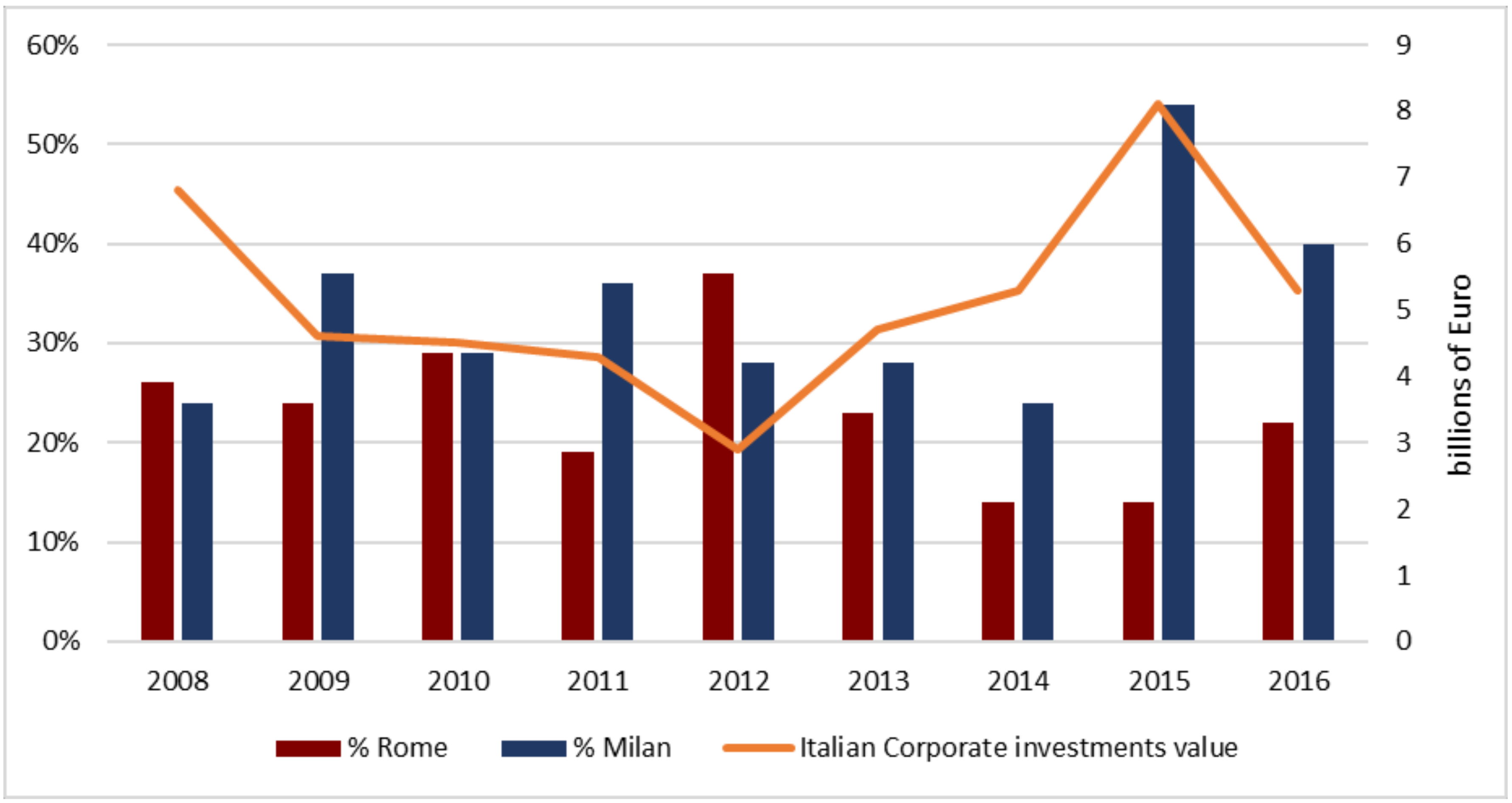
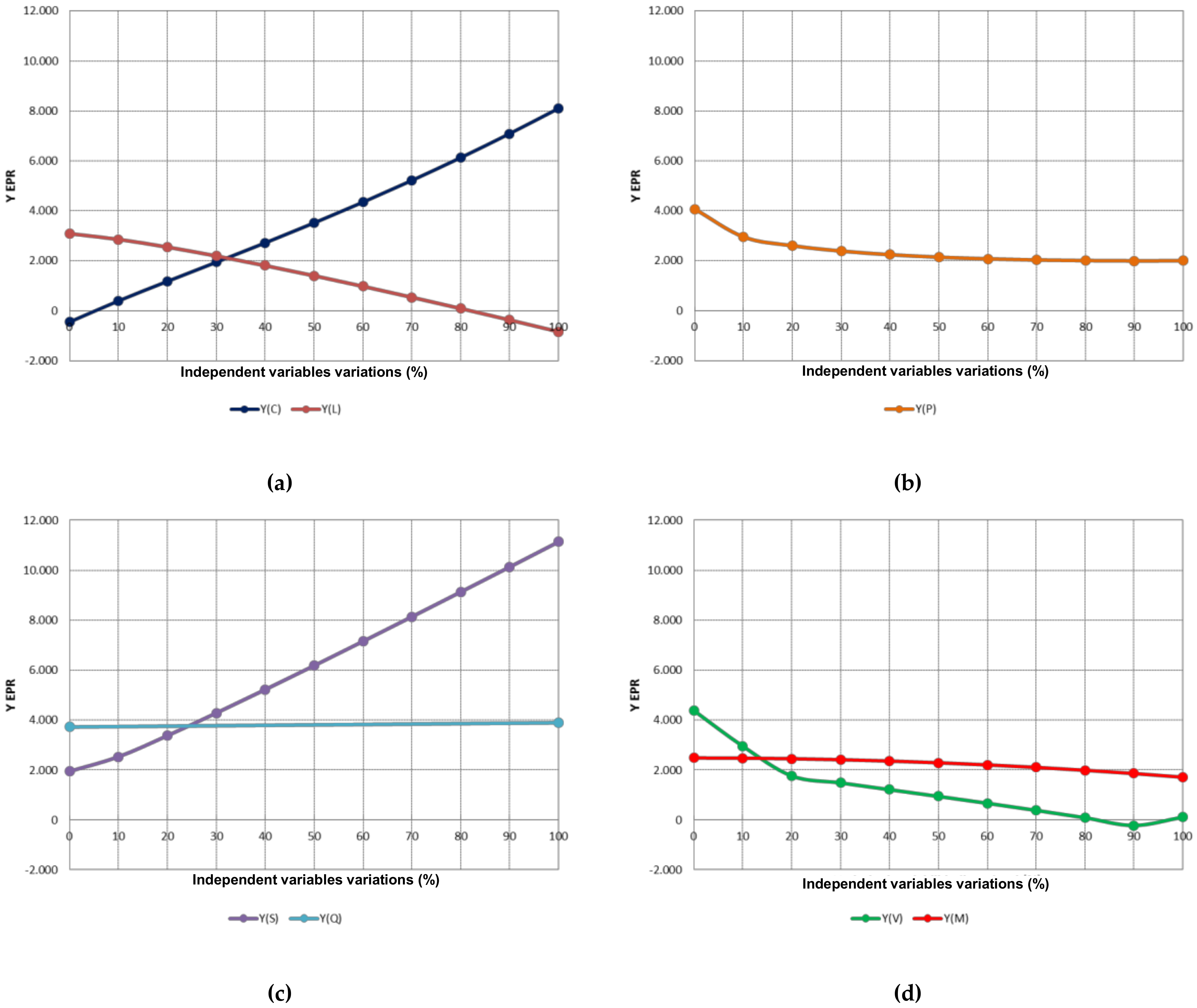
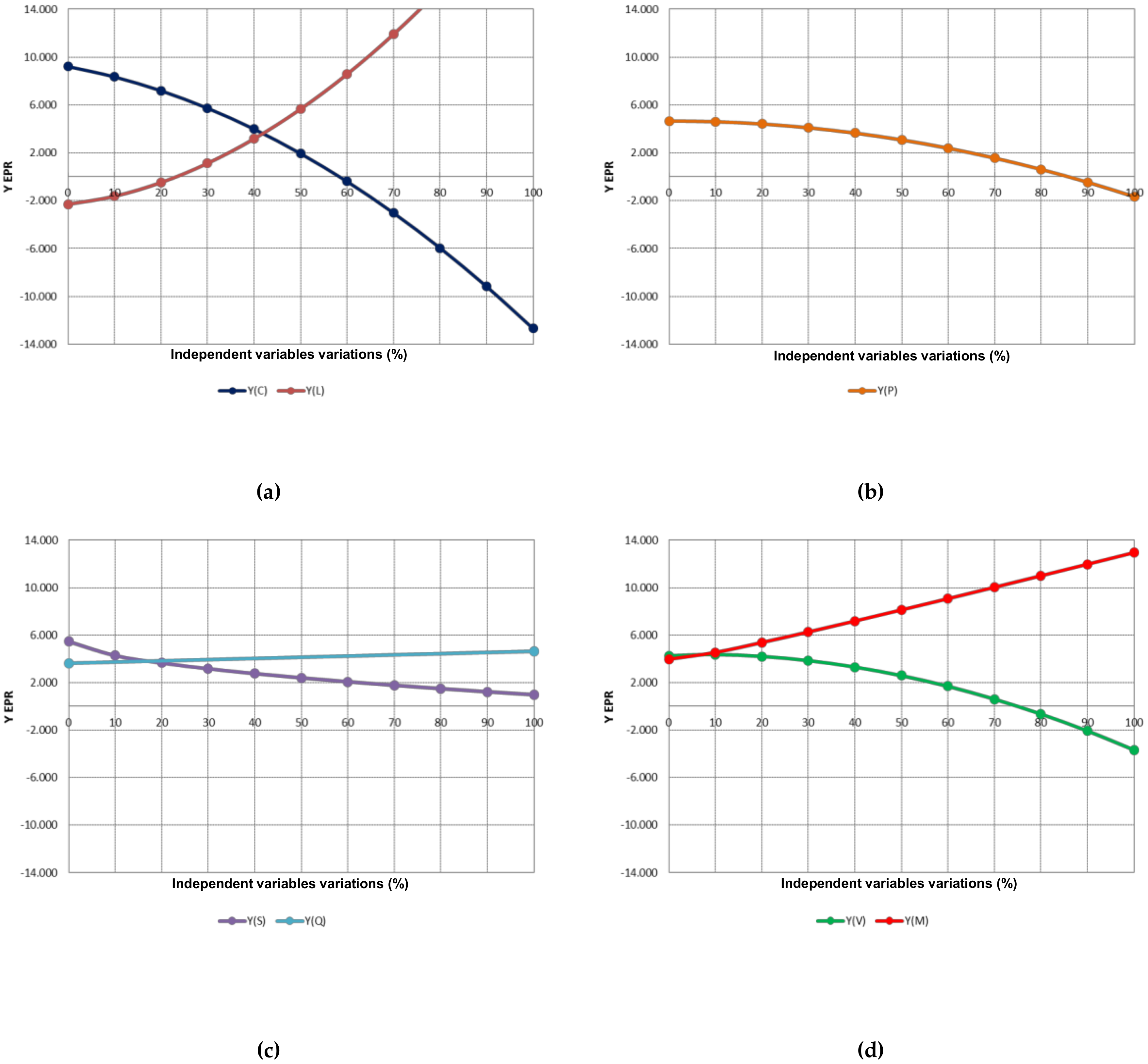


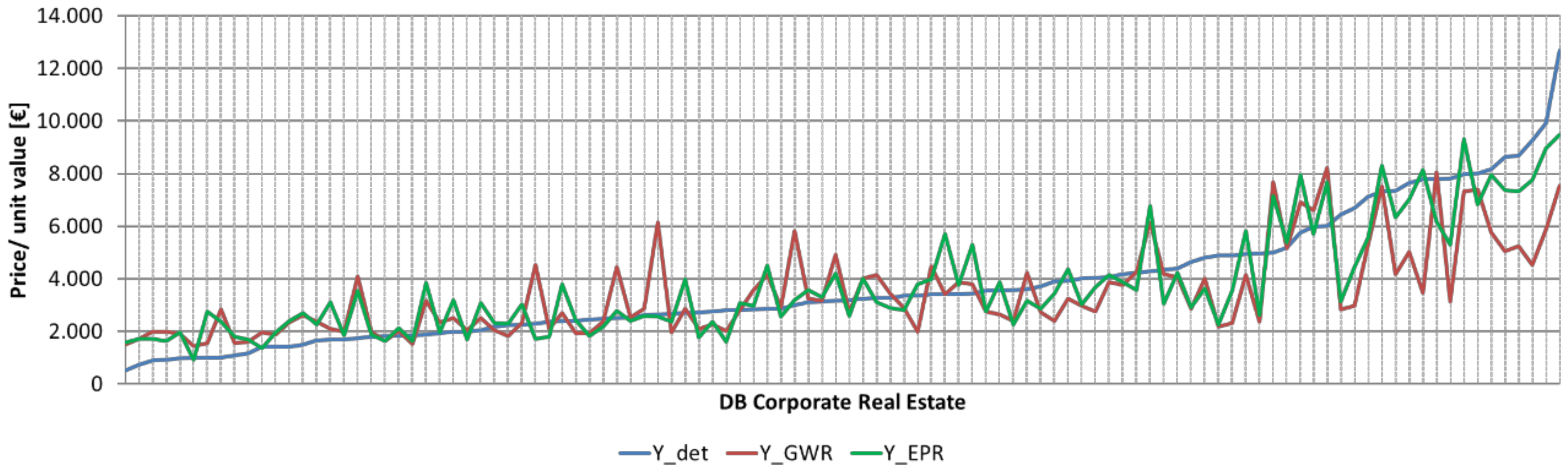
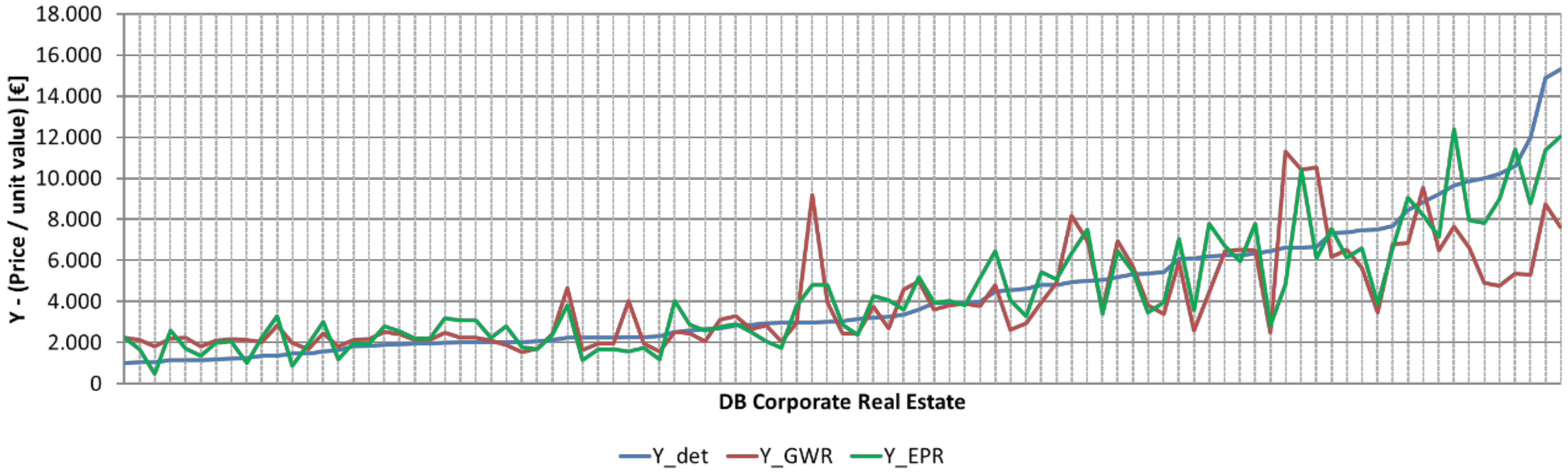
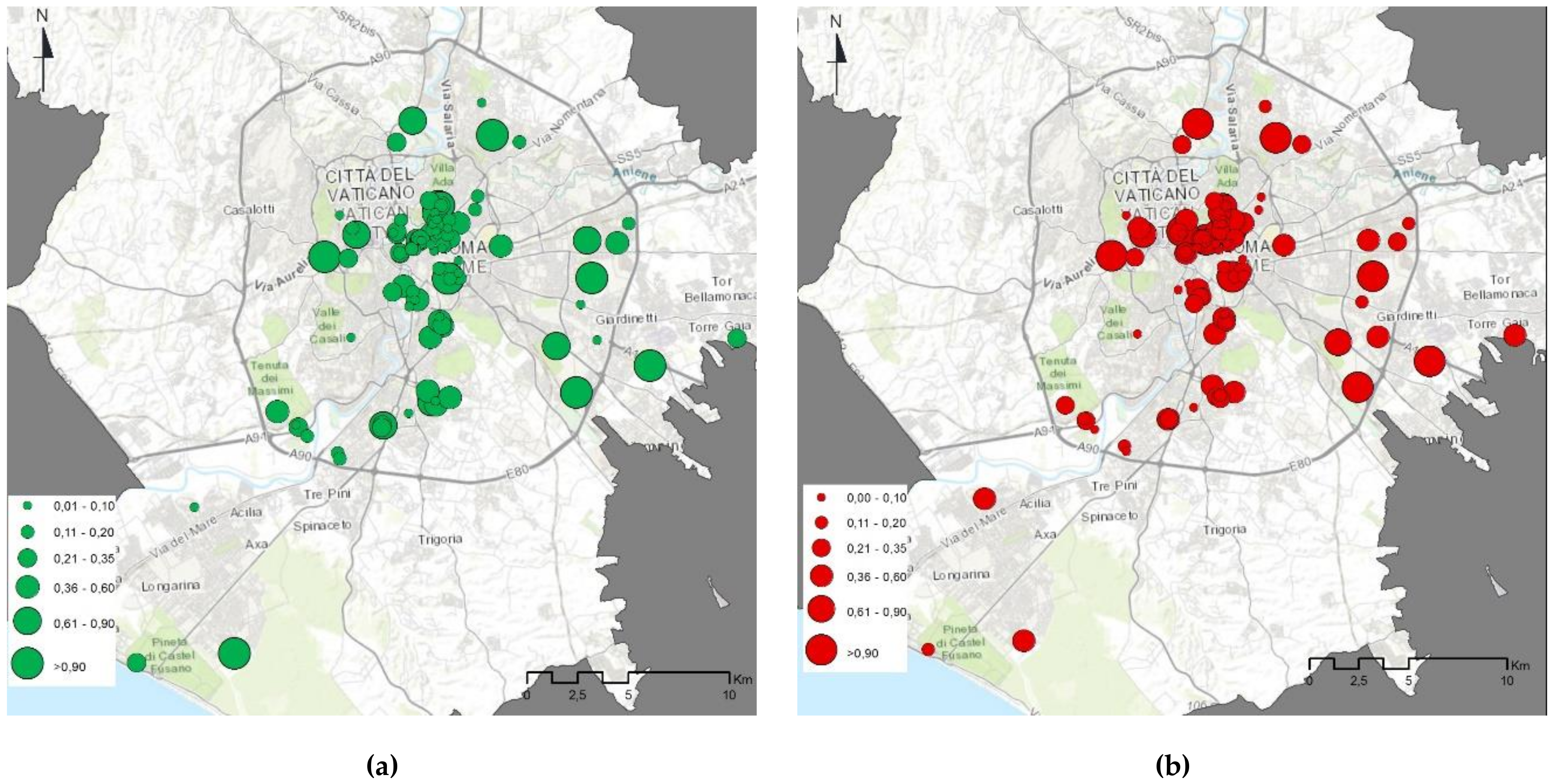
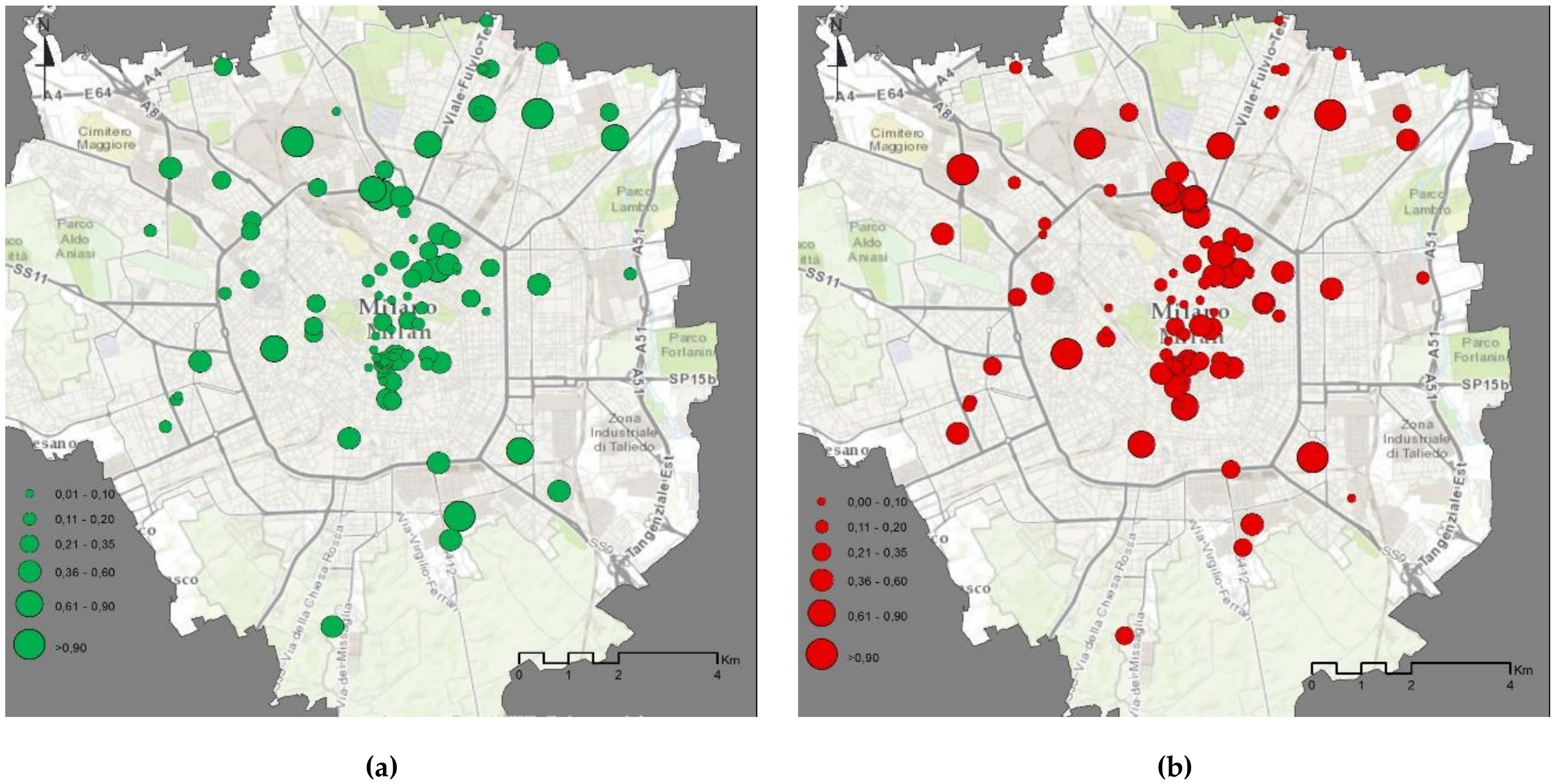
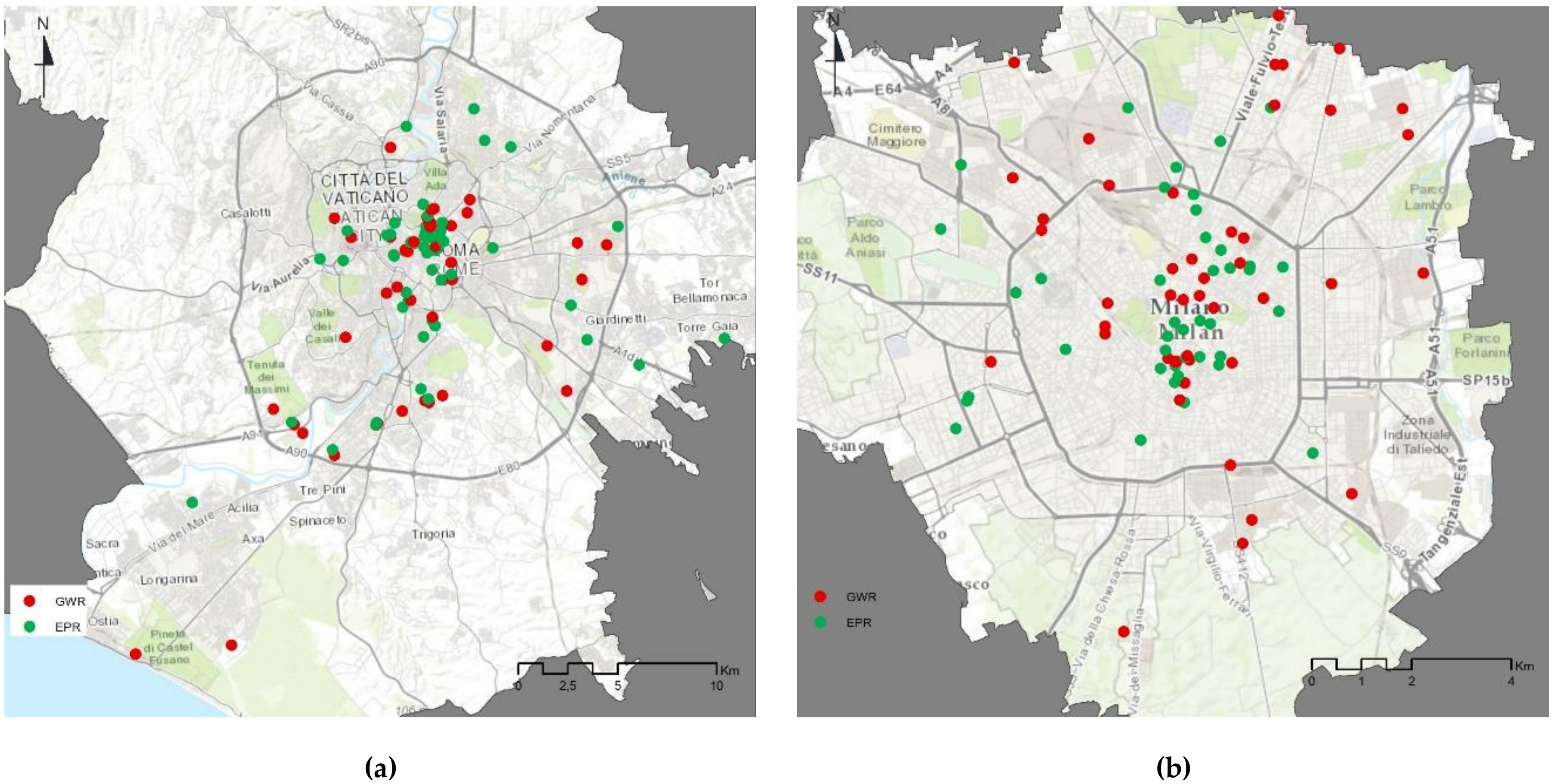



| Main Use | Selling Price (€) | Percentage | Number | Yavg (€/m2) | Yweighted (€/m2) | Average Price (€) |
|---|---|---|---|---|---|---|
| Residential | - | - | - | - | - | - |
| Retail | 1,147,546,028 | 26% | 80 | 3470 | 2655 | 14,344,325 |
| Office | 2,583,870,725 | 59% | 79 | 4123 | 3326 | 32,707,224 |
| Industrial | 126,000 | 0% | 1 | 1465 | 1465 | 126,000 |
| Hotel | 92,250,000 | 2% | 2 | 9902 | 9902 | 46,125,000 |
| Building area | 153,548,838 | 3% | 4 | 2852 | 212 | 38,387,210 |
| Others | 431,552,888 | 10% | 4 | 7750 | 6695 | 107,888,222 |
| Total | 4,408,894,479 | 100% | 170 |
| Main Use | Selling Price (€) | Percentage | Number | Yavg (€/m2) | Yweighted (€/m2) | Average Price (€) |
|---|---|---|---|---|---|---|
| Residential | 57,961,530 | 1% | 3 | 4789 | 4088 | 19,320,510 |
| Retail | 773,298,000 | 14% | 37 | 16,906 | 1046 | 20,899,946 |
| Office | 3,884,179,991 | 71% | 115 | 3327 | 2842 | 33,775,478 |
| Industrial | 120,255,022 | 2% | 8 | 511 | 436 | 15,031,878 |
| Hotel | 148,600,000 | 3% | 4 | 2267 | 2126 | 37,150,000 |
| Building area | 125,400,000 | 2% | 3 | 1013 | 1045 | 41,800,000 |
| Others | 356,612,974 | 7% | 18 | 3807 | 3874 | 19,811,832 |
| Total | 5,466,307,517 | 100% | 188 |
| Input | Y | C | L | P | S | Q | V | M |
|---|---|---|---|---|---|---|---|---|
| I Moran (Rome) | 0.769 | 1.226 | 1.372 | 1.514 | 0.251 | 1.033 | 1.295 | 0.497 |
| I Moran (Milan) | 1.061 | 1.103 | 1.037 | 1.185 | 0.187 | 0.931 | 0.190 | 0.154 |
| Model Setting | Model A | Model B | Model C |
|---|---|---|---|
| Number of terms | 7 | 7 | 7 |
| Dependent Variable | Y | Y | lnY |
| Exponents | 0; +0.5; +1; +2 | 0; ±0.5; ±1; ±2 | 0; +0.5; +1; +2 |
| City | Model A | Model B | Model C |
|---|---|---|---|
| Rome | 75.31 | 75.60 | 62.20 |
| Milan | 79.43 | 83.55 | 80.92 |
| Parameter | YEPR | C | L | P | S | Q | V | M |
|---|---|---|---|---|---|---|---|---|
| Min | 502 | 1800 | 9.5 | 0 | 526 | 0 | 0.00 | 0.00 |
| Avg | 3741 | 5236 | 26.1 | 69 | 9951 | - | 0.83 | 0.01 |
| Max | 12,677 | 11,300 | 79.3 | 245 | 110,000 | 1 | 4.00 | 0.03 |
| ΔYEPR | - | 8546 | 3924 | 2073 | 9191 | 1472 | 4600 | 769 |
| Parameter | YEPR | C | L | P | S | Q | V | M |
|---|---|---|---|---|---|---|---|---|
| Min | 998 | 1550 | 6.5 | 0 | 574 | 0 | 0.13 | 0.00 |
| Avg | 4298 | 4013 | 19.2 | 82 | 9847 | - | 0.93 | 0.02 |
| Max | 15,323 | 7900 | 35.0 | 308 | 86,086 | 1 | 4.15 | 0.39 |
| ΔYEPR | - | 21,893 | 26,767 | 6328 | 4478 | 1010 | 8035 | 8979 |
| Parameter | aC | aL | aP | aS | aQ | aV | aM |
|---|---|---|---|---|---|---|---|
| Min | 53% | 19% | 0% | 0% | 0% | 0% | 0% |
| Avg | 63% | 27% | 1% | 1% | 4% | 4% | 0% |
| Max | 72% | 39% | 6% | 22% | 23% | 18% | 1% |
| Parameter | aC | aP | aS | aQ | aV | aM |
|---|---|---|---|---|---|---|
| Min | 42% | 0% | 0% | 0% | 1% | 0% |
| Avg | 72% | 7% | 8% | 2% | 9% | 2% |
| Max | 92% | 36% | 49% | 18% | 51% | 26% |
| Statistical Indicator | GWR Rome | EPR Rome | GWR Milan | EPR Milan |
|---|---|---|---|---|
| MaxAPE | 17.6% | 18.4% | 14.1% | 15.3% |
| MAPE | 4.2% | 3.6% | 4.0% | 4.5% |
| RMSE | 5.5% | 4.9% | 5.1% | 5.7% |
© 2020 by the authors. Licensee MDPI, Basel, Switzerland. This article is an open access article distributed under the terms and conditions of the Creative Commons Attribution (CC BY) license (http://creativecommons.org/licenses/by/4.0/).
Share and Cite
Locurcio, M.; Morano, P.; Tajani, F.; Di Liddo, F. An Innovative GIS-Based Territorial Information Tool for the Evaluation of Corporate Properties: An Application to the Italian Context. Sustainability 2020, 12, 5836. https://doi.org/10.3390/su12145836
Locurcio M, Morano P, Tajani F, Di Liddo F. An Innovative GIS-Based Territorial Information Tool for the Evaluation of Corporate Properties: An Application to the Italian Context. Sustainability. 2020; 12(14):5836. https://doi.org/10.3390/su12145836
Chicago/Turabian StyleLocurcio, Marco, Pierluigi Morano, Francesco Tajani, and Felicia Di Liddo. 2020. "An Innovative GIS-Based Territorial Information Tool for the Evaluation of Corporate Properties: An Application to the Italian Context" Sustainability 12, no. 14: 5836. https://doi.org/10.3390/su12145836
APA StyleLocurcio, M., Morano, P., Tajani, F., & Di Liddo, F. (2020). An Innovative GIS-Based Territorial Information Tool for the Evaluation of Corporate Properties: An Application to the Italian Context. Sustainability, 12(14), 5836. https://doi.org/10.3390/su12145836

