Futuristic Sustainable Energy Management in Smart Environments: A Review of Peak Load Shaving and Demand Response Strategies, Challenges, and Opportunities


Abstract
1. Introduction
2. Smart Energy Management
2.1. Overview
2.2. Energy Management in Smart Environments
3. Peak Load Management in Smart Environments
3.1. Peak Load Shaving Strategies
3.2. Benefits of Peak Load Shaving
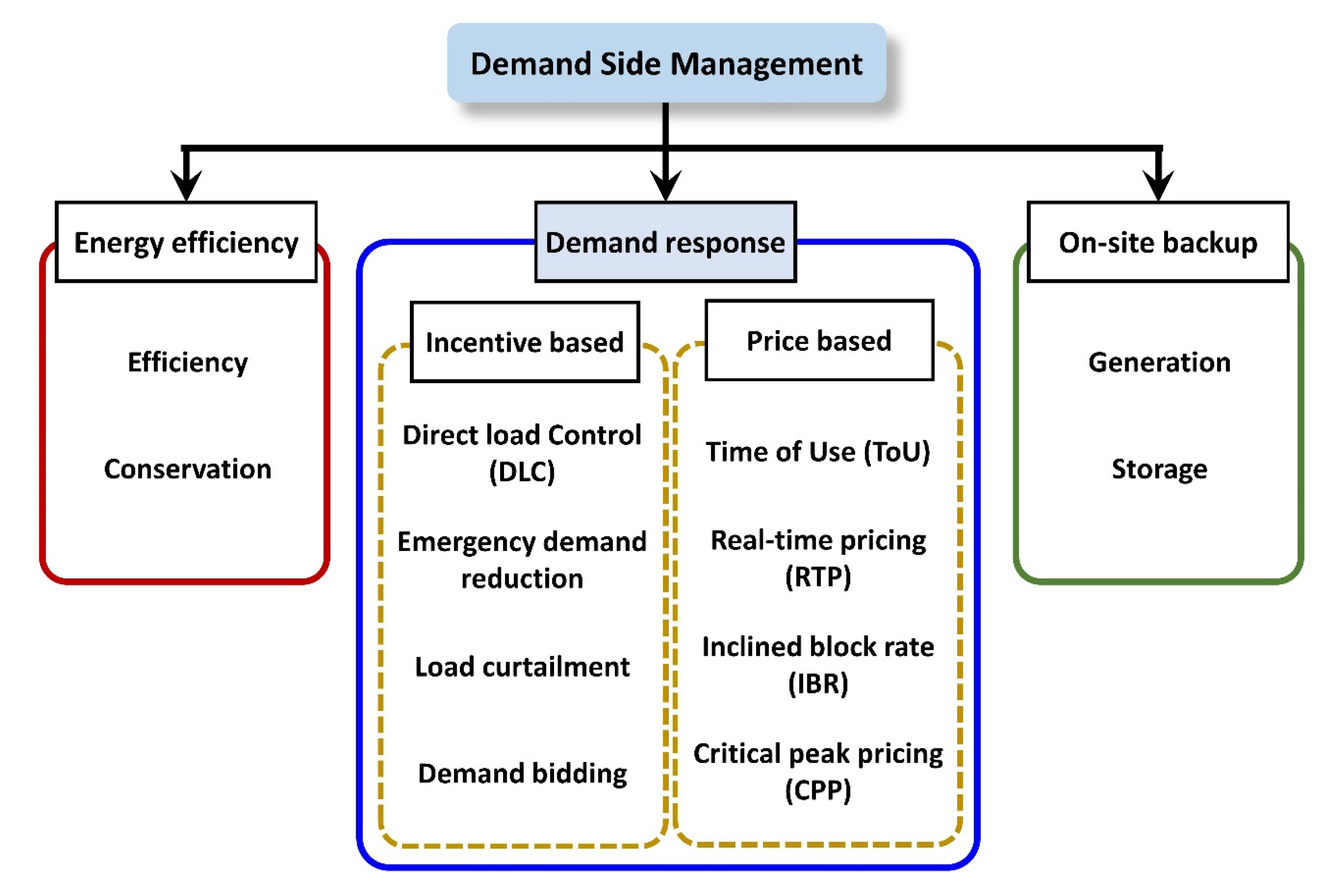
4. Demand Side Management in Smart Environments
4.1. Demand Response Strategies
4.1.1. Incentive-Based Demand Response
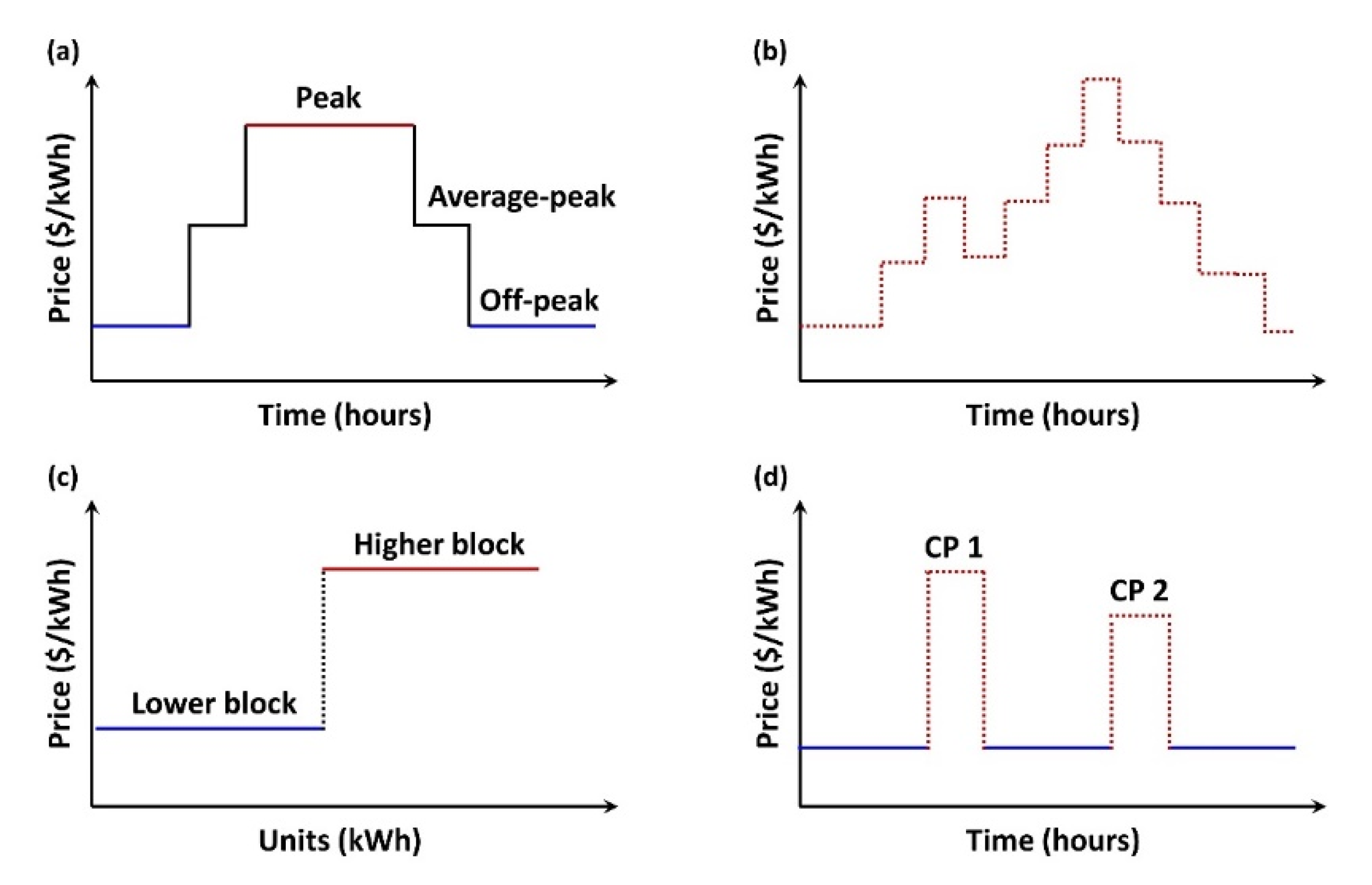
4.1.2. Price-Based Demand Response
4.2. Benefits of Demand Response
5. Challenges and Opportunities of Energy Management in Smart Environments
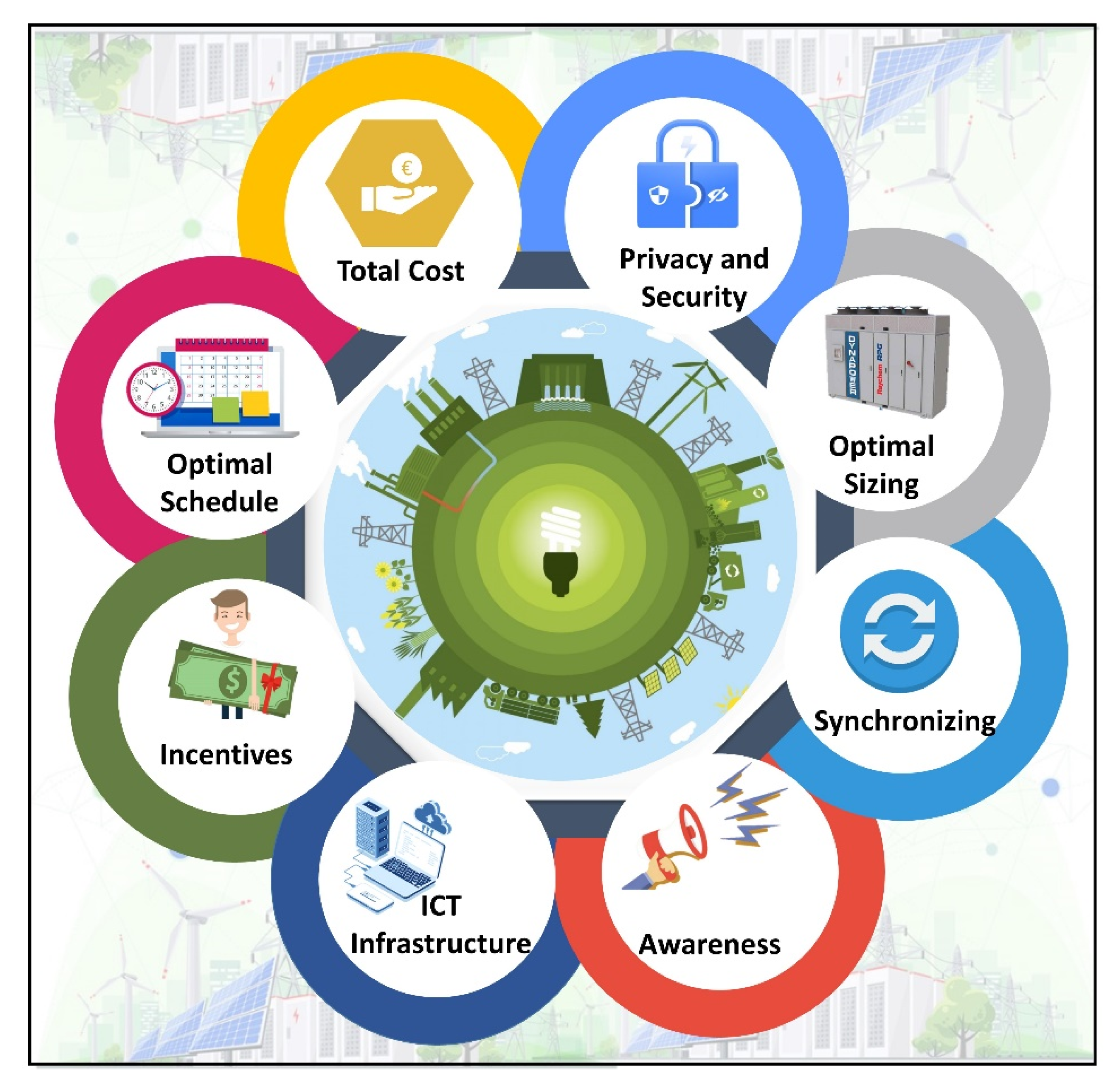
5.1. Challenges for Smart Environment Energy Management
5.2. Opportunities in Smart Environment Energy Management
6. Conclusions
Author Contributions
Funding
Conflicts of Interest
References
- Silva, B.N.; Khan, M.; Han, K. Towards sustainable smart cities: A review of trends, architectures, components, and open challenges in smart cities. Sustain. Cities Soc. 2018, 38, 697–713. [Google Scholar] [CrossRef] [Scilit]
- Silva, B.N.; Khan, M.; Han, K. Internet of things: A comprehensive review of enabling technologies, architecture, and challenges. IETE Tech. Rev. 2018, 35, 205–220. [Google Scholar] [CrossRef] [Scilit]
- Li, J.; Silva, B.N.; Diyan, M.; Cao, Z.; Han, K. A clustering based routing algorithm in iot aware wireless mesh networks. Sustain. Cities Soc. 2018, 40, 657–666. [Google Scholar] [CrossRef] [Scilit]
- Gubbi, J.; Buyya, R.; Marusic, S.; Palaniswami, M. Internet of things (iot): A vision, architectural elements, and future directions. Future Gener. Comput. Syst. 2013, 29, 1645–1660. [Google Scholar] [CrossRef] [Scilit]
- Vermesan, O.; Friess, P.; Guillemin, P.; Giaffreda, R.; Grindvoll, H.; Eisenhauer, M.; Serrano, M.; Moessner, K.; Spirito, M.; Blystad, L. Internet of things beyond the hype: Research innovation and deployment. In IERC Cluster SRIA; River Publisher: Gistrup, Danmark, 2015. [Google Scholar]
- Khan, M.; Silva, B.N.; Han, K. Internet of things based energy aware smart home control system. IEEE Access 2016, 4, 7556–7566. [Google Scholar] [CrossRef] [Scilit]
- Jabbar, S.; Khan, M.; Silva, B.N.; Han, K. A rest-based industrial web of things’ framework for smart warehousing. J. Supercomput. 2018, 74, 4419–4433. [Google Scholar] [CrossRef] [Scilit]
- Siano, P. Demand response and smart grids—A survey. Renew. Sustain. Energy Rev. 2014, 30, 461–478. [Google Scholar] [CrossRef] [Scilit]
- Catarinucci, L.; De Donno, D.; Mainetti, L.; Palano, L.; Patrono, L.; Stefanizzi, M.L.; Tarricone, L. An iot-aware architecture for smart healthcare systems. IEEE Internet Things J. 2015, 2, 515–526. [Google Scholar] [CrossRef] [Scilit]
- Silva, B.N.; Khan, M.; Han, K. Integration of big data analytics embedded smart city architecture with restful web of things for efficient service provision and energy management. Future Gener. Comput. Syst. 2017, 107, 975–987. [Google Scholar] [CrossRef] [Scilit]
- Silva, B.N.; Khan, M.; Jung, C.; Seo, J.; Muhammad, D.; Han, J.; Yoon, Y.; Han, K. Urban planning and smart city decision management empowered by real-time data processing using big data analytics. Sensors 2018, 18, 2994. [Google Scholar] [CrossRef] [Scilit] [PubMed]
- Ahmed, E.; Yaqoob, I.; Gani, A.; Imran, M.; Guizani, M. Internet-of-things-based smart environments: State of the art, taxonomy, and open research challenges. IEEE Wirel. Commun. 2016, 23, 10–16. [Google Scholar] [CrossRef] [Scilit]
- Khan, M.; Silva, B.N.; Jung, C.; Han, K. A context-aware smart home control system based on zigbee sensor network. KSII Trans. Internet Inf. Syst. 2017, 11, 1057–1069. [Google Scholar]
- Silva, B.N.; Khan, M.; Han, K. Load balancing integrated least slack time-based appliance scheduling for smart home energy management. Sensors 2018, 18, 685. [Google Scholar] [CrossRef] [Scilit] [PubMed]
- De Jong, M.; Joss, S.; Schraven, D.; Zhan, C.; Weijnen, M. Sustainable–smart–resilient–low carbon–eco–knowledge cities; making sense of a multitude of concepts promoting sustainable urbanization. J. Clean. Prod. 2015, 109, 25–38. [Google Scholar] [CrossRef] [Scilit]
- Tuballa, M.L.; Abundo, M.L. A review of the development of smart grid technologies. Renew. Sustain. Energy Rev. 2016, 59, 710–725. [Google Scholar] [CrossRef] [Scilit]
- Lund, H.; Andersen, A.N.; Østergaard, P.A.; Mathiesen, B.V.; Connolly, D. From electricity smart grids to smart energy systems–a market operation based approach and understanding. Energy 2012, 42, 96–102. [Google Scholar] [CrossRef] [Scilit]
- Lund, H. (Ed.) Definitions. In Renewable Energy Systems: A Smart Energy Systems Approach to the Choice and Modeling of 100% Renewable Solutions; Academic Press: Cambridge, MA, USA, 2014; pp. 6–10. [Google Scholar]
- Li, C.; Yu, X.; Yu, W.; Chen, G.; Wang, J. Efficient computation for sparse load shifting in demand side management. IEEE Trans. Smart Grid 2016, 8, 250–261. [Google Scholar] [CrossRef] [Scilit]
- Werminski, S.; Jarnut, M.; Benysek, G.; Bojarski, J. Demand side management using dadr automation in the peak load reduction. Renew. Sustain. Energy Rev. 2017, 67, 998–1007. [Google Scholar] [CrossRef] [Scilit]
- Yaghmaee, M.H.; Leon-Garcia, A.; Moghaddassian, M. On the performance of distributed and cloud-based demand response in smart grid. IEEE Trans. Smart Grid 2017, 9, 5403–5417. [Google Scholar] [CrossRef] [Scilit]
- Palensky, P.; Dietrich, D. Demand side management: Demand response, intelligent energy systems, and smart loads. IEEE Trans. Ind. Inform. 2011, 7, 381–388. [Google Scholar] [CrossRef] [Scilit]
- Jordehi, A.R. Optimisation of demand response in electric power systems, a review. Renew. Sustain. Energy Rev. 2019, 103, 308–319. [Google Scholar] [CrossRef] [Scilit]
- Yan, X.; Ozturk, Y.; Hu, Z.; Song, Y. A review on price-driven residential demand response. Renew. Sustain. Energy Rev. 2018, 96, 411–419. [Google Scholar] [CrossRef] [Scilit]
- Zhou, B.; Li, W.; Chan, K.W.; Cao, Y.; Kuang, Y.; Liu, X.; Wang, X. Smart home energy management systems: Concept, configurations, and scheduling strategies. Renew. Sustain. Energy Rev. 2016, 61, 30–40. [Google Scholar] [CrossRef] [Scilit]
- Rathnayaka, A.D.; Potdar, V.M.; Dillon, T.; Hussain, O.; Kuruppu, S. Goal-oriented prosumer community groups for the smart grid. IEEE Technol. Soc. Mag. 2014, 33, 41–48. [Google Scholar] [CrossRef] [Scilit]
- Steinheimer, M.; Trick, U.; Ruhrig, P. Energy communities in smart markets for optimisation of peer-to-peer interconnected smart homes. In Proceedings of the 8th International Symposium on Communication Systems, Networks & Digital Signal Processing (CSNDSP), Poznan, Poland, 18–20 July 2012; IEEE: Piscataway, NJ, USA, 2012; pp. 1–6. [Google Scholar]
- Midilli, A.; Dincer, I.; Ay, M. Green energy strategies for sustainable development. Energy Policy 2006, 34, 3623–3633. [Google Scholar] [CrossRef] [Scilit]
- Chu, S.; Majumdar, A. Opportunities and challenges for a sustainable energy future. Nature 2012, 488, 294–303. [Google Scholar] [CrossRef] [Scilit]
- Olatomiwa, L.; Mekhilef, S.; Ismail, M.S.; Moghavvemi, M. Energy management strategies in hybrid renewable energy systems: A review. Renew. Sustain. Energy Rev. 2016, 62, 821–835. [Google Scholar] [CrossRef] [Scilit]
- Gelazanskas, L.; Gamage, K.A. Demand side management in smart grid: A review and proposals for future direction. Sustain. Cities Soc. 2014, 11, 22–30. [Google Scholar] [CrossRef] [Scilit]
- Han, J.; Choi, C.-S.; Park, W.-K.; Lee, I.; Kim, S.-H. Smart home energy management system including renewable energy based on zigbee and plc. IEEE Trans. Consum. Electron. 2014, 60, 198–202. [Google Scholar] [CrossRef] [Scilit]
- Boynuegri, A.R.; Yagcitekin, B.; Baysal, M.; Karakas, A.; Uzunoglu, M. Energy management algorithm for smart home with renewable energy sources. In Proceedings of the Power Engineering, Energy and Electrical Drives (POWERENG), 2013 Fourth International Conference on, Istanbul, Turkey, 13–17 May 2013; IEEE: Piscataway, NJ, USA, 2013; pp. 1753–1758. [Google Scholar]
- Son, Y.-S.; Pulkkinen, T.; Moon, K.-D.; Kim, C. Home energy management system based on power line communication. IEEE Trans. Consum. Electron. 2010, 56, 1380–1386. [Google Scholar] [CrossRef] [Scilit]
- Kanchev, H.; Lu, D.; Colas, F.; Lazarov, V.; Francois, B. Energy management and operational planning of a microgrid with a pv-based active generator for smart grid applications. IEEE Trans. Ind. Electron. 2011, 58, 4583–4592. [Google Scholar] [CrossRef] [Scilit]
- Mohsenian-Rad, A.-H.; Wong, V.W.; Jatskevich, J.; Schober, R.; Leon-Garcia, A. Autonomous demand-side management based on game-theoretic energy consumption scheduling for the future smart grid. IEEE Trans. Smart Grid 2010, 1, 320–331. [Google Scholar] [CrossRef] [Scilit]
- Erol-Kantarci, M.; Mouftah, H.T. Wireless sensor networks for cost-efficient residential energy management in the smart grid. IEEE Trans. Smart Grid 2011, 2, 314–325. [Google Scholar] [CrossRef] [Scilit]
- Uddin, M.; Romlie, M.F.; Abdullah, M.F.; Halim, S.A.; Kwang, T.C. A review on peak load shaving strategies. Renew. Sustain. Energy Rev. 2018, 82, 3323–3332. [Google Scholar] [CrossRef] [Scilit]
- Sinha, S.; Chandel, S. Review of software tools for hybrid renewable energy systems. Renew. Sustain. Energy Rev. 2014, 32, 192–205. [Google Scholar] [CrossRef] [Scilit]
- Van den Bergh, K.; Delarue, E. Cycling of conventional power plants: Technical limits and actual costs. Energy Convers. Manag. 2015, 97, 70–77. [Google Scholar] [CrossRef] [Scilit]
- Shirazi, E.; Jadid, S. Cost reduction and peak shaving through domestic load shifting and ders. Energy 2017, 124, 146–159. [Google Scholar] [CrossRef] [Scilit]
- Charles, G.T.; Maples, B.A.; Kreith, F. The use of plug-in hybrid electric vehicles for peak shaving. J. Energy Resour. Technol. 2016, 138, 011201. [Google Scholar]
- Reihani, E.; Motalleb, M.; Ghorbani, R.; Saoud, L.S. Load peak shaving and power smoothing of a distribution grid with high renewable energy penetration. Renew. Energy 2016, 86, 1372–1379. [Google Scholar] [CrossRef] [Scilit]
- Lavrova, O.; Cheng, F.; Abdollahy, S.; Barsun, H.; Mammoli, A.; Dreisigmayer, D.; Willard, S.; Arellano, B.; Van Zeyl, C. Analysis of battery storage utilization for load shifting and peak smoothing on a distribution feeder in new mexico. In Proceedings of the IEEE PES Innovative Smart Grid Technologies (ISGT), Washington, DC, USA, 16–20 January 2012; IEEE: Piscataway, NJ, USA, 2012; pp. 1–6. [Google Scholar]
- Telaretti, E.; Dusonchet, L. Battery storage systems for peak load shaving applications: Part 1: Operating strategy and modification of the power diagram. In Proceedings of the IEEE 16th International Conference on Environment and Electrical Engineering (EEEIC), Florence, Italy, 7–10 June 2016; IEEE: Piscataway, NJ, USA, 2016; pp. 1–6. [Google Scholar]
- Telaretti, E.; Dusonchet, L. Battery storage systems for peak load shaving applications: Part 2: Economic feasibility and sensitivity analysis. In Proceedings of the IEEE 16th International Conference on Environment and Electrical Engineering (EEEIC), Florence, Italy, 7–10 June 2016; IEEE: Piscataway, NJ, USA, 2016; pp. 1–6. [Google Scholar]
- Lucas, A.; Chondrogiannis, S. Smart grid energy storage controller for frequency regulation and peak shaving, using a vanadium redox flow battery. Int. J. Electr. Power Energy Syst. 2016, 80, 26–36. [Google Scholar] [CrossRef] [Scilit]
- Zheng, M.; Meinrenken, C.J.; Lackner, K.S. Smart households: Dispatch strategies and economic analysis of distributed energy storage for residential peak shaving. Appl. Energy 2015, 147, 246–257. [Google Scholar] [CrossRef] [Scilit]
- Chua, K.H.; Lim, Y.S.; Morris, S. Energy storage system for peak shaving. Int. J. Energy Sect. Manag. 2016, 10, 3–18. [Google Scholar] [CrossRef] [Scilit]
- Leadbetter, J.; Swan, L. Battery storage system for residential electricity peak demand shaving. Energy Build. 2012, 55, 685–692. [Google Scholar] [CrossRef] [Scilit]
- Lu, C.; Xu, H.; Pan, X.; Song, J. Optimal sizing and control of battery energy storage system for peak load shaving. Energies 2014, 7, 8396–8410. [Google Scholar] [CrossRef] [Scilit]
- Wang, Z.; Wang, S. Grid power peak shaving and valley filling using vehicle-to-grid systems. IEEE Trans. Power Deliv. 2013, 28, 1822–1829. [Google Scholar] [CrossRef] [Scilit]
- Mahmud, K.; Morsalin, S.; Hossain, M.; Town, G. Domestic peak-load management including vehicle-to-grid and battery storage unit using an artificial neural network. In Proceedings of the IEEE International Conference on Industrial Technology (ICIT), Toronto, ON, Canada, 22–25 March 2017; IEEE: Piscataway, NJ, USA, 2017; pp. 586–591. [Google Scholar]
- Mägi, M. Utilization of electric vehicles connected to distribution substations for peak shaving of utility network loads. Electr. Control Commun. Eng. 2013, 2, 47–54. [Google Scholar] [CrossRef] [Scilit]
- Lee, J.Y.; Choi, S.G. Linear programming based hourly peak load shaving method at home area. In Proceedings of the 16th International Conference on Advanced Communication Technology, Pyeongchang, Korea, 16–19 February 2014; IEEE: Piscataway, NJ, USA, 2014; pp. 310–313. [Google Scholar]
- Erden, F.; Kisacikoglu, M.C.; Erdogan, N. Adaptive v2g peak shaving and smart charging control for grid integration of pevs. Electr. Power Compon. Syst. 2018, 46, 1494–1508. [Google Scholar] [CrossRef] [Scilit]
- Erdogan, N.; Erden, F.; Kisacikoglu, M. A fast and efficient coordinated vehicle-to-grid discharging control scheme for peak shaving in power distribution system. J. Mod. Power Syst. Clean Energy 2018, 6, 555–566. [Google Scholar] [CrossRef] [Scilit]
- Gazafroudi, A.S.; Pinto, T.; Prieto-Castrillo, F.; Corchado, J.M.; Abrishambaf, O.; Jozi, A.; Vale, Z. Energy flexibility assessment of a multi agent-based smart home energy system. In Proceedings of the IEEE 17th International Conference on Ubiquitous Wireless Broadband (ICUWB), Salamanca, Spain, 12–15 September 2017; IEEE: Piscataway, NJ, USA, 2017; pp. 1–7. [Google Scholar]
- Gajduk, A.; Todorovski, M.; Kocarev, L. Stability of power grids: An overview. Eur. Phys. J. Spec. Top. 2014, 223, 2387–2409. [Google Scholar] [CrossRef] [Scilit]
- Kalkhambkar, V.; Kumar, R.; Bhakar, R. Energy loss minimization through peak shaving using energy storage. Perspect. Sci. 2016, 8, 162–165. [Google Scholar] [CrossRef] [Scilit]
- Ha, M.P.; Kumar, L.; Ananthapadmanabha, T. A novel approach for optimal allocation of a distributed generator in a radial distribution feeder for loss minimization and tail end node voltage improvement during peak load. Int. Trans. Electr. Comput. Eng. Syst. 2014, 2, 67–72. [Google Scholar]
- Bradley, P.; Leach, M.; Torriti, J. A review of the costs and benefits of demand response for electricity in the uk. Energy Policy 2013, 52, 312–327. [Google Scholar] [CrossRef] [Scilit]
- Chua, K.H.; Lim, Y.S.; Morris, S. A novel fuzzy control algorithm for reducing the peak demands using energy storage system. Energy 2017, 122, 265–273. [Google Scholar] [CrossRef] [Scilit]
- Gellings, C.W.; Chamberlin, J.H. Demand-Side Management: Concepts and Methods; 1987. Available online: https://www.osti.gov/biblio/5275778-demand-side-management-concepts-methods (accessed on 5 July 2020).
- Shariatzadeh, F.; Mandal, P.; Srivastava, A.K. Demand response for sustainable energy systems: A review, application and implementation strategy. Renew. Sustain. Energy Rev. 2015, 45, 343–350. [Google Scholar] [CrossRef] [Scilit]
- Soares, A.; Gomes, Á.; Antunes, C.H. Categorization of residential electricity consumption as a basis for the assessment of the impacts of demand response actions. Renew. Sustain. Energy Rev. 2014, 30, 490–503. [Google Scholar] [CrossRef] [Scilit]
- López, M.; De La Torre, S.; Martín, S.; Aguado, J. Demand-side management in smart grid operation considering electric vehicles load shifting and vehicle-to-grid support. Int. J. Electr. Power Energy Syst. 2015, 64, 689–698. [Google Scholar] [CrossRef] [Scilit]
- Meyabadi, A.F.; Deihimi, M.H. A review of demand-side management: Reconsidering theoretical framework. Renew. Sustain. Energy Rev. 2017, 80, 367–379. [Google Scholar] [CrossRef] [Scilit]
- Haider, H.T.; See, O.H.; Elmenreich, W. A review of residential demand response of smart grid. Renew. Sustain. Energy Rev. 2016, 59, 166–178. [Google Scholar] [CrossRef] [Scilit]
- Albadi, M.H.; El-Saadany, E.F. Demand response in electricity markets: An overview. In Proceedings of the IEEE Power Engineering Society General Meeting, Tampa, FL, USA, 24–28 June 2007; IEEE: Piscataway, NJ, USA, 2007; pp. 1–5. [Google Scholar]
- Enernoc. The Demand Response Baseline. Available online: https://www.naesb.org/pdf4/dsmee_group3_100809w3.pdf (accessed on 5 July 2020).
- Cui, Q.; Wang, X.; Wang, X.; Zhang, Y. Residential appliances direct load control in real-time using cooperative game. IEEE Trans. Power Syst. 2015, 31, 226–233. [Google Scholar] [CrossRef] [Scilit]
- Aalami, H.; Moghaddam, M.P.; Yousefi, G. Demand response modeling considering interruptible/curtailable loads and capacity market programs. Appl. Energy 2010, 87, 243–250. [Google Scholar] [CrossRef] [Scilit]
- Yan, L.; Fang, S.; Gang, S.; SONG, Y.-W.; WU, Z.-H.; PEI, Z.-X.; FAN, J.-Y.; MAO, A.-J. Transmission capability of the grid cross section considering the interruptible load management. Destech Trans. Environ. Energy Earth Sci. 2016. [Google Scholar] [CrossRef] [Scilit]
- Saebi, J.; Taheri, H.; Mohammadi, J.; Nayer, S.S. Demand bidding/buyback modeling and its impact on market clearing price. In Proceedings of the 2010 IEEE International Energy Conference, Manama, Bahrain, 18–22 December 2010; IEEE: Piscataway, NJ, USA, 2010; pp. 791–796. [Google Scholar]
- Wu, C.-C.; Lee, W.-J.; Cheng, C.-L.; Lan, H.-W. Role and value of pumped storage units in an ancillary services market for isolated power systems-simulation in the taiwan power system. In Proceedings of the IEEE/IAS Industrial & Commercial Power Systems Technical Conference, Edmonton, AB, Canada, 6–11 May 2007; IEEE: Piscataway, NJ, USA, 2007; pp. 1–6. [Google Scholar]
- Tyagi, R.; Black, J.W. Emergency demand response for distribution system contingencies. In Proceedings of the IEEE PES T&D, New Orleans, LA, USA, 19–22 April 2010; IEEE: Piscataway, NJ, USA, 2010; pp. 1–4. [Google Scholar]
- Qian, L.P.; Zhang, Y.J.A.; Huang, J.; Wu, Y. Demand response management via real-time electricity price control in smart grids. IEEE J. Sel. Areas Commun. 2013, 31, 1268–1280. [Google Scholar] [CrossRef] [Scilit]
- Rastegar, M.; Fotuhi-Firuzabad, M.; Choi, J. Investigating the impacts of different price-based demand response programs on home load management. J. Electr. Eng. Technol. 2014, 9, 1125–1131. [Google Scholar] [CrossRef] [Scilit]
- Deng, R.; Yang, Z.; Chow, M.-Y.; Chen, J. A survey on demand response in smart grids: Mathematical models and approaches. IEEE Trans. Ind. Inform. 2015, 11, 570–582. [Google Scholar] [CrossRef] [Scilit]
- Mohsenian-Rad, A.-H.; Leon-Garcia, A. Optimal residential load control with price prediction in real-time electricity pricing environments. IEEE Trans. Smart Grid 2010, 1, 120–133. [Google Scholar] [CrossRef] [Scilit]
- Borenstein, S. Equity Effects of Increasing-Block Electricity Pricing. 2008. Available online: https://escholarship.org/content/qt3sr1h8nc/qt3sr1h8nc.pdf (accessed on 5 July 2020).
- Kato, T.; Tokuhara, A.; Ushifusa, Y.; Sakurai, A.; Aramaki, K.; Maruyama, F. Consumer responses to critical peak pricing: Impacts of maximum electricity-saving behavior. Electr. J. 2016, 29, 12–19. [Google Scholar] [CrossRef] [Scilit]
- Jang, D.; Eom, J.; Park, M.J.; Rho, J.J. Variability of electricity load patterns and its effect on demand response: A critical peak pricing experiment on korean commercial and industrial customers. Energy Policy 2016, 88, 11–26. [Google Scholar] [CrossRef] [Scilit]
- Chen, Z.; Wu, L.; Fu, Y. Real-time price-based demand response management for residential appliances via stochastic optimization and robust optimization. IEEE Trans. Smart Grid 2012, 3, 1822–1831. [Google Scholar] [CrossRef] [Scilit]
- Yoon, J.H.; Baldick, R.; Novoselac, A. Dynamic demand response controller based on real-time retail price for residential buildings. IEEE Trans. Smart Grid 2014, 5, 121–129. [Google Scholar] [CrossRef] [Scilit]
- Yousefi, S.; Moghaddam, M.P.; Majd, V.J. Optimal real time pricing in an agent-based retail market using a comprehensive demand response model. Energy 2011, 36, 5716–5727. [Google Scholar] [CrossRef] [Scilit]
- Ozturk, Y.; Senthilkumar, D.; Kumar, S.; Lee, G. An intelligent home energy management system to improve demand response. IEEE Trans. Smart Grid 2013, 4, 694–701. [Google Scholar] [CrossRef] [Scilit]
- Wang, Y.; Li, L. Time-of-use based electricity demand response for sustainable manufacturing systems. Energy 2013, 63, 233–244. [Google Scholar] [CrossRef] [Scilit]
- Muratori, M.; Rizzoni, G. Residential demand response: Dynamic energy management and time-varying electricity pricing. IEEE Trans. Power Syst. 2015, 31, 1108–1117. [Google Scholar] [CrossRef] [Scilit]
- Silva, B.N.; Han, K. Mutation operator integrated ant colony optimization based domestic appliance scheduling for lucrative demand side management. Future Gener. Comput. Syst. 2019, 100, 557–568. [Google Scholar] [CrossRef] [Scilit]
- Aslam, S.; Iqbal, Z.; Javaid, N.; Khan, Z.; Aurangzeb, K.; Haider, S. Towards efficient energy management of smart buildings exploiting heuristic optimization with real time and critical peak pricing schemes. Energies 2017, 10, 2065. [Google Scholar] [CrossRef] [Scilit]
- Javaid, N.; Ahmed, A.; Iqbal, S.; Ashraf, M. Day ahead real time pricing and critical peak pricing based power scheduling for smart homes with different duty cycles. Energies 2018, 11, 1464. [Google Scholar] [CrossRef] [Scilit]
- Rastegar, M.; Fotuhi-Firuzabad, M.; Zareipour, H. Home energy management incorporating operational priority of appliances. Int. J. Electr. Power Energy Syst. 2016, 74, 286–292. [Google Scholar] [CrossRef] [Scilit]
- Zhu, L.; Yan, Z.; Lee, W.-J.; Yang, X.; Fu, Y.; Cao, W. Direct load control in microgrids to enhance the performance of integrated resources planning. IEEE Trans. Ind. Appl. 2015, 51, 3553–3560. [Google Scholar] [CrossRef] [Scilit]
- Evora, J.; Hernandez, J.J.; Hernandez, M. A mopso method for direct load control in smart grid. Expert Syst. Appl. 2015, 42, 7456–7465. [Google Scholar] [CrossRef] [Scilit]
- Wang, J.; Shi, Y.; Zhou, Y. Intelligent demand response for industrial energy management considering thermostatically controlled loads and evs. IEEE Trans. Ind. Inform. 2018, 15, 3432–3442. [Google Scholar] [CrossRef] [Scilit]
- Huang, X.; Hong, S.H.; Yu, M.; Ding, Y.; Jiang, J. Demand response management for industrial facilities: A deep reinforcement learning approach. IEEE Access 2019, 7, 82194–82205. [Google Scholar] [CrossRef] [Scilit]
- Gomes, L.; Faria, P.; Morais, H.; Vale, Z.; Ramos, C. Distributed, agent-based intelligent system for demand response program simulation in smart grids. IEEE Intell. Syst. 2013, 29, 56–65. [Google Scholar]
- Mount, T.; Anderson, L.; Zimmerman, R.; Cardell, J. Coupling Wind Generation with Controllable Load and Storage: A Time-Series Application of the SuperOPF; PSERC Publication 12-29; PSERC: Madhya Marg, India, 2012.
- Kirby, B.J. Load response fundamentally matches power system reliability requirements. In Proceedings of the IEEE Power Engineering Society General Meeting, Tampa, FL, USA, 24–28 June 2007; IEEE: Piscataway, NJ, USA, 2007; pp. 1–6. [Google Scholar]
- Callaway, D.S.; Hiskens, I.A. Achieving controllability of electric loads. Proc. IEEE 2010, 99, 184–199. [Google Scholar] [CrossRef] [Scilit]
- Allcott, H. Rethinking real-time electricity pricing. Resour. Energy Econ. 2011, 33, 820–842. [Google Scholar]
- Silva, B.N.; Lee, K.; Yoon, Y.; Han, J.; Cao, Z.; Han, K. Cost-and comfort-aware aggregated modified least slack time-based domestic power scheduling for residential communities. Trans. Emerg. Telecommun. Technol. 2019. [Google Scholar] [CrossRef] [Scilit]
- Zarnikau, J.; Hallett, I. Aggregate industrial energy consumer response to wholesale prices in the restructured texas electricity market. Energy Econ. 2008, 30, 1798–1808. [Google Scholar] [CrossRef] [Scilit]
- Qdr, Q. Benefits of Demand Response in Electricity Markets and Recommendations for Achieving Them; Technical Report; US Department: Washington, DC, USA, 2006.
- De Jonghe, C.; Hobbs, B.F.; Belmans, R. Optimal generation mix with short-term demand response and wind penetration. IEEE Trans. Power Syst. 2012, 27, 830–839. [Google Scholar] [CrossRef] [Scilit]
- Pinson, P.; Madsen, H. Benefits and challenges of electrical demand response: A critical review. Renew. Sustain. Energy Rev. 2014, 39, 686–699. [Google Scholar]
- Strbac, G. Demand side management: Benefits and challenges. Energy Policy 2008, 36, 4419–4426. [Google Scholar] [CrossRef] [Scilit]
- Dorini, G.; Pinson, P.; Madsen, H. Chance-constrained optimization of demand response to price signals. IEEE Trans. Smart Grid 2013, 4, 2072–2080. [Google Scholar] [CrossRef] [Scilit]
- Sundstrom, O.; Binding, C. Planning electric-drive vehicle charging under constrained grid conditions. In Proceedings of the Power System Technology (POWERCON), International Conference on, Hangzhou, China, 24–28 October 2010; pp. 1–6. [Google Scholar]


| Scheme | Environment | Strategy | Purpose | Benefits | Drawbacks |
|---|---|---|---|---|---|
| Han et al. [32] | Smart home | Home energy management with renewable energy generation | Optimize home energy consumption | Reduce energy cost, Monitor solar panels using PLC for maximum generation capacity, Renewable energy forecasting | Cost analysis was not quantitative, Energy optimization is not tested in a real world scenario |
| Boynuegri et al. [33] | Smart home | Battery State of Charge (SOC) incorporated energy management with renewable energy sources | Reduce cost of energy considering SOC level, grid availability, and multi-rate tariff | Renewable energy generation, Energy cost reduction, Ability to operate with and without RES, User comfort | Cost reduction with RES is not significant |
| Son et al. [34] | Smart home | Intelligent controlling of appliances using smart metering and PLC | Provide easy to access real-time energy consumption information to coordinate appliances’ operation | Intelligent controlling of domestic appliances, Renewable energy generation, Cost reduction, Peak load shifting | Customer comfort is compromised, Appliance controlling solely based on historic information |
| Kanchev et al. [35] | Smart grid | Determinist energy management system embedded with PV, Energy Storage System (ESS), and gas micro turbine | Perform central energy management at the grid and local energy management at the consumer end | Power planning, Renewable energy generation and prediction, Central and local energy management, Load balancing and dispatching | Day ahead power planning |
| Mohsenian-Rad et al. [36] | Smart grid | DSM based on game theoretic energy consumption scheduling | Achieve global optimal performance for minimizing energy cost at the Nash equilibrium of formulated scheduling games | Minimize cost of energy, Balance total domestic power load, Facilitate interaction among users and interaction between utility and each user | Considered only single energy source, No consideration on reducing energy consumption, Aimed to manage only residential loads |
| Erol-Kantarci et al. [37] | Smart grid | Residential energy optimization with flexible communication between consumer and controller | Achieve cost-effective energy management in presence of local energy generation, Real-Time Pricing (RTP), and prioritized appliances | Cost reduction, Priority-based scheduling, Peak load management | Consumer comfort is not considered, Appliances’ pervasiveness is not considered |
| Work | Context | Strategy | Method | Remarks | Pros | Cons |
|---|---|---|---|---|---|---|
| Reihani et al. [43] | Grid | Battery operated ESS (BESS) | Forecast load curve to obtain SOC trajectory for peak load shaving, Shave peak load through power charging aligned with SOC trajectory, Real-time controlling of SOC level of BESS | Simultaneously perform load shaving and smoothing, Incorporated parallel and series-parallel methods for load forecasting | High accuracy in series-parallel processing predicted load for 20 min interval, Increased accuracy in real-time controlling of BESS SOC | Parallel processing forecasting for 24 h significantly deviates from actual load |
| Lavrova et al. [44] | Grid | BESS and DR | Demonstrated peak shifting with BESS, Smoothed PV output using BESS, Aggregate shaving and smoothing to maximize performance | Simultaneously perform peak load shaving and smoothing, Smoothed signal determined charging and discharging rates of BESS | Considered both residential and commercial loads, Obtained a minimum of 15% peak load reduction, Evaluated peak shifting, smoothing, DR, and financial benefit aspects | Rapid power variation of smoothing battery |
| Telaretti and Dusonchet [45,46] | Office | BESS | Peak load shaving through power diagram modification, Evaluated for multiple electrochemical storage systems | Peak load shaving to obtain flattest usage pattern, while maximizing consumer benefits, Calculated costs and estimated savings | Perfectly flattened consumer profiles during days with low peak load, Evaluate economic feasibility of installing BESS, Maximize load-flattening benefits | BESS sizing is defined as a user-chosen decision, According to results, at present, none of the BESS are cost-efficient compared to the cost |
| Lucas et al. [47] | Grid | BESS | Incorporated Vanadium Redox Flow Batteries (VRFB), Approving of charging and discharging requests are controlled by SOC thresholds | Simultaneously perform peak load shaving and frequency regulation, Charge BESS during off-peak hours and discharge during peak hours | Environmentally friendly. Faster frequency regulation | Supply power variation is not considered. Hence, unable to detect lower and upper bounds for power supply when demand change is significant |
| Zheng et al. [48] | House | ESS | Incorporated a variety of storage under realistic tariffs. Determined optimal shaving pattern based on dispatch strategy, cost levelling, battery lifetime, and load demand | Generated appliance level load profiles using an agent-based stochastic model. Storage dispatches energy upon noticing an aggregated demand that surpasses grid’s demand limit (DL). Iterative simulation has optimized the complete system to increase profit margin | Obtained annual profit of 10–31% without seasonal DL dispatching. Obtained annual profit of 6–39% with seasonal dispatching (profit margin depends on the type of ESS). Allows to determine profitable storage system for a residential context | Weather conditions are considered although seasonal DL is proven to have a correlation with annual profit |
| Chua et al. [49] | University | ESS | Proposed a sizing method for ESS sizing. Optimal operation strategy for ESS Maximum peak shaving through adaptive threshold algorithm | Derived optimal size for ESS considering consumers’ historic load profiles. Control algorithm determined peak shaving according to load profile | Optimize Return-on-Investment (ROI). Reduce electricity bill. Ensure maximum peak load shaving. Can extend to control Microgrid ESS with necessary modifications | |
| Leadbetter and Swan [50] | House | BESS | BESS sizing method. House load demand was used to determine DL of the grid | Input electricity profile for a household in 5 min interval. Determined optimal peak shaving based on grid DL, power capacity of ESS, and storage factors of BESS | Reduce peak load seen by the grid. Determined typical sizes of ESS for houses with low electricity consumption. Evaluate a variety of BESS | Capital investment for BESS installation is not considered. Maximum financial benefit is questionable. Applicability on high consuming households is not evaluated |
| Lu et al. [51] | Grid | BESS | Rolling method-based BESS sizing for peak load shaving | Simultaneously shave peak load and plan BESS capacity in real-time. Considered historical load profiles of same time of the day to forecast load using rolling method. BESS capacity was determined using forecasted load and real-time load requirements | Minimize peak load. Reduce gap between peak load and valley load. Reduce variance in daily load. Load forecasting. Determine minimum capacity of BESS | Fluctuation penalty cost |
| Wang and Wang [52] | Grid | EV | Proposed a Vehicle-to-Grid (V2G) architecture with constraints and an objective function for peak load shaving | Perform peak load shaving and valley filling. Derive maximum peak shaving by applying maximum livelihood strategy. Decrease the power of target curve to increase the shaving ability | Tested with real world city data. Quantitatively analyzed the influence of a connected number of EVs. | Assumed a known load. Does not consider power flow among EVs in a V2G architecture |
| Mahmud et al. [53] | House | BESS and EV | Artificial Neural Network (ANN)-based peak load shaving by coordinated responses of distributed energy resources | Charging and discharging performed during off-peak and peak hours, respectively | Peak load shaving up to 77% with a 6 kWh BESS | Load prediction methods are not incorporated. Power capacity of the EV is not defined |
| Mägi. M [54] | Grid | EV | Evaluate bi-directional energy exchange between grid and EVs to shave peak load of the grid network | Enable EV to take over peak load from substation by acting as a storage source | Short term peak load shaving. Allow substation to act as a service provider to Microgrid. Can utilize to develop control algorithms for automated substations | Long term peak shaving is not supported |
| Lee and Choi [55] | House | BESS and Plug-in Hybrid Electric Vehicle (PHEV) | Peak shaving with optimized load scheduling | Peak load reduction using Linear Programming (LP)-based optimization. ESS charging and discharging take place during off-peak and peak hours, respectively | Reduced peak load up to 38% | Real-time load demand is not considered. Individual contribution from BESS and PHEV is not evaluated. PHEV charging period is not considered |
| Erden et al. [56] | Grid | Plug-in Electric Vehicle (PEV) | Adaptive controlling of EV charging and discharging for peak load shaving and load levelling | Adaptive controlling based on PEV, user choices, load forecast, and predefined reference operating points. Determine dynamic reference points based on historic mobility data of PEV and non-PEV load data | Simultaneous peak load shaving and levelling. Monetary benefit to the utility. Anxiety-free user comfort. Easy charging nodes implementation | Voltage fluctuations are not considered. Battery degradation cost is not considered for cost evaluation |
| Erdogan et al. [57] | Grid | EV | Two stage V2G discharging control system to minimize peak demand in distribution grids | Incorporated offline load forecasting and mobility model to determine required peak shaving and duration. Considered real-time grid load and EV characteristics to dynamically adjust EV discharging rates | Reduce peak load at substation. Dynamically adjust discharging rates. Efficient performance even at low penetration rates of EV | Considered only assumption-based mobility routines of EV |
| Gazafroudi et al. [58] | Residential | Multi agent system (MAS) | Incorporated EV and PV panels to transact with local electricity market | Adaptive controlling of agents with MAS implement | Consider PV uncertainty, Cost reduction at demand side | Less adaptive energy management |
| Works | Context | Strategy | Method | Remarks | Pros | Cons |
|---|---|---|---|---|---|---|
| Chen et al. [85] | Residential | PBDR (RTP) | RTP-based DR through stochastic and robust optimization | Determine optimal operation schedule for 5 min slots, Minimizes cost per day, Minimizes worst cost incurred | Automatic execution, Considered RTP uncertainties, Achieve significant cost reduction | Increased computation load with stochastic optimization |
| Qian et al. [78] | Grid | PBDR (RTP) | RTP-based DR scheme for smart grids using simulated annealing-based price control | User and retailer together determine optimal price, User responds to RTP, Retailer defines RTP to maximize profits | Reduce PAR, Reduce electricity cost, Increase profits of retailers, Considered quality of service | Considered larger time intervals to predict RTP |
| Yoon et al. [86] | Residential | PBDR (RTP) | Dynamic DR controller that schedules heating, ventilation, and air conditioning (HVAC) loads according to RTP | Control HVAC loads by comparing RTP and user defined threshold price values | Preserve user comfort, Reduce peak load, Reduce electricity cost | Correlation between of retail price and wholesale price is not considered |
| Yousefi et al. [87] | Energy retailers | PBDR (RTP) | Comprehensive DR model to represent customer responses to RTP and to assist retailers to derive day ahead RTP | Retailers derive most favorable RTP based on Q-learning method’s principles. | Intelligent retail agents, Fine tune day ahead pricing to use it as RTP | Considered hourly behaviors of consumers |
| Ozturk et al. [88] | Residential | PBDR (ToU) | ToU-based decision support system to schedule and control residential loads | Derives optimal schedule considering user constraints, ToU, and user behaviors | Reduce electricity bill, Consider user comfort, Accurate behavior predictions | Evaluated predictions only for 2 appliances, Semi-flexible appliance scheduling is not considered |
| Wang et al. [89] | Manufacturing systems | PBDR (ToU) | ToU-based DR program for manufacturing systems considering production target constraints | Derived optimal schedule using binary particle swarm optimization (BPSO), Considered ToU, machine reliability, and buffer capacity for schedule optimization | Reduce total electricity consumption, electricity cost, production cost | Performance evaluation is limited |
| Muratori et al. [90] | Residential | PBDR (ToU) | Automated DR strategy based on multi-level ToU | Introduced multi-ToU pricing to avoid new peak formation, Derive optimal schedule through dynamic programming (DP) and stochastic optimization | Independent schedule optimization for each household, Reduce cost, mitigate new peak formation | User comfort is compromised by relying only on estimations based on deadlines and waiting times |
| Silva et al. [91] | Residential | PBDR (ToU) | DR strategy using ToU for residential communities using ant colony optimization (ACO) | Optimized flexible and semi-flexible appliances scheduling, Control PAR using power consumption constraints, Introduced mutation operator to ACO to avoid premature convergence during scheduling | Minimize electricity bill, waiting time, PAR | Renewable energy sources were not incorporated, user experience is not evaluated |
| Aslam et al. [92] | Residential | PBDR (CPP & RTP) | Heuristic optimization-based appliance scheduling incorporating RTP and CPP | Evaluated scheduling using three heuristic algorithms with integrated ESS for single house and multiple houses scenarios | Reduce electricity bill, waiting time, PAR | ESS considered without any on-site energy generation |
| Javaid et al. [93] | Residential | PBDR (CPP & RTP) | Hybrid scheduling algorithm using enhanced differential evolution and teacher learning-based optimization | Derived priority-based schedules for single house and multiple houses scenario | Reduce cost and PAR with maximum user comfort | RTP was defined for hourly intervals and have less control |
| Rastegar et al. [94] | Residential | PBDR (IBR) | Determine operational priority based on value on lost load (VOLL) | Schedule domestic appliances considering appliances’ VOLL, tariff, and operational constraints | Reduce electricity | Forceful appliance termination compromise user comfort |
| Rastegar et al. [79] | Residential | PBDR (IBR & ToU) | Manage residential loads using a hybrid pricing strategy | Incorporated a hybrid version of ToU and IBR to mitigate new peak formation incorporating ESS and EV | Reduce electricity cost, mitigate new peak formation | Simulation performed only considering flexible appliances |
| Zhu et al. [95] | Microgrid | IBDR (DLC) | Integrated resource planning (IRP) based on DLC | Classical DLC-based IRP model optimization for diesel generators, PV, wind turbines, and ESS | Optimal peak shaving and load shifting with minimal total social costs | Does not consider actual runtime behavior and duty cycling control (DCC) |
| Evora et al. [96] | Grid | IBDR (DLC) | DLC-based DR program using multi-objective particle swarm optimization (MO-PSO) | Divide power restrictions among neighbors and calculate multiple local optimizations to derive optimal global solution | Preserve grid stability, while maintaining user comfort. Scalable according to grid size | Evaluated for fewer appliances, with same operational time for all appliances and same comfort profile for all users |
| Aalami et al. [73] | Community | IBDR (Load curtail) | Economic model that allows independent system operators (ISO) to determine DR parameters | ISO determine DR parameters to improve load curve, ISO identifies user behavior based on incentives, penalties, satisfaction, and load profiles’ elasticities | Improve load curve and benefit users with incentives | Not evaluated for real-time data |
| Yan et al. [74] | Grid | IBDR (Load curtail) | Interruptible load management to improve static security of grids | Applied traditional N-1 analysis [73] with interruptible load management at demand side and considered interruptible load and power flow constraints | Improve transmission limit of the grid section, security of the grid, operational economy | User comfort is not addressed |
| Wang et al. [97] | Industrial | PBDR (ToU) | Mixed integer linear programming problem was solved to optimize operation of thermostatic loads and renewable generation | Control HVAC loads and renewable energy generation considering ToU pricing | Derives optimal operational schedule, Reduce electricity cost and peak load demand, Generalizable to many industrial contexts | Optimal energy storage sizing is not considered |
| Huang et al. [98] | Industrial | PBDR (ToU) | Actor-critic-based deep reinforcement learning derives optimal operational schedule | Considered all operations of steel powder manufacturing industry | Reduce energy costs, Maintain demand and supply balance, Meet production targets | Plausibility of generalizing is not addressed |
| Gomes et al. [99] | Grid | MAS | Distributed agent-based intelligent system that address demand response at grid end | The system connects various physical resources to allow simulation on real devices | Considered many DR programs, intelligent operation | Limited generalizability, less participants in simulation |
© 2020 by the authors. Licensee MDPI, Basel, Switzerland. This article is an open access article distributed under the terms and conditions of the Creative Commons Attribution (CC BY) license (http://creativecommons.org/licenses/by/4.0/).
Share and Cite
Silva, B.N.; Khan, M.; Han, K. Futuristic Sustainable Energy Management in Smart Environments: A Review of Peak Load Shaving and Demand Response Strategies, Challenges, and Opportunities. Sustainability 2020, 12, 5561. https://doi.org/10.3390/su12145561
Silva BN, Khan M, Han K. Futuristic Sustainable Energy Management in Smart Environments: A Review of Peak Load Shaving and Demand Response Strategies, Challenges, and Opportunities. Sustainability. 2020; 12(14):5561. https://doi.org/10.3390/su12145561
Chicago/Turabian StyleSilva, Bhagya Nathali, Murad Khan, and Kijun Han. 2020. "Futuristic Sustainable Energy Management in Smart Environments: A Review of Peak Load Shaving and Demand Response Strategies, Challenges, and Opportunities" Sustainability 12, no. 14: 5561. https://doi.org/10.3390/su12145561
APA StyleSilva, B. N., Khan, M., & Han, K. (2020). Futuristic Sustainable Energy Management in Smart Environments: A Review of Peak Load Shaving and Demand Response Strategies, Challenges, and Opportunities. Sustainability, 12(14), 5561. https://doi.org/10.3390/su12145561