

Identifying the Planning Priorities for Green Infrastructure within Urban Environments Using Analytic Hierarchy Process



Abstract
1. Introduction
2. Literature Review
2.1. Baseline Study on GI
2.2. Critical Elements for the Creation of GI
3. Research Methodology: AHP
4. Results and Discussion
4.1. Tier 1 Evaluation
4.2. Tier 2 Evaluation
5. Conclusions
Author Contributions
Funding
Acknowledgments
Conflicts of Interest
References
- UK Green Building Council. Demystifying Green Infrastructure; UK Green Building Council: London, UK, 2015. [Google Scholar]
- Berardi, U.; GhaffarianHoseini, A.; Ali, G. State-of- the-art analysis of the environmental benefits of green roofs. J. Appl. Energy 2013, 115, 411–428. [Google Scholar] [CrossRef]
- Vandermeulen, V.; Verspecht, A.; Vermeire, B.; Van Huylenbroeck, G.; Gellynck, X. The use of economic valuation to create public support for green infrastructure investments in urban areas. Landsc. Urban Plan. 2011, 103, 198–206. [Google Scholar] [CrossRef]
- Wang, Y.-C.; Shen, J.-K.; Xiang, W.-N. Ecosystem service of green infrastructure for adaptation to urban growth: Function and configuration. Ecosyst. Health Sustain. 2018, 4, 132–143. [Google Scholar] [CrossRef]
- Engström, G.; Gren, A. Capturing the value of green space in urban parks in a sustainable urban planning and design context: Pros and cons of hedonic pricing. Ecol. Soc. 2017, 22, 21. [Google Scholar] [CrossRef]
- Hewitt, C.N.; Ashworth, K.; MacKenzie, A.R. Using green infrastructure to improve urban air quality (GI4AQ). Ambio 2020, 49, 62–73. [Google Scholar] [CrossRef] [PubMed]
- Parker, J.; Zingoni de Baro, M.E. Green Infrastructure in the Urban Environment: A Systematic Quantitative Review. Sustainability 2019, 11, 3182. [Google Scholar] [CrossRef]
- Colding, J. The role of ecosystem services in contemporary urban planning. Urban Ecol. Patterns Process. Appl. 2011, 228–237. [Google Scholar]
- Ahern, J.; Cilliers, S.; Niemelä, J. The concept of ecosystem services in adaptive urban planning and design: A framework for supporting innovation. Landsc. Urban Plan. 2014, 125, 254–259. [Google Scholar] [CrossRef]
- Benedict, M.; McMahon, E. Green Infrastructure: Smart Conservation for the 21st Century. Renew. Resour. J. 2002, 20, 12–17. [Google Scholar]
- Kumar, P.; Druckman, A.; Gallagher, J.; Gatersleben, B.; Allison, S.; Eisenman, T.S.; Hoang, U.; Hama, S.; Tiwari, A.; Sharma, A.; et al. The nexus between air pollution, green infrastructure and human health. Environ. Int. 2019, 133, 105181. [Google Scholar] [CrossRef]
- Matthews, T.; Lo, A.Y.; Byrne, J.A. Reconceptualizing green infrastructure for climate change adaptation: Barriers to adoption and drivers for uptake by spatial planners. Landsc. Urban Plan. 2015, 138, 155–163. [Google Scholar] [CrossRef]
- Lovell, S.T.; Taylor, J.R. Supplying urban ecosystem services through multifunctional green infrastructure in the United States. Landsc. Ecol. 2013, 28, 1447–1463. [Google Scholar] [CrossRef]
- Albert, C.; Von Haaren, C. Implications of Applying the Green Infrastructure Concept in Landscape Planning for Ecosystem Services in Peri-Urban Areas: An Expert Survey and Case Study. Plan. Pract. Res. 2017, 32, 227–242. [Google Scholar] [CrossRef]
- Jim, C.Y.; Chen, W.Y. Perception and Attitude of Residents toward Urban Green Spaces in Guangzhou (China). Environ. Manag. 2006, 38, 338–349. [Google Scholar] [CrossRef]
- Tyrväinen, L.; Silvennoinen, H.; Kolehmainen, O. Ecological and aesthetic values in urban forest management. Urban For. Urban Green. 2003, 1, 135–149. [Google Scholar] [CrossRef]
- Zhou, X.; Parves Rana, M. Social benefits of urban green space: A conceptual framework of valuation and accessibility measurements. Manag. Environ. Qual. Int. J. 2012, 23, 173–189. [Google Scholar] [CrossRef]
- Hartig, T.; Mitchell, R.; de Vries, S.; Frumkin, H. Nature and Health. Annu. Rev. Public Health 2014, 35, 207–228. [Google Scholar] [CrossRef]
- Grahn, P.; Stigsdotter, U.A. Landscape planning and stress. Urban For. Urban Green. 2003, 2, 1–18. [Google Scholar] [CrossRef]
- Schilling, J.; Logan, J. Greening the Rust Belt: A Green Infrastructure Model for Right Sizing America’s Shrinking Cities. J. Am. Plan. Assoc. 2008, 74, 451–466. [Google Scholar] [CrossRef]
- Ahern, J. From fail-safe to safe-to-fail: Sustainability and resilience in the new urban world. Landsc. Urban Plan. 2011, 100, 341–343. [Google Scholar] [CrossRef]
- Kim, D.; Song, S.-K. Case Study on Community Benefits of Green Infrastructure. J. Korea Plan. Assoc. 2017, 52, 185. [Google Scholar] [CrossRef]
- Norton, B.A.; Coutts, A.M.; Livesley, S.J.; Harris, R.J.; Hunter, A.M.; Williams, N.S.G. Planning for cooler cities: A framework to prioritise green infrastructure to mitigate high temperatures in urban landscapes. Landsc. Urban Plan. 2015, 134, 127–138. [Google Scholar] [CrossRef]
- Bowler, D.E.; Buyung-Ali, L.; Knight, T.M.; Pullin, A.S. Urban greening to cool towns and cities: A systematic review of the empirical evidence. Landsc. Urban Plan. 2010, 97, 147–155. [Google Scholar] [CrossRef]
- Erell, E. The Application of Urban Climate Research in the Design of Cities. Adv. Build. Energy Res. 2008, 2, 95–121. [Google Scholar] [CrossRef]
- Porse, E. Open data and stormwater systems in Los Angeles: Applications for equitable green infrastructure. Local Environ. 2018, 23, 505–517. [Google Scholar] [CrossRef]
- Kambites, C.; Owen, S. Renewed prospects for green infrastructure planning in the UK 1. Plan. Pract. Res. 2006, 21, 483–496. [Google Scholar] [CrossRef]
- Hansen, R.; Pauleit, S. From Multifunctionality to Multiple Ecosystem Services? A Conceptual Framework for Multifunctionality in Green Infrastructure Planning for Urban Areas. Ambio 2014, 43, 516–529. [Google Scholar] [CrossRef]
- Haq, S.M.A. Urban Green Spaces and an Integrative Approach to Sustainable Environment. J. Environ. Prot. 2011, 2, 601–608. [Google Scholar] [CrossRef]
- EPA. The Causal Analysis/Diagnosis Decision Information System (CADDIS); EPA: New York, NY, USA, 2017.
- Alves, A.; Patiño Gómez, J.; Vojinovic, Z.; Sánchez, A.; Weesakul, S. Combining Co-Benefits and Stakeholders Perceptions into Green Infrastructure Selection for Flood Risk Reduction. Environments 2018, 5, 29. [Google Scholar] [CrossRef]
- Mell, I.C. Can green infrastructure promote urban sustainability? Proc. Inst. Civ. Eng. Eng. Sustain. 2009, 162, 23–34. [Google Scholar] [CrossRef]
- Mell, I.C. Green Infrstructure: Concepts and planning. FORUM ejournal 2008, 8, 69–80. [Google Scholar]
- Martinelli, L.; Battisti, A.; Matzarakis, A. Multicriteria analysis model for urban open space renovation: An application for Rome. Sustain. Cities Soc. 2015, 14, e10–e20. [Google Scholar] [CrossRef]
- Xu, C.; Tang, T.; Jia, H.; Xu, M.; Xu, T.; Liu, Z.; Long, Y.; Zhang, R. Benefits of coupled green and grey infrastructure systems: Evidence based on analytic hierarchy process and life cycle costing. Resour. Conserv. Recycl. 2019, 151, 104478. [Google Scholar] [CrossRef]
- Yang, J.K.; Lee, C.G.; Jeon, J.H.; Lee, H.K. Selection and management factor analysis of urban infrastructure for U-City construction. KSCE J. Civ. Eng. 2013, 17, 1637–1643. [Google Scholar] [CrossRef]
- Haider, H.; Chumman, A.R.; Al-Salamah, I.S.; Ghazaw, Y.; Abdel-Maguid, R.H. Sustainability Evaluation of Rainwater Harvesting-Based Flood Risk Management Strategies: A Multilevel Decision-Making Framework for Arid Environments. Arab. J. Sci. 2019, 44, 8465–8488. [Google Scholar] [CrossRef]
- Saaty, T.L. The Analytic Hierarchy Process; The McGraw Hill Building: New York, NY, USA, 1980. [Google Scholar]
- Saaty, T.L.; Vargas, L.G. Models, Methods, Concepts & Applications of the Analytic Hierarchy Process; Springer: New York, NY, USA, 2012. [Google Scholar]
- Erden, T.; Karaman, H. Analysis of earthquake parameters to generate hazard maps by integrating AHP and GIS for Küçükçekmece region. Nat. Hazards Earth Syst. Sci. 2012, 12, 475–483. [Google Scholar] [CrossRef]
- Song, K.-W.; Lee, Y. Re-scaling for Improving the Consistency of the AHP Method. Soc. Sci. Res. Rev. 2013, 29, 271–288. [Google Scholar]
- Kim, B. Analytic Hierarchy Process (AHP) Analysis Method; Kim’s inforamtion: Seoul, Korea, 2015. [Google Scholar]
- Ahn, S.H.; Shim, S.D.; Jang, J.K.; Kim, S.Y. General Guidelines for Preliminary Feasibility Studies, 5th ed.; Korea Development Institute: Sejong, Korea, 2008. [Google Scholar]
- Kim, D.; Song, S.-K. The Multifunctional Benefits of Green Infrastructure in Community Development: An Analytical Review Based on 447 Cases. Sustainability 2019, 11, 3917. [Google Scholar] [CrossRef]

| Literature | Keywords | |||
|---|---|---|---|---|
| Ecological | Landscape | Usability | Economic | |
| EPA, 2010 | Site Preservation protection plan Ecological Connectivity Climate change | Visual connectivity | Public participation Accessibility Public Health improvement | Choosing Material Synthetic Turf Maintenance Planning |
| Shah Md, 2011 | Absorbing pollutant preservation | Visual screen Commuting and recreation place | Diversity of land uses Contribution to health and active life styles in cities Social opportunity | Production and supply New job creation Increasing economic value |
| Lovell and Taylor, 2013 | Plant Biodiversity Microclimate control Soil infiltration Carbon sequestration | Visual Quality | Physical Activity Social Capital | Production |
| Hansen and Pauleit, 2014 | Connectivity | |||
| Martinelli et al., 2014 | Fruition and accessibility Bioclimate comfort | Intervention cost Maintenance requirement | ||
| Alida Alves et al., 2018 | Water quality Biodiversity Temperature reduction Groundwater Recharge Air quality improvement | Amenity and aesthetics Recreation and health Food security | Rainwater Harvesting Saving Energy Pumping and treatment reduction Real estate value | |
| Ahern et al., 2014 | Stormwater infiltration Water quality Habitat provisioning Air quality Urban climate Carbon storage and sequestration | Public recreation Cultural service provision Education service potential | Food security | |
| Mell, 2009 | Creating attractive places | Accessibility Exercise and recreational place Social cohesion Access to education Regeneration Linking people to local heritage | ||
| Primary Criteria (Tier 1) | Secondary Criteria (Tier 2) | Description |
|---|---|---|
| Ecological | Climate control | Reducing urban heat island effects, controlling seasonal temperature and humidity |
| Air quality improvement | Reducing air pollutants such as fine and ultra-fine particulates | |
| Stormwater runoff | Stormwater infiltration and filtration, reducing runoff | |
| Ecological conservation | Habitat creation and protection, soil conservation | |
| Landscape | Creating a featured landscape | Providing urban landmarks and aesthetic features |
| Harmonizing with the surrounding environment | Matching GI with surrounding buildings, roads, and the environment | |
| Providing natural elements within an urban setting | Naturalness within gray concrete structures | |
| Screening | Creating spaces and screening effects using planting | |
| Usability | Accessibility | Ease of community access to the GI |
| Leisure and amenity | Supporting leisure activities such as walking and exercising | |
| Educational functions | Educational programs such as working with school groups | |
| Shelter | Protection from natural hazards such as flash flooding and landslides, providing shelter | |
| Economic | Groundwork | Cost for groundworks |
| Planting | Cost for planting | |
| Paving and other works | Cost for roads, street furniture, and facilities, etc. | |
| Maintenance | Entire maintenance cost |
| Category | No. of Respondents | Percentage | |
|---|---|---|---|
| Total | 57 | 100 | |
| Sex | Male | 35 | 61.4 |
| Female | 22 | 38.6 | |
| Age | 20s | 13 | 22.8 |
| 30s | 17 | 29.8 | |
| 40s | 19 | 33.3 | |
| 50s | 8 | 14.0 | |
| Organization | Government | 11 | 19.3 |
| Academia | 13 | 22.8 | |
| Private Sector | 33 | 57.9 | |
| Subject | Environment | 11 | 19.3 |
| Architecture | 1 | 1.8 | |
| Landscape | 38 | 66.7 | |
| Forestry | 3 | 5.3 | |
| Policy | 2 | 3.5 | |
| Other | 2 | 3.5 | |
| Experience | Under 5 years | 18 | 31.6 |
| 6–10 years | 10 | 17.5 | |
| 11–15 years | 10 | 17.5 | |
| 16–20 years | 6 | 10.5 | |
| More than 21 years | 13 | 22.8 | |
| Scale | Definition | Description |
|---|---|---|
| 1 | Equal | Two activities have equal contribution. |
| 3 | Weak | One activity is mildly preferred over the other based on experience and judgment. |
| 5 | Strong | One activity is strongly preferred over the other based on experience and judgment. |
| 7 | Very strong | One activity is very strongly preferred over the other based on experience and judgment. |
| 9 | Extreme | One activity is extremely preferred over the other based on experience and judgment. |
| 2, 4, 6, 8 | Median | Median comparison value based on experience and judgment. |
| Category | No | Ecological | Landscape | Usability | Economic | |
|---|---|---|---|---|---|---|
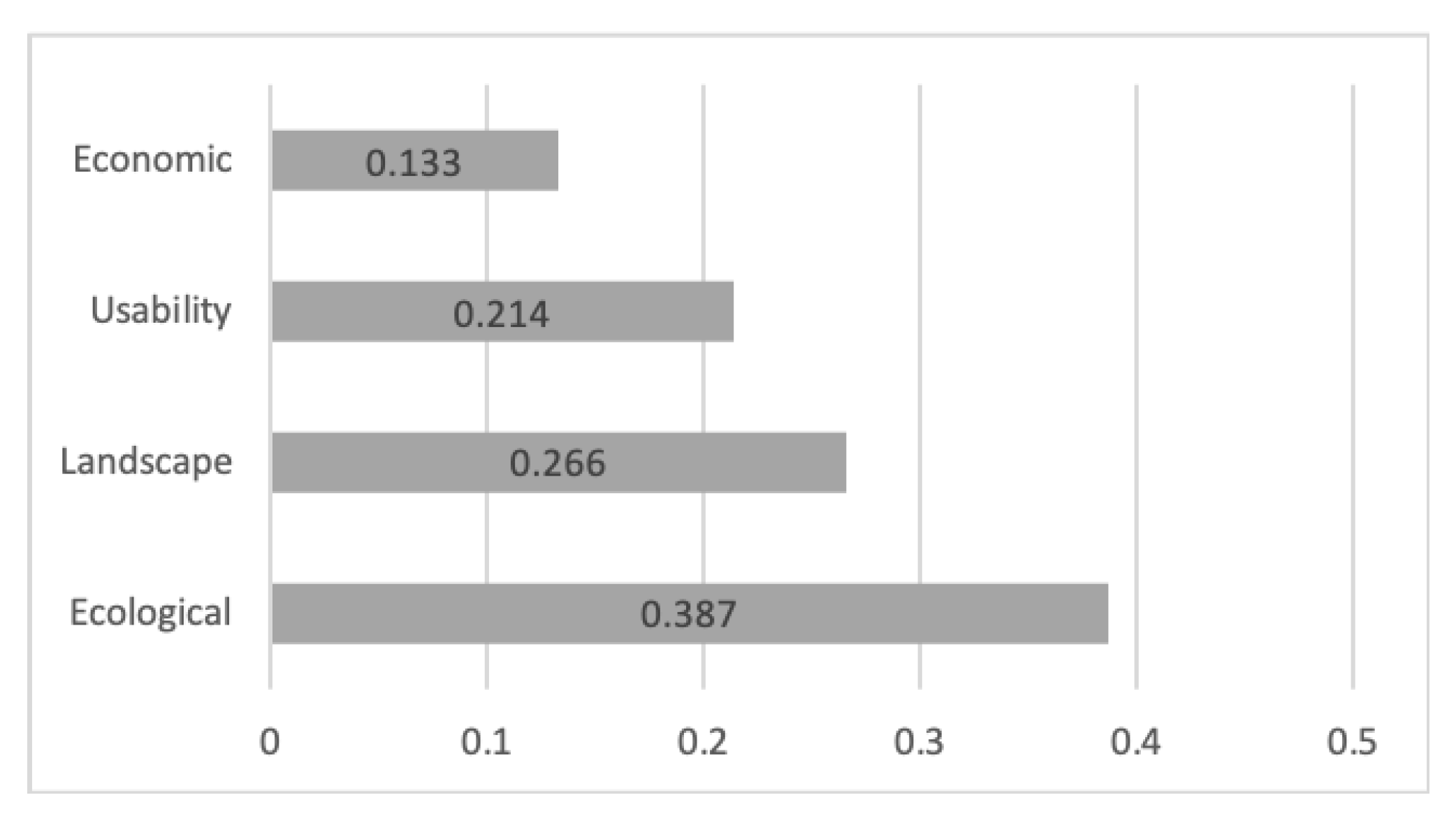
| Total | 38 | 0.387 | 0.266 | 0.214 | 0.133 | |
| Sex | Male | 23 | 0.362 | 0.281 | 0.224 | 0.133 |
| Female | 15 | 0.426 | 0.242 | 0.199 | 0.133 | |
| Age | 20s | 7 | 0.273 | 0.237 | 0.247 | 0.243 |
| 30s | 11 | 0.315 | 0.272 | 0.279 | 0.133 | |
| 40s | 14 | 0.477 | 0.258 | 0.163 | 0.102 | |
| 50s | 6 | 0.445 | 0.269 | 0.180 | 0.106 | |
| Organization | Government | 4 | 0.369 | 0.154 | 0.148 | 0.328 |
| Academia | 8 | 0.376 | 0.240 | 0.266 | 0.117 | |
| Private Sector | 26 | 0.384 | 0.291 | 0.207 | 0.118 | |
| Area | Policy/Research | 12 | 0.387 | 0.215 | 0.227 | 0.171 |
| Design/Construction | 26 | 0.384 | 0.291 | 0.207 | 0.118 | |
| Subject | Environment | 6 | 0.470 | 0.184 | 0.194 | 0.151 |
| Landscape | 27 | 0.366 | 0.296 | 0.211 | 0.127 | |
| Other | 5 | 0.394 | 0.219 | 0.247 | 0.140 | |
| Experience | Under 5 years | 8 | 0.293 | 0.217 | 0.225 | 0.265 |
| 6–10 years | 8 | 0.283 | 0.285 | 0.338 | 0.094 | |
| 11–15 years | 8 | 0.450 | 0.234 | 0.185 | 0.131 | |
| More than 16 years | 14 | 0.457 | 0.282 | 0.159 | 0.102 | |
| Tier 1 Criterion | Importance (Based on Tier 1 Evaluation) | Tier 2 Criteria | Importance (Based on Tier 2 Evaluation) |
|---|---|---|---|
| Ecological | 0.387 | Climate Control | 0.269 |
| Air Quality Improvement | 0.307 | ||
| Stormwater runoff | 0.194 | ||
| Ecological conservation | 0.230 |
| Tier 1 Criterion | Importance (Based on Tier 1 Evaluation) | Tier 2 Criteria | Importance (Based on Tier 2 Evaluation) |
|---|---|---|---|
| Landscape | 0.266 | Creating a featured landscape | 0.161 |
| Harmonizing with the surrounding environment | 0.282 | ||
| Providing natural elements within an urban setting | 0.407 | ||
| Screening | 0.151 |
| Tier 1 Criterion | Importance (Based on Tier 1 Evaluation) | Tier 2 Criteria | Importance (Based on Tier 2 Evaluation) |
|---|---|---|---|
| Usability | 0.214 | Accessibility | 0.307 |
| Leisure and amenity | 0.305 | ||
| Educational functions | 0.164 | ||
| Shelter | 0.224 |
| Tier 1 Criterion | Importance (Based on Tier 1 Evaluation) | Tier 2 Criteria | Importance (Based on Tier 2 Evaluation) |
|---|---|---|---|
| Economic | 0.133 | Cost for groundworks | 0.196 |
| Cost for planting | 0.356 | ||
| Cost for Paving and other works | 0.137 | ||
| Maintenance cost | 0.312 |
| Tier 2 Criteria | Weighed Value | Priority |
|---|---|---|
| Air quality improvement | 0.119 | 1 |
| Providing natural elements within urban settings | 0.108 | 2 |
| Climate control | 0.104 | 3 |
| Ecological conservation | 0.089 | 4 |
| Stormwater runoff | 0.075 | 5 |
| Harmonizing with the surrounding environment | 0.075 | 5 |
| Accessibility | 0.066 | 7 |
| Providing leisure and amenity | 0.065 | 8 |
| Shelter | 0.048 | 9 |
| Planting cost | 0.047 | 10 |
| Creating a featured landscape | 0.043 | 11 |
| Maintenance cost | 0.042 | 12 |
| Screening | 0.040 | 13 |
| Providing educational functions | 0.035 | 14 |
| Groundworks cost | 0.026 | 15 |
| Paving and other works cost | 0.018 | 16 |
| Category | N | Ecological | Landscape | Usability | Economic | |||||||||||||
|---|---|---|---|---|---|---|---|---|---|---|---|---|---|---|---|---|---|---|
| Climate control | Air quality improvement | Stormwater runoff | Ecological conservation | Featured landscape creation | Suitable with surrounding environment | Providing natural elements within urban areas | Improving landscape by screening | Accessibility by citizens | Providing leisure and amenity activities | Educational function | Shelter function | Cost for groundworks | Cost for planting | Cost for paving and etc. | Maintenance cost | |||
| Total | 38 | 0.104 | 0.119 | 0.075 | 0.089 | 0.043 | 0.075 | 0.108 | 0.040 | 0.066 | 0.065 | 0.035 | 0.048 | 0.026 | 0.047 | 0.018 | 0.042 | |
| Sex | Male | 23 | 0.097 | 0.115 | 0.062 | 0.088 | 0.046 | 0.082 | 0.112 | 0.041 | 0.071 | 0.073 | 0.038 | 0.043 | 0.022 | 0.050 | 0.017 | 0.044 |
| Female | 15 | 0.115 | 0.124 | 0.098 | 0.089 | 0.038 | 0.065 | 0.101 | 0.038 | 0.058 | 0.054 | 0.031 | 0.056 | 0.033 | 0.043 | 0.020 | 0.037 | |
| Age | 20s | 7 | 0.083 | 0.064 | 0.073 | 0.053 | 0.055 | 0.055 | 0.080 | 0.047 | 0.069 | 0.069 | 0.033 | 0.075 | 0.055 | 0.057 | 0.040 | 0.091 |
| 30s | 11 | 0.083 | 0.096 | 0.063 | 0.074 | 0.032 | 0.084 | 0.108 | 0.048 | 0.093 | 0.084 | 0.043 | 0.059 | 0.025 | 0.055 | 0.024 | 0.030 | |
| 40s | 14 | 0.122 | 0.155 | 0.078 | 0.122 | 0.038 | 0.067 | 0.120 | 0.032 | 0.045 | 0.054 | 0.031 | 0.034 | 0.015 | 0.040 | 0.010 | 0.037 | |
| 50s | 6 | 0.117 | 0.158 | 0.079 | 0.091 | 0.054 | 0.089 | 0.095 | 0.031 | 0.064 | 0.050 | 0.029 | 0.037 | 0.032 | 0.032 | 0.012 | 0.030 | |
| Organization | Public sector | 4 | 0.136 | 0.080 | 0.091 | 0.063 | 0.014 | 0.039 | 0.067 | 0.034 | 0.045 | 0.039 | 0.013 | 0.052 | 0.059 | 0.078 | 0.034 | 0.157 |
| Academic | 8 | 0.101 | 0.104 | 0.085 | 0.087 | 0.033 | 0.076 | 0.095 | 0.036 | 0.081 | 0.068 | 0.056 | 0.062 | 0.020 | 0.041 | 0.014 | 0.042 | |
| Private sector | 26 | 0.098 | 0.127 | 0.068 | 0.092 | 0.053 | 0.080 | 0.117 | 0.041 | 0.063 | 0.067 | 0.034 | 0.042 | 0.024 | 0.044 | 0.017 | 0.033 | |
| Parts | Policy/Research | 12 | 0.116 | 0.099 | 0.090 | 0.081 | 0.026 | 0.064 | 0.088 | 0.037 | 0.070 | 0.059 | 0.036 | 0.062 | 0.030 | 0.053 | 0.020 | 0.068 |
| Design/Construction | 26 | 0.098 | 0.127 | 0.068 | 0.092 | 0.053 | 0.080 | 0.117 | 0.041 | 0.063 | 0.067 | 0.034 | 0.042 | 0.024 | 0.044 | 0.017 | 0.033 | |
| Subject | Environmental | 6 | 0.089 | 0.137 | 0.111 | 0.133 | 0.036 | 0.040 | 0.084 | 0.025 | 0.069 | 0.048 | 0.025 | 0.053 | 0.044 | 0.037 | 0.027 | 0.044 |
| Landscape | 27 | 0.106 | 0.114 | 0.067 | 0.079 | 0.048 | 0.088 | 0.114 | 0.046 | 0.064 | 0.066 | 0.036 | 0.045 | 0.023 | 0.049 | 0.015 | 0.040 | |
| Other | 5 | 0.105 | 0.116 | 0.078 | 0.094 | 0.027 | 0.060 | 0.101 | 0.031 | 0.065 | 0.082 | 0.045 | 0.054 | 0.026 | 0.046 | 0.025 | 0.042 | |
| Experience | Under 5 years | 8 | 0.080 | 0.076 | 0.072 | 0.064 | 0.049 | 0.050 | 0.075 | 0.043 | 0.067 | 0.056 | 0.030 | 0.072 | 0.061 | 0.063 | 0.046 | 0.095 |
| 6–10 years | 8 | 0.069 | 0.083 | 0.072 | 0.058 | 0.033 | 0.091 | 0.112 | 0.049 | 0.119 | 0.104 | 0.056 | 0.059 | 0.018 | 0.038 | 0.013 | 0.025 | |
| 11–15 years | 8 | 0.147 | 0.111 | 0.045 | 0.146 | 0.027 | 0.053 | 0.122 | 0.031 | 0.053 | 0.062 | 0.029 | 0.041 | 0.020 | 0.051 | 0.020 | 0.039 | |
| More than 16 years | 14 | 0.109 | 0.168 | 0.090 | 0.089 | 0.051 | 0.090 | 0.107 | 0.035 | 0.047 | 0.050 | 0.030 | 0.033 | 0.021 | 0.039 | 0.011 | 0.032 | |
© 2020 by the authors. Licensee MDPI, Basel, Switzerland. This article is an open access article distributed under the terms and conditions of the Creative Commons Attribution (CC BY) license (http://creativecommons.org/licenses/by/4.0/).
Share and Cite
Shin, Y.; Kim, S.; Lee, S.-W.; An, K. Identifying the Planning Priorities for Green Infrastructure within Urban Environments Using Analytic Hierarchy Process. Sustainability 2020, 12, 5468. https://doi.org/10.3390/su12135468
Shin Y, Kim S, Lee S-W, An K. Identifying the Planning Priorities for Green Infrastructure within Urban Environments Using Analytic Hierarchy Process. Sustainability. 2020; 12(13):5468. https://doi.org/10.3390/su12135468
Chicago/Turabian StyleShin, Yeeun, Suyeon Kim, Sang-Woo Lee, and Kyungjin An. 2020. "Identifying the Planning Priorities for Green Infrastructure within Urban Environments Using Analytic Hierarchy Process" Sustainability 12, no. 13: 5468. https://doi.org/10.3390/su12135468
APA StyleShin, Y., Kim, S., Lee, S.-W., & An, K. (2020). Identifying the Planning Priorities for Green Infrastructure within Urban Environments Using Analytic Hierarchy Process. Sustainability, 12(13), 5468. https://doi.org/10.3390/su12135468

