Design of a Lightweight Rear Crash Management System in a Sustainable Perspective

Abstract
1. Introduction
2. Materials and Methods
2.1. Module Design
- -
- maximum deformation and energy absorption during RCAR low-speed structural crash test protocol for rear impact [46] and
- -
- bending moment when applying a deformation in the center of the beam.
2.2. Sustainability Assessment
2.2.1. System Boundaries and Impact Categories
- -
- Acidification midpoint (A) [Mole of H + Equation];
- -
- Climate Change midpoint (CC) [kg CO2 Equation];
- -
- Ozone Depletion midpoint (OD) [kg CFC-11 Equation];
- -
- Particulate Matter/Respiratory inorganics midpoint (PM) [kg PM2.5 Equation];
- -
- Photochemical Ozone Formation midpoint, human health (POF) [kg NMVOC Equation];
- -
- Resource Depletion, mineral, fossils and renewables, midpoint (RD) [kg Sb Equation].
2.2.2. Functional Unit
2.2.3. Life Cycle Inventory (LCI)
3. Results and Discussion
3.1. Contribution Analysis of Impacts: Influence of LC Stages and Module Components
3.2. Comparative Assessment Reference—Lightweight Design
3.3. Break-Even Point Analysis
3.4. Holistic Assessment
4. Conclusions
- -
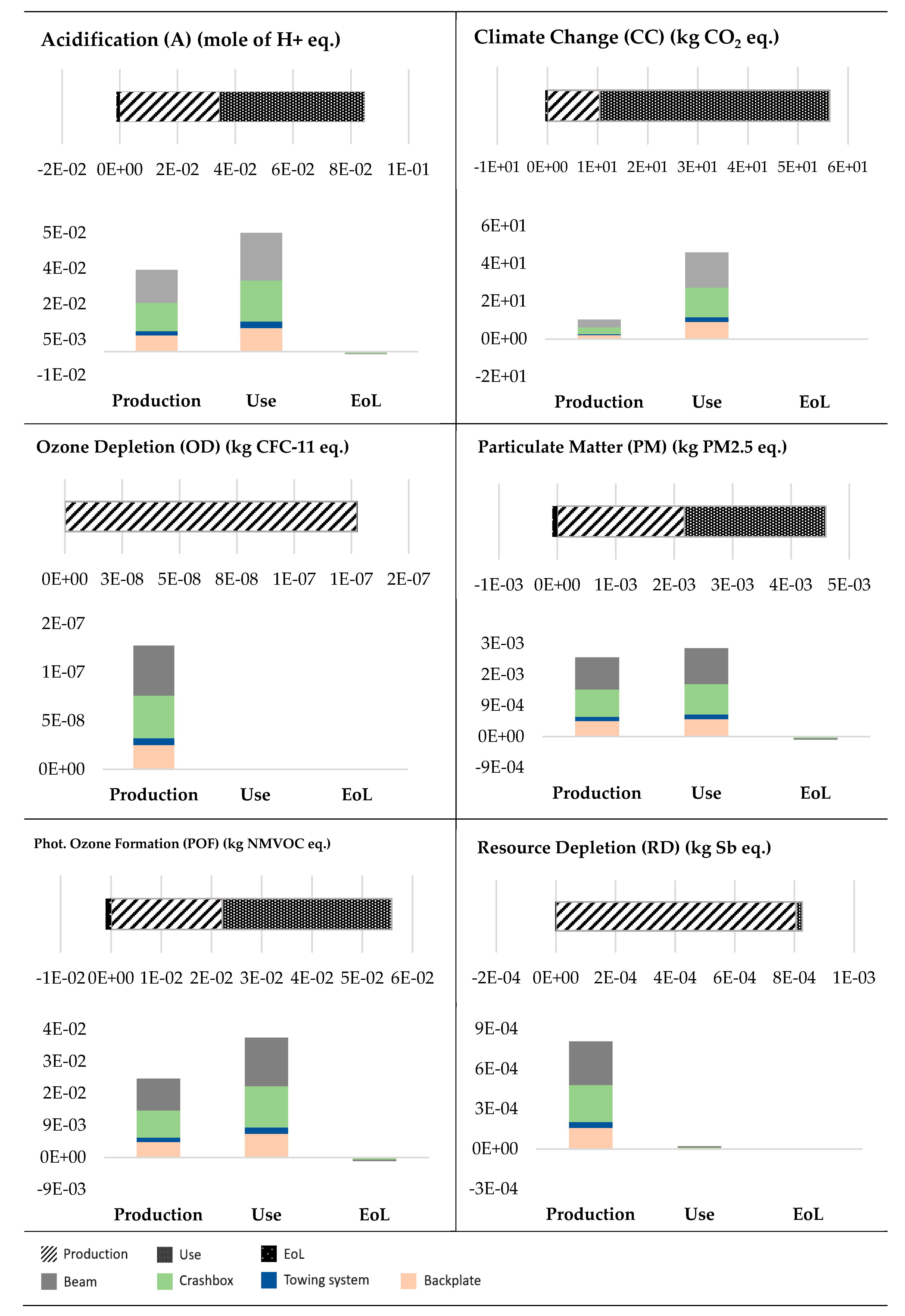
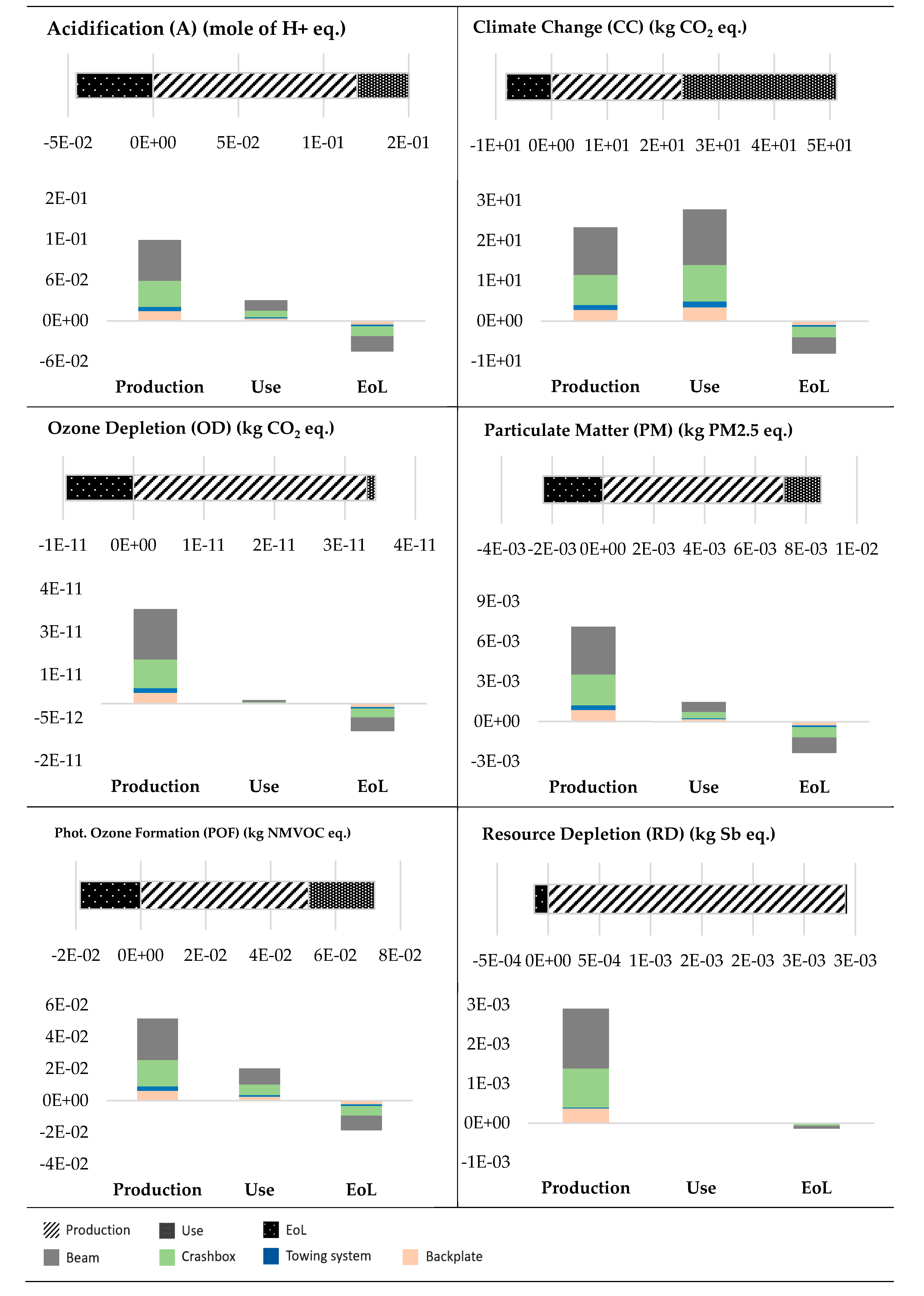
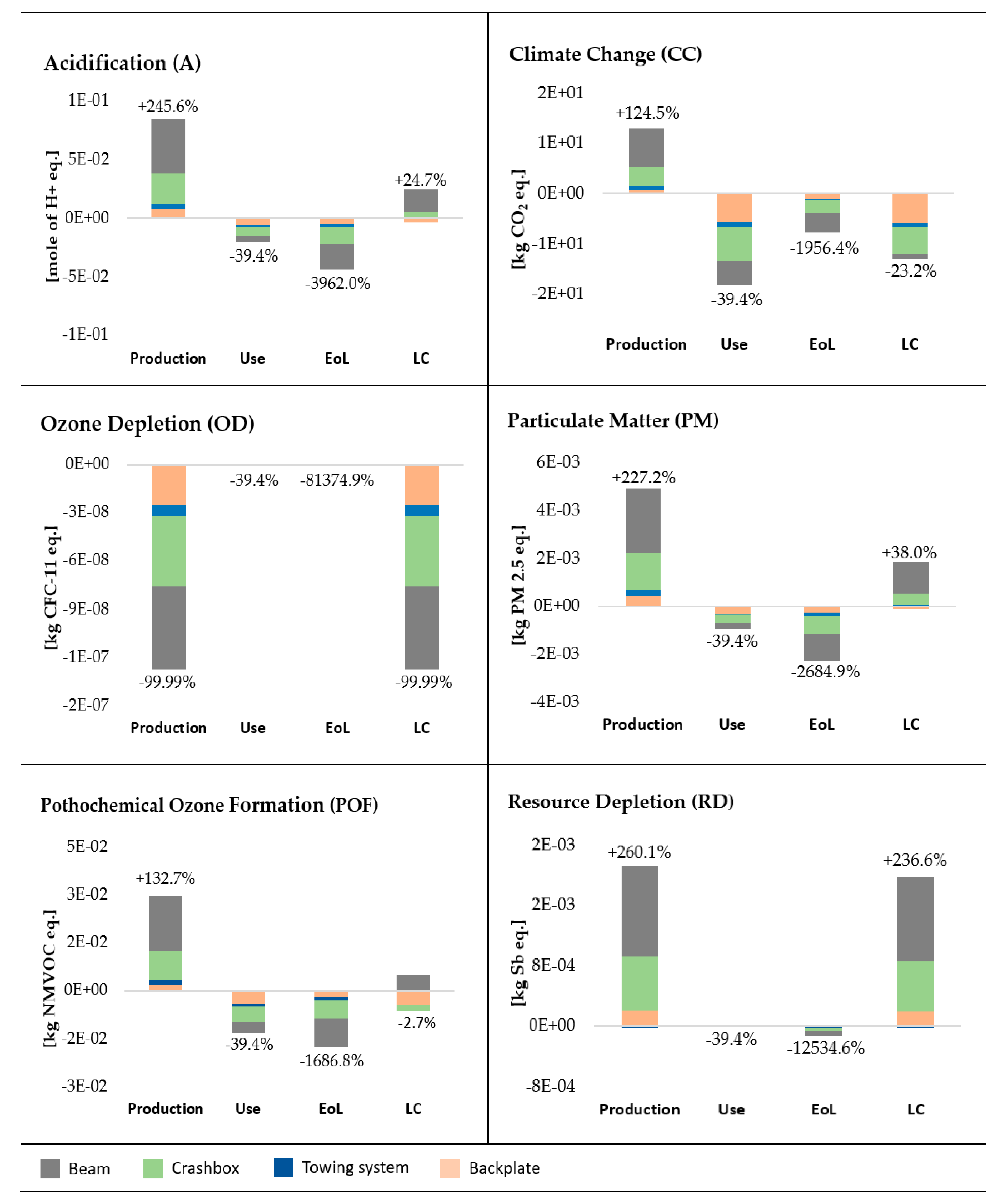
- For all indicators, material change involves an increase in the production impact due to the higher energy intensity and emissions caused by raw material acquisition of 7000 series aluminum alloy with respect to conventional steel. The only exception is represented by OD, for which the production impact of the novel design is almost completely abated due to the drastic drop of trichlorofluoromethane and dichlorotetrafluoroethane emissions in raw material acquisition. Concerning use and EoL phases, the entire set of indicators shows an impact decrease, thanks to, respectively, the reduced FC/emissions during operation and the higher credits of aluminum recycling.
- -
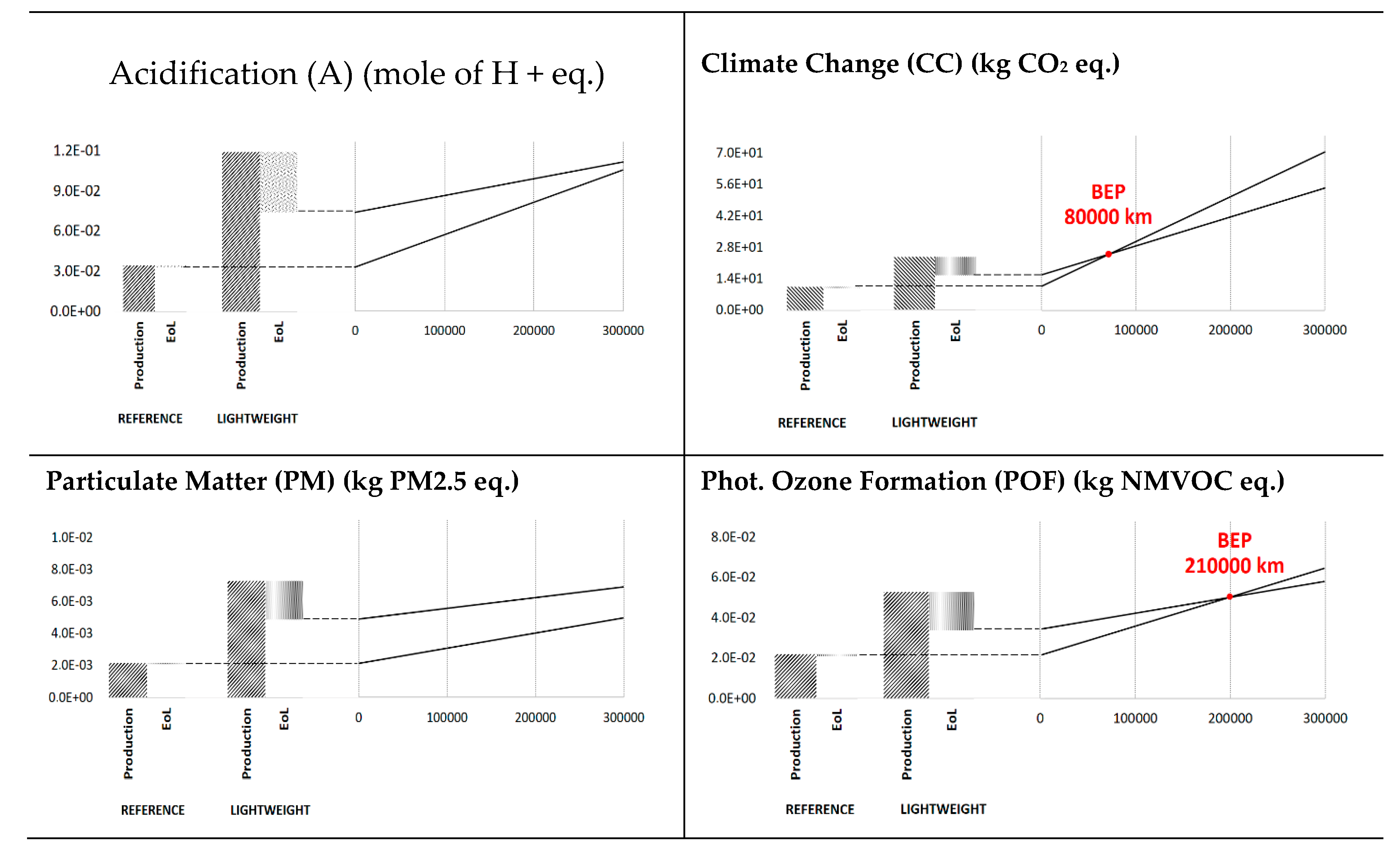
- As regards to total LC, CC and POF are the only categories for which the increased production impacts in mileage-independent phases are counterbalanced by beneficial effects in use, respectively at LC distance of about 80,000 and 210,000 km. On the other hand, the negative effects in production are predominant for A, PM and RD, for which the LC impact grows by 25, 38 and 237% and the break-even point is not reached even for LC mileage higher than 230,000 km. The LC OD saving (close to 100%) is almost exclusively concentrated in production, since around 99% of total impact of the reference CMS is associated with raw material acquisition.
- -
- It can be concluded that for three LCIA categories (CC, OD and POF), the lightweight design entails sustainability benefits while for the other three indicators (A, PM and RD), the steel baseline design appears to be environmentally preferable. That said, the targets, in terms of mass and climate change saving established by the ALLIANCE project, are fully achieved.
- -
- The environmental assessment is completed through the implementation of a MCDA method (TOPSIS) in order to holistically evaluate the competing alternatives on the basis of the entire panel of sustainability criteria. The analysis of the overall environmental profile reveals that the lightweight design solution appears to be slightly convenient for both weighting sets considered.
Author Contributions
Funding
Acknowledgments
Conflicts of Interest
Abbreviations
| A | Acidification midpoint |
| ALLIANCE | AffordabLe LIghtweight Automobiles AlliaNCE |
| AM | Additive Manufacturing |
| BIW | Body-In-White |
| CRFPs | Carbon Fiber Reinforced Plastics |
| CC | Climate Change midpoint |
| CMS | Crash Management System |
| EoL | End-of-Life |
| EU | European Union |
| FC | Fuel Consumption |
| FU | Functional Unit |
| GFRPs | Glass Fiber Reinforced Plastics |
| GHG | Greenhouse Gas |
| LC | Life Cycle |
| LCA | Life Cycle Assessment |
| LCI | Life Cycle Inventory |
| LCIA | Life Cycle Impact Assessment |
| NMVOCs | Non-Methane Volatile Organic Compounds Emissions |
| OD | Ozone Depletion midpoint |
| OEMs | Original Equipment Manufacturers |
| PM | Particulate Matter/Respiratory inorganics midpoint |
| POF | Photochemical Ozone Formation midpoint, human health |
| RD | Resource Depletion, mineral, fossils and renewables, midpoint |
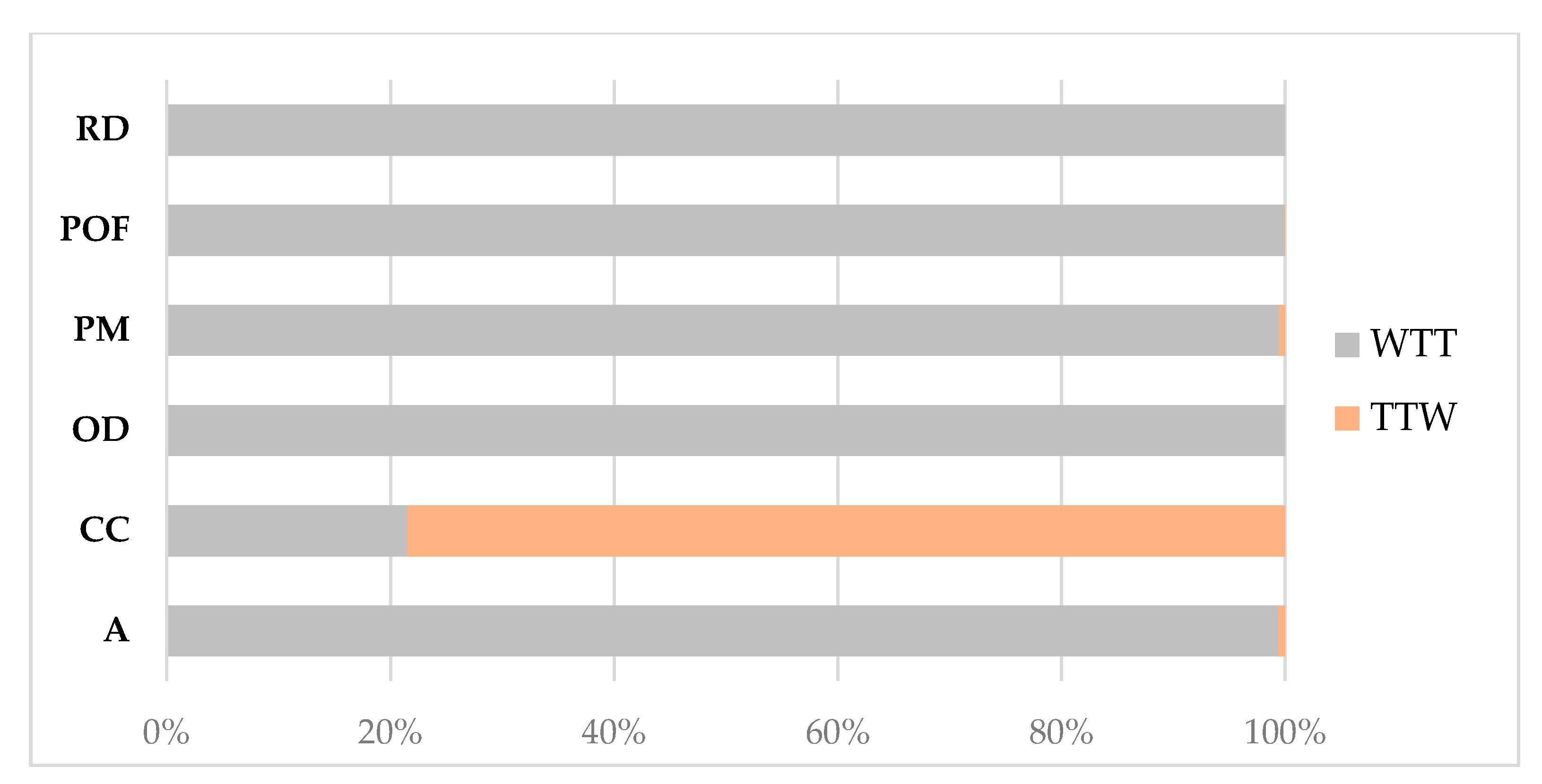
| TTW | Tank-To-Wheel |
| WLTP | Worldwide Harmonized Light-Duty Test Procedure |
| WTT | Well-To-Tank |
References
- European Commission. White Paper: Roadmap to a Single European Transport Area—Towards a Competitive and Resource Efficient Transport System; European Commission: Brussels, Belgium, 2011; /* COM/2011/0144 final */. [Google Scholar]
- Nehuis, F.; Kleemann, S.; Egede, P.; Vietor, T.; Herrmann, C. Future Trends in the Development of Vehicle Bodies Regarding Lightweight and Cost. In Innovative Design, Analysis and Development Practices in Aerospace and Automotive Engineering; Springer Science & Business: Berlin/Heidelberg, Germany, 2014; ISBN 978-81-322-1871-5. [Google Scholar] [CrossRef]
- Ferreira, V.; Merchán, M.; Egizabal, P.; García de Cortázar, M.; Irazustabarrena, A.; López-Sabiróna, A.M.; Ferreira, G. Technical and environmental evaluation of a new high performance material based on magnesium alloy reinforced with submicrometre-sized TiC particles to develop automotive lightweight components and make transport sector more sustainable. J. Mater. Res. Technol. 2019, 8, 2549–2564. [Google Scholar] [CrossRef] [Scilit]
- Koffler, C.; Rohde-Brandenburger, K. On the Calculation of Fuel Savings Through Lightweight Design in Automotive Life Cycle Assessments. Int. J. Life Cycle Assess. 2010, 15, 128–135. [Google Scholar] [CrossRef] [Scilit]
- Kim, H.C.; Wallington, T.J. Life Cycle Assessment of Vehicle Lightweight-ing: A Physics-Based Model to Estimate Use-Phase Fuel Consumption of Electrified Vehicles. Environ. Sci. Technol. 2016, 50, 11226–11233. [Google Scholar] [CrossRef] [Scilit]
- Kroll, L.; Blau, P.; Wabner, M.; Frie, U.; Eulitz, J.; Klärner, M. Lightweight Components for Energy-Efficient Machine Tools. CIRP J. Manuf. Sci. Technol. 2011, 4, 148–160. [Google Scholar] [CrossRef] [Scilit]
- Neugebauer, R.; Wabner, M.; Rentzsch, H.; Ihlenfeldt, S. Structure Principles of Energy Efficient Machine Tools. CIRP J. Manuf. Sci. Technol. 2011, 4, 136–147. [Google Scholar] [CrossRef] [Scilit]
- Goede, M. Super Light Car—Lightweight construction thanks to a multi-material design and function integration. Eur. Transp. Res. Rev. 2009, 1, 5–10. [Google Scholar] [CrossRef] [Scilit]
- Ferreira, V. Lightweight automotive components based on nano-diamond-reinforced aluminium alloy: A technical and environmental evaluation. Diam. Relat. Mater. 2019, 2019, 92. [Google Scholar]
- Tisza, M.; Czinege, I. Comparative study of the application of steels and aluminium in lightweight production of automotive parts. Int. J. Lightweight Mater. Manuf. 2018, 1, 229–238. [Google Scholar] [CrossRef] [Scilit]
- Ten Broek, C.; Singh, H.; Hillebrecht, M. Lightweight Design for the Future Steel Vehicle. ATZ Worldw. 2012, 114, 4–11. [Google Scholar] [CrossRef] [Scilit]
- Bian, J.; Mohrbacher, H.; Zhang, J.S.; Zhao, Y.T.; Lu, H.Z.; Dong, H. Application Potential of High Performance Steels for Weight Reduction and Efficiency Increase in Commercial Vehicles. Adv. Manuf. 2015, 3, 27–36. [Google Scholar] [CrossRef] [Scilit]
- Kelly, J.C.; Sullivan, J.L.; Burnham, A.; Elgowainy, A. Impacts of Vehicle Weight Reduction via Material Substitution on Life-Cycle Greenhouse Gas Emissions. Environ. Sci. Technol. 2015, 49, 12535–12542. [Google Scholar] [CrossRef] [Scilit] [PubMed]
- Stamboulis, A.; Baillie, C.A.; Garkhail, S.K.; Van Melick, H.G.H.; Peijs, T. Environmental Durability of Flax Fibres and Their Composites Based on Polypropylene Matrix. Appl. Compos. Mater. 2000, 7, 273–294. [Google Scholar] [CrossRef] [Scilit]
- Papadakis, L.; Schiel, M.; Vassilou, V.; Loizou, A.; Dilger, K. Adhesive Bonding of Attachments on Alternate Car Shell Surfaces in Automotive Final Assembly Lines. Procedia CIRP 2014, 18, 180–185. [Google Scholar] [CrossRef] [Scilit]
- Fleischer, J.; Lanza, G.; Tarisai, P.; Möhring, H.; Teti, R.; Caggiano, A. Composite Materials Parts Manufacturing. CIRP Ann.—Manuf. Technol. 2018, 67, 603–626. [Google Scholar] [CrossRef] [Scilit]
- Meschut, G.; Janzen, V.; Olfermann, T. Innovative and Highly Productive Joining Technologies for Multi-Material Lightweight Car Body Structures. J. Mater. Eng. Perform. 2014, 23, 1515–1523. [Google Scholar] [CrossRef] [Scilit]
- Duflou, J.R.; De Moor, J.; Verpoest, I.; Dewulf, W. Environmental Impact Analysis of Composite Use in Car Manufacturing. CIRP Ann.—Manuf. Technol. 2009, 58, 9–12. [Google Scholar] [CrossRef] [Scilit]
- Duflou, J.R.; Deng, Y.; Van Acker, K.; Dewulf, W. Do Fiber-Reinforced Polymer Composites Provide Environmentally Benign Alternatives? A Life-Cycle-Assessment-Based Study. MRS Bull. 2012, 37, 374–382. [Google Scholar] [CrossRef] [Scilit]
- Song, Y.S.; Youn, J.; Gutowski, T.G. Life Cycle Energy Analysis of Fiber-Reinforced Composites. Compos. Part A Appl. Sci. Manuf. 2009, 40, 1257–1265. [Google Scholar] [CrossRef] [Scilit]
- Shishoo, R. The Global Textile and Clothing Industry; Woodhead Publishing Limited: Cambridge, MA, USA, 2012. [Google Scholar]
- Soo, V.K.; Compston, P.; Subic, A.; Doolan, M. The Impact of Different Joining Decisions for Lightweight Materials on Life Cycle Assessment. In Proceedings of the AutoCRC 3rd Technical Conference, January 2014. [Google Scholar]
- Ashby, M. Materials selection in mechanical design: Fourth edition. In Materials Selection in Mechanical Design, 4th ed.; Butterworth-Heinemann: Oxford, UK, 2010; pp. 1–646. ISBN 9780080952239. [Google Scholar]
- Helou, M.; Kara, S. Design, Analysis and Manufacturing of Lattice Structures. Int. J. Comput. Integr. Manuf. 2017, 31, 243–261. [Google Scholar] [CrossRef] [Scilit]
- Ghoreishi, R.Z.; Roohi, A.H.; Ghadikolaei, A.D. Evaluation of tool wear in high-speed face milling of Al/SiC metal matrix composites. J. Braz. Soc. Mech. Sci. Eng. Vol. 2019, 41, 146. [Google Scholar] [CrossRef] [Scilit]
- Mehrpouya, M.; Dehghanghadikolaei, A.; Fotovvati, B.; Vosooghnia, A.; Emamian, S.; Gisario, A. The Potential of Additive Manufacturing in the Smart Factory Industrial 4.0: A Review. Appl. Sci. 2019, 9, 3865. [Google Scholar] [CrossRef] [Scilit]
- Kellens, K.; Baumers, M.; Gutowski, T.G.; Flanagan, W.; Lifset, R.; Duflou, J.R. Environmental Dimensions of Additive Manufacturing: Mapping Application Domains and Their Environmental Implications. J. Ind. Ecol. 2017, 21, S49–S68. [Google Scholar] [CrossRef] [Scilit]
- Arankalle, A. Advances in lightweight materials for body in white. Innovative Design and Development Practices in Aerospace and Automotive Engineering, Lecture Notes in Mechanical Engineering; Springer: Singapore, 2016; pp. 517–525. [Google Scholar]
- Beiter, P.; Groche, P. On the Development of Novel Light Weight Profiles for Automotive Industries by Roll Forming of Tailor Rolled Blanks. Key Eng. Mater. 2011, 473, 45–52. [Google Scholar] [CrossRef] [Scilit]
- Ingarao, G.; Di Lorenzo, R.; Micari, F. Sustainability Issues in Sheet Metal Forming Processes: An Overview. J. Clean. Prod. 2011, 19, 337–347. [Google Scholar] [CrossRef] [Scilit]
- Allwood, J.M.; Kong, H.; Pole, N. Sustainable Materials—With Both Eyes Open; UIT Cambridge: Cambridge, UK, 2012. [Google Scholar]
- Wiesbaden, S.F. InCar plus: Solutions for Automotive Efficiency. Atzextra Worldw. 2014, 19, 8–9. [Google Scholar] [CrossRef] [Scilit]
- Merklein, M.; Johannes, M.; Lechner, M.; Kuppert, A. A Review on Tailored Blanks—Production, Applications and Evaluation. J. Mater. Process-Sing Technol. 2014, 214, 151–164. [Google Scholar] [CrossRef] [Scilit]
- Carle, D.; Blount, G. The Suitability of Aluminium as an Alternative Material for Car Bodies. Mater. Des. 1999, 20, 267–272. [Google Scholar] [CrossRef] [Scilit]
- Del Pero, F.; Delogu, M.; Fernandez, V.; Ierides, M.; Seidel, K.; Thirunavukkarasu, D. Lightweight Design Solutions in the Automotive Sector: Impact Analysis for a Door Structure. In Sustainable Design and Manufacturing; KES-SDM 2019. Smart Innovation. Systems and Technologies; Springer: Singapore, 2019; Volume 155. [Google Scholar] [CrossRef]
- Del Pero, F.; Delogu, M.; Berzi, L.; Dattilo, C.A.; Zonfrillo, G.; Pierini, M. Sustainability assessment for different design solutions within the automotive field. Procedia Struct. Integr. 2019, 24, 906–925. [Google Scholar] [CrossRef] [Scilit]
- Herrmann, C.; Dewulf, W.; Hauschild, M.; Kaluza, A.; Kara, S.; Skerlos, S. Life cycle engineering of lightweight structures. CIRP Ann. 2018, 67, 651–672. [Google Scholar] [CrossRef] [Scilit]
- Modaresi, R.; Pauliuk, S.; Lövik, A.N.; Müller, D.B. Global Carbon Benefits of Material Substitution in Passenger Cars until 2050 and the Impact on the Steel and Aluminum Industries. Environ. Sci. Technol. 2014, 48, 10776–10784. [Google Scholar] [CrossRef] [Scilit] [PubMed]
- Hardwick, A.P.; Outteridge, T. Vehicle Lightweighting Through the Use of Molybdenum-bearing Advanced High-strength Steels (AHSS). Int.-AL J. Life Cycle Assess. 2016, 21, 1616–1623. [Google Scholar] [CrossRef] [Scilit]
- Kim, H.-J.; McMillan, C.; Keoleian, G.A.; Skerlos, S.J. Greenhouse Gas Emissions Payback for Lightweighted Vehicles Using Aluminum and High-Strength Steel. J. Ind. Ecol. 2010, 14, 929–946. [Google Scholar] [CrossRef] [Scilit]
- Kim, H.C.; Wallington, T.J. Life-Cycle Energy and Greenhouse Gas Emission Benefits of Lightweighting in Automobiles: Review and Harmonization. Environ. Sci. Technol. 2013, 47, 6089–6097. [Google Scholar] [CrossRef] [Scilit] [PubMed]
- Paraskevas, D.; Kellens, K.; Renal Dewulf, W.; Duflou, J.R. Closed and Open Loop Recycling of Aluminium: A Life Cycle Assessment Perspective. In Proceedings of the 11th Global Conference on Sustainable Manufacturing, Berlin, Germany, 23–25 September 2015; pp. 302–307. [Google Scholar]
- Cui, J.; Roven, H.J. Recycling of Automotive Aluminum. Trans. Nonferrous Met. Soc. China 2010, 20, 2057–2063. [Google Scholar] [CrossRef] [Scilit]
- Del Pero, F.; Delogu, M.; Pierini, M.; Kerschbaum, M.; Tölle, J. Design and Sustainability Assessment of Lightweight Concept for an Automotive car Module; SAE Technical Paper; SAE International: Warrendale, PA, USA, 2020; in press. [Google Scholar]
- Delogu, M.; Del Pero, F.; Zanchi, L.; Ierides, M.; Fernandez, V.; Seidel, K.; Thirunavukkarasu, D.; Bein, T. Lightweight Automobiles ALLIANCE Project: First Results of Environmental and Economic Assessment from a Life-Cycle Perspective; SAE Technical Paper 2018-37-0027; SAE Technical Paper; SAE International: Warrendale, PA, USA, 2018. [Google Scholar] [CrossRef] [Scilit]
- RCAR Low-Speed Structural Crash Test Protocol. Available online: http://rcar.org/Papers/Procedures/RCAR%20Structure%20Test%20procedure%20Version%202_3.pdf#zoom=80% (accessed on 5 June 2020).
- EC-JRC. International Reference Life Cycle Data System (ILCD) Handbook-Recommendations for Life Cycle Impact Assessment in the European Context; Publications Office of the European Union: Brussels, Belgium, 2011; ISBN 978-92-79-17451-3. [Google Scholar]
- ISO 14040/14044, 2006. Environmental Management e Life Cycle Assessment Principals and Framework/Requirements and Guidelines; ISO: Geneva, Switzerland, 2006. [Google Scholar]
- Weymar, E.; Finkbeiner, M. Statistical analysis of empirical lifetime mileage data for automotive LCA. Int. J. Life Cycle Assess. 2016, 21, 215–223. [Google Scholar] [CrossRef] [Scilit]
- Mock, P.; Kühlwein, J.; Tietge, U.; Franco, V.; Bandivadekar, A.; German, J. The WLTP: How a new test procedure for cars will affect fuel consumption values in the EU. Work. Pap.—Int. Counc. Clean Transp. 2014, 9, 35–47. [Google Scholar]
- Sphera, GaBi6 Software. 2020. Available online: http://www.gabi-software.com/italy/index/ (accessed on 10 April 2020).
- Enhanced Lightweight Design, ENLIGHT Project. Available online: https://cordis.europa.eu/project/id/314567 (accessed on 7 September 2019).
- E-Mobility Life Cycle Assessment Recommendations, e-LCAr Project. Available online: http://www.elcar-project.eu/ (accessed on 9 December 2019).
- Del Pero, F.; Delogu, M.; Pierini, M. The effect of lightweighting in automotive LCA perspective: Estimation of mass-induced fuel consumption reduction for gasoline turbocharged vehicles. J. Clean. Prod. 2017, 154, 566–577, ISSN 0959-6526. [Google Scholar] [CrossRef] [Scilit]
- Directive 2000/53/EC on End-of-Life Vehicles European Commission. Available online: https://eur-lex.europa.eu/legal-content/EN/ALL/?uri=CELEX%3A32000L0053 (accessed on 20 September 2019).
- ISO 22628. Road Vehicles, Recyclability and Recoverability Calculation Method; ISO: Geneva, Switzerland. Available online: https://www.iso.org/standard/35061.html (accessed on 4 May 2020).
- El Amine, M.; Pailhes, J.; Perry, N. Critical Review of Multi-criteria Decision Aid Methods in Conceptual Design Phases: Application to the Development of a Solar Collector Structure. Procedia CIRP 2014, 21, 497–502. [Google Scholar] [CrossRef] [Scilit]
- Castellani, V.; Benini, L.; Sala, S.; Pant, R. A distance-to-target weighting method for Europe 2020. Int. J. Life Cycle Assess. 2016, 21, 1159–1169. [Google Scholar] [CrossRef] [Scilit]


| Reference CMS | Lightweight CMS | ||||
|---|---|---|---|---|---|
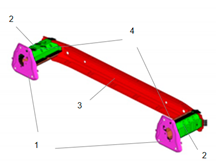 | 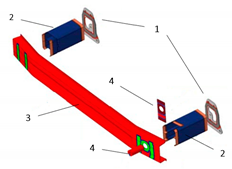 | ||||
| 1. Backplate; 2. Crash Box; 3. Beam; 4. Towing System | |||||
| Material | Mass (kg) | Manufacturing Process | |||
| Reference CMS | Backplate | HCT600X | 0.787 | 3.989 | Cold stamping |
| Crash box | HCT600X | 1.370 | Cold stamping | ||
| Beam | HCT980X | 1.614 | Cold stamping | ||
| Towing system | HC420LA/HC260LA | 0.218 | Cold stamping | ||
| Lightweight CMS | Backplate | EN AW7003 LS | 0.296 | 2.416 | Extrusion, Punching |
| Crash box | EN AW7003 LS | 0.787 | Extrusion, Milling | ||
| Beam | EN AW7003 HS | 1.202 | Extrusion, Forming, Punching | ||
| Towing system | EN AW6082 | 0.131 | Extrusion, Milling, Punching | ||
| Mass reduction Reference—Lightweight | 1.573 [kg] | ||||
| 39.4 [%] | |||||
| Inventory Data Collection | |||
|---|---|---|---|
| LCI Data | Quality | ||
| Production | Material composition of the module | See Table 1 | Primary |
| Raw material extraction and production | GaBi dataset processes [51] | Secondary | |
| Manufacturing process type | See Table 1 | Primary | |
| Manufacturing | GaBi dataset processes [51] | Secondary | |
| Use | Propulsion technology | Internal Combustion Engine Gasoline | Primary |
| Vehicle class | C | ||
| CO2 km (g/km) | 144 * | ||
| mileageuse (km) | 230,000 | ||
| ρfuel (kg/L) | 0.741 | ||
| FRV (L/100 kg*100 km) | 0.170 | Secondary | |
| mcomp (kg) | 3.989 (reference CMS) 2.416 (lightweight CMS) | Primary | |
| ppmsulphur (ppm) | 10 | Secondary | |
| EoL | Electricity for shredding (MJ/kg) | 0.18 | Secondary |
| Electricity for materials sorting (MJ/kg) | 0.12 | ||
| Share of recycled material (%) (both manufacturing scraps and EoL materials) | 98 (both steel and aluminum) | ||
| Substitution ratio for manufacturing scraps (%) | 51 (steel); 94 (aluminum) | ||
| Substitution ratio for EoL materials (%) | 33 (steel); 42 (aluminum) | ||
| Production | Use | EoL | LC | ||||
|---|---|---|---|---|---|---|---|
| Materials | Manufacturing | WTT | TTW | ||||
| Reference CMS | Acidification midpoint, (A) (Mole of H + Equation) | 3.42 × 10⁻² | 3.05 × 10⁻⁴ | 5.03 × 10⁻² | 5.03 × 10⁻⁶ | -1.11 × 10⁻³ | 8.37 × 10⁻² |
| Climate Change midpoint, incl. biogenic carbon (CC) (kg CO2 Equation) | 1.03 × 10+1 | 9.62 × 10⁻² | 4.54 × 10+1 | 4.59 × 10⁻¹ | -3.94 × 10⁻¹ | 5.59 × 10+1 | |
| Ozone Depletion midpoint (OD) (kg CFC-11 Equation) | 1.27 × 10⁻⁷ | 5.05 × 10⁻¹⁰ | 2.08 × 10⁻¹² | 2.10 × 10⁻¹⁴ | 1.18 × 10⁻¹⁴ | 1.28 × 10⁻⁷ | |
| Particulate Matter/Respiratory inorganics midpoint (PM) (kg PM2.5 Equation) | 2.16 × 10⁻³ | 1.50 × 10⁻⁵ | 2.42 × 10⁻³ | 2.42 × 10⁻⁷ | 8.44 × 10⁻⁵ | 4.52 × 10⁻³ | |
| Photochemical Ozone Formation midpoint, human health (POF) (kg NMVOC Equation) | 2.20 × 10⁻² | 1.67 × 10⁻⁴ | 7.25 × 10⁻³ | 2.65 × 10⁻² | -1.05 × 10⁻³ | 5.49 × 10⁻² | |
| Resource depletion, mineral, fossils and renewables (RD) (kg Sb Equation) | 8.05 × 10⁻⁴ | 4.80 × 10⁻⁷ | 2.00 × 10⁻⁵ | 2.02 × 10⁻⁷ | -1.08 × 10⁻⁶ | 8.25 × 10⁻⁴ | |
| Lightweight CMS | Acidification midpoint, (A) (Mole of H + Equation) | 1.16 × 10⁻¹ | 3.71 × 10⁻³ | 3.05 × 10⁻² | 3.05 × 10⁻⁶ | -4.52 × 10⁻² | 1.04 × 10⁻¹ |
| Climate Change midpoint, incl. biogenic carbon (CC) (kg CO2 Equation) | 2.22 × 10+1 | 1.18 × 10+0 | 2.75 × 10+1 | 2.78 × 10⁻¹ | -8.14 × 10+0 | 4.30 × 10+1 | |
| Ozone Depletion midpoint (OD) (kg CFC-11 Equation) | 2.78 × 10⁻¹¹ | 5.28 × 10⁻¹² | 1.26 × 10⁻¹² | 1.27 × 10⁻¹⁴ | -9.59 × 10⁻¹² | 2.48 × 10⁻¹¹ | |
| Particulate Matter/Respiratory inorganics midpoint (PM) (kg PM2.5 Equation) | 6.94 × 10⁻³ | 1.81 × 10⁻⁴ | 1.47 × 10⁻³ | 1.47 × 10⁻⁶ | -2.35 × 10⁻³ | 6.24 × 10⁻³ | |
| Photochemical Ozone Formation midpoint, human health (POF) (kg NMVOC Equation) | 4.97 × 10⁻² | 1.96 × 10⁻³ | 4.39 × 10⁻³ | 1.60 × 10⁻² | -1.87 × 10⁻² | 5.34 × 10⁻² | |
| Resource depletion, mineral, fossils and renewables (RD) (kg Sb Equation) | 2.90 × 10⁻³ | 5.48 × 10⁻⁶ | 1.21 × 10⁻⁵ | 1.22 × 10⁻⁷ | -1.37 × 10⁻⁴ | 2.78 × 10⁻³ | |
| A (Mole of H + Equation) | CC (kg CO2 Equation) | OD (kg CFC-11 Equation) | PM (kg PM2.5) | POF (kg NMVOC Equation) | RD (kg Sb Equation) | |
|---|---|---|---|---|---|---|
| Reference design | 8.37 × 10⁻² | 5.59 × 10+1 | 1.28 × 10⁻⁷ | 4.52 × 10⁻³ | 4.59 × 10⁻² | 8.25 × 10⁻⁴ |
| Lightweight design | 1.04 × 10⁻¹ | 4.30 × 10+1 | 2.48 × 10⁻¹¹ | 6.24 × 10⁻³ | 5.34 × 10⁻² | 2.78 × 10⁻³ |
| A | CC | OD | PM | POF | RD | |
|---|---|---|---|---|---|---|
| Reference weighting set | 1.0 | 1.0 | 1.0 | 1.0 | 1.0 | 1.0 |
| WFsA weighting set | 7.2 | 7.1 | 6.4 | 7.4 | 7.8 | 6.1 |
| Reference Design | Lightweight Design | |
|---|---|---|
| Reference weighting set | 0.42 | 0.58 |
| WFsA weighting set | 0.41 | 0.59 |
© 2020 by the authors. Licensee MDPI, Basel, Switzerland. This article is an open access article distributed under the terms and conditions of the Creative Commons Attribution (CC BY) license (http://creativecommons.org/licenses/by/4.0/).
Share and Cite
Del Pero, F.; Delogu, M.; Kerschbaum, M. Design of a Lightweight Rear Crash Management System in a Sustainable Perspective. Sustainability 2020, 12, 5243. https://doi.org/10.3390/su12135243
Del Pero F, Delogu M, Kerschbaum M. Design of a Lightweight Rear Crash Management System in a Sustainable Perspective. Sustainability. 2020; 12(13):5243. https://doi.org/10.3390/su12135243
Chicago/Turabian StyleDel Pero, Francesco, Massimo Delogu, and Martin Kerschbaum. 2020. "Design of a Lightweight Rear Crash Management System in a Sustainable Perspective" Sustainability 12, no. 13: 5243. https://doi.org/10.3390/su12135243
APA StyleDel Pero, F., Delogu, M., & Kerschbaum, M. (2020). Design of a Lightweight Rear Crash Management System in a Sustainable Perspective. Sustainability, 12(13), 5243. https://doi.org/10.3390/su12135243