Environmental Assessment of Electrochemical Energy Storage Device Manufacturing to Identify Drivers for Attaining Goals of Sustainable Materials 4.0

Abstract
1. Introduction
- Lead–acid (PbA) battery;
- Lithium manganese oxide (LiMn2O4);
- Nickel–cadmium (NiCd);
- Nickel–metal hydride (NiMH);
- Vanadium redox flow battery (VRFB).
- To identify the benchmark battery technology based on environmental performances during the manufacturing stage of selected systems by applying a consistent and updated LCI.
- To determine the key manufacturing components and materials of the benchmark battery technology that causes the more significant environmental impact.
- To identify new avenues of research in materials 4.0 that give importance to both environmental impacts and material availability, which are key issues for promoting the sustainable commercialisation and fair access of products while preserving the sources of raw materials for batteries within the EU.
2. Materials and Methods
2.1. Goal and Scope
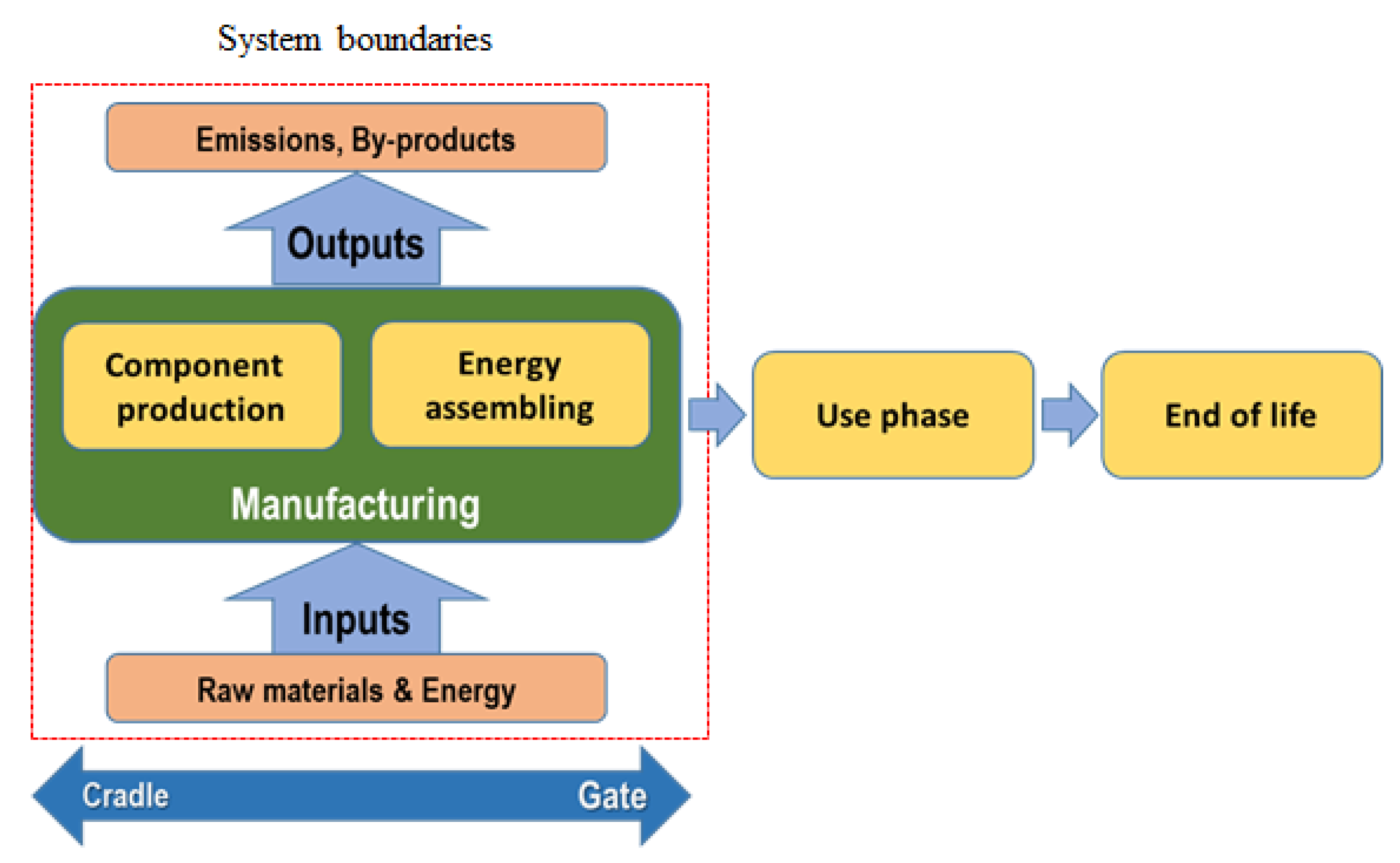
2.1.1. System Description and Boundaries
- Materials: flows of less than 1% of the cumulative mass were excluded because their environmental relevance is not a concern. However, it was ensured that the sum of the ignored material flows did not exceed 5% of the mass or environmental relevance.
- Energy: flows of less than 1% of the cumulative energy were excluded from this analysis. However, it was ensured that the sum of the ignored energy flows did not exceed 5% of the energy or environmental relevance.
2.1.2. Functional Unit
2.2. Life Cycle Inventory
- The cradle-to-gate LCI raw data per kilogram of battery material for all batteries was gathered. Particularly for VRFB, LCI raw data were obtained as kilogram of battery material per MWh of energy storage in 20 years.
- Raw data were referenced to the functional unit, 1 kWh of electricity storage. With the objective to normalise the raw data, information concerning specifications of the selected batteries were collected in all cases. It comprised average specific energy, cycles/all lifespan, and lifetime. These battery specifications were used to normalize average values of gathered data in terms of kilogram of battery to the functional unit (1 kWh of storage capacity, considering 20 years of working time).
- Eventual material replacement was also considered according to the reference lifetime of each battery technology. Because it was dependant on the lifetime of batteries, the number of batteries required for a service life of 20 years was calculated. In this sense, the LCA of batteries was done based on the normalised LCI of the manufacturing stage scaled with respect to the replacement of consumed materials needed to attain the reference service life.
- The cradle-to-gate impacts of the five battery technologies resulting from the modelled systems in SimaPro software were compared with LCA results published in previous works in order to validate the LCI level of consistency and reproducibility.
- The LCI raw data leading to the more accurate results were selected as the ones to be included in this work.The main LCI results used for the characterisation of selected batteries are presented in Section 3.1.
2.3. Life Cycle Impact Evaluation
2.4. Interpretation
3. Results and Discussions
3.1. General Characteristics of Batteries and LCI
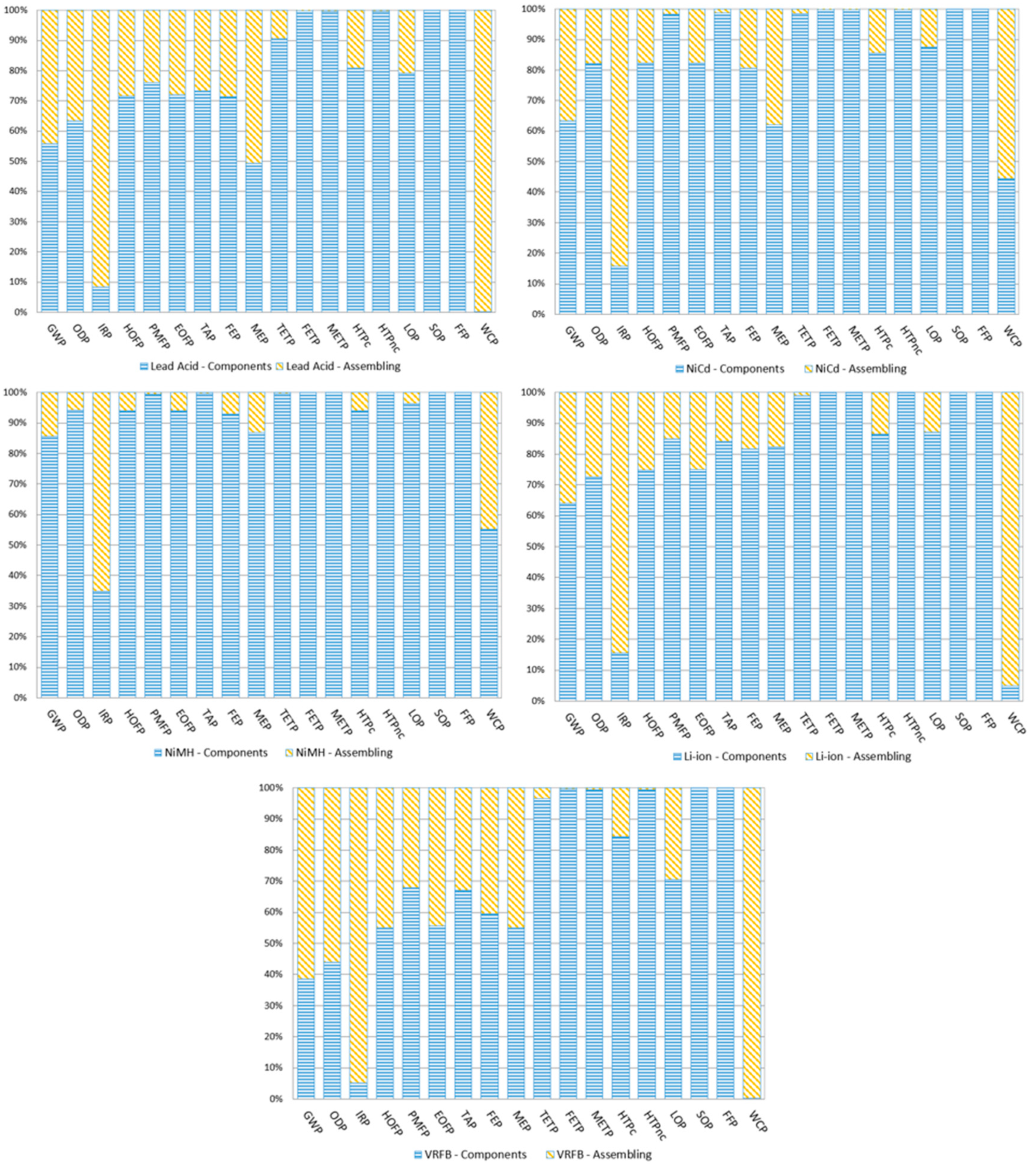
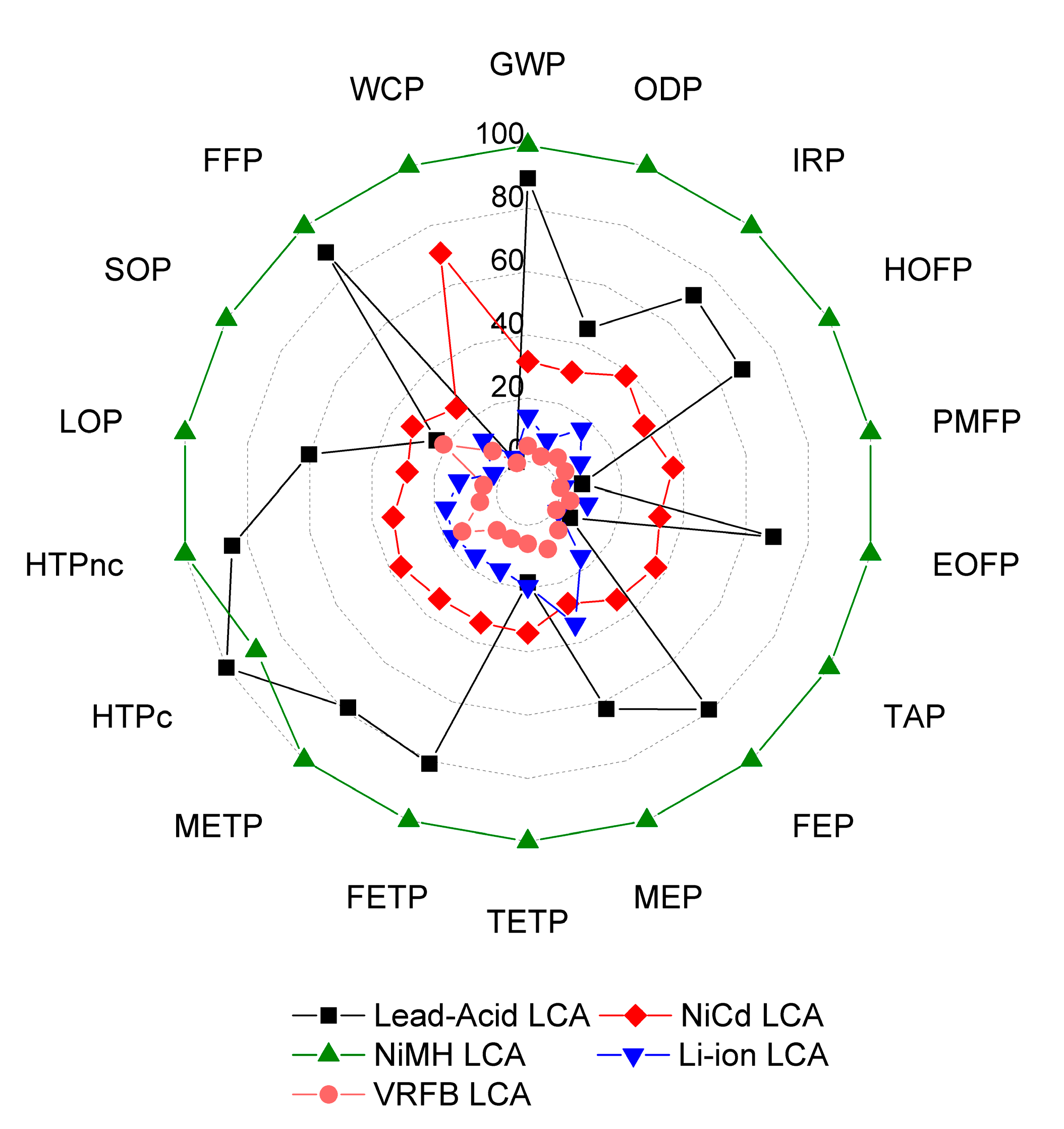
3.2. Comparative LCA of the Selected Batteries
3.3. LCA of VRFB
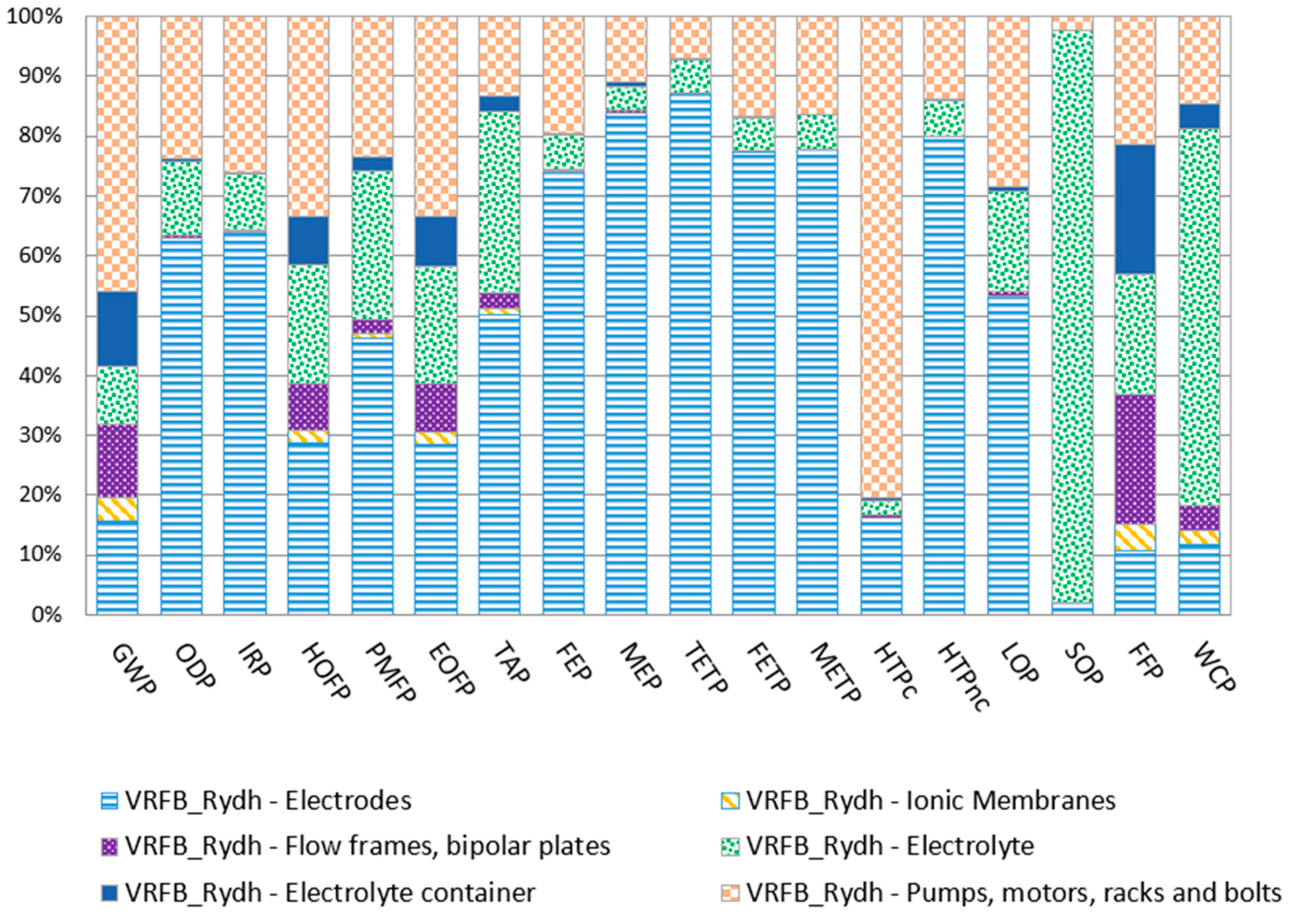
3.3.1. LCA Results Based on Battery Component Comparison
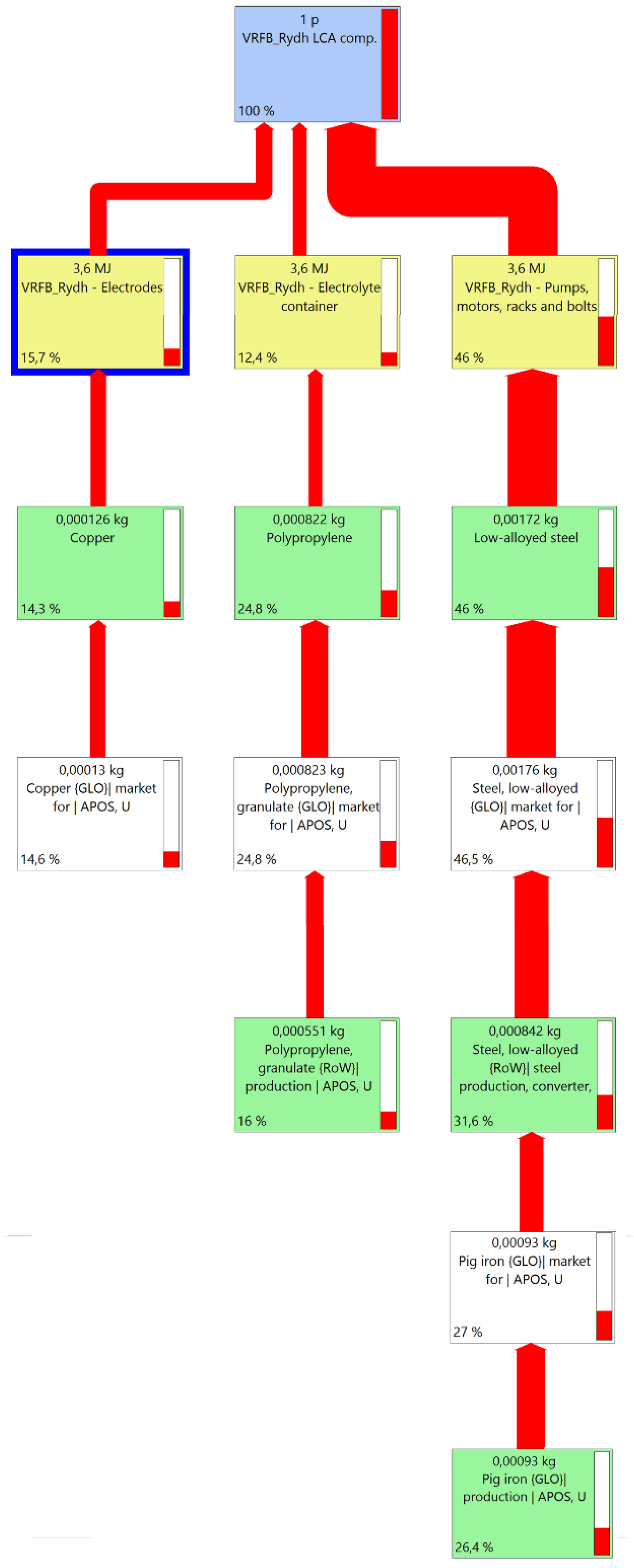
3.3.2. LCA Results Based on Battery Material Comparison
4. Conclusions
Author Contributions
Funding
Conflicts of Interest
Abbreviations
| CRMs | Critical raw materials |
| EOFP | Ozone formation terrestrial ecosystems |
| ESSs | Suitable energy storage systems |
| FEP | Freshwater eutrophication |
| FETP | Freshwater ecotoxicity |
| FFP | Fossil resource scarcity (FFP) |
| GWP | Global warming potential |
| HOFP | Ozone formation human health |
| HTPc | Human carcinogenic toxicity |
| HTPnc | Human non-carcinogenic toxicity |
| IRP | Ionising radiation |
| LCA | Life cycle assessment |
| LCI | Life cycle inventory |
| LiMn2O4 | Lithium manganese oxide |
| LOP | Land use |
| MEP | Marine eutrophication |
| METP | Marine ecotoxicity |
| NiCd | Nickel–cadmium |
| NiMH | Nickel–metal hydride |
| ODP | Stratospheric ozone depletion |
| PbA | Lead–acid |
| PMFP | Particulate matter formation |
| SOP | Mineral resource scarcity |
| TAP | Terrestrial acidification |
| TETP | Terrestrial ecotoxicity |
| VRFB | Vanadium redox flow battery |
| WCP | Water consumption (WCP) |
References
- Busu, M. The Role of Renewables in a Low-Carbon Society: Evidence from a Multivariate Panel Data Analysis at the EU Level. Sustainability 2019, 11, 5260. [Google Scholar] [CrossRef]
- Barragán-Escandón, A.; Terrados-Cepeda, J.; Zalamea-León, E. The Role of Renewable Energy in the Promotion of Circular Urban Metabolism. Sustainability 2017, 9, 2341. [Google Scholar] [CrossRef]
- Bhandari, B.; Lee, K.-T.; Lee, C.S.; Song, C.-K.; Maskey, R.K.; Ahn, S.-H. A novel off-grid hybrid power system comprised of solar photovoltaic, wind, and hydro energy sources. Appl. Energy 2014, 133, 236–242. [Google Scholar] [CrossRef]
- Naqvi, M.; Yan, J.; Dahlquist, E.; Naqvi, S.R. Off-grid electricity generation using mixed biomass compost: A scenario-based study with sensitivity analysis. Appl. Energy 2017, 201, 363–370. [Google Scholar] [CrossRef]
- Vandevyvere, H.; Stremke, S. Urban planning for a renewable energy future: Methodological challenges and opportunities from a design perspective. Sustainability 2012, 4, 1309–1328. [Google Scholar] [CrossRef]
- Zhang, Y.; Campana, P.E.; Yang, Y.; Stridh, B.; Lundblad, A.; Yan, J. Energy flexibility from the consumer: Integrating local electricity and heat supplies in a building. Appl. Energy 2018, 223, 430–442. [Google Scholar] [CrossRef]
- Li, H.; Campana, P.E.; Tan, Y.; Yan, J. Feasibility study about using a stand-alone wind power driven heat pump for space heating. Appl. Energy 2018, 228, 1486–1498. [Google Scholar] [CrossRef]
- Gioutsos, D.M.; Blok, K.; van Velzen, L.; Moorman, S. Cost-optimal electricity systems with increasing renewable energy penetration for islands across the globe. Appl. Energy 2018, 226, 437–449. [Google Scholar] [CrossRef]
- Ding, Y.; Shao, C.; Yan, J.; Song, Y.; Zhang, C.; Guo, C. Economical flexibility options for integrating fluctuating wind energy in power systems: The case of China. Appl. Energy 2018, 228, 426–436. [Google Scholar] [CrossRef]
- Science for Environment Policy Future Brief: Towards the Battery of the Future; Future Brief 20; Brief Produced for the European Commission DG Environment by the Science Communication Unit; UWE: Bristol, UK, 2018; Available online: http://ec.europa.eu/science-environment-policy (accessed on 27 November 2019).
- Castagneto Gissey, G.; Dodds, P.E.; Radcliffe, J. Market and regulatory barriers to electrical energy storage innovation. Renew. Sustain. Energy Rev. 2018, 82, 781–790. [Google Scholar] [CrossRef]
- Yang, Y.; Bremner, S.; Menictas, C.; Kay, M. Battery energy storage system size determination in renewable energy systems: A review. Renew. Sustain. Energy Rev. 2018, 91, 109–125. [Google Scholar] [CrossRef]
- Dehghani-Sanij, A.R.; Tharumalingam, E.; Dusseault, M.B.; Fraser, R. Study of energy storage systems and environmental challenges of batteries. Renew. Sustain. Energy Rev. 2019, 104, 192–208. [Google Scholar] [CrossRef]
- Luo, X.; Wang, J.; Dooner, M.; Clarke, J. Overview of current development in electrical energy storage technologies and the application potential in power system operation. Appl. Energy. 2015, 137, 511–536. [Google Scholar] [CrossRef]
- Akinyele, D.O.; Rayudu, R.K. Review of energy storage technologies for sustainable power networks. Sustain. Energy Technol. Assess. 2014, 8, 74–91. [Google Scholar] [CrossRef]
- Ballantyne, A.D.; Hallett, J.P.; Riley, D.J.; Shah, N.; Payne, D.J. Lead acid battery recycling for the twenty-first century. R. Soc. Open Sci. 2018, 5, 171368. [Google Scholar] [CrossRef]
- Huff, J.; Lunn, R.M.; Waalkes, M.P.; Tomatis, L.; Infante, P.F. Cadmium-induced cancers in animals and in humans. Int. J. Occup. Environ. Health 2007, 13, 202–212. [Google Scholar] [CrossRef]
- Kang, D.H.; Chen, M.; Ogunseitan, O.A. Potential environmental and human health impacts of rechargeable lithium batteries in electronic waste. Environ. Sci. Technol. 2013, 47, 5495–5503. [Google Scholar] [CrossRef]
- Chen, H.; Cong, T.N.; Yang, W.; Tan, C.; Li, Y.; Ding, Y. Progress in electrical energy storage system: A critical review. Prog. Nat. Sci. 2009, 19, 291–312. [Google Scholar] [CrossRef]
- European Commission—Directorate-General for Internal Market I, Entrepreneurship and SMEs Raw Materials. Final Report: Study on the Review of the List of Critical Raw Materials. 2018. Available online: https://op.europa.eu/en/publication-detail/-/publication/08fdab5f-9766-11e7-b92d-01aa75ed71a1 (accessed on 28 November 2019).
- European Commission. Report on Raw Materials for Battery Applications. 2018. Available online: https://ec.europa.eu/transport/sites/transport/files/3rd-mobility-pack/swd20180245.pdf (accessed on 28 November 2019).
- Grosjean, C.; Miranda, P.H.; Perrin, M.; Poggi, P. Assessment of world lithium resources and consequences of their geographic distribution on the expected development of the electric vehicle industry. Renew. Sustain. Energy Rev. 2012, 16, 1735–1744. [Google Scholar] [CrossRef]
- Nitta, N.; Wu, F.; Lee, J.T.; Yushin, G. Li-ion battery materials: Present and future. Mater. Today 2015, 18, 252–264. [Google Scholar] [CrossRef]
- Rubio Rodríguez, M.A.; Ruyck, J.D.; Díaz, P.R.; Verma, V.K.; Bram, S. An LCA based indicator for evaluation of alternative energy routes. Appl. Energy 2011, 88, 630–635. [Google Scholar] [CrossRef]
- Royo, P.; Ferreira, V.J.; López-Sabirón, A.M.; García-Armingol, T.; Ferreira, G. Retrofitting strategies for improving the energy and environmental efficiency in industrial furnaces: A case study in the aluminium sector. Renew. Sustain. Energy Rev. 2018, 82, 1813–1822. [Google Scholar] [CrossRef]
- Ferreira, V.J.; Arnal, A.J.; Royo, P.; García-Armingol, T.; López-Sabirón, A.M.; Ferreira, G. Energy and resource efficiency of electroporation-assisted extraction as an emerging technology towards a sustainable bio-economy in the agri-food sector. J. Clean. Prod. 2019, 233, 1123–1132. [Google Scholar] [CrossRef]
- Ferreira, V.J.; Merchan, M.; Egizabal, P.; García de Cortázar, M.; Irazustabarrena, A.; López-Sabirón, A.M.; Ferreira, G. Technical and environmental evaluation of a new high performance material based on magnesium alloy reinforced with submicrometre-sized TiC particles to develop automotive lightweight components and make transport sector more sustainable. J. Mater. Res. Technol. 2019, 8, 2549–2564. [Google Scholar] [CrossRef]
- Ferreira, V.J.; Egizabal, P.; Popov, V.; García de Cortázar, M.; Irazustabarrena, A.; López-Sabirón, A.M.; Ferreira, G. Lightweight automotive components based on nanodiamond-reinforced aluminium alloy: A technical and environmental evaluation. Diam. Relat. Mater. 2019, 92, 174–186. [Google Scholar] [CrossRef]
- Spanos, C.; Turney, D.E.; Fthenakis, V. Life-cycle analysis of flow-assisted nickel zinc-, manganese dioxide-, and valve-regulated lead-acid batteries designed for demand-charge reduction. Renew. Sustain. Energy Rev. 2015, 43, 478–494. [Google Scholar] [CrossRef]
- Barelli, L.; Bidini, G.; Ottaviano, P.A.; Pelosi, D. Vanadium redox flow batteries application to electric buses propulsion: Performance analysis of hybrid energy storage system. J. Energy Storage 2019, 24, 100770. [Google Scholar] [CrossRef]
- Weber, S.; Peters, J.F.; Baumann, M.; Weil, M. Life Cycle Assessment of a Vanadium Redox Flow Battery. Environ. Sci. Technol. 2018, 52, 10864–10873. [Google Scholar] [CrossRef]
- Kravanja, Z.; Čuček, L. Multi-objective optimisation for generating sustainable solutions considering total effects on the environment. Appl. Energy 2013, 101, 67–80. [Google Scholar] [CrossRef]
- Peters, J.; Buchholz, D.; Passerini, S.; Weil, M. Life cycle assessment of sodium-ion batteries. Energy Environ. Sci. 2016, 9, 1744–1751. [Google Scholar] [CrossRef]
- Hiremath, M.; Derendorf, K.; Vogt, T. Comparative Life Cycle Assessment of Battery Storage Systems for Stationary Applications. Environ. Sci. Technol. 2015, 49, 4825–4833. [Google Scholar] [CrossRef] [PubMed]
- Bobba, S.; Mathieux, F.; Ardente, F.; Blengini, G.A.; Cusenza, M.A.; Podias, A.; Pfrang, A. Life Cycle Assessment of repurposed electric vehicle batteries: An adapted method based on modelling energy flows. J. Energy Storage 2018, 19, 213–225. [Google Scholar] [CrossRef]
- Sullivan, J.L.; Gaines, L. Status of life cycle inventories for batteries. Energy Convers. Manag. 2012, 58, 134–148. [Google Scholar] [CrossRef]
- Environmental Management—Life Cycle Assessment—Principles and Framework; International Organization for Standardization: Geneva, Switzerland; Available online: https://www.iso.org/standard/37456.html (accessed on 28 November 2019).
- Environmental Management—Life Cycle Assessment—Requirements and Guidelines; International Organization for Standardization: Geneva, Switzerland; Available online: https://www.iso.org/standard/38498.html (accessed on 28 November 2019).
- Royo, P.; Ferreira, V.J.; López-Sabirón, A.M.; Ferreira, G. Hybrid diagnosis to characterise the energy and environmental enhancement of photovoltaic modules using smart materials. Energy 2016, 101, 174–189. [Google Scholar] [CrossRef]
- Bare, J.C.; Gloria, T.P. Critical Analysis of the Mathematical Relationships and Comprehensiveness of Life Cycle Impact Assessment Approaches. Environ. Sci. Technol. 2006, 40, 1104–1113. [Google Scholar] [CrossRef]
- Opatokun, S.A.; Lopez-Sabiron, A.M.; Ferreira, G.; Strezov, V. Life Cycle Analysis of Energy Production from Food Waste through Anaerobic Digestion, Pyrolysis and Integrated Energy System. Sustainability 2017, 9, 1804. [Google Scholar] [CrossRef]
- Ferreira, G.; López-Sabirón, A.M.; Aranda, J.; Mainar-Toledo, M.D.; Aranda-Usón, A. Environmental analysis for identifying challenges to recover used reinforced refractories in industrial furnaces. J. Clean. Prod. 2015, 88, 242–253. [Google Scholar] [CrossRef]
- Arnal, A.J.; Royo, P.; Pataro, G.; Ferrari, G.; Ferreira, V.J.; López-Sabirón, A.M.; Ferreira, G. Implementation of PEF Treatment at Real-Scale Tomatoes Processing Considering LCA Methodology as an Innovation Strategy in the Agri-Food Sector. Sustainability 2018, 10, 979. [Google Scholar] [CrossRef]
- Goedkoop, M.; Heijungs, R.; Huijbregts, M.; De Schryver, A.; Struijs, J.; Van Zelm, R. Recipe: A Life Cycle Impact Assessment Method which Comprises Harmonised Category Indicators at the Midpoint and the Endpoint Level, 1st ed.; Version 1.08; Ministry of Housing, Spatial Planning and Environment (VROM): Den Haag, The Netherlands, 2008. [Google Scholar]
- Van den Bossche, P.; Vergels, F.; Van Mierlo, J.; Matheys, J.; Van Autenboer, W. SUBAT: An assessment of sustainable battery technology. J. Power Sources 2006, 162, 913–919. [Google Scholar] [CrossRef]
- Majeau-Bettez, G.; Hawkins, T.R.; Strømman, A.H. Life Cycle Environmental Assessment of Lithium-Ion and Nickel Metal Hydride Batteries for Plug-In Hybrid and Battery Electric Vehicles. Environ. Sci. Technol. 2011, 45, 4548–4554. [Google Scholar] [CrossRef]
- Rydh, C.J.; Sandén, B.A. Energy analysis of batteries in photovoltaic systems. Part I: Performance and energy requirements. Energy Convers. Manag. 2005, 46, 1957–1979. [Google Scholar] [CrossRef]
- Unterreiner, L.; Jülch, V.; Reith, S. Recycling of Battery Technologies—Ecological Impact Analysis Using Life Cycle Assessment (LCA). Energy Procedia 2016, 99, 234. [Google Scholar] [CrossRef]
- Rydh, C.J. Environmental assessment of vanadium redox and lead-acid batteries for stationary energy storage. J. Power Sources 1999, 80, 21–29. [Google Scholar] [CrossRef]
- SUBAT: Sustainable Batteries. Final Report; SSPI-CT-2003-502490 Deliverable D 34; Final Report—EU Project N°502490. Available online: https://www.battery-electric.com/subatdocs/WP6-031.pdf (accessed on 28 November 2019).
- Comparative Life-Cycle Assessment of nickel-Cadmium (NiCd) Batteries Used in Cordless Power Tools (CPTs) vs. Their Alternatives Nickel-Metal Hydride (NiMH) and Lithium-Ion (Li-ion) Batteries. 2011. European Commission, DG ENV. Contract N° 07.0307/2010/573669/ETU/C2. Available online: https://ec.europa.eu/environment/waste/batteries/pdf/report_12.pdf (accessed on 28 December 2019).
- Fick, G.; Mirgaux, O.; Neau, P.; Patisson, F. Using Biomass for Pig Iron Production: A Technical, Environmental and Economical Assessment. Waste Biomass Valorization 2014, 5, 43–55. [Google Scholar] [CrossRef]




| Impact Category | Acronym | Unit | Description [43,44] |
|---|---|---|---|
| Global warming | GWP | kg CO2 eq | Based on climate change, which causes a number of environmental mechanisms that affect both the endpoint human health and ecosystem health. |
| Stratospheric ozone depletion | ODP | kg CFC-11 eq | Destruction of the stratospheric ozone layer by anthropogenic emissions of ozone-depleting substances. |
| Ionising radiation | IRP | kBq Co-60 eq | The routine releases of radioactive material to the environment affect the human health. |
| Ozone formation, human health | HOFP | kg NOx eq | Ozone is not directly emitted into the atmosphere, but it is formed as a result of photochemical reactions of NOx and non-methane volatile organic compounds (NMVOCs). Ozone concentrations lead to respiratory distress. |
| Ozone formation, terrestrial ecosystems | EOFP | kg NOx eq | |
| Fine particulate matter formation | PMFP | kg PM2.5 eq | It represents a complex mixture of organic and inorganic substances coming from both anthropogenic and natural sources. Particles with a diameter of 2.5 may have more visible impacts on respiratory morbidity. |
| Terrestrial acidification | TAP | kg SO2 eq | Measurement of emissions that cause acidifying effects to the environment. |
| Freshwater eutrophication | FEP | kg P eq | Over-enrichment of watercourses with ammonia, nitrates, nitrogen oxides, and phosphorous. Its occurrence can lead to damage of ecosystems, increased mortality of aquatic fauna and flora, and loss of species dependent on low-nutrient environments. |
| Marine eutrophication | MEP | kg N eq | It refers to the runoff and leach of plant nutrients (phosphorus and nitrogen) from soil and discharge into riverine or marine systems. This may lead to hypoxic waters and, if in excess, to anoxia and “dead zones”, which cause marine ecosystems disturbance. |
| Terrestrial ecotoxicity | TETP | kg 1,4-DCB | Assessment of toxicity based on maximum tolerable concentrations in freshwater and marine aquatic ecosystems and terrestrial ecosystems. |
| Freshwater ecotoxicity | FETP | kg 1,4-DCB | |
| Marine ecotoxicity | METP | kg 1,4-DCB | |
| Human carcinogenic toxicity | HTPc | kg 1,4-DCB | Effect of a chemical on the function of environmental persistence (fate), its accumulation in the human food chain (exposure), and the toxicity (effect) of the chemical. |
| Human non-carcinogenic toxicity | HTPnc | kg 1,4-DCB | |
| Land use | LOP | m2a crop eq | The land use impact category reflects the damage to ecosystems because of the effects of occupation and transformation of land |
| Mineral resource scarcity | SOP | kg Cu eq | Represent the amount mineral resources consumed, both directly and indirectly |
| Fossil resource scarcity | FFP | kg oil eq | Represent the amount fossil resources consumed, both directly and indirectly |
| Water consumption | WCP | m3 | Represent the amount of water consumed, both directly and indirectly |
| Battery Type | Average Specific Energy Wh kg −1 Cycle−1 | Cycles/All Lifespan | Lifetime | Data Reference |
|---|---|---|---|---|
| Lead–Acid (PbA) | 38.8 | 750 | 10 | [14] |
| Lithium Manganese Oxide (LiMn2O4) | 148.8 | 5500 | 12.5 | [14] |
| Nickel–Cadmium (NiCd) | 62.5 | 2250 | 14.7 | [14] |
| Nickel–Metal Hydride (NiMH) | 76.3 | 1633 | 9.0 | [45,46,47] |
| Vanadium Redox Flow Battery (VRFB) | 19.9 | 12.068 | 12.4 | [14,31,34,47,48,49] |
| Pb–Acid Battery Manufacturing | Raw Data [50] | Normalised Data | ||||
|---|---|---|---|---|---|---|
| Value | Unit | Value | Unit | |||
| Assembly | Energy consumption | Electricity | 10.71 | MJ/(kg battery) | 0.74 | MJ/(kWh storage) |
| Electrodes | Antimony (Sb) | 0.71 | g/100 g battery | 0.49 | g/(kWh storage) | |
| Arsenic (As) | 0.03 | g/100 g battery | 0.02 | g/(kWh storage) | ||
| Component production | Copper (Cu) | 0.01 | g/100 g battery | 0.01 | g/(kWh storage) | |
| Lead (Pb) | 60.97 | g/100 g battery | 41.96 | g/(kWh storage) | ||
| Oxygen (O2) | 2.26 | g/100 g battery | 1.56 | g/(kWh storage) | ||
| Electrolyte | Sulfuric Acid (H2SO4) | 10.33 | g/100 g battery | 7.11 | g/(kWh storage) | |
| Water (H2O) | 16.93 | g/100 g battery | 11.65 | g/(kWh storage) | ||
| Separator | Glass | 0.20 | g/100 g battery | 0.14 | g/(kWh storage) | |
| Polyethylene (PE) | 1.83 | g/100 g battery | 1.26 | g/(kWh storage) | ||
| Case | Polypropylene (PP) | 6.73 | g/100 g battery | 4.63 | g/(kWh storage) | |
| LiMn2O4 Battery Manufacturing | Raw Data [50] | Normalised Data | ||||
|---|---|---|---|---|---|---|
| Value | Unit | Value | Unit | |||
| Assembly | Energy consumption | Electricity | 42.75 | MJ/(kg battery) | 0.08 | MJ/(kWh storage) |
| Component production | Electrodes | Carbon (C) | 14.96 | g/100 g battery | 0.29 | g/(kWh storage) |
| Lithium manganese (LiMn2O4) oxide | 23.63 | g/100 g battery | 0.46 | g/(kWh storage) | ||
| Polyvinylidene fluoride | 1.19 | g/100 g battery | 0.02 | g/(kWh storage) | ||
| Styrene butadiene rubber | 1.19 | g/100 g battery | 0.02 | g/(kWh storage) | ||
| Aluminium (Al) | 20.73 | g/100 g battery | 0.41 | g/(kWh storage) | ||
| Copper (Cu) | 15.55 | g/100 g battery | 0.30 | g/(kWh storage) | ||
| Electrolyte | Propylene carbonate | 3.15 | g/100 g battery | 0.06 | g/(kWh storage) | |
| Ethylene carbonate | 6.3 | g/100 g battery | 0.12 | g/(kWh storage) | ||
| Dimethyl carbonate | 3.15 | g/100 g battery | 0.06 | g/(kWh storage) | ||
| Lithium hexafluorophosphate (LiPF6) | 3.15 | g/100 g battery | 0.06 | g/(kWh storage) | ||
| Separator | Polypropylene | 5 | g/100 g battery | 0.10 | g/(kWh storage) | |
| Case | Steel | 2 | g/100 g battery | 0.04 | g/(kWh storage) | |
| Ni–Cd Battery Manufacturing | Raw Data [50] | Normalised Data | ||||
|---|---|---|---|---|---|---|
| Value | Unit | Value | Unit | |||
| Assembly | Energy consumption | Electricity | 19.6 | MJ/(kg battery) | 0.19 | MJ/(kWh storage) |
| Component production | Electrodes | Nickel (Ni) | 28.67 | g/100 g battery | 2.78 | g/(kWh storage) |
| Cadmium hydroxide (Cd(OH)2) | 20.73 | g/100 g battery | 2.01 | g/(kWh storage) | ||
| Cobalt hydroxide (Co(OH)2) | 1.43 | g/100 g battery | 0.14 | g/(kWh storage) | ||
| Electrolyte | Potassium hydroxide (KOH) | 4.89 | g/100 g battery | 0.47 | g/(kWh storage) | |
| Sodium hydroxide (NaOH) | 0.35 | g/100 g battery | 0.03 | g/(kWh storage) | ||
| Lithium hydroxide (LiOH) | 0.63 | g/100 g battery | 0.06 | g/(kWh storage) | ||
| Water (H2O) | 16.47 | g/100 g battery | 1.60 | g/(kWh storage) | ||
| Separator | Polypropylene | 4.47 | g/100 g battery | 0.43 | g/(kWh storage) | |
| Case | Steel | 14.78 | g/100 g battery | 1.43 | g/(kWh storage) | |
| Polyethylene | 4.47 | g/100 g battery | 0.43 | g/(kWh storage) | ||
| Polypropylene (PP) | 3.11 | g/100 g battery | 0.30 | g/(kWh storage) | ||
| Ni–MH Battery Manufacturing | Raw Data [50] | Normalised Data | ||||
|---|---|---|---|---|---|---|
| Value | Unit | Value | Unit | |||
| Assembly | Energy consumption | Electricity | 9.79 | MJ/(kg battery) | 0.17 | MJ/(kWh storage) |
| Component production | Electrodes | Nickel (Ni) | 42.07 | g/100 g battery | 7.51 | g/(kWh storage) |
| Lanthanum (La) | 10.07 | g/100 g battery | 1.80 | g/(kWh storage) | ||
| Cobalt | 4.85 | g/100 g battery | 0.87 | g/(kWh storage) | ||
| Copper (Cu) | 1.2 | g/100 g battery | 0.21 | g/(kWh storage) | ||
| Electrolyte | Potassium hydroxide (KOH) | 3.35 | g/100 g battery | 0.60 | g/(kWh storage) | |
| Sodium hydroxide (NaOH) | 0.88 | g/100 g battery | 0.16 | g/(kWh storage) | ||
| Water (H2O) | 11.67 | g/100 g battery | 2.08 | g/(kWh storage) | ||
| Separator | Polypropylene | 2.57 | g/100 g battery | 0.46 | g/(kWh storage) | |
| Nylon | 3 | g/100 g battery | 0.54 | g/(kWh storage) | ||
| Stainless steel | 11.28 | g/100 g battery | 2.01 | g/(kWh storage) | ||
| Case | Polypropylene | 4.53 | g/100 g battery | 0.81 | g/(kWh storage) | |
| Polyethylene | 4.53 | g/100 g battery | 0.81 | g/(kWh storage) | ||
| Battery Manufacturing | Raw Data [49] | Normalised Data | ||||
|---|---|---|---|---|---|---|
| Value | Unit | Value | Unit | |||
| Assembly | Energy consumption | Electricity | 4.90 | MJ/(kg battery) | 0.08 | MJ/(kWh storage) |
| Components of Power Subsystem | Electrodes | Copper (Cu) | 0.78 | g/100g battery | 0.13 | g/(kWh storage) |
| Carbon felt, graphite | 0.26 | g/100g battery | 0.04 | g/(kWh storage) | ||
| Ionic membranes | Polysulphone and (polystyrene manufacturing assumed) | 0.44 | g/100g battery | 0.07 | g/(kWh storage) | |
| Flow frames, bipolar plates | Polypropylene, rubber, carbon black | 1.39 | g/100g battery | 0.23 | g/(kWh storage) | |
| Components of Energy Subsystem | Electrolyte | Water (H2O) | 47.85 | g/100g battery | 7.71 | g/(kWh storage) |
| Sulfuric acid (pure) | 25.95 | g/100g battery | 4.18 | g/(kWh storage) | ||
| Vanadium pentoxide | 10.07 | g/100g battery | 1.62 | g/(kWh storage) | ||
| Electrolyte container | Polypropylene (PP) | 2.55 | g/100g battery | 0.41 | g/(kWh storage) | |
| Components of Periphery | Pumps, motors, racks, and bolts | Stainless steel | 10.70 | g/100g battery | 1.72 | g/(kWh storage) |
| Impact Category | VRFB—Electrodes (%) | VRFB—Electrolyte (%) | VRFB—Pumps, Motors, Racks, and Bolts (%) |
|---|---|---|---|
| GWP | Steel (46) | ||
| ODP | Copper (63) | Steel (24) | |
| IRP | Copper (64) | Steel (26) | |
| HOFP | Cooper (29) | Steel (34) | |
| PMFP | Copper (46) | Sulfuric acid (25) | Steel (23) |
| EOFP | Cooper (28) | Steel (34) | |
| TAP | Copper (50) | Sulfuric acid (30) | |
| FEP | Copper (74) | ||
| MEP | Copper (84) | ||
| TETP | Copper (87) | ||
| FETP | Copper (77) | ||
| METP | Copper (77) | ||
| HTPc | Steel (80) | ||
| HTPnc | Copper (80) | ||
| LOP | Cooper (53) | Steel (28) | |
| SOP | Vanadium (95) | ||
| FFP | Steel (22) | ||
| WCP | Sulfuric acid (63) |
© 2020 by the authors. Licensee MDPI, Basel, Switzerland. This article is an open access article distributed under the terms and conditions of the Creative Commons Attribution (CC BY) license (http://creativecommons.org/licenses/by/4.0/).
Share and Cite
Díaz-Ramírez, M.C.; Ferreira, V.J.; García-Armingol, T.; López-Sabirón, A.M.; Ferreira, G. Environmental Assessment of Electrochemical Energy Storage Device Manufacturing to Identify Drivers for Attaining Goals of Sustainable Materials 4.0. Sustainability 2020, 12, 342. https://doi.org/10.3390/su12010342
Díaz-Ramírez MC, Ferreira VJ, García-Armingol T, López-Sabirón AM, Ferreira G. Environmental Assessment of Electrochemical Energy Storage Device Manufacturing to Identify Drivers for Attaining Goals of Sustainable Materials 4.0. Sustainability. 2020; 12(1):342. https://doi.org/10.3390/su12010342
Chicago/Turabian StyleDíaz-Ramírez, Maryori C., Víctor J. Ferreira, Tatiana García-Armingol, Ana María López-Sabirón, and Germán Ferreira. 2020. "Environmental Assessment of Electrochemical Energy Storage Device Manufacturing to Identify Drivers for Attaining Goals of Sustainable Materials 4.0" Sustainability 12, no. 1: 342. https://doi.org/10.3390/su12010342
APA StyleDíaz-Ramírez, M. C., Ferreira, V. J., García-Armingol, T., López-Sabirón, A. M., & Ferreira, G. (2020). Environmental Assessment of Electrochemical Energy Storage Device Manufacturing to Identify Drivers for Attaining Goals of Sustainable Materials 4.0. Sustainability, 12(1), 342. https://doi.org/10.3390/su12010342