An Analytical Model for the Many-to-One Demand Responsive Transit Systems



Abstract
1. Introduction
1.1. Literature Review
1.2. Objectives and Contributions
2. Methodology
2.1. General Description of the Analytical Model
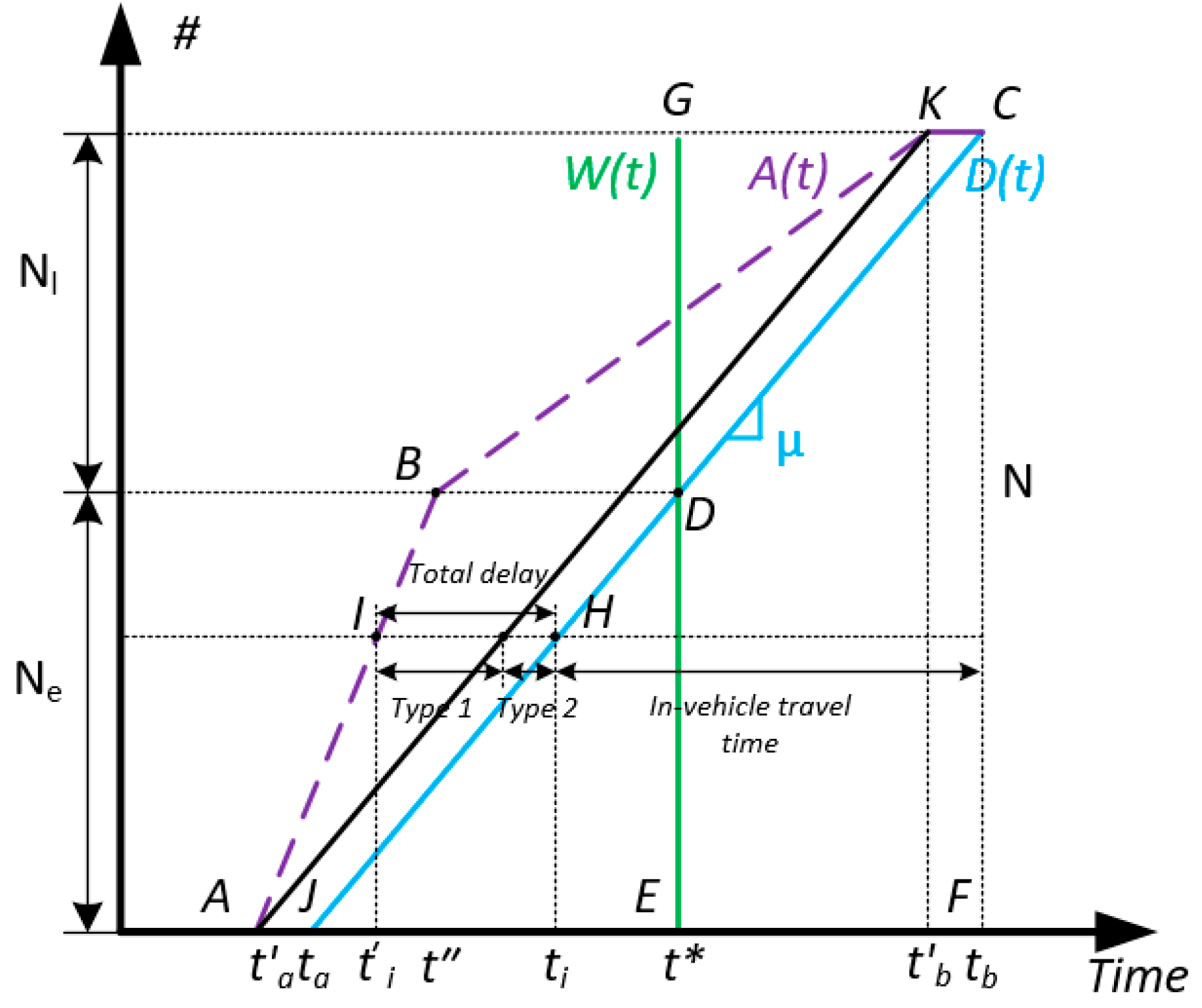
2.2. Agency Cost
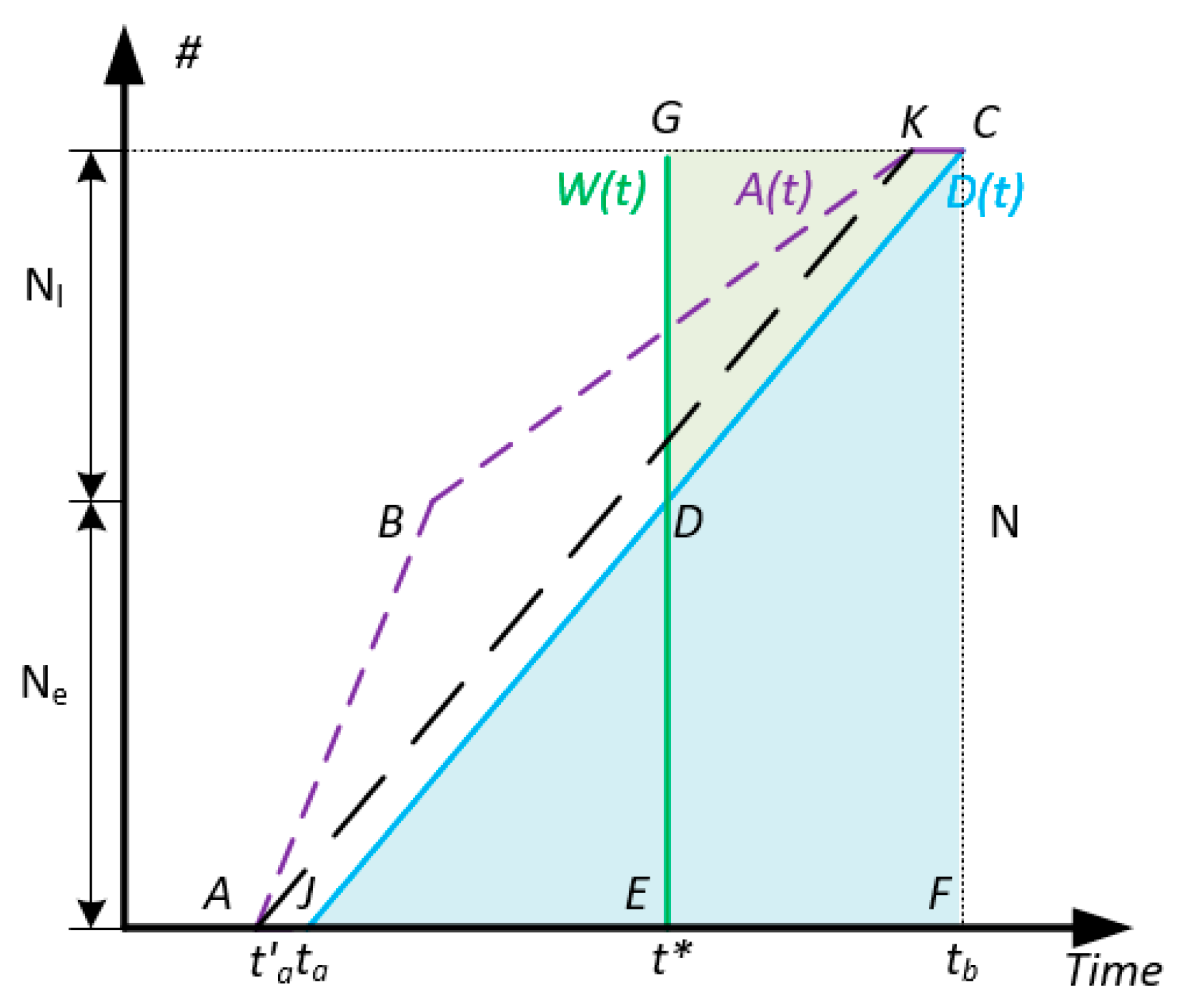
2.3. User Cost
2.4. Model Formulation
3. Numerical Experiments
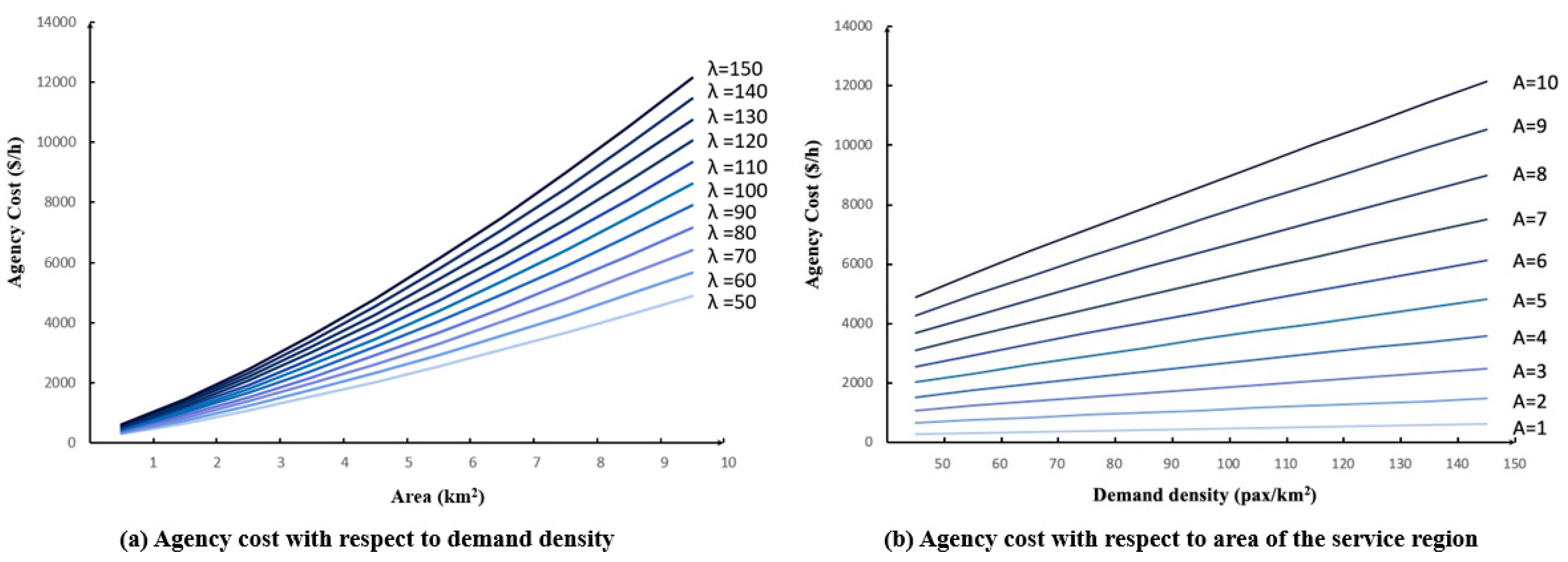
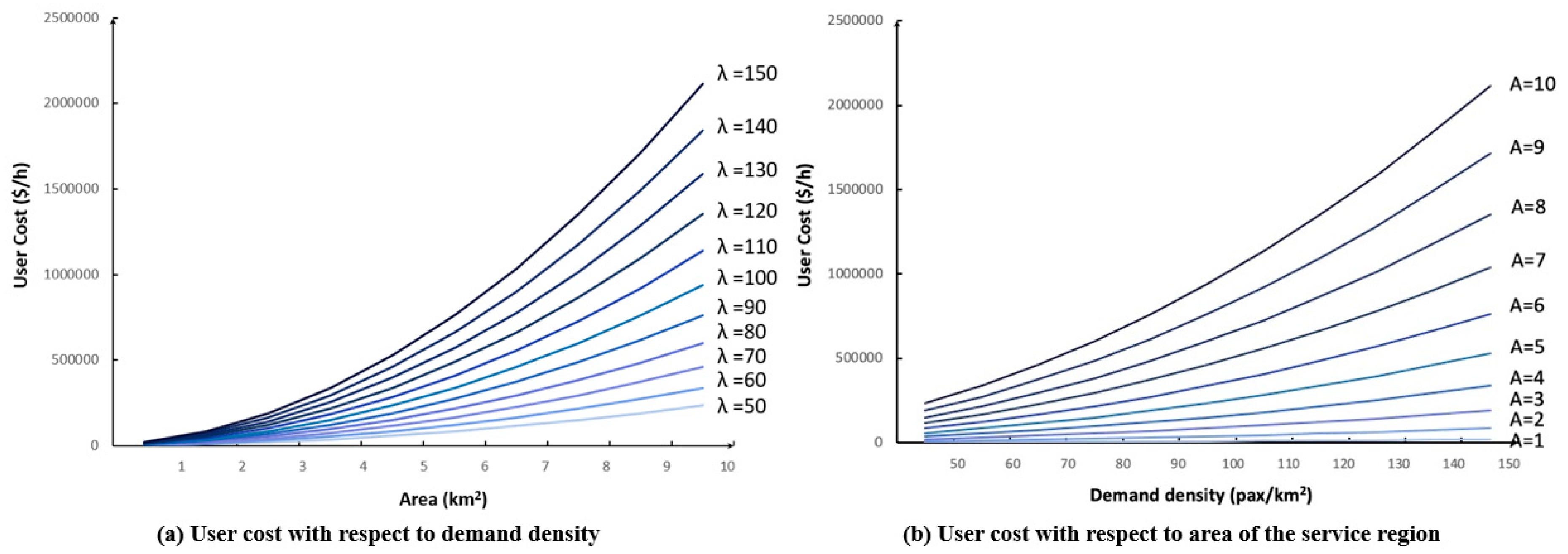
3.1. Effects of Area of the Service Region and Demand Density Changes
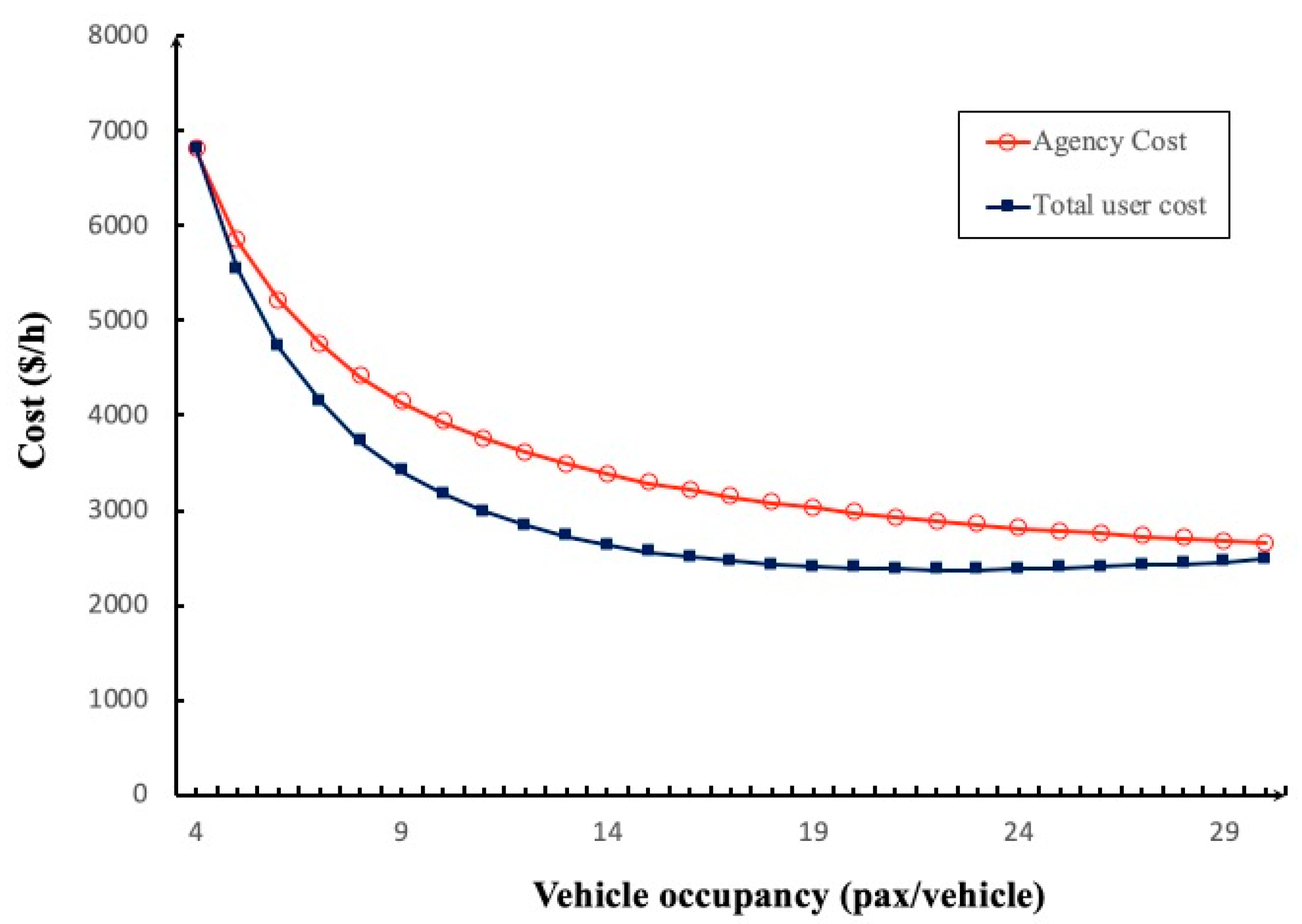
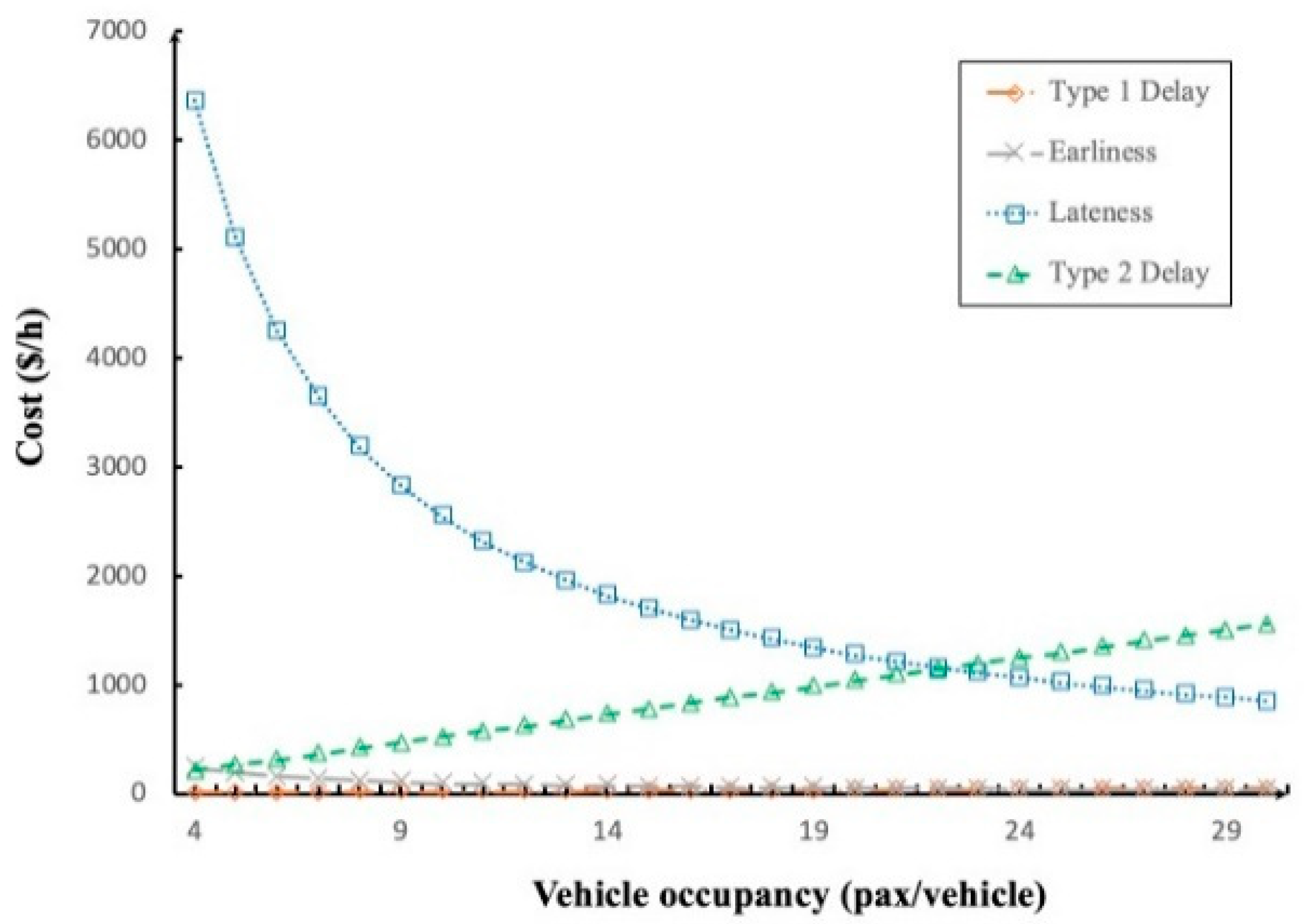
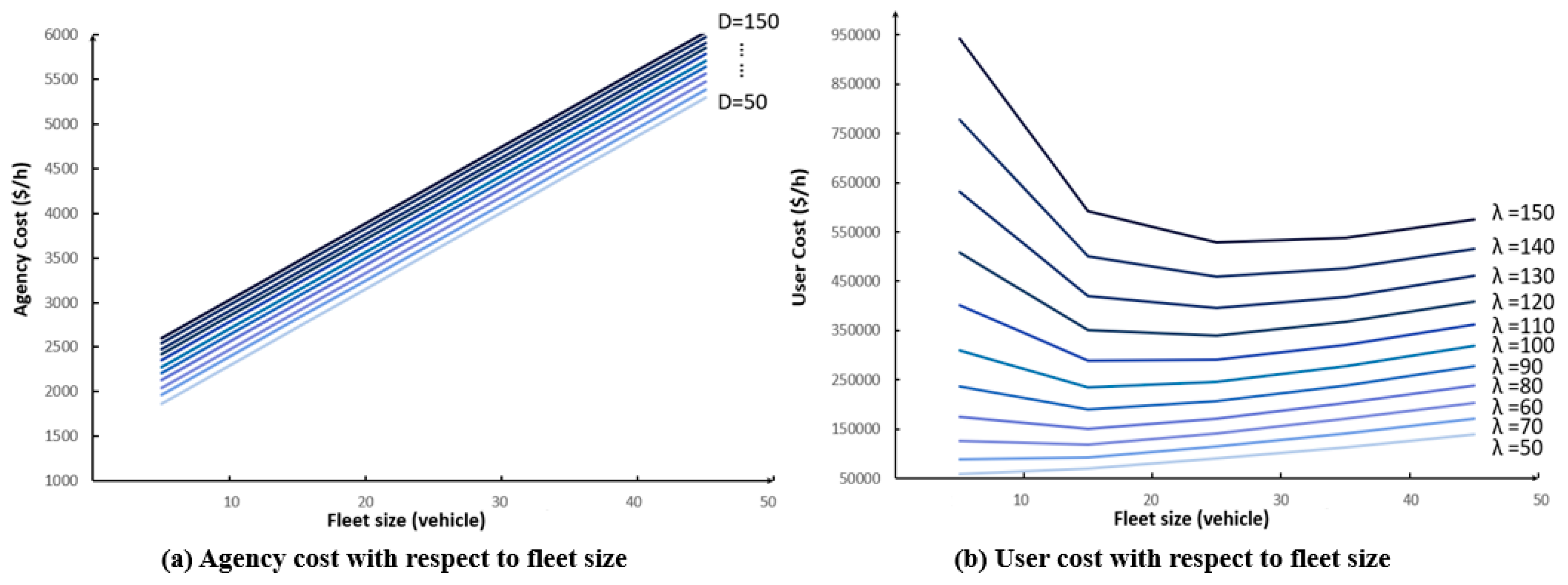
3.2. Effects of Vehicle Occupancy/Fleet Size Changes
4. Conclusions
Author Contributions
Funding
Conflicts of Interest
References
- Ciaffi, F.; Cipriani, E.; Petrelli, M. Feeder bus network design problem: A new metaheuristic procedure and real size applications. Procedia Soc. Behav. Sci. 2012, 54, 798–807. [Google Scholar] [CrossRef] [Scilit]
- Chandra, S.; Quadrifoglio, L. A model for estimating the optimal cycle length of demand responsive feeder transit services. Transp. Res. Part B 2013, 51, 1–16. [Google Scholar] [CrossRef] [Scilit]
- De Gruyter, C.; Currie, G.; Rose, G. Sustainability measures of urban public transport in cities: A world review and focus on the Asia/Middle East Region. Sustainability 2017, 9, 43. [Google Scholar] [CrossRef] [Scilit]
- Huang, D.; Gu, Y.; Wang, S.; Liu, Z.; Zhang, W. A two-phase optimization model for the demand-responsive customized bus network design. Transp. Res. Part C 2020, 111, 1–21. [Google Scholar] [CrossRef] [Scilit]
- Errico, F.; Crainic, T.G.; Malucelli, F.; Nonato, M. A survey on planning semi-flexible transit systems: Methodological issues and a unifying framework. Transp. Res. Part C 2013, 36, 324–338. [Google Scholar] [CrossRef] [Scilit]
- Han, Z.; Chen, Y.; Li, H.; Zhang, K.; Sun, J. Customized bus network design based on individual reservation demands. Sustainability 2019, 11, 5535. [Google Scholar] [CrossRef] [Scilit]
- Amirgholy, M.; Gonzales, E.J. Demand responsive transit systems with time-dependent demand: User equilibrium, system optimum, and management strategy. Transp. Res. Part B 2016, 92, 234–252. [Google Scholar] [CrossRef] [Scilit]
- Daganzo, C.F. Logistics Systems Analysis; Springer: New York, NY, USA, 2005. [Google Scholar]
- Bie, Y.; Xiong, X.; Yan, Y.; Qu, X. Dynamic headway control for high-frequency bus line based on speed guidance and intersection signal adjustment. Comput. Aided Civ. Infrastruct. Eng. 2020, 34, 4–25. [Google Scholar] [CrossRef] [Scilit]
- Ansari, S.; Basdere, M.; Li, X.; Ouyang, Y. Advancements in continuous approximation models for logistics and transportation systems: 1996–2016. Transp. Res. Part B 2018, 107, 229–252. [Google Scholar] [CrossRef] [Scilit]
- Vickrey, W.S. Congestion theory and transport investment. Am. Econ. Rev. 1969, 59, 251–260. [Google Scholar]
- Ho, S.C.; Szeto, W.Y.; Kuo, Y.H.; Leung, J.M.; Petering, M.; Tou, T.W. A survey of dial-a-ride problems: Literature review and recent developments. Transp. Res. Part B 2018, 111, 395–421. [Google Scholar] [CrossRef] [Scilit]
- Aldaihani, M.M.; Quadrifoglio, L.; Dessouky, M.M.; Hall, R. Network design for a grid hybrid transit service. Transp. Res. Part A 2004, 38, 511–530. [Google Scholar] [CrossRef] [Scilit]
- Chebbi, O.; Chaouachi, J. Reducing the wasted transportation capacity of personal rapid transit systems: An integrated model and multi-objective optimization approach. Transp. Res. Part E 2016, 89, 236–258. [Google Scholar] [CrossRef] [Scilit]
- Quadrifoglio, L.; Hall, R.W.; Dessouky, M.M. Performance and design of mobility allowance shuttle transit services: Bounds on the maximum longitudinal velocity. Transp. Sci. 2006, 40, 351–363. [Google Scholar] [CrossRef] [Scilit]
- Tong, L.C.; Zhou, L.; Liu, J.; Zhou, X. Customized bus service design for jointly optimizing passenger-to-vehicle assignment and vehicle routing. Transp. Res. Part E 2017, 85, 451–475. [Google Scholar] [CrossRef] [Scilit]
- Rahimi, M.; Amirgholy, M.; Gonzales, E.J. System modeling of demand responsive transportation services: Evaluating cost efficiency of service and coordinated taxi usage. Transp. Res. Part E 2018, 112, 66–83. [Google Scholar] [CrossRef] [Scilit]
- Fu, L. Improving paratransit scheduling by accounting for dynamic and stochastic variations in travel time. Transp. Res. Rec. 1999, 1666, 74–81. [Google Scholar] [CrossRef] [Scilit]
- Fu, L.; Teply, S. On-line and off-line routing and scheduling of dial-a-ride paratransit vehicles. Comput. Aided Civ. Infrastruct. Eng. 1999, 14, 309–319. [Google Scholar] [CrossRef] [Scilit]
- Dessouky, M.; Ordóñez, F.; Quadrifoglio, F. Productivity and Cost-Effectiveness of Demand Responsive Transit Systems; California PATH Program, Institute of Transportation Studies, University of California at Berkeley: Berkeley, CA, USA, 2005. [Google Scholar]
- Daganzo, C.F. An approximate analytic model of many-to-many demand responsive transportation systems. Transp. Res. 1978, 12, 325–333. [Google Scholar] [CrossRef] [Scilit]
- Diana, M.; Dessouky, M.M.; Xia, N. A model for the fleet sizing of demand responsive transportation services with time windows. Transp. Res. Part B 2006, 40, 651–666. [Google Scholar] [CrossRef] [Scilit]
- Fu, L. Analytical model for paratransit capacity and quality-of-service analysis. Transp. Res. Rec. 2003, 1841, 81–89. [Google Scholar] [CrossRef] [Scilit]
- Daganzo, C.F. The distance traveled to visit N points with a maximum of C stops per vehicle: An analytic model and an application. Transp. Sci. 1984, 18, 331–350. [Google Scholar] [CrossRef] [Scilit]
- Daganzo, C.F. The length of tours in zones of different shapes. Transp. Res. Part B 1984, 18, 135–145. [Google Scholar] [CrossRef] [Scilit]
- Gaboune, B.; Laporte, G.; Soumis, F. Expected distances between two uniformly distributed random points in rectangles and rectangular parallelpipeds. J. Oper. Res. Soc. 1993, 44, 513–519. [Google Scholar] [CrossRef] [Scilit]
- Del Castillo, J.M. A heuristic for the traveling salesman problem based on a continuous approximation. Transp. Res. Part B 1999, 33, 123–152. [Google Scholar] [CrossRef] [Scilit]
- Tian, Q.; Huang, H.J.; Yang, H. Equilibrium properties of the morning peak-period commuting in a many-to-one mass transit system. Transp. Res. Part B 2007, 41, 616–631. [Google Scholar] [CrossRef] [Scilit]
- Ceder, A. Public Transit Planning and Operation: Theory. Modeling and Practice; Elsevier: Oxford, UK, 2007. [Google Scholar]
- Franceschetti, A.; Jabali, O.; Laporte, G. Continuous approximation models in freight distribution management. Top 2017, 25, 413–433. [Google Scholar] [CrossRef] [Scilit]
- Campbell, J.F. One-to-many distribution with transshipments: An analytic model. Transp. Sci. 1993, 27, 330–340. [Google Scholar] [CrossRef] [Scilit]
- Vaughan, R. Approximate formulas for average distances associated with zones. Transp. Sci. 1984, 18, 231–244. [Google Scholar] [CrossRef] [Scilit]
- Fu, L. Planning and design of flex-route transit services. Transp. Res. Rec. 2002, 1791, 59–66. [Google Scholar] [CrossRef] [Scilit]
- Small, K.A. The scheduling of consumer activities: Work trips. Am. Econ. Rev. 1982, 72, 467–479. [Google Scholar]
- An, S.; Cui, N.; Li, X.; Ouyang, Y. Location planning for transit-based evacuation under the risk of service disruptions. Transp. Res. Part B 2013, 54, 1–16. [Google Scholar] [CrossRef] [Scilit]
- Wardrop, J.G.; Whitehead, J.I. Some theoretical aspects of road traffic research. Proc. Inst. Civ. Eng. 1952, 1, 767–768. [Google Scholar] [CrossRef] [Scilit]
- Arnott, R.; De Palma, A.; Lindsey, R. Economics of a bottleneck. J. Urban Econ. 1990, 27, 111–130. [Google Scholar] [CrossRef] [Scilit]
- Lindsey, R. Existence, uniqueness, and trip cost function properties of user equilibrium in the bottleneck model with multiple user classes. Transp. Sci. 2004, 38, 293–314. [Google Scholar] [CrossRef] [Scilit]
- Zhang, X.; Zhang, H.M.; Li, L. Analysis of user equilibrium traffic patterns on bottlenecks with time-varying capacities and their applications. Int. J. Sustain. Transp. 2010, 4, 56–74. [Google Scholar] [CrossRef] [Scilit]
- Daganzo, C.F. The uniqueness of a time-dependent equilibrium distribution of arrivals at a single bottleneck. Transp. Sci. 1985, 19, 29–37. [Google Scholar] [CrossRef] [Scilit]


| No. of Stops in | |
|---|---|
| 1 | 0 |
| 2 | 0.73 |
| 3 | 0.68 |
| 4 | 0.63 |
| 5 | 0.60 |
| ≥6 | 0.57 |
| Symbol | Definition | Baseline Value |
|---|---|---|
| Area of the service region (km2) | - | |
| b | Sum of pick-up and drop-off times (h) | 0.08 |
| Vehicle operating cost ($/veh h) | 50 | |
| Scalar factor for earliness delay | 0.5 | |
| Scalar factor for lateness delay | 1.5 | |
| Number of passengers (pax) | - | |
| Number of early passengers (pax) | - | |
| Number of late passengers (pax) | - | |
| Vehicle capacity (pax) | 30 | |
| Average vehicle speed (km/h) | 30 | |
| Scalar factor for in-vehicle waiting delay | 1.0 | |
| β | Cost rate of delay ($/h) | 5 |
| The weight of agency cost | 1 | |
| The weight of user cost | 1 | |
| Demand density (pax/km2) | - | |
| System service rate (pax/h) | - | |
| Distance from the depot to the centroid of (km) | - | |
| Distance from the centroid of to station (km) | - |
© 2019 by the authors. Licensee MDPI, Basel, Switzerland. This article is an open access article distributed under the terms and conditions of the Creative Commons Attribution (CC BY) license (http://creativecommons.org/licenses/by/4.0/).
Share and Cite
Huang, D.; Tong, W.; Wang, L.; Yang, X. An Analytical Model for the Many-to-One Demand Responsive Transit Systems. Sustainability 2020, 12, 298. https://doi.org/10.3390/su12010298
Huang D, Tong W, Wang L, Yang X. An Analytical Model for the Many-to-One Demand Responsive Transit Systems. Sustainability. 2020; 12(1):298. https://doi.org/10.3390/su12010298
Chicago/Turabian StyleHuang, Di, Weiping Tong, Lumeng Wang, and Xun Yang. 2020. "An Analytical Model for the Many-to-One Demand Responsive Transit Systems" Sustainability 12, no. 1: 298. https://doi.org/10.3390/su12010298
APA StyleHuang, D., Tong, W., Wang, L., & Yang, X. (2020). An Analytical Model for the Many-to-One Demand Responsive Transit Systems. Sustainability, 12(1), 298. https://doi.org/10.3390/su12010298