

Electric Charging Demand Location Model—A User- and Destination-Based Locating Approach for Electric Vehicle Charging Stations


Abstract
1. Introduction
2. State of the Art of CS Location Models
3. Materials and Methods
3.1. Data Analysis
3.1.1. Destinations
3.1.2. User Groups and Their Dwell Time
3.2. Electric Demand Analysis
3.3. Walking Distance Assumptions
3.4. Spatial Modeling
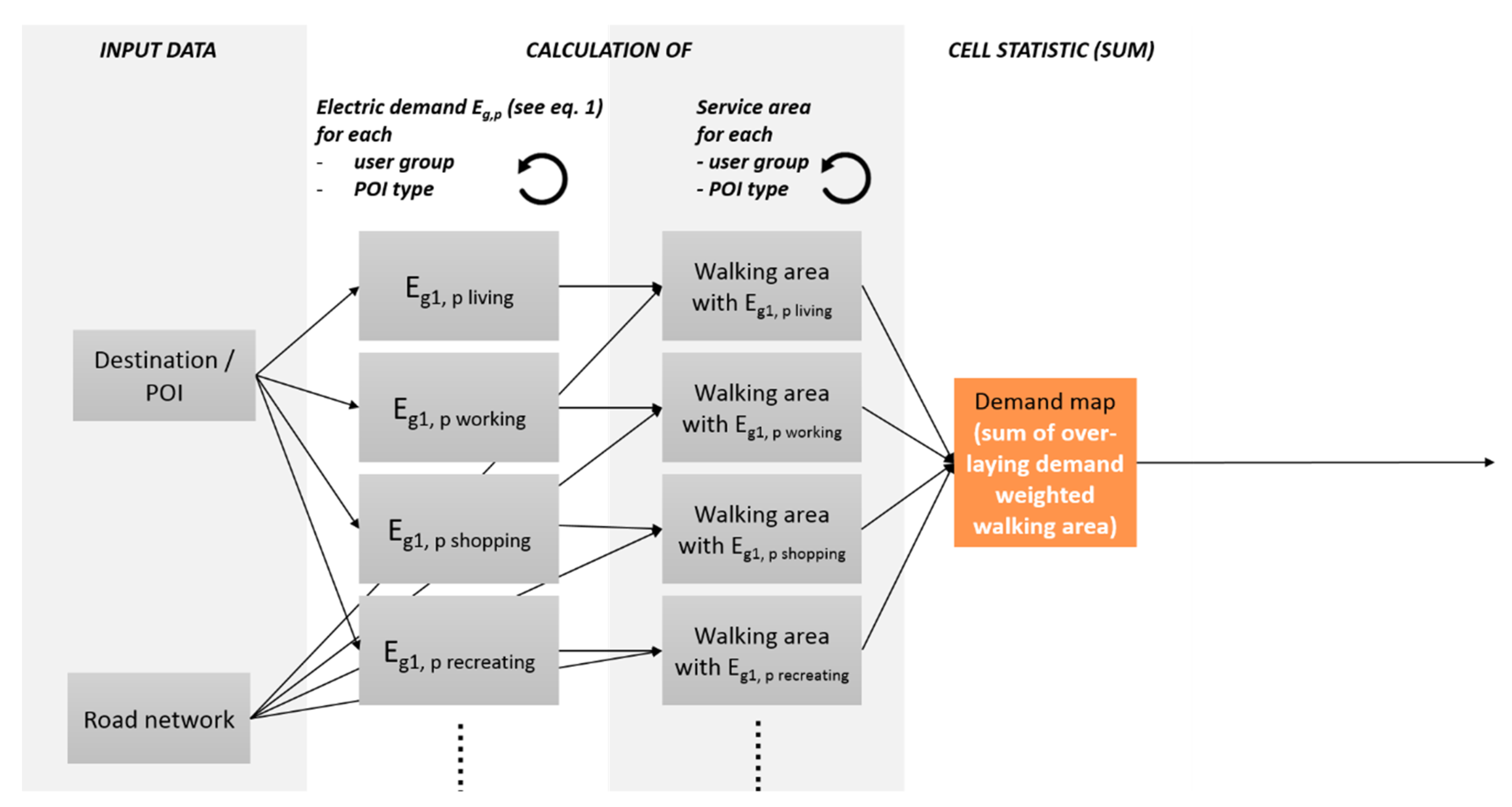
3.4.1. Overlay Analysis of Demand-Weighted Walking Areas
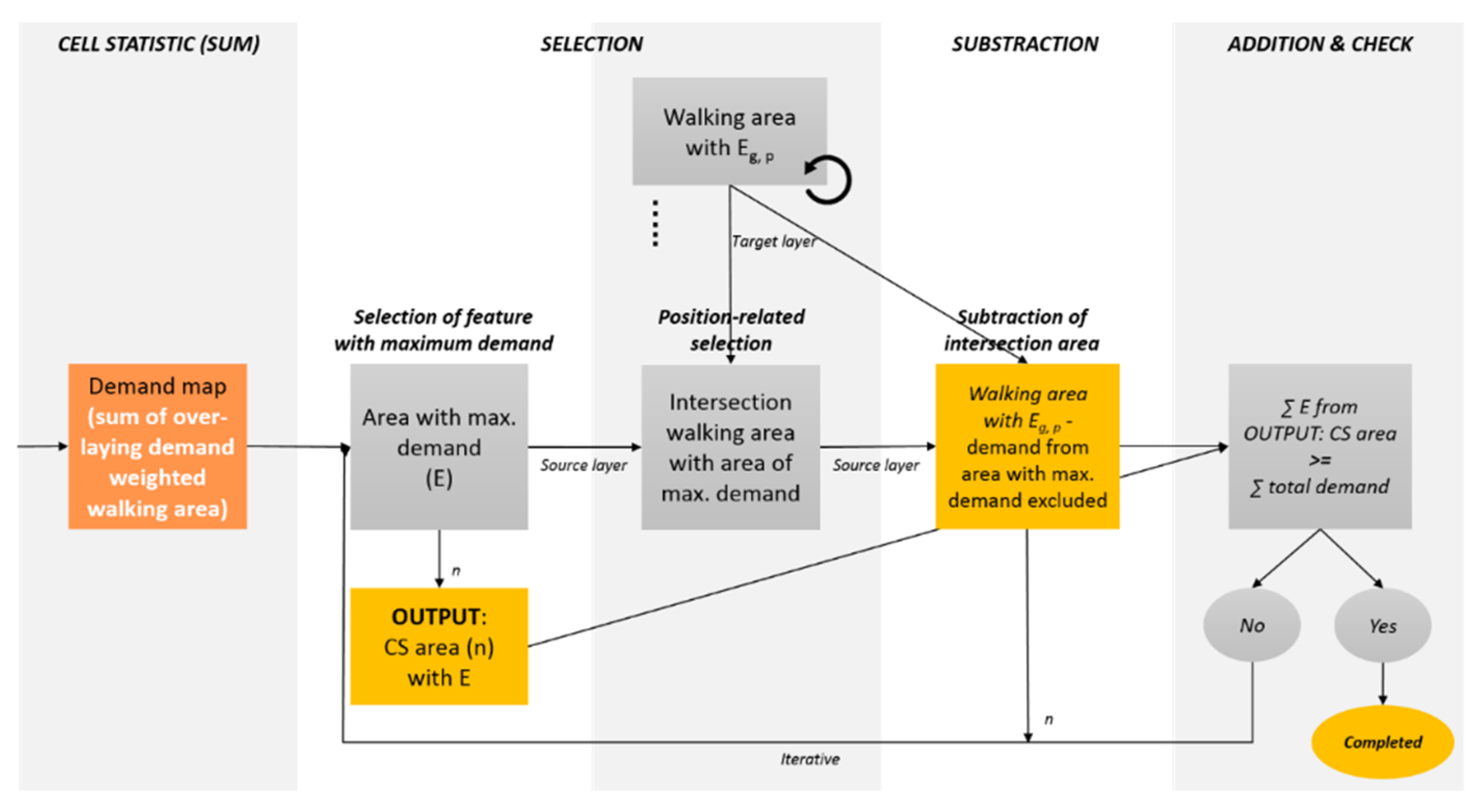
3.4.2. Selection Process of CS Locations
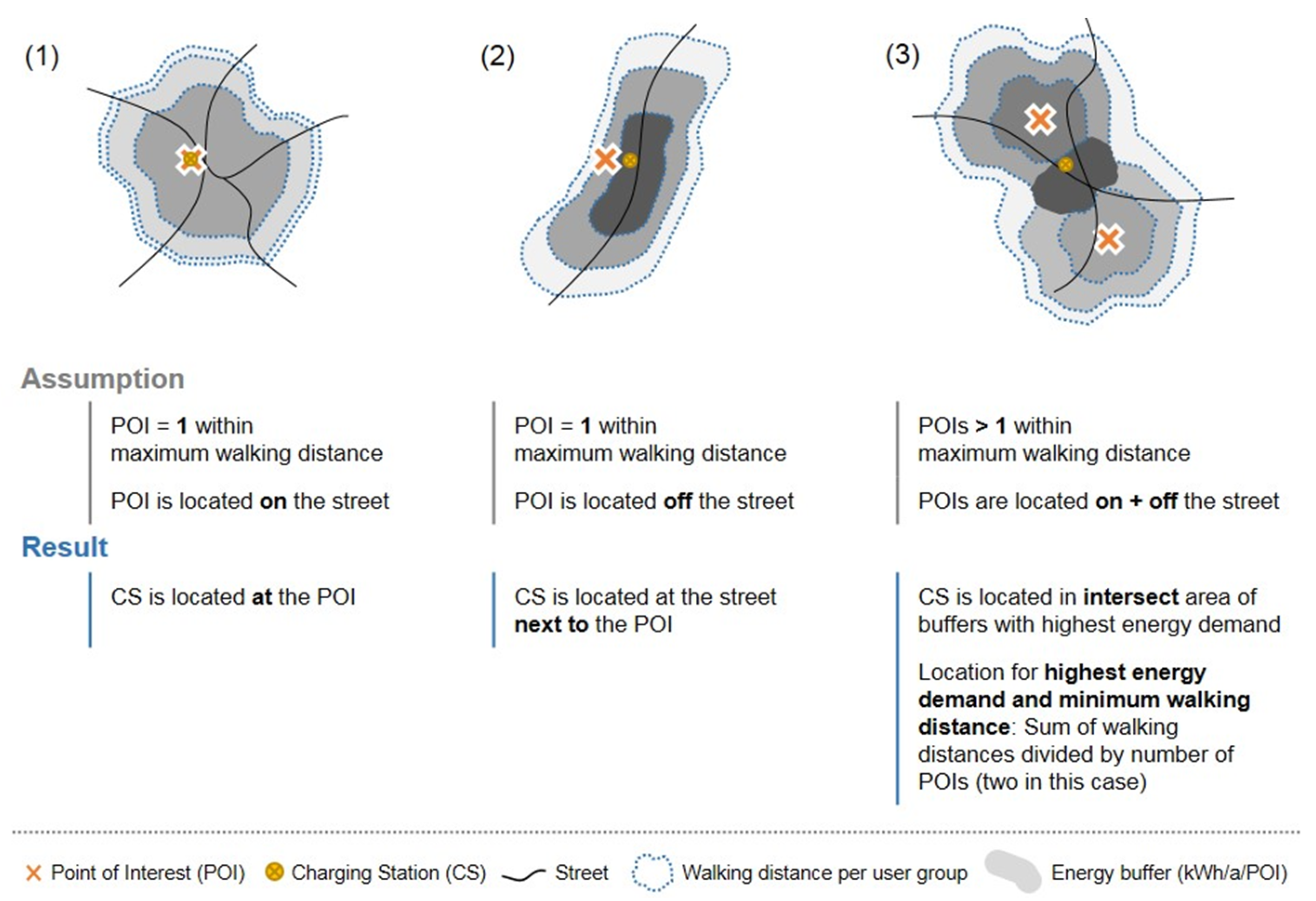
3.4.3. Alternative Considerations of Walking Distance Optimization
4. Case Study and Results
4.1. Data and Case Study Area
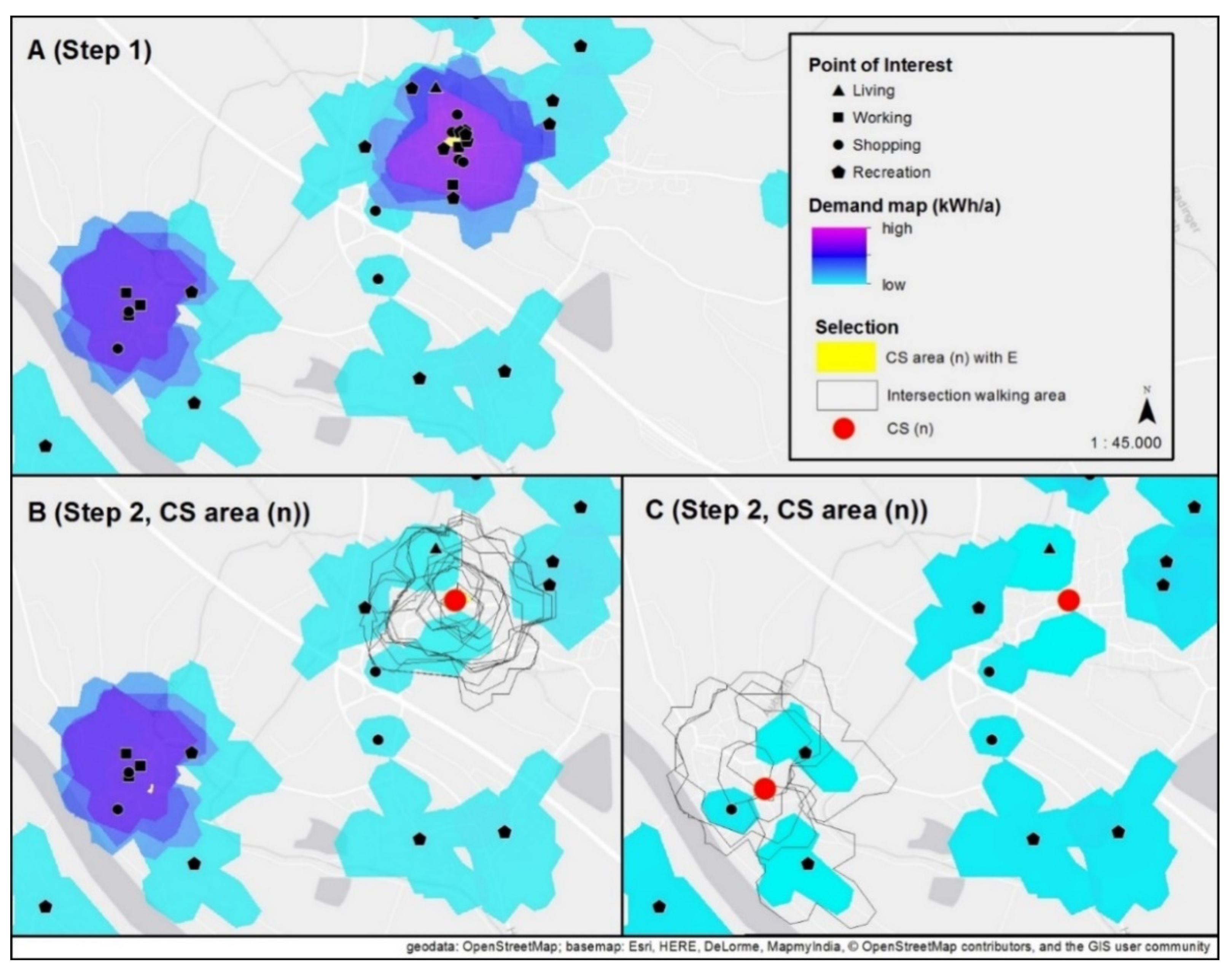
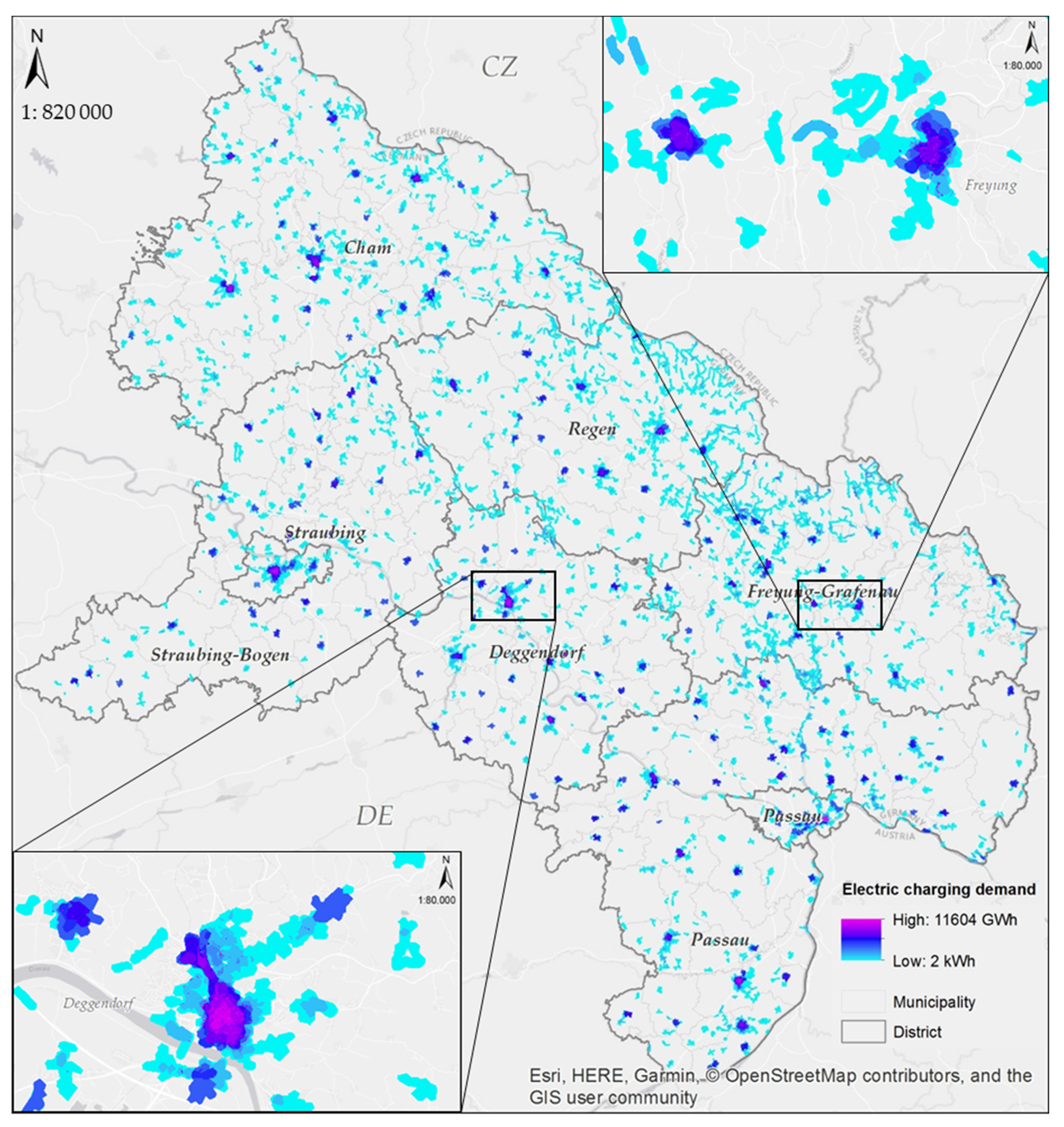
4.2. Results of CS Location Analysis
5. Discussion
6. Conclusions
Author Contributions
Funding
Conflicts of Interest
References
- European Environment Agency. Electric Vehicles in Europe; European Environment Agency: Copenhagen, Denmark, 2016. [Google Scholar]
- Amsterdam Round Table and McKinsey&Company. Electric Vehicles in Europe Gearing up for a New Phase. 2014. Available online: https://www.mckinsey.com/featured-insights/europe/electric-vehicles-in-europe-gearing-up-for-a-new-phase (accessed on 16 November 2016).
- European Automobile Manufacturers Association. Overview on Tax Incentives for Electric Vehicles in the EU. 2017. Available online: https://www. acea.be/uploads/publications/EV_incentives_overview_2017.pdf (accessed on 10 August 2017).
- Deng, Y.; Li, J.; Li, T.; Gao, X.; Yuan, C. Life cycle assessment of lithium sulfur battery for electric vehicles. J. Power Sources 2017, 343, 284–295. [Google Scholar] [CrossRef]
- Kaiser, O.; Meyer, S.; Schippl, J. ITA-Monitoring Elektromobilität. 2011. Available online: http://www.itas.kit.edu/pub/v/2011/epp/kaua11-pre01.pdf (accessed on 25 November 2017).
- Beckers, T.; Gizzi, F.; Kreft, T.; Hildebrandt, J. Effiziente Bereitstellung der (öffentlich zugänglichen) Ladeinfrastruktur für die Elektromobilität in Deutschland; TU Berlin: Berlin, Germany, 2015. [Google Scholar]
- Dong, J.; Liu, C.; Lin, Z. Charging infrastructure planning for promoting battery electric vehicles: An activity-based approach using multiday travel data. Transp. Res. Part C Emerg. Technol. 2014, 38, 44–55. [Google Scholar] [CrossRef]
- Philipsen, R.; Schmidt, T.; Ziefle, M. A Charging Place to Be–Users’ Evaluation Criteria for the Positioning of Fast-charging Infrastructure for Electro Mobility. Procedia Manuf. 2015, 3, 2792–2799. [Google Scholar] [CrossRef]
- Chen, S.; Shi, Y.; Chen, X.; Qi, F. Optimal location of electric vehicle charging stations using genetic algorithm. In Proceedings of the 2015 17th Asia-Pacific Network Operations and Management Symposium (APNOMS), Busan, Korea, 19–21 August 2015; pp. 372–375. [Google Scholar]
- Hidalgo, P.A.L.; Ostendorp, M.; Lienkamp, M. Optimizing the charging station placement by considering the user’s charging behavior. In Proceedings of the 2016 IEEE International Energy Conference (ENERGYCON), Leuven, Belgium, 4–8 April 2016; pp. 1–7. [Google Scholar]
- Salmon, J. Systems optimization of charging infrastructure for electric vehicles. In Proceedings of the 2016 Annual IEEE Systems Conference (SysCon), Orlando, FL, USA, 18–21 April 2016. [Google Scholar]
- Andrenacci, N.; Ragona, R.; Valenti, G. A demand-side approach to the optimal deployment of electric vehicle charging stations in metropolitan areas. Appl. Energy 2016, 182, 39–46. [Google Scholar] [CrossRef]
- Wirges, J. Planning the Charging Infrastructure for Electric Vehicles in Cities and Regions; KIT Scientific Publishing: Karlsruhe, Germany, 2016. [Google Scholar]
- Kameda, H.; Mukai, N. Optimization of charging station placement by using taxi probe data for on-demand electrical bus system. In Proceedings of the International Conference on Knowledge-Based and Intelligent Information and Engineering Systems, Kaiserslautern, Germany, 12–14 September 2011; Volume 6883. [Google Scholar]
- Tu, W.; Li, Q.; Fang, Z.; Shaw, S.; Zhou, B.; Chang, X. Optimizing the locations of electric taxi charging stations: A spatial–temporal demand coverage approach. Transp. Res. Part C Emerg. Technol. 2016, 65, 172–189. [Google Scholar] [CrossRef]
- Frade, I.; Ribeiro, A.; Gonçalves, G.; Antunes, A. Optimal Location of Charging Stations for Electric Vehicles in a Neighborhood in Lisbon, Portugal. Transp. Res. Rec. 2011, 2252, 91–98. [Google Scholar] [CrossRef]
- Namdeo, A.; Tiwary, A.; Dziurla, R. Spatial planning of public charging points using multi-dimensional analysis of early adopters of electric vehicles for a city region. Technol. Forecast. Soc. Chang. 2014, 89, 188–200. [Google Scholar] [CrossRef]
- Wagner, S.; Brandt, T.; Neumann, D. Smart city planning—Developing an urban charging infrastructure for electric vehicles. In Proceedings of the 22nd European Conference on Information Systems (ECIS 2014), Aviv, Israel, 9–11 June 2014. [Google Scholar]
- Chen, T.; Kockelman, K.; Khan, M. Locating electric vehicle charging stations. Transp. Res. Rec. 2013, 2385, 28–36. [Google Scholar] [CrossRef]
- Spieker, H.; Hagg, A.; Gaier, A.; Meilinger, S.; Asteroth, A. Multi-stage evolution of single- and multi-objective MCLP. Soft Comput. 2016, 21, 4859–4872. [Google Scholar] [CrossRef]
- Viswanathan, V.; Zehe, D.; Ivanchev, J.; Pelzer, D.; Knoll, A.; Aydt, H. Simulation-assisted exploration of charging infrastructure requirements for electric vehicles in urban environments. J. Comput. Sci. 2016, 12, 1–10. [Google Scholar] [CrossRef]
- Pagany, R.; Camargo, L.R.; Dorner, W. A review of spatial localization methodologies for the electric vehicle charging infrastructure. Int. J. Sustain. Transp. 2018, 1–17. [Google Scholar] [CrossRef]
- Ahn, Y.; Jun, C.; Yeo, H. Analysing driving patterns of electric taxi based on the location of charging station in urban area. In Proceedings of the 2016 IEEE International Smart Cities Conference (ISC2), Trento, Italy, 12–15 September 2016. [Google Scholar]
- Asamer, J.; Reinthaler, M.; Ruthmair, M.; Straub, M.; Puchinger, J. Optimizing charging station locations for urban taxi providers. Transp. Res. Part Policy Pract. 2016, 85, 233–246. [Google Scholar] [CrossRef]
- Efthymiou, D.; Antoniou, C.; Tyrinopoylos, Y.; Mitsakis, E. Spatial Exploration of Effective Electric Vehicle Infrastructure Location. Procedia Soc. Behav. Sci. 2012, 48, 765–774. [Google Scholar] [CrossRef]
- Brooker, R.P.; Qin, N. Identification of potential locations of electric vehicle supply equipment. J. Power Sources 2015, 299, 76–84. [Google Scholar] [CrossRef]
- Gkatzoflias, D.; Drossinos, Y.; Zambelli, P. Optimal Allocation of Electric Vehicle Charging Infrastructure in Cities and Regions; JRC Report; Publications Office of the European Union: Luxembourg, 2016. [Google Scholar]
- Brost, W.; Funke, T.; Lembach, M. Spatial Analysis of the Public Transport Accessibility for Modelling the Modal Split in the Context of Site Identification for Charging Infrastructure. Infrastructures 2018, 3, 21. [Google Scholar] [CrossRef]
- Franke, T.; Krems, J.F. Understanding charging behaviour of electric vehicle users. Transp. Res. Part F Traffic Psychol. Behav. 2013, 21, 75–89. [Google Scholar] [CrossRef]
- Morrissey, P.; Weldon, P.; O’Mahony, M. Future standard and fast charging infrastructure planning: An analysis of electric vehicle charging behaviour. Energy Policy 2016, 89, 257–270. [Google Scholar] [CrossRef]
- Bundesamt, S. Zeitverwendungserhebung—Aktivitäten in Stunden und Minuten für Ausgewählte Personengruppen—Zeitverwendung 2012/2013; Statistisches Bundesamt (Destatis): Wiesbaden, Germany, 2015.
- Wirges, J.; Linder, S.; Kessler, A. Modelling the development of a regional charging infrastructure for electric vehicles in time and space. Eur. J. Transp. Infrastruct. Res. 2012, 12, 391–416. [Google Scholar]
- DLR. Mobilitätspanel Deutschland-Nationale Verkehrserhebungen. Available online: http://daten.clearingstelle-verkehr.de/192/ (accessed on 9 May 2016).
- Millward, H.; Spinney, J.; Scott, D. Active-transport walking behavior: Destinations, durations, distances. J. Transp. Geogr. 2013, 28, 101–110. [Google Scholar] [CrossRef]
- Gunn, L.D.; King, T.L.; Mavoa, S.; Lamb, K.E.; Giles-Corti, B.; Kavanagh, A. Identifying destination distances that support walking trips in local neighborhoods. J. Transp. Health 2017, 5, 133–141. [Google Scholar] [CrossRef]
- Yang, Y.; Diez-Roux, A.V. Walking Distance by Trip Purpose and Population Subgroups. Am. J. Prev. Med. 2012, 43, 11–19. [Google Scholar] [CrossRef] [PubMed]
- ILS-NRW. Sicherung von Nahversorgung und Nahmobilität: Zusammenhänge zwischen Lebensmittelversorgung und Mobilitätsverhalten. ILS-Trends Entwicklungen in NRW. February 2007. Available online: http://www.wohnen-mobilitaet.ch/fileadmin/redaktion/wohnen/Literatur_Freudenau.pdf (accessed on 20 January 2016).
- Cavadas, J.; Correia, G.; Gouveia, J. Electric Vehicles Charging Network Planning. In Computer-Based Modelling and Optimization in Transportation; de Sousa, J.F., Rossi, R., Eds.; Springer: Cham, Switzerland, 2014; Volume 262, pp. 85–100. [Google Scholar]
- Bioly, S.; Kuchshaus, V.; Klumpp, M. Elektromobilität und Ladesäulenstandortbestimmung: Eine Exemplarische Analyse Mit Dem Beispiel der Stadt Duisburg; ILD Schriftenreihe Logistikforschung: Essen, Germany, 2012. [Google Scholar]

| Destination Category | OSM Superclasses |
|---|---|
| Living | Accommodation 1 |
| Working | Education, Money |
| Shopping | Health, Shopping |
| Recreation | Leisure, Catering, Tourism, Place of worship 2 |
| Category | g 1: Young Agers (18–29 years) 2 | Practicing (%) | g 2: Mid Agers (30–44 years) | Practicing (%) | g 3: Best Agers (45–64 years) | Practicing (%) | g 4: Silver Agers (65+ years) | Practicing (%) |
|---|---|---|---|---|---|---|---|---|
| Living | 14:00:20 | 14:58:49 | 15:26:20 | 17:48:01 | ||||
| Personal duties | 10:57:00 | 100% | 10:36:00 | 100% | 10:52:00 | 100% | 11:50:00 | 100% |
| Domestic work | 0:29:00 | 79% | 1:57:00 | 94% | 1:36:00 | 94% | 2:04:00 | 96% |
| Media use | 3:04:00 | 87% | 2:48:00 | 91% | 3:19:00 | 93% | 4:07:00 | 97% |
| Working | 3:47:22 | 3:43:14 | 3:09:24 | 0:13:31 | ||||
| Working | 7:19:00 | 40% | 7:10:00 | 51% | 6:59:00 | 45% | 4:35:00 | 4% |
| Education | 3:50:00 | 23% | 3:37:00 | 3% | 2:38:00 | 2% | 1:29:00 | 2% |
| Shopping | 0:23:37 | 0:30:47 | 0:37:31 | 0:44:19 | ||||
| Shopping | 1:03:00 | 38% | 1:04:00 | 48% | 1:12:00 | 52% | 1:19:00 | 56% |
| Recreating | 5:05:08 | 4:07:17 | 4:29:20 | 6:05:51 | ||||
| Voluntary work | 1:25:00 | 11% | 1:18:00 | 14% | 1:22:00 | 18% | 1:30:00 | 23% |
| Social issues | 1:53:00 | 76% | 1:17:00 | 75% | 1:13:00 | 76% | 1:19:00 | 84% |
| Sport | 1:57:00 | 42% | 1:15:00 | 36% | 0:52:00 | 28% | 1:11:00 | 57% |
| Media use 3 | 3:04:00 | 87% | 2:48:00 | 91% | 3:19:00 | 93% | 4:07:00 | 97% |
| POI Type | Maximum Walking Distance (in Meters) for User Group: | |||
|---|---|---|---|---|
| Young Agers (18–29 years) | Mid Agers (30–44 years) | Best Agers (45–64 years) | Silver Agers (65+ years) | |
| Living | 300 | 300 | 300 | 150 |
| Working | 500 | 500 | 500 | 500 |
| Shopping | 100 | 100 | 100 | 100 |
| Recreation | 500 | 500 | 500 | 250 |
| Statistics Case Study Area | |
|---|---|
| Area size | 7200 km² |
| Population density | 109 per km2 |
| Number of POI per type | 560 Living 400 Working 2480 Shopping 3280 Recreation |
| Number of persons per user group | 102,000 Young ager 143,000 Mid ager 224,000 Best ager 153,000 Silver ager |
| Number of vehicle (from inhabitants) | 449,000 |
| Number of daily tourist vehicles (average stay = 4 days/year) | 15,650 |
| Assumption: penetration rate | 50% |
| Average driving distance per day and person | 43 km |
| Electric demand (total in one year)—calculated | 85.76 Gigawatt hours (GWh) |
| POI Type | Total E (kWh) | Number of POI Per Type |
|---|---|---|
| Living | 18,577,000 | 560 |
| Working | 34,200,000 | 400 |
| Shopping | 12,530,000 | 2480 |
| Recreation | 20,454,000 | 3280 |
| District: Deggendorf | OSM | Das Örtliche (Online Telephone Book) | |
|---|---|---|---|
| Number of pharmacies | 24 | 17 | 22 |
| Number of doctors | 15 | 20 | 261 |
© 2019 by the authors. Licensee MDPI, Basel, Switzerland. This article is an open access article distributed under the terms and conditions of the Creative Commons Attribution (CC BY) license (http://creativecommons.org/licenses/by/4.0/).
Share and Cite
Pagany, R.; Marquardt, A.; Zink, R. Electric Charging Demand Location Model—A User- and Destination-Based Locating Approach for Electric Vehicle Charging Stations. Sustainability 2019, 11, 2301. https://doi.org/10.3390/su11082301
Pagany R, Marquardt A, Zink R. Electric Charging Demand Location Model—A User- and Destination-Based Locating Approach for Electric Vehicle Charging Stations. Sustainability. 2019; 11(8):2301. https://doi.org/10.3390/su11082301
Chicago/Turabian StylePagany, Raphaela, Anna Marquardt, and Roland Zink. 2019. "Electric Charging Demand Location Model—A User- and Destination-Based Locating Approach for Electric Vehicle Charging Stations" Sustainability 11, no. 8: 2301. https://doi.org/10.3390/su11082301
APA StylePagany, R., Marquardt, A., & Zink, R. (2019). Electric Charging Demand Location Model—A User- and Destination-Based Locating Approach for Electric Vehicle Charging Stations. Sustainability, 11(8), 2301. https://doi.org/10.3390/su11082301

