

Analysis of Self-Reported Walking for Transit in a Sprawling Urban Metropolitan Area in the Western U.S.




Abstract
1. Introduction
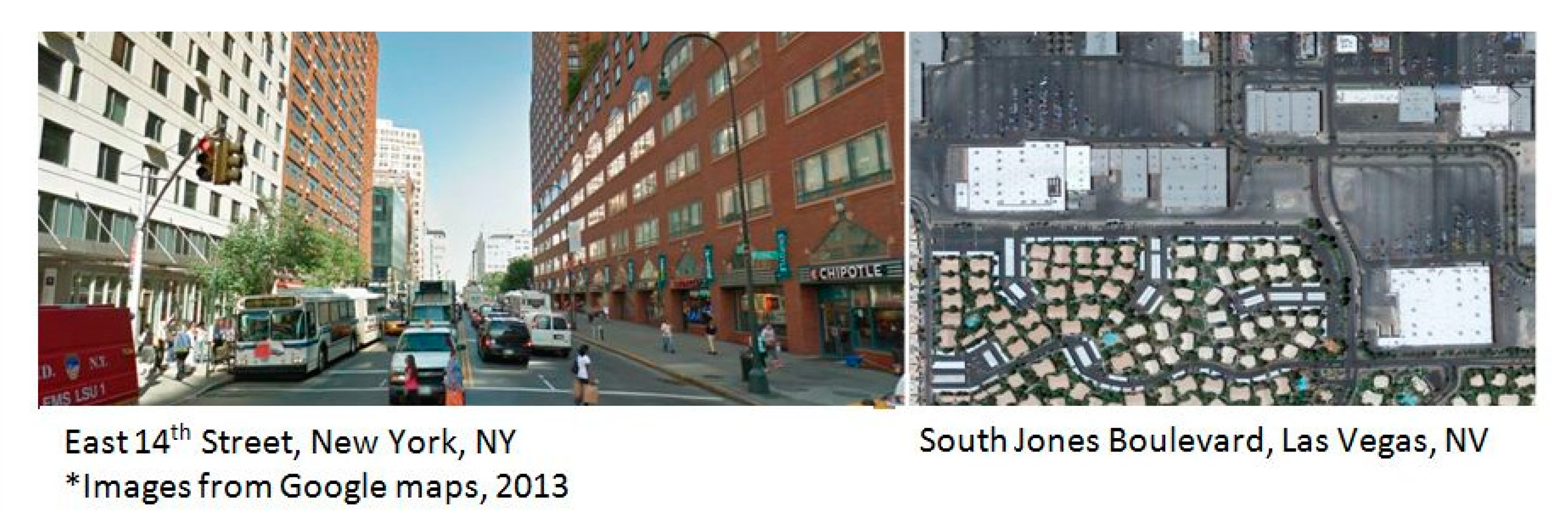
Sprawl
2. Materials and Methods
2.1. Setting
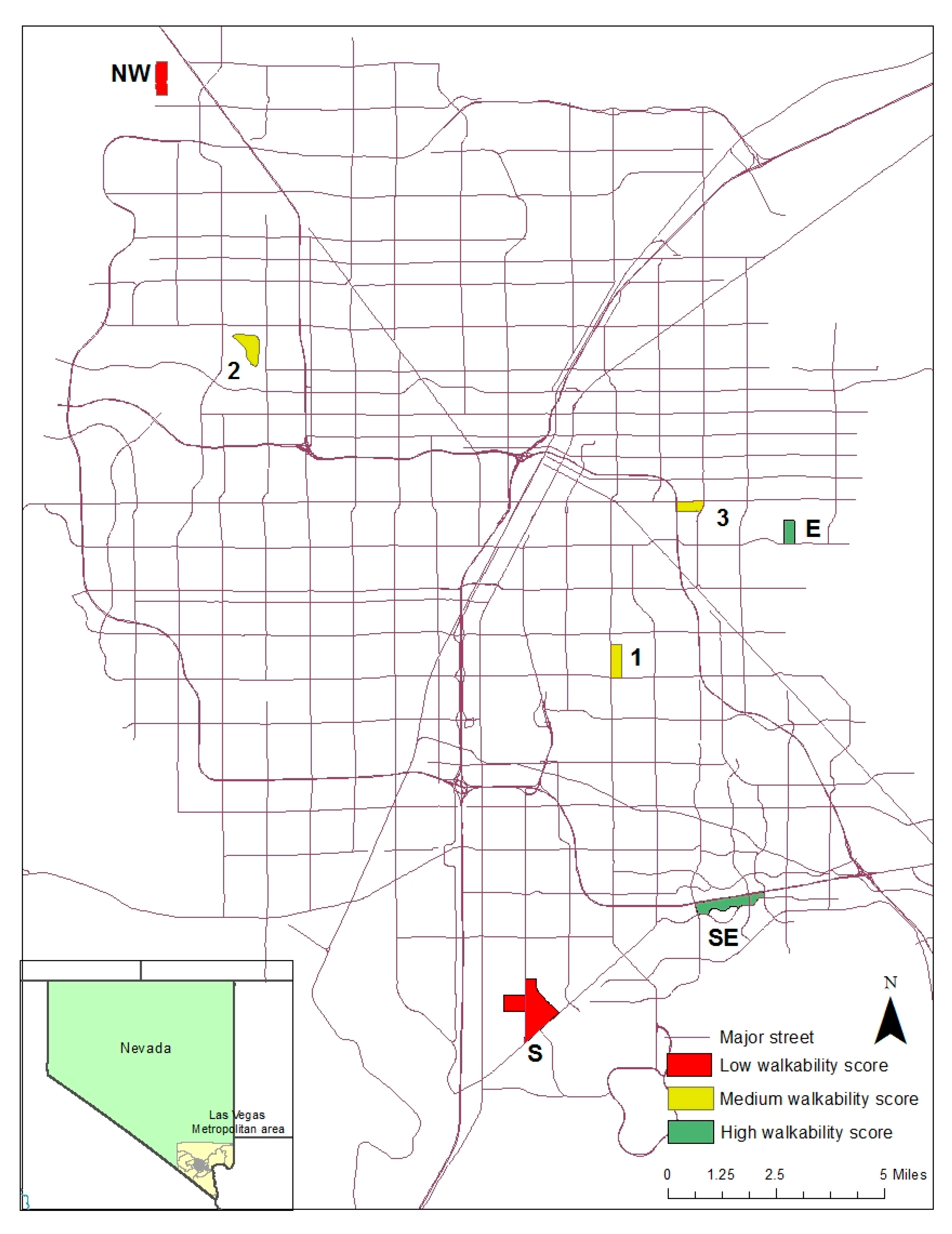
2.2. Neighborhood Selection
2.3. Walkability Index
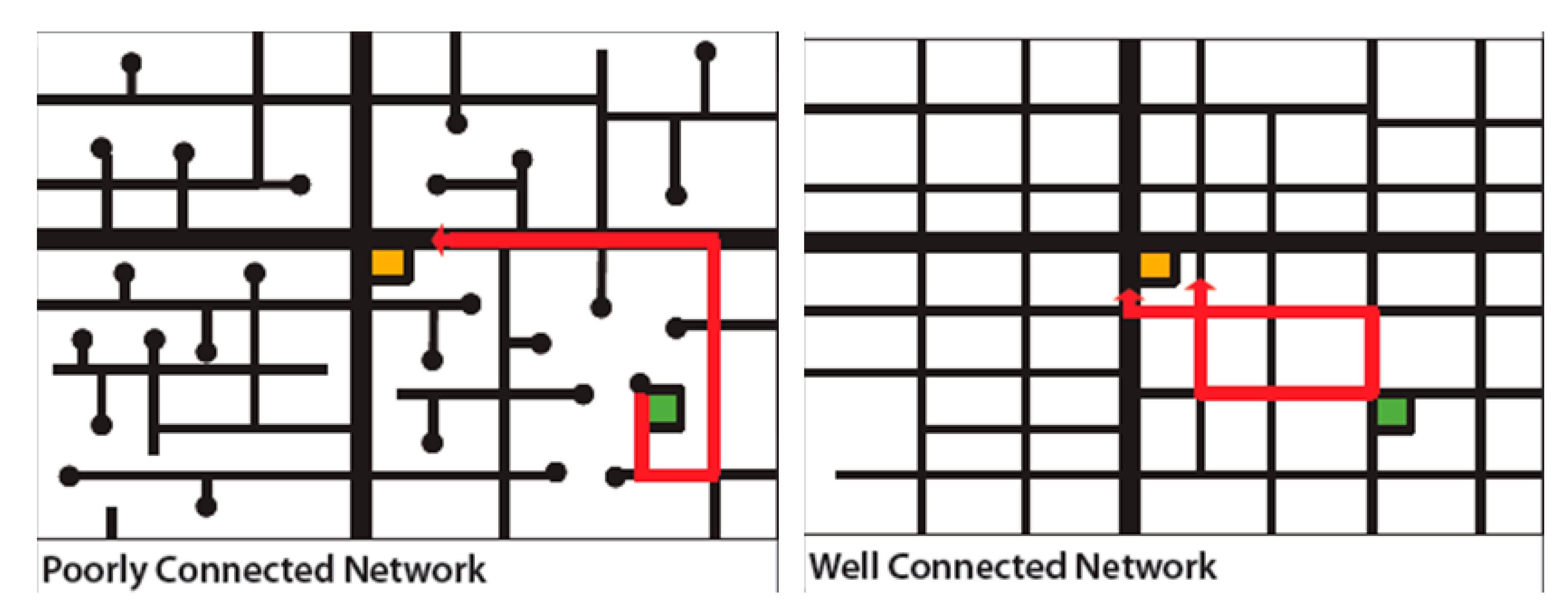
2.4. Sprawl Design Characteristics
2.5. Measures
2.6. Analysis
3. Results
3.1. Descriptive Analysis
3.2. Poisson Regression Model
4. Discussion
Limitations of This Study
5. Conclusions
Author Contributions
Funding
Acknowledgments
Conflicts of Interest
Appendix A

|
|
|
|
|
|
|
|
|
Appendix B
References
- Centers for Disease Control and Prevention (CDC). Behavioral Risk Factor Surveillance System Survey Data; CDC: Antlanta, GA, USA, 2014. [Google Scholar]
- Centers for Disease Control and Prevention. Physical Activity for Everyone; CDC: Antlanta, GA, USA, 2012. [Google Scholar]
- U.S. Department of Health and Human Services. Step it Up! the Surgeon General’s Call to Action to Promote Walking and Walkable Communities; U.S. Department of Health and Human Services: Washington, DC, USA, 2015.
- Frank, L.D.; Engelke, P.O.; Schmid, T.L. Health and Community Design. The Impact of the Built Environment of Physical Activity; Island Press: Washington, DC, USA, 2003. [Google Scholar]
- Castro, C.M.; King, A.C.; Brassington, G.S. Telephone Versus Mail Interventions for Maintenance of Physical Activity in Older Adults. Health Psychol. 2001, 20, 438. [Google Scholar] [CrossRef] [PubMed]
- Marcus, B.H.; Forsyth, L.H.; Stone, E.J.; Dubbert, P.M.; McKenzie, T.L.; Dunn, A.L.; Blair, S.N. Physical Activity Behavior Change: Issues in Adoption and Maintenance. Health Psychol. 2000, 19, 32. [Google Scholar] [CrossRef] [Scilit] [PubMed]
- Kubesch, N.J.; Therming Jørgensen, J.; Hoffmann, B.; Loft, S.; Nieuwenhuijsen, M.J.; Raaschou-Nielsen, O.; Pedersen, M.; Hertel, O.; Overvad, K.; Tjønneland, A. Effects of Leisure-Time and Transport-Related Physical Activities on the Risk of Incident and Recurrent Myocardial Infarction and Interaction with Traffic-Related Air Pollution: A Cohort Study. J. Am. Heart Assoc. 2018, 7, e009554. [Google Scholar] [CrossRef] [Scilit] [PubMed]
- Andersen, Z.J.; de Nazelle, A.; Mendez, M.A.; Garcia-Aymerich, J.; Hertel, O.; Tjonneland, A.; Overvad, K.; Raaschou-Nielsen, O.; Nieuwenhuijsen, M.J. A Study of the Combined Effects of Physical Activity and Air Pollution on Mortality in Elderly Urban Residents: The Danish Diet, Cancer, and Health Cohort. Environ. Health Perspect. 2015, 123, 557–563. [Google Scholar] [CrossRef] [Scilit] [PubMed]
- Carlson, J.A.; Saelens, B.E.; Kerr, J.; Schipperijn, J.; Conway, T.L.; Frank, L.D.; Chapman, J.E.; Glanz, K.; Cain, K.L.; Sallis, J.F. Association between Neighborhood Walkability and GPS-Measured Walking, Bicycling and Vehicle Time in Adolescents. Health Place 2015, 32, 1–7. [Google Scholar] [CrossRef] [Scilit] [PubMed]
- King, A.C.; Sallis, J.F.; Frank, L.D.; Saelens, B.E.; Cain, K.; Conway, T.L.; Chapman, J.E.; Ahn, D.K.; Kerr, J. Aging in Neighborhoods Differing in Walkability and Income: Associations with Physical Activity and Obesity in Older Adults. Soc. Sci. Med. 2011, 73, 1525–1533. [Google Scholar] [CrossRef] [Scilit] [PubMed]
- King, A.C.; Toobert, D.; Ahn, D.; Resnicow, K.; Coday, M.; Riebe, D.; Garber, C.E.; Hurtz, S.; Morton, J.; Sallis, J.F. Perceived Environments as Physical Activity Correlates and Moderators of Intervention in Five Studies. Am. J. Health Promot. 2006, 21, 24. [Google Scholar] [CrossRef] [Scilit]
- Frank, L.D.; Schmid, T.L.; Sallis, J.F.; Chapman, J.; Saelens, B.E. Linking Objectively Measured Physical Activity with Objectively Measured Urban Form: Findings from SMARTRAQ. Am. J. Prev. Med. 2005, 28, 117–125. [Google Scholar] [CrossRef] [Scilit]
- Saelens, B.; Sallis, J.; Black, J.; Chen, D. Neighborhood-Based Differences in Physical Activity: An Environment Scale Evaluation. Am. J. Public Health 2003, 93, 1552–1558. [Google Scholar] [CrossRef] [Scilit]
- Van Dyck, D.; Cardon, G.; Deforche, B.; Sallis, J.F.; Owen, N.; De Bourdeaudhuij, I. Neighborhood SES and Walkability are Related to Physical Activity Behavior in Belgian Adults. Prev. Med. 2010, 50, S74–S79. [Google Scholar] [CrossRef] [Scilit]
- Sallis, J.F.; Saelens, B.E.; Frank, L.D.; Conway, T.L.; Slymen, D.J.; Cain, K.L.; Chapman, J.E.; Kerr, J. Neighborhood Built Environment and Income: Examining Multiple Health Outcomes. Soc. Sci. Med. 2009, 68, 1285–1293. [Google Scholar] [CrossRef] [Scilit] [PubMed]
- Smith, K.R.; Brown, B.B.; Yamada, I.; Kowaleski-Jones, L.; Zick, C.D.; Fan, J.X. Walkability and Body Mass Index: Density, Design, and New Diversity Measures. Am. J. Prev. Med. 2008, 35, 237–244. [Google Scholar] [CrossRef] [Scilit] [PubMed]
- Frank, L.D.; Sallis, J.F.; Conway, T.L.; Chapman, J.E.; Saelens, B.E.; Bachman, W. Many Pathways from Land use to Health: Associations between Neighborhood Walkability and Active Transportation, Body Mass Index, and Air Quality. J. Am. Plan. Assoc. 2006, 72, 75–87. [Google Scholar] [CrossRef] [Scilit]
- Woodcock, J.; Edwards, P.; Tonne, C.; Armstrong, B.G.; Ashiru, O.; Banister, D.; Beevers, S.; Chalabi, Z.; Chowdhury, Z.; Cohen, A. Public Health Benefits of Strategies to Reduce Greenhouse-Gas Emissions: Urban Land Transport. Lancet 2009, 374, 1930–1943. [Google Scholar] [CrossRef] [Scilit]
- Grabow, M.L.; Spak, S.N.; Holloway, T.; Stone, B.; Mednick, A.C.; Patz, J.A. Air Quality and Exercise-Related Health Benefits from Reduced Car Travel in the Midwestern United States. Environ. Health Perspect. 2012, 120, 68–76. [Google Scholar] [CrossRef] [Scilit] [PubMed]
- Barrington-Leigh, C.; Millard-Ball, A. A Century of Sprawl in the United States. Proc. Natl. Acad. Sci. USA 2015, 112, 8244–8249. [Google Scholar] [CrossRef] [Scilit] [PubMed]
- Ewing, R.; Schmid, T.; Killingsworth, R.; Zlot, A.; Raudenbush, S. Relationship between Urban Sprawl and Physical Activity, Obesity, and Morbidity. Am. J. Health Promot. 2003, 18, 47–57. [Google Scholar] [CrossRef] [Scilit] [PubMed]
- Ewing, R.; Meakins, G.; Hamidi, S.; Nelson, A.C. Relationship between Urban Sprawl and Physical Activity, Obesity, and morbidity–update and Refinement. Health Place 2014, 26, 118–126. [Google Scholar] [CrossRef] [Scilit] [PubMed]
- Ewing, R.; Schieber, R.A.; Zegeer, C.V. Urban Sprawl as a Risk Factor in Motor Vehicle Occupant and Pedestrian Fatalities. Am. J. Public Health 2003, 93, 1541–1545. [Google Scholar] [CrossRef] [Scilit] [PubMed]
- Ewing, R.; Hamidi, S. Urban Sprawl as a Risk Factor in Motor Vehicle Occupant and Pedestrian Fatalities: Update and Refinement. Transp. Res. Record 2015, 2513, 40–47. [Google Scholar] [CrossRef] [Scilit]
- Bhatta, B. Causes and consequences of urban growth and sprawl. In Analysis of Urban Growth and Sprawl from Remote Sensing Data; Springer: Berlin, Germany, 2010; pp. 17–36. [Google Scholar]
- Retting, R.A.; Ferguson, S.A.; McCartt, A.T. A Review of Evidence-Based Traffic Engineering Measures Designed to Reduce Pedestrian-Motor Vehicle Crashes. Am. J. Public Health 2003, 93, 1456–1463. [Google Scholar] [CrossRef] [Scilit] [PubMed]
- McKenzie, E. Constructing the Pomerium in Las Vegas: A Case Study of Emerging Trends in American Gated Communities. Hous. Stud. 2005, 20, 187–203. [Google Scholar] [CrossRef] [Scilit]
- Coughenour, C.; Bungum, T.J. Single Entry Communities Increase Trip Distance and may Overestimate Neighborhood Walkability. J. Phys. Act. Health 2015, 12, S46–S52. [Google Scholar] [CrossRef] [Scilit] [PubMed]
- Brons, M.; Givoni, M.; Rietveld, P. Access to Railway Stations and its Potential in Increasing Rail use. Transp. Res. Part A 2009, 43, 136–149. [Google Scholar] [CrossRef] [Scilit]
- Villanueva, K.; Giles-Corti, B.; McCormack, G. Achieving 10,000 Steps: A Comparison of Public Transport Users and Drivers in a University Setting. Prev. Med. 2008, 47, 338–341. [Google Scholar] [CrossRef] [Scilit]
- Rissel, C.; Curac, N.; Greenaway, M.; Bauman, A. Physical Activity Associated with Public Transport use—A Review and Modelling of Potential Benefits. Int. J. Environ. Res. Public Health 2012, 9, 2454–2478. [Google Scholar] [CrossRef] [Scilit]
- Fulton, W.; Pendall, R.; Nguyen, M.; Harrison, A. Who Sprawls the Most? How Growth Patterns Differ Across the U.S.; The Brookings Institution, Center on Urban and Metropolitan Policy: Washington, DC, USA, 2001. [Google Scholar]
- City of Las Vegas. Meadows Walkable Community Plan; City of Las Vegas: Las Vegas, NV, USA, 2012. [Google Scholar]
- U.S. Census Bureau. Summary File 1. American FactFinder; U.S. Census Bureau: Suitland, MD, USA, 2010. [Google Scholar]
- U.S. Census Bureau. Table H-1. Income Limits for Each Fifth and Top 5 Percent. (Historical Income Tables: Households); U.S. Census Bureau: Suitland, MD, USA, 2011. [Google Scholar]
- Lovasi, G.S.; Neckerman, K.M.; Quinn, J.W.; Weiss, C.C.; Rundle, A. Effect of Individual or Neighborhood Disadvantage on the Association between Neighborhood Walkability and Body Mass Index. Am. J. Public Health 2009, 99, 279–284. [Google Scholar] [CrossRef] [Scilit]
- Murakami, E.; Young, J. Daily Travel by Persons with Low Income. 1997. Available online: https://rosap.ntl.bts.gov/view/dot/13239 (accessed on 15 November 2018).
- Frank, L.D.; Sallis, J.F.; Saelens, B.E.; Leary, L.; Cain, K.; Conway, T.L.; Hess, P.M. The Development of a Walkability Index: Application to the Neighborhood Quality of Life Study. Br. J. Sports Med. 2010, 44, 924–933. [Google Scholar] [CrossRef] [Scilit]
- Cerin, E.; Leslie, E.; Owen, N.; Bauman, A. Applying GIS in physical activity research: Communith ‘walkability’ and walking behaviors. In GIS for Health and the Environment. Lecture Notes in Geoinformation and Cartography; Lai, P.C., Mak, A.S.H., Eds.; Springer: Berlin/Heidelberg, Germany, 2007. [Google Scholar]
- Hagströmer, M.; Oja, P.; Sjöström, M. The International Physical Activity Questionnaire (IPAQ): A Study of Concurrent and Construct Validity. Public Health Nutr. 2006, 9, 755–762. [Google Scholar] [CrossRef] [Scilit]
- U.S. Census Bureau. American Housing Survey, National Tables; U.S. Census Bureau: Suitland, MD, USA, 2009. [Google Scholar]
- U.S. Census Bureau. Selected Social Characteristics; U.S. Census Bureau: Suitland, MD, USA, 2011. [Google Scholar]
- Bureau of Labor Statistics. Earnings and Unemployment Rates by Educational Attainment; Bureau of Labor Statistics: Washington, DC, USA, 2014.
- Leslie, E.; Saelens, B.; Frank, L.; Owen, N.; Bauman, A.; Coffee, N.; Hugo, G. Residents’ Perceptions of Walkability Attributes in Objectively Different Neighbourhoods: A Pilot Study. Health Place 2005, 11, 227–236. [Google Scholar] [CrossRef] [Scilit]
- Ewing, R.; Forinash, C.V.; Schroeer, W. Neighborhood Schools and Sidewalk Connections: What are the Impacts on Travel Mode Choice and Vehicle Emissions? TR News 2005, 237, 4–10. [Google Scholar]
- Cao, X.; Handy, S.L.; Mokhtarian, P.L. The Influences of the Built Environment and Residential Self-Selection on Pedestrian Behavior: Evidence from Austin, TX. Transportation 2006, 33, 1–20. [Google Scholar] [CrossRef] [Scilit]
- Besser, L.M.; Dannenberg, A.L. Walking to Public Transit: Steps to Help Meet Physical Activity Recommendations. Am. J. Prev. Med. 2005, 29, 273–280. [Google Scholar] [CrossRef] [Scilit] [PubMed]
- U.S. Census Bureau. Lot Size of New Single-Family Houses Sold Excluding Condominiums; U.S. Census Bureau: Suitland, MD, USA, 2010. [Google Scholar]
- Lang, R.E.; LeFurgy, J.B. Boomburbs: The Rise of America’s Accidental Cities; Brookings Institution Press: Washington, DC, USA, 2007. [Google Scholar]
- City of Las Vegas. Demographics; City of Las Vegas: Las Vegas, NV, USA, 2014. [Google Scholar]
- U.S. Census Bureau. State and County Quick Facts; U.S. Census Bureau: Suitland, MD, USA, 2010. [Google Scholar]
- Armstrong, J.S.; Overton, T.S. Estimating Nonresponse Bias in Mail Surveys. J. Market. Res. 1977, 14, 396–402. [Google Scholar] [CrossRef] [Scilit]
- Whitehead, J.C. Environmental Interest Group Behavior and self-selection Bias in Contingent Valuation Mail Surveys. Growth Chang. 1991, 22, 10–20. [Google Scholar] [CrossRef] [Scilit]
- de la Fuente Mella, H.; Navarro, M.; Riquelme, M. Analysis of Satisfaction of Students of the Faculty of Engineering of Universidad De Talca. Ingeniare 2014, 18, 350–363. [Google Scholar]
- McMurray, R.G.; Ward, D.S.; Elder, J.P.; Lytle, L.A.; Strikmiller, P.K.; Baggett, C.D.; Young, D.R. Do Overweight Girls Overreport Physical Activity? Am. J. Health Behav. 2008, 32, 538–546. [Google Scholar] [CrossRef] [Scilit]
- Sallis, J.F.; Saelens, B.E. Assessment of Physical Activity by Self-Report: Status, Limitations, and Future Directions. Res. Q. Exerc. Sport 2000, 71, 1–14. [Google Scholar] [CrossRef] [Scilit]
- Prince, S.A.; Adamo, K.B.; Hamel, M.E.; Hardt, J.; Gorber, S.C.; Tremblay, M. A Comparison of Direct Versus Self-Report Measures for Assessing Physical Activity in Adults: A Systematic Review. Int. J. Behav. Nutr. Phys. Act. 2008, 5, 56. [Google Scholar] [CrossRef] [Scilit]
| Component | Definition |
|---|---|
| Residential density | Number of residential units divided by land area in acres devoted to residential use. |
| Intersection density | Number of true intersections (3 or more segments) divided by the land area of the block group in acres. A higher ratio indicates greater connectivity. |
| Land-use mix | Diversity of land-use types in a block group. Land-use types include retail, residential, entertainment (parks, recreation facilities, theatres, restaurants), office, and institutional (schools, religious institutions, libraries/museums, community organizations, government facilities). Values were normalized between 0 and 1, with 0 being single use and 1 indicating a completely even distribution of land area. |
| Retail–floor-area ratio | Retail building area foot-print divided by retail land area foot-print. The higher the ratio is, the more indicative it is of pedestrian friendliness. |
| Residential Density | Intersection Density | Retail–floor Area Ratio | Entropy Score (Land-Use Mix) | |||||||
|---|---|---|---|---|---|---|---|---|---|---|
| Neighborhood | Raw Score | Z score | Raw Score | 2x Z score | Raw score | Z score | Raw Score | Z score | Walkability score | |
| NW | 9.33 | −0.1 | 0.13 | −3.02 | 0 | −1.37 | 0 | −1.14 | −5.64 | Low |
| S | 7.79 | −1.05 | 0.26 | 0.55 | 0 | −1.37 | 0 | −1.14 | −3.02 | Low |
| 1 | 9.91 | 0.25 | 0.20 | −1.10 | 0.311 | 0.54 | 0.699 | 0.86 | 0.56 | Medium |
| 2 | 7.38 | −1.3 | 0.29 | 1.37 | 0.43 | 1.28 | 0.147 | −0.72 | 0.63 | Medium |
| 3 | 9.45 | −0.03 | 0.22 | −0.55 | 0.28 | 0.37 | 0.812 | 1.19 | 0.98 | Medium |
| SE | 10.38 | 0.54 | 0.22 | −0.55 | 0.27 | 0.29 | 0.692 | 0.84 | 1.13 | High |
| E | 12.23 | 1.688 | 0.36 | 3.30 | 0.27 | 0.27 | 0.439 | 0.12 | 5.36 | High |
| NW (n = 35) | S (n = 31) | SE (n = 58) | E (n = 20) | Total (n = 144) | |
|---|---|---|---|---|---|
| Median household income * | $67,609 | $78,810 | $84,545 | $41,500 | |
| Race | |||||
| White | 60.0% | 58.1% | 79.3% | 50.0% | 66.0% |
| Non-white | 40.0% | 41.9% | 20.7% | 50.0% | 34.0% |
| Gender | |||||
| Female | 61.8% | 64.5% | 75.9% | 70.0% | 69.2% |
| Male | 38.2% | 35.5% | 24.1% | 30.0% | 30.8% |
| Education | |||||
| Less than college | 51.4% | 54.8% | 27.6% | 75. 0% | 45.8% |
| Four-year degree or greater | 48.6% | 25.8% | 72.4% | 25.0% | 54.2% |
| Age | |||||
| 18–29 years | 17.1% | 29.0% | 9.0% | 25.0% | 17.7% |
| 30–39 years | 25.7 % | 35.4% | 16.3% | 25.0% | 24.1% |
| 40–49 years | 42.9% | 22.6% | 32.7% | 35.0% | 33.3% |
| 50–59 years | 14.2% | 6.5% | 32.7% | 15.0% | 19.9% |
| 60–64 years | 0% | 6.5% | 9.0% | 0% | 5.0% |
| Lack of shade prevents walking for AT | 44.1% | 53.1% | 25.0% | 50.0% | 39.9% |
| Single-entry communities prevents walking for AT | 23.5% | 9.4% | 8.9% | 9.1% | 12.6% |
| Distance between crosswalks prevent walking for AT | 8.8% | 40.6% | 1.8% | 45.5% | 18.9% |
| High-speed streets prevent walking for AT | 26.5% | 43.8% | 14% | 22.7% | 25.0% |
| Large parking lots prevent walking for AT | 33.3% | 18.8% | 8.8% | 31.8% | 21.0% |
| Poor land-use mix prevent walking for AT | 38.2% | 81.3% | 12.5% | 40.9% | 39.2% |
| Poor street connectivity prevents walking for AT | 29.4% | 62.5% | 14.3% | 40.9% | 32.2% |
| Poor residential density prevents walking for AT | 5.9% | 28.1% | 1.8% | 22.7% | 11.9% |
| Convenient access to transit result in greater amounts of walking | 23.5% | 46.9% | 16.1% | 36.4% | 26.6% |
| Perceived Measures (Reverse Coded) | |
|---|---|
| Objectively measured retail–floor-area ratio | −0.521 ** |
| Objectively measured land-use mix | −0.561 ** |
| Objectively measured intersection density | 0.231 ** |
| Objectively measured residential density | −0.085 |
| Objectively measured number of single entry communities | 0.122 |
| Objectively measured percent shade cover | −0.299 ** |
| Objectively measured number of high speed streets (>35 mph) | −0.217 * |
| Objectively measured long distance between crosswalks (arterial roads with >0.25 miles to cross) | −0.246 ** |
| Objectively measured number of transit stops | 0.003 |
| (1) Variables | Coefficient | Std. Error | Z-Statistic | p-Value |
| Education (0 = less than four-year degree; 1 = four-year degree or greater) | −0.358 | 0.014 | −26.154 | <0.001 |
| Gender (0 = female; 1 = male) | 0.213 | 0.015 | 14.173 | <0.001 |
| Race (0 = white; 1 = non-white) | 0.373 | 0.015 | 24.872 | <0.001 |
| Age | 0.000 | 0.001 | 0.620 | 0.5351 |
| Street connectivity | −0.252 | 0.007 | −34.886 | <0.001 |
| Distance between crosswalks | −0.021 | 0.007 | −3.102 | 0.002 |
| Land-use mix | 0.085 | 0.004 | 21.108 | <0.001 |
| Residential density | 0.135 | 0.008 | 17.196 | <0.001 |
| Retail–floor-area ratio | −0.086 | 0.006 | −13.286 | <0.001 |
| Tree shade | 0.237 | 0.004 | 55.781 | <0.001 |
| Single-entry community | −0.080 | 0.006 | −13.309 | <0.001 |
| High-speed streets | −0.033 | 0.007 | −4.838 | <0.001 |
| Convenient access to transit * | 0.164 | 0.005 | 36.890 | <0.001 |
| 1) p-value = 0.002; pseudo R-squared: 0.113; Akaike: 301.851; Schwarz: 302.149; Hannan–Quinn: 301.972 | ||||
| (2) Variables | Coefficient | Std. Error | z-Statistic | p-Value |
| Education (0 = less than four-year degree; 1 = four-year degree or greater) | −0.357 | 0.013 | −27.026 | <0.001 |
| Gender (0 = female; 1 = male) | 0.296 | 0.014 | 20.532 | <0.001 |
| Race (0 = white; 1 = non-white) | 0.562 | 0.014 | 40.736 | <0.001 |
| Age | 0.002 | 0.001 | 2.270 | 0.023 |
| Street connectivity | −0.179 | 0.007 | −26.754 | <0.001 |
| Land-use mix | 0.141 | 0.004 | 37.335 | <0.001 |
| Residential density | 0.052 | 0.007 | 7.061 | <0.001 |
| Retail–floor-area ratio | −0.005 | 0.006 | −0.764 | 0.445 |
| 2) p-value = 0.023; Pseudo R-squared: 0.054; Akaike: 336.137; Schwarz: 336.329; Hannan–Quinn: 336.215. * Reverse coded. | ||||
© 2019 by the authors. Licensee MDPI, Basel, Switzerland. This article is an open access article distributed under the terms and conditions of the Creative Commons Attribution (CC BY) license (http://creativecommons.org/licenses/by/4.0/).
Share and Cite
Coughenour, C.; de la Fuente-Mella, H.; Paz, A. Analysis of Self-Reported Walking for Transit in a Sprawling Urban Metropolitan Area in the Western U.S. Sustainability 2019, 11, 852. https://doi.org/10.3390/su11030852
Coughenour C, de la Fuente-Mella H, Paz A. Analysis of Self-Reported Walking for Transit in a Sprawling Urban Metropolitan Area in the Western U.S. Sustainability. 2019; 11(3):852. https://doi.org/10.3390/su11030852
Chicago/Turabian StyleCoughenour, Courtney, Hanns de la Fuente-Mella, and Alexander Paz. 2019. "Analysis of Self-Reported Walking for Transit in a Sprawling Urban Metropolitan Area in the Western U.S." Sustainability 11, no. 3: 852. https://doi.org/10.3390/su11030852
APA StyleCoughenour, C., de la Fuente-Mella, H., & Paz, A. (2019). Analysis of Self-Reported Walking for Transit in a Sprawling Urban Metropolitan Area in the Western U.S. Sustainability, 11(3), 852. https://doi.org/10.3390/su11030852

