

Willingness to Pay for Eco-Labeled Food in Forests: Integrated View from South Korea




Abstract
1. Introduction
2. Literature Review and Hypothesis Development
2.1. Regulation on Certification for ELF
2.2. Certification on Agriculture
2.3. Certification on ELF in Forestry
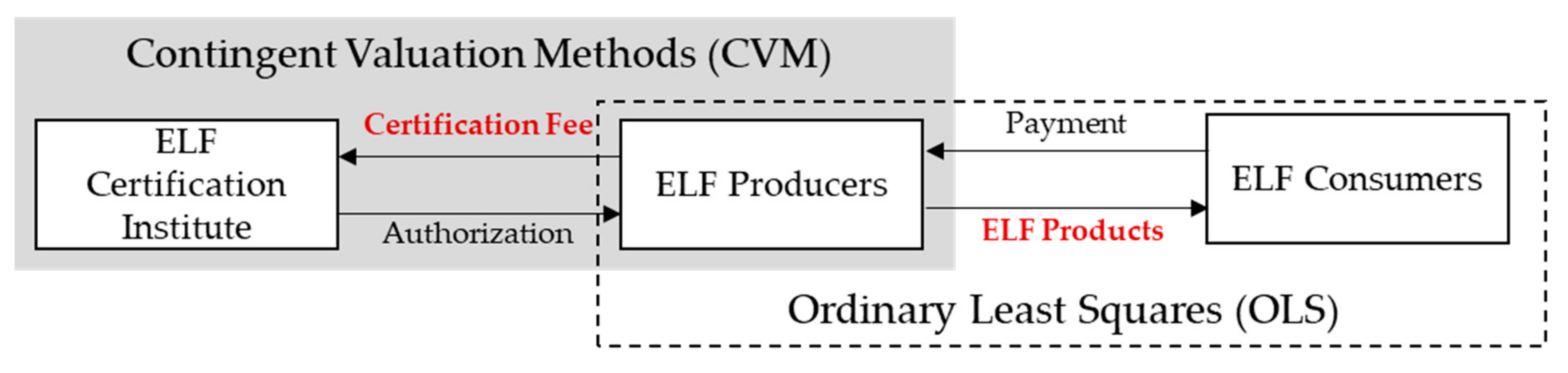
2.3.1. Supply Side: WTP
2.3.2. Demand Side: Satisfaction
3. Methodology
3.1. Samples
3.2. Contingent Valuation Method
3.3. Ordinary Least Square (OLS) Regression
3.4. Variables
4. Results
4.1. Descriptive Statistics
4.2. Double-Bounded Dichotomous Choice: Turnbull
4.3. OLS Regression
5. Conclusions and Discussion
5.1. Implications
5.2. Managerial Implications
5.3. Limitations
Author Contributions
Funding
Acknowledgments
Conflicts of Interest
References
- Loureiro, M.L.; McCluskey, J.J.; Mittelhammer, R.C. Will consumers pay a premium for eco-labeled apples? J. Consum. Aff. 2002, 36, 203–219. [Google Scholar] [CrossRef] [Scilit]
- Grankvist, G.; Biel, A. The importance of beliefs and purchase criteria in the choice of eco-labeled food products. J. Environ. Psychol. 2001, 21, 405–410. [Google Scholar] [CrossRef] [Scilit]
- Liu, Q.; Yan, Z.; Zhou, J. Consumer choices and motives for eco-labeled products in china: An empirical analysis based on the choice experiment. Sustainability 2017, 9, 331. [Google Scholar] [CrossRef] [Scilit]
- Shanley, P.; Pierce, A.; Laird, S.; Robinson, D. Beyond Timber: Certification and Management of Non-Timber Forest Products; Center for International Forestry Research (CIFOR): Bogor Barat, Indonesia, 2008. [Google Scholar]
- Duchelle, A.E.; Kainer, K.A.; Wadt, L.H. Is certification associated with better forest management and socioeconomic benefits? A comparative analysis of three certification schemes applied to brazil nuts in western amazonia. Soc. Nat. Resour. 2014, 27, 121–139. [Google Scholar] [CrossRef] [Scilit]
- Guedes Pinto, L.; Shanley, P.; Cota Gomes, A.; Robinson, D. Experience with ntfp certification in brazil. For. Trees Livelihoods 2008, 18, 37–54. [Google Scholar] [CrossRef] [Scilit]
- Jo, J.-H.; Roh, T.; Shin, S.; Youn, Y.-C. Sustainable assets and strategies affecting the forestry household income: Empirical evidence from south korea. Sustainability 2019, 11, 3680. [Google Scholar] [CrossRef] [Scilit]
- Shukri, M.; Awang Noor, A. Malaysian consumers preference and willingness to pay for environmentally certified wooden household furniture. Pertanika J. Trop. Agric. Sci. 2012, 35, 603–611. [Google Scholar]
- Grieg-Gran, M.; Porras, I.; Wunder, S. How can market mechanisms for forest environmental services help the poor? Preliminary lessons from latin america. World Dev. 2005, 33, 1511–1527. [Google Scholar] [CrossRef] [Scilit]
- Janssen, M.; Hamm, U. Product labelling in the market for organic food: Consumer preferences and willingness-to-pay for different organic certification logos. Food Qual. Prefer. 2012, 25, 9–22. [Google Scholar] [CrossRef] [Scilit]
- Kilchling, P.; Hansmann, R.; Seeland, K. Demand for non-timber forest products: Surveys of urban consumers and sellers in switzerland. For. Policy Econ. 2009, 11, 294–300. [Google Scholar] [CrossRef] [Scilit]
- Wilsey, D.S.; Radachowsky, J. Keeping ntfps in the forest: Can certification provide an alternative to intensive cultivation? Ethnobot. Res. Appl. 2007, 5, 45–58. [Google Scholar] [CrossRef] [Scilit]
- Schmitt, J.; Pokorny, B.; Ying, L. Certification of non-timber forest products in china: Effects on food quality, forest conservation and rural development. For. Trees Livelihoods 2008, 18, 81–89. [Google Scholar] [CrossRef] [Scilit]
- Yoon, Y.; Lee, H.; Lee, S.; Gwak, E.; Lee, J.; Ha, J.; Pyun, J. Good Agricultural Practices (Gap) for Agricultural Food Safety Management; KDI School of Public Policy and Management: Sejong, Korea, 2014. [Google Scholar]
- Kim, K.-D.; Lee, J.-Y.; Sok, N.-K. Purchase behavior of environment-friendly agricultural products by housewives in seoul area. J. Korean Soc. Food Sci. Nutr. 2008, 37, 1667–1673. [Google Scholar] [CrossRef] [Scilit]
- Nam, S.-M.; Noh, J.-K. A study on the uncertainty response behavior of the consumer in the purchase of the environment-friendly agricultural products. J. Mark. Stud. 2010, 18, 51–65. [Google Scholar]
- Lee, K.-I.; Kim, S.-H.; Heo, S.-Y.; Lim, S.-J.; Kim, J.-M.; Park, I.-H. The Consumer Behavior Survey for Food 2016; Korea Rural Economic Institute: Naju, Korea, 2016. [Google Scholar]
- Choi, M.K.; Seo, H.C.; Baek, S.H. The influence of environment-friendly agricultural products (eaps) perception of parents in chung-buk area on eaps consumption behavior. Korean J. Food Nutr. 2010, 23, 269–275. [Google Scholar]
- Lee, H.Y.; Lee, A.J.; Kim, H.S. Effect of awareness of organic foods and corporate image on purchase intention. J. Foodserv. Manag. 2011, 14, 119–137. [Google Scholar]
- Kim, C.-G.; Jeong, H.-K.; Lim, Y.-A.; Lee, H.-J.; Kim, Y.-G. Fostering Environment-Friendly Agriculture and Strengthening Management of Agri-Environmental Resources; Korea Rural Economic Institute: Naju, Korea, 2016. [Google Scholar]
- Kim, W.-S. Current status on the certification system of processed organic foods in korea and foreign countries. Food Sci. Ind. 2006, 39, 20–34. [Google Scholar]
- Shin, Y.; Hwang, Y. Directions for improving certification system of environmentally-friendly agricultural products. Korea J. Agric. Manag. Policy 2008, 35, 871–888. [Google Scholar]
- FAO. A Scheme and Training Manual on Good Agricultural Practices (Gap) for Fruits and Vegetables; FAO (Food and Agriculture Ogranization of the United Nations): Bangkok, Thailand, 2016. [Google Scholar]
- Hatanaka, M.; Bain, C.; Busch, L. Third-party certification in the global agrifood system. Food Policy 2005, 30, 354–369. [Google Scholar] [CrossRef] [Scilit]
- EAPC. Introduction of Certification System Mark; EAPC (Environmentfriendly Agricultural Products Certification): Seoul, Korea, 2018. [Google Scholar]
- KOPFI. Revitalizing the Management and Consumption of Clean Forest Products; KOPFI (Korea Forestry Promotion Institue): Seoul, Korea, 2019. [Google Scholar]
- Laird, S.A.; McLain, R.J.; Wynberg, R. Wild Product Governance: Finding Policies That Work for Non-Timber Forest Products; Earthscan: London, UK, 2010. [Google Scholar]
- Wilsey, D.S.; Hildebrand, P.E. Chamaedorea palm frond commercialization and certification considered from a smallholder livelihood system perspective. Small-Scale For. 2011, 10, 67–81. [Google Scholar] [CrossRef] [Scilit]
- Pierce, A.R.; Shanley, P.; Laird, S. Non-timber forest products and certification: Strange bedfellows. For. Trees Livelihoods 2008, 18, 23–35. [Google Scholar] [CrossRef] [Scilit]
- Jo, J.-H.; Roh, T. Analysis of stakeholder value chain for export activation of forest products: Focused on forest-product export specialized area. Reg. Ind. Rev. 2017, 40, 65–85. [Google Scholar]
- Mitchell, D.A.; Tedder, S.; Brigham, T.; Cocksedge, W.; Hobby, T. Policy gaps and invisible elbows: Ntfps in british columbia. In Wild Product Governance: Finding Policies That Work for Non-Timber Forest Products; Laird, S.A., McLain, R.J., Wynberg, R., Eds.; Earthscan: Washington, DC, USA, 2010. [Google Scholar]
- Prothero, A.; Dobscha, S.; Freund, J.; Kilbourne, W.E.; Luchs, M.G.; Ozanne, L.K.; Thøgersen, J. Sustainable consumption: Opportunities for consumer research and public policy. J. Public Policy Mark. 2011, 30, 31–38. [Google Scholar] [CrossRef] [Scilit]
- Krishnakumar, J.; Yanagida, J.F.; Anitha, V.; Balakrishnan, R.; Radovich, T.J. Non-timber forest products certification and management: A socioeconomic study among the kadars in kerala, india. Environ. Dev. Sustain. 2015, 17, 837–858. [Google Scholar] [CrossRef] [Scilit]
- Yadav, M.; Dugaya, D. Non-timber forest products certification in india: Opportunities and challenges. Environ. Dev. Sustain. 2013, 15, 567–586. [Google Scholar] [CrossRef] [Scilit]
- Heo, J.-N.; Kim, T.-G.; Byun, S.-H. Measuring consumers’ value of quality-certificated peaches using logit and turnbull models. Korea J. Agric. Manag. Policy 2000, 27, 91–102. [Google Scholar]
- Kwon, O.S. Estimating the willingness to pay for the non-gmo agricultural products. Korean J. Agric. Econ. 2003, 44, 111–131. [Google Scholar]
- Lee, Y.-J.; Kim, M.; Kim, E.-H. A study on the environmentally-friendly farm produce consumer behaviour on general characteristics. Food Serv. Ind. J. 2009, 5, 103–126. [Google Scholar]
- Haab, T.C.; McConnell, K.E. Referendum models and negative willingness to pay: Alternative solutions. J. Environ. Econ. Manag. 1997, 32, 251–270. [Google Scholar] [CrossRef] [Scilit]
- Han, S.Y. Estimating the stock value of woraksan national park using turnbull distribution-free model. J. Korean Soc. For. Sci. 2007, 96, 283–289. [Google Scholar]
- Han, S.-Y.; Lee, M.-H.; Yoo, R.-H.; Kim, J.-J. Estimating the stock value of sobaeksan national park: Application of turnbull distribution-free model. J. Korean Inst. For. Recreat. 2007, 11, 37–45. [Google Scholar]
- Kim, J.-H. An estimation of citizen’s willingness-to-pay for the quality improvement of tap water in the ulsan metropolitan area using cvm with a double-bounded choice model. Korean J. Local Gov. Stud. 2006, 10, 31–47. [Google Scholar]

| Field | Agriculture | Forestry | Source | |||
| Type | Organic | Non-Pesticide | Non-Antibiotic | Organic Processed | Organic | EAPC [25] KOPFI [26] |
| Certified Mark |  |  |  |  |  | |
| Panel A: Supplier | |||
| Variable | Category | Frequency (N) | Percentage (%) |
| Gender | Male | 36 | 90 |
| Female | 4 | 10 | |
| Age | 20s | 1 | 2.5 |
| 30s | 1 | 2.5 | |
| 40s | 7 | 17.5 | |
| 50s | 13 | 32.5 | |
| 60s | 18 | 45 | |
| Region | Gyunggi Province | 3 | 7.5 |
| Gangwon Province | 13 | 32.5 | |
| South Chungcheong Province | 5 | 12.5 | |
| North Chungcheong Province | 7 | 17.5 | |
| South Jeolla Province | 2 | 5 | |
| North Jeolla Province | 2 | 5 | |
| South Kyungsang Province | 4 | 10 | |
| North Kyungsang Province | 4 | 10 | |
| Total | 40 | 100 | |
| Panel B: Consumer | |||
| Variable | Category | Frequency (N) | Percentage (%) |
| Gender | Female | 67 | 59.82 |
| Male | 45 | 40.18 | |
| Age | 20s | 25 | 22.32 |
| 30s | 21 | 18.75 | |
| 40s | 19 | 16.96 | |
| 50s | 24 | 21.43 | |
| > 60s | 23 | 20.54 | |
| Number of family | 1 | 33 | 29.46 |
| 2 | 25 | 22.32 | |
| 3 | 29 | 25.89 | |
| 4 | 23 | 20.54 | |
| > 5 | 2 | 1.79 | |
| Infants in family | No | 55 | 49.11 |
| Yes | 57 | 50.89 | |
| Full-time mother in family | No | 102 | 91.07 |
| Yes | 10 | 8.93 | |
| Total | 112 | 100 | |
| First bid | Frequency (No) | Frequency (Yes) | Expected Value |
|---|---|---|---|
| 150,000 | 15 | 3 | 25,000 |
| 300,000 | 5 | 17 | 231,818 |
| 600,000 | 11 | 6 | 211,764 |
| 156,194 |
| Bid range | Frequency | PDF (%) | CDF (%) | Expected Value |
|---|---|---|---|---|
| 0 | 13 | 32.5 | 32.5 | 0 |
| 50,000 | 3 | 7.5 | 40 | 150,000 |
| 100,000 | 3 | 7.5 | 47.5 | 300,000 |
| 150,000 | 5 | 12.5 | 60 | 750,000 |
| 200,000 | 7 | 17.5 | 77.5 | 1,400,000 |
| 300,000 | 7 | 17.5 | 95 | 2,100,000 |
| 350,000 | 2 | 5 | 100 | 700,000 |
| 135,000 |
| Bid | Lower Bounded Range | Turnbull CDF | Turnbull PDF | Expected Value |
|---|---|---|---|---|
| 0 | 0–150,000 | 0 | 0 | 0 |
| 150,000 | 150,000–300,000 | 0.833 | 0.833 | 124,950 |
| 300,000 | 300,000–600,000 | 1 | 0.227 | 68,100 |
| 193,050 |
| 1 | 2 | 3 | 4 | |
|---|---|---|---|---|
| 1 PELFF | 1.00 | |||
| 2 AELFF | 0.01* | 1.00 | ||
| 3 AELFA | 0.21* | 0.09* | 1.00 | |
| 4 SELFA | 0.22* | 0.06* | 0.06* | 1.00 |
| Variables | Model 1 | Model 2 | ||
|---|---|---|---|---|
| Coefficient | t-Value | Coefficient | t-Value | |
| AELFA | 0.26* | (1.97) | ||
| SELFA | 0.19* | (2.02) | ||
| AELFF | 0.01 | (0.08) | −0.02 | (−0.11) |
| Age: 30s | 0.28 | (0.60) | 0.43 | (0.93) |
| Age: 40s | 0.16 | (0.33) | 0.19 | (0.40) |
| Age: 50s | −0.51 | (−1.09) | −0.34 | (−0.73) |
| Age: > 60s | −0.08 | (−0.17) | −0.13 | (−0.29) |
| Gender: Female | 0.04 | (0.11) | 0.09 | (0.29) |
| Family number: 2 | 0.33 | (0.79) | 0.43 | (1.04) |
| Family number: 3 | 0.15 | (0.35) | -0.00 | (−0.01) |
| Family number: 4 | −0.23 | (−0.53) | −0.15 | (−0.36) |
| Family number: >5 | 1.74 | (1.49) | 1.61 | (1.39) |
| Infants in family: No | 0.22 | (0.70) | 0.13 | (0.40) |
| Full-time mother in family: No | 0.10 | (0.19) | 0.06 | (0.11) |
| Constant | 4.40*** | (7.45) | 2.19* | (2.23) |
| Observations | 112 | 112 | ||
| R2 | 0.079 | 0.152 | ||
| adj-R2 | 0.032 | 0.033 | ||
| Log-likelihood | −201.98 | −197.36 | ||
| F | 0.71* | 1.24* | ||
© 2019 by the authors. Licensee MDPI, Basel, Switzerland. This article is an open access article distributed under the terms and conditions of the Creative Commons Attribution (CC BY) license (http://creativecommons.org/licenses/by/4.0/).
Share and Cite
Jo, J.-H.; Yang, J.Y.; Roh, T. Willingness to Pay for Eco-Labeled Food in Forests: Integrated View from South Korea. Sustainability 2019, 11, 6534. https://doi.org/10.3390/su11236534
Jo J-H, Yang JY, Roh T. Willingness to Pay for Eco-Labeled Food in Forests: Integrated View from South Korea. Sustainability. 2019; 11(23):6534. https://doi.org/10.3390/su11236534
Chicago/Turabian StyleJo, Jang-Hwan, Ji Yeon Yang, and Taewoo Roh. 2019. "Willingness to Pay for Eco-Labeled Food in Forests: Integrated View from South Korea" Sustainability 11, no. 23: 6534. https://doi.org/10.3390/su11236534
APA StyleJo, J.-H., Yang, J. Y., & Roh, T. (2019). Willingness to Pay for Eco-Labeled Food in Forests: Integrated View from South Korea. Sustainability, 11(23), 6534. https://doi.org/10.3390/su11236534

