Constructing an Evaluation Model for User Experience in an Unmanned Store



Abstract
1. Introduction
- Methods for decomposing and introducing activity theory via user experience;
- Reconstructing the journey of the user experience, and collecting and organizing the insufficiencies of the experience;
- Quantifying and analyzing user experience evaluation factors.
2. Literature Review
2.1. The Meaning of an Experience
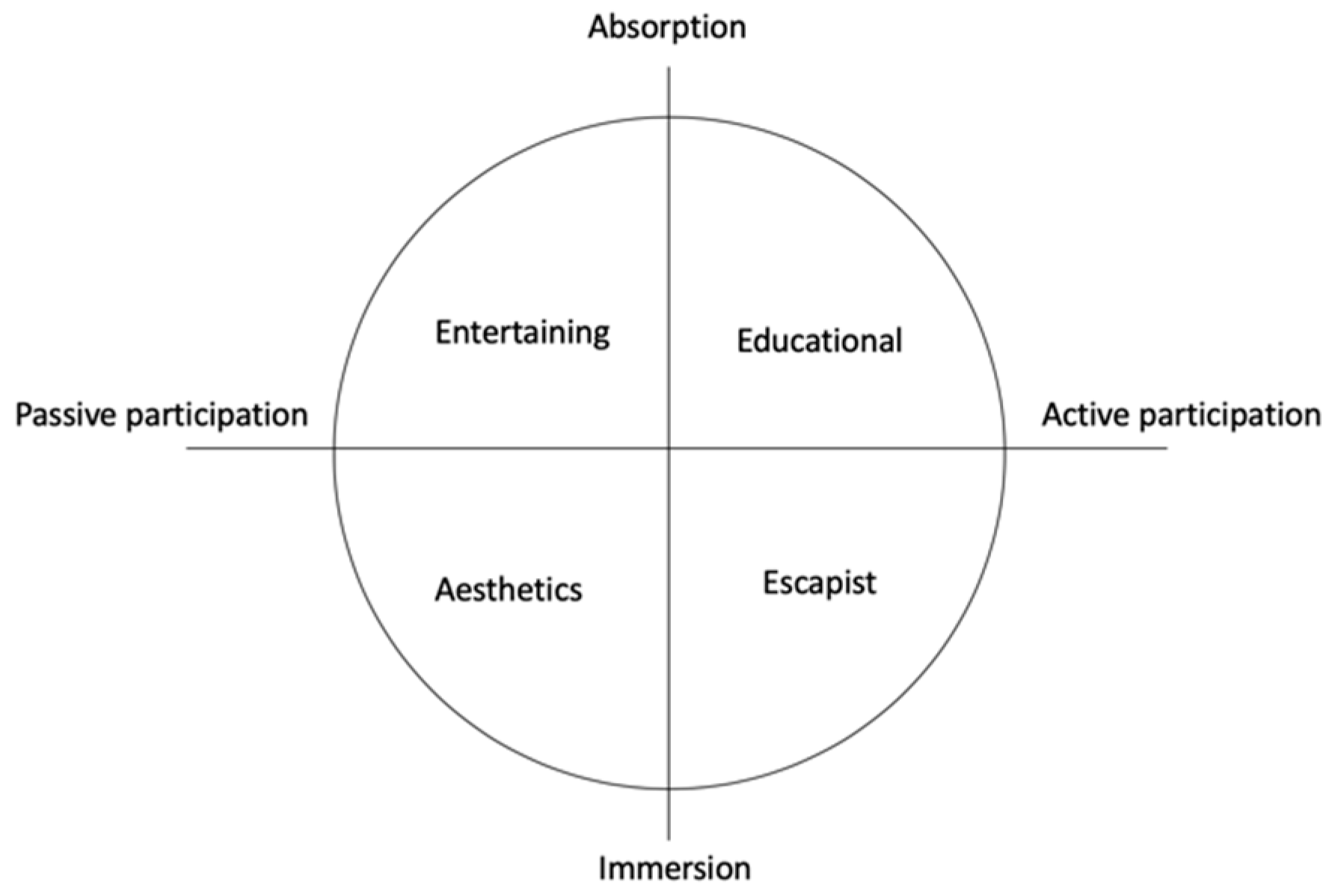
2.1.1. Experience Economy: Four Types of Experience and Four Economic Patterns
2.1.2. User-Centered Design Concept
2.1.3. Experience Marketing: Five Experience Modules
2.1.4. Qualia Experience: Value-Added Experience
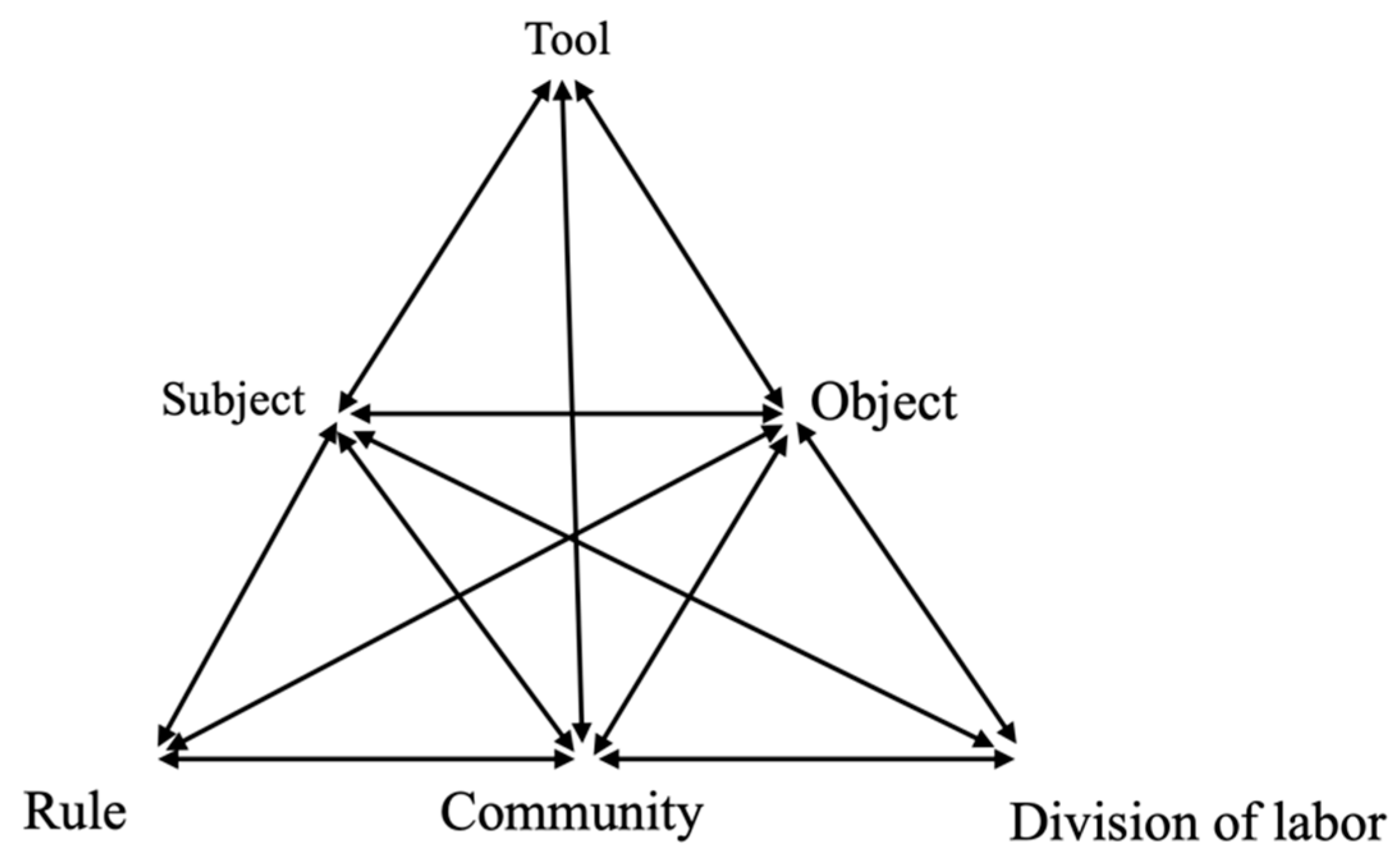
2.2. Activity Theory
3. Research Methodology and Process
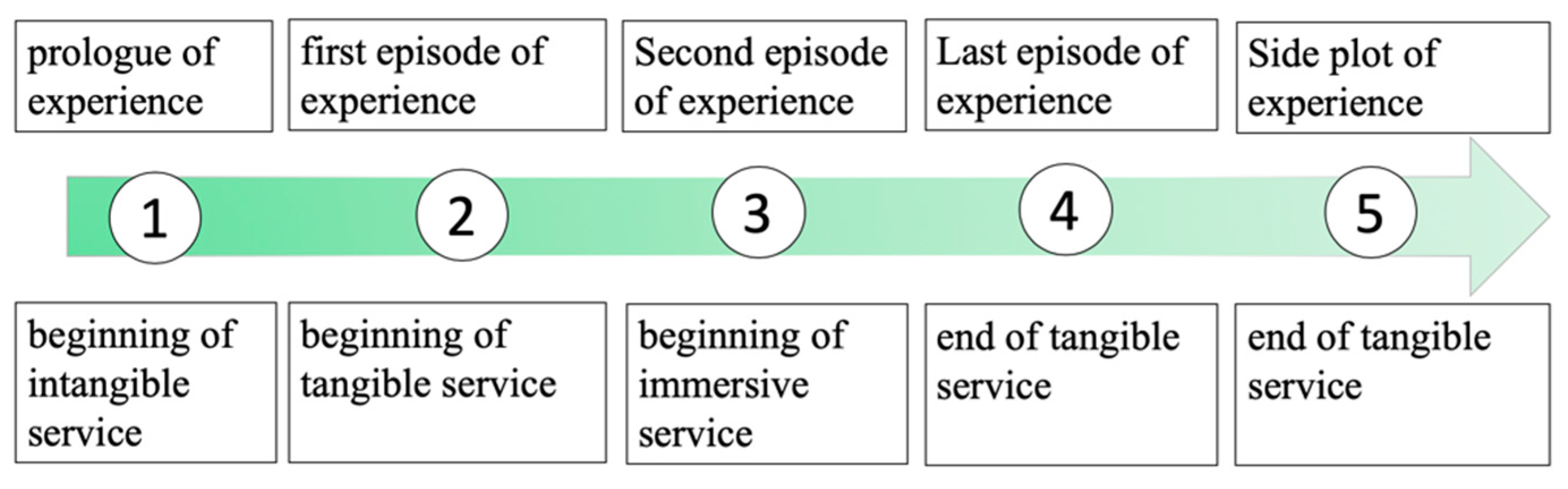
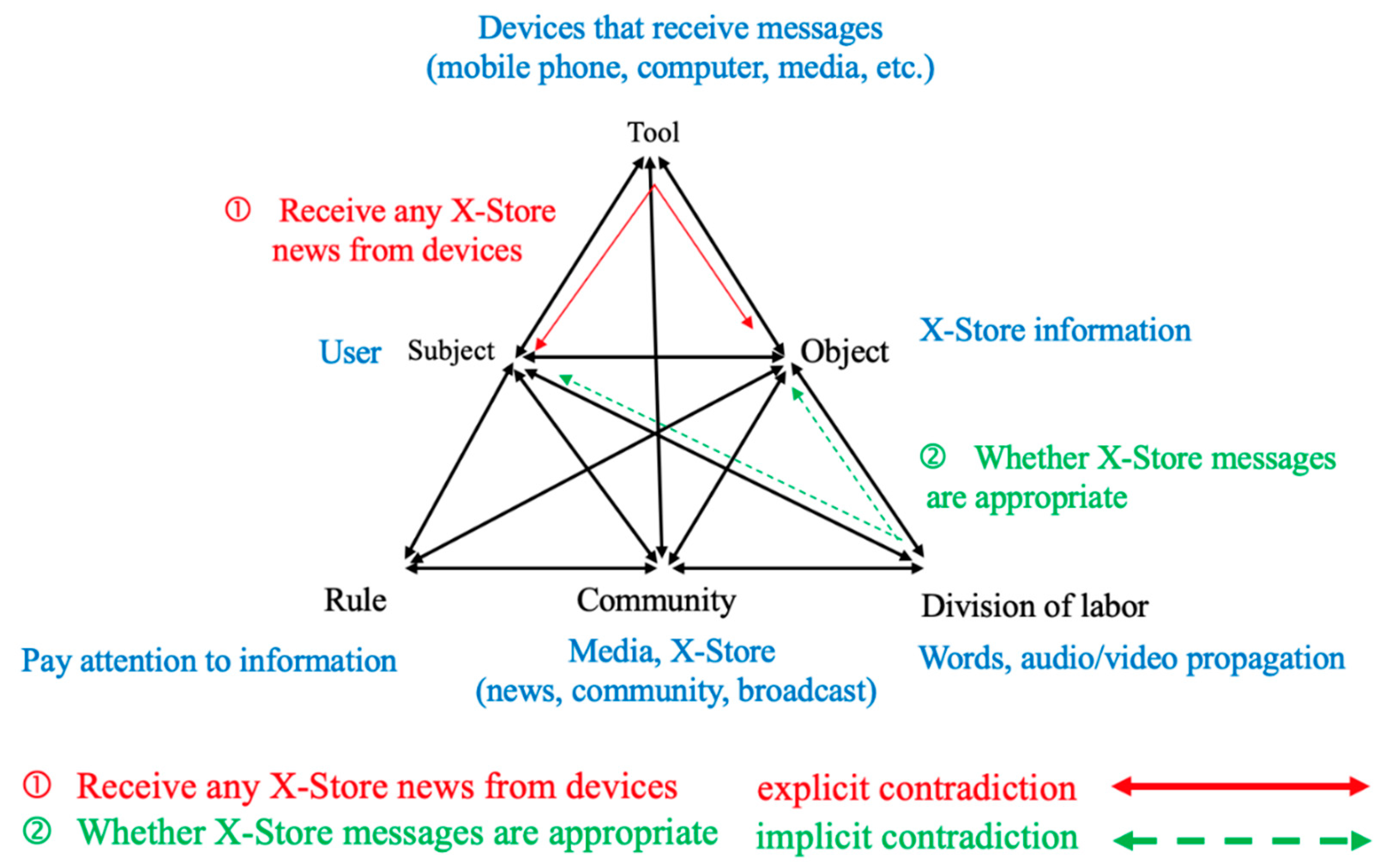
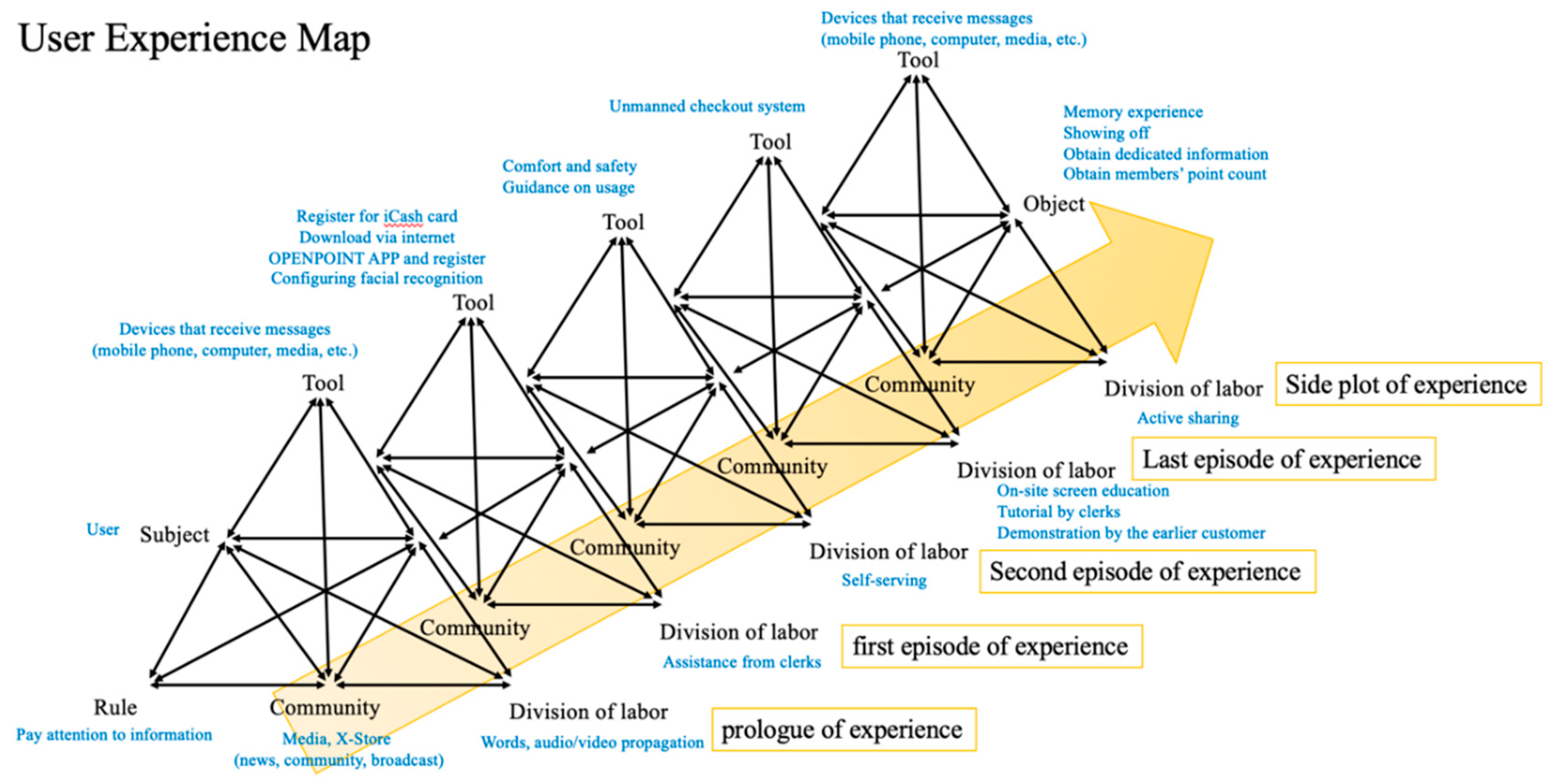
3.1. Five Segments of User Experience Journey
- Interaction tool: Devices that receive the information (e.g., smartphone, computer, radio)
- Object: Obtaining the information of the new pattern of unmanned stores
- Rule: Paying attention to news
- Stakeholder: Media, X-Store
- Division of labor: words, audio/video broadcasts
- Explicit contradiction: Receiving X-Store news from devices
- Implicit contradiction: Whether the X-Store news is appropriate
3.2. First Episode of Experience: Beginning of the Tangible Service
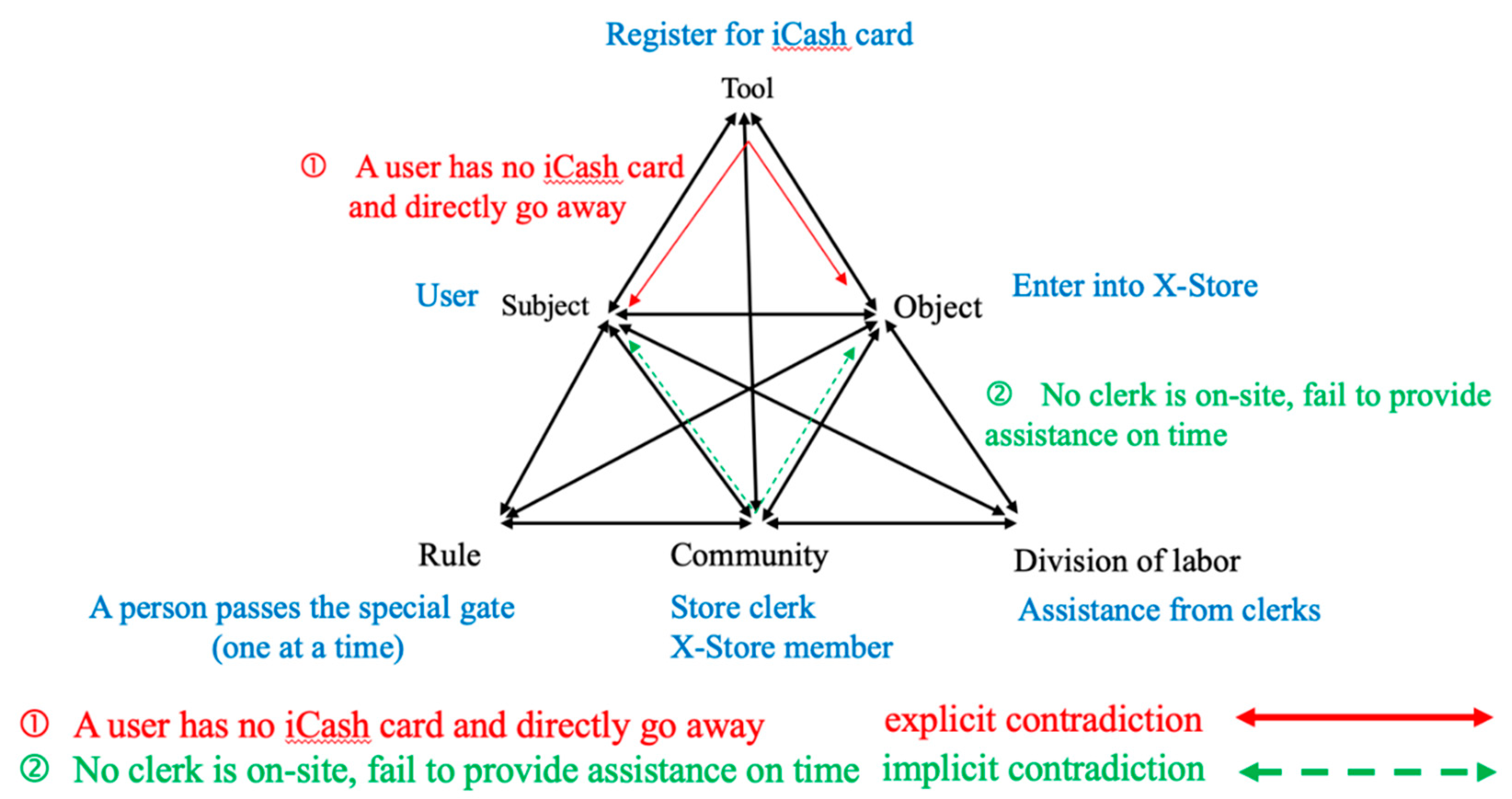
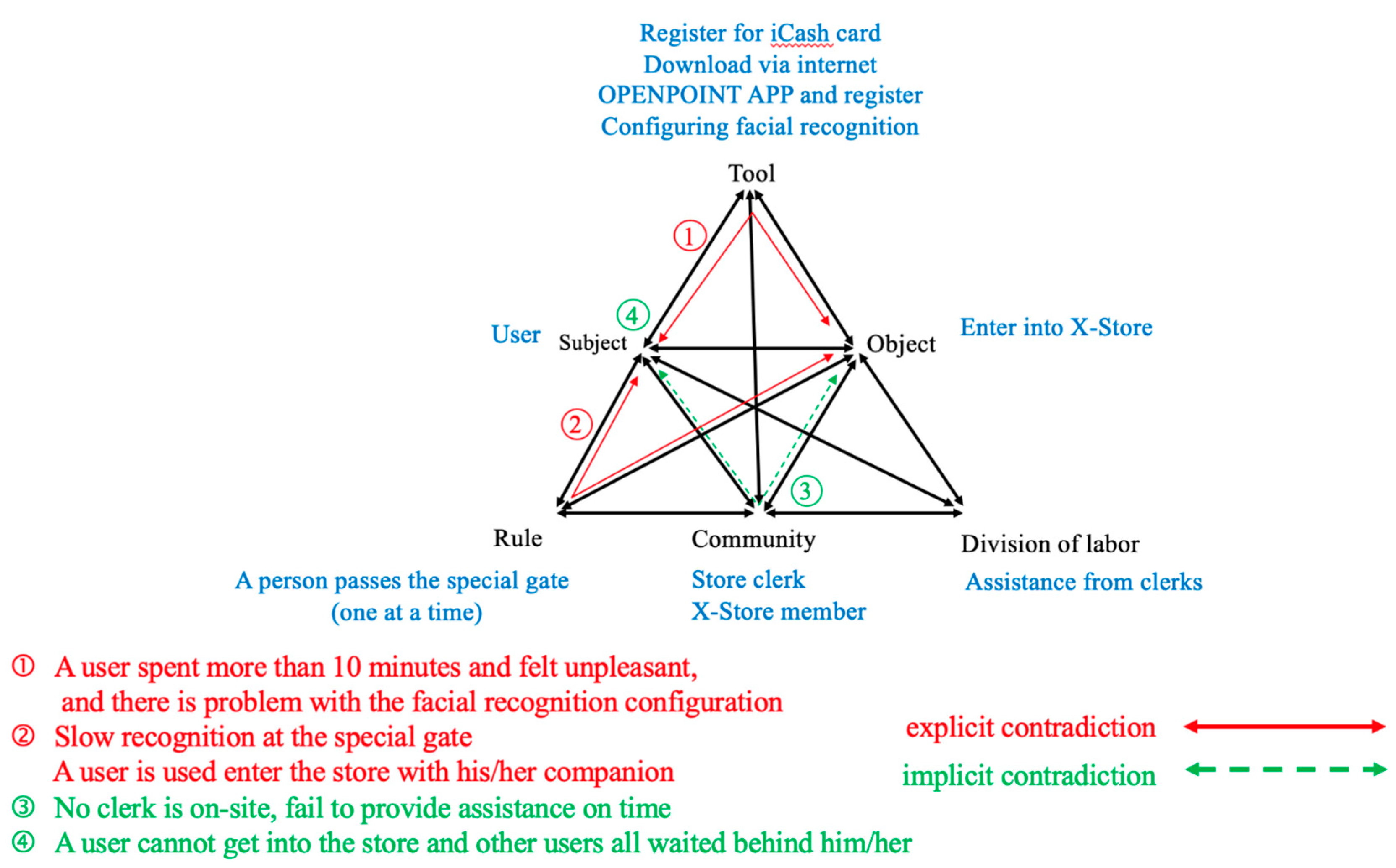
- Interaction tool:
- iCase 2.0 card
- Downloading OPENPOINT app and register
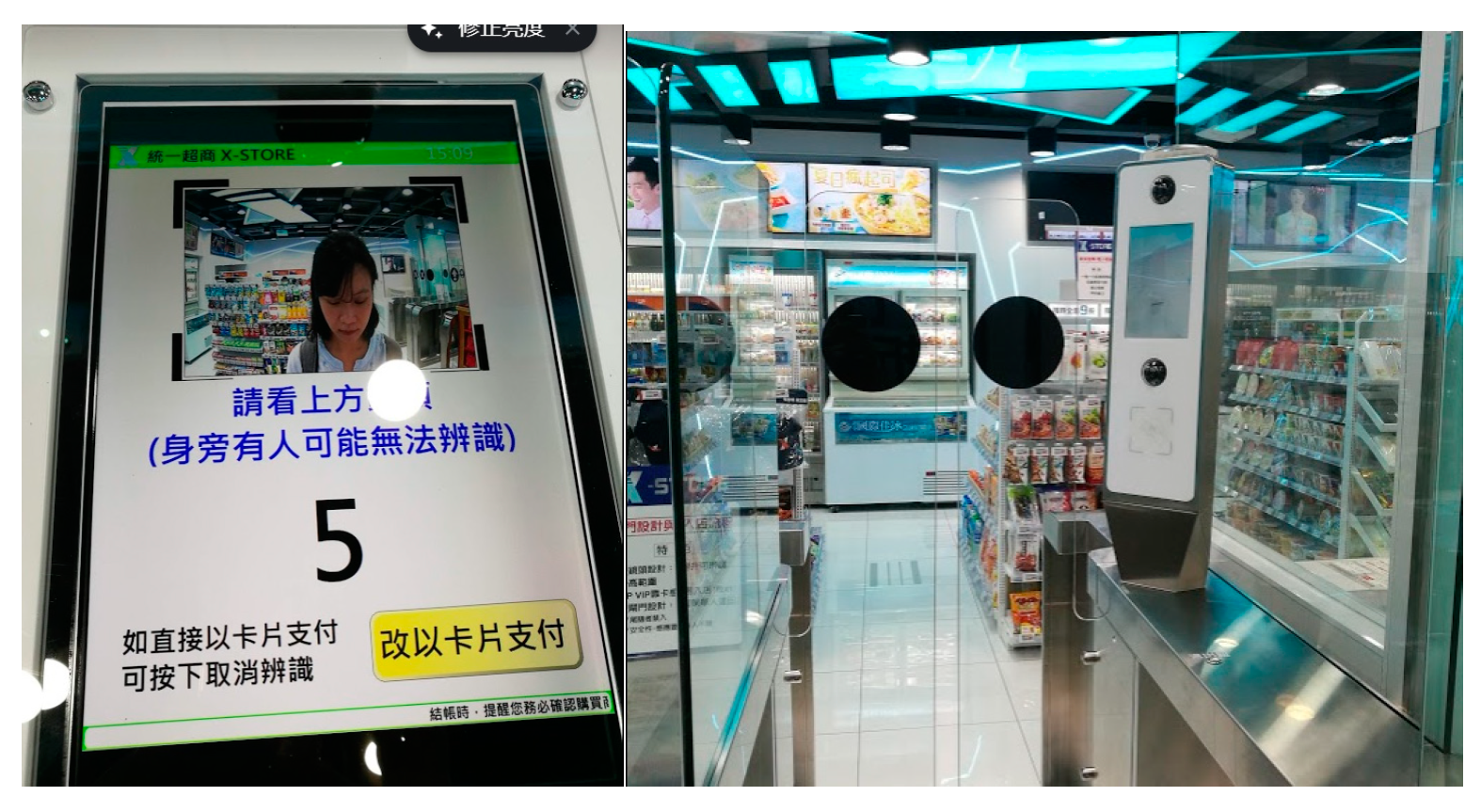
- Facial recognition configuration
- Object: Enter the X-Store
- Rule: 1. Arrive on-site. 2. Pass the special gate (one at a time)
- Stakeholder: clerks and other users
- Division of labor: Assistance from the clerks
- (Scenario 1) Explicit contradiction: A user does not have any iCash card and will go away.
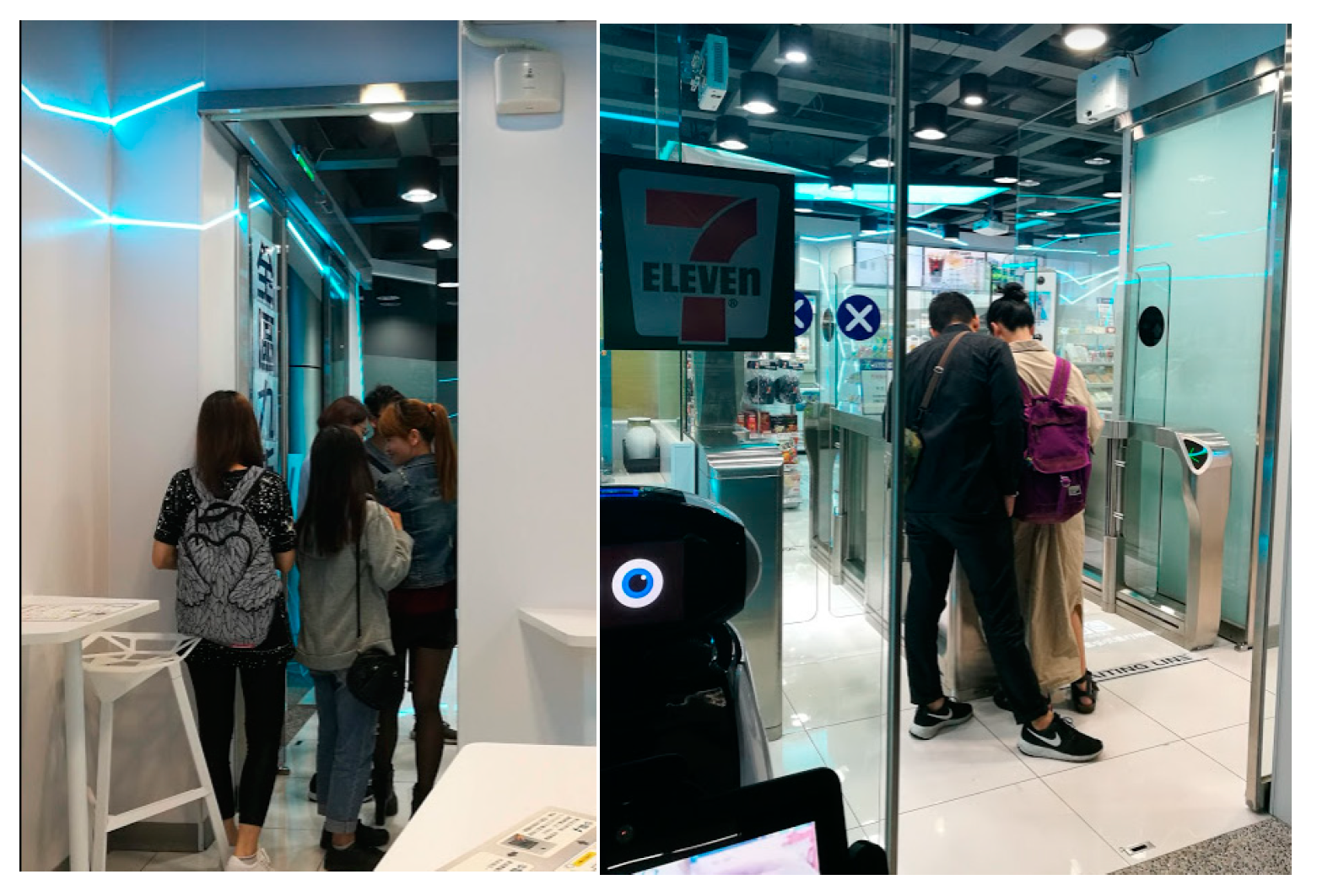
- Implicit contradiction: No clerk is available and therefore no assistance is provided (as shown in Figure 7).
- The gate is slow in recognition and a user got used to entering the store with his/her companion.Implicit contradiction: 1. No clerk is on-site and therefore no immediate assistance.
- A user cannot enter the store and the users behind him all waited after him at the door.
3.3. Second Episode of Experience: Beginning of the Immersive Service
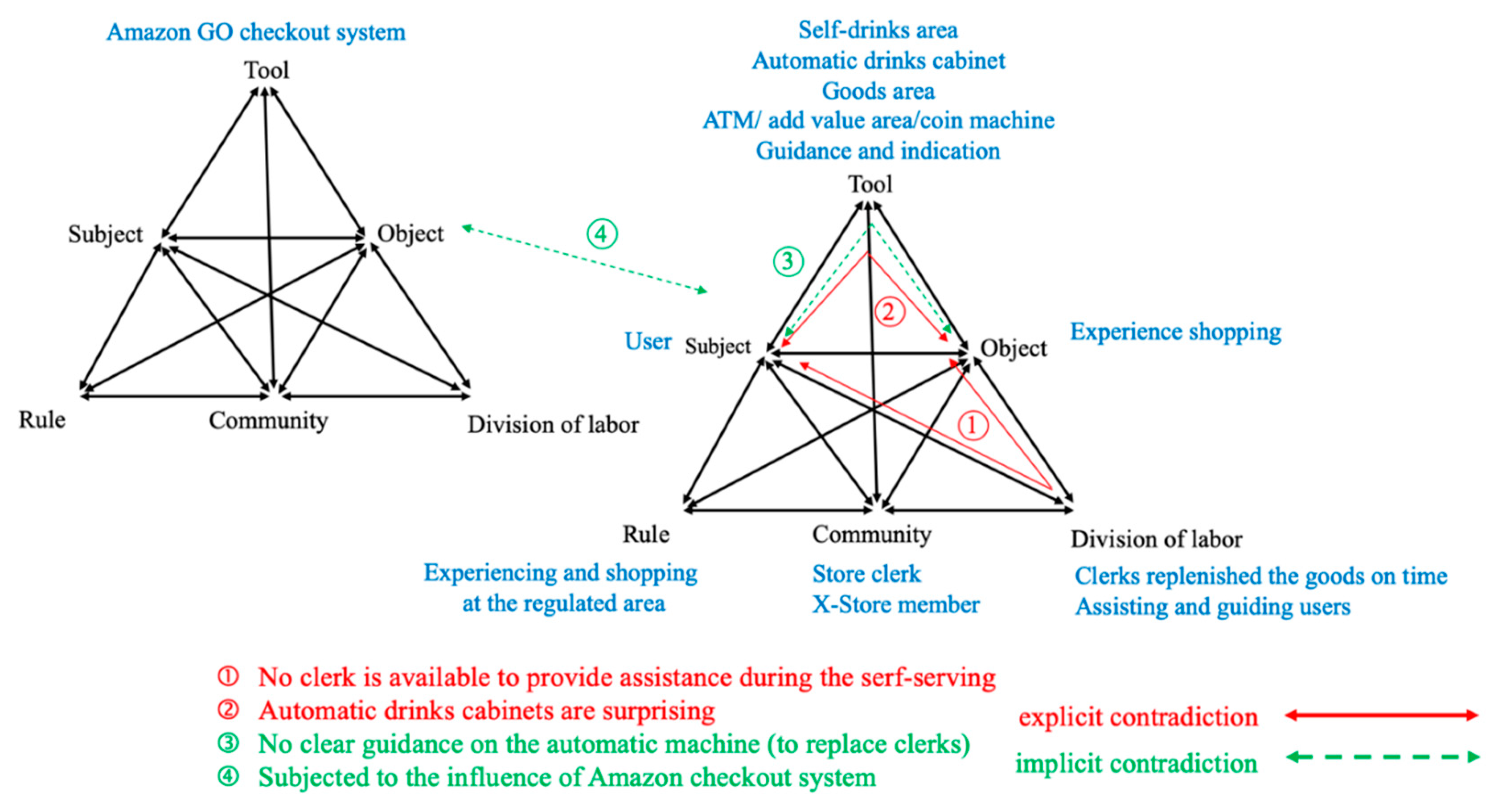
- Interactive tools:
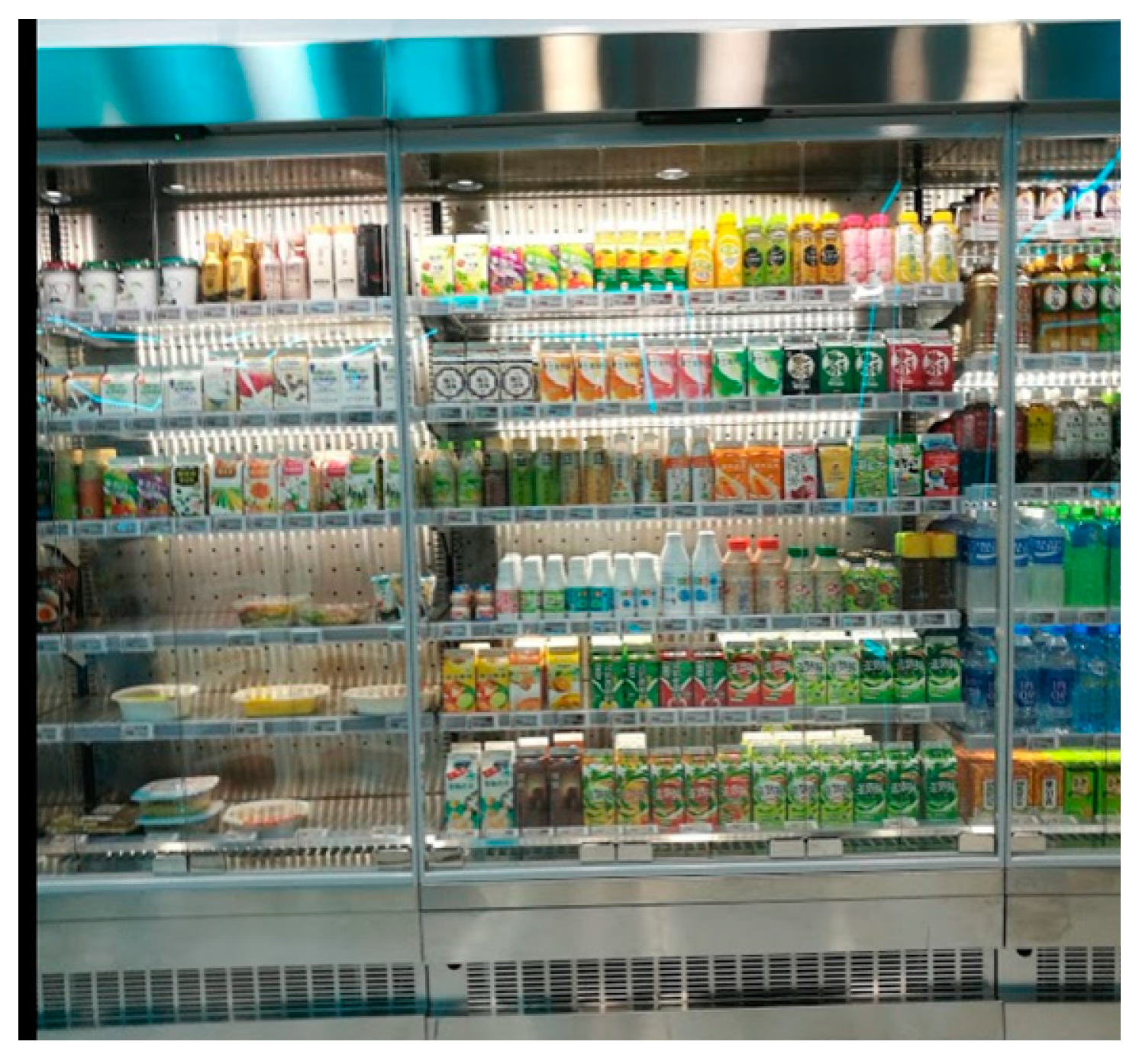
- Self-drinks area/automatic drinks cabinet
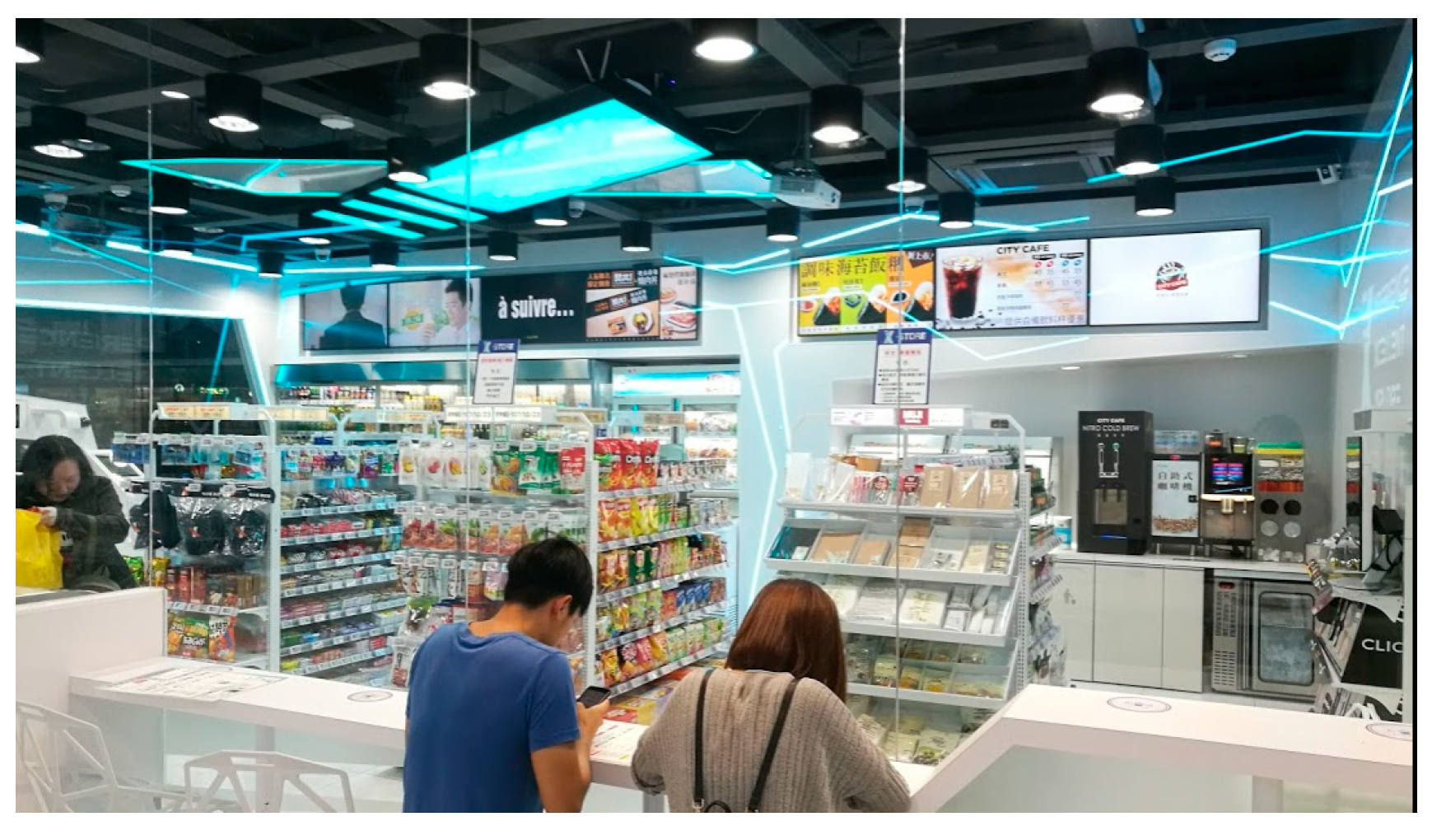
- Goods area
- ATM/add-value machine/coin machine
- Guidance and instructions
- Object: experience and shopping
- Rule: experiencing and shopping in the regulated area
- Stakeholder: X-Store members and clerks
- Division of labor: Clerks replenished the goods on time and assisted the customers
- Explicit contradiction: 1. Customers are confused with no clerk helping them. 2. Surprise with the automatic drinks cabinet.
- Implicit contradiction: 1. No clear guidance on the automatic machine (which replaces the clerks). 2. Users are affected by other new systems such as Amazon Go.
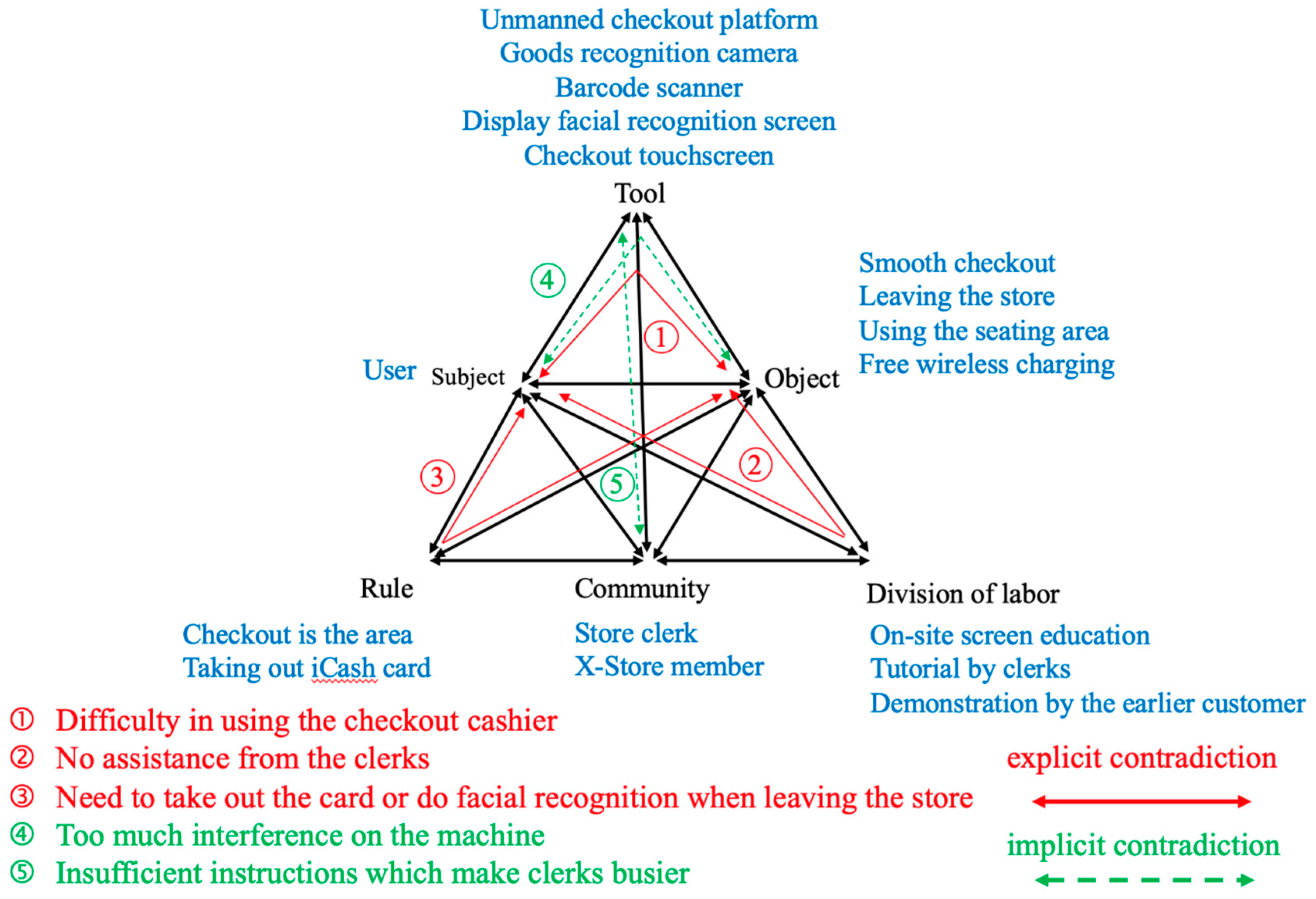
3.4. Last Episode of Experience: End of the Tangible Service
- Interactive tools:
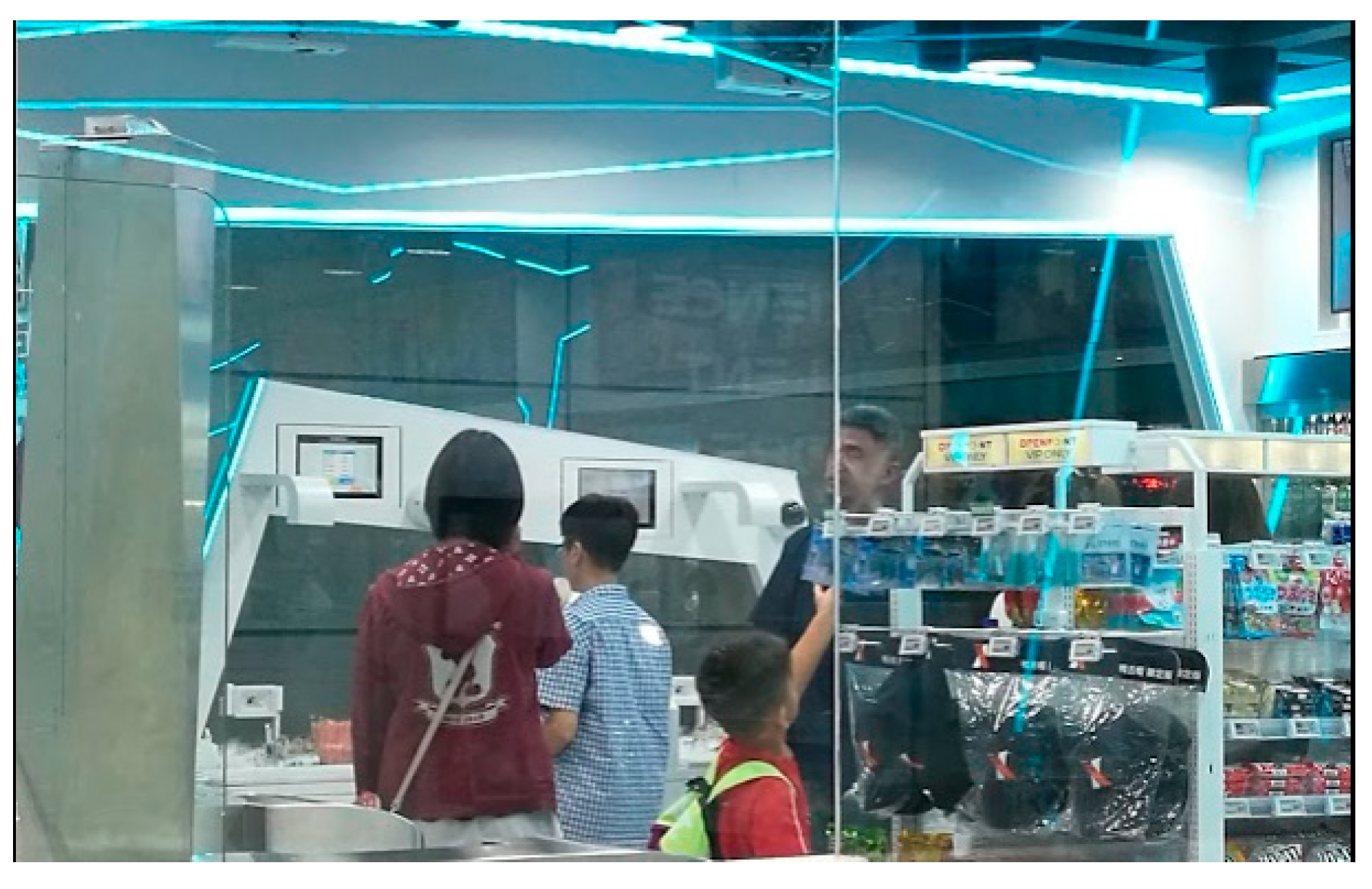
- Goods-recognizing camera (top)/barcode scanner (front)
- Facial recognition screen (top)/touchscreen (desktop)
- Platform and coffee cups and tools on the platform
- Object: Check out smoothly, leave the door and use the free charging service at the seating area
- Rule: Check out in the defined area and took out iCash card
- Stakeholder: X-Store members and clerks
- Division of labor: Tutorials on the screen on-site, instructions by clerks, and demonstration by the former user
- Explicit contradiction: 1. Difficulty in using the checkout machine. 2. No clerk to assist. 3. Needed to take out his/her iCash card again or pass the facial recognition when leaving the store.
- Implicit contradiction: 1. A user was interfered by so many machines at the cashier. 2. Insufficient instructions made clerks busier than expected.
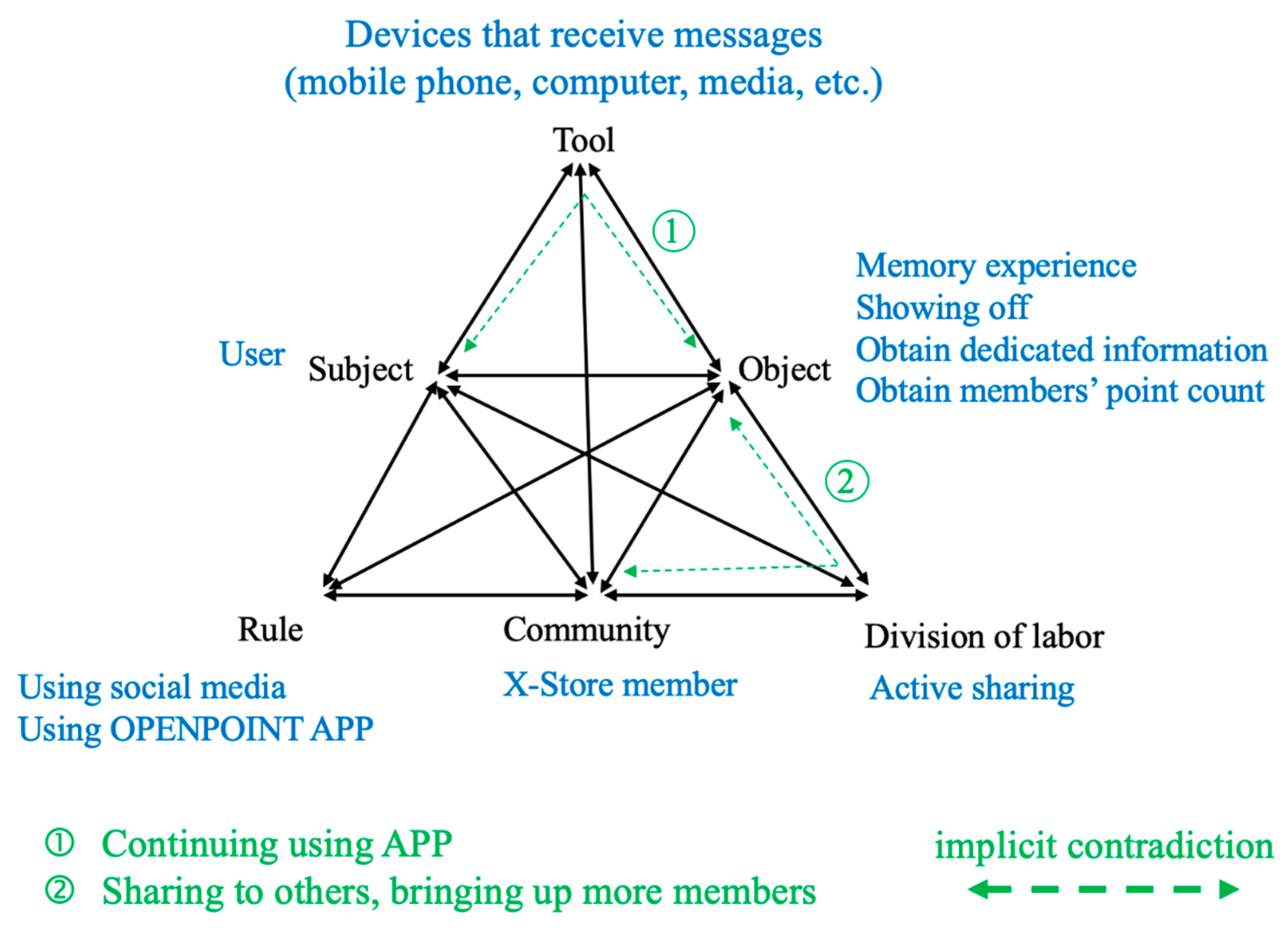
3.5. Side Plot of Experience: Continuous Fermentation of the Experience
- Interactive tool: Devices that receive information
- Object: Obtaining the information of unmanned stores’ new patterns
- Rule: Using social media and the Open Point app
- Stakeholder: X-Store members
- Division of labor: Sharing actively
- Implicit contradiction:
- 3.
- Continuing using the app
- 4.
- Sharing it to others and this might indirectly increase or reduce the member count
4. Case Study of User Experience Evaluation
5. Conclusions
- Experience gaps of user experience
- Insufficient or wrong online messages before the experience and this leads to higher or lower customer expectation.
- When arriving at the unmanned store, the guidance or instructions of the self-serving area are insufficient so that a user gave a lower evaluation score since no clerk is available. The clerks could be busier later.
- The registration process is complicated, or the instructions are not clear so that a user could simply go away without entering the store.
- A user could be affected by the way of operating in other unmanned stores so that there could be a divide in his/her expectation of the on-site operation.
- It is difficult to use the cashier machine since the interface and the operation are problematic.
- Insufficient instructions or guidance on the cashier machine so that a user could feel inconvenienced.
- When leaving the store, it is required to take out the iCash card or pass the facial recognition again (repetitive actions).
- Bad experience could lead to bad word-of-mouth marketing results.
- Summary of vocabularies that were used during the interviews
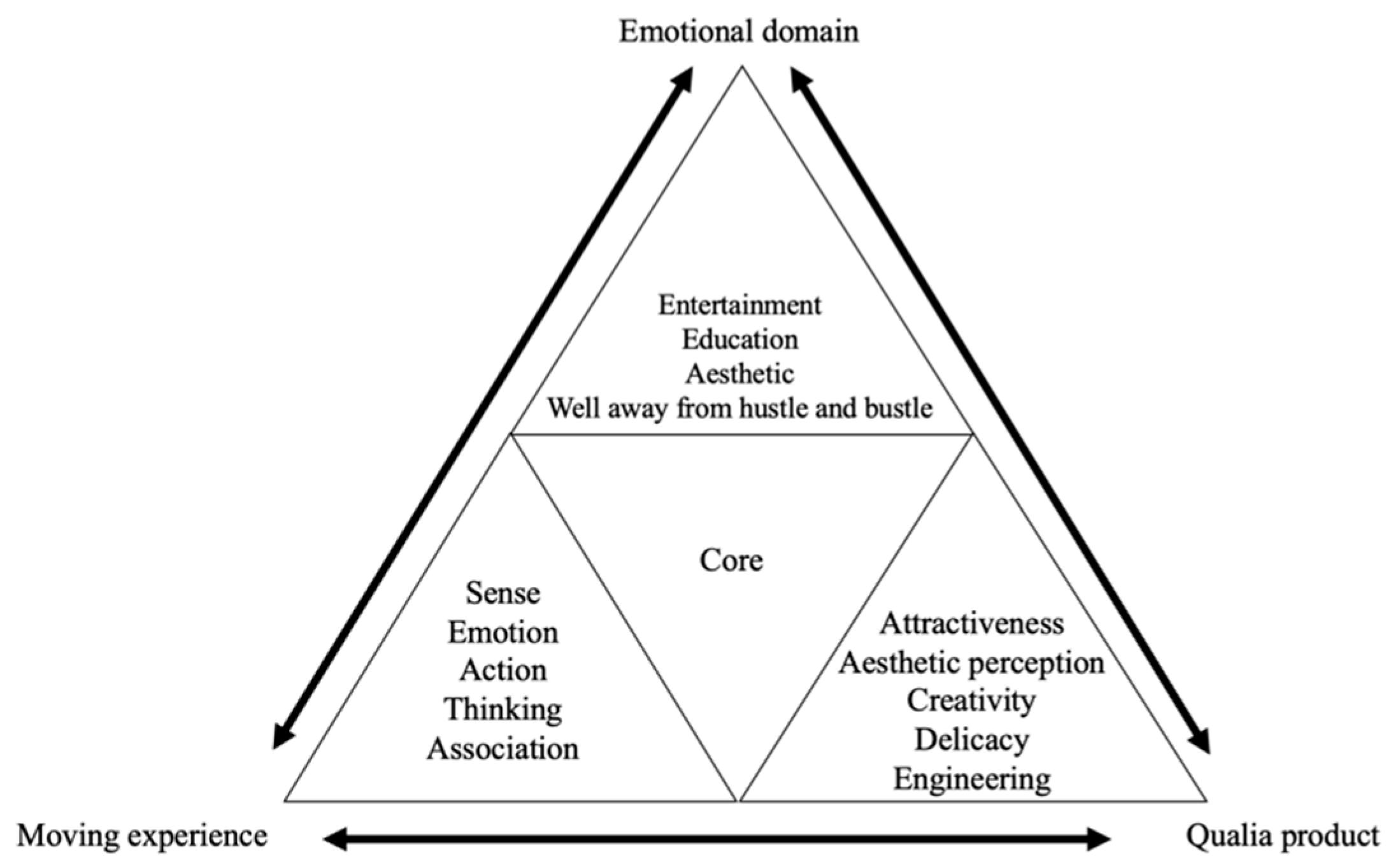
- Representative factors of the emotional domain
- Entertainment feeling: light and sound effect, vivid commercials on screen, navigating robots, interactive automatic drinks cabinet
- Education feeling: explanation of the collection of facial recognition data, new technology that is not available in other stores, labor-saving designs
- Heart-warming feeling: futuristic environment, equipment with technological feeling, goods arranged tidily
- Away from the hustle and bustle: futuristic environment, immersed in shopping, light and sound effect
- Representative factors of the moving experience
- Sensory experience: limited drinks, vivid commercials on screen, futuristic arrangement
- Positive emotion: smooth self-operation, multiple goods, tasteful instant foods
- Guiding to other ideas: memory of limited souvenirs, aftertaste of special goods, smart equipment and applications
- Perceiving the labor-saving effect: self-checkout, self-serving drinks, small-scale stores
- Triggering imagination: equipment with technological feeling, notification of discounts actively, discussing X-Store with other friends
- Representative factors of the qualia product or facility
- Aesthetics: special arrangement, goods arranged tidily, clean environment
- Attractiveness: interactive drinks cabinet, goods that are limited, self-checkout with the drinks
- Creativity: interactive drinks cabinet, several ways of checkout, facial recognition is available, navigating robots
- Delicacy: consistent overall arrangement, fast facial recognition, sensors of automatic drinks cabinet work perfect
- Easy to operate: app is easy to use, convenient access, fast checkout, drinks cabinets are convenient
Author Contributions
Funding
Conflicts of Interest
References
- Collins, C. Five Minutes with J.D. Power; Profiles: New York, NY, USA, 1996; p. 23. [Google Scholar]
- Hsiao, X.R. Grocery Stores in Early Taiwan; SunKids Culture Enterprise Co. Ltd.: Tai Pei, Taiwan, 2003. [Google Scholar]
- Chou, J.R. A psychometric user experience model based on fuzzy measure approaches. Adv. Eng. Inform. 2018, 38, 794–810. [Google Scholar] [CrossRef]
- Wang, Y.H.; Yu, S.H.; Xu, T. A user requirement driven framework for collaborative design knowledge management. Adv. Eng. Inform. 2017, 33, 16–28. [Google Scholar] [CrossRef]
- Lu, C.C.; Kang, S.C.; Hsieh, S.H.; Shiu, R.S. Improvement of a computer-based surveyor-training tool using a user-centered approach. Adv. Eng. Inform. 2009, 23, 81–92. [Google Scholar] [CrossRef]
- Hussain, J.; Hassan, A.U.; Muhammad Bilal, H.S.; Ali, R.; Afzal, M.; Hussain, S.; Bang, J.; Banos, O.; Lee, S. Model-based adaptive user interface based on context and user experience evaluation. J. Multimodal User Interfaces 2018, 12, 1–16. [Google Scholar] [CrossRef]
- Park, W.J.; Heo, H.Y.; Park, S.J.; Kim, J.M. A Study on the Presence of Immersive User Interface in Collaborative Virtual Environments Application. Symmetry 2019, 11, 476. [Google Scholar] [CrossRef]
- Norman, D.; Miller, J.; Henderson, A. What, You See, Some of What’s in the Future, and How We Go about Doing It: HI at Apple Computer. In Mosaic of Creativity, Proceedings of the CHI ’95 Conference on Human Factors in Computing Systems, Denver, CO, USA, 7–11 May 1995; ACM Press: New York, NY, USA, 1995; p. 155. [Google Scholar]
- Pine, J.; Gilmore, J. Welcome to the Experience Economy. Harv. Bus. Rev. 1998, 76, 97–105. [Google Scholar] [PubMed]
- Wang, C.J. The Model of Enjoyment Experience on Tourism Factory. Master’s Thesis, National Changhua University of Education, Changhua, Taiwan, 2014. [Google Scholar]
- Xia, Y.L.; Lu, W. The Era of Experience Economy; Cite Publishing Ltd.: Taipei, Taiwan, 2003. [Google Scholar]
- Pillan, M.; Costa, F.; Aureggi, M. The Complexity of Simple Goals: Case Study of a User-Centred Thermoregulation System for Smart Living and Optimal Energy Use. Sustainability 2019, 11, 3632. [Google Scholar] [CrossRef]
- Feng, L.; Wei, W. An Empirical Study on User Experience Evaluation and Identification of Critical UX Issues. Sustainability 2019, 11, 2432. [Google Scholar] [CrossRef]
- Feng, L.; Sun, B.P.; Wang, K.; Tsai, S.B. An Empirical Study on the Design of Digital Content Products from a Big Data Perspective. Sustainability 2018, 10, 3092. [Google Scholar] [CrossRef]
- Ma, N.; Chau, H.W.; Zhou, J.; Noguchi, M. Structuring the Environmental Experience Design Research Framework through Selected Aged Care Facility Data Analyses in Victoria. Sustainability 2017, 9, 2172. [Google Scholar] [CrossRef]
- Li, D.L.; Yang, C.T.; Lin, R.T. A Study of In-depth Experience of Customers in the Design of Service Domains. In Proceedings of the 15th Symposium of Chinese Institute of Design, University of Science and Technology, Southern Taiwan, 13 February 2010; pp. 1054–1059. [Google Scholar]
- Searle, J. The Rediscovery of Mind; MIT Press: Cambridge, MA, USA, 1992. [Google Scholar]
- Lin, R.T. Investigating qualia experience designs from service innovation thinking. J. Design. Sci. 2011. [Google Scholar]
- Hong, C.I.; Chen, J.L.; Lin, R.T. Investigating the Qualia Experience Model of Tourism Factory from the Standpoint of Social Design. J. Design 2017, 22, 69–92. [Google Scholar]
- Chien, C.W.; Chen, S.J.; Lin, R.T. The Research on Transforming the Intangible Qualia Experience to Tangible Products. J. Arts 2017, 101, 57–77. [Google Scholar]
- Vygotsky, L.S. Mind in Society; Harvard University Press: Cambridge, MA, USA, 1978. [Google Scholar]
- Engeström, Y. Learning by Expanding: An Activity-Theoretical Approach to Development Research; Orienta-Konsultit: Helsinki, Finland, 1987. [Google Scholar]
- Engeström, Y. Chapter 2 the tensions of judging: Handling cases of driving under the influence of alcohol in Finland and California. In Interactive Expertise: Studies in Distributed Working Intelligence; Department of Education, University of Helsinky: Helsinky, Finland, 1992; pp. 29–63. [Google Scholar]
- Engeström, Y. Activity theory and individual and social transformation. In Perspectives on Activity Theory; Engeström, Y., Miettern, R., Punamakl, R., Eds.; Cambridge University Press: Cambridge, UK, 1999. [Google Scholar]
- Engeström, Y. Activity theory as a framework for analyzing and redesigning work. Ergonomics 2000, 43, 960–974. [Google Scholar] [CrossRef] [PubMed]
- Engeström, Y. Disturbance management and masking in a television production team. In From Teams to Knots: Activity-Theoretical Studies of Collaboration and Learning at Work, 1st ed.; Engeström, Y., Ed.; Cambridge University Press: Cambridge, UK, 2008; pp. 22–47. [Google Scholar]
- Engeström, Y.; Sannino, A. Studies of expansive learning: Foundations, findings and future challenges. Educ. Res. Rev. 2010, 5, 1–24. [Google Scholar] [CrossRef]
- Chen, J.Y. Analysis of the Application of Activity Theory to the Doctor-patient Interaction of the Information Technology Mediation. Master’s Thesis, Chia Nan University of Pharmacy and Science, Tainan City, Taiwan, 31 July 2014. [Google Scholar]
- Cheng, S.P. Applying Activity Theory to Explore the Service Delivery Model of Telehealthcare: Perspectives on Service Promoting Process of Patients with Stroke Disease. Master’s Thesis, Chia Nan University of Pharmacy and Science, Tainan City, Taiwan, 16 June 2014. [Google Scholar]
- Carlson, J.; Rahman, M.M.; Rosenberger, P.J.; Holzmüller, H.H. Understanding communal and individual customer experiences in group-oriented event tourism: An activity theory perspective. J. Mark. Manag. 2016, 32, 900–925. [Google Scholar] [CrossRef]
- O’Keefe, M.; Wade, V.A.; McAllister, S.; Stupans, I.; Burgess, T.A. Improving management of student clinical placements: Insights from activity theory. BMC Med. Educ. 2016, 16, 1–10. [Google Scholar] [CrossRef] [PubMed]
- Song, B.S.; Kim, T.Y. Teacher (de)motivation from an Activity Theory perspective: Cases of two experienced EFL teachers in South Korea. System 2016, 57, 134–145. [Google Scholar] [CrossRef]
- Camacho, T.D.; Foth, M.; Rakotonirainy, A.; Rittenbruch, M. Understanding urban rail in-vehicle activities: An activity theory approach. Transport. Res. F-Traf. 2017, 46, 70–86. [Google Scholar] [CrossRef]
- Hirsh, Å.; Segolsson, M. Enabling teacher-driven school-development and collaborative learning: An activity theory-based study of leadership as an overarching practice. Educ. Manag. Adm. Lead. 2019, 47, 400–420. [Google Scholar] [CrossRef]







| Economic Model | Agriculture | Industry | Service | Experience |
|---|---|---|---|---|
| Economic product | Primary product | Processed product | Service | Experience |
| Economic function | Excavate and extract | Manufacture | Provide | Demonstrate |
| Product property | Replaceable | Tangible | Intangible | Unforgettable |
| Characteristic feature | Natural | Standardized | Customized | Personalized |
| Supply manner | Mass storage | Inventory after production | Distribution by demand | Demonstration during a certain period of time |
| Seller | Dealer | Manufacturer | Provider | Demonstrator |
| Buyer | Market | User | Customer | Customer |
| Demanding element | Characteristic | Distinguishing feature | Benefit | Unique perception |
| Primary Product | Goods | Service | Experience | Transformation | |
|---|---|---|---|---|---|
| What is the Product | Material | Product | Operation | Circumstance | Individual |
| Start | New material discovered | New invention developed | New product planned | New script portrayed | New target determined |
| Execution | Extraction is the core activity of dealers | Manufacturing is the core activity of manufacturers | Providing is the core activity of suppliers | Demonstration is the core activity of demonstrators | Guidance is the core activity of nucleus of activities |
| Correction | The impoverished evoked others to explore | A question evokes the patching to objects | A response evokes a question | Forgetting evokes the preservation of memory | A relapse evokes stronger determination |
| Application | Trade that links markets | Transaction that links users | Interaction that links customers | Circumstance that links customers | Perseverance that links willing minds |
| User | Interview Context Unit | Transformed into Interviewee Context |
|---|---|---|
| #C | I learned online that this store allows you to check out automatically. I thought this is not something special since there are already many overseas supermarkets offering this kind of service with no checkout operator by using this facility. You need only ask a consumer to scan the barcode so that he/she can check out. | I learned online in advance to see how others are discussing the way of checking out in the X-Store. |
| #D | I bought a drink by myself. The process was quite smooth since I’ve already seen others online. | I saw videos of others entered the X-Store for operations. |
| #E | When I took a drink, I did not know whether it counts when I picked it up or when I took it to the cashier. | I know the way of checking out in Amazon Go is simply taking the item but do not know X-Store’s. |
| User Experience Journey | Scenario | Disturbances of the Activity Theory |
|---|---|---|
| Prologue of experience | Intangible services | Insufficient or wrong messages which lead to higher or lower customer expectations. |
| First episode of experience | Beginning of the tangible services | 1. Do not know where to find a clerk when needing assistance. 2. Insufficient instructions or guidance which lead to inconvenience of customers or made customers busier. 3. Complicated registration process or unclear instructions so that customers might simply go away. |
| Second episode of experience | Immersive services | 1. Insufficient instructions or guidance of the self-serving area when no clerk is available so that there are concerns or unpleasant feelings. 2. Customers’ perception might be affected by other systems. |
| Last episode of experience | End of the services | 1. Trouble in using the checkout cashier due to interface or operation problems. 2. Insufficient instructions or guidance of the cashier which lead to inconvenience of customers. 3. Needed to take out the iCash card or pass the facial recognition again when leaving the store (repetitive actions). |
| Side plot of experience | Continuous fermentation of the services | Bad experience could lead to bad word-of-mouth marketing results. |
| Vocabularies used by Interviewees (Count) | Category (Item) | No. | Item (Small Category) |
|---|---|---|---|
| Special light and music (1) Many short commercials (screen) (3) Seems like in an amusement park with many robots (1) Interactive drinks cabinet (7) | X1-1 Entertainment | 1 | Light and sound effects |
| 2 | Vivid commercials on screen | ||
| 3 | Navigating robots | ||
| 4 | Interactive automatic drinks cabinet | ||
| Other purpose of registering the facial recognition (1) Machines and facilities that are not familiar with (3) Special checkout platform (2) Labor-saving configuration (5) | X1-2 Education | 1 | Explanation of the collection of facial recognition data |
| 2 | New technology that is not available in other stores | ||
| 3 | Labor-saving designs | ||
| Futuristic decorations (8) Special checkout platform (2) Machines and facilities that are not familiar with (3) Tidy arrangement (2) | X1-3 Heart-warming and delighted | 1 | Futuristic environment |
| 2 | Equipment with technological feeling | ||
| 3 | Goods arranged tidily | ||
| Overall environment is comfortable (3) Futuristic decorations (8) Seems like in an amusement park with many robots (1) Special light and music (1) | X1-4 Away from the hustles and bustles | 1 | Futuristic environment |
| 2 | Immersed in shopping | ||
| 3 | Light and music | ||
| Tasteful limited drinks (3) Many short commercials (screen) (3) Special light and music (1) | X2-1 Sensory experience | 1 | Limited drinks |
| 2 | Vivid commercials on screen | ||
| 3 | Futuristic arrangement | ||
| Smooth checkout (2) Goods are largely identical but with minor differences (4) Buy and eat (2) | X2-2 Positive emotion | 1 | Smooth self-operation |
| 2 | Multiple goods | ||
| 3 | Tasteful instant foods | ||
| Instant noodles and hats of limited edition (2) Advanced equipment and applications (2) Special checkout platform (2) Cabinets that automatically open and close (10) | X2-3 Guiding to other ideas | 1 | Memory of limited souvenirs |
| 2 | Aftertaste of special goods | ||
| 3 | Smart equipment and applications | ||
| Labor-saving design (5) No need for clerks to make drinks (3) Require not much manpower due to the smaller scale (1) | X2-4 Perceiving the labor-saving effect | 1 | Self-checkout |
| 2 | Self-serving drinks | ||
| 3 | Small-scale stores | ||
| Machines and facilities that are not familiar with (3) Special checkout platform (2) Seems like in an amusement park with many robots (1) Get other friends to see (2) APP for collecting reward points and redeem for gifts (2) | X2-5 Triggering imagination | 1 | Equipment with technological feeling |
| 2 | Notification of discounts actively | ||
| 3 | Discussing X-Store with other friends | ||
| Futuristic decorations (8) Tidy arrangement (2) Overall environment is comfortable (3) | X3-1 Aesthetic | 1 | Special arrangement |
| 2 | Goods arranged tidily | ||
| 3 | Clean environment | ||
| Cabinets that automatically open and close (10) Instant noodles and hats of limited edition (2) Fast self-checkout (4) | X3-2 Attractive | 1 | Interactive drinks cabinet |
| 2 | Goods that are limited | ||
| 3 | Self-checkout with the drinks | ||
| Cabinets that automatically open and close (10) Expectation of checkout by facial recognition (1) Convenient access by facial recognition (5) Seems like in an amusement park with many robots (1) | X3-3 Creative | 1 | Interactive drinks cabinet |
| 2 | Several ways of checkout | ||
| 3 | Facial recognition is available | ||
| 4 | Navigating robots | ||
| Special light and music (1) Futuristic decorations (8) Machines and facilities that are not familiar with (3) | X3-4 Delicate | 1 | Consistent overall arrangement |
| 2 | Fast facial recognition | ||
| 3 | Sensors of automatic drinks cabinet work perfect | ||
| APP for collecting reward points and redeem for gifts (2) Access by facial recognition is very convenient (5) Cabinets that automatically open and close (10) Shortened checkout time (2) | X3-5 Easy to operate | 1 | Apps is easy to use |
| 2 | Convenient access | ||
| 3 | Fast checkout | ||
| 4 | Drinks cabinets are convenient |
| When experiencing the X-Store, which description can describe the degree of your perception? | Entertainment feeling | Answer count | Percentage | Weighted average |
| Strongly agree | 34 | 32.69% | Between strongly agree and agree 1.8 | |
| Agree | 54 | 51.92% | ||
| Neither agree nor disagree | 12 | 11.54% | ||
| Disagree | 4 | 3.85% | ||
| Strongly disagree | 0 | 0% | ||
| Education feeling | Answer count | Percentage | Weighted average | |
| Strongly agree | 17 | 16.35% | Between agree and neither agree nor disagree 2.3 | |
| Agree | 40 | 38.46% | ||
| Neither agree nor disagree | 39 | 37.50% | ||
| Disagree | 8 | 7.69% | ||
| Strongly disagree | 0 | 0% | ||
| Aesthetic feeling | Answer count | Percentage | Weighted average | |
| Strongly agree | 29 | 28% | Between strongly agree and agree 1.9 | |
| Agree | 55 | 52.88% | ||
| Neither agree nor disagree | 20 | 19.23% | ||
| Disagree | 0 | 0% | ||
| Strongly disagree | 0 | 0% | ||
| Feeling of away from the reality (Away from the hustle and bustle) | Answer count | Percentage | Weighted average | |
| Strongly agree | 17 | 16.35% | Between agree and neither agree nor disagree 2.5 | |
| Agree | 33 | 31.73% | ||
| Neither agree nor disagree | 41 | 39.42% | ||
| Disagree | 10 | 9.62% | ||
| Strongly disagree | 3 | 2.88% |
| Valid Sample Size: 104 | ||
|---|---|---|
| Dependent Variable: Y | ||
| Independent Variable: | Items | Category Count |
| X1-1 Entertainment | 4 | |
| X1-2 Education | 3 | |
| X1-3 Aesthetic (warms the heart and delights the eye) | 3 | |
| X1-4 Escapist (away from hustle and bustle) | 3 | |
| No. | ITEM (Small Category) | Score | Partial Coefficient of Correlation | |
|---|---|---|---|---|
| X1-1 Entertainment | 1 | Sound and light effect | −2.6369934 | 0.611282557 |
| 2 | Vivid commercials on screen | −0.3886291 | ||
| 3 | Navigating robots | −1.9610108 | ||
| 4 | Interactive automatic drinks cabinet | 1.0067396 | ||
| X1-2 Education | 1 | Explanation of the collection of facial recognition data | −0.8157078 | 0.308052416 |
| 2 | New technology that is not available in other stores | −0.0941243 | ||
| 3 | Labor-saving design | 0.80293475 | ||
| X1-3 Aesthetic (warms the heart and delights the eye) | 1 | Environment of futuristic feeling | −0.315248 | 0.257239272 |
| 2 | Equipment with technological feeling | −0.2440858 | ||
| 3 | Goods arranged tidily | 0.75408063 | ||
| X1-4 Escapist (away from hustle and bustle) | 1 | Environment of futuristic feeling | 0.29952838 | 0.046000371 |
| 2 | Immersed in shopping | −0.0473321 | ||
| 3 | Sound and light effect | 0.00165714 | ||
| Constant | 15.3846154 | |||
| Multiple correlation coefficient = 0.696663652863141 | ||||
| Coefficient of determination (square of multiple correlation coefficient) = 0.485340245220615 | ||||
| After experiencing the X-Store, what was your perception at the moment? | Stimulus to the senses | Answer count | Percentage | Weighted average |
| Strongly agree | 30 | 28.85% | Between strongly agree and agree 1.9 | |
| Agree | 54 | 51.92% | ||
| Neither agree nor disagree | 19 | 18.27% | ||
| Disagree | 1 | 0.96% | ||
| Strongly disagree | 0 | 0% | ||
| Positive emotion | Answer count | Percentage | Weighted average | |
| Strongly agree | 29 | 27.88% | Between agree and neither agree nor disagree 2.0 | |
| Agree | 45 | 43.27% | ||
| Neither agree nor disagree | 29 | 27.89% | ||
| Disagree | 1 | 0.96% | ||
| Strongly disagree | 0 | 0% | ||
| Guiding to other ideas | Answer count | Percentage | Weighted average | |
| Strongly agree | 23 | 22.12% | Between agree and neither agree nor disagree 2.13 | |
| Agree | 47 | 45.19% | ||
| Neither agree nor disagree | 31 | 29.81% | ||
| Disagree | 3 | 2.88% | ||
| Strongly disagree | 0 | 0% | ||
| Perceiving the labor-saving effect | Answer count | Percentage | Weighted average | |
| Strongly agree | 40 | 38.46% | Between strongly agree and agree 1.92 | |
| Agree | 41 | 39.42% | ||
| Neither agree nor disagree | 14 | 13.46% | ||
| Disagree | 9 | 9% | ||
| Strongly disagree | 0 | 0% | ||
| Triggering imagination | Answer count | Percentage | Weighted average | |
| Strongly agree | 25 | 24.04% | Between agree and neither agree nor disagree 2.06 | |
| Agree | 46 | 44% | ||
| Neither agree nor disagree | 31 | 29.81% | ||
| Disagree | 2 | 1.92% | ||
| Strongly disagree | 0 | 0% |
| Valid Sample Size: 104 | ||
|---|---|---|
| Dependent Variable: Y | ||
| Independent Variable: | Items | Category Count |
| X2-1 Sensor experience | 3 | |
| X2-2 Positive emotion | 3 | |
| X2-3 Guiding to other ideas | 3 | |
| X2-4 Perceiving the labor-saving effect | 3 | |
| X2-5 Triggering imagination | 3 | |
| Category (Item) | No. | ITEM (Small Category) | Score | Partial Coefficient of Correlation |
|---|---|---|---|---|
| X2-1 Sensor experience | 1 | Limited drinks | −1.401178744 | 0.241764885 |
| 2 | Vivid commercials on screen | −0.230242463 | ||
| 3 | Futuristic decorations | 0.373454508 | ||
| X2-2 Positive emotion | 1 | Smooth self-operation | −0.691811482 | 0.396809763 |
| 2 | Multiple goods | 1.18988394 | ||
| 3 | Tasteful instant foods | 2.352715702 | ||
| X2-3 Guiding to other ideas | 1 | Memory of limited souvenirs | −1.597446204 | 0.371228342 |
| 2 | Aftertaste of special goods | −0.36725341 | ||
| 3 | Smart equipment and applications | 0.815841197 | ||
| X2-4 Perceiving the labor-saving effect | 1 | Unmanned checkout | −0.46079938 | 0.279724299 |
| 2 | Self-serving drinks | 0.826927104 | ||
| 3 | Small-scale store | 1.348587804 | ||
| X2-5 Triggering imagination | 1 | Equipment with technological feeling | −0.957044546 | 0.403806726 |
| 2 | Notification of discounts actively | 1.013818621 | ||
| 3 | Discussing X-Store with other friends | 0.817540882 | ||
| Constant | 19.91346154 | |||
| Multiple correlation coefficient = 0.700527914959168 | ||||
| Coefficient of determination (square of multiple correlation coefficient) = 0.490739359637039 | ||||
| How would you like to describe X-Store to others? | Aesthetics | Answer count | Percentage | Weighted average |
| Strongly agree | 32 | 30.77% | Between strongly agree and agree 1.86 | |
| Agree | 55 | 52.88% | ||
| Neither agree nor disagree | 16 | 15.38% | ||
| Disagree | 1 | 0.96% | ||
| Strongly disagree | 0 | 0% | ||
| Attractiveness | Answer count | Percentage | Weighted average | |
| Strongly agree | 37 | 35.58% | Between strongly agree and agree 1.82 | |
| Agree | 50 | 48.08% | ||
| Neither agree nor disagree | 15 | 14.42% | ||
| Disagree | 2 | 1.92% | ||
| Strongly disagree | 0 | 0% | ||
| Creativity | Answer count | Percentage | Weighted average | |
| Strongly agree | 51 | 49.04% | Between strongly agree and agree 1.6 | |
| Agree | 44 | 42.31% | ||
| Neither agree nor disagree | 7 | 6.73% | ||
| Disagree | 2 | 1.92% | ||
| Strongly disagree | 0 | 0% | ||
| Delicacy | Answer count | Percentage | Weighted average | |
| Strongly agree | 34 | 32.69% | Between strongly agree and agree 1.96 | |
| Agree | 44 | 42.31% | ||
| Neither agree nor disagree | 22 | 21.15% | ||
| Disagree | 4 | 3.85% | ||
| Strongly disagree | 0 | 0% | ||
| Easy-to-operate | Answer count | Percentage | Weighted average | |
| Strongly agree | 28 | 26.92% | Between agree and neither agree nor disagree 2.1 | |
| Agree | 39 | 37.50% | ||
| Neither agree nor disagree | 32 | 30.77% | ||
| Disagree | 4 | 3.85% | ||
| Strongly disagree | 1 | 0.96% |
| Valid Sample Size: 104 | ||
|---|---|---|
| Dependent Variable: Y | ||
| Independent Variable: | Items | Category Count |
| X3-1 With aesthetic perception | 3 | |
| X3-2 Attractive | 3 | |
| X3-3 Creative | 4 | |
| X3-4 Delicate | 3 | |
| X3-5 Easy-to-operate | 4 | |
| Category (Item) | No. | ITEM (Small Category) | Score | Partial Coefficient of Correlation |
|---|---|---|---|---|
| X3-1Aesthetics | 1 | Special arrangement | −0.38425 | 0.309845879 |
| 2 | Goods arranged tidily | 0.7432077 | ||
| 3 | Clean environment | 0.9467652 | ||
| X3-2Attractiveness | 1 | Interactive drinks cabinet | −0.494936 | 0.30231535 |
| 2 | Goods that are limited | 0.6092559 | ||
| 3 | Self-checkout with the drinks | 0.5033414 | ||
| X3-3Creativity | 1 | Interactive drinks cabinet | −3.08465 | 0.704571753 |
| 2 | Several ways of checkout | −0.049453 | ||
| 3 | Facial recognition is available | 1.844772 | ||
| 4 | Navigating robots | 0.4941689 | ||
| X3-4Delicacy | 1 | Consistent overall arrangement | −0.77287 | 0.259038883 |
| 2 | Fast facial recognition | −0.296057 | ||
| 3 | Sensors of automatic drinks cabinet work perfect | 0.2517705 | ||
| X3-5Easy-to-operate | 1 | App is easy to use | −2.004232 | 0.611501267 |
| 2 | Convenient access | −1.878118 | ||
| 3 | Fast checkout | −0.41567 | ||
| 4 | Drinks cabinets are convenient | 1.2430368 | ||
| Constant | 20.586538 | |||
| Multiple correlation coefficient = 0.916737111017968 | ||||
| Coefficient of determination (Square of the multiple correlation coefficient) = 0.840406930717571 | ||||
| Qualia Experience | Emotional Domain | Moving Experience | Qualia Product |
|---|---|---|---|
| All items | Entertaining Educational Aesthetic perception Away from hustle and bustle | Sensory experience Emotional experience Action experience Association experience Thinking experience | Creative Aesthetic perception Attractive Delicate Easy-to-operate |
| Items with a higher level of satisfaction | Entertaining (weighted average 1.8) | Sense experience (weighted average1.9) | Creative (weighted average 1.6) |
| Factors of item | Automatic drinks cabinet | Layout with futuristic feeling | Facial recognition is available |
| Items with a lower level of satisfaction | Away from hustle and bustle (weighted average 2.5) | Guiding to other ideas (thinking) (weighted average 2.13) | Easy-to-operate (weighted average 2.1) |
| Factors of item | Not able to immerse in shopping | No memory of limited souvenirs | APP is not good enough |
© 2019 by the authors. Licensee MDPI, Basel, Switzerland. This article is an open access article distributed under the terms and conditions of the Creative Commons Attribution (CC BY) license (http://creativecommons.org/licenses/by/4.0/).
Share and Cite
Lo, C.-H.; Wang, Y.-W. Constructing an Evaluation Model for User Experience in an Unmanned Store. Sustainability 2019, 11, 4965. https://doi.org/10.3390/su11184965
Lo C-H, Wang Y-W. Constructing an Evaluation Model for User Experience in an Unmanned Store. Sustainability. 2019; 11(18):4965. https://doi.org/10.3390/su11184965
Chicago/Turabian StyleLo, Chi-Hung, and Yi-Wen Wang. 2019. "Constructing an Evaluation Model for User Experience in an Unmanned Store" Sustainability 11, no. 18: 4965. https://doi.org/10.3390/su11184965
APA StyleLo, C.-H., & Wang, Y.-W. (2019). Constructing an Evaluation Model for User Experience in an Unmanned Store. Sustainability, 11(18), 4965. https://doi.org/10.3390/su11184965