

Willingness to Pay for Home Energy Management Systems: A Survey in New York and Tokyo

Abstract
1. Introduction
1.1. Objective
1.2. The Three Functions of HEMS: Considerations from A Technological Perspective
1.3. Social Aspects of Smart Home Technologies
1.4. Measurement of WTP: Considerations from an Economic Perspective
2. Materials and Methods
2.1. Survey and Design
2.1.1. Data Collection
2.1.2. WTP for the three functions of HEMS
2.1.3. Factors Affecting the WTP
2.2. Method
2.2.1. Experimental Design
2.2.2. Ordered Probit Model
2.2.3. Estimation of the HEMS Demand Probabilities Using the WTP
3. Results and Discussion
3.1. WTP for HEMS Functions
3.2. Results of the Ordered Probit Analysis
3.3. The Demand Probabilities for HEMS Functions
4. Conclusions
5. Human Subjects’ Approval Statement
Author Contributions
Funding
Acknowledgments
Conflicts of Interest
Abbreviations
| AC | Automatic control |
| CVM | Contingent valuation method |
| DR | Demand response |
| DSM | Demand side management |
| EI | Environmental impact |
| HEMS | Home energy management system |
| ICT | Information communication technology |
| IoT | Internet of things |
| MS | Money saving |
| MCDM | Multi-criteria decision making |
| PBC | Perceived behavioral control |
| TAM | Technology acceptance model |
| TPB | Theory of planned behavior |
| WTP | Willingness to pay |
Appendix A

| Question Item | Question Text | |
|---|---|---|
| Awareness of and intention to use HEMS | Awareness of HEMS and related technologies | How well did you understand the explanation of HEMS in the previous pages? |
| In general, how would you describe your familiarity of home energy technology like HEMS? | ||
| Before this survey, have you heard about technology similar to HEMS? | ||
| Intention to use HEMS | Using HEMS service is worthwhile. | |
| It is likely that I will use HEMS services in the future. | ||
| For sure, I would use HEMS services in the future. | ||
| Willingness to use additional services of HEMS | Service of assisting Senior Citizens | |
| Service of emergency contacts for children | ||
| Service of monitoring security | ||
| Tele-medical service | ||
| Mobility service | ||
| Service of job search | ||
| Community event updates | ||
| Socio-economic factorsbased on social psychology | (Factors of TPB) Attitudes for HEMS | HEMS is Beneficial to me. |
| HEMS is Helpful to me. | ||
| HEMS is Important to me. | ||
| Social norms | My family would think I should use HEMS to save money or electricity. | |
| My close friends would think I should use HEMS to save money or electricity. | ||
| My close neighbors who are important to me, would think I should use HEMS to save money or electricity. | ||
| Personal norms | I feel morally obligated to save energy. | |
| I would feel guilty if I would not reduce my energy use. | ||
| I would feel good if I would save energy. | ||
| Perceived behavioral control | I will be able to adopt HEMS services. | |
| Adopting HEMS services is entirely within my control. | ||
| I have the resources and ability to adopt HEMS services | ||
| (Factors of TAM) Perceived usefulness (Automation) | HEMS helps the residents proactively without human intervention. | |
| HEMS provides auto-adjusted control. | ||
| With HEMS, I can control home appliances through a simple operation. | ||
| Perceived usefulness (Mobility) | To assess HEMS services while moving from place to place or doing anything else at the same time. | |
| To use HEMS anywhere at any time through smart phones or computers. | ||
| Overall, mobility is an outstanding advantage of HEMS. | ||
| Perceived ease of use | Learning to live with HEMS will be easy for me. | |
| Interacting with HEMS will not require a lot of mental effort. | ||
| I will find HEMS easy to use. | ||
| (Other social psychological factors) Cost concern | I am concerned about HEMS basic fee. | |
| I am concerned about additional HEMS service fee. | ||
| I am concerned about HEMS maintenance fee. | ||
| Dependency concern | I would be too dependent on HEMS. | |
| I would have less control over my daily life with the use of HEMS. | ||
| I would have less freedom to live with the use of HEMS | ||
| Trust in utility companies | My utility company is reliable. | |
| My utility company always keeps promises and commitments. | ||
| My utility company always keeps customers’ best interests in mind. | ||
| I feel confidence in the brand of my utility company. | ||
| Cyber security | Some cyber hackers would break into HEMS network to access and misuse my personal information. | |
| Some cyber hackers will break into HEMS network to manipulate my usage information. | ||
| Some cyber hackers will bring down HEMS to cause the system unusable. | ||
| Technology Anxiety | Working with HEMS will make me nervous. | |
| A new technology like HEMS will make me feel uncomfortable | ||
| I hesitate to use a new technology like HEMS, for the fear of making major mistakes. | ||
| Conventional energy saving behavior | In general, avoiding using air-conditioners as much as you can. | |
| During summer, turning off AC or using a timer before going to sleep to save electricity. | ||
| During summer, setting the thermostat to about 28ºF or higher when someone is at home. | ||
| Turn off household appliances when not in use as much as possible. | ||
| Turn off lights when not in use. | ||
| Buy energy efficient light bulbs. | ||
| Buy energy efficient household appliances. | ||
| Demographic factors | age | What is your age? |
| region | Which region do you live in? | |
| gender | What is your gender? | |
| Weekday home time zone | In a typical weekday (not holidays or weekends), when are your family members usually at home? | |
| Power usage | Please tell us how you would rank your electricity use, in general, by choosing one of the following categories. | |
| Number of family members | How many people are currently living in your house/apartment? | |
| Family structure | Do any of the following people live with you? | |
| Occupation | Which of the following options best describes your job? | |
| Income level | What is your annual household income before taxes?" | |
| Type of housing | detached house/attached house/Wooden co-residence/Reinforced concrete apartment (4 stories or less/5 stories or more) | |
| Age of the house | How long ago was your house or apartment built? | |
| Size of the house | How large is your house/condo/apartment (indoor area, in square feet)? | |
| Electricity bill | How much was your last month’s utility bill? | |
| Ethnicity (New York only)) | What is your ethnic background? | |
| political preference (New York only) | Politically speaking, I consider myself as a Democrat/Independent/Republican/Apolitical/Others. |
Appendix B
| Explained Variable | ||||||
|---|---|---|---|---|---|---|
| Explanatory | USA | JPN | ||||
| Variable | WTP_MS | WTP_AC | WTP_EI | WTP_MS | WTP_AC | WTP_EI |
| Awareness 1 | 0.1316 (0.0464) *** | |||||
| Awareness 2 | 0.1200 (0.0399) *** | |||||
| Awareness 3 | −0.0843 (0.0396) ** | |||||
| Usage intention 1 | 0.1850 (0.0616) *** | |||||
| Usage intention 2 | −0.1118 (0.0551) ** | −0.0882 (0.0412) ** | ||||
| Add. Function 1 | 0.1015 (0.0365) *** | |||||
| Add. Function 2 | 0.1555 (0.0353) *** | 0.1576 (0.0374) *** | 0.1189 (0.0379) *** | |||
| Add. Function 3 | 0.0993 (0.0364) *** | 0.1736 (0.0354) *** | ||||
| Add. Function 4 | 0.1903 (0.0314) *** | 0.1271 (0.0362) *** | ||||
| Add. Function 5 | 0.1215 (0.0377) *** | |||||
| TPB Attitude 1 | 0.3475 (0.0816) *** | 0.2969 (0.0853) *** | 0.5072 (0.0564) *** | 0.3247 (0.0605) *** | 0.4589 (0.0459) *** | 0.3265 (0.0621) *** |
| TPB Attitude 2 | 0.2285 (0.0781) *** | 0.2539 (0.0796) *** | ||||
| TPB Social norms | 0.1527 (0.0448) *** | |||||
| TPB Personal norms 1 | 0.0864 (0.0423) ** | 0.1511 (0.0532) *** | ||||
| TPB Personal norms 2 | −0.1222 (0.0590) ** | |||||
| TPB PBC | 0.1079 (0.0417) ** | |||||
| TAM Usefulness 1 | 0.1574 (0.0519) *** | |||||
| TAM Usefulness 2 | 0.1183 (0.0524) ** | 0.1230 (0.0620) ** | 0.1885 (0.0639) *** | |||
| TAM Ease of use 1 | −0.0713 (0.0426) * | |||||
| TAM Ease of use 2 | −0.1380 (0.0472) *** | |||||
| Add Cost concern 1 | −0.2109 (0.0364) *** | −0.1320 (0.0517) ** | −0.2123 (0.0361) *** | |||
| Add Cost concern 2 | −0.1151 (0.0552) ** | |||||
| Add Dependency 1 | 0.1875 (0.0414) *** | 0.2040 (0.0396) *** | 0.1705 (0.0434) *** | |||
| Add Trust in utility | 0.0653 (0.0342) * | |||||
| Add Tech. anxiety | −0.1059 (0.0440) ** | −0.1481 (0.0403) *** | −0.1514 (0.0463) *** | |||
| Add Energy saving 1 | 0.0558 (0.0270) ** | 0.0721 (0.0284) ** | 0.0764 (0.0288) *** | |||
| Add Energy saving 2 | −0.0751 (0.0252) *** | |||||
| Add Energy saving 3 | −0.2054 (0.0425) *** | −0.1388 (0.0426) *** | −0.1815 (0.0417) *** | |||
| Age | −0.0586 (0.0158) *** | 0.0278 (0.0154) * | ||||
| Gender | −0.1419 (0.0645) ** | −0.1249 (0.0676) * | −0.1145 (0.0675) * | −0.1553 (0.0629) ** | −0.1552 (0.0653) ** | |
| House age | 0.0462 (0.0246) * | 0.0553 (0.0236) ** | ||||
| House size | 0.1160 (0.0256) *** | 0.0950 (0.0303) *** | 0.1081 (0.0287) *** | |||
| Number of obs | 1226 | 1137 | 1137 | 1316 | 1316 | 1316 |
| Log likelihood | −2003.094 | −1846.3771 | −1835.6021 | −2146.3187 | −2249.7782 | −2144.1351 |
| Wald chi2 | 571.43*** | 581.52*** | 485.66*** | 255.3*** | 322.85*** | 275.9*** |
| Pseudo R2 | 0.1495 | 0.1560 | 0.1493 | 0.0654 | 0.0664 | 0.0732 |
| Abbreviation | Text of the Questionnaire |
|---|---|
| Awareness 1 | How well did you understand the explanation of HEMS in the previous pages? |
| Awareness 2 | In general, how would you describe your familiarity of home energy technology like HEMS? |
| Awareness 3 | Before this survey, have you heard about technology similar to HEMS? |
| Usage intention 1 | Using HEMS service is worthwhile. |
| Usage intention 2 | For sure, I would use HEMS services in the future. |
| Add. Function 1 | Service of assisting Senior Citizens |
| Add. Function 2 | Tele-medical service |
| Add. Function 3 | Mobility service |
| Add. Function 4 | Service of job search |
| Add. Function 5 | Community event updates |
| TPB Attitude 1 | Beneficial to me. |
| TPB Attitude 2 | Helpful to me. |
| TPB Social norms | My family would think I should use HEMS to save money or electricity. |
| TPB Personal norms 1 | I feel morally obligated to save energy. |
| TPB Personal norms 2 | I would feel good if I would save energy. |
| TPB PBC | I have the resources and ability to adopt HEMS services |
| TAM Usefulness 1 | HEMS helps the residents proactively without human intervention. |
| TAM Usefulness 2 | With HEMS, I can control home appliances through a simple operation. |
| TAM Ease of use 1 | Interacting with HEMS will not require a lot of mental effort. |
| TAM Ease of use 2 | I will find HEMS easy to use. |
| Other Cost concern 1 | I am concerned about HEMS basic fee. |
| Other Cost concern 2 | I am concerned about HEMS maintenance fee |
| Other Dependency 1 | I would be too dependent on HEMS. |
| Other Trust in utility | My utility company always keeps customers’ best interests in mind. |
| Other Tech. anxiety | A new technology like HEMS will make me feel uncomfortable |
| Other Energy saving 1 | In general, avoiding using air-conditioners as much as you can. |
| Other Energy saving 2 | Turn off household appliances when not in use as much as possible. |
| Other Energy saving 3 | Turn off lights when not in use. |
| Age | Age |
| Gender | Gender (Female=1) |
| House age | How long ago was your house or apartment built? |
| House size | How large is your house/condo/apartment (indoor area, in square feet)? |
Appendix C. Estimation of Demand Probabilities for HEMS Functions
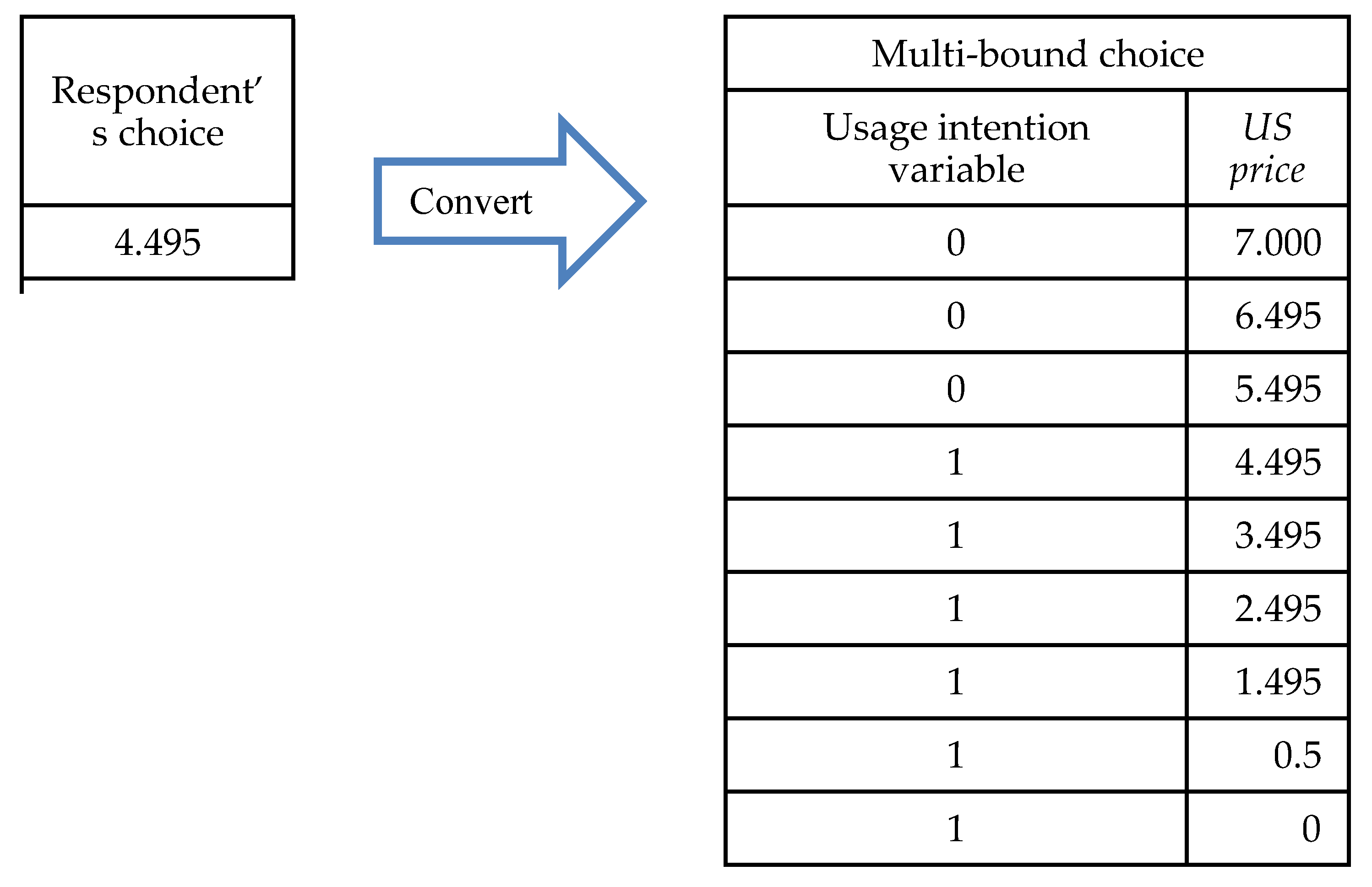
| USD | 7.00 or More | 6.00–6.99 | 5.00–5.99 | 4.00–4.99 | 3.00–3.99 | 2.00–2.99 | 1.00–1.99 | 0.01–0.99 | I’m Not Willing to Pay |
|---|---|---|---|---|---|---|---|---|---|
| Usage price | 7 | 6.495 | 5.495 | 4.495 | 3.495 | 2.495 | 1.495 | 0.5 | 0 |
| MS | AC | EI | |
|---|---|---|---|
| price (USD) | −0.1981 (0.0178) *** | −0.1535 (0.0180) *** | −0.1724 (0.0182) *** |
| Constant | −1.7435 (0.0673) *** | −1.9090 (0.0713) *** | −1.8625 (0.0708) *** |
| Number of obs. | 9824 | 9112 | 9112 |
| Log likelihood | −2669.8780 | −2466.4788 | −2432.9748 |
| Wald chi2(1) | 123.7 *** | 72.82 *** | 89.95 *** |
| Pseudo R2 | 0.0243 | 0.0148 | 0.0185 |
| MS | AC | EI | |
|---|---|---|---|
| price (JPY) | −0.0031 (0.0002) *** | −0.0028 (0.0002) *** | −0.0029 (0.0002) *** |
| Constant | −1.5097 (0.0610) *** | −1.5281 (0.0591) *** | −1.5968 (0.0610) *** |
| Number of obs. | 10528 | 10528 | 10528 |
| Log likelihood | −2585.7179 | −2769.2167 | −2598.3504 |
| Wald chi2(1) | 330.32 *** | 298.91 *** | 293.56 *** |
| Pseudo R2 | 0.0562 | 0.0451 | 0.0472 |
| MS | AC | EI | |
|---|---|---|---|
| price (USD) | −0.2760 (0.0424) *** | −0.1776 (0.0403) *** | −0.2449 (0.0423) *** |
| price x trust dummy | 0.2036 (0.0503) *** | 0.1378 (0.0488) *** | 0.1897 (0.0505) *** |
| trust dummy | −0.3955 (0.1856) *** | −0.1718 (0.1971) | −0.3090 (0.1941) |
| Constant | −1.6141 (0.1464) *** | −1.9500 (0.1562) *** | −1.7588 (0.1528) *** |
| Number of obs. | 5680 | 5216 | 5216 |
| Log likelihood | −1620.3431 | −1493.7519 | −1477.3351 |
| Wald chi2(3) | 50.87 *** | 26.92 *** | 41.22 *** |
| Pseudo R2 | 0.0193 | 0.0100 | 0.0162 |
| MS | AC | EI | |
|---|---|---|---|
| price (JPY) | −0.0056 (0.0013) *** | −0.0061 (0.0013) *** | −0.0067 (0.0014) *** |
| price x comprehension dummy | 0.0027 (0.0013) *** | 0.0036 (0.0013) *** | 0.0041 (0.0014) *** |
| comprehension dummy | −0.0981 (0.3041) | −0.1030 (0.3002) | −0.3620 (0.3021) |
| Constant | −1.3874 (0.2959) *** | −1.4018 (0.2925) *** | −1.2281 (0.2938) *** |
| Number of obs. | 8264 | 8264 | 8264 |
| Log likelihood | 2076.2658 | 2237.3031 | 2086.3383 |
| Wald chi2(3) | 255.8 *** | 228.22 *** | 219.8 *** |
| Pseudo R2 | 0.0581 | 0.0478 | 0.0503 |
References
- Faruqui, A.; Sergici, S. Household response to dynamic pricing of electricity: A survey of 15 experiments. J. Regul. Econ. 2010, 38, 193–225. [Google Scholar] [CrossRef]
- Ito, K.; Ida, T.; Tanaka, M. Moral Suasion and Economic Incentives: Field Experimental Evidence from Energy Demand. Am. Econ. J. Econ. Policy 2018, 10, 240–267. [Google Scholar] [CrossRef]
- Kato, T.; Tokuhara, A.; Ushifusa, Y.; Sakurai, A.; Aramaki, K.; Maruyama, F. Consumer responses to critical peak pricing: Impacts of maximum electricity-saving behavior. Electr. J. 2016, 29, 12–19. [Google Scholar] [CrossRef]
- Zipperer, A.; Aloise-Young, P.A.; Suryanarayanan, S.; Roche, R.; Earle, L.; Christensen, D.; Bauleo, P.; Zimmerle, D. Electric Energy Management in the Smart Home: Perspectives on Enabling Technologies and Consumer Behavior. Proc. IEEE 2013, 101, 2397–2408. [Google Scholar] [CrossRef]
- Ishii, H.; Hirohashi, W.; Mitsuoka, M.; Hayashi, Y. Demand-side response/Home energy management. In Smart Grid Handbook; John Wiley and Sons, Ltd.: Hoboken, NJ, USA, 2016; Volume 3. [Google Scholar] [CrossRef]
- Son, Y.S.; Pulkkinen, T.; Moon, K.D.; Kim, C. Home energy management system based on power line communication. IEEE Trans. Consum. Electron. 2010, 56, 1380–1386. [Google Scholar] [CrossRef]
- Han, D.M.; Lim, J.H. Smart home energy management system using IEEE 802.15.4 and zigbee. IEEE Trans. Consum. Electron. 2010, 56, 1403–1410. [Google Scholar] [CrossRef]
- Li, R.; Dane, G.; Finck, C.; Zeiler, W. Are building users prepared for energy flexible buildings?—A large-scale survey in the Netherlands. Appl. Energy 2017, 203, 623–634. [Google Scholar] [CrossRef]
- Nakano, S.; Washizu, A. Acceptance of energy efficient homes in large Japanese cities: Understanding the inner process of home choice and residence satisfaction. J. Environ. Manag. 2018, 225, 84–92. [Google Scholar] [CrossRef]
- Stenner, K.; Frederiks, E.R.; Hobman, E.V.; Cook, S. Willingness to participate in direct load control: The role of consumer distrust. Appl. Energy 2017, 189, 76–88. [Google Scholar] [CrossRef]
- Bayram, I.S.; Ustun, T.S. A survey on behind the meter energy management systems in smart grid. Renew. Sustain. Energy Rev. 2017, 72, 1208–1232. [Google Scholar] [CrossRef]
- Zhang, C.; Wang, Q.; Zeng, S.; Baležentis, T.; Štreimikienė, D.; Ališauskaitė-Šeškienė, I.; Chen, X. Probabilistic multi-criteria assessment of renewable micro-generation technologies in households. J. Clean. Prod. 2019, 212, 582–592. [Google Scholar] [CrossRef]
- Hu, Q.; Li, F. Hardware Design of Smart Home Energy Management System with Dynamic Price Response. IEEE Trans. Smart Grid 2013, 4, 1878–1887. [Google Scholar] [CrossRef]
- Basit, A.; Sidhu, G.A.S.; Mahmood, A.; Gao, F. Efficient and Autonomous Energy Management Techniques for the Future Smart Homes. IEEE Trans. Smart Grid 2017, 8, 917–926. [Google Scholar] [CrossRef]
- Ozturk, Y.; Senthilkumar, D.; Kumar, S.; Lee, G. An Intelligent Home Energy Management System to Improve Demand Response. IEEE Trans. Smart Grid 2013, 4, 694–701. [Google Scholar] [CrossRef]
- Javaid, N.; Ullah, I.; Akbar, M.; Iqbal, Z.; Khan, F.A.; Alrajeh, N.; Alabed, M.S. An Intelligent Load Management System with Renewable Energy Integration for Smart Homes. IEEE Access 2017, 5, 13587–13600. [Google Scholar] [CrossRef]
- Gangale, F.; Mengolini, F.; Onyeji, I. Consumer engagement: An insight from smart grid projects in Europe. Energy Policy 2013, 60, 621–628. [Google Scholar] [CrossRef]
- Balta-Ozkan, N.; Davidson, R.; Bicket, M.; Whitmarsh, L. Social barriers to the adoption of smart homes. Energy Policy 2013, 63, 363–374. [Google Scholar] [CrossRef]
- Berry, S.; Whaley, D.; Davidson, K.; Saman, W. Near zero energy homes–What do users think? Energy Policy 2014, 73, 127–137. [Google Scholar] [CrossRef]
- Dütschke, E.; Paetz, A. Dynamic electricity pricing—Which programs do consumers prefer? Energy Policy 2013, 59, 226–234. [Google Scholar] [CrossRef]
- Oltra, C.; Boso, A.; Espluga, J.; Prades, A. A qualitative study of users’ engagement with real-time feedback from in-house energy consumption displays. Energy Policy 2013, 61, 788–792. [Google Scholar] [CrossRef]
- Reeves, B.; Cummings, J.J.; Scarborough, J.K.; Yeykelis, L. Increasing energy efficiency with entertainment media: An experimental and field test of the influence of a social game on performance of energy behaviors. Environ. Behav. 2015, 47, 102–115. [Google Scholar] [CrossRef]
- Van Dam, S.S.; Bakker, C.A.; Buiter, J.C. Do home energy management systems make sense? Assessing their overall lifecycle impact. Energy Policy 2013, 63, 398–407. [Google Scholar] [CrossRef]
- Dyson, M.E.H.; Borgeson, S.D.; Tabone, M.D.; Callaway, D.S. Using smart meter data to estimate demand response potential, with application to solar energy integration. Energy Policy 2014, 73, 607–619. [Google Scholar] [CrossRef]
- Bamberg, S.; Möser, G. Twenty years after Hines, Hungerford, and Tomera: A new meta-analysis of psycho-social determinants of pro-environmental behavior. J. Environ. Psychol. 2007, 27, 14–25. [Google Scholar] [CrossRef]
- Ajzen, I. The theory of planned behavior. Organ. Behav. Hum. Decis. Process. 1991, 50, 179–211. [Google Scholar] [CrossRef]
- Xu, X.; Arpan, L.M.; Chen, C. The moderating role of individual differences in responses to benefit and temporal framing of messages promoting residential energy saving. J. Environ. Psychol. 2015, 44, 95–108. [Google Scholar] [CrossRef]
- Scott, F.L.; Jones, C.R.; Webb, T.L. What do people living in deprived communities in the UK think about household energy efficiency interventions? Energy Policy 2014, 66, 335–349. [Google Scholar] [CrossRef]
- Chen, C.; Xu, X.; Frey, S. Who wants solar water heaters and alternative fuel vehicles? Assessing social–psychological predictors of adoption intention and policy support in China. Energy Res. Soc. Sci. 2016, 15, 1–11. [Google Scholar] [CrossRef]
- Davis, F.D. Perceived Usefulness, Perceived Ease of Use, and User Acceptance of Information Technology. MIS Q. 1989, 13, 319–340. [Google Scholar] [CrossRef]
- Liu, Y.; Hong, Z.; Zhu, J.; Yan, J.; Liu, P. Promoting green residential buildings: Residents’ environmental attitude, subjective knowledge, and social trust matter. Energy Policy 2018, 112, 152–161. [Google Scholar] [CrossRef]
- Chen, C.; Xu, X.; Arpan, L. Between the technology acceptance model and sustainable energy technology acceptance model: Investigating smart meter acceptance in the United States. Energy Res. Soc. Sci. 2017, 25, 93–104. [Google Scholar] [CrossRef]
- Ida, T.; Murakami, K.; Tanaka, M. A stated preference analysis of smart meters, photovoltaic generation, and electric vehicles in Japan: Implications for penetration and GHG reduction. Energy Res. Soc. Sci. 2014, 2, 75–89. [Google Scholar] [CrossRef]
- Aizaki, H. Developing the Farmer’s Compost Demand Forecasting Methods for Planning Compost Production Facilities: Based on Contingent Valuation Method, Irrigation. Rural. Eng. J. 2003, 2003, 469–477. (In Japanese) [Google Scholar] [CrossRef]
- Stigka, E.K.; Paravantis, J.A.; Mihalakakou, G.K. Social acceptance of renewable energy sources: A review of contingent valuation applications. Renew. Sustain. Energy Rev. 2014, 32, 100–106. [Google Scholar] [CrossRef]
- Gómez, W.; Salgado, H.; Vásquez, F.; Chávez, C. Using stated preference methods to design cost-effective subsidy programs to induce technology adoption: An application to a stove program in southern Chile. J. Environ. Manag. 2014, 132, 346–357. [Google Scholar] [CrossRef] [PubMed]
- Yamamoto, Y. Opinion leadership and willingness to pay for residential photovoltaic systems. Energy Policy 2015, 83, 185–192. [Google Scholar] [CrossRef]
- Vidogbéna, F.; Dégbidi, A.; Tossou, R.; Assogba-Komlan, F.; Martin, T.; Ngouajio, M.; Simon, S.; Parrot, L.; Garnett, S.T.; Zander, K.K. Exploring factors that shape small-scale farmers’ opinions on the adoption of eco-friendly nets for vegetable production. Environ. Dev. Sustain. 2016, 18, 1749–1770. [Google Scholar] [CrossRef]
- Schlomann, B.; Schleich, J. Adoption of low-cost energy efficiency measures in the tertiary sector—An empirical analysis based on energy survey data. Renew. Sustain. Energy Rev. 2015, 43, 1127–1133. [Google Scholar] [CrossRef][Green Version]
- Bogale, A. Valuing Natural Forest Resources: An Application of Contingent Valuation Method on Adaba-Dodola Forest Priority Area, Bale Mountains, Ethiopia. J. Sustain. For. 2011, 30, 518–542. [Google Scholar] [CrossRef]
- Lin, B.; Tan, R. Estimation of the environmental values of electric vehicles in Chinese cities. Energy Policy 2017, 104, 221–229. [Google Scholar] [CrossRef]
- Winkelman, R.; Boes, S. Analysis of Microdata; Springer: New York, NY, USA, 2006; Available online: https://www.springer.com/jp/book/9783540296072 (accessed on 1 December 2018).
- Nichols, B.G.; Kockelman, K.M. Life-cycle energy implications of different residential settings: Recognizing buildings, travel, and public infrastructure. Energy Policy 2014, 68, 232–242. [Google Scholar] [CrossRef]
| New York | Tokyo | |||||
|---|---|---|---|---|---|---|
| Obs | Mean | Std.Dev. | Obs | Mean | Std.Dev. | |
| MS | 1228 | 1.96 | 2.27 | 1316 | 1.51 | 1.88 |
| AC | 1139 | 2.04 | 2.32 | 1316 | 1.74 | 1.96 |
| EI | 1139 | 1.96 | 2.28 | 1316 | 1.56 | 1.91 |
| New York | Tokyo | |||||||
|---|---|---|---|---|---|---|---|---|
| Price (USD) | Average price elasticity | Price (USD) | Average price elasticity | |||||
| 2.5 | 4.5 | 7.0 | 2.5 | 4.5 | 7.0 | |||
| MS | 25.6% | 18.8% | 12.4% | −0.21 | 24.8% | 14.9% | 7.4% | −0.27 |
| AC | 28.9% | 23.0% | 16.9% | −0.19 | 22.8% | 14.6% | 7.9% | −0.23 |
| EI | 28.7% | 22.2% | 15.6% | −0.20 | 26.5% | 16.9% | 9.0% | −0.27 |
| Difference between MS and AC | 3.3% | 4.2% | 4.5% | −1.9% | −0.4% | 0.5% | ||
| AC and EI | −0.2% | −0.8% | −1.3% | 3.6% | 2.3% | 1.2% | ||
| MS and EI | 3.1% | 3.4% | 3.2% | 1.7% | 2.0% | 1.6% | ||
| Trust in Utility Companies | MS | AC | EI | |||||||
|---|---|---|---|---|---|---|---|---|---|---|
| USD | 2.5 | 4.5 | 7.0 | 2.5 | 4.5 | 7.0 | 2.5 | 4.5 | 7.0 | |
| A. Yes | 22.7% | 20.3% | 17.5% | 21.4% | 20.1% | 18.5% | 20.9% | 19.2% | 17.1% | |
| B. No | 26.5% | 17.2% | 9.4% | 30.9% | 23.9% | 16.7% | 28.0% | 19.3% | 11.5% | |
| Difference between A and B | −3.8% | 3.1% | 8.1% | −9.5% | −3.8% | 1.8% | −7.1% | −0.1% | 5.7% | |
| Average price elasticity | A | −0.08 | −0.04 | −0.06 | ||||||
| B | −0.27 | −0.22 | −0.26 | |||||||
| Comprehension of HEMS | MS | AC | EI | |||||||
|---|---|---|---|---|---|---|---|---|---|---|
| USD | 2.5 | 4.5 | 7.0 | 2.5 | 4.5 | 7.0 | 2.5 | 4.5 | 7.0 | |
| A. Yes | 22.6% | 13.9% | 7.1% | 19.6% | 12.9% | 7.1% | 24.3% | 16.0% | 9.0% | |
| B. No | 27.8% | 11.1% | 3.0% | 28.4% | 10.5% | 3.0% | 23.6% | 7.5% | 1.5% | |
| Difference between A and B | −5.3% | 2.8% | 4.2% | −8.8% | 2.4% | 4.2% | 0.7% | 8.5% | 7.5% | |
| Average price elasticity | A | −0.24 | −0.19 | −0.24 | ||||||
| B | −0.39 | −0.40 | −0.34 | |||||||
© 2019 by the authors. Licensee MDPI, Basel, Switzerland. This article is an open access article distributed under the terms and conditions of the Creative Commons Attribution (CC BY) license (http://creativecommons.org/licenses/by/4.0/).
Share and Cite
Washizu, A.; Nakano, S.; Ishii, H.; Hayashi, Y. Willingness to Pay for Home Energy Management Systems: A Survey in New York and Tokyo. Sustainability 2019, 11, 4790. https://doi.org/10.3390/su11174790
Washizu A, Nakano S, Ishii H, Hayashi Y. Willingness to Pay for Home Energy Management Systems: A Survey in New York and Tokyo. Sustainability. 2019; 11(17):4790. https://doi.org/10.3390/su11174790
Chicago/Turabian StyleWashizu, Ayu, Satoshi Nakano, Hideo Ishii, and Yasuhiro Hayashi. 2019. "Willingness to Pay for Home Energy Management Systems: A Survey in New York and Tokyo" Sustainability 11, no. 17: 4790. https://doi.org/10.3390/su11174790
APA StyleWashizu, A., Nakano, S., Ishii, H., & Hayashi, Y. (2019). Willingness to Pay for Home Energy Management Systems: A Survey in New York and Tokyo. Sustainability, 11(17), 4790. https://doi.org/10.3390/su11174790

