


1. Introduction
Although it is among the most abundant elements in Earth’s crust (11th [1]) and water (13th [2]), phosphorus (P) is commonly referred to as “life’s bottleneck”, as “life can multiply until all the phosphorus is gone, and then there is an inexorable halt which nothing can prevent…” [3]. Historically, the first scientific knowledge about P and its impact on agriculture was acquired during the 19th century. Nevertheless, ancient farmers who lacked a deeper scientific understanding utilized macronutrients in manure and bones as fertilizers [4]. Ever since, phosphorus and its impact on agriculture, and therefore on food production, have gained interest and fostered demand. About half of today’s crop yield can be directly attributed to the application of modern mineral fertilizers (consisting mostly of P, nitrogen, and potash) [5,6]. This, in addition to its characteristics of being unsubstitutable, having a dissipative structure, and being finite in the form of concentrated deposits, makes phosphorus essential and unique.
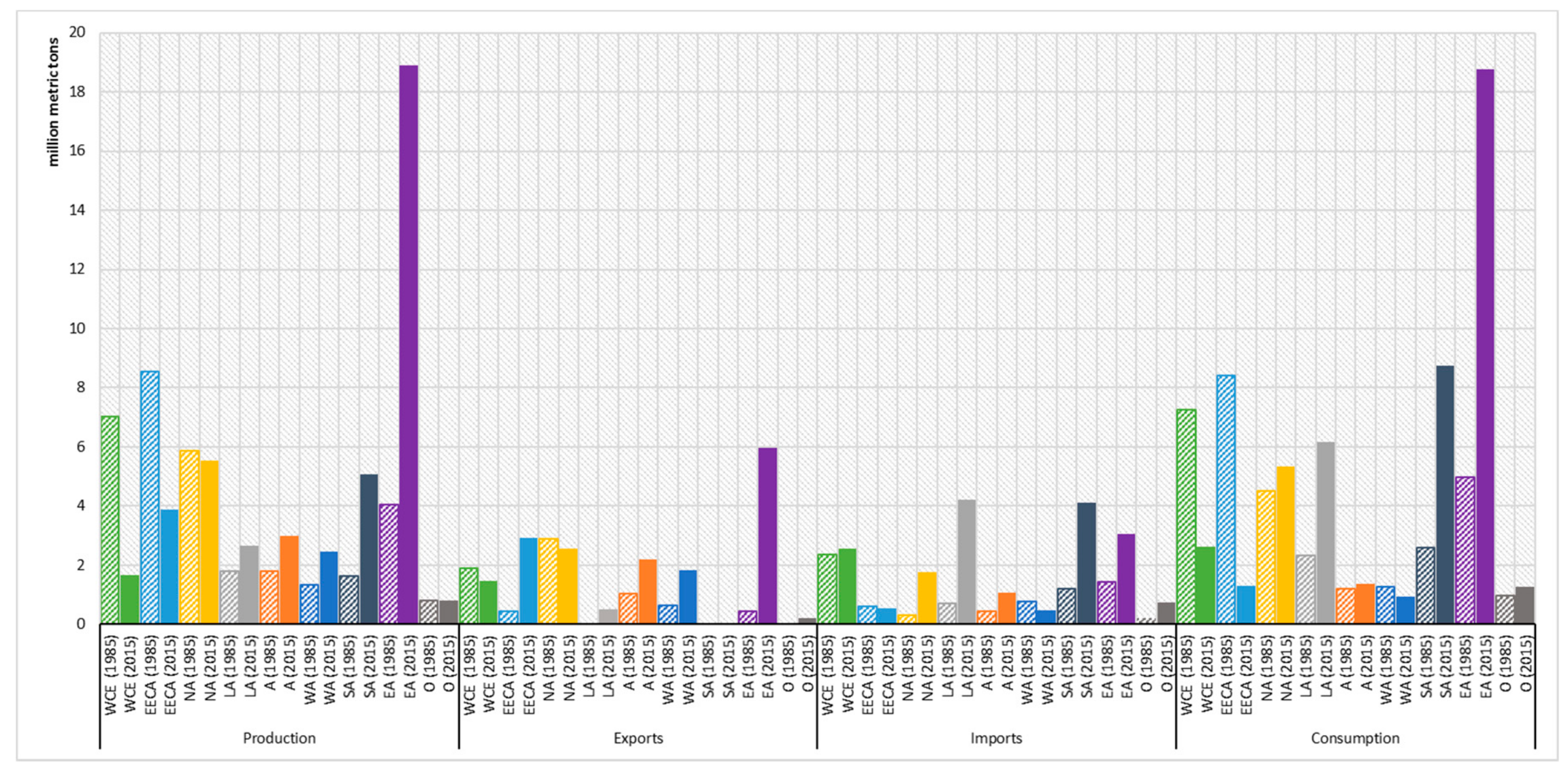
Nowadays, P is almost exclusively produced by the mining of phosphate rock (PR) deposits of either sedimentary (87%) or igneous (13%) origin [7]. Currently, a total of 200 to 265 million metric tons [8] (depending on the data source), of marketable PR concentrate is mined and further processed to produce phosphorus fertilizer (83%) or industrial P (17%) [7]. Figure 1 provides a snapshot of the global situation, including production, consumption, imports, and exports, for the end use of phosphate nutrients in fertilizers in 1985 and 2015. It also shows China’s dominant position (as part of eastern Asia) in terms of production and consumption, as well as increasing import dependency for regions such as Europe.
Figure 1.
Production, exports, imports, and consumption of P2O5 in fertilizers for the years 1985 and 2015 (WCE: Western and Central Europe; EECA: Eastern Europe and Central Asia; NA: North America; LA: Latin America; A: Africa; WA: Western Asia; SA: Southern Asia; EA: Eastern Asia; O: Oceania) based on IFA (International Fertilizer Association) data (http://ifadata.fertilizer.org/ucSearch.aspx).
All the above make phosphorus and its primary source, phosphate rock, a unique mineral raw material embedded in a complex global supply chain. This complexity is well documented in the literature (e.g., [9,10]), but only a few authors aim toward clearing the smoke of complexity. Still, interest in the field is growing, as numerous special issues with varying foci have shown over the last few years (selected issues):
- December 2015, edited by Roland W. Scholz and Thomas Hirth: “Losses and Efficiencies in Phosphorus Management” in Resources, Conservation and Recycling (Vol. 105, Part B, Pages 211–368)
- January 2016, edited by Andrea E. Ulrich: “Special Issue on Sustainable Phosphorus Taking stock: Phosphorus supply from natural and anthropogenic pools in the 21st Century” in Science of The Total Environment (Vol. 542, Part B, Pages 1005–1168)
- April 2016, edited by Thomas Nesme and Paul J. A. Withers: “Integrating Approaches to Sustainable Phosphorus Management in Agroecosystems” in Nutrient Cycling in Agroecosystems (Vol. 104(3), Pages 259–427)
Our aim is to contribute to a more holistic understanding of the underlying system dynamics along the supply chain for the benefit of scientific peers, industries, the public, and policy makers. The latter, especially, are the key to managing this limited resource in a more sustainable manner.
1.1. Essentiality, Criticality, Scarcity, and the Peak Theory
The question regarding available or potential substitutions represents the main distinction between criticality and essentiality. Scholz and Wellmer [11] use the example of energy; whereas energy is essential for society, the lack of primary resources such as uranium can be considered critical, but the basic function of producing energy, heat, motion, light, and power can be fulfilled by every energy source. Phosphorus, by contrast, represents one of the three macronutritional elements besides nitrogen (N) and potassium (K), and because it is not substitutable at all, P must be considered essential.
One major driver of the recent “popularity” of phosphorus is the ongoing discussion on scarcity. The literature reveals several types of scarcity [12,13,14], whereby this distinction is often neglected in discussions of P. The first is absolute scarcity, which equals the physical (un)availability (i.e., physical scarcity) of, in our case, a mineral. Second, relative scarcity deals with (un)availability under economic constraints (i.e., economic scarcity). Typically, economic scarcity occurs long before physical scarcity, as the extraction (in our case) of a mineral might still be possible from a technical stance, but the involved costs would exceed the willingness to pay for the mineral. Third and finally, structural scarcity represents a form of scarcity where the relationship between joint products (i.e., companion products or co-products) or by-products depends on (a) further (primary) product(s).
Most discussions about P or PR scarcity and its future availability have evolved around Hubbert’s peak theory [15]. Originally used to model the oil market, the concept was used for phosphate rock, and soon the term “peak phosphorus” was coined, raising great awareness. Much has been written about its highly controversial application to the case of P in recent years, for example [16,17,18,19,20], mostly around lack of availability of URR (ultimate recoverable resources) data and the comparability of oil and PR markets. However, this aspect is not within the scope of this special issue, and we point interested readers to the references mentioned above.
1.2. Economy, Circular Principles, and the Role of Innovation
Merriam-Webster defines economy as (1) “the structure or conditions of economic life in a country, area, or period; also: an economic system”, respectively; (2a) as the “thrifty and efficient use of material resources: frugality in expenditures; also: an instance or a means of economizing” [21]. In other words, an economy must be seen as a real-world system constraint by either geographic or temporal borders, which deals with resources based on the assumption of the rational choice of all agents [22]. However, circular economy (CE) is a concept that broadens the thoughts on purely economic rational choice in favor of sustainable development. The Ellen MacArthur Foundation defines it as follows:
“A circular economy is one that is restorative and regenerative by design and aims to keep products, components, and materials at their highest utility and value at all times, distinguishing between technical and biological cycles. This new economic model seeks to ultimately decouple global economic development from finite resource consumption. A circular economy addresses mounting resource-related challenges for business and economies, and could generate growth, create jobs, and reduce environmental impacts, including carbon emissions” [23].
Whereas we see a CE as a target state to aspire in a future economy, today’s challenge must be to consider ways of operationalizing this goal. The application of circular principles, including circular production and use, to ultimately form circular supply chains is inevitable. Nevertheless, the transition from today’s mostly linear supply chains requires a change in consumption behaviors, decision-making processes, and respective legislative frameworks. This involves firms and consumers on the microeconomic level, as well as policy makers on the macroeconomic level [22]. Innovation itself may be seen as a vehicle for change, whereby it is important to consider the multiplicity of innovation per se. Thus, rather than focusing solely on product and process innovation, we should also consider structural and social innovations of varying degrees (i.e., radical to incremental innovations) [24].
2. The Content of This Special Issue
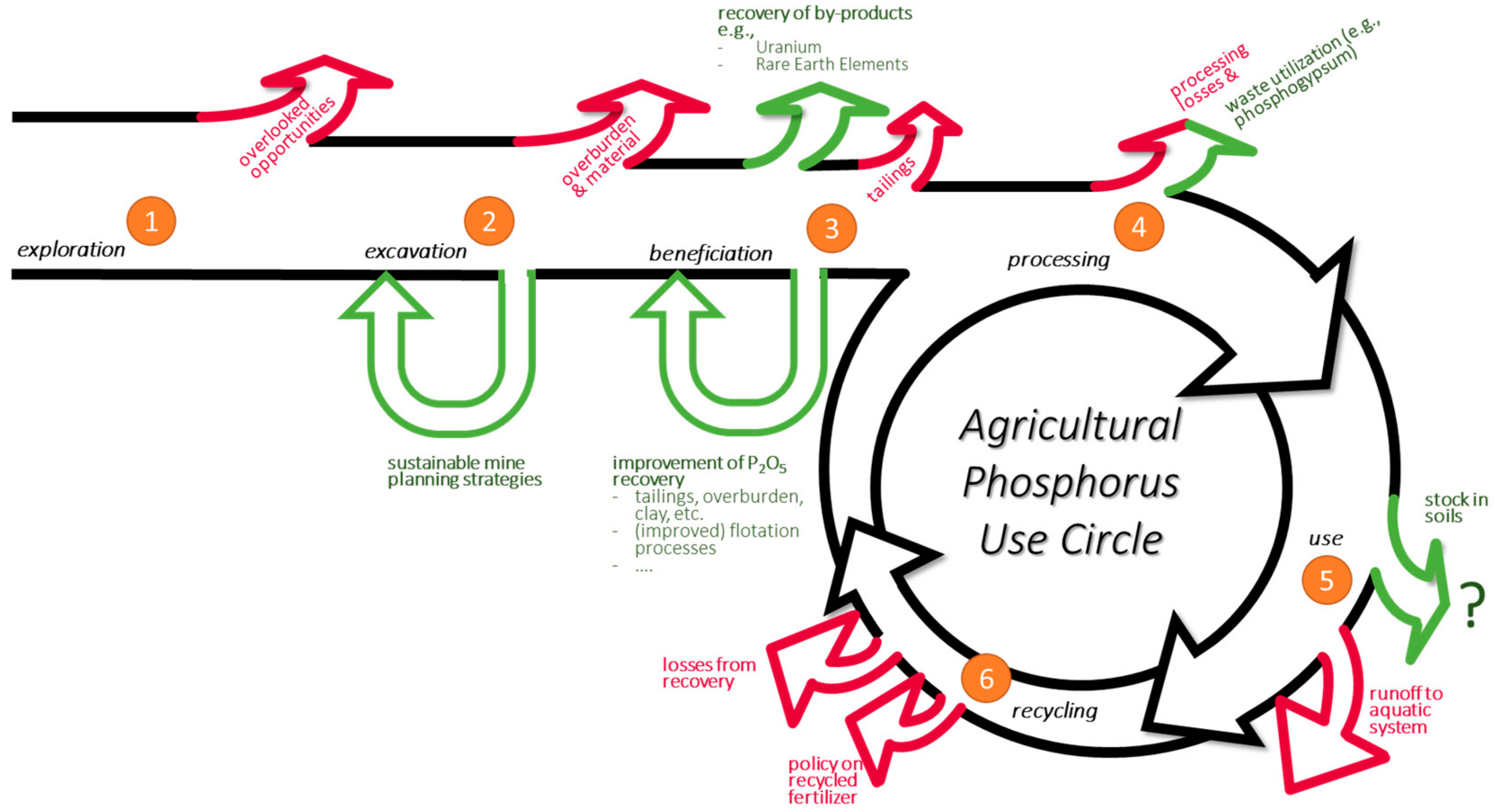
Although in a perfect CE, primary resource consumption (i.e., mining) would be obsolete, there is a long way to go to reach that stage, and for now, mining remains an essential factor. [25]. However, if we break down the goal of attaining an overall circular economy into subgoals, such as a phosphorus circular economy, the complexity can be reduced. This will require an adjustment about how we perceive an economy. As stated above, common definitions foresee a system bound by either geographic or time-frame means. Thus, if we consider a phosphorus CE, we define the value chain of P as the defining system boundary [22]. Below, Figure 2 is a first attempt to build on the linear Extended Phosphorus Supply Chain first introduced by Steiner et al. [26]. The agricultural phosphorus use cycle consists of the main phases of a P supply chain (black), some of the major losses involved in each phase (red), and several key challenges along the chain (green) where principles might be applied toward a circular economy of P and potential contributions made to an overall CE (e.g., the recovery of by-products such as uranium and rare earth elements or waste utilization).
Figure 2.
Circular principles for moving toward a circular phosphorus economy based on [22] categorizing [27,28,29,30,31,32,33,34,35,36,37,38,39].
Subsequently, Table 1 lists all contributions in the special issue. It is arranged in ascending order according to their main scope along the agricultural P use cycle. Each entry is complemented by core messages in a very brief summary of the main findings, as well as the keywords provided by the authors.
Table 1.
Publications of the special issue categorized by their scope. P—phosphate; PR—phosphate rock.
3. Conclusions and Outlook
Great appreciation goes to all participating authors, the numerous anonymous reviewers, and the editorial team of Sustainability. Without each of them, this special issue would never have been possible. In our attempt to provide a clear and coherent storyline across the potential single contributions of this SI, we also organized an authors’ workshop in November 2017, the 1st International Göttweig Mineral Resource Summit. This event was organized under the umbrella of the Transdisciplinarity Laboratory Sustainable Mineral Resources at Danube-University Krems in Austria (see www.donau-uni.ac.at/smr-tdlab).
We are positive that each single contribution on its own contributes significantly to the field of phosphorus research. Thus, in coherent consideration of the form of this special issue, it should be seen as a state-of-the-art starting point for further research contributing to the journey toward sustainable management of this essential resource and, ultimately, to a circular economy of phosphorus.
Author Contributions
Both authors contributed equally to this editorial and in the process of guest editorship.
Acknowledgments
We thank Michael C. Mew for his valuable feedback and Elaine Ambrose for the thoughtful language editing of this paper.
Conflicts of Interest
The authors declare no conflict of interest.
References
- Krauss, U.H.; Saam, H.G.; Schmidt, H.W. International Strategic Minerals Inventory Summary Report-Phosphate; U.S. Geological Survey: Reston, VA, USA, 1984. [Google Scholar]
- Smil, V. Phosphorus in the environment: Natural flows and human interferences. Annu. Rev. Energy Environ. 2000, 25, 53–88. [Google Scholar] [CrossRef] [Scilit]
- Asimov, I. Asimov on Chemistry; Doubleday & Company: Garden City, NY, USA, 1974; ISBN 978-0-385-04100-3. [Google Scholar]
- Scholz, R.W.; Roy, A.H.; Hellums, D.T. Sustainable phosphorus management: A transdisciplinary challenge. In Sustainable Phosphorus Management; Scholz, R.W., Roy, A.H., Brand, F.S., Hellums, D.T., Ulrich, A.E., Eds.; Springer: Dordrecht, The Netherlands, 2014; pp. 1–128. ISBN 978-94-007-7249-6. [Google Scholar]
- Erisman, J.W.; Sutton, M.A.; Galloway, J.; Klimont, Z.; Winiwarter, W. How a century of ammonia synthesis changed the world. Nat. Geosci. 2008, 1, 636–639. [Google Scholar] [CrossRef] [Scilit]
- Stewart, W.M.; Dibb, D.W.; Johnston, A.E.; Smyth, T.J. The contribution of commercial fertilizer nutrients to food production. Agron. J. 2005, 97, 1–6. [Google Scholar] [CrossRef] [Scilit]
- Prud’homme, M. Trends in Global Phosphate Supply. In Proceedings of the 5th Sustainable Phosphate Summit, Kuming, China, 17 August 2016. [Google Scholar]
- Geissler, B.; Steiner, G.; Mew, M.C. Clearing the fog on phosphate rock data—Uncertainties, fuzziness, and misunderstandings. Sci. Total Environ. 2018, 642, 250–263. [Google Scholar] [CrossRef] [Scilit] [PubMed]
- De Ridder, M.; de Jong, S.; Polchar, J.; Lingemann, S. Risks and Opportunities in the Global Phosphate Rock Market—Robust Strategies in Times of Uncertainty; The Hague Centre for Strategic Studies: The Hague, The Netherlands, 2012. [Google Scholar]
- Van Kauwenbergh, S.; Steward, M.; Mikkelsen, R. World Reserves of phosphate rock a dynamic and unfolding story. Better Crops 2013, 97, 18–20. [Google Scholar]
- Scholz, R.W.; Wellmer, F.-W. Interactive comment on “Recent revisions of phosphate rock reserves and resources: Reassuring or misleading? An in-depth literature review of global estimates of phosphate rock reserves and resources” by J.D. Edixhoven, et al. Earth Syst. Dyn. Discuss 2013, 4, C574–C598. [Google Scholar]
- Wolfensberger, M.; Lang, D.J.; Scholz, R.W. (Re-)Structuring the Field of Non-Energy Mineral Resource Scarcity Summary of the Workshop “Scarce Raw Materials”; NSSI: Davos, Switzerland, 2007. [Google Scholar]
- Baumgärtner, S.; Becker, C.; Faber, M.; Manstetten, R. Relative and absolute scarcity of nature. Assessing the roles of economics and ecology for biodiversity conservation. Ecol. Econ. 2006, 59, 487–498. [Google Scholar] [CrossRef] [Scilit]
- Mudd, G.M.; Weng, Z.; Jowitt, S.M.; Turnbull, I.D.; Graedel, T.E. Quantifying the recoverable resources of by-product metals: The case of cobalt. Ore Geol. Rev. 2013, 55, 87–98. [Google Scholar] [CrossRef] [Scilit]
- Hubbert, M.K. Energy from fossil fuels. Science 1949, 109, 103–109. [Google Scholar] [CrossRef] [Scilit] [PubMed]
- Edixhoven, J.D.; Gupta, J.; Savenije, H.H.G. Recent revisions of phosphate rock reserves and resources: A critique. Earth Syst. Dyn. 2014, 5, 491–507. [Google Scholar] [CrossRef] [Scilit]
- Edixhoven, J.D.; Gupta, J.; Savenije, H.H.G. Recent revisions of phosphate rock reserves and resources: Reassuring or misleading? An in-depth literature review of global estimates of phosphate rock reserves and resources. Earth Syst. Dyn. Discuss. 2013, 4, 1005–1034. [Google Scholar] [CrossRef] [Scilit]
- Scholz, R.W.; Wellmer, F.-W. Comment on: “Recent revisions of phosphate rock reserves and resources: A critique” by Edixhoven et al. (2014)—Clarifying comments and thoughts on key conceptions, conclusions and interpretation to allow for sustainable action. Earth Syst. Dyn. 2016, 7, 1–15. [Google Scholar] [CrossRef] [Scilit]
- Geissler, B.; Steiner, G. Interactive comment on “Comment on: ‘Recentrevisions of phosphate rock reserves and resources: A critique’ by Edixhovenet al. (2014)—Phosphate reserves and resources: What conceptions and data do stakeholders need for sustainable action?” by R.W. Scholz et al. (2015). Earth Syst. Dyn. Discuss 2015, 6, C56–C68. [Google Scholar]
- Cordell, D.; White, S. Peak phosphorus: Clarifying the key issues of a vigorous debate about long-term phosphorus security. Sustainability 2011, 3, 2027–2049. [Google Scholar] [CrossRef] [Scilit]
- Merriam-Webster Definition of Economy. Available online: https://www.merriam-webster.com/dictionary/economy (accessed on 25 July 2018).
- Geissler, B.; Hermann, L.; Mew, M.C.; Steiner, G. Striving toward a phosphorus circular economy: The role of phosphate rock mining. Minerals 2018. forthcoming. [Google Scholar]
- Ellen MacArthur Foundation. Towards a Circular Economy: Business Rationale for an Accelerated Transition; Ellen MacArthur Foundation: Isle of Wight, UK, 2015; p. 20. [Google Scholar]
- Geissler, B.; Mew, M.C.; Matschullat, J.; Steiner, G. The phosphate rock mining-innovation nexus. GAIA 2018, forthcoming. [Google Scholar]
- Wellmer, F.-W. Nachhaltigkeit und Rohstoffgewinnung—ein Widerspruch? Sustainability and Exploitation of Raw Materials—A Contradiction? Erdöl Erdgas Kohle 2016, 132, 46–85. [Google Scholar]
- Steiner, G.; Geissler, B.; Watson, I.; Mew, M.C. Efficiency developments in phosphate rock mining over the last three decades. Resour. Conserv. Recycl. 2015, 105, 235–245. [Google Scholar] [CrossRef] [Scilit]
- Bongaerts, J.C. A model for the optimal recovery of multiple substances from waste water with a focus on phosphate. Sustainability 2018. forthcoming. [Google Scholar]
- De Boer, M.A.; Romeo-Hall, A.; Rooimans, T.; Slootweg, J. An assessment of the drivers and barriers for the deployment of urban phosphorus recovery technologies: A case study of the Netherlands. Sustainability 2018, 10, 1790. [Google Scholar] [CrossRef] [Scilit]
- Hermann, L.; Kraus, F.; Hermann, R. Phosphorus processing—Potentials for higher efficiency. Sustainability 2018, 10, 1482. [Google Scholar] [CrossRef] [Scilit]
- Jedelhauser, M.; Mehr, J.; Binder, C. Transition of the Swiss phosphorus system towards a circular economy—Part 2: Socio-technical scenarios. Sustainability 2018, 10, 1980. [Google Scholar] [CrossRef] [Scilit]
- Khabarov, N.; Obersteiner, M. Modeling global trade in phosphate rock within a partial equilibrium framework. Sustainability 2018, 10, 1550. [Google Scholar] [CrossRef] [Scilit]
- Mehr, J.; Jedelhauser, M.; Binder, C. Transition of the Swiss phosphorus system towards a circular economy—Part 1: Current state and historical developments. Sustainability 2018, 10, 1479. [Google Scholar] [CrossRef] [Scilit]
- Mew, M.C.; Steiner, G.; Geissler, B. Phosphorus supply chain—Scientific, technical, and economic foundations: A transdisciplinary orientation. Sustainability 2018, 10, 1087. [Google Scholar] [CrossRef] [Scilit]
- Oster, M.; Reyer, H.; Ball, E.; Fornara, D.; McKillen, J.; Sørensen, K.; Poulsen, H.; Andersson, K.; Ddiba, D.; Rosemarin, A.; et al. Bridging gaps in the agricultural phosphorus cycle from an animal husbandry perspective—The case of pigs and poultry. Sustainability 2018, 10, 1825. [Google Scholar] [CrossRef] [Scilit]
- Römer, W.; Steingrobe, B. Fertilizer effect of phosphorus recycling products. Sustainability 2018, 10, 1166. [Google Scholar] [CrossRef] [Scilit]
- Someus, E.; Pugliese, M. Concentrated phosphorus recovery from food grade animal bones. Sustainability 2018, 10, 2349. [Google Scholar] [CrossRef] [Scilit]
- Strauch, S.; Wenzel, L.; Bischoff, A.; Dellwig, O.; Klein, J.; Schüch, A.; Wasenitz, B.; Palm, H. Commercial African catfish (Clarias gariepinus) recirculating aquaculture systems: Assessment of element and energy pathways with special focus on the phosphorus cycle. Sustainability 2018, 10, 1805. [Google Scholar] [CrossRef] [Scilit]
- Wellmer, F.-W.; Scholz, R. What is the optimal and sustainable lifetime of a mine? Sustainability 2018, 10, 480. [Google Scholar] [CrossRef] [Scilit]
- Withers, P.; Doody, D.; Sylvester-Bradley, R. Achieving sustainable phosphorus use in food systems through circularisation. Sustainability 2018, 10, 1804. [Google Scholar] [CrossRef] [Scilit]

© 2018 by the authors. Licensee MDPI, Basel, Switzerland. This article is an open access article distributed under the terms and conditions of the Creative Commons Attribution (CC BY) license (http://creativecommons.org/licenses/by/4.0/).