1. Introduction
The industrial sector is one of the major greenhouse gas (GHG) emitters worldwide [
1]. According to the International Energy Agency (IEA), it accounted for 80% of the global final consumption of coal and 42.5% of world electricity consumption in 2014 [
2]. Industrial sector electricity consumption has grown over the past decades [
3] and this trend is likely to continue [
4]. The energy intensity of the industrial sector has improved [
5], but must decrease further if the 2 °C goal adopted under the Paris Agreement, the latest major agreement in the international process under the United Nations Framework Convention on Climate Change (UNFCCC) [
6], is to be achieved [
5].
Both the UN 2030 Agenda for Sustainable Development, including its Sustainable Development Goals (SDGs) [
7], and the Paris Agreement assign technology an important role in achieving climate change mitigation and sustainable development. Target 4 of SDG 9, which focuses on infrastructure, industrial development, and innovation, underscores the need to “upgrade infrastructure and retrofit industries to make them sustainable, with increased resource-use efficiency and greater adoption of clean and environmentally sound technologies and industrial processes” [
7]. SDG 12 on responsible consumption and production, though not explicitly mentioning technology, prompts societies to “achieve the sustainable management and efficient use of natural resources” by 2030 [
7]. Article 10 of the Paris Agreement calls on strengthening cooperative action on technology development and transfer to foster climate change mitigation and adaptation [
6].
Against this backdrop and technological advances, particularly in the field of modern information and communication technologies (ICTs), intergovernmental organizations (IGOs) working at the intersection of climate change, sustainable energy, and industrial development have begun to consider the digital transformation of industrial processes in the light of climate change mitigation.
In the past years, digital technologies, such as cyber-physical systems, artificial intelligence, Big Data, augmented and virtual reality, and 3D-printing, have entered the sphere of industrial production and given rise to the notion of a “fourth industrial revolution” or “Industry 4.0”. The term was first established at the Hannover fare 2011 and further elaborated by a technological advisory board to the German government [
8]. A common definition for the term, “Industry 4.0”, is yet to be established within the scientific community [
9,
10]. However, when comparing recognized publications on this topic, such as [
9,
11,
12], a set of key characteristics can be identified that is commonly used to describe the concept of Industry 4.0. These publications explicitly or implicitly describe Industry 4.0 as being based on digital (or virtual) processes in which manufacturing systems and to-be-manufactured products are linked (or interconnected). Manufacturing is performed by decentralized and intelligent (or autonomous) machinery. The use of so-called cyber-physical systems (CPS) makes these smart factories highly flexible, enabling the application of self-organized and self-optimized manufacturing processes and facilitating affordable mass customization (or individualization-on-demand) [
9,
10,
11,
12]. While some technological elements of the Industry 4.0 concept are already widespread in the industrial sector (the use of 3D-printing and other additive manufacturing technologies in the aerospace sector is one prominent example), the comprehensive implementation of digitalized and interconnected processes along the entire product creation process remains an exception in the existing industrial landscape.
Although the implementation of Industry 4.0 is still in its infancy, we argue that there is an emerging discourse of IGOs on the role of digital technologies for the transformation of the industrial sector towards more climate-friendly and sustainable modes of production. In our understanding of discourses, we draw on Norman Fairclough, who describes discourses “as ways of representing aspects of the world—the processes, relations, and structures of the material world, the ‘mental world’ of thoughts, feelings, beliefs, and so forth, and the social world. […] Discourses not only represent the world as it is (or rather is seen to be), they are also projective, imaginaries, representing possible worlds which are different from the actual world, and tied in to projects to change the world in particular directions” [
13]. In the context of this paper, we view the Paris Agreement and the United Nations Sustainable Development Goals (UN SDGs) [
7]—two major international policy frameworks for sustainable development—as projects that aim “to change the world” [
13] by fostering efforts toward climate change mitigation and promoting sustainable solutions. The emerging discourse of IGOs on Industry 4.0 and climate change ties into these two projects and affects their implementation. It is therefore worthwhile taking a closer look at the assumptions underlying this discourse as well as how the role of Industry 4.0 is framed in it.
Consequently, the first research question this paper aims to address is: How do IGOs working at the intersection of climate change, sustainable energy, and industrial development view the role of Industry 4.0 in climate change mitigation? To provide meaningful conclusions that could inform the discussion around this issue at the international policy level and inspire further research, we furthermore juxtapose the views of IGOs with results from current research and ask a second question: What evidence exists in the scientific literature to support these views?
To answer both research questions, we will first analyze how Industry 4.0 and similar notions have been taken up by IGOs in the discussion on the decarbonization of the industrial sector and its transformation toward sustainable energy use. Based on this analysis, we will identify central assumptions for the role of Industry 4.0 in climate change mitigation. We will then review scientific journal articles dealing with both Industry 4.0 and relevant topics, such as energy efficiency or material savings, to better understand what is already known about the decarbonization potential of Industry 4.0. Subsequently, we compare the findings from both analyses to identify gaps and overlaps between science and policy.
This paper is structured as follows: In the following section, we will outline our methodological approach. We will then present the results of an analysis of key documents from IGOs and a scientific literature review. We close this paper by discussing and linking the results of both parts of our analysis to draw conclusions.
2. Materials and Methods
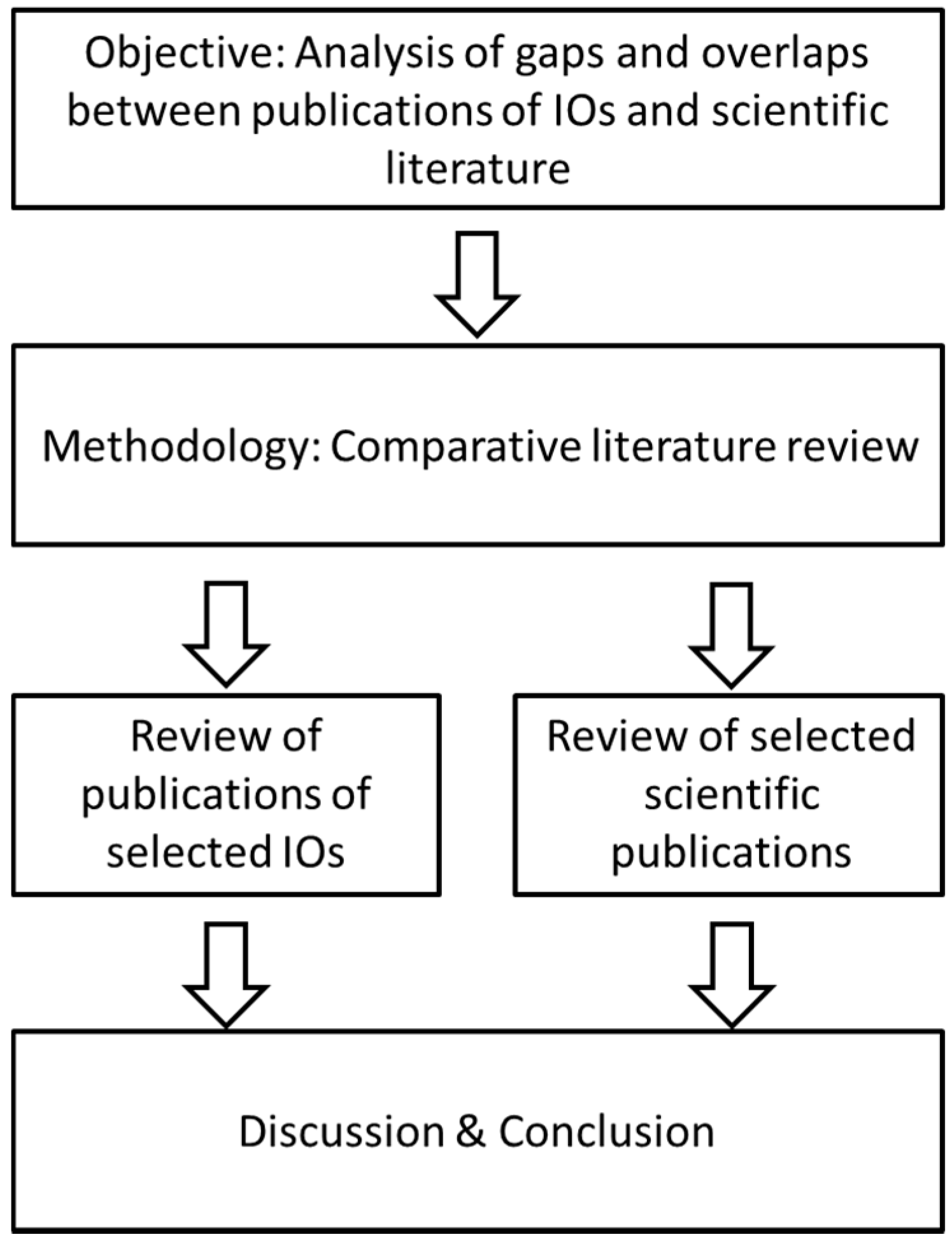
To answer its research questions, this paper applies a two-tier approach: First, we analyze relevant publications by selected IGOs to identify their understanding of the role of Industry 4.0 and related technologies in climate change mitigation. In the second part of our analysis, we conduct a review of peer-reviewed journal articles on Industry 4.0 and its potential for sustainable energy use and climate change mitigation. Finally, we juxtapose our findings to identify meaningful conclusions to further inform policymaking as well as research in the field of Industry 4.0 and climate change mitigation.
Figure 1 provides an overview of our approach. The subsequent sections outline each step of our analysis in more detail.
2.1. Approach to the Review of IGOs’ Views on Industry 4.0 and Climate Change Mitigation
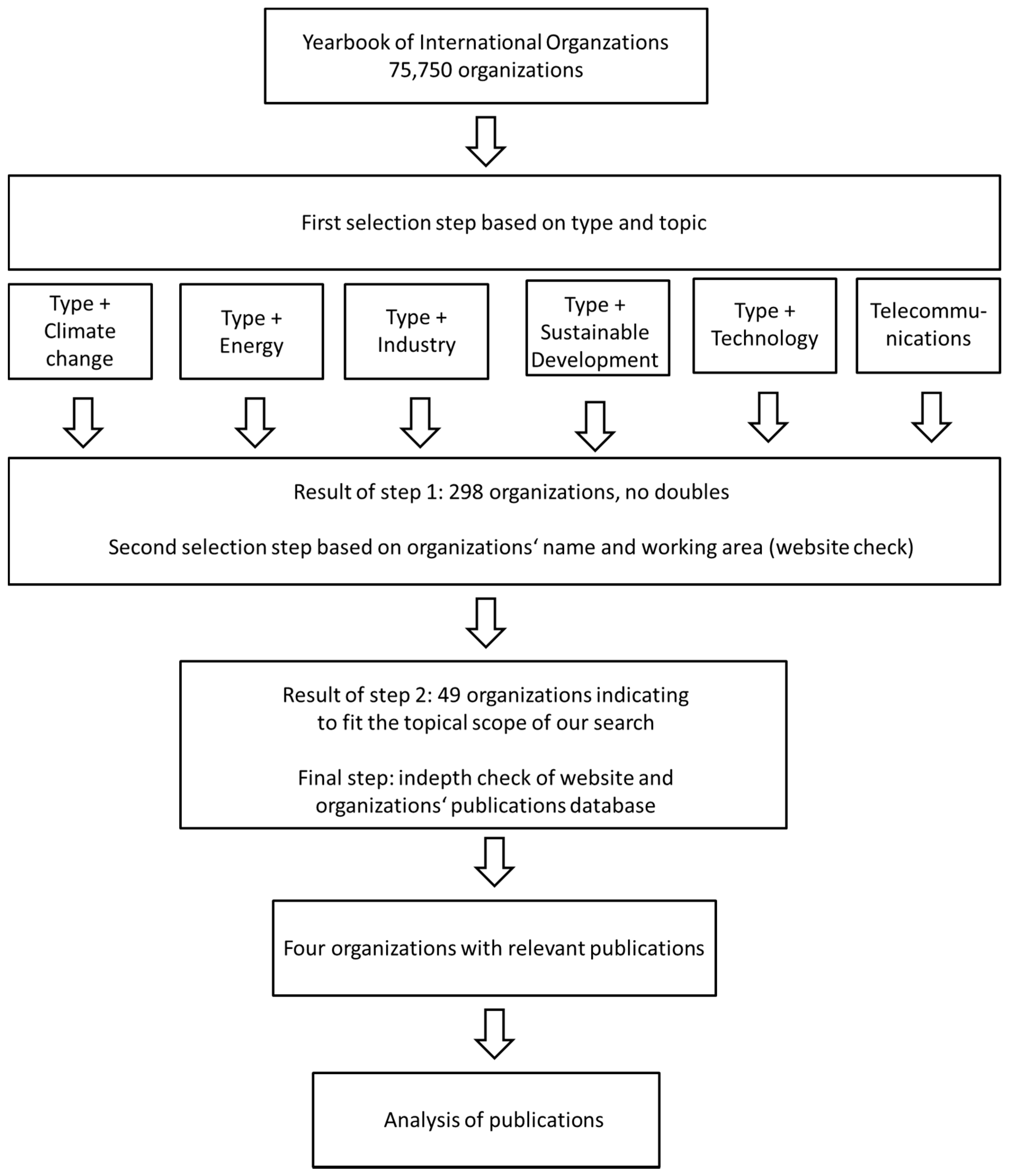
The aim of the first part of our analysis is to identify the key statements and assumptions of selected IGOs regarding the potential of Industry 4.0 for climate change mitigation. The identification and selection of IGOs to be relevant in this regard was conducted as follows: We used the online version of the Yearbook of International Organizations 2017 [
14], published by the Union of International Associations (UIA), which covers over 75,000 international associations, to identify relevant international organizations for our analysis. First, potentially relevant international organizations were extracted from the database based on two criteria: (1) Type of organization and (2) the thematic scope. We limited the scope of our search to universal membership organizations and organizations emanating from places, persons, proprietary products, or other bodies, including intergovernmental organizations, and excluding other international organizations, such as foundations or research institutes as well as internationally-oriented national institutions, to represent the current discourse on the level of intergovernmental organizations. To identify the thematically most suitable organizations, we used keywords from the subject index provided by the database as another selection criterion. The Yearbook of International Organizations provides a detailed explanation of the methodology for the development of the subject index. According to this methodology, the subject index is based on “words taken directly from the titles and profiles of international organizations” [
14]. We applied the following six keywords from the subject index for our search: Climate change, energy, industry, sustainable development, technology, and telecommunications. Since the database does not allow a combination of keywords, each keyword was individually used to extract potentially relevant organizations of the specific organization types mentioned above. This first selection step based on type and thematic scope resulted in 298 results (without doubles).
This sample was narrowed down to the most relevant IGOs in two subsequent steps. Firstly, those organizations were excluded whose names and areas of focus did not apparently fit the broad thematic scope of the nexus of sustainable energy, climate change, and industrial development. This step was necessary as many of the search results only matched a single topical area or had little or no overlap with the other topics relevant to our study. We identified 49 organizations whose name and working area indicated that they could by relevant for our research. Using the publication databases of these organizations, we then researched their websites for relevant publications focused on the topic of Industry 4.0 or related terms and concepts. We considered publications dealing exclusively with this topic as well as those that addressed the issue of Industry 4.0 in a broader context. Informal publications, such as blog entries or workshop reports, were not included in our search. We concentrated on reports and working papers, since they indicate an already more manifested interest in and occupation with a specific topic. The scope of this search was limited to documents published since 2008, however, most of the relevant publications that we found were published within the past few years. This is hardly surprising as the debate about Industry 4.0 is still very young.
We identified seven organizations with relevant publications, three of which emanated from one of the other organizations. Therefore, in total, we identified four IGOs that were relevant to our research.
Figure 2 provides an overview of the selection process for the IGOs.
These four organizations are the International Energy Agency (IEA), the International Renewable Energy Agency (IRENA), the International Telecommunication Union (ITU), and the United Nations Industrial Development Organization (UNIDO). We searched the identified publications of these four organizations for key terms, such as “Industry 4.0”, “internet of things”, “industrial internet of things”, “digitalization/digitalization”, “advanced manufacturing”, “additive manufacturing” as well as “digital transformation/revolution/disruption”, and analyzed whether and how these terms were mentioned in the context of climate change mitigation and the transformation toward sustainable energy solutions. The results of this analysis are presented in
Section 3.
2.2. Approach for Review of Scientific Literature
The second part of our analysis aims at providing insights from scientific literature with respect to current knowledge of the climate change mitigation potentials of Industry 4.0. For that purpose, we decided to systematically review the scientific literature for publications dealing with both Industry 4.0 and sustainability (both terms were also represented using their key characteristics and synonymous terms), making use of the Scopus database for this purpose. This database was selected on the basis that it is one of the largest abstract and citation databases of peer-reviewed literature and covers all the important journals relevant to the topics addressed in this paper. To safeguard scientific rigor and quality while ensuring that the quantity of potentially relevant results remained manageable, we opted to exclude conference papers as well as project reports (such as reports from Horizon2020 projects, unless published as peer-reviewed papers) as these often do not satisfy the strict quality requirements of a peer-review process. In addition, the database query was limited to peer-reviewed journal articles written in English. This first step resulted in 119 potentially interesting papers. In a second step, these articles were then assessed regarding their relevance by manually reviewing their abstracts. Papers that fulfilled the following criteria were selected for further analysis:
The article deals with the topic of resource/energy efficiency or resource/energy saving as a main topic. This approach excluded articles only mentioning efficiency or productivity improvements without researching the phenomena as such.
The article deals with Industry 4.0 or related key technologies (such as machine-to-machine communication, as it is a necessary precondition to enable autonomously acting interconnected machine systems) or concepts as a second main topic. This means that we excluded articles discussing single technological solutions (such as robotics or 3D printing) if they were not dealt with in an Industry 4.0 context.
As a result, 16 papers were selected for further analysis, i.e., they were reviewed for scientific evidence regarding the validation of energy efficiency improvements and potential quantifications of those improvements. The systematic literature review process is visually summarized in
Figure 3. After closely reading the articles, one of the papers was excluded in a final step. Six additional relevant papers were discovered in the “state of the art” sections of the analyzed articles and were also included in the literature review, adding up to a total of 21 papers reviewed for our analysis.
3. Assumptions and Claims about the Potential of Industry 4.0 for Climate Change Mitigation
Although modern digital technologies or, more specifically, the concept of Industry 4.0 are not explicitly mentioned in the Paris Agreement or the SDGs, the important role that technology plays in both projects provides entry points to tie in the discussion of Industry 4.0 and climate change mitigation. Our research shows that very few IGOs, to be precise only four, have picked up this topic in a substantive manner, but those who do belong to some of the most relevant and active IGOs in the field of sustainable energy and industrial development. In the following, we briefly summarize the IGOs’ views on the role of Industry 4.0 in reducing carbon emissions and fostering sustainable energy use as presented in key publications.
In one of their latest reports, the IEA [
15] provides a comprehensive view on the relation between digitalization and energy. In a chapter dedicated to the “[i]mpact of digitalization on energy demand in transport, buildings and industry”, the report highlights that it is “difficult to present a single figure for the energy savings that digitalization can yield in industry, as potential savings vary according to the type of activity, management systems, culture and the degree of integration along supply value chains. That said, real-plant data show that energy efficiency gains from the application of advanced digital process controls can yield significant savings at little or no net cost” [
15]. Furthermore, the report specifically points to potential energy and resource savings through 3D printing “under the right conditions” [
15] and its potential to fundamentally alter manufacturing processes. Since 3D printing requires electricity, it could stimulate the “electrification of thermal forming processes such as metal casting and forging” [
15]. This could eventually lead to reductions in carbon emissions “to the extent that power generation is decarbonised” [
15]. In summary, the report highlights the potentials of digital technologies to increase energy and resource efficiency in the industry and to contribute to the integration of renewable energies into electricity generation, but stays rather vague in terms of concrete energy and resource saving potentials. It is also noticeable that where efficiency potentials of digital technologies in industrial contexts are mentioned, only few references to scientific literature are made, mostly related to transportation and 3D printing. Throughout the report, digital technologies are predominately viewed as an enabler for more sustainable practices. However, the section presenting recommendations for policy makers also points out that “[c]onnected devices also have energy and environmental impacts from manufacture and disposal (e.g., electronic waste)” [
15] and therefore calls on considering the potentially adverse effects of digitalization on environmental protection in policy-making.
IRENA, similarly to the IEA, focuses particularly on the role of digital technologies for the transformation of the power sector [
16]. In its 2018 report on “Global Energy Transformation” [
17], however, the organization also briefly touches upon the interplay of renewable energies, digital technologies, and the industry, e.g., by highlighting that “[n]ew energy sources, in combination with information and communication technologies (ICT), are changing the entire transport industry” [
17]. In the section on the industrial sector, the report further points to improved process efficiency and the adoption of demand side management solutions as important contributions (among others) to increase energy efficiency of industrial production [
17]. To accelerate the energy transition, the report advises policy-makers to utilize “information communication technology and digitalization, along with demand side management, to reduce peak electricity demand, lower the need to invest in power capacity, and reduce operational costs” [
17]. Digital technologies are thus seen as one building block contributing to an overall more flexible, efficient, and climate friendly energy system. Energy and resource efficiency potentials of digital technologies in the industrial sector are, however, not dominant subjects in the report.
A UN agency specialized in modern ICTs, the ITU, addresses the link between digital technologies and climate change as well as sustainable development in several ways, e.g., regarding the energy efficiency of ICTs as well as their potential for climate change adaptation and mitigation in other sectors. It does so not in one specialized publication, but in several documents and on its website, which is why we made an exception from our focus on key publications and took a broader perspective on the materials provided on the ITU website. On this website, the organization has dedicated a special section to outlining the potential contribution of ICTs to the implementation of the SDGs [
18]. Industry 4.0 and the Internet of Things (IoT) are highlighted in the context of implementing SDG 9 on industry, innovation, and infrastructure [
19] and efforts to foster a circular economy. For example, the 8th Green Standards Week, organized by ITU in cooperation with the UN Habitat, United Nations University (UNU), UNIDO, Basel Convention, and UN Environment, was dedicated to the theme, “Linking circular economy and Industry 4.0” [
20]. In relation to SDG 12 (“Responsible consumption and production”), the website highlights that ICTs could contribute through “increased dematerialization and virtualization as well as innovative ICT applications enabling sustainable production and consumption” [
21]. While the ITU addresses the use of ICTs for climate change mitigation and adaptation in various contexts, it also puts particular emphasis on the ICT sector’s transformation towards more sustainable practices to lower the overall carbon footprint of ICTs themselves. In summary, modern digital technologies are viewed as enablers for clean industrial development, but again concrete figures or case studies regarding Industry 4.0 and climate change mitigation are lacking.
Against the backdrop of their longstanding work around clean energy and efficiency technologies in the industry, UNIDO has taken up the question of how the digital transformation of the industrial sector could be linked to a transition toward sustainable energy use. Much stronger than the other organizations analyzed before, it thereby refers to the term, “Industry 4.0”, however, without providing a precise definition. In a 2017 publication that was co-authored by the authors of this paper, the organization gave a first overview of how digital technologies could contribute to energy efficiency in the industrial sector and support the integration of renewable energies [
22]. The SDGs and the Paris Agreement are important points of reference within the report, which considers in particular how the opportunities and challenges for sustainable energy use in the context of Industry 4.0 could vary between countries that find themselves at different stages of industrial development. The report concludes that the “interconnectedness and flexibility of Industry 4.0 technologies could also entail several opportunities to support the transition to sustainable energy systems”, but stresses that the exploitation of these opportunities is often a mere side-effect and not deliberately targeted [
22].
In conclusion, this overview of key publications and documents of four selected IGOs shows that they have all taken up the topic of Industry 4.0 in the broader context of the SDGs and the implementation of the Paris Agreement. When mentioned in this regard, Industry 4.0 is usually assumed to be an enabler for increasing energy and resource efficiency, some organizations also point to the potentials of dematerializing industrial production. It is notable that statements in this vein frequently are rather vague and lack references from scientific literature. Where potentials are mentioned, they are sometimes accompanied by a reference to the challenge of assessing total savings considering the energy and resource inputs necessary to produce and apply digital technologies. Possible rebound effects of energy and resource savings through digital technologies in industrial production remain largely unmentioned in the documents analyzed for this brief review. Besides the IRENA report that highlights the possibility of improved demand side management, potentials for fostering the integration of renewable energies by, for example, increasing the flexibility of industrial energy consumption, do not figure largely in the reviewed publications. A forward-looking and in-depth discussion of the concrete potentials (e.g., regarding energy efficiency in particularly energy-intensive industrial sectors) as well as barriers, necessary framework conditions, and success factors relevant to fostering more sustainable energy use in the industrial sector is still lacking.
4. Results from the Review of the Scientific Literature
The first part of our analysis showed several dominant assumptions related to the digitalization of industrial processes and their potential to contribute to climate change mitigation. The following section aims to provide a “reality check” for these assumptions and, in doing so, to assess the evidence available in the scientific literature that supports the assumption that Industry 4.0 could significantly contribute to sustainable energy use in the industrial sector and therefore to climate change mitigation.
The scientific journal articles that we reviewed for this second part of our analysis can be divided roughly into two categories: Those with a broader and mostly non-technical focus addressing different aspects of Industry 4.0 and sustainable development, and those that focus mainly on specific technical solutions in an Industry 4.0 context (e.g., IoT-based energy management systems).
Table 1 provides an overview of these two categories and the approaches and topics they address.
4.1. Non-Technical Papers on Industry 4.0 and Sustainable Development
The non-technical papers on Industry 4.0 and sustainable development can be further subdivided into articles that use a scenario or a vision to illuminate the future sustainable production and those papers that use surveys to examine the expectations of experts with respect to the impact of digitalization on sustainable industrial practices.
4.1.1. Scenario Papers
Herrmann (2014) presents an early attempt to combine digitalization and sustainability in a scenario. The paper describes trends in manufacturing against a background of “increasing demand for global resources and the inherent challenges accompanying this demand” [
23]. In the article, the author reviews the development of industry over the last two centuries from craft production through mass production to lean manufacturing and mass customization and ending with the rise of ICT and cyber-physical systems (CPS) as the present trend in research [
23]. On this basis, the author describes six studies of holistic factory concepts integrating perspectives on production structure, energy flows, resource flows, human factor, learning and social aspects, symbiosis and spatial context, and ICT and CPS. According to the author, none of the six discussed concepts deals with the topic of ICT and CPS, showing that these aspects have not been included in a holistic factory perspective yet. The author endeavors to describe a more sustainable factory of the future that encompasses symbiotic flows and urban integration; adaptable factory elements, like flexible production systems; production clouds and CPS; and a learning and training environment. The contribution of CPS to this sustainable factory of the future is not described in detail and the author’s assumptions are not based on empirical findings.
Waibel et al. (2017) give an overview of the technical, social, and environmental impacts of smart production systems. With respect to their environmental impacts, the authors suggest such systems will facilitate “the intelligent steering of the whole manufacturing process, to reduce waste, overproduction and energy consumption” [
24]. They also expect the companies of the future to play an active role in smart energy management, enabling companies to schedule “energy intensive task[s] when there is a natural overproduction of energy through wind or solar energy” [
24]. The authors also mention possible negative environmental effects, such as the energy consumption of data centers and the consumption of resources in the manufacturing of new devices [
24]. To avoid those negative effects, the authors suggest that regular assessments of possible effects should be conducted based on the model of an Environmental Impact Assessment Report. Overall, the authors provide a non-empirical scenario that outlines how smart manufacturing could contribute to greater resource efficiency, while also noting possible negative effects.
4.1.2. Expert Survey Papers
Drawing on a survey among 746 German manufacturing companies from five industry sectors, Müller et al. (2018) examine the opportunities and challenges arising in connection with the implementation of Industry 4.0, while also taking into account various aspects relevant to sustainability. A reduction in energy consumption is one benefit anticipated by the authors in the context of Industry 4.0. The authors identify optimized load balancing as the main lever for reductions in resource consumption. This can be achieved, they suggest, through intelligent task and process scheduling, smart energy systems, enhancements in product-lifecycle-management made possible by improved transparency and optimized logistics based on decentralized production. The authors test and confirm the hypothesis that these environmental and additional social benefits “have a positive effect on manufacturing companies’ tendency to implement Industry 4.0” and conclude that the “reduction of waste, energy and resource consumption as well as improved working conditions lead to a tendency towards Industry 4.0 implementation” [
25]. In sum, the authors demonstrate, on the one hand, that central individuals in companies expect Industry 4.0 to be beneficial for the environment, e.g., reducing energy and improving resource efficiency, and on the other hand, that those benefits are drivers for Industry 4.0 implementation in themselves. The results do not reveal how actual improvements in efficiency will be realized.
Kiel et al. (2017) examine benefits and challenges of the industrial internet of things (IIoT) in the context of all three dimensions of sustainability (economic, environmental, and social aspects) using a qualitative study and semi-structured interviews. Based on a literature review, they summarize examples of benefits in the three dimensions. For the environmental dimension, the following benefits are mentioned: Transparency of greenhouse gas emissions, increased resource and energy efficiency, reduction of waste, reduction of logistics processes, e.g., due to reshoring, reduction of wrong delivery, and damaged goods [
26]. It remains unclear whether these examples are derived from empirical findings. The results of the study suggest that the interviewed company representatives anticipate that resource efficiency will increase “due to optimized resource utilization” [
26]. According to the study, this applies in particular to the machine engineering sector, where production is highly specialized and would benefit from improved resource utilization [
26]. Interviewees from all sectors also anticipate resource efficiency gains to result from the increased use of digital simulations, continuous data, and autonomous control loops that enable leaner processes, and a reduction in manual activities due to higher automation levels [
26]. The authors also identified a number of challenges within the three dimensions that must be addressed by an emergent IIoT, for example, the development of standardized communication protocols for data interfaces, and data and information security. Challenges relevant to the environmental dimension were not identified by interviewees.
Beier et al. (2017) approach the Industry 4.0 transformation from a sustainability research perspective. Drawing on two surveys addressing industry in Germany and China, the authors examine how companies expect industrial digitalization will impact on different sustainability aspects. Their findings show that resource efficiency is expected to be an important topic in the context of digitalization for both Chinese and German companies. In the case of German companies, their findings suggest that a window of opportunity exists for the coupling of smart, renewable energy systems with smart companies, as one third of the companies stated that they plan to set up their own renewable energy facilities. Based on the empirical findings of their survey, the authors illustrate that there could be a window of opportunity for improved energy and resource efficiency through Industry 4.0. The research did not address where those potentials lie exactly and does not deliver a quantification of potentials [
27,
43].
Niehoff et al. (2018) summarize their results in a vision of a resource efficient factory of the future, based mainly on the findings of a survey among 102 German companies and complemented by two semi-structured interviews. The interviewees saw the biggest potential for improved resource efficiency in the prevention of overproduction resulting from a demand-driven production in ‘real time’, a more time-efficient production, and optimized logistics. Overall, the survey reveals high expectations for improved resource efficiency, but also points out “the need to include the resource consumption of additional technologies—in particular information and communication technologies used in the frame of Industry 4.0—when assessing possible impacts on resource efficiency” [
28].
4.2. Papers Focusing on Technical Solutions
A number of papers centered on technological solutions in the context of Industry 4.0 and will be presented in the following subsections. According to their thematic foci, these papers can be divided into the following subcategories: Energy Management Systems, Energy Monitoring, Big Data, Demand Response, Orchestration, and New Digital Production Processes.
4.2.1. Energy Management System (EMS)
Tao et al. analyze the existing applications of IoT in product life-cycle energy management (PLEM), and the potential applications and challenges of IoT techniques in PLEM [
29], drafting a roadmap for future research activities in the area of PLEM. The work of Li et al. (2017) complements this analysis by outlining the architecture and functional framework of an IoT-based industrial EMS to fully evaluate the operational level of energy-intensive equipment and by offering a comprehensive evaluation model for monitoring industrial energy conservation [
30]. In that manner, both papers help strengthen the theoretical basics for EMS, while avoiding qualitative or quantitative estimation of the implications for energy savings of such approaches.
On the application side, an EMS with the capacity to collect energy consumption data at the finely granular level of production facilities is presented in [
31]. The authors claim that this innovation would enable facilities to “achieve [the] Industry 4.0 criteria of self-dependent planning and controlling.” Similarly, Heutmann and Schmitt developed an energy-oriented module for a Manufacturing Execution System (MES) that enables employees to plan, monitor, and control production regarding energy consumption. The proposed module would enable operators to reschedule tasks or reduce loads rapidly in response to changing energy tariffs [
32]. The strengths of the module as presented include its ability to interact with existing industrial software tools and its responsivity to sudden shifts in renewable energy environments. The role and potential of EMS to improve energy efficiency in a digitalized industry is likely to increase, due to the inherent availability of machine data. However, little information is offered with respect to the validation of the presented solutions and the concrete potentials associated with such approaches.
4.2.2. Energy Monitoring
This shortcoming of the aforementioned EMS solutions could be tackled with the mathematical model presented by Oses et al., which would allow operators to better estimate energy savings potentials in manufacturing environments [
33]. Their model was validated in very specific conditions, but could offer a means to reliably model the baseline energy consumption of production facilities. On a more general level, Shrouf and Miragliotta (2015) suggest a framework that uses an IoT-based approach to integrate energy data into industrial IT tools to support operational and tactical decision-making processes to improve energy efficiency in manufacturing [
34]. The framework the authors present is based on interviews and a literature review and is therefore on a very theoretical level and will need to be tested in an industrial context before any judgement on its effectiveness or even quantification of its potential for more energy efficiency can be stated.
4.2.3. Big Data Based Approaches
Katchasuwanmanee et al. (2015) generated a real-time, virtual factory model, allowing for thermal and energy management across manufacturing sites based on a ‘Big Data’ approach that gathers and analyzes data sources, including weather forecast, temperature and humidity sensors, machine energy consumption, and production process and scheduling [
35]. The prototype was tested over a very short time span inside a research lab. To properly validate the effectiveness of their system in an Industry 4.0 context, it would need to be tested in a real digitalized industrial setting. A framework based on a multi-layer model plus a Big Data analytic model was developed by Bevilacqua et al. (2017) to integrate IoT-based energy management into existing information systems, aiming to improve energy-aware decision-making. The approach was validated through a pilot study and enabled an Italian manufacturing company to collect energy consumption data from machines under different configurations and their respective production managers to select the most efficient configuration based on a clear understanding of the energy wastage at a particular production level and the energy needed to produce one piece [
36]. Effective Big Data solutions, which, on the one hand, create awareness of energy consumption patterns at the production line and machine level and, on the other hand, also support decision-making in identifying the most energy efficient solution, will be essential, as the volume of energy-related data generated in an Industry 4.0 future continues to grow.
4.2.4. Demand Response
Wei et al. (2016) present an IoT-based communication framework and energy management platform based on a common information model and open communication protocols to facilitate the application of demand response (DR) energy management systems in an industrial context [
44]. Pechmann et al. (2017) proposed and validated a methodology for determining the load-shifting potential of small- and medium-sized manufacturing companies (SME), which was validated in a medium-sized manufacturing company specializing in metal processing in Germany. The load-shifting potential they identified ranged from 35 kWh up to 848 kWh per day [
45]. Their methodology was validated on a rather small scale; however, their work shows that SMEs offer varying potentials for load-shifting, which should not be neglected, and investigate some of the causal factors. Both papers lay technological foundations for the efficient DR-based integration of industrial consumers into a renewable energy system also demonstrating the relevance of the topics to SMEs.
4.2.5. Orchestration
In 2011, Lu et al. presented a study of prevailing issues that hinder efficient activity scheduling techniques in machine-to-machine communications for more energy efficiency [
37]. This focused the attention of the research community on a problem that provided considerable potential for improvement as discussed in the following paragraphs. Stoldt et al. (2017) took up one of the identified challenges and proposed a workflow for the integration of an extension into existing and new simulation models, which integrates energy-related considerations into material flow simulation to improve the energy efficiency within production sites [
38]. Although showing some of the common shortcomings of a research prototype, the module they present is a promising step toward the combined simulation of energy and material flows in discrete production planning.
Ghani et al. (2012) propose a new simulation method to optimize energy on engineering production lines by fine tuning low-level device motions. In the same paper, the authors also present a method to integrate virtual engineering design and simulation modeling. Their algorithm optimizes energy usage by adjusting dynamic properties of the system components and was tested in the powertrain industry [
39]. A similar concept, also based on adjusting dynamic properties to reduce their overall energy consumption, was applied on industrial robots in [
40], where an algorithm was introduced that allows the robots to reduce their energy consumption by up to 30% by adapting acceleration and deceleration behavior, without substituting hardware or slowing the rate of production. The results they obtained are especially impressive as the proposed solution was validated in an industrial context.
The papers presented in this subsection have in common that they aim to improve the orchestration of production processes in a way that facilitates the integration of more sustainability parameters into production planning, which is essential if industrial resource consumption is to be reduced. For that reason, they provide an important building block to use the digitalization of industry as a pathway towards resource efficiency.
4.2.6. New Digital Production Processes
The potential of metal additive manufacturing (AM) to reduce energy consumption and the carbon footprint for distributed manufacturing and production of parts-on-demand have been studied in [
41]. Chen et al. have conducted a comparative analysis of AM and the traditional manufacturing paradigms of craft production, mass production, and mass customization to study its sustainability implications. A case study investigated the differences in terms of energy use of AM and mass production, respectively, while the authors also point toward the numerous technical and social challenges [
42]. Both papers point out the need for a more systematic and comprehensive analysis to capture the true environmental benefits and possible pitfalls of using AM.
5. Discussion
Our research aimed to identify the gaps and overlaps between the assumptions stated by IGOs and the scientific literature regarding the climate change potentials of Industry 4.0 and related technologies. We concentrated on the four IGOs that are currently most active in this field and analyzed their key publications to gain insights into the emerging international discourse on Industry 4.0 and climate change mitigation. Of course, this approach does not offer insights into the extent to which national organizations working on sustainable industrial development are addressing this topic. Exploring this would be an interesting subsequent research task. Another limitation of this study is that only peer-reviewed papers were included in the review of scientific literature. This excludes findings that are not yet published in peer reviewed journals (e.g., reports from current Horizon2020 research projects), which could contain more recent assessments of actual resource efficiency potentials as well as conference papers dealing with Industry 4.0 and its impacts on sustainability.
The first part of our analysis has revealed a recurrent assumption in the documents of the four IGOs included in our review; namely, that Industry 4.0 will increase resource and energy efficiency to foster climate change mitigation or even dematerialized industrial production. In addition, the potential of Industry 4.0 to support the transition toward renewable energy is mentioned, but it appears less prominently than potential energy and resource savings. There appears to be a general awareness concerning both the challenges and the framework conditions necessary to raise these potentials, however, they are not dealt with in-depth in any of the publications we reviewed. Furthermore, very few publications cited results from scientific literature on the topic. Possible rebound effects of Industry 4.0 that could decrease or even offset energy and resource savings remain largely unmentioned.
The scientific journal articles developing scenarios or presenting expert opinions about the role of Industry 4.0 for sustainable industrial development present similar assumptions to those in the discourse of the IOGs, though often in greater detail. While the expectations and assumptions of experts that Industry 4.0 will deliver improved resource and energy efficiency are communicated in these papers, empirical facts or concrete technical suggestions are not offered to underpin these. Rather, these papers sketch out a vision of what might be possible, including possible challenges and negative effects.
The papers focusing on actual technological solutions address a far broader scope of specific Industry 4.0 technologies than those mentioned in the IGOs’ publications, which remain generally rather vague. They too, however, offer little to validate claims around the potential energy savings and efficiency potentials of Industry 4.0. Most papers put forward frameworks that lay the theoretical foundations for more resource-efficient production in a hypothetical Industry 4.0 future, or provide prototypical solutions. Very few of the papers reviewed quantify efficiency potentials ([
40,
45]), and these will need to be interpreted carefully, as their relevance and possible potentials will significantly vary in different sectors of application. The presented approach, where the dynamic behavior of robots has been adapted to operate with as little energy as possible, will be highly relevant in the automotive industries, for example, but might not be equally relevant in the chemical or textile industries, as the use of hundreds of robots is not as common there. However, the general idea behind this approach to dynamically adjust automated operations so that they are performed only as quickly as is necessary to facilitate the following process step (and reducing energy-intensity in the process) should be transferred to many other areas of application. The full potential of this approach will become obvious and relevant in an Industry 4.0 future as automation increases and the scheduling of automated processes becomes more flexible.
The different natures of the industrial sectors mentioned above might be one reason why IGOs’ assumptions about Industry 4.0 and climate change mitigation remain vague and not a single scientific paper evaluated the overall ecological implications of a comprehensive Industry 4.0 scenario. The considerable effort required to build models that not only represent the direct effects of a single technology, but, instead, also include the indirect effects (such as rebounds, initial material investments to set up the digital manufacturing system, implications on following processes, and the supply chain) of a combination of technologies and organizational approaches are certainly another reason why a more comprehensive evaluation is currently lacking. Additionally, while the scientific literature offers a glimpse of some promising approaches toward improving energy efficiency with Industry 4.0 technologies, it does not validate the general assumption of improved energy efficiency through Industry 4.0 that figures so frequently in the discourse of the selected international organizations on a general level.
Viewing both literature reviews in relation to each other, it appears that both strands of literature share the assumption that digital technologies could contribute to more energy and resource-efficient industrial processes. However, as noted previously, IGO publications rarely take up research results from the scientific literature in their argumentation and generally consider the topic of Industry 4.0 and climate change on a very general level. Most IGOs focus on industry as a whole, with only a few are concerned with specific sectors, such as the ICT sector itself, power generation, or particularly energy intensive sectors. The scientific papers we reviewed, however, focus on more concrete application examples or scenarios. Both literatures have in common that they tend to look at the issue of energy and resource efficiency through Industry 4.0 or related technologies without reflecting upon the energy and material input necessary for the production and use of these technologies. A more comprehensive view on how Industry 4.0 may affect climate change mitigation is accordingly lacking in both literature strands.
6. Conclusions
From our analysis, it became obvious that the discourse of IGOs on climate change mitigation potentials of Industry 4.0 is currently only marginally drawing on the results of research in this field, although scientific literature discusses a broad range of technological possibilities that could foster increased resource efficiency. To inform policymaking and action for climate change mitigation on the international level, these currently existing silos should be overcome and dialog between science and policy strengthened. For that purpose, efforts should be strengthened to communicate findings from technology-centered research into political strategy-building and decision-making processes and, at the same time, raise awareness in the technological domain for the information needs of policymakers.
In this regard, it could be helpful to elaborate on the potentials of Industry 4.0 technologies related to specific industrial sectors or production processes—both in the scientific literature as well as in IGOs’ publications. Practical case studies, providing concrete figures on improved resource efficiency as well as insights into pitfalls as well as opportunities, could contribute to grounding the currently often vague assumptions about energy and resource efficiency potentials of Industry 4.0 in facts. Furthermore, they could fill the previously mentioned knowledge gap around suitable framework conditions, including incentives and regulations, to foster the exploitation of energy and resource efficiency gains provided by Industry 4.0. Such research should therefore be grounded in the larger context of contributing to the implementation of the Paris Agreement and the SDGs.
Furthermore, research on technical Industry 4.0 solutions to increase energy and resource efficiency could be designed in a way to provide a more comprehensive account of the potential climate change impact of such technologies. More specifically, future technology-centered research should focus on developing approaches and strategies that facilitate the evaluation of Industry 4.0 potentials in a more comprehensive manner, taking not only the resource input of ICTs into account, but also the way they are applied, and may lead to more systemic changes in industrial production. Such research should also take newly evolving technologies and their potential implications into account. One concrete example is blockchain technology, which is often mentioned as a potential enabler for efficient contracting in production environments with frequently varying production or supply partners (see for example [
46]), where blockchain technology could be used to enable decentralized demand response management. Future research should also address one limitation of this study and include findings from current Horizon 2020 research projects dealing with Industry 4.0 and its potential impacts on sustainability to integrate the most recently available knowledge on this issue. Several actions under the focus area, “Digitising and transforming European industry and services” [
47], appear promising in this regard, such as, for example, the innovation actions on the topics, “Smart Anything Everywhere”, “Big data solutions for energy”, and “Digital Manufacturing Platforms for Connected Smart Factories”. Ongoing and future research funded through these and similar calls might provide further insights into energy and resource efficiency gains through digital technologies in industrial manufacturing.
Furthermore, research on the impacts of digital technologies in industrial contexts could benefit from transdisciplinary approaches in order to build more complex scenarios or real-world case studies describing an Industry 4.0 future and to assess technological innovations from a socio-technical perspective that considers broader system boundaries (e.g., including energy and resource inputs required to produce and operate digital manufacturing systems and the implications for suppliers or logistics). In connection with this, the question of possible rebound effects requires more attention. Research on this topic would not just include addressing framework conditions and technical solutions, but would likely extend to social and organizational aspects that contribute to rebound effects. To explore these questions, interdisciplinary and transdisciplinary research approaches allowing the integration of knowledge and perspectives from multiple researchers and practitioners could be useful.