1. Introduction
The development of the manufacturing sector is an important index for measuring the overall strength of a country [
1]. The manufacturing industry in China has undergone extensive development in recent decades. At present, China’s manufacturing sector includes 31 industries, such as shipbuilding, metals, nuclear power, electronics, information, and the chemical industries, with advanced technology and strong production capacity. In addition, China has tens of thousands of product categories and an efficient supply–production–sales chain that flows from upstream to downstream industries [
2]. In particular, China has become a global manufacturing plant. The manufacturing sector plays an important role in China’s economy [
3].
The development of the logistics industry will become an important industrial sector as well as a new economic growth point of China in the 21st century [
4]. It will also improve the operational efficiency of the national economy as a whole, and directly increase the social economic benefits [
5]. The sustainable development of various economic sectors will be promoted by the logistics industry. Firstly, it helps the manufacturing industry reduce product costs, thus improving the core competitiveness of manufacturing enterprises [
6]. Secondly, it can encourage the development or new formats of many related fields such as the logistics equipment manufacturing industry, e-commerce, and so on [
7]. Thirdly, the logistics industry can help the development of traditional transport enterprises by innovating the transportation mode [
8].
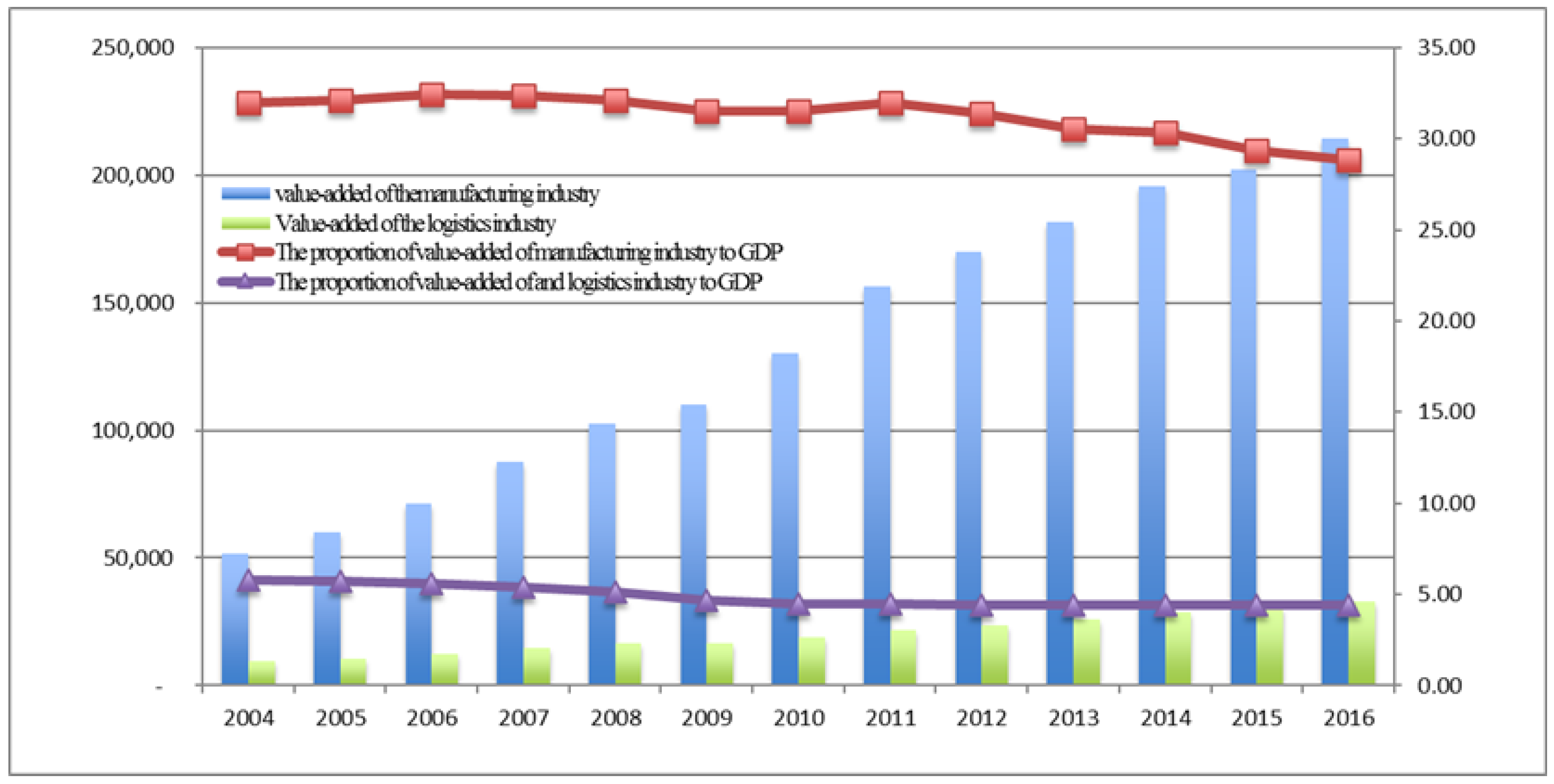
The value added to the manufacturing sector in China increased from 5.17 trillion Yuan in 2004 to 21.43 trillion Yuan in 2016, with an average annual growth rate of 12.57%. Meanwhile, the value added to the logistics industry rose from 930.65 billion Yuan in 2004 to 3.31 trillion Yuan in 2016, with an average annual growth rate of 11.14%. The proportions of value added from the manufacturing sector and logistics industries to the gross domestic product (GDP) were 28.82% and 4.40%, respectively.
Figure 1 shows the value added to the manufacturing and logistics industries and their proportion of the GDP from 2004 to 2016. It can be seen from the chart that although the proportion of GDP in 2016 is slightly lower than that in 2004, these two industries have basically maintained a stable development trend over the past 13 years.
As a crucial provider of producer services, the logistics industry is highly dependent on the manufacturing sector [
9,
10]. Manufacturing is the main source of logistics demand [
11], and progress in manufacturing has greatly helped and promoted the logistics sector [
12]. In contrast, the development level of the logistics industry is directly related to the efficiency of manufacturers and the benefits that they experience [
13].
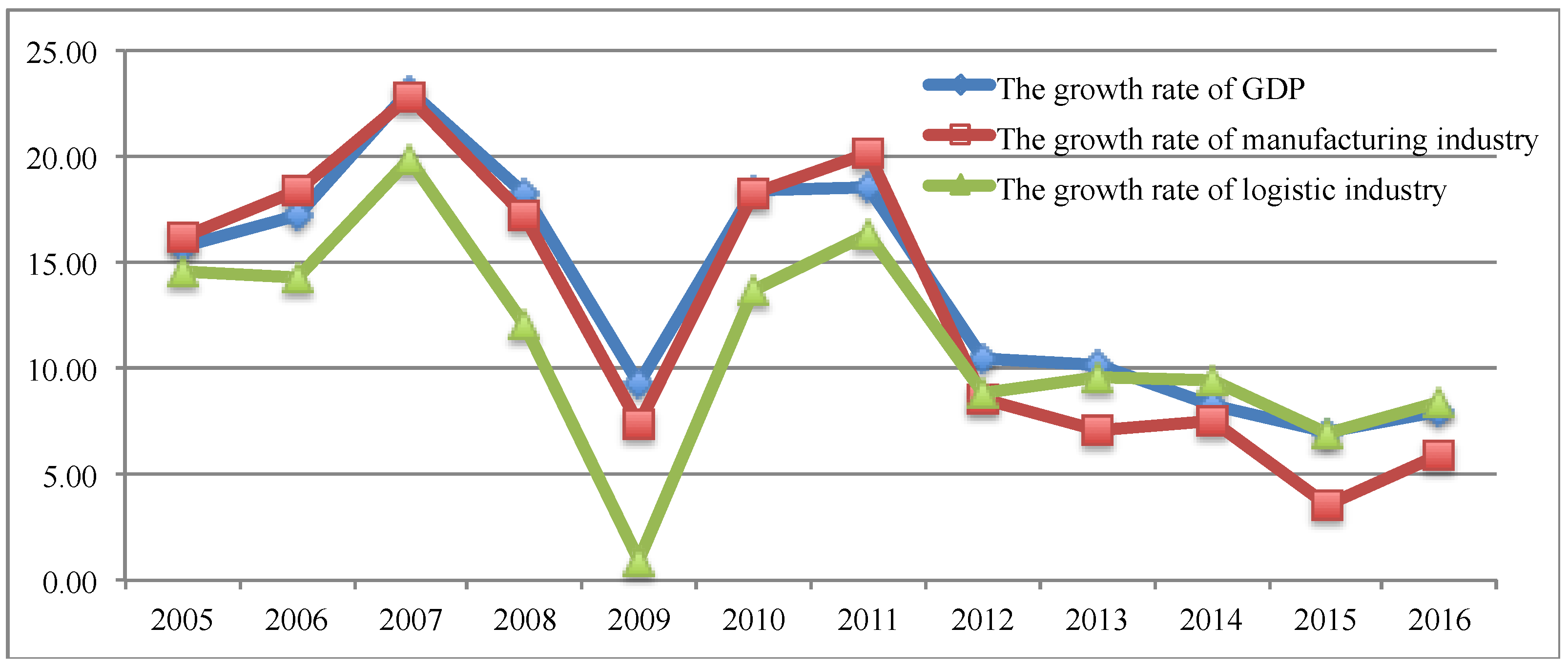
In general, the interactive development of the logistics and manufacturing industries is essential [
14]. As shown in
Figure 2, comparing the growth rate of the manufacturing and logistics industries with that of GDP in the period of 2005–2016, it is can be found that the development of the manufacturing and logistics industries keep abreast of the growth of GDP, which means that these two industries had a certain impact on economic development. In addition, from the growth rate between the manufacturing and logistics industries from 2005 to 2016, it is obvious that the development of the logistic industry keeps in step with manufacturing industry. According to the similar development trend of these two industries, we are aware of the close relationship between the manufacturing and the logistics industries, showing an increasing trend of convergence.
Different industries are measured by different indicators of performance [
15]. Due to the existence of a certain degree of interdependence between any two factors, interaction between the two industries has produced a basis for measurement [
16]. Therefore, for the sustainable development of the national economy, it is necessary to identify the key factors affecting the interaction between the two industries. However, the indexes evaluating industrial development are usually derived from statistical data. In previous studies [
17,
18,
19,
20,
21,
22,
23,
24], entropy is the most commonly used technique for obtaining index weights from statistical data. The entropy method is convenient in use, but it has some shortcomings [
25]. For example, it is more suitable for deliberately highlighting attributes such as contractor selection [
26]. In addition, if there are negative performance values, entropy will be invalid [
27].
Identifying the key factors affecting the interaction between the manufacturing and logistics industries is a kind of decision problem in the field of multiple criteria decision making (MCDM). MCDM methods are often used to deal with the problems that are characterized by several non-commensurable and conflicting (competing) criteria, where there may be no solution that satisfies all of the criteria simultaneously [
28]. Since the factors have interdependent impacts [
29], a hybrid MCDM model called Decision Making Trial and Evaluation Laboratory (DEMATEL)-based Analytic Hierarchy Process (ANP) (DANP) [
30] is suitable for solving such problems. However, DANP uses a direct influence matrix, which involves pairwise comparisons. Thus, what is required is how to generate the direct influence matrix for multiple criteria factors automatically. The grey relational analysis proposed by Deng [
31], also known as GRA, can be used to effectively measure the degree of relationships between the given data sequences or patterns [
32]. Therefore, we propose the Grey DANP decision model, which applies GRA to measure the criteria relationships and generate the direct influence matrix [
33], and identifies the key factors for interaction between manufacturing and logistics industries and determines the causal relationships between any two key factors.
The remainder of this paper is organized as follows.
Section 2 reviews the literature on the interaction between the manufacturing and logistics industries.
Section 3 introduces the traditional DEMATEL-based ANP (DANP), and
Section 4 introduces GRA and the proposed Grey DANP model.
Section 5 applies the proposed model to identify key factors affecting the interaction between the two industries in China using statistical data from the yearbook of China.
Section 6 discusses the various outcomes, and
Section 7 provides the conclusions.
2. Interaction between Manufacturing and Logistics Industries
Previous studies have investigated the interactive development of manufacturing and logistics industries. As a crucial part of the modern economy and a most economical and reasonable service model in industrialization, the logistics industry is developing rapidly worldwide [
8]. The interactive development of the two industries is aimed at symbiotic development, with principles of reciprocity and complementarity [
34]. Good interaction between the two industries can reduce operating costs, encourage manufacturing productivity, improve core manufacturing competitiveness, and improve logistics service levels [
35]. Therefore, the goal of interaction is to achieve a win–win situation [
15].
One of the theoretical bases of interaction between the manufacturing and logistics industries is a specification of work [
36]. Becker and Murphy [
37] believed that a deepening of the division of labor and an increased number of service types would reduce manufacturing costs, which would be an endogenous mechanism for promoting the development of producer services [
38]. Furthermore, the division of labor has network effects. The average cost and marginal cost tend to decrease as the level of specialization increases [
39]. Logistics has a strong external economy; the improvement of logistics efficiency can reduce transaction costs, and then reduce labor costs [
36], which is another theoretical basis of interaction between the manufacturing and logistics industries. The mechanism of interaction between the manufacturing and logistics industries entails two aspects: (1) the method of resource allocation in manufacturing enterprises, and (2) the trade-off in transaction costs between in-house and outsourced logistics [
40].
In previous studies, many methods have been used to measure the interaction between the manufacturing and logistics industries, and numerous indicators can be used to evaluate manufacturing development and logistics development [
36,
41,
42].
Table 1 shows the methodologies and indicators that have been described in relevant research articles.
Duan et al. [
65] indicated that the linked development of the manufacturing and logistics industries in Hubei Province was expected to accelerate the construction of supporting industries, cultivate and develop industrial clusters, and promote the development of multilevel logistics service outsourcing. Wang [
53] proposed that governments should launch preferential policies, such as financial subsidies, for logistics companies to recruit employees. Peng and Feng [
35] asserted that it is necessary to increase investment in logistics infrastructure, strengthen policy guidance, and encourage manufacturing firms to outsource logistics to promote the joint development of the two industries. Zhang [
61] argued that manufacturers should focus on promoting informatization and standardization among manufacturers, and third party logistics (TPL) providers should implement Just-in-Time practices to boost the collaborative development of the manufacturing and logistics industries. Chen and Ma [
54] noted that effective measures for the interactive development of the two industries include establishing a mechanism to promote the cooperation of the two industries, enacting preferential policies for the two industries, promoting the socialization of manufacturers for logistics needs, and improving TPL service quality.
3. DEMATEL-Based ANP (DANP)
DEMATELcan be applied to construct a network relation map (NRM) [
66] for ANP by describing interdependencies visually in the form of networks of explainable nodes and directed arcs [
28]. Ou Yang et al. [
28] and Tzeng and Huang [
66] proposed a novel DANP consisting of DEMETEL and ANP by taking the total influence matrix generated by DEMATEL as the unweighted supermatrix of ANP directly, avoiding the troublesome pairwise comparisons for ANP, particularly for high-order matrices [
67]. Hu et al. [
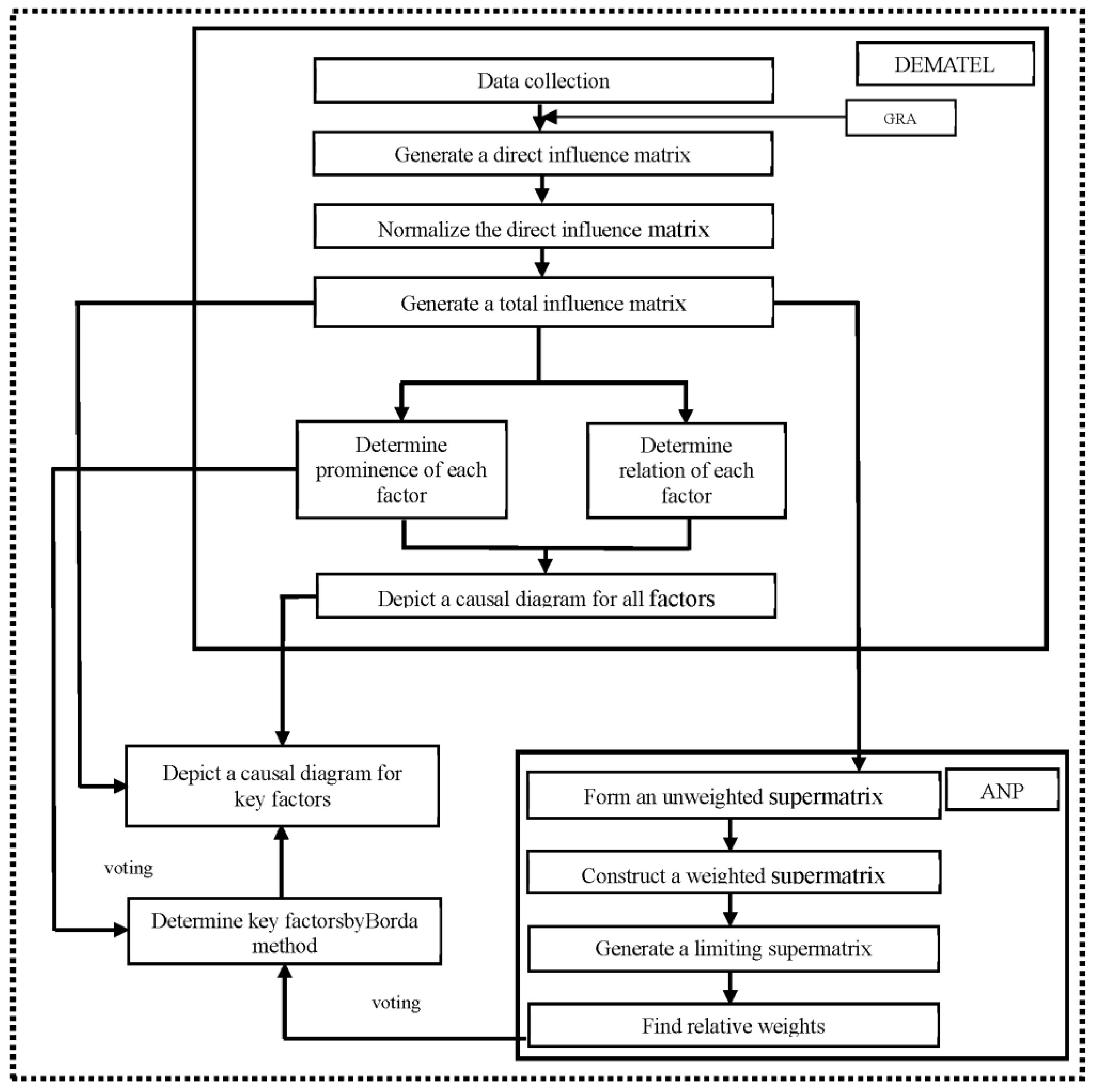
29] proposed a variant of DANP using the Borda method [
68] to determine the key factors from prominences generated by DEMATEL and relative weights generated by DANP, as shown in
Figure 3. To boost the analysis of interdependence among key factors, their DANP variant focused on the causal diagram for key factors rather than all of the factors in the original DANP. These distinctive features lead us to build the proposed decision model on the DANP variant.
To determine the DEMATEL total influence matrix,
T, the direct influence matrix,
Z, is first constructed using the degree of effect between each pair of elements taken from respondent questionnaires:
where
n is the number of factors; and
zij represents the extent to which factor
i affects factor
j, which is specified as a numerical scale. Commonly 0 = no effect, 1 = small effect, 2 = strong effect, and 3 = very strong effect; however, to reduce the effort of filling out questionnaires, this is sometimes shortened to a three-point scale: 0 = no effect, 1 = moderate effect, and 2 = very strong effect [
69]. All of the diagonal elements are zero.
Z is then normalized to produce the normalized direct influence matrix:
where:
Then, T is generated by X (1 − X)−1, and can be treated as an unweighted supermatrix for ANP. A weighted matrix, W, can be obtained by normalizing T, and the global weight of each factor is obtained by multiplying W by itself several times until a limiting supermatrix, W*, is derived.
Causes and effect can be derived from
T [
70]. For
T, each row was summed to obtain the value denoted by
d, and each column of the total influence matrix was summed to obtain the value denoted by
r. Then,
d +
r is the prominence, and shows the relative importance of the corresponding factor, where larger prominence implies greater importance; meanwhile,
d −
r is the relation, where a positive relation means the corresponding factor tends to affect other elements actively, which is referred to as a
cause, and a negative relation means the corresponding factor tends to be affected by other elements, which is referred to as an
effect.
Since both DEMATEL and ANP provide the importance of each factor, Hu et al. [
29] combined them using the Borda method rather than depending only on the degree of importance from ANP. For example, if a factor’s prominence was ranked second in DEMATEL, and fourth in ANP, then its Borda score was six. Thus, a smaller Borda score implied greater importance, which provides a method to select key factors. A causal diagram for key factors can be generated from the relations, following Hu et al. [
29].
4. Proposed Decision Model
Since zij represents the impact on factor j from factor i, it is reasonable to refer to this as a relationship between factors i and j, reflecting the degree of influence or similarity. For example, consider the sales or manufacture of products in a marketplace. A product may be treated as an influential factor, which is described by multiple criteria such as price, size, customer satisfaction, etc. Then, it is worth generating Z by exploring the relationships among different products.
GRA can identify relationships between a given reference sequence and several comparative sequences by viewing the reference sequence as the desired goal [
32], which can then be used to automatically generate the direct influence matrix.
To perform GRA, we must first compute the grey relational coefficients (GRCs) for each alternative. For the proposed model, we assume there are u (u ≥ 2) categories that can be defined beforehand, and each factor can be categorized into a single category. Let factor l in category p, which is represented as xpl = (xpl1, xpl2, …, xpls) (1 ≤ l ≤ cp), be a reference pattern, and let factor i in category q, which is represented as xqi, = (xqi1, xqi2, …, xqis) (1 ≤ i ≤ cq), be a comparative pattern, where cp and cq denote the number of factors in categories p and q, respectively; and c1 + c2 + … + cu = n.
Since the measurement scales are likely to be different for each criterion,
should be normalized following Chang [
71], in the case of a benefit criterion:
where max
pk and min
pk represent the maximum and minimum values, respectively, for criterion
k in category
p. For a cost criterion, the corresponding normalization is:
may be normalized similarly. See Chang [
71] for a full explanation of the principles to choose a suitable normalization.
Secondly, it is necessary to compute the grey relational coefficients (GRCs) for each factor. Let
ξk (
xqi,
xpl) denote a GRC with respect to
xi, indicating the relationship between
xqi and x
pl on attribute
k (1 ≤
k ≤
s). Then:
where
ρ is the discriminative coefficient (0 ≤
ρ ≤ 1), and usually
ρ = 0.5;
and:
The grey relational grade (GRG) indicates the grade of relationship between
xqi and
xpl and can be represented in this implementation as:
where
wk is the relative importance of attribute
k.
z(
xqi,
xpl) ranges from 0 to 1, and the sum of
w1,
w2, …,
wn is one. As a result,
Z is a partitioned matrix comprising
u2 segments, where each segment represents a relationship between two categories in a system, and the segment related to the relationship between categories
p and
q is:
When
p =
q, the corresponding segment is called a grey self-relational matrix. Then,
z(
xqi,
xqi) in
Zqq can be set to zero to conform to the requirement of DEMATEL. The novel Grey DANP model is summarized in
Figure 3.
5. Empirical Study
5.1. Case Study
Governments regularly publish statistics on their domestic industry and economy, and these may be used to analyze the current state of economic development. Since these historical data are objective rather than subjective, we use them to evaluate the development of the logistics industry in China.
Table 2 and
Table 3 describe the factors associated with data collected from the
China Statistical Yearbook for the period 2006–2015, and the manufacturing (
X1) and logistics (
X2) industries (i.e.,
r = 2), where
X1 and
X2 include five (
c1 = 5) and eight (
c2 = 8) alternatives, respectively. Therefore,
n = 13. Each factor was described for 10 consecutive years (i.e.,
s = 10).
For DANP, the direct influence matrix is obtained by survey. In contrast, the proposed Grey DANP can use the objective historical data to hand, where Z can be automatically obtained by GRA by partitioning into four segments (i.e., Z11, Z12, Z21, and Z22).
5.2. Generating the Initial Direct Influence Matrix Using GRA
Since the measurement scales are different for the criteria in this study, the raw data should be normalized. The criteria selected to describe the development of the logistics and manufacturing industries were all benefit criteria (the larger-the-better attributes), so Equation (4) is suitable for normalization, as shown in
Table 4.
GRGs for Z11, Z12, Z21, and Z22 were calculated using Equations (6)–(10). The manufacturing factors were selected as an example to illustrate the operation steps.
First, we set
x21 as the reference sequence and the other factors in aspect 2 as the comparability sequences. Parameters Δ
1lk, Δ
max, and Δ
min, and subsequently all of the grey relational coefficients were calculated using equations (6)–(9). For example, Δ
212 = |0.8326 − 0.3900| = 0.4426, Δ
max = 0.6436, and Δ
min = 0; so
ξ1(
x21,
x22) = (0 + 0.5 × 0.6436)/(0.4426 + 0.5 × 0.6436) = 0.4210. The complete grey relational coefficients
ξk(
x21,
x2l) are shown in
Table 5, and
Table 6 showed the results for
ξk(
x2i,
x2l).
To compute the GRGs, the importance of all of the attributes (i.e., years) was assumed to be equal. From Equation (10),
z(
x2i,
x2l) are shown in the last column of
Table 6. Since
p = 2 and
q = 2,
Table 7 shows the grey self-relational matrix of
z(
x2i,
x2l).
Finally, in this case,
u = 2, so
Z has four matrix segments, where each matrix segment represents a relationship between the logistics and manufacturing industries. The partitioned matrix represents the relationships between any two factors among the industries, and may be used to generate the initial direct influence matrix. Therefore,
z(
xqi,
xqi) was set to zero to conform to the requirements of DEMATEL, and the segments related to the relationships between the logistics and manufacturing industries were obtained using Equation (11), as shown in
Table 8.
5.3. Determining the Total Influence Matrix
Following the DEMATEL method, the normalized direct influence matrix was obtained using Equation (2), as shown in
Table 9. Since
T =
X (
I −
X)
−1, the total influence matrix is shown in
Table 10, and the prominence and relation of each factor are shown in
Table 11.
5.4. Deriving the Limiting Supermatrix
Table 12 shows the weighted supermatrix, which is obtained by normalizing the total influence matrix, and
Table 13 shows the limiting supermatrix derived from the weighted supermatrix.
Table 14 shows the overall rankings for factors, which are arranged in ascending order of the Borda score of each factor.
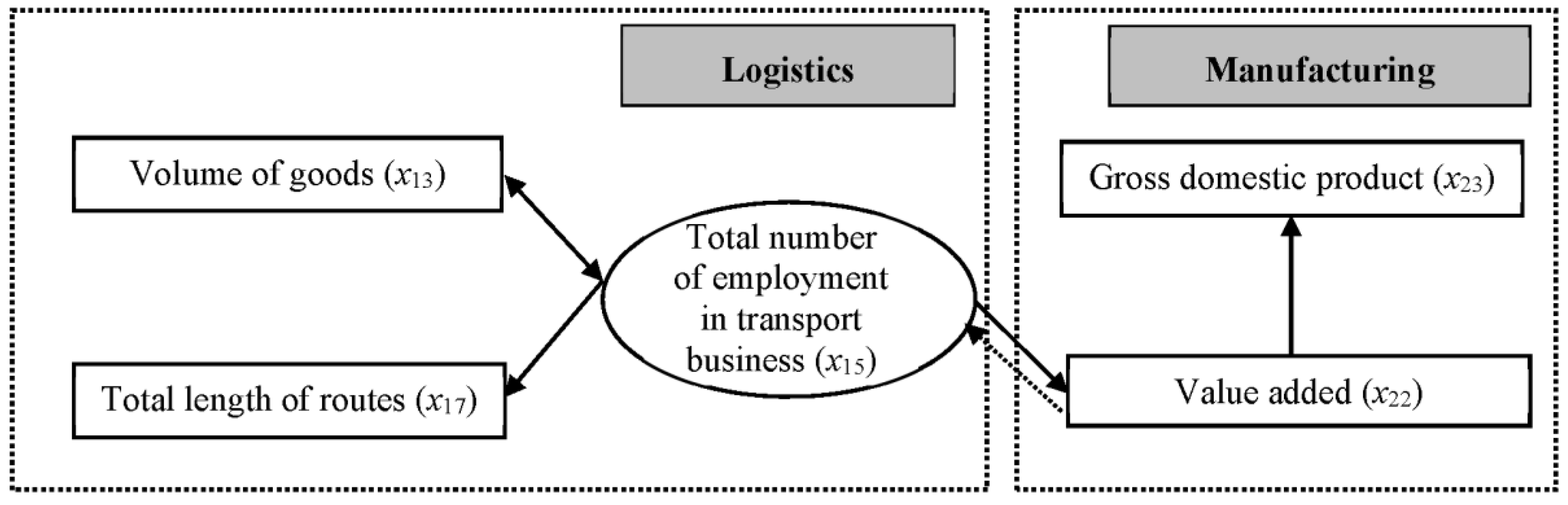
Considering the industry differences, it is reasonable to choose key factors for each industry. The key criteria in the logistics industry for interaction development are the total number of employment in transport business (x15), the volume of goods (x13), and the total length of routes (x17). The key criteria in the manufacturing industry for interaction development are the gross domestic product (x23) and value added (x22).
5.5. Depicting the Causal Diagram
Figure 4 shows the causal diagram corresponding to the total influence matrix that is shown in
Table 10.
The influences between the volume of goods (x13) and total number of employment in the transport business (x15) are the two critical factors affecting the development of the logistics industry and facilitating the other key factors. Since the relation (i.e., d − r) of x13 and x15 are both greater than zero, x13 and x15 are appropriate to be the start.
The impact on
x15 from the logistics industry is
x13, whereas it is interesting to know which factor in the manufacturing industry has the largest influence on
x15.
Table 10 shows that
x22 has the largest impacts on
x15. Thus, it is reasonable to presume that the “gross domestic product” and “value added” can be helpful to boost the “total number of employment in transport business”.
Figure 4 shows the impacts from
x22 as a dashed line.
6. Managerial Implications
Both the manufacturing and logistics industries play a vital role in economic growth. The empirical results demonstrate that the development of the manufacturing industry can affect that of the logistics industry. Rapid economic growth can fuel the rapid growth of the logistics industry, and the logistics industry plays a crucial role in both microeconomic and macroeconomic aspects. Logistics is a service industry, and so provides substantial contributions to society, such as the promotion of infrastructure construction, employment, and consumption. Thus, governments attach great importance to the development of the logistics industry. However, due to the late start of modern logistics, the development of the logistics industry has been somewhat deficient. Therefore, ensuring the healthy development of the logistics industry in China has become a critical issue.
The five key factors determined by the Grey DANP (GDANP) are reasonable, because the total number of employees in the transport business was the most important criterion, with other key factors being the volume of goods, the total length of routes, GDP, and value added. As mentioned previously, the manufacturing industry can boost the development of the logistics industry mainly by eliciting an impact of
x22 on
x15. Furthermore, the logistics factor influencing the development of the manufacturing industry is the total number of employees in the transport business. Manufacturing factors could promote the growth of the logistics industry, and logistics factors could promote growth in manufacturing as well, which is in agreement with past studies [
15,
34,
35]. The five key factors and two results are discussed as follows.
First, from the perspective of the logistics industry, the total number of employees in the transport business represents the total productivity of the transport industry. Within the industry, the number of employees directly affects the volume of goods, and vice versa.
Hiring sufficient labor can enable the logistics industry to expand its operations and extend the total length of routes. For example, the rapid growth of e-commerce in China has led to a surge in the volume of express business, which has led to a marked rapid increase in the demand for air cargo. Therefore, various airlines have increased their aircraft acquisition to increase their market share. However, China faces a substantial shortage of domestic pilots. As Bloomberg reported, “Chinese airlines must hire almost 100 pilots a week for the next 20 years to meet [the] skyrocketing travel demand”. This shortage severely limits business route extension.
The number of employees certainly affects value added. Labor is one of the most important essential productive factors. Sufficient labor resources in logistics can drive industrial output. Logistics providers can help manufacturers deliver products to the market to meet the growing consumer demand. Therefore, smooth and timely logistics service is essential for guaranteeing the delivery of products to the market. An adequate numbers of employees can ensure the successful implementation of services. Good outsourcing logistics services enable manufacturers to focus on their core business, and the value added by the manufacturer increases accordingly, which tends to increase profits. Problems with logistics tend to cascade into a host of related problems, such as a backlog of inventory. When this occurs, manufacturers must reduce production, which has a negative impact on manufacturing output.
Second, from the perspective of the manufacturing industry, value added affects the total number of employees in transport. Growing value added in manufacturing tends to increase logistics service demand. Logistics providers may need to hire additional workers to cope with the rapid growth of value added. However, output growth tends to drive consumption, and increasing consumption promotes employment. Furthermore, the quality of the labor force tends to rise accordingly. As
Figure 4 shows, once the performance of
x22 is improved, the performance of
x23 tends to improve as well.
The improvement of x15 tends to improve the performance of other key factors. Therefore, the stakeholders (i.e., the Chinese government and logistics providers) should focus on this factor. To effectively improve x15, logistics providers should accurately determine the number of employees that are required to guarantee normal operation, and the government should take effective measures to ensure the labor supply and improve the quality of the labor force. Logistics providers should also expand their distribution network, increasing their total length of routes, which tends to increase the number of employees. Furthermore, manufacturers should spare no effort in increasing GDP and value added. This ensures the competitive advantage and competitiveness of enterprises, and it promotes employment in the logistics industry, as well as other productive industries.