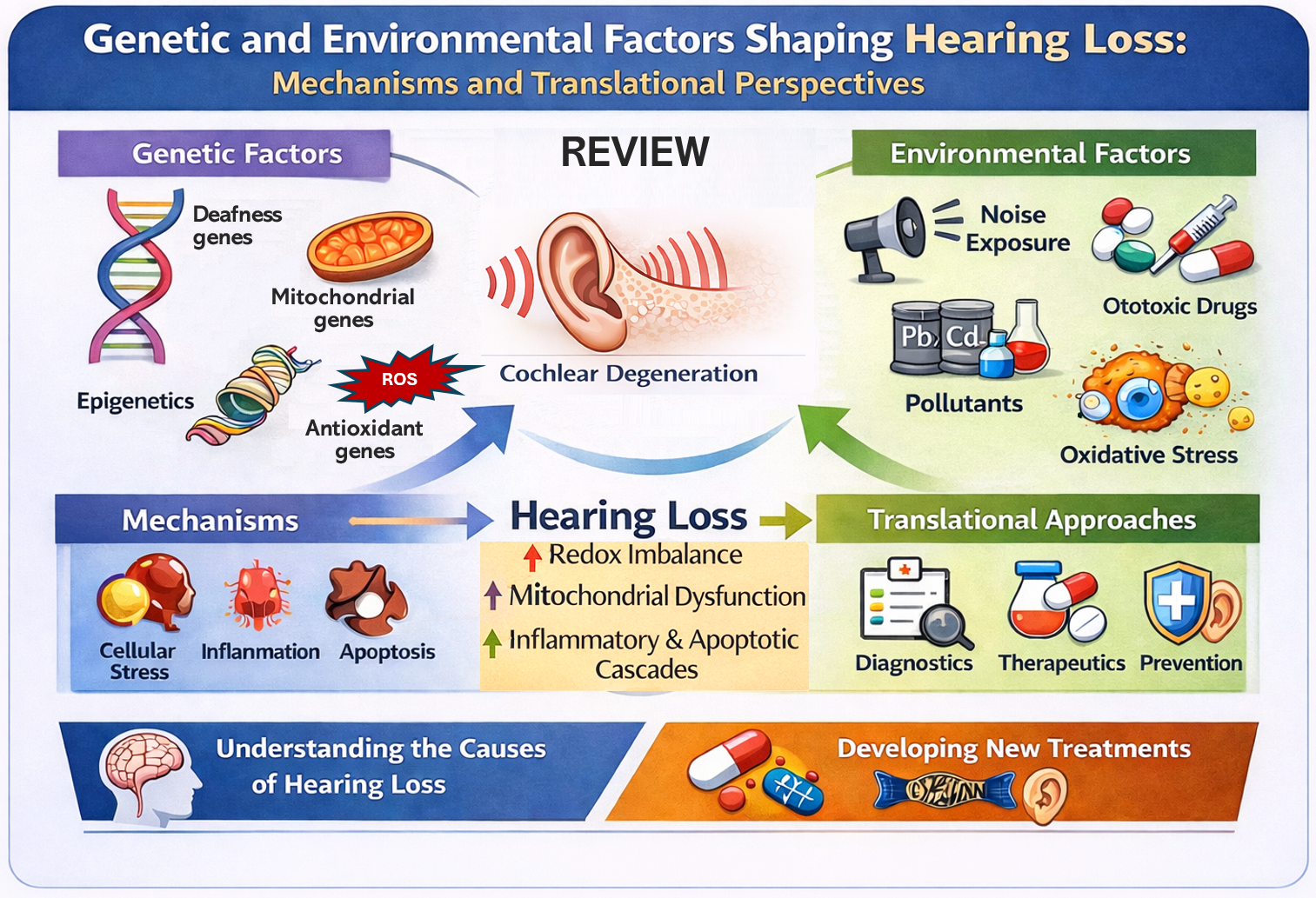

Genetic and Environmental Factors Shaping Hearing Loss: Xenobiotics, Mechanisms and Translational Perspectives


Abstract
1. Introduction and Background
1.1. Epidemiological Perspective
1.2. Multifactorial Nature of Hearing Impairment
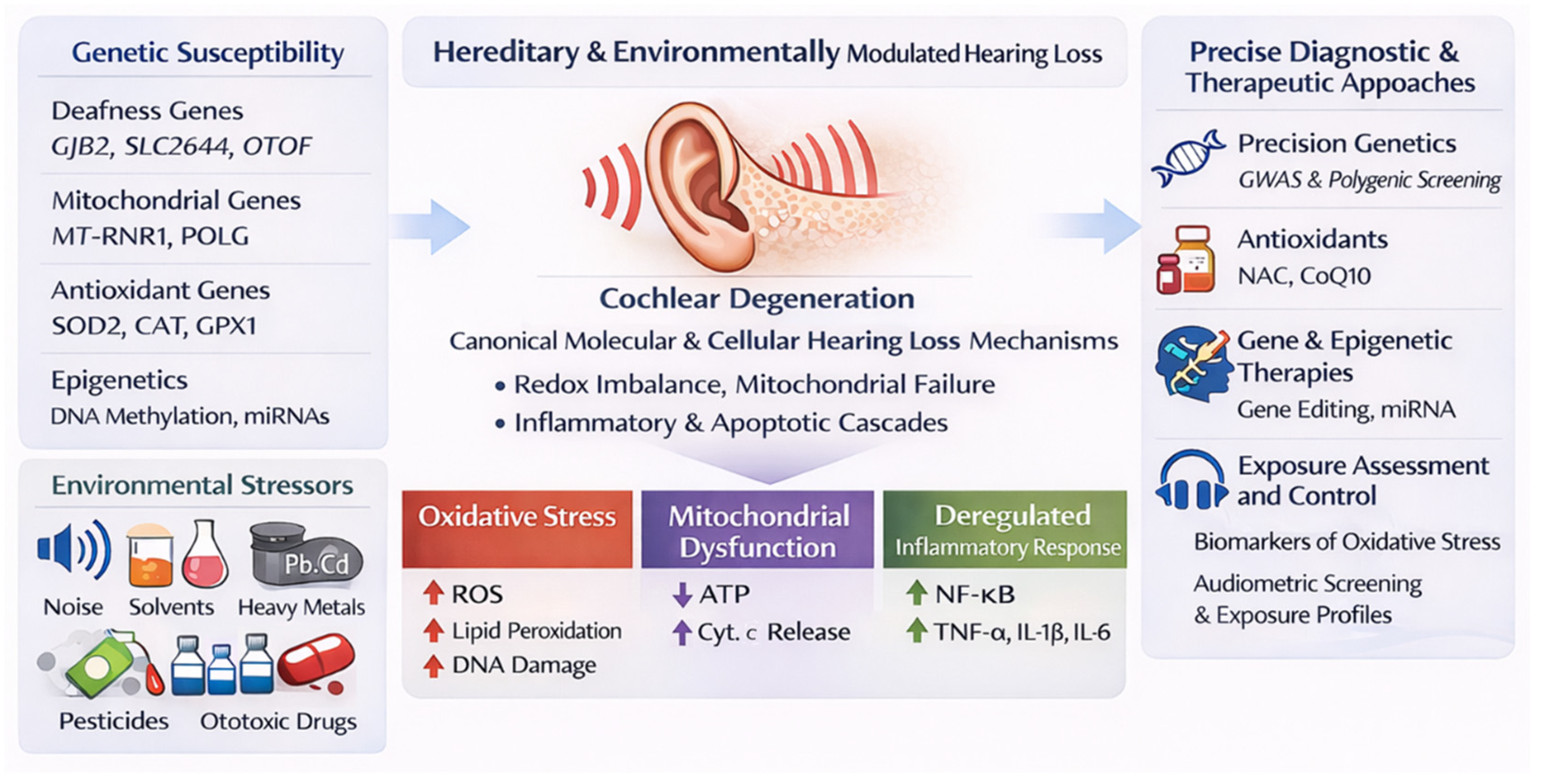
1.3. Gene–Environment Interactions in Hearing Loss: Mechanisms of Cochlear Vulnerability and Prevention
2. Genetic Basis of Hearing Loss
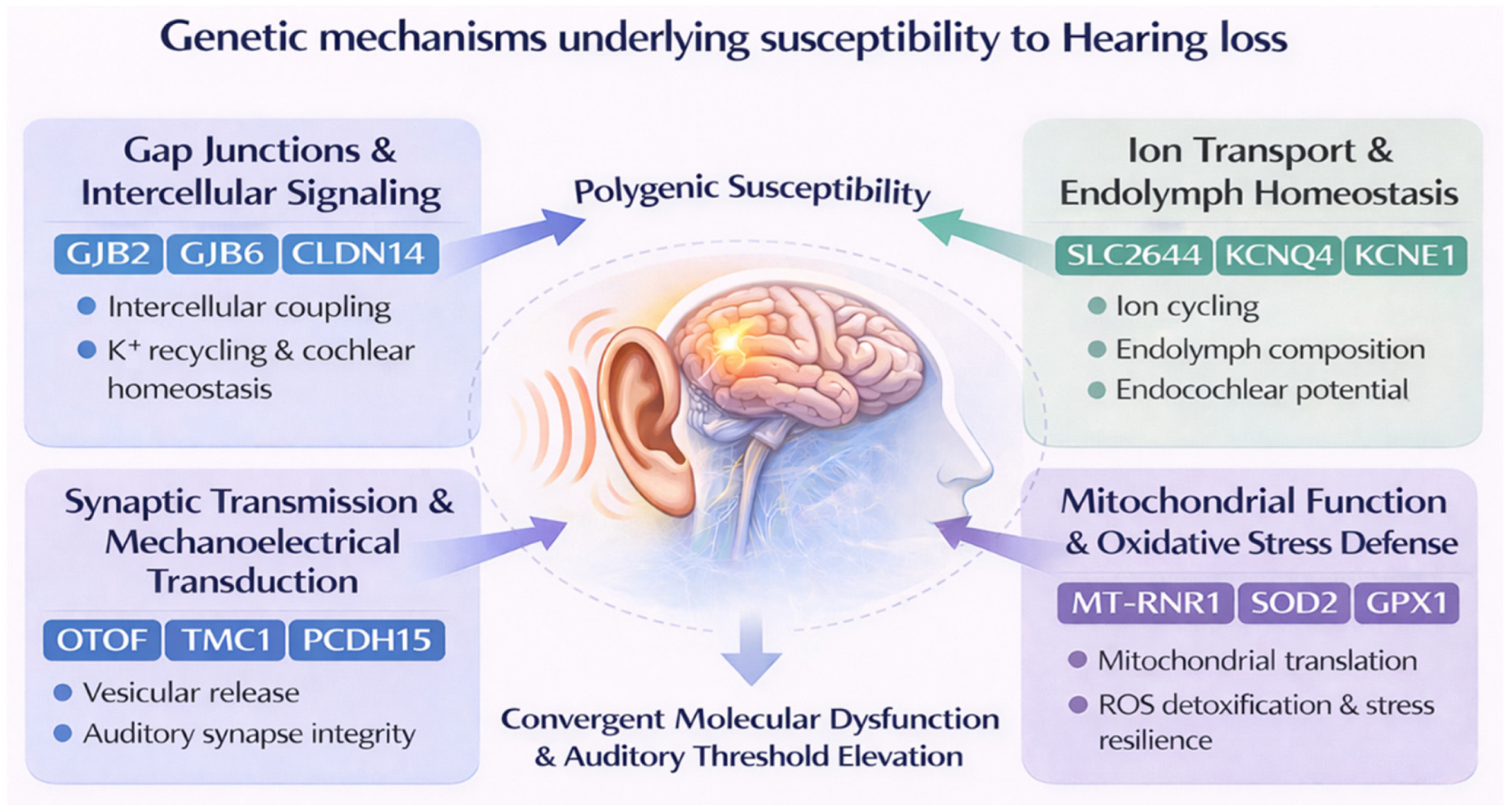
2.1. Genetic Mechanisms Underlying Hearing Loss Susceptibility
2.2. Strong Genetic Contribution Modulated by Environmental Exposures
2.3. Major Genes Associated with Deafness
2.4. Genes Related to Antioxidant Defense
2.5. Additional Deafness-Associated Genes
2.6. GWAS Major Achievements and Breakthroughs
2.7. Epigenetic Regulation
3. Environmental Determinants of Hearing Loss
3.1. Ototoxic Agents and Environmental Xenobiotics

| Xenobiotic Class [Examples] | Evidence (Typical Patterns/Interactions) | Main Cellular & Molecular Mechanisms | Key Cochlear/Neural Targets | Relevant References |
|---|---|---|---|---|
| Aromatic & industrial organic solvents (VOCs) [BTEX mixtures; Benzene, toluene, ethylbenzene, xylene] | Occupational and population studies associate higher biomarker levels with hearing disorders; synergy with noise is common | Lipophilic uptake and blood–labyrinth barrier passage; accumulation in stria vascularis and OHCs; CYP oxidative biotransformation → ROS, lipid peroxidation; mitochondrial dysfunction, ATP depletion; apoptosis | OHCs; stria vascularis; auditory nerve/central pathways | [28,29,32,254,256,258,260,266] |
| Industrial organic solvents [Styrenics–styrene] | Animal/experimental evidence of cochlear injury; epidemiology supports increased risk, especially with co-exposure to noise | ROS generation (incl. metabolic activation); oxidative stress and mitochondrial injury; membrane damage; hair cell apoptosis; potentiation of acoustic trauma | OHCs; SGNs | [28,256,257,258,259] |
| Mixtures: solvents + noise [TEXS mixtures; toluene/ethylbenzene/xylene/styrene] | Co-exposure studies show greater threshold shifts than single exposures; consistent “adding insult to injury” pattern | Convergent oxidative stress pathways; exacerbated mitochondrial dysfunction; greater synaptopathy/SGN vulnerability under metabolic stress | OHCs; ribbon synapses; SGNs | [256,266,267,268] |
| Heavy metals [Lead (Pb)] | Meta-analytic and cohort evidence links blood Pb to hearing loss; experimental work shows synaptic injury and potentiation of NIHL | Accumulation in inner ear tissues; Ca2+ dysregulation; mitochondrial electron transport interference → ROS/ATP depletion; antioxidant enzyme disruption (e.g., GPx, catalase); nitrative stress; inflammation; apoptosis | Ribbon synapses; OHCs; stria; SGNs | [7,24,26,27,261] |
| Heavy metals [Mercury (Hg)] | Epidemiology supports association with auditory dysfunction (strength depends on exposure metrics and co-exposures) | Oxidative stress; mitochondrial dysfunction; Ca2+ homeostasis disruption; inflammatory signaling | Hair cells; SGNs | [24,25,27] |
| Heavy metals [Cadmium (Cd)] | Epidemiologic associations reported with auditory impairment; often alongside smoking/occupational co-exposures | Oxidative stress; mitochondrial impairment; depletion of antioxidant defenses; inflammatory mediators | Hair cells; stria vascularis | [24,25,27] |
| Pesticides: organophosphates (OPs) [chlorpyrifos and other OP insecticides] | Human studies in agricultural settings show elevated high-frequency thresholds (meaning hearing worsens); risk increases with noise and other exposures | NF-κB activation, pro-inflammatory cascades; excess NO/iNOS signaling; oxidative/nitrative stress; synaptic degeneration; neurotoxicity to SGNs | Ribbon synapses; SGNs; possible efferent pathway disruption | [38,262,263,264] |
| Pesticides: organochlorines (persistent organic pollutants-POPs) [legacy POPs measured in serum] | NHANES-based association reported between organochlorine body burden and hearing impairment | Likely oxidative stress, endocrine/mitochondrial disruption and neuroinflammation (mechanistic evidence is less direct than for solvents/metals) | Cochlea + auditory neural pathways | [24,25,265] |
| Combined chemical mixtures in workplaces [Metals + solvents + noise (various)] | Studies in shipyards/industry indicate higher risk and permanent threshold shifts (hearing loss) under multi-exposure scenarios | Additive/synergistic oxidative stress and inflammatory signaling; reduced antioxidant reserve; compounded metabolic load | OHCs; stria; SGNs | [24,267,269] |
| Pharmaceutical xenobiotics: ribosome-targeting ototoxic antibiotics [aminoglycosides (e.g., gentamicin; class-level)—exposure in carriers of MT-RNR1 m.1555A > G/m.1494C > T] | Irreversible progressive SNHL can occur after transient aminoglycoside exposure, including at apparent “clinically safe” doses in MT-RNR1 carriers; vulnerability can be amplified by co-stressors (e.g, noise/acoustic trauma, smoking, metabolic syndrome) | Enhanced aminoglycoside binding to mitochondrial 12S rRNA (MT-RNR1 variants) → impaired mitochondrial protein synthesis and oxidative phosphorylation; ROS overproduction; altered NAD+/NADH balance; Ca2+ overload; intrinsic apoptosis (cytochrome c release, caspase-9 activation); mtDNA damage | Cochlear hair cells (mitochondria-dependent, especially OHCs); downstream synapses/neurons | [45,50,51,52,53,60,89,93,102,206,207,208,209,210,211,270,271,272] |
| Pharmaceutical xenobiotics: other ribosome-targeting ototoxic antibiotics [non-aminoglycosides (e.g., macrolides as erythromycin)] | SNHL has been reported after exposure to non-aminoglycoside antibiotics and may be modulated by co-stressors (e.g, noise/acoustic trauma, smoking, metabolic syndrome) and host susceptibility (mtDNA variants, including carriers of MT-RNR1 m.1555A > G/m.1494C > T) | Conserved antibiotic–ribosome interaction motifs suggest possible off-target disruption of mitochondrial ribosomes/translation; reduced mitochondrial protein synthesis impairs oxidative phosphorylation and ATP supply, elevates ROS and redox imbalance, perturbs Ca2+ homeostasis, and activates intrinsic apoptosis (cytochrome c release → caspase-9), with mtDNA damage and defective mitochondrial maintenance further amplifying injury | Mitochondria-dependent cochlear hair cells (esp. OHCs); stria vascularis; downstream synapses/SGNs (secondary vulnerability) | [89,92,102,206,207,208,209,210,211,222,270,272,273,274] |
3.2. Noise Exposure and Occupational Ototoxicity
3.3. Experimental and Epidemiological Evidence
4. Physiopathological Mechanisms and Cochlear Damage
4.1. Oxidative Stress
4.2. Mitochondrial Pathways
4.3. Secondary Inflammation
5. Translational and Integrated Therapeutic Perspectives
5.1. Precise Diagnosis and Risk Prediction
5.2. Gene Therapy and Epigenetic Approaches
5.3. Antioxidant Interventions
5.4. Occupational and Targeted Public Health Prevention
6. Final Remarks and Perspectives
Author Contributions
Funding
Institutional Review Board Statement
Informed Consent Statement
Data Availability Statement
Acknowledgments
Conflicts of Interest
Abbreviations
| AAV | Adeno-Associated Virus |
| ANSD | Auditory Neuropathy Spectrum Disorder |
| ARHL | Age-Related Hearing Loss |
| ATP | Adenosine Triphosphate |
| CAT | Catalase |
| Cx26 | Connexin 26 |
| DFNA | Deafness Autosomal dominant |
| DFNB | Deafness Autosomal recessive |
| EVA | Enlarged Vestibular Aqueduct |
| GPX1 | Glutamate Metabotropic Receptor 7 |
| GRM7 | Glutamate Metabotropic Receptor 7 |
| GSR | Glutathione Reductase |
| GST | Glutathione S-Transferase |
| GSTM1 | Glutathione S-Transferase Mu 1 |
| GJB2 | Gap Junction Beta-2 Protein |
| GJB6 | Gap Junction Beta-6 Protein |
| HC | Hair Cell |
| HHL | Hereditary Hearing Loss |
| IHC | Inner Hair Cell |
| IL-1β | Interleukin-1 Beta |
| IL-6 | Interleukin-6 |
| MT-RNR1 | Mitochondrially Encoded 12S rRNA |
| NF-κB | Nuclear Factor Kappa-Light-Chain-Enhancer of Activated B Cells |
| Nrf2 | Nuclear Factor Erythroid 2-Related Factor 2 |
| OTOF | Otoferlin |
| OHCs | Outer hair cells |
| POLG | DNA Polymerase Gamma |
| ROS | Reactive Oxygen Species |
| SLC26A4 | Solute Carrier Family 26 Member 4 |
| SOD2 | Superoxide Dismutase 2 |
| SGNs | Spiral ganglion neurons |
| TMC1 | Transmembrane Chanel-like 1 |
| TNF-α | Tumor Necrosis Factor Alpha |
References
- WHO World Health Organization (WHO). “Deafness and Hearing Loss”. 2019. Available online: https://www.who.int/news-room/fact-sheets/detail/deafness-and-hearing-loss (accessed on 22 November 2025).
- Wilson, B.S.; Tucci, D.L.; O’Donoghue, G.M.; Merson, M.H.; Frankish, H. A Lancet Commission to Address the Global Burden of Hearing Loss. Lancet 2019, 393, 2106–2108. [Google Scholar] [CrossRef]
- Shen, Y.; Zhou, T.; Zou, W.; Zhang, J.; Yan, S.; Ye, H.; Huang, W. Global, Regional, and National Burden of Hearing Loss from 1990 to 2021: Findings from the 2021 Global Burden of Disease Study. Ann. Med. 2025, 57, 2527367. [Google Scholar] [CrossRef]
- Tran, Y.; Tang, D.; Lo, C.; Macken, O.; Newall, J.; Bierbaum, M.; Gopinath, B. Establishing Multifactorial Risk Factors for Adult-Onset Hearing Loss: A Systematic Review with Topic Modelling and Synthesis of Epidemiological Evidence. Prev. Med. 2024, 180, 107882. [Google Scholar] [CrossRef]
- GBD 2019 USA Hearing Loss Collaborators; Haile, L.M.; Orji, A.U.; Reavis, K.M.; Briant, P.S.; Lucas, K.M.; Alahdab, F.; Bärnighausen, T.W.; Bell, A.W.; Cao, C.; et al. Hearing Loss Prevalence, Years Lived with Disability, and Hearing Aid Use in the United States from 1990 to 2019: Findings from the Global Burden of Disease Study. Ear Hear. 2024, 45, 257–267. [Google Scholar] [CrossRef]
- Nocini, R.; Henry, B.M.; Lippi, G.; Mattiuzzi, C. Estimating the Worldwide Burden of Health Loss Due to Hearing Loss. Eur. J. Public Health 2023, 33, 146–148. [Google Scholar] [CrossRef]
- Van Eyken, E.; Van Camp, G.; Van Laer, L. The Complexity of Age-Related Hearing Impairment: Contributing Environmental and Genetic Factors. Audiol. Neurotol. 2007, 12, 345–358. [Google Scholar] [CrossRef]
- Förster, C.Y.; Shityakov, S.; Stavrakis, S.; Scheper, V.; Lenarz, T. Interplay between Noise-Induced Sensorineural Hearing Loss and Hypertension: Pathophysiological Mechanisms and Therapeutic Prospects. Front. Cell. Neurosci. 2025, 19, 1523149. [Google Scholar] [CrossRef]
- Ford, C.L.; Riggs, W.J.; Quigley, T.; Keifer, O.P.; Whitton, J.P.; Valayannopoulos, V. The Natural History, Clinical Outcomes, and Genotype–Phenotype Relationship of Otoferlin-Related Hearing Loss: A Systematic, Quantitative Literature Review. Hum. Genet. 2023, 142, 1429–1449. [Google Scholar] [CrossRef]
- Lieu, J.E.C.; Kenna, M.; Anne, S.; Davidson, L. Hearing Loss in Children: A Review. JAMA 2020, 324, 2195–2205. [Google Scholar] [CrossRef]
- Sheffield, A.M.; Smith, R.J.H. The Epidemiology of Deafness. Cold Spring Harb. Perspect. Med. 2019, 9, a033258. [Google Scholar] [CrossRef]
- Looi, L.M.; Ganten, D.; McGrath, P.F.; Gross, M.; Griffin, G.E. Hearing Loss: A Global Health Issue. Lancet 2015, 385, 943–944. [Google Scholar] [CrossRef]
- Wilson, B.S.; Tucci, D.L.; Merson, M.H.; O’Donoghue, G.M. Global Hearing Health Care: New Findings and Perspectives. Lancet 2017, 390, 2503–2515. [Google Scholar] [CrossRef]
- Zhou, H.; Zhou, Y.; Zhang, H.; Yu, A.; Zhu, B.; Zhang, L. Socio-Economic Disparity in the Global Burden of Occupational Noise-Induced Hearing Loss: An Analysis for 2017 and the Trend since 1990. Occup. Environ. Med. 2021, 78, 125–128. [Google Scholar] [CrossRef]
- Chen, K.; Yang, B.; Yue, X.; Mi, H.; Leng, J.; Li, L.; Wang, H.; Lai, Y. Global, Regional, and National Burdens of Hearing Loss for Children and Adolescents from 1990 to 2019: A Trend Analysis. Trends Hear. 2024, 28, 23312165241273391. [Google Scholar] [CrossRef]
- Huang, G.-J.; Fan, Z.-J.; Lu, B.-Q. The Global Prevalence of Complete Hearing Loss in 204 Countries and Territories from 1992 to 2021: A Systematic Analysis for the Global Burden of Disease Study 2021. Front. Public Health 2025, 13, 1526719. [Google Scholar] [CrossRef]
- Vos, T.; Abajobir, A.A.; Abate, K.H.; Abbafati, C.; Abbas, K.M.; Abd-Allah, F.; Abdulkader, R.S.; Abdulle, A.M.; Abebo, T.A.; Abera, S.F.; et al. Global, Regional, and National Incidence, Prevalence, and Years Lived with Disability for 328 Diseases and Injuries for 195 Countries, 1990–2016: A Systematic Analysis for the Global Burden of Disease Study 2016. Lancet 2017, 390, 1211–1259. [Google Scholar] [CrossRef]
- Caroça, C.; De Matos, T.M.; Ribeiro, D.; Lourenço, V.; Martins, T.; Campelo, P.; Fialho, G.; Silva, S.N.; Paço, J.; Caria, H. Genetic Basis of Nonsyndromic Sensorineural Hearing Loss in the Sub-Saharan African Island Population of São Tomé and Príncipe: The Role of the DFNB1 Locus? OMICS J. Integr. Biol. 2016, 20, 449–455. [Google Scholar] [CrossRef]
- Sun, S.; Zhao, Q.; He, H.; Liu, Y.; Nie, Y.; Zhou, Y. Pathophysiological Insights and Therapeutic Developments in Age-Related Hearing Loss: A Narrative Review. Front. Aging Neurosci. 2025, 17, 1657603. [Google Scholar] [CrossRef]
- Sliwinska-Kowalska, M. Hearing. Handb. Clin. Neurol. 2015, 131, 341–363. [Google Scholar] [CrossRef]
- Feng, Y.; Hu, S.; Zhao, S.; Chen, M. Recent Advances in Genetic Etiology of Non-Syndromic Deafness in Children. Front. Neurosci. 2023, 17, 1282663. [Google Scholar] [CrossRef]
- Chen, K.-H.; Su, S.-B.; Chen, K.-T. An Overview of Occupational Noise-Induced Hearing Loss among Workers: Epidemiology, Pathogenesis, and Preventive Measures. Environ. Health Prev. Med. 2020, 25, 65. [Google Scholar] [CrossRef]
- Zhou, B.; Zhang, J. Occupational Epidemiological Characteristics of Noise-Induced Hearing Loss and the Impact of Combined Exposure to Noise and Dust on Workers’ Hearing-a Retrospective Study. Front. Public Health 2024, 12, 1488065. [Google Scholar] [CrossRef]
- Rosati, R.; Jamesdaniel, S. Environmental Exposures and Hearing Loss. Int. J. Environ. Res. Public Health 2020, 17, 4879. [Google Scholar] [CrossRef]
- Tihányi, J.; Horváthová, E.; Fábelová, L.; Murínová, Ľ.P.; Sisto, R.; Moleti, A.; Belovičová, M.; Trnovec, T. Environmental Ototoxicants: An Update. Environ. Sci. Pollut. Res. 2025, 32, 8629–8642. [Google Scholar] [CrossRef]
- Rosati, R.; Birbeck, J.A.; Westrick, J.; Jamesdaniel, S. Lead Exposure Induces Nitrative Stress and Disrupts Ribbon Synapses in the Cochlea. Front. Mol. Neurosci. 2022, 15, 934630. [Google Scholar] [CrossRef]
- Yang, T.; Chen, H.J.; Zhang, C.Y.; He, D.; Yuan, W. Association of Blood Heavy Metal Concentrations with Hearing Loss: A Systematic Review and Meta-Analysis. Public Health 2024, 227, 95–102. [Google Scholar] [CrossRef]
- Campo, P.; Morata, T.C.; Hong, O. Chemical Exposure and Hearing Loss. Dis. Mon. 2013, 59, 119–138. [Google Scholar] [CrossRef]
- Liu, Y.; Long, Z.; Qiu, J.; Chen, Q.; Yang, A.; Xiao, M.; Dang, S.; Zhu, Y.; Liu, Q.; Lv, Y.; et al. Combined Effects of Benzene, Toluene, Xylene, Ethylbenzene, and Styrene Exposure on Hearing Loss Mediated by Oxidative Stress at Realistic Low Levels. Environ. Pollut. 2024, 363, 125149. [Google Scholar] [CrossRef]
- Liu, C.; He, L.; Shan, X.; Zhang, L.; Ge, E.; Zhang, K.; Luo, B. The Burden of Occupational Noise-Induced Hearing Loss from 1990 to 2019: An Analysis of Global Burden of Disease Data. Ear Hear. 2024, 45, 1138–1148. [Google Scholar] [CrossRef]
- Gong, X.; Yi, M.; Jiang, C.; Xiong, Q.; Xu, B.; Weng, F.; Zeng, L.; Lu, R.; Chen, Z.; Yan, C.; et al. Global Burden and Trends of Occupational Noise-Induced Hearing Loss (1990–2021) and Projection to 2040. Front. Public Health 2025, 13, 1682413. [Google Scholar] [CrossRef]
- Fuente, A.; McPherson, B. Organic Solvents and Hearing Loss: The Challenge for Audiology. Int. J. Audiol. 2006, 45, 367–381. [Google Scholar] [CrossRef]
- Kitama, T.; Nishiyama, T.; Hosoya, M.; Shimanuki, M.N.; Ueno, M.; You, F.; Ozawa, H.; Oishi, N. Noise-Induced Hearing Loss: Overview and Future Prospects for Research on Oxidative Stress. Int. J. Mol. Sci. 2025, 26, 4927. [Google Scholar] [CrossRef]
- Lim, J. Advanced Noise-Induced Deafness among Workers in Singapore—What Has Changed? Noise Health 2018, 20, 217–222. [Google Scholar] [CrossRef]
- Pang, W.; Song, Y.; Xie, J.; Yan, X.; Luo, Y.; Qiu, K.; Rao, Y.; Deng, D.; Mao, M.; Li, J.; et al. Working Behaviors and the Risk of Sensorineural Hearing Loss: A Large Cohort Study. Scand. J. Work Environ. Health 2025, 51, 77–88. [Google Scholar] [CrossRef]
- Lie, A.; Skogstad, M.; Johnsen, T.S.; Engdahl, B.; Tambs, K. Noise-Induced Hearing Loss in a Longitudinal Study of Norwegian Railway Workers. BMJ Open 2016, 6, e011923. [Google Scholar] [CrossRef]
- Zhou, J.; Shi, Z.; Zhou, L.; Hu, Y.; Zhang, M. Occupational Noise-Induced Hearing Loss in China: A Systematic Review and Meta-Analysis. BMJ Open 2020, 10, e039576. [Google Scholar] [CrossRef]
- Sena, T.R.R.; Dourado, S.S.F.; Lima, L.V.; Antoniolli, Â.R. The Hearing of Rural Workers Exposed to Noise and Pesticides. Noise Health 2018, 20, 23–26. [Google Scholar]
- Matos, T.D.; Simões-Teixeira, H.; Caria, H.; Gonçalves, A.C.; Chora, J.; Correia, M.D.C.; Moura, C.; Rosa, H.; Monteiro, L.; O’Neill, A.; et al. Spectrum and Frequency of GJB2 Mutations in a Cohort of 264 Portuguese Nonsyndromic Sensorineural Hearing Loss Patients. Int. J. Audiol. 2013, 52, 466–471. [Google Scholar] [CrossRef][Green Version]
- Yamasoba, T.; Lin, F.R.; Someya, S.; Kashio, A.; Sakamoto, T.; Kondo, K. Current Concepts in Age-Related Hearing Loss: Epidemiology and Mechanistic Pathways. Hear. Res. 2013, 303, 30–38. [Google Scholar] [CrossRef]
- O’Leary, R.M.; Wingfield, A.; Lyons, M.J.; Franz, C.E.; Kremen, W.S. Genetic and Environmental Contributions to Age-Related Hearing Loss: Results from a Longitudinal Twin Study. Trends Hear. 2025, 29, 23312165251320156. [Google Scholar] [CrossRef]
- Duan, H.; Song, W.; Wang, W.; Cao, H.; Wang, B.; Liu, Y.; Xu, C.; Wu, Y.; Pang, Z.; Zhang, D. A Genome-Wide Association Study of Age-Related Hearing Impairment in Middle- and Old-Aged Chinese Twins. BioMed Res. Int. 2021, 2021, 3629624. [Google Scholar] [CrossRef]
- Smith, R.J.; Azaiez, H.; Booth, K. GJB2-Related Autosomal Recessive Nonsyndromic Hearing Loss. In GeneReviews®; Adam, M.P., Bick, S., Mirzaa, G.M., Pagon, R.A., Wallace, S.E., Amemiya, A., Eds.; University of Washington: Seattle, WA, USA, 1993. [Google Scholar]
- Everett, L.A.; Glaser, B.; Beck, J.C.; Idol, J.R.; Buchs, A.; Heyman, M.; Adawi, F.; Hazani, E.; Nassir, E.; Baxevanis, A.D.; et al. Pendred Syndrome Is Caused by Mutations in a Putative Sulphate Transporter Gene (PDS). Nat. Genet. 1997, 17, 411–422. [Google Scholar] [CrossRef]
- Prezant, T.R.; Agapian, J.V.; Bohlman, M.C.; Bu, X.; Oztas, S.; Qiu, W.Q.; Arnos, K.S.; Cortopassi, G.A.; Jaber, L.; Rotter, J.I.; et al. Mitochondrial Ribosomal RNA Mutation Associated with Both Antibiotic-Induced and Non-Syndromic Deafness. Nat. Genet. 1993, 4, 289–294. [Google Scholar] [CrossRef]
- Yasunaga, S.; Grati, M.; Cohen-Salmon, M.; El-Amraoui, A.; Mustapha, M.; Salem, N.; El-Zir, E.; Loiselet, J.; Petit, C. A Mutation in OTOF, Encoding Otoferlin, a FER-1-like Protein, Causes DFNB9, a Nonsyndromic Form of Deafness. Nat. Genet. 1999, 21, 363–369. [Google Scholar] [CrossRef]
- Estivill, X.; Fortina, P.; Surrey, S.; Rabionet, R.; Melchionda, S.; D’Agruma, L.; Mansfield, E.; Rappaport, E.; Govea, N.; Milà, M.; et al. Connexin-26 Mutations in Sporadic and Inherited Sensorineural Deafness. Lancet 1998, 351, 394–398. [Google Scholar] [CrossRef]
- Simões-Teixeira, H.; Matos, T.D.; Marques, M.C.; Dias, Ó.; Andrea, M.; Barreiros, E.; Barreiros, L.; Moreno, F.; Fialho, G.; Caria, H.; et al. Novel Splice-Site Mutation c.1615-2A>G (IVS14-2A>G) in the SLC26A4 Gene Causing Pendred Syndrome in a Consanguineous Portuguese Family. Am. J. Med. Genet. A 2011, 155, 924–927. [Google Scholar] [CrossRef]
- Kelsell, D.P.; Dunlop, J.; Stevens, H.P.; Lench, N.J.; Liang, J.N.; Parry, G.; Mueller, R.F.; Leigh, I.M. Connexin 26 Mutations in Hereditary Non-Syndromic Sensorineural Deafness. Nature 1997, 387, 80–83. [Google Scholar] [CrossRef]
- Nguyen, T.; Jeyakumar, A. Genetic Susceptibility to Aminoglycoside Ototoxicity. Int. J. Pediatr. Otorhinolaryngol. 2019, 120, 15–19. [Google Scholar] [CrossRef]
- Jing, W.; Zongjie, H.; Denggang, F.; Na, H.; Bin, Z.; Aifen, Z.; Xijiang, H.; Cong, Y.; Yunping, D.; Ring, H.Z.; et al. Mitochondrial Mutations Associated with Aminoglycoside Ototoxicity and Hearing Loss Susceptibility Identified by Meta-Analysis. J. Med. Genet. 2015, 52, 95–103. [Google Scholar] [CrossRef]
- Usami, S.; Nishio, S. Nonsyndromic Hearing Loss and Deafness, Mitochondrial. In GeneReviews®; Adam, M.P., Bick, S., Mirzaa, G.M., Pagon, R.A., Wallace, S.E., Amemiya, A., Eds.; University of Washington: Seattle, WA, USA, 1993. [Google Scholar]
- McDermott, J.H.; Wolf, J.; Hoshitsuki, K.; Huddart, R.; Caudle, K.E.; Whirl-Carrillo, M.; Steyger, P.S.; Smith, R.J.H.; Cody, N.; Rodriguez-Antona, C.; et al. Clinical Pharmacogenetics Implementation Consortium Guideline for the Use of Aminoglycosides Based on MT-RNR1 Genotype. Clin. Pharmacol. Ther. 2022, 111, 366–372. [Google Scholar] [CrossRef]
- Azaiez, H.; Booth, K.T.; Ephraim, S.S.; Crone, B.; Black-Ziegelbein, E.A.; Marini, R.J.; Shearer, A.E.; Sloan-Heggen, C.M.; Kolbe, D.; Casavant, T.; et al. Genomic Landscape and Mutational Signatures of Deafness-Associated Genes. Am. J. Hum. Genet. 2018, 103, 484–497. [Google Scholar] [CrossRef] [PubMed]
- Chen, X.-M.; Xue, X.-M.; Yu, N.; Guo, W.-W.; Yuan, S.-L.; Jiang, Q.-Q.; Yang, S.-M. The Role of Genetic Variants in the Susceptibility of Noise-Induced Hearing Loss. Front. Cell. Neurosci. 2022, 16, 946206. [Google Scholar] [CrossRef] [PubMed]
- Lavinsky, J.; Ge, M.; Crow, A.L.; Pan, C.; Wang, J.; Salehi, P.; Myint, A.; Eskin, E.; Allayee, H.; Lusis, A.J.; et al. The Genetic Architecture of Noise-Induced Hearing Loss: Evidence for a Gene-by-Environment Interaction. G3 Genes Genomes Genet. 2016, 6, 3219–3228. [Google Scholar] [CrossRef] [PubMed]
- Ohgami, N.; Iida, M.; Yajima, I.; Tamura, H.; Ohgami, K.; Kato, M. Hearing Impairments Caused by Genetic and Environmental Factors. Environ. Health Prev. Med. 2013, 18, 10–15. [Google Scholar] [CrossRef]
- Kujawa, S.G.; Liberman, M.C. Translating Animal Models to Human Therapeutics in Noise-Induced and Age-Related Hearing Loss. Hear. Res. 2019, 377, 44–52. [Google Scholar] [CrossRef]
- Zhang, C.; Li, Q.; Chen, M.; Lu, T.; Min, S.; Li, S. The Role of Oxidative Stress in the Susceptibility of Noise-Impaired Cochleae to Synaptic Loss Induced by Intracochlear Electrical Stimulation. Neuropharmacology 2021, 196, 108707. [Google Scholar] [CrossRef]
- Gao, Z.; Chen, Y.; Guan, M.-X. Mitochondrial DNA Mutations Associated with Aminoglycoside Induced Ototoxicity. J. Otol. 2017, 12, 1–8. [Google Scholar] [CrossRef]
- Frye, M.D.; Ryan, A.F.; Kurabi, A. Inflammation Associated with Noise-Induced Hearing Loss. J. Acoust. Soc. Am. 2019, 146, 4020. [Google Scholar] [CrossRef]
- Das, S.; Bakshi, S.S.; Seepana, R. Demystifying Autoimmune Inner Ear Disease. Eur. Arch. Oto-Rhino-Laryngol. 2019, 276, 3267–3274. [Google Scholar] [CrossRef]
- Ciorba, A.; Corazzi, V.; Bianchini, C.; Aimoni, C.; Pelucchi, S.; Skarżyński, P.H.; Hatzopoulos, S. Autoimmune Inner Ear Disease (AIED): A Diagnostic Challenge. Int. J. Immunopathol. Pharmacol. 2018, 32, 2058738418808680. [Google Scholar] [CrossRef]
- Psillas, G.; Dimas, G.G.; Savopoulos, C.; Constantinidis, J. Autoimmune Hearing Loss: A Diagnostic Challenge. J. Clin. Med. 2022, 11, 4601. [Google Scholar] [CrossRef] [PubMed]
- Sung, C.Y.W.; Hayase, N.; Yuen, P.S.T.; Lee, J.; Fernandez, K.; Hu, X.; Cheng, H.; Star, R.A.; Warchol, M.E.; Cunningham, L.L. Macrophage Depletion Protects against Cisplatin-Induced Ototoxicity and Nephrotoxicity. Sci. Adv. 2024, 10, eadk9878. [Google Scholar] [CrossRef] [PubMed]
- Haile, L.M.; Kamenov, K.; Briant, P.S.; Orji, A.U.; Steinmetz, J.D.; Abdoli, A.; Abdollahi, M.; Abu-Gharbieh, E.; Afshin, A.; Ahmed, H.; et al. Hearing Loss Prevalence and Years Lived with Disability, 1990–2019: Findings from the Global Burden of Disease Study 2019. Lancet 2021, 397, 996–1009. [Google Scholar] [CrossRef] [PubMed]
- Swain, S.K. Gene Therapy for Hearing Loss: A Review. Apollo Med. 2025, 22, 153–159. [Google Scholar] [CrossRef]
- Shen, H.; Cao, J.; Hong, Z.; Liu, K.; Shi, J.; Ding, L.; Zhang, H.; Du, C.; Li, Q.; Zhang, Z.; et al. A Functional Ser326Cys Polymorphism in hOGG1 Is Associated with Noise-Induced Hearing Loss in a Chinese Population. PLoS ONE 2014, 9, e89662. [Google Scholar] [CrossRef]
- Shen, H.; Huo, X.; Liu, K.; Li, X.; Gong, W.; Zhang, H.; Xu, Y.; Wang, M.; Li, X.; Zhang, J.; et al. Genetic Variation in GSTM1 Is Associated with Susceptibility to Noise-Induced Hearing Loss in a Chinese Population. J. Occup. Environ. Med. 2012, 54, 1157–1162. [Google Scholar] [CrossRef]
- Wu, J.; Jiang, Z.; Huang, X.; Luo, Z.; Peng, H. Association of Polymorphisms in the Catalase Gene with the Susceptibility to Noise-Induced Hearing Loss: A Meta-Analysis. Am. J. Otolaryngol. 2023, 44, 103699. [Google Scholar] [CrossRef]
- Zong, S.; Zeng, X.; Guan, Y.; Liu, T.; Luo, P.; Wan, F.; Qu, Y.; Chen, P.; Xiao, H. Association of Glutathione S-Transferase M1 and T1 Gene Polymorphisms with the Susceptibility to Acquired Sensorineural Hearing Loss: A Systematic Review and Meta-Analysis. Sci. Rep. 2019, 9, 833. [Google Scholar] [CrossRef]
- Lin, C.-Y.; Wu, J.-L.; Shih, T.-S.; Tsai, P.-J.; Sun, Y.-M.; Guo, Y.L. Glutathione S-Transferase M1, T1, and P1 Polymorphisms as Susceptibility Factors for Noise-Induced Temporary Threshold Shift. Hear. Res. 2009, 257, 8–15. [Google Scholar] [CrossRef]
- Konings, A.; Van Laer, L.; Pawelczyk, M.; Carlsson, P.-I.; Bondeson, M.-L.; Rajkowska, E.; Dudarewicz, A.; Vandevelde, A.; Fransen, E.; Huyghe, J.; et al. Association between Variations in CAT and Noise-Induced Hearing Loss in Two Independent Noise-Exposed Populations. Hum. Mol. Genet. 2007, 16, 1872–1883. [Google Scholar] [CrossRef]
- Taha, M.M.; Samir Ellaithy, L.; Abd El-Aziz, N.S.; Mahdy-Abdallah, H.; Adel Helmy, M. Implication of Noise Exposure on Hearing with Emphasis to hOGG1 and GPx-1 Polymorphisms and HO-1 Protein among Textile Workers. Environ. Sci. Pollut. Res. 2024, 31, 6176–6185. [Google Scholar] [CrossRef]
- Jiang, W.; Wang, G.; Bai, F.; Hu, B.; Xu, Y.; Xu, X.; Nie, G.; Zhu, W.-G.; Chen, F.; Pei, X.-H. BRCA1 Promotes Repair of DNA Damage in Cochlear Hair Cells and Prevents Hearing Loss. J. Neurosci. 2024, 44, e0132242024. [Google Scholar] [CrossRef] [PubMed]
- Jiang, W.; Bai, F.; Wang, G.; Liu, X.; Peng, B.; Xu, X.; Nie, G.; Zhu, W.-G.; Hu, B.; Pei, X.-H. BRCA1 Deficiency Promotes DNA Damage in Cochlear Hair Cells with Activation of ATM-P53 Pathway Independent of CHK2. Hear. Res. 2025, 465, 109369. [Google Scholar] [CrossRef] [PubMed]
- Jiang, Z.; Fa, B.; Zhang, X.; Wang, J.; Feng, Y.; Shi, H.; Zhang, Y.; Sun, D.; Wang, H.; Yin, S. Identifying Genetic Risk Variants Associated with Noise-Induced Hearing Loss Based on a Novel Strategy for Evaluating Individual Susceptibility. Hear. Res. 2021, 407, 108281. [Google Scholar] [CrossRef] [PubMed]
- Ukaji, T.; Arai, D.; Tsutsumi, H.; Nakagawa, R.; Matsumoto, F.; Ikeda, K.; Nureki, O.; Kamiya, K. AAV-Mediated Base Editing Restores Cochlear Gap Junction in GJB2 Dominant-Negative Mutation-Associated Syndromic Hearing Loss Model. JCI Insight 2025, 10, e185193. [Google Scholar] [CrossRef]
- Han, S.; Chen, Z.; Wang, D.; Jiang, L.; Fan, X.; Zhong, J.; Cui, C.; Chen, Y.; Lv, J.; Zhang, J.; et al. Clinical Gene Therapy Restores Hearing: A Paradigm Shift. Trends Mol. Med. 2025; ahead of print. [Google Scholar] [CrossRef]
- Zeng, F.-G.; Qi, J.; Wu, C.-C.; Shu, Y.; Chai, R. Treating Hearing Loss: From Cochlear Implantation to Gene Therapy. Adv. Sci. 2025, 12, e09960. [Google Scholar] [CrossRef]
- Shibata, S.B.; Ranum, P.T.; Moteki, H.; Pan, B.; Goodwin, A.T.; Goodman, S.S.; Abbas, P.J.; Holt, J.R.; Smith, R.J.H. RNA Interference Prevents Autosomal-Dominant Hearing Loss. Am. J. Hum. Genet. 2016, 98, 1101–1113. [Google Scholar] [CrossRef]
- Xia, R.; Jin, C.; Fei, S.; Dong, T.; Wen, T.; Zhu, F.; Shi, Y.; Zhou, Q.; Tao, Y.; Peng, C. Therapeutic Restoration of miR-96 Prevents Hearing Loss in Mice through Modulation of Noise-Induced and Genetic Pathways. iScience 2025, 28, 112355. [Google Scholar] [CrossRef]
- Layman, W.S.; Williams, D.M.; Dearman, J.A.; Sauceda, M.A.; Zuo, J. Histone Deacetylase Inhibition Protects Hearing against Acute Ototoxicity by Activating the Nf-κB Pathway. Cell Death Discov. 2015, 1, 15012. [Google Scholar] [CrossRef]
- Layman, W.S.; Zuo, J. Preventing Ototoxic Hearing Loss by Inhibiting Histone Deacetylases. Cell Death Dis. 2015, 6, e1882. [Google Scholar] [CrossRef]
- Sliwinska-Kowalska, M.; Pawelczyk, M. Contribution of Genetic Factors to Noise-Induced Hearing Loss: A Human Studies Review. Mutat. Res. 2013, 752, 61–65. [Google Scholar] [CrossRef]
- Deng, J.; Ma, G.; Cao, X.; Chen, Y.; Hu, L.; Zhang, J. The Genetic Susceptibility of SOD2 Gene Polymorphism in Sudden Sensorineural Hearing Loss (SSNHL). Glob. Med. Genet. 2025, 12, 100021. [Google Scholar] [CrossRef] [PubMed]
- Wang, S.L.; Yu, L.G.; Liu, R.P.; Zhu, W.Z.; Gao, W.M.; Xue, L.P.; Jiang, X.; Zhang, Y.H.; Yi, D.; Chen, D.; et al. Gene-Gene Interaction of GJB2, SOD2, and CAT on Occupational Noise-Induced Hearing Loss in Chinese Han Population. Biomed. Environ. Sci. 2014, 27, 965–968. [Google Scholar] [CrossRef] [PubMed]
- Carlsson, P.-I.; Van Laer, L.; Borg, E.; Bondeson, M.-L.; Thys, M.; Fransen, E.; Van Camp, G. The Influence of Genetic Variation in Oxidative Stress Genes on Human Noise Susceptibility. Hear. Res. 2005, 202, 87–96. [Google Scholar] [CrossRef] [PubMed]
- Henderson, D.; Bielefeld, E.C.; Harris, K.C.; Hu, B.H. The Role of Oxidative Stress in Noise-Induced Hearing Loss. Ear Hear. 2006, 27, 1–19. [Google Scholar] [CrossRef]
- Gao, Y.; Wu, F.; He, W.; Cai, Z.; Pang, J.; Zheng, Y. Reactive Oxygen Species-Related Disruptions to Cochlear Hair Cell and Stria Vascularis Consequently Leading to Radiation-Induced Sensorineural Hearing Loss. Antioxid. Redox Signal. 2024, 40, 470–491. [Google Scholar] [CrossRef]
- Nyilo, P.; Serafika Permoni Putri, M. The Association of Reactive Oxygen Species Levels on Noise Induced Hearing Loss of High Risk Workers in Dr. Soetomo General Hospital Surabaya, Indonesia. Indian J. Otolaryngol. Head Neck Surg. 2019, 71, 86–89. [Google Scholar] [CrossRef]
- Bernardi, P.; Gerle, C.; Halestrap, A.P.; Jonas, E.A.; Karch, J.; Mnatsakanyan, N.; Pavlov, E.; Sheu, S.-S.; Soukas, A.A. Identity, Structure, and Function of the Mitochondrial Permeability Transition Pore: Controversies, Consensus, Recent Advances, and Future Directions. Cell Death Differ. 2023, 30, 1869–1885. [Google Scholar] [CrossRef]
- Su, Z.; Chen, Y.; Liu, Y.; Cao, J.; Cui, J.; Chen, H.; Li, Q. Oxidative Stress and Inflammation Combine to Exacerbate Cochlear Damage and Sensorineural Hearing Loss in C57BL/6 Mice. Front. Neurosci. 2025, 19, 1563428. [Google Scholar] [CrossRef]
- Adams, J.C.; Seed, B.; Lu, N.; Landry, A.; Xavier, R.J. Selective Activation of Nuclear Factor Kappa B in the Cochlea by Sensory and Inflammatory Stress. Neuroscience 2009, 160, 530–539. [Google Scholar] [CrossRef]
- Gao, W.; Guo, L.; Yang, Y.; Wang, Y.; Xia, S.; Gong, H.; Zhang, B.-K.; Yan, M. Dissecting the Crosstalk Between Nrf2 and NF-κB Response Pathways in Drug-Induced Toxicity. Front. Cell Dev. Biol. 2021, 9, 809952. [Google Scholar] [CrossRef]
- Tong, J.; Hu, C.; Wu, Y.; Liu, Q.; Sun, D. Radiation-Induced NF-κB Activation Is Involved in Cochlear Damage in Mice via Promotion of a Local Inflammatory Response. J. Radiat. Res. 2023, 64, 63–72. [Google Scholar] [CrossRef] [PubMed]
- Li, P.; Liu, Z.; Wang, J.; Bi, X.; Xiao, Y.; Qiao, R.; Zhou, X.; Guo, S.; Wan, P.; Chang, M.; et al. Gstm1/Gstt1 Is Essential for Reducing Cisplatin Ototoxicity in CBA/CaJ Mice. J. Off. Publ. Fed. Am. Soc. Exp. Biol. 2022, 36, e22373. [Google Scholar] [CrossRef] [PubMed]
- May, L.A.; Kramarenko, I.I.; Brandon, C.S.; Voelkel-Johnson, C.; Roy, S.; Truong, K.; Francis, S.P.; Monzack, E.L.; Lee, F.-S.; Cunningham, L.L. Inner Ear Supporting Cells Protect Hair Cells by Secreting HSP70. J. Clin. Investig. 2013, 123, 3577–3587. [Google Scholar] [CrossRef] [PubMed]
- Kujawa, S.G.; Liberman, M.C. Adding Insult to Injury: Cochlear Nerve Degeneration after “Temporary” Noise-Induced Hearing Loss. J. Neurosci. 2009, 29, 14077–14085. [Google Scholar] [CrossRef] [PubMed]
- Lei, S.; Huang, L.; Liu, Y.; Xu, L.; Wang, D.; Yang, L. Association between Polymorphisms of Heat-Shock Protein 70 Genes and Noise-Induced Hearing Loss: A Meta-Analysis. PLoS ONE 2017, 12, e0188539. [Google Scholar] [CrossRef]
- Li, Y.; Yu, S.; Gu, G.; Chen, G.; Zheng, Y.; Jiao, J.; Zhou, W.; Wu, H.; Zhang, Z.; Zhang, H.; et al. Polymorphisms of Heat Shock Protein 70 Genes (HSPA1A, HSPA1B and HSPA1L) and Susceptibility of Noise-Induced Hearing Loss in a Chinese Population: A Case-Control Study. PLoS ONE 2017, 12, e0171722. [Google Scholar] [CrossRef]
- Shokolenko, I.; Venediktova, N.; Bochkareva, A.; Wilson, G.L.; Alexeyev, M.F. Oxidative Stress Induces Degradation of Mitochondrial DNA. Nucleic Acids Res. 2009, 37, 2539–2548. [Google Scholar] [CrossRef]
- Lee, D.S.; Schrader, A.; Zou, J.; Ang, W.H.; Warchol, M.E.; Sheets, L. Direct Targeting of Mitochondria by Cisplatin Leads to Cytotoxicity in Zebrafish Lateral-Line Hair Cells. iScience 2024, 27, 110975. [Google Scholar] [CrossRef]
- Makris, K.C.; Baccarelli, A.; Silverman, E.K.; Wright, R.O. How Exposomic Tools Complement and Enrich Genomic Research. Cell Genom. 2025, 5, 100952. [Google Scholar] [CrossRef]
- Robillard, K.N.; de Vrieze, E.; van Wijk, E.; Lentz, J.J. Altering Gene Expression Using Antisense Oligonucleotide Therapy for Hearing Loss. Hear. Res. 2022, 426, 108523. [Google Scholar] [CrossRef]
- Shearer, A.E.; Hildebrand, M.S.; Odell, A.M.; Smith, R.J. Genetic Hearing Loss Overview. In GeneReviews®; Adam, M.P., Bick, S., Mirzaa, G.M., Pagon, R.A., Wallace, S.E., Amemiya, A., Eds.; University of Washington: Seattle, WA, USA, 1993. [Google Scholar]
- Korver, A.M.H.; Smith, R.J.H.; Van Camp, G.; Schleiss, M.R.; Bitner-Glindzicz, M.A.K.; Lustig, L.R.; Usami, S.-I.; Boudewyns, A.N. Congenital Hearing Loss. Nat. Rev. Dis. Primer 2017, 3, 16094. [Google Scholar] [CrossRef] [PubMed]
- Ma, J.; Ma, X.; Lin, K.; Huang, R.; Bi, X.; Ming, C.; Li, L.; Li, X.; Li, G.; Zhao, L.; et al. Genetic Screening of a Chinese Cohort of Children with Hearing Loss Using a Next-Generation Sequencing Panel. Hum. Genom. 2023, 17, 1. [Google Scholar] [CrossRef] [PubMed]
- Tropitzsch, A.; Schade-Mann, T.; Gamerdinger, P.; Dofek, S.; Schulte, B.; Schulze, M.; Battke, F.; Fehr, S.; Biskup, S.; Heyd, A.; et al. Diagnostic Yield of Targeted Hearing Loss Gene Panel Sequencing in a Large German Cohort with a Balanced Age Distribution from a Single Diagnostic Center: An Eight-Year Study. Ear Hear. 2022, 43, 1049–1066. [Google Scholar] [CrossRef] [PubMed]
- Tekin, D.; Yan, D.; Bademci, G.; Feng, Y.; Guo, S.; Foster, J.; Blanton, S.; Tekin, M.; Liu, X. A Next-Generation Sequencing Gene Panel (MiamiOtoGenes) for Comprehensive Analysis of Deafness Genes. Hear. Res. 2016, 333, 179–184. [Google Scholar] [CrossRef]
- Walls, W.; Walls, W.D.; Azaiez, H.; Smith, R.J.H. Hereditary Hearing Loss Homepage. Available online: https://hereditaryhearingloss.org (accessed on 10 December 2025).
- Kemperman, M.H.; Hoefsloot, L.H.; Cremers, C.W. Hearing Loss and Connexin 26. J. R. Soc. Med. 2002, 95, 171–177. [Google Scholar] [CrossRef][Green Version]
- Snoeckx, R.L.; Huygen, P.L.M.; Feldmann, D.; Marlin, S.; Denoyelle, F.; Waligora, J.; Mueller-Malesinska, M.; Pollak, A.; Ploski, R.; Murgia, A.; et al. GJB2 Mutations and Degree of Hearing Loss: A Multicenter Study. Am. J. Hum. Genet. 2005, 77, 945–957. [Google Scholar] [CrossRef]
- Pryor, S.P.; Madeo, A.C.; Reynolds, J.C.; Sarlis, N.J.; Arnos, K.S.; Nance, W.E.; Yang, Y.; Zalewski, C.K.; Brewer, C.C.; Butman, J.A.; et al. SLC26A4/PDS Genotype-Phenotype Correlation in Hearing Loss with Enlargement of the Vestibular Aqueduct (EVA): Evidence That Pendred Syndrome and Non-Syndromic EVA Are Distinct Clinical and Genetic Entities. J. Med. Genet. 2005, 42, 159–165. [Google Scholar] [CrossRef]
- Honda, K.; Griffith, A.J. Genetic Architecture and Phenotypic Landscape of SLC26A4-Related Hearing Loss. Hum. Genet. 2022, 141, 455–464. [Google Scholar] [CrossRef]
- Azaiez, H.; Thorpe, R.K.; Odell, A.M.; Smith, R.J. OTOF-Related Hearing Loss. In GeneReviews®; Adam, M.P., Bick, S., Mirzaa, G.M., Pagon, R.A., Wallace, S.E., Amemiya, A., Eds.; University of Washington: Seattle, WA, USA, 1993. [Google Scholar]
- Well, D.; Blanchard, S.; Kaplan, J.; Guilford, P.; Gibson, F.; Walsh, J.; Mburu, P.; Varela, A.; Levilliers, J.; Weston, M.D.; et al. Defective Myosin VIIA Gene Responsible for Usher Syndrome Type IB. Nature 1995, 374, 60–61. [Google Scholar] [CrossRef]
- Vona, B.; Rad, A.; Reisinger, E. The Many Faces of DFNB9: Relating OTOF Variants to Hearing Impairment. Genes 2020, 11, 1411. [Google Scholar] [CrossRef]
- Liu, X.-Z.; Hope, C.; Walsh, J.; Newton, V.; Ke, X.M.; Liang, C.Y.; Xu, L.R.; Zhou, J.M.; Trump, D.; Steel, K.P.; et al. Mutations in the Myosin VIIA Gene Cause a Wide Phenotypic Spectrum, Including Atypical Usher Syndrome. Am. J. Hum. Genet. 1998, 63, 909–912. [Google Scholar] [CrossRef] [PubMed]
- Imizcoz, T.; Prieto-Matos, C.; Manrique-Huarte, R.; Calavia, D.; Huarte, A.; Pruneda, P.C.; Ordoñez, G.R.; Cañada-Higueras, E.; Patiño-García, A.; Alkorta-Aranburu, G.; et al. Next-Generation Sequencing Improves Precision Medicine in Hearing Loss. Front. Genet. 2023, 14, 1264899. [Google Scholar] [CrossRef] [PubMed]
- Belyantseva, I.A.; Boger, E.T.; Naz, S.; Frolenkov, G.I.; Sellers, J.R.; Ahmed, Z.M.; Griffith, A.J.; Friedman, T.B. Myosin-XVa Is Required for Tip Localization of Whirlin and Differential Elongation of Hair-Cell Stereocilia. Nat. Cell Biol. 2005, 7, 148–156. [Google Scholar] [CrossRef] [PubMed]
- Kurima, K.; Peters, L.M.; Yang, Y.; Riazuddin, S.; Ahmed, Z.M.; Naz, S.; Arnaud, D.; Drury, S.; Mo, J.; Makishima, T.; et al. Dominant and Recessive Deafness Caused by Mutations of a Novel Gene, TMC1, Required for Cochlear Hair-Cell Function. Nat. Genet. 2002, 30, 277–284. [Google Scholar] [CrossRef]
- Cabanillas, R.; Diñeiro, M.; Cifuentes, G.A.; Castillo, D.; Pruneda, P.C.; Álvarez, R.; Sánchez-Durán, N.; Capín, R.; Plasencia, A.; Viejo-Díaz, M.; et al. Comprehensive Genomic Diagnosis of Non-Syndromic and Syndromic Hereditary Hearing Loss in Spanish Patients. BMC Med. Genom. 2018, 11, 58. [Google Scholar] [CrossRef]
- Hilgert, N.; Alasti, F.; Dieltjens, N.; Pawlik, B.; Wollnik, B.; Uyguner, O.; Delmaghani, S.; Weil, D.; Petit, C.; Danis, E.; et al. Mutation Analysis of TMC1 Identifies Four New Mutations and Suggests an Additional Deafness Gene at Loci DFNA36 and DFNB7/11. Clin. Genet. 2008, 74, 223–232. [Google Scholar] [CrossRef]
- Hildebrand, M.S.; Morín, M.; Meyer, N.C.; Mayo, F.; Modamio-Hoybjor, S.; Mencía, A.; Olavarrieta, L.; Morales-Angulo, C.; Nishimura, C.J.; Workman, H.; et al. DFNA8/12 Caused by TECTA Mutations Is the Most Identified Subtype of Nonsyndromic Autosomal Dominant Hearing Loss. Hum. Mutat. 2011, 32, 825–834. [Google Scholar] [CrossRef]
- Verhoeven, K.; Van Laer, L.; Kirschhofer, K.; Legan, P.K.; Hughes, D.C.; Schatteman, I.; Verstreken, M.; Van Hauwe, P.; Coucke, P.; Chen, A.; et al. Mutations in the Human Alpha-Tectorin Gene Cause Autosomal Dominant Non-Syndromic Hearing Impairment. Nat. Genet. 1998, 19, 60–62. [Google Scholar] [CrossRef]
- Bolz, H.; Von Brederlow, B.; Ramírez, A.; Bryda, E.C.; Kutsche, K.; Nothwang, H.G.; Seeliger, M.; Cabrera, M.D.C.-S.; Vila, M.C.; Molina, O.P.; et al. Mutation of CDH23, Encoding a New Member of the Cadherin Gene Family, Causes Usher Syndrome Type 1D. Nat. Genet. 2001, 27, 108–112. [Google Scholar] [CrossRef]
- Reis, C.S.; Quental, S.; Fernandes, S.; Castedo, S.; Moura, C.P. Whole-Exome Sequencing Targeting a Gene Panel for Sensorineural Hearing Loss: The First Portuguese Cohort Study. Cytogenet. Genome Res. 2022, 162, 1–9. [Google Scholar] [CrossRef]
- Ahmed, Z.M.; Riazuddin, S.; Bernstein, S.L.; Ahmed, Z.; Khan, S.; Griffith, A.J.; Morell, R.J.; Friedman, T.B.; Riazuddin, S.; Wilcox, E.R. Mutations of the Protocadherin Gene PCDH15 Cause Usher Syndrome Type 1F. Am. J. Hum. Genet. 2001, 69, 25–34. [Google Scholar] [CrossRef]
- Verpy, E.; Masmoudi, S.; Zwaenepoel, I.; Leibovici, M.; Hutchin, T.P.; Del Castillo, I.; Nouaille, S.; Blanchard, S.; Lainé, S.; Popot, J.L.; et al. Mutations in a New Gene Encoding a Protein of the Hair Bundle Cause Non-Syndromic Deafness at the DFNB16 Locus. Nat. Genet. 2001, 29, 345–349. [Google Scholar] [CrossRef] [PubMed]
- Han, S.; Zhang, D.; Guo, Y.; Fu, Z.; Guan, G. Prevalence and Characteristics of STRC Gene Mutations (DFNB16): A Systematic Review and Meta-Analysis. Front. Genet. 2021, 12, 707845. [Google Scholar] [CrossRef] [PubMed]
- Kubisch, C.; Schroeder, B.C.; Friedrich, T.; Lütjohann, B.; El-Amraoui, A.; Marlin, S.; Petit, C.; Jentsch, T.J. KCNQ4, a Novel Potassium Channel Expressed in Sensory Outer Hair Cells, Is Mutated in Dominant Deafness. Cell 1999, 96, 437–446. [Google Scholar] [CrossRef] [PubMed]
- Kharkovets, T.; Hardelin, J.-P.; Safieddine, S.; Schweizer, M.; El-Amraoui, A.; Petit, C.; Jentsch, T.J. KCNQ4, a K+ Channel Mutated in a Form of Dominant Deafness, Is Expressed in the Inner Ear and the Central Auditory Pathway. Proc. Natl. Acad. Sci. USA 2000, 97, 4333–4338. [Google Scholar] [CrossRef]
- Praveen, K.; Dobbyn, L.; Gurski, L.; Ayer, A.H.; Staples, J.; Mishra, S.; Bai, Y.; Kaufman, A.; Moscati, A.; Benner, C.; et al. Population-Scale Analysis of Common and Rare Genetic Variation Associated with Hearing Loss in Adults. Commun. Biol. 2022, 5, 540. [Google Scholar] [CrossRef]
- Schraders, M.; Ruiz-Palmero, L.; Kalay, E.; Oostrik, J.; del Castillo, F.J.; Sezgin, O.; Beynon, A.J.; Strom, T.M.; Pennings, R.J.E.; Zazo Seco, C.; et al. Mutations of the Gene Encoding Otogelin Are a Cause of Autosomal-Recessive Nonsyndromic Moderate Hearing Impairment. Am. J. Hum. Genet. 2012, 91, 883–889. [Google Scholar] [CrossRef]
- Oonk, A.M.M.; Leijendeckers, J.M.; Huygen, P.L.M.; Schraders, M.; Del Campo, M.; Del Castillo, I.; Tekin, M.; Feenstra, I.; Beynon, A.J.; Kunst, H.P.M.; et al. Similar Phenotypes Caused by Mutations in OTOG and OTOGL. Ear Hear. 2014, 35, e84–e91. [Google Scholar] [CrossRef]
- Zwaenepoel, I.; Mustapha, M.; Leibovici, M.; Verpy, E.; Goodyear, R.; Liu, X.Z.; Nouaille, S.; Nance, W.E.; Kanaan, M.; Avraham, K.B.; et al. Otoancorin, an Inner Ear Protein Restricted to the Interface between the Apical Surface of Sensory Epithelia and Their Overlying Acellular Gels, Is Defective in Autosomal Recessive Deafness DFNB22. Proc. Natl. Acad. Sci. USA 2002, 99, 6240–6245. [Google Scholar] [CrossRef]
- Delmaghani, S.; Del Castillo, F.J.; Michel, V.; Leibovici, M.; Aghaie, A.; Ron, U.; Van Laer, L.; Ben-Tal, N.; Van Camp, G.; Weil, D.; et al. Mutations in the Gene Encoding Pejvakin, a Newly Identified Protein of the Afferent Auditory Pathway, Cause DFNB59 Auditory Neuropathy. Nat. Genet. 2006, 38, 770–778. [Google Scholar] [CrossRef] [PubMed]
- Ruel, J.; Emery, S.; Nouvian, R.; Bersot, T.; Amilhon, B.; Van Rybroek, J.M.; Rebillard, G.; Lenoir, M.; Eybalin, M.; Delprat, B.; et al. Impairment of SLC17A8 Encoding Vesicular Glutamate Transporter-3, VGLUT3, Underlies Nonsyndromic Deafness DFNA25 and Inner Hair Cell Dysfunction in Null Mice. Am. J. Hum. Genet. 2008, 83, 278–292. [Google Scholar] [CrossRef] [PubMed]
- Donaudy, F.; Zheng, L.; Ficarella, R.; Ballana, E.; Carella, M.; Melchionda, S.; Estivill, X.; Bartles, J.R.; Gasparini, P. Espin Gene (ESPN) Mutations Associated with Autosomal Dominant Hearing Loss Cause Defects in Microvillar Elongation or Organisation. J. Med. Genet. 2006, 43, 157–161. [Google Scholar] [CrossRef] [PubMed]
- Vahava, O.; Morell, R.; Lynch, E.D.; Weiss, S.; Kagan, M.E.; Ahituv, N.; Morrow, J.E.; Lee, M.K.; Skvorak, A.B.; Morton, C.C.; et al. Mutation in Transcription Factor POU4F3 Associated with Inherited Progressive Hearing Loss in Humans. Science 1998, 279, 1950–1954. [Google Scholar] [CrossRef]
- Robertson, N.G.; Lu, L.; Heller, S.; Merchant, S.N.; Eavey, R.D.; McKenna, M.; Nadol, J.B.; Miyamoto, R.T.; Linthicum, F.H.; Lubianca Neto, J.F.; et al. Mutations in a Novel Cochlear Gene Cause DFNA9, a Human Nonsyndromic Deafness with Vestibular Dysfunction. Nat. Genet. 1998, 20, 299–303. [Google Scholar] [CrossRef]
- Mburu, P.; Mustapha, M.; Varela, A.; Weil, D.; El-Amraoui, A.; Holme, R.H.; Rump, A.; Hardisty, R.E.; Blanchard, S.; Coimbra, R.S.; et al. Defects in Whirlin, a PDZ Domain Molecule Involved in Stereocilia Elongation, Cause Deafness in the Whirler Mouse and Families with DFNB31. Nat. Genet. 2003, 34, 421–428. [Google Scholar] [CrossRef]
- Kalay, E.; Li, Y.; Uzumcu, A.; Uyguner, O.; Collin, R.W.; Caylan, R.; Ulubil-Emiroglu, M.; Kersten, F.F.J.; Hafiz, G.; Van Wijk, E.; et al. Mutations in the Lipoma HMGIC Fusion Partner-like 5 (LHFPL5) Gene Cause Autosomal Recessive Nonsyndromic Hearing Loss. Hum. Mutat. 2006, 27, 633–639. [Google Scholar] [CrossRef]
- Grillet, N.; Kazmierczak, P.; Xiong, W.; Schwander, M.; Reynolds, A.; Sakaguchi, H.; Tokita, J.; Kachar, B.; Müller, U. The Mechanotransduction Machinery of Hair CellsA Presentation from the 48th Annual Meeting of the American Society for Cell Biology (ASCB), San Francisco, 13 to 17 December 2008. Sci. Signal. 2009, 2, pt5. [Google Scholar] [CrossRef]
- Hilgert, N.; Huentelman, M.J.; Thorburn, A.Q.; Fransen, E.; Dieltjens, N.; Mueller-Malesinska, M.; Pollak, A.; Skorka, A.; Waligora, J.; Ploski, R.; et al. Phenotypic Variability of Patients Homozygous for the GJB2 Mutation 35delG Cannot Be Explained by the Influence of One Major Modifier Gene. Eur. J. Hum. Genet. 2009, 17, 517–524. [Google Scholar] [CrossRef][Green Version]
- Gonçalves, A.C.; Santos, R.; O’Neill, A.; Escada, P.; Fialho, G.; Caria, H. Caratterizzazione Della Mutazione SLC26A4 c.918+2T>C e Report Di Una Nuova Variante Potenzialmente a Rischio. Acta Otorhinolaryngol. Ital. 2016, 36, 233–238. [Google Scholar] [CrossRef]
- Kremer, H. Hereditary Hearing Loss; About the Known and the Unknown. Hear. Res. 2019, 376, 58–68. [Google Scholar] [CrossRef]
- Smith, R.J.; Azaiez, H.; Odell, A.M. SLC26A4-Related Sensorineural Hearing Loss. In GeneReviews®; Adam, M.P., Bick, S., Mirzaa, G.M., Pagon, R.A., Wallace, S.E., Amemiya, A., Eds.; University of Washington: Seattle, WA, USA, 1993. [Google Scholar]
- Nishio, S.-Y.; Schrauwen, I.; Moteki, H.; Azaiez, H. Advances in Molecular Genetics and the Molecular Biology of Deafness. BioMed Res. Int. 2016, 2016, 5629093. [Google Scholar] [CrossRef] [PubMed]
- Ivarsdottir, E.V.; Holm, H.; Benonisdottir, S.; Olafsdottir, T.; Sveinbjornsson, G.; Thorleifsson, G.; Eggertsson, H.P.; Halldorsson, G.H.; Hjorleifsson, K.E.; Melsted, P.; et al. The Genetic Architecture of Age-Related Hearing Impairment Revealed by Genome-Wide Association Analysis. Commun. Biol. 2021, 4, 706. [Google Scholar] [CrossRef] [PubMed]
- Hoffmann, T.J.; Keats, B.J.; Yoshikawa, N.; Schaefer, C.; Risch, N.; Lustig, L.R. A Large Genome-Wide Association Study of Age-Related Hearing Impairment Using Electronic Health Records. PLoS Genet. 2016, 12, e1006371. [Google Scholar] [CrossRef] [PubMed]
- Fransen, E.; Lemkens, N.; Van Laer, L.; Van Camp, G. Age-Related Hearing Impairment (ARHI): Environmental Risk Factors and Genetic Prospects. Exp. Gerontol. 2003, 38, 353–359. [Google Scholar] [CrossRef]
- Trpchevska, N.; Freidin, M.B.; Broer, L.; Oosterloo, B.C.; Yao, S.; Zhou, Y.; Vona, B.; Bishop, C.; Bizaki-Vallaskangas, A.; Canlon, B.; et al. Genome-Wide Association Meta-Analysis Identifies 48 Risk Variants and Highlights the Role of the Stria Vascularis in Hearing Loss. Am. J. Hum. Genet. 2022, 109, 1077–1091. [Google Scholar] [CrossRef]
- Liu, W.; Johansson, Å.; Rask-Andersen, H.; Rask-Andersen, M. A Combined Genome-Wide Association and Molecular Study of Age-Related Hearing Loss in H. Sapiens. BMC Med. 2021, 19, 302. [Google Scholar] [CrossRef]
- Friedman, R.A.; Van Laer, L.; Huentelman, M.J.; Sheth, S.S.; Van Eyken, E.; Corneveaux, J.J.; Tembe, W.D.; Halperin, R.F.; Thorburn, A.Q.; Thys, S.; et al. GRM7 Variants Confer Susceptibility to Age-Related Hearing Impairment. Hum. Mol. Genet. 2009, 18, 785–796. [Google Scholar] [CrossRef]
- Haider, H.F.; Flook, M.; Aparicio, M.; Ribeiro, D.; Antunes, M.; Szczepek, A.J.; Hoare, D.J.; Fialho, G.; Paço, J.C.; Caria, H. Biomarkers of Presbycusis and Tinnitus in a Portuguese Older Population. Front. Aging Neurosci. 2017, 9, 346. [Google Scholar] [CrossRef]
- Duan, H.; Zhang, D.; Liang, Y.; Xu, C.; Wu, Y.; Tian, X.; Pang, Z.; Tan, Q.; Li, S.; Qiu, C. Heritability of Age-Related Hearing Loss in Middle-Aged and Elderly Chinese: A Population-Based Twin Study. Ear Hear. 2019, 40, 253–259. [Google Scholar] [CrossRef]
- Guo, L.; Wang, W.; Song, W.; Cao, H.; Tian, H.; Wang, Z.; Ren, J.; Ning, F.; Zhang, D.; Duan, H. Genome-Wide DNA Methylation Analysis of Middle-Aged and Elderly Monozygotic Twins with Age-Related Hearing Loss in Qingdao, China. Gene 2023, 849, 146918. [Google Scholar] [CrossRef] [PubMed]
- Xu, C.; Zhang, D.; Tian, X.; Duan, H.; Wu, Y.; Pang, Z.; Li, S.; Tan, Q. Genetic and Environmental Influences on Correlations Between Hearing and Cognitive Functions in Middle and Older Chinese Twins. Twin Res. Hum. Genet. 2017, 20, 374–379. [Google Scholar] [CrossRef] [PubMed][Green Version]
- Momi, S.K.; Wolber, L.E.; Fabiane, S.M.; MacGregor, A.J.; Williams, F.M.K. Genetic and Environmental Factors in Age-Related Hearing Impairment. Twin Res. Hum. Genet. 2015, 18, 383–392. [Google Scholar] [CrossRef] [PubMed]
- Wingfield, A.; Panizzon, M.; Grant, M.D.; Toomey, R.; Kremen, W.S.; Franz, C.E.; Jacobson, K.C.; Eisen, S.A.; Lyons, M. A Twin-Study of Genetic Contributions to Hearing Acuity in Late Middle Age. J. Gerontol. A Biol. Sci. Med. Sci. 2007, 62, 1294–1299. [Google Scholar] [CrossRef]
- Bogo, R.; Farah, A.; Johnson, A.-C.; Karlsson, K.K.; Pedersen, N.L.; Svartengren, M.; Skjönsberg, Å. The Role of Genetic Factors for Hearing Deterioration across 20 Years: A Twin Study. J. Gerontol. A Biol. Sci. Med. Sci. 2015, 70, 647–653. [Google Scholar] [CrossRef]
- Karlsson, K.K.; Harris, J.R.; Svartengren, M. Description and Primary Results from an Audiometric Study of Male Twins. Ear Hear. 1997, 18, 114–120. [Google Scholar] [CrossRef]
- Kharkovets, T.; Dedek, K.; Maier, H.; Schweizer, M.; Khimich, D.; Nouvian, R.; Vardanyan, V.; Leuwer, R.; Moser, T.; Jentsch, T.J. Mice with Altered KCNQ4 K+ Channels Implicate Sensory Outer Hair Cells in Human Progressive Deafness. EMBO J. 2006, 25, 642–652. [Google Scholar] [CrossRef]
- Van Laer, L.; Van Eyken, E.; Fransen, E.; Huyghe, J.R.; Topsakal, V.; Hendrickx, J.-J.; Hannula, S.; Mäki-Torkko, E.; Jensen, M.; Demeester, K.; et al. The Grainyhead like 2 Gene (GRHL2), Alias TFCP2L3, Is Associated with Age-Related Hearing Impairment. Hum. Mol. Genet. 2008, 17, 159–169. [Google Scholar] [CrossRef]
- Fujimoto, C.; Yamasoba, T. Oxidative Stresses and Mitochondrial Dysfunction in Age-Related Hearing Loss. Oxid. Med. Cell. Longev. 2014, 2014, 582849. [Google Scholar] [CrossRef]
- Polimanti, R.; Jensen, K.P.; Gelernter, J. Phenome-Wide Association Study for CYP2A6 Alleles: Rs113288603 Is Associated with Hearing Loss Symptoms in Elderly Smokers. Sci. Rep. 2017, 7, 1034. [Google Scholar] [CrossRef]
- Ahmed, S.; Vaden, K.I.; Lewis, M.A.; Leitao, D.; Steel, K.P.; Dubno, J.R.; Drögemöller, B.I. Large-Scale Audiometric Phenotyping Identifies Distinct Genes and Pathways Involved in Hearing Loss Subtypes. Commun. Biol. 2025, 8, 1515. [Google Scholar] [CrossRef]
- Ninoyu, Y.; Friedman, R.A. The Genetic Landscape of Age-Related Hearing Loss. Trends Genet. 2024, 40, 228–237. [Google Scholar] [CrossRef] [PubMed]
- Bhatt, I.S.; Tucker, D.; Britton, M.; Hoffa, A.; Pate, B.J.; Dias, R.; Garay, J.A.R. A Phenome-Wide Comorbidity Atlas of Age-Related Hearing Loss, Speech-in-Noise Deficits, and Tinnitus: Distinguishing Causal Signals from Correlation. J. Assoc. Res. Otolaryngol. 2025, 26, 715–737. [Google Scholar] [CrossRef] [PubMed]
- Irace, A.L.; Armstrong, N.M.; Deal, J.A.; Chern, A.; Ferrucci, L.; Lin, F.R.; Resnick, S.M.; Golub, J.S. Longitudinal Associations of Subclinical Hearing Loss with Cognitive Decline. J. Gerontol. A Biol. Sci. Med. Sci. 2022, 77, 623–631. [Google Scholar] [CrossRef] [PubMed]
- Kamiya, K.; Yum, S.W.; Kurebayashi, N.; Muraki, M.; Ogawa, K.; Karasawa, K.; Miwa, A.; Guo, X.; Gotoh, S.; Sugitani, Y.; et al. Assembly of the Cochlear Gap Junction Macromolecular Complex Requires Connexin 26. J. Clin. Investig. 2014, 124, 1598–1607. [Google Scholar] [CrossRef]
- Chen, P.; Wu, W.; Zhang, J.; Chen, J.; Li, Y.; Sun, L.; Hou, S.; Yang, J. Pathological Mechanisms of Connexin26-Related Hearing Loss: Potassium Recycling, ATP-Calcium Signaling, or Energy Supply? Front. Mol. Neurosci. 2022, 15, 976388. [Google Scholar] [CrossRef]
- Wingard, J.C.; Zhao, H.-B. Cellular and Deafness Mechanisms Underlying Connexin Mutation-Induced Hearing Loss—A Common Hereditary Deafness. Front. Cell. Neurosci. 2015, 9, 202. [Google Scholar] [CrossRef]
- Kriukelis, R.; Gabbett, M.T.; Beswick, R.; McInerney-Leo, A.M.; Driscoll, C.; Liddle, K. The Congenital Hearing Phenotype in GJB2 in Queensland, Australia: V37I and Mild Hearing Loss Predominates. Eur. J. Hum. Genet. 2025, 33, 208–219. [Google Scholar] [CrossRef]
- Gasparini, P.; Rabionet, R.; Barbujani, G.; Melçhionda, S.; Petersen, M.; Brøndum-Nielsen, K.; Metspalu, A.; Oitmaa, E.; Pisano, M.; Fortina, P.; et al. High Carrier Frequency of the 35delG Deafness Mutation in European Populations. Genetic Analysis Consortium of GJB2 35delG. Eur. J. Hum. Genet. 2000, 8, 19–23. [Google Scholar] [CrossRef]
- Cohen-Salmon, M.; Ott, T.; Michel, V.; Hardelin, J.P.; Perfettini, I.; Eybalin, M.; Wu, T.; Marcus, D.C.; Wangemann, P.; Willecke, K.; et al. Targeted Ablation of Connexin26 in the Inner Ear Epithelial Gap Junction Network Causes Hearing Impairment and Cell Death. Curr. Biol. 2002, 12, 1106–1111. [Google Scholar] [CrossRef]
- Lerer, I.; Sagi, M.; Malamud, E.; Levi, H.; Raas-Rothschild, A.; Abeliovich, D. Contribution of Connexin 26 Mutations to Nonsyndromic Deafness in Ashkenazi Patients and the Variable Phenotypic Effect of the Mutation 167delT. Am. J. Med. Genet. 2000, 95, 53–56. [Google Scholar] [CrossRef] [PubMed]
- Zhu, Y.; Liang, C.; Chen, J.; Zong, L.; Chen, G.-D.; Zhao, H.-B. Active Cochlear Amplification Is Dependent on Supporting Cell Gap Junctions. Nat. Commun. 2013, 4, 1786. [Google Scholar] [CrossRef] [PubMed]
- Chang, Q.; Tang, W.; Ahmad, S.; Zhou, B.; Lin, X. Gap Junction Mediated Intercellular Metabolite Transfer in the Cochlea Is Compromised in Connexin30 Null Mice. PLoS ONE 2008, 3, e4088. [Google Scholar] [CrossRef] [PubMed]
- Tawalbeh, M.; Aburizeg, D.; Abu Alragheb, B.O.; Alaqrabawi, W.S.; Dardas, Z.; Srour, L.; Altarayra, B.H.; Zayed, A.A.; El Omari, Z.; Azab, B. SLC26A4 Phenotypic Variability Influences Intra- and Inter-Familial Diagnosis and Management. Genes 2022, 13, 2192. [Google Scholar] [CrossRef]
- Miyagawa, M.; Nishio, S.-Y.; Usami, S.-I. Deafness Gene Study Consortium Mutation Spectrum and Genotype-Phenotype Correlation of Hearing Loss Patients Caused by SLC26A4 Mutations in the Japanese: A Large Cohort Study. J. Hum. Genet. 2014, 59, 262–268. [Google Scholar] [CrossRef]
- Trune, D.R. Ion Homeostasis in the Ear: Mechanisms, Maladies, and Management. Curr. Opin. Otolaryngol. Head Neck Surg. 2010, 18, 413–419. [Google Scholar] [CrossRef]
- Mey, K.; Muhamad, A.A.; Tranebjaerg, L.; Rendtorff, N.D.; Rasmussen, S.H.; Bille, M.; Cayé-Thomasen, P. Association of SLC26A4 Mutations, Morphology, and Hearing in Pendred Syndrome and NSEVA. Laryngoscope 2019, 129, 2574–2579. [Google Scholar] [CrossRef]
- Zhuang, B.; Du, H.; Chen, C.; Li, M.; Kang, S.; Wang, Q.; Wang, S.; Guo, W.; Lin, C.; Li, J.; et al. Clinical Phenotypic Characterization of the SLC26A4 Mutation in Pendred Syndrome/Nonsyndromic Enlarged Vestibular Aqueduct. Laryngoscope 2025, 135, 848–856. [Google Scholar] [CrossRef]
- Sklenar, M.; Borecka, S.; Varga, L.; Bernardinelli, E.; Stanik, J.; Skopkova, M.; Sabo, M.; Ugorova, D.; Dossena, S.; Gasperikova, D. Genetic Heterogeneity in Patients with Enlarged Vestibular Aqueduct and Pendred Syndrome. Mol. Med. 2025, 31, 208. [Google Scholar] [CrossRef]
- Roesch, S.; Bernardinelli, E.; Nofziger, C.; Tóth, M.; Patsch, W.; Rasp, G.; Paulmichl, M.; Dossena, S. Functional Testing of SLC26A4 Variants-Clinical and Molecular Analysis of a Cohort with Enlarged Vestibular Aqueduct from Austria. Int. J. Mol. Sci. 2018, 19, 209. [Google Scholar] [CrossRef]
- Choi, B.Y.; Kim, H.-M.; Ito, T.; Lee, K.-Y.; Li, X.; Monahan, K.; Wen, Y.; Wilson, E.; Kurima, K.; Saunders, T.L.; et al. Mouse Model of Enlarged Vestibular Aqueducts Defines Temporal Requirement of Slc26a4 Expression for Hearing Acquisition. J. Clin. Investig. 2011, 121, 4516–4525. [Google Scholar] [CrossRef] [PubMed]
- Wangemann, P.; Itza, E.M.; Albrecht, B.; Wu, T.; Jabba, S.V.; Maganti, R.J.; Lee, J.H.; Everett, L.A.; Wall, S.M.; Royaux, I.E.; et al. Loss of KCNJ10 Protein Expression Abolishes Endocochlear Potential and Causes Deafness in Pendred Syndrome Mouse Model. BMC Med. 2004, 2, 30. [Google Scholar] [CrossRef] [PubMed]
- Aoki, N.; Maruyama, A.; Miwa, T.; Kurata, N.; Honda, K.; Kawashima, Y.; Tsutsumi, T.; Ito, T. Influence of Melanin and Macrophage Activation on Hearing Loss in SLC26A4 Deficient Mice. Neurobiol. Dis. 2025, 212, 106962. [Google Scholar] [CrossRef] [PubMed]
- Jabba, S.V.; Oelke, A.; Singh, R.; Maganti, R.J.; Fleming, S.; Wall, S.M.; Everett, L.A.; Green, E.D.; Wangemann, P. Macrophage Invasion Contributes to Degeneration of Stria Vascularis in Pendred Syndrome Mouse Model. BMC Med. 2006, 4, 37. [Google Scholar] [CrossRef]
- Pangršič, T.; Reisinger, E.; Moser, T. Otoferlin: A Multi-C2 Domain Protein Essential for Hearing. Trends Neurosci. 2012, 35, 671–680. [Google Scholar] [CrossRef]
- Chen, H.; Cretu, C.; Trebilcock, A.; Evdokimova, N.; Babai, N.; Feldmann, L.; Leidner, F.; Benseler, F.; Mutschall, S.; Esch, K.; et al. Structure and Function of Otoferlin, a Synaptic Protein of Sensory Hair Cells Essential for Hearing. Sci. Adv. 2025, 11, eady8532. [Google Scholar] [CrossRef]
- Iwasa, Y.-I.; Nishio, S.-Y.; Yoshimura, H.; Sugaya, A.; Kataoka, Y.; Maeda, Y.; Kanda, Y.; Nagai, K.; Naito, Y.; Yamazaki, H.; et al. Detailed Clinical Features and Genotype-Phenotype Correlation in an OTOF-Related Hearing Loss Cohort in Japan. Hum. Genet. 2022, 141, 865–875. [Google Scholar] [CrossRef]
- Rodríguez-Ballesteros, M.; Reynoso, R.; Olarte, M.; Villamar, M.; Morera, C.; Santarelli, R.; Arslan, E.; Medá, C.; Curet, C.; Völter, C.; et al. A Multicenter Study on the Prevalence and Spectrum of Mutations in the Otoferlin Gene (OTOF) in Subjects with Nonsyndromic Hearing Impairment and Auditory Neuropathy. Hum. Mutat. 2008, 29, 823–831. [Google Scholar] [CrossRef]
- Wang, H.; Guan, L.; Wu, X.; Guan, J.; Li, J.; Li, N.; Wu, K.; Gao, Y.; Bing, D.; Zhang, J.; et al. Clinical and Genetic Architecture of a Large Cohort with Auditory Neuropathy. Hum. Genet. 2024, 143, 293–309. [Google Scholar] [CrossRef]
- Yang, J.-H.; Zhang, D.-M.; Wang, K. Pathogenesis and Research Progress of OTOF Gene Related Auditory Neuropathy: A Retrospective Review. Am. J. Transl. Res. 2025, 17, 1643–1650. [Google Scholar] [CrossRef]
- Stalmann, U.; Franke, A.J.; Al-Moyed, H.; Strenzke, N.; Reisinger, E. Otoferlin Is Required for Proper Synapse Maturation and for Maintenance of Inner and Outer Hair Cells in Mouse Models for DFNB9. Front. Cell. Neurosci. 2021, 15, 677543. [Google Scholar] [CrossRef] [PubMed]
- Leclère, J.-C.; Dulon, D. Otoferlin as a Multirole Ca2+ Signaling Protein: From Inner Ear Synapses to Cancer Pathways. Front. Cell. Neurosci. 2023, 17, 1197611. [Google Scholar] [CrossRef] [PubMed]
- Dulon, D.; Safieddine, S.; Jones, S.M.; Petit, C. Otoferlin Is Critical for a Highly Sensitive and Linear Calcium-Dependent Exocytosis at Vestibular Hair Cell Ribbon Synapses. J. Neurosci. 2009, 29, 10474–10487. [Google Scholar] [CrossRef] [PubMed]
- Al-Moyed, H.; Cepeda, A.P.; Jung, S.; Moser, T.; Kügler, S.; Reisinger, E. A Dual-AAV Approach Restores Fast Exocytosis and Partially Rescues Auditory Function in Deaf Otoferlin Knock-out Mice. EMBO Mol. Med. 2019, 11, e9396. [Google Scholar] [CrossRef]
- Reid, F.M.; Vernham, G.A.; Jacobs, H.T. A Novel Mitochondrial Point Mutation in a Maternal Pedigree with Sensorineural Deafness. Hum. Mutat. 1994, 3, 243–247. [Google Scholar] [CrossRef]
- Van Goethem, G.; Dermaut, B.; Löfgren, A.; Martin, J.J.; Van Broeckhoven, C. Mutation of POLG Is Associated with Progressive External Ophthalmoplegia Characterized by mtDNA Deletions. Nat. Genet. 2001, 28, 211–212. [Google Scholar] [CrossRef]
- Kokotas, H.; Petersen, M.B.; Willems, P.J. Mitochondrial Deafness. Clin. Genet. 2007, 71, 379–391. [Google Scholar] [CrossRef]
- He, H.; Han, Z.; Cheng, S.; Zhou, Y. Hearing the Call of Mitochondria: Insight into Its Role in Sensorineural Hearing Loss. Neurobiol. Dis. 2025, 213, 107030. [Google Scholar] [CrossRef]
- Miwa, T.; Hashimoto, K.; Seto, T.; Sakamoto, H. Mitochondrial Hearing Loss: Genetic Variants and Clinical Progression. Cureus 2025, 17, e85825. [Google Scholar] [CrossRef]
- Esterberg, R.; Linbo, T.; Pickett, S.B.; Wu, P.; Ou, H.C.; Rubel, E.W.; Raible, D.W. Mitochondrial Calcium Uptake Underlies ROS Generation during Aminoglycoside-Induced Hair Cell Death. J. Clin. Investig. 2016, 126, 3556–3566. [Google Scholar] [CrossRef]
- Chen, J.-W.; Ma, P.-W.; Yuan, H.; Wang, W.-L.; Lu, P.-H.; Ding, X.-R.; Lun, Y.-Q.; Yang, Q.; Lu, L.-J. Mito-TEMPO Attenuates Oxidative Stress and Mitochondrial Dysfunction in Noise-Induced Hearing Loss via Maintaining TFAM-mtDNA Interaction and Mitochondrial Biogenesis. Front. Cell. Neurosci. 2022, 16, 803718. [Google Scholar] [CrossRef] [PubMed]
- Manwaring, N.; Jones, M.M.; Wang, J.J.; Rochtchina, E.; Howard, C.; Newall, P.; Mitchell, P.; Sue, C.M. Mitochondrial DNA Haplogroups and Age-Related Hearing Loss. Arch. Otolaryngol. Head Neck Surg. 2007, 133, 929–933. [Google Scholar] [CrossRef] [PubMed]
- Tan, W.J.T.; Song, L. Role of Mitochondrial Dysfunction and Oxidative Stress in Sensorineural Hearing Loss. Hear. Res. 2023, 434, 108783. [Google Scholar] [CrossRef] [PubMed]
- Tuerdi, A.; Kinoshita, M.; Kamogashira, T.; Fujimoto, C.; Iwasaki, S.; Shimizu, T.; Yamasoba, T. Manganese Superoxide Dismutase Influences the Extent of Noise-Induced Hearing Loss in Mice. Neurosci. Lett. 2017, 642, 123–128. [Google Scholar] [CrossRef]
- Someya, S.; Xu, J.; Kondo, K.; Ding, D.; Salvi, R.J.; Yamasoba, T.; Rabinovitch, P.S.; Weindruch, R.; Leeuwenburgh, C.; Tanokura, M.; et al. Age-Related Hearing Loss in C57BL/6J Mice Is Mediated by Bak-Dependent Mitochondrial Apoptosis. Proc. Natl. Acad. Sci. USA 2009, 106, 19432–19437. [Google Scholar] [CrossRef]
- Ohlemiller, K.K.; McFadden, S.L.; Ding, D.L.; Lear, P.M.; Ho, Y.S. Targeted Mutation of the Gene for Cellular Glutathione Peroxidase (Gpx1) Increases Noise-Induced Hearing Loss in Mice. J. Assoc. Res. Otolaryngol. 2000, 1, 243–254. [Google Scholar] [CrossRef]
- Kim, H.-J.; Cao, W.; Oh, G.-S.; Lee, S.; Shen, A.; Khadka, D.; Lee, S.-B.; Sharma, S.; Kim, S.Y.; Choe, S.-K.; et al. Augmentation of Cellular NAD+ by NQO1 Enzymatic Action Improves Age-Related Hearing Impairment. Aging Cell 2019, 18, e13016. [Google Scholar] [CrossRef]
- Lee, J.M.; Cha, Y.J.; Oh, Y.J.; Kim, H.O.; Kim, S.S.; Kim, Y.-J.; Yon, D.K.; Yeo, S.G. Expression and Roles of Free Radicals and Reactive Oxygen Species in Hearing Loss. Antioxidants 2025, 14, 1397. [Google Scholar] [CrossRef]
- Sutton, A.; Imbert, A.; Igoudjil, A.; Descatoire, V.; Cazanave, S.; Pessayre, D.; Degoul, F. The Manganese Superoxide Dismutase Ala16Val Dimorphism Modulates Both Mitochondrial Import and mRNA Stability. Pharmacogenet. Genom. 2005, 15, 311–319. [Google Scholar] [CrossRef]
- Sutton, A.; Khoury, H.; Prip-Buus, C.; Cepanec, C.; Pessayre, D.; Degoul, F. The Ala16Val Genetic Dimorphism Modulates the Import of Human Manganese Superoxide Dismutase into Rat Liver Mitochondria. Pharmacogenetics 2003, 13, 145–157. [Google Scholar] [CrossRef]
- Liu, Y.-M.; Li, X.-D.; Guo, X.; Liu, B.; Lin, A.-H.; Ding, Y.-L.; Rao, S.-Q. SOD2 V16A SNP in the Mitochondrial Targeting Sequence Is Associated with Noise Induced Hearing Loss in Chinese Workers. Dis. Markers 2010, 28, 137–147. [Google Scholar] [CrossRef] [PubMed]
- Kinoshita, M.; Sakamoto, T.; Kashio, A.; Shimizu, T.; Yamasoba, T. Age-Related Hearing Loss in Mn-SOD Heterozygous Knockout Mice. Oxid. Med. Cell. Longev. 2013, 2013, 325702. [Google Scholar] [CrossRef] [PubMed]
- Mao, H.; Chen, Y. Noise-Induced Hearing Loss: Updates on Molecular Targets and Potential Interventions. Neural Plast. 2021, 2021, 4784385. [Google Scholar] [CrossRef] [PubMed]
- Steyger, P.S. Mechanisms of Aminoglycoside- and Cisplatin-Induced Ototoxicity. Am. J. Audiol. 2021, 30, 887–900. [Google Scholar] [CrossRef]
- Dinkova-Kostova, A.T.; Talalay, P. NAD(P)H:Quinone Acceptor Oxidoreductase 1 (NQO1), a Multifunctional Antioxidant Enzyme and Exceptionally Versatile Cytoprotector. Arch. Biochem. Biophys. 2010, 501, 116–123. [Google Scholar] [CrossRef]
- Atia, A. A Review of NAD(P)H:Quinone Oxidoreductase 1 (NQO1); A Multifunctional Antioxidant Enzyme. J. Appl. Pharm. Sci. 2014, 4, 118–122. [Google Scholar] [CrossRef]
- Nioi, P.; McMahon, M.; Itoh, K.; Yamamoto, M.; Hayes, J.D. Identification of a Novel Nrf2-Regulated Antioxidant Response Element (ARE) in the Mouse NAD(P)H:Quinone Oxidoreductase 1 Gene: Reassessment of the ARE Consensus Sequence. Biochem. J. 2003, 374, 337–348. [Google Scholar] [CrossRef]
- Sellon, J.B.; Ghaffari, R.; Freeman, D.M. The Tectorial Membrane: Mechanical Properties and Functions. Cold Spring Harb. Perspect. Med. 2019, 9, a033514. [Google Scholar] [CrossRef]
- McGuirt, W.T.; Prasad, S.D.; Griffith, A.J.; Kunst, H.P.; Green, G.E.; Shpargel, K.B.; Runge, C.; Huybrechts, C.; Mueller, R.F.; Lynch, E.; et al. Mutations in COL11A2 Cause Non-Syndromic Hearing Loss (DFNA13). Nat. Genet. 1999, 23, 413–419. [Google Scholar] [CrossRef]
- Petit, C.; Bonnet, C.; Safieddine, S. Deafness: From Genetic Architecture to Gene Therapy. Nat. Rev. Genet. 2023, 24, 665–686. [Google Scholar] [CrossRef]
- Dror, A.A.; Avraham, K.B. Hearing Impairment: A Panoply of Genes and Functions. Neuron 2010, 68, 293–308. [Google Scholar] [CrossRef] [PubMed]
- Gonçalves, A.C.; Matos, T.D.; Simões-Teixeira, H.R.; Pimenta Machado, M.; Simão, M.; Dias, O.P.; Andrea, M.; Fialho, G.; Caria, H. WFS1 and Non-Syndromic Low-Frequency Sensorineural Hearing Loss: A Novel Mutation in a Portuguese Case. Gene 2014, 538, 288–291. [Google Scholar] [CrossRef]
- Bespalova, I.N.; Van Camp, G.; Bom, S.J.; Brown, D.J.; Cryns, K.; DeWan, A.T.; Erson, A.E.; Flothmann, K.; Kunst, H.P.; Kurnool, P.; et al. Mutations in the Wolfram Syndrome 1 Gene (WFS1) Are a Common Cause of Low Frequency Sensorineural Hearing Loss. Hum. Mol. Genet. 2001, 10, 2501–2508. [Google Scholar] [CrossRef] [PubMed]
- Hildebrand, M.S.; de Silva, M.G.; Tan, T.Y.; Rose, E.; Nishimura, C.; Tolmachova, T.; Hulett, J.M.; White, S.M.; Silver, J.; Bahlo, M.; et al. Molecular Characterization of a Novel X-Linked Syndrome Involving Developmental Delay and Deafness. Am. J. Med. Genet. Part A 2007, 143A, 2564–2575. [Google Scholar] [CrossRef] [PubMed]
- De Kok, Y.J.; van der Maarel, S.M.; Bitner-Glindzicz, M.; Huber, I.; Monaco, A.P.; Malcolm, S.; Pembrey, M.E.; Ropers, H.H.; Cremers, F.P. Association between X-Linked Mixed Deafness and Mutations in the POU Domain Gene POU3F4. Science 1995, 267, 685–688. [Google Scholar] [CrossRef]
- Vuckovic, D.; Mezzavilla, M.; Cocca, M.; Morgan, A.; Brumat, M.; Catamo, E.; Concas, M.P.; Biino, G.; Franzè, A.; Ambrosetti, U.; et al. Whole-Genome Sequencing Reveals New Insights into Age-Related Hearing Loss: Cumulative Effects, Pleiotropy and the Role of Selection. Eur. J. Hum. Genet. 2018, 26, 1167–1179. [Google Scholar] [CrossRef]
- Wells, H.R.R.; Freidin, M.B.; Zainul Abidin, F.N.; Payton, A.; Dawes, P.; Munro, K.J.; Morton, C.C.; Moore, D.R.; Dawson, S.J.; Williams, F.M.K. GWAS Identifies 44 Independent Associated Genomic Loci for Self-Reported Adult Hearing Difficulty in UK Biobank. Am. J. Hum. Genet. 2019, 105, 788–802. [Google Scholar] [CrossRef]
- Clifford, R.; Johnson, J.; Mackey, C.E.; Mikita, E.A.; Ryan, A.F.; Million Veteran Program; Maihofer, A.X.; Nievergelt, C.M. Genome-Wide Association Study Meta-Analysis Brings Monogenic Hearing Loss Genes into the Polygenic Realm. medRxiv 2025. preprint. [Google Scholar]
- Kalra, G.; Milon, B.; Casella, A.M.; Herb, B.R.; Humphries, E.; Song, Y.; Rose, K.P.; Hertzano, R.; Ament, S.A. Biological Insights from Multi-Omic Analysis of 31 Genomic Risk Loci for Adult Hearing Difficulty. PLoS Genet. 2020, 16, e1009025. [Google Scholar] [CrossRef]
- Li, J.-H.; Liu, C.; Qiu, S.-Y.; Zheng, S.-M.; He, Y.-Z. Epigenetic Modifications in Sensorineural Hearing Loss: Protective Mechanisms and Therapeutic Potential. Curr. Med. Sci. 2025, 45, 415–429. [Google Scholar] [CrossRef]
- Hodge, D.R.; Peng, B.; Pompeia, C.; Thomas, S.; Cho, E.; Clausen, P.A.; Marquez, V.E.; Farrar, W.L. Epigenetic Silencing of Manganese Superoxide Dismutase (SOD-2) in KAS 6/1 Human Multiple Myeloma Cells Increases Cell Proliferation. Cancer Biol. Ther. 2005, 4, 585–592. [Google Scholar] [CrossRef]
- Min, J.Y.; Lim, S.-O.; Jung, G. Downregulation of Catalase by Reactive Oxygen Species via Hypermethylation of CpG Island II on the Catalase Promoter. FEBS Lett. 2010, 584, 2427–2432. [Google Scholar] [CrossRef] [PubMed]
- Kulak, M.V.; Cyr, A.R.; Woodfield, G.W.; Bogachek, M.; Spanheimer, P.M.; Li, T.; Price, D.H.; Domann, F.E.; Weigel, R.J. Transcriptional Regulation of the GPX1 Gene by TFAP2C and Aberrant CpG Methylation in Human Breast Cancer. Oncogene 2013, 32, 4043–4051. [Google Scholar] [CrossRef] [PubMed]
- Zhou, Y.; Fang, C.; Yuan, L.; Guo, M.; Xu, X.; Shao, A.; Zhang, A.; Zhou, D. Redox Homeostasis Dysregulation in Noise-Induced Hearing Loss: Oxidative Stress and Antioxidant Treatment. J. Otolaryngol. Head Neck Surg. 2023, 52, 78. [Google Scholar] [CrossRef]
- He, Y.; Zheng, Z.; Liu, C.; Li, W.; Zhao, L.; Nie, G.; Li, H. Inhibiting DNA Methylation Alleviates Cisplatin-Induced Hearing Loss by Decreasing Oxidative Stress-Induced Mitochondria-Dependent Apoptosis via the LRP1-PI3K/AKT Pathway. Acta Pharm. Sin. B 2022, 12, 1305–1321. [Google Scholar] [CrossRef] [PubMed]
- Zheng, Z.; Zeng, S.; Liu, C.; Li, W.; Zhao, L.; Cai, C.; Nie, G.; He, Y. The DNA Methylation Inhibitor RG108 Protects against Noise-Induced Hearing Loss. Cell Biol. Toxicol. 2021, 37, 751–771. [Google Scholar] [CrossRef]
- Leso, V.; Fontana, L.; Finiello, F.; De Cicco, L.; Luigia Ercolano, M.; Iavicoli, I. Noise Induced Epigenetic Effects: A Systematic Review. Noise Health 2020, 22, 77–89. [Google Scholar]
- Das, S.; Manor, U. Gene Therapy for Hearing Loss: Challenges and the Promise of Cellular Plasticity and Epigenetic Modulation. Front. Neurol. 2024, 15, 1511938. [Google Scholar] [CrossRef]
- Bu, H.; Wedel, S.; Cavinato, M.; Jansen-Dürr, P. MicroRNA Regulation of Oxidative Stress-Induced Cellular Senescence. Oxid. Med. Cell. Longev. 2017, 2017, 2398696. [Google Scholar] [CrossRef]
- Leung, A.K.L.; Sharp, P.A. MicroRNA Functions in Stress Responses. Mol. Cell 2010, 40, 205–215. [Google Scholar] [CrossRef]
- Xue, T.; Wei, L.; Zha, D.-J.; Qiu, J.-H.; Chen, F.-Q.; Qiao, L.; Qiu, Y. miR-29b Overexpression Induces Cochlear Hair Cell Apoptosis through the Regulation of SIRT1/PGC-1α Signaling: Implications for Age-Related Hearing Loss. Int. J. Mol. Med. 2016, 38, 1387–1394. [Google Scholar] [CrossRef]
- Xiong, H.; Pang, J.; Yang, H.; Dai, M.; Liu, Y.; Ou, Y.; Huang, Q.; Chen, S.; Zhang, Z.; Xu, Y.; et al. Activation of miR-34a/SIRT1/P53 Signaling Contributes to Cochlear Hair Cell Apoptosis: Implications for Age-Related Hearing Loss. Neurobiol. Aging 2015, 36, 1692–1701. [Google Scholar] [CrossRef] [PubMed]
- Hao, S.; Wang, L.; Zhao, K.; Zhu, X.; Ye, F. Rs1894720 Polymorphism in MIAT Increased Susceptibility to Age-Related Hearing Loss by Modulating the Activation of miR-29b/SIRT1/PGC-1α Signaling. J. Cell. Biochem. 2019, 120, 4975–4986. [Google Scholar] [CrossRef] [PubMed]
- Xiong, H.; Chen, S.; Lai, L.; Yang, H.; Xu, Y.; Pang, J.; Su, Z.; Lin, H.; Zheng, Y. Modulation of miR-34a/SIRT1 Signaling Protects Cochlear Hair Cells against Oxidative Stress and Delays Age-Related Hearing Loss through Coordinated Regulation of Mitophagy and Mitochondrial Biogenesis. Neurobiol. Aging 2019, 79, 30–42. [Google Scholar] [CrossRef] [PubMed]
- Ripa, R.; Dolfi, L.; Terrigno, M.; Pandolfini, L.; Savino, A.; Arcucci, V.; Groth, M.; Terzibasi Tozzini, E.; Baumgart, M.; Cellerino, A. MicroRNA miR-29 Controls a Compensatory Response to Limit Neuronal Iron Accumulation during Adult Life and Aging. BMC Biol. 2017, 15, 9. [Google Scholar] [CrossRef]
- Morata, T.C. Chemical Exposure as a Risk Factor for Hearing Loss. J. Occup. Environ. Med. 2003, 45, 676–682. [Google Scholar] [CrossRef]
- Esteves, F.; Rueff, J.; Kranendonk, M. The Central Role of Cytochrome P450 in Xenobiotic Metabolism-A Brief Review on a Fascinating Enzyme Family. J. Xenobiot. 2021, 11, 94–114. [Google Scholar] [CrossRef]
- Nakhooda, F.; Sartorius, B.; Govender, S.M. The Effects of Combined Exposure of Solvents and Noise on Auditory Function—A Systematic Review and Meta-Analysis. S. Afr. J. Commun. Disord. 2019, 66, e1–e11. [Google Scholar] [CrossRef]
- Chen, G.-D.; Henderson, D. Cochlear Injuries Induced by the Combined Exposure to Noise and Styrene. Hear. Res. 2009, 254, 25–33. [Google Scholar] [CrossRef]
- Hoet, P.; Lison, D. Ototoxicity of Toluene and Styrene: State of Current Knowledge. Crit. Rev. Toxicol. 2008, 38, 127–170. [Google Scholar] [CrossRef]
- Loquet, G.; Campo, P.; Lataye, R. Comparison of Toluene-Induced and Styrene-Induced Hearing Losses. Neurotoxicol. Teratol. 1999, 21, 689–697. [Google Scholar] [CrossRef]
- Staudt, A.M.; Whitworth, K.W.; Chien, L.-C.; Whitehead, L.W.; Gimeno Ruiz De Porras, D. Association of Organic Solvents and Occupational Noise on Hearing Loss and Tinnitus among Adults in the U.S., 1999–2004. Int. Arch. Occup. Environ. Health 2019, 92, 403–413. [Google Scholar] [CrossRef] [PubMed]
- Jamesdaniel, S.; Rosati, R.; Westrick, J.; Ruden, D.M. Chronic Lead Exposure Induces Cochlear Oxidative Stress and Potentiates Noise-Induced Hearing Loss. Toxicol. Lett. 2018, 292, 175–180. [Google Scholar] [CrossRef] [PubMed]
- Zou, M.; Huang, M.; Zhang, J.; Chen, R. Exploring the Effects and Mechanisms of Organophosphorus Pesticide Exposure and Hearing Loss. Front. Public Health 2022, 10, 1001760. [Google Scholar] [CrossRef] [PubMed]
- Terreros, G.; Cifuentes-Cabello, C.; D’Espessailles, A.; Munoz, F. Impact of Pesticide Exposure on Auditory Health: Mechanisms, Efferent System Disruption, and Public Health Implications. Toxicology 2025, 512, 154071. [Google Scholar] [CrossRef]
- Munoz, F.; Aedo-Sanchez, C.; Paredes-Aravena, F.; Aguilar-Vidal, E.; Jilberto-Vergara, P.; Terreros, G. Impact of Pesticide Exposure on High-Frequency Auditory Thresholds and Cochlear Function in Young People Residing near Agricultural Areas. Toxics 2025, 13, 375. [Google Scholar] [CrossRef]
- Long, L.; Tang, X. Exploring the Association of Organochlorine Pesticides Exposure and Hearing Impairment in United States Adults. Sci. Rep. 2022, 12, 11887. [Google Scholar] [CrossRef]
- Zhang, Y.; Liu, Y.; Li, Z.; Liu, X.; Chen, Q.; Qin, J.; Liao, Q.; Du, R.; Deng, Q.; Xiao, Y.; et al. Effects of Coexposure to Noise and Mixture of Toluene, Ethylbenzene, Xylene, and Styrene (TEXS) on Hearing Loss in Petrochemical Workers of Southern China. Environ. Sci. Pollut. Res. 2023, 30, 31620–31630. [Google Scholar] [CrossRef]
- Schaal, N.; Slagley, J.; Zreiqat, M.; Paschold, H. Effects of Combined Exposure to Metals, Solvents, and Noise on Permanent Threshold Shifts. Am. J. Ind. Med. 2017, 60, 227–238. [Google Scholar] [CrossRef]
- Lataye, R.; Campo, P. Combined Effects of a Simultaneous Exposure to Noise and Toluene on Hearing Function. Neurotoxicol. Teratol. 1997, 19, 373–382. [Google Scholar] [CrossRef]
- Schaal, N.C.; Slagley, J.M.; Richburg, C.M.; Zreiqat, M.M.; Paschold, H.W. Chemical-Induced Hearing Loss in Shipyard Workers. J. Occup. Environ. Med. 2018, 60, e55–e62. [Google Scholar] [CrossRef]
- Jensen-Smith, H.C.; Hallworth, R.; Nichols, M.G. Gentamicin Rapidly Inhibits Mitochondrial Metabolism in High-Frequency Cochlear Outer Hair Cells. PLoS ONE 2012, 7, e38471. [Google Scholar] [CrossRef]
- Mangiardi, D.A.; McLaughlin-Williamson, K.; May, K.E.; Messana, E.P.; Mountain, D.C.; Cotanche, D.A. Progression of Hair Cell Ejection and Molecular Markers of Apoptosis in the Avian Cochlea Following Gentamicin Treatment. J. Comp. Neurol. 2004, 475, 1–18. [Google Scholar] [CrossRef] [PubMed]
- Abramov, A.Y.; Scorziello, A.; Duchen, M.R. Three Distinct Mechanisms Generate Oxygen Free Radicals in Neurons and Contribute to Cell Death during Anoxia and Reoxygenation. J. Neurosci. 2007, 27, 1129–1138. [Google Scholar] [CrossRef] [PubMed]
- Cheng, A.G.; Cunningham, L.L.; Rubel, E.W. Mechanisms of Hair Cell Death and Protection. Curr. Opin. Otolaryngol. Head Neck Surg. 2005, 13, 343–348. [Google Scholar] [CrossRef] [PubMed]
- Paternoga, H.; Crowe-McAuliffe, C.; Bock, L.V.; Koller, T.O.; Morici, M.; Beckert, B.; Myasnikov, A.G.; Grubmüller, H.; Nováček, J.; Wilson, D.N. Structural Conservation of Antibiotic Interaction with Ribosomes. Nat. Struct. Mol. Biol. 2023, 30, 1380–1392. [Google Scholar] [CrossRef]
- NIOSH. About Occupational Hearing Loss. Centers for Disease Control and Prevention. 2025. Available online: https://www.cdc.gov/niosh/noise/about (accessed on 22 November 2025).
- FPS Health, Food Chain Safety and Environment. Available online: https://www.health.belgium.be/en/themes/health/je-gezondheid/omgeving-gezondheid/invloed-geluidshinder-je-gezondheid/sound-noise-nuisance (accessed on 22 November 2025).
- Fernandez, K.A.; Jeffers, P.W.C.; Lall, K.; Liberman, M.C.; Kujawa, S.G. Aging after Noise Exposure: Acceleration of Cochlear Synaptopathy in “Recovered” Ears. J. Neurosci. 2015, 35, 7509–7520. [Google Scholar] [CrossRef]
- Liberman, L.D.; Suzuki, J.; Liberman, M.C. Dynamics of Cochlear Synaptopathy after Acoustic Overexposure. J. Assoc. Res. Otolaryngol. 2015, 16, 205–219. [Google Scholar] [CrossRef]
- Yang, Z.-J.; Zhao, C.-L.; Liang, W.-Q.; Chen, Z.-R.; Du, Z.-D.; Gong, S.-S. ROS-Induced Oxidative Stress and Mitochondrial Dysfunction: A Possible Mechanism Responsible for Noise-Induced Ribbon Synaptic Damage. Am. J. Transl. Res. 2024, 16, 272–284. [Google Scholar] [CrossRef]
- Kurabi, A.; Keithley, E.M.; Housley, G.D.; Ryan, A.F.; Wong, A.C.-Y. Cellular Mechanisms of Noise-Induced Hearing Loss. Hear. Res. 2017, 349, 129–137. [Google Scholar] [CrossRef]
- Zhang, G.; Zheng, H.; Pyykko, I.; Zou, J. The TLR-4/NF-κB Signaling Pathway Activation in Cochlear Inflammation of Rats with Noise-Induced Hearing Loss. Hear. Res. 2019, 379, 59–68. [Google Scholar] [CrossRef]
- Paciello, F.; Pisani, A.; Rolesi, R.; Escarrat, V.; Galli, J.; Paludetti, G.; Grassi, C.; Troiani, D.; Fetoni, A.R. Noise-Induced Cochlear Damage Involves PPAR Down-Regulation through the Interplay between Oxidative Stress and Inflammation. Antioxidants 2021, 10, 1188. [Google Scholar] [CrossRef] [PubMed]
- Saraei, M.; Omidi, R.; Aminian, O.; Izadi, N.; Akbarpour, S.; Ebrahimi Meimand, S. The Combined Effect of Noise and Solvent Exposure on Hearing Loss in the Tire Factory Workers. Indian J. Otolaryngol. Head Neck Surg. 2022, 74, 3887–3892. [Google Scholar] [CrossRef] [PubMed]
- Honkura, Y.; Matsuo, H.; Murakami, S.; Sakiyama, M.; Mizutari, K.; Shiotani, A.; Yamamoto, M.; Morita, I.; Shinomiya, N.; Kawase, T.; et al. NRF2 Is a Key Target for Prevention of Noise-Induced Hearing Loss by Reducing Oxidative Damage of Cochlea. Sci. Rep. 2016, 6, 19329. [Google Scholar] [CrossRef] [PubMed]
- De Barba, M.C.; Jurkiewicz, A.L.; Zeigelboim, B.S.; de Oliveira, L.A.; Belle, A.P. Audiometric Findings in Petrochemical Workers Exposed to Noise and Chemical Agents. Noise Health 2005, 7, 7–11. [Google Scholar] [CrossRef]
- Shi, X.; Nuttall, A.L. Upregulated iNOS and Oxidative Damage to the Cochlear Stria Vascularis Due to Noise Stress. Brain Res. 2003, 967, 1–10. [Google Scholar] [CrossRef]
- Dröge, W. Free Radicals in the Physiological Control of Cell Function. Physiol. Rev. 2002, 82, 47–95. [Google Scholar] [CrossRef]
- Zhang, L.; Du, Z.; He, L.; Liang, W.; Liu, K.; Gong, S. ROS-Induced Oxidative Damage and Mitochondrial Dysfunction Mediated by Inhibition of SIRT3 in Cultured Cochlear Cells. Neural Plast. 2022, 2022, 5567174. [Google Scholar] [CrossRef]
- Riedl, S.J.; Salvesen, G.S. The Apoptosome: Signalling Platform of Cell Death. Nat. Rev. Mol. Cell Biol. 2007, 8, 405–413. [Google Scholar] [CrossRef]
- Lee, J.E.; Nakagawa, T.; Kim, T.S.; Iguchi, F.; Endo, T.; Dong, Y.; Yuki, K.; Naito, Y.; Lee, S.H.; Ito, J. A Novel Model for Rapid Induction of Apoptosis in Spiral Ganglions of Mice. Laryngoscope 2003, 113, 994–999. [Google Scholar] [CrossRef]
- Ding, D.; Jiang, H.; Chen, G.-D.; Longo-Guess, C.; Muthaiah, V.P.K.; Tian, C.; Sheppard, A.; Salvi, R.; Johnson, K.R. N-Acetyl-Cysteine Prevents Age-Related Hearing Loss and the Progressive Loss of Inner Hair Cells in γ-Glutamyl Transferase 1 Deficient Mice. Aging 2016, 8, 730–750. [Google Scholar] [CrossRef]
- Fetoni, A.R.; Piacentini, R.; Fiorita, A.; Paludetti, G.; Troiani, D. Water-Soluble Coenzyme Q10 Formulation (Q-Ter) Promotes Outer Hair Cell Survival in a Guinea Pig Model of Noise Induced Hearing Loss (NIHL). Brain Res. 2009, 1257, 108–116. [Google Scholar] [CrossRef] [PubMed]
- Yamasoba, T.; Someya, S.; Yamada, C.; Weindruch, R.; Prolla, T.A.; Tanokura, M. Role of Mitochondrial Dysfunction and Mitochondrial DNA Mutations in Age-Related Hearing Loss. Hear. Res. 2007, 226, 185–193. [Google Scholar] [CrossRef] [PubMed]
- Trifunovic, A.; Wredenberg, A.; Falkenberg, M.; Spelbrink, J.N.; Rovio, A.T.; Bruder, C.E.; Bohlooly-Y, M.; Gidlöf, S.; Oldfors, A.; Wibom, R.; et al. Premature Ageing in Mice Expressing Defective Mitochondrial DNA Polymerase. Nature 2004, 429, 417–423. [Google Scholar] [CrossRef] [PubMed]
- Someya, S.; Prolla, T.A. Mitochondrial Oxidative Damage and Apoptosis in Age-Related Hearing Loss. Mech. Ageing Dev. 2010, 131, 480–486. [Google Scholar] [CrossRef]
- Uehara, N.; Fujita, T.; Uehara, K.; Shimoda, H.; Yamashita, D.; Yokoi, J.; Katsunuma, S.; Kakigi, A.; Nibu, K.-I. Clinical Characteristics and Hearing Impairment in Carriers of the m.3243 A > G Variant. J. Hum. Genet. 2025; ahead of print. [Google Scholar] [CrossRef]
- Babolmorad, G.; Latif, A.; Domingo, I.K.; Pollock, N.M.; Delyea, C.; Rieger, A.M.; Allison, W.T.; Bhavsar, A.P. Toll-like Receptor 4 Is Activated by Platinum and Contributes to Cisplatin-Induced Ototoxicity. EMBO Rep. 2021, 22, e51280. [Google Scholar] [CrossRef]
- Domingo, I.K.; Latif, A.; Bhavsar, A.P. Pro-Inflammatory Signalling PRRopels Cisplatin-Induced Toxicity. Int. J. Mol. Sci. 2022, 23, 7227. [Google Scholar] [CrossRef]
- Rai, V.; Wood, M.B.; Feng, H.; Schabla, N.M.; Tu, S.; Zuo, J. The Immune Response after Noise Damage in the Cochlea Is Characterized by a Heterogeneous Mix of Adaptive and Innate Immune Cells. Sci. Rep. 2020, 10, 15167. [Google Scholar] [CrossRef]
- Fujioka, M.; Okano, H.; Ogawa, K. Inflammatory and Immune Responses in the Cochlea: Potential Therapeutic Targets for Sensorineural Hearing Loss. Front. Pharmacol. 2014, 5, 287. [Google Scholar] [CrossRef]
- Fujioka, M.; Kanzaki, S.; Okano, H.J.; Masuda, M.; Ogawa, K.; Okano, H. Proinflammatory Cytokines Expression in Noise-Induced Damaged Cochlea. J. Neurosci. Res. 2006, 83, 575–583. [Google Scholar] [CrossRef]
- Vethanayagam, R.R.; Yang, W.; Dong, Y.; Hu, B.H. Toll-like Receptor 4 Modulates the Cochlear Immune Response to Acoustic Injury. Cell Death Dis. 2016, 7, e2245. [Google Scholar] [CrossRef]
- Shearer, A.E.; Smith, R.J.H. Genetics: Advances in Genetic Testing for Deafness. Curr. Opin. Pediatr. 2012, 24, 679–686. [Google Scholar] [CrossRef]
- Idan, N.; Brownstein, Z.; Shivatzki, S.; Avraham, K.B. Advances in Genetic Diagnostics for Hereditary Hearing Loss. J. Basic Clin. Physiol. Pharmacol. 2013, 24, 165–170. [Google Scholar] [CrossRef] [PubMed]
- Abou Tayoun, A.N.; Al Turki, S.H.; Oza, A.M.; Bowser, M.J.; Hernandez, A.L.; Funke, B.H.; Rehm, H.L.; Amr, S.S. Improving Hearing Loss Gene Testing: A Systematic Review of Gene Evidence toward More Efficient next-Generation Sequencing-Based Diagnostic Testing and Interpretation. Genet. Med. 2016, 18, 545–553. [Google Scholar] [CrossRef] [PubMed]
- Perry, J.; Redfield, S.; Oza, A.; Rouse, S.; Stewart, C.; Khela, H.; Srinivasan, T.; Albano, V.; Shearer, E.; Kenna, M. Exome Sequencing Expands the Genetic Diagnostic Spectrum for Pediatric Hearing Loss. Laryngoscope 2023, 133, 2417–2424. [Google Scholar] [CrossRef] [PubMed]
- Wu, J.; Cao, Z.; Su, Y.; Wang, Y.; Cai, R.; Chen, J.; Gao, B.; Han, M.; Li, X.; Zhang, D.; et al. Molecular Diagnose of a Large Hearing Loss Population from China by Targeted Genome Sequencing. J. Hum. Genet. 2022, 67, 643–649. [Google Scholar] [CrossRef]
- Zazo Seco, C.; Wesdorp, M.; Feenstra, I.; Pfundt, R.; Hehir-Kwa, J.Y.; Lelieveld, S.H.; Castelein, S.; Gilissen, C.; de Wijs, I.J.; Admiraal, R.J.; et al. The Diagnostic Yield of Whole-Exome Sequencing Targeting a Gene Panel for Hearing Impairment in The Netherlands. Eur. J. Hum. Genet. 2017, 25, 308–314. [Google Scholar] [CrossRef]
- Yamamoto, N.; Balciuniene, J.; Hartman, T.; Diaz-Miranda, M.A.; Bedoukian, E.; Devkota, B.; Lawrence, A.; Golenberg, N.; Patel, M.; Tare, A.; et al. Comprehensive Gene Panel Testing for Hearing Loss in Children: Understanding Factors Influencing Diagnostic Yield. J. Pediatr. 2023, 262, 113620. [Google Scholar] [CrossRef]
- Corriols-Noval, P.; López Simón, E.C.; Cadiñanos, J.; Diñeiro, M.; Capín, R.; González Aguado, R.; Costales Marcos, M.; Morales Angulo, C.; Cabanillas Farpón, R. Clinical Impact of Genetic Diagnosis of Sensorineural Hearing Loss in Adults. Otol. Neurotol. 2022, 43, 1125–1136. [Google Scholar] [CrossRef]
- Konings, A.; Van Laer, L.; Van Camp, G. Genetic Studies on Noise-Induced Hearing Loss: A Review. Ear Hear. 2009, 30, 151–159. [Google Scholar] [CrossRef]
- Yu, Q.; Wang, Y.; Chang, Q.; Wang, J.; Gong, S.; Li, H.; Lin, X. Virally Expressed Connexin26 Restores Gap Junction Function in the Cochlea of Conditional Gjb2 Knockout Mice. Gene Ther. 2014, 21, 71–80. [Google Scholar] [CrossRef]
- Rankovic, V.; Vogl, C.; Dörje, N.M.; Bahader, I.; Duque-Afonso, C.J.; Thirumalai, A.; Weber, T.; Kusch, K.; Strenzke, N.; Moser, T. Overloaded Adeno-Associated Virus as a Novel Gene Therapeutic Tool for Otoferlin-Related Deafness. Front. Mol. Neurosci. 2020, 13, 600051. [Google Scholar] [CrossRef] [PubMed]
- Ma, Y.; Wise, A.K.; Shepherd, R.K.; Richardson, R.T. New Molecular Therapies for the Treatment of Hearing Loss. Pharmacol. Ther. 2019, 200, 190–209. [Google Scholar] [CrossRef] [PubMed]
- Iizuka, T.; Kamiya, K.; Gotoh, S.; Sugitani, Y.; Suzuki, M.; Noda, T.; Minowa, O.; Ikeda, K. Perinatal Gjb2 Gene Transfer Rescues Hearing in a Mouse Model of Hereditary Deafness. Hum. Mol. Genet. 2015, 24, 3651–3661. [Google Scholar] [CrossRef] [PubMed]
- Akil, O.; Dyka, F.; Calvet, C.; Emptoz, A.; Lahlou, G.; Nouaille, S.; Boutet De Monvel, J.; Hardelin, J.-P.; Hauswirth, W.W.; Avan, P.; et al. Dual AAV-Mediated Gene Therapy Restores Hearing in a DFNB9 Mouse Model. Proc. Natl. Acad. Sci. USA 2019, 116, 4496–4501. [Google Scholar] [CrossRef]
- Sellon, J.B.; So, K.S.; D’Arcangelo, A.; Cancelarich, S.; Drummond, M.C.; Slade, P.G.; Pan, N.; Gibson, T.M.; Yang, T.; Burns, J.C.; et al. Recovery Kinetics of Dual AAV-Mediated Human Otoferlin Expression. Front. Mol. Neurosci. 2024, 17, 1376128. [Google Scholar] [CrossRef]
- Tang, H.; Wang, H.; Wang, S.; Hu, S.W.; Lv, J.; Xun, M.; Gao, K.; Wang, F.; Chen, Y.; Wang, D.; et al. Hearing of Otof-Deficient Mice Restored by Trans-Splicing of N- and C-Terminal Otoferlin. Hum. Genet. 2023, 142, 289–304. [Google Scholar] [CrossRef]
- Jang, S.H.; Song, H.G.; Jung, J.; Gee, H.Y. Recent Preclinical and Clinical Advances in Gene Therapy for Hereditary Hearing Loss. Mol. Cells 2025, 48, 100285. [Google Scholar] [CrossRef]
- Zhang, L.; Tan, F.; Qi, J.; Lu, Y.; Wang, X.; Yang, X.; Chen, X.; Zhang, X.; Fan, J.; Zhou, Y.; et al. AAV-Mediated Gene Therapy for Hereditary Deafness: Progress and Perspectives. Adv. Sci. 2024, 11, e2402166. [Google Scholar] [CrossRef]
- Lv, J.; Wang, H.; Cheng, X.; Chen, Y.; Wang, D.; Zhang, L.; Cao, Q.; Tang, H.; Hu, S.; Gao, K.; et al. AAV1-hOTOF Gene Therapy for Autosomal Recessive Deafness 9: A Single-Arm Trial. Lancet 2024, 403, 2317–2325. [Google Scholar] [CrossRef]
- Valayannopoulos, V.; Bance, M.; Carvalho, D.S.; Greinwald, J.H.; Harvey, S.A.; Ishiyama, A.; Landry, E.C.; Löwenheim, H.; Lustig, L.R.; Manrique, M.; et al. DB-OTO Gene Therapy for Inherited Deafness. N. Engl. J. Med. 2025; ahead of print. [Google Scholar] [CrossRef]
- Chen, J.; Hill, K.; Sha, S.-H. Inhibitors of Histone Deacetylases Attenuate Noise-Induced Hearing Loss. J. Assoc. Res. Otolaryngol. 2016, 17, 289–302. [Google Scholar] [CrossRef]
- Wang, J.; Wang, Y.; Chen, X.; Zhang, P.; Shi, Z.; Wen, L.; Qiu, J.; Chen, F. Histone Deacetylase Inhibitor Sodium Butyrate Attenuates Gentamicin-Induced Hearing Loss In Vivo. Am. J. Otolaryngol. 2015, 36, 242–248. [Google Scholar] [CrossRef]
- Nunez, D.A.; Guo, R.C. Acquired Sensorineural Hearing Loss, Oxidative Stress, and microRNAs. Neural Regen. Res. 2025, 20, 2513–2519. [Google Scholar] [PubMed]
- Pisani, A.; Paciello, F.; Montuoro, R.; Rolesi, R.; Galli, J.; Fetoni, A.R. Antioxidant Therapy as an Effective Strategy against Noise-Induced Hearing Loss: From Experimental Models to Clinic. Life 2023, 13, 1035. [Google Scholar] [CrossRef] [PubMed]
- Fetoni, A.R.; Ralli, M.; Sergi, B.; Parrilla, C.; Troiani, D.; Paludetti, G. Protective Effects of N-Acetylcysteine on Noise-Induced Hearing Loss in Guinea Pigs. Acta Otorhinolaryngol. Ital. 2009, 29, 70–75. [Google Scholar] [PubMed]
- Duan, M.; Qiu, J.; Laurell, G.; Olofsson, A.; Counter, S.A.; Borg, E. Dose and Time-Dependent Protection of the Antioxidant N-L-Acetylcysteine against Impulse Noise Trauma. Hear. Res. 2004, 192, 1–9. [Google Scholar] [CrossRef]
- Wu, H.-P.; Hsu, C.-J.; Cheng, T.-J.; Guo, Y.L. N-Acetylcysteine Attenuates Noise-Induced Permanent Hearing Loss in Diabetic Rats. Hear. Res. 2010, 267, 71–77. [Google Scholar] [CrossRef]
- Somdaş, M.A.; Güntürk, İ.; Balcıoğlu, E.; Avcı, D.; Yazıcı, C.; Özdamar, S. Protective Effect of N-Acetylcysteine against Cisplatin Ototoxicity in Rats: A Study with Hearing Tests and Scanning Electron Microscopy. Braz. J. Otorhinolaryngol. 2020, 86, 30–37. [Google Scholar] [CrossRef]
- Müderris, T.; Yıldırım, O.; Uzun, T.; Mungan Durankaya, S.; Kahraman Çetin, N.; Kırkım, G.; Yılmaz, O. Investigation of the Protective and Therapeutic Effects of Coenzyme Q10 on Acoustic Trauma-Induced Hearing Loss in Rats. Int. J. Pediatr. Otorhinolaryngol. 2025, 197, 112534. [Google Scholar] [CrossRef]
- Xiong, H.; Ou, Y.; Xu, Y.; Huang, Q.; Pang, J.; Lai, L.; Zheng, Y. Resveratrol Promotes Recovery of Hearing Following Intense Noise Exposure by Enhancing Cochlear SIRT1 Activity. Audiol. Neurootol. 2017, 22, 303–310. [Google Scholar] [CrossRef]
- Wang, J.; Tian, K.-Y.; Fang, Y.; Chang, H.-M.; Han, Y.-N.; Chen, F.-Q. Sulforaphane Attenuates Cisplatin-Induced Hearing Loss by Inhibiting Histone Deacetylase Expression. Int. J. Immunopathol. Pharmacol. 2021, 35, 20587384211034086. [Google Scholar] [CrossRef]
- Chora, J.R.; Matos, T.D.; Martins, J.H.; Alves, M.C.; Andrade, S.M.; Silva, L.F.; Ribeiro, C.A.; Antunes, M.C.; Fialho, M.G.; Caria, M.H. DFNB1-associated Deafness in Portuguese Cochlear Implant Users: Prevalence and Impact on Oral Outcome. Int. J. Pediatr. Otorhinolaryngol. 2010, 74, 1135–1139. [Google Scholar] [CrossRef]
- Chora, J.R.; Simões-Teixeira, H.; Matos, T.D.; Martins, J.H.; Alves, M.; Ferreira, R.; Silva, L.; Ribeiro, C.; Fialho, G.; Caria, H. Two Portuguese Cochlear Implanted Dizygotic Twins: A Case Report. Case Rep. Genet. 2012, 2012, 623860. [Google Scholar] [CrossRef]


| Gene | DFNA/DFNB Type (HHL) | Function in Hair Cells (Concise) | Association with Progressive Hearing Loss | Relevant References |
|---|---|---|---|---|
| GJB2 | DFNB1 | Encodes connexin 26; forms gap junctions in supporting cells and stria vascularis, important for K+ recycling | Variable; often congenital, may be stable or progressive depending on variant | [49,112,113] |
| GJB6 | DFNB1 (deletion with GJB2) | Connexin 30; interacts with Cx26 in cochlear gap junction networks | Can contribute to progressive loss when combined with GJB2 alleles | [112] |
| SLC26A4 | DFNB4 | Pendrin: anion exchanger in cochlea and endolymph homeostasis; associated with enlarged vestibular aqueduct | Often progressive or fluctuating, especially with enlarged vestibular aqueduct | [46,114,115] |
| OTOF | DFNB9 | Otoferlin: Ca2+-sensing synaptic protein essential for vesicle release at inner hair cells ribbon synapses (auditory synaptopathy) | Typically congenital severe-to-profound non-progressive, but phenotype can vary | [9,116,117,118] |
| MYO7A | DFNA11/DFNB2 (also USH1B) | Unconventional myosin involved in stereocilia organization and cargo transport in hair cells | Variable; can be progressive in some DFNA cases | [108,119,120] |
| MYO15A | DFNB3 | Unconventional myosin (Myosin XVa) required for stereocilia elongation and bundle development | Usually congenital severe-to-profound; progression rare | [121,122,123] |
| TMC1 | DFNA36/DFNB7/11 | Transmembrane channel-like protein implicated in mechanoelectrical transduction in hair-cell stereocilia | Dominant mutations often cause progressive hearing loss; recessive cause congenital profound loss | [120,122,124] |
| TECTA | DFNA8/12, DFNB21 | Alpha-tectorin: extracellular matrix of the tectorial membrane, crucial for coupling of stereocilia | Many DFNA8/12 alleles cause mid-frequency progressive loss; DFNB21 often congenital | [125,126] |
| CDH23 | DFNB12/USH1D | Cadherin 23: tip-link component for mechanotransduction and stereocilia cohesion | Recessive mutations often congenital severe; some dominant alleles cause progressive loss | [127,128] |
| PCDH15 | DFNB23/USH1F | Protocadherin 15: tip-link component working with CDH23 in mechanoelectrical transduction | Recessive forms usually congenital; dominant missense variants may be progressive | [85,129] |
| STRC | DFNB16 | Stereocilin: required for stereociliary bundle cohesion and auditory perception | Typically non-progressive congenital moderate-to-severe; some reports of mild progression | [130,131] |
| KCNQ4 | DFNA2 | Voltage-gated K+ channel in OHCs contributing to repolarization and cell excitability | Usually progressive high-frequency hearing loss (adult-onset progressive) | [132,133] |
| TMPRSS3 | DFNB8/10 | Serine protease implicated in hair-cell survival and cochlear homeostasis | Phenotype variable; can be prelingual progressive or postlingual progressive | [109,134] |
| OTOG | DFNB18 | Otogelin: acellular gel-like structures of the otolithic and tectorial membranes; structural support of hair bundles | Usually congenital non-progressive but phenotype heterogeneity exists | [135,136] |
| OTOA | DFNB22 | Otoancorin: mediates attachment of the tectorial membrane to the cochlear sensory epithelium | Often congenital; progression uncommon | [137] |
| PJVK | DFNB59 | Pejvakin: involved in auditory nerve/hair-cell oxidative stress response and sound-evoked adaptation | Usually auditory neuropathy with variable progression | [138] |
| SLC17A8 | DFNA25 | VGLUT3: vesicular glutamate transporter in inner hair cell synaptic transmission | Progressive postlingual hearing loss reported in some families | [139] |
| ESPN | DFNB36 | Espin: actin-bundling protein essential for stereocilia length/shape | Usually congenital; progression uncommon | [140] |
| POU4F3 | DFNA15 | Transcription factor required for hair-cell differentiation and survival | Typically progressive postlingual sensorineural hearing loss | [141] |
| COCH | DFNA9 | Cochlin: extracellular matrix protein of inner ear affecting inner ear homeostasis and proteostasis | Progressive sensorineural hearing loss with vestibular dysfunction (adult-onset progressive) | [142] |
| WHRN | DFNB31 | Whirlin: scaffolding protein at stereocilia tips, important for elongation and mechanotransduction | Recessive forms congenital; dominant alleles may show progression | [143] |
| LHFPL5 | DFNB67 | TMHS/LHFPL5: component of the mechanoelectrical transduction complex at tip links | Usually congenital; progression rare | [144] |
| LOXHD1 | DFNB77 | Important for stereocilia membrane homeostasis; multipass membrane protein with role in mechanotransduction | Often progressive postlingual in some families | [109,145] |
Disclaimer/Publisher’s Note: The statements, opinions and data contained in all publications are solely those of the individual author(s) and contributor(s) and not of MDPI and/or the editor(s). MDPI and/or the editor(s) disclaim responsibility for any injury to people or property resulting from any ideas, methods, instructions or products referred to in the content. |
© 2026 by the authors. Licensee MDPI, Basel, Switzerland. This article is an open access article distributed under the terms and conditions of the Creative Commons Attribution (CC BY) license.
Share and Cite
Esteves, F.; Caria, H. Genetic and Environmental Factors Shaping Hearing Loss: Xenobiotics, Mechanisms and Translational Perspectives. J. Xenobiot. 2026, 16, 27. https://doi.org/10.3390/jox16010027
Esteves F, Caria H. Genetic and Environmental Factors Shaping Hearing Loss: Xenobiotics, Mechanisms and Translational Perspectives. Journal of Xenobiotics. 2026; 16(1):27. https://doi.org/10.3390/jox16010027
Chicago/Turabian StyleEsteves, Francisco, and Helena Caria. 2026. "Genetic and Environmental Factors Shaping Hearing Loss: Xenobiotics, Mechanisms and Translational Perspectives" Journal of Xenobiotics 16, no. 1: 27. https://doi.org/10.3390/jox16010027
APA StyleEsteves, F., & Caria, H. (2026). Genetic and Environmental Factors Shaping Hearing Loss: Xenobiotics, Mechanisms and Translational Perspectives. Journal of Xenobiotics, 16(1), 27. https://doi.org/10.3390/jox16010027