
Human Trafficking Among North American Indigenous Women: A Scoping Review



Abstract
1. Introduction
Aims
2. Materials and Methods
2.1. Data Sources
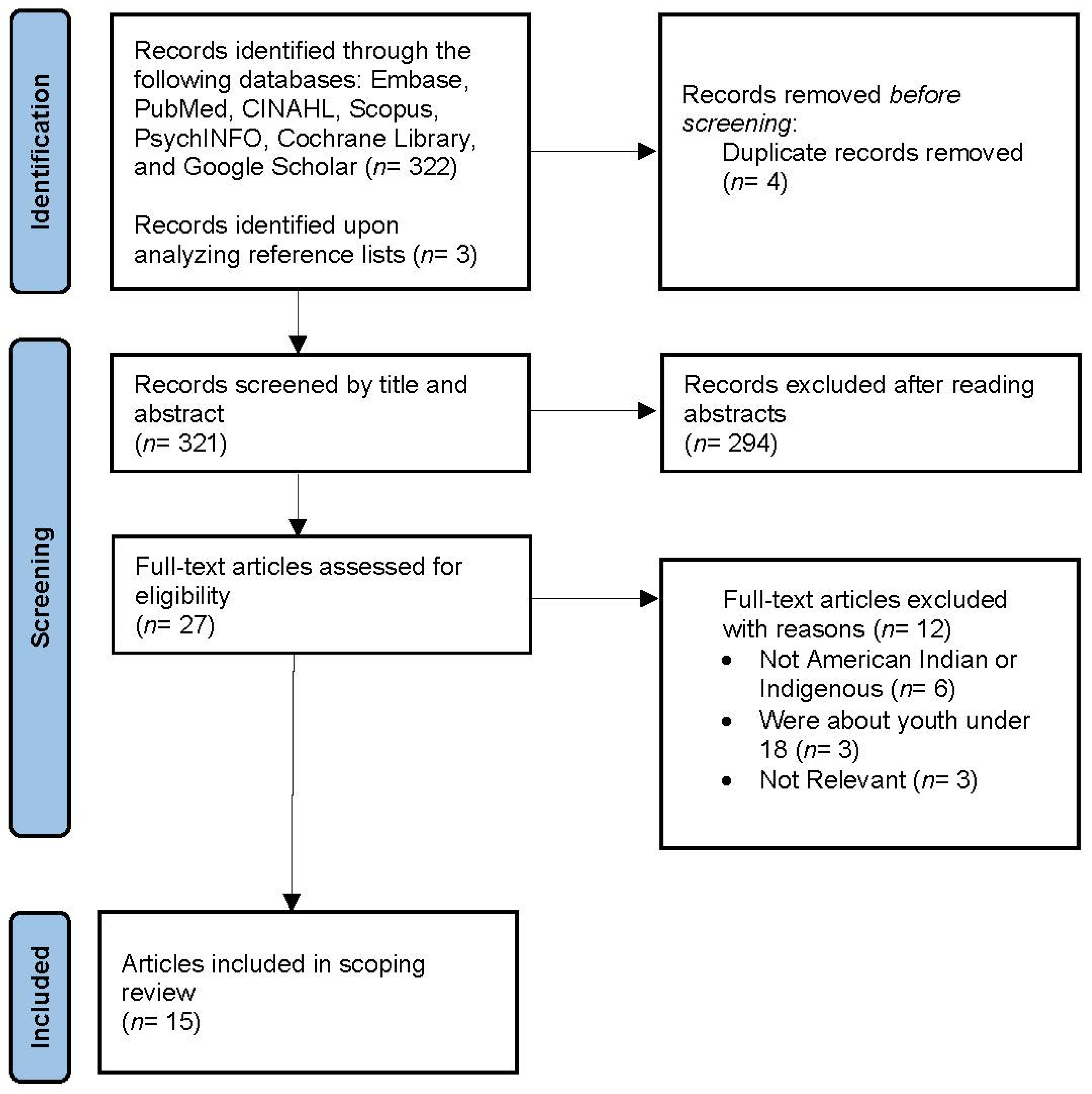
2.2. Study Selection
2.3. Data Extraction and Synthesis
3. Results
3.1. Study Characteristics
3.2. Identified Themes
3.2.1. Structurally Produced Vulnerabilities and Other Contributors to Human Trafficking
3.2.2. Long-Term Effects of Human Trafficking
3.2.3. Collaboration of Key Stakeholders Needed to End Trafficking
4. Discussion
Strengths and Limitations
5. Conclusions
Author Contributions
Funding
Institutional Review Board Statement
Informed Consent Statement
Data Availability Statement
Public Involvement Statement
Guidelines and Standards Statement
Use of Artificial Intelligence
Acknowledgments
Conflicts of Interest
Abbreviations
| AI/AN | American Indian/Alaska Native |
| LGBTQ | Lesbian, gay, bisexual, transgender, or queer |
References
- UN General Assembly. Protocol to Prevent, Suppress and Punish Trafficking in Persons, Especially Women and Children, Supplementing the United Nations Convention Against Transnational Organized Crime. 15 November 2000. Article 3. Available online: https://www.refworld.org/legal/agreements/unga/2000/23886 (accessed on 30 June 2026).
- Canada. Criminal Code, RSC 1985, c C-46, ss 279.01, 279.04; Immigration and Refugee Protection Act, SC 2001, c 27, s 118. Government of Canada: Ottawa, ON, Canada. Available online: https://laws-lois.justice.gc.ca/ (accessed on 3 July 2026).
- United States. Trafficking Victims Protection Act of 2000, Pub. L. No. 106-386, 114 Stat. 1464, Codified as Amended at 22 U.S.C. § 7102(11) (2000). U.S. Government Publishing Office: Washington, DC, USA. Available online: https://www.govinfo.gov/content/pkg/PLAW-106publ386/pdf/PLAW-106publ386.pdf (accessed on 3 July 2026).
- McAmis, N.E.; Mirabella, A.C.; McCarthy, E.M.; Cama, C.A.; Fogarasi, M.C.; Thomas, L.A.; Feinn, R.S.; Rivera-Godreau, I. Assessing healthcare provider knowledge of human trafficking. PLoS ONE 2022, 17, e0264338. [Google Scholar] [CrossRef] [Scilit] [PubMed]
- Murray, A.; Smith, L. Implementing evidence-based care for women who have experienced human trafficking. Nurs. Womens Health 2019, 23, 98–104. [Google Scholar] [CrossRef] [Scilit] [PubMed]
- Urban Indian Health Institute. Missing and Murdered Indigenous Women and Girls. 2018. Available online: https://www.uihi.org/wp-content/uploads/2018/11/Missing-and-Murdered-Indigenous-Women-and-Girls-Report.pdf (accessed on 3 April 2024).
- Pytalski, S.; Burns, C.; Villegas, M. Human and Sex Trafficking: Trends and Responses Across Indian Country; National Congress of American Indians (NCAI) Policy Research Center: Washington, DC, USA, 2016. [Google Scholar]
- Brave Heart, M.Y.H. The return to the sacred path: Healing the historical trauma and historical unresolved grief response among the lakota through a psychoeducational group intervention. Smith Coll. Stud. Soc. Work 1998, 68, 287–305. [Google Scholar] [CrossRef] [Scilit]
- Brave Heart, M.Y.H.; Chase, J.; Elkins, J.; Altschul, D.B. Historical Trauma Among Indigenous Peoples of the Americas: Concepts, Research, and Clinical Considerations. J. Psychoact. Drugs 2011, 43, 282–290. [Google Scholar] [CrossRef] [Scilit] [PubMed]
- Nagata, D.K.; Kim, J.H.J.; Gone, J.P. Intergenerational transmission of ethnoracial historical trauma in the United States. Annu Rev. Clin. Psychol. 2024, 20, 175–200. [Google Scholar] [CrossRef] [PubMed]
- Polaris. On-Ramps, Intersections, and Exit Routes: A Roadmap for Systems and Industries to Prevent and Disrupt Human Trafficking. 2018. Available online: https://polarisproject.org/wp-content/uploads/2018/08/A-Roadmap-for-Systems-and-Industries-to-Prevent-and-Disrupt-Human-Trafficking-Health-Care.pdf (accessed on 3 April 2024).
- Braun, B. Human Trafficking Awareness in the Emergency Care Setting: Joint Position Statement. J. Forensic Nurs. 2024, 20, E53–E56. [Google Scholar] [CrossRef] [Scilit] [PubMed]
- Macy, R.J.; Klein, L.B.; Shuck, C.A.; Rizo, C.F.; VanDenise, T.B.; Wretman, C.J.; Luo, J. A scoping review of human trafficking screening and response. Trauma Violence Abus. 2023, 2, 1202–1219. [Google Scholar] [CrossRef] [Scilit] [PubMed]
- Hodgins, E.; Mutis, J.; Mason, R.; Du Mont, J. Sex trafficking of women and girls in Canada: A scoping review of the scholarly literature. Trauma Violence Abus. 2023, 24, 2363–2378. [Google Scholar] [CrossRef] [Scilit] [PubMed]
- Link, D.G. Hiding in Plain Sight. J. Nurse Pract. 2018, 14, 505–506. [Google Scholar] [CrossRef] [Scilit]
- Muka, T.; Glisic, M.; Milic, J.; Verhoog, S.; Bohlius, J.; Bramer, W.; Chowdhury, R.; Franco, O.H. A 24-step guide on how to design, conduct, and successfully publish a systematic review and meta-analysis in medical research. Eur. J. Epidemiol. 2020, 35, 49–60. [Google Scholar] [CrossRef] [Scilit] [PubMed]
- Tricco, A.C.; Lillie, E.; Zarin, W.; O’Brien, K.K.; Colquhoun, H.; Levac, D.; Moher, D.; Peters, M.D.J.; Horsley, T.; Weeks, L.; et al. PRISMA Extension for Scoping Reviews (PRISMA-ScR): Checklist and Explanation. Ann. Intern Med. 2018, 169, 467–473. [Google Scholar] [CrossRef] [Scilit] [PubMed]
- Hintz, J. A Culturally Based Healing Intervention for Commercially Sex Trafficked Native American Women. Master of Social Work Thesis, University of St. Thomas, St. Paul, MN, USA, 2016. [Google Scholar]
- Olson-Pitawanakwat, B.; Baskin, C. In between the missing and murdered: The need for Indigenous-led responses to trafficking. Affilia 2021, 36, 10–26. [Google Scholar] [CrossRef] [Scilit]
- Fear, W. Tekicihila unpo (Love one another): Confronting human trafficking with the guidance of traditional Lakota wisdom in nursing practice. Creat Nurs. 2019, 25, 59–62. [Google Scholar] [CrossRef] [Scilit] [PubMed]
- Hill, M.; Anderson, M.B.; King, I. Human trafficking as a racialized economy and the exploitation of indigenous socio-spatial (im)mobility in North America. Front. Sustain. Cities 2022, 4, 884195. [Google Scholar] [CrossRef] [Scilit]
- Farley, M.; Deer, S.; Golding, J.M.; Matthews, N.; Lopez, G.; Stark, C.; Hudon, E. The prostitution and trafficking of American Indian/Alaska Native women in Minnesota. Am. Indian Alsk. Nativ. Ment. Health Res. 2016, 23, 65–104. [Google Scholar] [CrossRef] [Scilit] [PubMed]
- Weedn, H.; Scovel, J.; Juran, J. Human Trafficking & Native Peoples in Oregon: A Human Rights Report; International Human Rights Clinic at Willamette University College of Law: Salem, OR, USA, 2014; Available online: https://www.doj.state.or.us/wp-content/uploads/2017/06/human_trafficking_and_native_peoples_in_oregon_a_human_rights_report.pdf (accessed on 28 March 2024).
- Shanley, E.; Jordan, R. Sex Trafficking in Indian Country. In Human Trafficking Is a Public Health Issue: A Paradigm Expansion in the United States; Springer: Cham, Switzerland, 2017; pp. 123–140. [Google Scholar] [CrossRef] [Scilit]
- Stark, C. Strategies to Restore Justice for Sex Trafficked Native Women. In The Palgrave International Handbook of Human Trafficking; Springer International Publishing: Cham, Switzerland, 2020; pp. 1219–1240. [Google Scholar] [CrossRef] [Scilit]
- Hagen, L.A.; Whittemore, B.L. Combatting trafficking of Native Americans and Alaska Natives. U. S. Atty. Bull. 2017, 65, 149. [Google Scholar]
- Pierce, A.; Koepplinger, S. New Language, Old Problem: Sex Trafficking of American Indian Women and Children. Available online: https://vawnet.org/material/new-language-old-problem-sex-trafficking-american-indian-women-and-children (accessed on 12 November 2023).
- Bailey, J.; Shayan, S. Missing and murdered Indigenous women crisis: Technological dimensions. Can. J. Women Law 2016, 28, 321–341. [Google Scholar] [CrossRef] [Scilit]
- Bourgeois, R. Colonial exploitation: The Canadian state and the trafficking of indigenous women and girls in Canada. UCLA Law Rev. 2015, 62, 1426. [Google Scholar]
- Finn, K.; Gajda, E.; Perin, T.; Fredericks, C. Responsible resource development and prevention of sex trafficking: Safeguarding Native women and children on the Fort Berthold Reservation. Harv. J. Law Gend. 2017, 40, 1. [Google Scholar] [CrossRef] [Scilit]
- Monchalin, L.; Marques, O.; Reasons, C.; Arora, P. Homicide and Indigenous peoples in North America: A structural analysis. Aggress. Violent Behav. 2019, 46, 212–218. [Google Scholar] [CrossRef] [Scilit]
- Stumblingbear-Riddle, G.; Burlew, A.; Gaztambide, D.; Madore, M.R.; Neville, H.; Joseph, G. Standing with our American Indian and Alaska Native women, girls, and two-spirit people: Exploring the impact of and resources for survivors of human trafficking. J. Indig. Res. 2019, 7, 1. [Google Scholar] [CrossRef]
- Smith, L.T. Decolonizing Methodologies: Research and Indigenous Peoples, 2nd ed.; Zed Books: London, UK, 2012. [Google Scholar]
- Petreca, V.G.; Dowdell, E.B.; Harding, S.L. Murdered native and Indigenous women: A comparison study of victim and perpetrator patterns and characteristics. J. Forensic Nurs. 2024, 20, 174–184. [Google Scholar] [CrossRef] [Scilit] [PubMed]
- Rosario, A.A.; Gau, A.; Munsterman, E.; Ancheta, A.J. Decolonizing nursing for health equity: A scoping review. Nurs. Outlook 2024, 72, 102230. [Google Scholar] [CrossRef] [Scilit] [PubMed]
- Truth and Reconciliation Commission of Canada. Truth and Reconciliation Commission of Canada: Calls to Action; National Centre for Truth and Reconciliation: Winnipeg, MB, Canada, 2015; Available online: https://ehprnh2mwo3.exactdn.com/wp-content/uploads/2021/01/Calls_to_Action_English2.pdf (accessed on 30 June 2026).


| Search Engines | Search Terms and Combinations | Search Results |
|---|---|---|
| CINAHL | (MH “Native Americans+”) OR TI ((“native american” or “american indian” or indigenous or “native tribe people”)) OR AB ((“native american” or “American indian” or indigenous tribes” or “native people”)) OR TI ((“human trafficking” or “sex trafficking” or enslavement)) OR AB ((“trafficking” or “sex trafficking” or enslavement)) AND (MH “human trafficking”) | All results (n = 10); after title/abstract (n = 3); final selection (n = 1) |
| Cochrane Library | “Human Trafficking” | All results (n = 1); after title/abstract (n = 0); final selection (n = 0) |
| Embase | ‘American Indian’/exp OR ‘Native American’:ab, ti OR ‘American Indian’:ab, ti OR indigenous: ab, ti OR ‘native tribes’: ab, ti OR native: ab, ti AND ‘human trafficking’: ab, ti OR ‘sex trafficking’: ab, ti OR enslavement: ab, ti | All results (n = 22); after title/abstract (n = 1); final selection (n = 1) |
| Google Scholar | (“Human Trafficking” OR “enslavement OR “sex work” OR “human trafficking*” OR “sex trafficking*” OR “labor trafficking*” OR “trafficking of women”) AND ((“Native American” OR Indian OR native OR indigenous OR tribe OR tribal)) AND (woman or women or female) | All results (n = 15); after title/abstract (n = 8); final selection (n = 7) |
| PsycINFO | DE “Human Trafficking” OR DE “Sex Trafficking” OR TI ((“native american” or “American Indian” or indigenous or “native tribal people”)) OR AB ((“native American” or “American Indian” or indigenous tribes” or “native people”)) | All results (n = 25); after title/abstract (n = 1); final selection (n = 1) |
| PubMed | (“Human Trafficking” [Mesh])) OR “human trafficking” [Title/Abstract] OR indigenous [Title/Abstract] OR Indian [Title/Abstract])) AND “Human Trafficking” [Mesh] AND Indian [Title/Abstract])) OR “Human Trafficking” [Mesh] AND indigenous [Title/Abstract] OR “Human Trafficking” [Title/Abstract]) AND native [Title/Abstract] OR “human trafficking” [Title/Abstract])) AND ((“Indians, North American” [Mesh]) | All results (n = 12); after title/abstract (n = 0); final selection (n = 0) |
| Scopus | TITLE-ABS-KEY (“human trafficking” OR “sex trafficking” OR enslavement) AND (“native American” OR “American Indian” OR indigenous) AND (women OR woman OR female) | All results (n = 237); after title/abstract (n = 14); final selection (n = 5) |
| Author (Year) | Literature Type or Methods and Source | Location and Population | Aims | Key Findings or Conclusions |
|---|---|---|---|---|
| Bailey & Shayan (2016) [28] | Review of Literature and Feminist Critique Law Journal | Canada First Peoples including First Nations, Inuit, and Métis | To consider how digital technologies are informed by, and implicated in, the missing and murdered Indigenous women crisis in Canada. | Digital communications technologies, such as the internet, are encoded to perpetuate power imbalances for women and First Peoples. Technologies interact with other socio-cultural and historical forces in ways that expose Indigenous women and girls to vulnerabilities that are recognized as the root causes of the missing and murdered Indigenous women crisis in Canada. Voluntary DNA programs are helpful in retribution, but do not address the root causes of trafficking. Digital communications should be involved in increasing victims’ access to justice and a national action plan. |
| Bourgeois (2015) [29] | Review of Literature Law Journal | Canada Indigenous women | To explore the role of the Canadian State in the human trafficking of Indigenous women and girls in Canada. A review of past and current litigation and an argument that Canada has been complicit in human trafficking of Indigenous women and girls in Canada. | While it is admirable the Canadian State has stepped up to fight human trafficking of Indigenous women, they remain complicit in the violence. To end human trafficking within the indigenous population, decolonization must take place, requiring a hard internal examination of the complexities of human trafficking. |
| Farley et al. (2016) [22] | Mixed-Methods Design Health Journal | Minnesota 81% Anishinaabe women | To examine social and physical violence against AI/AN women in prostitution and the impact on mental and physical health. | In total, 98% were currently or previously homeless. Common themes of vulnerabilities that led to human trafficking were homelessness, rape, assault, and racism. The victims had a high prevalence of physical and mental symptoms of muscle pain, impaired memory, headaches, and post-traumatic stress disorder. The women need collaborative approaches with healthcare, legal assistance, physical protection from a pimp, and childcare to overcome victimization. |
| Fear (2019) [20] | Case Study Nursing Journal | North Dakota Lakota women | To bring awareness of the problem of human trafficking in the Indigenous population. To describe the nursing care given to Native women victims of trafficking that empowers them and provides positive messaging. | This is a call to action: to truly know someone’s needs, healthcare professionals need to look past medication lists and reasons for being seen. |
| Finn et al. (2017) [30] | Review of Literature Law and Gender Journal | North Dakota Mandan, Hidatsa, and Airkara Nation women | To describe the intersection of sex trafficking and oil and gas development on the Fort Berthold Reservation; to describe jurisdiction and examine strategies to address the complex issue. | Native Americans are the only ethnic/racial group where missing person numbers are not tracked. Social risks are high with oil development in American Indian Reservations. Native American victims have overlapping risk factors that include exposure to domestic abuse, sexual assault, and poverty. Human trafficking will continue to be a silent crime unless all stake holders come together to combat the violence. |
| Hagen & Whittemore (2017) [26] | US Government Report | United States American Indian and Alaska Native Peoples | To outline federal jurisdiction from commercial sex trafficking offenses in Indian Country and to offer an example of the development of a comprehensive plan to combat human trafficking in Indian Country. | Collaboration is key, as working within American Indian reservations is complex due to multiple jurisdictions and a myriad of criminal justice and social services personnel. Risk factors include vulnerability, financial instability, and history of abuse and sexual assault. Improving public safety and the fair administration of justice in tribal communities is a top priority for the Department of Justice. |
| Hill, et al. (2022) [21] | Review of Literature and Case Studies Urban Environment Journal | Northwestern United States American Indian Women | To summarize the socio-political history contributing to risks of American Indian women, and to conceptualize the industry that profits from human trafficking as a “racial economy.” To empirically examine case studies of missing and murdered Indigenous women. | The legacy of colonialism contributes to the problem of trafficking of Indigenous women. American Indian women continue to be sexualized in images, which contributes to sexual demand. Homelessness and/or lack of stable relationships create vulnerability. Complicated legal and jurisdictional structures and socio-economic inequality lead to immobility and social exclusion from resources and contributes to human trafficking. Mobility needs to be considered in human trafficking prevention efforts. |
| Hintz (2016) [18] | Qualitative Social Work Thesis | United States Female professionals working with Native American Women in a Northern Plains Tribe | To determine the essential components of a culturally based healing intervention for Native American Women who have experienced being prostituted. | Six themes were identified: (a) spiritualty cannot be separated from therapeutic interventions, (b) ceremony as a diverse, integral component of healing, (c) the role of community in healing, d) therapeutic activities that connect to culture, (e) person-centered intervention planning and (f) the lack of recognition of traditional healing practices. |
| Monchalin, et al. (2019) [31] | Review of Literature Criminology Journal | United States and Canada Indigenous Peoples | To reinscribe the understandings of the racialization of homicide statistics, the tragedy of missing and murdered Indigenous women and girls. | The colonialist treatment of Indigenous Peoples is most evident with the missing and murdered Indigenous women crisis. Indigenous voices and experiences are invisible. |
| Olson-Pitawanakwat & Baskin (2021) [19] | Qualitative Feminist Social Work Journal | Toronto, Canada Social service providers and American Indian, Two-spirit, and transwomen victims/survivors of human trafficking from the Wendat, Anishinabek, and Haudenosunee Peoples | To examine the lived experiences of human trafficking of the participants. | Identified five themes: (a) pathways into human trafficking, (b) collective and intergenerational trauma caused by systems of colonization, (c) uniqueness of Two-Spirit/Queer/Trans experiences, (d) what helped victims get out, and (e) healing journeys. |
| Pierce, et al. (2011) [27] | Review of Literature Gender-based Violence Website | United States and Canada Indigenous women | To summarize published materials on the commercial sexual exploitation of Indigenous women and children in the U.S. and Canada. | Research is limited on human trafficking of Indigenous women and girls. Three main points drawn from existing research were: human trafficking is a critical problem in the U.S. and Canada, American Indian women are more heavily targeted in some regions, and traffickers prey on Indigenous women because of vulnerabilities. |
| Shanley & Jordan (2017) [24] | Book Chapter Human Trafficking | Minnesota and Oregon American Indian Peoples | To examine contemporary human trafficking in Indian Country. | Contributing factors to human trafficking include historical context, U.S. government policies, vulnerability, historical trauma, substance use disorders, mental health diagnoses, racism, poverty, homelessness, history of child welfare involvement, and jurisdiction loopholes. Examples of culturally relevant interventions to combat trafficking are shared. |
| Stark (2019) [25] | Book Chapter Human Trafficking | North America American Indian and First Nations Women | Examine the history of sex trafficking of Indigenous Women. | Disparities experienced by Native American and First Nations women make them more vulnerable to human trafficking. Geographic areas like borders and ports are loci. Collaboration is key to combating this issue, with a need to develop civil litigation and support services for human trafficking victims. |
| Stumblingbear-Riddle, et al. (2019) [32] | Review of Literature Indigenous Research Journal | United States American Indian/Alaska Native women, girls, and two-spirit people | To discuss the influence of gender/race/ ethnicity/Indigeneity on trauma and the outcomes of human trafficking. | Repeated exposure to trauma related to sexual and gender violence for AI/AN women and girls and two-spirit people leads to a focus on survival. Human trafficking has devastating effects on survivors, families, and communities. Advocates on the front lines who are combating human trafficking contribute to healing. |
| Weedn, et al. (2014) [23] | Mixed-Methods Law Journal | Oregon Native American Peoples who had prosecuting, protecting, or preventing roles | To measure whether federal, state, and local government officials are meeting their obligations under international, national, and state laws in prosecuting traffickers, protecting survivors, and preventing trafficking as it involves the Native American population in Oregon. | Themes: (a) officials are not meeting obligations to prevention, prosecution, and protection of American Indian human trafficking victims, (b) generational trauma is a major contributor to human trafficking, along with a relationship between foster care, homelessness, and vulnerability to human trafficking, (c) the underreporting of sex trafficking crimes within Native American communities, (d) the distrust of non-tribal law enforcement, (e) jurisdictional confusion, and f) lack of funding for traditional healing methods. |
Disclaimer/Publisher’s Note: The statements, opinions and data contained in all publications are solely those of the individual author(s) and contributor(s) and not of MDPI and/or the editor(s). MDPI and/or the editor(s) disclaim responsibility for any injury to people or property resulting from any ideas, methods, instructions or products referred to in the content. |
© 2026 by the authors. Licensee MDPI, Basel, Switzerland. This article is an open access article distributed under the terms and conditions of the Creative Commons Attribution (CC BY) license.
Share and Cite
Thompson, D.; Hodgson, C.; Godfrey, T.M.; Taylor-Piliae, R.E. Human Trafficking Among North American Indigenous Women: A Scoping Review. Nurs. Rep. 2026, 16, 246. https://doi.org/10.3390/nursrep16070246
Thompson D, Hodgson C, Godfrey TM, Taylor-Piliae RE. Human Trafficking Among North American Indigenous Women: A Scoping Review. Nursing Reports. 2026; 16(7):246. https://doi.org/10.3390/nursrep16070246
Chicago/Turabian StyleThompson, Deanna, Christine Hodgson, Timian M. Godfrey, and Ruth E. Taylor-Piliae. 2026. "Human Trafficking Among North American Indigenous Women: A Scoping Review" Nursing Reports 16, no. 7: 246. https://doi.org/10.3390/nursrep16070246
APA StyleThompson, D., Hodgson, C., Godfrey, T. M., & Taylor-Piliae, R. E. (2026). Human Trafficking Among North American Indigenous Women: A Scoping Review. Nursing Reports, 16(7), 246. https://doi.org/10.3390/nursrep16070246