
Feasibility of REBOA (Resuscitative Endovascular Balloon Occlusion of the Aorta) Implementation in HEMS (Helicopter Emergency Medical Service) Units in Castilla-La Mancha, Spain

 ,
,  , , , and
Abstract
1. Introduction
2. Materials and Methods
2.1. Study Design
2.2. Review Process
- Chronology: from 1 January 2023 to 31 December 2023.
- Medical helicopters of Castilla-La Mancha: Giant 1 (Albacete), Giant 2 (Ciudad Real), Giant 3 (Cuenca), Giant 4 (Toledo).
- Warnings in which advance notice was given by trauma code.
- Reports with Code ICD (International Classification of Diseases) 9 URGENCIAS GUETS (Gerencia de Urgencias, Emergencias y Transporte Sanitario, which is the Pre-hospital Care Service in Castilla-La Mancha) (Table 1).
- Estimated age is between 18 and 80 years.
- Out-of-hospital cardiac arrest.
- Cardiac arrest of non-traumatic origin.
- Less than 10 min from the onset of arrest to the start of basic or advanced life support.
- Advanced life support is established and can be continued.
- Patients who experience cardiac arrest while being cared for by ambulance personnel or the HEMS emergency medical team.
- Traumatic cardiac arrest, including strangulation, electrocution, and patients rescued from avalanches.
- Accidental hypothermia with temperature < 32 °C.
- Suspected cerebral hemorrhage as the cause of cardiac arrest.
- Suspected non-traumatic hemorrhage as the cause of cardiac arrest.
- Pregnancy, evident or suspected.
- Other factors determined by the treating team (environmental, safety or other factors).
- Traumatic cardiac arrest with suspected non-compressible hemorrhage in the abdomen or pelvis.
- Absence of other immediate treatable causes (such as tension pneumothorax or cardiac tamponade).
- Femoral vascular access is possible and rapid.
- Massive hemorrhage with persistent hemodynamic instability, defined as refractory shock, and including the following.
- Systolic blood pressure < 90 mmHg despite resuscitation with fluids and/or blood products.
- Shock index > 0.9 despite resuscitation with fluids and/or blood products.
- Need for temporary bleeding control while preparing for definitive intervention.
- Femoral vascular access is possible without anatomical contraindications.
- Hemorrhage controlled by conventional measures.
- Anatomical or technical contraindications:
- Aortic aneurysm, aortic dissection, femoral thrombosis, or impossible vascular access.
- Bleeding above the diaphragm (upper esophageal or nasopharyngeal):
- REBOA is not effective in these cases, as aortic occlusion does not control bleeds above zone 1.
- Prolonged time from onset of bleeding without intervention (>6 h).
- Patient with terminal prognosis or anticipated decisions not to resuscitate (DNR).
2.3. Statistical Analysis
3. Results
3.1. Case Selection Flow
3.2. Demographic Characteristics and Geographic Distribution
3.3. HEMS Base Activity
3.4. Pre-Hospital Response and Transport Times
3.5. Logistical Variables and Access to the Healthcare System
3.6. Mechanisms of Injury and Clinical Severity
3.7. Physiological Parameters and Clinical Scales
3.8. Mortality and Hospital Stay
3.9. Correlation Analysis and Statistical Tests
4. Discussion
5. Conclusions
Author Contributions
Funding
Institutional Review Board Statement
Informed Consent Statement
Data Availability Statement
Public Involvement Statement
Guidelines and Standards Statement
Use of Artificial Intelligence
Acknowledgments
Conflicts of Interest
Abbreviations
| ACLS | Advanced Cardiovascular Life Support |
| ANOVA | Analysis of variance |
| AUC | Area under the curve |
| AIS | Abbreviated Injury Scale by trauma localization |
| ALS | Advanced Life Support |
| BLS | Basic Life Support |
| BPM | Beats per minute |
| CPR | Cardiopulmonary Resuscitation |
| CRA | Cardiorespiratory Arrest |
| DGT | Dirección General de Tráfico |
| Dl | Decilities |
| DNR | Do Not Resuscitate |
| DSI | Diastolic index shock |
| ECMO | Extracorporeal Membrane Oxygenation |
| ERC | European Resuscitation Council |
| GWCS | Glasgow Coma Scale |
| GUETS | Gerencia de Urgencias, Emergencias y Transporte Sanitario |
| HEMS | Helicopter Emergency Medical Services |
| ICD | International Classification of Diseases |
| ICU | Intensive Care Unit |
| ISS | Injury Severity Score |
| KM | Kilometers |
| mg | Milligrams |
| mmHg | Millimeters of mercury |
| MSI | Modified Shock Index |
| N | Statistical population |
| NISS | New Injury Severity Score |
| RC | Red Cross |
| REBOA | Resuscitative Endovascular Balloon Occlusion of the Aorta |
| RSI | Reserved Shock index |
| RTS | Revised Trauma Score |
| RR | Respiratory rate |
| SAFI | (SpO2/FiO2)x 100 |
| SD | Continuous variables |
| SI | Shock Index |
| STO2% | Oxygen saturation |
| SPSS | Statistical Package for the Social Sciences |
| WHO | World Health Organization |
Appendix A
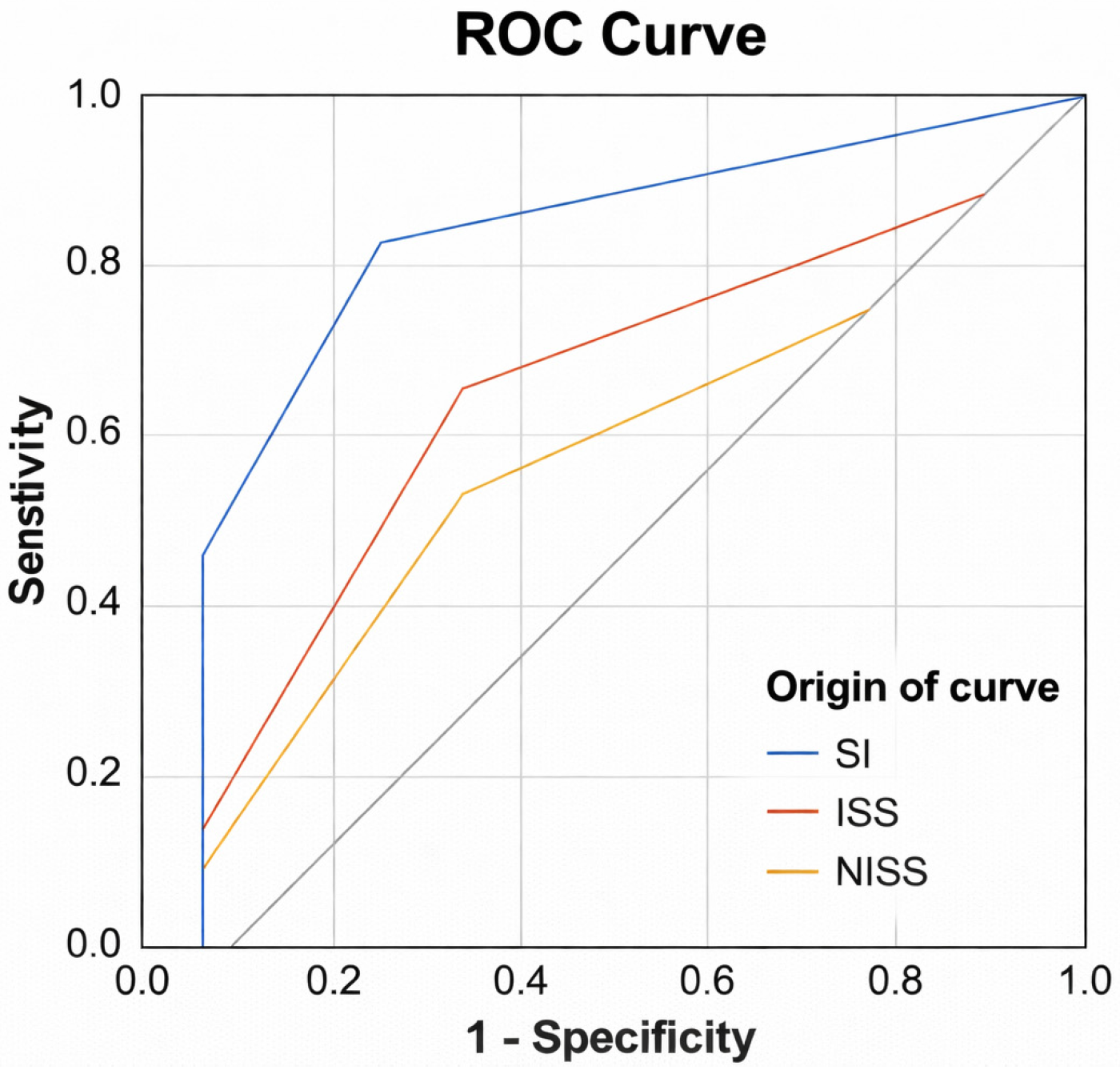
ROC Curve of IS, RTS, ISS, NISS

References
- Ministerio de Presidencia. REAL DECRETO 2792007, de 23 de Febrero, por el Que se Determinan los Requisitos Exigibles para la Realización de las Operaciones de Transporte Aéreo Comercial por Helicópteros Civiles; BOE: Madrid, Spain, 2007. [Google Scholar]
- Ministerio de Presidencia. Real Decreto 836/2012, de 25 de Mayo, por el Que se Establecen las Características Técnicas, el Equipamiento Sanitario y la Dotación de Personal de los Vehículos de Transporte Sanitario por Carretera; BOE: Madrid, Spain, 2012. [Google Scholar]
- España, F.J.G. Helitransporte Medicalizado: Situación Actual en España y Análisis de los Últimos doce Años de Actividad en Andalucía. Ph.D. Thesis, Universidad de Málaga, Málaga, Spain, 2015. [Google Scholar]
- Paucar Ccama, Y.; Remache Tucno, M.M. Efectividad del Servicio de Transporte de Emergencia en Helicóptero en Comparación con el Terrestre para Disminuir la Mortalidad en Pacientes con Traumatismo Grave; Universidad Privada Norbert Wiener: Lima, Peru, 2019. [Google Scholar]
- Velilla Moliner, J.; Valverde, A.G.; López, A.R.; González, F.S.; González, A.L.; Lacueva, M.I.M.; Lacambra, M.A.L.; Feria, M.M.; Lardies, B.L.; Manjón, Y.F. Análisis y evaluación del helitransporte sanitario en Aragón. Emergencias 2007, 19, 16–20. [Google Scholar]
- Ministerio de Sanidad. Patrones de Mortalidad en España, 2022; Ministero de Sanidad: Madrid, Spain, 2025. [Google Scholar]
- WHO. La OMS Revela las Principales Causas de Muerte y Discapacidad en el Mundo: 2000–2019. WHO. 2020. Available online: https://www.who.int/es/news/item/09-12-2020-who-reveals-leading-causes-of-death-and-disability-worldwide-2000-2019 (accessed on 8 April 2025).
- Van Skike, C.E.; Baer, D.G.; Spalding, M.C.; Radomski, M. Complete and Partial Resuscitative Endovascular Balloon Occlusion of the Aorta for Hemorrhagic Shock. J. Vis. Exp. 2022, 183, e63767. [Google Scholar] [PubMed]
- Ramos Perkis, J.P.; Ortega Ruiz, J.; Loaiza Medina, P.D.; Zinco Acosta, A.; Ottolino Lavarte, P. Balón de resucitación aórtico endovascular (REBOA) para el control de la hemorragia no compresible de torso. Revisión de la evidencia. Rev. Cir. 2025, 75, 263–269. Available online: https://revistacirugia.cl/index.php/revistacirugia/article/view/1724 (accessed on 8 April 2025). [CrossRef]
- Hilbert-Carius, P.; Schmalbach, B.; Wrigge, H.; Schmidt, M.; Abu-Zidan, F.M.; Aschenbrenner, U.; Streibert, F. Do we need pre-hospital resuscitative endovascular balloon occlusion of the aorta (REBOA) in the civilian helicopter emergency medical services (HEMS)? Intern. Emerg. Med. 2023, 18, 627–637. [Google Scholar] [CrossRef]
- Chico Fermandez, M.; Abelardo Baerea Mendoza, J.; Mudarra Reche, C.; Murillo Perez, M.; Orejon Garcia, L.; Valiente Fernandez, V. Atención Inicial al Trauma Grave las Primeras 24h, 1st ed.; Elservier: Madrid, Spain, 2022. [Google Scholar]
- Meyer, C.H.; Beckett, A.; Dennis, B.M.; Duchesne, J.; Kundi, R.; Pandya, U.; Lawless, R.; Moore, E.; Spalding, C.; Vassy, W.M.; et al. pREBOA versus ER-REBOA impact on blood utilization and resuscitation requirements: A pilot analysis. J. Trauma Acute Care Surg. 2025, 98, 87–93. [Google Scholar] [CrossRef]
- Maiga, A.W.; Kundi, R.; Morrison, J.J.; Spalding, C.; Duchesne, J.; Hunt, J.; Nguyen, J.; Benjamin, E.; E Moore, E.; Lawless, R.; et al. Systematic review to evaluate algorithms for REBOA use in trauma and identify a consensus for patient selection. Trauma Surg. Acute Care Open 2022, 7, e000984. [Google Scholar] [CrossRef]
- Carroll, S.L.; Dye, D.W.; Smedley, W.A.; Stephens, S.W.; Reiff, D.A.; Kerby, J.D.; Holcomb, J.B.; Jansen, J.O. Early and prehospital trauma deaths: Who might benefit from advanced resuscitative care? J. Trauma Acute Care Surg. 2020, 88, 776–782. [Google Scholar] [CrossRef]
- Lott, C.; Truhlář, A.; Alfonzo, A.; Barelli, A.; González-Salvado, V.; Hinkelbein, J.; Nolan, J.P.; Paal, P.; Perkins, G.D.; Thies, K.C.; et al. European Resuscitation Council Guidelines 2021: Cardiac arrest in special circumstances. Resuscitation 2021, 161, 152–219. [Google Scholar] [CrossRef]
- Cralley, A.L.; Moore, E.E.; Scalea, T.M.; Inaba, K.; Bulger, E.M.; Meyer, D.E.; Fox, C.J.; Sauaia, A. Predicting success of resuscitative endovascular occlusion of the aorta: Timing supersedes variable techniques in predicting patient survival. J. Trauma Acute Care Surg. 2021, 91, 473–479. [Google Scholar] [CrossRef]
- Brede, J.R.; Lafrenz, T.; Klepstad, P.; Skjærseth, E.A.; Nordseth, T.; Søvik, E.; Krüger, A.J. Feasibility of Pre-Hospital Resuscitative Endovascular Balloon Occlusion of the Aorta in Non-Traumatic Out-of-Hospital Cardiac Arrest. J. Am. Heart Assoc. 2019, 8, e014394. [Google Scholar] [CrossRef]
- Jansen, J.O.; Hudson, J.; Cochran, C.; MacLennan, G.; Lendrum, R.; Sadek, S.; Gillies, K.; Cotton, S.; Kennedy, C.; Boyers, D.; et al. Emergency Department Resuscitative Endovascular Balloon Occlusion of the Aorta in Trauma Patients with Exsanguinating Hemorrhage: The UK-REBOA Randomized Clinical Trial. JAMA 2023, 330, 1862. [Google Scholar] [CrossRef] [PubMed]
- McGreevy, D.T.; Abu-Zidan, F.M.; Sadeghi, M.; Pirouzram, A.; Toivola, A.; Skoog, P.; Idoguchi, K.; Kon, Y.; Ishida, T.; Matsumura, Y.; et al. Feasibility and Clinical Outcome of Reboa in Patients with Impending Traumatic Cardiac Arrest. Shock 2020, 54, 218–223. [Google Scholar] [CrossRef] [PubMed]
- Alberdi, F.; García, I.; Atutxa, L.; Zabarte, M. Epidemiología del trauma grave. Med. Intensiv. 2014, 38, 580–588. [Google Scholar] [CrossRef] [PubMed]
- National Institute for Health and Care Excellence. GUIA NICE. Trauma. 2018. Available online: https://www.nice.org.uk/guidance/qs166/resources/trauma-pdf-75545603800261 (accessed on 1 January 2020).
- SESCAM. Codigo Trauma Sescam Guets; Servicio de Salud de Castilla-La Mancha: Albacete, Spain, 2011. [Google Scholar]
- Castro, E.; Figueras, I.; Jiménez, X.; Olivé, M.; Sánchez, P. Guia d’Actuació Infermera d’Urgències i Emergències Prehospitalàries; Sistema d’Emergències Mèdiques, SA (SEM): Cataluña, Spain, 2017. [Google Scholar]
- SAMUR PC. Manual de Procedimientos SAMUR-PC; SAMUR PC: Madrid, Spain, 2025. [Google Scholar]
- INE. Encuesta de Características Esenciales de la Población y las Viviendas. Año 2021. Available online: https://www.ine.es/dyngs/INEbase/operacion.htm?c=Estadistica_C&cid=1254736176992&menu=ultiDatos&idp=1254735572981 (accessed on 8 April 2025).
- Garrote Moreno, J.I. Manual de Transporte Aéreo Medicalizado, ala Fija y HEMS, 1st ed; Zumaque: Madrid, Spain, 2019. [Google Scholar]
- Aziz, S.; Barratt, J.; Wilson-Baig, N.; Lachowycz, K.; Major, R.; Barnard, E.B.G.; Rees, P. A protocol for the ERICA-ARREST feasibility study of Emergency Resuscitative Endovascular Balloon occlusion of the Aorta in Out-of-Hospital Cardiac Arrest. Resusc. Plus 2024, 19, 100688. [Google Scholar] [CrossRef]
- Brede, J.R.; Skulberg, A.K.; Rehn, M.; Thorsen, K.; Klepstad, P.; Tylleskär, I.; Farbu, B.; Dale, J.; Nordseth, T.; Wiseth, R.; et al. REBOARREST, resuscitative endovascular balloon occlusion of the aorta in non-traumatic out-of-hospital cardiac arrest: A study protocol for a randomised, parallel group, clinical multicentre trial. Trials 2021, 22, 511. [Google Scholar] [CrossRef]
- Treffalls, R.N.; DuBose, J.J.; Brenner, M.; Piccinini, A.; Inaba, K.; Scalea, T.M.; Moore, L.J.; Kauvar, D.S. Outcomes Associated with Aortic Balloon Occlusion Time in Patients with Zone 1 Resuscitative Endovascular Balloon Occlusion of the Aorta. J. Surg. Res. 2024, 296, 256–264. [Google Scholar] [CrossRef]
- Nowadly, C.D.; Johnson, M.A.; Hoareau, G.L.; Manning, J.E.; Daley, J.I. The use of resuscitative endovascular balloon occlusion of the aorta (REBOA) for non-traumatic cardiac arrest: A review. JACEP Open 2020, 1, 737–743. [Google Scholar] [CrossRef]
- Bini, J.K.; Hardman, C.; Morrison, J.; Scalea, T.M.; Moore, L.J.; Podbielski, J.M.; Inaba, K.; Piccinini, A.; Kauvar, D.S.; Cannon, J.; et al. Survival benefit for pelvic trauma patients undergoing Resuscitative Endovascular Balloon Occlusion of the Aorta: Results of the AAST Aortic Occlusion for Resuscitation in Trauma Acute Care Surgery (AORTA) Registry. Injury 2022, 53, 2126–2132. [Google Scholar] [CrossRef]
- Ordoñez, C.A.; Rodríguez, F.; Parra, M.; Herrera, J.P.; Guzmán-Rodríguez, M.; Orlas, C.; Caicedo, E.Y.; Serna, J.J.; Salcedo, A.; Del Valle, A.M.; et al. Resuscitative endovascular balloon of the aorta is feasible in penetrating chest trauma with major hemorrhage: Proposal of a new institutional deployment algorithm. J. Trauma Acute Care Surg. 2020, 89, 311–319. [Google Scholar] [CrossRef]
- Brede, J.R.; Kramer-Johansen, J.; Rehn, M. A needs assessment of resuscitative endovascular balloon occlusion of the aorta (REBOA) in non-traumatic out-of-hospital cardiac arrest in Norway. BMC Emerg Med. 2020, 20, 28. [Google Scholar] [CrossRef]
- Martínez Hernández, A.; Chorro, R.; Climent, A.; Lazaro-Paulina, F.G.; Martínez García, V. Has the balloon really burst? Analysis of “the UK-REBOA randomized clinical trial”. Am. J. Surg. 2024, 234, 62–67. [Google Scholar] [CrossRef]

| Name | Code |
|---|---|
| Unspecified Peritonitis | 567.9 |
| Traumatic amputation of leg(s), complete or partial | 897 |
| Traumatic amputation of toe | 895 |
| Traumatic amputation of foot, complete or partial | 896 |
| Traumatic amputation of arm and hand | 887 |
| Traumatic amputation of thumb, complete or partial | 885 |
| Amputations: more specific data | |
| Crushing of multiple and unspecified sites | 929 |
| Crushing injury of lower limb | 928 |
| Crushing injury of upper limb | 927 |
| Crushing injury of trunk and/or external genitalia | 926 |
| Unspecified complication of labor and delivery | 669.9 |
| Abdominal rigidity | 789.4 |
| Contusion of the hip | 924.01 |
| Contusion of sternum, clavicle and/or costal region | 922.1 |
| Contusion of the back and buttocks (includes lumbo-sacral-coccygeal region) | 922.3 |
| Contusion of lower limb with unspecified site | 924.9 |
| Contusion of the abdominal wall | 922.2 |
| Contusion of chest wall | 922.1 |
| Contusion of the foot | 924.20 |
| Contusion of the lower leg | 924.10 |
| Injury to heart and lung | 861 |
| Multiple contusions of lower limb | 924.4 |
| Multiple contusions on trunk | 922.8 |
| Fracture of ribs or sternum | 807 |
| Fracture of femur | 821 |
| Fracture of pelvis | 808 |
| Antepartum hemorrhage | 641.9 |
| Hemorrhage of gastrointestinal tract, unspecified | 578.9 |
| Excessive hemorrhage after abortion or ectopic or molar pregnancy | 639.1 |
| Immediate postpartum hemorrhage | 666.1 |
| Secondary and recurrent hemorrhage | 958.2 |
| Traumatic hemothorax and/or pneumothorax | 860 |
| Hemothorax, hemopneumothorax, non-traumatic hydrothorax | 511.8 |
| Wound in hip, buttock and/or thigh | 890.0 |
| Open wounds of other and unspecified parts of the trunk, except limbs | 879 |
| Chest wall injury | 875 |
| Superficial wound with opening of thoracic cavity | 860.5 |
| Multiple wounds on lower limb except thigh | 894 |
| Hypovolemia (not hypovolemic shock) | 276.5 |
| Superficial injury hip thigh, knee, leg and ankle | 916 |
| Superficial trunk injury | 911 |
| Metrorrhagia not related to menstrual cycle | 626.6 |
| Cardiorespiratory arrest | 427.5 |
| Multiple contusions | 924.8 |
| Polytraumatized | 959.8 |
| Rectorrhagia | 569.3 |
| Cardiogenic shock | 785.51 |
| Hypovolemic shock | 785.59 |
| Non-specific shock | 785.50 |
| Unspecified injury to the trunk | 959.1 |
| Unspecified injury to the hip and thigh region | 959.6 |
| Unspecified injury to the knee, leg, ankle and foot | 959.7 |
| Flail chest | 807.4 |
| Frequency | Percentage | ||
|---|---|---|---|
| Sex | WOMEN | 15 | 14.6 |
| MEN | 75 | 72.8 | |
| Total | 90 | 87.4 | |
| Lost | System | 13 | 12.6 |
| Total | 103 | 100.0 | |
| Frequency | Percentage | Valid Percentage | Cumulative Percentage | ||
|---|---|---|---|---|---|
| Province of origin | Not specified | 13 | 12.6 | 12.6 | 12.6 |
| Albacete | 18 | 17.5 | 17.5 | 30.1 | |
| Ciudad Real | 27 | 26.2 | 26.2 | 56.3 | |
| Cuenca | 16 | 15.5 | 15.5 | 71.8 | |
| Toledo | 20 | 19.4 | 19.4 | 91.3 | |
| Guadalajara | 8 | 7.8 | 7.8 | 99.0 | |
| Madrid | 1 | 1.0 | 1.0 | 100.0 | |
| Total | 103 | 100.0 | 100.0 | ||
| Frequency | Percentage | Valid Percentage | Cumulative Percentage | ||
|---|---|---|---|---|---|
| HEMS Giant | 1 | 17 | 16.5 | 16.5 | 16.5 |
| 2 | 32 | 31.1 | 31.1 | 47.6 | |
| 3 | 26 | 25.2 | 25.2 | 72.8 | |
| 4 | 28 | 27.2 | 27.2 | 100.0 | |
| Total | 103 | 100.0 | 100.0 | ||
| Parameter | N | Mean | Median | Mode | Std Dev | Min | Max | Range | Std Error | Variance |
|---|---|---|---|---|---|---|---|---|---|---|
| Arrival time to incident (min) | 100 | 19.46 | 20.00 | 21.00 | 11.87 | 2.00 | 45.00 | 43 | ||
| Air travel time to hospital (min) | 39 | 28.90 | 27.00 | 26.00 | 10.77 | 11.00 | 52.00 | 41 | ||
| Distance to incident straight line (km) | 87 | 57.19 | 32.395 | 2 | 191 | 189 | 3.473 | 1049.443 | ||
| Travel time by car (min) | 87 | 53.11 | 25.459 | 7 | 157 | 150 | 2.730 | 648.173 | ||
| Distance to hospital (km) | 43 | 60.00 | 31.359 | 5 | 154 | 149 | 4.782 | 983.381 | ||
| Travel time by car to hospital (min) | 43 | 51.28 | 23.845 | 9 | 132 | 123 | 3.636 | 568.587 |
| Frequency | Percentage | Valid Percentage | Cumulative Percentage | ||
|---|---|---|---|---|---|
| Injury mechanism | Not specified | 1 | 1.0 | 1.0 | 1.0 |
| Bicycle accident | 1 | 1.0 | 1.0 | 1.9 | |
| Motorcycle accident | 1 | 1.0 | 1.0 | 2.9 | |
| Quad bike accident | 1 | 1.0 | 1.0 | 3.9 | |
| Tractor accident | 3 | 2.9 | 2.9 | 6.8 | |
| Traffic accident | 17 | 16.5 | 16.5 | 23.3 | |
| Hanging | 1 | 1.0 | 1.0 | 24.3 | |
| Stabbing | 1 | 1.0 | 1.0 | 25.2 | |
| Choking | 1 | 1.0 | 1.0 | 26.2 | |
| Trapped | 1 | 1.0 | 1.0 | 27.2 | |
| Hit by a vehicle | 1 | 1.0 | 1 | 28.2 | |
| Fall | 2 | 1.9 | 1.9 | 30.1 | |
| Thoracic surgery | 1 | 1.0 | 1.0 | 31.1 | |
| Upper gastrointestinal bleeding | 3 | 2.9 | 2.9 | 34 | |
| Lower gastrointestinal bleeding | 1 | 1.0 | 1.0 | 35 | |
| Gunshot wound | 2 | 1.9 | 1.9 | 36.9 | |
| CPR | 1 | 1.0 | 1.0 | 37.9 | |
| Non-traumatic CPR | 51 | 49.5 | 49.5 | 87.4 | |
| Other non-traumatic CPR | 1 | 1.0 | 1.0 | 88.3 | |
| Traumatic CPR | 2 | 1.9 | 1.9 | 90.3 | |
| Plunge | 5 | 4.9 | 4.9 | 95.1 | |
| Vaginal bleeding | 1 | 1.0 | 1.0 | 96.1 | |
| Cardiogenic shock | 1 | 1.0 | 1 | 97.1 | |
| Cardiogenic shock with non-traumatic CPR | 1 | 1.0 | 1.0 | 98.1 | |
| Septic shock | 1 | 1.0 | 1 | 99.0 | |
| Esophageal varicose veins | 1 | 1.0 | 1 | 100.0 | |
| Total | 103 | 100.0 | 100.0 | ||
| Descriptive Statistics of Index | N | Mean | Standard Deviation |
|---|---|---|---|
| IS (HR/HRR) Initial | 45 | 1.42 | 0.597 |
| RSI (TAS/FC) | 45 | 0.83 | 0.361 |
| Final ETCO2 | 30 | 28.33 | 15.634 |
| Initial ETCO2 | 29 | 31.69 | 16.937 |
| InitiaL RTS | 31 | 7.77 | 3.566 |
| IS (FC/TAS) Final | 49 | 1.21 | 0.419 |
| Final MODIFIED IS | 49 | 1.62 | 0.588 |
| Initial REVISED TRAUMA SCORE | 32 | 7.44 | 3.379 |
| Final REVISED TRAUMA SCORE | 31 | 6.84 | 3.760 |
| ISS | 16 | 9.88 | 11.960 |
| NISS | 16 | 27.56 | 13.441 |
| Transfusion | 97 | 0.61 | 2.494 |
| Valid N (by list) | 5 |
| Pre-Hospital Death | Frequency | Percentage | Valid Percentage | Cumulative Percentage | |
| Exitus | No | 49 | 47.6 | 69.0 | 69.0 |
| Yes | 22 | 21.4 | 31.0 | 100.0 | |
| Total | 71 | 68.9 | 100.0 | ||
| Lost data | System | 32 | 31.1 | ||
| Total | 103 | 100.0 | |||
| Pre-Hospital Outcome | Average | N | Standard Deviation | ||
| No | 1.89 | 10 | 0.738 | ||
| Yes | 2.49 | 7 | 1.447 | ||
| Total | 2.14 | 17 | 1.089 | ||
| Variable | AUC | 95% CI | p-Value |
|---|---|---|---|
| Revised Trauma Score (Initial) | 0.869 | 0.628–1.000 | 0.027 |
| Revised Trauma Score (Final) | 0.881 | 0.657–1.000 | 0.022 |
| SAFI Index | 0.833 | 0.535–1.000 | 0.046 |
| IS Final | 0.345 | 0.028–0.663 | NS |
| NISS | 0.393 | 0.069–0.717 | NS |
| Variable | Chi2 | p-Value |
|---|---|---|
| SI Initial | 8.022 | 0.005 |
| Trauma Severity vs. CPR | 29.670 | <0.001 |
| Variable | F | p-Value |
|---|---|---|
| SAFI Index | 14.092 | 0.001 |
| IS Modified Initial | - | 0.081 |
| DSI | - | 0.093 |
Disclaimer/Publisher’s Note: The statements, opinions and data contained in all publications are solely those of the individual author(s) and contributor(s) and not of MDPI and/or the editor(s). MDPI and/or the editor(s) disclaim responsibility for any injury to people or property resulting from any ideas, methods, instructions or products referred to in the content. |
© 2026 by the authors. Licensee MDPI, Basel, Switzerland. This article is an open access article distributed under the terms and conditions of the Creative Commons Attribution (CC BY) license.
Share and Cite
Martínez García, A.; Ortega-Deballon, I.; Roldán, J.M.L.-R.; Martínez Hernández, A.; Torralba Melero, M.; Quintero Mínguez, R. Feasibility of REBOA (Resuscitative Endovascular Balloon Occlusion of the Aorta) Implementation in HEMS (Helicopter Emergency Medical Service) Units in Castilla-La Mancha, Spain. Nurs. Rep. 2026, 16, 85. https://doi.org/10.3390/nursrep16030085
Martínez García A, Ortega-Deballon I, Roldán JML-R, Martínez Hernández A, Torralba Melero M, Quintero Mínguez R. Feasibility of REBOA (Resuscitative Endovascular Balloon Occlusion of the Aorta) Implementation in HEMS (Helicopter Emergency Medical Service) Units in Castilla-La Mancha, Spain. Nursing Reports. 2026; 16(3):85. https://doi.org/10.3390/nursrep16030085
Chicago/Turabian StyleMartínez García, Antonio, Iván Ortega-Deballon, Juan Manuel López-Reina Roldán, Andreu Martínez Hernández, Martín Torralba Melero, and Rubén Quintero Mínguez. 2026. "Feasibility of REBOA (Resuscitative Endovascular Balloon Occlusion of the Aorta) Implementation in HEMS (Helicopter Emergency Medical Service) Units in Castilla-La Mancha, Spain" Nursing Reports 16, no. 3: 85. https://doi.org/10.3390/nursrep16030085
APA StyleMartínez García, A., Ortega-Deballon, I., Roldán, J. M. L.-R., Martínez Hernández, A., Torralba Melero, M., & Quintero Mínguez, R. (2026). Feasibility of REBOA (Resuscitative Endovascular Balloon Occlusion of the Aorta) Implementation in HEMS (Helicopter Emergency Medical Service) Units in Castilla-La Mancha, Spain. Nursing Reports, 16(3), 85. https://doi.org/10.3390/nursrep16030085