1. Introduction
Hemoglobinopathies have become an important public health problem due to migration in the world. According to the World Health Organization (WHO), hemoglobin disorders are endemic in 60% of 229 countries, with 5.1% of the world’s population being affected. More than 300,000 children with hemoglobinopathy are born every year worldwide [
1].
The epidemiology of hemoglobinopathies is changing, because migration has increased the prevalence of the disease in areas that previously had low prevalence, and the number of affected individuals has increased despite prevention and screening programs in endemic areas [
2].
There is still no definitive information about hemoglobinopathies among immigrants and their epidemiological impact on the general resident population. Health services for immigrants may not be adequately accessible due to language, cultural, religious, and social barriers, and unfortunately, this may continue for many years in the host country [
3].
A study has provided the prevalence, incidence, mortality, and disability-adjusted life years (DALYs) of thalassemia in 204 countries and the regions of thalassemia between 1990 and 2021, focusing on the age structure and time trends of the disease burden. The global burden of thalassemia, reflected in its prevalence, incidence, mortality, and DALYs, exhibits significant disparities [
4].
The Anatolian lands and Europe have been exposed to large refugee movements throughout history. Over the past two decades, official national statistics have revealed that immigrants to Europe come from many different countries [
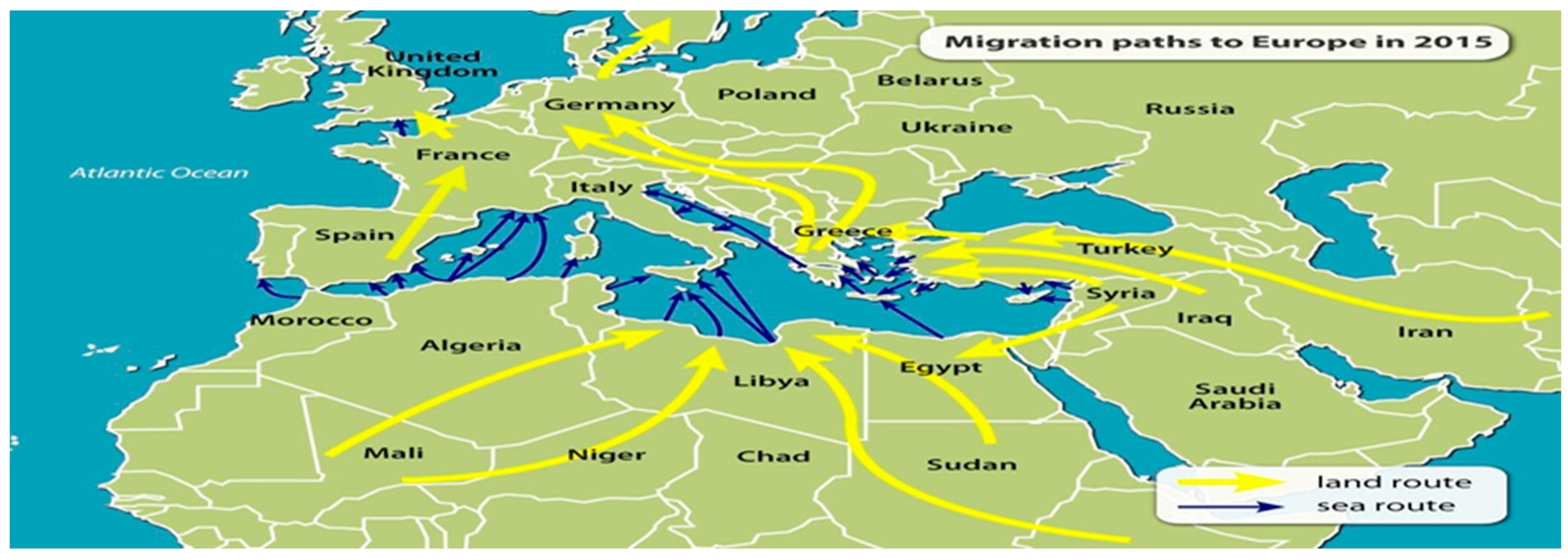
5]. While immigrants to Italy and Spain mainly come from Africa due to their geographical proximity, immigrants to Türkiye largely come from Syria, Middle Eastern countries, and African Countries, among others (
Figure 1) [
6].
In recent years, Sickle Cell Disease (SCD) has increased in European countries such as Italy and Spain, with immigration from more affected countries contributing to its spread [
7]. Officials from all European countries met in Berlin in 2017 and formed a consensus on SCD screening in newborns. Thus, screening for SCD in newborns began [
8]. In Türkiye, the Hemoglobinopathy Prevention Program (HPP) was started in 33 provinces on 8 May 2003. An approximately 90% reduction in newborns with hemoglobinopathy occurred within ten years [
9]. This program was extended to the whole country in 2018.
Since 2011, approximately 4 million Syrian immigrants have come to Türkiye. The frequency of thalassemia in Syria is around 5% [
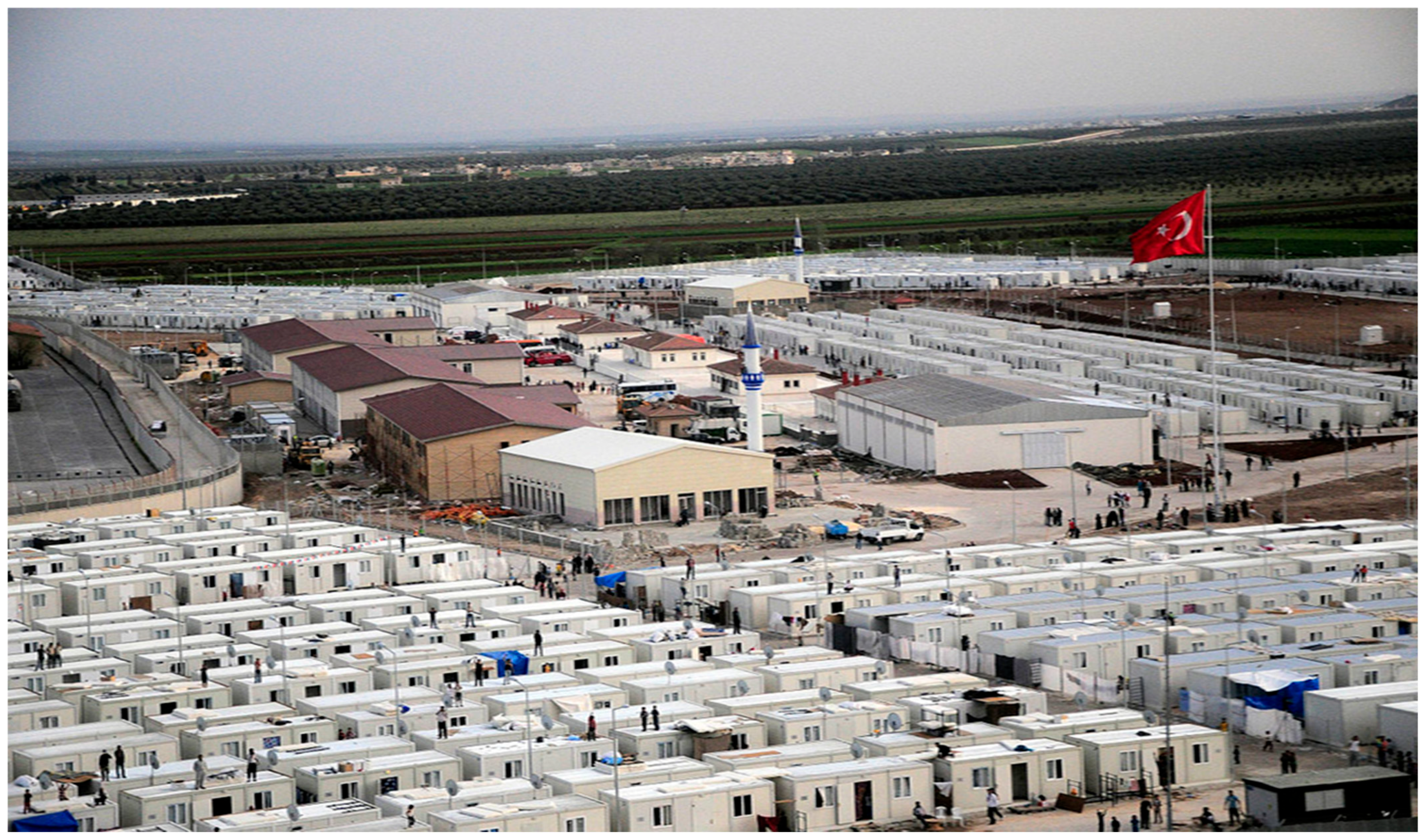
10]. This has led to an increase of approximately 200,000 carriers and 1000 patients in Türkiye. All kinds of health services are provided by the Ministry of Health to immigrants residing in immigrant camps in the southern provinces of Türkiye (
Figure 2). The number of patients and carriers of haemoglobinopathies has increased, especially in the southern and southeastern Turkish provinces, such as Adana Mersin, Hatay, Gaziantep, Kilis, and Sanliurfa. Health centers have been established for immigrants in six provinces by the Ministry of Health of Türkiye, and doctors from Syria serve as family physicians for immigrants. Immigrants benefit from all services free of charge [
6]. Syrian immigrant patients with thalassemia are being treated in various centers in Türkiye [
11]. However, the number of patients with newborn hemoglobinopathy is increasing because this cannot be controlled. On the other hand, the number of patients with newborn hemoglobinopathy in the Turkish population of the same six provinces was almost zero.
The aim of this project was to achieve the following objectives: (a) to evaluate hemoglobinopathy among immigrants living in Türkiye, Spain, and Italy; (b) to train representatives of the Ministry of Health and health managers in six provinces on the prevention of the disease in Italy and Spain; (c) to train Syrian doctors who work at immigrant health centers in six provinces; and (d) to prevent the birth of new patients with hemoglobinopathy.
2. Material and Methods
Our project acronym is EQUALITY PLUS and its name is Hemoglobinopathy for Immigrants: Education, Prevention, Genetic Diagnosis and the Treatment Approach. The project was accepted by EU Erasmus. We planned transnational meetings (TPM), vocational education meetings (VET), and Practical Implementation Meetings (PIEM) according to an established and detailed timetable for this education program.
TPMs were held in Italy, Spain, and Türkiye. In the TPMs, the functional dimensions of the project, its problems, and its budget were discussed. VETs were held in Italy, Spain, and Türkiye. Hemoglobinopathy among immigrants in these countries was discussed. In addition, training was provided to the participants by trainers (VDS, JLVC, and DC) on the diagnosis, prevention, genetic counseling, and treatment of patients with hemoglobinopathies. Evaluation surveys were conducted after each program.
PIEMs were held in six provinces in the south of Türkiye (Adana, Mersin, Hatay, Gaziantep, Şanlıurfa, and Kilis), areas with a large immigrant population, with the participation of health managers and Syrian doctors. Health professionals were selected by provincial health directors in each province. A pre- and post-test survey was administered. The number of immigrants in each province and the health services provided to them were explained by the provincial health managers. The prevention of hemoglobinopathies, genetic counseling, and prenatal diagnosis and preimplantation genetic diagnosis methods were explained by DC. The speeches were simultaneously translated into Arabic. Evaluation surveys were conducted after each program.
3. Results
Four TPMs were held in Türkiye (at the beginning and end), Spain, and Italy, involving a total of 49 health professionals: 41 from Türkiye, 4 from Italy, and 4 from Spain.
For the training of health managers in six cities, two VETs were held in Spain and Italy. The training focused on the situation of immigrants in Italy, Spain, and Türkiye, and the prevention, diagnosis, complications, and treatment of hemoglobinopathies. A total of 23 health professionals—19 from Türkiye, 2 from Italy and 2 from Spain—attended both VETs.
Six PIEMs were held in the southern provinces of Turkey, an area with a large population of Syrian immigrants. In each province, the number of immigrants in the province was provided by the provincial health directors. The numbers were as follows: 500,000 immigrants lived in refugee camps in Adana, 300,000 in Mersin, 600,000 in Hatay, 400,000 in Gaziantep, 50,000 in Kilis and 500,000 in Sanliurfa. Doctors from Syria served as family physicians. All expenses were covered by the Ministry of Health of Türkiye. The meetings were held with the devoted work of the provincial health directorate team. In order to ensure the meetings did not interfere with the duties of the Syrian doctors working in immigrant health centers, one group was trained in the morning and another group in the afternoon. All Syrian doctors in the provinces attended the PIEMs. In summary, a total of 442 persons participated, including 373 Syrian family physicians and 69 provincial health managers. A total 45 persons in Adana, 48 persons in Mersin, 137 persons in Hatay, 80 persons in Gaziantep, 38 persons in Kilis, and 94 persons in Sanliurfa attended the PIEMs.
4. Discussion
In recent years, hemoglobinopathies have spread from the Mediterranean, Africa, and Asia to Europe, America, and Australia through migration and have become a global public health problem [
2]. The prevention and management of hemoglobinopathies are well-established and managed in countries where these disorders have traditionally been endemic or in countries that have long received immigrants [
3]. Public health authorities have set up the following targets for the treatment of hemoglobinopathy in immigrant populations: providing information on hemoglobinopathies to migrant communities; detecting carriers among immigrants (through screening programs); providing genetic counseling for carriers; and providing prenatal diagnosis for couples at risk [
5].
While the immigrants to Italy and Spain come mainly from Central and North West African maritime routes, immigrants to Türkiye predominantly come from Syria [
6].
The migration of people from different parts of the world can also increase the spread of selected genetic diseases. Sub-Saharan African countries, along with India, are the countries most affected by hemoglobinopathies, with an incidence of up to 1% of newborns. While infant mortality has become rare in industrialized countries, it is still prevalent in Africa where more than half of children will not reach the age of 10 [
12].
No neonatal thalassemia or hemoglobinopathy patients were reported in the six provinces where this study was conducted in Türkiye.
However, Türkiye has received a total of 4 million immigrants from Syria, and it is estimated that 200 may be carriers of Thalassemia. In the refugee camps where Syrian immigrants live, the fertility rate is high and the number of sick newborns is increasing because birth control, genetic counseling, and prenatal diagnosis methods are not sufficient in immigrant camps.
A total of 442 health personnel, including 373 Syrian doctors and 69 health managers, were trained, comprising the target audience of this project. Thus, the educational components, which were the objective of the program, were successfully completed. At this stage, Syrian doctors working in immigrant health centers learned how to detect carriers of hemoglobinopathy, provide genetic counseling, and refer carrier couples to prenatal diagnosis in order to prevent the birth of sick children.
This project was evaluated as a guide to prevent the problem of hemoglobinopathy in Syrian immigrants. Further projects are needed to address the fertility rate and number of sick newborns in the refugee camps.
In conclusion, physicians working at migrant health centers received training on the prevention of hemoglobinopathies. This training included providing detailed genetic counseling to families and providing prenatal diagnosis and preimplantation genetic diagnosis opportunities. Because of the major earthquake that occurred in this region after this project, this work could not continue and preliminary data could not be obtained. The Ministry of Health’s General Directorate of Public Health will monitor the results of this project’s implementation in the future, aiming to reduce the number of sick newborns.



 ,
,