

Trends in Adult Cochlear Implant Access and Uptake Across Ten Years of Reported Data

 , , and
Abstract
1. Introduction
2. Methods
2.1. Part 1
2.2. Part 2
2.3. Ethics
2.4. Statistics
3. Results
3.1. Part 1—Uptake Rates Reported in the Published Literature
3.2. Part 2—New Uptake Rates for 2019 Based on Global Burden of Disease Report
3.3. Limitations
4. Discussion
5. Conclusions
Author Contributions
Funding
Institutional Review Board Statement
Data Availability Statement
Conflicts of Interest
References
- Bond, M.; Mealing, S.; Anderson, R.; Elston, J.; Weiner, G.; Taylor, R.S.; Hoyle, M.; Liu, Z.; Price, A.; Stein, K. The effectiveness and cost-effectiveness of cochlear implants for severe to profound deafness in children and adults: A systematic review and economic model. Health Technol. Assess. 2009, 13, 44. [Google Scholar] [CrossRef]
- Cuda, D.; Manrique, M.; Ramos, Á.; Marx, M.; Bovo, R.; Khnifes, R.; Hilly, O.; Belmin, J.; Stripeikyte, G.; Graham, P.L.; et al. Improving quality of life in the elderly: Hearing loss treatment with cochlear implants. BMC Geriatr. 2024, 24, 16. [Google Scholar] [CrossRef]
- Lin, F.R.; Ferrucci, L.; Metter, E.J.; An, Y.; Zonderman, A.B.; Resnick, S.M. Hearing loss and cognition in the Baltimore Longitudinal Study of Aging. Neuropsychology 2011, 25, 763–770. [Google Scholar] [CrossRef]
- Livingston, G.; Huntley, J.; Sommerlad, A.; Ames, D.; Ballard, C.; Banerjee, S.; Brayne, C.; Burns, A.; Cohen-Mansfield, J.; Cooper, C.; et al. Dementia prevention, intervention, and care: 2020 report of the Lancet Commission. Lancet 2020, 396, 413–446. [Google Scholar] [CrossRef]
- Mostert, C.M.; Udeh-Momoh, C.; Winkler, A.S.; McLaughlin, C.; Eyre, H.; Salama, M.; Ranchod, K.; Trepel, D.; Vradenburg, G.; Hynes, W.; et al. Broadening dementia risk models: Building on the 2024 Lancet Commission report for a more inclusive global framework. eBioMedicine 2025, 120, 105950. [Google Scholar] [CrossRef] [PubMed]
- De Raeve, L.; Archbold, S.; Lehnhardt-Goriany, M.; Kemp, T. Prevalence of cochlear implants in Europe: Trend between 2010 and 2016. Cochlea-Implant. Int. 2020, 21, 275–280. [Google Scholar] [CrossRef] [PubMed]
- Sorkin, D.L.; Buchman, C.A. Cochlear Implant Access in Six Developed Countries. Otol. Neurotol. 2016, 37, e161–e164. [Google Scholar] [CrossRef] [PubMed]
- Sorkin, D.L. Cochlear implantation in the world’s largest medical device market: Utilization and awareness of cochlear implants in the United States. Cochlear Implant. Int. 2013, 14, S4–S12. [Google Scholar] [CrossRef]
- Manrique, M.; Ramos, Á.; Pradel, B.; Cenjor, C.; Calavia, D.; Morera, C. Encuesta sobre el conocimiento en la indicación de implantes cocleares para el tratamiento de la hipoacusia en España. Acta Otorrinolaringol. Esp. 2018, 69, 251–259. [Google Scholar] [CrossRef]
- Raine, C.; Atkinson, H.; Strachan, D.R.; Martin, J.M. Access to cochlear implants: Time to reflect. Cochlear Implant. Int. 2016, 17, 42–46. [Google Scholar] [CrossRef]
- Baumgartner, W.-D.; Gavilán, J.; Benghalem, A.; Sallavaci, S.; Rajan, G.; Rajeswaran, R.; Zernotti, M.; Chadha, S. Experts’ discussion: Implications of the World Health Organization’s World report on hearing for the cochlear implant field. Braz. J. Otorhinolaryngol. 2025, 91, 101556. [Google Scholar] [CrossRef]
- Stevens, G.; Flaxman, S.; Brunskill, E.; Mascarenhas, M.; Mathers, C.D.; Finucane, M. Global and regional hearing impairment prevalence: An analysis of 42 studies in 29 countries. Eur. J. Public Health 2013, 23, 146–152. [Google Scholar] [CrossRef]
- D’Haese, P.; Topsakal, V.; Greenham, P. The World Report on Hearing, what does it mean for me and how can it improve access to hearing devices? Ear Nose Throat J. 2023, 104, 616–618. [Google Scholar] [CrossRef] [PubMed]
- World Health Organization. World Report on Hearing. 2021. Available online: https://www.who.int/teams/noncommunicable-diseases/sensory-functions-disability-and-rehabilitation/highlighting-priorities-for-ear-and-hearing-care (accessed on 5 December 2022).
- Kang, J.M.; Bentan, M.; Coelho, D.H. Awareness campaigns for cochlear implants: Are we making an impact? Cochlear Implant. Int. 2024, 25, 93–98. [Google Scholar] [CrossRef]
- Lamb, B.; Archbold, S.; Ng, Z.Y. Cochlear implants and deafness: A global case study to increase policy awareness and action on an under-resourced health issue. Int. J. Audiol. 2024, 63, 473–481. [Google Scholar] [CrossRef]
- D’Haese, P.; Van Rompaey, V.; De Bodt, M.; Van de Heyning, P. The knowledge and beliefs regarding practical aspects of cochlear implants: A study of otorhinolaryngologists in a secondary setting in a multi-country study. Cochlear Implant. Int. 2018, 19, 14–21. [Google Scholar] [CrossRef] [PubMed]
- D’Haese, P.; Van Rompaey, V.; De Bodt, M.; Van de Heyning, P. Can a Digital Awareness Campaign Change Knowledge and Beliefs Regarding Cochlear Implants? A Study in Older Adults in 5 European Countries. INQUIRY J. Health Care Organ. Provis. Financ. 2020, 57, 46958020910566. [Google Scholar] [CrossRef] [PubMed]
- Eikelboom, R.; Sucher, C.M.; Bellekom, S.R.; Atlas, M. Cochlear implantation in Australia: A retrospective analysis of 23 years of activity. Clin. Otolaryngol. 2025, 50, 871–877. [Google Scholar] [CrossRef]
- GBD 2019 Hearing Loss Collaborators. Hearing loss prevalence and years lived with disability, 1990–2019: Findings from the Global Burden of Disease Study 2019. Lancet 2021, 397, 996–1009. [CrossRef]
- Huang, G.-J.; Fan, Z.-J.; Lu, B.-Q. The global prevalence of complete hearing loss in 204 countries and territories from 1992 to 2021: A systematic analysis for the global burden of disease study 2021. Front. Public Health 2025, 13, 1526719. [Google Scholar] [CrossRef]
- Holder, J.T.; Reynolds, S.M.; Sunderhaus, L.W.; Gifford, R.H. Current Profile of Adults Presenting for Preoperative Cochlear Implant Evaluation. Trends Hear. 2018, 22, 233121651875528. [Google Scholar] [CrossRef]
- Nassiri, A.M.; Sorkin, D.L.; Carlson, M.L. Current Estimates of Cochlear Implant Utilization in the United States. Otol. Neurotol. 2022, 43, e558–e562. [Google Scholar] [CrossRef]
- De Raeve, L.; van Hardeveld, R. Prevalence of cochlear implants in Europe: What do we know and what can we expect? J. Hear. Sci. 2013, 3, 9–16. [Google Scholar] [CrossRef]
- Davis, A. Hearing in Adults: The Prevalence and Distribution of Hearing Impairment and Reported Hearing Disability in the MRC Institute of Hearing Research’s National Study of Hearing; Whurr: London, UK, 1995. [Google Scholar]
- De Raeve, L. Cochlear implants in Belgium: Prevalence in paediatric and adult cochlear implantation. Eur. Ann. Otorhinolaryngol. Head Neck Dis. 2016, 133, S57–S60. [Google Scholar] [CrossRef] [PubMed]
- Gumbie, M.; Olin, E.; Parkinson, B.; Bowman, R.; Cutler, H. The cost-effectiveness of Cochlear implants in Swedish adults. BMC Health Serv. Res. 2021, 21, 319. [Google Scholar] [CrossRef]
- Kashio, A.; Takahashi, H.; Nishizaki, K.; Hara, A.; Yamasoba, T.; Moriyama, H. Cochlear implants in Japan: Results of cochlear implant reporting system over more than 30 years. Auris Nasus Larynx 2021, 48, 622–629. [Google Scholar] [CrossRef]
- Löfvenberg, C.; Carlsson, P.-I.; Barrenäs, M.L.; Skagerstrand, Å.; Simic, D.; Carlsson, J.; Wigdén, J.; Westman, E. Prevalence of severe-to-Profound hearing loss in the adult Swedish population and comparison with cochlear implantation rate. Acta Otolaryngol. 2022, 142, 410–414. [Google Scholar] [CrossRef]
- Raine, C. Cochlear implants in the United Kingdom: Awareness and utilization. Cochlear Implant. Int. 2013, 14, S32–S37. [Google Scholar] [CrossRef]
- Turunen-Taheri, S.K.; Edén, M.; Hellström, S.; Carlsson, P.-I. Rehabilitation of adult patients with severe-to-profound hearing impairment—Why not cochlear implants? Acta Otolaryngol. 2019, 139, 604–611. [Google Scholar] [CrossRef]
- Zhan, K.Y.; Mazul, A.; Kallogjeri, D.L.; Buchman, C.A. Use of Diagnostic Audiology and Cochlear Implantation in the US. JAMA Otolaryngol.–Head Neck Surg. 2024, 150, 353–354. [Google Scholar] [CrossRef] [PubMed]
- Nassiri, A.M.; Marinelli, J.P.; Lohse, C.M.; Carlson, M.L. Incidence of Cochlear Implantation Among Adult Candidates in the United States. Otol. Neurotol. 2023, 44, 549–554. [Google Scholar] [CrossRef]
- Balachandra, S.; Xierali, I.M.; Nivet, M.A.; Hunter, J.B. Trends in Cochlear Implantation in Texas: An Exploration of Outpatient Discharge Data, 2010 to 2017. Ann. Otol. Rhinol. Laryngol. 2022, 131, 86–93. [Google Scholar] [CrossRef]
- Daher, C.V.; Bahmad, F. Cochlear implants in a low-income country: Brazilian public health system (SUS)—A longitudinal analysis since the beginning. Braz. J. Otorhinolaryngol. 2021, 87, 245–246. [Google Scholar] [CrossRef] [PubMed]
- Berruecos, P. Los implantes cocleares en América Latina. Auditio 2021, 2, 1–2. [Google Scholar] [CrossRef]
- The Finnish Association of Cochlear Implant Recipient. LapCI—The Finnish Association of Cochlear Implant Recipient Children. Available online: https://lapci.fi/in-english/#:~:text=In%20Finland%2C%20circa%20200%20cochlear%20implants%20are,old%20at%20the%20time%20of%20the%20operation (accessed on 21 April 2025).
- National Institute on Deafness and Other Communication Disorders. Cochlear Implants. Available online: https://www.nidcd.nih.gov/health/cochlear-implants (accessed on 21 April 2025).
- OPCI Foundation. Independent Platform Cochlear Implantation Foundation (OPCI). Available online: https://opciweb.nl/ci-centra/aantal-implantaties-in-nederland-t-m-2023/ (accessed on 21 April 2025).
- Bhamjee, A.; Mahomed-Asmail, F.; Perold, J.; Loock, J.W.; le Roux, T. Cochlear implantation in South Africa (part 1). S. Afr. Med. J. 2021, 112, 8–10. [Google Scholar] [CrossRef]
- Audiology World News. Cochlear Implants: Stigma and Lack of Information Keeping Use Low Among Spain’s Profoundly Deaf, Audiology World News. 2024. Available online: https://www.audiology-worldnews.com/5002-cochlear-implants-stigma-and-lack-of-information-keeping-use-low-among-spain-s-profoundly-deaf/ (accessed on 21 April 2025).
- GlobalData Report Store. Spain Hearing Implant Procedures Count by Segments and Forecast to 2030. 2023. Available online: https://www.globaldata.com/store/report/spain-hearing-implant-procedures-market-analysis/ (accessed on 21 April 2025).
- Swiss Cochlear Implant Registry. Swiss Cochlear Implant Registry (CI Database) Interim Report as of 31 December 2023. Available online: https://www.ci-basel.ch/PDFs/CICH_oeffentlicher_Jahresbericht_2023.pdf (accessed on 21 April 2025).
- Cullington, H. BCIG Annual UK Data Collection 01/04/2019–31/03/2020. Available online: https://www.bcig.org.uk/_userfiles/pages/files/audit/1920_bcigcidata.pdf (accessed on 21 April 2025).
- Lane, C.; Zimmerman, K.; Agrawal, S.; Parnes, L. Cochlear implant failures and reimplantation: A 30-year analysis and literature review. Laryngoscope 2020, 130, 782–789. [Google Scholar] [CrossRef]
- GBD 2021 Diseases and Injuries Collaborators. Global incidence, prevalence, years lived with disability (YLDs), disability-adjusted life-years (DALYs), and healthy life expectancy (HALE) for 371 diseases and injuries in 204 countries and territories and 811 subnational locations, 1990–2021: A systematic analysis for the Global Burden of Disease Study 2021. Lancet 2024, 403, 2133–2161. [Google Scholar] [CrossRef]
- Perkins, E.; Dietrich, M.S.; Manzoor, N.; O’Malley, M.; Bennett, M.; Rivas, A.; Haynes, D.; Labadie, R.; Gifford, R. Further Evidence for the Expansion of Adult Cochlear Implant Candidacy Criteria. Otol. Neurotol. 2021, 42, 815–823. [Google Scholar] [CrossRef]
- Loth, A.; Vazzana, C.; Leinung, M.; Guderian, D.; Issing, C.; Baumann, U.; Stöver, T. Quality control in cochlear implant therapy: Clinical practice guidelines and registries in European countries. Eur. Arch. Oto-Rhino-Laryngol 2022, 279, 4779–4786. [Google Scholar] [CrossRef]
- Neukam, J.D.; Kunnath, A.J.; Patro, A.; Gifford, R.H.; Haynes, D.S.; Moberly, A.C.; Tamati, T.N. Barriers to Cochlear Implant Uptake in Adults: A Scoping Review. Otol. Neurotol. 2024, 45, e679–e686. [Google Scholar] [CrossRef]
- Nassiri, A.M.; Marinelli, J.P.; Sorkin, D.L.; Carlson, M.L. Barriers to Adult Cochlear Implant Care in the United States: An Analysis of Health Care Delivery. Semin. Hear. 2021, 42, 311–320. [Google Scholar] [CrossRef] [PubMed]
- Carlson, M.L.; Nassiri, A.M.; Marinelli, J.P.; Lohse, C.M.; Sydlowski, S.A. Awareness, Perceptions, and Literacy Surrounding Hearing Loss and Hearing Rehabilitation Among the Adult Population in the United States. Otol. Neurotol. 2022, 43, e323–e330. [Google Scholar] [CrossRef] [PubMed]
- Shield, B. Hearing Loss Numbers and Costs: Evaluation of the Social an Economic Costs of Hearing Impairment. 2018. Available online: https://www_hear-it.org (accessed on 24 April 2025).
- Marinelli, J.P.; Sydlowski, S.A.; Carlson, M.L. Cochlear Implant Awareness in the United States: A National Survey of 15,138 Adults. Semin. Hear. 2022, 43, 317–323. [Google Scholar] [CrossRef]
- Mahendran, G.N.; Rosenbluth, T.; Featherstone, M.; Vivas, E.X.; Mattox, D.E.; Hobson, C.E. Racial Disparities in Adult Cochlear Implantation. Otolaryngol.–Head Neck Surg. 2022, 166, 1099–1105. [Google Scholar] [CrossRef]
- Tolisano, A.M.; Schauwecker, N.; Baumgart, B.; Whitson, J.; Kutz, J.W.; Isaacson, B.; Hunter, J.B. Identifying Disadvantaged Groups for Cochlear Implantation: Demographics from a Large Cochlear Implant Program. Ann. Otol. Rhinol. Laryngol. 2020, 129, 347–354. [Google Scholar] [CrossRef]
- Dornhoffer, J.R.; Holcomb, M.A.; Meyer, T.A.; Dubno, J.R.; McRackan, T.R. Factors Influencing Time to Cochlear Implantation. Otol. Neurotol. 2020, 41, 173–177. [Google Scholar] [CrossRef]
- Barnett, M.; Hixon, B.; Okwiri, N.; Irungu, C.; Ayugi, J.; Thompson, R.; Shinn, J.B.; Bush, M.L. Factors involved in access and utilization of adult hearing healthcare: A systematic review. Laryngoscope 2017, 127, 1187–1194. [Google Scholar] [CrossRef]
- Lin, F.R.; Thorpe, R.; Gordon-Salant, S.; Ferrucci, L. Hearing Loss Prevalence and Risk Factors Among Older Adults in the United States. J. Gerontol. A Biol. Sci. Med. Sci. 2011, 66A, 582–590. [Google Scholar] [CrossRef]
- Sciberras, A.; Greenham, P.; D’Haese, P. Improving Access to Adult Hearing Care: A Retrospective Review of an Awareness Campaign and Community Hearing Test Service. Inq. J. Health Care Organ. Provis. Financ. 2025, 62, 469580251372815. [Google Scholar] [CrossRef]
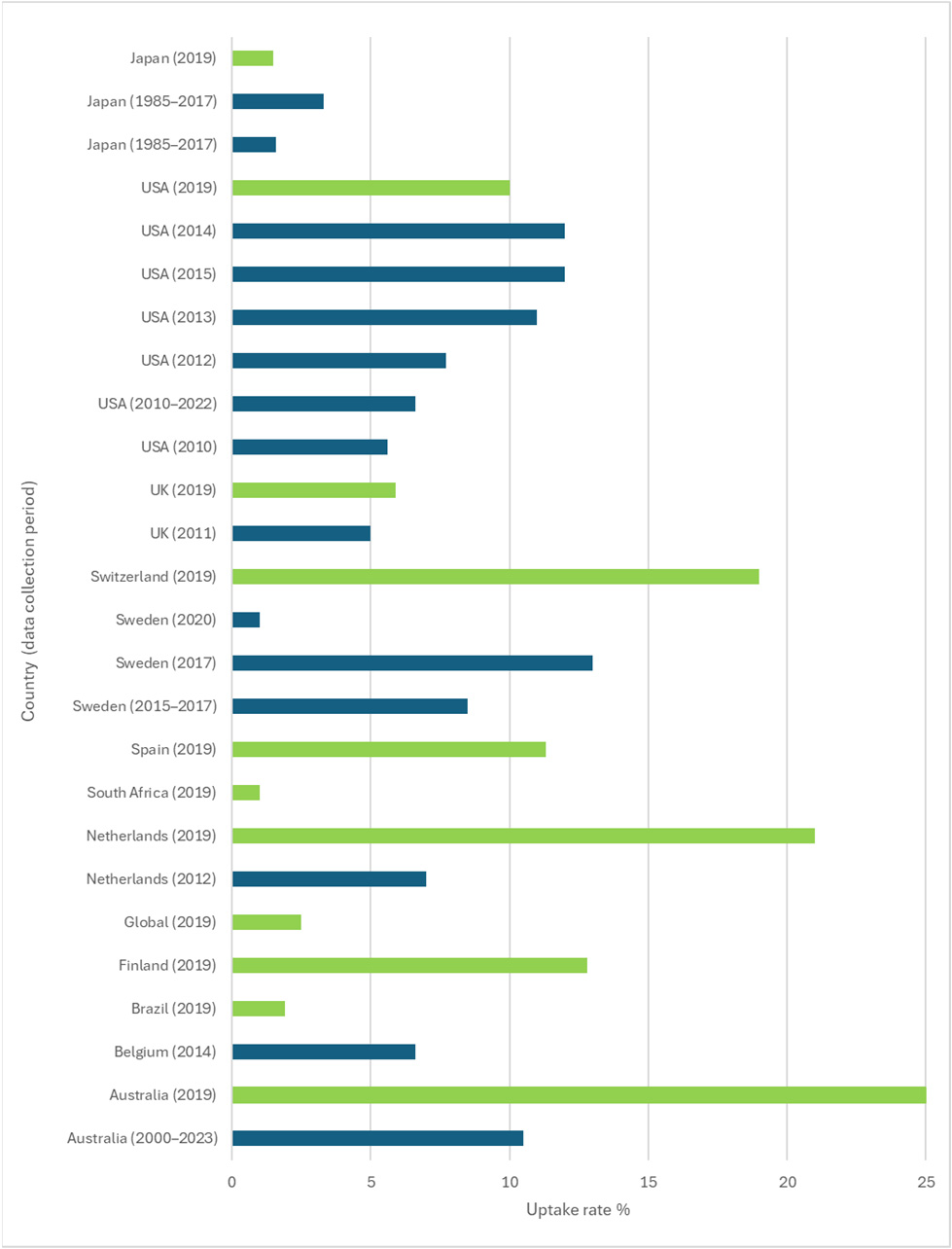

| Study (Year) | Country | Data Collection Period | CI User Estimation Method | Source CI Candidate Data | Hearing Loss Criteria | Population Group | Uptake Rate (%) |
|---|---|---|---|---|---|---|---|
| Sorkin (2013) [8] | USA | 2010 | iData market research report 2010 | iData market research report 2010 | Severe to profound | Adults and children combined | 5.6 |
| Holder (2018) [22] | USA | 2012 | NIDCD * 2016 data | NIDCD 2004 estimates | Severe to profound | Adults | 7.7 |
| Nassiri (2022) [23] | USA | 2013 | iData market research report 2016 | iData market research report 2016 | Severe to profound | Adults and children combined | 11 |
| 2014 | 12 | ||||||
| 2015 | 12 | ||||||
| De Raeve & van Hardeveld (2013) [24] | Netherlands | 2012 | Euro-CI users registry | Davis (1995) [25] | >90 dB HL | Adults | 7.0 |
| De Raeve (2016) [26] | Belgium | 2014 | Approved reimbursement | Davis (1995) [25] | >85 dB HL | Adults | 6.6 |
| Eikelboom (2025) [19] | Australia | 2000–2023 | Institute for Health and Welfare surgery data ** | Global Burden of Disease | Severe to profound | Adults | 10.5 |
| Gumbie (2022) [27] | Sweden | 2017 | National Otorhinolaryngology registry | National Otorhino-laryngology registry | Severe to profound | Adults | 13.0 |
| Kashio (2021) [28] | Japan | 1985–2017 | National CI registry | Davis (1995) [25] | >90 dB HL | Adults | 1.6 |
| e-Stat registry | 3.3 | ||||||
| Löfvenberg (2022) [29] | Sweden | 2020 | National surgical registry | Auditbase audiometry database | ≥70 dB HL | Adults | 1.0 |
| Raine (2013) [30] | UK | 2011 | UK CI centre reports | Davis (1995) [25] | Profound | Adults | 5.0 |
| Turunen-Taheri (2019) [31] | Sweden | 2015–2017 | Selected registry sample | Selected registry sample | Severe to profound | Adults | 8.5 |
| Zhan (2024) [32] | USA | 2010–2022 | PearlDiver claims database | PearlDiver claims database | Severe to profound | Adults | 6.6 |
| Study and Country | Data Collection Period | CI User Estimation Method | Hearing Loss Criteria | Population Group | Number Per 100,000 Population |
|---|---|---|---|---|---|
| Nassiri et al. 2023 [33] USA | 2015 | Prospective registries from two CI manufacturers | Severe to profound | Adults | 2.3 * |
| 2019 | 3.4 * | ||||
| Balachandra et al. 2022 [34] USA | 2010 | Texas Health Care Information Council hospital discharge data | Not defined | Adults and children combined | 3.8 |
| 2017 | 6.9 | ||||
| De Raeve et al. 2020 [6] Multiple countries (listed below) | Publicly available databases | Severe to profound | Adults and children combined | ||
| UK | 2010 | As above | As above | As above | 1.7 |
| 2016 | As above | As above | As above | 2.2 | |
| Switzerland | 2010 | As above | As above | As above | 2.0 |
| 2016 | As above | As above | As above | 2.7 | |
| Sweden | 2010 | As above | As above | As above | 2.3 |
| 2016 | As above | As above | As above | 2.9 | |
| Netherlands | 2010 | As above | As above | As above | 2.7 |
| 2016 | As above | As above | As above | 3.0 | |
| Belgium | 2010 | As above | As above | As above | 1.7 |
| 2016 | As above | As above | As above | 2.7 | |
| Spain | 2010 | As above | As above | As above | 2.0 |
| 2016 | As above | As above | As above | 1.7 | |
| Finland | 2010 | As above | As above | As above | 1.7 |
| 2016 | As above | As above | As above | 2.7 | |
| Germany | 2010 | As above | As above | As above | 4.9 |
| 2016 | As above | As above | As above | 4.5 | |
| Other | 2016 | As above | As above | As above | ≤1 |
| Country and Data Source | Reported CI Numbers | Adjustments Made | Final Number of CI at 2019 | Potential CI Candidates Thousands (95% CI) | Uptake Rate % (95% CI) |
|---|---|---|---|---|---|
| * Australia Eikelboom et al. (2025) [19] from the National Hospital Morbidity Database | July 2000 to June 2019, n = 22,319 adult and child recipients | 2000 added from estimates of implants 1990–2000 at 200 per year | 24,319 | 94.9 (75–119) | 25 (20–32) |
| * Brazil Daher et al. (2021) [35] From DATASUS government database | 2000–2019, n = 10,427 CI surgeries | 597 added pre-2000 based on ¼ of the total implantations in Latin America [36] | 11,024 | 547 (432–686) | 1.9 (1.6–2.5) |
| Finland The Finnish Association of Cochlear Implant Recipient Children [37] | Up to 2019, n = 1801 individuals | 1801 | 14.0 (11–18) | 12.8 (10–16) | |
| * Global National Institute on Deafness and Other Communication Disorders [38] | Up to 2019, n = 736,000 registered devices | 736,000 | 30 million (24–36) | 2.5 (2–3) | |
| * Japan Kashio et al. (2021) [28] | 1985–2017 n = 10,778 cases | 1222 added based on extrapolation from the graph | 12,000 | 781 (611–985) | 1.5 (1.2–1.9) |
| * Netherlands Independent Platform Cochlear Implantation Foundation (OPCI) [39] | Up to 2023, n = 9722 unilateral surgeries | Reduced by 1560 based on number of CI surgeries per year for 2020–2023 from the National CI Registry | 8162 | 39.4 (30–50) | 21 (16–27) |
| South Africa Bhamjee et al. (2022) [40] | Up to 2019, n = 2877 individuals | 2877 | 278 (219–350) | 1 (0.8–1.3) | |
| Spain Associations of Cochlear Implant Patients of Spain [41] | Up to 2024, n = 23,000 individuals | 23,000 discounted at 3000 per year for 2023 and 2022, and 1500 per year for 2021 and 2020 based on estimates from market data [42] | 14,000 (discounted at 3000 CIs per year) | 123.9 (97–157) | 11.3 (14.4–8.9) |
| * Switzerland Swiss Cochlear Implant Register [43] | Up to 2019, n = 3882 surgeries | 3882 | 19.8 (15–25) | 19.6 (11.5–26) | |
| * UK British Cochlear Implant Group [44] | Up to 2019, n = 18,000 total CIs maintained | 18,000 | 303 (242–375) | 5.9 (4.8–7.4) | |
| * USA National Institute on Deafness and Other Communication Disorders [38] | Up to 2019, n = 183,100 registered devices | 183,100 | 1800 (1429–2250) | 10 (8–13) |
Disclaimer/Publisher’s Note: The statements, opinions and data contained in all publications are solely those of the individual author(s) and contributor(s) and not of MDPI and/or the editor(s). MDPI and/or the editor(s) disclaim responsibility for any injury to people or property resulting from any ideas, methods, instructions or products referred to in the content. |
© 2026 by the authors. Licensee MDPI, Basel, Switzerland. This article is an open access article distributed under the terms and conditions of the Creative Commons Attribution (CC BY) license.
Share and Cite
D’Haese, P.; Van de Heyning, P.; Gavilan, J.; Zernotti, M.E.; Greenham, P. Trends in Adult Cochlear Implant Access and Uptake Across Ten Years of Reported Data. Audiol. Res. 2026, 16, 19. https://doi.org/10.3390/audiolres16010019
D’Haese P, Van de Heyning P, Gavilan J, Zernotti ME, Greenham P. Trends in Adult Cochlear Implant Access and Uptake Across Ten Years of Reported Data. Audiology Research. 2026; 16(1):19. https://doi.org/10.3390/audiolres16010019
Chicago/Turabian StyleD’Haese, Patrick, Paul Van de Heyning, Javier Gavilan, Mario Emilio Zernotti, and Paula Greenham. 2026. "Trends in Adult Cochlear Implant Access and Uptake Across Ten Years of Reported Data" Audiology Research 16, no. 1: 19. https://doi.org/10.3390/audiolres16010019
APA StyleD’Haese, P., Van de Heyning, P., Gavilan, J., Zernotti, M. E., & Greenham, P. (2026). Trends in Adult Cochlear Implant Access and Uptake Across Ten Years of Reported Data. Audiology Research, 16(1), 19. https://doi.org/10.3390/audiolres16010019

