


Abstract
Background: The extent to which bone marrow aspiration technique affects the biological quality of bone marrow aspirate and its clinical relevance in knee osteoarthritis remains uncertain. This study compares the efficacy of the traditional aspiration method and the Snap Back technique at two anatomical harvest sites, the posterior iliac crest and the proximal tibia. Methods: This ancillary post hoc analysis was conducted within a randomized trial comparing posterior iliac crest and proximal tibia harvest sites in 60 patients with unicompartmental knee OA. Aspiration technique (traditional vs. Snap Back) was selected intraoperatively and not randomized. BMA samples were analyzed for MSCs, mononuclear cells (MNCs), platelet concentration, and marrow purity. Clinical outcomes were assessed at baseline and six months using the Visual Analog Scale and the Western Ontario and McMaster Universities Osteoarthritis Index. Results: The posterior iliac crest yielded significantly higher MSC and MNC concentrations compared to the tibia, with superior purity and PLT counts observed using the Snap Back technique. Within each anatomical site, Snap Back aspiration provided improved cellular recovery over the traditional method. However, differences in clinical outcomes between groups were modest and did not consistently reach statistical significance. Conclusions: Both harvest site and aspiration technique were associated with substantial differences in the cellular composition of BMA. The withdrawal from posterior iliac crest combined with the Snap Back technique optimizes MSC yield and marrow purity, though clinical improvements appear independent of cellular concentration in the short term. These findings suggest that standardized aspiration protocols may be relevant for the biological efficacy of orthobiologic therapies in knee OA.
1. Introduction
Among degenerative joint diseases, osteoarthritis (OA) is widely recognized as one of the most prevalent, economically burdensome, and functionally debilitating conditions [1]. Historically, OA was conceptualized primarily as a “wear-and-tear” phenomenon confined to articular cartilage. However, recent scientific findings indicate that OA is multifactorial, involving not only mechanical cartilage deterioration but also inflammatory processes that affect the entire synovial joint [2,3]. This includes structural and functional alterations in the whole joint (subchondral bone, periarticular ligaments and synovium). These significant structural modifications lead to disability, pain and reduced quality of life [4]. In the past, five major studies were underway (CHECK, OAI, FNIH Biomarkers Consortium, IMI-APPROACH, and MOST) [5,6,7,8,9], reflecting the global scientific community’s concerted effort to address OA from multiple perspectives.
OA treatments can be divided into surgical and non-surgical treatments [10]. Surgical techniques are further classified as “joint-preserving surgery”, including osteotomies around the knee and unicompartmental knee arthroplasty (UKA), and “joint-sacrificing surgery”, corresponding to total knee arthroplasty (TKA). Non-surgical treatment includes both non-pharmacological and pharmacological interventions. The latest guidelines from the American Academy of Orthopaedic Surgeons (AAOS) [11] underscore the importance of non-pharmacological treatments. In particular, self-management and patient education programs are recommended to alleviate pain in patients with knee osteoarthritis. The various pharmacological treatment options are extremely diverse and include oral nonsteroidal anti-inflammatory drugs (NSAIDs), oral acetaminophen, oral narcotics, topical therapies, and intra-articular (IA) injections (corticosteroids, platelet-rich plasma [PRP], and hyaluronic acid [HA]). The latest frontier in pharmacological therapy is represented by the administration of MSCs [12]. Among the tissues, human bone marrow (BM) is a rich source of MSCs, other progenitor cells, and various growth factors and cytokines, all of which can support anti-inflammatory and regenerative processes in multiple tissues, including cartilage and bone [13,14]. Bone marrow aspirate concentrate (BMAC) is commonly prepared from bone marrow aspirate (BMA) by density gradient centrifugation [15]. Although the posterior or anterior iliac crest is the standard donor site, BMA can also be collected from the distal femoral or proximal tibial metaphysis [16]. In recent years, several studies have investigated the optimal harvest site and the most effective aspiration technique for MSC recovery [17,18,19].
Despite calls for guidelines for the techniques used [20,21] several bone marrow harvesting techniques have been described [22,23,24].
The aim of this ancillary post hoc analysis was to assess whether the BMA technique is associated with differences in the biological composition of bone marrow aspirate and short-term clinical outcomes in patients with knee OA. Specifically, we compared biological and clinical outcomes between procedures performed using the Snap Back [25] technique and those using the traditional aspiration method, across two harvest sites (posterior iliac crest and proximal tibia). An additional exploratory objective was to examine whether variation in aspirate biological composition was associated with differences in clinical response.
2. Materials and Methods
2.1. Study Design and Data Source
This work is an ancillary, post hoc observational analysis derived from a parent randomized controlled trial, in which 60 patients were enrolled between February 2023 and February 2024 and randomized 1:1 to bone marrow harvest from either the posterior iliac crest (n = 30) or the proximal tibia (n = 30). The parent trial did not randomize patients according to aspiration technique [19]. Bone marrow aspiration was performed in both randomized groups using the same standardized device and protocol, as described in the following sections. The primary objective of this study was to evaluate the superior efficacy of treatment with BMA harvested using the ‘snap back’ technique compared to conventional aspiration method in terms of change in the VAS and WOMAC index at 6 months. As secondary objective we analyzed the cellular composition of BMA harvested with the two methods, to demonstrate whether a different cellular composition has an effect on the clinical efficacy.
All analyses for the present ancillary study were conducted using prospectively collected variables from the parent trial, which had obtained full ethical approval. The ancillary analysis assessed differences in study outcomes according to aspiration technique, reflecting intraoperative decisions made at the time of treatment. Specifically, outcomes were compared between procedures performed using the traditional Marrow Cellution trocar and those using the Snap Back technique. Given the observational nature of this comparison, causal interpretation should be avoided.
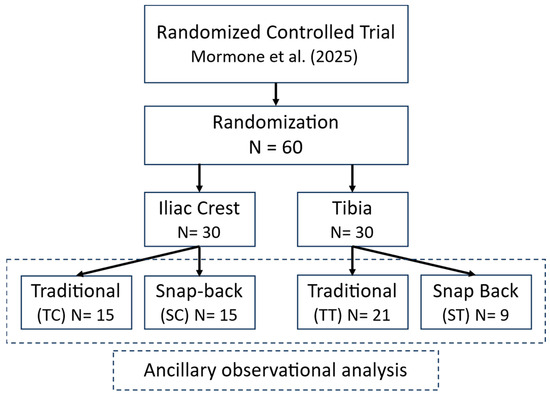
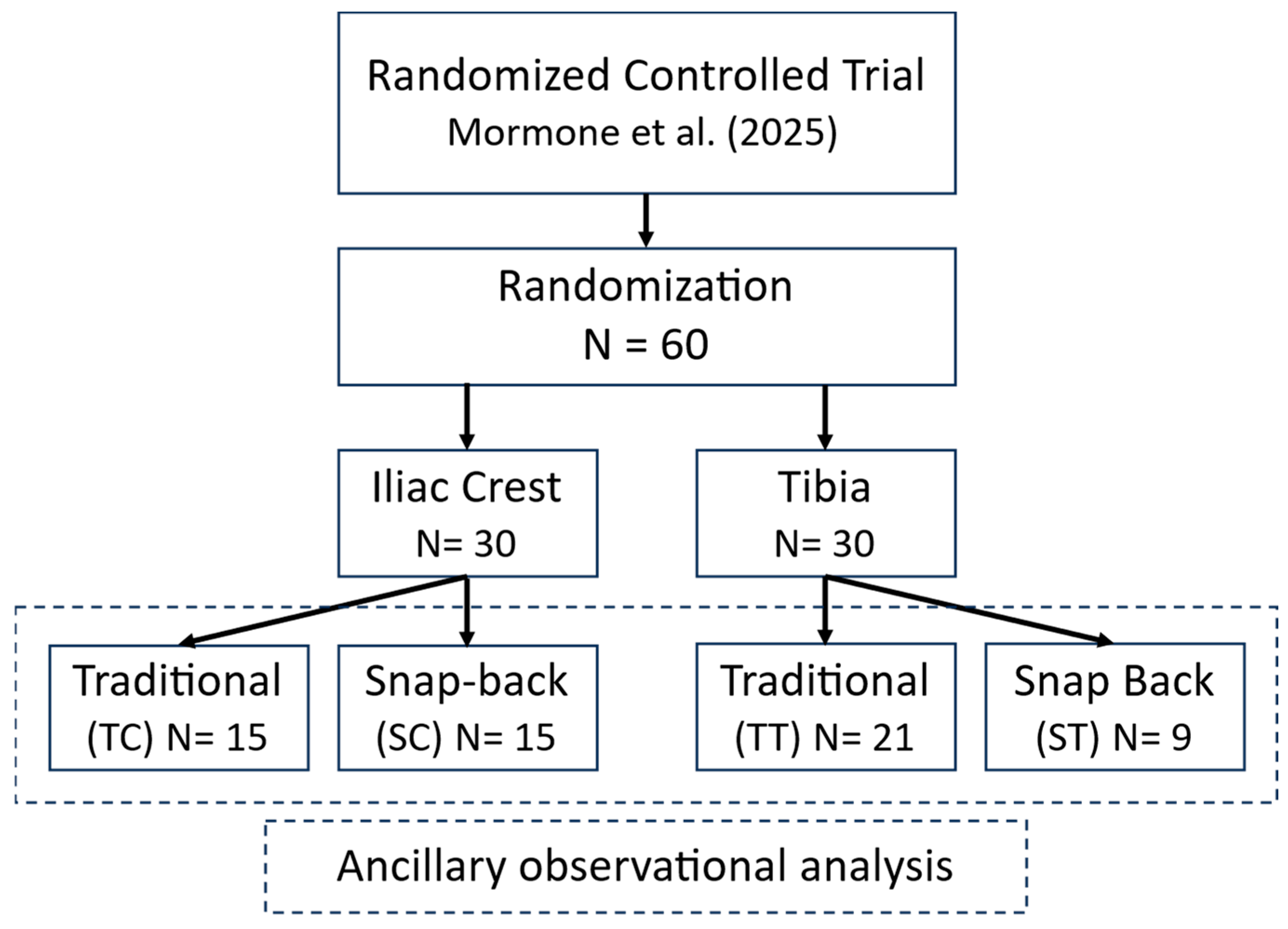
The combination of the randomized harvest site and the aspiration technique defined four analytical subgroups, as illustrated in the CONSORT-style diagram (Figure 1):
Figure 1.
CONSORT flowchart [19].
- A total of 21 patients underwent tibial BMA using the traditional aspiration technique (TT group);
- A total of 9 patients underwent tibial BMA using the Snap Back technique (ST group);
- A total of 15 patients underwent iliac crest BMA using the traditional aspiration technique (TC group);
- A total of 15 patients underwent iliac crest BMA using the Snap Back technique (SC group).
2.2. Study Outcomes and Comparisons
Given the ancillary, post hoc, and exploratory nature of the present study, all outcomes were defined retrospectively and should be interpreted as hypothesis-generating rather than confirmatory.
Clinical outcomes of interest were patient-reported changes from baseline to 6 months in the Western Ontario and McMaster Universities Osteoarthritis Index (WOMAC) total score and in the visual analog scale (VAS).
Within this exploratory framework, the primary comparisons of interest were the comparisons between the traditional and Snap Back aspiration techniques performed within each harvest site (iliac crest and proximal tibia). Comparisons between harvest sites within each aspiration technique were considered secondary and exploratory.
2.3. Clinical Outcome Assessment
Clinical outcomes were assessed at baseline (T0) and at 6 months (T6). Pain intensity was evaluated using a visual analogue scale (VAS), with scores ranging from 0 (no pain) to 10 (worst imaginable pain). Knee-related symptoms and functional status were assessed using the Western Ontario and McMaster Universities Osteoarthritis Index (WOMAC), including the total score and the pain, stiffness, and physical function subscales. Knee range of motion (ROM), including flexion and extension, was measured using standard clinical goniometric assessment performed by trained personnel. ROM was expressed in degrees, and total ROM was calculated as the difference between maximal flexion and extension.
2.4. Inclusion and Exclusion Criteria
Eligibility criteria were those defined in the parent randomized trial. Patients were included if they had unicompartmental knee osteoarthritis (Kellgren–Lawrence I–IV), lacked clinical benefit from prior corticosteroid treatment, were 35–65 years of age, and were able to provide informed consent and comply with study procedures. Exclusion criteria comprised malignancy, rheumatologic disease, pregnancy, elevated inflammatory markers, recent trauma involving the lower limb, lower-limb deformity greater than 10°, BMI < 18 or >35, involvement in the study team, and any condition judged by the investigator to compromise safety or adherence.
2.5. Bone Marrow Aspiration Technique
Bone marrow aspiration was carried out using the Marrow Cellution™ Bone Marrow Aspiration System (Aspire Medical Innovation, Munich, Germany.), a multi-level and multi-directional device engineered to obtain high-quality marrow from several sites within the medullary cavity through a single cortical entry. The same device was used for both the traditional and the Snap Back techniques. Its patented design eliminates the need for post-aspiration processing outside the sterile field, such as centrifugation. In contrast to conventional Jamshidi needles—which rely on a single distal opening and are susceptible to peripheral blood dilution—the Marrow Cellution™ system uses multiple lateral ports for aspiration. Although some modified Jamshidi needles incorporate lateral holes, the distal tip often remains the primary aspiration route, allowing continued blood contamination. To overcome this limitation, the Marrow Cellution™ device employs a cannula that occludes the distal tip, ensuring aspiration exclusively through the lateral ports. A threaded mechanism further enables precise positional adjustments within the marrow cavity, ensuring consistent technique and optimal sample quality.
Patients were positioned prone for posterior iliac crest harvests or supine for tibial harvests, with aspiration performed on the same side as the knee designated for injection. Ultrasound guidance was used to identify the harvest site, and all procedures were conducted under sterile conditions in accordance with standard guidelines. No filtration or concentration systems were used, allowing the final aspirate to retain a high proportion of viable stem and progenitor cells [26]. The procedure was performed under mild sedation and was well tolerated, with minimal or no post-procedural discomfort reported. Following aspiration, 5 mL of each sample were injected intra-articularly into the knee joint, while the remaining 5 mL were stored in heparinized tubes (1000 U/mL; Sigma-Aldrich, St. Louis, MO, USA) for subsequent laboratory analyses.
2.6. Traditional Aspiration Technique
Once the aspiration site was identified, a heparin-coated introducer needle was carefully inserted through the cortical bone into the medullary cavity. After reaching the medullary space, the sharp stylet was removed and replaced with a 10 mL syringe to aspirate approximately 1 mL of bone marrow, confirming correct positioning. A blunt stylet was then introduced, and the needle was advanced to the targeted depth. The guide grip was adjusted to skin level, and the blunt stylet was withdrawn. Subsequently, the aspiration cannula and syringe were attached and secured. Another 1 mL of bone marrow was aspirated. While maintaining the guide grip in place, the handle was rotated 360° counterclockwise to reposition the lateral aspiration ports, and an additional 1 mL of marrow was collected. This procedure is repeated until a total of 10 mL of sample has been obtained.
2.7. Snap Back Aspiration Technique
The Snap Back technique was first described by Hernigou [17]. The initial phase of the procedure closely mirrors the traditional technique up to the point of syringe placement. Aspiration is performed by a swift and forceful retraction of the syringe plunger to collect 1–2 mL of bone marrow. Following each draw, the plunger is released, allowing internal pressure to equilibrate and the plunger to return automatically to a stable position, typically approximately 1–2 mL higher than the previous fill level. The process is then repeated at a new aspiration site by rotating the handle 360 degrees counterclockwise and repositioning the cannula using the threaded adjustment mechanism. The procedure is reiterated until a cumulative volume of 10 mL of sample has been attained.
2.8. Flow Cytometric Analysis
Erythrocyte-lysed whole bone marrow (BM) samples were immunophenotyped using an eight-color direct immunofluorescence panel. The following antibody combination was employed to identify MSCs: CD45-V500/CD19-V450/CD71-APC-H7/CD105-PerCP-Cy5.5/CD34-PE-Cy7/CD271-PE/CD73-FITC/HLADR-APC. All monoclonal antibodies were obtained from BD Biosciences.
The gating strategy for MSC identification was performed in sequential steps: (1) selection of the CD271-positive cell population; (2) gating of CD271-positive events co-expressing CD73 and CD105; (3) back-gating on CD45-negative/low events to confirm the MSC phenotype previously defined.
MSCs were quantified as the percentage of total BM cells. For reporting purposes, MSC values were multiplied by 1000 (expressed as “103× %”) to avoid the use of decimals and improve readability.
Bone marrow purity (%BM) was calculated according to the Holdrinet formula [27], which estimates peripheral blood contamination by comparing the erythrocyte-to-nucleated cell ratios in the bone marrow aspirate and in a concurrently collected peripheral blood sample.
An intra-assay quality control of the entire cell sample was ensured by detecting B-cell precursors (CD19+, HLA-DR+, CD45+ low), hematopoietic stem cells (CD34+, HLA-DR+, CD45+ intermediate), and nucleated red blood cells (CD71+, HLA-DR−, CD45−). For all samples, an isotype-matched negative control lacking BM reactivity was included. A minimum of 100,000 events were acquired using a FACS Canto flow cytometer (BD Biosciences) and analyzed with FACS Diva software (https://www.bdbiosciences.com/en-eu/products/software/instrument-software/bd-facsdiva-software#Overview).
2.9. Statistical Analysis
Descriptive statistics were summarized as medians and interquartile ranges (IQR) for continuous variables, including patient age, BMI, HKA, %BM, MSCs, MNCs, monocytes, PLT, and %HCT. Categorical variables, including sex, treated side, and Kellgren–Lawrence grade, were summarized as absolute and relative frequencies.
Comparisons of continuous variables between independent groups were performed using two-sided Wilcoxon rank-sum tests, while categorical variables were compared using Fisher’s exact test, in accordance with the predefined comparison framework.
Six-month ΔVAS and ΔWOMAC were first compared between groups using two-sided Wilcoxon rank-sum tests. To account for potential baseline imbalances, both outcomes were additionally examined through multivariable median regression models in which baseline scores, Kellgren–Lawrence grade, and age were entered as covariates to provide adjusted estimates of the between-group differences.
Given the ancillary and exploratory nature of the present analysis, no formal adjustment for multiple comparisons was applied, and all statistical results were interpreted descriptively rather than as confirmatory.
All statistical analyses were conducted using Stata version 17 (StataCorp LLC, College Station, TX, USA). A p-value < 0.05 was considered statistically significant.
3. Results
3.1. Study Population
A total of 60 patients were enrolled and assessed for eligibility, including 30 women and 30 men. The overall median age was 56 years (IQR, 47–59). Baseline demographic, clinical, hematological, and cellular data are summarized in Table 1.
Table 1.
Baseline demographic, clinical, hematological, and cellular characteristics of the study population.
3.2. Iliac Crest: Comparison Between Traditional and Snap Back Aspiration
Within the iliac crest group, the TC and SC groups were comparable in their baseline demographic and clinical characteristics (Table 2).
Table 2.
Baseline demographic and clinical characteristics of the study population, with comparisons between the Traditional and Snap-Back aspiration techniques, reported separately for the iliac crest and tibial subgroups.
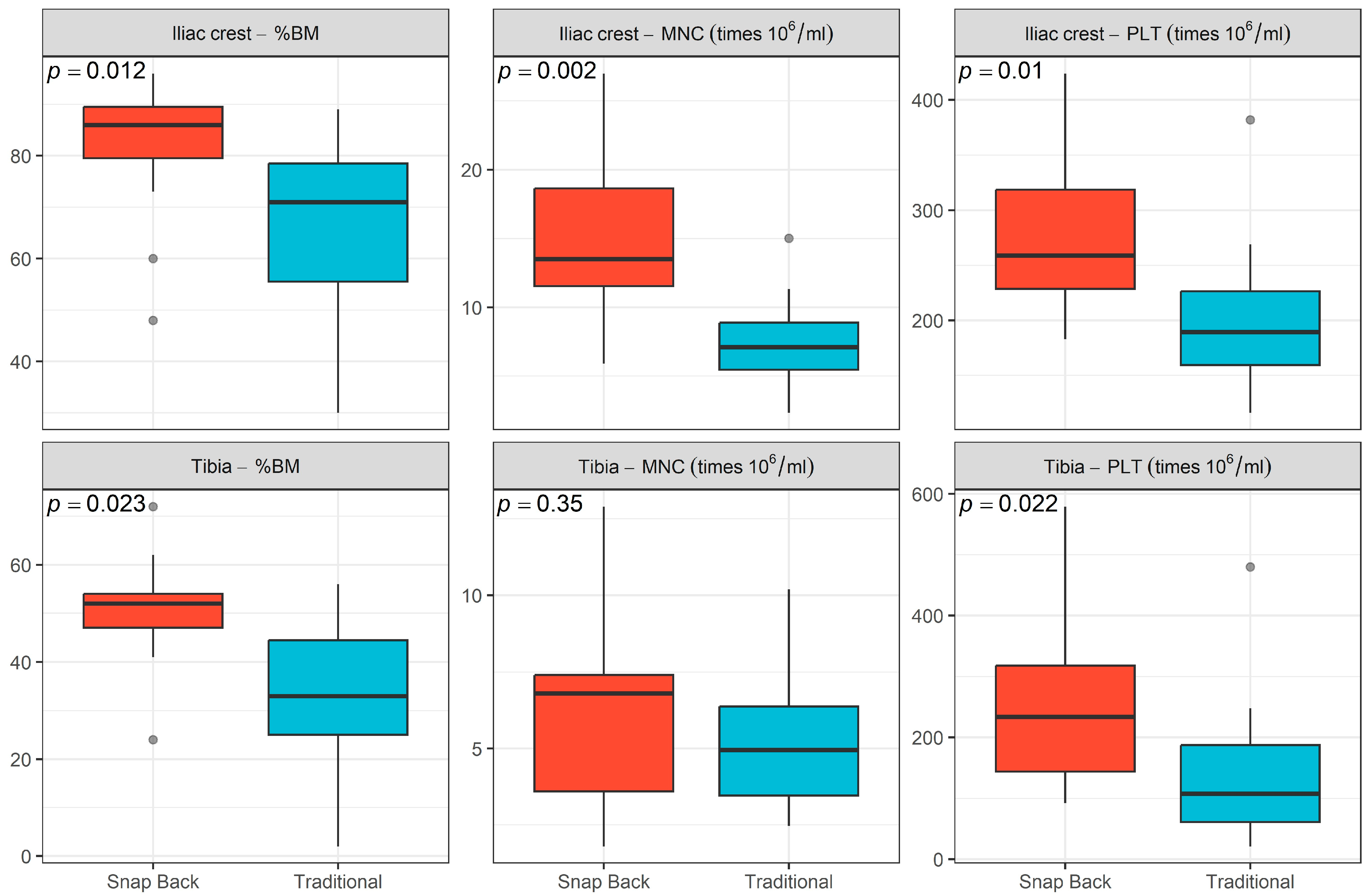
Compared with the traditional technique, the Snap Back approach at the iliac crest was associated with higher bone marrow purity (median 86% vs. 71%; p = 0.012), platelet concentration (259 vs. 190 × 106/mL; p = 0.010), and mononuclear cell concentration (13.5 vs. 7.1 × 10⁶/mL; p = 0.002). No significant differences were observed in monocyte counts or MSCs percentage (Table 3).
Table 3.
Cellular composition and hematologic profile of the bone marrow aspirate, with comparisons between the Traditional and Snap-Back aspiration techniques, reported separately for the iliac crest and tibial subgroups.
Clinically, both groups showed within-patient improvements in VAS and WOMAC scores at 6 months.
3.3. Tibia: Comparison Between Traditional and Snap Back Aspiration
Within the tibial group, the traditional and Snap Back subgroups showed comparable baseline demographic and clinical characteristics.
The Snap Back technique was associated with higher bone marrow purity (median 52% vs. 33%; p = 0.023) and platelet concentration (234 vs. 108 × 106/mL; p = 0.022) compared with the traditional approach, while no significant differences were observed in monocyte or mononuclear cell concentrations, or in MSCs percentage.
Clinically, both groups showed statistically significant median within-patient improvements in VAS scores at 6 months, whereas statistically significant improvements in WOMAC scores were observed only in the TT group. However, no statistically significant differences were observed between TT and ST in 6-month changes in either VAS or WOMAC scores (Table 4).
Table 4.
Patient-reported pain and functional outcomes (VAS, total WOMAC, and WOMAC subscales) and knee range-of-motion measures (extension, flexion, and ROM), evaluated at baseline (T0), at 6 months (T6), and as changes from baseline (ΔT6–T0), with comparisons between the Traditional and Snap-Back aspiration techniques reported separately for the iliac crest and tibial subgroups.
3.4. Traditional Aspiration: Comparison Between Iliac Crest and Tibia
Baseline demographic and clinical characteristics were comparable between the TC and TT groups (Table 1). Bone marrow aspirates obtained from the posterior iliac crest showed significantly higher purity than those harvested from the proximal tibia (p < 0.001), along with a markedly higher MSCs yield (p < 0.001) and higher platelet concentrations (p = 0.029). Mononuclear cell and monocyte concentrations did not differ significantly between harvesting sites (Table 3 and Figure 2). Despite these biological differences, no statistically significant differences were observed in 6-month changes in VAS or WOMAC scores between harvesting sites (Table 3).
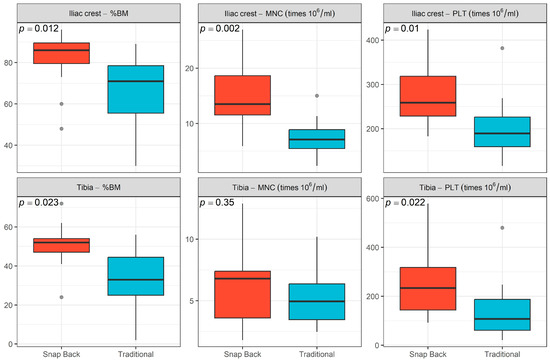
Figure 2.
Comparative analysis of bone marrow fraction (%BM), mononuclear cell concentration (MNC), and platelet concentration (PLT) between Traditional and Snap Back techniques, stratified by harvest site (iliac crest and tibia). p-values for each comparison were computed using a two-sample Wilcoxon test. Individual dots represent potential outliers, defined as values exceeding 1.5 times the interquartile range from the edge of the box (Tukey’s rule).
3.5. Snap-Back Aspiration: Comparison Between Iliac Crest and Tibia
Baseline demographic and clinical characteristics were largely comparable between the SC and ST groups, with the exception of a higher median age in the SC group that did not reach statistical significance (p = 0.073; Table 1). With the Snap Back aspiration technique, bone marrow aspirates obtained from the posterior iliac crest showed significantly higher purity (p < 0.001), together with a markedly higher MSCs yield (p < 0.001) and higher monocyte (p < 0.001) and mononuclear cell concentrations (p = 0.003) than those harvested from the proximal tibia. Platelet concentrations did not differ significantly between harvesting sites (Table 2 and Figure 2). Analysis of 6-month changes in VAS and WOMAC scores showed no statistically significant differences between iliac crest and tibial harvest sites (Table 3).
3.6. Adjusted Analyses of 6-Month Clinical Outcomes
Although baseline demographic and clinical characteristics were largely comparable across groups, some between-group differences were observed at baseline, including a statistically significant difference in baseline VAS between the TC and SC groups, as well as other smaller, non-significant imbalances (Table 3 and Table 5). Thus, to account for potential baseline imbalances and to improve the interpretability of change scores, additional multivariable regression analyses were performed. The 6-month change in VAS was used as the dependent variable, with aspiration technique, baseline VAS, Kellgren–Lawrence grade, and age included as covariates. A similar model was fitted for the 6-month change in WOMAC. The adjusted estimates (median values with 95% confidence intervals), summarised in Table 5, were consistent with the findings of the unadjusted comparisons: no statistically significant differences in 6-month ΔVAS or ΔWOMAC were detected between the groups under comparison.
Table 5.
Adjusted estimates of 6-month changes in VAS and WOMAC scores (T6–T0) from models controlling for baseline values, Kellgren–Lawrence grade, and age.
4. Discussion
This analysis explored the impact of different bone marrow aspiration techniques and harvesting sites on the cellular composition and early clinical outcomes of BMA administered intra-articularly in individuals with knee OA. The findings indicate that both the anatomical harvest site and the aspiration technique are linked to differences in aspirate purity, and cellularity. However, these biological differences were not reflected in statistically significant differences in patient-reported outcomes over a six-month follow-up period.
In agreement with earlier investigations, the posterior iliac crest consistently provided bone marrow aspirates with higher MSCs concentrations, increased platelet levels, and superior purity compared to aspirates obtained from the proximal tibia, regardless of the aspiration technique employed [17,28]. This is consistent with the prevailing consensus that the iliac crest remains the preferred site for harvesting bone marrow, owing to its rich hematopoietic environment and the reduced likelihood of peripheral blood dilution when small-volume, multi-site draws are performed [26,29,30]. Conversely, the proximal tibial metaphysis is characterized by a higher content of fatty marrow, which may partly explain the reduced progenitor cell recovery and the increased chance of aspirate contamination with peripheral blood observed in this study.
From a procedural standpoint, the proximal tibia presents practical benefits such as simpler anatomical access, easier patient positioning, and potentially reduced procedural discomfort, particularly in cases where iliac crest harvest is contraindicated or technically challenging [31]. Nevertheless, our data demonstrate that tibial aspirates contain substantially lower MSC concentrations compared to those obtained from the iliac crest. Such reduced cellular content may compromise the regenerative potential of bone marrow aspirate BMA harvested from the tibia, making it a less effective option for therapeutic applications where cell-based biologic activity is critical [32].
The current findings show that the Snap Back aspiration technique was associated with higher marrow purity and cellular yield than conventional aspiration methods, particularly in procedures performed at the posterior iliac crest, which increases the number of MNC and monocytes. This aligns with established data indicating that repeated low-volume draws, interspersed with syringe re-pressurization or repositioning, reduce peripheral blood contamination and enhance recovery of progenitor cell populations [17,23,26]. The Snap Back method, characterized by rapid plunger recoil between draws, maintains intraosseous negative pressure, thereby facilitating the extraction of nucleated, cell-rich marrow with minimal dilution [33,34].
Despite its procedural simplicity, the adoption of the Snap Back technique remains inconsistent in clinical practice. This may reflect a lack of widespread training or standardization, as well as unfamiliarity with the underlying hemodynamic principles. The present study provides new evidence that procedural refinements can yield meaningful improvements in the biological quality of BMA, encouraging broader dissemination of optimized harvesting protocols.
Although the Snap Back technique and the posterior iliac crest were associated with higher aspirate cellularity and purity, clinical outcomes at six months were comparable between groups. All treatment cohorts reported improvements in both Visual Analog Scale (VAS) and Western Ontario and McMaster Universities Osteoarthritis Index (WOMAC) scores; however, differences among groups were minimal and lacked statistical significance. These findings align with recent meta-analyses and systematic reviews indicating that while BMAC is safe and generally effective in alleviating pain and enhancing function in knee osteoarthritis, there remains insufficient evidence to assert that higher cellular concentrations yield superior clinical benefits [35,36].
Potential reasons for this observed disconnect include the inherently complex pathophysiology of OA, which extends beyond cartilage degradation to involve synovial inflammation, subchondral bone remodeling, and biomechanical alterations within the joint [35,37]. It is plausible that the short-term symptom relief following intra-articular BMAC injections derives primarily from anti-inflammatory paracrine mediators, such as cytokines and extracellular vesicles, rather than direct engraftment or replication of MSCs [38,39]. Additionally, although this study identified statistically significant differences in MSCs concentrations between groups, these disparities may not have exceeded a biological threshold necessary to trigger notably different clinical outcomes within the six-month observation period. Supporting this view, a recent phase I dose-escalation study involving early knee OA patients demonstrated that increasing BMAC cell doses (from 10 to 100 × 106 cells) improved safety and functional outcomes but did not exhibit a clear dose-dependent clinical efficacy trend [40,41]. Similarly, in a large patient series with long-term follow-up, Berveglieri et al. demonstrated that the number of mononuclear cells (MNCs) and platelets in bone marrow aspirate concentrate (BMAC) does not influence overall clinical outcomes in patients with osteochondral lesions augmented with BMAC [42]. Lastly, beside the role played by MSCs, anti-inflammatory and regenerative capacity is associated also with the other cells analyzed, that would collaborate with the MSCs in their healing ability generating the “Orchestra” effect [43]
Patient-specific variables, such as age, BMI, OA severity, and inherent differences in bone marrow cellularity, likely exert significant influence on treatment outcomes, underscoring an urgent need for individualized therapeutic strategies [44,45]. A prospective study involving 111 knee OA patients found that mineralization improvements and sustained symptomatic relief were more pronounced in younger individuals with milder disease, whereas higher OA severity, particularly among older patients, predicted less favorable outcomes [44]. To better understand how such patient-level factors modify treatment response, incorporating comprehensive biological profiling—including cell surface marker phenotyping and quantification of cytokines or extracellular vesicles—is essential. These analyses could elucidate the relationship between BMA composition and clinical efficacy, enabling personalization of BMAC therapy in knee OA.
Some limitations should be considered when interpreting the findings of this investigation. Firstly, this work represents an ancillary observational analysis derived from a randomized clinical trial. Although the harvest site was randomized in the parent study, the aspiration technique was selected intraoperatively and was not randomized. As a result, the subgroup comparisons examined here were not determined by random treatment allocation, raising the possibility of confounding by indication. This design inherently limits the ability to draw causal inferences, and the presence of unmeasured or residual confounding cannot be fully excluded, despite the methodological rigor applied in data collection and outcome assessment. In addition, some baseline imbalances between subgroups (most notably in baseline pain scores) may have influenced observed change scores, even though adjusted analyses were performed to mitigate their impact. Secondly, the relatively small number of participants, particularly within the tibial Snap Back subgroup, limits statistical power and may have reduced the ability to detect modest but potentially clinically relevant differences between groups. Thirdly, although the hematological and flow cytometric assessments were conducted with methodological rigor, these analyses were limited to a single time point and therefore do not capture potential temporal variability in aspirate composition. Fourthly, the follow-up duration was limited, which may be insufficient to fully evaluate the durability of clinical improvements or longer-term functional outcomes. Finally, the study population was restricted to individuals with unicompartmental knee OA, which limits the generalizability of the findings to patients with different disease phenotypes or to other musculoskeletal conditions.
Future studies should prioritize large-scale, multicenter randomized controlled trials with extended follow-up periods that employ advanced imaging modalities—such as quantitative MRI techniques (e.g., dGEMRIC, T2 mapping)—to objectively evaluate changes in cartilage morphology and subchondral bone integrity [46,47]. Furthermore, conducting head-to-head comparisons of BMA with other injectable biologics—such as platelet-rich plasma low and rich leukocyte and micro-fragmented adipose tissue (MFAT)—will provide critical insights into their relative efficacy, safety, and cost-effectiveness within the growing landscape of orthobiologic therapies for osteoarthritis. This evidence is essential for establishing a robust clinical framework to guide therapeutic decisions and optimize joint-preserving strategies.
Finally, the establishment of standardized guidelines for bone marrow aspiration techniques, sample processing protocols, and quality control measures is essential to enhance reproducibility and support regulatory compliance. Such consensus frameworks would help to mitigate the methodological variability currently observed across clinical studies, which hinders the comparability and external validity of published findings [17,35,48]. By implementing uniform standards for cell characterization, aspiration volumes, and processing conditions, the field can progress towards more consistent clinical outcomes and robust evidence to inform best practices in orthobiologic interventions.
5. Conclusions
In conclusion, this study demonstrates that both the anatomical site of bone marrow harvest and the aspiration technique notably influence the cellular composition and purity of the aspirate. Harvesting from the posterior iliac crest using the Snap Back technique consistently yielded samples with greater MSCs content and reduced peripheral blood contamination compared with aspirates obtained from the proximal tibia using a conventional method. However, these biological enhancements were not accompanied by clinically significant improvements in patient-reported outcomes. These findings highlight the need for further research to better define the relationship between MSCs concentration alongside other BM cells and biological efficacy, as well as to assess how individual patient characteristics may modulate the therapeutic response. Establishing standardized and evidence-based harvesting protocols remains essential to improve the biological potential of bone marrow aspirate concentrate while ensuring safety and procedural feasibility.
Author Contributions
Conceptualization, F.M. and E.M.; methodology, F.M., E.M. and M.S.; software, M.S.; validation, F.L.G., L.S. and M.B.; formal analysis, M.S.; investigation, F.M. and E.M.; resources, L.S., M.B. and E.M.; data curation, M.S.; writing—original draft preparation, F.M., E.M. and M.S.; writing—review and editing, L.S. and M.B.; visualization, M.B. and F.L.G.; supervision, F.M. and E.M.; project administration F.M. All authors have read and agreed to the published version of the manuscript.
Funding
This research received no external funding.
Institutional Review Board Statement
The study protocol was conducted in accordance with the ethical principles of the Declaration of Helsinki (1964) and its subsequent amendments. and in consideration of the retrospective, non-interventional nature of this study, as well as the fact that all patients received treatment in accordance with the standard of care defined by our institution, formal ethical committee approval was deemed unnecessary.
Informed Consent Statement
Informed consent for the scientific use of anonymized clinical data was obtained in compliance with institutional regulations and the guidelines of the Italian Data Protection Authority. All patient data were fully anonymized to safeguard confidentiality.
Data Availability Statement
The datasets generated and/or analyzed during the current study are not publicly available due to institutional data protection policies but are available from the corresponding author upon reasonable request.
Acknowledgments
The manuscript has undergone a thorough, line-by-line language revision by a fluent English speaker. The authors have carefully reviewed and edited the output and take full responsibility for the content of this publication.
Conflicts of Interest
The authors declare no conflicts of interest.
Abbreviations
The following abbreviations are used in this manuscript:
| AAOS | American Academy of Orthopaedic Surgeons |
| BMA | bone marrow aspirate |
| BMAC | bone marrow aspirate concentrate |
| BMI | body mass index |
| BM | bone marrow |
| %BM | bone marrow fraction |
| HCT | hematocrit |
| HKA | hip–knee–ankle angle |
| IA | intra-articular |
| IQR | interquartile range |
| IRB | Institutional Review Board |
| KL | Kellgren–Lawrence |
| MNCs | mononuclear cells |
| MSCs | mesenchymal stromal cells |
| OA | osteoarthritis |
| PLT | platelets |
| PRP | platelet-rich plasma |
| ROM | range of motion |
| TKA | total knee arthroplasty |
| UKA | unicompartmental knee arthroplasty |
| VAS | Visual Analog Scale |
| WOMAC | Western Ontario and McMaster Universities Osteoarthritis Index |
References
- Kan, H.; Chan, P.; Chiu, K.; Yan, C.; Yeung, S.; Ng, Y.; Shiu, K.; Ho, T. Non-surgical treatment of knee osteoarthritis. Hong Kong Med. J. 2019, 25, 127–133. [Google Scholar] [CrossRef] [Scilit] [PubMed]
- Cross, M.; Smith, E.; Hoy, D.; Nolte, S.; Ackerman, I.; Fransen, M.; Bridgett, L.; Williams, S.; Guillemin, F.; Hill, C.L.; et al. The global burden of hip and knee osteoarthritis: Estimates from the Global Burden of Disease 2010 study. Ann. Rheum. Dis. 2014, 73, 1323–1330. [Google Scholar] [CrossRef] [Scilit] [PubMed]
- Dainese, P.; Wyngaert, K.; De Mits, S.; Wittoek, R.; Van Ginckel, A.; Calders, P. Association between knee inflammation and knee pain in patients with knee osteoarthritis: A systematic review. Osteoarthr. Cartil. 2022, 30, 516–534. [Google Scholar] [CrossRef] [Scilit]
- Runge, N.; Aina, A.; May, S. The Benefits of Adding Manual Therapy to Exercise Therapy for Improving Pain and Function in Patients with Knee or Hip Osteoarthritis: A Systematic Review with Meta-analysis. J. Orthop. Sports Phys. Ther. 2022, 52, 675–684. [Google Scholar] [CrossRef] [Scilit]
- Wesseling, J.; Boers, M.; A Viergever, M.; Hilberdink, W.K.; Lafeber, F.P.; Dekker, J.; Bijlsma, J.W. Cohort profile: Cohort Hip and Cohort Knee (CHECK) study. Int. J. Epidemiol. 2016, 45, 36–44. [Google Scholar] [CrossRef] [Scilit]
- Eckstein, F.; Kwoh, C.K.; Link, T.M. Imaging research results from the Osteoarthritis Initiative (OAI): A review and lessons learned 10 years after start of enrolment. Ann. Rheum. Dis. 2014, 73, 1289–1300. [Google Scholar] [CrossRef] [Scilit]
- Roemer, F.W.; Collins, J.E.; Neogi, T.; Crema, M.D.; Guermazi, A. Association of knee OA structural phenotypes to risk for progression: A secondary analysis from the Foundation for National Institutes of Health Osteoarthritis Biomarkers study (FNIH). Osteoarthr. Cartil. 2020, 28, 1220–1228. [Google Scholar] [CrossRef] [Scilit] [PubMed]
- van Helvoort, E.M.; van Spil, W.E.; Jansen, M.P.; Welsing, P.M.J.; Kloppenburg, M.; Loef, M.; Blanco, F.J.; Haugen, I.K.; Berenbaum, F.; Bacardit, J.; et al. Cohort profile: The Applied Public-Private Research enabling OsteoArthritis Clinical Headway (IMI-APPROACH) study: A 2-year, European, cohort study to describe, validate and predict phenotypes of osteoarthritis using clinical, imaging and biochemical markers. BMJ Open 2020, 10, e035101. [Google Scholar]
- Roemer, F.W.; Zhang, Y.; Niu, J.; Lynch, J.A.; Crema, M.D.; Marra, M.D.; Nevitt, M.C.; Felson, D.T.; Hughes, L.B.; El-Khoury, G.Y.; et al. Tibiofemoral joint osteoarthritis: Risk factors for MR-depicted fast cartilage loss over a 30-month period in the multicenter osteoarthritis study. Radiology 2009, 252, 772–780. [Google Scholar] [CrossRef] [Scilit] [PubMed]
- Billesberger, L.M.; Fisher, K.M.; Qadri, Y.J.; Boortz-Marx, R.L. Procedural Treatments for Knee Osteoarthritis: A Review of Current Injectable Therapies. Pain Res. Manag. 2020, 2020, 3873098. [Google Scholar] [CrossRef] [Scilit]
- Waters, P.; Anderson, R.; Anderson, J.M.; Scott, J.; Detweiler, B.; Streck, S.; Hartwell, M.; Torgerson, T.; Vassar, M. Analysis of the Evidence Underpinning the American Academy of Orthopedic Surgeons Knee Osteoarthritis Clinical Practice Guidelines. Sports Health 2023, 15, 11–25. [Google Scholar] [CrossRef] [Scilit]
- Zhu, C.; Wu, W.; Qu, X. Mesenchymal Stem Cells in Osteoarthritis Therapy: A Review. Am. J. Transl. Res. 2021, 13, 448–461. [Google Scholar]
- Hernigou, P.H.; Poignard, A.; Beaujean, F.; Rouard, H. Percutaneous Autologous Bone-Marrow Grafting for Nonunions Influence of the Number and Concentration of Progenitor Cells. J. Bone Jt. Surg. 2005, 87, 1430–1437. [Google Scholar] [CrossRef] [Scilit]
- Shapiro, S.A.; Arthurs, J.R. Bone marrow aspiration for regenerative orthopedic intervention: Technique with ultrasound guidance for needle placement. Regen. Med. 2017, 12, 917–928. [Google Scholar] [CrossRef] [Scilit]
- Brozovich, A.; Sinicrope, B.J.; Bauza, G.; Niclot, F.B.; Lintner, D.; Taraballi, F.; McCulloch, P.C. High Variability of Mesenchymal Stem Cells Obtained via Bone Marrow Aspirate Concentrate Compared with Traditional Bone Marrow Aspiration Technique. Orthop. J. Sports Med. 2021, 9, 23259671211058459. [Google Scholar] [CrossRef] [Scilit]
- Mormone, E.; Savastano, L.; Rossi, G.; Maruccia, F.; Di Maggio, G.; Sinisi, N.P.; Sandri, M.; Copetti, M.; De Santis, E.; Guerra, V.; et al. Posterior iliac crest vs. proximal tibia: Distinct sources of anti-inflammatory and regenerative cells with comparable 6-month clinical outcomes in treatment of osteoarthritis. J. Transl. Med. 2024, 22, 1101. [Google Scholar] [CrossRef] [Scilit]
- Hernigou, P.; Homma, Y.; Lachaniette, C.H.F.; Poignard, A.; Allain, J.; Chevallier, N.; Rouard, H. Benefits of small volume and small syringe for bone marrow aspirations of mesenchymal stem cells. Int. Orthop. 2013, 37, 2279–2287. [Google Scholar] [CrossRef] [Scilit] [PubMed]
- Grønkjær, M.; Hasselgren, C.F.; Østergaard, A.S.L.; Johansen, P.; Korup, J.; Bøgsted, M.; Bilgrau, A.E.; Jensen, P. Bone Marrow Aspiration: A Randomized Controlled Trial Assessing the Quality of Bone Marrow Specimens Using Slow and Rapid Aspiration Techniques and Evaluating Pain Intensity. Acta Haematol. 2016, 135, 81–87. [Google Scholar] [CrossRef] [Scilit] [PubMed]
- Mormone, E.; Savastano, L.; Guerra, V.; Sandri, M.; Maruccia, F.; Rossi, G.; Di Maggio, G.; Sinisi, N.P.; Gorgoglione, F.L. A randomised controlled trial confirms the non-superiority of bone marrow aspirate (BMA) from the posterior iliac crest and proximal tibia compared to platelet rich plasma (PRP) in the treatment of knee osteoarthritis. J. Exp. Orthop. 2025, 12, e70442. [Google Scholar] [CrossRef] [Scilit] [PubMed] [PubMed Central]
- Knapik, D.M.; Evuarherhe, A.; Frank, R.M.; Steinwachs, M.; Rodeo, S.; Mumme, M.; Cole, B.J. Nonoperative and Operative Soft-Tissue and Cartilage Regeneration and Orthopaedic Biologics of the Knee: An Orthoregeneration Network (ON) Foundation Review. Arthrosc. J. Arthrosc. Relat. Surg. 2021, 37, 2704–2721. [Google Scholar] [CrossRef] [Scilit]
- Kon, E.; Di Matteo, B. Editorial Commentary: Minimally Invasive Strategies for Osteoarthritis: From Platelets to Mesenchymal Stem Cells. Arthrosc. J. Arthrosc. Relat. Surg. 2021, 37, 2258–2261. [Google Scholar] [CrossRef] [Scilit]
- Dulic, O.; Rasovic, P.; Lalic, I.; Kecojevic, V.; Gavrilovic, G.; Abazovic, D.; Maric, D.; Miskulin, M.; Bumbasirevic, M. Bone marrow aspirate concentrate versus platelet rich plasma or hyaluronic acid for the treatment of knee osteoarthritis. Medicina 2021, 57, 1193. [Google Scholar] [CrossRef] [Scilit] [PubMed]
- Oliver, K.; Awan, T.; Bayes, M. Single- versus multiple-site harvesting techniques for bone marrow concentrate: Evaluation of aspirate quality and pain. Orthop. J. Sports Med. 2017, 5, 2325967117724398. [Google Scholar] [CrossRef] [Scilit] [PubMed]
- Chahla, J.; Mannava, S.; Cinque, M.E.; Geeslin, A.G.; Codina, D.; LaPrade, R.F. Bone Marrow Aspirate Concentrate Harvesting and Processing Technique. Arthrosc. Tech. 2017, 6, e441–e445. [Google Scholar] [CrossRef] [Scilit] [PubMed]
- Oyadomari, S.; Ranawat, A.; Wang, D. Centrifuge-Free Bone Marrow Aspirate Harvest for Orthopaedic Applications. Arthrosc. Tech. 2025, 14, 103721. [Google Scholar] [CrossRef] [Scilit]
- Pabinger, C.; Dammerer, D.; Lothaller, H.; Kobinia, G.S. Reorientation technique has benefits in bone marrow aspiration of stem cells. Sci. Rep. 2022, 12, 11637. [Google Scholar] [CrossRef] [Scilit]
- Holdrinet, R.S.G. Flow Cytometric Studies of Human Hematopoietic Cells; Radboud University: Nijmegen, The Netherlands, 1981. [Google Scholar]
- Cavallo, C.; Boffa, A.; de Girolamo, L.; Merli, G.; Kon, E.; Cattini, L.; Santo, E.; Grigolo, B.; Filardo, G. Bone marrow aspirate concentrate quality is affected by age and harvest site. Knee Surg. Sports Traumatol. Arthrosc. 2023, 31, 2140–2151. [Google Scholar] [CrossRef] [Scilit]
- Che, X.; Kim, H.-J.; Jin, X.; Kim, J.-W.; Park, K.-H.; Lim, J.-O.; Kyung, H.-S.; Oh, C.-W.; Choi, J.-Y. Bone Marrow Stem Cell Population in Single- and Multiple-Level Aspiration. Biomedicines 2024, 12, 2731. [Google Scholar] [CrossRef] [Scilit]
- Epah, J.; Spohn, G.; Preiß, K.; Müller, M.M.; Dörr, J.; Bauer, R.; Daqiq-Mirdad, S.; Schwäble, J.; Bernas, S.N.; Schmidt, A.H.; et al. Small volume bone marrow aspirates with high progenitor cell concentrations maximize cell therapy dose manufacture and substantially reduce donor hemoglobin loss. BMC Med. 2023, 21, 360. [Google Scholar] [CrossRef] [Scilit]
- Jeyaraman, M.; Bingi, S.K.; Muthu, S.; Jeyaraman, N.; Packkyarathinam, R.P.; Ranjan, R.; Sharma, S.; Jha, S.K.; Khanna, M.; Rajendran, S.N.S.; et al. Impact of the Process Variables on the Yield of Mesenchymal Stromal Cells from Bone Marrow Aspirate Concentrate. Bioengineering 2022, 9, 57. [Google Scholar] [CrossRef] [Scilit]
- Nallakumarasamy, A.; Shrivastava, S.; Ravi, V.; Jeyaraman, N.; Devadas, A.G.; Ramasubramanian, S.; Jeyaraman, M.; Rangarajan, R.V. Optimizing bone marrow harvesting sites for enhanced mesenchymal stem cell yield and efficacy in knee osteoarthritis treatment. World J. Methodol. 2025, 15, 101458. [Google Scholar] [CrossRef] [Scilit]
- Hernigou, P.; Desroches, A.; Queinnec, S.; Lachaniette, C.H.F.; Poignard, A.; Allain, J.; Chevallier, N.; Rouard, H. Morbidity of graft harvesting versus bone marrow aspiration in cell regenerative therapy. Int. Orthop. 2014, 38, 1855–1860. [Google Scholar] [CrossRef] [Scilit]
- Pabinger, C.; Lothaller, H.; Kobinia, G.S. Intra-articular injection of bone marrow aspirate concentrate (mesenchymal stem cells) in KL grade III and IV knee osteoarthritis: 4 year results of 37 knees. Sci. Rep. 2024, 14, 2665. [Google Scholar] [CrossRef] [Scilit]
- Shapiro, S.A.; Kazmerchak, S.E.; Heckman, M.G.; Zubair, A.C.; O’Connor, M.I. A Prospective, Single-Blind, Placebo-Controlled Trial of Bone Marrow Aspirate Concentrate for Knee Osteoarthritis. Am. J. Sports Med. 2017, 45, 82–90. [Google Scholar] [CrossRef] [Scilit]
- Anz, A.W.; Hubbard, R.; Rendos, N.K.; Everts, P.A.; Andrews, J.R.; Hackel, J.G. Bone Marrow Aspirate Concentrate Is Equivalent to Platelet-Rich Plasma for the Treatment of Knee Osteoarthritis at 2 Years: A Prospective Randomized Trial. Am. J. Sports Med. 2022, 50, 618–629. [Google Scholar] [CrossRef] [Scilit]
- Im, G. Considerations in modern regenerative medicine for osteoarthritis. EFORT Open Rev. 2025, 10, 336–344. [Google Scholar] [CrossRef] [Scilit] [PubMed]
- Xue, Z.; Liao, Y.; Li, Y. Effects of microenvironment and biological behavior on the paracrine function of stem cells. Genes Dis. 2024, 11, 135–147. [Google Scholar] [CrossRef] [Scilit] [PubMed]
- Zhang, X.; Liu, T.; Ran, C.; Wang, W.; Piao, F.; Yang, J.; Tian, S.; Li, L.; Zhao, D. Immunoregulatory paracrine effect of mesenchymal stem cells and mechanism in the treatment of osteoarthritis. Front. Cell Dev. Biol. 2024, 12, 1411507. [Google Scholar] [CrossRef] [Scilit] [PubMed]
- Shimomura, K.; Wong, K.L.; Saseendar, S.; Muthu, S.; Concaro, S.; Fernandes, T.L.; Mahmood, A. Exploring the potential of mesenchymal stem/stromal cell-derived extracellular vesicles as cell-free therapy for osteoarthritis: A narrative review. J. Cartil. Jt. Preserv. 2024, 4, 100184. [Google Scholar] [CrossRef] [Scilit]
- Muthu, S.; Ramanathan, K.; Alagar Yadav, S.; Jha, S.K.; Ranjan, R. Increased Cellular Dosage of Bone Marrow Aspiration Concentrate Does Not Translate to Increased Clinical Effectiveness in Knee Osteoarthritis: A Phase I Dose Escalation Study. Indian J. Orthop. 2024, 58, 1001–1008. [Google Scholar] [CrossRef] [Scilit]
- Berveglieri, L.; Vannini, F.; Ramponi, L.; Boffa, A.; Cavallo, C.; Cenacchi, A.; Filardo, G.; Buda, R.; Faldini, C. The influence of cell and platelet number on clinical outcomes provided by a one-step scaffold transplantation with bone marrow concentrate for the treatment of osteochondral lesions of the talus. Foot Ankle Surg. 2025, 31, 486–491. [Google Scholar] [CrossRef] [Scilit] [PubMed]
- Zhu, M.; Cao, L.; Melino, S.; Candi, E.; Wang, Y.; Shao, C.; Melino, G.; Shi, Y.; Chen, X. Orchestration of Mesenchymal Stem/Stromal Cells and Inflammation During Wound Healing. Stem Cells Transl. Med. 2023, 12, 576–587. [Google Scholar] [CrossRef] [Scilit] [PubMed] [PubMed Central]
- Rasovic, P.; Dulic, O.; Lalic, I.; Matijevic, R.; Janjic, N.; Tosic, M.; Aleksandric, D.; Abazovic, D.; Miskulin, M.; Matijevic, S.; et al. The role of osteoarthritis severity, BMI and age on clinical efficacy of bone marrow aspirate concentrate in the treatment of knee osteoarthritis. Regen. Med. 2023, 18, 735–747. [Google Scholar] [CrossRef] [Scilit] [PubMed]
- Park, D.; Koh, H.S.; Choi, Y.H.; Park, I. Bone Marrow Aspirate Concentrate (BMAC) for Knee Osteoarthritis: A Narrative Review of Clinical Efficacy and Future Directions. Medicina 2025, 61, 853. [Google Scholar] [CrossRef] [Scilit]
- Eckstein, F.; Wirth, W.; Culvenor, A.G. Osteoarthritis year in review 2020: Imaging. Osteoarthr. Cartil. 2021, 29, 170–179. [Google Scholar] [CrossRef] [Scilit]
- Im, G.I.; Henrotin, Y. Regenerative medicine for early osteoarthritis. Ther. Adv. Musculoskelet. Dis. 2023, 15, 1759720X231194813. [Google Scholar] [CrossRef] [Scilit]
- Jo, C.H.; Chai, J.W.; Jeong, E.C.; Oh, S.; Shin, J.S.; Shim, H.; Yoon, K.S. Intra-articular Injection of Mesenchymal Stem Cells for the Treatment of Osteoarthritis of the Knee: A 2-Year Follow-up Study. Am. J. Sports Med. 2017, 45, 2774–2783. [Google Scholar] [CrossRef] [Scilit] [PubMed]

Disclaimer/Publisher’s Note: The statements, opinions and data contained in all publications are solely those of the individual author(s) and contributor(s) and not of MDPI and/or the editor(s). MDPI and/or the editor(s) disclaim responsibility for any injury to people or property resulting from any ideas, methods, instructions or products referred to in the content. |
© 2026 by the authors. Licensee MDPI, Basel, Switzerland. This article is an open access article distributed under the terms and conditions of the Creative Commons Attribution (CC BY) license.