
Article

Radiographic Factors Associated with Tibial Pain After Expandable Distal Femoral Endoprosthesis in Skeletally Immature Patients: A Retrospective Cohort Study

1
Department of Orthopedics, Hasharon Hospital, Rabin Medical Center, Tel Aviv University, Tel Aviv 6997801, Israel
2
Gray Faculty of Medical & Health Sciences, Tel Aviv University, Tel Aviv 6997801, Israel
3
The Royal Orthopaedic Hospital NHS Foundation Trust, Bristol Road South, Northfield, Birmingham B31 2AP, UK
4
Hasharon-Hospital at Clalit Health Services, Rabin Medical Center, Tel Aviv University, Tel Aviv 6139001, Israel
5
Department of Orthopedics, Hillel Yaffe Medical Center, Hadera 3820302, Israel
*
Authors to whom correspondence should be addressed.
These authors contributed equally to this work.
Surg. Tech. Dev. 2026, 15(1), 10; https://doi.org/10.3390/std15010010
Submission received: 24 January 2026 / Revised: 13 February 2026 / Accepted: 24 February 2026 / Published: 3 March 2026

Abstract

Background: Limb-salvage surgery using extendable distal femoral endoprostheses has become the standard reconstruction following tumor resection in skeletally immature patients, allowing continued growth and improved function. However, mechanical complications, particularly tibial pain, remain challenging and poorly understood. This study aimed to identify radiographic predictors of tibial pain and evaluate their potential utility in early risk detection. Methods: A retrospective cohort study was conducted of 29 skeletally immature patients (mean age 10.4 years) who underwent expandable distal femoral endoprosthetic replacement between 2008 and 2018 at a tertiary orthopedic oncology center. Standardized radiographs were analyzed at 6 months and final follow-up (mean 75 months) to assess cortical thickness, stem-to-cortex distances, stem migration, stress shielding, pedestal formation, and periosteal reaction. Associations between radiographic parameters and tibial pain were assessed using multivariable logistic regression, t-tests, and chi-square analyses. Results: Seventeen patients (58.6%) developed activity-limiting tibial pain requiring analgesics, as documented during follow-up. Mean medial and lateral cortical thickness increased from 3.0 mm and 3.4 mm to 4.1 mm and 5.1 mm, respectively. The logistic regression model demonstrated strong explanatory power (Pseudo R2 = 0.57, p = 0.004). Medial cortical thickness at last follow-up was the only significant independent predictor of tibial pain (p = 0.042), and was significantly associated with tibial pain. Patients with tibial pain exhibited greater medial cortical thickening (p < 0.001). Stem migration (φ = 0.421, p = 0.065), stress shielding (φ = 0.476, p = 0.044), pedestal formation (φ = 0.608, p = 0.004), and periosteal reaction (φ = 0.569, p = 0.008) were also associated with pain. Conclusions: Medial cortical hypertrophy emerged as a potential radiographic biomarker for tibial pain. after expandable distal femoral endoprosthesis in growing patients. The findings suggest that cortical remodeling, stress shielding, and pedestal formation collectively reflect stem micromotion and bone adaptation. Early radiographic surveillance of these parameters warrants further investigation in prospective studies to determine their clinical utility. Larger multicenter studies are warranted to validate these predictors and refine postoperative monitoring protocols.

1. Introduction

Bone tumors were historically managed through amputation or rotationplasty. However, advances in diagnostic imaging, adjuvant chemotherapy, and limb-salvage surgical techniques have significantly improved survival, with contemporary 5-year survival rates now approaching 70%. This shift in oncologic prognosis has placed greater emphasis on long-term functional outcomes and quality of life. Accordingly, limb-salvage reconstruction has become the standard of care for managing bone defects after tumor resection in both skeletally immature and adult patients. Expandable endoprostheses are favored in younger patients because fixed-length implants impede growth of the operated limb and lead to progressive limb-length discrepancy [1,2,3].
Skeletally immature patients possess open epiphyseal growth plates, and bone tumors arising in the metaphysis often require resection of the physis. This abolishes longitudinal limb growth and historically necessitated invasive lengthening procedures that were associated with high morbidity and complications. Expandable distal femoral endoprostheses provide a reliable alternative, allowing minimally invasive, incremental limb lengthening that mimics physiological growth while preserving functional alignment [4,5].
The distal femur is the most common site of primary malignant bone tumors in children, and modern expandable prostheses incorporate cemented femoral components, cementless tibial components, and modular titanium–cobalt–chrome articulations at the knee joint. Earlier threaded sleeves have largely been abandoned because of canal limitations and difficulty with removal after skeletal maturity [6,7].
Despite significant advances in implant design and surgical technique, revision rates remain substantial, often ranging between 40% and 60%. Mechanical and biological failure modes were formalized by Henderson et al. and later expanded to include pediatric and expandable prosthesis-specific complications [8,9]. However, several clinically relevant manifestations—particularly tibial pain and bone-adaptive responses around the stem—remain underreported and poorly understood.
Stem micromotion can impair osteointegration, alter the remodeling cycle, and provoke inflammatory cascades. These biological and mechanical responses may manifest radiographically as changes in cortical thickness, pedestal formation, periosteal reaction, or stem migration. In severe cases, stem–bone interaction may produce localized pain that affects mobility and can prompt revision surgery [10,11,12].
While several radiographic parameters have been studied in the context of thigh pain after hip arthroplasty and stress fractures, no prior study has investigated their relevance to tibial pain after expandable distal femoral endoprosthesis in skeletally immature patients [13,14,15]. The present study addresses this gap by examining the association between tibial pain and bone-adaptation markers detectable on standard radiographs.

2. Materials and Methods

2.1. Study Design and Patient Selection

This retrospective cohort study represents an extension of a previously published series and evaluated skeletally immature patients who underwent limb-salvage surgery with expandable distal femoral endoprostheses. Patients treated between January 2008 and December 2018 for histologically confirmed osteosarcoma of the distal femur at a single tertiary orthopedic oncology referral center were identified from a prospectively maintained institutional database. Inclusion was limited to skeletally immature patients undergoing primary reconstruction with a customized expandable distal femoral endoprosthesis incorporating a passive sliding tibial component. Exclusion criteria included treatment outside the institution, revision surgery, incomplete clinical or radiographic data, or use of alternative tibial designs. The final cohort comprised 29 patients (mean age 10.4 years), all managed within a multidisciplinary tumor board framework ensuring standardized oncologic and reconstructive care.
All patients were managed within a multidisciplinary sarcoma treatment protocol and received standardized osteosarcoma chemotherapy according to contemporary pediatric oncology guidelines. No patients received local radiotherapy to the tibia. The uniform oncologic management across the cohort reduced variability in treatment-related effects on bone remodeling. No patients received pharmacologic bone-modifying agents (e.g., bisphosphonates or other bone resorption/formation therapies) as part of their routine management during the study period.

2.2. Surgical Technique and Implant Characteristics

All patients underwent reconstruction using a customized expandable distal femoral endoprosthesis (Stanmore Implants Worldwide, Elstree, UK). The femoral component was implanted with cemented fixation using Palacos R bone cement under controlled pressurization. All implants incorporated a minimum lengthening capacity of 2 cm, achieved either through non-invasive magnetic expansion or minimally invasive mechanical mechanisms. The tibial stem was designed as a cementless passive sliding component to accommodate growth and reduce physeal stress. Implant configuration was uniform across the cohort, enabling homogeneous assessment of tibial remodeling and related clinical outcomes.

2.3. Clinical Follow-Up and Pain Assessment

Patients were followed according to a standardized surveillance protocol at regular postoperative intervals and annually thereafter. At each follow-up visit, clinical assessments included systematic documentation of tibial pain, recorded as a binary outcome based on patient or caregiver report during routine clinical evaluation by the treating orthopedic oncology team. Tibial pain was defined as pain localized to the tibial region of the operated limb and considered clinically relevant when it was activity-limiting and required analgesic treatment. Documentation required recurrent complaints across clinical visits, as recorded in the medical chart. Due to the retrospective nature of the cohort and the long study period, standardized numerical pain scores and validated functional pain scales were not consistently available. Consequently, pain severity grading and categorization into intermittent versus persistent pain could not be reliably performed.

2.4. Radiographic Acquisition and Measurements

Standardized anteroposterior and lateral radiographs were obtained at 6 months postoperatively and at final follow-up (mean 75 months). Radiographs were acquired with controlled magnification and positioning to minimize measurement bias. Two investigators independently evaluated all images, one blinded to clinical outcomes. Assessed parameters included medial and lateral cortical thickness, stem–cortex distances, stem migration, pedestal formation, stress shielding, periosteal reaction, and epiphyseal resorption. All radiographic measurements were recorded in millimeters (mm) for clinical interpretability. Cortical hypertrophy, migration, and bone remodeling features were defined using standardized radiographic criteria. Stress shielding was defined as cortical thinning or reduced bone density adjacent to the tibial stem compared with earlier follow-up radiographs. Pedestal formation was defined as end-of-stem cortical sclerosis or bone bridging at the distal tip of the tibial component visible on radiographs. Periosteal reaction was defined as new cortical bone apposition along the tibial diaphysis visible on anteroposterior and/or lateral radiographs. Stem migration was defined as angular deviation of the tibial stem from the longitudinal tibial axis, with migration >3° classified as malalignment. All radiographs were independently evaluated by two investigators, one of whom was blinded to clinical outcomes.

2.5. Statistical Analysis

Radiographic variables were analyzed as continuous and binary parameters. Multivariable logistic regression was used to identify radiographic predictors of tibial pain, incorporating all continuous measurements. Group comparisons were performed using independent samples t-tests for continuous variables and chi-square tests with Phi coefficients for binary associations. Given the limited sample size and number of outcome events, the multivariable logistic regression analysis was considered exploratory and hypothesis-generating. The model was used to assess potential independent associations rather than to develop a stable predictive model. Statistical significance was defined as p < 0.05, and all analyses were conducted using standard statistical software in accordance with accepted methodological assumptions.

2.6. Ethical Considerations

The study was conducted in accordance with the Declaration of Helsinki and institutional ethical standards. Given its retrospective design and use of de-identified data, the requirement for informed consent and formal Helsinki Committee approval was waived. All patient data were handled confidentially, with no identifiable information included in the analysis.

3. Results

3.1. Patient Characteristics

All patients were skeletally immature with a mean age of 10.4 years (ranging from 7 to 15 years). All patients were diagnosed with osteosarcoma, of which 65.5% were high-grade tumors. Most patients had tumors in the right limb (83%). All children underwent expandable distal femoral endoprostheses, the majority (76%) had non-invasive lengthening procedures, and 24% had minimally to extensive invasive procedures. No children had sleeve insertion. They were followed up to an average of 88.8 months (ranging from 18 to 172 months). The last radiographs were obtained after a mean of 75.14 months (ranging from 16 to 166 months).

3.2. Patients’ Radiographic Characteristics

At 6-month follow-up, patients had a mean medial and lateral cortex thickness of 3.0 mm and 3.4 mm, respectively. The mean distances between the stem tip and medial versus lateral cortex were 0.19 cm and 0.09 cm, respectively. At the last follow-up, all these values were increased. The mean thickness of the medial and lateral cortex became 4.1 mm and 5.1 mm, with a mean increase of 1.1 mm and 1.7 mm respectively. The mean distance between stem tip and medial cortex became 0.34 cm, with a mean increase of 0.15 cm. However, the mean distance between the stem tip and lateral cortex was decreased to 0.05 cm, with a mean decrease of 0.04 cm. At the last follow-up, most patients had migration of stem, stress shielding, pedesteal, and periosteal reaction: 72.4%, 86.2%, 79.3%, and 65.5%, respectively. The migration of the stem was less than three degrees in most cases (neutral; 86.2%), with only a few cases (13.8%) having more than three-degree migration laterally (varus formation) (Table 1, Table 2 and Table 3).

3.3. The Association Between Tibial Pain and Radiographic Parameters

3.3.1. Model Setting and Validation

We applied the Logit model, MLE method, True coverage, and Non-robust LLR covariance type to investigate the relationship between the radiographic parameters group A and tibial pain. The model log-Likelihood was −8.43 and LL-Null was −19.67. The Pseudo R-squared was approximately 0.57, so the model explains about 57% of the variation in the dependent variable. This indicates a relatively strong explanatory power of the model. The model p-value was 0.004, reflecting the statistical significance of the model.

3.3.2. The Relationship Between Radiographic Parameters Group A and Tibial Pain

The regression coefficients were used to explore independent associations between radiographic parameters and tibial pain. The radiographic parameters included in the model were thickness of medial cortex, thickness of lateral cortex, distance between stem tip and medial cortex, and distance between stem tip and lateral cortex after 6 months of operation and at last follow up. Results indicated that the value of each parameter after 6 months of operation decreased the log odds of experiencing tibial pain; however, values obtained at the last follow-up acted differently; they increased those odds. Among all parameters, the thickness of medial cortex at the last follow-up was the only one that showed a statistically significant effect on the likelihood of experiencing tibial pain with a p-value of 0.042. The regression coefficient for medial cortical thickness at final follow-up reached statistical significance (p = 0.042), indicating an independent association with tibial pain. The significance of this value besides that of the model suggested a potential association between this parameter and tibial pain. Moreover, T-statistics comparing the change in these parameters (measurements at last follow-up minus those at 6 months post-operation) between patients with and without tibial pain showed significant differences among groups in the thickness of the medial cortex (p-value < 0.001). This result further confirmed the relationship between these parameters. It is worth mentioning that the difference in the thickness of lateral cortex, between patients with tibial pain and those without it, was not statistically significant (p = 0.067), although a trend toward association was observed (Table 4 and Table 5).

3.3.3. The Relationship Between Radiographic Parameters Group B and Tibial Pain

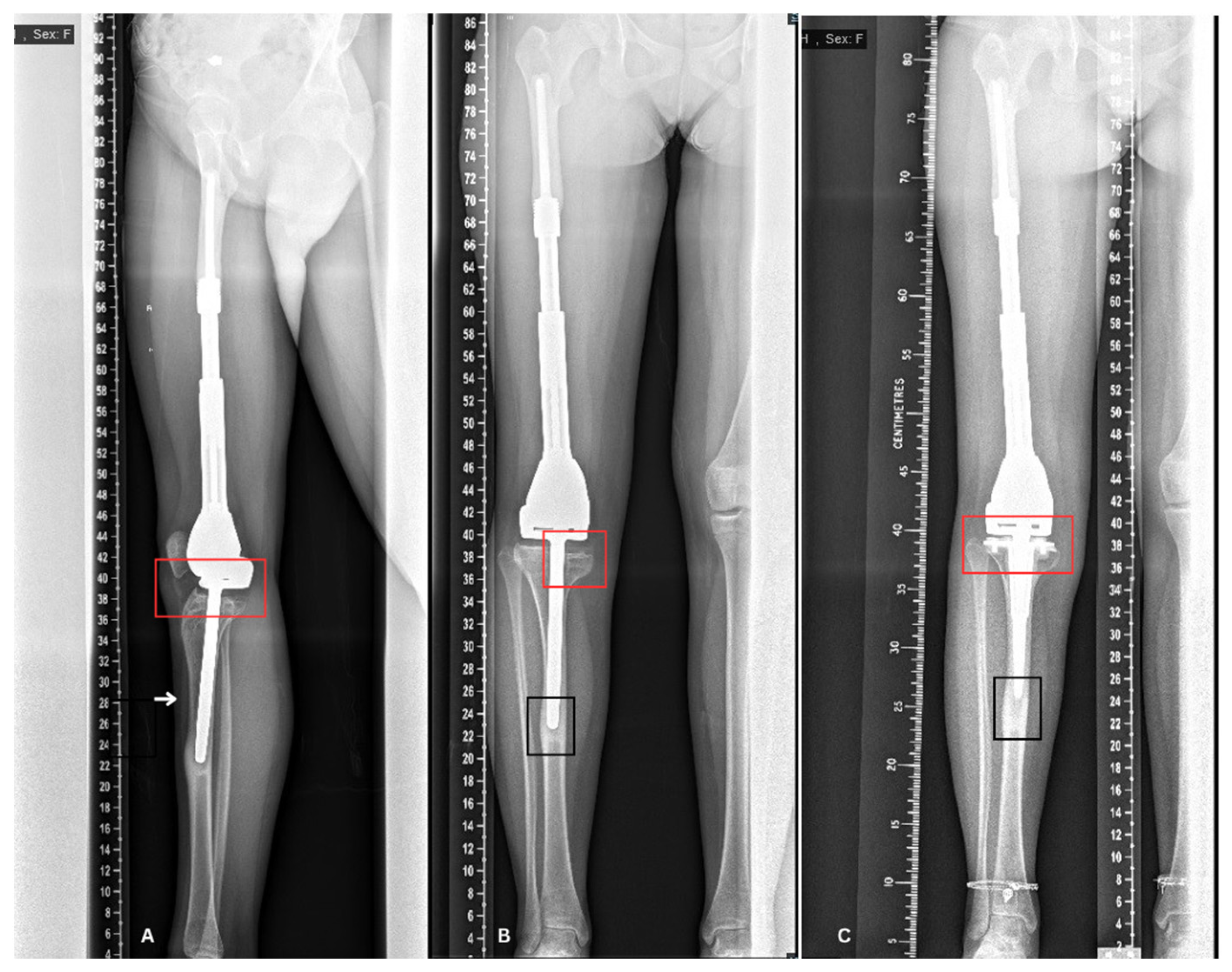
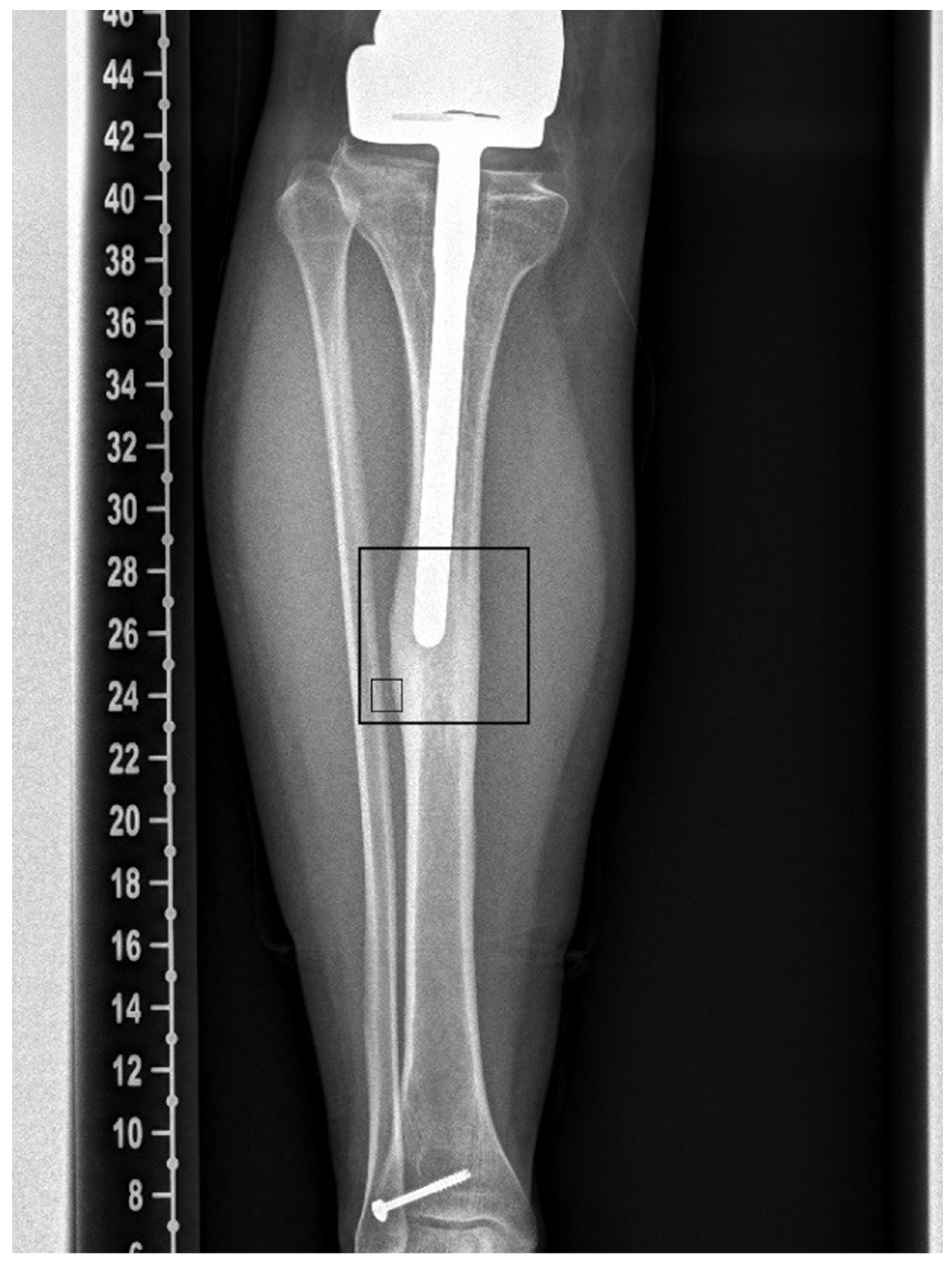
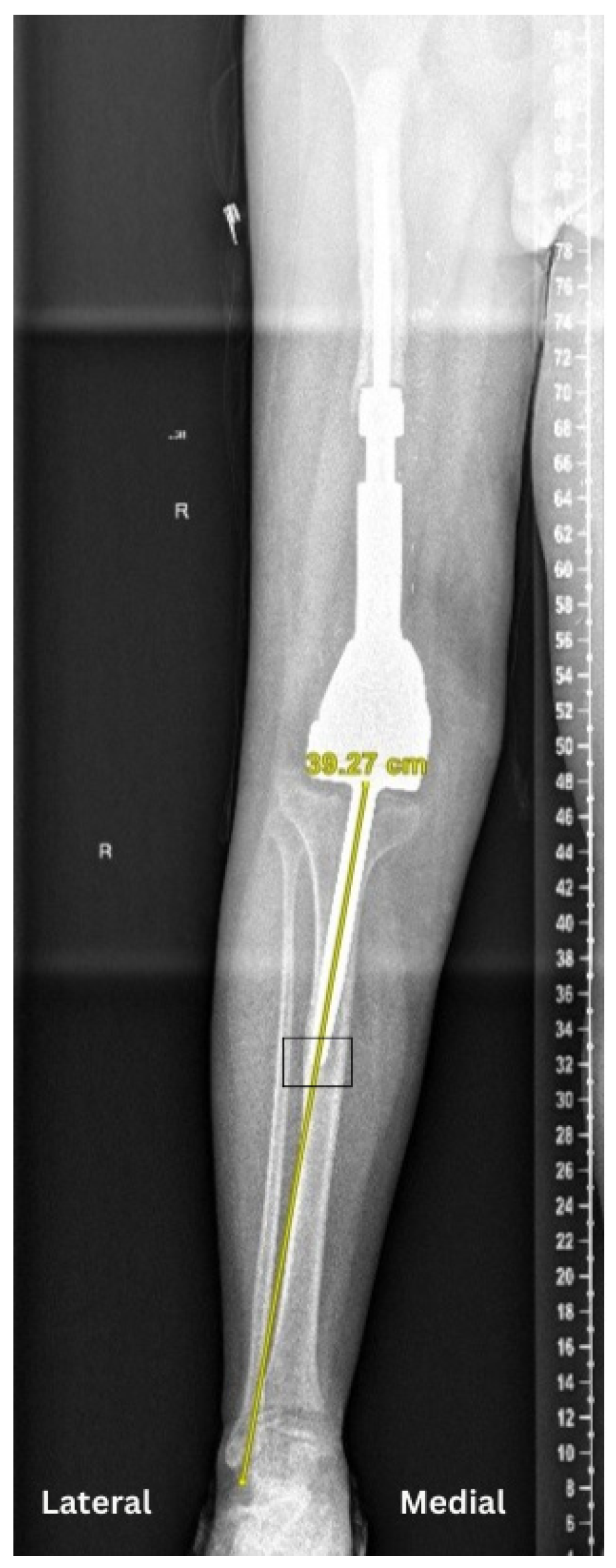
Stem migration at the last follow-up showed moderate to strong association (phi coefficient = 0.421) with tibial pain. Stress shielding, pedesteal, and periostal reaction at the last follow-up were strongly associated with tibial pain (phi = 0.476, 0.608, and 0.569, respectively). Unlike stem migration, the last three parameters were statistically significant (p-value < 0.05) (Table 6). However, stem migration was close to significance (p-value = 0.065), suggesting potential association with larger sample size (Figure 1, Figure 2 and Figure 3).

4. Discussion

In this study we investigated the potential relationship between two groups of radiographical parameters (numerical and binary variables) and the development of tibial pain due to stem instability after expandable distal femoral endoprosthesis in skeletally immature patients (N = 29). We developed an exploratory regression model using the numerical variables (thickness of medial cortex, thickness of lateral cortex, distance between stem tip and medial cortex, and distance between stem tip and lateral cortex after 6 months of operation and at last follow up). We also tested the association between tibial pain and the differences in each of these variables at last follow-up minus 6-month post-operation. Moreover, we determined the strength and significance of the association between tibial pain and the binary parameter (stem migration, stress shielding, pedesteal, and periostal reaction at the last follow-up).
The exploratory regression model identified medial cortical thickness at final follow-up as independently associated with tibial pain. However, given the small cohort size and limited number of outcome events, these findings should be interpreted cautiously. The regression analysis was not intended to establish a stable predictive model but rather to explore potential independent associations that may guide future research. Therefore, our findings should be interpreted as demonstrating association rather than prediction or causation.
A plausible biomechanical explanation for medial cortical hypertrophy relates to asymmetric load transfer and stem micromotion. In expandable distal femoral endoprostheses, the cementless tibial stem may experience repetitive micro-movement within the diaphyseal canal during growth and activity. This micromotion can shift load toward the cortical bone, particularly along the medial tibial cortex, stimulating periosteal bone formation through adaptive remodeling. Similar cortical responses have been described in stress reactions and periprosthetic bone adaptation, where repetitive mechanical loading triggers osteoblastic activity and cortical thickening. Over time, this adaptive response may reflect a maladaptive load distribution pattern associated with localized pain.
Insertion of the stem produces a kinetic energy that destroys the surrounding tissue. The size of the damaged area depends on the force put into the bone and its velocity. This injury triggers body response by producing pro-inflammatory cytokines and recruiting inflammatory cells. This response is followed by bone resorption by osteoclasts to clean the damage. Then, osteoprogenitor cells release non-collagenous proteins around the implant to link it with the host bone. This process facilitates osteointegration, implant stability, and bone healing. However, many patients develop implant instability. When the implant moves it damages the surrounding tissue. The movement of the implant base damages the epiphyses and surrounding bone, leading to its resorption and stress-shielding. However, stem movement along the bone shaft (diaphysis) stimulates an inflammatory response and bone deposition. These events lead to changes in cortical thickness, stem migration, periosteal reaction, and pedestal resorption [13,14,15].
Bone is a connective tissue composed of compact and spongy osseous tissues. Long bones were split into three regions, two epiphyses, which represent the long bones’ ends, and a diaphysis, which represents the shaft. Long bones are rich in blood vessels and nerves. They receive nourishment from arteries that pass through the compact bone and marrow cavities and leave the bone through the foramina. Nerves are moving inside the bone alongside the vessels, and their concentration is positively associated with the metabolic activity of the region. Repetitive movement of the stem leads to bone stress injuries, including stress reactions and stress fractures, as well as nerve injuries and subsequent localized pain that worsens with activity. This pain may restrict movement and require medical intervention [12,16,17].
Bone is not solely a mechanical structure but a tissue that efficiently adapts its geometry to the received loads. Bone geometry has been used to predict the risk of stress injuries. Newsham-West et al. [18] found that athletes with a thinner anterior tibial cortex and thicker medial-lateral cortices were more likely to have clinical symptoms or MRI signs of a bony stress reaction, the precursor of a stress fracture. Radiographical parameters have also been used to distinguish the patients with bone tumors who are at high from those at low risk of proximal femoral fracture. This resulted in the optimization of intervention, improved prognosis, and lower morbidity. Kawabata et al. [19] determined that medial femoral cortex thickness was significantly associated with stress fracture, with a cut-off value of 3.67 mm. In our study, we found a significant association between medial cortical thickness and tibial pain, with a mean value of 4.07 ± 0.81 mm after a mean follow-up of 75.14 months. Although the present study was not designed to establish clinical thresholds for intervention, the observed association suggests that progressive medial cortical thickening may represent a radiographic warning sign. Future prospective studies are needed to determine whether specific cortical thickness thresholds could inform surveillance intensity or early clinical evaluation. At present, these findings should be interpreted as hypothesis-generating rather than as a basis for surgical decision-making.
In complex revision surgery with comminuted and osteopenic bone, García-Rey et al. [20] observed a gradual increase in medial cortex at 6 months, 12 months, and the last follow-up post-surgery. However, the thickness of the lateral cortex fluctuated over time; this indicates more vulnerability of the lateral cortex compared to medial cortex to the internal and external factors, such as bone density, mechanical load, and patients’ activity level. In our study, lateral cortex thickness increased nearly in all patients. We did not detect the fluctuation because this measurement was taken in two intervals. However, our results align with García-Rey et al. as all patients had increased thickness at the last follow-up compared to 6 months post-surgery; the fluctuation was observed at 12-month follow-up. The minimal follow-up for radiographical assessment was 18 months, so it is possible that some of our patients had a small decrease in the thickness at 12 months postoperatively, and then increased the thickness at the last follow-up. Patients with tibial pain had a higher increase in the lateral thickness than no pain group at the last follow-up and the mean increase was close to significant (0.1971 ± 0.2176 cm, 1383 ± 0.953 cm, respectively; p-value = 0.067). The low sample size in this study might underestimate this significance. Future larger studies are needed to confirm these results.
Je Cho et al. [21] reported lateral femoral atrophy in patients who underwent total hip arthroplasty (THA) using a short stem with a long-coated area. The study proposed that the direct contact of the stem surface with that of the endosteal had contributed to stress shielding and subsequent lateral femoral atrophy. Schiller et al. [22] suggested that stress-shielding could be the result of rigid components of endoprosthesis for pediatrics; the cementless fixation and an intramedullary stem. It is also suggested to stimulate bode deposition and increase bone mass and cortical thickness. Variations among studies could be related to the surgical procedure itself and the operated bone and implant design, as well as patient characteristics, including age, gender, and bone quality. In our study, the distance from the stem to the lateral cortex decreased with a mean of 0.04 but it increased between the stem and medial cortex with a mean of 0.15. This finding suggested lateral migration of the stem and increased its contact with the lateral cortex. Our results align with Schiller et al.’s explanation as we answered increased lateral cortex thickness.
Jaiswal et al. [15] followed 33 patients with osteosarcoma or Ewing’s sarcoma (aged 6–16) who were treated with expandable endoprosthesis for an average of 42.9 months. They reported an increase in tibial prosthesis migration and lateral cortical thickness, which was significant in the group with sleeve insertion. The prosthesis migration was lateral and assumed to result due to wear, osteolysis, and loosening due to micromotion between the polyethylene surface and host bone, or abnormal growth of a damaged physis during sleeve insertion. Patients also had a cortical reaction at the tip of the tibial prosthesis proposed to be a result of implant migration and underlying sclerotic reaction. Similar to this study, our patients had stem migration more laterally and no one had medial migration. Moreover, most had increased lateral cortical thickness (96.6%) and periosteal reaction (65.5%) after a mean follow-up of 75.14 months. However, none of our patients had sleeves, which suggests that endoprosthesis contributes to these manifestations, and they are further promoted when sleeves are used.
This study is limited by low sample size, lack of controls, and the nature of retrospective design. Moreover, it included patients in one tertiary in the UK; thus, it cannot be generalized to other populations. Tibial pain was recorded as a binary clinical outcome without standardized pain scales or functional scoring, which may introduce misclassification bias and limit assessment of pain severity and temporal characteristics. The multivariable regression model included several radiographic parameters despite a limited number of outcome events, which increases the risk of overfitting and coefficient instability; therefore, the results should be considered exploratory. Interobserver reliability statistics were not available due to the retrospective design; however, all measurements were performed using standardized protocols and independent blinded assessment. Chemotherapy-related effects on bone quality and remodeling could not be separately analyzed. In addition, the potential influence of systemic therapies on bone remodeling could not be fully evaluated. Furthermore, the cohort originated from a highly specialized tertiary sarcoma center using a uniform implant system and pediatric population; therefore, the findings may not be directly generalizable to other institutions, implant designs, or adult patients.
However, the results were close to those found in the literature, indicating close characteristics of our population with others, but still, caution must be taken when comparing and interpreting results. Most studies investigated the femoral bone parameters; the literature lacks information regarding tibial bone parameters. Our study highlighted this knowledge gap and provided invaluable insights. The adaptation process in the bone is affected by bone quality, such as bone density, mineralization, and bone pathologies. These confounders were not considered in our study. Pil Jang et al. [23] reported a significant association between femoral lateral and medial cortical thickness and bone loss. Radiographical parameters were determined through X-ray images; other modalities, like MRI, are more sensitive. This choice of radiographs was related to the cost and time available. This limitation was alleviated by the standardization of the radiograph protocol and evaluation of the parameters by two highly expert specialists who were able to detect very small details. Moreover, X-ray is routinely used for reconstruction procedures; it is widely available in most facilities. Future studies using advanced imaging techniques could provide more accurate results and contribute to identifying other radiographical signs.

5. Conclusions

This retrospective cohort study identified radiographic features associated with tibial pain after expandable distal femoral endoprosthesis in skeletally immature patients. Key findings include the following:
  • Medial cortical thickening was independently associated with tibial pain in an exploratory regression analysis.
  • Stress shielding, pedestal formation, and periosteal reaction were significantly associated with tibial pain.
  • Radiographic changes collectively suggest stem micromotion and adaptive bone remodeling.
These findings are exploratory and hypothesis-generating. Future prospective multicenter studies are required to validate these observations and determine their role in postoperative surveillance strategies.

Author Contributions

Conceptualization and methodology, A.M. and M.K.; software and formal analysis, A.M. and M.K.; investigation, D.R. and A.Y.; data curation, H.M., F.Q. and A.Y.; visualization, H.M., F.Q. and A.Y.; resources, E.L.; validation, D.R. and M.Y.; supervision and project administration, M.Y.; writing—original draft preparation, A.M. and M.K.; writing—review and editing, H.M., F.Q., A.Y., D.R., M.Y. and E.L. All authors have read and agreed to the published version of the manuscript.

Funding

This research received no external funding.

Institutional Review Board Statement

The study was conducted in accordance with the principles of the Declaration of Helsinki and relevant institutional ethical standards. Owing to the retrospective nature of the study and the exclusive use of fully de-identified data, the requirement for formal approval by the Helsinki Committee was waived. All data were analyzed anonymously, and no patient-identifiable information was accessed or included at any stage of the study.

Informed Consent Statement

Patient consent was waived due to this being a retrospective cohort study.

Data Availability Statement

Data is available upon request.

Acknowledgments

During the preparation of this manuscript, the authors used Large Language Model platforms for the purposes of correct grammar to enhance the readability of the manuscript. The authors have reviewed and edited the output and take full responsibility for the content of this publication.

Conflicts of Interest

The authors declare no conflicts of interest.

References

  1. Beebe, K.; Song, K.J.; Ross, E.; Tuy, B.; Patterson, F.; Benevenia, J. Functional Outcomes After Limb-Salvage Surgery and Endoprosthetic Reconstruction with an Expandable Prosthesis: A Report of 4 Cases. Arch. Phys. Med. Rehabil. 2009, 90, 1039–1047. [Google Scholar] [CrossRef]
  2. Cipriano, C.A.; Gruzinova, I.S.; Frank, R.M.; Gitelis, S.; Virkus, W.W. Frequent Complications and Severe Bone Loss Associated With the Repiphysis Expandable Distal Femoral Prosthesis. Clin. Orthop. Relat. Res. 2015, 473, 831–838. [Google Scholar] [CrossRef]
  3. Gupta, A.; Meswania, J.; Pollock, R.; Cannon, S.R.; Briggs, T.W.R.; Taylor, S.; Blunn, G. Non-invasive distal femoral expandable endoprosthesis for limb-salvage surgery in paediatric tumours. J. Bone Jt. Surg. Br. Vol. 2006, 88, 649–654. [Google Scholar] [CrossRef]
  4. Lex, J.R.; Adlan, A.; Tsoi, K.; Evans, S.; Stevenson, J.D. Frequency and reason for reoperation following non-invasive expandable endoprostheses: A systematic review. J. Bone Oncol. 2021, 31, 100397. [Google Scholar] [CrossRef]
  5. Henderson, E.R.; Pepper, A.M.; Marulanda, G.; Binitie, O.T.; Cheong, D.; Letson, G.D. Outcome of Lower-Limb Preservation with an Expandable Endoprosthesis After Bone Tumor Resection in Children. J. Bone Jt. Surg. 2012, 94, 537–547. [Google Scholar] [CrossRef]
  6. Batta, V.; Coathup, M.J.; Parratt, M.T.; Pollock, R.C.; Aston, W.J.; Cannon, S.R.; Skinner, J.A.; Briggs, T.W.; Blunn, G.W. Uncemented, custom-made, hydroxyapatite-coated collared distal femoral endoprostheses: Up to 18 years’ follow-up. Bone Jt. J. 2014, 96, 263–269. [Google Scholar] [CrossRef]
  7. Schwartz, A.J.; Kabo, M.J.; Eilber, F.C.; Eilber, F.R.; Eckardt, J.J. Cemented Distal Femoral Endoprostheses for Musculoskeletal Tumor: Improved Survival of Modular versus Custom Implants. Clin. Orthop. Relat. Res. 2010, 468, 2198–2210. [Google Scholar] [CrossRef]
  8. Henderson, E.R.; Groundland, J.S.; Pala, E.; Dennis, J.A.; Wooten, R.; Cheong, D.; Windhager, R.; Kotz, R.I.; Mercuri, M.; Funovics, P.T.; et al. Failure Mode Classification for Tumor Endoprostheses: Retrospective Review of Five Institutions and a Literature Review. J. Bone Jt. Surg. 2011, 93, 418–429. [Google Scholar] [CrossRef]
  9. Henderson, E.R.; O’Connor, M.I.; Ruggieri, P.; Windhager, R.; Funovics, P.T.; Gibbons, C.L.; Guo, W.; Hornicek, F.J.; Temple, H.T.; Letson, G.D. Classification of failure of limb salvage after reconstructive surgery for bone tumours: A modified system Including biological and expandable reconstructions. Bone Jt. J. 2014, 96, 1436–1440. [Google Scholar] [CrossRef]
  10. Barrack, R.L.; Paprosky, W.; Butler, R.; Palafox, A.; Szuszczewicz, E.; Myers, L. Patients’ perception of pain after total hip arthroplasty. J. Arthroplast. 2000, 15, 590–596. [Google Scholar] [CrossRef]
  11. Brown, T.E.; Larson, B.; Shen, F.; Moskal, J.T. Thigh Pain After Cementless Total Hip Arthroplasty: Evaluation and Management. J. Am. Acad. Orthop. Surg. 2002, 10, 385–392. [Google Scholar] [CrossRef]
  12. Cibulka, M.T.; White, D.M.; Woehrle, J.; Harris-Hayes, M.; Enseki, K.; Fagerson, T.L.; Slover, J.; Godges, J.J. Hip Pain and Mobility Deficits—Hip Osteoarthritis: Revision 2017. J. Orthop. Sports Phys. Ther. 2017, 47, A1–A37. [Google Scholar] [CrossRef]
  13. Delaisse, J.-M.; Andersen, T.L.; Kristensen, H.B.; Jensen, P.R.; Andreasen, C.M.; Søe, K. Re-thinking the bone remodeling cycle mechanism and the origin of bone loss. Bone 2020, 141, 115628. [Google Scholar] [CrossRef]
  14. Tran, P.; Zhang, B.X.; Lade, J.A.; Pianta, R.M.; Unni, R.P.; Haw, C.S. Periprosthetic Bone Remodeling After Novel Short-Stem Neck-Sparing Total Hip Arthroplasty. J. Arthroplast. 2016, 31, 2530–2535. [Google Scholar] [CrossRef]
  15. Jaiswal, P.K.; Blunn, G.; Pollock, R.; Skinner, J.A.; Cannon, S.R.; Briggs, T.W. Bone Remodeling Around the Tibial Component of Distal Femoral Expandable Endoprosthesis. J. Arthroplast. 2009, 24, 421–426. [Google Scholar] [CrossRef]
  16. Barrack, R.L.; Stanley, T.; Burt, M.; Hopkins, S. The effect of stem design on end-of-stem pain in revision total knee arthroplasty. J. Arthroplast. 2004, 19, 119–124. [Google Scholar] [CrossRef]
  17. Clarke, B. Normal Bone Anatomy and Physiology. Clin. J. Am. Soc. Nephrol. 2008, 3, S131–S139. [Google Scholar] [CrossRef]
  18. Newsham-West, R.J.; Lyons, B.; Milburn, P.D. Regional bone geometry of the tibia in triathletes and stress reactions. J. Sci. Med. Sport 2014, 17, 150–154. [Google Scholar] [CrossRef]
  19. Kawabata, Y.; Matsuo, K.; Nezu, Y.; Kamiishi, T.; Inaba, Y.; Saito, T. The risk assessment of pathological fracture in the proximal femur using a CT-based finite element method. J. Orthop. Sci. 2017, 22, 931–937. [Google Scholar] [CrossRef]
  20. García-Rey, E.; García-Cimbrelo, E.; Cruz-Pardos, A.; Madero, R. Increase of Cortical Bone After a Cementless Long Stem in Periprosthetic Fractures. Clin. Orthop. Relat. Res. 2013, 471, 3912–3921. [Google Scholar] [CrossRef][Green Version]
  21. Cho, Y.J.; Bae, C.I.; Yoon, W.K.; Chun, Y.S.; Rhyu, K.H. High incidence of early subtrochanteric lateral cortical atrophy after hip arthroplasty using bone-conserving short stem. Int. Orthop. 2018, 42, 303–309. [Google Scholar] [CrossRef]
  22. Schiller, C.; Windhager, R.; Fellinger, E.J.; Salzer-Kuntschik, M.; Kaider, A.; Kotz, R. Extendable tumour endoprostheses for the leg in children. J. Bone Jt. Surg. Br. 1995, 77, 608–614. [Google Scholar] [CrossRef]
  23. Jang, S.P.; Yeo, I.; So, S.-Y.; Kim, K.; Moon, Y.-W.; Park, Y.-S.; Lim, S.-J. Atypical Femoral Shaft Fractures in Female Bisphosphonate Users. BioMed Res. Int. 2017, 2017, 5932496. [Google Scholar] [CrossRef]
Figure 1. This figure represents the right leg of an 18-year-old female after 8 years of having an extendable distal femur endoprosthesis. The large square shows stem migration to the left (varus formation); the white line in the radiograph that is covered with the small square indicates a periosteal reaction.
Std 15 00010 g001
Figure 2. The figures show multiple images of the right leg of a 14-year-old female after five years of distal femoral endoprosthesis and revision with cemented tibia due to tibial pain. The red square illustrates the resorption of the medial epiphysis and stress shielding. The region marked with the black square in (A,B) indicates anterolateral cortex hypertrophy, stem migration (varus formation), and pedestal resorption. The arrow in (A) indicates a periosteal reaction. (C) illustrates the leg after revision. The black square shows stem hypertrophy and the red square shows the cemented component.
Std 15 00010 g002
Figure 3. This figure illustrates the leg of a nine-year-old child who suffered from tibial pain after distal tibial endoprosthesis. The black square shows lateral migration of the stem tip (varus formation).
Std 15 00010 g003
Table 1. Radiographical characteristics (group A) of the study patients.
Radiographic ParametersMean (mm)Min (mm)Max (mm)
Thickness of Medial Cortex—6 Month Follow-up3.02.14.2
Thickness of Medial Cortex—Last Follow-up4.12.76.5
Thickness of Lateral Cortex—6 Month Follow-up3.42.44.5
Thickness of Lateral Cortex—Last Follow-up5.10.49.8
Distance Stem Tip–Medial Cortex—6 Month1.90.04.0
Distance Stem Tip–Medial Cortex—Last3.40.07.4
Distance Stem Tip–Lateral Cortex—6 Month0.90.04.0
Distance Stem Tip–Lateral Cortex—Last0.50.03.0
Table 2. The difference in radiographical characteristics (group A) of the study patients at the last follow-up compared to 6 month follow-up.
Radiographic ParametersMean (mm)Min (mm)Max (mm)
Thickness Medial Cortex Change1.050.02.7
Thickness Lateral Cortex Change1.71−3.36.6
Stem Tip–Medial Cortex Change1.49−1.25.0
Stem Tip–Lateral Cortex Change−0.43−2.01.6
Table 3. Radiographical characteristics (group B) of the study patients at last follow-up.
Radiographic ParametersNumber of Cases (N = 29)Percentage (%)
Migration of Stem2172.4
Varus (Lateral)413.8
Neutral (Midline)2586.2
Valgus (Medial)00
Stress Shielding—Difference in Bone Density2586.2
Pedesteal2379.3
Periostal Reaction1965.5
Table 4. Multivariable logistic regression analysis of the relationship between the radiographical parameters (group A) and tibial pain.
Radiographic ParametersCoefficientStandard Errorp-Value
Thickness of Medial Cortex
6 Month Follow-up−15.405624.990.538
Last Follow-up *50.431224.7410.042
Thickness of Lateral Cortex
6 Month Follow-up−28.174123.1690.224
Last Follow-up10.63997.670.165
Distance Between Stem Tip and Medial Cortex
6 Month Follow-up−5.308711.5980.647
Last Follow-up3.68557.3690.617
Distance Between Stem Tip and Lateral Cortex
6 Month Follow-up−19.190715.9780.23
Last Follow-up3.202712.5590.799
* Indicates statistically significant.
Table 5. T-Statistics of the relationship between the differences in radiographical parameters of group A at the last follow-up compared to 6 months postoperatively and tibial pain.
Radiographic ParametersT-Statisticsp-Value
Thickness of Medial Cortex *3.790.0008
Thickness of Lateral Cortex1.910.0666
Distance Between Stem Tip and Medial Cortex−0.040.9666
Distance Between Stem Tip and Lateral Cortex0.540.5965
* Indicates statistically significant.
Table 6. Chi-square test of independence and the phi coefficient analysis of the association between radiographic parameters of group B at last follow-up and tibial pain.
Radiographic ParametersChi-SquarePhi-Coefficientp-Value
Migration of Stem3.4120.4210.065
Stress Shielding *4.0690.4760.044
Pedesteal *7.8870.6080.004
Periostal Reaction *7.1130.5690.008
* Indicates statistically significant.
Disclaimer/Publisher’s Note: The statements, opinions and data contained in all publications are solely those of the individual author(s) and contributor(s) and not of MDPI and/or the editor(s). MDPI and/or the editor(s) disclaim responsibility for any injury to people or property resulting from any ideas, methods, instructions or products referred to in the content.