
Article

Acaricidal and Repellent Activities of Rhizobacterial Isolates Against Tetranychus urticae (Acari: Tetranychidae) Under Laboratory and Greenhouse Conditions

1
Regional Center of Agricultural Research of Agadir, National Institute of Agricultural Research (INRA), Avenue Ennasr, BP415 Rabat Principal, Rabat 10090, Morocco
2
Laboratory of Biotechnology and Valorization of Natural Resources, Faculty of Science, Ibn Zohr University of Agadir, Agadir 80000, Morocco
3
AgroBioSciences Department (AgBS), Mohammed VI Polytechnic University (UM6P), Ben Guerir 43150, Morocco
4
Research Team in Science and Technsology, Higher School of Technology, Ibn Zohr University, Quartier 25 Mars, P.O. Box 3007, Laayoune 70000, Morocco
5
Macrobial Production Unit, Omnium Agricole du Souss, Tassila Industrial Zone, Agadir 80000, Morocco
*
Author to whom correspondence should be addressed.
Int. J. Plant Biol. 2026, 17(8), 69; https://doi.org/10.3390/ijpb17080069
Submission received: 13 June 2026 / Revised: 3 August 2026 / Accepted: 4 August 2026 / Published: 6 August 2026
(This article belongs to the Section Plant–Microorganisms Interactions)

Abstract

The two-spotted spider mite, Tetranychus urticae Koch, is a highly polyphagous and economically important pest affecting a wide range of crops worldwide. This study evaluated the potential of four rhizobacterial isolates—Leucobacter aridicollis (IQR1), Paenochrobactrum sp. (IQR2), uncultured bacterium IQR3, and marine bacterium AK6_052 (IQR5)—as candidate biological control agents against T. urticae. The rhizobacterial isolates were obtained from the tomato rhizosphere at the INRA experimental farm (Agadir, Morocco) and evaluated for their acaricidal and repellent activities against T. urticae. Corrected mortality and repellency index were assessed after 24, 48, and 72 h of exposure. All four isolates exhibited acaricidal activity, with IQR3 and IQR5 showing the greatest efficacy. Corrected mortality reached 69.9% with IQR3 at the highest concentration after 72 h of exposure. The isolates showed no statistically significant repellent activity. Under greenhouse conditions (108 CFU mL−1), IQR3 was associated with the lowest infestation incidence (64%), the lowest infestation severity (13.3%) and the lowest adult density (1.8 adults leaf−1); IQR5 showed a comparable trend. Overall, IQR3 and IQR5 represent promising rhizobacterial candidates for the sustainable management of T. urticae in tomato production. Further studies are needed to optimize their formulation, elucidate their mechanisms of action, and validate their efficacy under field conditions.

1. Introduction

The two-spotted spider mite Tetranychus urticae Koch (Acari: Tetranychidae) is a highly polyphagous species that infests more than 1100 plant species belonging to over 140 families [1]. It is widely regarded as one of the most economically damaging arthropod pests worldwide, causing significant yield losses in numerous agricultural crops, including fruits, cotton, vegetables, and ornamentals [2,3,4,5,6].
The damage caused by T. urticae is primarily direct: the mites pierce the leaf epidermis and feed on the contents of mesophyll cells, leading to chlorosis, reduced chlorophyll content, impaired photosynthesis, and ultimately premature leaf desiccation; under heavy infestation, plant death may occur [7]. As a typical colonizing species, T. urticae combines high female fecundity with a strongly female-biased offspring sex ratio, enabling extremely rapid population growth and a correspondingly short generation time [8]. These life-history traits, together with its haplodiploid reproduction, are central to its notorious capacity for rapid adaptation to control measures.
In conventional pest management, control of T. urticae relies largely on repeated applications of broad-spectrum acaricides [9]. While initially effective against the target pest, this approach adversely affects beneficial arthropods—including predatory mites—and has driven the selection of resistant populations together with the accumulation of chemical residues in the environment [10,11,12,13,14]. Indeed, T. urticae has now evolved resistance to acaricides spanning at least eleven distinct modes of action, making it the most resistance-prone invertebrate pest known [15]. This challenge is further compounded by the exceptionally rapid evolution of resistance in field populations: resistance to the recently commercialized acaricide cyetpyrafen, for instance, became widespread within only three years, driven by an unprecedented number of recurrently evolved target-site mutations that promote cross-resistance across multiple chemical classes [16,17].
Given these limitations, spider mite management increasingly emphasizes biological control and reduced-risk inputs as sustainable alternatives [18,19,20]. Among these, plant-growth-promoting rhizobacteria (PGPR) have attracted growing interest, as they can elicit induced systemic resistance (ISR) through jasmonic-acid- and ethylene-dependent signaling pathways [21]. PGPR-mediated ISR has been shown to adversely affect T. urticae fitness, reducing fecundity, prolonging developmental time, and lowering intrinsic population growth rates [22]. Such evidence strengthens the rationale for developing microbial-based biocontrol strategies against this pest.
Beyond ISR, several rhizobacteria—particularly within the genera Pseudomonas and Bacillus—have proven directly effective in suppressing mite populations [5,23,24,25]. Likewise, bacteria such as Xenorhabdus spp., Yersinia entomophaga, Pseudomonas entomophila, Burkholderia spp., Chromobacterium spp., Streptomyces spp., and Saccharopolyspora spp. have gained considerable commercial interest for producing diverse metabolites with potent insecticidal and acaricidal activity [26,27]. In Pseudomonas fluorescens, for example, bacterial chitinases contribute to mite control by hydrolyzing the chitinous exoskeleton [28,29]. Collectively, these bacteria show strong potential as environmentally sustainable alternatives to synthetic acaricides [26,27].
In this context, the present study aimed to evaluate the acaricidal and repellent activities of four rhizobacterial isolates—Leucobacter aridicollis (IQR1), Paenochrobactrum sp. (IQR2), uncultured bacterium (IQR3), and marine bacterium AK6_052 (IQR5)—isolated from the rhizosphere of tomato plants cultivated in a greenhouse [30] against the two-spotted spider mite T. urticae (Acari: Tetranychidae).

2. Materials and Methods

2.1. Isolation and Characterization of Bacterial Agents

Four bacterial isolates—Leucobacter aridicollis (ON799334.1) (IQR1), Paenochrobactrum sp. (JF804769.1) (IQR2), uncultured bacterium (JQ337400.1) IQR3, and marine bacterium AK6_052 (KF816539.1) (IQR5)—were obtained from the Microbiology Laboratory of the National Institute of Agricultural Research (INRA), Regional Center of Agadir, Morocco [30]. These isolates had previously been isolated from the rhizospheric soil of tomato plants (Solanum lycopersicum L.) grown at the INRA experimental farm in Agadir, Morocco. For inoculum preparation, an aliquot of each isolate was inoculated into 100 mL of nutrient broth supplemented with 0.1% Tween 20 (v/v) and incubated on an orbital shaker at 28 ± 1 °C and 150 rpm for 24 h [31]. After incubation, the cultures were centrifuged at 10,000× g for 10 min at 4 °C, and the resulting bacterial pellets were washed twice with sterile distilled water to remove residual growth medium. The cells were then resuspended in sterile distilled water. The cell density was adjusted spectrophotometrically at 640 nm to a stock suspension of approximately 108 CFU mL−1, which was then serially diluted in sterile distilled water to obtain the two working suspensions of approximately 103 and 104 CFU mL−1; final densities were confirmed by plate counting on nutrient agar [32].

2.2. Effects of Four Isolates Against T. urticae Under Controlled Conditions

2.2.1. Acaricidal Activity

The four bacterial isolates, IQR1, IQR2, IQR3, and IQR5, were assessed for their acaricidal activity against adult T. urticae on tomato leaves at two bacterial suspension concentrations: C1 (103 CFU mL−1) and C2 (104 CFU mL−1). The initial population of T. urticae was obtained from the SAOAS Company (Agadir, Morocco). Fresh, unsprayed tomato leaves (Solanum lycopersicum L.) were collected from an organic tomato greenhouse at the experimental farm of INRA Agadir (30.045499° N, 9.552841° W), washed thoroughly with tap water, and rinsed with sterile distilled water. The leaves were air-dried, immersed in the corresponding bacterial suspension for 20 s, and again allowed to air-dry under sterile conditions. Treated leaflets were then placed upper-surface down on water-saturated sponges within leaf cages to maintain turgor and prevent mite escape.
Fifteen adults of T. urticae were subsequently transferred to each leaflet using a fine camel-hair brush. Sterile distilled water was applied as the control treatment. Mite mortality was recorded at 24, 48, and 72 h after treatment; individuals were considered dead when they failed to move their appendages after gentle prodding with the brush. The experiment was arranged in a randomized complete block design with four replicates per treatment and was repeated three times, resulting in a total of 12 biological replicates per treatment. In total, 1620 adult T. urticae were used in the experiment. The experiments were conducted in a growth chamber maintained at 25 ± 1 °C under a 16:8 h (L:D) photoperiod, at the Laboratory of Plant Protection, National Institute of Agricultural Research (INRA), Regional Center of Agadir, Morocco. Corrected mortality (%) was calculated using Abbott’s formula [33]:
Crr.M% = [(Mt − Mc)/(100 − Mc)] × 100,
where Mt and Mc represent mortality in treated and control groups, respectively.

2.2.2. Repellent Activity

The repellency bioassay was adapted from the dual-choice system described by Qessaoui et al. [5]. Two bacterial suspension concentrations, C1 (103 CFU mL−1) and C2 (104 CFU mL−1), were tested. Each tomato leaf was immersed for 20 s in the corresponding bacterial suspension and left to dry completely under a laminar flow hood. For the control, leaves were immersed in sterile distilled water under the same conditions. Each experimental unit consisted of two connected boxes—one containing a treated leaf and the other an untreated (control) leaf—allowing the mites to move freely between the two compartments and thereby choosing between treated and untreated substrates.
Fifteen adults of T. urticae were introduced into the central opening of each system, after which the opening was sealed. The experiment was arranged in a randomized complete block design with four replicates per treatment, conducted in a growth chamber at 25 ± 1 °C under a 16:8 h (L:D) photoperiod, and repeated three times. The number of adult mites present on each leaf (treated versus control) was recorded at 24, 48, and 72 h after introduction to monitor the temporal dynamics of the repellent response. A repellency index was then calculated according to the formula of Pascual-Villalobos and Robledo [34]: RI = [(C − T)/(C + T)] × 100, with RI: repellency index, C: number of T. urticae adults counted in the control box, T: number of T. urticae adults counted in the treated box.

2.3. Evaluation of the Effect of Isolates on T. urticae Under Greenhouse Conditions

The in vivo experiments were conducted in a greenhouse at the Melk Zhar experimental farm of INRA, Agadir, Morocco. Tomato plants (Solanum lycopersicum L. cv. Campbell 33) at the BBCH 15–16 growth stage (5–6 true leaves) were used, with 45 plants assigned to each treatment, and the experiment was arranged in a randomized complete block design. Under greenhouse (in vivo) conditions, the bacterial inoculum faces abiotic and biotic stresses absent in vitro—UV radiation, desiccation, temperature fluctuations, competition with the native phyllosphere microbiota, and dilution over a larger plant surface. Because these factors reduce the viability and effective density of cells reaching the target mites, the concentration applied under greenhouse conditions was increased relative to the laboratory assays to ensure delivery of an effective concentration. A suspension of 108 CFU mL−1 [35,36] was prepared for each isolate, and each plant was sprayed with 20 mL of the corresponding suspension using a hand-held sprayer. Control plants were treated with sterile distilled water. Following treatment, the greenhouse was kept open to allow for natural (passive) infestation by the resident T. urticae population.

2.3.1. Assessment of T. urticae Incidence and Severity

Infestation incidence was assessed three days after treatment by recording the number of plants harboring at least one adult T. urticae to evaluate the initial response of the mite to the treatments. Infestation severity was expressed as the percentage of infested leaflets per plant—leaflets bearing at least one adult mite—determined from six randomly selected leaves per plant.

2.3.2. Assessment of T. urticae Adult Density

Adult mite density was assessed three days after treatment by examining four randomly selected leaflets from the middle stratum of the canopy of each plant per experimental unit. The number of adult T. urticae on each leaflet was counted manually under a stereomicroscope, enabling comparison of adult mite populations among bacterial isolates under greenhouse conditions.

2.4. Statistical Analysis

The acaricidal efficacy of the bacterial isolates against T. urticae was calculated using Abbott’s formula, whereas repellency was determined according to the method of Pascual-Villalobos and Robledo [34]. Percentage mortality data were arcsine square-root-transformed prior to analysis to stabilize variances and meet the assumptions of parametric tests. A three-way analysis of variance (ANOVA) was performed to assess the effects of treatment, dose, time, and their interactions on corrected mortality. Infestation severity and adult density were analyzed using one-way ANOVA. The assumptions of normality and homogeneity of variances were verified using the Shapiro–Wilk and Levene’s tests, respectively. When significant differences were detected, treatment means were compared using Tukey’s honestly significant difference (HSD) test at the 5% significance level. Statistical significance was set at p < 0.05. All statistical analyses were performed using R software (version 4.6.1; R Foundation for Statistical Computing, Vienna, Austria).

3. Results

3.1. Acaricidal Activity

A three-way ANOVA revealed a significant effect of bacterial treatment on the corrected mortality of T. urticae (F = 5.734, p = 0.0021). Overall, isolates IQR3 and IQR5 induced significantly higher corrected mortality than IQR2, whereas IQR1 showed an intermediate response and did not differ significantly from either IQR5 or IQR3 (Figure 1). No significant difference was detected between IQR3 and IQR5.
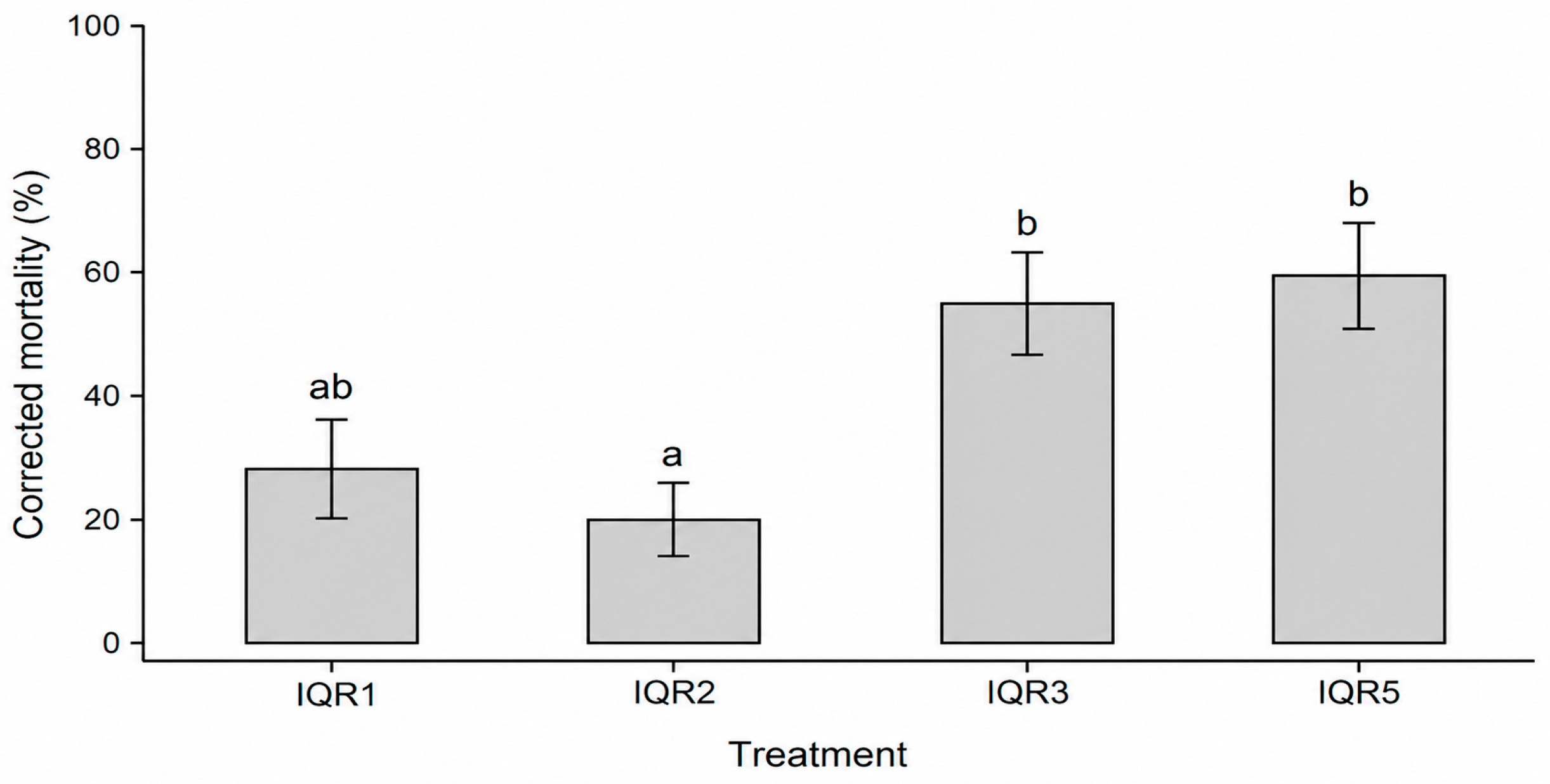
The acaricidal activity of the rhizobacterial isolates varied with exposure time (Table 1). No significant differences among treatments were detected after 24 or 72 h of exposure (p > 0.05). In contrast, significant differences were observed after 48 h, when IQR3 and IQR5 produced significantly higher corrected mortality than IQR2, while IQR1 showed an intermediate response (Figure 2).
Exposure of T. urticae adults to the rhizobacterial isolates induced progressive intoxication symptoms, characterized by reduced mobility, followed by gradual darkening of the body before death. Mortality was first recorded 24 h after treatment and generally increased with exposure time, although the magnitude of the response depended on the bacterial isolate and concentration (Table 1).
At 24 h, corrected mortality ranged from 10.1 ± 2.1% (IQR1, C2) to 47.9 ± 11.5% (IQR2, C2), with no significant differences among treatments. After 48 h, mortality increased markedly, reaching 62.5 ± 13.0% for IQR5 (C1) and 57.7 ± 15.6% for IQR3 (C2), both of which were significantly higher than that of IQR2. After 72 h, corrected mortality reached its highest value (69.9 ± 8.8%) in IQR3 (C2); however, differences among treatments were no longer statistically significant (p > 0.05).

3.2. Repellent Activity

Regarding the repellent effect, the assumptions of normality and homogeneity of variances were satisfied prior to the factorial ANOVA. The Shapiro–Wilk test confirmed the normality of residuals (W = 0.9798, p = 0.2992), while Levene’s test indicated homogeneous variances among treatment combinations (F = 0.3174, p = 0.998).
Factorial ANOVA revealed that bacterial isolate (F = 0.581, p = 0.6301), concentration (F = 3.179, p = 0.0809), exposure time (F = 0.038, p = 0.9630), and all interaction terms had no significant effect on the repellency index (RI) of T. urticae (p > 0.05). Although the concentration effect approached significance (p = 0.0809), it did not reach the 5% significance threshold.
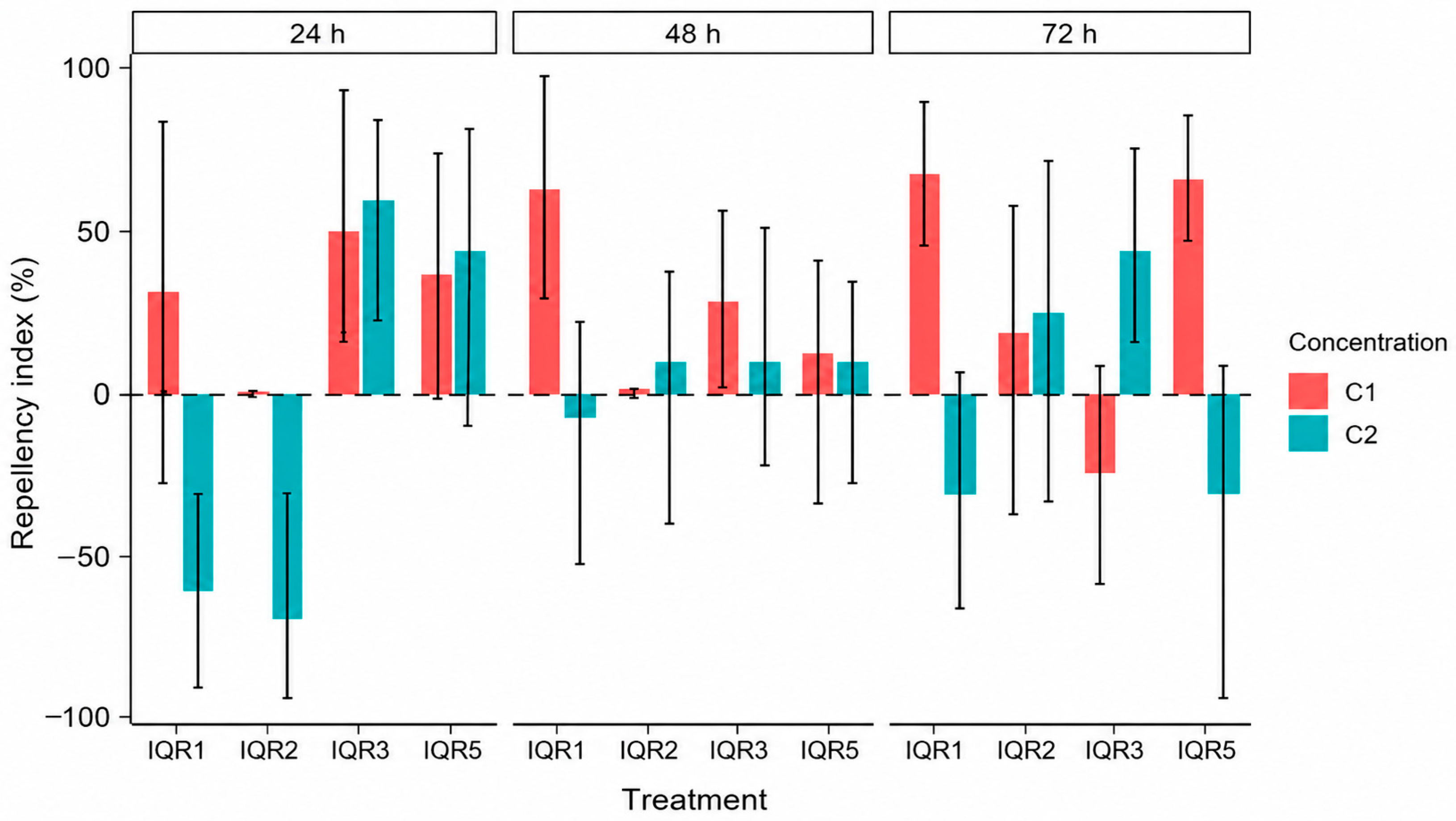
Positive RI values indicated avoidance of the treated leaves by T. urticae, whereas negative RI values indicated attraction. Despite the absence of statistically significant treatment effects, noticeable differences in repellency patterns were observed among bacterial isolates, concentrations, and exposure periods (Figure 3). IQR5 consistently produced positive RI values, particularly at concentration C1 after 72 h, while IQR1 also showed relatively high positive RI values after 48 and 72 h. In contrast, negative RI values were recorded for several isolate–concentration combinations, notably IQR1, IQR2, and IQR5 at concentration C2 and IQR3 at concentration C1, suggesting occasional attraction rather than repellency.
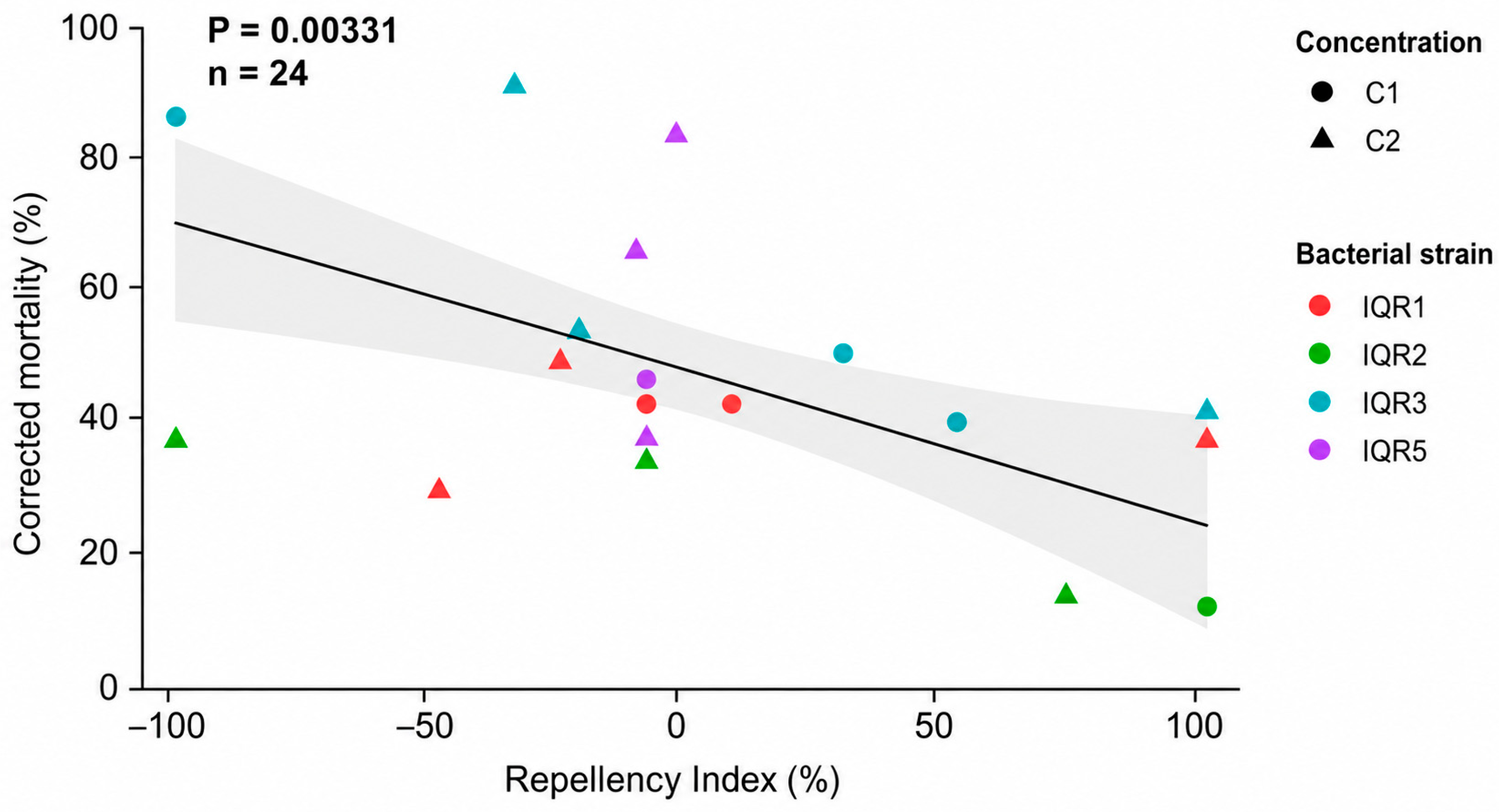
To assess the association between the toxic and behavioral responses of T. urticae, corrected mortality and repellency index at 48 h were subjected to Pearson’s correlation analysis (Figure 4). A significant negative correlation was observed between the two variables (r = −0.575, p = 0.003, n = 24), indicating that treatments producing higher corrected mortality were generally associated with lower repellency indices. Conversely, highly repellent treatments tended to induce lower mortality. These findings reveal an inverse relationship between the lethal and repellent activities of the tested rhizobacterial isolates, suggesting that different bacterial isolates may preferentially express one mode of action over the other.

3.3. Evaluation of Isolates Effect on T. urticae Under Greenhouse Conditions

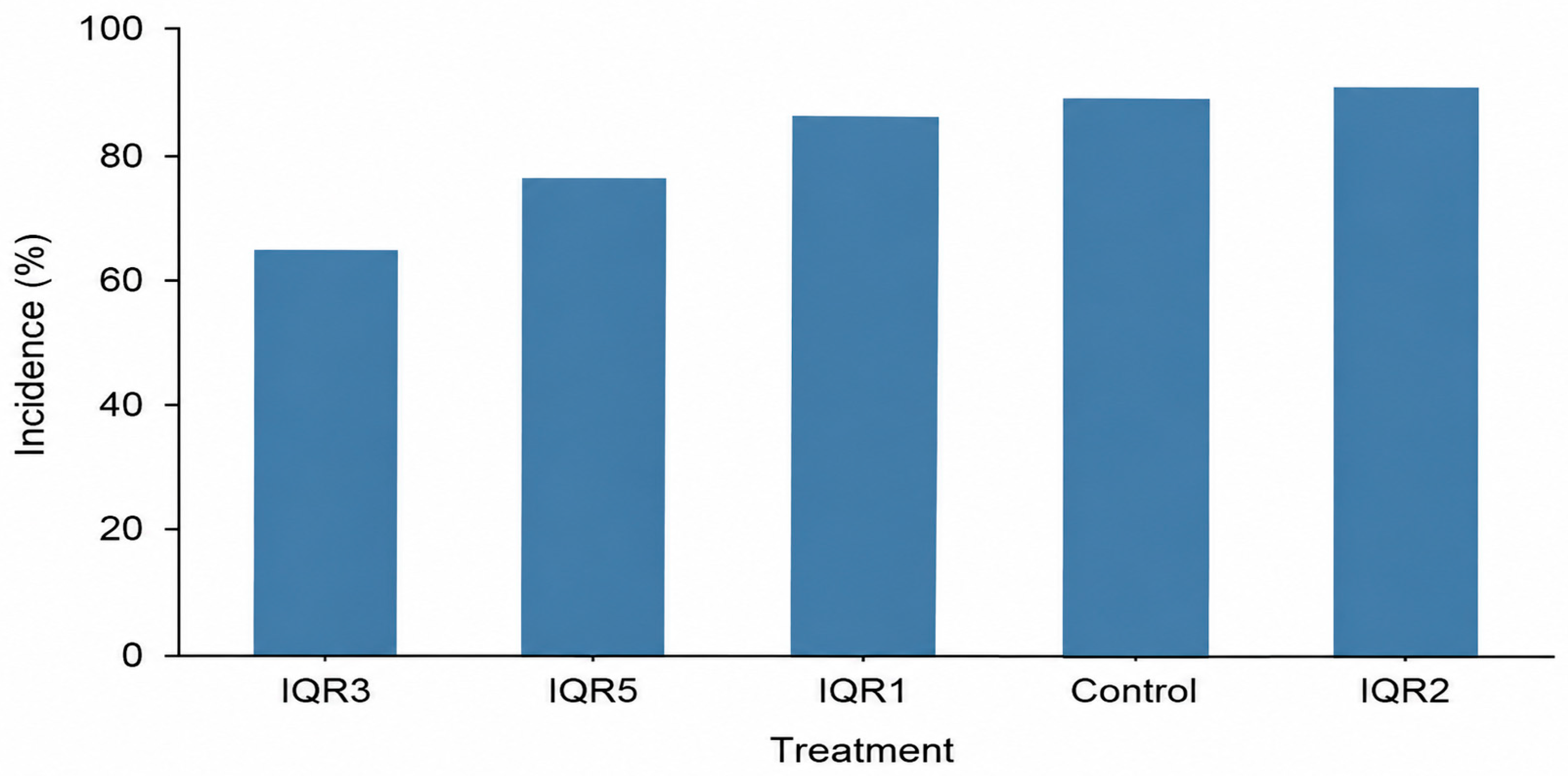
Under greenhouse conditions, rhizobacterial treatments affected the incidence, severity, and adult density of T. urticae on tomato plants. Infestation incidence, expressed as the percentage of infested plants, varied among treatments, with the lowest incidence recorded for IQR3 (64%), followed by IQR5 (76%), whereas IQR1 and IQR2 showed higher incidences (88% and 92%, respectively) (Figure 5). These results suggest that IQR3 was the most effective isolate in reducing the establishment of mite infestations under greenhouse conditions.
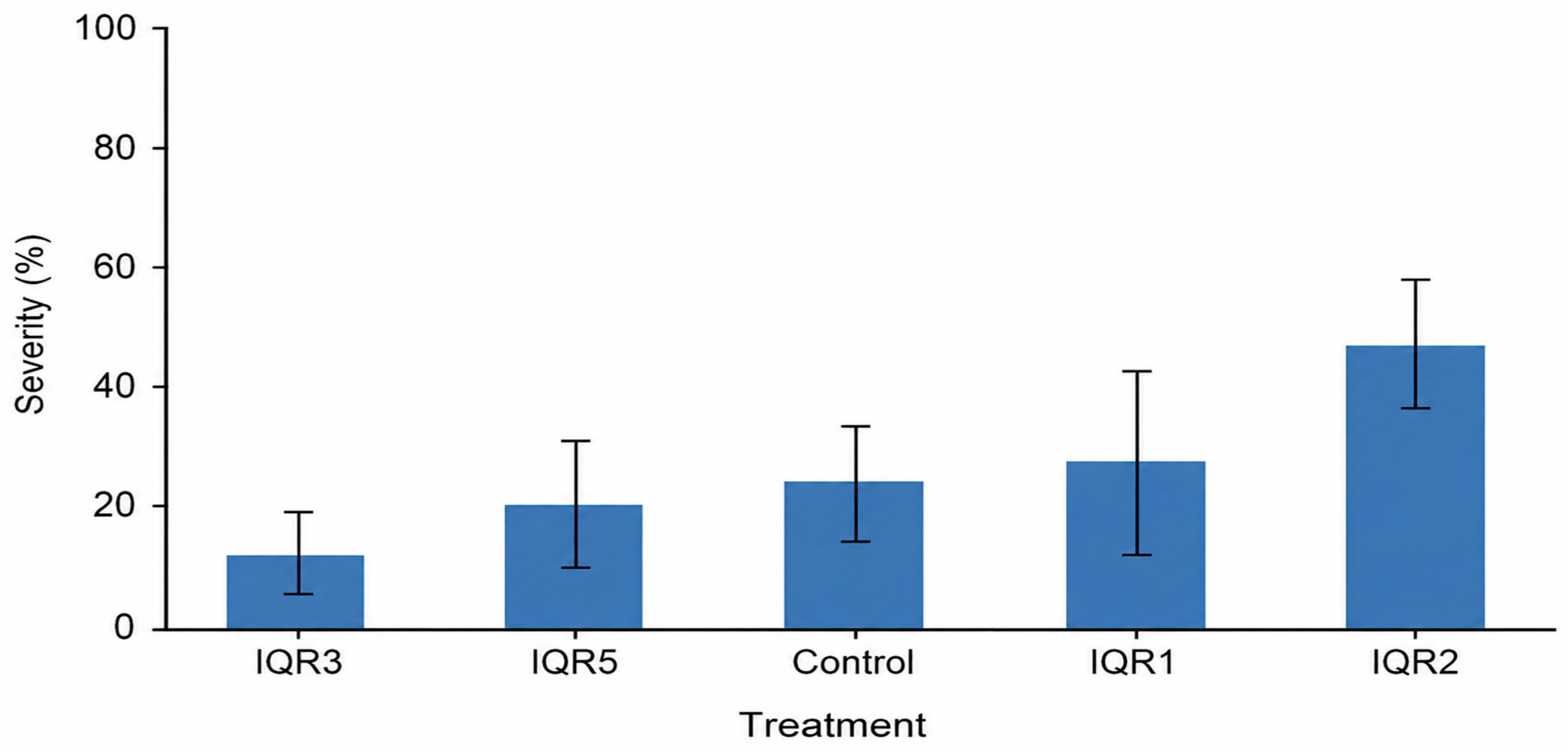
In contrast, infestation severity, expressed as the percentage of infested leaves per plant, did not differ significantly among treatments (one-way ANOVA, F4,20 = 1.464, p = 0.250) (Figure 6). Although IQR3 showed the lowest mean severity (13.3%), followed by IQR5 (20.0%), the observed differences were not statistically significant.
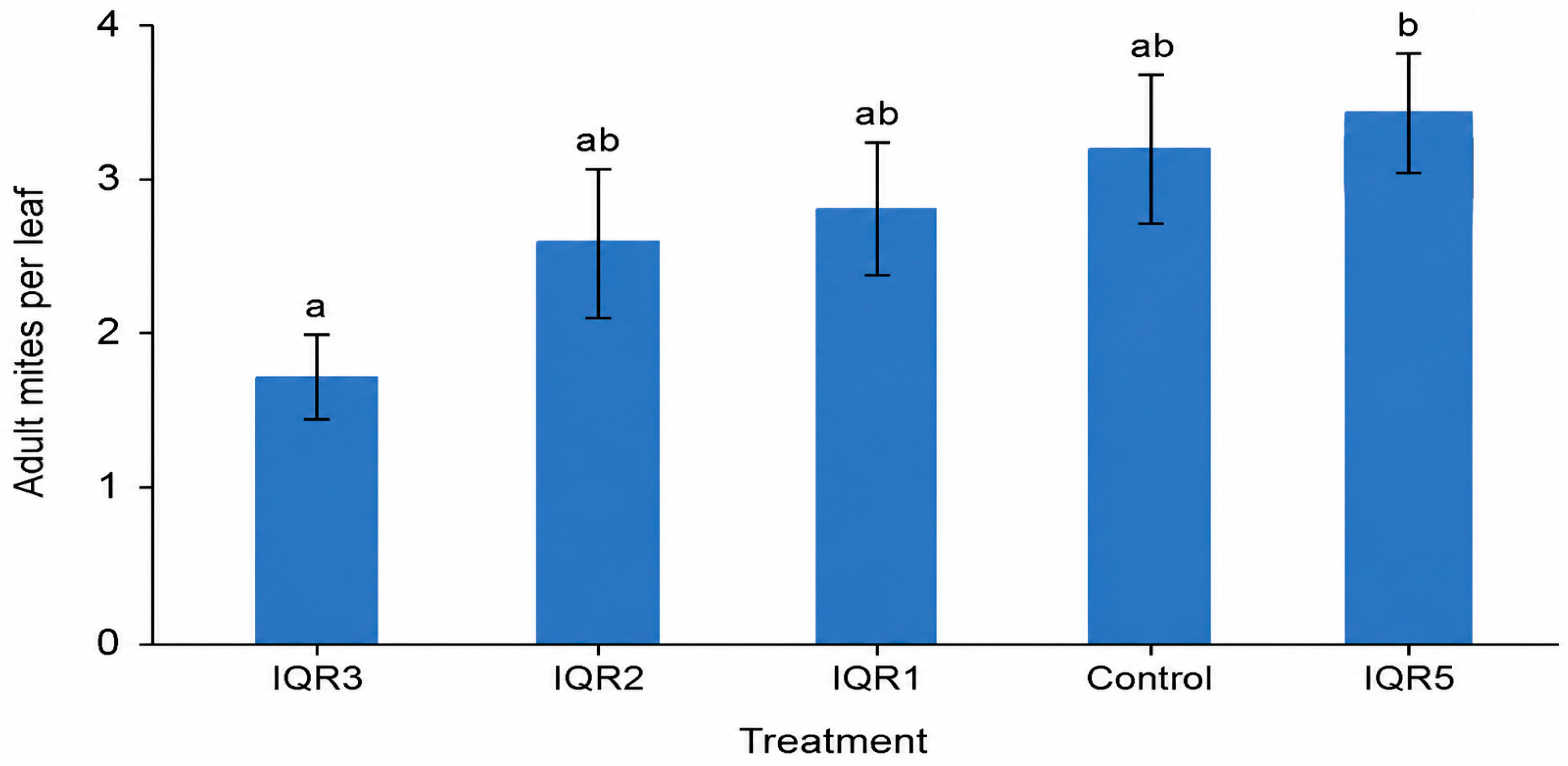
Adult mite density per leaf was significantly affected by bacterial treatment (one-way ANOVA, F4,20 = 3.072, p = 0.040) (Figure 7). Tukey’s HSD test revealed that IQR3 significantly reduced mite density compared with IQR5, while IQR1 and IQR2 showed intermediate values and did not differ significantly from either group. The lowest adult density was recorded for IQR3 (1.8 adults leaf−1), whereas the highest density was observed for IQR5 (3.5 adults leaf−1). These findings demonstrate that rhizobacterial isolates differed in their capacity to suppress T. urticae populations under greenhouse conditions, with IQR3 showing the greatest potential for reducing both infestation incidence and adult mite density.
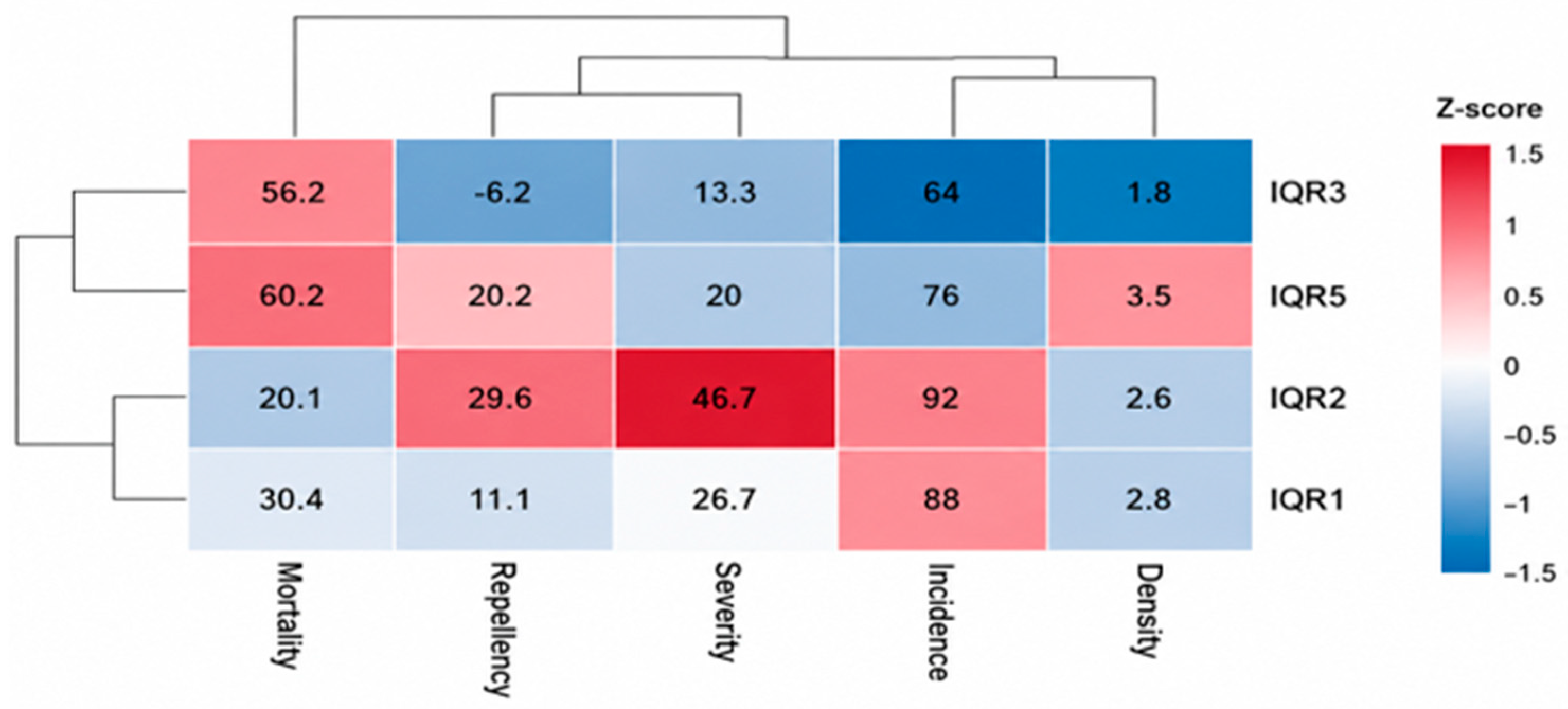
To provide an integrated overview of the biological performance of the tested bacterial isolates, a heatmap based on standardized response variables was generated (Figure 8). Hierarchical clustering separated the isolates according to their overall efficacy against T. urticae. IQR3 formed a distinct cluster characterized by the lowest infestation incidence (64%), lowest infestation severity (13.3%), lowest adult density (1.8 adults per leaf), and high corrected mortality (56.2%). IQR5 also showed a favorable profile, whereas IQR2 and the control exhibited the least effective overall performance. This multivariate visualization highlights the complementary information provided by mortality, repellency, incidence, severity, and adult density measurements.
Overall, IQR3 and IQR5 represent promising rhizobacterial candidates for the biological control of T. urticae in tomato production, although further studies are required to optimize formulations, clarify their modes of action, and validate their efficacy under field conditions.

4. Discussion

The present study demonstrates the potential of rhizobacterial isolates recovered from the tomato rhizosphere as biological control agents against T. urticae. Among the four isolates evaluated, IQR3 and IQR5 induced significantly higher corrected mortality than IQR1 in laboratory bioassays (F = 5.734, p = 0.0021), while IQR3 exhibited the strongest and most consistent performance across all experimental conditions, including in vitro acaricidal activity, infestation incidence, and adult mite density under greenhouse conditions.
The acaricidal activity observed for IQR3 and IQR5, reaching corrected mortalities of up to 69.9% and 62.5%, respectively, is consistent with previously reported effects of rhizobacterial isolates on spider mites. Emam [37] reported significant acaricidal activity of Pseudomonas aeruginosa, Bacillus subtilis, and Lysinibacillus sphaericus against adult female T. urticae when applied by spraying, with mortality levels broadly comparable to those observed in the present study. Similarly, Qessaoui et al. [5] demonstrated that Pseudomonas strains isolated from the tomato rhizosphere caused both significant mortality and repellent effects against T. urticae, supporting the general acaricidal potential of rhizosphere-associated bacteria. The observation that significant mortality differences among isolates emerged only at 48 h, and not at 24 or 72 h, aligns with the time-dependent intoxication process described in these studies and likely reflects the time required for bacterial virulence factors to achieve effective penetration and colonization of the mite cuticle.
The mechanisms underlying the acaricidal activity of the tested isolates are likely multifactorial. Aksoy et al. [25] demonstrated that Pseudomonas putida biotype B was highly effective in inducing mortality of T. urticae, and proposed that contact-mediated enzymatic activity played a key role. Similarly, Serratia marcescens has been shown to produce proteases and chitinases with larvicidal activity against Anopheles dirus [38], illustrating the broad arthropod-targeting potential of bacterial hydrolytic enzymes across taxonomically distant pest species. In the present study, vegetative cells of the tested isolates were applied directly to the body surface of the mites, which likely facilitated bacterial adhesion and colonization via the cuticle, stigmas, and body orifices of T. urticae. According to Vodovar et al. [39], pathogenic bacteria rely on surface-associated virulence factors to adhere to and colonize host surfaces, subsequently enabling the penetration of proteases, chitinases, lipases, and hydrolases that disrupt host tissue integrity. Bacterial chitinases in particular are well-established agents of arthropod suppression, hydrolyzing the chitinous exoskeleton and compromising cuticle integrity [40,41]. Hemolysins—exotoxins that induce cell membrane rupture [36]—may additionally contribute to the rapid intoxication symptoms (reduced mobility, progressive body darkening) observed in the current study. Bacterial cells may reach the ventral mite surface during locomotion on the treated leaf or through cleaning of mouthparts [36], and the moist cuticular surface likely enhances bacterial adhesion and virulence factor delivery. These observations are consistent with reports of acaricidal, and insecticidal effects of bacterial strains applied either as cell suspensions or as formulated products [5,35,41].
Regarding repellent activity, no statistically significant effect of bacterial isolate, concentration, or exposure time was detected on the repellency index of T. urticae (all p > 0.05). The absence of statistical significance may be partly attributed to the high variability in repellency responses among experimental replicates, as evidenced by the simultaneous occurrence of strongly positive and strongly negative repellency index values within the same treatment groups (Figure 3). Nevertheless, descriptive patterns suggested that IQR5 and IQR1 consistently produced positive repellency index values, particularly at concentration C1, indicating that behavioral deterrence may be occurring even if it does not reach statistical significance at the current sample size. These tendencies could be linked to the production of volatile organic compounds (VOCs) or diffusible secondary metabolites that deter pest settlement without direct contact toxicity [42]. Rhizobacterial volatiles (e.g., 2,3-butanediol, acetoin, dimethyl disulfide) and diffusible metabolites such as salicylates, pyrrolnitrin and phenazines have been shown to modulate arthropod behavior through olfactory interference and priming of plant defense signaling [42,43,44,45]. Conversely, the apparent inversion of the repellency index observed at the higher concentration (C2) for some isolates—shifting from repellency to attraction—may reflect a quorum sensing-dependent regulation of secondary metabolite production at elevated cell densities, a mechanism that warrants dedicated investigation. Taken together, these observations indicate that the tested rhizobacterial isolates may express a spectrum of behavioral effects on T. urticae that depends on both isolate identity and cell density, and that future repellency bioassays should be designed with sufficient replication to detect these potentially subtle effects.
A significant negative correlation between corrected mortality and repellency index at 48 h (Pearson’s r = −0.575, p = 0.003) was detected (Figure 4), indicating that bacterial treatments producing higher mite mortality tended to exhibit lower repellency and vice versa. This inverse relationship suggests that the tested rhizobacterial isolates may preferentially express either lethal or behavioral modes of action, rather than both simultaneously. The broader literature supports this interpretation: Dowling and O’Gara [46] noted that secondary metabolites produced by Pseudomonas strains can act simultaneously as virulence factors and as chemical signals modulating arthropod behavior, while Ramamoorthy et al. [43] highlighted the diversity of biocontrol mechanisms expressed by different PGPR strains. These findings suggest the importance of characterizing each isolate’s dominant mode of action when designing biocontrol strategies, and of coupling mortality and behavioral assays to obtain a comprehensive efficacy profile.
Under greenhouse conditions, adult mite density differed significantly among treatments (one-way ANOVA, F4,20 = 3.072, p = 0.040); the post-hoc test separated IQR3 from IQR5, whereas no treatment differed significantly from the untreated control. IQR3 nevertheless recorded the lowest infestation incidence (64%) and the lowest adult mite density (1.8 adults leaf−1). The consistent superiority of IQR3 across laboratory and greenhouse conditions points to a robust biocontrol phenotype that may extend beyond direct contact toxicity to include plant defense priming. Hosseini et al. [22] demonstrated that PGPR strains can enhance plant resistance to spider mites through jasmonate-dependent signaling pathways, reducing mite fecundity and population growth rates. This mechanism may partially explain the sustained efficacy of IQR3 under greenhouse conditions, where direct bacterial–mite contact is less predictable than in controlled bioassays. Interestingly, IQR5—which produced the second-highest corrected mortality in laboratory bioassays at 48 h—showed the highest adult mite density among treated plants under greenhouse conditions (3.5 adults leaf−1). This apparent discrepancy between in vitro acaricidal performance and greenhouse efficacy likely reflects the ecological constraints inherent to open-canopy greenhouse environments: UV-induced bacterial inactivation, desiccation, competition with resident phyllosphere microbiota, and dilution effects over a larger plant surface. Differences in the capacity of each strain to colonize the phyllosphere and establish sustained populations under field-relevant conditions may further account for the divergent outcomes observed between IQR3 and IQR5.
The present findings support the integration of IQR3 and IQR5 as candidate biopesticide agents within integrated pest management (IPM) frameworks targeting T. urticae. Biopesticides represent key components of sustainable IPM strategies and are receiving increasing attention as tools to reduce synthetic acaricide inputs [44]. Combining entomopathogenic fungi with predatory mites has been shown to enhance control of T. urticae relative to single-agent approaches [47], suggesting that a comparable multi-trophic pathway is worth testing for IQR3 and IQR5. These findings further suggest that bacterial epiphytes and rhizospheric bacteria previously explored for the biological control of plant pathogens could be valuably extended to arthropod pest management [44,45].
Despite these promising results, several limitations of the present study must be acknowledged. First, the bioassays focused exclusively on adult mites; the effects of the bacterial isolates on eggs, larvae, and nymphs remain to be assessed. Second, the bacterial suspensions used are inherently unstable under field conditions, with a short shelf life under ambient temperatures. Recent advances in microencapsulation, wettable powder formulations, and nanobiopesticide delivery systems have substantially extended the field persistence of microbial biocontrol agents [48,49], and future work should evaluate the performance of formulated products of IQR3 and IQR5 as a prerequisite for practical deployment. Third, the biochemical and molecular mechanisms underlying the acaricidal activity of these isolates were not characterized; identification of the active compounds (chitinases, lipopeptides, VOCs) would strengthen mechanistic understanding and guide formulation optimization. Fourth, the potential non-target effects on beneficial arthropods—including predatory mites and pollinators—and on soil fauna must be quantified before integration into certified IPM or organic production systems. Finally, the concentration-dependent shift from repellency to attraction observed for some isolates at C2 suggests that behavioral resistance mechanisms at the population level deserve investigation through acaricidal behavioral bioassays standardized for distinguishing repellency from contact toxicity [50]. Addressing these gaps through multi-stage efficacy assessments, field trials, and environmental risk evaluation will be essential to fully validate the potential of IQR3 and IQR5 within sustainable pest management strategies.

5. Conclusions

The results of this study revealed the potential of tomato rhizosphere bacteria to control T. urticae through contact toxicity; repellent effects were variable and did not reach statistical significance. Mortality rates varied with exposure time, with significant differences detected at 48 h but not at 24 or 72 h. Among the four isolates, IQR3 showed the highest acaricidal activity, reaching 69.9% corrected mortality at 72 h, although treatment differences were no longer significant at that time point. At 48 h, IQR3 and IQR5 induced significantly higher overall mortality than IQR2 (p < 0.05). Regarding repellent effects, no statistically significant differences were detected among isolates or concentrations (p > 0.05); however, descriptive trends suggested isolate-dependent variation, with IQR5 and IQR1 consistently producing positive repellency index values. Under greenhouse conditions, IQR3 recorded the lowest infestation incidence (64%) and the lowest adult mite density (1.8 adults leaf−1), while IQR5 also showed a favorable profile with reduced incidence (76%). Overall, the results indicate that selected bacterial isolates, particularly IQR3 and IQR5, may contribute to suppressing T. urticae populations and thus warrant further investigation for incorporation into integrated pest management (IPM) strategies following formulation optimization and field validation.

Author Contributions

Conceptualization, S.B., S.C., R.B. and R.Q.; methodology, S.B., S.E.A. and A.E.; software, S.C. and R.Q.; validation, R.Q., E.H.M. and R.B.; formal analysis, S.C. and R.Q.; investigation, S.B., S.C., R.Q. and R.B.; resources, R.E.; writing—original draft preparation, R.Q., M.O. and R.B.; writing—review and editing, R.Q. and R.B.; visualization, F.E. and A.W.; supervision, E.H.M. and R.B. All authors have read and agreed to the published version of the manuscript.

Funding

This research received no external funding.

Data Availability Statement

The data presented in this study are available within the article. Additional datasets generated and analyzed during the current study are available from the corresponding author on reasonable request.

Conflicts of Interest

The authors declare no conflicts of interest.

References

  1. Grbić, M.; Van Leeuwen, T.; Clark, R.M.; Rombauts, S.; Rouzé, P.; Grbić, V.; Osborne, E.J.; Dermauw, W.; Thi Ngoc, P.C.; Ortego, F.; et al. The genome of Tetranychus urticae reveals herbivorous pest adaptations. Nature 2011, 479, 487–492. [Google Scholar] [CrossRef] [PubMed]
  2. Bolland, H.R.; Gutierrez, J.; Flechtmann, C.H.W. World Catalogue of the Spider Mite Family: (Acari: Tetranychidae); Brill Publishers: Leiden, The Netherlands, 1998. [Google Scholar]
  3. Fathi, S.A.A. Eggplant-garlic intercrops reduce the density of Tetranychus urticae on eggplant and improve crop yield. Exp. Appl. Acarol. 2023, 91, 43–55. [Google Scholar] [CrossRef] [PubMed]
  4. Türkoğlu, H.; Çetin, H.; Elma, F.N. The effect of Tetranychus urticae Koch (Acari: Tetranychidae) infestation on some plant nutrients and growth parameters of common bean under laboratory conditions. Acarologia 2024, 64, 1175–1181. [Google Scholar] [CrossRef]
  5. Qessaoui, R.; Bouharroud, R.; Amarraque, A.; Ajerrar, A.; Mayad, E.H.; Chebli, B.; Dadi, M.; Elaini, R.; El Filali, F.; Walters, A.S. Ecological Applications of Pseudomonas as a Biopesticide to Control Two-Spotted Mite Tetranychus urticae: Chitinase and HCN Production. J. Plant Prot. Res. 2017, 57, 409–416. [Google Scholar] [CrossRef]
  6. Ghongade, D.S.; Sood, A.K. Economic injury level for Tetranychus urticae Koch on parthenocarpic cucumber under protected environment in north-western Indian Himalayas. Phytoparasitica 2021, 49, 893–905. [Google Scholar] [CrossRef]
  7. Park, Y.L.; Lee, J.H. Leaf Cell and Tissue Damage of Cucumber Caused by Twospotted Spider Mite (Acari: Tetranychidae). J. Econ. Entomol. 2002, 95, 952–957. [Google Scholar] [CrossRef] [PubMed]
  8. Carey, J.; Bradley, J. Developmental Rates, Vital Schedules, Sex Ratios and Life Tables for Tetranychus urticae, T. Turkestani and T. Pacificus (Acarina: Tetranychidae) on Cotton. Acarologia 1982, 33, 333–345. [Google Scholar]
  9. Adesanya, A.W.; Lavine, M.D.; Moural, T.W.; Lavine, L.C.; Zhu, F.; Walsh, D.B. Mechanisms and management of acaricide resistance for Tetranychus urticae in agroecosystems. J. Pest Sci. 2021, 94, 639–663. [Google Scholar] [CrossRef]
  10. Muir, R.; Cranham, J. Resistance to Pesticides in Damson-Hop Aphid and Red Spider Mite on English Hops. In Proceedings of the British Crop Protection Council: Proceedings of the 1979 British Crop Protection Conference—Pests and Diseases (10th British Insecticide and Fungicide Conference); British Crop Protection Council: Cambridge, UK, 1981; pp. 161–167. [Google Scholar]
  11. Goka, K. Mode of Inheritance of Resistance to Three New Acaricides in the Kanzawa Spider Mite Tetranychus Kanzawai Kishida (Acari:Tetranychidae). Exp. Appl. Acarol. 1998, 22, 699–708. [Google Scholar] [CrossRef]
  12. Devine, G.J.; Barber, M.; Denholm, I. Incidence and Inheritance of Resistance to METI-Acaricides in European Strains of the Two-Spotted Spider Mite (Tetranychus urticae) (Acari: Tetranychidae). Pest Manag. Sci. Former. Pestic. Sci. 2001, 57, 443–448. [Google Scholar] [CrossRef] [PubMed]
  13. Nauen, R.; Stumpf, N.; Elbert, A.; Zebitz, C.P.W.; Kraus, W. Acaricide Toxicity and Resistance in Larvae of Different Strains of Tetranychus urticae and Panonychus Ulmi (Acari: Tetranychidae). Pest Manag. Sci. 2001, 57, 253–261. [Google Scholar] [CrossRef] [PubMed]
  14. Ay, R.; Yorulmaz, S. Inheritance and Detoxification Enzyme Levels in Tetranychus urticae Koch (Acari: Tetranychidae) Strain Selected with Chlorpyrifos. J. Pest Sci. 2009, 83, 85–93. [Google Scholar] [CrossRef]
  15. De Rouck, S.; İnak, E.; Dermauw, W.; Van Leeuwen, T. A Review of the Molecular Mechanisms of Acaricide Resistance in Mites and Ticks. Insect Biochem. Mol. Biol. 2023, 159, 103981. [Google Scholar] [CrossRef] [PubMed]
  16. Cao, L.-J.; Chen, J.-C.; Thia, J.A.; Schmidt, T.L.; Ffrench-Constant, R.; Zhang, L.-X.; Yang, Y.; Yuan, M.-C.; Zhang, J.-Y.; Zhang, X.-Y.; et al. Recurrent Mutations Drive the Rapid Evolution of Pesticide Resistance in the Two-Spotted Spider Mite Tetranychus urticae. eLife 2025, 14, RP106288. [Google Scholar] [CrossRef] [PubMed]
  17. Kewedar, S.; Chen, Q.R.; Moural, T.W.; Lo, C.; Umbel, E.; Forrence, P.J.; Walsh, D.B.; Zhu, F. Acaricide Resistance Monitoring and Structural Insights for Precision Tetranychus urticae Management. Insects 2025, 16, 440. [Google Scholar] [CrossRef] [PubMed]
  18. Chandler, D.; Davidson, G.; Pell, J.K.; Ball, B.V.; Shaw, K.; Sunderland, K.D. Fungal Biocontrol of Acari. Biocontrol Sci. Technol. 2000, 10, 357–384. [Google Scholar] [CrossRef]
  19. Van Der Geest, L.P.S.; Elliot, S.L.; Breeuwer, J.A.J.; Beerling, E.A.M. Diseases of Mites. Exp. Appl. Acarol. 2000, 24, 497–560. [Google Scholar] [CrossRef] [PubMed]
  20. Qessaoui, R.; Chafiki, S.; Mahroug, A.; Ajerrar, A.; Elaini, R.; Bouharroud, R. Evaluation of Warionia Saharae Ethanolic Extracts under Controlled Conditions: Potent Acaricidal and Repellent Activities Against Tetranychus urticae Koch. (Acari: Tetranychidae). Afr. Mediterr. Agric. J.-AL Awamia 2024, 263–270. [Google Scholar] [CrossRef]
  21. Mazuecos-Aguilera, I.; Anta-Fernández, F.; Crespo-Barreiro, A.; Martínez-Quesada, A.; Lombana-Larrea, L.; González-Andrés, F. Plant Growth-Promoting Rhizobacteria Enhanced Induced Systemic Resistance of Tomato against Botrytis Cinerea Phytopathogen. Front. Plant Sci. 2025, 16, 1570986. [Google Scholar] [CrossRef] [PubMed]
  22. Hosseini, A.; Hosseini, M.; Schausberger, P. Plant Growth-Promoting Rhizobacteria Enhance Defense of Strawberry Plants Against Spider Mites. Front. Plant Sci. 2022, 12, 783578. [Google Scholar] [CrossRef] [PubMed]
  23. MacIntosh, S.C.; Stone, T.B.; Sims, S.R.; Hunst, P.L.; Greenplate, J.T.; Marrone, P.G.; Perlak, F.J.; Fischhoff, D.A.; Fuchs, R.L. Specificity and Efficacy of Purified Bacillus Thuringiensis Proteins against Agronomically Important Insects. J. Invertebr. Pathol. 1990, 56, 258–266. [Google Scholar] [CrossRef] [PubMed]
  24. Chapman, M.H.; Hoy, M.A. Relative Toxicity of Bacillus Thuringiensis Var. Tenebrionis to the Two-spotted Spider Mite (Tetranychus urticae Koch) and Its Predator Metaseiulus Occidentalis (Nesbitt) (Acari, Tetranychidae and Phytoseiidae). J. Appl. Entomol. 1991, 111, 147–154. [Google Scholar] [CrossRef]
  25. Aksoy, H.M.; Ozman-Sullivan, S.K.; Ocal, H.; Celik, N.; Sullivan, G.T. The Effects of Pseudomonas Putida Biotype B on Tetranychus urticae (Acari: Tetranychidae). Exp. Appl. Acarol. 2008, 46, 223–230. [Google Scholar] [CrossRef] [PubMed]
  26. Ruiu, L. Insect Pathogenic Bacteria in Integrated Pest Management. Insects 2015, 6, 352–367. [Google Scholar] [CrossRef] [PubMed]
  27. Beltrán Pineda, M.E.; Castellanos-Rozo, J. Bacterial Insecticides beyond Bacillus Thuringiensis. Phytopathol. Res. 2025, 7, 19. [Google Scholar] [CrossRef]
  28. Roobakkumar, A.; Babu, A.; Kumar, D.; Sarkar, S. Pseudomonas Fluorescens as an Efficient Entomopathogen against Oligonychus Coffeae Nietner (Acari: Tetranychidae) Infesting Tea. J. Entomol. Nematol. 2011, 3, 73. [Google Scholar]
  29. Rathore, A.S.; Gupta, R.D. Chitinases from Bacteria to Human: Properties, Applications, and Future Perspectives. Enzym. Res. 2015, 2015, 791907. [Google Scholar] [CrossRef] [PubMed]
  30. Bahoch, S.; Elaasri, A.; Chafiki, S.; Elame, F.; Wifaya, A.; Mayad, E.H.; Bouharroud, R.; Qessaoui, R. Biocontrol Potential of Rhizobacteria Against Passalora fulva and Tuta absoluta: A Sustainable Approach for Tomato Protection. Plants 2025, 14, 2672. [Google Scholar] [CrossRef] [PubMed]
  31. Ateyyat, M.A.; El-Shatnawi, M.K.; Alawi Al-mazra’awi, M. Culturable Whitefly Associated Bacteria and Their Potential as Biological Control Agents. Jordan J. Biol. Sci. 2009, 2, 139–144. [Google Scholar]
  32. Zhang, C.R.; Zhang, S.; Xia, J.; Li, F.F.; Xia, W.Q.; Liu, S.S.; Wang, X.W. The Immune Strategy and Stress Response of the Mediterranean Species of the Bemisia Tabaci Complex to an Orally Delivered Bacterial Pathogen. PLoS ONE 2014, 9, e94477. [Google Scholar] [CrossRef] [PubMed]
  33. Abbott, W.S. A Method of Computing the Effectiveness of an Insecticide. J. Econ. Entomol. 1925, 18, 265–267. [Google Scholar] [CrossRef]
  34. Pascual-Villalobos, M.J.; Robledo, A. Screening for Anti-Insect Activity in Mediterranean Plants. Ind. Crops Prod. 1998, 8, 183–194. [Google Scholar] [CrossRef]
  35. Qessaoui, R.; Amarraque, A.; Lahmyed, H.; Ajerrar, A.; Mayad, E.H.; Chebli, B.; Walters, A.S.; Bouharroud, R. Inoculation of tomato plants with rhizobacteria suppresses development of whitefly Bemisia tabaci (Gennadius) (Hemiptera: Aleyrodidae): Agro-ecological application. PLoS ONE 2020, 15, e0231496. [Google Scholar] [CrossRef] [PubMed]
  36. Al-Azzazy, M.M.; Alsohim, A.S.; Yoder, C.E. Biological effects of three bacterial species on Tetranychus urticae (Acari: Tetranychidae) infesting eggplant under laboratory and greenhouse conditions. Acarologia 2020, 60, 587–594. [Google Scholar] [CrossRef]
  37. Emam, H. Efficiency of Three Bacterial Strains against Tetranychus urticae Koch (Acari: Tetranychidae) under Laboratory Conditions. Arab. Univ. J. Agric. Sci. 2021, 29, 447–457. [Google Scholar] [CrossRef]
  38. Jupatanakul, N.; Pengon, J.; Selisana, S.M.G.; Choksawangkarn, W.; Jaito, N.; Saeung, A.; Bunyong, R.; Posayapisit, N.; Thammatinna, K.; Kalpongnukul, N.; et al. Serratia Marcescens Secretes Proteases and Chitinases with Larvicidal Activity against Anopheles Dirus. Acta Trop. 2020, 212, 105686. [Google Scholar] [CrossRef] [PubMed]
  39. Vodovar, N.; Vallenet, D.; Cruveiller, S.; Rouy, Z.; Barbe, V.; Acosta, C.; Cattolico, L.; Jubin, C.; Lajus, A.; Segurens, B.; et al. Complete Genome Sequence of the Entomopathogenic and Metabolically Versatile Soil Bacterium Pseudomonas Entomophila. Nat. Biotechnol. 2006, 24, 673–679. [Google Scholar] [CrossRef] [PubMed]
  40. Kramer, K.J.; Muthukrishnan, S. Insect Chitinases: Molecular Biology and Potential Use as Biopesticides. Insect Biochem. Mol. Biol. 1997, 27, 887–900. [Google Scholar] [CrossRef] [PubMed]
  41. Broadway, R.M.; Gongora, C.; Kain, W.C.; Sanderson, J.P.; Monroy, J.A.; Bennett, K.C.; Warner, J.B.; Hoffmann, M.P. Novel Chitinolytic Enzymes with Biological Activity against Herbivorous Insects. J. Chem. Ecol. 1998, 24, 985–998. [Google Scholar] [CrossRef]
  42. Grahovac, J.; Pajčin, I.; Vlajkov, V. Bacillus VOCs in the context of biological control. Antibiotics 2023, 12, 581. [Google Scholar] [CrossRef] [PubMed]
  43. Ramamoorthy, V.; Viswanathan, R.; Raguchander, T.; Prakasam, V.; Samiyappan, R. Induction of Systemic Resistance by Plant Growth Promoting Rhizobacteria in Crop Plants against Pests and Diseases. Crop Prot. 2001, 20, 1–11. [Google Scholar] [CrossRef]
  44. Mnif, I.; Ghribi, D. Potential of Bacterial Derived Biopesticides in Pest Management. Crop Prot. 2015, 77, 52–64. [Google Scholar] [CrossRef]
  45. Prabhu, S.; Poorniammal, R.; Dufossé, L. Microbial Metabolites: A Sustainable Approach to Combat Plant Pests. Metabolites 2025, 15, 418. [Google Scholar] [CrossRef] [PubMed]
  46. Dowling, D.N.; O’Gara, F. Metabolites of Pseudomonas Involved in the Biocontrol of Plant Disease. Trends Biotechnol. 1994, 12, 133–141. [Google Scholar] [CrossRef]
  47. Hernández-Valencia, V.; Santillán-Galicia, M.T.; Guzmán-Franco, A.W.; Rodríguez-Leyva, E.; Santillán-Ortega, C. Combined Application of Entomopathogenic Fungi and Predatory Mites for Biological Control of Tetranychus urticae on Chrysanthemum. Pest Manag. Sci. 2024, 80, 4199–4206. [Google Scholar] [CrossRef] [PubMed]
  48. Tadesse Mawcha, K.; Malinga, L.; Muir, D.; Ge, J.; Ndolo, D. Recent Advances in Biopesticide Research and Development with a Focus on Microbials. F1000Research 2025, 13, 1071. [Google Scholar] [CrossRef] [PubMed]
  49. Shourove, J.H.; Meem, F.C.; Chowdhury, R.S.; Eti, S.A.; Samaddar, M. Biocontrol Agents and Their Potential Use as Nano Biopesticides to Control the Tea Red Spider Mite (Oligonychus Coffeae): A Comprehensive Review. Heliyon 2024, 10, e34605. [Google Scholar] [CrossRef] [PubMed]
  50. Adesanya, A.W.; Beauchamp, M.J.; Lavine, M.D.; Lavine, L.C.; Zhu, F.; Walsh, D.B. Physiological Resistance Alters Behavioral Response of Tetranychus urticae to Acaricides. Sci. Rep. 2019, 9, 19308. [Google Scholar] [CrossRef] [PubMed]
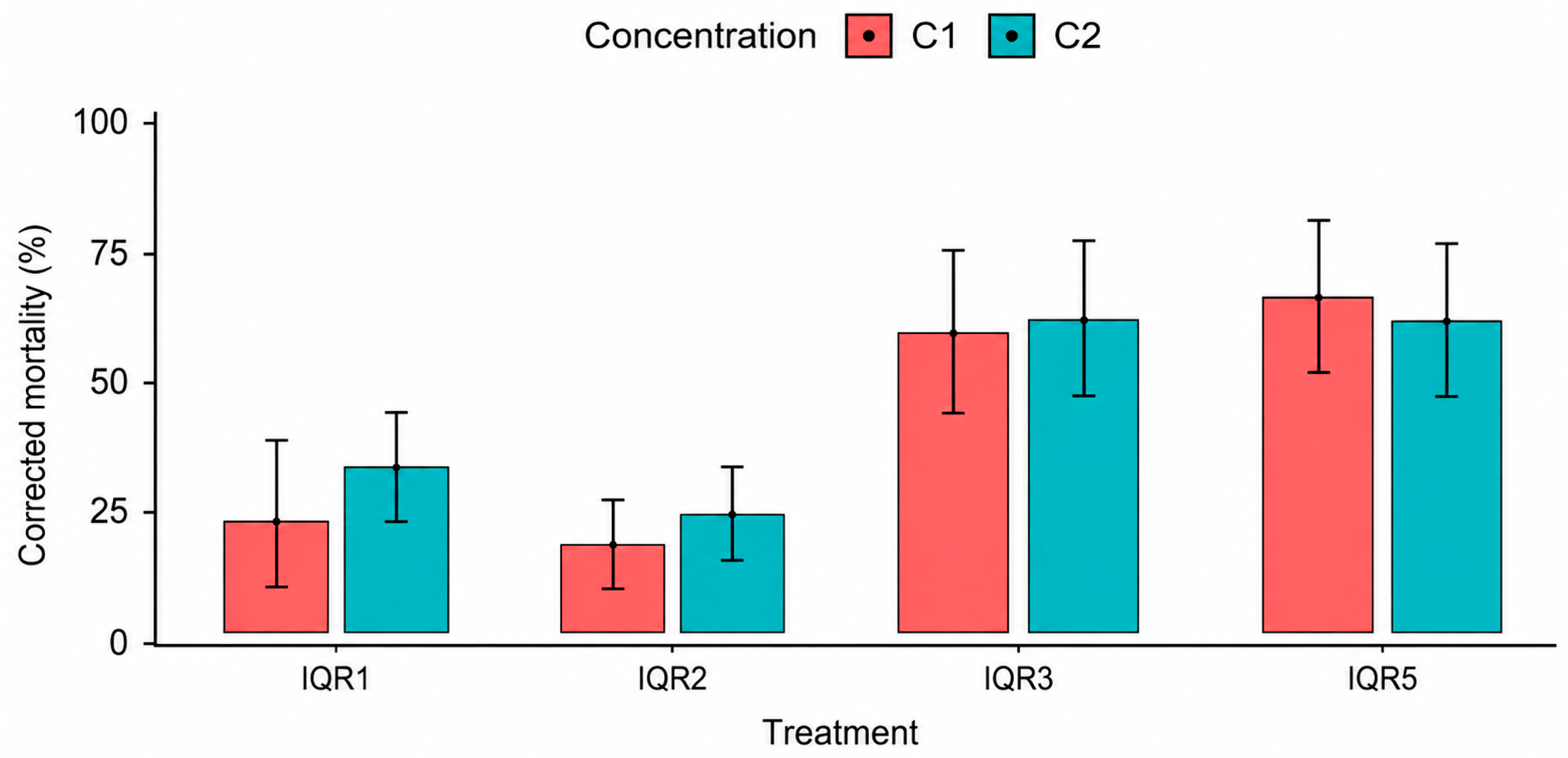
Figure 1. Effects of four rhizobacterial isolates and two concentrations (C1 and C2) on the overall corrected mortality (%) of T. urticae. Bars represent mean ± SE calculated from the three evaluation periods (24, 48, and 72 h).
Ijpb 17 00069 g001
Figure 2. Corrected mortality (%) of T. urticae adults at 48 h after treatment with four rhizobacterial isolates. Bars represent mean ± SE. Different letters indicate significant differences according to Tukey’s HSD test (p < 0.05).
Ijpb 17 00069 g002
Figure 3. Repellency index (RI, %) of T. urticae adults exposed to four rhizobacterial isolates at two concentrations (C1 and C2) after 24, 48, and 72 h. Bars represent the mean ± SE. Positive RI values indicate repellency, whereas negative RI values indicate attraction.
Ijpb 17 00069 g003
Figure 4. Relationship between corrected mortality (%) and repellency index (%) of T. urticae 48 h after treatment with four rhizobacterial isolates at two bacterial concentrations (C1 and C2). Each point represents one biological replicate. The solid line indicates the fitted linear regression and the shaded area represents the 95% confidence interval. A significant negative correlation was detected between corrected mortality and repellency (Pearson’s r = −0.575, p = 0.003, n = 24), suggesting that bacterial treatments inducing higher mite mortality generally exhibited lower repellency.
Ijpb 17 00069 g004
Figure 5. Effect of bacterial treatments on T. urticae incidence on tomato plants under greenhouse conditions.
Ijpb 17 00069 g005
Figure 6. Severity (%) of T. urticae infestation on tomato plants treated with four rhizobacterial isolates under greenhouse conditions. Bars represent mean ± SE.
Ijpb 17 00069 g006
Figure 7. Adult density of T. urticae (adults leaf−1) on tomato plants treated with four rhizobacterial isolates under greenhouse conditions. Bars represent mean ± SE. Different letters indicate significant differences among treatments according to Tukey’s HSD test (p < 0.05).
Ijpb 17 00069 g007
Figure 8. Heatmap summarizing the biological performance of the four rhizobacterial isolates against T. urticae based on five response variables: corrected mortality (%), repellency index (%), infestation severity (%), infestation incidence (%), and adult density (adults per leaf). Cell colors represent standardized values (Z-scores), where blue indicates lower values and red indicates higher values relative to the overall mean. The numerical values shown within each cell correspond to the original (non-standardized) means. Hierarchical clustering groups bacterial isolates and response variables according to similarity in their biological profiles.
Ijpb 17 00069 g008
Table 1. Effects of four rhizobacterial isolates on the corrected mortality (%) of T. urticae at two concentrations (C1 and C2) after 24, 48, and 72 h.
Isolate ConcentrationExposition Period
24 h48 h72 h
IQR1C120.6 ± 14.7 a22.5 ± 13.7 ab27.5 ± 19.2 a
C210.1 ± 2.1 a33.3 ± 4.8 ab7.4 ± 16.7 a
IQR2C135.4 ± 5.1 a17.2 ± 7.7 a31.2 ± 15.8 a
C247.9 ± 11.5 a23.0 ± 8.0 a31.2 ± 13.6 a
IQR3C135.3 ± 3.8 a54.6 ± 17.1 b39.0 ± 18.3 a
C228.6 ± 4.6 a57.7 ± 15.6 b69.9 ± 8.8 a
IQR5C144.4 ± 9.7 a62.5 ± 13.0 b32.1 ± 17.1 a
C240.6 ± 9.8 a57.8 ± 14.9 b64.8 ± 12.5 a
Values are presented as mean ± SE. Statistical analyses were performed on arcsine square-root-transformed percentage data, whereas untransformed means are presented. Means within the same column followed by the same letter are not significantly different according to Tukey’s HSD test (p < 0.05).
Disclaimer/Publisher’s Note: The statements, opinions and data contained in all publications are solely those of the individual author(s) and contributor(s) and not of MDPI and/or the editor(s). MDPI and/or the editor(s) disclaim responsibility for any injury to people or property resulting from any ideas, methods, instructions or products referred to in the content.