3.1. Development and Crop Cycle of Grafted and Non-Grafted Passiflora Edulis Under Saline Water Irrigation
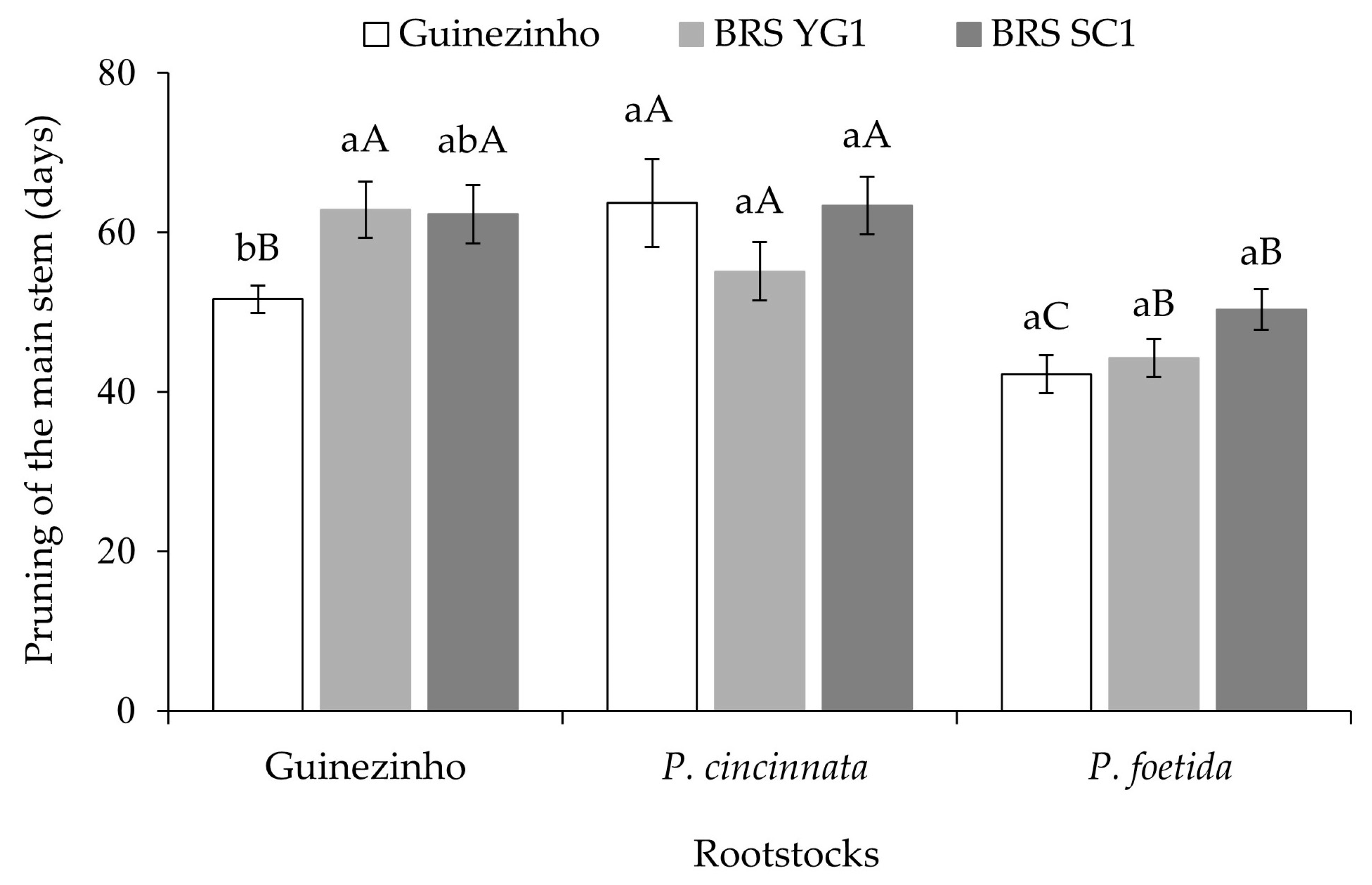
The time of main stem pruning was influenced by the interaction between rootstock and scion (F = 2.53;
p = 0.0489, CV
subplot = 6.95%). The
P.
foetida rootstock reduced the number of days for pruning the main stem (
Figure 4). The number of days for pruning the main stem when grafting
P.
edulis, Guinezinho cultivar, onto
P.
foetida was 42 days, which was less than grafting onto
P.
edulis, Guinezinho cultivar (52 days), with an increase of 9 days, or onto
P.
cincinnata (64 days), with an increase of 22 days, with the latter combination resulting in the greatest delay in pruning. The number of days for pruning the main stem when grafting
P.
edulis, BRS YG1 cultivar, onto
P.
foetida was 44 days, which was less than grafting onto
P.
cincinnata (55 days) and
P.
edulis, Guinezinho cultivar (63 days), which did not differ from each other, with an average reduction of 15 days. The number of days for pruning the main stem when grafting
P.
edulis, BRS SC1 cultivar, onto
P.
foetida was 50 days, a shorter period compared to grafting onto
P.
edulis, cultivar Guinezinho (62 days), and
P.
cincinnata (63 days), which did not differ from each other and delayed grafting by 13 days. Regarding the scions, differences were observed in the number of days for pruning the main stem only when the rootstock was
P.
edulis, Guinezinho cultivar (
Figure 4). Using the Guinezinho cultivar, the shortest time (52 days) was obtained, less than the days when the scions were of BRS SC1 (62 days) and BRS YG1 (63 days), which did not differ from each other, resulting in an average delay of 11 days.
The
P.
edulis cultivars (Guinezinho, BRS YG1, and BRS SC1) as scions, irrigated with water at 0.5 or 3.0 dS m
−1, reduced the period for pruning the main stem to between 33 and 74 days (
Table 5). While the non-grafted plants only showed the effect of the cultivar (F = 16.71;
p < 0.0001; CV
subplot = 6.95%), Guinezinho (92 days) was the earliest, followed by BRS YG1 (120 days) and BRS SC1 (124 days), which did not differ from each other.
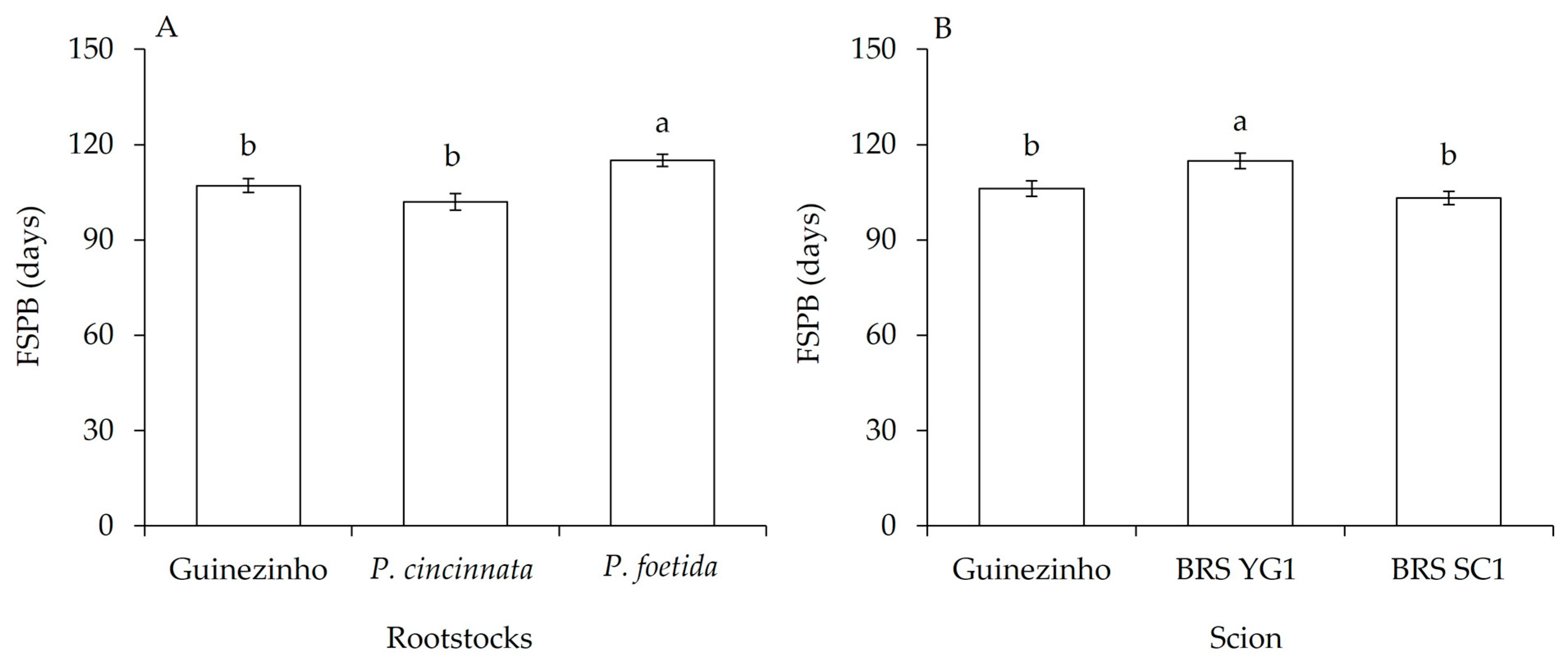
The time it takes for secondary and productive branches to form was affected by both the rootstock (F = 4.30;
p = 0.0175; CV
subplot = 7.42%) and the scion (F = 3.49;
p = 0.0364; CV
subplot = 7.42%). Plants grafted onto
P.
foetida showed a greater number of days for the formation of secondary and productive branches (115 days), surpassing the time with the rootstocks of
P.
edulis, Guinezinho cultivar (107 days), and
P.
cincinnata (102 days), which did not differ from each other, and a reduction of 11 days was achieved when
P. foetida was used (
Figure 5A). When using
P.
edulis scions from the BRS YG1 cultivar, a greater number of days for secondary branch formation was observed (115 days), exceeding the time obtained with the Guinezinho (106 days) and BRS SC1 (103 days) cultivars, which did not differ from each other, and exceeding the average of these last two cultivars by 11 days (
Figure 5B).
The
P.
edulis BRS YG1 and BRS SC1 cultivars, used as scions and under irrigation with water at 0.5 dS m
−1, increased the number of days for the formation of secondary and productive branches by 46 and 28 days, respectively (
Table 5). However, under irrigation with water at 3.0 dS m
−1, this effect was observed only with the BRS SC1 cultivar with an additional 19 days. For the Guinezinho cultivar, under irrigation with water at 0.5 or 3.0 dS m
−1, no alteration was observed in the formation time of secondary and productive branches when grafting. It was also observed that in non-grafted plants, the interaction effect between varieties and the electrical conductivity of irrigation water was significant (F = 9.30;
p = 0.0003; CV
plot = 4.40%; CV
subplot = 7.42%). Under irrigation with water at 0.5 dS m−1, no differences were observed between the cultivars, with an average of 80 days for the formation of secondary and productive branches (
Table 5). Meanwhile, when irrigating with water at 3.0 dS m
−1, the longest time was obtained with the BRS YG1 cultivar (127 days), which did not differ from the Guinezinho cultivar (93 days) but surpassed the BRS SC1 cultivar (81 days). The electrical conductivity of the irrigation water only altered the pattern for the BRS YG1 cultivar, increasing from 69 days under a conductivity of 0.5 dS m
−1 to 127 days under irrigation with water of 3.0 dS m
−1.
For the duration of the productive phase of grafted
P.
edulis, no effect of the scion, rootstock, or electrical conductivity of the irrigation water was observed, either in isolation or in interaction (F ≤ 1.34;
p ≥ 0.2690; CV
plot = 14.20%; CV
subplot = 10.08%), with an average of 122 ± 3 days. It was also observed that grafting increased the duration of the productive phase of the BRS SC1 cultivar irrigated with water at 0.5 dS m
−1 and 3.0 dS m
−1 by 40 days and 44 days, respectively (
Table 5). With the BRS YG1 cultivar, this phase also increased by 83 days, but only under irrigation with water at 3.0 dS m
−1. In the Guinezinho cultivar, no alteration resulting from grafting was observed. However, non-grafted plants were influenced by the interaction between cultivar and electrical conductivity of irrigation water (F = 10.41;
p = 0.0001; CV
plot = 14.20%; CV
subplot = 10.08%). For these plants, irrigated with water at 0.5 dS m
−1, no difference was observed in the productive phase, with an average of 102 days (
Table 5). However, when irrigated with water at 3.0 dS m
−1, a reduction was observed for the BRS YG1 cultivar (43 days) compared to the Guinezinho cultivar (117 days) and the BRS SC1 cultivar (83 days), which did not differ from each other.
The duration of the cycle of grafted
P.
edulis plants was influenced only by the scion (F = 3.59;
p = 0.0332; CVsubplot = 3.38%), but the means did not differ by Tukey’s test (
p ≤ 0.05), with an average duration of 295 ± 1 days. Only with the BRS YG1 cultivar, when irrigated with water at 3.0 dS m
−1, was an increase in the crop cycle observed, estimated at 12 days (
Table 5). With the other cultivars and electrical conductivity of irrigation water, the differences with grafting were not significant. With non-grafted
P.
edulis, the effects of cultivar and electrical conductivity of irrigation water, individually and in interaction, were not significant (F ≤ 3.26;
p ≥ 0.0752; CVplot = 4.07%; CVsubplot = 3.38%), with a mean of 293 ± 2 days.
3.2. Stem Diameter and Stem Diameter Growth Rates of Grafted and Non-Grafted Passiflora Edulis Under Saline Water Irrigation
The stem diameter, when the grafted plants reached the trellis, was affected by the rootstock (F = 19.02;
p ≤ 0.0001, CV
subplot = 9.62%) and the scion (F = 22.28;
p ≤ 0.0001, CV
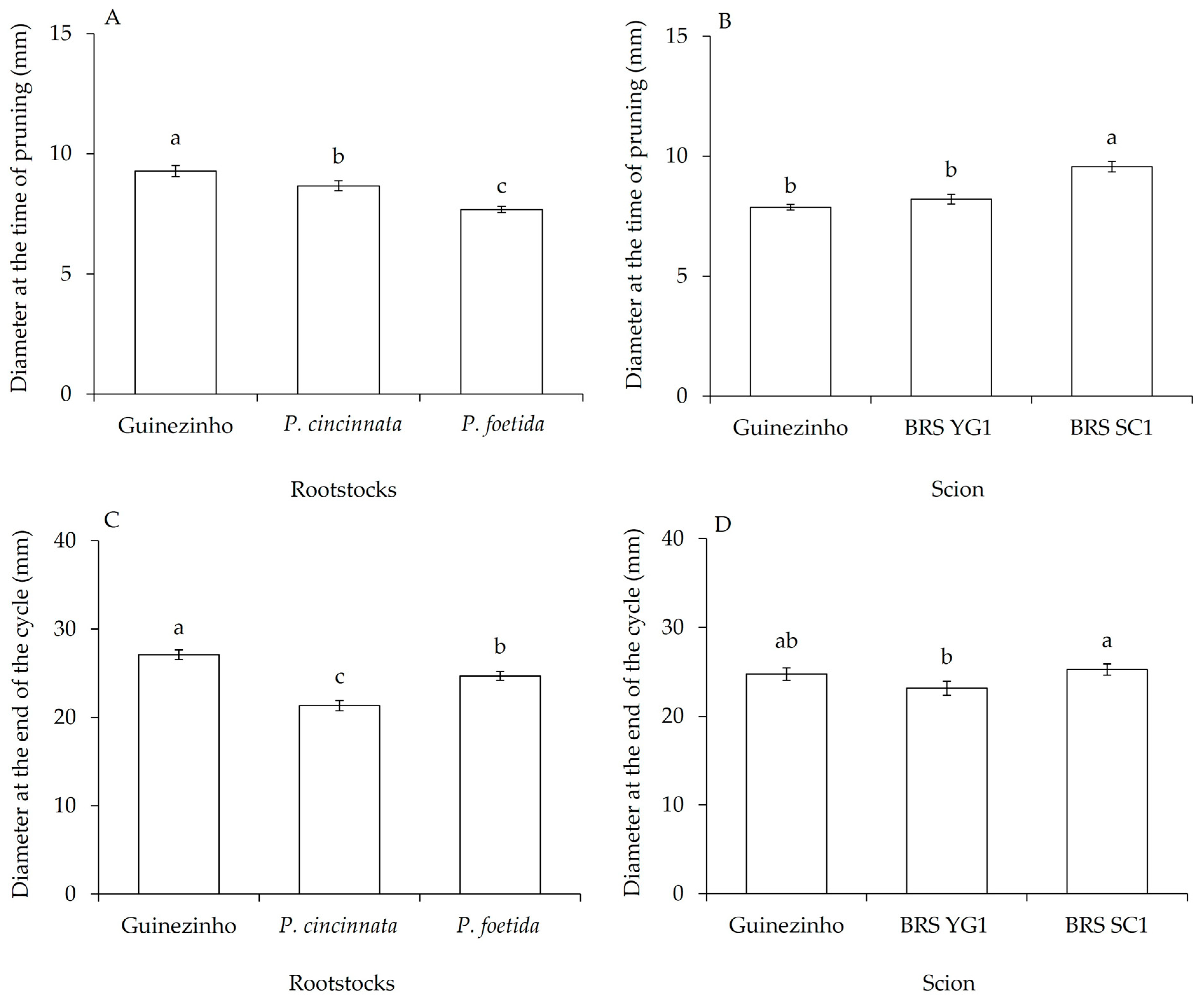
subplot = 9.62%). Plants with
P.
edulis Guinezinho cultivar rootstock showed a larger diameter (9.28 mm), exceeding the values obtained with
P.
cincinnata (8.67 mm) and
P.
foetida (7.68 mm), with estimated reductions of 6.57% and 17.24%, respectively (
Figure 6A). Regarding
P.
edulis scions, the largest diameter was obtained using the BRS SC1 cultivar (9.56 mm), surpassing the Guinezinho (7.87 mm) and BRS YG1 (8.20 mm) cultivars, which did not differ from each other (
Figure 6B).
When grafting
P.
edulis, a reduction in stem diameter was observed at the time of pruning the main stem only when using the Guinezinho cultivar as scion, irrigated with water at 0.5 dS m
−1 or 3.0 dS m
−1 (
Table 6). Differences in stem diameter growth at pruning time were also observed only as a function of the variety (F = 8.85;
p = 0.0004; CV
subplot = 9.62%) of non-grafted
P.
edulis. The largest values were observed with the Guinezinho cultivar (9.85 mm), followed by the BRS SC1 cultivar (8.77 mm), not differing from each other, and the smallest diameter was observed in the BRS YG1 cultivar (7.84 mm), differing only from the Guinezinho cultivar (
Table 6).
The diameter growth of the plants, at the end of the cycle, was affected by the rootstock (F = 24.63;
p ≤ 0.0001, CV
subplot = 11.74%) and the scion (F = 3.56;
p = 0.0341, CV
subplot = 11.74%). The diameter of the plants is related to the rootstock, differing between them, with the
P.
edulis Guinezinho cultivar having the largest diameter (27.10 mm), followed by
P.
foetida (24.68 mm) and
P.
cincinnata (21.33 mm) (
Figure 6C). Regarding the scions of
P.
edulis, when using the BRS SC1 and Guinezinho cultivars, the largest diameters were obtained (25.26 and 24.72 mm, respectively), not differing from each other, while with the BRS YG1 cultivar, the smallest diameter was obtained (23.14 mm); however, it did not differ from the Guinezinho cultivar and was 8.39% smaller when the BRS SC1 cultivar was used (
Figure 6D).
Grafting also affected stem diameter growth, measured at the end of the cycle, but only it only increased when using the BRS YG1 cultivar as scion and irrigated with water at 0.5 dS m
−1 (
Table 6). Differences in stem diameter growth were also observed at the end of the cycle, but only as a function of the variety (F = 7.83;
p = 0.0009; CV
subplot = 11.74%) of non-grafted
P.
edulis. The largest diameters were recorded with the BRS SC1 (26.63 mm) and Guinezinho (25.32 mm) cultivars, which did not differ from each other, and the smallest value was observed with the BRS YG1 (21.24 mm) cultivar, which was lower than that obtained with the BRS SC1 cultivar (
Table 6).
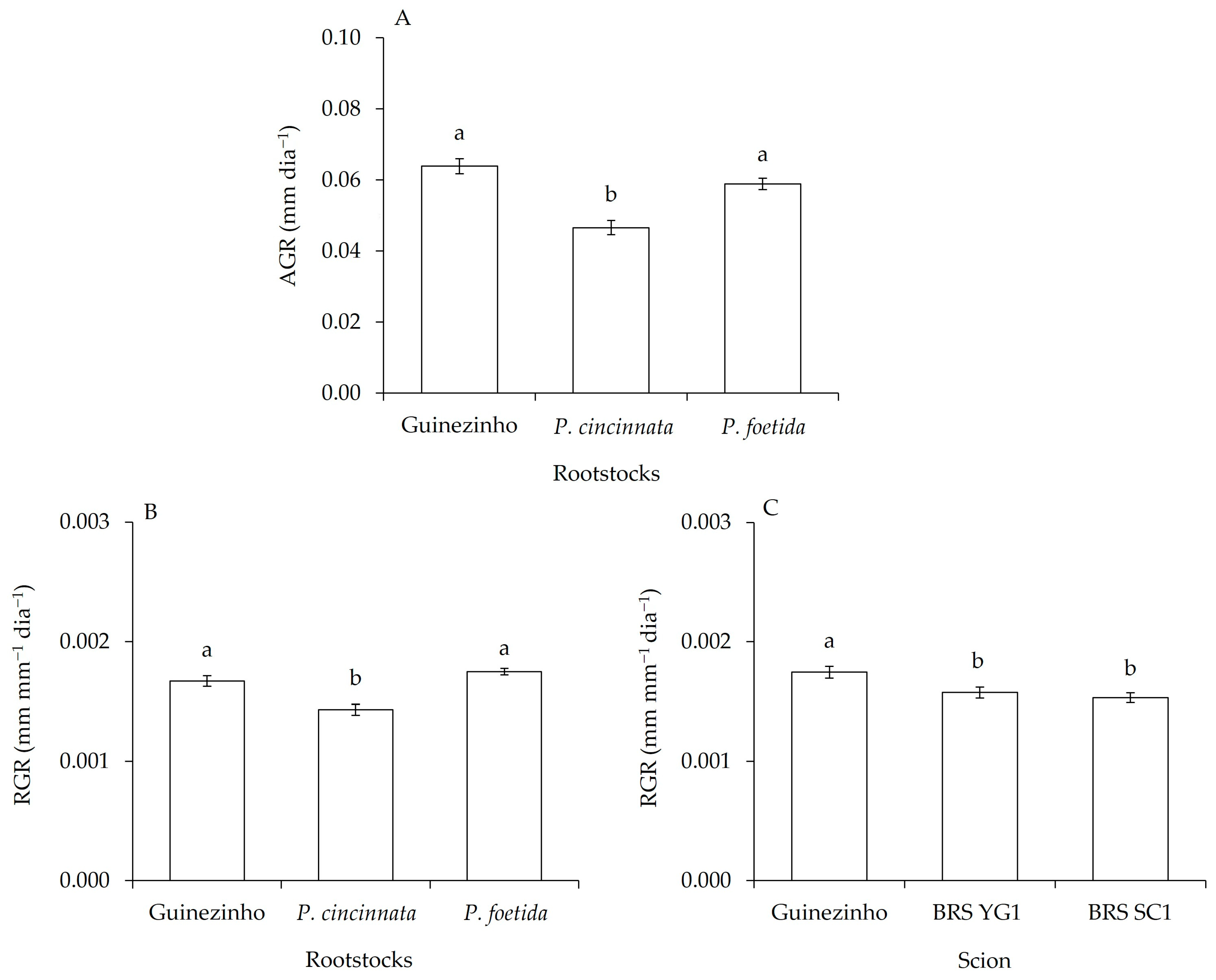
The absolute growth rate of stem diameter was affected only by the rootstock (F = 16.11;
p ≤ 0.0001, CVsubplot = 34.35%), with the highest rates for
P.
edulis Guinezinho cultivar and the species
P.
foetida (0.064 mm day
−1 and 0.059 mm day
−1, respectively), not differing from each other, while
P.
cincinnata showed the lowest growth rate (
Figure 7A). It was also observed that using scions of the BRS SC1 cultivar, irrigated with water at 0.5 dS m
−1 and 3.0 dS m
−1, and the BRS YG1 cultivar, irrigated with water at 3.0 dS m
−1, reduced the absolute growth rate of plant diameter compared to non-grafted plants (
Table 6). These non-grafted
P.
edulis cultivars differed from each other (F = 10.59;
p = 0.0001; CV
subplot = 34.35%), and an effect of the electrical conductivity of the irrigation water (F = 5.46;
p = 0.0224; CV
plot = 18.26%) on the absolute stem growth rate was observed. The highest absolute stem growth rate was observed with the BRS SC1 cultivar (0.09 mm day
−1), and the lowest rates were observed with the Guinezinho and BRS YG1 cultivars (0.06 mm day
−1 and 0.06 mm day
−1, respectively), which did not differ from each other (
Table 6). Regarding the electrical conductivity of irrigation water, the highest absolute growth rate in diameter was obtained with water of 0.5 dS m
−1 (0.07 mm day
−1), lower than that obtained with water at 3.0 dS m
−1 (0.08 mm day
−1).
The relative growth rate of plant stem diameter was affected by both the rootstock (F = 11.47;
p ≤ 0.0001, CV
subplot = 35.05%) and the scion (F = 5.04;
p = 0.0092, CV
subplot = 35.05%). Regarding the rootstock, the highest rates were observed with the Guinezinho cultivar and the
P.
foetida species (0.00167 mm mm
−1 day
−1 and 0.00175 mm mm
−1 day
−1, respectively), not differing from each other, while the lowest rate of 0.00143 mm mm
−1 day
−1 was recorded with
P.
cincinnata (
Figure 7B). When using the
P.
edulis scion of the Guinezinho cultivar, the highest relative growth rate of stem diameter was obtained (0.00174 mm mm
−1 day
−1), surpassing that obtained when using the BRS YG1 (0.00158 mm mm
−1 day
−1) and BRS SC1 (0.00153 mm mm
−1 day
−1) cultivars, which did not differ from each other (
Figure 7C). Reductions in stem diameter growth rate were also observed in the BRS YG1 and BRS SC1 cultivars of
P.
edulis, irrigated with water at 0.5 dS m
−1 or 3.0 dS m
−1, compared to non-grafted plants (
Table 6). The non-grafted
P.
edulis cultivars differed from each other (F = 12.56;
p < 0.0001; CV
subplot = 35.05%), and the electrical conductivity of the irrigation water (F = 5.47;
p = 0.0223; CV
plot = 29.90%) also altered the relative stem growth rate.
The highest rates were observed with the BRS YG1 (0.0020 mm mm
−1 day
−1) and BRS SC1 (0.0023 mm mm
−1 day
−1) cultivars, which did not differ from each other, while the lowest rate was recorded with the Guinezinho cultivar (0.0017 mm mm
−1 day
−1), differing only from BRS SC1 (
Table 6). The increase in the electrical conductivity of the irrigation water raised the relative growth rate in stem diameter of the plants, with an average of 0.0019 mm mm
−1 day
−1 under irrigation with water at 0.5 dS m
−1, and 0.0021 mm mm
−1 day
−1 when irrigated with water at 3.0 dS m
−1 (
Table 6).
3.3. Yield Components, Productivity, and Production Earliness Indices of Grafted and Non-Grafted Passiflora Edulis Under Saline Water Irrigation
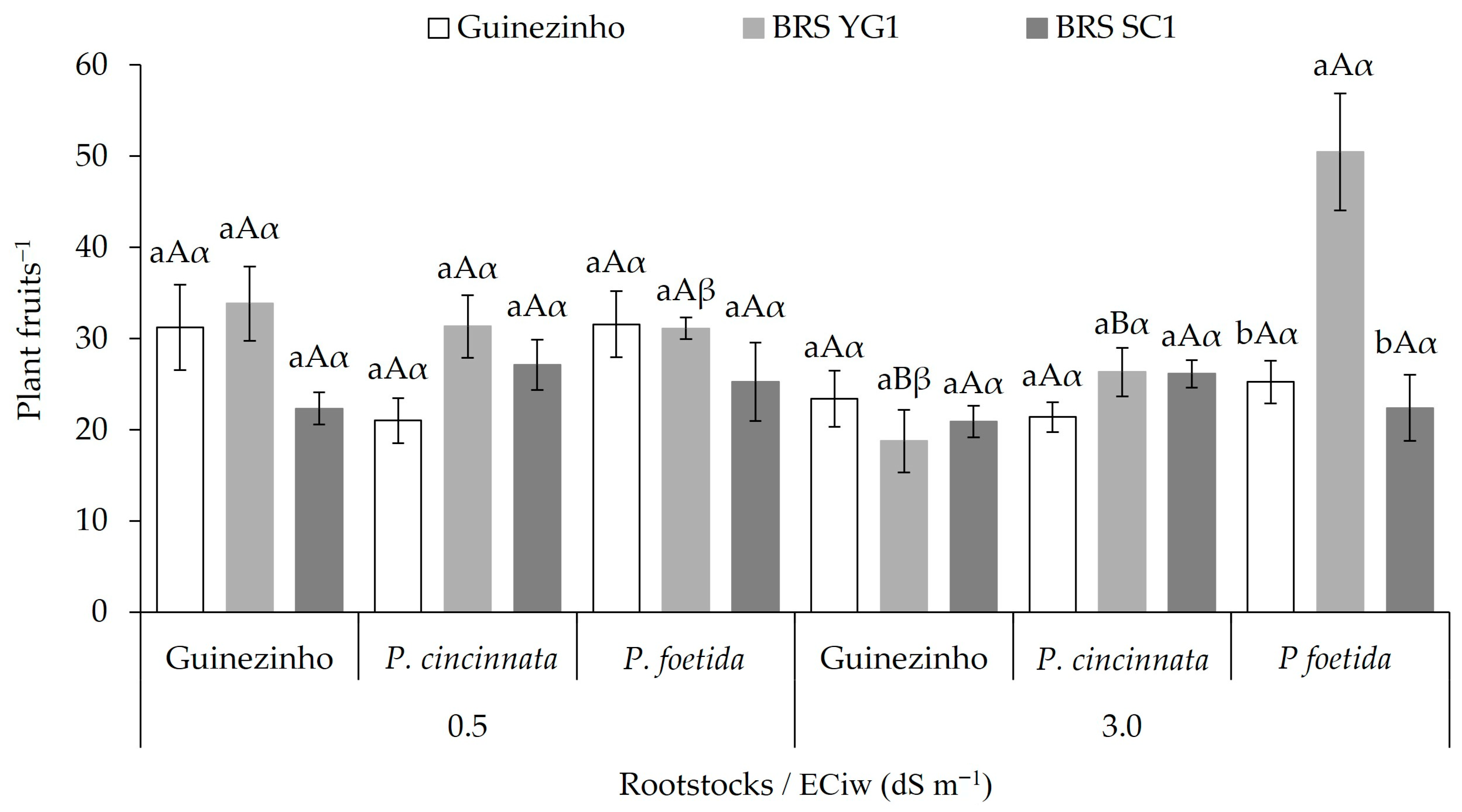
The number of fruits per plant was affected by the interaction between the electrical conductivity of the irrigation water, rootstock, and scion (F = 4.57;
p = 0.0026, CVplot = 11.70%; CVsubplot = 13.12%). The highest number of fruits was obtained under irrigation with water at 3.0 dS m
−1 in plants of the
P.
foetida, as rootstock, and
P.
edulis BRS YG1 cultivar (50 fruits), as scion (
Figure 8). Increasing the electrical conductivity of irrigation water to 3.0 dS m
−1 increased the number of fruits of
P.
edulis scion of the BRS YG1 cultivar onto
P.
foetida under irrigation with water at 0.5 dS m
−1; the number of fruits per plant was 31, and under water at 3.0 dS m
−1, 50 fruits per plant were produced, an increase of 61.29%. However, for the BRS YG1 cultivar grafted onto the Guinezinho cultivar, there was a reduction from 34 fruits per plant under water at 0.5 dS m
−1 to 19 fruits under water at 3.0 dS m
−1, a reduction of 44.12%. Regarding the rootstocks, these only differed under irrigation with water of 3.0 dS m
−1 and when the
P.
edulis scion of the BRS YG1 cultivar was used, where the highest number of fruits was obtained with the
P.
foetida rootstock (50 fruits), exceeding those obtained with the Guinezinho (19 fruits) and
P.
cincinnata (26 fruits) rootstocks by 163.16% and 93.31%, respectively (
Figure 8). The number of fruits per plant only differed between scions of
P.
edulis cultivars when grafted onto
P.
foetida and irrigated with water at 3.0 dS m
−1, where the highest number was obtained in plants grafted with the BRS YG1 cultivar (50 fruits), exceeding those obtained with the Guinezinho (25 fruits) and BRS SC1 (22 fruits) cultivars by 100.00% and 127.27%, respectively (
Figure 8).
The
P.
edulis Guinezinho, BRS YG1 and BRS SC1 cultivars, as scions, under irrigation with water at 0.5 dS m
−1 and 3.0 dS m
−1, produced a greater number of fruits per plant when compared with these cultivars without grafting (
Table 7). It was also observed that there was an interaction between the non-grafted
P.
edulis cultivars and the electrical conductivity of the irrigation water (F = 36.79;
p = 0.0303; CV
plot = 11.70%; CV
subplot = 13.12%). The highest number of fruits was obtained with the Guinezinho cultivar (16 fruits), surpassing the number obtained with the BRS YG1 (5 fruits) and BRS SC1 (4 fruits) cultivars, which did not differ from each other (
Table 7).
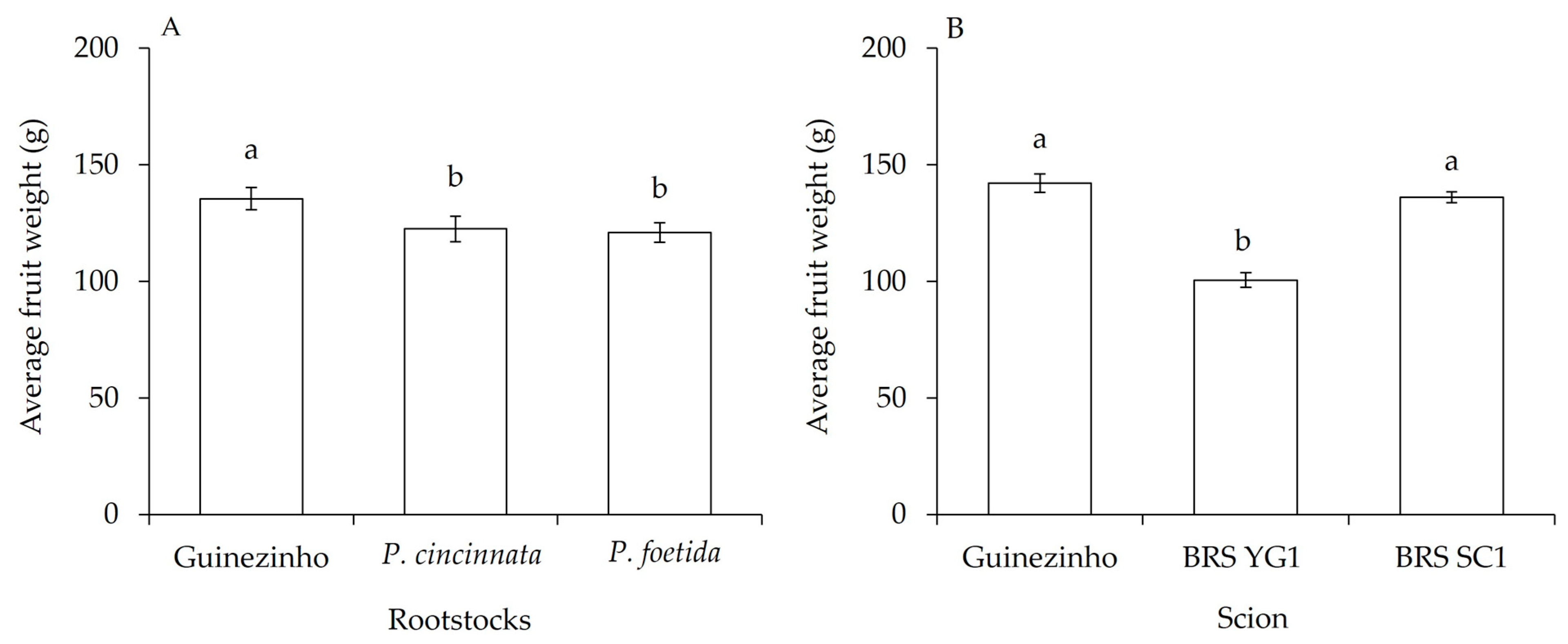
The average fruit mass was affected by the passionflower species used as rootstock (F = 8.03;
p = 0.0008, CVsubplot = 10.92%) and the
P.
edulis varieties used as scion (F = 64.05;
p ≤ 0.0001, CV
subplot =10.92%). The highest average fruit mass occurred in the fruits of plants with the Guinezinho cultivar rootstock (135.44 g) of the
P.
edulis species, being 10.54% and 12.03% higher than those obtained from the
P.
cincinnata (122.52 g) and
P.
foetida (120.89 g) species, respectively, which did not differ from each other (
Figure 9A). The highest average passion fruit masses occurred when harvested from plants grafted with the Guinezinho (142.25 g) and BRS SC1 (136.07 g) cultivars, which did not differ from each other, and were higher than the average mass of the fruits from plants grafted with the cultivar BRS YG1 (100.52 g), with an average reduction of 27.8% (
Figure 9B).
Grafting of
P.
edulis cultivars only affected the average mass of passion fruit when the BRS SC1 cultivar was used and irrigated with water at 3.0 dS m
−1, with an average reduction of 17.06 g per fruit (
Table 7). It was also observed that there was an interaction between the non-grafted
P.
edulis cultivars and the electrical conductivity of the irrigation water (F = 9.73;
p = 0.0002; CV
plot = 7.30%; CV
subplot = 10.93%). The highest fruit masses were obtained with the BRS SC1 (154.82 g) and Guinezinho (137.60 g) cultivars when the plants were irrigated with water at 3.0 dS m
−1, not differing from each other and exceeding the mass of fruits harvested from the BRS YG1 cultivar (
Table 7). It was also observed that reducing the electrical conductivity of the irrigation water, from 3.0 dS m
−1 to 0.5 dS m
−1, did not cause any change in the average mass of the Guinezinho passion fruit cultivar, but reduced it by 22.3% for the BRS SC1 cultivar and increased it by 27.6% for the BRS YG1 cultivar. Under irrigation with water at 0.5 dS m
−1, the highest average passion fruit masses were obtained with the Guinezinho (143.93 g) and BRS SC1 (120.27 g) cultivars, which did not differ from each other, and the latter did not differ from the BRS YG1 cultivar (110.95 g).
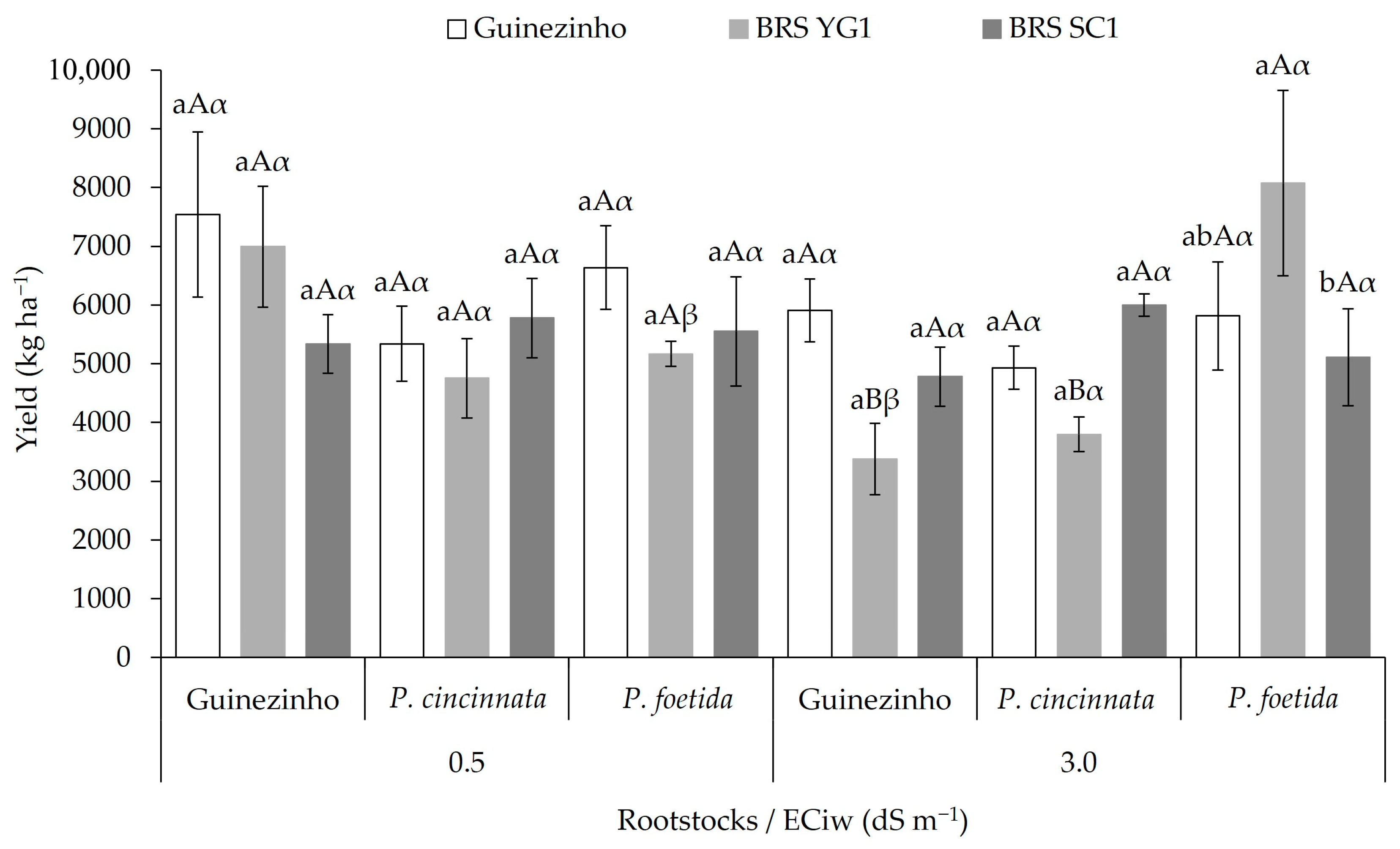
Yield was affected by the interaction between the factors of electrical conductivity of irrigation water, passionflower species as rootstock, and
P.
edulis cultivars as scion (F = 3.14;
p = 0.0199, CV
plot = 25.86%; CV
subplot = 31.19). The highest productivity was obtained with the BRS YG1 cultivar grafted onto the
P.
foetida species and irrigated with water at 3.0 dS m
−1, with an average of 8073.96 kg ha
−1 (
Figure 10). Increasing the electrical conductivity of irrigation water to 3.0 dS m
−1 increased the productivity of the BRS YG1 cultivar grafted onto
P.
foetida by 56.27%, from 5166.51 kg ha
−1 irrigated with water of 0.5 dS m
−1 to 8073.96 kg ha
−1 under irrigation with water of 3.0 dS m
−1, while for the BRS YG1 cultivar grafted onto
P.
edulis Guinezinho cultivar, there was a reduction from 6995.48 kg ha
−1 when using irrigation water with 0.5 dS m
−1 to 3375.58 when irrigating with water of 3.0 dS m
−1, a reduction of 51.75%.
Regarding the rootstocks of the passionflower species, these only differed under irrigation with water of 3.0 dS m
−1 and when the scion of the BRS YG1 cultivar of
P.
edulis was used, where the highest yield was obtained with the
P.
foetida rootstock (8073.96 kg ha
−1), exceeding those obtained with
P.
edulis rootstocks of the Guinezinho cultivar (3375.58 kg ha
−1) and
P.
cincinnata (3797.75 kg ha
−1) by 139.19% and 112.60%, respectively (
Figure 10). Yield only differed between scions when grafted onto
P.
foetida and irrigated with water at 3.0 dS m
−1, where the highest yield was obtained with the scion of the BRS YG1 cultivar (8073.96 kg ha
−1), with no significant difference in productivity compared to the Guinezinho cultivar (5813.62 kg ha
−1), but with a productivity 57.93% higher than that obtained with the BRS SC1 cultivar (5112.26 kg ha
−1), without a significant difference between the productivity of the Guinezinho and BRS SC1 cultivars (
Figure 10).
The Guinezinho, BRS YG1, and BRS SC1 cultivars, when grafted under irrigation with water of 0.5 dS m
−1 and 3.0 dS m
−1, resulted in higher yield than when cultivated without grafting, with an increase between 2207.9 kg ha
−1 and 4979.5 kg ha
−1 (
Table 7). For non-grafted plants, the
P.
edulis cultivars showed differences between them (F = 9.55;
p = 0.0002; CVplot = 31.19%), with the highest average for the Guinezinho cultivar (3588.9 kg ha
−1), exceeding the averages of the BRS YG1 (794.1 kg ha
−1) and BRS SC1 (941.1 kg ha
−1) cultivars, which did not differ from each other (
Table 7). No significant variation in productivity was observed in relation to the electrical conductivity of the irrigation water (F ≤ 1.89;
p ≥ 0.1739; CV
plot = 25.86%).
The number of productive branches per plant, in grafted plants, was not affected by the electrical conductivity of the irrigation water, the rootstock, and the scion, either individually or in interaction (F ≤ 1.38;
p ≥ 0.2594; CV
plot = 14.37%; CV
subplot = 9.13%), with an average of 22 ± 0.3 productive branches. No gain was observed with grafting (
Table 7). Non-grafted
P.
edulis cultivars also did not differ and were not affected by the electrical conductivity of the irrigation water (F ≤ 1.39;
p ≥ 0.2553; CV
plot = 14.37%; CV
subplot = 9.13%;
Table 7), with an average of 22 ± 0.5 productive branches.
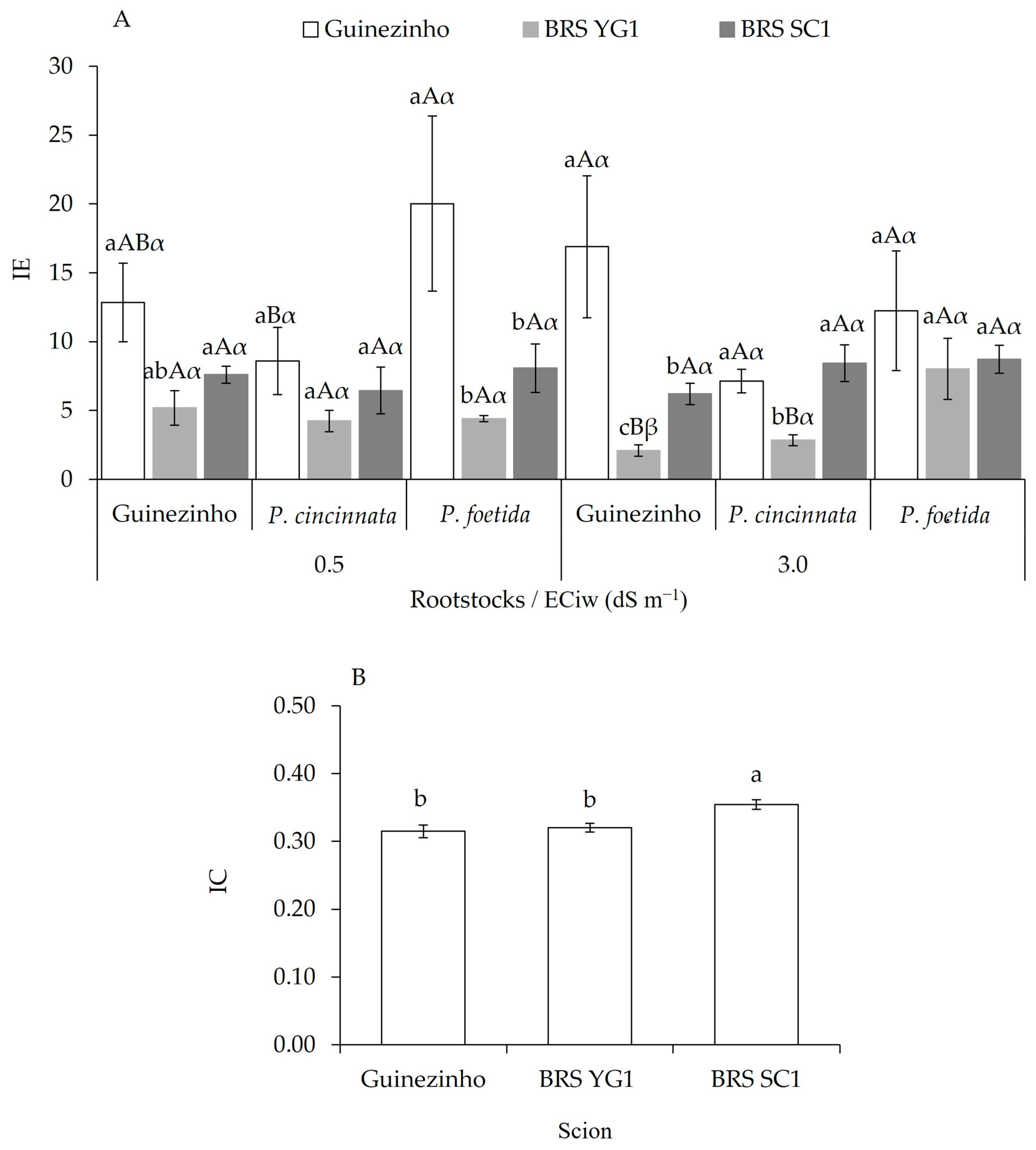
The early ripening index was affected by the interaction between the electrical conductivity of the irrigation water, the passionflower species used as rootstock, and the
P.
edulis cultivars used as scion (F = 2.56;
p = 0.0466; CV
plot = 63.79%; CV
subplot = 56.14%). The highest rates of early ripening occurred when the Guinezinho cultivar of
P.
edulis was used as a scion, with the highest value in the combination where the Guinezinho cultivar was grafted onto
P.
foetida with irrigation at 0.5 dS m
−1, estimated at 20.02 (
Figure 11A). The use of saline water in plant irrigation reduced the early ripening index only in plants of the BRS YG1 cultivar when grafted onto the Guinezinho cultivar, with an average of 5.19 when irrigated with water of 0.5 dS m
−1 to an average of 2.09 under irrigation with water of 3.0 dS m
−1, a reduction of 59.73% (
Figure 11A). Under irrigation with water at 0.5 dS m
−1, the highest rates of early ripening occurred in plants of the Guinezinho cultivar grafted onto
P.
foetida (20.02), higher than the values obtained on grafting onto the
P.
edulis Guinezinho cultivar (12.86) and
P.
cincinnata (8.60 ± 2.44) species, higher by 55.68% and 132.79%, respectively. Under irrigation with water at 0.5 dS m
−1, the scions differed only when grafted onto
P.
foetida, and the scion of the Guinezinho cultivar showed a higher early ripening index (20.02), superior to those obtained with the BRS YG1 (4.41) and BRS SC1 (8.08 ± 1.77) cultivars, which were 353.97% and 147.77% higher, respectively (
Figure 11A).
When under irrigation with 3.0 dS m−1, the rootstocks differed only when combined with the scion of the BRS YG1 cultivar, and with P. foetida rootstock, the early ripening index was 8.02, superior to those obtained with the P. edulis rootstocks of the Guinezinho cultivar (2.09) and P. cincinnata (2.84) by 283.73% and 182.39%, respectively. The scions only differed when grafted onto the Guinezinho cultivar of P. edulis and P. cincinnata, and when grafted onto the Guinezinho cultivar; the highest early maturation index value occurred with the Guinezinho cultivar (16.89) scion, followed by the BRS SC1 (6.20) and BRS YG1 (2.09) cultivars, with the value obtained with the Guinezinho cultivar being 172.42% and 708.13% higher, respectively.
The Guinezinho, BRS YG1, and BRS SC1 cultivars of
P.
edulis, when grafted and irrigated with water at 0.5 dS m
−1 and 3.0 dS m
−1, showed a greater increase in the early ripening index compared to the cultivars without grafting (
Table 7). For the non-grafted
P.
edulis cultivars, differences were observed (F = 14.29;
p < 0.0001; CV
subplot = 56.15%), with the highest average obtained with the Guinezinho cultivar (2.75), higher than the averages obtained with the BRS YG1 (0.25) and BRS SC1 (0.52) cultivars, which did not differ from each other. No effect of the electrical conductivity of the irrigation water was observed (F = 0.11;
p = 1.57; CV
plot = 63.79%).
In the concentrated crop index, only the scions showed an effect (F = 4.97;
p = 0.0098, CV = 25.59%). The scion of the BRS SC1 cultivar resulted in the highest concentrated crop index (0.35), 12.90% and 9.37% higher than the values obtained with the scions of the Guinezinho (0.31) and BRS YG1 (0.32) cultivars, respectively, and the values of Guinezinho and BRS YG1 did not differ from each other (
Figure 11B). For non-grafted
P.
edulis, an interaction was observed between the cultivars and the electrical conductivity of the irrigation water (F = 42.64;
p < 0.0001; CV
plot = 39.56%; CV
subplot = 26.60%). Under irrigation with water at 0.5 dS m
−1, the highest crop concentration index was obtained with the BRS SC1 cultivar (0.64), exceeding the values obtained with the Guinezinho (0.40) and BRS YG1 (0.47) cultivars, which did not differ from each other (
Table 7). When irrigating with water at 3.0 dS m
−1, the three cultivars differed from each other, with estimated values of 0.80, 0.47, and 0.33 for the BRS YG1, SC1, and Guinezinho cultivars, respectively. When the electrical conductivity of the irrigation water was changed from 0.5 dS m
−1 to 3.0 dS m
−1, for the concentration crop index, no difference was observed in the Guinezinho cultivar, while for the BRS YG1 cultivar, there was an increase of 70.2%, and for the BRS SC1 cultivar, there was a reduction of 26.6%
3.4. Multivariate Analysis (Principal Component and Cluster Analyses) of Phenological, Growth, and Productive Traits of Passiflora edulis Under Saline Water Irrigation
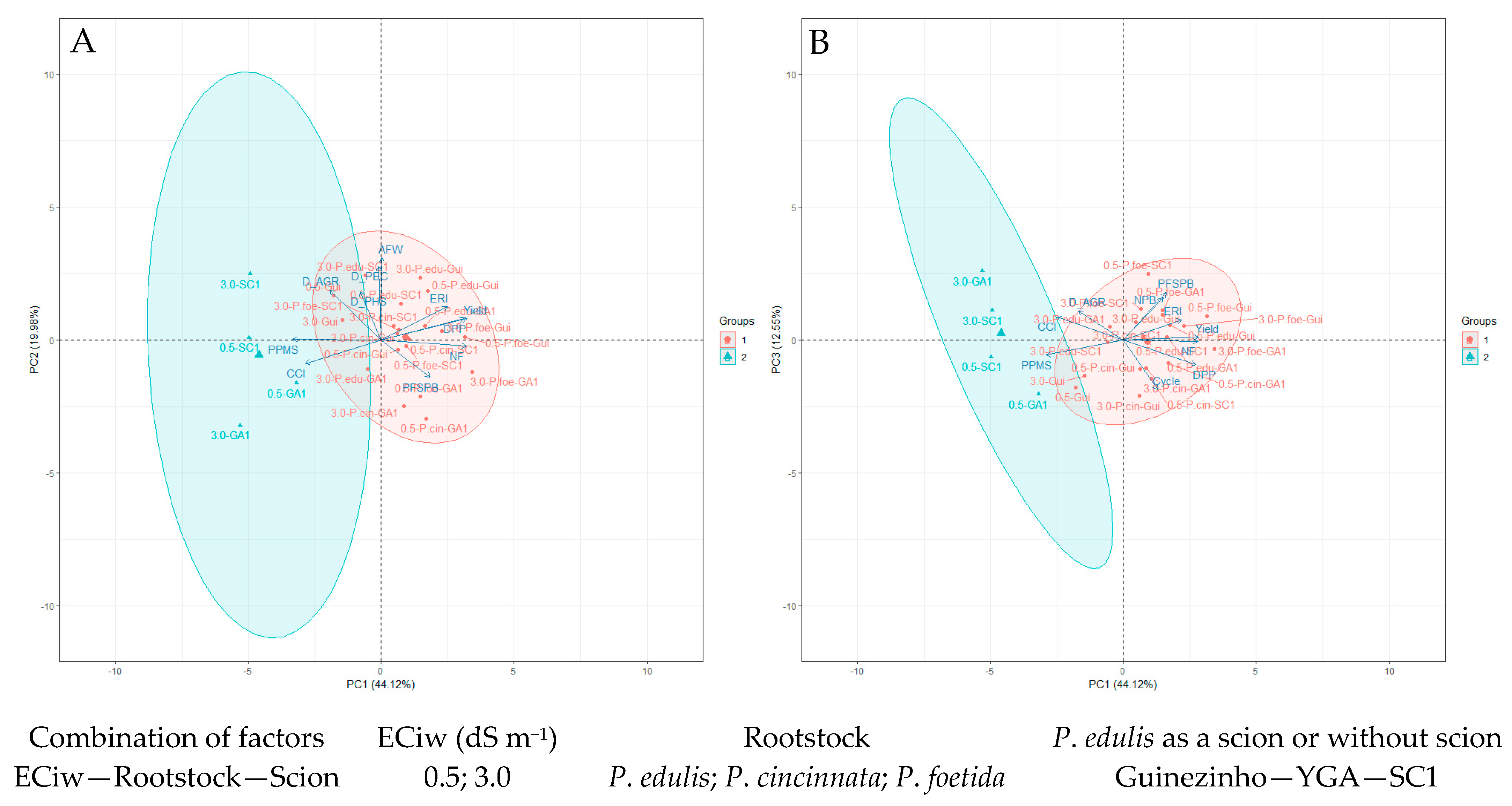
In the principal component analysis, the phenological, growth, and productive variables of
P.
edulis under irrigation with non-saline (0.5 dS m
−1) and saline (3.0 dS m
−1) water, cultivated without grafting and with interspecific and intraspecific grafting, were summarized into three principal components, representing 76.65% of the total variation (
Table 8).
The first principal component, accounting for 44.12% of the total variability, is related to the duration of the vegetative and productive phases and crop productivity (
Table 8). The variables with the greatest contribution (eigenvector 2 × 100) in this component were the period for pruning the main stem (16.09%), productivity (15.14%), number of fruits (14.94%), duration of the productive phase (14.19%), and concentrated cultivation index (11.86%), with plants that reach the trellis in less time having a longer time in the productive phase, contributing to higher productivity distributed more homogeneously among the harvests.
The second component, accounting for 19.98% of the total variability, relates stem growth to the physical quality of the passion fruit, with the average fruit mass contributing 30.87% (eigenvector2 × 100) of the component, followed by the variables stem diameter at the end of the cycle (24.65%), absolute stem growth rate (11.41%), and stem diameter at the time of pruning the main stem (10.71%), indicating that the average mass of the passion fruit is directly related to stem diameter growth.
In the third principal component, representing 12.55% of the total variability, we observe the relationship between the production cycle, with 23.37% (eigenvector2 × 100) of the component, the formation phase of secondary and productive branches, with 21.08% of the component, and the number of productive branches, with 16.80% of the component. This reveals that shorter cycles had longer periods for the formation of secondary and productive branches, and a greater number of productive branches.
According to the cluster analysis, based on the treatment scores, two groups were formed (
Figure 12). The first group includes grafted plants with all combinations of rootstocks and scions, in both electrical conductivities of irrigation water. In this group, it is observed that the highest productivity and the greatest number of fruits are related to the use of
P.
foetida as rootstock, and that using
P.
edulis as rootstock reduces production. In the second group, the ungrafted plants reached the trellis faster and had more concentrated production, but had a lower yield.



 ,
,