Article

Chemical Treatment to Remove or Prevent Salmonella Contamination of Poultry Feed

1
Department of Bacteriology, Animal and Plant Health Agency (APHA-Weybridge), Addlestone KT15 3NB, Surrey, UK
2
Discipline of Comparative Biomedical Sciences, School of Veterinary Medicine, University of Surrey, Guildford GU2 7AL, Surrey, UK
*
Author to whom correspondence should be addressed.
Microbiol. Res. 2026, 17(3), 64; https://doi.org/10.3390/microbiolres17030064
Submission received: 11 February 2026 / Revised: 15 March 2026 / Accepted: 19 March 2026 / Published: 20 March 2026
(This article belongs to the Special Issue Zoonotic Bacteria: Infection, Pathogenesis and Drugs—Second Edition)

Abstract

Introduction: Salmonella may contaminate livestock feed at several stages of production, transport and storage. Formaldehyde is an effective anti-Salmonella feed treatment, but it is now banned for this use in Europe. Organic acid-based additives are an alternative. Gap Statement: The efficacy of organic acid feed additives against natural Salmonella feed contamination is uncertain due to a paucity of reported work investigating low levels of infection that may be relevant for real-world situations. Aim: To compare the anti-Salmonella effects of feed additives based on formaldehyde versus those based on organic acids. Methodology: Experimental contamination of poultry feed with one of three Salmonella serovars at moderate (between 10 and 200 CFU/g) or low (around 1 CFU/g) levels was preceded (‘prevention’ mode) or followed (‘decontamination’ mode) by application of commercial antimicrobial additives. Storage at room temperature for 24 h was followed by pre-enrichment then culture. Results: Organic acid-based products at recommended application rates only eliminated detectable Salmonella from samples with the lowest degree of contamination. The effect was partial, with a proportion of samples still yielding Salmonella in most experiments, and only one such product showed efficacy above 50% of samples for the decontamination mode. The two formaldehyde-based products showed partial efficacy against moderate contamination, and one was entirely effective against low-level contamination even at its lower inclusion rate. Conclusions: Organic acid-based feed additives have a lesser anti-Salmonella effect than formaldehyde-based products at their respective recommended inclusion rates. However, some non-formaldehyde products may be substantially effective against a low, natural degree of contamination. Impact Statement: Chemical suppression of Salmonella in animal feed is an important element of measures to safeguard livestock health and, consequentially, public health too. The European ban on using formaldehyde for this purpose has necessitated the use of alternative products. The present work includes very low levels of Salmonella in feed, possibly mimicking natural contamination, to show that under these circumstances some such alternatives may be as efficacious as formaldehyde products.

1. Introduction

Contamination with Salmonella spp. is a continual challenge to the microbiological safety of animal feed and (by extension) to food animals and foods of animal origin, the human food chain, and the environment [1]. In the UK and elsewhere, a range of Salmonella serovars are isolated from animal feed each year, following routine monitoring or investigations [2,3,4,5]. Ingredients may arrive at feed mills bearing Salmonella contamination from their source, from rodent or bird access, or derived from contaminated ingredient processing facilities such as oilseed crushing plants [6,7,8]. There may additionally be intermittent or persistent Salmonella contamination of the ingredient side of feed mills involving, for example, intake pits, conveyors or ingredient storage [9,10,11].
Thermal treatment of rations for livestock, including poultry, has benefits including the elimination or suppression of pathogens that enter the feed via ingredients or their processing facilities [6,12]. However, it may adversely affect nutrient levels and the stability of intestinal microbiota [13]. The microbicidal benefit of heat treatment can be reduced by insufficient time and/or temperature during processing, and/or by recontamination of the processed feed. Contamination of finished product may occur at any of several stages, including in pellet coolers, at handling and out-loading facilities of the feed mill [6,14], during transport in feed trucks, and on destination farms [9]. Furthermore, some rations (particularly the compounded mash forms often used for commercial laying hens) are not routinely heat-treated in many countries [15].
To reduce Salmonella risks, chemical treatments are often applied to feed ingredients and/or to processed feed to combat contamination or to prevent recontamination after processing [16]. Higher concentrations of chemical additives can be used in high-risk ingredients before compounding the final ration, whereas acceptable concentrations in whole processed rations are constrained by several factors. These include effects such as alimentary tract irritation, damage to milling equipment and reduced palatability, plus the costs of treating large volumes of feed.
Formaldehyde was used in the European Union (EU) and elsewhere for many years as an antimicrobial additive to animal feed, and was considered to be effective in this role against Salmonella [17,18]. However, following evaluation of the potential risks to operators and livestock of exposure to the agent, and the availability of licenced alternatives, permission to use formaldehyde as a feed treatment was withdrawn by the EU in 2018 under Regulation (EU) 2018/183, which was also carried over into United Kingdom (UK) law. Its use in this mode continues in some other territories, including those from which animal feed ingredients are sourced in the UK [19]. The ban on formaldehyde treatment is a concern for feed manufacturers due to its proven efficacy in Salmonella control [17,18].
Organic acids (OAs) and their salts are key agents used as alternatives to (or to synergise with) formaldehyde in animal feed. Additional antimicrobial phytochemicals are also used in some blended products. OAs are weak acids that are believed to diffuse across bacterial membranes in their undissociated state, potentially interfering with bacterial cell pH control, metabolism and membrane functions [20]. Previous work has suggested that OA-based products used at standard inclusion rates or as powdered (rather than liquid) formulations may be less efficacious [17,21,22], and/or more variable [23,24] in their anti-Salmonella effects, when compared with products containing formaldehyde.
The present study was conducted to examine the effects of formaldehyde and OA-based feed treatments upon artificial Salmonella contamination of heat-treated poultry feed. Three serovars were used individually as contaminants, all of which are currently recognised as being competent colonisers of poultry flocks in the UK. The effect of a range of commercially available feed treatment products was determined against three levels of experimental Salmonella contamination. Salmonella was added either before or after chemical treatment, with the latter to assess protection against contamination after production. Salmonella viability after treatment was tested by culture, with an additional trial of OA- or formaldehyde-neutralising agents during bacterial pre-enrichment. By contrast with previous studies, there is a particular focus on OA-based products used at manufacturers’ recommended inclusion rates for finished product, alongside Salmonella concentrations consistent with measured natural contamination in compounded feed.

2. Materials and Methods

2.1. Salmonella Strains and Bacteriological Procedures

Three field Salmonella enterica sp. enterica isolates from the years 2017 or 2018 were selected, representing serovars important to the poultry industry. Two of these, S. 13,23:i:- and S. Enteritidis phage type (PT) 13a, were isolated from poultry feed mills. The third, S. Infantis, is a multidrug-resistant isolate that was an intractable problem on a broiler farm and associated with persistent contamination of pan feeder systems. Strains were recovered from storage by culturing on blood agar plates for 24 ± 3 h at 37 °C.
Single colonies were inoculated into Luria–Bertani (LB) broth (4 mL), which was incubated (20 ± 2 h, 37 °C) to give approximately 1 × 10⁹ colony forming units (CFUs) per mL. For the assays, broths were diluted in phosphate-buffered saline (PBS) to give various concentrations of suspended Salmonella. For accurate dose quantification, duplicate 100 μL aliquots were spread-plated onto LB agar for each dilution, and colonies were counted after incubation for 24 ± 3 h at 37 °C.
Efficacy assays were based on methods reported previously by Carrique-Mas et al. [17]. For bacterial recovery following contamination prevention treatments (product added to feed before Salmonella), 25 g feed samples were added to 225 mL sterile buffered peptone water (BPW), mixed by swirling, then subjected to culture according to a modified ISO 6579-1:2017 procedure [25]. Briefly, the suspension was pre-enriched for 18 ± 2 h at 37 °C, then an aliquot (0.1 mL) of the BPW culture was inoculated onto modified semi-solid Rappaport Vassiliadis agar (MSRV; Mast: Mast Group Ltd., Bootle, UK) containing 1 mg/mL novobiocin (Sigma; Sigma-Aldrich, Gillingham, UK) and incubated at 41.5 °C. After 24 and 48 ± 3 h, a 1 µL loop from the edge of the MSRV opaque growth zone was inoculated onto Rambach agar (Merck, Sigma-Aldrich, Gillingham, UK) and incubated for 24 ± 3 h at 37 °C. Salmonella identity was confirmed by slide agglutination tests using polyclonal antisera.
For recovery following decontamination treatments (product added to feed after Salmonella), some test samples had neutralisers added at the pre-enrichment stage to examine possible inhibition (masking) of residual Salmonella by the products. Histidine (1 g) was added for formaldehyde products and 2 mL 1 M NaOH was added for OA products. In these cases, three pre-enrichment broths were prepared for each treatment, each containing 225 mL BPW and a 25 g contaminated-then-treated feed sample, plus one of: no neutraliser, neutraliser added at t = 0 (standard inhibition), or neutraliser added at t = 90 min (delayed inhibition). Samples were then incubated and processed as already described.

2.2. Feed Contamination and Treatment

Poultry feed that had been heat-treated but not pelleted was kindly supplied by GLW Feeds (Loughborough, UK). A turkey grower mix was used because the broiler feed (otherwise very similar in composition) contained coccidiostatic antimicrobial drugs. Feed composition is detailed in Table 1.
For prevention tests, each treatment product was added at the specified concentration (Table 2) to 1 kg of feed, which was then thoroughly mixed and left in sealed containers at room temperature (RT). After 24 and 72 h, 25 g subsamples were transferred to sterile pots and 1 mL Salmonella suspension in PBS was added dropwise whilst mixing thoroughly using sterile plastic stirrers. Sealed pots were left at RT for 24 h before culturing the contents. For decontamination tests, Salmonella was first added (in the manner previously described) to 25 g feed. After 4 h at RT the chemical treatments were added slowly whilst mixing thoroughly. Samples were then left at RT for 24 h before culturing.

2.3. Assays

Single Salmonella serovars were used as contaminating doses in all cases. All tests were run in triplicate and performed on two separate occasions, i.e., six replications. Triplicate negative controls (i.e., feed only) were run on receipt of the feed and again with each assay. Salmonella doses were prepared fresh for each of the two testing occasions.

2.3.1. Study 1

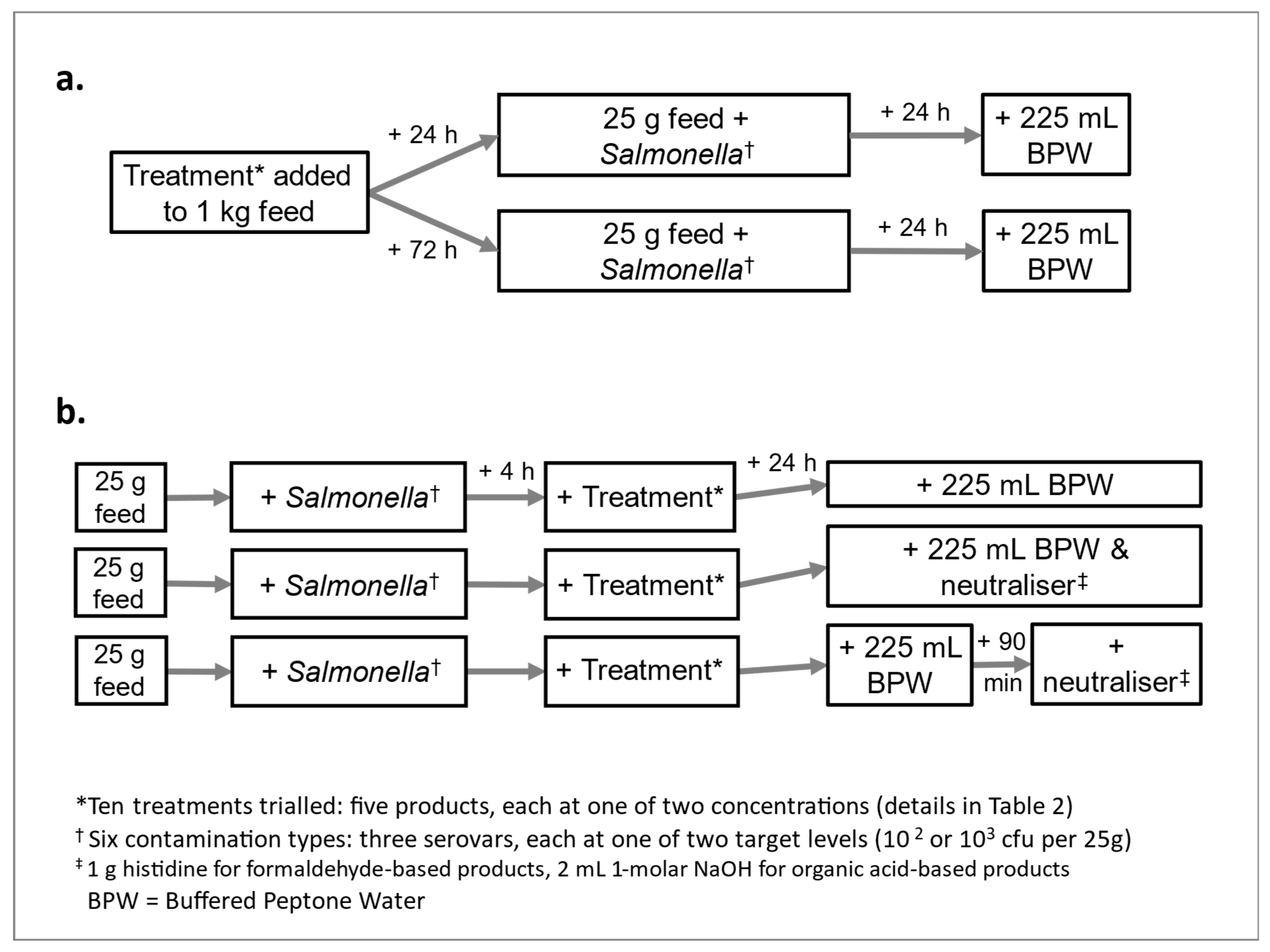
For the prevention mode tests (Figure 1a) the two intended Salmonella contamination doses were 102 and 103 CFU in 25 g of feed. Thus, for each of the products examined (n = 5) there were 12 combinations of product inclusion rate (x2), Salmonella serovar (x3) and Salmonella dose (x2). The two Salmonella application times (24 or 72 h post-treatment) and the six replications made for a total of 144 samples of 25 g feed cultured for each of the five products.
The decontamination mode tests used the same 12 combinations of Salmonella and inclusion rate as the prevention tests. To accommodate neutraliser testing, three samples of 25 g feed were prepared for each of these combinations (Figure 1b) and six replications undertaken, making a total of 216 cultured samples for each product.

2.3.2. Study 2

A lower contamination dose (20 to 30 CFU) was used in Study 2, amounting to approximately 1 CFU per gram of feed. Eight products were examined, each at a single inclusion rate (Table 2). The prevention mode test used all combinations of Salmonella serovars (x3), dose (x1), application times (x2) and treatment inclusion rate (x1), plus six replications, to give 36 samples of 25 g feed cultured for each treatment product. For the decontamination mode, no neutralisers were used, giving a single feed sample to be cultured for each of the three serovars before six replications, making 18 sample results per product.

2.4. Statistical Analysis

A Chi-squared (χ2) test was used in univariable analyses to compare the numbers of Salmonella-positive or -negative samples with each treatment and assay type. Yates’ correction was used, compensating upwards bias on 2 × 2 tables with some small-value cells. Tests were run on Prism 8 (GraphPad Software).

3. Results

3.1. Study 1

Salmonella was recovered from all positive controls and from none of the negative controls.

3.1.1. Contamination Prevention Tests

Measured lower and higher contamination doses were 5 × 10² and 5 × 10³ CFU, respectively. There was an obvious difference between the efficacies of the formaldehyde-based products compared to the OA products. None of the OA products prevented recovery of Salmonella in any of the tests (i.e., 100% recovery), regardless of Salmonella strain, dose or pre-contamination treatment period (24 or 72 h). The same results were seen for the low concentration (1.0 g/kg) of the two formaldehyde-based products. By contrast, Salmonella was not recovered from any of the high concentration (3.0 g/kg) formaldehyde-treated samples (i.e., 0% recovery:χ2 = 68, p < 0.0001).

3.1.2. Decontamination Tests

Measured contamination doses were slightly lower (3 × 10² and 3 × 10³ CFU) than for the prevention tests. The performance of all the OA products replicated their effect in the prevention tests, i.e., all cultures yielded Salmonella regardless of product concentration, Salmonella dose and neutraliser regime. Results for formaldehyde-containing products are summarised in Table 3. These, particularly at the higher concentration of 3.0 mL/kg, reduced the frequency of Salmonella recovery compared to the controls.
Statistical analyses were conducted only on the formaldehyde product data from decontamination tests (Table 4). Examining the two products, with combined neutralisation regime and serovar results, demonstrated no significant difference from the positive control for product F1 at 1.0 mL/kg, and a modestly significant (p = 0.025) apparent suppression associated with product F2 at the same lower inclusion rate. At the higher inclusion rate of 3.0 mL/kg, both products showed a highly significant difference (p < 0.0001) from positive controls. Comparing the two products using all results showed significantly more suppression with F2 than with F1.
When neutralisation regime data were analysed (Table 4), significant differences were seen only with the higher inclusion rate. For F1, standard versus no neutralisation yielded significantly more positive results for the former (p = 0.0004), whilst delayed versus no neutralisation showed less difference. Significant differences were seen for both standard (p < 0.0001) and delayed (p = 0.0095) neutralisation of F2, compared with no neutralisation. Thus, with products plus inclusion rates that were substantially effective (formaldehyde, 3.0 mL/kg), neutralisation of pre-enrichment mixtures significantly increased the frequency of Salmonella recovery.
Comparisons of Salmonella subtypes (Table ) yielded significant differences only with the lower inoculating dose of 3 × 10² CFU. Under this condition, significantly more suppression of S. 13,23:i:- was seen, compared with either S. Infantis or S. Enteritidis PT13a.

3.1.3. Prevention Versus Decontamination

Considering data from both F1 and F2 together, at 3.0 mL/kg the effect of formaldehyde was more marked for prevention than for decontamination (0% vs. 47% recovery; χ2 = 93, p < 0.0001). By contrast, at 1.0 mL/kg decontamination was the more effective mode (89% recovery vs. 100% for prevention; χ2 = 15.4, p < 0.0001), albeit in the context of substantially poorer efficacy overall.

3.2. Study 2

The inclusion rates tested were informed by the results from Study 1. Study 2 results are summarised in Table 5. All tests were conducted without neutralising agents. Negative controls were uniformly Salmonella-negative.
The formaldehyde-based products, used only at the lower inclusion rate of 1.0 mL/kg, were substantially effective in both the preventive and decontamination tests. As with the Study 1 tests using higher contamination, there appeared to be a difference between the two products, with F2 being the most efficacious under these conditions. Some of the OA products also showed efficacy (by contrast with the Study 1 tests) in both prevention and decontamination modes.
In both the prevention and decontamination tests, Salmonella was recovered from two or (usually) three of each triplicate set of positive control samples. The same frequency of recovery was seen for two of the OA products (OA4 and OA6) for all serovars, and for two others (OA3 and OA5) in the case of Salmonella Infantis. OA1, by contrast, showed evidence of a consistent anti-Salmonella effect in both modes of use; although complete efficacy (zero recovery) was only observed in the decontamination mode, the difference in outcomes between the two modes of use was of borderline significance (χ2 = 3.8, p = 0.053). The remaining OA product and serovar combinations generally yielded evidence of a modestly reduced frequency of Salmonella recovery. There was no significant difference between serovars in the frequency of recovery.

4. Discussion

The present study examined the anti-Salmonella effect of products used at post-processing inclusion rates in feed that had been heat-treated but not yet pelleted. Contamination was simulated at three dose levels of each of three poultry-related Salmonella serovars, added either before or after addition of the feed treatment products. The three selected Salmonella strains were of established provenance as persistent colonisers of poultry feed-handling facilities. A commercial feed formulation, stored and tested under ambient indoor conditions of moisture and temperature, was used as an approximation of field usage conditions for housed poultry. Mixing-in of product and of Salmonella contamination was thorough but it allowed for some small-scale heterogeneity of distribution that would be expected under field conditions. The study provides indication of treatment efficacies, albeit within limitations of the experimental set up. Numerous parameters, including other Salmonella strains and serovars, feed formulations, variations in temperature, humidity and the effects of pelleting were not undertaken due to resource constraints, but their effects would be worth investigating.
A qualitative approach was taken to determine the treatment effect, examining presence versus absence of Salmonella detectable by sensitive culture [26]. The possible effect of ‘masking’ viable Salmonella in the culture process by the added chemicals was investigated by incorporating neutralising agents for OAs or for formaldehyde into some of the culture pre-enrichment mixes. Effects likely to be significant and of meaningful magnitude in the field were tested using χ2 univariable tests on six repetitions of serovar–product–concentration combinations.
With heavier contamination (approximately 102 or 103 CFU per 25 g feed), which would be unlikely to occur in commercial compounded feed production [6], none of three OA products tested had any measurable effect in the test system, either as a preventative treatment or for decontamination. By contrast, both formaldehyde products were associated with significant reductions in the number of Salmonella-positive samples. Some masking of the detection of viable Salmonella was likely to have occurred with both of the formaldehyde products at the higher inclusion rate of 3.0 mL/kg. This was revealed by the addition of 1 g histidine, which has empirically been found to be an effective unmasking agent and dose by Carrique-Mas et al. [17]. The histidine concentration, of 0.4% w/v in the pre-enrichment mix, is 13× the maximum possible concentration of formaldehyde product (0.03%). By comparison, a suggested neutralisation step for aldehyde disinfectants in European Standard EN 14347:2005 for suspension testing without suspended solids uses histidine at 2.5× the concentration of the disinfectant. The 2 mL of 1 M NaOH added for OA-based products can be compared with the 4 or 8 mL added by Carrique-Mas et al. [17] that neutralised the pH of OA preparations added at an inclusion rate of 1.5%, which is 1.5×–10× more product per sample than in the present work.
With a lighter contamination dose of around 1 CFU/g (20–30 CFU per 25 g sample), application of some of the OA products resulted in a modest reduction in positive samples. Furthermore, one product (OA1) at 4.0 mL/kg was found to perform similarly to the formaldehyde-based treatments at 1.0 mL/kg, despite showing no such effect against the higher Salmonella challenge of 102 CFU. Previous studies have reported effectiveness for some OA products [24], although greater in vitro efficacy of formaldehyde treatments has been observed on several occasions [22,23], including with low inoculation doses of around 1 CFU/g [17]. In the quantitative study by Wales et al. [22], the only product to reduce the numbers of Salmonella to below the limit of detection contained formaldehyde. Direct comparisons between these studies are hindered by the numerous variations between the test models, but nevertheless there is evidence that some OA feed treatment products at a suitable concentration can reduce the occurrence and numbers of Salmonella in feed [24]. Furthermore, certain OAs may be more protective than formaldehyde within the intestinal tract of animals consuming treated feed [27]. Formaldehyde products are, however, more effective as feed and milling equipment treatments at concentrations that are recommended for commercial use [28].
As Salmonella contamination in finished feed appears typically to occur at a low concentration, results from some of the present OA products indicate the potential for some efficacy in the field despite the apparent superiority of the formaldehyde-based products. There are few quantitative studies of natural Salmonella feed contamination, but D’Aoust and Sewell [29] reported a median most probable number (MPN) of around 0.1 per gram among samples of Salmonella-positive compounded feed and ingredients. Other investigators have reported similar results with similar techniques [1] and, using PCR, Schelin et al. [30] reported median MPN to be 0.14 per gram of naturally contaminated soya bean meal.
The Salmonella strains tested appear to survive well in poultry feed environments and did not show wide variation in susceptibility to the treatments. Nonetheless, some caution should be exercised about the generalisability of findings in this respect. Furthermore, there are several other reasons for uncertainty about how closely experimental contamination studies may represent performance in the field. It is unclear to what extent reported counts from natural contamination represent single cells versus larger clusters of viable organisms, and focally there may be greater contamination. Indeed, the cited quantitative evaluation studies all indicate a spread of values, sometimes from within the same batch of feedstuff, with a minority of samples showing Salmonella densities that are one or more orders of magnitude greater than the median. This might occur if there is a chance for local multiplication due to humidity and warmth, e.g., within contaminated pellet or heat-treated meal coolers [6] or perhaps focal faecal contamination such as rodent or wild bird droppings which remain in a mash ration after sieving or are deposited into feed after processing [31]. Furthermore, concentrations of Salmonella in ingredients produced in a persistently contaminated oilseed processing plant may be uniformly considerably higher than those typical for compounded feed [21].
It is also likely that ‘natural’ Salmonella contamination of feed differs from experimental contamination, at least in respect of the physiological adaptations of the organism to stress, as well as in the distributions, aggregations and micro-environments of the cells. This may increase the organism’s resistance to chemical treatments, similar to the observed effect on thermal processing resistance [32]. Moreover, the concentration of natural contamination appears to be less significant in terms of the efficacy of organic acid treatments than the particular ingredient within which that contamination is found [21]. A related point is the lack of data on the chemical treatment of non-heat-treated feed containing large particles (including layer mash), or of whole grain that is added to some finished poultry rations without any further processing [33]. Bearing in mind the foregoing considerations, the present studies nonetheless provide a useful comparison between products for post-processing protection or decontamination of feed.
It might be argued that a substantial reduction in viable counts (and therefore Salmonella infection risk) may have been achieved by some products without much reduction in positive samples because a sensitive culture technique with pre-enrichment and a large (25 g) sample was used. However, with the low-dose Study 2, any tenfold reduction or more in viable cells would be expected to show many negative samples. There are no data on performance in the field of the apparently more effective products among the OA-based treatments, although observations made by the study team within diverse feed and poultry companies do suggest a greater likelihood of Salmonella contamination and flock infection problems when less efficacious, organic acid feed treatment products have been used.
For both of the formaldehyde products tested, conditions of heavy contamination and high inclusion (3.0 mL/kg) yielded superior efficacy in prevention mode compared with decontamination. This difference has been observed previously [17,34] and is an important factor when considering the time of application in a working environment. When inclusion was lower (1.0 mL/kg), performance generally was poorer, and the relative efficacies against heavy contamination in the two modes of use were reversed, with less efficacy as prevention. Similarly, there was a bias towards better efficacy for decontamination rather than prevention with the most effective OA product (OA1), albeit against lighter contamination.
It is unclear why the relative effectiveness for prevention versus decontamination alters with different product inclusion rates, but prevention seems relatively less effective than decontamination when chemical action is more marginal, i.e., at lower inclusion rates and with less potent products. Under these circumstances, effects such as interactions between product and feed matrix, and/or the evaporation of components, may reduce the microbicidal potency of products before Salmonella cells are added. The present data show no discernible difference between 24 and 72 h of pre-contamination treatment in the preventive mode.
The decontamination part of Study 1 also demonstrated a significant amount of masking with the formaldehyde products at the higher inclusion rates. This could not be demonstrated for the OA products as they had no measurable effect under any of the test conditions. In a study by Carrique-Mas et al. [17], which looked at a number of different test matrices, masking was demonstrated both for OA products and the formaldehyde treatment (product F2 in the present study). Further investigation of OA products, with low doses of Salmonella plus different neutralisation regimes and monitoring of the pH of the pre-enrichment mix, might help clarify this matter. It is possible that some of the antimicrobial effects of OA products happen after ingestion and hydration of the feed, in the crop or stomach of the animal [35], and pre-enrichment with delayed or absent neutralisation could provide a model for this scenario. Field studies to assess the efficacy of various feed treatments for the protection of animals fed on contaminated rations are needed, but the biological variability in such challenge studies makes the likely impact at a whole flock or herd level very difficult to evaluate [36].
At higher contamination doses (Study 1), the S. 13,23:i:- isolate appeared to be more susceptible to treatments than the other two Salmonella serovars. Authors of two earlier studies [17,22] reported no differences in susceptibility between strains from a limited number of serovars (including two vaccine strains), but none of these were 13,23:i:. In Study 2 no significant difference was observed between serovars, although the S. 13,23:i:- strain was again recovered the least often. In the absence of comparative experimental data on acid and formaldehyde susceptibility of the three serovars used, further studies would be needed to determine if this apparent susceptibility is serotype- or strain-specific.
In conclusion, the present work has indicated, in agreement with earlier studies, that formaldehyde treatments are more effective for Salmonella control in feed than OA-based products at commercially recommended concentrations. Higher application rates that may be used on smaller volumes of high-risk ingredients were not tested, with the novel focus here being on inclusion rates plus Salmonella contamination associated with finished products. The infectious dose of Salmonella for young animals such as chicks can be very low [37], and with thousands of tonnes of feed being consumed daily there is a need for the most efficacious treatment possible, as well as for preventing the recontamination of heat-treated rations. None of the tested OA products were capable of producing results consistent with a three log10 reduction in viable counts. Furthermore, lower concentrations than those tested here are often used for economic reasons within the feed industry. Nevertheless, some OA products at recommended rates do at least appear to reduce the numbers of Salmonella in compound feeds, with one such treatment eliminating detection of the organism from a contamination level that is believed to be typical of that in such feeds.

Author Contributions

Conceptualization, S.C. and R.D.; methodology, S.C. and R.D.; formal analysis, S.C. and A.W.; investigation, S.C. and T.H.; writing—original draft preparation, S.C. and A.W.; writing—review and editing, S.C., A.W., T.H. and R.D.; supervision, S.C.; project administration, S.C.; funding acquisition, S.C. All authors have read and agreed to the published version of the manuscript.

Funding

This research work and preparation of the article was funded by the Department for Environment, Food and Rural Affairs (Defra), UK, under Project CR2005.

Institutional Review Board Statement

Not applicable.

Data Availability Statement

Data available on request.

Conflicts of Interest

The authors declare no conflicts of interest.

References

  1. Binter, C.; Straver, J.M.; Häggblom, P.; Bruggeman, G.; Lindqvist, P.-A.; Zentek, J.; Andersson, M.G. Transmission and Control of Salmonella in the Pig Feed Chain: A Conceptual Model. Internat. J. Food Microbiol. 2011, 145, S7–S17. [Google Scholar] [CrossRef]
  2. APHA. Salmonella in Animals and Feed in Great Britain 2023; Animal and Plant Health Agency: Weybridge, UK, 2024; p. 307. Available online: https://assets.publishing.service.gov.uk/media/66e98539f8082e9740881c71/salmonella–animals-feed-gb-2023_FINAL__002_.pdf (accessed on 17 March 2025).
  3. Bucher, O.; Holley, R.A.; Ahmed, R.; Tabor, H.; Nadon, C.; Ng, L.K.; D’Aoust, J.Y. Occurrence and Characterization of Salmonella from Chicken Nuggets, Strips, and Pelleted Broiler Feed. J. Food. Prot. 2007, 70, 2251–2258. [Google Scholar] [CrossRef]
  4. EFSA. Biological Hazards Reports; European Food Safety Authority: Parma, Italy, 2021; Available online: https://www.efsa.europa.eu/en/data-report/biological-hazards-reports (accessed on 26 September 2023).
  5. Jones, F.T.; Richardson, K.E. Salmonella in Commercially Manufactured Feeds. Poult. Sci. 2004, 83, 384–391. [Google Scholar] [CrossRef]
  6. Jones, F.T. A Review of Practical Salmonella Control Measures in Animal Feed. J. Appl. Poult. Res. 2011, 20, 102–113. [Google Scholar] [CrossRef]
  7. Rocha, M.D.; Chaves, R.D.; Freire, L.; Pia, A.K.R.; Furtado, M.M.; Alvarenga, V.O.; Crucello, A.; Lopes, L.S.; Santos, A.F.M.; Rodrigues, D.P.; et al. Salmonella enterica in Soybean Production Chain: Occurrence, Characterization, and Survival during Soybean Storage. Int. J. Food Microbiol. 2022, 372, 109695. [Google Scholar] [CrossRef] [PubMed]
  8. Wierup, M. Salmonella in Feed. In Salmonella in Domestic Animals; Barrow, P.A., Methner, U., Eds.; CABI: Wallingford, UK, 2013; pp. 377–398. [Google Scholar]
  9. EFSA. Microbiological Risk Assessment in Feedingstuffs for Food-Producing Animals—Scientific Opinion of the Panel on Biological Hazards. EFSA J. 2008, 6, 720. [Google Scholar] [CrossRef]
  10. Pellegrini, D.d.C.P.; Paim, D.S.; Lima, G.J.M.M.d.; Pissetti, C.; Kich, J.D.; Cardoso, M.R.d.I. Distribution of Salmonella Clonal Groups in Four Brazilian Feed Mills. Food Control 2015, 47, 672–678. [Google Scholar] [CrossRef]
  11. Torres, G.J.; Piquer, F.J.; Algarra, L.; de Frutos, C.; Sobrino, O.J. The Prevalence of Salmonella enterica in Spanish Feed Mills and Potential Feed-Related Risk Factors for Contamination. Prev. Vet. Med. 2011, 98, 81–87. [Google Scholar] [CrossRef]
  12. McCracken, K.J. Effects of Physical Processing on the Nutritive Value of Poultry Diets. In Poultry Feedstuffs: Supply, Composition and Nutritive Value; CABI Publishing: Wallingford, UK, 2002; pp. 301–316. [Google Scholar]
  13. Yameen, R.K.; Nazir, A.; Bilal, R.M.; Shahzad, A.; Tahir, M.A.; Farag, M.; Elnesr, S.S.; El-Shall, N.A.; Di Cerbo, A.; Alagawany, M. A Review on Feed Particle Size and Form: Implications on the Performance and Gut Health of Poultry. Poult. Sci. J. 2025, 13, 1–15. [Google Scholar] [CrossRef]
  14. Gosling, R.; Oastler, C.; Nichols, C.; Jackson, G.; Wales, A.D.; Davies, R.H. Investigations into Salmonella Contamination in Feed Mills Producing Rations for the Broiler Industry in Great Britain. Vet. Sci. 2022, 9, 307. [Google Scholar] [CrossRef]
  15. Ruhnke, I.; Röhe, I.; Krämer, C.; Goodarzi Boroojeni, F.; Knorr, F.; Mader, A.; Schulze, E.; Hafeez, A.; Neumann, K.; Löwe, R.; et al. The Effects of Particle Size, Milling Method, and Thermal Treatment of Feed on Performance, Apparent Ileal Digestibility, and pH of the Digesta in Laying Hens. Poult. Sci. 2015, 94, 692–699. [Google Scholar] [CrossRef]
  16. Kholif, A.E.; Gouda, G.A.; Olafadehan, O.A.; Sallam, S.M.; Anele, U.Y. Acidifiers and Organic Acids in Livestock Nutrition and Health. In Organic Feed Additives for Livestock; Alagawany, M., Sallam, S.M., Abd El-Hack, M.E., Eds.; Academic Press: Cambridge, MA, USA, 2025; pp. 43–56. [Google Scholar] [CrossRef]
  17. Carrique-Mas, J.J.; Bedford, S.; Davies, R.H. Organic Acid and Formaldehyde Treatment of Animal Feeds to Control Salmonella: Efficacy and Masking during Culture. J. Appl. Microbiol. 2007, 103, 88–96. [Google Scholar] [CrossRef] [PubMed]
  18. Jones, F.T.; Axtell, R.C.; Rives, D.V.; Scheideler, S.E.; Tarver, F.R.; Walker, R.L.; Wineland, M.J. A Survey of Salmonella Contamination in Modern Broiler Production. J. Food Prot. 1991, 54, 502–507. [Google Scholar] [CrossRef]
  19. Hunt, H. Sourcing Sustainable Soya; NFU—The Voice of British Farming: London, UK, 2024; Available online: https://www.nfuonline.com/updates-and-information/sourcing-good-soya-7-things-you-might-not-know/ (accessed on 15 March 2026).
  20. Hirshfield, I.N.; Terzulli, S.; O’Byrne, C. Weak Organic Acids: A Panoply of Effects on Bacteria. Sci. Prog. 2003, 86, 245–269. [Google Scholar] [CrossRef] [PubMed]
  21. Axmann, S.; Kolar, V.; Adler, A.; Strnad, I. Efficiency of Organic Acid Preparations for the Elimination of Naturally Occurring Salmonella in Feed Material. Food Addit. Contam. Part A 2017, 34, 1915–1924. [Google Scholar] [CrossRef] [PubMed]
  22. Wales, A.; McLaren, I.; Rabie, A.; Gosling, R.J.; Martelli, F.; Sayers, R.; Davies, R. Assessment of the Anti-Salmonella Activity of Commercial Formulations of Organic Acid Products. Avian Pathol. 2013, 42, 268–275. [Google Scholar] [CrossRef][Green Version]
  23. Cochrane, R.A.; Huss, A.R.; Aldrich, G.C.; Stark, C.R.; Jones, C.K. Evaluating Chemical Mitigation of Salmonella Typhimurium ATCC 14028 in Animal Feed Ingredients. J. Food Prot. 2016, 79, 672–676. [Google Scholar] [CrossRef]
  24. Gosling, R.J.; Mawhinney, I.; Richardson, K.; Wales, A.; Davies, R. Control of Salmonella and Pathogenic E. coli Contamination of Animal Feed Using Alternatives to Formaldehyde-Based Treatments. Microorganisms 2021, 9, 263. [Google Scholar] [CrossRef]
  25. ISO 6579-1:2017; Microbiology of the Food Chain—Horizontal Method for the Detection, Enumeration and Serotyping of Salmonella—Part 1: Detection of Salmonella spp. ISO: Geneva, Switzerland, 2017.
  26. Koyuncu, S.; Haggblom, P. A Comparative Study of Cultural Methods for the Detection of Salmonella in Feed and Feed Ingredients. BMC Vet. Res. 2009, 5, 6. [Google Scholar] [CrossRef]
  27. Hu, Z.; Liu, L.; Guo, F.; Huang, J.; Qiao, J.; Bi, R.; Huang, J.; Zhang, K.; Guo, Y.; Wang, Z. Dietary Supplemental Coated Essential Oils and Organic Acids Mixture Improves Growth Performance and Gut Health along with Reduces Salmonella Load of Broiler Chickens Infected with Salmonella Enteritidis. J. Anim. Sci. Biotechnol. 2023, 14, 95. [Google Scholar] [CrossRef]
  28. Santos, P.H.G.d.S.; Oliveira, G.d.S.; McManus, C.; dos Santos, V.M. Use of Formaldehyde in Poultry Production for the Treatment of Litter, Hatching Eggs, Hatcheries, and Feed: An Updated Mini Review. Toxics 2025, 13, 1003. [Google Scholar] [CrossRef] [PubMed]
  29. D’Aoust, J.Y.; Sewell, A.M. Slow Rehydration for Detection of Salmonella spp. in Feeds and Feed Ingredients. Appl. Environ. Microbiol. 1986, 51, 1220–1223. [Google Scholar] [CrossRef] [PubMed]
  30. Schelin, J.; Andersson, G.; Vigre, H.; Norling, B.; Häggblom, P.; Hoorfar, J.; Rådström, P.; Löfström, C. Evaluation of pre-PCR Processing Approaches for Enumeration of Salmonella enterica in Naturally Contaminated Animal Feed. J. Appl. Microbiol. 2014, 116, 167–178. [Google Scholar] [CrossRef]
  31. Daniels, M.J.; Hutchings, M.R.; Greig, A. The Risk of Disease Transmission to Livestock Posed by Contamination of Farm Stored Feed by Wildlife Excreta. Epidemiol. Infect. 2003, 130, 561–568. [Google Scholar] [CrossRef]
  32. Liu, T.S.; Snoeyenbos, G.H.; Carlson, V.L. Thermal Resistance of Salmonella senftenberg 775W in Dry Animal Feeds. Avian Dis. 1969, 13, 611–631. [Google Scholar] [CrossRef]
  33. Doddabematti Prakash, S.; Rivera, J.; Sabillón, L.; Siliveru, K. From Wheat Grain to Flour: A Review of Potential Sources of Enteric Pathogen Contamination in Wheat Milled Products. Crit. Rev. Food Sci. Nutr. 2025, 65, 2965–2975. [Google Scholar] [CrossRef]
  34. Rouse, J.; Rolow, A.; Nelson, C.E. Effect of Chemical Treatment of Poultry Feed on Survival of Salmonella. Poult. Sci. 1988, 67, 1225–1228. [Google Scholar] [CrossRef]
  35. Wales, A.D.; Allen, V.M.; Davies, R.H. Chemical Treatment of Animal Feed and Water for the Control of Salmonella. Foodborne Pathog. Dis. 2010, 7, 3–15. [Google Scholar] [CrossRef]
  36. Sargeant, J.M.; Totton, S.C.; Plishka, M.; Vriezen, E.R. Salmonella in Animal Feeds: A Scoping Review. Front. Vet. Sci. 2021, 8, 727495. [Google Scholar] [CrossRef]
  37. Hinton, M. Salmonella Infection in Chicks Following the Consumption of Artificially Contaminated Feed. Epidemiol. Infect. 1988, 100, 247–256. [Google Scholar] [CrossRef] [PubMed]
Figure 1. Workflows for Study 1 assays: prevention (a) and decontamination (b).
Microbiolres 17 00064 g001
Table 1. Composition of the unpelleted, heat-treated feed used in the tests.
Ingredients%Analysis%
Whole maize10.21Ash4.28
Wheat51.58Dry matter89.7
Wheatfeed meal4.08Fibre3.80
Soya27.55Oil4.93
Calcium carbonate1.12Protein21.32
Monocalcium phosphate (22.7%)1.21Calcium 0.85
Salt0.19Chloride0.17
Sodium bicarbonate0.05Phosphorous0.63
Vitamin and trace element premix0.36Sodium0.10
Liquid Lysine (liquid)0.53
Methionine (liquid)0.31
L-threonine0.11
Soya oil2.70
Table 2. Feed treatment product formulations and test concentrations.
ProductStudy CodeFormulationFormRecommended Dose (kg/L per MT)Inclusion (g or mL/kg) *
Study 1Study 2
Finio®OA1Novel phytochemicals and carboxylic acidsLiquid1–32.0 and 4.04
VevoVitall®OA2Benzoic acidSolid3–105.0 and 10.010
Fysal® OA3 Organic acids and their ammonium saltsSolid1–31.5 and 3.03
SalguardOA4Formic acid, Ammonium formate, Ammonium PropionateLiquid1–8-4
Sal CURB™ OA5Formic, propionic and lactic acidsLiquid3-3
Sal CURB™ DryOA6Formic, propionic and lactic acidsSolid0.5–1-1
F1 ††F1Formaldehyde, formic and propionic acids, formatesLiquid1–31.0 and 3.01
Termin-8®F2Formaldehyde, propionic acid, natural terpenesLiquid1–31.0 and 3.01
* Grams/mL product per kilogram feed. Product is marketed for fattening pigs, to reduce dysbacteriosis.†† Product is no longer marketed.
Table 3. Feed samples contaminated by one of three Salmonella serovars then treated with formaldehyde-containing products four hours later: recovery of Salmonella after 24 h.
Salmonella enterica SerovarDose (CFU)Product F1, Inclusion *, Neutralisation Product F2, Inclusion *, Neutralisation
1.0 mL/kg3.0 mL/kg1.0 mL/kg3.0 mL/kg
NSDNSDNSDNSD
Infantis3 × 102666062666043
3 × 103666066666163
Enteritidis3 × 102666233344130
3 × 103666666666236
13,23:i:-3 × 102443030332020
3 × 103666333666154
Totals (/36) 34343311272030313052316
Total (%) 949492317556838683146444
Values after 24 h exposure to the product. * Millilitres product per kilogram feed. ‘N’ = no neutraliser. ‘S’ = standard: neutraliser added at start of pre-enrichment. ‘D’ = delayed: neutraliser added to pre-enrichment mix after 90 min.
Table 4. Chi-squared tests comparing selected feed treatments, neutralisation regimes and Salmonella serovars in decontamination tests, Study 1.
ComparisonPositives/Total Culturesχ2 Value *p Value (2-Tailed)
First Second
Treatment
F1 (1.0 mL/kg) vs. Positive control101/108vs.36/361.250.26
F1 (3.0 mL/kg) vs. Positive control58/108vs.36/3623.53<0.0001
F2 (1.0 mL/kg) vs. Positive control91/108vs.36/365.000.025
F2 (3.0 mL/kg) vs. Positive control44/108vs.36/3636.04<0.0001
F2 vs. F1135/216vs.159/2165.630.018
Neutralisation (at 3.0 g/mL inclusion)
Standard vs. None (F1)27/36vs.11/3612.540.0004
Delayed vs. None (F1)20/36vs.11/363.630.057
Standard vs. None (F2)23/36vs.5/3616.89<0.0001
Delayed vs. None (F2)16/36vs.5/366.720.0095
Serovar (at lower dose )
13,23:i:- vs. Infantis24/72vs.51/7218.81<0.0001
13,23:i:- vs. Enteritidis24/72vs.41/727.180.007
F1 and F2 are formaldehyde-containing products, details in Table 2. * One degree of freedom. 3 × 10² cfu per 25 g feed sample.
Table 5. Recovery of Salmonella from 25 g feed samples (n = 6) contaminated with a low dose (20–30 CFU) of Salmonella.
Mode *Serovar +/− Time to Contamination Treatment Product (Inclusion Rates from Table 2, Study 2)
OA1OA2OA3OA4OA5OA6F1F2None
Prev.Infantis24 h246655005
72 h235656006
Enteritidis24 h246645205
72 h024636206
13,23:i:-24 h134625105
72 h223636106
Total (/36)918283622336033
Total %25%50%78%100%61%92%17%0%92%
Decon.Infantis055666105
Enteritidis044656006
13,23:i:-045546206
Total (/18)013141715183017
Total %0%72%78%94%83%100%17%0%94%
Values are the number of samples (out of six) from which Salmonella was recovered after 24 h exposure to the product. * ‘Prev.’ = Prevention: treatment applied 24 or 72 h before contamination. ‘Decon.’ = Decontamination: treatment applied 4 h after contamination. Time, in hours, between application of product to feed and contamination by Salmonella.
Disclaimer/Publisher’s Note: The statements, opinions and data contained in all publications are solely those of the individual author(s) and contributor(s) and not of MDPI and/or the editor(s). MDPI and/or the editor(s) disclaim responsibility for any injury to people or property resulting from any ideas, methods, instructions or products referred to in the content.