Communication

Growth of Ectomycorrhizal Fungi on Inorganic and Organic Nitrogen Sources

by
Burenjargal Otgonsuren
1,2,
Hangyu Lan
3 and
Douglas L. Godbold
1,3,*
1
Department of Forest Protection and Wildlife Management, Faculty of Forestry and Wood Technology, Mendel University in Brno, Zemědělská 3, 61300 Brno, Czech Republic
2
Department of Ecology, School of Agroecology, Mongolian University of Life Sciences, Zaisan, Khan-Uul District, Ulaanbaatar 17024, Mongolia
3
Institute of Forest Ecology, Department of Ecosystem Management, Climate and Biodiversity BOKU University, 1180 Vienna, Austria
*
Author to whom correspondence should be addressed.
Microbiol. Res. 2026, 17(1), 5; https://doi.org/10.3390/microbiolres17010005

Submission received: 6 November 2025 / Revised: 19 December 2025 / Accepted: 23 December 2025 / Published: 25 December 2025

Abstract

In forest soils, nitrogen (N) is present in inorganic and organic forms. The organic forms include monomeric amino acids, but also polymers such as chitin. Ectomycorrhizal fungi are known to take up both inorganic and organic N forms, and to depolymerize large organic compounds; however, it is unknown if the compounds are used for growth. The aim of this investigation was to determine the growth of a range of ectomycorrhizal fungi on inorganic and organic N sources. Seven ectomycorrhizal fungi and one endophyte originating from mountain regions either in Austria, Mongolia, or Slovenia were grown in in-vitro cultures containing ammonium, nitrate, or chitin. Four ectomycorrhizal fungi were used to investigate growth on amino acids. All fungi, except Paxillus involutus, utilized nitrate as a N source. All fungi also grew on both chitin and N-acetylglucosamine, the amino sugar precursor of chitin. Paxillus involutus and Melanogaster broomeanus showed enhanced growth on chitin-containing media. Amanita muscaria, Rhizopogon roseolus, and Suillus granulatus, but not Paxillus involutus, were able to utilize the amino acids glycine and glutamate, as well as the tripeptide triglycine. The ability to utilize the different N sources was independent of the origin of the fungi.

1. Introduction

Nitrogen is the limiting nutrient in many ecosystems [1]. Forest soils contain soluble forms of both inorganic N as ammonium (NH4) and nitrate (NO3), but also organic N primarily in the forms of amino acids [2]. The relative importance of organic forms is higher under N limited conditions [3]. The availability of the different N forms varies with season, but also with soil pH [4]. Whereas more acid, organic matter-rich, boreal forest soils tend to be rich in NH4 and amino acids [5], neutral and higher pH soils tend to have higher contents of NO3 [6]. Thus, ectomycorrhizal trees are exposed to a range of soluble N forms depending on the soil pH and the soil N levels. The soluble organic N components are primarily the cleavage products of polymeric N forms [5]. Ectomycorrhizal fungi, which are symbiotic primarily with woody plants, have been shown to absorb many forms of N, both inorganic forms as NH4 and nitrate NO3, but also organic forms such as monomeric amino acids and polymeric proteins [7,8]. The N acquired is both retained by the fungus but also passed on the host plant in exchange for carbon (C) in the form of sugars and lipids [9].
Polymeric substances such as proteins and chitin form a large N pool, particularly in more acid soils. Cleavage of proteins and utilization of amino acids has been shown for many ectomycorrhizal and ericoid mycorrhizal fungi [10]. The cleavage of proteins is carried out by the secretion of proteases and peptidases [11] to yield amino acids, which are then absorbed by plant roots and mycorrhizal fungi. However, both the uptake of amino acids [12] and the use of amino acids for growth has been shown to vary greatly between different species and strains [13] of ectomycorrhizal fungi.
Chitin is an important component of soil organic matter (SOM) [14] and represents a significant organic N pool [15]. Chitin is derived from the exoskeleton of insects, but also as necromass from fungal cell walls [16,17]. Like proteins, chitin must first be cleaved into its monomeric precursor N-acetylglucosamine [18]. Fungi degrade chitin by hydrolysis using endochitinases and β-N-acetylglucosaminidases (NAGases, or exochitinases) [19]. However, SOM may also be degraded non-enzymatically through Fenton reactions [20].
Although there is increasing awareness of the importance of chitin as a N pool in forest soils [15,16,17], and the decomposition of fungal necromass as a potential N source [16], little is known about the role of chitin in N nutrition [18]. However, in earlier work [21], it was shown that ericoid mycorrhizas could utilize chitin as a N source, but not two ectomycorrhizal fungi, Paxillus involutus and Rhizopogon roseolus. It has been shown that ectomycorrhizal fungi can cleave complex substrates, particularly proteins in the form of bovine serum albumen [11], yet few studies have investigated whether these substrates can be utilized for fungal growth.
There is increasing evidence that ectomycorrhizal root tips may be composed of several co-existing fungal partners [22,23]. This co-existence is often an ectomycorrhizal fungus and fungal endophytes [23,24]. The fungal endophytes have been shown to be physiologically active [25] and involved in N and P uptake processes [26], but despite the ecological importance of fungal root endophytes, little is known about their ability to utilize organic N.
In this work, we investigated the ability of seven ectomycorrhizal fungi and one root-associated fungal endophyte to utilize chitin and its derivative N-acetylglucosamine for growth. This was compared to the ability to utilize other N sources: nitrate, amino acids, and a peptide. In addition, as the availability of N forms is pH-dependent, we investigated growth at a number of pH ranges, relevant for forest soils.

2. Materials and Methods

2.1. Sources of the Fungal Isolates

The ectomycorrhizal fungi assessed originated from a number of sources (Table 1). All of the ectomycorrhizal isolates were from mountain regions either in Austria, Mongolia, or Slovenia. All of the fungi were isolated from sporocarps except Absidia cf. psychrophilia, which was isolated from an ectomycorrhizal root tip of Pinus sibirica collected in Mongolia [27]. The fungal isolates originated from different soil types developed from both acid and calcareous parent materials.

2.2. Culture of the Fungal Isolates

The fungi were maintained on Modified Melin-Norkrans medium (MMN), and grown at 22 °C. The MMN medium contained 10 g L−1 glucose, 3 g L−1 malt extract, 1.9 mM (NH4)2SO4, 3.7 mM KH2PO4, 0.6 mM MgSO4, 0.5 mM CaCl2, 0.4 mM NaCl, 6.0 mM FeCl3, and 10 μg L−1 thiamine [28]. The medium was set using 2% agar and was adjusted to pH 5.6 before sterilization. The medium was sterilized at 121 °C for 15 min. FeCl3 and thiamine were sterile filtered and added to the medium after it cooled to 70 °C.
pH. To obtain MMN agar with a range of pH values, MMN medium was adjusted to pH 8, 7, 6, and 5 before sterilization. For pH 4 and 3, to prevent degradation of the agar at the low pH during sterilization, the agar and medium were sterilized separately. The double strength medium without agar was adjusted to pH 4 and 3, and aqueous 4% agar was adjusted to pH 5 before sterilization. After sterilization, the medium and agar were mixed, resulting in pH 4 and 3 in the final medium.
Nitrogen sources. The agar plates used MMN medium without malt extract and contained inorganic (NO3) and organic N sources (amino acids, peptides, amines, and polyamines). The standard MMN medium contains 3.8 mM NH4. To obtain the different N sources, the NH4 was substituted by the addition of KNO3, glycine, triglycine, L-glutamate, N-acetyl-D-glucosamine, or chitin (from shrimp shells), to give a total N concentration of 3.7–3.8 mM N in the MMN medium. The powdered chitin had a N concentration of 6.9%. The stock solutions of glycine, triglycine, glutamate, and glucosamine were sterile filtered and added to the medium after it cooled to 70 °C. Chitin was added from a stock suspension directly to the MMN and autoclaved at 121 °C for 15 min. The agar plates with chitin were slightly turbid. The addition of KNO3 increased the K concentration to 7.5 mM in the MMN medium, and the different N source MMN medium contained 0.6 mM SO4 compared to 2.5 mM SO4 in the basic NH4 containing medium.
To estimate the effect of pH and N source on the growth of the fungi, a 6 mm diameter plug was taken from the growing edge of a fungal culture and placed in the centre of a new 8.0 cm diameter agar plate. The cultures were maintained at 22 °C and grown for between 21 and 28 days. Every 2 days, the radius of the growing hyphal mat was estimated in 4 cardinal directions and used to calculate the total surface area of the hyphal mat, as a perfect circle. For comparison of the treatments, values were used at a time point when the fastest growing treatment had reached a diameter of 2.0 to 2.6 cm. This point was between 9 and 11 days after beginning the experiment and was dependent upon the fungal taxa used. This point also corresponded to the highest growth rate.

2.3. Statistical Analysis

To normalize growth rates, the growth of all fungi was calculated as the percentage growth of the ammonium containing standard MMN medium. For the pH study, the growth rates were normalized against the growth at pH 5. Data were tested for normality using the Shapiro–Wilk test and equal variance using the Brown–Forsythe test. Significant differences between treatments were determined by one-way analysis of variance using the Holm–Sidek test, where p < 0.05.

3. Results

3.1. Effect of pH on Radial Growth

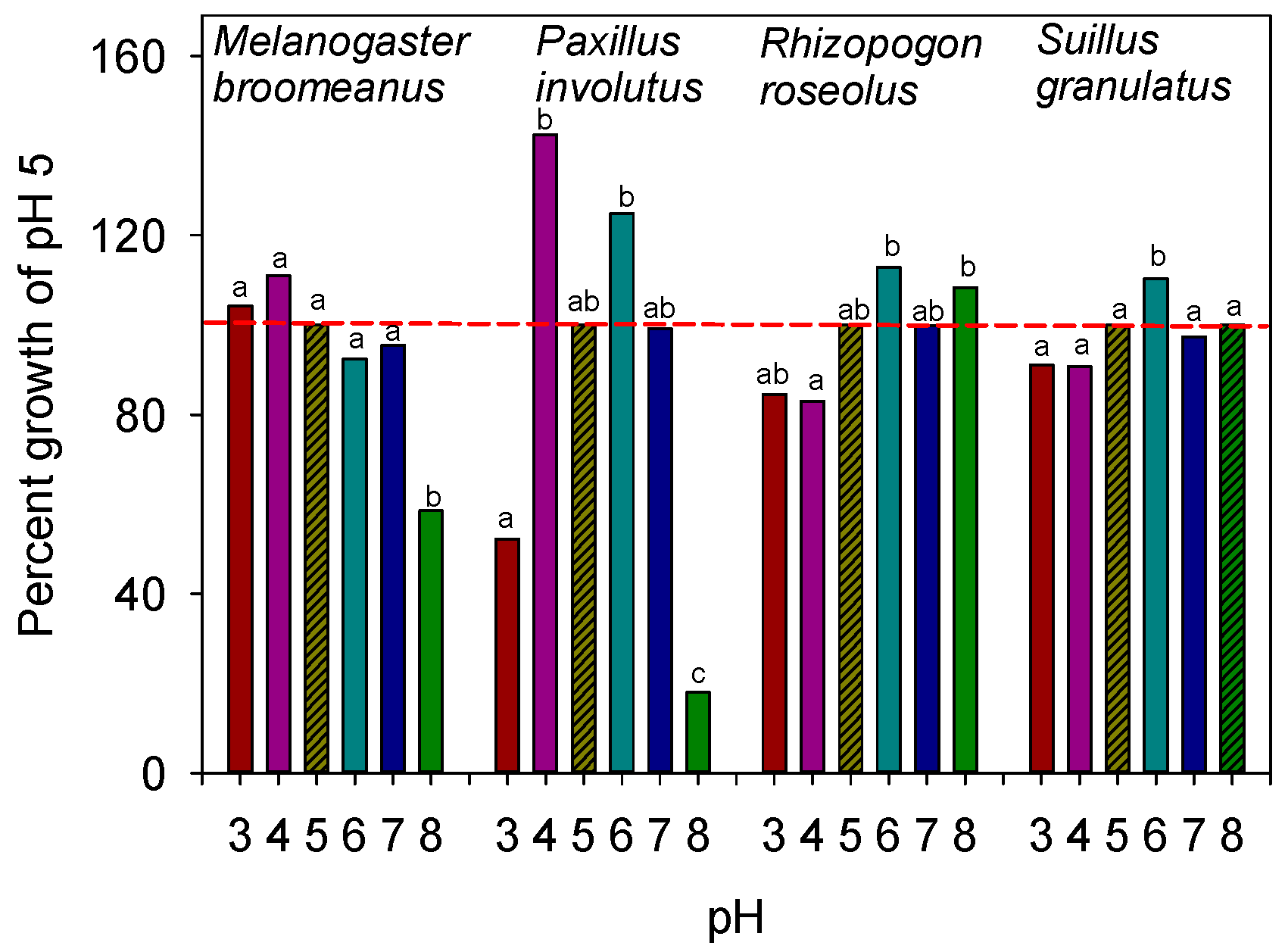
The growth of all the fungi was relatively unaffected by pH within the range 4 to 7 (Figure 1). Melanogaster broomeanus showed a strong reduction in radial growth at pH 8, as did Paxillus involutus, which also showed reduced growth at pH 3. Rhizopogon roseolus showed no clear pattern of response to pH but showed a lower rate of growth at pH 3 and 4, but this was not significantly different. Suillus granulatus had a significantly higher radial growth rate at pH 6 compared to all other pH values.

3.2. Effect of N Source on Radial Growth

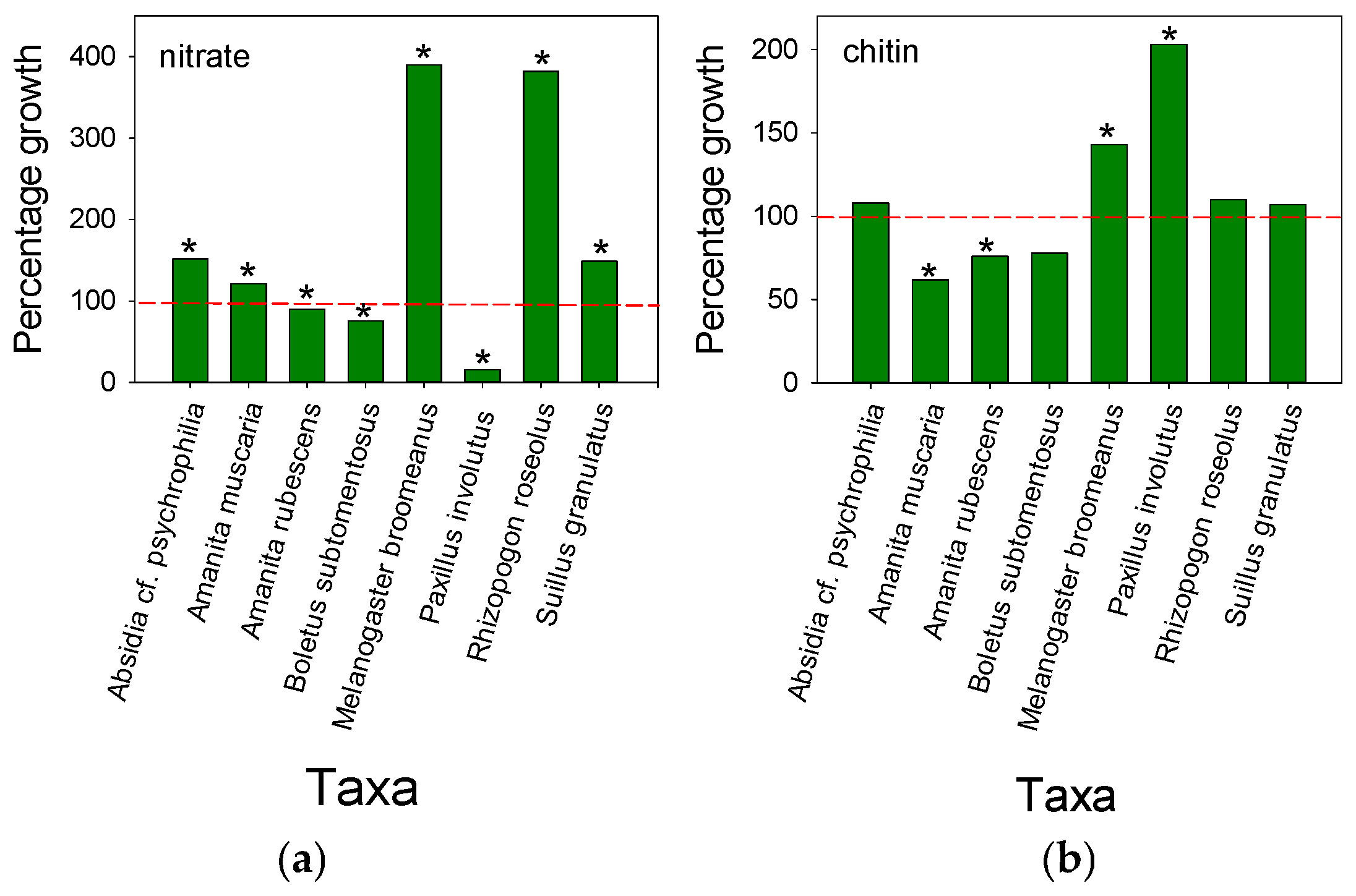
Two fungi Melanogaster broomeanus and Rhizopogon roseolus showed a nearly 4-fold greater radial growth rate on MMN medium containing NO3 compared to NH4 (Figure 2a). A significantly higher growth on medium containing NO3 was also shown for Absidia cf. psychrophilia, Amanita muscaria, and Suillus granulatus. In contrast the growth of Paxillus involutus on MMN medium containing NO3 was reduced to 20% of that on medium containing NH4. Amanita rubescens and Boletus subtomentosus showed a slightly lower radial growth rate on NO3 compared to NH4.
All of the fungi were able to use chitin as a N source (Figure 2b). The radial growth of Melanogaster broomeanus and Paxillus involutus was significantly greater when N was supplied as chitin compared to growth on NH4. In contrast, Amanita muscaria and Amanita rubescens had lower growth rates on chitin compared to NH4.
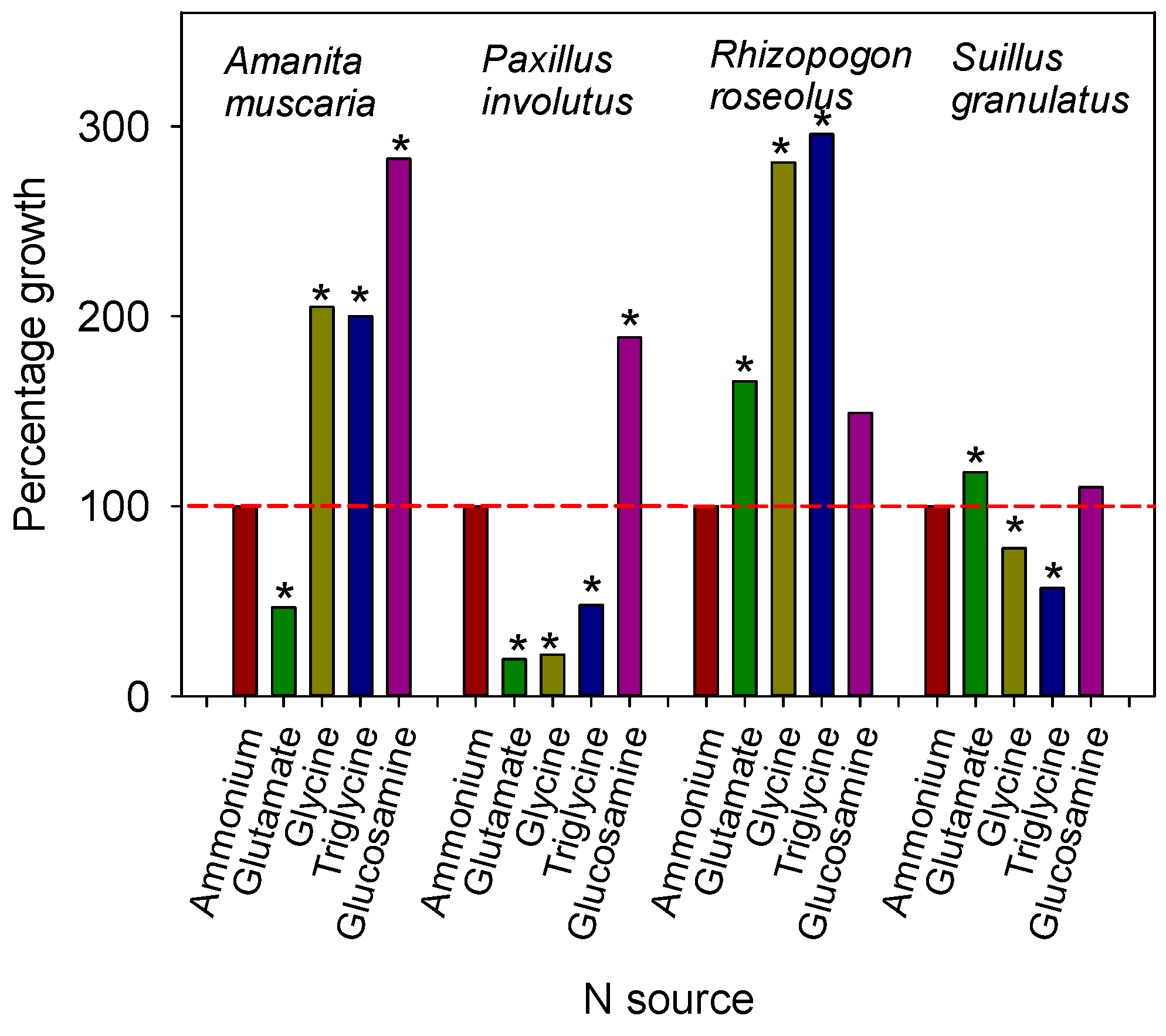
The growth of Amanita muscaria, Paxillus involutus, Rhizopogon roseolus, and Suillus granulatus on a number of N sources is shown in Figure 3. The growth of Amanita muscaria was lower on glutamate but was greater on glycine and triglycine compared to growth on NH4. The growth of Paxillus involutus was lower on all of the amino acids, as was the growth of Suillus granulatus on glycine and triglycine. However, in Suillus granulatus, growth on glutamate was greater than the NH4 control. Rhizopogon roseolus grew better on all amino acids compared to the NH4 control. All of the fungi were able to utilize glucosamine as a N source. Amanita muscaria and Paxillus involutus showed greater growth on glucosamine compared to growth on NH4.

4. Discussion

The degree to which the different ectomycorrhizal fungi were able to utilize the different N sources varied between the different taxa. Most ectomycorrhizal fungi are able to utilize ammonium [4,12] and thus NH4 is commonly used in culture media. In our investigation, most of the fungi were also able to utilize NO3 and only Paxillus involutus did not grow on the NO3 containing medium. In all cases, we expressed the growth relative on different N sources in relation to the growth on the standard NH4 containing MMN medium [28]. Two fungi, Melanogaster broomeanus and Rhizopogon roseolus, grew 3–4 times better on NO3 compared to NH4. Two other EM fungi, Amanita muscaria and Suillus granulatus, and the endophyte Absidia cf. psychrophilia, also grew significantly better on NO3 compared to NH4. Greater growth on NO3 compared to NH4 has been shown in a number of other studies but was species-dependent. Lazarevic et al. [29] showed that Lactarius deciduous also grew better on NO3 compared to NH4, but that the growth of Suillus granulatus was unaffected by N source. In contrast, Francis and Reid [30] also showed a better growth of Suillus granulatus on NO3. Finlay et al. [10] showed that Suillus variegatus, Piloderma croceum, Paxillus involutus, and Hebeloma crustuliniforme grew less well on NO3 compared to NH4. In ectomycorrhizal root tips of Fagus sylvatica from a temperate forest, Khokon et al. [12] showed that uptake of NH4 generally exceeded that of NO3 for a range of EM taxa, matching the expected availability of these N forms at such sites. However, in a study of over 68 species [31], from both boreal and temperate forests, the majority of the species were also able to utilize NO3 irrespective of their isolation source. Thus, even fungi isolated from boreal forests, where soil NO3 levels tend to be low [1], were able to utilize NO3. In addition, in 35 out of 43 tested strains partial sequences of the nar gene were determined. This gene codes the enzyme nitrate reductase, which is considered to be essential for the assimilation of NO3 [32]. In our study, only Paxillus involutus was unable to utilize NO3, and was isolated from an acidic spruce forest in Northern Germany. In forests, sporocarp production of Paxillus involutus has been shown to increase under N addition [33]. Ek et al. [34] found that Paxillus involutus was able to transfer N as nitrate through the extramatrical mycelium to the host plant, leading Nygren et al. [31] to suggest that this may be a mechanism to avoiding potential toxic effects of NO3. Clearly this would not be possible in in-vitro cultures, which may explain the lack of growth of Paxillus involutus on NO3. At the species level, no clear pattern emerges in the relative ability to utilize NO3 for growth, both in this study and in comparison to previous work. While the ability to assimilate NO3 seems common amongst ectomycorrhizal fungi, the use of NO3 for growth is species- and also strain-dependent [35].
Similarly, there were differences between the ectomycorrhizal fungi in the ability to use both monomeric amino acids and the peptide triglycine. Paxillus involutus, which was unable to utilize NO3, also only poorly utilized the amino acids and the peptide. In contrast, Rhizopogon roseolus showed increased growth on media containing all amino acids including glutamate, and also on the NO3 containing medium. Both Paxillus involutus and Rhizopogon roseolus originated from acid soil types, showing that there is no clear link between the N source preference and origin. In previous studies, Hebeloma isolates were also shown to use alanine and glutamic acid better than NH4 (Tibbett et al., 1998) [36].
In our study, all fungi were able to utilize and grow on the polymeric substance chitin, and those tested also on the amino sugar glucosamine. Chitin was utilized by both the ectomycorrhizal fungi and the endophyte. Chitin and glucosamine are important organic N pools in boreal forest soils [15,37]. The ability to degrade protein, commonly in the form of bovine serum albumin, is widespread [11,20], but often growth on BSA is poor compared to growth on NH4 [10,35]. Thus, there appears to be a dichotomy between the ability to degrade a complex substrate and actual utilization for growth. Paxillus involutus and Melanogaster broomeanus grew better on chitin than on NH4, whereas both taxa of Amanita grew less well on chitin. In contrast, all three of these fungi we able to utilize the chitin precursor glucosamine. Although Paxillus involutus is considered to be an efficient decomposer of soil organic matter [38] and has been shown in other studies to degrade hyphal necromass [17], it was shown that it was not able to utilize N from chitin [18]. In a study of 16 EM fungal taxa [18], only 4 had a significant capacity for chitin degradation, leading to the suggestion that the ability to degrade chitin is not widespread. However, in our study. all of the fungi tested grew with chitin as a N source, and also on the N containing glucosamine, some (Amanita muscaria, Paxillus involutus) better than on NH4. In the method we used, all other sources of N including malt extract were not included in the MMN medium. Chitin was primarily present as fine particles in the agar, suggesting that the fungi degraded the polymer. However, we cannot rule out that during sterilization, some degradation of the chitin occurred. Similarly, we cannot rule out that there was not some residual N in the agar used to gel the plates and also in the 6 mm inoculation plug. As the MMN contained 10 g L−1 glucose, it is unlikely that the glucose contribution from chitin or glucosamine stimulated growth, but rather both act as a source of N.
All of the fungi tested were relatively insensitive to pH except at very low (pH 3) or very high (pH 8) values. Similar results have also been found for other ectomycorrhizal fungi [29,39].

5. Conclusions

Ectomycorrhizal fungi can utilize a number of N sources, both inorganic and organic. Our work shows evidence that ectomycorrhizal fungi and also a root-associated endophyte can actively use chitin as a N source. The ability to utilize the different N sources was independent of the origin of the fungi.

Author Contributions

Conceptualization, D.L.G. and B.O.; Methodology, D.L.G.; Formal Analysis, B.O., H.L. and D.L.G.; Writing—Original Draft Preparation, D.L.G.; Writing—Review and Editing, D.L.G. and B.O. All authors have read and agreed to the published version of the manuscript.

Funding

HL was funded by the China Scholarship Council [grant number 202006600004]. DLG and BO were supported by the EU Horizon project EXCELLENTIA [grant number 101087262] at Mendel University in Brno during the manuscript preparation phase.

Institutional Review Board Statement

Not applicable.

Informed Consent Statement

Not applicable.

Data Availability Statement

The original contributions presented in this study are included in the article. Further inquiries can be directed to the corresponding authors.

Acknowledgments

The authors thank Hojka Kraigher and Tine Grebenc for providing the Slovenian isolates. We thank Miriam Feichtinger, Victoria Gaupmann, Barbara Hofer, Markus Huber, Helen Steiner, Laura Steinwidder and Stefan Villunger for carrying out much of the laboratory work.

Conflicts of Interest

The authors declare no conflict of interest.

References

  1. Högberg, P.; Nasholm, T.; Franklin, O.; Högberg, M.N. Tamm review: On the nature of the nitrogen limitation to plant growth in Fennoscandian boreal forests. For. Ecol. Manag. 2017, 403, 161–185. [Google Scholar] [CrossRef]
  2. Dannenmann, M.; Simon, J.; Gasche, R.; Holst, J.; Naumann, P.S.; Kögel-Knabner, I.; Knicker, H.; Mayer, H.; Schloter, M.; Pena, R.; et al. Tree girdling provides insight on the role of labile carbon in nitrogen partitioning between soil microorganisms and adult European beech. Soil Biol. Biochem. 2009, 41, 1622–1631. [Google Scholar] [CrossRef]
  3. Lipson, D.A.; Näsholm, T. The unexpected versatility of plants: Organic nitrogen use and availability in terrestrial ecosystems. Oecologia 2001, 128, 305–316. [Google Scholar] [CrossRef] [PubMed]
  4. Nguyen, D.Q.; Schneider, D.; Brinkmann, N.; Song, B.; Janz, D.; Schöning, I.; Daniel, R.; Pena, R.; Polle, A. Soil and root nutrient chemistry structure root associated fungal assemblages in temperate forests. Environ. Microbiol. 2020, 22, 3081–3095. [Google Scholar] [CrossRef]
  5. Andersen, B.R.; Gundersen, P. Nitrogen and carbon interactions of forest soil water. In Carbon and Nitrogen Cycling in European Forest Ecosystems. Ecological Studies; Schulze, E.-D., Ed.; Springer: Berlin/Heidelberg, Germany, 2000; Volume 142, pp. 332–340. [Google Scholar]
  6. Nannipieri, P.; Paul, P. The chemical and functional characterization of soil N and its biotic components. Soil Biol. Biochem. 2009, 41, 2357–2369. [Google Scholar] [CrossRef]
  7. Chalot, M.; Plassard, C. Ectomycorrhiza and nitrogen provision to the host tree. In Ecological Aspects of Nitrogen Metabolism in Plants; John Wiley and Sons: Hoboken, NJ, USA, 2011; pp. 69–94. [Google Scholar]
  8. Phillips, R.P.; Brzostek, E.; Midgley, M.G. The mycorrhizal-associated nutrient economy: A new framework for predicting carbon–nutrient couplings in temperate forests. New Phytol. 2013, 199, 41–51. [Google Scholar] [CrossRef]
  9. Nehls, U.; Plassard, C. Nitrogen and phosphate metabolism in ectomycorrhizas. New Phytol. 2018, 220, 1047–1058. [Google Scholar] [CrossRef]
  10. Finlay, R.D.; Frostegard, A.; Sonnerfeldt, A.M. Utilization of organic and inorganic nitrogen sources by ectomycorrhizal fungi in pure culture and in symbiosis with Pinus contorta Dougl. ex Loud. New Phytol. 1992, 120, 105–115. [Google Scholar] [CrossRef]
  11. Abuzinadah, R.A.; Read, D.J. The role of proteins in the nitrogen nutrition of ectomycorrhizal plants. I. Utilization of peptides and proteins by ectomycorrhizal fungi. New Phytol. 1986, 103, 481–493. [Google Scholar] [CrossRef]
  12. Khokon, A.; Janz, D.; Polle, A. Ectomycorrhizal diversity, taxon-specific traits and root N uptake in temperate beech forests. New Phytol. 2023, 239, 739–751. [Google Scholar] [CrossRef]
  13. Talbot, J.M.; Treseder, K.K. Controls over mycorrhizal uptake of organic nitrogen. Pedobiologia 2010, 53, 169–179. [Google Scholar] [CrossRef]
  14. Schmidt, M.W.I.; Torn, M.S.; Abviven, S.; Dittmar, T.; Guggenberger, G.; Janssens, J.; Kleber, M.; Kogel-Knabner, I.; Lehmann, J.; Manning, D.A.C.; et al. Persistence of soil organic matter as an ecosystem property. Nature 2011, 478, 49–56. [Google Scholar] [CrossRef] [PubMed]
  15. Pramanik, P.; Ghosh, G.K.; Chung, Y.R. Changes in nutrient content, enzymatic activities and microbial properties of lateritic soil due to application of different vermicomposts: A comparative study of ergosterol and chitin to determine fungal biomass in soil. Soil Use Manag. 2010, 26, 508–515. [Google Scholar] [CrossRef]
  16. Kumar, M.N.R. A review of chitin and chitosan applications. React. Funct. Polym. 2000, 46, 1–27. [Google Scholar] [CrossRef]
  17. Akroume, E.; Maillard, F.; Bach, C.; Hossann, C.; Brechet, C.; Angeli, N.; Zeller, B.; Saint-André, L.; Buée, M. First evidences that the ectomycorrhizal fungus Paxillus involutus mobilizes nitrogen and carbon from saprotrophic fungus necromass. Environ. Microbiol. 2019, 21, 197–208. [Google Scholar] [CrossRef]
  18. Maillard, F.; Didion, M.; Fauchery, L.; Bach, C.; Buee, M. N-Acetylglucosaminidase activity, a functional trait of chitin degradation, is regulated differentially within two orders of ectomycorrhizal fungi: Boletales and Agaricales. Mycorrhiza 2018, 28, 391–397. [Google Scholar] [CrossRef]
  19. Cantarel, B.L.; Coutinho, P.M.; Rancurel, C.; Bernard, T.; Lombard, V.; Henrissat, B. The Carbohydrate-Active EnZymes database (CAZY): An expert resource for glycogenomics. Nucleic Acids Res. 2009, 37, 233–238. [Google Scholar] [CrossRef]
  20. Rineau, F.; Stas, J.; Nguyen, N.H.; Kuyper, T.W.; Carleer, R.; Vangronsveld, J.; Colpaert, J.V.; Kennedy, P.G. Ectomycorrhizal fungal protein degradation ability predicted by soil organic nitrogen availability. Appl. Environ. Microbiol. 2016, 82, 1391–1400. [Google Scholar] [CrossRef]
  21. Leake, J.R.; Read, D.J. Chitin as a nitrogen source for mycorrhizal fungi. Mycol. Res. 1990, 94, 993–995. [Google Scholar] [CrossRef]
  22. Vohník, M.; Mrnka, L.; Lukešová, T.; Bruzone, M.C.; Kohout, P.; Fehrer, J. The cultivable endophytic community of Norway spruce ectomycorrhizas from microhabitats lacking ericaceous hosts is dominated by ericoid mycorrhizal Meliniomyces variabilis. Fungal Ecol. 2013, 6, 281–292. [Google Scholar] [CrossRef]
  23. Tedersoo, L.; Pärtel, K.; Jairus, T.; Gates, G.; Pöldmaa, K.; Tamm, H. Ascomycetes associated with ectomycorrhizas: Molecular diversity and ecology with particular reference to the Helotiales. Environ. Microbiol. 2009, 11, 3166–3178. [Google Scholar] [CrossRef] [PubMed]
  24. Noguchi, M.; Toju, H. Mycorrhizal and endophytic fungi structure forest below-ground symbiosis through contrasting but interdependent assembly processes. Environ. Microbiome 2024, 19, 84. [Google Scholar] [CrossRef] [PubMed]
  25. Terhonen, E.; Sipari, N.; Asiegbu, F.O. Inhibition of phytopathogens by fungal root endophytes of Norway spruce. Biol. Control 2016, 99, 53–63. [Google Scholar] [CrossRef]
  26. Vohník, M.; Albrechtová, J.; Vosátka, M. The inoculation with Oidiodendron maius and Phialocephala fortinii alters phosphorus and nitrogen uptake, foliar C: N ratio and root biomass distribution in Rhododendron cv. Azurro. Symbiosis 2005, 40, 87–96. [Google Scholar]
  27. Otgonsuren, B.; Rosinger, C.; Wang, L.; Godbold, D.L. Winter soils of Mongolian forests have viable ectomycorrhizas and soil enzymatic activity. Soil Biol. Biochem. 2020, 148, 107914. [Google Scholar] [CrossRef]
  28. Marx, D.H. The influence of ectotrophic fungi on the resistance of pine roots to pathogenic infection. Phytopathology 1969, 59, 153–163. [Google Scholar]
  29. Lazarević, J.; Stojičić, D.; Keč, N. Effects of temperature, pH and carbon and nitrogen sources on growth of in vitro cultures of ectomycorrhizal isolates from Pinus heldreichii forest. For. Syst. 2016, 25, e048. [Google Scholar] [CrossRef]
  30. France, R.C.; Reid, C.P.P. Pure culture growth of ectomycorrhizal fungi on inorganic nitrogen sources. Microb. Ecol. 1984, 10, 187–195. [Google Scholar] [CrossRef]
  31. Nygren, C.M.R.; Eberhardt, U.; Karlsson, M.; Parrent, J.L.; Lindahl, B.D.; Taylor, A.F.S. Growth on nitrate and occurrence of nitrate reductase-encoding genes in a phylogenetically diverse range of ectomycorrhizal fungi. New Phytol. 2008, 180, 875–889. [Google Scholar] [CrossRef]
  32. Marschner, H.; Marschner, P. Marschner’s Mineral Nutrition of Higher Plants; Academic Press: Cambridge, MA, USA, 2011. [Google Scholar]
  33. Shubin, V.I. Influence of fertilizers on the fruiting of forest mushrooms. Acta Bot. Fenn. 1988, 136, 85–87. [Google Scholar]
  34. Ek, H.; Andersson, S.; Arnebrant, K.; Söderström, B. Growth and assimilation of and by Paxillus involutus in association with Betula pendula and Picea abies as affected by substrate pH. New Phytol. 1994, 128, 629–637. [Google Scholar] [CrossRef]
  35. Sawyer, N.A.; Chambers, S.M.; Cairney, J.W.G. Utilisation of inorganic and organic nitrogen sources by Amanita species native to temperate eastern Australia. Mycol. Res. 2003, 107, 413–420. [Google Scholar] [CrossRef]
  36. Tibbett, M.; Sanders, F.E.; Minto, S.J.; Dowell, M.; Cairney, J.W.G. Utilization of organic nitrogen by ectomycorrhizal fungi (Hebeloma spp.) of arctic and temperate origin. Mycol. Res. 1998, 102, 1525–1532. [Google Scholar] [CrossRef]
  37. Joergensen, R.G. Amino sugars as specific indices for fungal and bacterial residues in soil. Biol. Fertil. Soils 2018, 54, 559–568. [Google Scholar] [CrossRef]
  38. Bödeker, I.T.M.; Clemmensen, K.E.; de Boer, W.; Martin, F.; Olson, A.; Lindahl, B.D. Ectomycorrhizal Cortinarius species participate in enzymatic oxidation of humus in northern forest ecosystems. New Phytol. 2014, 203, 245–256. [Google Scholar] [CrossRef]
  39. Sanchez, F.; Honrubia, M.; Torres, P. Effects of pH, water stress and temperature on in vitro growth of ectomycorrhizal fungi from Mediterranean forests. Cryptog. Mycol. 2001, 22, 243–258. [Google Scholar] [CrossRef]
Figure 1. The effect of pH on the radial growth of four ectomycorrhizal fungi. Growth is shown as percentage growth compared to growth at pH 5 (100%). The red broken line shows 100%. Bars not followed by the same letters within a fungal taxa are significantly different. p < 0.05.
Microbiolres 17 00005 g001
Figure 2. The effect of nitrate (a) and chitin (b) on the radial growth of ectomycorrhizal fungi and Absidia cf. psychrophilia. Growth of nitrate and chitin is shown as percentage growth compared to growth on ammonium (100%). The red broken line shows 100%. The values of bars marked with an asterisk (*) are significantly different when comparing growth on nitrate or chitin with growth on ammonium. p < 0.05.
Microbiolres 17 00005 g002
Figure 3. The radial growth of four ectomycorrhizal fungi on various N sources. Growth is shown as percentage growth compared to growth in ammonium (100%). The red broken line shows 100%. The values of bars marked with an asterisk (*) are significantly different when comparing growth on glutamate, glycine, triglycine, or glucosamine with growth on ammonium, p < 0.05.
Microbiolres 17 00005 g003
Table 1. Sources of fungi. Shown are the country of origin, the dominant tree species at the site of origin, and the soil type.
TaxaSource CountryAssociated Tree SpeciesSoil Type
Absidia cf. psychrophiliaMongoliaPinus sibiricaNeutral
Amanita muscariaScotlandPinus sylvestrisUnknown
Amanita rubescensSloveniaQuercus petraea, Pinus sylvestris, Fagus sylvaticaAcid
Boletus subtomentosusSloveniaQuercus petraea, Carpinus betulus,Calcareous
Melanogaster broomeanusSloveniaFagus sylvaticaCalcareous
Paxillus involutus 533GermanyPicea abiesAcid
Rhizopogon roseolusSloveniaPicea abiesAcid
Suillus granulatusSloveniaUnknownUnknown
Disclaimer/Publisher’s Note: The statements, opinions and data contained in all publications are solely those of the individual author(s) and contributor(s) and not of MDPI and/or the editor(s). MDPI and/or the editor(s) disclaim responsibility for any injury to people or property resulting from any ideas, methods, instructions or products referred to in the content.