Article

Identification and Characterization of a Proteinaceous Antibacterial Factor from Pseudomonas extremorientalis PEY1 Active Against Edwardsiella tarda


by
Hyun-Sol Jo
1,2,
Youl-Lae Jo
3,* and
Sun-Mee Hong
1,*
1
Marin Industry Research Institute for East Sea Rim, 22 Haeyanggwahak-gil, Uljin-gun 36315, Gyeongsangbuk-do, Republic of Korea
2
Korea Food Research Institute, Iseo-myeon, Wanju-Gun 55365, Jeollabuk-do, Republic of Korea
3
Department of Biotechnology, College of Life and Applied Sciences, Yeungnam University, 280 Daehak-ro, Gyeongsan 38541, Gyeongsangbuk-do, Republic of Korea
*
Authors to whom correspondence should be addressed.
Microbiol. Res. 2026, 17(1), 6; https://doi.org/10.3390/microbiolres17010006 (registering DOI)

Submission received: 11 November 2025 / Revised: 18 December 2025 / Accepted: 22 December 2025 / Published: 30 December 2025

Abstract

Pseudomonas extremorientalis PEY1, isolated from the intestinal contents of marine fish, was evaluated for the production and properties of antibacterial proteins active against Edwardsiella tarda, a major pathogen in aquaculture. Antibacterial production was maximized in a minimal medium supplemented with 1% yeast extract and 1% galactose under stationary cultivation at 25 °C and pH 7.0. Growth and bioactivity assays were conducted under varying carbon and nitrogen sources, temperatures, and pH levels. Sodium dodecyl sulfate-polyacrylamide gel electrophoresis analysis revealed a distinct ~37 kDa protein band corresponding to antibacterial activity, exhibiting an inhibition zone of 2.4 ± 0.1 cm against E. tarda. The activity was completely abolished by papain digestion but remained detectable after exposure to 55 °C and pH 8, indicating that the active compound is a moderately heat-stable, proteinaceous antibacterial molecule. LC–MS/MS analysis identified the protein as a putative disulfide reductase with ~40% sequence coverage. The antibacterial factor exhibited strong physicochemical stability, retaining activity in the presence of surfactants and metal ions. Collectively, these findings demonstrate that P. extremorientalis PEY1 produces a thermostable, papain-sensitive antibacterial protein with selective activity against E. tarda, highlighting its potential as a promising natural biocontrol or postbiotic candidate for sustainable aquaculture.

1. Introduction

Aquaculture is expanding rapidly to meet the increasing global demand for high-quality protein; however, this growth has been accompanied by recurrent outbreaks of bacterial diseases that compromise fish health and farm productivity. Among these pathogens, Edwardsiella tarda—a Gram-negative, facultative anaerobe—is one of the most serious causative agents of edwardsiellosis in both freshwater and marine fish, characterized by hemorrhagic septicemia, granulomatous inflammation, and high mortality [1,2]. The intensification of aquaculture, with high stocking densities and limited water exchange, has further exacerbated stress and disease susceptibility in fish, resulting in substantial economic losses [3].
Antibiotics and vaccines have been widely explored to control bacterial infections. However, both strategies face critical limitations. Antibiotic overuse has accelerated the emergence of antimicrobial resistance and raised concerns over drug residues in edible fish tissues, posing public health and food safety risks [4,5,6]. Vaccines, while effective in certain contexts, remain costly and logistically difficult to apply at scale, and often offer limited protection in early life stages or under mixed-infection conditions [7,8]. These challenges underscore the urgent need for sustainable, eco-friendly antimicrobial alternatives suitable for aquaculture systems.
Natural antibacterial compounds, particularly bacteriocins and bacteriocin-like proteins, are attracting increasing attention as promising biocontrol agents. Bacteriocins are ribosomally synthesized peptides or proteins produced by bacteria that display potent inhibitory activity against specific or closely related pathogens. They are commonly classified into Class I (lantibiotics), Class II (small heat-stable peptides), and Class III (large heat-labile proteins), differing in structure and mechanism of action [9,10,11]. Their bactericidal mechanisms typically involve membrane permeabilization or inhibition of cell wall synthesis, and their narrow-spectrum selectivity enables suppression of pathogens without disrupting beneficial microbiota—an advantage for application in aquaculture [12]. Despite their potential, bacteriocin-like proteins derived from marine microorganisms remain poorly characterized, representing an untapped source of novel antimicrobial candidates.
The genus Pseudomonas is known for its metabolic versatility and production of diverse bioactive metabolites, including siderophores, biosurfactants, and proteinaceous antibacterial substances [13,14,15]. Several Pseudomonas strains isolated from aquatic environments have exhibited antibacterial effects against fish pathogens; however, detailed molecular characterization of their active compounds remains limited. Pseudomonas extremorientalis (P. extremorientalis), a psychrotolerant species first isolated from marine or cold environments, has recently gained attention for its stress tolerance and secretion of extracellular enzymes [16,17]. Yet, its potential to produce antibacterial proteins effective against E. tarda has not been reported.
In this study, we isolated P. extremorientalis PEY1 from the intestinal contents of marine fish and identified its strong antibacterial activity against E. tarda. We optimized minimal culture conditions for the production of the active compound, characterized its biochemical stability (enzyme, temperature, and pH resistance), and identified the active protein using sodium dodecyl sulfate-polyacrylamide gel electrophoresis (SDS–PAGE) and liquid chromatography-tandem mass spectrometry (LC–MS/MS) analysis. The compound was determined to be a ~37 kDa heat-stable, papain-sensitive protein identified as a protein disulfide reductase–like enzyme. To our knowledge, this is the first report describing a heat-stable antibacterial factor from P. extremorientalis effective against E. tarda, suggesting a novel mechanism of bacterial antagonism and a potential natural postbiotic candidate for sustainable aquaculture applications.

2. Materials and Methods

2.1. Isolation and Identification of the Antibacterial Strain

Bacterial strains exhibiting antibacterial activity against E. tarda were isolated from the intestinal contents of marine fish purchased from local markets in Gyeongsangbuk-do, Republic of Korea, following standard procedures for bacterial isolation from fish microbiota [1,2]. Briefly, 1 g of intestinal content was suspended in 9 mL of nutrient salt solution composed of NaCl (2%), MgSO4 (0.2%), KCl (0.1%), CaCl2 (0.01%), and trace minerals, and incubated at 25 °C with shaking at 100 rpm for 4 h. The incubated suspension was serially diluted (10−1–10−4) with sterile distilled water, and 100 μL aliquots were spread onto Luria–Bertani (LB) agar plates (BD Difco™, Franklin Lakes, NJ, USA). After incubation at 25 °C for 24 h, colonies forming inhibition zones against E. tarda KCTC 12267 (Korean Collection for Type Cultures, Jeongeup, Republic of Korea) were selected and purified by triple streaking to obtain pure isolates.
For molecular identification, genomic DNA was extracted using a Wizard® Genomic DNA Purification Kit (Promega, Madison, WI, USA) according to the manufacturer’s instructions. The 16S rRNA gene was amplified via polymerase chain reaction (PCR) using universal primers 27F (5′-AGAGTTTGATCCTGGCTCAG-3′) and 1492R (5′-GGTTACCTTGTTACGACTT-3′) [15]. PCR products were purified using a QIAquick PCR Purification Kit (Qiagen, Hilden, Germany), and sequencing was performed by Macrogen Inc. (Seoul, Republic of Korea). The obtained sequences were analyzed for sequence similarity using the BLAST algorithm (National Center for Biotechnology Information [NCBI, https://blast.ncbi.nlm.nih.gov], Bethesda, MD, USA) [16,17]. The strain was routinely cultured in LB broth at 25 °C for 24 h with shaking (120 rpm) and stored in 15% (v/v) glycerol at −72 °C for long-term storage.

2.2. Optimization of Culture Conditions and Antibacterial Activity Assay

2.2.1. Effect of Aeration and Temperature

Culture conditions for PEY1 were optimized to enhance growth and antibacterial activity following standard optimization approaches used for Pseudomonas spp. [18,19]. A 1% (v/v) overnight culture in LB broth (BD Difco™, Sparks, MD, USA) was used as inoculum for all experiments. Aeration effects were assessed in 250 mL Erlenmeyer flasks (Corning Inc., Corning, NY, USA) containing 50 mL medium under static (0 rpm) or shaking (120 rpm) conditions at 25 °C for 24 h. Temperature optimization was performed at 20, 25, 30, 40, and 50 °C using a shaking incubator (SI-600R, Jeio Tech, Daejeon, Republic of Korea).

2.2.2. Effect of Carbon and Nitrogen Sources

Carbon and nitrogen sources were screened as described for bacterial metabolite production [8,9]. Diluted LB broth (10% (v/v)) was supplemented with 1% (w/v) of each compound. Carbon sources included glucose, lactose, maltose, sucrose, galactose, sodium acetate, and sodium citrate (Sigma-Aldrich, St. Louis, MO, USA). Nitrogen sources included (NH4)2SO4 (Daejung Chemicals, Siheung-si, Gyeonggi-do, Republic of Korea), peptone, tryptone, yeast extract, malt extract, beef extract (BD Difco™, Sparks, MD, USA), and urea (Sigma-Aldrich, USA). The most effective combination (1% galactose and 1% yeast extract) was further evaluated with or without 10% LB supplementation.

2.2.3. Effect of Initial pH

The initial pH was adjusted from 3.0 to 11.0 using 50 mM buffer systems: citrate (pH 3–5), potassium phosphate (pH 6–7), Tris–HCl (pH 8–9), and NaHCO3-NaOH solution for alkaline conditions. All buffers and chemicals were obtained from Sigma-Aldrich (USA). Media were sterilized separately by autoclaving at 121 °C for 15 min, and pH adjustment was performed post-sterilization [9]. After incubation at each test pH, all samples were readjusted to pH 7.0 prior to antibacterial activity measurements to ensure that observed differences reflected the stability of the antibacterial factor rather than variations in assay pH.

2.2.4. Growth Kinetics

Under optimized conditions (1% galactose + 1% yeast extract, pH 7.0, 25 °C, static culture), the growth kinetics of PEY1 were analyzed over 32 h. Samples were collected every 4 h, and cell growth was monitored by measuring optical density at 600 nm (OD600) using a UV–Visible spectrophotometer (UV-1800, Shimadzu, Kyoto, Japan).

2.2.5. Antibacterial Activity Assay

The antibacterial spectrum of the culture supernatant was evaluated against eight indicator bacteria: Bacillus cereus ATCC 14579 (LB agar, 30 °C), Staphylococcus aureus ATCC 12600 (LB agar, 30 °C), Streptococcus mutans KCTC 3065 (BHI agar, 30 °C), Streptococcus sobrinus ATCC 29521 (BHI agar, 30 °C), Streptococcus parauberis KCTC 3651 (BHI agar, 37 °C), Streptococcus iniae KCTC 3657, Vibrio anguillarum KCTC 2711 (Marine agar, 25 °C), and Edwardsiella tarda KCTC 12267 (LB agar, 25 °C). These strains were selected because they include major aquaculture pathogens and representative Gram-positive and Gram-negative bacteria commonly used to evaluate antibacterial specificity and spectrum. After spreading each strain onto its respective media, 8-mm sterile paper disks (Advantec, Tokyo, Japan) loaded with 100 µL of the PEY1 supernatant were placed on the surface. Plates were incubated at 25 °C for 18 h, and the diameter of the inhibition zone (including the 8-mm disk) was measured to assess antibacterial range and selectivity.

2.3. Characterization of Antibacterial Substances Produced by P. extremorientalis PEY1

2.3.1. Preparation of Cell-Free Supernatant

Cultures of PEY1 were incubated under optimized conditions (1% galactose and 1% yeast extract, pH 7.0, 25 °C, static) for 24 h. Cells were removed by centrifugation at 8000× g for 10 min at 4 °C (Supra 22K, Hanil Scientific, Gimpo, Republic of Korea), and the supernatants were filtered through 0.45 μm syringe filters (Advantec, Tokyo, Japan). The resulting cell-free supernatants were used immediately for physicochemical assays without further concentration. Antibacterial activity was assessed using the paper disk diffusion method as described in Section 2.2.5, and inhibition zone diameters were recorded in centimeters.

2.3.2. Thermal and pH Stability

Thermal stability was evaluated by heating the cell-free supernatant at 10–100 °C for 3 h using a heating block (Thermo Bath ALB64, FINEPCR, Seoul, Republic of Korea). After treatment, samples were cooled to room temperature (25 °C), and residual antibacterial activity was measured using the disk diffusion assay. For pH stability, the effect of pH on the stability of the antibacterial compound was assessed as described in Section 2.2.3, using the same buffer systems ranging from pH 2 to 11. Equal volumes (100 μL each) of the supernatant and buffer solutions were mixed and incubated at 4 °C for 12 h. Relative activity (%) was calculated based on the inhibition zone diameter compared with the untreated control (set as 100%).

2.3.3. Chemical Stability

To evaluate chemical stability, the supernatant was treated with various surfactants and denaturing agents at a final concentration of 1 × 10⁻³ M. The chemicals included sodium dodecyl sulfate (SDS), sodium azide, Tween 40, Triton X-100, and urea (Sigma-Aldrich, St. Louis, MO, USA). Samples were incubated at 4 °C for 12 h, and antibacterial activity was measured using the disk diffusion assay. Relative activity was calculated as the percentage of the untreated control.

2.3.4. Metal Ion Sensitivity

To evaluate metal ion effects, FeSO4, CaCl2, CoCl2, CuSO4, MgSO4, and ZnSO4 (all from Sigma-Aldrich, USA) were added to the supernatant at a final concentration of 1 × 10⁻³ M. Following incubation at 4 °C for 12 h, residual activity was determined as described above. Relative activity was expressed as a percentage of the control without metal ions.

2.3.5. Proteolytic Enzyme Sensitivity

To determine whether the antibacterial compound was proteinaceous, the cell-free supernatant of PEY1 was treated with various proteolytic enzymes, including trypsin (0.25%, 37 °C), pepsin (4 mg/mL, 37 °C), proteinase K (4 mg/mL, 55 °C), and papain (4 mg/mL, 55 °C). All enzymes were purchased from Sigma-Aldrich (USA), except papain, which was obtained from Fluka (Buchs, Switzerland). A control was prepared by replacing the enzyme solution with sterile distilled water. The antibacterial activity of each treated supernatant was then determined using the paper disk diffusion method against E. tarda KCTC 12267. Relative activity (%) was calculated based on the inhibition zone diameter relative to the untreated control.

2.4. Identification of the Antibacterial Substance

2.4.1. SDS-PAGE Analysis and Protease/Heat Sensitivity

The concentrated supernatant was analyzed with SDS–PAGE using a 12% resolving gel according to the Laemmli method [20]. Electrophoresis was performed at 120 V for 90 min using a Mini-PROTEAN Tetra Cell system (Bio-Rad, Hercules, CA, USA). Protein bands were visualized by staining with 0.1% (w/v) Coomassie Brilliant Blue R-250 (Bio-Rad, Hercules, CA, USA). For protease sensitivity, a distilled water–treated control (at 55 °C for 1 h) was processed in parallel. After treatment, residual antibacterial activity was evaluated using the paper disk diffusion assay. Samples were then cooled on ice and analyzed by SDS–PAGE under identical conditions.

2.4.2. LC–MS/MS Protein Identification

The ~37 kDa protein band associated with antibacterial activity was excised from the Coomassie-stained gel and subjected to in-gel digestion. Gel slices were destained with 50% (v/v) acetonitrile, reduced with 1 M dithiothreitol, and alkylated with 1 M iodoacetamide. Proteolytic digestion was performed overnight at 37 °C using sequencing-grade trypsin (Promega, Madison, WI, USA), as described previously [21]. Peptides were extracted, desalted on a C18 spin column (Thermo Fisher Scientific, Waltham, MA, USA), and concentrated using a SpeedVac concentrator (Labconco, Kansas City, MO, USA). Mass spectrometric analysis was carried out using an Ultra-High Performance Liquid Chromatography Ultimate 3000 system (Thermo Fisher Scientific (Dionex™, Sunnyvale, CA, USA) coupled to a TripleTOF 5600+ mass spectrometer (AB Sciex, Framingham, MA, USA) equipped with an electrospray ionization source. MS/MS spectra were analyzed using ProteinPilot™ (v5.0, AB Sciex) and PeakView™ software (AB Sciex, Framingham, MA, USA), and protein identification was performed via homology search against the NCBI nonredundant protein database [22,23].

2.5. Statistical Analysis

All experiments were conducted in triplicate, and the results are presented as the mean ± standard deviation. Statistical analyses were performed using SPSS Statistics 26.0 (IBM Corp., Armonk, NY, USA). Differences among groups were evaluated using one-way analysis of variance followed by Duncan’s multiple range test to determine significant differences between means. p < 0.05 was considered statistically significant.

3. Results

3.1. Optimization of Culture Conditions and Evaluation of Antibacterial Activity

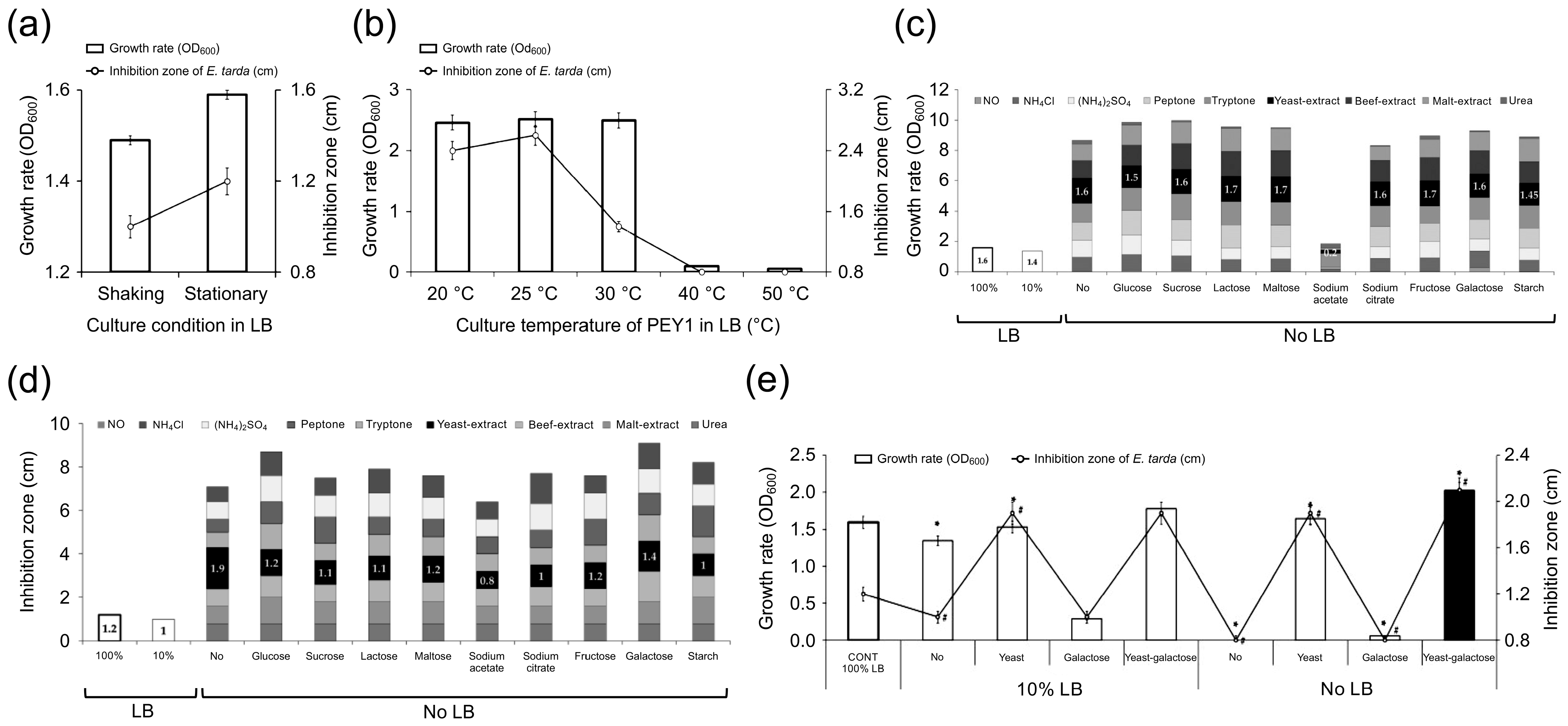
The P. extremorientalis PEY1 strain, exhibiting strong antibacterial activity against E. tarda, was isolated from the intestinal contents of marine fish using a nutrient salt solution designed to enrich moderately halophilic bacteria while suppressing fast-growing contaminants. Clear inhibition zones against E. tarda were observed on LB agar plates. The isolate showed the highest 16S rRNA sequence similarity to P. extremorientalis [17] and was designated as P. extremorientalis PEY1 (NCBI accession no. PX642490). Following isolation, PEY1 was routinely maintained in LB medium, which supported stable growth and consistent production of the antibacterial compound. This medium was subsequently used as a basal system for optimizing the culture parameters and physicochemical factors influencing PEY1 growth and metabolite biosynthesis (Figure 1).
The growth and antibacterial activity of PEY1 were markedly influenced by both cultivation mode and medium composition (Figure 1). When cultured in LB medium, stationary conditions resulted in significantly higher cell growth and antibacterial activity than shaking cultivation (Figure 1a).
Temperature exerted a pronounced effect on both growth and antibacterial activity (Figure 1b). PEY1 exhibited optimal proliferation and antibacterial activity at 25 °C, whereas both parameters declined markedly at temperatures ≥ 30 °C and were completely lost above 40 °C. Based on this profile, PEY1 is characterized as a mesophilic strain that produces antibacterial metabolites most efficiently at moderate temperatures and exhibits clear sensitivity to thermal stress.
To identify nutrient factors contributing to antibacterial production, various carbon and nitrogen sources were evaluated using a minimal medium (Figure 1b,c). Among the carbon sources tested, galactose supported the highest cell density (OD600 = 1.5) and moderate antibacterial activity (inhibition zone = 1.4 cm) against E. tarda, whereas glucose, sucrose, and maltose produced comparatively smaller inhibition zones. Nitrogen sources exerted a more pronounced effect on both bacterial proliferation and bioactive compound synthesis [24]. Yeast extract substantially enhanced PEY1 proliferation and antibacterial activity relative to other organic (peptone, malt extract, beef extract) and inorganic nitrogen sources ((NH4)2SO4, NH4Cl, urea).
A minimal medium supplemented with 1% yeast extract was sufficient to support substantial growth and detectable antibacterial activity. Co-supplementation with 1% galactose produced a synergistic enhancement in both biomass accumulation and bioactivity, under nutrient-limited conditions (10% LB or LB-free medium) (Figure 1d).
Taken together, the optimal conditions for antibacterial substance production were determined as a minimal medium supplemented with 1% yeast extract with or without 1% galactose, under stationary cultivation at 25 °C. These optimized parameters were used in subsequent experiments to characterize the physicochemical stability and molecular characteristics of the antibacterial protein.

3.2. Characterization of Growth and Antibacterial Activity

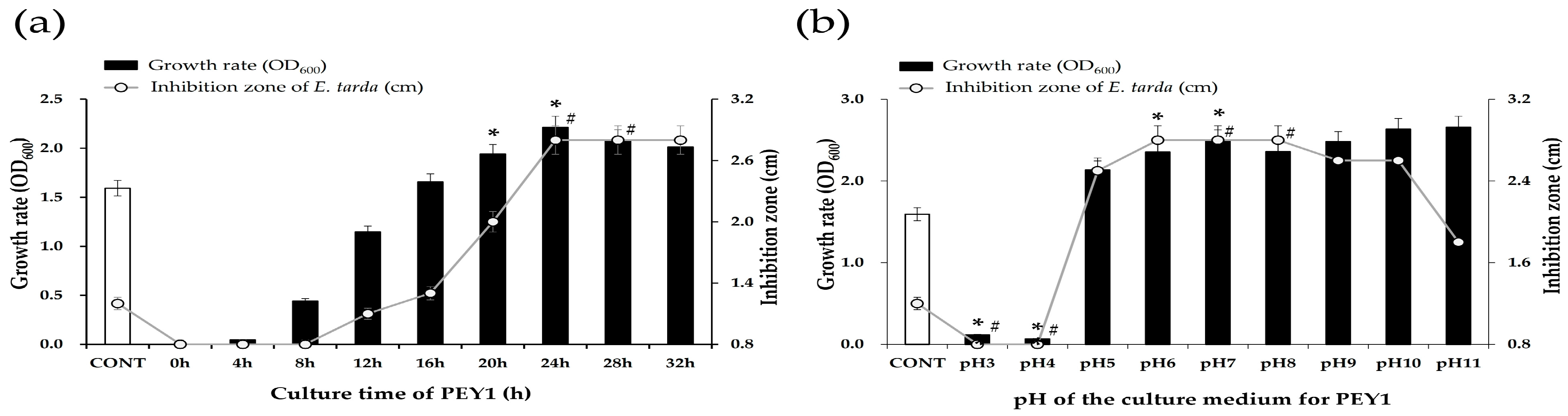
The effects of incubation time and initial pH on the growth and antibacterial activity of PEY1 were investigated using a minimal medium supplemented with 1% yeast extract and 1% galactose (Figure 2). The previous optimization results obtained in LB medium (Figure 1) demonstrated that PEY1 exhibited maximal growth and antibacterial activity at 25 °C; therefore, this temperature was adopted for all subsequent cultivation experiments.
During batch culture at 25 °C, antibacterial activity increased in parallel with cell growth and reached its maximum after 24 h, corresponding to the transition from the late exponential to early stationary phase (Figure 2a). This temporal pattern indicates that the antibacterial compound is produced as a secondary metabolite or stress-induced protein under nutrient limitation.
The influence of initial pH on PEY1 growth and antibacterial activity was also evaluated (Figure 2b). Both parameters were highest under near-neutral to slightly alkaline conditions (pH 6–8). In contrast, strongly acidic conditions (pH ≤ 4) or highly alkaline conditions (pH ≥ 10) resulted in markedly reduced growth and antibacterial activity.
Antibacterial spectrum assays conducted with eight indicator strains showed that PEY1 displayed inhibitory activity exclusively against E. tarda, while all other strains remained unaffected. This outcome confirms that the antibacterial factor produced by PEY1 is highly selective and exhibits species-specific activity toward E. tarda.
Together, these results indicate that cultivation at 25 °C and 24 h under mildly acidic to neutral conditions (pH 6–8) in a minimal medium supplemented with 1% yeast extract and 1% galactose provides the optimal conditions for maximizing both bacterial growth and antibacterial activity of PEY1.

3.3. Physicochemical Properties

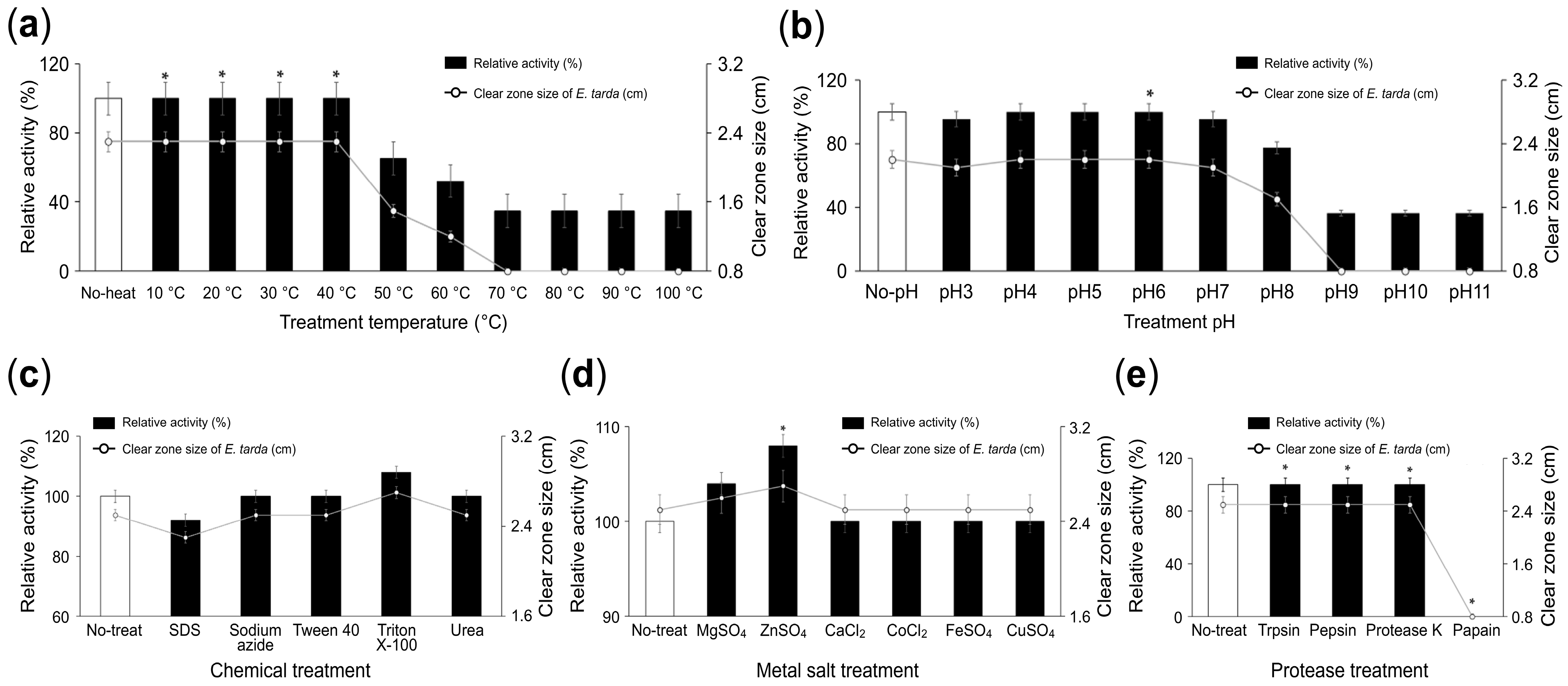
Physicochemical characterization demonstrated that the antibacterial substance produced by PEY1 is a heat-stable, proteinaceous molecule with substantial environmental tolerance (Figure 3). As confirmed in Figure 2, the substance was isolated from the culture supernatant of PEY1 grown under optimized conditions—25 °C, pH 6–8, and 24 h incubation in a minimal medium supplemented with 1% yeast extract and 1% galactose—which maximized both bacterial growth and antibacterial activity. Antibacterial activity was retained at ≥80% of the untreated control up to 40 °C and progressively declined at temperatures ≥ 50 °C, indicating moderate thermal stability (Figure 3a).
The compound exhibited the highest stability within a narrow pH range (3.0–7.0), whereas alkaline (pH ≥ 8) conditions markedly decreased antibacterial activity (Figure 3b).
Chemical treatment further confirmed the robustness of the PEY1-derived compound. Exposure to surfactants (SDS, Tween 40, Triton X-100), denaturants (urea), and metabolic inhibitors (sodium azide) caused minimal loss of activity, with relative activity remaining above 90% of the control (Figure 3c). Similarly, supplementation with divalent metal ions (Mg2+, Zn2+, Ca2+, Co2+, Fe2+, Cu2+) did not significantly affect antibacterial performance, although Zn2+ slightly enhanced activity, while Cu2+ and Fe2+ caused mild inhibition (Figure 3d).
Proteolytic enzyme assays revealed that antibacterial activity was maintained after treatment with trypsin, pepsin, and proteinase K, but was completely lost following papain digestion (Figure 3e and Figure S1). These results indicate that the active compound is specifically susceptible to papain.
Collectively, the findings show that the antibacterial compound produced by PEY1 is moderately heat-stable, papain-sensitive, and exhibits strong pH and chemical tolerance, with narrow-spectrum activity limited to E. tarda.

3.4. Identification and Characterization of the Antibacterial Protein

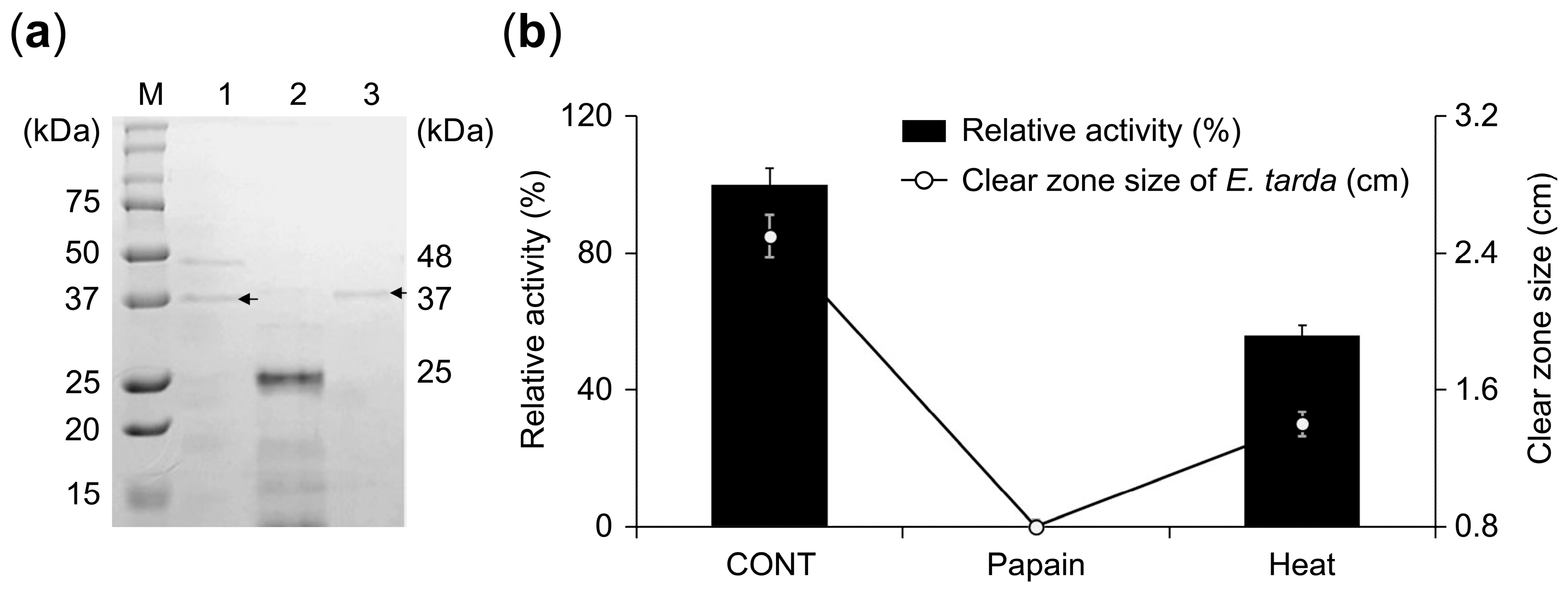
SDS–PAGE analysis of the PEY1 culture supernatant revealed two major protein bands at approximately 37 and 48 kDa (Figure 4a). In the papain-treated sample (Lane 2), both bands completely disappeared, whereas in the sample heat-treated at 55 °C (Lane 3), there was selective retention of the 37 kDa band, while the 48 kDa band was lost. Correspondingly, antibacterial activity against E. tarda markedly decreased following the heat treatment but was completely abolished by papain digestion (Figure 4b).
As shown previously in Figure 3e, enzymatic stability assays further demonstrated that the antibacterial activity of PEY1 was unaffected by trypsin, pepsin, or protease K treatment, but was completely abolished by papain digestion.
Heat-stability assays further supported these observations. The 37 kDa band remained detectable after exposure to temperatures between 45–55 °C for 10–60 min (Figure S2), and antibacterial activity was largely retained under these moderate heating conditions. However, temperatures ≥ 60 °C led to progressive loss of the 37 kDa band and substantial activity reduction (Figure 3a), indicating thermal denaturation beyond this threshold.
Overall, these findings indicate that the 37 kDa protein produced by PEY1 is the primary antibacterial factor. Its selective susceptibility to papain, stability under moderate thermal conditions, and partial resistance to denaturation collectively suggest that it is a proteinaceous antimicrobial compound with a compact and relatively robust tertiary structure. To further elucidate its molecular identity and functional classification, LC–MS/MS analysis was performed.
LC–MS/MS analysis of the excised ~37 kDa band yielded six high-confidence peptide fragments: SAKQPAWGK, SKLSATELSTYASAK, LSATELSTYASAK, LAGLDDATKVAR, VHWAGSDSK, and LAGLDDATK, each matched to entries in the NCBI Pseudomonas protein database at >95% confidence. These peptides predominantly matched protein disulfide reductase (PDR; 40.2% sequence coverage), with minor matches to alkaline phosphatase and elongation factor Tu (Table 1). Taken together, the peptide mapping results strongly implicate the ~37 kDa antibacterial factor as a disulfide reductase–like enzyme.
The antibacterial activity of the protein was completely lost following papain digestion, whereas activity was retained under moderate heat and remained detectable after exposure to surfactants and metal ions (Figure 3). The protein showed selective antibacterial activity toward E. tarda, with no inhibition observed against the other indicator strains. Collectively, these results indicate that the ~37 kDa molecule isolated from PEY1 corresponds to a disulfide reductase–like protein and constitutes the active antibacterial component under the tested conditions.

4. Discussion

SDS–PAGE and protease-sensitivity assays revealed that the active compound is an approximately 37 kDa protein that is completely degraded by papain yet remains stable under moderate heat stress (up to 55 °C). Several lines of evidence collectively support that this 37 kDa protein—rather than the co-occurring 48 kDa band—is the primary antibacterial factor produced by PEY1. First, heat treatment selectively eliminated the 48 kDa band while the 37 kDa protein remained clearly detectable. Under these conditions, antibacterial activity was reduced by only ~50%, indicating that the 48 kDa protein is heat-labile and nonessential, whereas the 37 kDa protein corresponds to the heat-tolerant functional component. This correlation between thermal stability and bioactivity strongly suggests that the 48 kDa band does not contribute meaningfully to antibacterial function. Second, papain treatment removed both the 37 and 48 kDa proteins and simultaneously abolished antibacterial activity. Heat treatment (which removed only the 48 kDa band) did not eliminate activity, whereas papain digestion (which removed both bands) completely inactivated the compound, indicating that the 37 kDa protein is indispensable for antibacterial function. Third, LC–MS/MS analysis returned six high-confidence peptides covering 40.2% of the 37 kDa protein, while the 48 kDa band did not yield any reliable peptide matches. These proteomic data further confirm that only the 37 kDa band corresponds to a biologically meaningful antibacterial molecule, while the 48 kDa band is likely a heat-sensitive, nonfunctional extracellular protein unrelated to the antibacterial phenotype of PEY1. Taken together, these integrated thermal, proteolytic, and proteomic findings establish that the 37 kDa protein is the principal antibacterial factor produced by PEY1, overcoming the limitations of SDS–PAGE band correlation alone. The physicochemical characteristics of this compound—moderate heat tolerance, protease sensitivity, and a molecular mass of ~37 kDa—suggest that it belongs to a class of large, heat-tolerant bacteriocin-like inhibitory proteins [9,11,12]. Similar 30–40 kDa antibacterial proteins have been reported in Pseudomonas and Bacillus species from marine environments [25], functioning through mechanisms such as membrane permeabilization, nutrient sequestration, and oxidative stress induction. However, unlike the broader-spectrum bacteriocins produced by P. fluorescens or P. aeruginosa, the PEY1-derived protein displays narrow-spectrum, species-specific activity against E. tarda, underscoring its distinct ecological function and unique selective mode of action [26,27].
Furthermore, the protein’s stability across a broad pH range and its resistance to surfactants, denaturants, and metal ions demonstrate structural robustness—a highly desirable feature for aquaculture applications, where environmental parameters, such as salinity and organic load, can fluctuate widely [6,15,25]. The thermostability and chemical tolerance observed here are consistent with previously characterized marine bacteriocin-like proteins that retain functionality under stress, supporting their classification as potential postbiotic or biocontrol agents [9,19,28]. Although recombinant expression and direct activity testing of the 37 kDa protein were not performed in this study, such experiments would provide definitive evidence for its functional role and are therefore an important direction for future work. Likewise, although the antibacterial protein was clearly identified and characterized, its precise production yield (mg/L or mg/g biomass) was not quantified. Determining the production yield through protein purification will be essential for assessing scalability and practical application. Future studies integrating recombinant production, structural and functional validation, and quantitative yield determination will further clarify the mechanistic basis and industrial potential of this antibacterial protein.
LC–MS/MS analysis identified the antibacterial protein as a protein disulfide reductase (PDR) with 40.2% sequence coverage. Although PDRs are typically intracellular oxidoreductases responsible for maintaining thiol–disulfide homeostasis [18,29], emerging evidence indicates that bacterial PDR-like enzymes can function extracellularly as redox-active antimicrobial effectors [30,31,32]. For instance, extracellular oxidoreductases, such as DsbM in Pseudomonas aeruginosa, exhibit antimicrobial potential by catalyzing disulfide bond rearrangements that destabilize target cell surface proteins [31]. Similarly, redox-modifying enzymes in marine bacteria have been proposed as defense mechanisms that disrupt competitor cell envelopes or induce oxidative stress responses in target pathogens [32].
In this context, the PEY1-derived PDR-like protein may act as a redox-active antibacterial agent, perturbing disulfide linkages and inducing oxidative imbalance in E. tarda. Such mechanisms could result in membrane disruption, protein misfolding, or oxidative damage, leading to selective inhibition of susceptible species [27,28,30]. The observed papain sensitivity further suggests that cysteine-rich active regions are crucial for catalytic and antimicrobial function, consistent with other thiol-dependent bacteriocin-like proteins [12,28].
The narrow-spectrum activity of the PEY1 compound provides a practical advantage for aquaculture, as it minimizes disruption of beneficial microbiota. Bacteriocin-like proteins are biodegradable, less prone to induce resistance, and environmentally safer than conventional antibiotics [3,4,5,6,9,19,25,33]. Furthermore, the exceptional stability of the PEY1 factor across a range of physicochemical conditions enhances its practical applicability as a natural postbiotic candidate for disease prevention in fish farming [25,26,28,33].
In summary, this study identified a heat-stable, papain-sensitive disulfide reductase–like antibacterial protein from PEY1 exhibiting potent and selective activity against E. tarda. It represents a novel example of an oxidoreductase functioning as a bacteriocin-like antimicrobial agent [34]. Future research should focus on purification, structural characterization, redox mechanism validation (e.g., reactive oxygen species quantification, cysteine-mutant assays), and in vivo validation to assess its potential use in aquaculture.

5. Conclusions

A marine-derived bacterium, P. extremorientalis PEY1, was isolated as a potent producer of an antibacterial protein with selective activity against E. tarda. Optimal production was achieved in a minimal medium supplemented with 1% yeast extract and 1% galactose under static cultivation at 25 °C and pH 7.0, indicating that complex nutrients are not required for efficient biosynthesis. The active compound was characterized as a heat-stable protein of approximately 37 kDa, whose activity was completely abolished by papain digestion, confirming its proteinaceous nature. LC–MS/MS analysis identified the protein as a disulfide reductase–like enzyme, implicating its role in antibacterial defense. The inhibition zone of this protein (1.3–1.6 cm) is comparable to reported bacteriocin-like activities in Pseudomonas and Bacillus spp. This protein was examined because disulfide reductase–like enzymes in marine bacteria are known to function as redox-active antimicrobial factors. The compound retained activity across moderate thermal conditions (45–55 °C) and pH (6–8) ranges and exhibited resistance to surfactants and metal ions, indicating remarkable physicochemical stability. Collectively, these findings demonstrate that P. extremorientalis PEY1 produces a stable and selective antibacterial factor, representing a promising natural biocontrol or postbiotic candidate for sustainable aquaculture applications.

Supplementary Materials

The following supporting information can be downloaded at: https://www.mdpi.com/article/10.3390/microbiolres17010006/s1, Figure S1: Enzymatic stability of the antibacterial protein after papain treatment; Figure S2: Thermal stability of the 37 kDa antibacterial protein after exposure to 45–55 °C for 10–60 min.

Author Contributions

Formal analysis, resources, experimental design, data collection, analysis and interpretation, and writing—original draft preparation, H.-S.J.; Conceptualization, methodology, and writing—original draft preparation, Y.-L.J.; Conceptualization, methodology, validation, formal analysis, investigation, data collection, writing—original draft preparation, writing—review and editing, supervision, project administration, funding acquisition, and overall responsibility, S.-M.H. All authors have read and agreed to the published version of the manuscript.

Funding

This work was supported by the Scale-up TIPS (Tech Incubator Program for Startup) funded by the Ministry of SMEs and Startups (RS-2025-25458500), Republic of Korea.

Institutional Review Board Statement

Not applicable.

Data Availability Statement

The data supporting the findings of this study are available on request from the corresponding author. The data are not publicly available due to institutional and privacy restrictions.

Acknowledgments

The authors gratefully acknowledge the Marine Industry Research Institute (MIRE) and Yeungnam University for providing access to research facilities, analytical equipment, and technical support that greatly contributed to the completion of this study.

Conflicts of Interest

The authors declare no conflicts of interest.

References

  1. Austin, B.; Austin, D.A. Bacterial Fish Pathogens: Disease of Farmed and Wild Fish, 6th ed.; Springer: Cham, Switzerland, 2016. [Google Scholar]
  2. Park, S.B.; Aoki, T.; Jung, T.S. Pathogenesis of and strategies for preventing Edwardsiella tarda infection in fish. Vet. Res. 2012, 43, 67. [Google Scholar] [CrossRef]
  3. Bondad-Reantaso, M.G.; Subasinghe, R.P.; Arthur, J.R.; Ogawa, K.; Chinabut, S.; Adlard, R.; Tan, Z.; Shariff, M. Disease and health management in Asian aquaculture. Vet. Parasitol. 2005, 132, 249–272. [Google Scholar] [CrossRef]
  4. Cabello, F.C. Heavy use of prophylactic antibiotics in aquaculture: A growing problem for human and animal health and for the environment. Environ. Microbiol. 2006, 8, 1137–1144. [Google Scholar] [CrossRef]
  5. Watts, J.E.M.; Schreier, H.J.; Lanska, L.; Hale, M.S. The rising tide of antimicrobial resistance in aquaculture: Sources, sinks and solutions. Mar. Drugs 2017, 15, 158. [Google Scholar] [CrossRef] [PubMed]
  6. Defoirdt, T.; Sorgeloos, P.; Bossier, P. Alternatives to antibiotics for the control of bacterial disease in aquaculture. Curr. Opin. Microbiol. 2011, 14, 251–258. [Google Scholar] [CrossRef]
  7. Adams, A. Progress, challenges and opportunities in fish vaccine development. Fish Shellfish Immunol. 2019, 90, 210–214. [Google Scholar] [CrossRef] [PubMed]
  8. Munang’andu, H.M.; Evensen, Ø. A review of intra- and extracellular antigen delivery systems for virus vaccines of finfish. J. Immunol. Res. 2015, 2015, 960859. [Google Scholar] [CrossRef]
  9. Cotter, P.D.; Hill, C.; Ross, R.P. Bacteriocins: Developing innate immunity for food. Nat. Rev. Microbiol. 2005, 3, 777–788. [Google Scholar] [CrossRef] [PubMed]
  10. Alvarez-Sieiro, P.; Montalbán-López, M.; Mu, D.; Kuipers, O.P. Bacteriocins of lactic acid bacteria: Extending the family. Appl. Microbiol. Biotechnol. 2016, 100, 2939–2951. [Google Scholar] [CrossRef]
  11. Yang, S.C.; Lin, C.H.; Sung, C.T.; Fang, J.Y. Antibacterial activities of bacteriocins: Application in foods and pharmaceuticals. Front. Microbiol. 2014, 5, 241. [Google Scholar] [CrossRef]
  12. Perez, R.H.; Zendo, T.; Sonomoto, K. Novel bacteriocins from lactic acid bacteria (LAB): Various structures and applications. Microb. Cell Fact. 2014, 13, S3. [Google Scholar] [CrossRef]
  13. De Man, J.C.; Rogosa, M.; Sharpe, M.E. A medium for the cultivation of Lactobacilli. J. Appl. Bacteriol. 1960, 23, 130–135. [Google Scholar] [CrossRef]
  14. Balouiri, M.; Sadiki, M.; Ibnsouda, S.K. Methods for in vitro evaluating antimicrobial activity: A review. J. Pharm. Anal. 2016, 6, 71–79. [Google Scholar] [CrossRef]
  15. Weisburg, W.G.; Barns, S.M.; Pelletier, D.A.; Lane, D.J. 16S ribosomal DNA amplification for phylogenetic study. J. Bacteriol. 1991, 173, 697–703. [Google Scholar] [CrossRef] [PubMed]
  16. Altschul, S.F.; Gish, W.; Miller, W.; Myers, E.W.; Lipman, D.J. Basic local alignment search tool. J. Mol. Biol. 1990, 215, 403–410. [Google Scholar] [CrossRef]
  17. Ivanova, E.P.; Gorshkova, N.M.; Sawabe, T.; Hayashi, K.; Kalinovskaya, N.I.; Lysenko, A.M.; Zhukova, N.V.; Nicolau, D.V.; Kuznetsova, T.A.; Mikhailov, V.V.; et al. Pseudomonas extremorientalis sp. nov., isolated from a drinking water reservoir. Int. J. Syst. Evol. Microbiol. 2002, 52, 2113–2120. [Google Scholar] [CrossRef]
  18. Weller, D.M. Pseudomonas biocontrol agents of soilborne pathogens: Looking back over 30 years. Phytopathology 2007, 97, 250–256. [Google Scholar] [CrossRef] [PubMed]
  19. Rizzo, C.; Perrin, E.; Poli, A.; Finore, I.; Fani, R.; Lo Giudice, A. Characterization of the exopolymer-producing Pseudoalteromonas sp. S8-8 from Antarctic sediment. Appl. Microbiol. Biotechnol. 2022, 106, 7173–7185. [Google Scholar] [CrossRef]
  20. Laemmli, U.K. Cleavage of structural proteins during the assembly of the head of bacteriophage T4. Nature 1970, 227, 680–685. [Google Scholar] [CrossRef]
  21. Shevchenko, A.; Wilm, M.; Vorm, O.; Mann, M. Mass spectrometric sequencing of proteins silver-stained polyacrylamide gels. Anal. Chem. 1996, 68, 850–858. [Google Scholar] [CrossRef]
  22. Scigelova, M.; Makarov, A. Orbitrap mass analyzer—Overview and applications in proteomics. Proteomics 2006, 6, 16–21. [Google Scholar] [CrossRef]
  23. Gross, H.; Loper, J.E. Genomics of secondary metabolite production by Pseudomonas spp. Nat. Prod. Rep. 2009, 26, 1408–1446. [Google Scholar] [CrossRef]
  24. Li, W.; Lu, C.D. Regulation of carbon and nitrogen utilization by CbrAB and NtrBC two-component systems in Pseudomonas aeruginosa. J. Bacteriol. 2007, 189, 5413–5420. [Google Scholar] [CrossRef]
  25. Simons, A.; Alhanout, K.; Duval, R.E. Bacteriocins, antimicrobial peptides from bacterial origin: Overview of their biology and their impact against multidrug-resistant bacteria. Microorganisms 2020, 8, 639. [Google Scholar] [CrossRef]
  26. Parret, A.H.; Temmerman, K.; De Mot, R. Novel lectin-like bacteriocins of biocontrol strain Pseudomonas fluorescens Pf-5. Appl. Environ. Microbiol. 2005, 71, 5197–5207. [Google Scholar] [CrossRef]
  27. Ghequire, M.G.K.; Öztürk, B.; De Mot, R. Lectin-like bacteriocins. Front. Microbiol. 2018, 9, 2706. [Google Scholar] [CrossRef]
  28. Kim, S.; Jeon, H.; Han, H.S.; Hur, J.W. Evaluation of Bacillus albus SMG-1 and B. safensis SMG-2 isolated from Saemangeum Lake as probiotics for aquaculture of white shrimp (Litopenaeus vannamei). Aquac. Rep. 2021, 21, 100743. [Google Scholar] [CrossRef]
  29. Łasica, A.M.; Jagusztyn-Krynicka, E.K. The role of Dsb proteins of Gram-negative bacteria in the process of pathogenesis. FEMS Microbiol. Rev. 2007, 31, 626–636. [Google Scholar] [CrossRef]
  30. Dhaked, H.P.S.; Cao, L.; Biswas, I. Redox sensing modulates the activity of the ComE response regulator of Streptococcus mutans. J. Bacteriol. 2021, 203, e0033021. [Google Scholar] [CrossRef] [PubMed]
  31. Shouldice, S.R.; Heras, B.; Jarrott, R.; Sharma, P.; Scanlon, M.J.; Martin, J.L. Characterization of the DsbA oxidative folding catalyst from Pseudomonas aeruginosa reveals a highly oxidizing protein that binds small molecules. Antioxid. Redox Signal. 2010, 12, 921–931. [Google Scholar] [CrossRef] [PubMed]
  32. Wu, C.Q.; Zhang, T.; Zhang, W.; Shi, M.; Tu, F.; Yu, A.; Li, M.; Yang, M. Two DsbA proteins are important for Vibrio parahaemolyticus pathogenesis. Front. Microbiol. 2019, 10, 1103. [Google Scholar] [CrossRef] [PubMed]
  33. Chen, X.; Liu, H.; Liu, S.; Mao, J. Impact of bacteriocins on multidrug-resistant bacteria and their application in aquaculture disease prevention and control. Rev. Aquac. 2024, 16, 1048–1076. [Google Scholar] [CrossRef]
  34. Brzoza, P.; Godlewska, U.; Borek, A.; Morytko, A.; Zegar, A.; Kwiecinska, P.; Zabel, B.A.; Osyczka, A.; Kwitniewski, M.; Cichy, J. Redox active antimicrobial peptides in controlling growth of microorganisms at body barriers. Antioxidants 2021, 10, 446. [Google Scholar] [CrossRef] [PubMed]
Figure 1. Optimization of minimal medium composition and cultivation conditions for the antibacterial activity of Pseudomonas extremorientalis PEY1 against Edwardsiella tarda. (a) Comparison of shaking and stationary culture conditions in Luria–Bertani (LB) medium. (b) Effects of culture temperature on bacterial growth and antibacterial activity of PEY1 in LB medium. (c) Effects of different carbon and nitrogen sources on bacterial growth (OD600). Minimal media were supplemented with 1% (w/v) of various carbon sources (starch, galactose, fructose, sodium citrate, sodium acetate, maltose, lactose, sucrose, and glucose) or nitrogen sources (tryptone, yeast extract, beef extract, peptone, malt extract, NH4Cl, (NH4)2SO4, and urea). (d) Antibacterial activity of PEY1 cultured under the same conditions, expressed as the diameter of the inhibition zone against E. tarda (cm). (e) Synergistic effects of yeast extract and galactose supplementation on bacterial growth and antibacterial activity under nutrient-limited (10% LB) and minimal (no-LB) conditions. The control (CONT) represents PEY1 cultured in 100% LB medium under stationary conditions at 25 °C. Data represent the mean ± SD from three independent experiments. Asterisks (*) indicate significant differences in growth (OD600), and hash marks (#) denote significant differences in antibacterial activity (inhibition zone size). In (bd), data were analyzed using the same test (p < 0.05).
Microbiolres 17 00006 g001
Figure 2. Effects of culture pH and incubation time on the growth and antibacterial activity of Pseudomonas extremorientalis PEY1 cultured in a minimal medium supplemented with 1% yeast extract and 1% galactose. (a) Effect of culture time on growth and antibacterial activity. The control (CONT) represents PEY1 cultured in 100% Luria–Bertani (LB) medium at 25 °C for 24 h. (b) Effect of initial pH on bacterial growth (OD600) and antibacterial activity against E. tarda. Data are expressed as the mean ± standard deviation (SD) from three independent experiments. Asterisks (*) and hash symbols (#) indicate significant differences (p < 0.05) in growth rate and antibacterial activity, respectively, compared with the control.
Microbiolres 17 00006 g002
Figure 3. Physicochemical characterization of the antibacterial protein produced by Pseudomonas extremorientalis PEY1. (a) Thermal stability of the antibacterial activity after exposure to different temperatures for 3 h. (b) pH stability of the antibacterial compound following incubation in buffers with varying initial pH values (3–11). (c) Chemical stability in the presence of surfactants and denaturants, including sodium dodecyl sulfate (SDS), sodium azide, Tween 40, Triton X-100, and urea. (d) Effects of metal ions (Mg2+, Zn2+, Ca2+, Co2+, Fe2+, and Cu2+) on antibacterial activity. (e) Enzymatic stability of the antibacterial protein after treatment with trypsin, pepsin, protease K, or papain. Relative activity (%) represents the residual antibacterial activity relative to the untreated PEY1 control cultured under optimized conditions (25 °C, pH 6–8, 24 h, 1% yeast extract and 1% galactose). Data are expressed as mean ± standard deviation (SD) (n = 3). Asterisks (*) indicate statistically significant differences compared with the untreated control (p < 0.05).
Microbiolres 17 00006 g003
Figure 4. SDS-PAGE analysis and characterization of the antibacterial protein in the culture supernatant of Pseudomonas extremorientalis PEY1 after papain protease treatment. (a) SDS-PAGE profile showing a distinct protein band at approximately 37 kDa (indicated by arrows). M, protein molecular weight marker; 1, untreated culture supernatant; 2, papain-treated sample (55 °C, 1 h); 3, distilled water–treated control (55 °C, 1 h). (b) Relative antibacterial activity (%) and inhibition zone diameter against E. tarda following papain and heat treatment. CONT, the untreated control group; SDS-PAGE, sodium dodecyl sulfate-polyacrylamide gel electrophoresis. Data are presented as mean ± standard deviation (SD) from three independent experiments.
Microbiolres 17 00006 g004
Table 1. Protein identification of the excised ~37 kDa antibacterial protein band from Pseudomonas extremorientalis PEY1 by LC–MS/MS analysis and database search against the NCBI Pseudomonas protein repository.
NameAccession No.SpeciesCoverage
(%)
Peptides
(>95%)
protein disulfide reductaseWP_123474076.1Pseudomonas40.216
alkaline phosphataseWP_060613926.1Pseudomonas37.97
elongation factor TuWP_020290706.1Pseudomonas9.81
FAD-dependent oxidoreductaseWP_105228981.1Pseudomonas61
pyridoxal kinase PdxYWP_065879229.1Pseudomonas8.31
hypothetical proteinWP_041924669.1Pseudomonas18.11
1-deoxy-D-xylulose-5-phosphate reductoisomeraseWP_069863658.1Pseudomonas7.81
sulfurtransferase complex subunit TusBWP_069517293.1Pseudomonas21.21
phasin family proteinWP_109752025.1Pseudomonas38.11
SDR family oxidoreductaseWP_029886093.1Pseudomonas7.61
thioredoxinWP_081319933.1Pseudomonas3.11
NCBI, National Center for Biotechnology Information; LC-MS-MS, liquid chromatography tandem mass spectrometry.
Disclaimer/Publisher’s Note: The statements, opinions and data contained in all publications are solely those of the individual author(s) and contributor(s) and not of MDPI and/or the editor(s). MDPI and/or the editor(s) disclaim responsibility for any injury to people or property resulting from any ideas, methods, instructions or products referred to in the content.