
Review

Regulatory Mechanisms of Fumonisin Biosynthesis and Applications in Food Safety and Biotechnology

by
Lei Fan
1,2,
Yuqing Lei
1,2,
Zhihui Qi
1,2,
Haiyang Zhang
1,2,
Lin Tian
1,2 and
Fang Tang
1,2,*
1
Academy of National Food and Strategic Reserves Administration, Beijing 100037, China
2
National Engineering Research Center of Grain Storage and Logistics, Beijing 102209, China
*
Author to whom correspondence should be addressed.
Microbiol. Res. 2026, 17(1), 4; https://doi.org/10.3390/microbiolres17010004
Submission received: 28 November 2025 / Revised: 15 December 2025 / Accepted: 18 December 2025 / Published: 24 December 2025

Abstract

Fumonisins, a major class of mycotoxins, pose significant health risks to humans and animals due to their widespread contamination and potent toxicity. Recent advances in molecular biology, biochemistry, and enzymology have greatly enhanced the understanding of fumonisin biosynthesis and its genetic regulation. The key biosynthetic genes are typically organized in clusters and regulated by specific transcription factors; increasing evidence also highlights the involvement of complex transcriptional and epigenetic mechanisms. Environmental factors such as nitrogen, carbon, and pH also modulate these regulatory networks. Despite substantial progress, critical gaps remain in fully elucidating the regulatory pathways that control fumonisin production. This review synthesizes current knowledge regarding fumonisin biosynthesis, gene clusters, and multi-level regulatory mechanisms, while emphasizing recent trends, existing challenges, and potential applications in food safety and biotechnology to enhance food security and promote sustainable development.

1. Introduction

Fumonisins are polyketide-derived mycotoxins, primarily produced by several Fusarium species, including F. verticillioides, F. proliferatum, F. fujikuroi, and F. oxysporum [1]. Certain Aspergillus species have also been reported to produce fumonisins in crops [2]. These toxigenic fungi generate more than 28 fumonisin homologs, which can be divided into four groups (A, B, C, and P) based on their chemical structures. All of these homologs can yield additional derivatives when metabolized by animals after ingestion. Among them, B-series fumonisins are the most important: fumonisin B1 (FB1) is the most prevalent and most toxic type, causing the majority of contamination occurrences; this is followed by fumonisin B2 (FB2) and fumonisin B3 (FB3) [3].
Fumonisin contamination is globally widespread, primarily affecting maize and maize-based products. According to the World Health Organization (WHO), approximately 50% of these products are contaminated with FB1 [4]. This issue is particularly severe in Latin America, South America, Africa, and South/Southeast Asia. In Brazil, fumonisin was the predominant mycotoxin in maize and maize-derived products, with 85.9% of samples testing positive. The median concentration reached 1695 µg/kg, and the maximum level was 31,420 µg/kg [5]. In Southern Africa, fumonisins were detected in 90% of maize samples, reaching up to 40,000 µg/kg; notably, 53.9% exceeded the European Union regulatory limit for fumonisins (1000 µg/kg) [6]. In China, new-season corn showed an 87.16% positive rate, with an average level of 3549.65 µg/kg and a maximum of 41,600 µg/kg [7]. Beyond maize, fumonisins have also been detected in crops such as sorghum, soybean, and rice, as well as in postharvest fruits and processed products (e.g., dried figs), contributing to additional food safety concerns [8]. Fumonisins exert their toxic effects on humans and animals by inhibiting ceramide synthase and disrupting sphingolipid metabolism. FB1 is associated with several diseases, including leukoencephalomalacia in horses, pulmonary edema in pigs, growth impairment in children, liver and kidney toxicity, neural tube defects, and esophageal cancer [9]. Based on these effects, FB1 is classified as a Group 2B possible human carcinogen by the International Agency for Research on Cancer [10].
Given the substantial economic and health impacts, the European Food Safety Authority has classified fumonisins as critical mycotoxins, underscoring the urgency for stringent global management [11]. In recent decades, diverse strategies to mitigate fumonisin contamination have been proposed or implemented, including adoption of good agricultural practices, regulation of environmental factors, application of biocontrol agents or natural compounds, enhancement of host crop resistance, and deployment of effective detoxification technologies [8,12]. Despite these efforts, it remains highly challenging to control fumonisin contamination across agricultural production and its subsequent food chain, with persistent difficulties in fully interrupting contamination pathways.
Consequently, fumonisin production has become one of the most extensively studied fungal secondary metabolite processes. As in other fungi, fumonisins are synthesized through a complex biosynthetic pathway involving multiple enzymatic reactions [3]. The genes encoding these enzymes are organized into a cluster, and their coordinated expression is regulated by gene cluster-specific regulators such as Fum21, Fum19, and ZBD1 [13]. However, as a secondary metabolite, fumonisin biosynthesis also depends on multifaceted regulatory mechanisms elicited by environmental cues such as pH fluctuations, light exposure, nutrient availability, and oxidative stress. These external stimuli activate various intracellular signaling pathways that ultimately influence the transcriptional regulation of toxin biosynthetic genes [14]. Additionally, post-translational modifications, RNA polymerase-associated factors, proteins related to organelles (e.g., vacuoles, mitochondria, and peroxisomes), and cytoskeletal components further contribute to the regulation of fumonisin biosynthesis. Although a wide range of regulatory factors have been identified, their precise mechanisms of action and interrelationships remain poorly understood. Elucidating these regulatory networks will not only provide a comprehensive framework for understanding fumonisin biosynthesis and associated metabolic pathways in eukaryotic organisms but also facilitate the design of novel strategies to reduce fumonisin production by targeting upstream regulatory components—advances that could ultimately support innovative biotechnological applications [8,15].
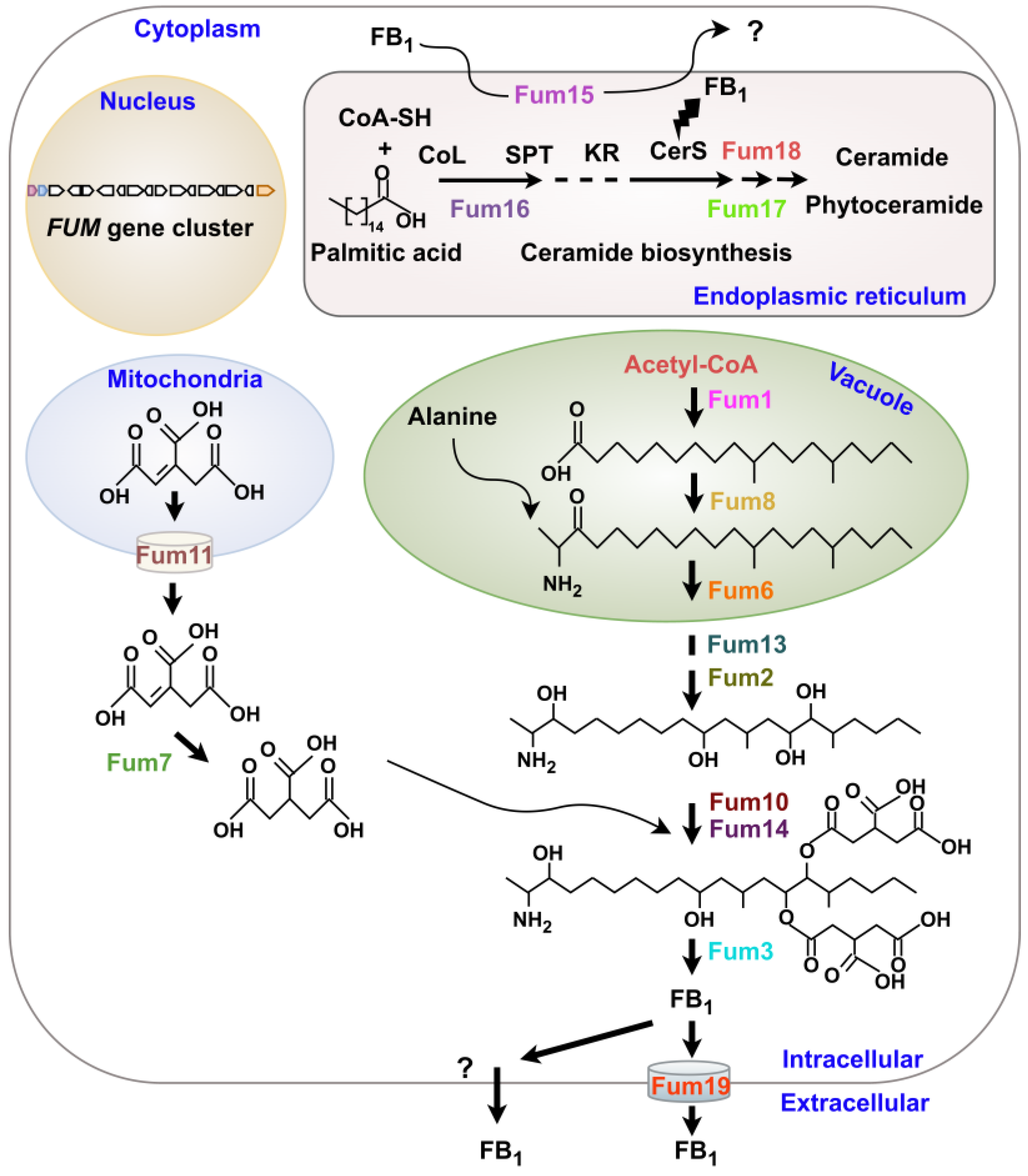
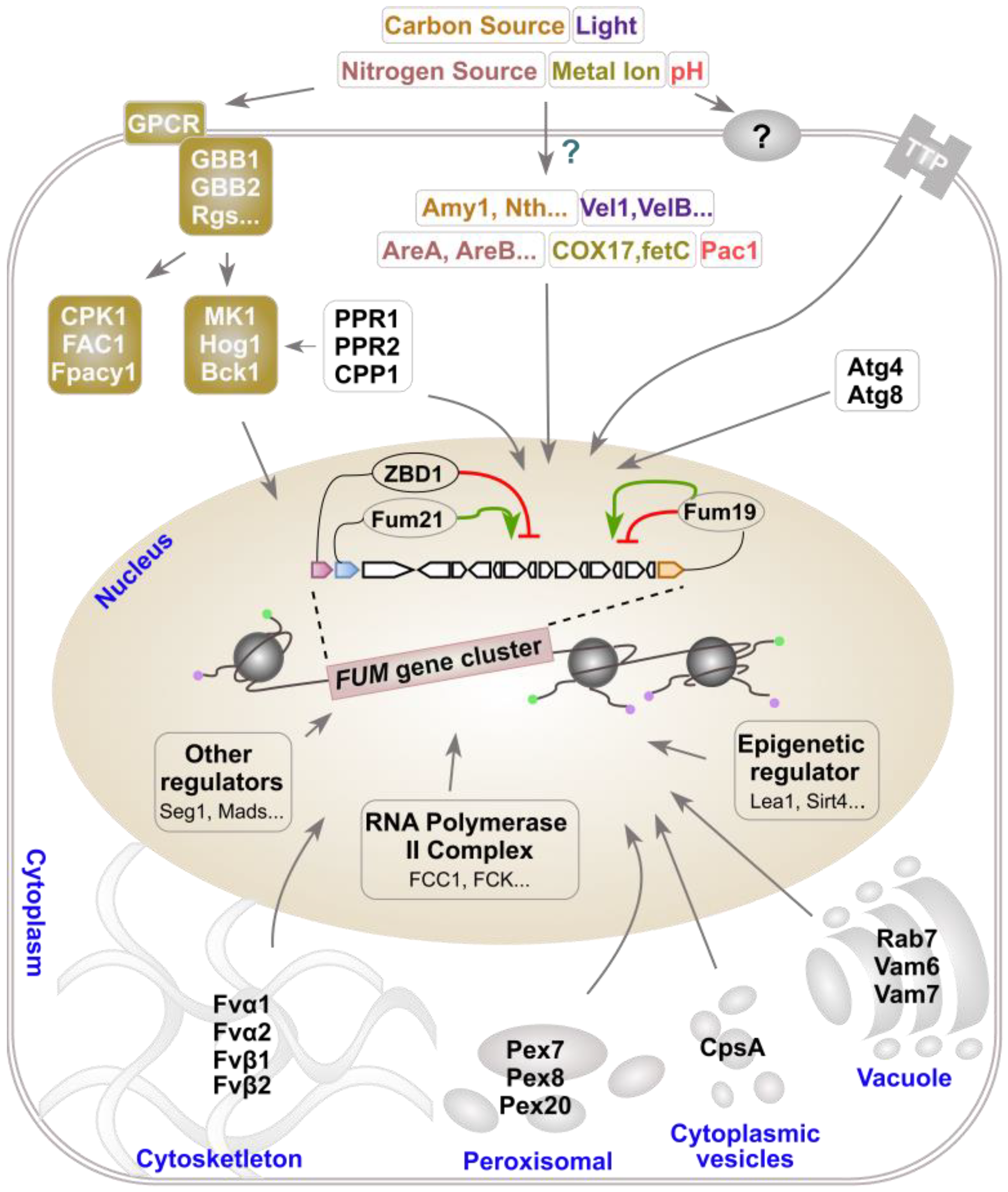
This review updates recent advances in fumonisin synthesis, emphasizing the biosynthetic pathways (Figure 1 and Figure 2) and the multiple levels of molecular regulation (Figure 3). A comprehensive list of relevant genes is provided in Supplementary Table S1, categorized as biosynthetic genes, fumonisin cluster regulators, environmental response factors, cell signaling components, RNA polymerase II complex subunits, and factors involved in post-translational modifications. Finally, potential applications of these genes are briefly discussed.

2. Fumonisin Biosynthetic Pathway

2.1. The Fumonisin Gene Cluster

Fumonisin is primarily produced by F. verticillioides. In this fungus, the genome is organized into 11 chromosomes, with the genes responsible for fumonisin biosynthesis located within a 42-kb region on chromosome 1 [3,16]. This biosynthetic gene cluster consists of 17 genes, including biosynthetic, regulatory, and self-protection genes (Figure 1; Supplementary Table S1) [17]. Other species within the F. fujikuroi complex and F. oxysporum can also produce fumonisins but often lack complete biosynthetic gene clusters (BGCs) [18,19]. In contrast, more distantly related fungi such as Aspergillus niger exhibit substantial differences in fumonisin production. A. niger can produce FB2, FB4, and FB6, but not the most toxic form, FB1, because its truncated BGCs lack the hydroxylation gene FUM2 [2,14]. Phylogenetic evidence suggests that these clusters originated via horizontal gene transfer, followed by gene loss and rearrangement, explaining the evolutionary divergence in toxin profiles [20].

2.2. Enzymatic Cascade Leading to Fumonisin Synthesis

Fumonisin biosynthesis involves a series of enzymatic reactions that convert simple precursors into the complex final structure [3]. These reactions occur in various compartments within fungal cells, with compartmentalization proposed as a self-protection mechanism against the toxic effects of these mycotoxins (Figure 2) [13]. The major steps are outlined below:
Polyketide Backbone Formation: The process begins with Fum1, a polyketide synthase (PKS) that catalyzes the condensation of nine acetate units and two methyl groups to form an 18-carbon linear polyketide. This intermediate—structurally similar to 10,14-dimethyl octadecanoic acid—remains covalently bound to the PKS cofactor during early steps [21]. FUM1 is essential for initiating FB1 biosynthesis, and its disruption completely abolishes toxin production [22,23,24].
Alanine Condensation: Fum8, an α-oxoamine synthase homolog, condenses the polyketide with alanine to generate a 20-carbon backbone with an amine group at C-2. This step differentiates B-series fumonisins from C-series fumonisins, as species-specific FUM8 orthologs determine whether glycine or alanine is incorporated [18].
Early Hydroxylations and Carbonyl Reduction: Fum6, a cytochrome P450 monooxygenase and reductase, hydroxylates C-14 and C-15 to generate a 3-keto intermediate [25,26]. Fum13, a short-chain dehydrogenase/reductase, subsequently reduces the C-3 ketone to a hydroxyl group [27,28]. Mutants lacking FUM6 or FUM13 accumulate precursors with unmodified carbonyl groups [25,27]. Localization studies of Fum8 in ER-derived vesicles have indicated that early fumonisin biosynthesis occurs within these compartments [17]. However, a recent study reported that Fum1, Fum8, and Fum6—key enzymes in the early steps of FB1 biosynthesis—co-localize in the vacuole. Additionally, two vacuole-associated proteins, FvRab7 and FVam7, are essential for FB1 production [29], suggesting that Fum protein localization may vary among species.
C-10 Hydroxylation: Fum2, another cytochrome P450 enzyme, hydroxylates C-10 of fumonisins. Loss-of-function mutants produce fumonisins lacking this modification [30].
Tricarballylic Acid Esterification: The formation of the tricarballylic (C3) side chains is catalyzed by Fum7 (a dehydrogenase) and Fum10 (an acyl-CoA synthetase), followed by esterification to C-14 and C-15 via Fum14, a nonribosomal peptide synthetase (NRPS) domain-containing enzyme [31,32]. Fum11, a mitochondrial membrane–associated protein, functions as a tricarboxylic acid transporter, exporting intermediates for esterification. Mutations in these genes result in hydrolyzed or partially esterified analogs [31]. Although C-3 ketone reduction, C-10 hydroxylation, and C-14/C-15 esterification are considered the fourth, fifth, and sixth steps in fumonisin biosynthesis, production profiles from F. verticillioides mutants indicate that these reactions can occur independently, suggesting that the order is not strictly conserved [3].
Final C-5 Hydroxylation: Fum3, a dioxygenase localized in the cytoplasm, performs the terminal C-5 hydroxylation [33]. This reaction requires prior C-3 reduction and side-chain esterification.
Together, the enzymes encoded by the fumonisin biosynthetic genes described above perform all major enzymatic functions required for fumonisin production. In addition to FUM21, a key regulatory gene [34,35], five adjacent non-biosynthetic genes (FUM15FUM19) contribute to self-protection. Among these, FUM19 encodes an ATP-binding cassette (ABC) transporter that regulates intracellular and secreted levels of FB1 [17,36]. In F. verticillioides, FUM15FUM18 encode a P450 monooxygenase, a CoA ligase, and two of the five ceramide synthase (CerS) homologs, respectively. These enzymes are co-localized with ceramide synthases in the endoplasmic reticulum, where they contribute to ceramide biosynthesis and help mitigate FB1-induced toxicity [17,37].

3. Regulatory Mechanisms of Fumonisin Biosynthesis

Extensive research has identified multiple factors influencing fumonisin production, revealing a complex regulatory network. Although several key regulatory mechanisms have been elucidated, they are part of a broader hierarchical system that integrates cluster-specific regulators, environmental signals, cell signaling pathways, epigenetic modifications, and organelle/cytoskeleton-associated factors (Figure 3; Supplementary Table S1).

3.1. Fumonisin Cluster Regulators

The FUM gene cluster contains multiple regulatory components essential for controlling fumonisin biosynthesis (Figure 1). Among them, the Zn(II)2Cys6 transcription factor Fum21, encoded by a gene adjacent to the polyketide synthase gene FUM1, regulates the expression of cluster genes. In Δfum21 mutants, transcript levels of FUM1 and FUM8 are significantly reduced, resulting in undetectable fumonisin production [35,38]. This regulatory role is conserved in A. niger, where deletion of FUM21 abolishes fumonisin synthesis and downregulates 10 of the 12 FUM cluster genes [34].
Fum19, an ABC transporter, functions as a repressor of the FUM gene cluster in F. verticillioides; its activity is dependent on ATP hydrolysis. Deletion of FUM19 increases FUM17, FUM18, and FUM8 expression, elevating FB1 production. Conversely, overexpression of FUM19 reduces both intracellular and secreted FB1 levels [17]. In F. proliferatum, however, FUM19 appears to play a positive role in FB1 biosynthesis, as its deletion causes a modest 14.7% reduction in FB1 levels relative to the wild type [38].
Additionally, the zinc-binding dehydrogenase gene ZBD1, a non-canonical component of the fumonisin biosynthetic cluster located near the FUM gene cluster, also represses fumonisin production. Δfvzbd1 mutants exhibit dramatically increased FB1, FB2, and FB3 levels. Pyrrocidine likely targets ZBD1 to inhibit fumonisin biosynthesis [39]. Further research is warranted to clarify the regulatory role of ZBD1 in FUM gene expression and to elucidate potential interactions among Fum21, Fum19, and ZBD1 in controlling fumonisin biosynthesis.

3.2. General Regulatory Responses to Environmental Factors

3.2.1. Carbon Sources

Carbon source availability strongly influences fumonisin biosynthesis in Fusarium species, though the underlying mechanisms remain incompletely understood. Recent studies have demonstrated that sucrose acts as a positive regulator of toxin production in most species but suppresses fumonisin synthesis in F. proliferatum via transcriptional downregulation of FUM1, FUM8, and ZFR1 [40,41]. The replacement of sucrose with cellulose, hemicellulose, or banana peel polysaccharides decreases fumonisin levels in a similar manner [41]. The structure of starch also strongly impacts fumonisin biosynthesis. Amylopectin, but not amylose, induces FB1 production. Disruption of the α-amylase gene AMY1 abolishes FB1 biosynthesis on starchy kernels [42]. In addition to polysaccharide metabolism, sugar catabolism regulates toxin production by modulating acetyl-CoA supply, a key precursor in fumonisin biosynthesis. Reduced sugar availability lowers acyl-CoA levels in F. verticillioides, thereby suppressing FB1 production. Deletion of HXK1, a key glycolytic enzyme, decreases acetyl-CoA generation and reduces toxin synthesis [43]. Trehalose metabolism provides glucose to sustain this pathway; knockdown of FvNTH, which governs trehalase activity, limits glucose availability and consequently diminishes FB1 biosynthesis [44]. Although the C2H2-type transcription factor CreA/Cre1 is a well-known global repressor of carbon catabolite metabolism in fungi, its specific role in fumonisin regulation remains to be elucidated. In contrast, other transcription factors have been more directly linked to fumonisin biosynthesis. In F. verticillioides, the zinc binuclear cluster transcription factor ZFR1 regulates FB1 biosynthesis, likely through modulation of carbohydrate sensing or uptake. Deletion of ZFR1 significantly reduces FB1 levels, alters the expression of sugar transporter genes—including FST1, which is essential for FB1 production during maize kernel colonization—and increases α-amylase activity [45,46,47]. Similarly, ART1 is required for starch degradation and FB1 production. Δart1 mutants exhibit defects in starch hydrolysis, lower expression of key biosynthetic genes FUM1 and FUM12, and significantly reduced FB1 levels [48]. Conversely, SDA1 functions as a negative regulator of FB1 biosynthesis and is involved in polyol metabolism. Δsda1 mutants produce higher FB1 levels but reduced amounts of arabitol and mannitol [49]. These observations highlight the complexity of interconnected regulatory networks, in which carbon response mechanisms, carbon metabolism-related genes, and transcription factors collectively orchestrate fumonisin biosynthesis, providing new insights into the management of mycotoxin contamination in crops.

3.2.2. Nitrogen Sources

Nitrogen metabolite repression in filamentous fungi is regulated by the GATA transcription factors AreA and AreB, which play critical roles in modulating fumonisin biosynthesis [13]. In F. fujikuroi, both ΔareA and ΔareB mutants exhibit complete inhibition of FUM gene expression (e.g., FUM1, FUM6, FUM8) and FB1/FB2 production, indicating that AreA and AreB act as positive regulators of fumonisin biosynthesis [50]. Moreover, the global regulator FfSGE1, which controls multiple secondary metabolite pathways including fumonisins, shows strongly reduced expression in the ΔareA mutant. Although overexpression of FfSGE1 partially restores gibberellin biosynthesis in this background, fumonisin production remains absent, underscoring the dominant role of AreA in the regulatory network governing fumonisin biosynthesis [51]. In F. proliferatum, the ΔAreA mutant shows reduced nitrate utilization while retaining ammonium/glutamine utilization. Although ΔAreA considerably impairs fumonisin biosynthesis, supplementation with 120 mM NH4Cl restores FB1 production and FUM gene expression [52]. Similarly, in F. verticillioides, deletion of areA leads to poor growth on mature maize kernels, though growth is rescued by ammonium phosphate supplementation. However, FB1 production remains completely abolished under all tested conditions [53]. In addition, a fungal-specific gene designated FUG1 in F. verticillioides encodes an uncharacterized protein required for maize kernel colonization and fumonisin biosynthesis. Transcriptomic analysis revealed downregulation of areA in the FUG1 deletion strain, suggesting that FUG1 influences fumonisin biosynthesis via the nitrogen regulator AreA [54]. However, there is little evidence to indicate that FUG1 affects fumonisin biosynthesis by direct or indirect regulation of AreA.

3.2.3. pH Conditions

pH is another critical extracellular factor modulating fungal secondary metabolite production. The Pal-pH pathway and its transcription factor PacC play central roles in this process [55]. Under alkaline conditions, PacC undergoes pH-dependent PalB-mediated proteolytic cleavage—with assistance from PalA and PalC—to generate nuclear-localized PacC27, which binds the 5′-GCCARG-3′ DNA motif to activate alkaline-expressed genes and suppress acid-responsive genes [56]. In A. nidulans, pacCc mutations bypass the requirement for pH signal transduction [57].
Pac1, a PACC-like gene, may function as a repressor of fumonisin biosynthesis. In F. verticillioides, deletion of PAC1 increases FB1 production and elevates FUM1 expression under both acidic (pH 4.5) and alkaline (pH 8.4) conditions relative to the wild type [58]. Fumonisin biosynthesis is generally repressed under alkaline pH; however, this inhibitory effect can vary with culture conditions. F. proliferatum exhibits distinct pH-dependent patterns: under nitrogen-limited conditions, it grows normally but produces minimal FB1 at pH levels above 5.0, whereas at pH levels below 5.0, growth is reduced but FB1 production substantially increases [59]. Notably, Li et al. reported that cultivation in Czapek’s broth medium (CB) at pH 5 specifically inhibits fumonisin production compared with pH 10 in this species. Proteomic analysis further revealed that pH 10 upregulates enzymes such as polyketide synthase, cytochrome P450, and methyltransferases associated with fumonisin biosynthesis, whereas pH 5 elevates inhibitors such as citrate lyase, isocitrate dehydrogenase and L-amino-acid oxidase, potentially suppressing the condensation of the fumonisin backbone [60].
The pH response is modulated by nitrogen availability because the nitrogen source can influence medium pH and regulate nitrogen-responsive transcription factors. When ammonium sulfate is used as the nitrogen source, ammonia assimilation is accompanied by the release of H+ ions, leading to medium acidification. In Colletotrichum gloeosporioides, PacC represses acid-expressed genes through AreB [61]. However, it remains unclear whether PacC suppresses acid-expressed genes via AreB to regulate fumonisin production or directly binds to fumonisin biosynthetic gene promoters.

3.2.4. Light

Light response mechanisms in filamentous fungi are closely associated with the Velvet complex, which regulates secondary metabolism and developmental processes in a light-dependent manner [62]. This system has been extensively studied in A. nidulans, where VeA—a light-responsive global regulator—mediates transitions between sexual and asexual reproduction. In darkness, VeA translocates to the nucleus via KapA-mediated import, promoting LaeA–VelA–VelB trimer formation to activate secondary metabolism while suppressing asexual development. Conversely, light exposure retains VeA in the cytoplasm, reducing VelB/VosA levels to favor asexual reproduction and repress secondary metabolism [63]. Although this mechanism is well-characterized in Aspergillus, its direct application to fumonisin regulation in Fusarium species remains unclear.
Unlike the light-mediated repression of secondary metabolism observed in Aspergillus, light conditions positively influence fumonisin production compared with dark incubation in Fusarium species. For instance, F. proliferatum strains show the greatest FB1 increases under blue light; white, red, green, and yellow light also stimulate FB1 biosynthesis relative to dark conditions [64,65]. Similarly, F. verticillioides exhibits enhanced FB1 production under yellow and green light—and other light conditions also activate FB1 biosynthesis [65,66].
Despite these differences, Velvet-domain proteins remain central to fumonisin regulation across Fusarium species. In F. verticillioides, FvVE1 (a VeA ortholog) is essential for fumonisin biosynthesis, given that its deletion abolishes FB1 production by repressing the expression of FUM21 and the structural genes within the FUM cluster [67,68]. Consistent with this role, FvVelB also contributes to fumonisin regulation, whereas FvVelC appears to be dispensable [69]. Similarly, in F. fujikuroi, the FfVel1–FfLae1 complex is required for fumonisin production. ΔFfvel1 mutants produce reduced FB2 (2%) and undetectable FB1. Notably, Ffvel1 expression is strongly repressed under high-nitrogen conditions (e.g., 60 mM glutamine). Transcript levels of Ffvel1 are comparable between the wild type and the ΔareA mutant, suggesting that FfVel1 may partially alleviate nitrogen repression of fumonisin genes and modulate their AreA-dependent activation [70]. Although Velvet-domain proteins are conserved, the specific light-sensing mechanisms that connect Velvet complex activity to fumonisin biosynthesis remain unclear among Fusarium species.

3.2.5. Oxidative Stress

H2O2-induced oxidative stress considerably alters fumonisin production in F. verticillioides in a strain-dependent manner. After H2O2 exposure, two F. verticillioides isolates exhibited a substantial increase in fumonisin production (>300%), whereas three others showed a pronounced decrease (<20%) relative to control cultures. Transcriptional analysis revealed elevated expression of seven fumonisin biosynthetic genes in the high-producing strains; little to no change was observed in the low-producing strains. Additionally, the FCC1 gene—encoding a C-type cyclin involved in signal transduction that regulates fumonisin biosynthesis and fungal development—displays differential expression patterns that are both strain-dependent and H2O2-responsive [71,72]. These findings suggest that F. verticillioides exhibits complex, strain-specific responses to oxidative stress, underscoring the importance of evaluating this variability under natural conditions.

3.2.6. Metal Ions

Metal ions, particularly iron and copper, play pivotal roles in regulating fumonisin biosynthesis in Fusarium species. In F. proliferatum, deletion of the multicopper ferroxidase gene FpfetC, which catalyzes the oxidation of ferrous to ferric iron, results in elevated FB1 production and the upregulation of key FUM genes, including FUM1, FUM2, FUM8, and FUM21. These increases are observed across various iron concentrations, indicating that FpfetC negatively regulates fumonisin biosynthesis independently of environmental iron levels [73]. Similarly, in F. fujikuroi, deletion of the copper chaperone gene FfCOX17 leads to substantially increased expression of FUM2 and enhanced fumonisin production [74]. Thus far, the precise molecular mechanisms by which these proteins exert negative regulatory effects on fumonisin biosynthesis remain to be elucidated.

3.3. Cell Signaling

3.3.1. G Protein Signaling Pathway

The heterotrimeric G protein signaling pathway—comprising Gα, Gβ, and Gγ subunits—is a key component in mediating diverse eukaryotic cellular responses to environmental stimuli [75]. Upon activation by G protein-coupled receptors (GPCRs), Gα dissociates from Gβγ; these components then modulate downstream effectors such as adenylyl cyclase and mitogen-activated protein kinase (MAPK). In fungi, regulators of G protein signaling (RGS) act as GTPase-activating proteins to terminate GPCR-mediated signaling by promoting GTP hydrolysis on Gα subunits [75,76].
Several key G protein subunits and RGS proteins have been shown to modulate FB1 production. In F. verticillioides, the canonical Gα subunit FvGpa2 modulates FB1 levels; its deletion leads to reduced FB1 accumulation [77]. The Gβ subunit-encoding genes GBB1 and GBB2 are also critical positive regulators of FB1 biosynthesis. Deletion of GBB1 drastically decreases FB1 production and abolishes the expression of FUM1 and FUM8, two key FB1 biosynthetic cluster genes [78]. Similarly, ΔFvgbb2 mutants exhibit severe defects in FB1 biosynthesis and downregulation of FUM1 and other PKS genes, although FvGbb2 appears to act independently of canonical G protein subunits (FvGpa1, FvGpa2, FvGpa3, FvGbb1, and FvGpb1). Moreover, FvGbb2 regulates fumonisin production and the cell wall stress response independently of MAP kinase pathways, as no direct physical interactions were observed between FvGbb2 and the three MAPK cascade proteins involved in cell wall integrity (FvSlt2, FvMkk1/2, and FvBck1) [77].
The RGS proteins FlbA1, FlbA2, RgsB, and RgsC1 play distinct roles in regulating FB1 biosynthesis. Deletion of FvflbA2 or simultaneous deletion of FvflbA2 and FvflbA1FvflbA2 and ΔFvflbA2/A1) results in increased FB1 production; the ΔrgsB mutant also exhibits significantly elevated FB1 levels relative to the wild type. In contrast, deletion of FvflbA1 or RgsC1 alone has no observable impact on FB1 synthesis, suggesting that FlbA2 and RgsB act as negative regulators of fumonisin biosynthesis. Furthermore, split-luciferase assays demonstrated that FvFlbA paralogs physically interact with key heterotrimeric G protein components, thereby modulating G protein—mediated signaling pathways that govern FB1 production [79,80]. In A. niger, FlbA may also regulate fumonisin production, as the expression of FUM21, is significantly downregulated in the ΔflbA strain [34].
Additionally, the monomeric G-protein GBP1 inhibits FB1 biosynthesis in F. verticillioides—Δgbp1 mutants accumulate higher levels of FB1 [81]. Conversely, the Rab GTPase FvSec4 is essential for FB1 synthesis; ΔFvsec4 mutants display reduced FUM1 and FUM8 expression and lower FB1 levels, potentially due to impaired trafficking of LCP1, a secreted protein linked to FB1 biosynthesis [82,83].
The intricate interactions among G protein subunits, RGS proteins, and effector molecules in the precise regulation of FB1 biosynthesis remain unclear. Detailed functional characterization of these components is essential for elucidating species-specific regulatory mechanisms that underlie FB1 production.

3.3.2. cAMP Signaling Pathway

The cAMP signaling pathway plays a critical role in fungal development, pathogenesis, and toxin biosynthesis. This pathway operates via the second messenger cAMP, which is synthesized by adenylate cyclase (AC) and degraded by phosphodiesterases. cAMP activates protein kinase A by promoting the dissociation of its regulatory subunits from the catalytic subunit (CPK1), thereby enabling phosphorylation of downstream targets [84]. However, genetic analyses in F. verticillioides revealed that deletion of CPK1 or FAC1 (encoding the catalytic subunit of protein kinase A and AC, respectively) impairs radial growth and microconidiation but does not affect FB1 biosynthesis [85]. Similarly, in F. proliferatum, disruption of Fpacy1 (an AC homolog) results in developmental defects, including reduced vegetative growth, altered conidiation, and impaired female fertility during sexual reproduction; FB1 synthesis remains unaffected [86]. Collectively, these findings demonstrate that although cAMP signaling regulates morphological and reproductive processes in Fusarium, it is functionally uncoupled from FB1 biosynthesis, highlighting distinct regulatory mechanisms that govern fungal development and secondary metabolite production.

3.3.3. MAPK Signaling Pathway

In addition to cAMP signaling, MAPKs are well-known downstream targets of trimeric G proteins. MAPK cascades are conserved in eukaryotic organisms and regulate fungal secondary metabolism through phosphorylation cascades [75]. In Fusarium species, distinct MAPK pathways differentially influence fumonisin biosynthesis [13,87].
In F. verticillioides, FvMk1, a component of the FUS3/KSS1 MAPK pathway, positively regulates FB1 production. ΔFvmk1 mutants exhibit reduced expression of FUM1 and FUM8, along with decreased FB1 levels. FvMk1 phosphorylation depends on the Gβ subunit Gbb1, although residual activation in Δgbb1 mutants suggests the involvement of additional upstream regulators [88].
The cell wall integrity (CWI) MAPK pathway is also closely linked to fumonisin regulation in F. verticillioides. FvBCK1, a MAP kinase kinase kinase (MAPKKK) homolog, is required for both cell wall integrity and FB1 biosynthesis; ΔFvBck1 mutants exhibit impaired cell wall integrity and reduced FB1 production [89]. Studies in Saccharomyces cerevisiae and A. niger indicate that MADS-box proteins function as targets of the protein kinase C1-regulated MAPK pathway, contributing to cell wall integrity under stress. In F. verticillioides, the MADS-box transcription factors Mads1 and Mads2 are also important for fumonisin biosynthesis; genetic deletion studies suggest that Mads1 broadly influences fumonisin production, Mads2 may act downstream within the polyketide biosynthetic pathway [90]. However, the precise relationship between the CWI pathway and MADS-box proteins remains unclear.
The high-osmolarity glycerol (HOG) pathway is another well-studied MAPK module in fungi. In F. proliferatum, the high-osmolarity glycerol (HOG)-type MAPK Fphog1 regulates nitrogen starvation-induced FB1 biosynthesis. ΔFphog1 mutants display increased FUM gene expression and elevated FB1 accumulation under nitrogen-limiting conditions [91,92]. Conversely, in F. verticillioides, FvHog1 functions as a positive regulator of FB1 production. Loss of FvHOG1 leads to a substantial decrease in FB1 production. Under FB1-inducing conditions, FvHog1 undergoes phosphorylation-dependent nuclear translocation, through which it orchestrates the regulation of FUM gene clusters and modulates Ca2+ homeostasis [93]. Notably, FvAtfA, a homolog of yeast Atf1 activated by a MAPK ortholog of yeast Hog1, is essential for FB1 biosynthesis in F. verticillioides. Deletion of FvAtfA completely abolishes FB1 production and considerably downregulates the expression of FUM1 and FUM8, whereas FUM21 expression remains unaffected. Promoter analysis has revealed the presence of putative cAMP response element motifs—potential targets of direct regulation by AtfB—in the promoters of FUM1 and FUM8, but not in FUM21. These findings suggest that FvAtfA directly regulates FUM1 and FUM8 via cAMP response element binding. To confirm this direct interaction, further studies such as electrophoretic mobility shift assays and chromatin immunoprecipitation sequencing are warranted [94].
Thus far, the literature indicates that MAPK pathways may function as central integrators of environmental and developmental signals in Fusarium secondary metabolism, with distinct subfamilies (FUS3/KSS1, CWI, HOG) exerting context-dependent regulation of FB1 biosynthesis. Consequently, a more comprehensive understanding of the specific MAPK pathways involved in FB1 production is needed within the broader context of fungal secondary metabolism.

3.4. RNA Polymerase II Complex

RNA polymerase II (Pol II) is essential for gene expression, and its activity is regulated by the Mediator complex—a conserved multi-subunit assembly that coordinates signals between gene-specific transcriptional activators and the basal transcription machinery, serving as both a structural scaffold and a key regulator of Pol II activity [95]. Functional analyses have shown that disruption of Mediator-related components strongly affects FB1 production. For instance, restriction enzyme-mediated integration mutagenesis indicated that the FCC1 gene, encoding a C-type cyclin homologous to yeast Mediator protein Ssn8, is essential for FB1 biosynthesis [72]. FCC1 and its partner FCK1, a cyclin-dependent kinase, form the FCC1/FCK1 complex, which globally regulates gene expression. Deletion of either FCC1 or FCK1 reduces FB1 levels and downregulates FUM genes (e.g., FUM1) [96]. In addition, FCC1 is required for transcription of the FUM genes, as well as ZFR1, a positive regulator of fumonisin biosynthesis. ZFR1 may be regulated by FCC1 and potentially interacts with FCC1 and/or its cyclin-dependent kinase partner to directly control expression of fumonisin pathway genes. Further studies are needed to elucidate this regulatory mechanism [46]. During F. verticillioides infection of maize kernels, Mediator subunit genes (e.g., FvMed3, FvMed7, FvMed12) were upregulated. However, transcriptomic comparisons between moderate and high fumonisin-producing maize lines revealed no statistically significant differences in Mediator subunit expression, implying post-transcriptional or functional regulation. Deletion of 10 Mediator subunit genes (FvMed1, FvMed3, FvMed5, FvMed9, FvMed12, FvMed13, FvMed16, FvMed18, FvMed31, FvFcc1, and FvFck1) led to reduced FB1 production, indicating that they constitute positive regulators [97]. Conversely, FvMed1 functions as a negative regulator, since its deletion enhances FB1 production and upregulates FUM1. FvMed1 influences FB1 biosynthesis by modulating amylopectin metabolism, with mutations in its motif leading to elevated amylopectin accumulation strongly associated with increased FB1 levels. Intriguingly, FvMed1 demonstrated relocation from the nucleus to the cytoplasm under FB1-inducing conditions—a novel finding in filamentous fungi—implying a role in cytoplasmic signaling pathways associated with FB1 biosynthesis [97,98]. Nevertheless, the identities of potential cytoplasmic FvMed1-interacting proteins have not yet been elucidated.

3.5. Post-Translational Modification and Enzyme Activity Regulation

Post-translational modifications—essential for protein function—are tightly regulated by enzymatic processes such as methylation, acetylation, phosphorylation, and glycosylation to maintain cellular homeostasis. In fungi, histone post-translational modifications play crucial roles in modulating chromatin structure and gene expression. Genes involved in fumonisin production are epigenetically regulated through post-translational modifications [13].

3.5.1. Histone Methylation

Histone methylation plays a pivotal yet complex role in regulating fumonisin biosynthesis across Fusarium species; distinct mechanisms have been observed for various histone modifications and regulatory enzymes. LaeA, a global secondary metabolite regulator with methyltransferase activity, modulates chromatin structure to influence fumonisin production [13,99]. In F. verticillioides, deletion of LEA1 (the laeA ortholog) reduces FUM gene expression but does not alter fumonisin levels, whereas the LAE1-complemented strain produces 50% more fumonisins than the wild type. LaeA might affect additional regulatory processes beyond transcription [100]. Similarly, in F. fujikuroi, loss of lae1 reduces the expression of PKS11 (fumonisin cluster-encoded polyketide synthase) under low-nitrogen conditions [101]. However, further analysis of the direct substrates of Lae1 is required to fully elucidate the impact of histone modifications on fungal secondary metabolism.
Set-mediated histone methylation is critical for FUM gene activation. In F. verticillioides, deletion of FvSet1 inhibits FB1 production and consistently results in downregulation of FUM genes [102]. In F. fujikuroi, SET1 and KDM5 antagonistically regulate H3K4 trimethylation (H3K4me3) levels. However, under low-nitrogen conditions, both Δset1 and Δkdm5 mutants exhibit downregulation of PKS11 [103]. FvSet2 catalyzes H3K36 trimethylation (H3K36me3), which positively regulates fumonisin synthesis in F. verticillioides. Loss of the FvSet2 gene reduces H3K36me3 enrichment at the 3′ regions of FUM genes, leading to diminished expression of genes such as FvFUM1, FvFUM7 and FvFUM10, and consequently decreasing FB1 production [104]. Set2 and Ash1 have been identified as specific methyltransferases responsible for catalyzing H3K36 methylation in F. fujikuroi, with each exhibiting distinct functional roles. Set2-mediated H3K36me3 is primarily associated with transcriptional elongation, likely through its interaction with RNA polymerase II. In contrast, Ash1-deposited H3K36me3 plays a crucial role in the repair of DNA double-strand breaks. In Δset2 and Δash1 mutants, H3K36me3 levels are greatly reduced. Under low-nitrogen conditions, PKS11 expression is substantially downregulated in both mutants, highlighting the crucial role of H3K36 methylation in the regulation of fumonisin biosynthesis [105]. Additionally, Skb1 (also known as protein arginine methyltransferase 5, PRMT5), a type II arginine methyltransferase, positively regulates FB1 production by modulating FUM gene expression and regulating the histone deacetylase gene FvSirt4. This suggests a compensatory mechanism and highlights the crucial interplay between histone methyltransferases and other epigenetic regulators in controlling secondary metabolism [106].
Conversely, FvDim5, a regulator of H3K9 trimethylation (H3K9me3), functions as a negative regulator of FB1 biosynthesis. The ΔFvDim5 strain promotes FB1 biosynthesis and increases FvHog1 phosphorylation, suggesting that FvDim5 additionally regulates FB1 biosynthesis via the HOG signaling pathway [91,93,107]. KMT6, the H3K27-specific histone methyltransferase, also negatively influences the expression of fumonisin biosynthetic genes. Disruption of KMT6 in F. fujikuroi leads to upregulation of PKS11 in complete medium (CM) [108]; PKS11 genes in F. graminearum are enriched for H3K27me3, and the Δkmt6 strains express PKS11 under low-nitrogen conditions [109].
Despite progress, the regulation of fumonisin biosynthetic genes by histone methylation, as well as crosstalk among various chromatin modifications, remains poorly understood. Further mechanistic studies are required to determine how these epigenetic regulators fine-tune fumonisin production in response to environmental cues.

3.5.2. Histone Acetylation

Histone acetylation, a conserved epigenetic modification mediated by histone acetyltransferases and histone deacetylases (HDACs), plays an important role in regulating fumonisin production [110]. In F. verticillioides, histone acetylation at the promoters of FUM1 and FUM21 has been reported to influence FB1 biosynthesis [111].
Class I HDACs, such as FvHos2, HosA and FvRpd3, generally function as positive regulators of fumonisin biosynthesis. In F. verticillioides, the disruption of Fvhos2 results in mutants with elevated H4K16 acetylation and significantly decreased expression of FUM1, FUM8, FUM19, and FUM21, leading to reduced FB1 production [106]. In A. niger, ΔHosA mutants also exhibit diminished FB1 and FB2 biosynthesis [112]. Overexpression of FvRpd3 leads to upregulation of FUM1, FUM8, and other FUM genes, thereby promoting increased FB1 production [106].
Class II HDACs, including FvHda1 and HdaA, display species-dependent regulatory roles. In F. verticillioides, the deletion of FvHda1 results in increased FB1 accumulation along with FUM1 upregulation, whereas the expression patterns of FUM8, FUM19, and FUM21 remain unchanged. These observations suggest that FvHda1 negatively regulates FB1 biosynthesis, potentially through its modulatory effect on FUM1 [106]. In contrast, deletion of hdaA leads to reduced production of FB1 and FB2 in A. niger [112]. Additionally, the Δffhda1 mutant in F. fujikuroi displays downregulated expression of four genes within the FUM cluster (FFUJ_09243, FFUJ_09246, FFUJ_09252, FFUJ_09254) [113].
Class III sirtuins (FvSir2, FvHst2, FvSirt4) suppress FB1 biosynthesis through distinct regulatory mechanisms [106]. ΔFvsir2 and ΔFvhst2 mutants exhibit increased FB1 production; the ΔFvsir2hst2 double mutant shows a synergistic increase in FB1 levels relative to the single mutants, indicating additive inhibitory effects of FvSir2 and FvHst2 on the FB1 pathway. Overexpression of FvSirt4 reduces toxin levels and significantly decreases the expression levels of FUM1, FUM8, and FUM19. Among these genes, only FUM19 is strongly upregulated in the ΔFvsir2, ΔFvhst2, and ΔFvsir2hst2 mutants [106].
Compared with HDACs, studies on the impact of histone acetyltransferases on fumonisin biosynthesis are limited. In F. fujikuroi, the SAGA (Spt–Ada–Gcn5 acetyltransferase) complex histone acetyltransferase Gcn5 mediates acetylation of multiple histone H3 lysine residues (H3K4, H3K9, H3K18, and H3K27). Disruption of GCN5 downregulates FUM1 expression, indicating its influence on fumonisin biosynthesis [114]. Further investigation into the underlying acetylation mechanisms, as well as the interplay among various HDACs and histone acetyltransferases, will provide deeper insights into their regulatory roles concerning fungal secondary metabolism.

3.5.3. Phosphorylation Modification

Phosphorylation, a dynamic post-translational modification regulated by kinases and phosphatases, involves protein phosphatase type 2A (PP2A)—a heterotrimeric complex composed of structural (A), catalytic (C), and regulatory (B) subunits—which plays a central role in cellular signaling and toxin production [115]. In F. verticillioides, the PP2A catalytic subunit CPP1 represses FB1 biosynthesis: Δcpp1 mutants show increased FUM1 expression and FB1 production, whereas complementation with CPP1 restores the wild-type phenotype [116]. Functional studies further suggest that CPP1 functions upstream of the FvMk1 pathway, possibly by dephosphorylating FvMk1 or its downstream targets. This may explain the opposing regulatory roles of CPP1 and FvMK1 in fumonisin biosynthesis [88]. Among regulatory B subunits, PPR1 and PPR2 have opposing effects: deletion of PPR2 enhances FB1 production, whereas Δppr1 mutants display reduced toxin levels. Importantly, PPR1 and PPR2 display distinct subcellular localizations, suggesting that PP2A-mediated regulation of FB1 biosynthesis may involve spatially segregated signaling mechanisms [117]. Further investigation into the molecular mechanisms linking PP2A subunits to FB1 biosynthesis, including substrate specificities, will enhance our understanding of the role of PP2A in fungal secondary metabolism.

3.5.4. Glycosylation Modification

Glycosylation, catalyzed by glycosyltransferases (GTs), is another important post-translational modification that influences protein function and stability. In F. verticillioides, family 2 glycosyltransferase FvCpsA negatively regulates FB1 production by repressing FUM1, FUM8, and FUM13 expression. Targeted deletion of FvCpsA results in strongly elevated FB1 production and upregulated expression of these FUM genes, whereas complementation restores the wild-type phenotype [118]. Additionally, FvCpsA affects the expression of upstream global regulators veA and laeA, both of which mediate chromatin remodeling of secondary metabolite gene clusters [119]. However, whether FvCpsA regulates fumonisin production directly or indirectly through veA and laeA remains unresolved.

3.6. Cellular Structure and Functional Components

Fumonisin biosynthesis is also tightly regulated by diverse cellular structural and functional components, including organelles, cytoskeletal elements, and membrane-associated proteins. Vacuolar dynamics and associated proteins are critical for FB1 production. The vacuole and mitochondria patch (FvCLAMP) complex, particularly FvVam6, regulates vacuole morphology and FB1 biosynthesis [120]. Other vacuole-associated proteins, such as FvRab7, FvVam7, and microtubule components Fvα2, Fvβ1, and Fvβ2, positively regulate FUM1 expression and enzyme trafficking, whereas Fvα1 functions as a negative regulator [29]. The ergosterol-binding protein FvOSHC—essential for FB1 production—regulates lipid metabolism and vesicle trafficking via interaction with FvSec14 [121]. Peroxisomes also play a key role in FB1 production. Peroxisomal components of the docking/translocation module (DTM), including FvPex8, FvPex7, and FvPex20, are indispensable for fumonisin biosynthesis; deletion of these genes drastically reduces FB1 levels and FUM gene expression [122,123]. Additionally, Fv_Tan2, an NADPH sensor, may regulate FB1 biosynthesis by maintaining mitochondrial reactive oxygen species homeostasis [124]. The autophagy-related proteins FvAtg4 and FvAtg8 promote FB1 biosynthesis by regulating intracellular alanine levels. Supplementation with exogenous alanine can rescue the reduced FB1 production in their deletion mutants [125]. Other structural regulators include the secreted LysM protein FvLCP1, which is required for FB1 biosynthesis, with the LysM domain playing a critical role [83]. The oxylipin-producing enzyme FvLDS1 negatively regulates FB1 synthesis through chromatin modification—ΔFvlds1 mutants show increased FB1 production and FUM1 expression, along with hyperacetylation of histone H4 at the FUM1 promoter [126]. Additionally, the transmembrane protein FvTTP, essential for FB1 biosynthesis, is subject to post-transcriptional regulation by maize-derived miR528b-5p [127].

3.7. Other Regulators

Fumonisin biosynthesis is regulated by multiple molecular pathways, and in addition to the factors discussed above, several additional regulatory elements have been identified. SGE1, a homolog of morphological switch regulators, is essential for FB1 production in both F. verticillioides and F. fujikuroi, functioning as a positive regulator of FUM gene expression [51,128]. The GATA-type transcription factor Csm1 regulates PKS11 expression in a nitrogen- and pH-dependent manner [129]. In F. verticillioides, the cutinase transcription factor FvCtf1α binds directly to the promoters of several key FUM genes (FUM1, FUM2, FUM6, FUM14, and FUM16), thereby promoting FB1 biosynthesis [130]. The HAP complex has also emerged as an important regulatory factor. One of its components has been identified as a potential interaction partner of multiple MAPK genes, and the subunit HAP3 enhances the expression of FUM1 and FUM21, likely through direct interaction with the FUM21 promoter. These findings suggest that the HAP complex may influence fumonisin production either by directly modulating MAPK signaling through upstream environmental sensors or by functioning as a downstream activator or repressor within MAPK-mediated signal transduction [131]. Additionally, the WW domain-containing protein FvSO facilitates FB1 production, potentially through interactions with intracellular signaling proteins [132]. Interestingly, the APSES-class transcription factor StuA positively regulates FvSO, while promoting the expression of FUM6, HAP3, and MADS2, as well as FB1 biosynthesis [133]. However, the precise regulatory mechanisms underlying these interactions remain to be elucidated.

4. Applications

4.1. Species-Specific Markers

Molecular tools based on conserved genes—such as TEF-1α, TUB2, and ITS—are widely used for Fusarium species identification. However, in low-diversity populations, mycotoxin biosynthetic genes such as FUM genes often exhibit higher sequence variability and can serve as more effective markers for distinguishing Fusarium strains at sub-specific or host-specific levels [134,135]. Stępień et al. analyzed partial FUM1 sequences from 36 isolates collected from diverse hosts and demonstrated that FUM1-based phylogenies provided superior resolution of host-related groupings compared with TEF-1α [136]. Isolates from tropical and subtropical hosts (e.g., pineapple, date palm) formed a distinct, well-supported clade. Phylogenetic trees based on FUM1 and FUM8 sequences further differentiated Fusarium species such as F. nygamai, F. proliferatum, F. subglutinans, F. verticillioides, and F. fujikuroi, underscoring their utility in species classification [135]. However, high sequence divergence within the FUM cluster can complicate primer design; for instance, markers such as FUM2 and FUM21 often fail to amplify across diverse isolates. Additionally, variability in intergenic spacer regions (e.g., FUM6–FUM7 and FUM7–FUM8) has also led to inconsistent phylogenetic placements of F. nygamai, suggesting evolutionary divergence and potential trans-species polymorphism, similar to that observed in TRI clusters [135,137]. Furthermore, Proctor et al. reported discordance between phylogenies constructed from primary metabolism genes and those based on FUM cluster genes, supporting the hypothesis that the FUM cluster and the evolution of Fusarium may have distinct evolutionary histories [138]. Collectively, these findings highlight the need for expanded molecular marker development and comprehensive genomic studies to improve the identification and classification of Fusarium species.

4.2. Predicting the Fumonisin Production

Markers based on mycotoxin biosynthetic genes—particularly the FUM gene cluster—are valuable tools for diagnosing the fumonisin production potential of fungal species. DNA-based strategies, primarily polymerase chain reaction (PCR)–based assays, have been developed to provide sensitive, specific, and robust methods for distinguishing between fumonisin-producing and non-producing strains [139]. For example, a PCR assay using FUM1-derived primers demonstrated high specificity for F. verticillioides and partial detection of F. proliferatum, showing promise for fumonisin diagnostics [140]. However, in pea-derived F. proliferatum and F. verticillioides strains, differences in B-series fumonisin production cannot be attributed solely to sequence variations in core FUM genes [141]. Similarly, an analysis of 90 F. verticillioides strains isolated from maize in five Mediterranean countries (Italy, Spain, Tunisia, Egypt, and Iran) found that 80% of the strains produced fumonisins in vitro, with levels ranging from 0.03 to 69.84 µg/g. Despite considerable variation in fumonisin levels both within and between regions, sequencing of FUM1 and the intergenic regions between FUM6FUM7 and FUM7FUM8 revealed high genetic uniformity across populations. Neither geographic origin nor fumonisin production capacity was correlated with genetic diversity [134]. Consistent with these findings, Susca et al. reported conservation of the FUM cluster genomic context in A. niger and A. welwitschiae isolates from Mediterranean grapes, regardless of their ability to produce fumonisins [2]. These findings suggest that variability in fumonisin production is not driven solely by structural differences in essential FUM genes but may also involve differential regulatory mechanisms affecting their expression.
Correlations between fumonisin production and the expression of FUM biosynthetic genes have been widely studied, and quantitative reverse transcription–PCR is recognized as a valuable tool for assessing the toxigenic potential of Fusarium species [142]. Strong associations have been identified between specific FUM genes and B-series fumonisin production. For instance, López-Errasquín et al. demonstrated linear correlations of FUM1 and FUM19 transcript levels with FB1 production in F. verticillioides cultures incubated at 20 °C for 14 days [143]. Similarly, Jurado et al. reported a significant positive correlation (r = 0.77) between FUM1 expression and FB1 production in F. proliferatum culture filtrates after 7 days [144]. However, these correlations are often observed only under specific environmental conditions or within certain parameter ranges. Inconsistencies have been documented between FUM gene expression and mycotoxin production. For example, Cendoya et al. reported that FUM8 and FUM19 expression levels at 25 °C were correlated with B-series fumonisin production regardless of water activity (aw). However, at 15 °C, these genes showed high expression despite minimal fumonisin accumulation [145]. Furthermore, Fanelli et al. observed that FUM1 and FUM21 expression levels peaked at 15 °C in F. verticillioides, but optimal fumonisin production occurred at 30 °C [146]. Lilly et al. analyzed F. verticillioides MRC 826 isolates and found that the combined expression of FUM1, FUM6, FUM8, and FUM21 was negatively associated with fumonisin production over 28 days at 25 °C. Gene expression peaked on day 7, whereas fumonisin levels were lowest at that time and highest between days 14 and 21 [147]. These discrepancies, influenced by environmental factors, species-specific variability, and post-transcriptional regulation, underscore the limitations and risks of solely relying on FUM gene expression as a surrogate marker for fumonisin production.

4.3. Manegement of Fumonisin Contamination

Biotechnological approaches have emerged as pivotal tools for managing fungal diseases and mitigating mycotoxin contamination in food systems. Substantial progress in understanding fumonisin biosynthetic pathways has facilitated the development of innovative strategies, particularly through genetic engineering aimed at regulating fumonisin production [8]. Johnson et al. demonstrated the use of FUM1 segments to generate double-stranded RNA (dsRNA) in F. verticillioides, resulting in transformants with substantially reduced FUM1 expression and FB1 production—ranging from a 24-fold to a 3675-fold decrease. A similar dsRNA-based approach targeting FUM8 reduced fumonisin production by 3.5-fold to 2240-fold [148]. Additionally, Qu et al. identified the maize-derived microRNA miR528b-5p, which targets the FvTTP mRNA encoding a transmembrane protein in F. verticillioides. miR528b-5p suppresses FvTTP expression, thereby inhibiting F. verticillioides infection and reducing fumonisin production [127]. These findings support the development of transgenic crops employing RNA interference–mediated host-induced gene silencing (HIGS) to overexpress dsRNAs targeting key fungal genes, resulting in reduced fumonisin production [8,149]. The development of dsRNA- and siRNA-based RNA fungicides offers an additional, environmentally friendly strategy for controlling mycotoxin production in both field crops and stored grains. Targeting essential fumonisin biosynthesis genes such as FUM1, FUM8, and FvTTP with RNA fungicides offers a promising approach for reducing fumonisin contamination [150]. CRISPR-Cas genome-editing systems also provide a powerful platform for mycotoxin control, enabling deletion of entire fumonisin BGCs rather than silencing individual genes. This approach could lead to the development of non-toxigenic Fusarium strains that outcompete fumonisin-producing strains, potentially eliminating fumonisin production altogether [12,151]. Finally, the identification of additional fumonisin-regulating genes—such as FvNth, VE1, FvOshC, and HXK1—offers novel molecular targets for the development of mycotoxin control agents. These biotechnological advances lay the foundation for innovative strategies to mitigate fumonisin contamination in crops, addressing both pre-harvest and post-harvest challenges in food and feed systems.
The development of small-molecule inhibitors is another rapidly advancing field in chemical biology, offering powerful tools to modulate complex biological systems. These compounds have been used in diverse applications, such as altering host metabolism by targeting microbial enzymes (e.g., choline trimethylamine lyase) [152] and inhibiting the Wnt signaling pathway—a key regulator of development and homeostasis—through small-molecule inhibitors of Notum [153]. Targeting epigenetic protein–protein interactions—particularly reader domains and scaffolding proteins—has also emerged as a promising approach for disease treatment, especially in oncology [154]. The well-characterized regulatory networks controlling mycotoxin biosynthesis, including those governing fumonisin production, present valuable targets for small-molecule intervention. Using structure-based virtual screening, Zhao et al. identified xanthatin, a selective natural inhibitor of FvOshC, which effectively suppressed F. verticillioides growth and FB1 production, demonstrating strong potential for antifungal and mycotoxin control [121]. Collectively, small-molecule inhibitors targeting biosynthetic enzymes, signaling molecules, or histone-modifying enzymes offer innovative and effective strategies to reduce toxin production, advancing mycotoxin management in agriculture and food safety.

4.4. Engineering High-Yield Fumonisin-Producing Strains

The high toxicity and widespread occurrence of fumonisins have fueled intensive research into their toxicology, metabolism, and risk assessment. To meet the growing demand for high-purity fumonisins, efforts have focused on developing reliable toxin-producing strains and establishing efficient methods for toxin isolation and purification [155]. Strain improvement is crucial for industrial applications; however, the limited efficiency of conventional genetic tools has hindered strain optimization for enhanced and targeted fumonisin production. Recent advances in understanding the biosynthetic genes and regulatory mechanisms of fumonisin synthesis have opened new avenues for production enhancement through genetic engineering [156]. For example, the deletion of LDS1 significantly increased B-series fumonisin production (FB1 + FB2 + FB3) in maize ears, with Δlds1 mutants producing 5828 ± 458 ppb at 15 days post-inoculation, compared with 867 ± 96 ppb in the wild type. The Δlds1 mutant also exhibited faster growth (1.85-fold), higher conidial production (1.5-fold), and improved germination rates (1.3-fold) relative to the wild type [126]. Similarly, deletion of FvZBD1 led to dramatic increases in fumonisin levels. The ΔFvZBD1 mutants produced over 9 mg/mL of FB1 per gram of fungal tissue in GYAM liquid cultures—more than 30-fold higher than the wild-type strain (284.4 μg/mL/g)—along with approximately 40-fold higher FB2 production and substantially increased FB3 levels. These mutants also displayed more uniform colony morphology [39]. Overexpression of FUM3, a key enzyme that converts FB3 to FB1, further enhanced FB1 production [33]. However, not all genetic modifications have yielded beneficial outcomes. Deletions of genes such as Fphog1, FvMed1, PPR2, and FvCpsA increased fumonisin production but negatively affected fungal growth and sporulation [91,92,97,98,117,118]. To date, most genetic engineering efforts have focused on gibberellin biosynthesis, with comparatively fewer studies targeting fumonisin production [157]. For effective strain optimization, it is crucial to enhance the fumonisin biosynthetic pathway while eliminating redundant genes related to pathogenicity and secondary metabolism that impose metabolic burdens. Furthermore, a deeper understanding of upstream regulatory networks—particularly global regulators linked to nutrient sensing and signaling—could reveal novel targets for boosting fumonisin synthesis. Technological advancements in protoplast preparation, DNA transformation protocols, CRISPR-Cas systems, and the expansion of promoter and selection marker toolkits have significantly improved the feasibility of genetic manipulation in Fusarium species [156,157]. Nevertheless, fully optimizing strain engineering remains challenging, particularly in deciphering the complex regulatory networks governing fumonisin biosynthesis.

4.5. Novel Metabolite Discovery

Secondary metabolite production is tightly regulated by hierarchical networks in which core factors orchestrate the transcriptional activation of secondary metabolite BGCs. Genetic manipulation—such as overexpression of pathway-specific regulators or disruption of epigenetic repression—can derepress silent or weakly expressed BGCs, thereby unlocking cryptic natural products. This approach, which leverages pathway-specific transcription factors, global regulators, or chromatin-modifying proteins, has proven highly effective for activating cryptic metabolic pathways under laboratory conditions, circumventing the limitations of conventional co-culture methods [15]. For instance, overexpression of the in-cluster pathway-specific regulator apdR (a Zn(II)2Cys6 protein) in A. nidulans activated the apd BGC, leading to the discovery of the novel pyridone alkaloids aspyridones A and B [158]. Similarly, in A. niger, overexpression of azaR—another Zn(II)2Cys6 regulator within a dual PKS gene cluster —identified six new azaphilone compounds [159]. To date, approximately 30 new secondary metabolites have been identified through such pathway-specific regulator overexpression strategies [15]. In the fumonisin pathway, key regulators include Fum21 and ZBD1, although their potential in driving novel metabolite production has not been fully explored. Global regulators and epigenetic modifiers also play pivotal roles. The conserved fungal global regulator LaeA modulates heterochromatin structure to influence multiple secondary metabolite BGCs. Overexpression of LaeA in Chaetomium globosum upregulated the chaetoglobosin gene cluster, producing a new analogue (chaetoglobosin Z 31) along with six known analogues (chaetoglobosins A, B, D, E, O, and V) [160]. Epigenetic regulation via histone-modifying enzymes has further expanded secondary metabolite discovery. For example, inactivation of the HDAC hdaA in Calcarisporium arbuscula produced novel peptides and diterpenes [161], whereas downregulation of rpdA (another HDAC) in A. nidulans selectively induced two new lipopeptides (aspercryptin A1/A2) [162]. Knockdown of the methyltransferase gene Kmt6, which influences fumonisin synthesis in F. fujikuroi, decreased H3K27me3 levels, leading to activation of cryptic secondary metabolite gene clusters and accumulation of novel compounds, including a previously unidentified sesquiterpene derived from the STC5 product [108]. Leveraging the well-characterized fumonisin gene network, together with deeper insights into its global and epigenetic regulation, presents a promising route for the systematic activation of silent natural product pathways. This approach holds great potential for expanding fungal metabolic diversity and enabling the discovery of novel bioactive compounds for drug development.

4.6. Enzyme Engineering

Enzyme engineering has been widely utilized across biotechnology, pharmaceuticals, agriculture, and detergent industries. Microbial enzymes—particularly those involved in metabolic synthesis and hydrolysis—are promising targets for biocatalyst development, as they can be engineered to enhance stability, broaden substrate specificity, improve catalytic efficiency, or enable novel biochemical reactions [163]. Cytochrome P450 enzymes, ubiquitous in organisms ranging from fungi and bacteria to plants, have shown potential in bioremediation [164]. For example, Harford-Cross et al. engineered a cytochrome P450 mutant with high NADH turnover, greatly enhancing the degradation of polycyclic aromatic hydrocarbons such as phenanthrene and benzo[a]pyrene [165]. Within the fumonisin biosynthetic pathway, FUM6 encodes a cytochrome P450 monooxygenase and NADPH-dependent reductase that catalyzes the hydroxylation of C-14 and C-15 of fumonisin and has potential as a biocatalyst for detoxifying contaminated food and feed—offering an environmentally friendly alternative to conventional detoxification methods. Similarly, ketoreductases—such as those derived from Lactobacillus kefir—have been modified for industrial use in reducing ketone intermediates to chiral alcohols, a critical step in synthesizing pharmaceutical compounds like atorvastatin and duloxetine [166]. Fum13, a short-chain dehydrogenase/reductase in the fumonisin biosynthetic pathway, catalyzes the reduction of the C-3 ketone to a hydroxyl group and could be repurposed for ketoreductase-based applications, including the synthesis of pharmaceutical intermediates. Although fumonisin-related enzymes are typically linked to mycotoxin production, targeted enzyme engineering could reprogram them for innovative applications in industrial biocatalysis and synthetic biology.

5. Conclusions and Perspectives

Global climate change and the increasing frequency of extreme weather events have heightened the threat posed by fumonisins and increased the unpredictability of contamination. Therefore, elucidating the biosynthetic and regulatory mechanisms of fumonisin production—and identifying key core regulatory factors—is crucial for accurate detection, early warning, and effective prevention and control. Over recent decades, genetic, analytical chemistry, and biochemical studies have substantially advanced our understanding of fumonisin biosynthesis. It is now widely recognized that fumonisin production is governed by a complex, multilayered regulatory network (Figure 3) [13], encompassing cluster-specific regulators, signal transduction pathways, organelle-level processes, post-translational modifications, metabolic regulation, and environmental cues. However, the extensive crosstalk among these regulatory layers presents considerable challenges in identifying core regulatory elements and elucidating their dynamic interactions.
The advent of high-throughput technologies has enabled comprehensive molecular profiling across multiple omics layers, including genomics, transcriptomics, proteomics, metabolomics, epigenomics, and single-cell omics. Integrative multi-omics approaches provide a powerful systems-level framework for unraveling the complex regulation of fumonisin biosynthesis. Yet, the integration and interpretation of multi-omics data remain challenging due to data heterogeneity, inconsistent formats and identifiers, and the high computational demands of large-scale analysis [167]. Additional obstacles include limited biological interpretability, insufficient functional validation, and a lack of user-friendly analytical platforms, all of which hinder the translation of research findings into practical applications.
To address these limitations, future research should prioritize the integration of multi-omics data with artificial intelligence technologies [167]. Machine learning, deep learning, and neural network approaches—suitable for analyses of high-dimensional and complex datasets—can accelerate the identification of regulatory biomarkers [168], uncover novel intervention targets [169], and improve microbial production efficiency [170]. Looking ahead, advances in multi-omics integration, artificial intelligence technologies, and robust functional validation hold great promise for decoding intricate regulatory networks, enabling the development of early-warning systems, fostering innovative biotechnological tools for fumonisin control, and broadening the potential applications of these processes.

Supplementary Materials

The following supporting information can be downloaded at: https://www.mdpi.com/article/10.3390/microbiolres17010004/s1, Table S1: List of the current insights into fumonisin synthesis and regulatory genes.

Author Contributions

Conceptualization, L.T. and F.T.; methodology, Y.L. and H.Z.; data curation, L.F.; writing—original draft preparation, L.F.; writing—review & editing, L.F., Y.L. and F.T.; visualization, L.F., Z.Q. and F.T.; supervision, F.T. All authors have read and agreed to the published version of the manuscript.

Funding

This research was financially supported by the Fundamental Research Funds of the Central Research Institutes of China (No. ZX2505).

Institutional Review Board Statement

Not applicable.

Informed Consent Statement

Not applicable.

Data Availability Statement

No new data were created or analyzed in this study. Data sharing is not applicable to this article.

Acknowledgments

We acknowledge the use of the open-source software Draw.io v.28.2.8 and the molecular visualization software PyMOL v.2.4.0 for figure preparation.

Conflicts of Interest

The authors declare no conflicts of interest.

References

  1. Rheeder, J.P.; Marasas, W.F.; Vismer, H.F. Production of fumonisin analogs by Fusarium species. Appl. Environ. Microbiol. 2002, 68, 2101–2105. [Google Scholar] [CrossRef]
  2. Susca, A.; Proctor, R.H.; Butchko, R.A.; Haidukowski, M.; Stea, G.; Logrieco, A.; Moretti, A. Variation in the fumonisin biosynthetic gene cluster in fumonisin-producing and nonproducing black aspergilli. Fungal Genet. Biol. 2014, 73, 39–52. [Google Scholar] [CrossRef] [PubMed]
  3. Alexander, N.J.; Proctor, R.H.; McCormick, S.P. Genes, gene clusters, and biosynthesis of trichothecenes and fumonisins in Fusarium. Toxin Rev. 2009, 28, 198–215. [Google Scholar] [CrossRef]
  4. Bryła, M.; Roszko, M.; Szymczyk, K.; Jędrzejczak, R.; Obiedziński, M.W.; Sękul, J. Fumonisins in plant-origin food and fodder—A review. Food Addit. Contam. A 2013, 30, 1626–1640. [Google Scholar] [CrossRef] [PubMed]
  5. Biscoto, G.L.; Salvato, L.A.; Alvarenga, É.R.; Dias, R.R.S.; Pinheiro, G.R.G.; Rodrigues, M.P.; Pinto, P.N.; Freitas, R.P.; Keller, K.M. Mycotoxins in Cattle Feed and Feed Ingredients in Brazil: A Five-Year Survey. Toxins 2022, 14, 552. [Google Scholar] [CrossRef]
  6. Akello, J.; Ortega-Beltran, A.; Katati, B.; Atehnkeng, J.; Augusto, J.; Mwila, C.M.; Mahuku, G.; Chikoye, D.; Bandyopadhyay, R. Prevalence of Aflatoxin- and Fumonisin-Producing Fungi Associated with Cereal Crops Grown in Zimbabwe and Their Associated Risks in a Climate Change Scenario. Foods 2021, 10, 287. [Google Scholar] [CrossRef]
  7. Hao, W.; Guan, S.; Li, A.; Wang, J.; An, G.; Hofstetter, U.; Schatzmayr, G. Mycotoxin Occurrence in Feeds and Raw Materials in China: A Five-Year Investigation. Toxins 2023, 15, 63. [Google Scholar] [CrossRef]
  8. Li, T.; Li, J.; Wang, J.; Xue, K.S.; Su, X.; Qu, H.; Duan, X.; Jiang, Y. The occurrence and management of fumonisin contamination across the food production and supply chains. J. Adv. Res. 2024, 60, 13–26. [Google Scholar] [CrossRef]
  9. Anumudu, C.K.; Ekwueme, C.T.; Uhegwu, C.C.; Ejileugha, C.; Augustine, J.; Okolo, C.A.; Onyeaka, H. A Review of the Mycotoxin Family of Fumonisins, Their Biosynthesis, Metabolism, Methods of Detection and Effects on Humans and Animals. Int. J. Mol. Sci. 2025, 26, 184. [Google Scholar] [CrossRef]
  10. IARC Working Group on the Evaluation of Carcinogenic Risks to Humans. IARC monographs on the evaluation of carcinogenic risks to humans. Ingested nitrate and nitrite, and cyanobacterial peptide toxins. IARC Monogr. Eval. Carcinog. Risks Hum. 2010, 94, 1–412.
  11. EFSA—European Food Safety Authority. Opinion of the scientific committee on a request from EFSA related to a harmonised approach for risk assessment of substances which are both genotoxic and carcinogenic. EFSA J. 2007, 3, 282. [Google Scholar] [CrossRef]
  12. Deepa, N.; Achar, P.N.; Sreenivasa, M.Y. Current Perspectives of Biocontrol Agents for Management of Fusarium verticillioides and Its Fumonisin in Cereals-A Review. J. Fungi 2021, 7, 776. [Google Scholar] [CrossRef]
  13. Li, T.; Su, X.; Qu, H.; Duan, X.; Jiang, Y. Biosynthesis, regulation, and biological significance of fumonisins in fungi: Current status and prospects. Crit. Rev. Microbiol. 2022, 48, 450–462. [Google Scholar] [CrossRef] [PubMed]
  14. Gil-Serna, J.; Vazquez, C.; Patino, B. Genetic regulation of aflatoxin, ochratoxin A, trichothecene, and fumonisin biosynthesis: A review. Int. Microbiol. 2020, 23, 89–96. [Google Scholar] [CrossRef]
  15. Lyu, H.N.; Liu, H.W.; Keller, N.P.; Yin, W.B. Harnessing diverse transcriptional regulators for natural product discovery in fungi. Nat. Prod. Rep. 2020, 37, 6–16. [Google Scholar] [CrossRef]
  16. Yao, G.; Chen, W.; Sun, J.; Wang, X.; Wang, H.; Meng, T.; Zhang, L.; Guo, L. Gapless genome assembly of Fusarium verticillioides, a filamentous fungus threatening plant and human health. Sci. Data 2023, 10, 229. [Google Scholar] [CrossRef]
  17. Janevska, S.; Ferling, I.; Jojić, K.; Rautschek, J.; Hoefgen, S.; Proctor, R.H.; Hillmann, F. Self-Protection against the Sphingolipid Biosynthesis Inhibitor Fumonisin B(1) Is Conferred by a FUM Cluster-Encoded Ceramide Synthase. mBio 2020, 11, e00455-20. [Google Scholar] [CrossRef]
  18. Proctor, R.H.; Busman, M.; Seo, J.A.; Lee, Y.W.; Plattner, R.D. A fumonisin biosynthetic gene cluster in Fusarium oxysporum strain O–1890 and the genetic basis for B versus C fumonisin production. Fungal Genet. Biol. 2008, 45, 1016–1026. [Google Scholar] [CrossRef]
  19. Sultana, S.; Suga, H. Genetic Background of Variable Fumonisin Production in the Fusarium fujikuroi Species Complex. Rev. Agric. Sci. 2021, 9, 43–55. [Google Scholar] [CrossRef]
  20. Khaldi, N.; Wolfe, K.H. Evolutionary Origins of the Fumonisin Secondary Metabolite Gene Cluster in Fusarium verticillioides and Aspergillus niger. Int. J. Evol. Biol. 2011, 2011, 423821. [Google Scholar] [CrossRef]
  21. Gerber, R.; Lou, L.; Du, L. A PLP-dependent polyketide chain releasing mechanism in the biosynthesis of mycotoxin fumonisins in Fusarium verticillioides. J. Am. Chem. Soc. 2009, 131, 3148–3149. [Google Scholar] [CrossRef] [PubMed]
  22. Desjardins, A.E.; Munkvold, G.P.; Plattner, R.D.; Proctor, R.H. FUM1—A gene required for fumonisin biosynthesis but not for maize ear rot and ear infection by Gibberella moniliformis in field tests. Mol. Plant. Microbe Interact. 2002, 15, 1157–1164. [Google Scholar] [CrossRef] [PubMed]
  23. Proctor, R.H.; Desjardins, A.E.; Plattner, R.D.; Hohn, T.M. A polyketide synthase gene required for biosynthesis of fumonisin mycotoxins in Gibberella fujikuroi mating population A. Fungal Genet. Biol. 1999, 27, 100–112. [Google Scholar] [CrossRef] [PubMed]
  24. Zhu, X.; Yu, F.; Bojja, R.S.; Zaleta-Rivera, K.; Du, L. Functional replacement of the ketosynthase domain of FUM1 for the biosynthesis of fumonisins, a group of fungal reduced polyketides. J. Ind. Microbiol. Biotechnol. 2006, 33, 859–868. [Google Scholar] [CrossRef]
  25. Bojja, R.S.; Cerny, R.L.; Proctor, R.H.; Du, L. Determining the biosynthetic sequence in the early steps of the fumonisin pathway by use of three gene-disruption mutants of Fusarium verticillioides. J. Agric. Food Chem. 2004, 52, 2855–2860. [Google Scholar] [CrossRef]
  26. Seo, J.A.; Proctor, R.H.; Plattner, R.D. Characterization of four clustered and coregulated genes associated with fumonisin biosynthesis in Fusarium verticillioides. Fungal Genet. Biol. 2001, 34, 155–165. [Google Scholar] [CrossRef]
  27. Butchko, R.A.; Plattner, R.D.; Proctor, R.H. FUM13 encodes a short chain dehydrogenase/reductase required for C–3 carbonyl reduction during fumonisin biosynthesis in Gibberella moniliformis. J. Agric. Food Chem. 2003, 51, 3000–3006. [Google Scholar] [CrossRef]
  28. Yi, H.; Bojja, R.S.; Fu, J.; Du, L. Direct evidence for the function of FUM13 in 3–ketoreduction of mycotoxin fumonisins in Fusarium verticillioides. J. Agric. Food Chem. 2005, 53, 5456–5460. [Google Scholar] [CrossRef]
  29. Yan, H.; Zhou, Z.; Zhang, H.; Shim, W.B. Vacuole Proteins with Optimized Microtubule Assembly Is Required for Fum1 Protein Localization and Fumonisin Biosynthesis in Mycotoxigenic Fungus Fusarium verticillioides. J. Fungi 2023, 9, 268. [Google Scholar] [CrossRef]
  30. Proctor, R.H.; Plattner, R.D.; Desjardins, A.E.; Busman, M.; Butchko, R.A. Fumonisin production in the maize pathogen Fusarium verticillioides: Genetic basis of naturally occurring chemical variation. J. Agric. Food Chem. 2006, 54, 2424–2430. [Google Scholar] [CrossRef]
  31. Butchko, R.A.; Plattner, R.D.; Proctor, R.H. Deletion analysis of FUM genes involved in tricarballylic ester formation during fumonisin biosynthesis. J. Agric. Food Chem. 2006, 54, 9398–9404. [Google Scholar] [CrossRef]
  32. Zaleta-Rivera, K.; Xu, C.; Yu, F.; Butchko, R.A.; Proctor, R.H.; Hidalgo-Lara, M.E.; Raza, A.; Dussault, P.H.; Du, L. A bidomain nonribosomal peptide synthetase encoded by FUM14 catalyzes the formation of tricarballylic esters in the biosynthesis of fumonisins. Biochemistry 2006, 45, 2561–2569. [Google Scholar] [CrossRef] [PubMed]
  33. Ding, Y.; Bojja, R.S.; Du, L. Fum3p, a 2-ketoglutarate-dependent dioxygenase required for C–5 hydroxylation of fumonisins in Fusarium verticillioides. Appl. Environ. Microbiol. 2004, 70, 1931–1934. [Google Scholar] [CrossRef] [PubMed]
  34. Aerts, D.; Hauer, E.E.; Ohm, R.A.; Arentshorst, M.; Teertstra, W.R.; Phippen, C.; Ram, A.F.J.; Frisvad, J.C.; Wösten, H.A.B. The FlbA-regulated predicted transcription factor Fum21 of Aspergillus niger is involved in fumonisin production. Antonie Leeuwenhoek 2018, 111, 311–322. [Google Scholar] [CrossRef]
  35. Brown, D.W.; Butchko, R.A.; Busman, M.; Proctor, R.H. The Fusarium verticillioides FUM gene cluster encodes a Zn(II)2Cys6 protein that affects FUM gene expression and fumonisin production. Eukaryot. Cell 2007, 6, 1210–1218. [Google Scholar] [CrossRef] [PubMed]
  36. Proctor, R.H.; Brown, D.W.; Plattner, R.D.; Desjardins, A.E. Co-expression of 15 contiguous genes delineates a fumonisin biosynthetic gene cluster in Gibberella moniliformis. Fungal Genet. Biol. 2003, 38, 237–249. [Google Scholar] [CrossRef]
  37. Gherlone, F.; Jojić, K.; Huang, Y.; Hoefgen, S.; Valiante, V.; Janevska, S. The palmitoyl-CoA ligase Fum16 is part of a Fusarium verticillioides fumonisin subcluster involved in self-protection. mBio 2025, 16, e0268124. [Google Scholar] [CrossRef]
  38. Sun, L.; Chen, X.; Gao, J.; Zhao, Y.; Liu, L.; Hou, Y.; Wang, L.; Huang, S. Effects of Disruption of Five FUM Genes on Fumonisin Biosynthesis and Pathogenicity in Fusarium proliferatum. Toxins 2019, 11, 327. [Google Scholar] [CrossRef]
  39. Gao, M.; Glenn, A.E. Pyrrocidine, a molecular off switch for fumonisin biosynthesis. PLoS Pathog. 2020, 16, e1008595. [Google Scholar] [CrossRef]
  40. Caceres, I.; Khoury, A.A.; Khoury, R.E.; Lorber, S. Aflatoxin Biosynthesis and Genetic Regulation: A Review. Toxins 2020, 12, 150. [Google Scholar] [CrossRef]
  41. Wu, Y.; Li, T.; Gong, L.; Wang, Y.; Jiang, Y. Effects of Different Carbon Sources on Fumonisin Production and FUM Gene Expression by Fusarium proliferatum. Toxins 2019, 11, 289. [Google Scholar] [CrossRef]
  42. Bluhm, B.H.; Woloshuk, C.P. Amylopectin induces fumonisin B1 production by Fusarium verticillioides during colonization of maize kernels. Mol. Plant. Microbe Interact. 2005, 18, 1333–1339. [Google Scholar] [CrossRef] [PubMed]
  43. Kim, H.; Smith, J.E.; Ridenour, J.B.; Woloshuk, C.P.; Bluhm, B.H. HXK1 regulates carbon catabolism, sporulation, fumonisin B1 production and pathogenesis in Fusarium verticillioides. Microbiology 2011, 157, 2658–2669. [Google Scholar] [CrossRef] [PubMed]
  44. Zhao, B.; Li, J.; Zhou, L.; Liu, W.; Geng, S.; Zhao, Y.; Hou, Z.; Zhao, R.; Liu, Y.; Dong, J. Validamycin A Inhibited FB1 Biosynthesis by the Target FvNth in Fusarium verticillioides. J. Agric. Food Chem. 2024, 72, 15487–15497. [Google Scholar] [CrossRef] [PubMed]
  45. Bluhm, B.H.; Kim, H.; Butchko, R.A.; Woloshuk, C.P. Involvement of ZFR1 of Fusarium verticillioides in kernel colonization and the regulation of FST1, a putative sugar transporter gene required for fumonisin biosynthesis on maize kernels. Mol. Plant Pathol. 2008, 9, 203–211. [Google Scholar] [CrossRef]
  46. Flaherty, J.E.; Woloshuk, C.P. Regulation of fumonisin biosynthesis in Fusarium verticillioides by a zinc binuclear cluster-type gene, ZFR1. Appl. Environ. Microbiol. 2004, 70, 2653–2659. [Google Scholar] [CrossRef]
  47. Kim, H.; Woloshuk, C.P. Functional characterization of fst1 in Fusarium verticillioides during colonization of maize kernels. Mol. Plant. Microbe Interact. 2011, 24, 18–24. [Google Scholar] [CrossRef]
  48. Oh, M.; Son, H.; Choi, G.J.; Lee, C.; Kim, J.C.; Kim, H.; Lee, Y.W. Transcription factor ART1 mediates starch hydrolysis and mycotoxin production in Fusarium graminearum and F. verticillioides. Mol. Plant Pathol. 2016, 17, 755–768. [Google Scholar] [CrossRef]
  49. Malapi-Wight, M.; Smith, J.; Campbell, J.; Bluhm, B.H.; Shim, W.B. Sda1, a Cys2-His2 zinc finger transcription factor, is involved in polyol metabolism and fumonisin B1 production in Fusarium verticillioides. PLoS ONE 2013, 8, e67656. [Google Scholar] [CrossRef]
  50. Rösler, S.M.; Sieber, C.M.; Humpf, H.U.; Tudzynski, B. Interplay between pathway-specific and global regulation of the fumonisin gene cluster in the rice pathogen Fusarium fujikuroi. Appl. Microbiol. Biotechnol. 2016, 100, 5869–5882. [Google Scholar] [CrossRef]
  51. Michielse, C.B.; Studt, L.; Janevska, S.; Sieber, C.M.; Arndt, B.; Espino, J.J.; Humpf, H.U.; Güldener, U.; Tudzynski, B. The global regulator FfSge1 is required for expression of secondary metabolite gene clusters but not for pathogenicity in Fusarium fujikuroi. Environ. Microbiol. 2015, 17, 2690–2708. [Google Scholar] [CrossRef] [PubMed]
  52. Lei, S.; Xu, C.; Qianya, Z.; Tianlei, Z.; Qian, Y.; Lianmeng, L.; Shiwen, H.; Ling, W. Effects of Nitrogen-Regulating Gene AreA on Growth, Pathogenicity, and Fumonisin Synthesis of Fusarium proliferatum. Rice Sci. 2024, 31, 10–13. [Google Scholar] [CrossRef]
  53. Kim, H.; Woloshuk, C.P. Role of AREA, a regulator of nitrogen metabolism, during colonization of maize kernels and fumonisin biosynthesis in Fusarium verticillioides. Fungal Genet. Biol. 2008, 45, 947–953. [Google Scholar] [CrossRef] [PubMed]
  54. Ridenour, J.B.; Bluhm, B.H. The novel fungal-specific gene FUG1 has a role in pathogenicity and fumonisin biosynthesis in Fusarium verticillioides. Mol. Plant Pathol. 2017, 18, 513–528. [Google Scholar] [CrossRef]
  55. Luo, Z.; Ren, H.; Mousa, J.J.; Rangel, D.E.; Zhang, Y.; Bruner, S.D.; Keyhani, N.O. The PacC transcription factor regulates secondary metabolite production and stress response, but has only minor effects on virulence in the insect pathogenic fungus Beauveria bassiana. Environ. Microbiol. 2017, 19, 788–802. [Google Scholar] [CrossRef]
  56. Li, B.; Chen, Y.; Tian, S. Function of pH-dependent transcription factor PacC in regulating development, pathogenicity, and mycotoxin biosynthesis of phytopathogenic fungi. FEBS J. 2022, 289, 1723–1730. [Google Scholar] [CrossRef]
  57. Tilburn, J.; Sarkar, S.; Widdick, D.A.; Espeso, E.A.; Orejas, M.; Mungroo, J.; Peñalva, M.A.; Arst, H.N., Jr. The Aspergillus PacC zinc finger transcription factor mediates regulation of both acid- and alkaline-expressed genes by ambient pH. EMBO J. 1995, 14, 779–790. [Google Scholar] [CrossRef]
  58. Flaherty, J.E.; Pirttilä, A.M.; Bluhm, B.H.; Woloshuk, C.P. PAC1, a pH-regulatory gene from Fusarium verticillioides. Appl. Environ. Microbiol. 2003, 69, 5222–5227. [Google Scholar] [CrossRef]
  59. Keller, S.E.; Sullivan, T.M.; Chirtel, S. Factors affecting the growth of Fusarium proliferatum and the production of fumonisin B1: Oxygen and pH. J. Ind. Microbiol. Biotechnol. 1997, 19, 305–309. [Google Scholar] [CrossRef]
  60. Li, T.; Gong, L.; Wang, Y.; Chen, F.; Gupta, V.K.; Jian, Q.; Duan, X.; Jiang, Y. Proteomics analysis of Fusarium proliferatum under various initial pH during fumonisin production. J. Proteom. 2017, 164, 59–72. [Google Scholar] [CrossRef]
  61. Ment, D.; Alkan, N.; Luria, N.; Bi, F.C.; Reuveni, E.; Fluhr, R.; Prusky, D. A Role of AREB in the Regulation of PACC-Dependent Acid-Expressed-Genes and Pathogenicity of Colletotrichum gloeosporioides. Mol. Plant. Microbe Interact. 2015, 28, 154–166. [Google Scholar] [CrossRef] [PubMed]
  62. Bayram, O.; Krappmann, S.; Ni, M.; Bok, J.W.; Helmstaedt, K.; Valerius, O.; Braus-Stromeyer, S.; Kwon, N.J.; Keller, N.P.; Yu, J.H.; et al. VelB/VeA/LaeA complex coordinates light signal with fungal development and secondary metabolism. Science 2008, 320, 1504–1506. [Google Scholar] [CrossRef] [PubMed]
  63. Fanelli, F.; Geisen, R.; Schmidt-Heydt, M.; Logrieco, A.F.; Mulè, G. Light regulation of mycotoxin biosynthesis: New perspectives for food safety. World Mycotoxin J. 2016, 9, 129–146. [Google Scholar] [CrossRef]
  64. Fanelli, F.; Schmidt-Heydt, M.; Haidukowski, M.; Geisen, R.; Logrieco, A.; Mulè, G. Influence of light on growth, fumonisin biosynthesis and FUM1 gene expression by Fusarium proliferatum. Int. J. Food Microbiol. 2012, 153, 148–153. [Google Scholar] [CrossRef]
  65. Matić, S.; Spadaro, D.; Prelle, A.; Gullino, M.L.; Garibaldi, A. Light affects fumonisin production in strains of Fusarium fujikuroi, Fusarium proliferatum, and Fusarium verticillioides isolated from rice. Int. J. Food Microbiol. 2013, 166, 515–523. [Google Scholar] [CrossRef]
  66. Fanelli, F.; Schmidt-Heydt, M.; Haidukowski, M.; Susca, A.; Geisen, R.; Logrieco, A.; Mulè, G. Influence of light on growth, conidiation and fumonisin production by Fusarium verticillioides. Fungal Biol. 2012, 116, 241–248. [Google Scholar] [CrossRef]
  67. Li, S.; Myung, K.; Guse, D.; Donkin, B.; Proctor, R.H.; Grayburn, W.S.; Calvo, A.M. FvVE1 regulates filamentous growth, the ratio of microconidia to macroconidia and cell wall formation in Fusarium verticillioides. Mol. Microbiol. 2006, 62, 1418–1432. [Google Scholar] [CrossRef]
  68. Myung, K.; Li, S.; Butchko, R.A.; Busman, M.; Proctor, R.H.; Abbas, H.K.; Calvo, A.M. FvVE1 regulates biosynthesis of the mycotoxins fumonisins and fusarins in Fusarium verticillioides. J. Agric. Food Chem. 2009, 57, 5089–5094. [Google Scholar] [CrossRef]
  69. Lan, N.; Zhang, H.; Hu, C.; Wang, W.; Calvo, A.M.; Harris, S.D.; Chen, S.; Li, S. Coordinated and distinct functions of velvet proteins in Fusarium verticillioides. Eukaryot. Cell 2014, 13, 909–918. [Google Scholar] [CrossRef]
  70. Wiemann, P.; Brown, D.W.; Kleigrewe, K.; Bok, J.W.; Keller, N.P.; Humpf, H.U.; Tudzynski, B. FfVel1 and FfLae1, components of a velvet-like complex in Fusarium fujikuroi, affect differentiation, secondary metabolism and virulence. Mol. Microbiol. 2010, 77, 972–994. [Google Scholar] [CrossRef]
  71. Ferrigo, D.; Raiola, A.; Bogialli, S.; Bortolini, C.; Tapparo, A.; Causin, R. In Vitro Production of Fumonisins by Fusarium verticillioides under Oxidative Stress Induced by H2O2. J. Agric. Food Chem. 2015, 63, 4879–4885. [Google Scholar] [CrossRef] [PubMed]
  72. Shim, W.B.; Woloshuk, C.P. Regulation of fumonisin B(1) biosynthesis and conidiation in Fusarium verticillioides by a cyclin-like (C-type) gene, FCC1. Appl. Environ. Microbiol. 2001, 67, 1607–1612. [Google Scholar] [CrossRef] [PubMed]
  73. Wang, L.; Li, W.; Ge, S.; Sheng, Z.; Hu, S.; Jiao, G.; Shao, G.; Xie, L.; Tang, S.; Hu, P. The Role of FpfetC from Fusarium proliferatum in Iron Acquisition, Fumonisin B1 Production, and Virulence. Int. J. Mol. Sci. 2025, 26, 2883. [Google Scholar] [CrossRef] [PubMed]
  74. Mao, X.; Wu, Z.; Chen, F.; Zhou, M.; Hou, Y. FfCOX17 is Involved in Fumonisins Production, Growth, Asexual Reproduction, and Fungicide Sensitivity in Fusarium fujikuroi. Toxins 2022, 14, 427. [Google Scholar] [CrossRef]
  75. Yang, Y.; Huang, P.; Ma, Y.; Jiang, R.; Jiang, C.; Wang, G. Insights into intracellular signaling network in Fusarium species. Int. J. Biol. Macromol. 2022, 222, 1007–1014. [Google Scholar] [CrossRef]
  76. Alkhayyat, F.; Yu, J.H. Upstream regulation of mycotoxin biosynthesis. Adv. Appl. Microbiol. 2014, 86, 251–278. [Google Scholar] [CrossRef]
  77. Yan, H.; Shim, W.B. Characterization of non-canonical G beta-like protein FvGbb2 and its relationship with heterotrimeric G proteins in Fusarium verticillioides. Environ. Microbiol. 2020, 22, 615–628. [Google Scholar] [CrossRef]
  78. Sagaram, U.S.; Shim, W.B. Fusarium verticillioides GBB1, a gene encoding heterotrimeric G protein beta subunit, is associated with fumonisin B biosynthesis and hyphal development but not with fungal virulence. Mol. Plant Pathol. 2007, 8, 375–384. [Google Scholar] [CrossRef]
  79. Mukherjee, M.; Kim, J.E.; Park, Y.S.; Kolomiets, M.V.; Shim, W.B. Regulators of G-protein signalling in Fusarium verticillioides mediate differential host-pathogen responses on nonviable versus viable maize kernels. Mol. Plant Pathol. 2011, 12, 479–491. [Google Scholar] [CrossRef]
  80. Yan, H.; Zhou, Z.; Shim, W.B. Two regulators of G-protein signaling (RGS) proteins FlbA1 and FlbA2 differentially regulate fumonisin B1 biosynthesis in Fusarium verticillioides. Curr. Genet. 2021, 67, 305–315. [Google Scholar] [CrossRef]
  81. Sagaram, U.S.; Butchko, R.A.; Shim, W.B. The putative monomeric G-protein GBP1 is negatively associated with fumonisin B production in Fusarium verticillioides. Mol. Plant Pathol. 2006, 7, 381–389. [Google Scholar] [CrossRef]
  82. Yan, H.; Huang, J.; Zhang, H.; Shim, W.B. A Rab GTPase protein FvSec4 is necessary for fumonisin B1 biosynthesis and virulence in Fusarium verticillioides. Curr. Genet. 2020, 66, 205–216. [Google Scholar] [CrossRef] [PubMed]
  83. Zhang, H.; Kim, M.S.; Huang, J.; Yan, H.; Yang, T.; Song, L.; Yu, W.; Shim, W.B. Transcriptome analysis of maize pathogen Fusarium verticillioides revealed FvLcp1, a secreted protein with type-D fungal LysM and chitin-binding domains, that plays important roles in pathogenesis and mycotoxin production. Microbiol. Res. 2022, 265, 127195. [Google Scholar] [CrossRef]
  84. D’Souza, C.A.; Heitman, J. Conserved cAMP signaling cascades regulate fungal development and virulence. FEMS Microbiol. Rev. 2001, 25, 349–364. [Google Scholar] [CrossRef] [PubMed]
  85. Choi, Y.E.; Xu, J.R. The cAMP signaling pathway in Fusarium verticillioides is important for conidiation, plant infection, and stress responses but not fumonisin production. Mol. Plant. Microbe Interact. 2010, 23, 522–533. [Google Scholar] [CrossRef] [PubMed]
  86. Kohut, G.; Oláh, B.; Adám, A.L.; García-Martínez, J.; Hornok, L. Adenylyl cyclase regulates heavy metal sensitivity, bikaverin production and plant tissue colonization in Fusarium proliferatum. J. Basic Microbiol. 2010, 50, 59–71. [Google Scholar] [CrossRef]
  87. Nagygyörgy, E.D.; Hornok, L.; Adám, A.L. Role of MAP Kinase Signaling in Secondary Metabolism and Adaptation to Abiotic/Fungicide Stress in Fusarium. In Fungicides—Beneficial and Harmful Aspects; Thajuddin, N., Ed.; InTech: London, UK, 2011; pp. 167–178. ISBN 978-953-307-451-1. [Google Scholar] [CrossRef]
  88. Zhang, Y.; Choi, Y.E.; Zou, X.; Xu, J.R. The FvMK1 mitogen-activated protein kinase gene regulates conidiation, pathogenesis, and fumonisin production in Fusarium verticillioides. Fungal Genet. Biol. 2011, 48, 71–79. [Google Scholar] [CrossRef]
  89. Zhang, C.; Wang, J.; Tao, H.; Dang, X.; Wang, Y.; Chen, M.; Zhai, Z.; Yu, W.; Xu, L.; Shim, W.B.; et al. FvBck1, a component of cell wall integrity MAP kinase pathway, is required for virulence and oxidative stress response in sugarcane Pokkah Boeng pathogen. Front. Microbiol. 2015, 6, 1096. [Google Scholar] [CrossRef]
  90. Ortiz, C.S.; Shim, W.B. The role of MADS-box transcription factors in secondary metabolism and sexual development in the maize pathogen Fusarium verticillioides. Microbiology 2013, 159, 2259–2268. [Google Scholar] [CrossRef]
  91. Adám, A.L.; Kohut, G.; Hornok, L. Fphog1, a HOG-type MAP kinase gene, is involved in multistress response in Fusarium proliferatum. J. Basic Microbiol. 2008, 48, 151–159. [Google Scholar] [CrossRef]
  92. Kohut, G.; Adám, A.L.; Fazekas, B.; Hornok, L. N-starvation stress induced FUM gene expression and fumonisin production is mediated via the HOG-type MAPK pathway in Fusarium proliferatum. Int. J. Food Microbiol. 2009, 130, 65–69. [Google Scholar] [CrossRef] [PubMed]
  93. Xia, H.; Xia, X.; Guo, M.; Liu, W.; Tang, G. The MAP kinase FvHog1 regulates FB1 synthesis and Ca2+ homeostasis in Fusarium verticillioides. J. Hazard. Mater. 2024, 473, 134682. [Google Scholar] [CrossRef] [PubMed]
  94. Szabó, Z.; Pákozdi, K.; Murvai, K.; Pusztahelyi, T.; Kecskeméti, Á.; Gáspár, A.; Logrieco, A.F.; Emri, T.; Ádám, A.L.; Leiter, É.; et al. FvatfA regulates growth, stress tolerance as well as mycotoxin and pigment productions in Fusarium verticillioides. Appl. Microbiol. Biotechnol. 2020, 104, 7879–7899. [Google Scholar] [CrossRef] [PubMed]
  95. Lewis, B.A.; Reinberg, D. The mediator coactivator complex: Functional and physical roles in transcriptional regulation. J. Cell Sci. 2003, 116, 3667–3675. [Google Scholar] [CrossRef]
  96. Bluhm, B.H.; Woloshuk, C.P. Fck1, a C-type cyclin-dependent kinase, interacts with Fcc1 to regulate development and secondary metabolism in Fusarium verticillioides. Fungal Genet. Biol. 2006, 43, 146–154. [Google Scholar] [CrossRef]
  97. Zhou, Z.; Yan, H.; Kim, M.S.; Shim, W.B. Distinct Function of Mediator Subunits in Fungal Development, Stress Response, and Secondary Metabolism in Maize Pathogen Fusarium verticillioides. Phytopathology 2022, 112, 1730–1738. [Google Scholar] [CrossRef]
  98. Zhou, Z.; Liu, J.; Zhang, J.; Yan, H. Characterization of Fusarium verticillioides Med1 LxxLL Motif Involved in Fumonisin Biosynthesis. Toxins 2023, 15, 652. [Google Scholar] [CrossRef]
  99. Hou, X.; Liu, L.; Xu, D.; Lai, D. Involvement of LaeA and Velvet Proteins in Regulating the Production of Mycotoxins and Other Fungal Secondary Metabolites. J. Fungi 2024, 10, 561. [Google Scholar] [CrossRef]
  100. Butchko, R.A.; Brown, D.W.; Busman, M.; Tudzynski, B.; Wiemann, P. Lae1 regulates expression of multiple secondary metabolite gene clusters in Fusarium verticillioides. Fungal Genet. Biol. 2012, 49, 602–612. [Google Scholar] [CrossRef]
  101. Niehaus, E.M.; Rindermann, L.; Janevska, S.; Münsterkötter, M.; Güldener, U.; Tudzynski, B. Analysis of the global regulator Lae1 uncovers a connection between Lae1 and the histone acetyltransferase HAT1 in Fusarium fujikuroi. Appl. Microbiol. Biotechnol. 2018, 102, 279–295. [Google Scholar] [CrossRef]
  102. Gu, Q.; Tahir, H.A.; Zhang, H.; Huang, H.; Ji, T.; Sun, X.; Wu, L.; Wu, H.; Gao, X. Involvement of FvSet1 in Fumonisin B1 Biosynthesis, Vegetative Growth, Fungal Virulence, and Environmental Stress Responses in Fusarium verticillioides. Toxins 2017, 9, 43. [Google Scholar] [CrossRef] [PubMed]
  103. Janevska, S.; Güldener, U.; Sulyok, M.; Tudzynski, B.; Studt, L. Set1 and Kdm5 are antagonists for H3K4 methylation and regulators of the major conidiation-specific transcription factor gene ABA1 in Fusarium fujikuroi. Environ. Microbiol. 2018, 20, 3343–3362. [Google Scholar] [CrossRef] [PubMed]
  104. Gu, Q.; Wang, Z.; Sun, X.; Ji, T.; Huang, H.; Yang, Y.; Zhang, H.; Tahir, H.A.S.; Wu, L.; Wu, H.; et al. FvSet2 regulates fungal growth, pathogenicity, and secondary metabolism in Fusarium verticillioides. Fungal Genet. Biol. 2017, 107, 24–30. [Google Scholar] [CrossRef] [PubMed]
  105. Janevska, S.; Baumann, L.; Sieber, C.M.K. Elucidation of the Two H3K36me3 Histone Methyltransferases Set2 and Ash1 in Fusarium fujikuroi Unravels Their Different Chromosomal Targets and a Major Impact of Ash1 on Genome Stability. Genetics 2018, 208, 153–171. [Google Scholar] [CrossRef]
  106. Yu, W.; Wang, J.; Wang, M.; Wen, G.; Liang, J.; Chen, X.; Lu, G.; Wang, Z.; Huang, J. Regulation of Fumonisin B1 Production and Pathogenicity in Fusarium verticillioides by Histone Deacetylases. Agronomy 2024, 14, 2196. [Google Scholar] [CrossRef]
  107. Gu, Q.; Ji, T.; Sun, X.; Huang, H.; Zhang, H.; Lu, X.; Wu, L.; Huo, R.; Wu, H.; Gao, X. Histone H3 lysine 9 methyltransferase FvDim5 regulates fungal development, pathogenicity and osmotic stress responses in Fusarium verticillioides. FEMS Microbiol. Lett. 2017, 364, fnx184. [Google Scholar] [CrossRef]
  108. Studt, L.; Rösler, S.M.; Burkhardt, I.; Arndt, B.; Freitag, M.; Humpf, H.U.; Dickschat, J.S.; Tudzynski, B. Knock-down of the methyltransferase Kmt6 relieves H3K27me3 and results in induction of cryptic and otherwise silent secondary metabolite gene clusters in Fusarium fujikuroi. Environ. Microbiol. 2016, 18, 4037–4054. [Google Scholar] [CrossRef]
  109. Connolly, L.R.; Smith, K.M.; Freitag, M. The Fusarium graminearum histone H3K27 methyltransferase KMT6 regulates development and expression of secondary metabolite gene clusters. PLoS Genet. 2013, 9, e1003916. [Google Scholar] [CrossRef]
  110. Hou, X.; Liu, L.; Li, Y.; Wang, P.; Pan, X.; Xu, D.; Lai, D. Regulation of Histone Acetylation Modification on Biosynthesis of Secondary Metabolites in Fungi. Int. J. Mol. Sci. 2024, 26, 25. [Google Scholar] [CrossRef]
  111. Visentin, I.; Montis, V.; Döll, K.; Alabouvette, C.; Tamietti, G.; Karlovsky, P.; Cardinale, F. Transcription of genes in the biosynthetic pathway for fumonisin mycotoxins is epigenetically and differentially regulated in the fungal maize pathogen Fusarium verticillioides. Eukaryot. Cell 2012, 11, 252–259. [Google Scholar] [CrossRef]
  112. Li, X.; Pan, L.; Wang, B.; Pan, L. The Histone Deacetylases HosA and HdaA Affect the Phenotype and Transcriptomic and Metabolic Profiles of Aspergillus niger. Toxins 2019, 11, 520. [Google Scholar] [CrossRef]
  113. Studt, L.; Schmidt, F.J.; Jahn, L.; Sieber, C.M.; Connolly, L.R.; Niehaus, E.M.; Freitag, M.; Humpf, H.U.; Tudzynski, B. Two histone deacetylases, FfHda1 and FfHda2, are important for Fusarium fujikuroi secondary metabolism and virulence. Appl. Environ. Microbiol. 2013, 79, 7719–7734. [Google Scholar] [CrossRef] [PubMed]
  114. Rösler, S.M.; Kramer, K.; Finkemeier, I.; Humpf, H.U.; Tudzynski, B. The SAGA complex in the rice pathogen Fusarium fujikuroi: Structure and functional characterization. Mol. Microbiol. 2016, 102, 951–974. [Google Scholar] [CrossRef] [PubMed]
  115. Virshup, D.M. Protein phosphatase 2A: A panoply of enzymes. Curr. Opin. Cell Biol. 2000, 12, 180–185. [Google Scholar] [CrossRef] [PubMed]
  116. Choi, Y.E.; Shim, W.B. Functional characterization of Fusarium verticillioides CPP1, a gene encoding a putative protein phosphatase 2A catalytic subunit. Microbiology 2008, 154, 326–336. [Google Scholar] [CrossRef][Green Version]
  117. Shin, J.H.; Kim, J.E.; Malapi-Wight, M.; Choi, Y.E.; Shaw, B.D.; Shim, W.B. Protein phosphatase 2A regulatory subunits perform distinct functional roles in the maize pathogen Fusarium verticillioides. Mol. Plant Pathol. 2013, 14, 518–529. [Google Scholar] [CrossRef]
  118. Deng, Q.; Wu, H. Glycosyltransferase FvCpsA Regulates Fumonisin Biosynthesis and Virulence in Fusarium verticillioides. Toxins 2021, 13, 718. [Google Scholar] [CrossRef]
  119. Feng, X.; Ramamoorthy, V.; Pandit, S.S.; Prieto, A.; Espeso, E.A.; Calvo, A.M. cpsA regulates mycotoxin production, morphogenesis and cell wall biosynthesis in the fungus Aspergillus nidulans. Mol. Microbiol. 2017, 105, 13682. [Google Scholar] [CrossRef]
  120. Liu, J.; Zhang, J.; Yan, H.; Yi, T.; Shim, W.B.; Zhou, Z. FvVam6 is associated with fungal development and fumonisin biosynthesis via vacuole morphology regulation in Fusarium verticillioides. J. Integr. Agric. 2024, 37, 4. [Google Scholar] [CrossRef]
  121. Zhao, B.; Liu, J.; Zhao, Y.; Geng, S.; Zhao, R.; Li, J.; Cao, Z.; Liu, Y. FvOshC Is a Key Global Regulatory Target in Fusarium verticillioides for Fumonisin Biosynthesis and Disease Control. J. Agric. Food Chem. 2024, 72, 15463–15473. [Google Scholar] [CrossRef]
  122. Lin, M.; Abubakar, Y.S.; Wei, L.; Wang, J.; Lu, X.; Lu, G.; Wang, Z.; Zhou, J.; Yu, W. Fusarium verticillioides Pex7/20 mediates peroxisomal PTS2 pathway import, pathogenicity, and fumonisin B1 biosynthesis. Appl. Microbiol. Biotechnol. 2022, 106, 6595–6609. [Google Scholar] [CrossRef] [PubMed]
  123. Yu, W.; Lin, M.; Peng, M.; Yan, H.; Wang, J.; Zhou, J.; Lu, G.; Wang, Z.; Shim, W.B. Fusarium verticillioides FvPex8 Is a Key Component of the Peroxisomal Docking/Translocation Module That Serves Important Roles in Fumonisin Biosynthesis but Not in Virulence. Mol. Plant Microbe Interact. 2021, 34, 803–814. [Google Scholar] [CrossRef] [PubMed]
  124. Wang, L.; Zhai, W. Tangeretin Suppresses Fumonisin Production by Modulating an NmrA- and HSCARG-like Protein in Fusarium verticillioides. J. Fungi 2025, 11, 313. [Google Scholar] [CrossRef]
  125. Wang, Y.; Liu, X.; Xu, Y.; Gu, Y.; Zhang, X.; Zhang, M.; Wen, W.; Lee, Y.W.; Shi, J.; Mohamed, S.R.; et al. The autophagy-related proteins FvAtg4 and FvAtg8 are involved in virulence and fumonisin biosynthesis in Fusarium verticillioides. Virulence 2022, 13, 764–780. [Google Scholar] [CrossRef] [PubMed]
  126. Scala, V.; Giorni, P.; Cirlini, M.; Ludovici, M.; Visentin, I.; Cardinale, F.; Fabbri, A.A.; Fanelli, C.; Reverberi, M.; Battilani, P.; et al. LDS1-produced oxylipins are negative regulators of growth, conidiation and fumonisin synthesis in the fungal maize pathogen Fusarium verticillioides. Front. microbiol. 2014, 5, 669. [Google Scholar] [CrossRef]
  127. Qu, Q.; Liu, N.; Su, Q.; Liu, X.; Jia, H.; Liu, Y.; Sun, M.; Cao, Z.; Dong, J. MicroRNAs involved in the trans-kingdom gene regulation in the interaction of maize kernels and Fusarium verticillioides. Int. J. Biol. Macromol. 2023, 242, 125046. [Google Scholar] [CrossRef]
  128. Brown, D.W.; Busman, M.; Proctor, R.H. Fusarium verticillioides SGE1 is required for full virulence and regulates expression of protein effector and secondary metabolite biosynthetic genes. Mol. Plant Microbe Interact. 2014, 27, 809–823. [Google Scholar] [CrossRef]
  129. Niehaus, E.M.; Schumacher, J.; Burkhardt, I.; Rabe, P.; Spitzer, E.; Münsterkötter, M.; Güldener, U.; Sieber, C.M.K.; Dickschat, J.S.; Tudzynski, B. The GATA-Type Transcription Factor Csm1 Regulates Conidiation and Secondary Metabolism in Fusarium fujikuroi. Front. Microbiol. 2017, 8, 1175. [Google Scholar] [CrossRef]
  130. Peng, M.; Wang, J.; Lu, X.; Wang, M.; Wen, G.; Wu, C.; Lu, G.; Wang, Z.; Shim, W.B.; Yu, W. Functional analysis of cutinase transcription factors in Fusarium verticillioides. Phytopathol. Res. 2024, 6, 48. [Google Scholar] [CrossRef]
  131. Ridenour, J.B.; Smith, J.E.; Bluhm, B.H. The HAP Complex Governs Fumonisin Biosynthesis and Maize Kernel Pathogenesis in Fusarium verticillioides. J. Food Prot. 2016, 79, 1498–1507. [Google Scholar] [CrossRef]
  132. Guo, L.; Wenner, N.; Kuldau, G.A. FvSO regulates vegetative hyphal fusion, asexual growth, fumonisin B1 production, and virulence in Fusarium verticillioides. Fungal Biol. 2015, 119, 1158–1169. [Google Scholar] [CrossRef]
  133. Rath, M.; Crenshaw, N.J.; Lofton, L.W.; Glenn, A.E.; Gold, S.E. FvSTUA is a Key Regulator of Sporulation, Toxin Synthesis, and Virulence in Fusarium verticillioides. Mol. Plant Microbe Interact. 2020, 33, 958–971. [Google Scholar] [CrossRef] [PubMed]
  134. Beccari, G.; Stępień, Ł.; Onofri, A.; Lattanzio, V.M.T.; Ciasca, B.; Fatah, S.I.A.; Valente, F.; Urbaniak, M.; Covarelli, L. In Vitro Fumonisin Biosynthesis and Genetic Structure of Fusarium verticillioides Strains from Five Mediterranean Countries. Microorganisms 2020, 8, 241. [Google Scholar] [CrossRef] [PubMed]
  135. Stępień, L.; Koczyk, G.; Waśkiewicz, A. FUM cluster divergence in fumonisins-producing Fusarium species. Fungal Biol. 2011, 115, 112–123. [Google Scholar] [CrossRef] [PubMed]
  136. Stępień, L.; Koczyk, G.; Waśkiewicz, A. Genetic and phenotypic variation of Fusarium proliferatum isolates from different host species. J. Appl. Genet. 2011, 52, 487–496. [Google Scholar] [CrossRef]
  137. Proctor, R.H.; McCormick, S.P.; Alexander, N.J.; Desjardins, A.E. Evidence that a secondary metabolic biosynthetic gene cluster has grown by gene relocation during evolution of the filamentous fungus Fusarium. Mol. Microbiol. 2009, 74, 1128–1142. [Google Scholar] [CrossRef]
  138. Proctor, R.H.; Van Hove, F.; Susca, A.; Stea, G.; Busman, M.; van der Lee, T.; Waalwijk, C.; Moretti, A.; Ward, T.J. Birth, death and horizontal transfer of the fumonisin biosynthetic gene cluster during the evolutionary diversification of Fusarium. Mol. Microbiol. 2013, 90, 290–306. [Google Scholar] [CrossRef]
  139. González-Jaén, M.T.; Mirete, S.; Patiño, B.; López-Errasquín, E.; Vázquez, C. Genetic Markers for the Analysis of Variability and for Production of Specific Diagnostic Sequences in Fumonisin-Producing Strains of Fusarium verticillioides. Eur. J. Plant Pathol. 2004, 110, 525–532. [Google Scholar] [CrossRef]
  140. Baird, R.; Abbas, H.K.; Windham, G.; Williams, P.; Baird, S.; Ma, P.; Kelley, R.; Hawkins, L.; Scruggs, M. Identification of select fumonisin forming Fusarium species using PCR applications of the polyketide synthase gene and its relationship to fumonisin production in vitro. Int. J. Mol. Sci. 2008, 9, 554–570. [Google Scholar] [CrossRef]
  141. Waśkiewicz, A.; Stępień, L.; Wilman, K.; Kachlicki, P. Diversity of pea-associated F. proliferatum and F. verticillioides populations revealed by FUM1 sequence analysis and fumonisin biosynthesis. Toxins 2013, 5, 488–503. [Google Scholar] [CrossRef]
  142. Kolawole, O.; Meneely, J.; Petchkongkaew, A.; Elliott, C. A review of mycotoxin biosynthetic pathways: Associated genes and their expressions under the influence of climatic factors. Fungal Biol. Rev. 2021, 37, 8–26. [Google Scholar] [CrossRef]
  143. López-Errasquín, E.; Vázquez, C.; Jiménez, M.; González-Jaén, M.T. Real-Time RT-PCR assay to quantify the expression of fum1 and fum19 genes from the Fumonisin-producing Fusarium verticillioides. J. Microbiol. Methods 2007, 68, 312–317. [Google Scholar] [CrossRef] [PubMed]
  144. Jurado, M.; Marín, P.; Callejas, C.; Moretti, A.; Vázquez, C.; González-Jaén, M.T. Genetic variability and Fumonisin production by Fusarium proliferatum. Food Microbiol. 2010, 27, 50–57. [Google Scholar] [CrossRef] [PubMed]
  145. Cendoya, E.; Pinson-Gadais, L.; Farnochi, M.C.; Ramirez, M.L.; Chéreau, S.; Marcheguay, G.; Ducos, C.; Barreau, C.; Richard-Forget, F. Abiotic conditions leading to FUM gene expression and fumonisin accumulation by Fusarium proliferatum strains grown on a wheat-based substrate. Int. J. Food Microbiol. 2017, 253, 12–19. [Google Scholar] [CrossRef] [PubMed]
  146. Fanelli, F.; Iversen, A.; Logrieco, A.F.; Mulè, G. Relationship between fumonisin production and FUM gene expression in Fusarium verticillioides under different environmental conditions. Food Addit. Contam. A 2013, 30, 365–371. [Google Scholar] [CrossRef]
  147. Lilly, M.; Rheeder, J.P.; Proctor, R.H.; Gelderblom, W.C.A. FUM gene expression and variation in fumonisin production of clonal isolates of Fusarium verticillioides MRC 826. World Mycotoxin J. 2021, 14, 121–138. [Google Scholar] [CrossRef]
  148. Johnson, E.T.; Proctor, R.H.; Dunlap, C.A.; Busman, M. Reducing production of fumonisin mycotoxins in Fusarium verticillioides by RNA interference. Mycotoxin Res. 2018, 34, 29–37. [Google Scholar] [CrossRef]
  149. Gilbert, M.K.; Majumdar, R.; Rajasekaran, K.; Chen, Z.Y.; Wei, Q.; Sickler, C.M.; Lebar, M.D.; Cary, J.W.; Frame, B.R.; Wang, K. RNA interference-based silencing of the alpha-amylase (amy1) gene in Aspergillus flavus decreases fungal growth and aflatoxin production in maize kernels. Planta 2018, 247, 1465–1473. [Google Scholar] [CrossRef]
  150. Zhao, J.H.; Liu, Q.Y.; Xie, Z.M.; Guo, H.S. Exploring the challenges of RNAi-based strategies for crop protection. Biotechnol. Adv. 2024, 2, 23. [Google Scholar] [CrossRef]
  151. Liu, W.; An, C.; Shu, X.; Meng, X.; Yao, Y.; Zhang, J.; Chen, F.; Xiang, H.; Yang, S.; Gao, X.; et al. A Dual-Plasmid CRISPR/Cas System for Mycotoxin Elimination in Polykaryotic Industrial Fungi. ACS Synth. Biol. 2020, 9, 2087–2095. [Google Scholar] [CrossRef]
  152. Pathak, P.; Helsley, R.N.; Brown, A.L.; Buffa, J.A.; Choucair, I.; Nemet, I.; Gogonea, C.B.; Gogonea, V.; Wang, Z.; Garcia-Garcia, J.C.; et al. Small molecule inhibition of gut microbial choline trimethylamine lyase activity alters host cholesterol and bile acid metabolism. Am. J. Physiol. 2020, 318, H1474–H1486. [Google Scholar] [CrossRef] [PubMed]
  153. Zhao, Y.; Jolly, S.; Benvegnu, S.; Jones, E.Y.; Fish, P.V. Small-molecule inhibitors of carboxylesterase Notum. Future Med. Chem. 2021, 13, 1001–1015. [Google Scholar] [CrossRef] [PubMed]
  154. Linhares, B.M.; Grembecka, J.; Cierpicki, T. Targeting epigenetic protein-protein interactions with small-molecule inhibitors. Future Med. Chem. 2020, 12, 1305–1326. [Google Scholar] [CrossRef] [PubMed]
  155. Guo, W.; Zheng, H.; Yang, J.; Rao, Q.; Zhao, Z. Simultaneous preparation and characterization of three high-purity type B fumonisins from maize culture. Anal. Methods 2016, 8, 2737–2742. [Google Scholar] [CrossRef]
  156. Fan, J.; Wei, P.L.; Li, Y.; Zhang, S.; Ren, Z.; Li, W.; Yin, W.B. Developing filamentous fungal chassis for natural product production. Bioresour. Technol. 2025, 415, 131703. [Google Scholar] [CrossRef]
  157. Cen, Y.K.; Lin, J.G.; Wang, Y.L.; Wang, J.Y.; Liu, Z.Q.; Zheng, Y.G. The Gibberellin Producer Fusarium fujikuroi: Methods and Technologies in the Current Toolkit. Front. Bioeng. Biotechnol. 2020, 8, 232. [Google Scholar] [CrossRef]
  158. Bergmann, S.; Schümann, J.; Scherlach, K.; Lange, C.; Brakhage, A.A.; Hertweck, C. Genomics-driven discovery of PKS-NRPS hybrid metabolites from Aspergillus nidulans. Nat. Chem. Biol. 2007, 3, 213–217. [Google Scholar] [CrossRef]
  159. Zabala, A.O.; Xu, W.; Chooi, Y.H.; Tang, Y. Characterization of a silent azaphilone gene cluster from Aspergillus niger ATCC 1015 reveals a hydroxylation-mediated pyran-ring formation. Chem. Biol. 2012, 19, 1049–1059. [Google Scholar] [CrossRef]
  160. Jiang, T.; Wang, M.; Li, L.; Si, J.; Song, B.; Zhou, C.; Yu, M.; Wang, X.; Zhang, Y.; Ding, G.; et al. Overexpression of the Global Regulator LaeA in Chaetomium globosum Leads to the Biosynthesis of Chaetoglobosin Z. Indian J. Nat. Prod. 2016, 79, 2487–2494. [Google Scholar] [CrossRef]
  161. Mao, X.M.; Xu, W.; Li, D.; Yin, W.B.; Chooi, Y.H.; Li, Y.Q.; Tang, Y.; Hu, Y. Epigenetic genome mining of an endophytic fungus leads to the pleiotropic biosynthesis of natural products. Angew. Chem. 2015, 54, 7592–7596. [Google Scholar] [CrossRef]
  162. Henke, M.T.; Soukup, A.A.; Goering, A.W.; McClure, R.A.; Thomson, R.J.; Keller, N.P.; Kelleher, N.L. New Aspercryptins, Lipopeptide Natural Products, Revealed by HDAC Inhibition in Aspergillus nidulans. ACS Chem. Biol. 2016, 11, 2117–2123. [Google Scholar] [CrossRef] [PubMed]
  163. Victorino da Silva Amatto, I.; Gonsales da Rosa-Garzon, N.; Antônio de Oliveira Simões, F.; Santiago, F.; Pereira da Silva Leite, N.; Raspante Martins, J.; Cabral, H. Enzyme engineering and its industrial applications. Biotechnol. Appl. Biochem. 2022, 69, 389–409. [Google Scholar] [CrossRef] [PubMed]
  164. Behrendorff, J.B.Y.H. Reductive Cytochrome P450 Reactions and Their Potential Role in Bioremediation. Front. Microbiol. 2021, 12, 649273. [Google Scholar] [CrossRef] [PubMed]
  165. Harford-Cross, C.F.; Carmichael, A.B.; Allan, F.K.; England, P.A.; Rouch, D.A.; Wong, L.L. Protein engineering of cytochrome p450(cam) (CYP101) for the oxidation of polycyclic aromatic hydrocarbons. Protein Eng. 2000, 13, 121–128. [Google Scholar] [CrossRef]
  166. Qiao, L.; Luo, Z.; Chen, H.; Zhang, P.; Wang, A.; Sheldon, R.A. Engineering ketoreductases for the enantioselective synthesis of chiral alcohols. Chem. Commun. 2023, 59, 7518–7533. [Google Scholar] [CrossRef]
  167. Zhang, J. Emerging Trends in multi-omics data integration: Challenges and future directions. Comput. Mol. Biol. 2024, 14, 64–75. [Google Scholar] [CrossRef]
  168. Demirel, H.C.; Arici, M.K.; Tuncbag, N. Computational approaches leveraging integrated connections of multi-omic data toward clinical applications. Mol. Omics 2022, 18, 7–18. [Google Scholar] [CrossRef]
  169. Turanli, B.; Karagoz, K.; Gulfidan, G.; Sinha, R.; Mardinoglu, A.; Arga, K.Y. A Network-Based Cancer Drug Discovery: From Integrated Multi-Omics Approaches to Precision Medicine. Curr. Pharm. Des. 2018, 24, 3778–3790. [Google Scholar] [CrossRef]
  170. Gong, X.; Zhang, J.; Gan, Q.; Teng, Y.; Hou, J.; Lyu, Y.; Liu, Z.; Wu, Z.; Dai, R.; Zou, Y.; et al. Advancing microbial production through artificial intelligence-aided biology. Biotechnol. Adv. 2024, 74, 108399. [Google Scholar] [CrossRef]
Figure 1. The fumonisin gene cluster in F. verticillioides. Genes (FUM1FUM14) encoding fumonisin biosynthetic enzymes are highlighted in green box. The regulatory genes embedded within the cluster—FUM21, FUM19, and ZBD1—are indicated in blue, orange, and red, respectively. The self-protection genes (FUM15, FUM16, FUM17, FUM18, and FUM19) are marked with purple boxes.
Microbiolres 17 00004 g001
Figure 2. Fumonisin B1 (FB1) biosynthesis and self-protection strategies in F. verticillioides. Fum1–Fum14 are involved in the compartmentalized biosynthetic pathway of FB1. Fum15, Fum16, Fum17, and Fum18 contribute to fungal self-protection against FB1 by participating in or modulating ceramide biosynthesis, whereas the ABC transporter Fum19 mediates FB1 export. FB1 may also be transported to the extracellular space via other, as-yet-unidentified factors, which is indicated by a question mark. Fum15 may chemically modify FB1 and thereby detoxify it; however, the modification product remains unknown and is therefore also indicated by a question mark. The dashed arrows represent multiple intermediate steps that are not shown.
Microbiolres 17 00004 g002
Figure 3. Regulatory model of the expression of the fumonisin biosynthetic gene cluster. This model integrates fumonisin cluster-specific regulators, environmental response factors, cell signaling components, RNA polymerase II complex subunits, factors involved in post-translational modifications, and organelle-associated regulatory factors. In this model, green arrows indicate activation, red arrows represent repression, and gray arrows depict regulatory relationships without specifying activation or repression, or whether the interaction is direct or indirect. Ellipses denote additional, unlisted regulatory factors. The question mark denotes unknown factor(s). G protein signaling factors: GBB1, GBB2, and Rgs; MAPK signaling factors: MK1, Hog1, and Bck1…; cAMP signaling factors: CPK1, FAC1, and Fpacy1; Phosphatases: PPR1, PPR2, and CPP1; Glycosyltransferase: CpsA; Autophagy-related proteins: Atg4 and Atg8.
Microbiolres 17 00004 g003
Disclaimer/Publisher’s Note: The statements, opinions and data contained in all publications are solely those of the individual author(s) and contributor(s) and not of MDPI and/or the editor(s). MDPI and/or the editor(s) disclaim responsibility for any injury to people or property resulting from any ideas, methods, instructions or products referred to in the content.