Review

Endoscopic and Hybrid Approaches for Gastric Subepithelial Tumors: Expanding the Frontiers of Minimally Invasive Therapy


by
Francesco Bombaci
1,2,†,
Angelo Bruni
1,2,*,†,
Michele Dota
3,
Massimo Del Gaudio
2,4,
Giuseppe Dell’Anna
5,6,
Francesco Vito Mandarino
5,
Francesco Azzolini
5,
Emanuele Sinagra
7,
Lorenzo Fuccio
1,2,
Rocco Maurizio Zagari
2,8,
Giovanni Barbara
1,2 and
Paolo Cecinato
1,2,*,†
1
Gastroenterology Unit, IRCCS Azienda Ospedaliero-Universitaria di Bologna, 40138 Bologna, Italy
2
Department of Medical and Surgical Sciences (DIMEC), University of Bologna, 40138 Bologna, Italy
3
Department of Internal Medicine and Medical Therapy, University of Pavia, 27100 Pavia, Italy
4
Hepatobiliary and Transplant Surgery Unit, IRCCS Azienda Ospedaliero-Universitaria di Bologna, 40138 Bologna, Italy
5
Gastroenterology and Gastrointestinal Endoscopy Unit, IRCCS San Raffaele Hospital, 20132 Milan, Italy
6
Gastroenterology and Gastrointestinal Endoscopy Division, IRCCS Policlinico San Donato, 20097 San Donato Milanese, Italy
7
Gastroenterology and Endoscopy Unit, Fondazione Istituto San Raffaele Giglio, 90015 Cefalù, Italy
8
Upper GI Unit, IRCCS Azienda Ospedaliero-Universitaria di Bologna, 40138 Bologna, Italy
*
Authors to whom correspondence should be addressed.
These authors contributed equally to this work.
Gastroenterol. Insights 2026, 17(1), 13; https://doi.org/10.3390/gastroent17010013
Submission received: 11 November 2025 / Revised: 5 January 2026 / Accepted: 5 January 2026 / Published: 10 February 2026
(This article belongs to the Collection Advances in Gastrointestinal Cancer)

Abstract

Per-oral flexible endoscopy has expanded minimally invasive options for the management of gastric subepithelial tumors (G-SETs). This narrative review appraises conventional and advanced endoscopic resections alongside hybrid laparoscopic–endoscopic procedures, within a size- and layer-based clinical framework. Endoscopic mucosal resection (EMR) and endoscopic submucosal dissection (ESD) achieve high en bloc resection rates for small, intraluminal tumors arising from mucosa or submucosa. Traction strategies and dedicated traction devices may improve submucosal exposure, shorten procedure time, and reduce adverse events. Submucosal tunneling endoscopic resection (STER) has been developed to enucleate tumors originating from the muscularis propria while preserving mucosal integrity. However, tunnel creation and specimen retrieval become challenging for large tumors or for those located in the cardia or fundus. Endoscopic full-thickness resection (EFTR) enables controlled transmural excision of G-SETs arising from deeper wall layers. Exposed EFTR, combined with secure endoscopic closure, provides high en bloc and complete (R0) resection rates. Closure options range from through-the-scope clips—for small defects—to over-the-scope clips, endoloop-clip purse-string methods, reopenable-clip over-the-line techniques and endoscopic suturing systems—for larger defects. Non-exposed EFTR and device-assisted systems reduce the risk of peritoneal contamination, although complete resection rates are more variable. Hybrid approaches, including classical laparoscopic–endoscopic cooperative surgery (LECS) and non-exposure variants, combine endoscopic precision with the safety and closure capabilities of laparoscopic surgery, minimizing the amount of resected gastric wall. They are particularly suited to larger, awkwardly located or ulcerated G-SETs. Emerging traction platforms, flexible robotic systems, and AI-based tools may further broaden the role of per-oral flexible endoscopy for the treatment of G-SETs. However, evidence remains preliminary, and surgery continues to play a key role for large, extraluminal or anatomically prohibitive G-SETs.

1. Introduction

Gastric subepithelial tumors (G-SETs) represent a group of solid lesions that originate beneath the mucosal layer of the stomach wall, more specifically from the muscularis mucosae, submucosa or muscularis propria. They are usually detected incidentally during endoscopic examinations as a mass, bulge, or impression covered with normal appearing mucosa [1].
Precise epidemiological data about G-SETs are scarce. According to recent studies, their prevalence among healthy individuals is between 0.76% and 1.94%, with a median age at diagnosis of 62 [2,3,4].
The majority of G-SETs are mesenchymal tumors, specifically Gastrointestinal Stromal Tumors (GISTs) and leiomyomas, while other typical G-SETs are neuroendocrine tumors (NETs), schwannomas and pancreatic rests [5].
Since endoscopy has low specificity in identifying the layer of origin of SETs [6], current Western guidelines recommend endoscopic ultrasonography (EUS) as the best tool to characterize tumors features (e.g., size, location, originating layer, echogenicity and shape) [7,8]. Despite the latest advancements in contrast-enhanced harmonic EUS in the characterization of SETs, histopathological diagnosis is still recommended prior to endoscopic or surgical treatment for all tumors with features suggestive of GISTs or high-risk stigmata or when size is >20 mm [7]. EUS-guided fine-needle biopsy and mucosal incision-assisted biopsy are equally recommended for SETs >20 mm [9], while the need for tissue acquisition for smaller tumors should be evaluated on a case-by-case basis depending on the location, ease of sampling and clinical history [8]. More details about SETs are summarized in Table 1.
Many G-SETs are asymptomatic and discovered incidentally, but some of them possess a malignant potential, especially GISTs, and therefore require adequate therapeutic management [10]. Surgery has been the gold standard for the management of symptomatic and high-risk G-SETs until the last decade, when the advent of “third space” endoscopy has introduced novel, safe and organ-sparing techniques with the potential for curative outcomes in select cases [11].
The growing body of literature on endoscopic management of G-SETs is rapidly evolving, with the introduction of new devices, closure techniques and minimally invasive strategies. While systematic reviews and meta-analyses have focused on individual techniques or lesion types, there remains a need for a comprehensive, narrative synthesis that contextualizes these innovations within the broader clinical framework and that compares these techniques, highlighting their potential roles in future clinical practice.
This narrative review aims to provide a contemporary overview of the most recent and innovative endoscopic and hybrid techniques employed in the treatment of G-SETs. We adopted a size- and layer-based framework consistent with contemporary European Society of Gastrointestinal Endoscopy (ESGE) guidance, anticipating the decision algorithm which stratifies high-risk G-SETs by diameter thresholds, layer of origin, site and resection strategy.
Table 1. Characteristics of main types of SETs.
SET Endoscopic Appearance EUS LayerEUS Appearance
GISTNo specific characteristics, ulcerations could be seen4th
(rarely 2nd or 3rd)
Hypoechoic
LeiomyomaNo specific characteristics2nd, 3rd, or 4thHypoechoic
LipomaYellow hue, pillow sign (high specificity, low
sensitivity), tent sign,
usually isolated
3rd Hyperechoic
Schwannoma, Neuroma,
Neurofibroma
No specific characteristics 3rd or 4thHypoechoic
Granular cell tumor No specific characteristics, majority small (<4 cm) and solitary2nd or 3rdHypoechoic,
heterogeneous echotexture
Inflammatory
fibroid polyp
Smooth, usually solitary, sessile polyp with
ulceration of the overlying mucosa, 2–5 cm
3rd or 4thHypoechoic to
hyperechoic, indistinct margin, homogeneous
appearance
Duplication cystSmooth and regular
appearance, slightly
translucent, compressible
Any or
extramural
Anechoic, 3- to 5-layer wall, round or oval, absent Doppler signal
LymphangiomaCyst-like bulging mass, easily compressed, more common in intestine3rdAnechoic with internal septa
Pancreatic rest 90% have umbilicated
surface corresponding to a draining duct,
>90% located in the antrum within 5 cm of pylorus in 3–6 o’clock position
2nd, 3rd, or 4thHypoechoic or mixed echogenicity
(heterogeneous = acinous tissue, anechoic = ductal structures),
indistinct margin;
anechoic cystic or tubular structures within the
lesions can be seen in
one-third of cases
Brunner gland
hyperplasia
Duodenal bulb,
usually single
2nd and 3rdHyperechoic, anechoic area due to duct, smooth margin
CarcinoidNo specific characteristics, may be yellowish in
appearance, gastric
carcinoids often multiple; types 1 and 2 are usually benign and type 3 is
usually malignant; rectal and duodenal usually
solitary
2nd or 3rdMildly hypoechoic or
isoechoic, homogeneous, oval or round, smooth margin
LymphomaNo specific characteristics2nd or 3rd Hypoechoic
Metastasis No specific characteristicsAny or allHypoechoic,
heterogeneous mass
Glomus tumorNo specific characteristics, mostly seen in the antrum3rd or 4thHypoechogenicity or
hyperechogenicity; more than half have internal
hyperechoic spots that
correspond to
calcifications; Doppler EUS shows a prominent vascular signal consistent with the hypervascular
nature of the tumor
SETs—Subepithelial Tumors; EUS—Endoscopic Ultrasonography. Source: AGA Clinical Practice Update on Management of Subepithelial Lesions Encountered During Routine Endoscopy, 2012 [12].

2. Materials and Methods

A structured literature search was conducted in PubMed/MEDLINE, Embase, and Scopus to identify relevant articles published between January 2010 and September 2025. The search aimed to capture studies evaluating endoscopic and hybrid approaches for the treatment of G-SETs and to enable a comparative analysis of available techniques. The search strategy combined the following terms: “gastric subepithelial tumor”, “gastric submucosal tumor”, “endoscopic treatment”, “endoscopic resection”, “endoscopic submucosal dissection”, “endoscopic full-thickness resection”, “submucosal tunneling endoscopic resection” and “laparoscopic–endoscopic cooperative surgery”.
We included systematic reviews and meta-analyses, clinical studies and large case series that reported outcomes of endoscopic and combined laparoscopic–endoscopic treatment of G-SETs. Case reports or small case series with fewer than five patients, narrative reviews without original data, editorials, letters, and studies involving non-human models were excluded. A recursive search of the reference lists from all eligible articles was performed to identify additional pertinent studies. Only full-text articles published in English were included. Study selection was performed independently by two investigators, with any discrepancies resolved by discussion and consensus. A summary of the search strategy is provided in Table 2.
Given the narrative design, we performed a qualitative synthesis structured according to a clinically oriented framework based on lesion size, layer of origin, and type of technique. No quantitative meta-analysis or formal risk-of-bias assessment was undertaken; outcomes and safety signals were contextualized against ESGE statements [7,13] and contemporary cohort evidence where applicable.

3. Conventional and Innovative Endoscopic Techniques

3.1. Endoscopic Mucosal Resection (EMR)

Conventional EMR plays only a minor role in the treatment of G-SETs. Although it is widely available and technically straightforward, its limited access to the deep submucosa and muscularis propria, together with the frequent need for piecemeal resection, reduces histopathological accuracy and may increase the risk of local recurrence. The likelihood of incomplete resection and tumor spillage increases with both lesion size and depth of origin [13,14].
To overcome these limitations, several EMR variants have been developed for small (≤2 cm) lesions arising from mucosa or submucosa [10]. In Cap-assisted EMR (C-EMR), the lesion is suctioned into a transparent cap mounted on the endoscope tip, a snare is closed at its base, and the tumor is resected [15]. A recent retrospective study of 43 small (≤2 cm) intraluminal gastric GISTs reported a high complete resection rate with C-EMR, suggesting that this technique may be suitable for carefully selected, small, endoluminal lesions confined to the superficial layers [16]. Ligation-assisted EMR (L-EMR) follows a similar principle but begins with ligation of the lesion base using an elastic band or endoloop, followed by snare excision. Lesions arising from the muscularis propria are usually not amenable to conventional EMR; however, in a prospective study L-EMR was safe and effective for G-SETs up to 1.2 cm originating from the muscularis propria, achieving en bloc resection rates close to 100% [17]. These findings indicate that, when performed in expert hands, L-EMR may offer a minimally invasive option for very small intraluminal tumors with limited mural penetration.
Despite its feasibility, the evidence supporting the use of EMR and its variants for G-SETs remains limited, and these techniques should be reserved for highly selected cases in which lesions are small, predominantly intraluminal, and favorably located.

3.2. Endoscopic Submucosal Dissection (ESD) and Traction Techniques

ESD was developed as an advanced technique for en bloc removal of gastrointestinal lesions through a circumferential mucosal incision and subsequent submucosal dissection [18]. When dissection extends into the muscularis propria with partial removal of the overlying tissue, the technique is often referred to as “endoscopic submucosal excavation” (ESE). Prior tissue sampling with bite-on-bite biopsies can induce submucosal fibrosis and compromise technical success of ESD [7]. In addition, bite-on-bite biopsies showed relatively low diagnostic yield, when compared with EUS-guided fine-needle biopsy (67.1% vs. 89.3%) [19].
ESD was first employed for the treatment of G-SETs by Lee et al. in 2006 [20], with a technical success of 75%. Since then, outcomes have progressively improved. In a meta-analysis of 290 G-SETs with a mean size of 18–28 mm treated with ESD, Bang et al. [21] reported a pooled complete resection rate of 86.2%, with higher technical success for lesions arising from the submucosa than from the muscularis propria (91.4% vs. 84.4%). A recent italian multicenter study confirmed these trends in a Western setting, showing an overall R0 resection of 85.2% for 61 G-SETs and achieving 100% R0 resection for tumors located in the antrum and angulus [22].
ESD has one of the steepest learning curves in gastrointestinal endoscopy: proficiency benchmarks for adequate en bloc resection are achieved after at least 250 procedures for endoscopists that have already mastered EMR and advanced hemostasis [23,24]. Moreover, it carries a higher risk of bleeding and perforation than EMR, especially for tumors arising from the muscularis propria and in anatomically challenging areas such as the esophagogastric junction (EGJ) [25,26,27]. However, when ESD is performed in expert, high-volume centers, the incidence of bleeding and perforations decreases to below 10% and the risk of recurrence approaches 0% [28].
Several modified and alternative techniques have been developed to address ESD technical challenges. The pocket creation method establishes a controlled submucosal pocket through a small mucosal incision, providing intrinsic traction, improved scope stability, and a clear view of the dissection plane. Although mainly used for superficial gastric neoplasia, prospective comparative studies have shown that the pocket creation method significantly increases dissection speed and facilitates safe resections in difficult sites such as the lesser curvature and the gastric angle, without compromising oncological outcomes [29,30]. Endoscopic intermuscular dissection was instead developed for tumors located predominantly in the muscularis propria layer, where the dissection is carried out between the circular and longitudinal muscle layers; although this procedure was mainly employed in colorectal lesions [31,32], it may offer an oncologically safe resection also in selected deep gastric tumors [33]. Similarly, Underwater ESD was studied mainly for the treatment of colorectal lesions with limited evidence for gastric lesions, but when compared to conventional ESD it showed lower duration and comparable rates of en bloc and R0 resection and adverse events [34]. The advantages are related to the water-immersion technique, which allows the lesion and mucosa to float, reducing tension and providing a stable interface for dissection [35]. Finally, hybrid ESD combines elements of both EMR and ESD involving mucosal incisions and partial submucosal dissections, followed by a final excision of the tumor with a snare, thus reducing procedural time compared to conventional ESD, especially for smaller lesions (≤20 mm) [36].
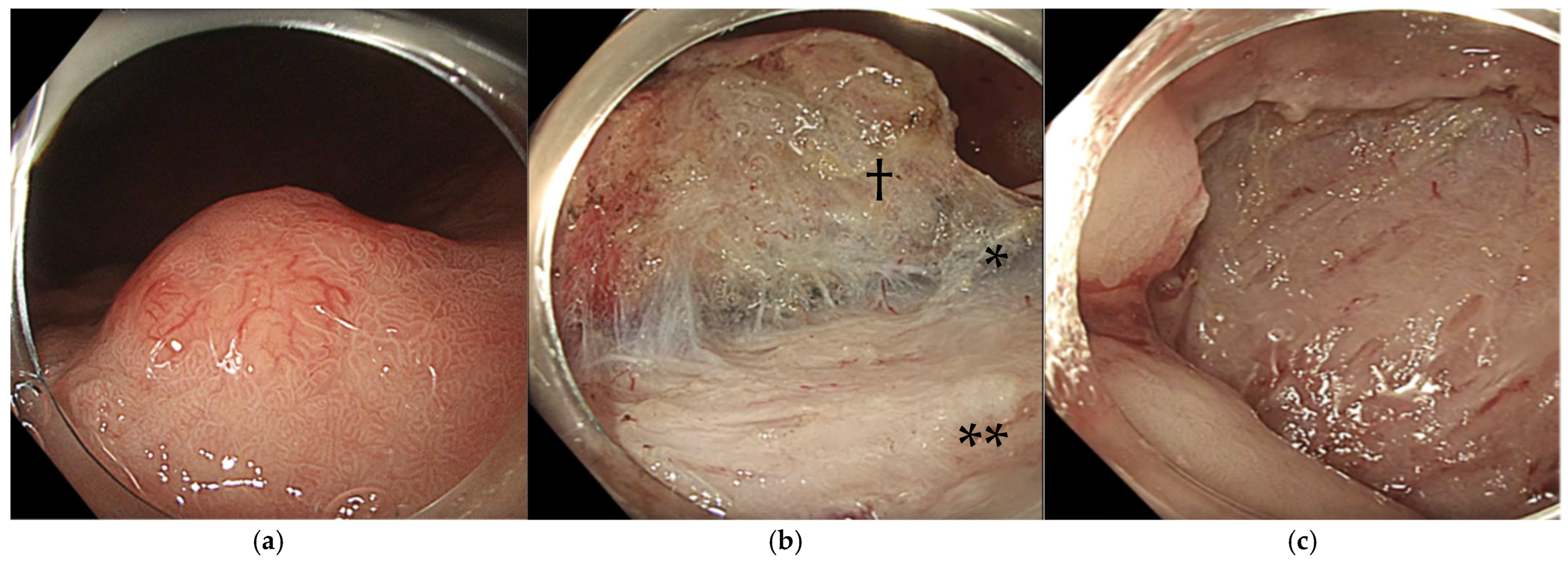
Alongside these procedural innovations, traction techniques have become a key adjunct to gastric ESD. Traction improves exposure of submucosa and reduces both procedure duration and complication rates, especially for larger or more complex lesions [37,38]. The most widely adopted method is “clip with line” traction, in which a clip tied to a dental floss is anchored to the lesion edge and pulled in oral direction. This simple, low-cost method has been compared with conventional ESD in a randomized controlled trial (RCT) of 640 patients with gastric adenoma or cancer, demonstrating a reduced risk of perforation and remarkable reduction in procedure time for lesions located in the upper curvature or middle stomach [39]. Another well-established method is the “double-clip with rubber band” technique, where a first clip grasping a rubber band is positioned on the lesion edge and a second clip anchors the rubber band to the opposite wall of the stomach. A recent meta-analysis by Awad et al. [40] included 1508 patients with gastrointestinal lesions and showed that “double-clip with rubber band” traction is superior to conventional ESD in achieving R0 resection, en bloc resection and shortened procedure duration. Similar results were obtained with the “spring-and-loop with clip” technique, another inner traction system with two clips and a spring between them [41,42].
The main difference between these methods lies in the nature of the traction they provide. In the clip-with-line technique, traction is essentially fixed and unidirectional once applied. By contrast, double-clip with rubber band and spring-and-loop with clip systems offer dynamic, multidirectional traction: the vector can be adjusted intra-procedurally by repositioning the anchoring clip on the opposite wall, allowing better control of the dissection plane in difficult locations. The use of traction methods is actually recommended by the ESGE particularly for G-SETs located in the greater curvature of upper/middle body of the stomach with size >20 mm or anytime the access to the submucosa is difficult [37]. A key advantage of these methods is that they are simple to implement and do not require complex dedicated devices. Most can be performed using standard accessories available in routine practice, making traction-assisted ESD widely applicable, even outside highly specialized centers.
An example of a traction-assisted ESD is represented in Figure 1.

3.3. Endoscopic Full-Thickness Resection (EFTR) and Closure Techniques

EFTR has emerged as a viable and advanced endoscopic technique for the treatment of G-SETs, particularly those arising from the deeper layers of the gastric wall. This technique relies on a controlled, intentional perforation that enables the complete removal of the tumor [43].
Exposed-EFTR is similar to ESD/ESE, as it is based on a “free-hand” approach where the mucosa around the lesion is incised circumferentially using an endoscopic knife. The dissection is then extended through all layers of the gastric wall in order to achieve full-thickness resection of the tumor. Lastly, closure of the full-thickness defect is carried out to prevent leakage of gastric contents and peritonitis and the resected specimen is retrieved trans-orally [43].
In a systematic review of 99 studies including almost 1000 exposed-EFTR procedures for G-SETs, the pooled estimate of R0 resection was near 100% (99.3%), with surgical conversion rates of only 0.09% [44]. Moreover, it proved to be a relatively safe technique because of pooled estimate of major adverse events lower than 0.3%, including delayed bleeding, perforation and peritonitis.
Recently, a Cap-assisted-EFTR variant has been developed for small G-SETs <15 mm. In this approach, the tumor is first suctioned into a transparent cap, then a snare is tightened at the base of the tumor, that is subsequently resected. Early series suggest comparable perioperative outcomes with shorter procedure time [45].
Because intentional transmural defects are central to EFTR, closure methods represent a critical determinant of both feasibility and safety. Conventional through-the-scope clips can be effective for small defects (<20 mm), but their reliability decreases as defect size increases [46]. Over-the-scope clips (OTSCs) have therefore become a widely adopted solution [47], providing strong serosa-to-serosa apposition and high burst-pressure resistance in clinical studies for defects within the dimensional limits of the device [48,49]. In a prospective single-center trial of 64 patients with G-SETs, exposed EFTR with OTSC closure achieved 100% technical success and R0 resection rate of 98.5%, with durable long-term outcomes and no recurrences over a mean follow-up of four years [50]. Beyond OTSC, several additional closure and suturing strategies have been developed to expand the therapeutic applicability of EFTR. Purse-string techniques that combine multiple clips with endoloop have been shown to achieve complete closure of gastric defects up to 4 cm, with excellent safety and clinical success rates [51,52]. Moreover, in order to achieve closure of difficult lesions due to their size or location, the pre-purse-string technique can be employed. This technique involves positioning an endoloop with one or two clips before completion of the dissection phase; the remaining clips are then anchored around the defect, and the endoloop is finally tightened to achieve defect closure [51]. Endoscopic suturing devices have also broadened the armamentarium for EFTR closure. The OverStitch system, for example, allows for continuous or interrupted full-thickness suturing and has been validated in prospective multicenter registries as a reliable method for managing complex or irregular defects, though its use remains limited by device cost and technical demand [53]. Emerging alternatives such as the reopenable-clip over-the-line method have also demonstrated feasibility in clinical settings, providing a low-cost and versatile solution for secure closure without the need for dedicated suturing systems [54].
By contrast, the non-exposed EFTR technique is based on a “close first, cut later” principle [55]. A dedicated full-thickness resection device (FTRD) has been developed, where an OTSC is deployed at the base of the tumor to create a secure serosa-to-serosa apposition, then an integrated snare resects the pseudo-polyp created above the clip. This technique minimizes the risk of free perforation and spillage of gastric contents into the peritoneal cavity. However, the bulky distal cap significantly reduces scope maneuverability, making intubation and retroflexion particularly challenging in angulated segments such as the antrum and duodenum. In addition, the limited cap volume imposes a practical upper size threshold of approximately 20–25 mm for reliable en bloc capture, so larger G-SETs are often better managed with exposed EFTR [56].
From a training perspective, EFTR is regarded as a late-stage advanced endoscopic skill, as operators must first achieve solid competency in diagnostic endoscopy, EMR, ESD and hemostasis before attempting transmural resections. Particular emphasis should be placed on mastering cap-mounted clip systems and endoscopic suturing, since reliable full-thickness defect closure is the defining technical step of EFTR [57]. Although no formal training curriculum has been developed by the major international societies of gastrointestinal endoscopy, a training pathway has been proposed, with a stepwise progression from ex vivo and animal models to human cases. The absence of validated competency metrics and the need for specialized infrastructure mean that, for now, EFTR training and practice remain largely confined to high-volume tertiary centers, limiting the dissemination of this technique on a wider scale [57].
According to ESGE guidelines, EFTR is feasible for SETs up to 4 cm and may be considered as an alternative to surgery for gastric GISTs <35 mm protruding into the gastric lumen [7]. Clinical data from both retrospective cohorts and meta-analyses provide further insights into the performance of EFTR in G-SETs. In one of the earliest single-center series, Wang et al. [43] evaluated 66 patients undergoing exposed EFTR for GISTs ≤3.5 cm, reporting a technical success of 98.5%, with R0 resection achieved in all but one case. In this series complications such as intra-procedural perforation were common (22.7%). This relatively high perforation rate has not been confirmed in subsequent larger series and systematic reviews, in which major adverse events have been consistently low.
A recent systematic review by Tada et al. [58] summarized 27 studies including 1234 patients treated with pure gastric EFTR over more than two decades. Tumors were predominantly GISTs arising from the muscularis propria and were mainly located in the gastric body and fundus, with a median lesion size of 16.4 mm (range 10.0–28.2 mm). The pooled complete resection rate was 99.7%, with en bloc resection and R0 resection rates of 98.4% and 96.5%, respectively. Major adverse events occurred in only 1.13% of cases, with delayed bleeding and delayed perforation rates of 0.16% and 0.08%, and no tumor recurrence during a median follow-up of 12 months.
Focusing on EFTR technique, Granata et al. [59] conducted a systematic review of 15 retrospective series encompassing 750 G-SETs, most of which originated from the muscularis propria. Mean lesion size ranged from 1.3 to 3.4 cm and locations were mostly gastric body and fundus. The authors reported pooled technical success and R0 resection rate near 99%, while major adverse events were observed in 1.6% of procedures.
Evidence on non-exposed EFTR for the treatment of G-SETs remains limited to observational studies with a small number of patients, usually derived from mixed upper gastrointestinal cohorts. A series of 23 G-SETs originating from the muscularis propria that underwent non-exposed EFTR reported technical success rates of 100% with no major complications [49]. High technical success for the treatment of G-SETs is also emerging in FTRD series: in the prospective RESET trial, FTRD achieved en bloc resection in 89.7% and R0 resection in 76% of 29 G-SETs [60], while the first international FTRD registry on 27 SETs of the upper gastrointestinal tract reported a 78% technical success and 70% R0 resection rate [61]. Although these outcomes appear less favorable than those reported for exposed EFTR in high-volume centers, FTRD has the advantage of a shorter learning curve and a standardized, device-based workflow. Its broader adoption is nonetheless constrained by device availability, cost, and the anatomic and size limitations inherent to cap-based full-thickness resection [62].

3.4. Submucosal Tunneling Endoscopic Resection (STER)

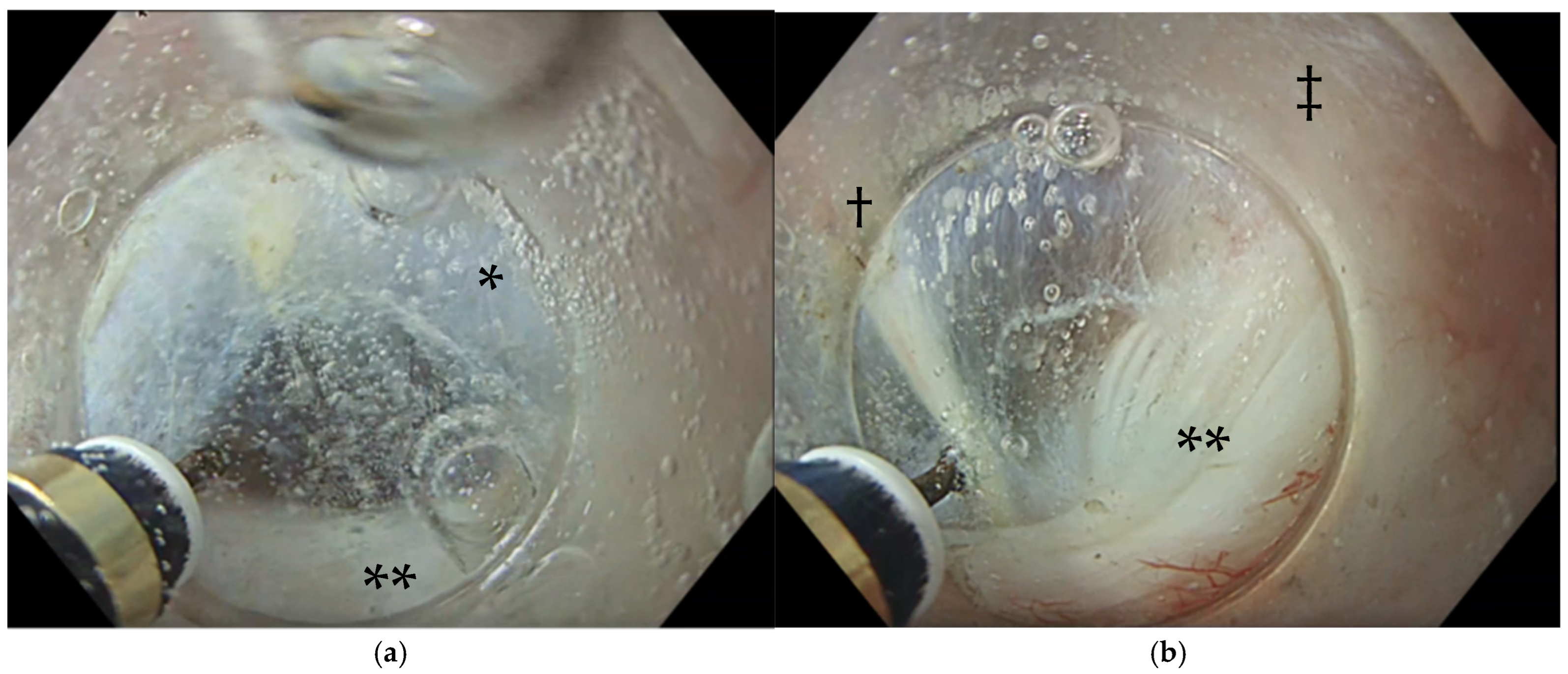
STER is an advanced therapeutic technique that allows the resection of subepithelial tumors arising from deeper layers of the gastrointestinal wall while preserving the integrity of the overlying mucosa [55]. A straight submucosal tunnel is created starting 3–5 cm above the G-SET, which is then dissected and mobilized from the surrounding tissue. Finally, the tumor is retrieved through the oral route, and the submucosal entry site is securely closed using clips [63].
First performed by Xu et al. in 2010 [64], STER was initially developed for lesions originating from muscularis propria. Moreover, the tunneling technique makes STER feasible particularly for tumors located in the morphologically straight esophagus and in the EGJ [65]. To date, STER has shown high en bloc and R0 resection rates also for gastric lesions. A meta-analysis of 9 studies including 305 G-SETs with a mean size between 14 and 25 mm and located in EGJ, gastric fundus, body and antrum, revealed a 97.9% pooled rate of R0 resection [66]. More specifically, R0 resection seems to be higher for tumors located in the EGJ (96.1%) rather than in other sites of the stomach (90.6%) [67]. The major complications of STER are gas-related, such as subcutaneous emphysema and pneumomediastinum (14.8–21.5%), with the EGJ as the most common site; however, most of them could be prevented or reduced by using CO2 insufflation. Among other complications, perforation (5.6%) was the one that most likely occurred in the stomach, while bleeding, mucosal dehiscence or leakage are exceedingly rare [68,69]. Moreover, neither local recurrence nor STER-related deaths have been described [70].
Despite these strengths, STER does present certain limitations and challenges. Usually, it is recommended for lesions up to 35 mm as larger tumors struggle with passing through the entrance of the submucosal tunnel [66]. Piecemeal resection has been indeed associated positively with larger size and irregular shape of the specimens, with unknown influence on long-term outcomes [71]. A difficult site is represented by the gastric fundus near the EGJ, due to the abundance of blood vessels in the submucosal space and complexity to create the submucosal tunnel space on the distal side of the tumor. To overcome this limitation, a “double-opening STER” technique has been developed that consist in creating a second tunnel over the inferior border of the tumor in order to push the resected lesion into the gastric lumen [72].
Although current evidence includes systematic reviews and meta-analyses, most available data derive from retrospective cohorts, and high-quality RCTs are lacking. Moreover, like other third-space techniques, STER is technically demanding, requiring precise navigation of the submucosal tunnel and stable endoscope control in a confined working space [73]. Trainees should already be proficient in adverse event management (bleeding control, clip closure) and, ideally, have prior ESD experience before progressing through a step-up pathway that includes simulator-based training, ex vivo and live animal models, and closely mentored clinical cases [73]. Up to now, a STER-specific curriculum is still lacking; as a result, its use is largely confined to high-volume centers with advanced expertise, limiting its applicability on a broader scale [65].
An example of STER is represented in Figure 2.

4. Hybrid Laparoscopic–Endoscopic Techniques

The evolution of minimally invasive approaches for G-SETs has led to the development of hybrid techniques, that combine the precision of endoscopic submucosal dissection with the safety and closure capabilities of laparoscopic surgery. These procedures aim to overcome key limitations of conventional laparoscopic wedge resection, which may struggle with accurate tumor localization and can result in excessive gastric wall removal, resulting in deformity and functional impairment [74].

4.1. Laparoscopic and Endoscopic Cooperative Surgery (LECS)

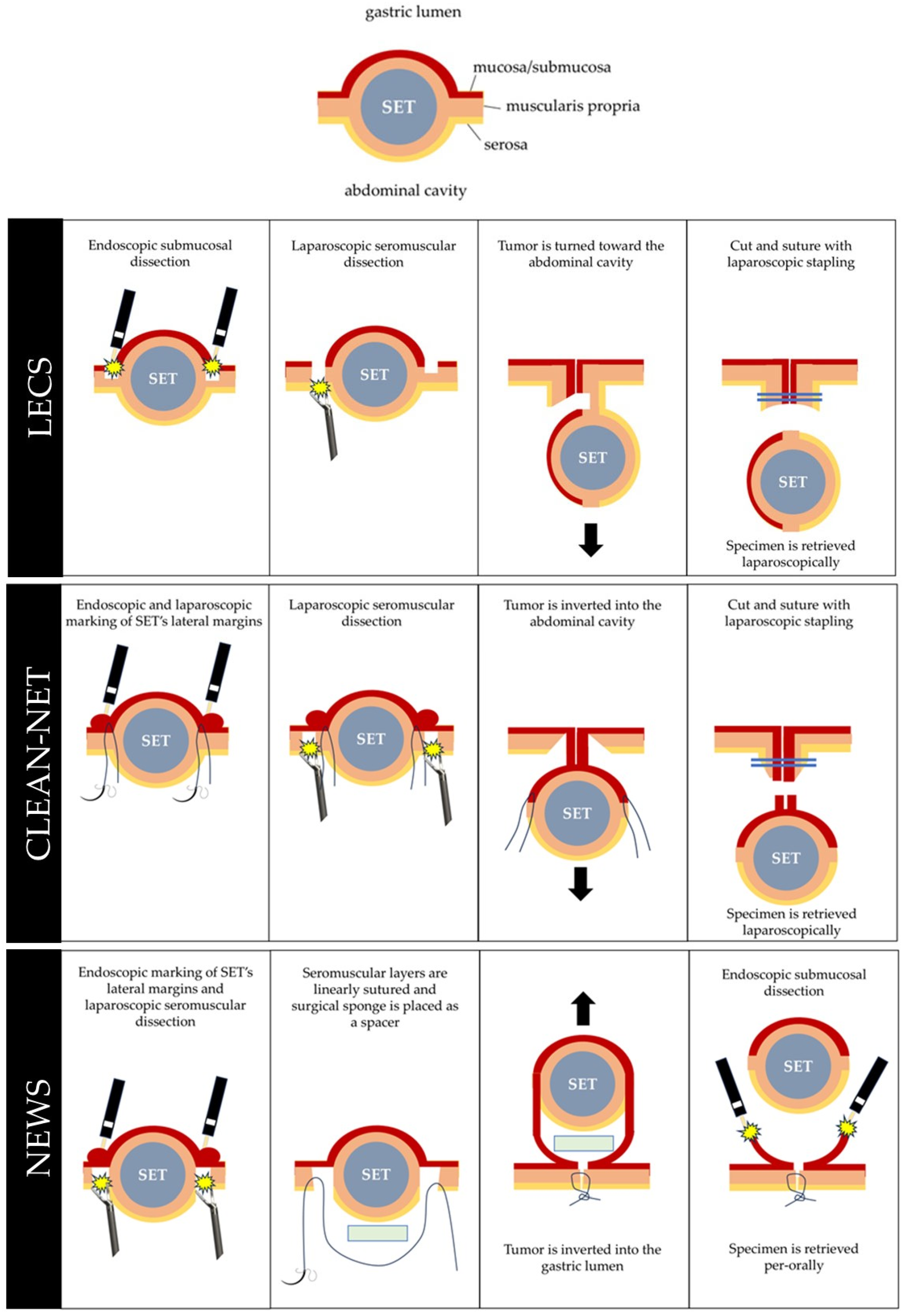
Initially described by Hiki et al. in 2008 [75], classical LECS begins with endoscopic identification and marking of the G-SET. A solution containing 10% glycerin and 5% fructose is injected around the tumor, then a circumferential mucosal and submucosal incision is carried out using an endoscopic knife [75]. The laparoscopic phase then involves seromuscular layer dissection around approximately three-quarters of the tumor circumference, exposure of the lesion toward the peritoneal cavity, and completion of resection and wall closure with a linear stapler [76]. A variation in this technique is laparoscopic-assisted EFTR (LA-EFTR), which was first proposed by Abe et al. [77]. In this technique, endoscopic dissection around the tumor is extended through the seromuscular layers under laparoscopic supervision, and the gastric defect is closed with hand-sewn sutures rather than staplers. At the end, the lesion can be removed either via laparoscopic trocars or trans-orally.
Classical LECS is generally considered a safe and effective option for G-SETs. The upper size limit of lesions treated with LECS is usually considered 5 cm, because of the increased risk of malignant potential and technical difficulty in removal, but strong evidence is lacking [76]. Based on original single-arm series and pooled data, LECS shows consistently high efficacy for gastric and EGJ lesions. In a Western cohort, Davila et al. [78] reported the application of LECS for G-SETs with a mean tumor size of about 3.4 cm, predominantly located in the gastric body and fundus, achieving en bloc and R0 resection in all cases and a postoperative complication rate of 10.5%. In a larger multicenter Japanese series, Matsuda et al. [79] observed a mean lesion size of 3.0 cm, with most tumors located in the middle third of the stomach and 13–14% at the EGJ, again reporting 100% negative margins and an overall morbidity of 4.8%.
However, a difficult site for LECS is represented by the EGJ, as reconstruction poses a risk of anastomotic insufficiency if more than one-third of the circumference is resected [76]. This site has indeed shown a higher rate of conversion to open surgery and hospitalization time [80].
The primary limitation of LECS is the intentional opening of the gastric wall, which carries a risk of spillage of gastric contents including bacteria and tumor cells into the abdominal cavity, potentially leading to infection or peritoneal neoplastic dissemination [80].

4.2. Modified LECS Techniques

To mitigate the risk of peritoneal contamination, several modified LECS procedures have been developed, focusing on a non-exposure technique that avoids opening the gastric lumen during dissection and prevents cancer cell seeding.
Inverted LECS. After endoscopic mucosal incision around the tumor, the gastric wall is lifted up along the resection line by laparoscopic positioning of external stitches anchored to the abdominal wall, forming a “crown”. The full-thickness dissection is then carried out endoscopically using an endoscopic knife, with the help of laparoscopic devices that can provide adequate tension for the incision. Any residual gastric wall dissection is completed laparoscopically. Finally, the tumor is inverted into the gastric cavity and removed trans-orally. Even if inverted LECS is a non-exposure technique, a slight risk of gastric content contamination cannot be ruled out [81].
Clean No-Exposure Technique (CLEAN-NET). The key principle of this technique is maintaining the continuity of the mucosal layer, which acts as a barrier or “clean net”. It begins with endoscopic marking of the lesion’s lateral margins. Subsequently, the mucosal layer is fixed to the seromuscular layer with four stay sutures that are positioned with laparoscopic guidance along the margins of the lesion; the position of the stay sutures is also controlled by endoscopic vision. A selective laparoscopic seromuscular dissection is then performed outside these sutures with an endoscopic knife, facilitated by submucosal injection performed endoscopically. The full-layer specimen is finally resected en bloc using a mechanical stapler [82]. The limitations of this technique are the difficulty in accurately determining the mucosal incision line from the serosal side and the risk of mucosal laceration for lesions bigger than 3 cm [76].
Non-Exposed Endoscopic Wall-Inversion Surgery (NEWS). This technique adopts a “suture first and then cut” principle. The procedure starts with endoscopic mucosal markings around the lesion, followed by laparoscopic serosal markings guided by endoscopy. A solution of sodium hyaluronate and indigo-carmine dye is injected around the lesion and a circumferential seromuscular incision is performed laparoscopically around the serosal markings. The seromuscular layers are then linearly sutured, inverting the lesion into the stomach’s lumen. Before suturing, a laparoscopic surgical sponge is strategically placed as a spacer between the suture layer and the serosal layer of the inverted lesion. This spacer provides counter-traction and protects the sutures during the subsequent endoscopic circumferential mucosal and submucosal tissue incisions. The resected specimen and the spacer are retrieved per-orally, and the mucosal edges are closed using endoscopic clips. Non-exposure simple suturing endoscopic full-thickness resection (NESS-EFTR) is a technique that has been described more recently and that differs from the NEWS for the circumferential incision around the tumor, which is made on the mucosal side of the stomach using an endoscopic approach, and for the endoscopic closure of the perforation using a looping with clips method. The superiority of these techniques lies in the precise resection of both serosal and mucosal layers under direct visualization. Nevertheless, NEWS and NESS-EFTR are relatively contraindicated for lesions bigger than 30 mm, as specimens are retrieved per-orally, and locations such as the EGJ or pyloric ring can sometimes be limiting [83,84]. Early prospective experience with the non-exposure NEWS technique in 20 gastric SETs, mainly in the upper stomach, also demonstrated 100% en bloc and R0 resection with only one intraoperative perforation and no severe adverse events [85].
A summary of indications, anatomical suitability, size thresholds and main advantages/limitations of hybrid laparoscopic–endoscopic techniques for the treatment of G-SETs has been reported in Table 3.
A graphical representation of hybrid laparoscopic–endoscopic techniques is shown in Figure 3.
Overall, the level of evidence supporting LECS and its non-exposure variants remains low to, at best, moderate, as it is almost entirely based on small single-center observational cohorts and a few meta-analyses of retrospective series, with limited long-term oncologic follow-up and no RCTs. From a training standpoint, all hybrid procedures are technically demanding, as they require close coordination between an endoscopist skilled in ESD and a laparoscopic surgeon experienced in advanced gastric surgery [86]. However, no formal learning-curve metrics, training steps or minimum experience thresholds are provided in the included studies [82]; learning curve is discussed qualitatively (e.g., need for experienced teams, complex coordination) rather than quantified [80] and pre-clinical animal training is desirable [85]. In this setting, most published series originate from high-volume referral centers and procedure-specific curricula are still lacking [86]. Furthermore, evidence on costs and cost-effectiveness is scarce or absent: most studies report operative time and length of stay as surrogate resource metrics, but dedicated economic analyses comparing hybrid approaches with endoscopic-only or surgical strategies are rarely available. These factors, together with the need for dedicated multidisciplinary teams currently limit widespread adoption, suggesting that these techniques should be reserved for carefully selected patients in experienced centers [79,80,85].

5. Comparative Analysis of Techniques

Across major society documents, surveillance is generally reserved for small, asymptomatic, low-risk G-SETs when a definitive benign diagnosis is not established, whereas lesions with a confident benign phenotype (e.g., lipoma or pancreatic rest) are consistently considered not to require follow-up [7,10,12]. For muscularis propria-derived lesions <2 cm (including small gastric GISTs), american guidelines support considering EUS-based surveillance, but evidence is insufficient to mandate surveillance over resection in all cases [8,10,12]. According to ESGE, asymptomatic and stable G-SETs <20 mm could be managed conservatively with surveillance, except for GISTs with EUS features that are suspicious for malignant degeneration and for type 1 gastric NETs >10 mm [7]. Differently from american guidelines ESGE suggest a more precise work-up for undiagnosed and asymptomatic G-SETs: after a early reassessment at 3–6 months, a size-stratified endoscopic/EUS surveillance could be adopted every 2–3 years, if size is <10 mm, or every 1–2 years, if size is 10–20 mm [7]. However, when histological diagnosis is undefined despite multiple attempts at tissue acquisition, endoscopic treatment of the lesion can be an option to avoid unnecessary follow-up [7].
Table 4 summarizes the high-risk features for malignancy in G-SETs, which require active treatment.
So far, there are no RCTs that directly compare endoscopic resection and surgery for G-SETs using standardized endpoints (en bloc and R0 resection, adverse events). Most available data derive from single-center case series and retrospective comparative cohorts, often from high-volume referral centers and with heterogeneous case mix (histology, layer of origin, growth pattern, and location) and variable follow-up [21,58,80]. Systematic reviews and meta-analyses are increasingly available, but they largely pool non-randomized studies and therefore remain susceptible to selection bias, confounding by indication and “expert-center” effect [21,44,66,67,70,80,88].
For ESD/ESE, evidence is dominated by retrospective single-center cohorts and meta-analyses of retrospective series; overall, they support high en bloc/R0 rates in selected lesions, but outcomes vary by layer of origin and challenging locations such as the EGJ, limiting external validity [20,21,22,25,27,28,89]. Definitions of adverse events and reporting granularity are inconsistent across studies, limiting cross-study comparability and the strength of indirect comparisons with EFTR/STER [21,28]. For exposed EFTR, several retrospective cohorts and meta-analyses with large samples report consistently high technical success and R0 rates with low severe adverse-event rates [44,58,90]; however, heterogeneity in closure strategies and non-uniform definitions of “perforation” (intentional full-thickness defect vs. clinically relevant leak/peritonitis) complicates cross-study comparisons [58,59]. By contrast, non-exposed EFTR/FTRD evidence is more limited and frequently derived from mixed upper-gastrointestinal cohorts or registries with less robust gastric-only stratification [61,88]. For STER, evidence includes multiple meta-analyses that support high en bloc and R0 resection rates in selected tumors, but they are still dominated by retrospective series [64,66,69,70,91]. Furthermore, stomach-specific performance is influenced by location and growth pattern (intraluminal vs. extraluminal) and direct comparative studies remain scarce [69,70,92]. Finally, hybrid laparoscopic–endoscopic techniques are mainly supported by retrospective comparative studies and meta-analyses, but non-exposure variants only rely on small cohorts of patients and early prospective experiences, with limited long-term oncologic data and scarce cost-effectiveness analyses beyond operative time and length of stay in hospital [78,80,84,85,93].
With the limit of heterogeneity across the included studies, we conducted a comparative analysis of the current endoscopic and hybrid laparoscopic–endoscopic approaches most suitable for the treatment of high-risk G-SETs, stratified by tumor size, gastric location, and layer of origin. This analysis highlights similar outcomes across techniques as well as clinically meaningful differences that may condition patient selection and procedural choice.

5.1. Small Lesions (<2–3 cm)

For small, intraluminal G-SETs, particularly those arising from the submucosa, ESD consistently achieves excellent outcomes; however, the risk of perforation and incomplete resection should always be considered, especially for tumors located at the EGJ and originating from the muscularis propria [21,25]. In this setting, for small tumors arising from the muscularis propria at the EGJ, STER represents a valuable alternative to ESD in terms of efficacy. However, STER requires a longer operative time and is more technically demanding, so it should be employed only in anatomically constrained regions where ESD carries a higher risk of complications [94].

5.2. Intermediate-Size Lesions (3–4 cm)

In this range, the growth pattern of the tumor (endoluminal vs. extraluminal) and the depth of the layer of origin become decisive for the choice of technique. For muscularis propria-derived tumors or those with partial extraluminal growth, studies demonstrate a clear advantage for EFTR or hybrid laparoscopic–endoscopic approaches over the other endoscopic techniques. In a prospective comparison, Chiu et al. [95] observed that EFTR achieved en bloc resection in 100% of cases versus 80% for STER, without significant differences in overall complication rates. On the other hand, in a meta-analysis comparing STER with ESE for G-SETs originating from the muscularis propria, Neto et al. [96] reported similar complete R0 resection rates (91.8% vs. 93.1%) and en bloc resection rates (83.3% vs. 90.0%), with low local recurrence (~2% in both groups) and no significant differences in overall complication rates. Taken together, these data indicate that for intermediate-sized gastric lesions, exposed EFTR provides the most reliable histologic completeness, while STER remains appropriate for selected intraluminal tumors with favorable access.
Hybrid approaches show comparable efficacy in this setting. In a recent meta-analysis by De Brito et al., LECS and its derivatives have been compared to laparoscopic surgery and ESD for the treatment of G-SETs, showing no significant differences in terms of technical success, with a trend to higher rates of R0 resection (near 100%) and fewer adverse events and shorter hospitalization time in the LECS arm. On the other hand, procedural time for LECS was longer than for pure endoscopic techniques and laparoscopic surgery [80]. Overall, these results are nearly equivalent to exposed EFTR, though hybrid procedures may be preferred when capsule rupture or peritoneal contamination risk is present, particularly for ulcerated GISTs.

5.3. Large Lesions (>4–5 cm)

For larger G-SETs, the feasibility of purely endoscopic management declines due to risks of incomplete resection and challenges in secure closure. Although data from Iwakawa et al. [97] are limited to 7 cases, they suggest that LECS could be technically achievable even for lesions exceeding 5 cm, maintaining en bloc and R0 rates above 95% and no significant increase in morbidity compared with smaller lesions.
However, EFTR or STER approaches are rarely applied in this size range, primarily due to workspace constraints and higher risk of perforation or incomplete closure.

5.4. Anatomical Location

Anatomical location strongly impacts the choice of the technique. Lesions of the gastric body, fundus and antrum are the most amenable to endoscopic therapy, with reported en bloc and R0 resection rates consistently above 90% across ESD and EFTR series [21,59]; however, at the EGJ their technical performance decreases [25,89]. At this site, STER has shown higher technical success; therefore, it should be the preferred technique [94]. At the EGJ, and generally in all difficult sites, LECS preserves excellent outcomes, achieving R0 resection in 95–100% of cases with minimal leakage or bleeding. Therefore, it should be preferred when endoscopic access or closure is challenging [80,85,98].

5.5. Layer of Origin

Tumors confined to the submucosa can be effectively managed by ESD or STER, with high R0 resection rates and limited risk [21,66].
G-SETs arising from the muscularis propria generally require full-thickness management; exposed EFTR provides the highest radicality (R0 resection up to 96%) at the expense of procedural complexity, whereas hybrid
Laparoscopic–endoscopic techniques offer similar histologic completeness with enhanced safety margins due to laparoscopic closure [58,59,80].

5.6. Endoscopic and Hybrid Techniques vs. Surgery: A Decision-Making Algorithm for G-SETs

Across past surgical series, laparoscopic wedge and segmental gastrectomy achieved almost universal en bloc and R0 resection rates (≈100%), with major morbidity typically below 10% and recurrence-free survival exceeding 90% at medium-term follow-up [99,100,101,102,103]. Mean tumor sizes in these cohorts ranged between 3 and 5 cm, most arising from the muscularis propria of the body or fundus, while cardial and antral lesions were resected safely with minor adjustments in technique. All these studies confirmed excellent oncologic control and rapid recovery after laparoscopic surgery, and they were supported by the meta-analysis conducted by Koh et al. [104]. This study also showed shorter hospital stay and lower blood loss for laparoscopy compared with open resection, while no significant differences emerged in terms of survival and R0 resection rates between these two techniques.
More recently, multiple comparative studies demonstrate the oncologic equivalence of minimally invasive endoscopic and hybrid methods to laparoscopic surgery for GISTs ≤5 cm. In the retrospective analysis conducted by Zhao et al. [105], EFTR achieved R0 resection in 95.3% of cases versus 100% for laparoscopic or open surgery, with adverse events 5.9% versus 7.8–16.4%, and no procedure-related mortality. Two meta-analyses of, respectively, 17 and 13 retrospective studies, confirmed similar R0 resection rates (endoscopic resection 93–95% vs. laparoscopic resection 98–100%), comparable safety, and significantly shorter operative time and hospital stay for endoscopic resection [106,107].
Lastly, LECS shows equivalent therapeutic outcomes but may entail longer procedural times and, in large or complex lesions, slightly higher morbidity (up to 32%) [80,108].
The similar technical success translates into comparable long-term oncologic outcomes between these techniques. In the population-based analysis by Chai et al. [109], including 749 patients with 2–5 cm gastric GISTs, no significant differences were observed in 5- and 10-year overall or cancer-specific survival.
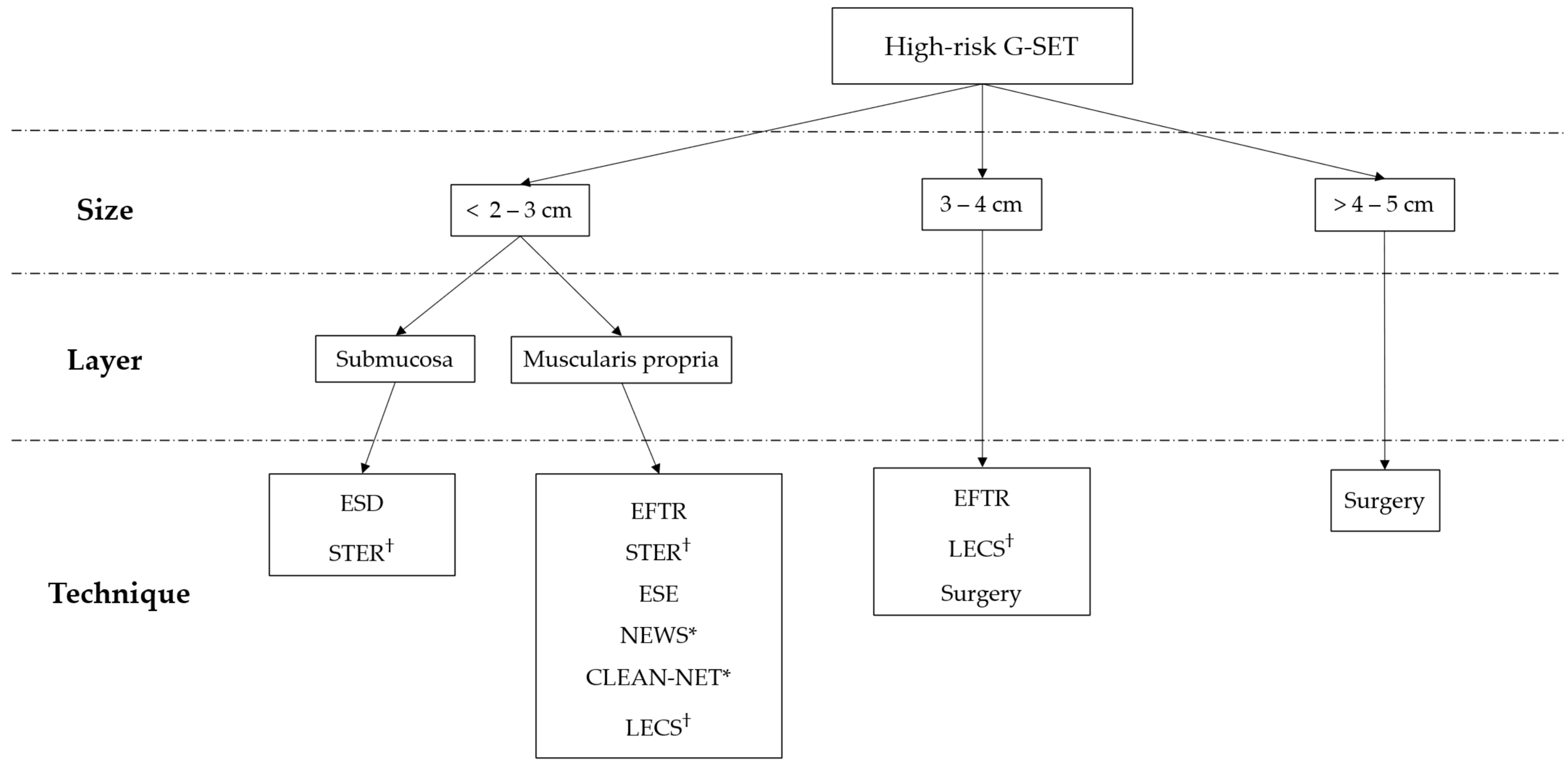
Based on the evidence discussed above, we propose a practical decision-making algorithm (Figure 4) to guide clinicians to select the most appropriate treatment for high-risk G-SETs, according to tumor size and layer of origin. Additional considerations have been included for tumor located at the EGJ and when ulceration is present. This framework must be intended as a guide rather than a prescriptive rule, and final decision should be individualized according to patient characteristics and local expertise and resources.

6. Emerging Technologies and Devices

6.1. New Traction Techniques

Achieving effective traction is one of the main issues in advanced endoscopic resection in the gastric setting, particularly during ESD and exposed EFTR, where the endoscope’s axial approach limits the access to the submucosa [41]. These constraints are amplified in anatomically difficult settings (e.g., EGJ), and in large or fibrotic lesions, where submucosal exposure may become inconsistent and procedure time and the risk of muscularis propria injury may increase [89]. Conventional traction strategies (e.g., clip-with-line, elastic-band systems, spring-based traction, traction-wire platforms) can improve exposure and efficiency, but they often provide a fixed or only partially adjustable traction vector and may require repositioning or repeated anchoring to restore optimal tension and direction during dissection [41]. Against this background, recent years have witnessed the emergence of more dynamic, operator-controlled traction solutions designed to deliver multidirectional, re-adjustable tissue manipulation and to improve procedural reproducibility in complex locations [110,111,112,113,114].
Among these, the TRACMOTION device represents a through-the-scope, articulated traction system that allows precise multidirectional tissue manipulation during ESD. In a pilot clinical study based on a porcine model evaluation, Miura et al. [110] demonstrated that TRACMOTION significantly improved dissection speed for gastric lesions located on the posterior wall compared to standard ESD, while also reducing muscularis propria injury rates. Importantly, this system enables the operator to independently control traction angle without relying on external assistance, an advantage in anatomically complex sites like the upper stomach.
Similarly, Okamura et al. [111] proposed a novel multipoint traction strategy based on a combination of nylon threads and rubber bands anchored via clips in a triangular configuration. This system demonstrated enhanced submucosal exposure and higher resection speed in both ex vivo and in vivo models. It may be particularly beneficial in managing large or fibrotic lesions, providing uniform countertraction across wider tissue planes while remaining compatible with standard single-channel endoscopes.
In the esophageal setting, where space constraints limit tool maneuverability, Wallenhorst et al. [112] introduced an elegant pulley traction system. By tunneling a traction line externally through the oral route, they achieved effective bidirectional tissue retraction in a case of ESD for a laterally spreading tumor, resulting in successful en bloc R0 resection and optimal submucosal plane visibility.
Beyond mechanical systems, magnetic-assisted traction also holds promise, as shown by Zhang et al. [113] that developed the Magnetic Anchor Line-Guided EFTR system for G-SETs. Early human series showed that this dynamic traction method enhanced lesion exposure and dissection control without compromising safety, marking a step toward less invasive full-thickness resections.
Finally, in the colorectal domain, Grimaldi et al. [114] validated the ATRACT device, a flexible, articulating, reusable system capable of anchoring and reorienting tissue via a dual-channel endoscope. While the study was ex vivo, the system demonstrated excellent traction control and modularity, suggesting its potential for transposition to upper gastrointestinal ESD in the future.
Collectively, these innovations signal a shift from static traction systems toward operator-controlled, responsive platforms that may improve technical success and broaden the accessibility of complex endoscopic resections.

6.2. Robotic-Assisted Endoscopy

Robotic assistance in flexible endoscopy is rapidly transitioning from experimental prototypes to early clinical applications, particularly for technically demanding endoscopic resections. Differently from standard endoscopes, robotic platforms offer fine tissue manipulation through multi-degree-of-freedom articulated arms with bimanual dexterity. In this way, they can shorten procedure duration, lower operator fatigue, especially in difficult gastric locations [115]. Hybrid laparoscopic–endoscopic techniques can improve safety and closure, but they require an operating-room setting and two-team coordination [76], while robotic platforms could be managed by a single operator seated at a console [116].
The Master and Slave Transluminal Endoscopic Robot (MASTER) system represents a milestone in this evolution. As early as 2012, Phee et al. [117] conducted the first multicenter human trial using this robotic platform in five patients with early gastric neoplasia. The MASTER system, featuring dual robotic arms inserted via a double-channel endoscope, enabled high-precision submucosal dissection with a mean procedure time of 39 min and no perioperative complications. All patients achieved en bloc and R0 resections and showed complete mucosal healing at 30-day follow-up. This study laid the foundation for safe, effective, and reproducible robotic ESD in humans, particularly in anatomically challenging areas like the gastric antrum and body. A major advancement was later reported by Chiu et al. [118], who applied the same MASTER system in a preclinical study to perform robot-assisted endoscopic full-thickness gastric resection in porcine models. The robotic arms facilitated simultaneous traction and electrosurgical dissection through the gastric wall. The procedure maintained stable luminal exposure via percutaneous gastropexy and showed no organ injury or gas leakage post-closure, underscoring the potential for this combined approach in managing G-SETs. The evolution of the MASTER system culminated with the MASTER V3, which improved arm articulation and console integration. In a prospective pilot trial, Jeon et al. confirmed 100% technical and clinical success in five gastric ESD cases using the newer generation device, with enhanced precision and no adverse events [119].
Preclinical innovations further support this pathway. Liang et al. [120] developed a fully flexible, origami-type robotic endoscope equipped with a 3D-printed arm that demonstrated stable tissue control and precision resection in porcine stomachs. This system is notable for its self-supporting structure and tool-tip control, both crucial for the replication of fine dissection movements in challenging positions.
In parallel, Kume et al. [116] described the ENDOFLEX platform, a joystick-controlled robotic endoscope with a steerable, torque-stable tip. Designed to simplify submucosal dissections and reduce loop formation, the system supports intuitive use by operators-in-training, suggesting a future role in training centers and community hospitals.
These technologies collectively improve surgical ergonomics and may contribute to a reduction in the operator learning curve. However, their widespread implementation is currently hindered by substantial costs and limited clinical evidence. In particular, comparative data evaluating efficacy and safety of robotic platforms against established endoscopic resection techniques remain scarce. Further high-quality studies are required before robotic systems can be considered a standard tool in therapeutic endoscopy.

6.3. Artificial Intelligence-Based Platforms for Resection Planning

Within therapeutic endoscopy for G-SETs, margin definition can be challenging, which contributes to incomplete resection or inadvertent injury to the muscularis propria with subsequent perforation [11]. Hybrid laparoscopic–endoscopic approaches can mitigate some safety concerns, but they do not solve upstream problems such as reproducible margin delineation, and procedural standardization across centers [80]. In this context, artificial intelligence (AI) is increasingly integrated into real-time endoscopic systems as decision-support tools rather than autonomous navigators. Li et al. [121] evaluated an AI-based lesion labeling system in a prospective cohort of patients undergoing esophageal ESD in a low-volume center. The system provided margin detection support, significantly improving lateral margin delineation and leading to a higher rate of complete resections, despite operator inexperience. Alongside, Dong et al. [122] introduced an AI module designed to predict deep margin status during gastric ESD. Applied in real-time, this system allowed intra-procedural adaptation of the resection plane to minimize the risk of incomplete resection or perforation.
Overall, AI platforms are evolving from diagnostic classifiers into potential real-time navigational aids in therapeutic endoscopy, but current evidence on their role during resective procedures such as ESD and EFTR remains limited. Their most promising application appears to lie in the enhancement of lesion characterization and in supporting precise delineation of lesion margins before and during resection, although robust clinical data are still needed to confirm these benefits.

7. Conclusions

The therapeutic management of G-SETs has significantly evolved in the last decade, driven by advances in endoscopic and hybrid techniques. ESD, EFTR and STER have demonstrated high rates of en bloc and R0 resection, especially for lesions originating from the muscularis propria, while hybrid approaches have broadened treatment indications, particularly in anatomically complex sites or larger tumors. The most appropriate strategy should be decided on a case-by-case basis, taking into account factors such as procedural risk and the patient’s overall health. Based on current evidence, our proposed practical algorithm (Figure 4) outlines a therapeutic pathway based on tumor size and layer of origin. For smaller tumors (generally <2 cm, and up to 2–3 cm in selected cases), endoscopic resection is typically appropriate when a complete en bloc specimen can be obtained safely. Submucosal lesions are most often managed with ESD, frequently with traction assistance when exposure is suboptimal. When the lesion originates from the muscularis propria, “enucleation-type” techniques such as ESE or STER are preferred to achieve R0 resection while minimizing the need for a full-thickness defect; STER is particularly useful at the esophagogastric junction, where access and defect closure can be more challenging. For intermediate-size tumors (approximately 3–4 cm), especially those arising from the muscularis propria or with a relevant extraluminal component, exposed EFTR offers a consistent likelihood of complete resection, provided that secure defect closure is achievable with dedicated devices and experienced endoscopists. In this range, hybrid laparoscopic–endoscopic techniques become particularly valuable when ulceration, fibrosis, or anatomic constraints raise concern for spillage or unreliable endoscopic closure; when technically feasible and within customary size limits, non-exposure approaches may further reduce contamination risk. For tumors larger than 4–5 cm or located in anatomically prohibitive sites, surgical resection remains the reference standard, with hybrid organ-sparing options reserved for highly selected cases in expert centers.
Despite excellent outcomes reported in expert series, real-world implementation of advanced endoscopic and hybrid approaches remains uneven. The evidence base is still largely derived from retrospective cohorts in high-volume tertiary centers, and many procedures carry steep learning curves and depend on consistent case volume, reliable management of bleeding/perforation and access to dedicated closure devices [7,28,55]. Hybrid laparoscopic–endoscopic approaches further require complex organizational resources, including coordinated endoscopy-surgery lists and institutional investments in equipment and training [86]. As a result, the implementation of these techniques remains heterogeneous and largely centralized. Future research should therefore not only refine indications and compare long-term oncological outcomes, but also address issues of training and creation of a multidisciplinary pathway to ensure that minimally invasive strategies for G-SETs can be delivered safely and equitably across different healthcare settings.
The advent of innovative technologies such as advanced traction systems, robotic-assisted platforms, and AI-guided tools undoubtedly opens new frontiers in the field of endoscopic resection. These systems promise to enhance precision and safety, particularly in challenging anatomical contexts. However, most of them remain confined to preliminary investigations or highly specialized centers, with limited comparative data. At present, there is insufficient evidence to support their superiority over current techniques in terms of efficacy, safety, or cost-effectiveness. As such, while these technologies may play a complementary role in selected cases, rigorous clinical validation and long-term outcome data are still required before they can be routinely integrated into the therapeutic algorithm for G-SETs.

Author Contributions

Conceptualization, F.B. and A.B.; methodology, A.B.; validation, P.C.; formal analysis, A.B.; investigation, F.B. and M.D.; resources, A.B.; data curation, F.B.; writing—original draft preparation, F.B. and M.D.; writing—review and editing, A.B. and P.C.; visualization, G.B. and R.M.Z.; supervision, M.D.G., G.D., F.V.M., F.A., E.S., L.F., G.B. and R.M.Z. All authors have read and agreed to the published version of the manuscript.

Funding

This research received no external funding.

Institutional Review Board Statement

Not applicable.

Informed Consent Statement

Not applicable.

Data Availability Statement

No new data were created or analyzed in this study. Data sharing is not applicable to this article.

Conflicts of Interest

The authors declare no conflicts of interest.

Abbreviations

The following abbreviations are used in this manuscript:
G-SETsGastric Subepithelial Tumors
GISTsGastrointestinal Stromal Tumors
NETsNeuroendocrine Tumors
EUSEndoscopic Ultrasonography
ESGEEuropean Society of Gastrointestinal Endoscopy
EMREndoscopic Mucosal Resection
C-EMRCap-assisted Endoscopic Mucosal Resection
L-EMRLigation-assisted Endoscopic Mucosal Resection
RCTRandomized Controlled Trial
ESDEndoscopic Submucosal Dissection
ESEEndoscopic Submucosal Excavation
EFTREndoscopic Full-Thickness Resection
OTSCOver-The-Scope Clip
FTRDFull-Thickness Resection Device-assisted
STERSubmucosal Tunneling Endoscopic Resection
EGJEsophagogastric Junction
LECSLaparoscopic and Endoscopic Cooperative Surgery
LA-EFTRLaparoscopic-assisted Endoscopic Full-Thickness Resection
CLEAN-NETClean No-Exposure Technique.
NEWSNon-Exposed Endoscopic Wall-Inversion Surgery
NESS-EFTRNon-Exposure Simple Suturing Endoscopic Full-Thickness Resection
AIArtificial intelligence

References

  1. Humphris, J.L.; Jones, D.B. Subepithelial Mass Lesions in the Upper Gastrointestinal Tract. J. Gastroenterol. Hepatol. 2008, 23, 556–566. [Google Scholar] [CrossRef] [PubMed]
  2. Heo, D.H.; Yang, M.A.; Song, J.S.; Lee, W.D.; Cho, J.W. Prevalence and Natural Course of Incidental Gastric Subepithelial Tumors. Clin. Endosc. 2024, 57, 495–500. [Google Scholar] [CrossRef] [PubMed]
  3. Lim, Y.J.; Son, H.J.; Lee, J.S.; Byun, Y.H.; Suh, H.J.; Rhee, P.L.; Kim, J.J.; Rhee, J.C. Clinical Course of Subepithelial Lesions Detected on Upper Gastrointestinal Endoscopy. World J. Gastroenterol. 2010, 16, 439–444. [Google Scholar] [CrossRef] [PubMed]
  4. Choe, Y.; Cho, Y.K.; Kim, G.H.; Choi, J.H.; Kim, E.S.; Kim, J.H.; Choi, E.K.; Kim, T.H.; Kim, S.H.; Kim, D.H. Prevalence, Natural Progression, and Clinical Practices of Upper Gastrointestinal Subepithelial Lesions in Korea: A Multicenter Study. Clin. Endosc. 2023, 56, 744–753. [Google Scholar] [CrossRef]
  5. Kim, G.H. Systematic Endoscopic Approach for Diagnosing Gastric Subepithelial Tumors. Gut Liver 2022, 16, 19–27. [Google Scholar] [CrossRef]
  6. Hwang, J.H.; Saunders, M.D.; Rulyak, S.J.; Shaw, S.; Nietsch, H.; Kimmey, M.B. A Prospective Study Comparing Endoscopy and EUS in the Evaluation of GI Subepithelial Masses. Gastrointest. Endosc. 2005, 62, 202–208. [Google Scholar] [CrossRef]
  7. Deprez, P.H.; Moons, L.M.G.; O’Toole, D.; Gincul, R.; Seicean, A.; Pimentel-Nunes, P.; Fernández-Esparrach, G.; Polkowski, M.; Vieth, M.; Borbath, I.; et al. Endoscopic Management of Subepithelial Lesions Including Neuroendocrine Neoplasms: European Society of Gastrointestinal Endoscopy (ESGE) Guideline. Endoscopy 2022, 54, 412–429. [Google Scholar] [CrossRef]
  8. Jacobson, B.C.; Bhatt, A.; Greer, K.B.; Lee, L.S.; Park, W.G.; Sauer, B.G.; Shami, V.M. ACG Clinical Guideline: Diagnosis and Management of Gastrointestinal Subepithelial Lesions. Am. J. Gastroenterol. 2023, 118, 46–58. [Google Scholar] [CrossRef]
  9. Facciorusso, A.; Arvanitakis, M.; Crinò, S.F.; Fabbri, C.; Fornelli, A.; Leeds, J.; Archibugi, L.; Carrara, S.; Dhar, J.; Gkolfakis, P.; et al. Endoscopic Ultrasound-Guided Tissue Sampling: European Society of Gastrointestinal Endoscopy (ESGE) Technical and Technology Review. Endoscopy 2025, 57, 390–418. [Google Scholar] [CrossRef]
  10. Faulx, A.L.; Kothari, S.; Acosta, R.D.; Agrawal, D.; Bruining, D.H.; Chandrasekhara, V.; Eloubeidi, M.A.; Fanelli, R.D.; Gurudu, S.R.; Khashab, M.A.; et al. The Role of Endoscopy in Subepithelial Lesions of the GI Tract. Gastrointest. Endosc. 2017, 85, 1117–1132. [Google Scholar] [CrossRef]
  11. Abulawi, A.; Hasak, S.; Torres, R.M.; Gopakumar, H.; Richter, S.; Dahiya, D.S.; Alashram, R.; Malik, T.F.; Khan, A.; Sharma, N.R. Gastrointestinal Subepithelial Lesions: Evolution in Management and Endoscopic Resection Techniques. Curr. Gastroenterol. Rep. 2025, 27, 12. [Google Scholar] [CrossRef]
  12. Sharzehi, K.; Sethi, A.; Savides, T. AGA Clinical Practice Update on Management of Subepithelial Lesions Encountered During Routine Endoscopy: Expert Review. Clin. Gastroenterol. Hepatol. 2022, 20, 2435–2443.e4. [Google Scholar] [CrossRef]
  13. Pimentel-Nunes, P.; Libânio, D.; Bastiaansen, B.A.J.; Bhandari, P.; Bisschops, R.; Bourke, M.J.; Esposito, G.; Lemmers, A.; Maselli, R.; Messmann, H.; et al. Endoscopic Submucosal Dissection for Superficial Gastrointestinal Lesions: European Society of Gastrointestinal Endoscopy (ESGE) Guideline—Update 2022. Endoscopy 2022, 54, 591–622. [Google Scholar] [CrossRef]
  14. Chen, Z.-M.; Peng, M.-S.; Wang, L.-S.; Xu, Z.-L. Efficacy and Safety of Endoscopic Resection in Treatment of Small Gastric Stromal Tumors: A State-of-the-Art Review. World J. Gastroenterol. 2021, 13, 462–471. [Google Scholar] [CrossRef]
  15. Inoue, H.; Takeshita, K.; Hori, H.; Muraoka, Y.; Yoneshima, H.; Endo, M. Endoscopic Mucosal Resection with a Cap-Fitted Panendoscope for Esophagus, Stomach, and Colon Mucosal Lesions. Gastrointest. Endosc. 1993, 39, 58–62. [Google Scholar] [CrossRef] [PubMed]
  16. Meng, R.; Ni, M.; Ren, W.; Zhou, T.; Zhang, X.; Yan, P.; Ding, X.; Xu, G.; Lv, Y.; Zou, X.; et al. Comparison of Modified Cap-Assisted Endoscopic Mucosal Resection and Endoscopic Submucosal Dissection in Treating Intraluminal Gastric Gastrointestinal Stromal Tumor (≤20 Mm). Clin. Transl. Gastroenterol. 2023, 14, e00589. [Google Scholar] [CrossRef] [PubMed]
  17. Pan, W.; Shi, D. Band-Assisted Endoscopic Mucosal Resection for Small (≤1.5 cm) Submucosal Tumors Originating from the Muscularis Propria in the Gastric Fundus: A Prospective Study. Surg. Endosc. 2023, 37, 1806–1812. [Google Scholar] [CrossRef] [PubMed]
  18. Cecinato, P.; Sinagra, E.; Laterza, L.; Pianigiani, F.; Grande, G.; Sassatelli, R.; Barbara, G. Endoscopic Removal of Gastrointestinal Lesions by Using Third Space Endoscopy Techniques. Best Pract. Res. Clin. Gastroenterol. 2024, 71, 101931. [Google Scholar] [CrossRef]
  19. Facciorusso, A.; Crinò, S.F.; Ramai, D.; Ofosu, A.; Muscatiello, N.; Mangiavillano, B.; Lamonaca, L.; Lisotti, A.; Fusaroli, P.; Gkolfakis, P.; et al. Comparison between Endoscopic Ultrasound-Guided Fine-Needle Biopsy and Bite-on-Bite Jumbo Biopsy for Sampling of Subepithelial Lesions. Dig. Liver Dis. 2022, 54, 676–683. [Google Scholar] [CrossRef]
  20. Lee, L.; Lin, P.Y.; Tung, Y.; Shen, H.; Wei, L.; Wu, S. Endoscopic Submucosal Dissection for the Treatment of intraluminal Gastric Subepithelial Tumors originating from the Muscularis Propria Layer. Endoscopy 2006, 32, 1024–1028. [Google Scholar] [CrossRef]
  21. Bang, C.S.; Baik, G.H.; Shin, I.S.; Suk, K.T.; Yoon, J.H.; Kim, D.J. Endoscopic Submucosal Dissection of Gastric Subepithelial Tumors: A Systematic Review and Meta-Analysis. Korean J. Intern. Med. 2016, 31, 860–871. [Google Scholar] [CrossRef]
  22. Manta, R.; Zito, F.P.; Pugliese, F.; Caruso, A.; Mangiafico, S.; D’alessandro, A.; Castellani, D.; Germani, U.; Mutignani, M.; Conigliaro, R.L.; et al. Endoscopic Submucosal Dissection for Subepithelial Tumor Treatment in the Upper Digestive Tract: A Western, Multicenter Study. GE Port. J. Gastroenterol. 2023, 30, 115–120. [Google Scholar] [CrossRef]
  23. Zhang, X.; Ly, E.K.; Nithyanand, S.; Modayil, R.J.; Khodorskiy, D.O.; Neppala, S.; Bhumi, S.; DeMaria, M.; Widmer, J.L.; Friedel, D.M.; et al. Learning Curve for Endoscopic Submucosal Dissection with an Untutored, Prevalence-Based Approach in the United States. Clin. Gastroenterol. Hepatol. 2020, 18, 580–588.e1. [Google Scholar] [CrossRef] [PubMed]
  24. Pimentel-Nunes, P.; Pioche, M.; Albéniz, E.; Berr, F.; Deprez, P.; Ebigbo, A.; Dewint, P.; Haji, A.; Panarese, A.; Weusten, B.L.A.M.; et al. Curriculum for Endoscopic Submucosal Dissection Training in Europe: European Society of Gastrointestinal Endoscopy (ESGE) Position Statement. Endoscopy 2019, 51, 980–992. [Google Scholar] [CrossRef] [PubMed]
  25. Jang, Y.S.; Lee, B.E.; Kim, G.H.; Park, D.Y.; Jeon, H.K.; Baek, D.H.; Kim, D.U.; Song, G.A.; Gara, N. Factors Associated with Outcomes in Endoscopic Submucosal Dissection of Gastric Cardia Tumors: A Retrospective Observational Study. Medicine 2015, 94, e1201. [Google Scholar] [CrossRef]
  26. Ham, N.S.; Kim, J.; Oh, E.H.; Hwang, S.W.; Park, S.H.; Yang, D.H.; Ye, B.D.; Myung, S.J.; Yang, S.K.; Byeon, J.S. Cost of Endoscopic Submucosal Dissection Versus Endoscopic Piecemeal Mucosal Resection in the Colorectum. Dig. Dis. Sci. 2020, 65, 969–977. [Google Scholar] [CrossRef] [PubMed]
  27. Li, L.; Wang, F.; Wu, B.; Wang, Q.; Wang, C.; Liu, J. Endoscopic Submucosal Dissection of Gastric Fundus Subepithelial Tumors Originating from the Muscularis Propria. Exp. Ther. Med. 2013, 6, 391–395. [Google Scholar] [CrossRef]
  28. Santos-Antunes, J.; Marques, M.; Morais, R.; Baldaque-Silva, F.; Vilas-Boas, F.; Moutinho-Ribeiro, P.; Lopes, S.; Carneiro, F.; Macedo, G. Retrospective Analysis of the Outcomes of Endoscopic Submucosal Dissection for the Diagnosis and Treatment of Subepithelial Lesions in a Center with High Expertise. Ann. Gastroenterol. 2022, 35, 68–73. [Google Scholar] [CrossRef]
  29. Kitamura, M.; Miura, Y.; Shinozaki, S.; Lefor, A.K.; Yamamoto, H. The Pocket-Creation Method Facilitates Endoscopic Submucosal Dissection of Gastric Neoplasms Along the Lesser Curvature at the Gastric Angle. Front. Med. 2022, 9, 825325. [Google Scholar] [CrossRef]
  30. Kitamura, M.; Miura, Y.; Shinozaki, S.; Sakamoto, H.; Hayashi, Y.; Sakaguchi, M.; Fukushima, N.; Lefor, A.K.; Yamamoto, H. The Pocket-Creation Method Facilitates Endoscopic Submucosal Dissection of Gastric Neoplasms Involving the Pyloric Ring. Endosc. Int. Open 2021, 9, E1062–E1069. [Google Scholar] [CrossRef]
  31. Van Der Schee, L.; Albers, S.C.; Didden, P.; Lacle, M.M.; Farina Sarasqueta, A.; Richir, M.C.; Intven, M.P.W.; Tuynman, J.B.; Hompes, R.; Dekker, E.; et al. Results of Endoscopic Intermuscular Dissection for Deep Submucosal Invasive Rectal Cancer: A Three-Year Follow-up Study. Gut 2025, 74, 1995–2003. [Google Scholar] [CrossRef] [PubMed]
  32. Moons, L.M.G.; Bastiaansen, B.A.J.; Richir, M.C.; Hazen, W.L.; Tuynman, J.; Elias, S.G.; Schrauwen, R.W.M.; Vleggaar, F.P.; Dekker, E.; Bos, P.; et al. Endoscopic Intermuscular Dissection for Deep Submucosal Invasive Cancer in the Rectum: A New Endoscopic Approach. Endoscopy 2022, 54, 993–998. [Google Scholar] [CrossRef] [PubMed]
  33. Despott, E.J.; Lucaciu, L.A.; Murino, A.; Rimondi, A.; Binmoeller, K. First Report of Gastric Endoscopic Intermuscular Dissection. Endoscopy 2024, 56, E132–E133. [Google Scholar] [CrossRef] [PubMed]
  34. Singh, S.; Mohan, B.P.; Vinayek, R.; Dutta, S.; Singh Dahiya, D.; Inamdar, S.; Charan, V.; Kumar, S.; Aswath, G.; Sharma, N.; et al. Underwater versus Conventional Endoscopic Submucosal Dissection for Colorectal Lesions: Systematic Review and Meta-Analysis. Gastrointest. Endosc. 2025, 101, 551–557.e5. [Google Scholar] [CrossRef]
  35. Kim, D.H.; Park, S.Y.; Kim, J.W.; Kim, H.S. Feasibility and Efficacy of Gastric Underwater Endoscopic Mucosal Resection. Diagnostics 2024, 14, 536. [Google Scholar] [CrossRef]
  36. Kobara, H.; Mori, H.; Masaki, T. Effective and Economical Endoscopic Resection Using a Novel Multifunctional Snare for Small-Sized Gastric Neoplasms. Dig. Endosc. 2018, 30, 800–801. [Google Scholar] [CrossRef]
  37. Libânio, D.; Pimentel-Nunes, P.; Bastiaansen, B.; Bisschops, R.; Bourke, M.J.; Deprez, P.H.; Esposito, G.; Lemmers, A.; Leclercq, P.; Maselli, R.; et al. Endoscopic Submucosal Dissection Techniques and Technology: European Society of Gastrointestinal Endoscopy (ESGE) Technical Review. Endoscopy 2023, 55, 361–389. [Google Scholar] [CrossRef]
  38. Esaki, M.; Ihara, E.; Gotoda, T. Endoscopic Instruments and Techniques in Endoscopic Submucosal Dissection for Early Gastric Cancer. Expert Rev. Gastroenterol. Hepatol. 2021, 15, 1009–1020. [Google Scholar] [CrossRef]
  39. Yoshida, M.; Takizawa, K.; Suzuki, S.; Koike, Y.; Nonaka, S.; Yamasaki, Y.; Minagawa, T.; Sato, C.; Takeuchi, C.; Watanabe, K.; et al. Conventional versus Traction-Assisted Endoscopic Submucosal Dissection for Gastric Neoplasms: A Multicenter, Randomized Controlled Trial (with Video). Gastrointest. Endosc. 2018, 87, 1231–1240. [Google Scholar] [CrossRef]
  40. Awad, A.A.; Abosheaishaa, H.; Hassan, M.A.; Marey, M.M.; Bahnasy, A.; Mohamed, R.G.; Keshk, M.A.; Alnomani, Y.R.; Balouz, M.A.; Hussein, A.A.M.; et al. Endoscopic Submucosal Dissection with Rubber Bands and Clips Compared to Conventional Endoscopic Submucosal Dissection: A Systematic Review and Meta-Analysis. Dig. Dis. Sci. 2025, 70, 2823–2833. [Google Scholar] [CrossRef]
  41. Nagata, M. Advances in Traction Methods for Endoscopic Submucosal Dissection: What Is the Best Traction Method and Traction Direction? World J. Gastroenterol. 2022, 28, 1–22. [Google Scholar] [CrossRef] [PubMed]
  42. Li, J.; Hou, X.; Chen, K.; Peng, K.; Huang, C.; Liu, F. Internal Traction in Endoscopic Full-Thickness Resection for Gastric Subepithelial Lesions Arising from the Muscularis Propria: Comparative Study. Endosc. Int. Open 2025, 13, a25442572. [Google Scholar] [CrossRef] [PubMed]
  43. Wang, L.; Ren, W.; Fan, C.Q.; Li, Y.H.; Zhang, X.; Yu, J.; Zhao, G.C.; Zhao, X.Y. Full-Thickness Endoscopic Resection of Nonintracavitary Gastric Stromal Tumors: A Novel Approach. Surg. Endosc. 2011, 25, 641–647. [Google Scholar] [CrossRef] [PubMed]
  44. Granata, A.; Martino, A.; Ligresti, D.; Tuzzolino, F.; Lombardi, G.; Traina, M. Exposed Endoscopic Full-Thickness Resection without Laparoscopic Assistance for Gastric Submucosal Tumors: A Systematic Review and Pooled Analysis. Dig. Liver Dis. 2022, 54, 729–736. [Google Scholar] [CrossRef]
  45. Yang, J.; Ni, M.; Jiang, J.; Ren, X.; Zhu, T.; Cao, S.; Hassan, S.; Lv, Y.; Zhang, X.; Wei, Y.; et al. Comparison of Endoscopic Full-Thickness Resection and Cap-Assisted Endoscopic Full-Thickness Resection in the Treatment of Small (≤1.5 Cm) Gastric GI Stromal Tumors. Gastrointest. Endosc. 2022, 95, 660–670.e2. [Google Scholar] [CrossRef]
  46. Zhang, M.; Liu, J.; Gu, J.-N.; Han, K.; Jia, W.; Li, P.; Sun, Y.; An, N.; Yang, Z. Advances in Endoscopic Closure Techniques for Endoscopic Full-Thickness Resection. World J. Gastrointest. Endosc. 2025, 17, 107157. [Google Scholar] [CrossRef]
  47. Iabichino, G.; Eusebi, L.H.; Palamara, M.A.; Arena, M.; Pellicano, R.; Consolo, P.; Fagoonee, S.; Amato, L.; Opocher, E.; Barabino, M.; et al. Performance of the Over-the-Scope Clip System in the Endoscopic Closure of Iatrogenic Gastrointestinal Perforations and Post-Surgical Leaks and Fistulas. Minerva Gastroenterol. Dietol. 2018, 64, 75–83. [Google Scholar] [CrossRef]
  48. Kappelle, W.F.W.; Backes, Y.; Valk, G.D.; Moons, L.M.G.; Vleggaar, F.P. Endoscopic Full-Thickness Resection of Gastric and Duodenal Subepithelial Lesions Using a New, Flat-Based over-the-Scope Clip. Surg. Endosc. 2018, 32, 2839–2846. [Google Scholar] [CrossRef]
  49. Guo, J.; Liu, Z.; Sun, S.; Liu, X.; Wang, S.; Ge, N.; Wang, G.; Qi, Y. Endoscopic Full-Thickness Resection with Defect Closure Using an over-the-Scope Clip for Gastric Subepithelial Tumors Originating from the Muscularis Propria. Surg. Endosc. 2015, 29, 3356–3362. [Google Scholar] [CrossRef]
  50. Guo, J.-T.; Zhang, J.-J.; Wu, Y.-F.; Liao, Y.; Wang, Y.-D.; Zhang, B.-Z.; Wang, S.; Sun, S.-Y. Endoscopic Full-Thickness Resection Using an over-the-Scope Device: A Prospective Study. World J. Gastroenterol. 2021, 27, 725–736. [Google Scholar] [CrossRef]
  51. Zhang, Y.; Wang, X.; Xiong, G.; Qian, Y.; Wang, H.; Liu, L.; Miao, L.; Fan, Z. Complete Defect Closure of Gastric Submucosal Tumors with Purse-String Sutures. Surg. Endosc. 2014, 28, 1844–1851. [Google Scholar] [CrossRef] [PubMed]
  52. Shi, Q.; Chen, T.; Zhong, Y.S.; Zhou, P.H.; Ren, Z.; Xu, M.D.; Yao, L.Q. Complete Closure of Large Gastric Defects after Endoscopic Full-Thickness Resection, Using Endoloop and Metallic Clip Interrupted Suture. Endoscopy 2013, 45, 329–334. [Google Scholar] [CrossRef] [PubMed]
  53. Maselli, R.; Palma, R.; Traina, M.; Granata, A.; Juzgado, D.; Bisello, M.; Neuhaus, H.; Beyna, T.; Bansi, D.; Flor, L.; et al. Endoscopic Suturing for GI Applications: Initial Results from a Prospective Multicenter European Registry. Gastrointest. Endosc. 2022, 96, 780–786. [Google Scholar] [CrossRef] [PubMed]
  54. Nomura, T.; Sugimoto, S.; Temma, T.; Oyamada, J.; Ito, K.; Kamei, A. Reopenable Clip-over-the-Line Method for Closing Large Mucosal Defects Following Gastric Endoscopic Submucosal Dissection: Prospective Feasibility Study. Dig. Endosc. 2023, 35, 505–511. [Google Scholar] [CrossRef]
  55. Dalal, I.; Andalib, I. Advances in Endoscopic Resection: A Review of Endoscopic Submucosal Dissection (ESD), Endoscopic Full Thickness Resection (EFTR) and Submucosal Tunneling Endoscopic Resection (STER). Transl. Gastroenterol. Hepatol. 2022, 7, 19. [Google Scholar] [CrossRef]
  56. Manti, M.; Papaefthymiou, A.; Dritsas, S.; Kamperidis, N.; Papanikolaou, I.S.; Paraskeva, K.; Facciorusso, A.; Triantafyllou, K.; Papadopoulos, V.; Tziatzios, G.; et al. Endoscopic Full Thickness Resection Device (FTRD®) for the Management of Gastrointestinal Lesions: Current Evidence and Future Perspectives. Diagnostics 2025, 15, 932. [Google Scholar] [CrossRef]
  57. Bazarbashi, A.N.; Thompson, C.C. Training and Development in Endoscopic Full Thickness Resection. Tech. Gastrointest. Endosc. 2019, 21, 38–42. [Google Scholar] [CrossRef]
  58. Tada, N.; Kobara, H.; Nishiyama, N.; Fujihara, S.; Masaki, T.; Uedo, N. Current Status of Endoscopic Full-Thickness Resection for Gastric Subepithelial Tumors: A Literature Review Over Two Decades. Digestion 2023, 104, 415–429. [Google Scholar] [CrossRef]
  59. Granata, A.; Martino, A.; Amata, M.; Ligresti, D.; Tuzzolino, F.; Traina, M. Efficacy and Safety of Gastric Exposed Endoscopic Full-Thickness Resection without Laparoscopic Assistance: A Systematic Review. Endosc. Int. Open 2020, 8, E1173–E1182. [Google Scholar] [CrossRef]
  60. Meier, B.; Schmidt, A.; Glaser, N.; Meining, A.; Walter, B.; Wannhoff, A.; Riecken, B.; Caca, K. Endoscopic Full-Thickness Resection of Gastric Subepithelial Tumors with the GFTRD-System: A Prospective Pilot Study (RESET Trial). Surg. Endosc. 2020, 34, 853–860. [Google Scholar] [CrossRef]
  61. Hajifathalian, K.; Ichkhanian, Y.; Dawod, Q.; Meining, A.; Schmidt, A.; Glaser, N.; Vosoughi, K.; Diehl, D.L.; Grimm, I.S.; James, T.; et al. Full-Thickness Resection Device (FTRD) for Treatment of Upper Gastrointestinal Tract Lesions: The First International Experience. Endosc. Int. Open 2020, 8, E1291–E1301. [Google Scholar] [CrossRef] [PubMed]
  62. D’Souza, L.S.; Yang, D.; Diehl, D. AGA Clinical Practice Update on Endoscopic Full-Thickness Resection for the Management of Gastrointestinal Subepithelial Lesions: Commentary. Gastroenterology 2024, 166, 345–349. [Google Scholar] [CrossRef] [PubMed]
  63. Liu, B.R.; Song, J.T. Submucosal Tunneling Endoscopic Resection (STER) and Other Novel Applications of Submucosal Tunneling in Humans. Gastrointest. Endosc. Clin. N. Am. 2016, 26, 271–282. [Google Scholar] [CrossRef] [PubMed]
  64. Xu, M.D.; Cai, M.Y.; Zhou, P.H.; Qin, X.Y.; Zhong, Y.S.; Chen, W.F.; Hu, J.W.; Zhang, Y.Q.; Ma, L.L.; Qin, W.Z.; et al. Submucosal Tunneling Endoscopic Resection: A New Technique for Treating Upper GI Submucosal Tumors Originating from the Muscularis Propria Layer (with Videos). Gastrointest. Endosc. 2012, 75, 195–199. [Google Scholar] [CrossRef]
  65. Du, C.; Chai, N.L.; Ling-Hu, E.Q.; Li, Z.J.; Li, L.S.; Zou, J.L.; Jiang, L.; Lu, Z.S.; Meng, J.Y.; Tang, P. Submucosal Tunneling Endoscopic Resection: An Effective and Safe Therapy for Upper Gastrointestinal Submucosal Tumors Originating from the Muscularis Propria Layer. World J. Gastroenterol. 2019, 25, 245–257. [Google Scholar] [CrossRef]
  66. Cao, B.D.X.; Lu, J.X.; Tan, Y.Y.; Liu, D.L. Efficacy and Safety of Submucosal Tunneling Endoscopic Resection for Gastric Submucosal Tumors: A Systematic Review and Meta-Analysis. Rev. Esp. Enferm. Dig. 2021, 113, 52–59. [Google Scholar] [CrossRef]
  67. Min Tun, K.; Dhindsa, B.S.; Dossaji, Z.; Deliwala, S.S.; Narra, G.; Haque, L.; Lo, C.-H.; Dhaliwal, A.; Chandan, S.; Ramai, D.; et al. Efficacy and Safety of Submucosal Tunneling Endoscopic Resection for Subepithelial Tumors in the Upper GI Tract: A Systematic Review and Meta-Analysis of >2900 Patients. Gastrointest. Endosc. 2023, 2, 529–537. [Google Scholar]
  68. Song, S.; Wang, X.; Zhang, S.; Li, Y.; Zhang, X.; Chu, X. Efficacy and Complications of Submucosal Tunneling Endoscopic Resection for Upper Gastrointestinal Submucosal Tumors and Exploration for Influencing Factors. Z. Gastroenterol. 2018, 56, 365–373. [Google Scholar] [CrossRef]
  69. Lv, X.H.; Wang, C.H.; Xie, Y. Efficacy and Safety of Submucosal Tunneling Endoscopic Resection for Upper Gastrointestinal Submucosal Tumors: A Systematic Review and Meta-Analysis. Surg. Endosc. 2017, 31, 49–63. [Google Scholar] [CrossRef]
  70. Peng, W.; Tan, S.; Huang, S.; Ren, Y.; Li, H.; Peng, Y.; Fu, X.; Tang, X. Efficacy and Safety of Submucosal Tunneling Endoscopic Resection for Upper Gastrointestinal Submucosal Tumors with More than 1-Year’ Follow-up: A Systematic Review and Meta-Analysis. Scand. J. Gastroenterol. 2019, 54, 397–406. [Google Scholar] [CrossRef]
  71. Du, C.; Chai, N.; Linghu, E.; Gao, Y.; Li, Z.; Li, L.; Zhai, Y.; Lu, Z.; Meng, J.; Tang, P. Treatment of Cardial Submucosal Tumors Originating from the Muscularis Propria Layer: Submucosal Tunneling Endoscopic Resection versus Endoscopic Submucosal Excavation. Surg. Endosc. 2018, 32, 4543–4551. [Google Scholar] [CrossRef] [PubMed]
  72. Zhang, Q.; Cai, J.Q.; Xiang, L.; Wang, Z.; De Liu, S.; Bai, Y. Modified Submucosal Tunneling Endoscopic Resection for Submucosal Tumors in the Esophagus and Gastric Fundus near the Cardia. Endoscopy 2017, 49, 784–791. [Google Scholar] [CrossRef] [PubMed]
  73. Roser, D.; Nagl, S.; Ebigbo, A. Navigating the Learning Landscape: Comprehensive Training in Third Space Endoscopy—Training, Techniques, and Practical Recommendations. Best Pract. Res. Clin. Gastroenterol. 2024, 71, 101918. [Google Scholar] [CrossRef] [PubMed]
  74. Wong, V.W.Y.; Goto, O.; Gregersen, H.; Chiu, P.W.Y. Endoscopic Treatment of Subepithelial Lesions of the Gastrointestinal Tract. Curr. Treat. Options Gastroenterol. 2017, 15, 603–617. [Google Scholar] [CrossRef]
  75. Hiki, N.; Yamamoto, Y.; Fukunaga, T.; Yamaguchi, T.; Nunobe, S.; Tokunaga, M.; Miki, A.; Ohyama, S.; Seto, Y. Laparoscopic and Endoscopic Cooperative Surgery for Gastrointestinal Stromal Tumor Dissection. Surg. Endosc. Other Interv. Tech. 2008, 22, 1729–1735. [Google Scholar] [CrossRef]
  76. Hiki, N.; Nunobe, S.; Matsuda, T.; Hirasawa, T.; Yamamoto, Y.; Yamaguchi, T. Laparoscopic Endoscopic Cooperative Surgery. Dig. Endosc. 2015, 27, 197–204. [Google Scholar] [CrossRef]
  77. Abe, N.; Takeuchi, H.; Yanagida, O.; Masaki, T.; Mori, T.; Sugiyama, M.; Atomi, Y. Endoscopic Full-Thickness Resection with Laparoscopic Assistance as Hybrid NOTES for Gastric Submucosal Tumor. Surg. Endosc. 2009, 23, 1908–1913. [Google Scholar] [CrossRef]
  78. Dávila, J.S.; Momblán, D.; Ginès, À.; Sánchez-Montes, C.; Araujo, I.; Saavedra-Pérez, D.; Lacy, A.M.; Fernández-Esparrach, G. Endoscopic-Assisted Laparoscopic Resection for Gastric Subepithelial Tumors. Surg. Endosc. 2016, 30, 199–203. [Google Scholar] [CrossRef]
  79. Matsuda, T.; Nunobe, S.; Kosuga, T.; Kawahira, H.; Inaki, N.; Kitashiro, S.; Abe, N.; Miyashiro, I.; Nagao, S.; Nishizaki, M.; et al. Laparoscopic and Luminal Endoscopic Cooperative Surgery Can Be a Standard Treatment for Submucosal Tumors of the Stomach: A Retrospective Multicenter Study. Endoscopy 2017, 49, 476–483. [Google Scholar] [CrossRef]
  80. De Brito, S.O.; Libânio, D.; Pinto, C.M.M.; Teixeira, J.P.P.O.D.A.; Teixeira, J.P.M.D.A. Efficacy and Safety of Laparoscopic Endoscopic Cooperative Surgery in Upper Gastrointestinal Lesions: A Systematic Review and Meta-Analysis. GE Port. J. Gastroenterol. 2023, 30, 4–19. [Google Scholar] [CrossRef]
  81. Nunobe, S.; Hiki, N.; Gotoda, T.; Murao, T.; Haruma, K.; Matsumoto, H.; Hirai, T.; Tanimura, S.; Sano, T.; Yamaguchi, T. Successful Application of Laparoscopic and Endoscopic Cooperative Surgery (LECS) for a Lateral-Spreading Mucosal Gastric Cancer. Gastric. Cancer 2012, 15, 338–342. [Google Scholar] [CrossRef] [PubMed]
  82. Inoue, H.; Ikeda, H.; Hosoya, T.; Yoshida, A.; Onimaru, M.; Suzuki, M.; Kudo, S.E. Endoscopic Mucosal Resection, Endoscopic Submucosal Dissection, and beyond: Full-Layer Resection for Gastric Cancer with Nonexposure Technique (CLEAN-NET). Surg. Oncol. Clin. N. Am. 2012, 21, 129–140. [Google Scholar] [CrossRef] [PubMed]
  83. Mitsui, T.; Yamashita, H.; Aikou, S.; Niimi, K.; Fujishiro, M.; Seto, Y. Non-Exposed Endoscopic Wall-Inversion Surgery for Gastrointestinal Stromal Tumor. Transl. Gastroenterol. Hepatol. 2018, 3, 17. [Google Scholar] [CrossRef] [PubMed]
  84. Eom, B.W.; Kim, C.G.; Kook, M.C.; Yoon, H.M.; Ryu, K.W.; Kim, Y.W.; Rho, J.Y.; Kim, Y.I.; Lee, J.Y.; Choi, I.J. Non-Exposure Simple Suturing Endoscopic Full-Thickness Resection with Sentinel Basin Dissection in Patients with Early Gastric Cancer: The Senorita 3 Pilot Study. J. Gastric. Cancer 2020, 20, 245–255. [Google Scholar] [CrossRef]
  85. Goto, O.; Takeuchi, H.; Sasaki, M.; Kawakubo, H.; Akimoto, T.; Fujimoto, A.; Ochiai, Y.; Maehata, T.; Nishizawa, T.; Kitagawa, Y.; et al. Laparoscopy-Assisted Endoscopic Full-Thickness Resection of Gastric Subepithelial Tumors Using a Nonexposure Technique. Endoscopy 2016, 48, 1010–1015. [Google Scholar] [CrossRef]
  86. Min, J.S.; Seo, K.W.; Jeong, S.H. Choice of Lecs Procedure for Benign and Malignant Gastric Tumors. J. Gastric. Cancer 2021, 21, 111–121. [Google Scholar] [CrossRef]
  87. Papanikolaou, I.S. Endoscopic Ultrasonography for Gastric Submucosal Lesions. World J. Gastrointest. Endosc. 2011, 3, 86. [Google Scholar] [CrossRef]
  88. Abdallah, M.; Suryawanshi, G.; McDonald, N.; Chandan, S.; Umar, S.; Azeem, N.; Bilal, M. Endoscopic Full-Thickness Resection for Upper Gastrointestinal Tract Lesions: A Systematic Review and Meta-Analysis. Surg. Endosc. 2023, 37, 3293–3305. [Google Scholar] [CrossRef]
  89. Liu, B.; Chen, H.; Zhang, W.; Zhang, G. A Novel Technique for Removing Large Gastric Subepithelial Tumors with ESD Method in the Subcardia Region. Oncol. Lett. 2019, 18, 5277–5282. [Google Scholar] [CrossRef]
  90. Jain, D.; Mahmood, E.; Desai, A.; Singhal, S. Endoscopic Full Thickness Resection for Gastric Tumors Originating from Muscularis Propria. World J. Gastrointest. Endosc. 2016, 8, 489. [Google Scholar] [CrossRef]
  91. Chung, C.S.; Chen, K.H.; Chen, K.C.; Chen, C.Y.; Lee, T.H.; Lin, C.K.; Wu, J.M. Peroral Endoscopic Tumor Resection (POET) with Preserved Mucosa Technique for Management of Upper Gastrointestinal Tract Subepithelial Tumors. Surg. Endosc. 2021, 35, 3753–3762. [Google Scholar] [CrossRef] [PubMed]
  92. Cai, M.-Y.; Zhu, B.-Q.; Xu, M.-D.; Qin, W.-Z.; Zhang, Y.-Q.; Chen, W.-F.; Ooi, M.; Li, Q.-L.; Yao, L.-Q.; Zhou, P.-H. Submucosal Tunnel Endoscopic Resection for Extraluminal Tumors: A Novel Endoscopic Method for En Bloc Resection of Predominant Extraluminal Growing Subepithelial Tumors or Extra-Gastrointestinal Tumors (with Videos). Gastrointest. Endosc. 2018, 88, 160–167. [Google Scholar] [CrossRef] [PubMed]
  93. Lim, S.G.; Hur, H.; Han, S.U.; Lee, K.M.; Kang, J.K.; Shin, S.J.; Cho, Y.K.; Kim, J.H. Laparoscopy-Assisted Endoscopic Full-Thickness Resection for Gastric Subepithelial Tumors Originated from the Muscularis Propria Layer: A Pilot Study with Literature Review. Scand. J. Gastroenterol. 2016, 52, 257–263. [Google Scholar] [CrossRef] [PubMed]
  94. Xu, H.W.; Zhao, Q.; Yu, S.X.; Jiang, Y.; Hao, J.H.; Li, B. Comparison of Different Endoscopic Resection Techniques for Submucosal Tumors Originating from Muscularis Propria at the Esophagogastric Junction. BMC Gastroenterol. 2019, 19, 174. [Google Scholar] [CrossRef]
  95. Chiu, P.W.Y.; Yip, H.C.; Chan, S.M.; Ng, S.K.K.; Teoh, A.Y.B.; Ng, E.K.W. Endoscopic Full-Thickness Resection (EFTR) Compared to Submucosal Tunnel Endoscopic Resection (STER) for Treatment of Gastric Gastrointestinal Stromal Tumors. Endosc. Int. Open 2023, 11, E179–E186. [Google Scholar] [CrossRef]
  96. Ponte Neto, F.L.; de Moura, D.T.H.; Sagae, V.M.T.; Ribeiro, I.B.; Mancini, F.C.; Boghossian, M.B.; McCarty, T.R.; Miyajima, N.T.; Ide, E.; Bernardo, W.M.; et al. Endoscopic Resection of Esophageal and Gastric Submucosal Tumors from the Muscularis Propria Layer: Submucosal Tunneling Endoscopic Resection versus Endoscopic Submucosal Excavation: A Systematic Review and Meta-Analysis. Surg. Endosc. 2021, 35, 6413–6426. [Google Scholar] [CrossRef]
  97. Iwakawa, Y.; Nishi, M.; Wada, Y.; Yoshikawa, K.; Takasu, C.; Tokunaga, T.; Nakao, T.; Kashihara, H.; Yoshimoto, T.; Md, N.; et al. Feasibility of Laparoscopic and Endoscopic Cooperative Surgery for Gastric Gastrointestinal Stromal Tumor with Tumor Diameter of >5 Cm. J. Med. Investig. 2024, 71, 148–153. [Google Scholar] [CrossRef]
  98. Kikuchi, S.; Nishizaki, M.; Kuroda, S.; Tanabe, S.; Noma, K.; Kagawa, S.; Shirakawa, Y.; Kato, H.; Okada, H.; Fujiwara, T. Nonexposure Laparoscopic and Endoscopic Cooperative Surgery (Closed Laparoscopic and Endoscopic Cooperative Surgery) for Gastric Submucosal Tumor. Gastric Cancer 2017, 20, 553–557. [Google Scholar] [CrossRef]
  99. Catena, F.; Di Battista, M.; Fusaroli, P.; Ansaloni, L.; Di Scioscio, V.; Santini, D.; Pantaleo, M.; Biasco, G.; Caletti, G.; Pinna, A. Laparoscopic Treatment of Gastric Gist: Report of 21 Cases and Literature’s Review. J. Gastrointest. Surg. 2008, 12, 561–568. [Google Scholar] [CrossRef]
  100. Novitsky, Y.W.; Kercher, K.W.; Sing, R.F.; Heniford, B.T. Long-Term Outcomes of Laparoscopic Resection of Gastric Gastrointestinal Stromal Tumors. Ann. Surg. 2006, 243, 738–745. [Google Scholar] [CrossRef]
  101. Sexton, J.A.; Pierce, R.A.; Halpin, V.J.; Eagon, J.C.; Hawkins, W.G.; Linehan, D.C.; Brunt, L.M.; Frisella, M.M.; Matthews, B.D. Laparoscopic Gastric Resection for Gastrointestinal Stromal Tumors. Surg. Endosc. Other Interv. Tech. 2008, 22, 2583–2587. [Google Scholar] [CrossRef] [PubMed]
  102. De Vogelaere, K.; Van Loo, I.; Peters, O.; Hoorens, A.; Haentjens, P.; Delvaux, G. Laparoscopic Resection of Gastric Gastrointestinal Stromal Tumors (GIST) Is Safe and Effective, Irrespective of Tumor Size. Surg. Endosc. 2012, 26, 2339–2345. [Google Scholar] [CrossRef] [PubMed]
  103. Otani, Y.; Furukawa, T.; Yoshida, M.; Saikawa, Y.; Wada, N.; Ueda, M.; Kubota, T.; Mukai, M.; Kameyama, K.; Sugino, Y.; et al. Operative Indications for Relatively Small (2-5 Cm) Gastrointestinal Stromal Tumor of the Stomach Based on Analysis of 60 Operated Cases. Surgery 2006, 139, 484–492. [Google Scholar] [CrossRef]
  104. Koh, Y.X.; Chok, A.Y.; Zheng, H.L.; Tan, C.S.; Chow, P.K.H.; Wong, W.K.; Goh, B.K.P. A Systematic Review and Meta-Analysis Comparing Laparoscopic versus Open Gastric Resections for Gastrointestinal Stromal Tumors of the Stomach. Ann. Surg. Oncol. 2013, 20, 3549–3560. [Google Scholar] [CrossRef] [PubMed]
  105. Zhao, Y.; Pang, T.; Zhang, B.; Wang, L.; Lv, Y.; Ling, T.; Zhang, X.; Huang, Q.; Xu, G.; Zou, X. Retrospective Comparison of Endoscopic Full-Thickness Versus Laparoscopic or Surgical Resection of Small (≤5 cm) Gastric Gastrointestinal Stromal Tumors. J. Gastrointest. Surg. 2020, 24, 2714–2721. [Google Scholar] [CrossRef]
  106. Hayashi, K.; Hayashi, S.; Passera, R.; Meroni, C.; Dallorto, R.; Marafante, C.; Ammirati, C.A.; Arezzo, A.; Inaki, N. Endoscopic Resection Versus Laparoscopic Resection for Gastric Submucosal Tumors: A Systematic Review and Meta-Analysis of Safety and Efficacy. Asian J. Endosc. Surg. 2025, 18, e70104. [Google Scholar] [CrossRef]
  107. Wang, Y.Q.; Li, L.Q.; Li, G.M. Comparison of Efficacy and Safety between Endoscopic and Laparoscopic Resections in the Treatment of Gastric Stromal Tumors: A Systematic Review and Meta-Analysis. J. Gastrointest. Oncol. 2022, 13, 2863–2873. [Google Scholar] [CrossRef]
  108. Kahaleh, M.; Bhagat, V.; Dellatore, P.; Tyberg, A.; Sarkar, A.; Shahid, H.M.; Andalib, I.; Alkhiari, R.; Gaidhane, M.; Kedia, P.; et al. Subepithelial Tumors: How Does Endoscopic Full-Thickness Resection & Submucosal Tunneling with Endoscopic Resection Compare with Laparoscopic Endoscopic Cooperative Surgery? Endosc. Int. Open 2022, 10, E1491–E1496. [Google Scholar] [CrossRef]
  109. Chai, Y.; Lin, B.; Zhong, J.; Wu, X.; Lin, X.; Ge, X.; Jiang, J.; Liang, Z.; Liu, S.; Gu, C. Long-Term Outcomes of Endoscopic Therapy versus Surgical Resection for 2–5 Cm Gastric Gastrointestinal Stromal Tumors: A Population-Based Comparative Study. Eur. J. Surg. Oncol. 2024, 50, 108262. [Google Scholar] [CrossRef]
  110. Miura, Y.; Tsuji, Y.; Miyata, R.; Fujisawa, A.; Tsukihara, H.; Fujishiro, M. Effectiveness of a Novel Traction Device (TRACMOTION) for Endoscopic Submucosal Dissection Using a Scissor-Type Knife: An Animal Pilot Study and Clinical Experiences. DEN Open 2025, 5, e70052. [Google Scholar] [CrossRef]
  111. Okamura, T.; Honda, T.; Ikeda, T.; Ishida, S.; Kuribayashi, Y.; Ichikawa, T.; Nakao, K. Development of a Novel Multipoint Traction Device for Gastric and Colorectal Endoscopic Submucosal Dissection and Evaluation of Its Efficacy and Safety. Surg. Endosc. 2024, 38, 4704–4711. [Google Scholar] [CrossRef]
  112. Wallenhorst, T.; Pioche, M.; Grainville, T.; Pagenault, M.; Masgnaux, L.J.; Jacques, J.; Pinard, F. Pulley Traction Strategy during Esophageal Endoscopic Submucosal: A New Way to Optimize Submucosal Exposure. Endoscopy 2025, 57, E310–E311. [Google Scholar] [CrossRef] [PubMed]
  113. Zhang, X.; Wang, H.; He, C.; Xiao, Z.; Zhang, Y.; Qu, B. Magnetic Anchors with Line-Guided Endoscopic Full-Thickness Resection for Gastric Submucosal Tumors. Eur. J. Med. Res. 2025, 30, 154. [Google Scholar] [CrossRef] [PubMed]
  114. Grimaldi, J.; Masgnaux, L.J.; Lafeuille, P.; de Cristofaro, E.; Rivory, J.; Ponchon, T.; Yzet, C.; Wallenhorst, T.; Alexandru, L.; Legros, R.; et al. Endoscopic Submucosal Dissection with Adaptive Traction Strategy: First Prospective Multicenter Study (with Video). Gastrointest. Endosc. 2024, 100, 517–523. [Google Scholar] [CrossRef] [PubMed]
  115. Tada, N.; Sumiyama, K. Robotic Platforms for Therapeutic Flexible Endoscopy: A Literature Review. Diagnostics 2024, 14, 595. [Google Scholar] [CrossRef]
  116. Kume, K.; Sakai, N.; Ueda, T. Development of a Novel Gastrointestinal Endoscopic Robot Complete Remote Control of All Operations: Endoscopic Robot System (ETRS). Gastroenterol. Res. Pract. 2019, 2019, 6909547. [Google Scholar] [CrossRef]
  117. Phee, S.J.; Reddy, N.; Chiu, P.W.Y.; Rebala, P.; Rao, G.V.; Wang, Z.; Sun, Z.; Wong, J.Y.Y.; Ho, K.Y. Robot-Assisted Endoscopic Submucosal Dissection Is Effective in Treating Patients with Early-Stage Gastric Neoplasia. Clin. Gastroenterol. Hepatol. 2012, 10, 1117–1121. [Google Scholar] [CrossRef]
  118. Chiu, P.W.Y.; Phee, S.J.; Wang, Z.; Sun, Z.; Poon, C.C.; Yamamoto, T.; Penny, I.; Wong, J.Y.Y.; Lau, J.Y.W.; Ho, K.Y. Feasibility of Full-Thickness Gastric Resection Using Master and Slave Transluminal Endoscopic Robot and Closure by Overstitch: A Preclinical Study. Surg. Endosc. 2014, 28, 319–324. [Google Scholar] [CrossRef]
  119. Jeon, H.J.; Keum, B.; Lee, B.; Kim, S.; Choi, H.S.; Lee, J.M.; Kim, E.S.; Jeen, Y.T.; Lee, H.S.; Chun, H.J. A Novel Robotic Arm-Assisted Endoscopic Submucosal Dissection Platform with Augmented Traction for Gastric Neoplasms: A First-in-Human Prospective Pilot Study (with Videos). Gastrointest. Endosc. 2025, in press. [Google Scholar] [CrossRef]
  120. Liang, T.; Zhang, C.; Wang, Y.; Kong, K.; Chen, X.; Wei, B.; Wang, S.; Zuo, S. A Novel Miniature Flexible Robotic System for Endoscopic Mucosal Dissection: An Animal Experimental Study. J. Robot. Surg. 2024, 18, 17. [Google Scholar] [CrossRef]
  121. Li, B.; Dong, Y.-L.; Liu, J.-Y.; Tan, W.-M.; He, D.-L.; Qi, Z.-P.; Yu, H.-H.; Shi, Q.; Ren, Z.; Cai, M.-Y.; et al. Application of Artificial Intelligence Lesion Labeling System-Assisted Endoscopic Submucosal Dissection for the Treatment of Esophageal Lesions in a Low-Volume Center: A Prospective Cohort Study. Int. J. Surg. 2025, 111, 6093–6101. [Google Scholar] [CrossRef]
  122. Dong, Z.; Zhao, X.; Zheng, H.; Zheng, H.Y.; Chen, D.; Cao, J.; Xiao, Z.; Sun, Y.; Zhuang, Q.; Wu, S.; et al. Efficacy of Real-Time Artificial Intelligence-Aid Endoscopic Ultrasonography Diagnostic System in Discriminating Gastrointestinal Stromal Tumors and Leiomyomas: A Multicenter Diagnostic Study. EClinicalMedicine 2024, 73, 102656. [Google Scholar] [CrossRef]
Figure 1. Traction-assisted ESD of a gastric-NET. After detection of the tumor in the gastric antrum (a), a circumferential incision is made around the lesion. Then, the NET is progressively dissected through the submucosa using a needle-type knife following a pocket creation method traction-assisted with clip and rubber (b). At the end, clean muscular layer is seen at the base of excision (c). Metallic clips will be then positioned on the excision base in order to obtain secure closure of the gastric wall defect. * submucosa; ** muscularis propria; † gastric NET originating from the submucosa.
Gastroent 17 00013 g001
Figure 2. STER of a gastric GIST. Creation of the submucosal tunnel (a). Knife-tip coagulation of a submucosal vessel before cutting (b). The GIST will be progressively enucleated from the surrounding tissue and finally retrieved trans-orally. Traction systems could be employed in order to facilitate the resection. * submucosa; ** muscularis propria; † submucosal vessel; ‡ gastric GIST originating from the muscularis propria.
Gastroent 17 00013 g002
Figure 3. Conceptual diagram of LECS, CLEAN-NET and NEWS for the treatment of G-SETs. SET—Subepithelial Tumor; LECS—Laparoscopic Endoscopic Cooperative Surgery; NEWS—Non-Exposed Endoscopic Wall-Inversion Surgery; CLEAN-NET—Clean No-Exposure Technique.
Gastroent 17 00013 g003
Figure 4. Decision-making algorithm for high-risk G-SETs. † Preferred technique for ulcerated tumors; * Preferred technique for tumors located at the EGJ; G-SET—Gastric Subepithelial Tumor; NET—Neuroendocrine tumors; EMR—Endoscopic Mucosal Resection; ESD—Endoscopic Submucosal Dissection; ESE—Endoscopic Submucosal Excavation; EFTR—Endoscopic Full-Thickness Resection; NEWS—Non-Exposed Endoscopic Wall-Inversion Surgery; CLEAN-NET—Clean No-Exposure Technique; LECS—Laparoscopic Endoscopic Cooperative Surgery; EGJ—Esophagogastric Junction.
Gastroent 17 00013 g004
Table 2. Search strategy summary.
ItemsSpecification
Date of search 30 September 2025
Databases and other sources searchedPubMed/MEDLINE, Embase, Scopus
Search terms used Combinations of MeSH and free-text terms for “gastric subepithelial tumor”, “gastric submucosal tumor”, “endoscopic treatment”, “endoscopic resection”, “endoscopic submucosal dissection”, “endoscopic full-thickness resection”, “submucosal tunneling endoscopic resection”, “peroral endoscopic tumor resection”, and “laparoscopic–endoscopic cooperative surgery”. Boolean operators (AND, OR) were used to maximize retrieval sensitivity. Reference lists of selected papers were also screened to capture additional eligible studies.
Timeframe2010–2025
Inclusion and
exclusion criteria
Inclusion criteria: systematic reviews and meta-analyses, clinical studies and large case series on patients with G-SETs, full-text articles, English language.
Exclusion criteria: case reports or small case series with fewer than 5 patients, narrative reviews without original data, editorials, letters, and studies involving non-human models.
Selection process Titles and abstracts of all retrieved records were screened independently by two reviewers. Disagreements were resolved with involvement of a third senior reviewer when needed.
Table 3. Technical aspects of hybrid laparoscopic–endoscopic techniques for the management of G-SETs.
TechniqueGastric SiteTumor SizeAdvantagesLimitations
Classical LECS
LA-EFTR
Any<5 cm
  • Precise resection with accurate margins, secure closure of the gastric wall defect
  • For classical LECS endoscopic work is limited to circumferential submucosal incision.
  • Risk of intraperitoneal spillage for ulcerated tumors
  • Technically difficult at EGJ (high risk of anastomotic insufficiency when resection involves more than 1/3 of circumference)
Inverted LECSAny<5 cm“Non-exposure”
technique
  • Limited risk of intraperitoneal spillage, but still based on intentional perforation;
  • Evidence limited to very small series in expert centers.
CLEAN-NETExcept EGJ or
pyloric ring
<3 cm
  • “Non-exposure” technique;
  • Shorter operative time (compared to NEWS)
  • Technically difficult at EGJ or pylorus (limited mucosal eversion)
  • Lesions larger than 3 cm are more difficult to elevate and resect without mucosal tearing.
NEWSExcept EGJ or
pyloric ring
<3 cm“Non-exposure”
technique
  • Technically difficult at EGJ or pylorus;
  • Longer operative time (compared to CLEAN-NET)
G-SET—Gastric Subepithelial Tumor; EFTR—Endoscopic Full-Thickness Resection; NEWS—Non-Exposed Endoscopic Wall-Inversion Surgery; CLEAN-NET—Clean No-Exposure Technique; NESS-EFTR—Non-Exposure Simple Suturing Endoscopic Full-Thickness Resection; LECS—Laparoscopic Endoscopic Cooperative Surgery. LA-EFTR—Laparoscopic Assisted Full Thickness Resection.
Table 4. High-risk features of G-SETs.
Clinical presentation
  • Symptomatic: overt or occult gastrointestinal bleeding, iron-deficiency anemia, abdominal pain or obstructive symptoms.
Endoscopy
  • Ulceration of the overlying mucosa.
Size and
growth pattern
  • >2 cm (even in the absence of other risk factors);
  • Progressive enlargement of a previously small lesion (<2 cm) on follow-up.
EUS morphology
  • Heterogeneous echotexture: mixed echogenicity suggesting internal necrosis, hemorrhage or variable cellularity;
  • Irregular or poorly defined margins: spiculated or indistinct borders, raising suspicion of infiltrative growth;
  • Lobulated outer contour: nodular or lobulated tumor surface rather than a smooth, round or oval outline;
  • Anechoic or cystic intralesional spaces: cystic/necrotic areas within the lesion, frequently reported in higher-risk GISTs;
  • Echogenic foci: bright internal spots corresponding to calcifications or intratumoral hemorrhage;
  • Suspicious regional lymphadenopathy: enlarged, hypoechoic.
G-SET—Gastric Subepithelial Tumor; GIST—Gastrointestinal Stromal Tumor. Sources: ACG Clinical Guideline: Diagnosis and Management of Gastrointestinal Subepithelial Lesions, 2022 [8]; Papanikolau et al., 2011 [87].
Disclaimer/Publisher’s Note: The statements, opinions and data contained in all publications are solely those of the individual author(s) and contributor(s) and not of MDPI and/or the editor(s). MDPI and/or the editor(s) disclaim responsibility for any injury to people or property resulting from any ideas, methods, instructions or products referred to in the content.