
Phenotypic Spectrum, Diagnostic Challenges, and Clinical Outcomes in Stiff Person Syndrome: A Single-Center Case Series

 ,
,  ,
, 
 ,
,  ,
,
Abstract
1. Introduction
- Case 1
- Case 2
2. Discussion
3. Conclusions
4. Limitations
Author Contributions
Funding
Institutional Review Board Statement
Informed Consent Statement
Data Availability Statement
Acknowledgments
Conflicts of Interest
Abbreviations
| GABA | γ-aminobutyric acid |
| SPS | Stiff person spectrum |
| EMG | Electromyography |
| Anti-GAD | Glutamic acid decarboxylase antibodies |
| GAD-Abs | Glutamic acid decarboxylase antibodies |
References
- Moersch, F.P.; Woltman, H.W. Progressive fluctuating muscular rigidity and spasm (“stiff-man” syndrome); report of a case and some observations in 13 other cases. Mayo Clin. Proc. 1956, 31, 421–427. [Google Scholar] [CrossRef] [Scilit]
- Hadavi, S.; Noyce, A.J.; David Leslie, R.; Giovannoni, G. Stiff person syndrome. Pract. Neurol. 2011, 11, 272–282. [Google Scholar] [CrossRef] [Scilit] [PubMed]
- Ortiz, J.F.; Ghani, M.R.; Morillo Cox, Á.; Tambo, W.; Bashir, F.; Wirth, M.; Moya, G. Stiff-Person Syndrome: A Treatment Update and New Directions. Cureus 2020, 12, e11995. [Google Scholar] [CrossRef] [Scilit] [PubMed]
- Buechner, S.; Florio, I.; Capone, L. Stiff Person Syndrome: A Rare Neurological Disorder, Heterogeneous in Clinical Presentation and Not Easy to Treat. Case Rep. Neurol. Med. 2015, 2015, 278065. [Google Scholar] [CrossRef] [Scilit] [PubMed]
- Bhatti, A.B.; Gazali, Z.A. Recent Advances and Review on Treatment of Stiff Person Syndrome in Adults and Pediatric Patients. Cureus 2015, 7, e427. [Google Scholar] [CrossRef] [Scilit] [PubMed]
- Vlad, B.; Wang, Y.; Newsome, S.D.; Balint, B. Stiff Person Spectrum Disorders—An Update and Outlook on Clinical, Pathophysiological and Treatment Perspectives. Biomedicines 2023, 11, 2500. [Google Scholar] [CrossRef] [Scilit] [PubMed]
- Güllü, G.; Akarsu, E.O.; Karlı, N.; Okan, M.S.; Erer, S. Glutamic acid decarboxylase antibody-related stiff person syndrome: Two case reports of a child and an adult. Turk. J. Neurol. 2024, 30, 056–061. [Google Scholar] [CrossRef] [Scilit]
- Gerschlager, W.; Schrag, A.; Brown, P. Quality of life in stiff-person syndrome. Mov. Disord. 2002, 17, 1064–1067. [Google Scholar] [CrossRef] [Scilit] [PubMed]
- Baizabal-Carvallo, J.F.; Alonso-Juarez, M. Stiff-Person Syndrome Spectrum Disorders. In Contemporary Clinical Neuroscience; Springer Nature: London, UK, 2019; pp. 621–649. [Google Scholar]
- Wang, Y.; Hu, C.; Aljarallah, S.; Reyes Mantilla, M.; Mukharesh, L.; Simpson, A.; Roy, S.; Harrison, K.; Shoemaker, T.; Comisac, M.; et al. Expanding clinical profiles and prognostic markers in stiff person syndrome spectrum disorders. J. Neurol. 2024, 271, 1861–1872. [Google Scholar] [PubMed]
- Balint, B.; Bhatia, K.P. Stiff person syndrome and other immune-mediated movement disorders—New insights. Curr. Opin. Neurol. 2016, 29, 496–506. [Google Scholar] [CrossRef] [Scilit] [PubMed]
- Benavides, D.R.; Newsome, S.D. Serotonin-norepinephrine reuptake inhibitors may exacerbate stiff-person syndrome. Neurol. Neuroimmunol. Neuroinflamm. 2016, 3, e281, Erratum in Neurol. Neuroimmunol. Neuroinflamm. 2016, 3, e295. [Google Scholar]
- Dalakas, M.C. Stiff-person Syndrome and GAD Antibody-spectrum Disorders: GABAergic Neuronal Excitability, Immunopathogenesis and Update on Antibody Therapies. Neurotherapeutics 2022, 19, 832–847. [Google Scholar] [CrossRef] [Scilit] [PubMed]
- Nasri, A.; Gharbi, A.; Ouali, U.; Mrabet, S.; Souissi, A.; Jomli, R.; Gargouri, A.; Bendjebara, M.; Kacem, I.; Gouider, R. Psychiatric Symptoms in Stiff-Person Syndrome: A Systematic Review and a Report of Two Cases. J. Acad. Consult.-Liaison Psychiatry 2023, 64, 183–191. [Google Scholar] [CrossRef] [Scilit] [PubMed]
- Baizabal-Carvallo, J.F.; Jankovic, J. Stiff-person syndrome: Insights into a complex autoimmune disorder. J. Neurol. Neurosurg. Psychiatry 2015, 86, 840–848. [Google Scholar] [PubMed]
- Dade, M.; Berzero, G.; Izquierdo, C.; Giry, M.; Benazra, M.; Delattre, J.Y.; Psimaras, D.; Alentorn, A. Neurological syndromes associated with anti-gad antibodies. Int. J. Mol. Sci. 2020, 21, 3701. [Google Scholar] [CrossRef] [Scilit] [PubMed]
- Rakocevic, G.; Floeter, M.K. Autoimmune stiff person syndrome and related myelopathies: Understanding of electrophysiological and immunological processes. Muscle Nerve 2012, 45, 623–634. [Google Scholar] [CrossRef] [Scilit] [PubMed]
- Lester, J.; Cojab, J.; Klériga, E. Stiff Person Syndrome and Acetylcholine Receptor Ganglionic Neuronal Antibodies. Case Rep. Neurol. 2020, 12, 24–26. [Google Scholar] [CrossRef] [Scilit] [PubMed]
- Floeter, M.K.; Valls-Sole, J.; Toro, C.; Jacobowitz, D.; Hallett, M. Physiologic studies of spinal inhibitory circuits in patients with stiff-person syndrome. Neurology 1998, 51, 85–93. [Google Scholar] [CrossRef] [Scilit]
- Ehler, E.; Kopal, A.; Mandysova, P.; Vojtisek, P.; Zamecnik, J. Stiff-person syndrome associated with myotonic dystrophy type 2—A case report. Ceska Slov. Neurol. Neurochir. 2014, 77, 104–108. [Google Scholar] [CrossRef] [Scilit]
- Lima, S.M.; Rini, N.; Calì, A.; Brighina, F.; Di Stefano, V. Clonidine for the management of crises in stiff-person syndrome. J. Neurol. 2025, 272, 485. [Google Scholar] [CrossRef] [Scilit] [PubMed]
- Dalakas, M.C. A double-blind, placebo-controlled study of rituximab in patients with stiff person syndrome. Ann. Neurol. 2017, 82, 271–277. [Google Scholar] [CrossRef] [Scilit] [PubMed]
- Pimentel Maldonado, D.A.; Balshi, A.; Hu, C.; Fitzgerald, K.C.; Koshorek, J.; Reyes-Mantilla, M.I.; Obando, D.; Wang, Y.; Newsome, S.D. Respiratory symptoms are common in stiff person syndrome spectrum disorders and are associated with number of body regions involved. Eur. J. Neurol. 2023, 30, 2498–2505. [Google Scholar] [CrossRef] [Scilit] [PubMed]
- Meinck, H.M.; Thompson, P.D. Stiff man syndrome and related conditions. Mov. Disord. 2002, 17, 853–866. [Google Scholar] [CrossRef] [Scilit] [PubMed]
- Chu, C.I.; Hsueh, I.H.; Cheng, S.J. Stiff-person syndrome with cerebellar manifestations and foot deformities. Int. J. Gerontol. 2013, 7, 177–178. [Google Scholar] [CrossRef] [Scilit]



| Dalakas | Case 1 | Case 2 |
|---|---|---|
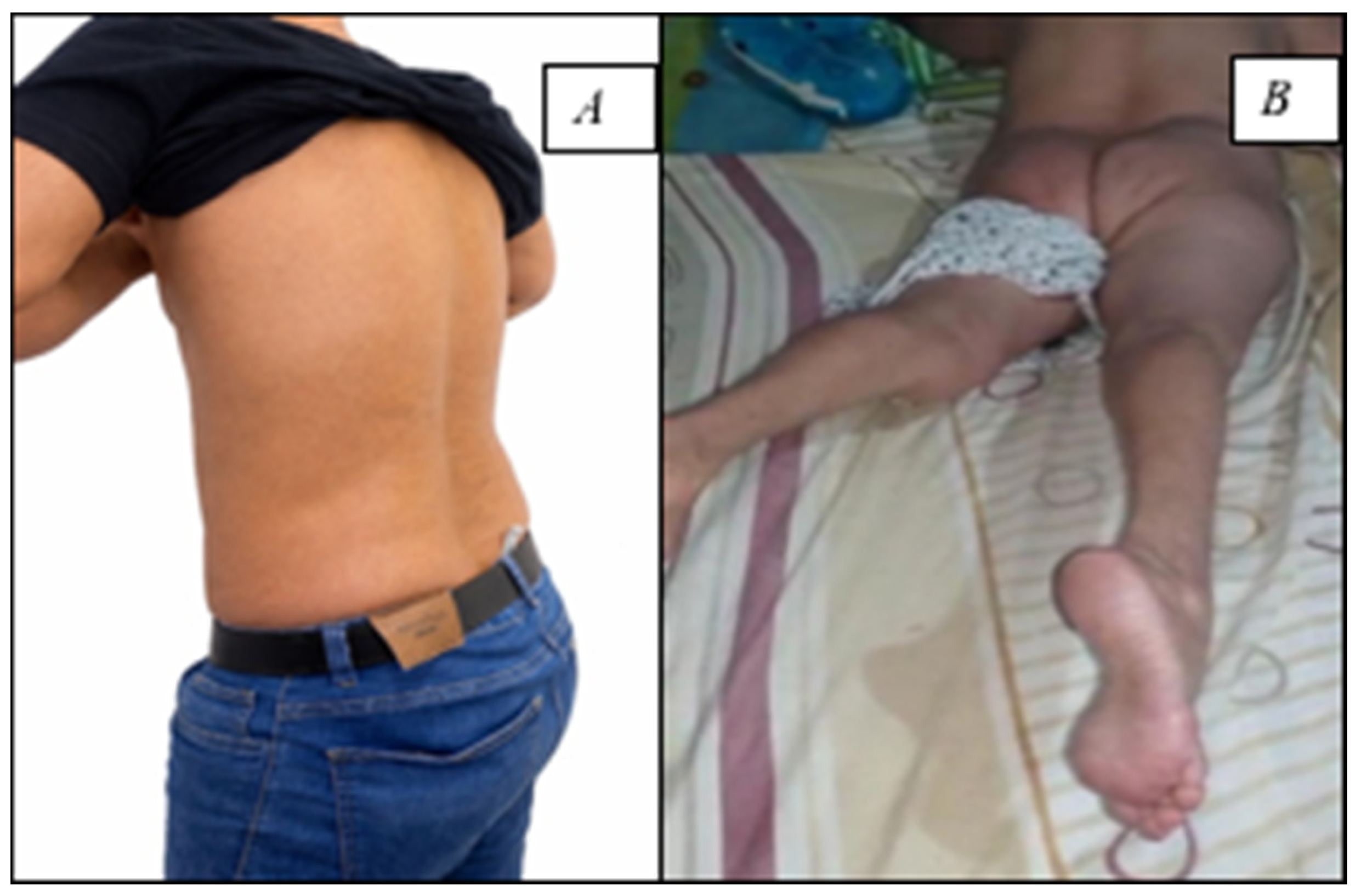
| Rigidity in axial muscles, mainly involving the paraspinal, abdominal, and thoracolumbar muscles, leading to a fixed deformity (hyperlordosis) | + | + |
| Superimposed painful spasms triggered by unexpected noises, emotional stress, or tactile stimuli | + | + |
| Confirmation of continuous motor unit activity in agonist and antagonist muscles on electromyography | + | + |
| Confirmation of continuous motor unit activity in agonist and antagonist muscles on electromyography | Absent | Absent |
| Positive serology for GAD65 (or amphiphysin) autoantibodies, assessed by immunocytochemistry, Western blot, or radioimmunoassay | + GAD 65 | + GAD 65 |
| Clinical response to diazepam | +Clonazepam | + Clonazepam |
| Symptoms | Case 1 | Case 2 |
|---|---|---|
| Increased tone in axial/truncal muscle groups | + | + |
| Increased tone in the legs (symmetric or asymmetric) | + | + |
| Normal strength in upper and lower limbs (except in advanced stages of the disease) | + | Advanced stage |
| Possible hyperreflexia, without plantar extension | + | + |
| Normal sensory function and coordination | + | + |
| Lumbar spine hyperlordosis (resulting from contraction of abdominal and paraspinal muscles) | + | + |
| “Wooden” sensation on muscle palpation due to spasms | + | + |
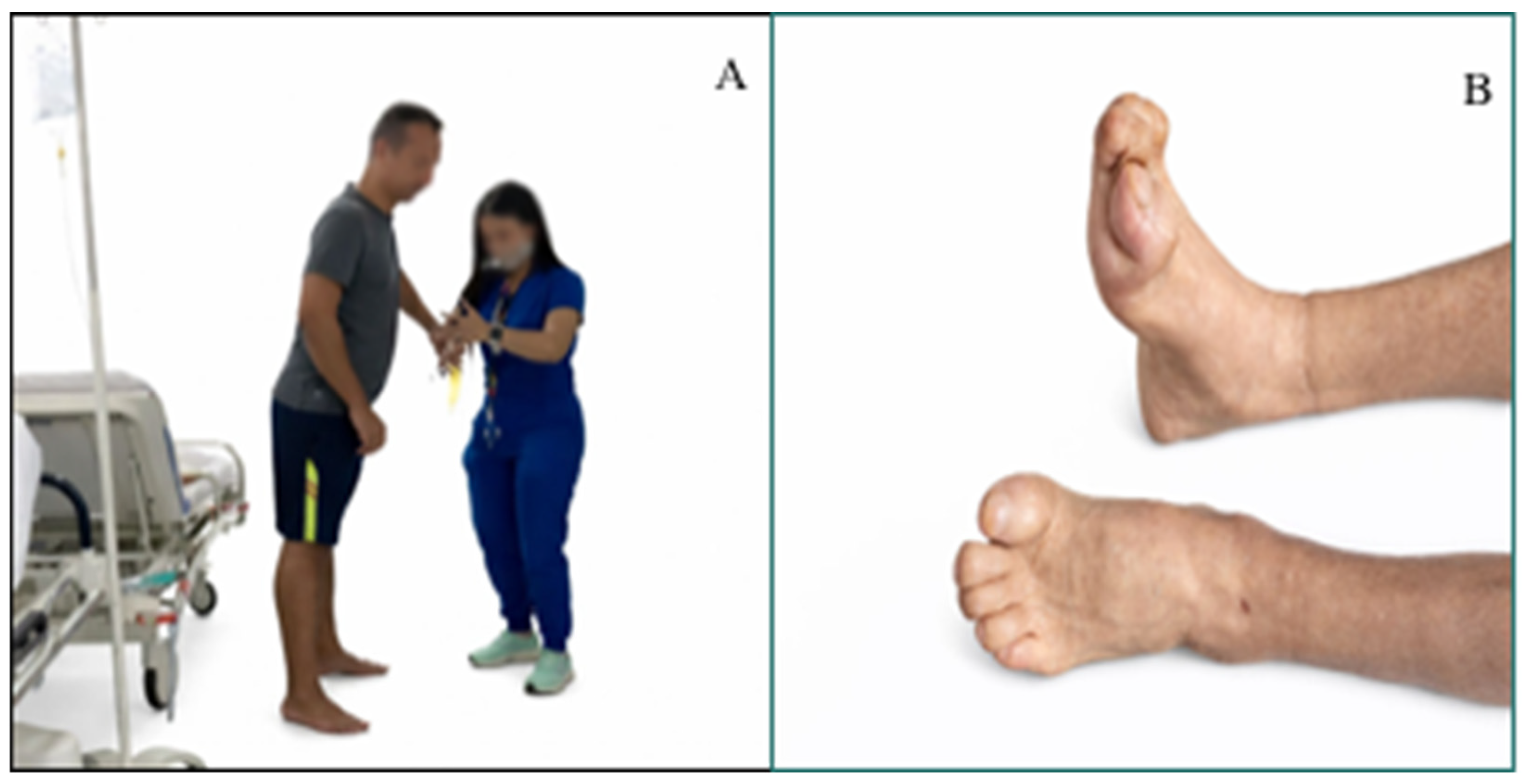
| Slow, wide-based, and cautious gait | + | Barthel scale 65 points |
| Intact cognitive function | + | + |
| Normal sphincter function | + | + |
Disclaimer/Publisher’s Note: The statements, opinions and data contained in all publications are solely those of the individual author(s) and contributor(s) and not of MDPI and/or the editor(s). MDPI and/or the editor(s) disclaim responsibility for any injury to people or property resulting from any ideas, methods, instructions or products referred to in the content. |
© 2026 by the authors. Licensee MDPI, Basel, Switzerland. This article is an open access article distributed under the terms and conditions of the Creative Commons Attribution (CC BY) license.
Share and Cite
Eraso, M.-I.; Carolina-Rosero, A.; Alma-Fuentes; Melissa-Luque; Angelica-Coronel, M.; Fontanilla, L.; Rodriguez, J.C.; Nunez, N.B. Phenotypic Spectrum, Diagnostic Challenges, and Clinical Outcomes in Stiff Person Syndrome: A Single-Center Case Series. Neurol. Int. 2026, 18, 143. https://doi.org/10.3390/neurolint18080143
Eraso M-I, Carolina-Rosero A, Alma-Fuentes, Melissa-Luque, Angelica-Coronel M, Fontanilla L, Rodriguez JC, Nunez NB. Phenotypic Spectrum, Diagnostic Challenges, and Clinical Outcomes in Stiff Person Syndrome: A Single-Center Case Series. Neurology International. 2026; 18(8):143. https://doi.org/10.3390/neurolint18080143
Chicago/Turabian StyleEraso, M-Isabel, Angela Carolina-Rosero, Alma-Fuentes, Melissa-Luque, Maria Angelica-Coronel, Luis Fontanilla, Juan Camilo Rodriguez, and Narledys Bravo Nunez. 2026. "Phenotypic Spectrum, Diagnostic Challenges, and Clinical Outcomes in Stiff Person Syndrome: A Single-Center Case Series" Neurology International 18, no. 8: 143. https://doi.org/10.3390/neurolint18080143
APA StyleEraso, M.-I., Carolina-Rosero, A., Alma-Fuentes, Melissa-Luque, Angelica-Coronel, M., Fontanilla, L., Rodriguez, J. C., & Nunez, N. B. (2026). Phenotypic Spectrum, Diagnostic Challenges, and Clinical Outcomes in Stiff Person Syndrome: A Single-Center Case Series. Neurology International, 18(8), 143. https://doi.org/10.3390/neurolint18080143