
Subjective Cognitive Decline in Brazilian Adults: Prevalence and Associated Social, Lifestyle, and Health-Related Factors: A Nationally Representative Cross-Sectional Analysis from the ELSI-Brazil Cohort
 , ,
, ,  ,
,  and
and
Abstract
1. Introduction
2. Materials and Methods
2.1. Study Design and Study Population
2.2. Data Collection
2.3. Study Variables
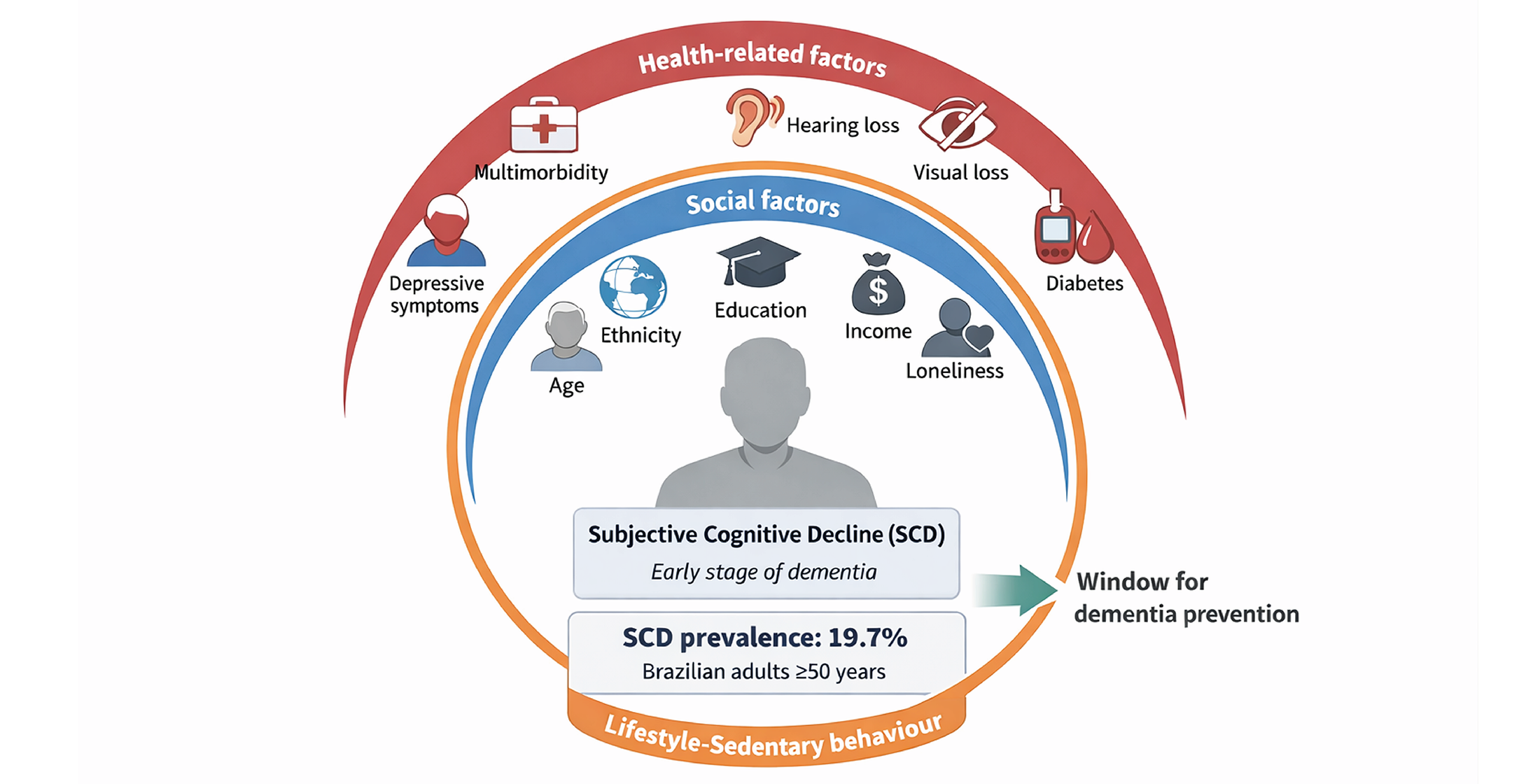
- For social factors, we included the following:
- Educational level, categorized according to the International Standard Classification of Education (ISCED) [19] as no education (0), primary (1), lower secondary (2), upper secondary (3), and tertiary/university degree (4–8);
- Per capita income, categorized into low, lower-middle, upper-middle/high, according to the World Bank classification [20];
- Loneliness, categorized into never, almost or always, based on self-reported frequency of feeling lonely.
- For lifestyle factors, we included the following:
- Physical activity, classified as sedentary (vigorous activity < 75 min/week or moderate activity < 150 min/week) or active [21];
- Smoking habit, categorized as never, former or current smoker;
- Alcohol consumption, categorized as no/yes for alcohol abuse, is defined as >21 units of alcohol per week [22].
- For health-related factors—based on self-reported prior medical diagnosis of chronic diseases, and a subset of them, known as risk factors for cognitive decline—were considered:
- hypertension;
- diabetes;
- hypercholesterolemia;
- hearing loss;
- visual loss;
- obesity.
2.4. Statistical Analysis
3. Results
4. Discussion
5. Conclusions
Supplementary Materials
Author Contributions
Funding
Institutional Review Board Statement
Informed Consent Statement
Data Availability Statement
Acknowledgments
Conflicts of Interest
Abbreviations
| BMI | Body Mass Index |
| CES-D | Centre for Epidemiological Studies Depression Scale |
| CIs | Confidence Intervals |
| ELSI-Brazil | The Brazilian Longitudinal Study of Aging |
| ISCED | International Standard Classification of Education |
| LMICs | Low- And Middle-Income Countries |
| MCI | Mild Cognitive Impairment |
| ORs | Odds Ratios |
| SCD | Subjective Cognitive Decline |
References
- Livingston, G.; Huntley, J.; Liu, K.Y.; Costafreda, S.G.; Selbæk, G.; Alladi, S.; Ames, D.; Banerjee, S.; Burns, A.; Brayne, C.; et al. Dementia Prevention, Intervention, and Care: 2024 Report of the Lancet Standing Commission. Lancet 2024, 404, 572–628. Available online: https://www.thelancet.com/journals/lancet/article/PIIS0140-6736(24)01296-0/fulltext (accessed on 29 May 2025).
- Jessen, F.; Amariglio, R.E.; van Boxtel, M.; Breteler, M.; Ceccaldi, M.; Chételat, G.; Dubois, B.; Dufouil, C.; Ellis, K.A.; van der Flier, W.M.; et al. A Conceptual Framework for Research on Subjective Cognitive Decline in Preclinical Alzheimer’s Disease. Alzheimers Dement. 2014, 10, 844–852. [Google Scholar] [CrossRef]
- Jessen, F.; Wolfsgruber, S.; Kleineindam, L.; Spottke, A.; Altenstein, S.; Bartels, C.; Berger, M.; Brosseron, F.; Daamen, M.; Dichgans, M.; et al. Subjective Cognitive Decline and Stage 2 of Alzheimer Disease in Patients from Memory Centers. Alzheimers Dement. 2023, 19, 487–497. [Google Scholar] [CrossRef]
- Molinuevo, J.L.; Rabin, L.A.; Amariglio, R.; Buckley, R.; Dubois, B.; Ellis, K.A.; Ewers, M.; Hampel, H.; Klöppel, S.; Rami, L.; et al. Implementation of Subjective Cognitive Decline Criteria in Research Studies. Alzheimers Dement. 2017, 13, 296–311. [Google Scholar] [CrossRef] [PubMed]
- Kang, M.; Li, C.; Mahajan, A.; Spat-Lemus, J.; Durape, S.; Chen, J.; Gurnani, A.S.; Devine, S.; Auerbach, S.H.; Ang, T.F.A.; et al. Subjective Cognitive Decline Plus and Longitudinal Assessment and Risk for Cognitive Impairment. JAMA Psychiatry 2024, 81, 993–1002. [Google Scholar] [CrossRef] [PubMed]
- Liew, T.M. Distinct Trajectories of Subjective Cognitive Decline before Diagnosis of Neurocognitive Disorders: Longitudinal Modelling over 18 Years. J. Prev. Alzheimer’s Dis. 2025, 12, 100123. [Google Scholar] [CrossRef]
- van Dyck, C.H.; Swanson, C.J.; Aisen, P.; Bateman, R.J.; Chen, C.; Gee, M.; Kanekiyo, M.; Li, D.; Reyderman, L.; Cohen, S.; et al. Lecanemab in Early Alzheimer’s Disease. N. Engl. J. Med. 2023, 388, 9–21. [Google Scholar] [CrossRef]
- Sims, J.R.; Zimmer, J.A.; Evans, C.D.; Lu, M.; Ardayfio, P.; Sparks, J.; Wessels, A.M.; Shcherbinin, S.; Wang, H.; Monkul Nery, E.S.; et al. Donanemab in Early Symptomatic Alzheimer Disease: The TRAILBLAZER-ALZ 2 Randomized Clinical Trial. JAMA 2023, 330, 512–527. [Google Scholar] [CrossRef]
- Mintun, M.A.; Lo, A.C.; Duggan Evans, C.; Wessels, A.M.; Ardayfio, P.A.; Andersen, S.W.; Shcherbinin, S.; Sparks, J.; Sims, J.R.; Brys, M.; et al. Donanemab in Early Alzheimer’s Disease. N. Engl. J. Med. 2021, 384, 1691–1704. [Google Scholar] [CrossRef]
- Borelli, W.V.; Zimmer, E.R.; Bieger, A.; Coelho, B.; Pascoal, T.A.; Chaves, M.L.F.; Amariglio, R.; Castilhos, R.M. Subjective Cognitive Decline in Brazil: Prevalence and Association with Dementia Modifiable Risk Factors in a Population-Based Study. Alzheimers Dement. 2022, 14, e12368. [Google Scholar] [CrossRef]
- Schrempft, S.; Baysson, H.; Graindorge, C.; Pullen, N.; Hagose, M.; Zaballa, M.-E.; Preisig, M.; Nehme, M.; Guessous, I.; Stringhini, S.; et al. Biopsychosocial Risk Factors for Subjective Cognitive Decline among Older Adults during the COVID-19 Pandemic: A Population-Based Study. Public. Health 2024, 234, 16–23. [Google Scholar] [CrossRef]
- Röhr, S.; Pabst, A.; Riedel-Heller, S.G.; Jessen, F.; Turana, Y.; Handajani, Y.S.; Brayne, C.; Matthews, F.E.; Stephan, B.C.M.; Lipton, R.B.; et al. Estimating Prevalence of Subjective Cognitive Decline in and across International Cohort Studies of Aging: A COSMIC Study. Alzheimers Res. Ther. 2020, 12, 167. [Google Scholar] [CrossRef]
- Marino, C.; Malotaux, V.; Giudicessi, A.; Aguillon, D.; Sepulveda-Falla, D.; Lopera, F.; Quiroz, Y.T. Protective Genetic Variants against Alzheimer’s Disease. Lancet Neurol. 2025, 24, 524–534. [Google Scholar] [CrossRef] [PubMed]
- Borelli, W.V.; Leotti, V.B.; Strelow, M.Z.; Chaves, M.L.F.; Castilhos, R.M. Preventable Risk Factors of Dementia: Population Attributable Fractions in a Brazilian Population-Based Study. Lancet Reg. Health Am. 2022, 11, 100256. [Google Scholar] [CrossRef] [PubMed]
- Seyedsalehi, A.; Warrier, V.; Bethlehem, R.A.I.; Perry, B.I.; Burgess, S.; Murray, G.K. Educational Attainment, Structural Brain Reserve and Alzheimer’s Disease: A Mendelian Randomization Analysis. Brain 2023, 146, 2059–2074. [Google Scholar] [CrossRef] [PubMed]
- Síntese de Indicadores Sociais|IBGE. Available online: https://www.ibge.gov.br/estatisticas/sociais/saude/9221-sintese-de-indicadores-sociais.html (accessed on 29 May 2025).
- Lima-Costa, M.F.; de Melo Mambrini, J.V.; Bof de Andrade, F.; de Souza, P.R.B.; de Vasconcellos, M.T.L.; Neri, A.L.; Castro-Costa, E.; Macinko, J.; de Oliveira, C. Cohort Profile: The Brazilian Longitudinal Study of Ageing (ELSI-Brazil). Int. J. Epidemiol. 2023, 52, e57–e65. [Google Scholar] [CrossRef]
- Jessen, F.; Amariglio, R.E.; Buckley, R.F.; van der Flier, W.M.; Han, Y.; Molinuevo, J.L.; Rabin, L.; Rentz, D.M.; Rodriguez-Gomez, O.; Saykin, A.J.; et al. The Characterisation of Subjective Cognitive Decline. Lancet Neurol. 2020, 19, 271–278. [Google Scholar] [CrossRef]
- United Nations Educational, Scientific and Cultural Organization (UNESCO). The International Standard Classification of Education (ISCED). Prospects 1975, 5, 283–284. [Google Scholar] [CrossRef]
- World Bank Country Classifications by Income Level for 2024–2025. Available online: https://blogs.worldbank.org/en/opendata/world-bank-country-classifications-by-income-level-for-2024-2025 (accessed on 13 February 2026).
- Bull, F.C.; Al-Ansari, S.S.; Biddle, S.; Borodulin, K.; Buman, M.P.; Cardon, G.; Carty, C.; Chaput, J.-P.; Chastin, S.; Chou, R.; et al. World Health Organization 2020 Guidelines on Physical Activity and Sedentary Behaviour. Br. J. Sports Med. 2020, 54, 1451–1462. [Google Scholar] [CrossRef]
- Kivimäki, M.; Singh-Manoux, A.; Batty, G.D.; Sabia, S.; Sommerlad, A.; Floud, S.; Jokela, M.; Vahtera, J.; Beydoun, M.A.; Suominen, S.B.; et al. Association of Alcohol-Induced Loss of Consciousness and Overall Alcohol Consumption with Risk for Dementia. JAMA Netw. Open 2020, 3, e2016084. [Google Scholar] [CrossRef]
- Park, S.-H.; Yu, H.Y. How Useful Is the Center for Epidemiologic Studies Depression Scale in Screening for Depression in Adults? An Updated Systematic Review and Meta-Analysis✰. Psychiatry Res. 2021, 302, 114037. [Google Scholar] [CrossRef]
- Gupta, S. Racial and Ethnic Disparities in Subjective Cognitive Decline: A Closer Look, United States, 2015–2018. BMC Public Health 2021, 21, 1173. [Google Scholar] [CrossRef]
- An, R.; Gao, Y.; Huang, X.; Yang, Y.; Yang, C.; Wan, Q. Predictors of Progression from Subjective Cognitive Decline to Objective Cognitive Impairment: A Systematic Review and Meta-Analysis of Longitudinal Studies. Int. J. Nurs. Stud. 2024, 149, 104629. [Google Scholar] [CrossRef] [PubMed]
- Breit, M.; Scherrer, V.; Tucker-Drob, E.M.; Preckel, F. The Stability of Cognitive Abilities: A Meta-Analytic Review of Longitudinal Studies. Psychol. Bull. 2024, 150, 399–439. [Google Scholar] [CrossRef] [PubMed]
- Kim, Y.; Stern, Y.; Seo, S.W.; Na, D.L.; Jang, J.-W.; Jang, H.; Cognitive Reserve Research Group of Korea Dementia Association. Factors Associated with Cognitive Reserve According to Education Level. Alzheimers Dement. 2024, 20, 7686–7697. [Google Scholar] [CrossRef] [PubMed]
- Iskandar, M.; Martindale, J.; Bynum, J.P.W.; Davis, M.A. Association between Family Household Income and Cognitive Resilience among Older US Adults: A Cross-Sectional Study. J. Prev. Alzheimers Dis. 2024, 11, 1406–1409. [Google Scholar] [CrossRef]
- Wang, A.-Y.; Hu, H.-Y.; Ou, Y.-N.; Wang, Z.-T.; Ma, Y.-H.; Tan, L.; Yu, J.-T. Socioeconomic Status and Risks of Cognitive Impairment and Dementia: A Systematic Review and Meta-Analysis of 39 Prospective Studies. J. Prev. Alzheimers Dis. 2023, 10, 83–94. [Google Scholar] [CrossRef]
- Pecchinenda, A.; Yankouskaya, A.; Boccia, M.; Piccardi, L.; Guariglia, C.; Giannini, A.M. Exploring the Relationship between Perceived Loneliness and Subjective Cognitive Decline in Older Individuals. Aging Ment. Health 2024, 28, 73–82. [Google Scholar] [CrossRef]
- Xu, P.; Zhang, F.; Cheng, J.; Huang, Y.; Ren, Z.; Ye, R.; Fan, J.; Li, L.; Gao, Y. The Relationship between Physical Activity and Subjective Cognitive Decline: Evidence from the Behavioral Risk Factor Surveillance System (BRFSS). J. Affect. Disord. 2023, 328, 108–115. [Google Scholar] [CrossRef]
- Liu, Y.; Jiang, D. Multimorbidity Patterns in US Adults with Subjective Cognitive Decline and Their Relationship with Functional Difficulties. J. Aging Health 2022, 34, 929–938. [Google Scholar] [CrossRef]
- Omura, J.D.; Brown, D.R.; McGuire, L.C.; Taylor, C.A.; Fulton, J.E.; Carlson, S.A. Cross-Sectional Association between Physical Activity Level and Subjective Cognitive Decline among US Adults Aged ≥45 Years, 2015. Prev. Med. 2020, 141, 106279. [Google Scholar] [CrossRef]
- de Havenon, A.; Stulberg, E.L.; Littig, L.; Wong, K.-H.; Sarpong, D.; Li, V.; Sharma, R.; Falcone, G.J.; Williamson, J.D.; Pajewski, N.M.; et al. Socioeconomic and Medical Determinants of State-Level Subjective Cognitive Decline in the United States. Alzheimers Dement. 2024, 20, 7567–7579. [Google Scholar] [CrossRef]
- Koyanagi, A.; Smith, L.; Shin, J.I.; Oh, H.; Kostev, K.; Jacob, L.; Abduljabbar, A.S.; Haro, J.M. Multimorbidity and Subjective Cognitive Complaints: Findings from 48 Low- and Middle-Income Countries of the World Health Survey 2002–2004. J. Alzheimers Dis. 2021, 81, 1737–1747. [Google Scholar] [CrossRef]
- Curhan, S.G.; Willett, W.C.; Grodstein, F.; Curhan, G.C. Longitudinal Study of Hearing Loss and Subjective Cognitive Function Decline in Men. Alzheimers Dement. 2019, 15, 525–533. [Google Scholar] [CrossRef]
- Hafdi, M.; Hoevenaar-Blom, M.P.; Richard, E. Multi-Domain Interventions for the Prevention of Dementia and Cognitive Decline. Cochrane Database Syst. Rev. 2021, 11, CD013572. [Google Scholar] [CrossRef]
- Magklara, E.; Stephan, B.C.M.; Robinson, L. Current Approaches to Dementia Screening and Case Finding in Low- and Middle-Income Countries: Research Update and Recommendations. Int. J. Geriatr. Psychiatry 2019, 34, 3–7. [Google Scholar] [CrossRef]


| Total N | SCD n | SCD Weighted Prevalence (95% CI) | |
|---|---|---|---|
| Overall | 6631 | 1346 | 19.7 (18.6–20.9) |
| Males | 2767 | 538 | 20.2 (18.7–21.7) |
| Females | 3864 | 808 | 20.9 (19.6–22.2) |
| Age 50–60 | 2019 | 336 | 16.5 (14.5–18.4) |
| Age 60–79 | 3956 | 821 | 20.4 (18.9–21.9) |
| Age 80+ | 656 | 189 | 28.8 (24.6–33.0) |
| Total N (%) | SCD | p-Value * | |||
|---|---|---|---|---|---|
| No N (%) | Yes N (%) | ||||
| Overall | 6631 | 5285 (80.3) | 1346 (19.7) | ||
| Sex | |||||
| Women | 3864 (57.5) | 3056 (79.8) | 808 (20.2) | 0.20 | |
| Men | 2767 (42.6) | 2229 (80.9) | 538 (19.1) | ||
| Age [50–109 years] Mean (SD) | 65.1 (±9.7) | 65.0 (±9.7) | 65.2 (±9.8) | <0.01 | |
| Ethnicity | |||||
| Non-White | 3600 (54.4) | 2771 (76.9) | 829 (15.9) | <0.01 | |
| White | 2968 (45.6) | 2454 (84.1) | 514 (23.1) | ||
| Educational Level | <0.01 | ||||
| No education | 676 (9.9) | 471 (69.3) | 205 (30.7) | ||
| Primary | 3404 (51.2) | 2618 (77.7) | 786 (22.3) | ||
| Lower secondary | 1292 (20.3) | 1065 (82.3) | 227 (17.7) | ||
| Upper secondary | 901 (14.3) | 802 (90.0) | 99 (10.0) | ||
| Tertiary/University degree | 279 (4.3) | 253 (88.10) | 26 (11.9) | ||
| Income level | <0.01 | ||||
| Low | 704 (11.5) | 540 (76.7) | 164 (23.3) | ||
| Low-Mild | 4424 (70.5) | 3420 (77.9) | 1004 (22.1) | ||
| Upper-Mild/High | 1121 (18.0) | 971 (87.1) | 150 (12.9) | ||
| Loneliness | <0.01 | ||||
| Never | 3990 (64.8) | 3260 (82.5) | 730 (17.5) | ||
| Sometimes/Always | 2231 (35.2) | 1697 (76.4) | 537 (23.6) | ||
| Physical Activity | <0.01 | ||||
| Active | 2646 (43.6) | 2198 (83.1) | 448 (16.9) | ||
| Sedentary | 3617 (56.4) | 2762 (77.0) | 855 (23.0) | ||
| Alcohol Abuse | 0.21 | ||||
| No | 6520 (98.0) | 5190 (80.1) | 1330 (19.9) | ||
| Yes | 111 (2.0) | 95 (86.4) | 16 (13.6) | ||
| Smoking Habits | 0.23 | ||||
| No | 5182 (68.0) | 3636 (68.7) | 904 (66.7) | ||
| Ex/Current | 2402 (32.0) | 1642 (31.3) | 442 (33.3) | ||
| Number of chronic diseases | <0.01 | ||||
| 0 | 849 (13.4) | 729 (86.6) | 120 (14.0) | ||
| 1 | 1141 (17.7) | 948 (83.6) | 193 (16.4) | ||
| 2 | 1152 (18.2) | 924 (80.8) | 228 (19.2) | ||
| ≥3 | 3333 (50.7) | 2552 (77.1) | 781 (22.9) | ||
| Hypertension | <0.01 | ||||
| No | 3029 (47.2) | 2480 (82.7) | 549 (17.3) | ||
| Yes (alone) | 426 (6.6) | 357 (84.8) | 69 (15.2) | ||
| Yes (with comorbidities) | 3020 (46.2) | 2316 (76.9) | 704 (23.1) | ||
| Diabetes | <0.01 | ||||
| No | 5298 (82.1) | 4240 (81) | 1049 (19.0) | ||
| Yes (alone) | 65 (1.1) | 59 (87.2) | 6 (12.85) | ||
| Yes (with comorbidities) | 1121 (16.9) | 854 (75.7) | 267 (24.3) | ||
| Obesity | 0.76 | ||||
| No | 2358 (42.1) | 1873 (80.0) | 485 (20.0) | ||
| Yes | 3215 (57.9) | 2536 (79.7) | 679 (20.3) | ||
| Hypercholesterolemia | 0.09 | ||||
| No | 4939 (76.5%0 | 3973 (80.9) | 960 (19.1) | ||
| Yes (alone) | 83 (1.3) | 64 (79.4) | 19 (20.6) | ||
| Yes (with comorbidities) | 1453 (22.3) | 1110 (77.7) | 343 (22.3) | ||
| Visual Problems | <0.01 | ||||
| No | 3731 (59.3) | 3092 (83.2) | 639 (16.8) | ||
| Yes (alone) | 82 (1.3) | 67 (83.9) | 15 (16.4) | ||
| Yes (with comorbidities) | 2653 (39.4) | 1985 (75.4) | 668 (24.6) | ||
| Hearing loss | <0.01 | ||||
| No | 4709 (73.7) | 3980 (84.8) | 729 (15.2) | ||
| Yes (alone) | 145 (2.3) | 103 (72.5) | 42 (27.5) | ||
| Yes (with comorbidities) | 1589 (24.1) | 1041 (66.6) | 548 (33.4) | ||
| Depressive symptoms † | <0.01 | ||||
| No | 4588 (77.8) | 3759 (82.4) | 829 (17.6) | ||
| Yes (alone) | 79 (1.5) | 61 (77.3) | 18 (22.7) | ||
| Yes (with comorbidities) | 1267 (21.3) | 923 (74.3) | 344 (25.7) | ||
| OR Model 1 * (95%CI) | OR Model 2 † (95%CI) | |
|---|---|---|
| Sex (ref. male) | 0.91 (0.78–1.05) | 0.99 (0.84–1.16) |
| Age | ||
| 50–59 | 1 | 1 |
| 60–79 | 1.22 (1.02–1.45) | 1.22 (1.01–1.47) |
| 80+ | 1.72 (1.33–2.23) | 1.57 (1.19–2.09) |
| P for trend | <0.01 | 0.006 |
| Ethnicity (ref. white) | 1.56 (1.34–1.81) | 1.53 (1.30–1.79) |
| Educational Level | ||
| No education | 3.19 (2.35–4.33) | 2.79 (2.02–3.85) |
| Primary | 2.32 (1.81–2.97) | 2.14 (1.65–2.77) |
| Lower secondary | 1.79 (1.34–2.37) | 1.67 (1.24–2.25) |
| Upper secondary or higher | 1 | 1 |
| P for trend | <0.01 | <0.01 |
| Income level | ||
| Low | 1.55 (1.13–2.12) | 1.58 (1.14–2.21) |
| Lower-Middle | 1.44 (1.14–1.83) | 1.50 (1.17–1.92) |
| Upper-Middle/High | 1 | 1 |
| P for trend | <0.01 | <0.01 |
| Loneliness | ||
| Never | 1 | 1 |
| Sometimes/Always | 1.41 (1.20–1.65) | 1.35 (1.15–1.59) |
| Physical Activity | ||
| Active | 1 | 1 |
| Sedentary | 1.36 (1.17–1.60) | 1.33 (1.13–1.57) |
| Alcohol Abuse | ||
| No | 1 | 1 |
| Yes | 0.57 (0.29–1.14) | 0.60 (0.30–1.20) |
| Smoking Habits | ||
| No | 1 | 1 |
| Ex/Current | 1.09 (0.93–1.27) | 1.08 (0.92–1.27) |
| Number of chronic diseases | ||
| 0 | 1 | 1 |
| 1 | 1.14 (0.84–1.54) | 1.11 (0.81–1.52) |
| 2 | 1.30 (0.97–1.74) | 1.18 (0.87–1.61) |
| ≥3 | 1.47 (1.13–1.91) | 1.40 (1.06–1.84) |
| P for trend | <0.01 | <0.01 |
| Hypertension | ||
| No | 1 | 1 |
| Yes (alone) | 0.85 (0.61–1.17) | 0.93 (0.65–1.32) |
| Yes (with comorbidities) | 1.27 (1.08–1.49) | 1.17 (0.99–1.39) |
| Diabetes | ||
| No | 1 | 1 |
| Yes (alone) | 0.62 (0.25–1.54) | 0.67 (0.28–1.63) |
| Yes (with comorbidities) | 1.29 (1.07–1.56) | 1.25 (1.02–1.53) |
| Obesity | ||
| No | 1 | 1 |
| Yes | 1.00 (0.85–1.18) | 1.00 (0.85–1.18) |
| Hypercholesterolemia | ||
| No | 1 | 1 |
| Yes (alone) | 1.46 (0.75–2.87) | 1.67 (0.82–3.40) |
| Yes (with comorbidities) | 1.15 (0.97–1.37) | 1.04 (0.87–1.25) |
| Visual Loss | ||
| No | 1 | 1 |
| Yes (alone) | 0.97 (0.49–1.92) | 0.87 (0.39–1.92) |
| Yes (with comorbidities) | 1.414 (1.21–1.64) | 1.31 (1.11–1.56) |
| Hearing Loss | ||
| No | 1 | 1 |
| Yes (alone) | 2.08 (1.31–3.32) | 2.11 (1.29–3.44) |
| Yes (with comorbidities) | 2.47 (2.11–2.90) | 2.29 (1.93–2.71) |
| Depressive symptoms ‡ | ||
| No | 1 | 1 |
| Yes (alone) | 1.56 (0.79–3.09) | 1.58 (0.77–3.24) |
| Yes (with other diseases) | 1.55 (1.29–1.85) | 1.30 (1.05–1.60) |
Disclaimer/Publisher’s Note: The statements, opinions and data contained in all publications are solely those of the individual author(s) and contributor(s) and not of MDPI and/or the editor(s). MDPI and/or the editor(s) disclaim responsibility for any injury to people or property resulting from any ideas, methods, instructions or products referred to in the content. |
© 2026 by the authors. Licensee MDPI, Basel, Switzerland. This article is an open access article distributed under the terms and conditions of the Creative Commons Attribution (CC BY) license.
Share and Cite
Lopes, J.M.; Bertuccio, P.; Blandi, L.; Vecchio, R.; Odone, A. Subjective Cognitive Decline in Brazilian Adults: Prevalence and Associated Social, Lifestyle, and Health-Related Factors: A Nationally Representative Cross-Sectional Analysis from the ELSI-Brazil Cohort. Neurol. Int. 2026, 18, 42. https://doi.org/10.3390/neurolint18030042
Lopes JM, Bertuccio P, Blandi L, Vecchio R, Odone A. Subjective Cognitive Decline in Brazilian Adults: Prevalence and Associated Social, Lifestyle, and Health-Related Factors: A Nationally Representative Cross-Sectional Analysis from the ELSI-Brazil Cohort. Neurology International. 2026; 18(3):42. https://doi.org/10.3390/neurolint18030042
Chicago/Turabian StyleLopes, Johnnatas Mikael, Paola Bertuccio, Lorenzo Blandi, Riccardo Vecchio, and Anna Odone. 2026. "Subjective Cognitive Decline in Brazilian Adults: Prevalence and Associated Social, Lifestyle, and Health-Related Factors: A Nationally Representative Cross-Sectional Analysis from the ELSI-Brazil Cohort" Neurology International 18, no. 3: 42. https://doi.org/10.3390/neurolint18030042
APA StyleLopes, J. M., Bertuccio, P., Blandi, L., Vecchio, R., & Odone, A. (2026). Subjective Cognitive Decline in Brazilian Adults: Prevalence and Associated Social, Lifestyle, and Health-Related Factors: A Nationally Representative Cross-Sectional Analysis from the ELSI-Brazil Cohort. Neurology International, 18(3), 42. https://doi.org/10.3390/neurolint18030042