
Psychometric Validation of the Arabic Version of the WPAI:Migraine Questionnaire in Patients with Migraine
 , , , , , , and
Abstract
1. Introduction
2. Materials and Methods
2.1. Study Design, Participants, and Ethical Considerations
2.2. Study Measures and Content Adaptation
2.3. Data Collection
2.4. Statistical Analysis
- Percent work time missed due to migraine (Absenteeism): Q2/(Q2 + Q4) × 100.
- Percent impairment while working due to migraine (Presenteeism): (Q5/10) × 100.
- Percent overall work impairment due to migraine: (Q2/(Q2 + Q4)) + ((1 − Q2/(Q2 + Q4)) × Q5/10) × 100.
- Percent activity impairment due to migraine: (Q6/10) × 100.
3. Results
3.1. Baseline Demographic and Disease Characteristics
3.2. Piloting, Cognitive Interview, and Proofreading
3.3. WPAI:Migraine Psychometric Analysis
3.3.1. Reliability
3.3.2. Concurrent Validity and Known-Group Validity
4. Discussion
5. Conclusions
Supplementary Materials
Author Contributions
Funding
Institutional Review Board Statement
Informed Consent Statement
Data Availability Statement
Acknowledgments
Conflicts of Interest
Abbreviations
| ANOVA | One-Way Analysis of Variance |
| CGRP mAbs | Calcitonin Gene-Related Peptide Monoclonal Antibodies |
| GBD | Global Burden of Disease |
| HIT-6 | Headache Impact Test |
| ICC | Interclass Correlation Coefficient |
| ICHD-3 | International Classification of Headache Disorders, Third Edition |
| IHS | International Headache Society |
| MIDAS | Migraine Disability Assessment Scale |
| MSQ v2.1 | Migraine-Specific Quality of Life Questionnaire Version 2.1 |
| PROM | Patient-Reported Outcome Measures |
| RCT | Randomized Clinical Trials |
| SD | Standard Deviation |
| SPSS | Statistical Package for Social Sciences |
| VAS | Visual Analog Scale |
| WPAI | Work Productivity and Activity Impairment |
| WPAI:GH | Work Productivity and Activity Impairment: General Health |
| WPAI:Migraine | Work Productivity and Activity Impairment: Migraine |
References
- Vos, T.; Abajobir, A.A.; Abate, K.H.; Abbafati, C.; Abbas, K.M.; Abd-Allah, F.; Abdulkader, R.S.; Abdulle, A.M.; Abebo, T.A.; Abera, S.F.; et al. Global, regional, and national incidence, prevalence, and years lived with disability for 328 diseases and injuries for 195 countries, 1990–2016: A systematic analysis for the Global Burden of Disease Study 2016. Lancet 2017, 390, 1211–1259. [Google Scholar] [CrossRef]
- Steiner, T.J.; Stovner, L.J.; Vos, T.; Jensen, R.; Katsarava, Z. Migraine is first cause of disability in under 50s: Will health politicians now take notice? J. Headache Pain 2018, 19, 17. [Google Scholar] [CrossRef]
- MacGregor, E.A.; Brandes, J.; Eikermann, A.; Giammarco, R. Impact of migraine on patients and their families: The Migraine And Zolmitriptan Evaluation (MAZE) survey—Phase III. Curr. Med. Res. Opin. 2004, 20, 1143–1150. [Google Scholar] [CrossRef]
- Burch, R.C.; Buse, D.C.; Lipton, R.B. Migraine: Epidemiology, Burden, and Comorbidity. Neurol. Clin. 2019, 37, 631–649. [Google Scholar] [CrossRef] [PubMed]
- Parikh, S.K.; Young, W.B. Migraine: Stigma in Society. Curr. Pain Headache Rep. 2019, 23, 8. [Google Scholar] [CrossRef] [PubMed]
- Vos, T.; Lim, S.S.; Abbafati, C.; Abbas, K.M.; Abbasi, M.; Abbasifard, M.; Abbasi-Kangevari, M.; Abbastabar, H.; Abd-Allah, F.; Abdelalim, A.; et al. Global burden of 369 diseases and injuries in 204 countries and territories, 1990–2019: A systematic analysis for the Global Burden of Disease Study 2019. Lancet 2020, 396, 1204–1222. [Google Scholar] [CrossRef]
- Al Jumah, M.; Al Khathaami, A.M.; Kojan, S.; Husøy, A.; Steiner, T.J. The burden of headache disorders in the adult general population of the Kingdom of Saudi Arabia: Estimates from a cross-sectional population-based study including a health-care needs assessment. J. Headache Pain 2024, 25, 66. [Google Scholar] [PubMed]
- Al Jumah, M.; Al Khathaami, A.M.; Kojan, S.; Hussain, M.; Thomas, H.; Steiner, T.J. The prevalence of primary headache disorders in Saudi Arabia: A cross-sectional population-based study. J. Headache Pain 2020, 21, 11. [Google Scholar] [CrossRef]
- Albalawi, M.F.; Alanazi, W.L.; Albalawi, H.S.; Alghannami, S.S.; Albalawi, A.F. Prevalence of Migraine Headache in Saudi Arabia: A Systematic Review and Meta-Analysis. Cureus 2023, 15, e37560. [Google Scholar] [CrossRef]
- Tyrovolas, S.; El Bcheraoui, C.; Alghnam, S.A.; Alhabib, K.F.; Almadi, M.A.H.; Al-Raddadi, R.M.; Bedi, N.; El Tantawi, M.; Krish, V.S.; Memish, Z.A.; et al. The burden of disease in Saudi Arabia 1990–2017: Results from the Global Burden of Disease Study 2017. Lancet Planet. Health 2020, 4, e195–e208. [Google Scholar] [CrossRef]
- Al Harbi, F.G.; Al Ateeq, M.A. Quality of life of migraine patients followed in neurology clinics in Riyadh, Saudi Arabia. J. Fam. Community Med. 2020, 27, 37–45. [Google Scholar] [CrossRef]
- Labor Market Statistics. Unemployment Rate of Total Population in the Kingdom Stabilizes Relatively at 3.5% in Q1 2024. General Authority for Statistics in Saudi Arabia. 2024. Available online: http://www.stats.gov.sa (accessed on 3 February 2023).
- Leonardi, M.; Raggi, A. A narrative review on the burden of migraine: When the burden is the impact on people’s life. J. Headache Pain 2019, 20, 41. [Google Scholar] [CrossRef]
- Munakata, J.; Hazard, E.; Serrano, D.; Klingman, D.; Rupnow, M.F.; Tierce, J.; Reed, M.; Lipton, R.B. Economic burden of transformed migraine: Results from the American Migraine Prevalence and Prevention (AMPP) Study. Headache 2009, 49, 498–508. [Google Scholar] [CrossRef] [PubMed]
- Martelletti, P.; Schwedt, T.J.; Lanteri-Minet, M.; Quintana, R.; Carboni, V.; Diener, H.-C.; Ruiz De La Torre, E.; Craven, A.; Rasmussen, A.V.; Evans, S.; et al. My Migraine Voice survey: A global study of disease burden among individuals with migraine for whom preventive treatments have failed. J. Headache Pain 2018, 19, 115. [Google Scholar] [CrossRef] [PubMed]
- Alpuente, A.; Torres-Ferrus, M.; Caronna, E.; Pozo-Rosich, P. The state of art on the use of patient reported outcomes in migraine. Curr. Opin. Neurol. 2024, 37, 271–282. [Google Scholar] [CrossRef] [PubMed]
- Ford, J.H.; Ye, W.; Ayer, D.W.; Mi, X.; Bhandari, S.; Buse, D.C.; Lipton, R.B. Validation and meaningful within-patient change in work productivity and activity impairment questionnaire (WPAI) for episodic or chronic migraine. J. Patient-Rep. Outcomes 2023, 7, 34. [Google Scholar]
- Domingues, R.B.; Picon, I.S.; Vescovi, J.; Chung, G.; Cabral, F.T.; Bertelli, A.P.; Lee, A.A.H.; Silva, P.D.S. Assessment of Work Productivity and Activity Impairment (WPAI) questionnaire for migraine with the help of a smartphone app. Arq. Neuro-Psiquiatr. 2020, 78, 468–472. [Google Scholar] [CrossRef]
- Vo, P.; Fang, J.; Bilitou, A.; Laflamme, A.K.; Gupta, S. Patients’ perspective on the burden of migraine in Europe: A cross-sectional analysis of survey data in France, Germany, Italy, Spain, and the United Kingdom. J. Headache Pain 2018, 19, 82. [Google Scholar] [CrossRef]
- Tassorelli, C.; Diener, H.-C.; Dodick, D.W.; Silberstein, S.D.; Lipton, R.B.; Ashina, M.; Becker, W.J.; Ferrari, M.D.; Goadsby, P.J.; Pozo-Rosich, P.; et al. Guidelines of the International Headache Society for controlled trials of preventive treatment of chronic migraine in adults. Cephalalgia Int. J. Headache 2018, 38, 815–832. [Google Scholar]
- Diener, H.-C.; Tassorelli, C.; Dodick, D.W.; Silberstein, S.D.; Lipton, R.B.; Ashina, M.; Becker, W.J.; Ferrari, M.D.; Goadsby, P.J.; Pozo-Rosich, P.; et al. Guidelines of the International Headache Society for controlled trials of preventive treatment of migraine attacks in episodic migraine in adults. Cephalalgia Int. J. Headache 2020, 40, 1026–1044, Corrigendum in Cephalalgia Int. J. Headache 2020, 40, NP1. https://doi.org/10.1177/0333102420952270. [Google Scholar] [CrossRef]
- Spierings, E.L.H.; Ning, X.; Ramirez Campos, V.; Cohen, J.M.; Barash, S.; Buse, D.C. Improvements in quality of life and work productivity with up to 6 months of fremanezumab treatment in patients with episodic and chronic migraine and documented inadequate response to 2 to 4 classes of migraine-preventive medications in the phase 3b FOCUS study. Headache 2021, 61, 1376–1386. [Google Scholar]
- Barbanti, P.; Goadsby, P.J.; Lambru, G.; Ettrup, A.; Christoffersen, C.L.; Josiassen, M.K.; Phul, R.; Sperling, B. Effects of eptinezumab on self-reported work productivity in adults with migraine and prior preventive treatment failure in the randomized, double-blind, placebo-controlled DELIVER study. J. Headache Pain 2022, 23, 153. [Google Scholar] [CrossRef]
- Lanteri-Minet, M.; Goadsby, P.J.; Reuter, U.; Wen, S.; Hours-Zesiger, P.; Ferrari, M.D.; Klatt, J. Effect of erenumab on functional outcomes in patients with episodic migraine in whom 2–4 preventives were not useful: Results from the LIBERTY study. J. Neurol. Neurosurg. Psychiatry 2021, 92, 466–472. [Google Scholar] [CrossRef]
- Lipton, R.B.; Buse, D.C.; Sandoe, C.H.; Ford, J.H.; Hand, A.L.; Jedynak, J.P.; Port, M.D.; Detke, H.C. Changes in migraine interictal burden following treatment with galcanezumab: Results from a phase III randomized, placebo-controlled study. Headache 2023, 63, 683–691. [Google Scholar] [PubMed]
- Ciconelli, R.M.; de Soárez, P.C.; Kowalski, C.C.G.; Ferraz, M.B. The Brazilian Portuguese version of the Work Productivity and Activity Impairment: General Health (WPAI-GH) Questionnaire. Sao Paulo Med. J. Rev. Paul. Med. 2006, 124, 325–332. [Google Scholar]
- Arnold, M. Headache Classification Committee of the International Headache Society (IHS) The International Classification of Headache Disorders, 3rd edition. Cephalalgia Int. J. Headache 2018, 38, 1–211. [Google Scholar]
- Reilly Asociates. WPAI Translations. Available online: http://www.reillyassociates.net/WPAI_Translations.html (accessed on 23 October 2022).
- Reilly, M.C.; Zbrozek, A.S.; Dukes, E.M. The validity and reproducibility of a work productivity and activity impairment instrument. PharmacoEconomics 1993, 4, 353–365. [Google Scholar] [CrossRef]
- Stewart, W.F.; Lipton, R.B.; Dowson, A.J.; Sawyer, J. Development and Testing of the Migraine Disability Assessment (MIDAS) Questionnaire to Assess Headache-Related Disability. Neurology 2001, 56, S20–S28. [Google Scholar] [CrossRef] [PubMed]
- Mourad, D.; Hajj, A.; Hallit, S.; Ghossoub, M.; Khabbaz, L.R. Validation of the Arabic Version of the Migraine Disability Assessment Scale Among Lebanese Patients with Migraine. J. Oral. Facial Pain Headache 2019, 33, 47–53. [Google Scholar]
- Mokkink, L.B.; Terwee, C.B.; Patrick, D.L.; Alonso, J.; Stratford, P.W.; Knol, D.L.; Bouter, L.M.; de Vet, H.C. The COSMIN study reached international consensus on taxonomy, terminology, and definitions of measurement properties for health-related patient-reported outcomes. J. Clin. Epidemiol. 2010, 63, 737–745. [Google Scholar] [CrossRef] [PubMed]
- Landis, J.R.; Koch, G.G. The measurement of observer agreement for categorical data. Biometrics 1977, 33, 159–174. [Google Scholar] [CrossRef] [PubMed]
- Wong, L.P.; Alias, H.; Bhoo-Pathy, N.; Chung, I.; Chong, Y.C.; Kalra, S.; Shah, Z.U.B.S. Impact of migraine on workplace productivity and monetary loss: A study of employees in banking sector in Malaysia. J. Headache Pain 2020, 21, 68, Correction in J. Headache Pain 2020, 21, 104. https://doi.org/10.1186/s10194-020-01172-9. [Google Scholar] [CrossRef] [PubMed]
- Chang, E.M.; Gillespie, E.F.; Shaverdian, N. Truthfulness in patient-reported outcomes: Factors affecting patients’ responses and impact on data quality. Patient Relat. Outcome Meas. 2019, 10, 171–186. [Google Scholar] [CrossRef] [PubMed]


| Characteristics | Migraine Patients (n = 82) |
|---|---|
| Age, years, mean (SD) | 38 (11) |
| Female sex, (n) % | 63 (76.8) |
| Employment status, n (%) | |
| Employed | 47 (57.3) |
| Unemployed | 35 (42.7) |
| Education, n (%) | |
| Low education (illiterate–middle school) | 6 (7.3) |
| High education (high school or above) | 76 (92.7) |
| Headache characteristics, mean (SD) | |
| Frequency, days/week | 3 (2) |
| Headache duration, hours | 18 (30) |
| Headache intensity, VAS | 7 (2) |
| WPAI:Migraine domains, mean (SD) | |
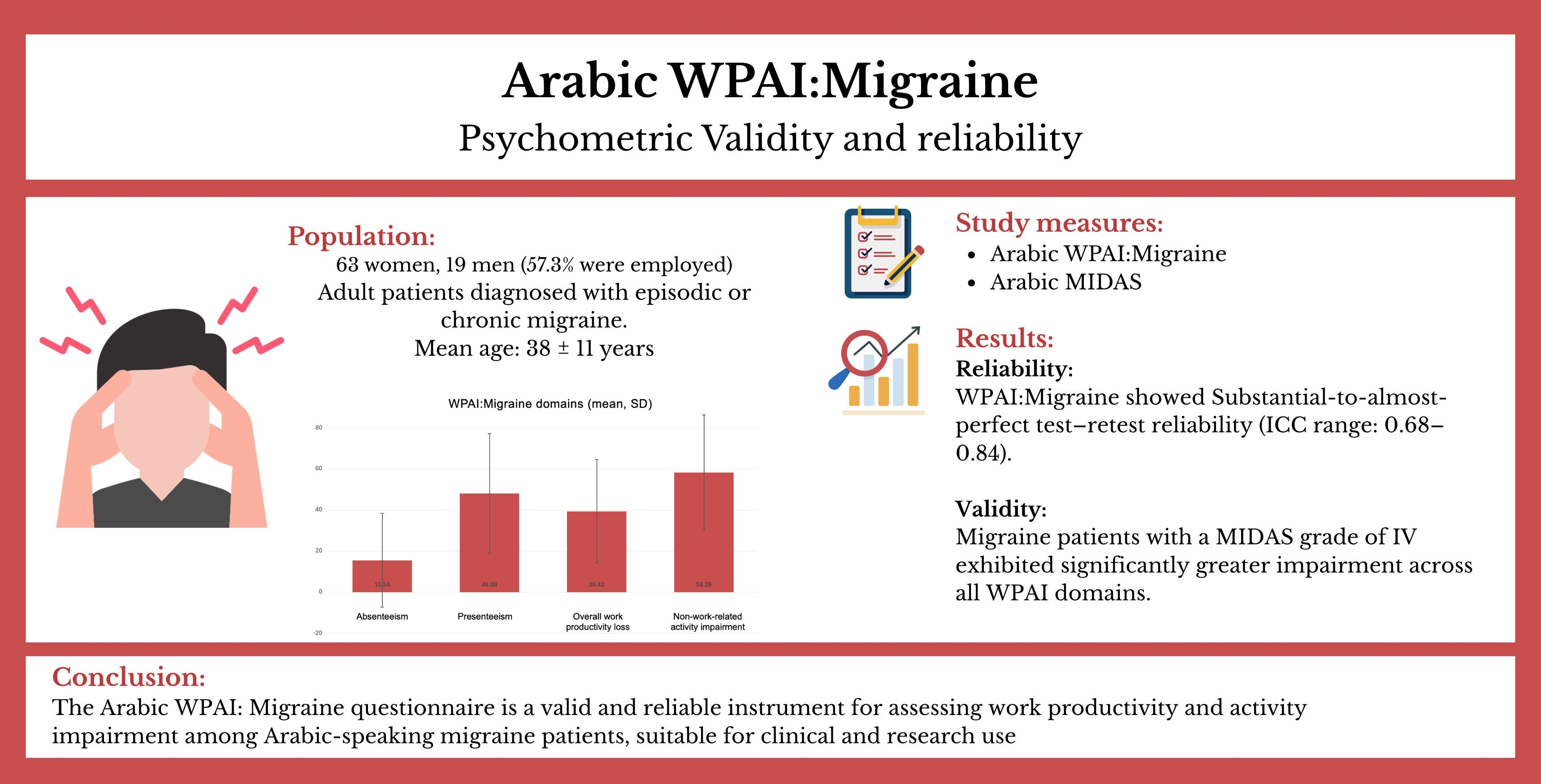
| Absenteeism | 15.54 (22.83) |
| Presenteeism | 48.09 (29.17) |
| Overall work productivity loss | 39.42 (25.20) |
| Non-work-related activity impairment | 58.29 (28.06) |
| MIDAS total score, mean (SD) | 45.77 (44.50) |
| MIDAS disability grade (%) | |
| Grade I | 8% |
| Grade II | 9% |
| Grade III | 19% |
| Grade IV | 64% |
| Domain | Test Mean (SD) | Retest Mean (SD) | Mean Difference (95% CI) | ICC (95% CI, p Value) |
|---|---|---|---|---|
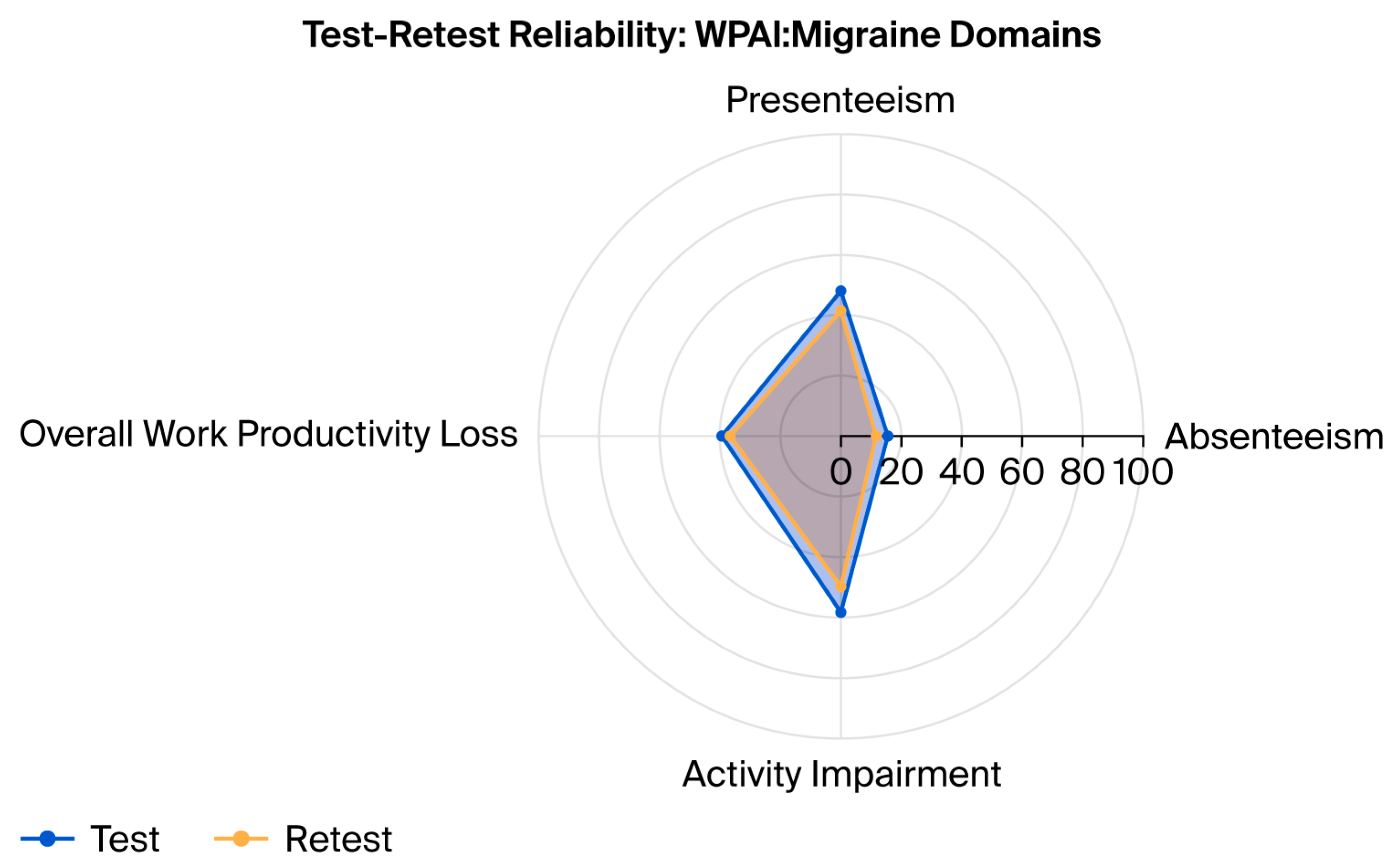
| Absenteeism | 15.54 (22.83) | 11.70 (16.75) | 4.03 (−3.80–11.87) | 0.76 (0.45–0.90, <0.001 *) |
| Presenteeism | 48.09 (29.17) | 41.48 (29.31) | 5.77 (−3.24–14.78) | 0.84 (0.65–0.93, <0.001 *) |
| Overall work productivity loss | 39.42 (25.20) | 36.71 (25.00) | 2.66 (−7.89–13.21) | 0.68 (0.27–0.86, 0.004 *) |
| Activity impairment | 58.29 (28.06) | 49.77 (26.86) | 7.91 (1.21–14.61) | 0.812 (0.65–0.90, <0.001 *) |
| WPAI:Migraine Domain | Pearson’s r | 95% CI (p Value) | Spearman’s ρ | 95% CI (p Value) |
|---|---|---|---|---|
| Absenteeism | 0.356 | 0.07–0.59, 0.018 * | 0.522 | 0.26–0.71, <0.001 * |
| Presenteeism | 0.408 | 0.13–0.62, 0.005 * | 0.526 | 0.27–0.71, <0.001 * |
| Overall work impairment | 0.149 | −0.16–0.48, 0.336 | 0.294 | −0.01–0.55, 0.053 |
| Activity impairment | 0.452 | 0.19–0.65, 0.001 * | 0.576 | 0.34–0.74, <0.001 * |
| WPAI:Migraine Domain | Grade I | Grade II | Grade III | Grade IV | F | df | p-Value |
|---|---|---|---|---|---|---|---|
| Absenteeism | 0 (0) | 1.79 (3.57) | 1.85 (3.75) | 21.72 (25.15) | 1.55 | 3 | 0.040 * |
| Presenteeism | 0 (0) | 55.00 (31.09) | 36.67 (26.93) | 57.59 (24.74) | 0.30 | 3 | <0.001 * |
| Overall work impairment | 0 (0) | 54.30 (31.57) | 35.70 (28.77) | 43.09 (21.37) | 3.74 | 3 | 0.019 * |
| Activity impairment | 2.50 (5.00) | 52.50 (26.30) | 27.78 (22.79) | 58.67 (20.97) | 11.62 | 3 | <0.001 * |
Disclaimer/Publisher’s Note: The statements, opinions and data contained in all publications are solely those of the individual author(s) and contributor(s) and not of MDPI and/or the editor(s). MDPI and/or the editor(s) disclaim responsibility for any injury to people or property resulting from any ideas, methods, instructions or products referred to in the content. |
© 2025 by the authors. Licensee MDPI, Basel, Switzerland. This article is an open access article distributed under the terms and conditions of the Creative Commons Attribution (CC BY) license (https://creativecommons.org/licenses/by/4.0/).
Share and Cite
Albilali, A.; Almutawa, R.A.; Almusahel, E.A.; Almutawa, R.A.; Almutawa, N.A.; Almutawa, F.M.; AlAujan, S.; AlMalag, H.M. Psychometric Validation of the Arabic Version of the WPAI:Migraine Questionnaire in Patients with Migraine. Neurol. Int. 2025, 17, 202. https://doi.org/10.3390/neurolint17120202
Albilali A, Almutawa RA, Almusahel EA, Almutawa RA, Almutawa NA, Almutawa FM, AlAujan S, AlMalag HM. Psychometric Validation of the Arabic Version of the WPAI:Migraine Questionnaire in Patients with Migraine. Neurology International. 2025; 17(12):202. https://doi.org/10.3390/neurolint17120202
Chicago/Turabian StyleAlbilali, Abdulrazaq, Rema A. Almutawa, Elaf A. Almusahel, Renad A. Almutawa, Nasser A. Almutawa, Faisal M. Almutawa, Shiekha AlAujan, and Haya M. AlMalag. 2025. "Psychometric Validation of the Arabic Version of the WPAI:Migraine Questionnaire in Patients with Migraine" Neurology International 17, no. 12: 202. https://doi.org/10.3390/neurolint17120202
APA StyleAlbilali, A., Almutawa, R. A., Almusahel, E. A., Almutawa, R. A., Almutawa, N. A., Almutawa, F. M., AlAujan, S., & AlMalag, H. M. (2025). Psychometric Validation of the Arabic Version of the WPAI:Migraine Questionnaire in Patients with Migraine. Neurology International, 17(12), 202. https://doi.org/10.3390/neurolint17120202