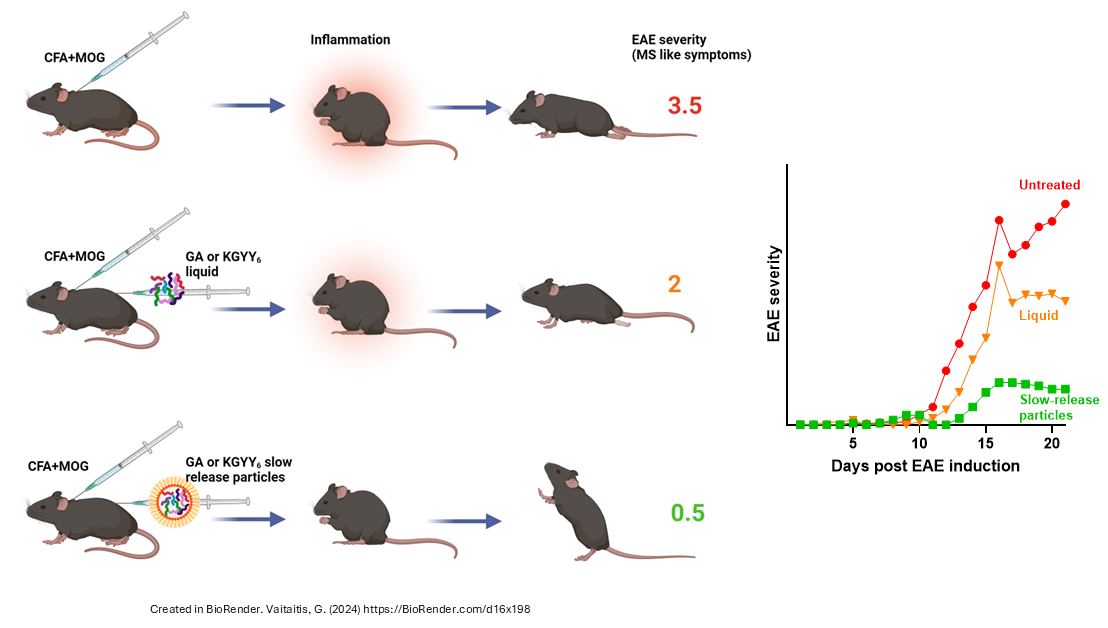

Slow Subcutaneous Release of Glatiramer Acetate or CD40-Targeting Peptide KGYY6 Is More Advantageous in Treating Ongoing Experimental Autoimmune Encephalomyelitis


Abstract
Share and Cite
Vaitaitis, G.M.; Wagner, D.H., Jr. Slow Subcutaneous Release of Glatiramer Acetate or CD40-Targeting Peptide KGYY6 Is More Advantageous in Treating Ongoing Experimental Autoimmune Encephalomyelitis. Neurol. Int. 2024, 16, 1540-1551. https://doi.org/10.3390/neurolint16060114
Vaitaitis GM, Wagner DH Jr. Slow Subcutaneous Release of Glatiramer Acetate or CD40-Targeting Peptide KGYY6 Is More Advantageous in Treating Ongoing Experimental Autoimmune Encephalomyelitis. Neurology International. 2024; 16(6):1540-1551. https://doi.org/10.3390/neurolint16060114
Chicago/Turabian StyleVaitaitis, Gisela M., and David H. Wagner, Jr. 2024. "Slow Subcutaneous Release of Glatiramer Acetate or CD40-Targeting Peptide KGYY6 Is More Advantageous in Treating Ongoing Experimental Autoimmune Encephalomyelitis" Neurology International 16, no. 6: 1540-1551. https://doi.org/10.3390/neurolint16060114
APA StyleVaitaitis, G. M., & Wagner, D. H., Jr. (2024). Slow Subcutaneous Release of Glatiramer Acetate or CD40-Targeting Peptide KGYY6 Is More Advantageous in Treating Ongoing Experimental Autoimmune Encephalomyelitis. Neurology International, 16(6), 1540-1551. https://doi.org/10.3390/neurolint16060114