
The Genetic Architecture of Sudden Cardiac Death: A State-of-the-Art Review
 , , , ,
  , ,
, ,  ,
,  and
and 
Abstract
1. Introduction
2. Epidemiology and Mechanisms of Sudden Cardiac Death
3. Genetic Basis of Sudden Cardiac Death in Cardiomyopathies
3.1. Hypertrophic Cardiomyopathy
3.2. Dilated Cardiomyopathy
3.3. Arrhythmogenic Right Ventricular Cardiomyopathy
3.4. Non-Dilated Left Ventricular Cardiomyopathy
3.5. Restrictive Cardiomyopathy
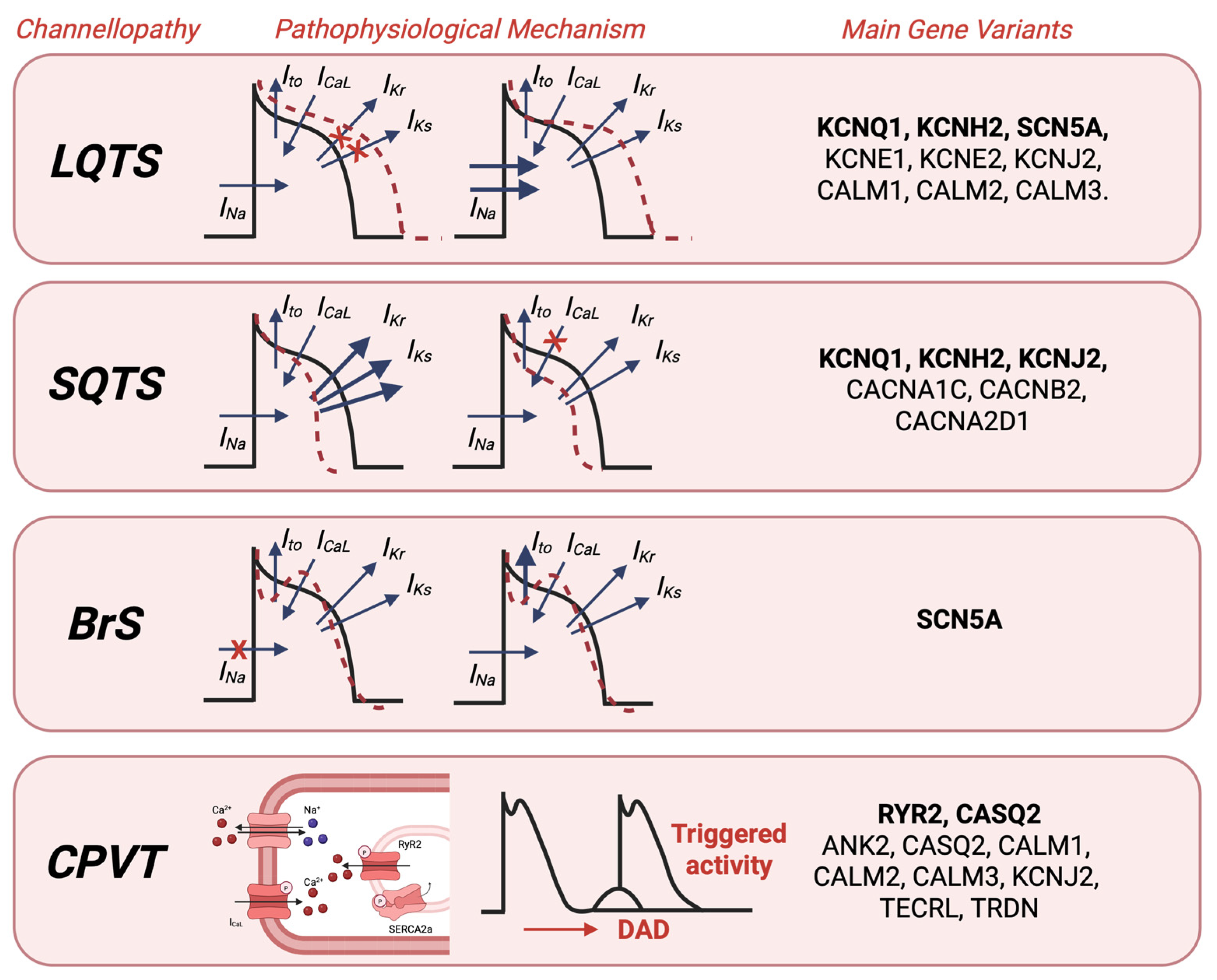
4. Genetic Basis of Sudden Cardiac Death in Channelopathies
4.1. Long QT Syndrome
4.2. Short QT Syndrome
4.3. Brugada Syndrome
4.4. Catecholaminergic Polymorphic Ventricular Tachycardia
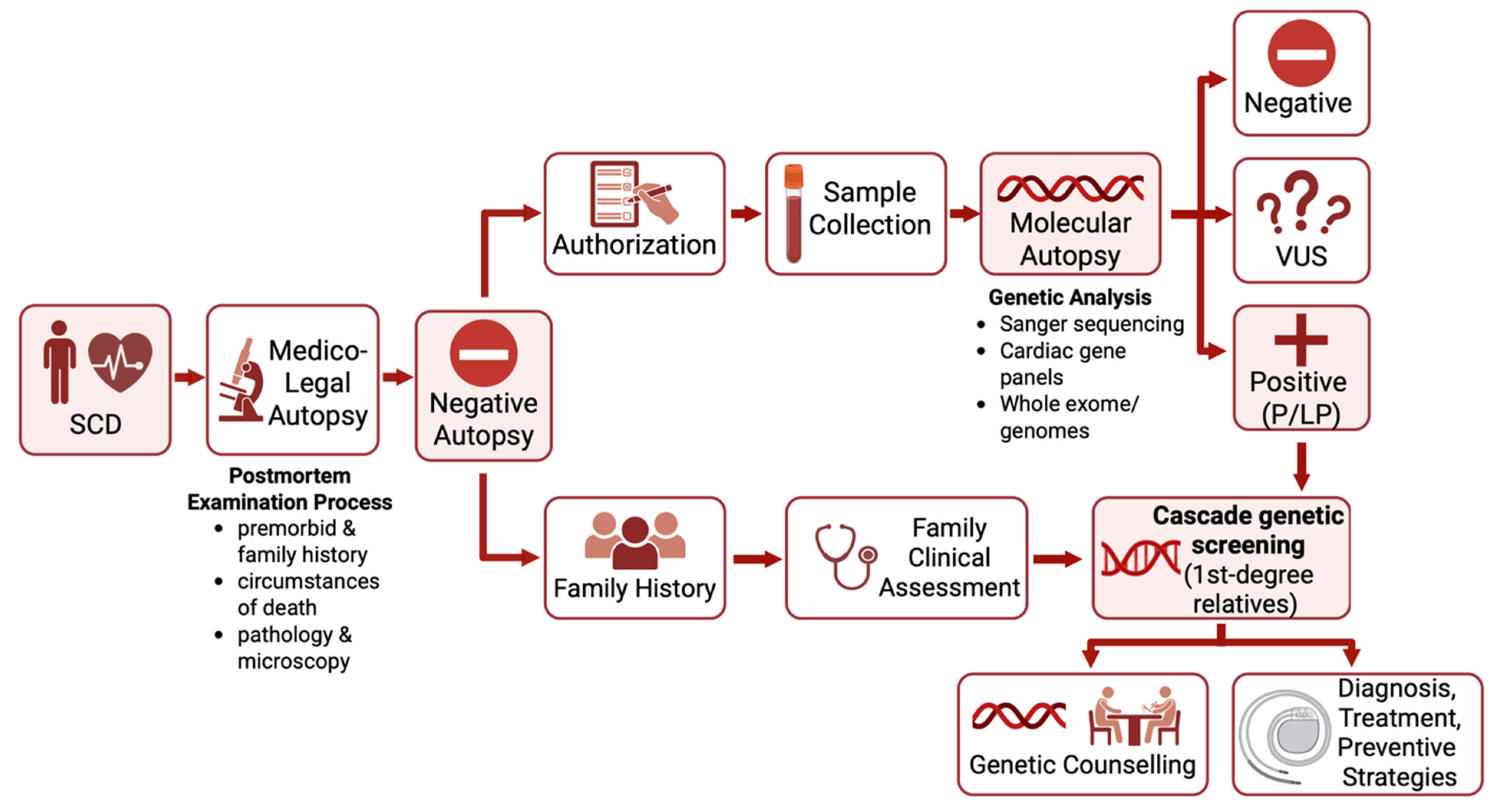
5. Genetic Basis of Sudden Unexplained Death
6. Genetics for Prediction of Sudden Cardiac Death
7. Clinical Consequences of Positive Genetic Testing
8. Future Perspectives
9. Conclusions
Author Contributions
Funding
Institutional Review Board Statement
Informed Consent Statement
Data Availability Statement
Conflicts of Interest
References
- Zeppenfeld, K.; Tfelt-Hansen, J.; de Riva, M.; Winkel, B.G.; Behr, E.R.; Blom, N.A.; Charron, P.; Corrado, D.; Dagres, N.; de Chillou, C.; et al. 2022 ESC Guidelines for the management of patients with ventricular arrhythmias and the prevention of sudden cardiac death. Eur. Heart J. 2022, 43, 3997–4126. [Google Scholar] [CrossRef] [PubMed]
- Scrocco, C.; Bezzina, C.R.; Ackerman, M.J.; Behr, E.R. Genetics and genomics of arrhythmic risk: Current and future strategies to prevent sudden cardiac death. Nat. Rev. Cardiol. 2021, 18, 774–784. [Google Scholar] [CrossRef]
- Hayashi, M.; Shimizu, W.; Albert, C.M. The Spectrum of Epidemiology Underlying Sudden Cardiac Death. Circ. Res. 2015, 116, 1887–1906. [Google Scholar] [CrossRef] [PubMed]
- Deo, R.; Albert, C.M. Epidemiology and Genetics of Sudden Cardiac Death. Circulation 2012, 125, 620–637. [Google Scholar] [CrossRef]
- Chugh, S.S.; Uy-Evanado, A.; Teodorescu, C.; Reinier, K.; Mariani, R.; Gunson, K.; Jui, J. Women have a lower prevalence of structural heart disease as a precursor to sudden cardiac arrest: The Ore-SUDS (Oregon Sudden Unexpected Death Study). J. Am. Coll. Cardiol. 2009, 54, 2006–2011. [Google Scholar] [CrossRef]
- Becker, L.B.; Han, B.H.; Meyer, P.M.; Wright, F.A.; Rhodes, K.V.; Smith, D.W.; Barrett, J. Racial Differences in the Incidence of Cardiac Arrest and Subsequent Survival. N. Engl. J. Med. 1993, 329, 600–606. [Google Scholar] [CrossRef]
- Kumar, A.; Avishay, D.M.; Jones, C.R.; Shaikh, J.D.; Kaur, R.; Aljadah, M.; Kichloo, A.; Shiwalkar, N.; Keshavamurthy, S. Sudden cardiac death: Epidemiology, pathogenesis and management. Rev. Cardiovasc. Med. 2021, 22, 147. [Google Scholar] [CrossRef]
- Basso, C.; Aguilera, B.; Banner, J.; Cohle, S.; d’Amati, G.; de Gouveia, R.H.; di Gioia, C.; Fabre, A.; Gallagher, P.J.; Leone, O.; et al. Guidelines for autopsy investigation of sudden cardiac death: 2017 update from the Association for European Cardiovascular Pathology. Virchows Arch. 2017, 471, 691–705. [Google Scholar] [CrossRef]
- Marijon, E.; Narayanan, K.; Smith, K.; Barra, S.; Basso, C.; Blom, M.T.; Crotti, L.; D’Avila, A.; Deo, R.; Dumas, F.; et al. The Lancet Commission to reduce the global burden of sudden cardiac death: A call for multidisciplinary action. Lancet 2023, 402, 883–936. [Google Scholar] [CrossRef]
- Semsarian, C.; Ingles, J. Molecular autopsy in victims of inherited arrhythmias. J. Arrhythmia 2016, 32, 359–365. [Google Scholar] [CrossRef]
- Sarquella-Brugada, G.; Campuzano, O.; Iglesias, A.; Sánchez-Malagón, J.; Guerra-Balic, M.; Brugada, J.; Brugada, R. Genetics of sudden cardiac death in children and young athletes. Cardiol. Young 2013, 23, 159–173. [Google Scholar] [CrossRef]
- Martínez-Barrios, E.; Grassi, S.; Brión, M.; Toro, R.; Cesar, S.; Cruzalegui, J.; Coll, M.; Alcalde, M.; Brugada, R.; Greco, A.; et al. Molecular autopsy: Twenty years of post-mortem diagnosis in sudden cardiac death. Front. Med. 2023, 10, 1118585. [Google Scholar] [CrossRef]
- Isbister, J.C.; Nowak, N.; Yeates, L.; Singer, E.S.; Sy, R.W.; Ingles, J.; Raju, H.; Bagnall, R.D.; Semsarian, C. Concealed Cardiomyopathy in Autopsy-Inconclusive Cases of Sudden Cardiac Death and Implications for Families. J. Am. Coll. Cardiol. 2022, 80, 2057–2068. [Google Scholar] [CrossRef]
- Mistrulli, R.; Ferrera, A.; Salerno, L.; Vannini, F.; Guida, L.; Corradetti, S.; Addeo, L.; Valcher, S.; Di Gioia, G.; Spera, F.R.; et al. Cardiomyopathy and Sudden Cardiac Death: Bridging Clinical Practice with Cutting-Edge Research. Biomedicines 2024, 12, 1602. [Google Scholar] [CrossRef]
- Žebrauskienė, D.; Sadauskienė, E.; Puronaitė, R.; Masiulienė, R.; Vaišnorė, R.; Bratčikovienė, N.; Valevičienė, N.; Barysienė, J.; Jakaitienė, A.; Preikšaitienė, E. Genotype-Phenotype Relationship in Hypertrophic Cardiomyopathy. Genes 2025, 16, 1090. [Google Scholar] [CrossRef]
- Eldemire, R.; Mestroni, L.; Taylor, M.R.G. Genetics of Dilated Cardiomyopathy. Annu. Rev. Med. 2024, 75, 417–426. [Google Scholar] [CrossRef]
- Zarate, Y.A.; Abdelmoti, L.M.; Oh, S.; White, A.; Starks, C.; Au, M.G.; Chen, J.; Weaver, N.K.; Korotkov, K.V.; Galperin, E. ACTC1 Variants Result in Isolated and Syndromic Cardiac Phenotypes. Clin. Genet. 2025, 108, 713–719. [Google Scholar] [CrossRef]
- Adalsteinsdottir, B.; Burke, M.; Maron, B.J.; Danielsen, R.; Lopez, B.; Diez, J.; Jarolim, P.; Seidman, J.; Seidman, C.E.; Ho, C.Y.; et al. Hypertrophic cardiomyopathy in myosin-binding protein C (MYBPC3) Icelandic founder mutation carriers. Open Heart 2020, 7, e001220. [Google Scholar] [CrossRef]
- Kelly, M.A.; Caleshu, C.; Morales, A.; Buchan, J.; Wolf, Z.; Harrison, S.M.; Cook, S.; Dillon, M.W.; Garcia, J.; Haverfield, E.; et al. Adaptation and validation of the ACMG/AMP variant classification framework for MYH7-associated inherited cardiomyopathies: Recommendations by ClinGen’s Inherited Cardiomyopathy Expert Panel. Genet. Med. 2018, 20, 351–359. [Google Scholar] [CrossRef]
- Manivannan, S.N.; Darouich, S.; Masmoudi, A.; Gordon, D.; Zender, G.; Han, Z.; Fitzgerald-Butt, S.; White, P.; McBride, K.L.; Kharrat, M.; et al. Novel frameshift variant in MYL2 reveals molecular differences between dominant and recessive forms of hypertrophic cardiomyopathy. PLoS Genet. 2020, 16, e1008639. [Google Scholar] [CrossRef]
- Osborn, D.P.S.; Emrahi, L.; Clayton, J.; Tabrizi, M.T.; Wan, A.Y.B.; Maroofian, R.; Yazdchi, M.; Garcia, M.L.E.; Galehdari, H.; Hesse, C.; et al. Autosomal recessive cardiomyopathy and sudden cardiac death associated with variants in MYL3. Genet. Med. 2021, 23, 787–792. [Google Scholar] [CrossRef]
- Pua, C.J.; Tham, N.; Chin, C.W.L.; Walsh, R.; Khor, C.C.; Toepfer, C.N.; Repetti, G.G.; Garfinkel, A.C.; Ewoldt, J.F.; Cloonan, P.; et al. Genetic Studies of Hypertrophic Cardiomyopathy in Singaporeans Identify Variants in TNNI3 and TNNT2 That Are Common in Chinese Patients. Circ. Genom. Precis. Med. 2020, 13, 424–434. [Google Scholar] [CrossRef]
- Fernlund, E.; Kissopoulou, A.; Green, H.; Karlsson, J.E.; Ellegård, R.; Årstrand, H.K.; Jonasson, J.; Gunnarsson, C. Hereditary Hypertrophic Cardiomyopathy in Children and Young Adults—The Value of Reevaluating and Expanding Gene Panel Analyses. Genes 2020, 11, 1472. [Google Scholar] [CrossRef]
- Lopes, L.R.; Garcia-Hernández, S.; Lorenzini, M.; Futema, M.; Chumakova, O.; Zateyshchikov, D.; Isidoro-Garcia, M.; Villacorta, E.; Escobar-Lopez, L.; Garcia-Pavia, P.; et al. Alpha-protein kinase 3 (ALPK3) truncating variants are a cause of autosomal dominant hypertrophic cardiomyopathy. Eur. Heart J. 2021, 42, 3063–3073. [Google Scholar] [CrossRef]
- Park, J.; Levin, M.G.; Zhang, D.; Reza, N.; Mead, J.O.; Carruth, E.D.; Kelly, M.A.; Winters, A.; Kripke, C.M.; Judy, R.L.; et al. Bidirectional Risk Modulator and Modifier Variant of Dilated and Hypertrophic Cardiomyopathy in BAG3. JAMA Cardiol. 2024, 9, 1124–1133. [Google Scholar] [CrossRef]
- Rubattu, S.; Bozzao, C.; Pennacchini, E.; Pagannone, E.; Musumeci, B.M.; Piane, M.; Germani, A.; Savio, C.; Francia, P.; Volpe, M. A Next-Generation Sequencing Approach to Identify Gene Mutations in Early- and Late-Onset Hypertrophic Cardiomyopathy Patients of an Italian Cohort. Int. J. Mol. Sci. 2016, 17, 1239. [Google Scholar] [CrossRef]
- Antonicka, H.; Mattman, A.; Carlson, C.G.; Glerum, D.M.; Hoffbuhr, K.C.; Leary, S.C.; Kennaway, N.G.; Shoubridge, E.A. Mutations in COX15 Produce a Defect in the Mitochondrial Heme Biosynthetic Pathway, Causing Early-Onset Fatal Hypertrophic Cardiomyopathy. Am. J. Hum. Genet. 2003, 72, 101–114. [Google Scholar] [CrossRef]
- Thorkelsson, A.; Chou, C.; Tripp, A.; Ali, S.A.; Galper, J.; Chin, M.T. Hypertrophic Cardiomyopathy-Associated CRYABR123W Activates Calcineurin, Reduces Calcium Sequestration, and Alters the CRYAB Interactome and the Proteomic Response to Pathological Hypertrophy. Int. J. Mol. Sci. 2025, 26, 2383. [Google Scholar] [CrossRef]
- Tadros, R.; Francis, C.; Xu, X.; Vermeer, A.M.C.; Harper, A.R.; Huurman, R.; Kelu Bisabu, K.; Walsh, R.; Hoorntje, E.T.; Te Rijdt, W.P.; et al. Shared genetic pathways contribute to risk of hypertrophic and dilated cardiomyopathies with opposite directions of effect. Nat. Genet. 2021, 53, 128–134. [Google Scholar] [CrossRef]
- Binder, M.S.; Brown, E.; Aversano, T.; Wagner, K.R.; Calkins, H.; Barth, A.S. Novel FHL1 Mutation Associated with Hypertrophic Cardiomyopathy, Sudden Cardiac Death, and Myopathy. JACC Case Rep. 2020, 2, 372–377. [Google Scholar] [CrossRef]
- Walsh, R.; Offerhaus, J.A.; Tadros, R.; Bezzina, C.R. Minor hypertrophic cardiomyopathy genes, major insights into the genetics of cardiomyopathies. Nat. Rev. Cardiol. 2022, 19, 151–167. [Google Scholar] [CrossRef]
- Payne, R.M.; Wagner, G.R. Cardiomyopathy in Friedreich Ataxia: Clinical Findings and Research. J. Child Neurol. 2012, 27, 1179–1186. [Google Scholar] [CrossRef]
- Rupp, S.; Felimban, M.; Schänzer, A.; Schranz, D.; Marschall, C.; Zenker, M.; Logeswaran, T.; Neuhäuser, C.; Thul, J.; Jux, C.; et al. Genetic basis of hypertrophic cardiomyopathy in children. Clin. Res. Cardiol. 2019, 108, 282–289. [Google Scholar] [CrossRef]
- Chaves-Markman, Â.V.; Markman, M.; Calado, E.B.; Pires, R.F.; Santos-Veloso, M.A.O.; Pereira, C.M.F.; Lordsleem, A.B.M.D.S.; Lima, S.G.; Markman Filho, B.; Oliveira, D.C. GLA Gene Mutation in Hypertrophic Cardiomyopathy with a New Variant Description: Is it Fabry’s Disease? Arq. Bras. Cardiol. 2019, 113, 77–84. [Google Scholar] [CrossRef]
- Meinert, M.; Englund, E.; Hedberg-Oldfors, C.; Oldfors, A.; Kornhall, B.; Lundin, C.; Wittström, E. Danon disease presenting with early onset of hypertrophic cardiomyopathy and peripheral pigmentary retinal dystrophy in a female with a de novo novel mosaic mutation in the LAMP2 gene. Ophthalmic Genet. 2019, 40, 227–236. [Google Scholar] [CrossRef]
- Zheng, J.; Huang, Z.; Hou, S.; Jiang, X.; Zhang, Y.; Liu, W.; Jia, J.; Li, Y.; Sun, X.; Xie, L. Case Report: Novel LIM domain-binding protein 3 (LDB3) mutations associated with hypertrophic cardiomyopathy family. Front. Pediatr. 2022, 10, 947963. [Google Scholar] [CrossRef]
- Ahamed, H.; Balegadde, A.V.; Menon, S.; Menon, R.; Ramachandran, A.; Mathew, N.; Natarajan, K.U.; Nair, I.R.; Kannan, R.; Shankar, M.; et al. Phenotypic expression and clinical outcomes in a South Asian PRKAG2 cardiomyopathy cohort. Sci. Rep. 2020, 10, 20610. [Google Scholar] [CrossRef]
- Tartaglia, M.; Kalidas, K.; Shaw, A.; Song, X.; Musat, D.L.; van der Burgt, I.; Brunner, H.G.; Bertola, D.R.; Crosby, A.; Ion, A.; et al. PTPN11 Mutations in Noonan Syndrome: Molecular Spectrum, Genotype-Phenotype Correlation, and Phenotypic Heterogeneity. Am. J. Hum. Genet. 2002, 70, 1555–1563. [Google Scholar] [CrossRef]
- Thompson, D.; Patrick-Esteve, J.; Surcouf, J.W.; Rivera, D.; Castellanos, B.; Desai, P.; Lilje, C.; Lacassie, Y.; Marble, M.; Zambrano, R. RAF1 variants causing biventricular hypertrophic cardiomyopathy in two preterm infants: Further phenotypic delineation and review of literature. Clin. Dysmorphol. 2017, 26, 195–199. [Google Scholar] [CrossRef]
- Leegaard, A.; Gregersen, P.A.; Nielsen, T.Ø.; Bjerre, J.V.; Handrup, M.M. Succesful MEK-inhibition of severe hypertrophic cardiomyopathy in RIT1-related Noonan Syndrome. Eur. J. Med. Genet. 2022, 65, 104630. [Google Scholar] [CrossRef]
- Von Renesse, A.; Morales-Gonzalez, S.; Gill, E.; Salomons, G.S.; Stenzel, W.; Schuelke, M. Muscle Weakness, Cardiomyopathy, and L-2-Hydroxyglutaric Aciduria Associated with a Novel Recessive SLC25A4 Mutation. In JIMD Reports; Morava, E., Baumgartner, M., Patterson, M., Rahman, S., Zschocke, J., Peters, V., Eds.; Springer: Berlin/Heidelberg, Germany, 2018; Volume 43, pp. 27–35. [Google Scholar] [CrossRef]
- Carlus, S.J.; Almuzaini, I.S.; Karthikeyan, M.; Loganathan, L.; Al-Harbi, G.S.; Carlus, F.H.; Al-Mazroea, A.H.; Morsy, M.M.; Abo-Haded, H.M.; Abdallah, A.M.; et al. A novel homozygous TPM1 mutation in familial pediatric hypertrophic cardiomyopathy and in silico screening of potential targeting drugs. Eur. Rev. Med. Pharmacol. Sci. 2020, 24, 7732–7744. [Google Scholar] [CrossRef]
- Lopes, L.R.; Futema, M.; Akhtar, M.M.; Lorenzini, M.; Pittman, A.; Syrris, P.; Elliott, P.M. Prevalence of TTR variants detected by whole-exome sequencing in hypertrophic cardiomyopathy. Amyloid 2019, 26, 243–247. [Google Scholar] [CrossRef]
- Akhtar, M.M.; Lorenzini, M.; Cicerchia, M.; Ochoa, J.P.; Hey, T.M.; Sabater Molina, M.; Restrepo-Cordoba, M.A.; Dal Ferro, M.; Stolfo, D.; Johnson, R.; et al. Clinical Phenotypes and Prognosis of Dilated Cardiomyopathy Caused by Truncating Variants in the TTN Gene. Circ. Heart Fail. 2020, 13, e006832. [Google Scholar] [CrossRef]
- Wang, Z.; Wu, J.; Lv, Z.; Liang, P.; Li, Q.; Li, Y.; Guo, Y. LMNA-related cardiomyopathy: From molecular pathology to cardiac gene therapy. J. Adv. Res. 2025, 77, 443–464. [Google Scholar] [CrossRef]
- Asatryan, B.; Rieder, M.; Murray, B.; Muller, S.A.; Tichnell, C.; Gasperetti, A.; Carrick, R.T.; Joseph, E.; Leung, D.G.; Te Riele, A.S.J.M.; et al. Natural History, Phenotype Spectrum, and Clinical Outcomes of Desmin (DES)-Associated Cardiomyopathy. Circ. Genom. Precis. Med. 2025, 18, e004878. [Google Scholar] [CrossRef]
- Brodehl, A.; Diedingm, M.; Biere, N.; Unger, A.; Klauke, B.; Walhorn, V.; Gummert, J.; Schulz, U.; Linke, W.A.; Gerull, B.; et al. Functional characterization of the novel DES mutation p.L136P associated with dilated cardiomyopathy reveals a dominant filament assembly defect. J. Mol. Cell. Cardiol. 2016, 91, 207–214. [Google Scholar] [CrossRef]
- Johnson, R.; Otway, R.; Chin, E.; Horvat, C.; Ohanian, M.; Wilcox, J.A.L.; Su, Z.; Prestes, P.; Smolnikov, A.; Soka, M.; et al. DMD-Associated Dilated Cardiomyopathy: Genotypes, Phenotypes, and Phenocopies. Circ. Genom. Precis. Med. 2023, 16, 421–430. [Google Scholar] [CrossRef]
- Augusto, J.B.; Eiros, R.; Nakou, E.; Moura-Ferreira, S.; Treibel, T.A.; Captur, G.; Akhtar, M.M.; Protonotarios, A.; Gossios, T.D.; Savvatis, K.; et al. Dilated cardiomyopathy and arrhythmogenic left ventricular cardiomyopathy: A comprehensive genotype-imaging phenotype study. Eur. Heart J.-Cardiovasc. Imaging 2019, 21, 326–336. [Google Scholar] [CrossRef]
- Ortiz-Genga, M.F.; Cuenca, S.; Dal Ferro, M.; Zorio, E.; Salgado-Aranda, R.; Climent, V.; Padrón-Barthe, L.; Duro-Aguado, I.; Jiménez-Jáimez, J.; Hidalgo-Olivares, V.M.; et al. Truncating FLNC Mutations Are Associated with High-Risk Dilated and Arrhythmogenic Cardiomyopathies. J. Am. Coll. Cardiol. 2016, 68, 2440–2451. [Google Scholar] [CrossRef]
- De Frutos, F.; Ochoa, J.P.; Navarro-Peñalver, M.; Baas, A.; Bjerre, J.V.; Zorio, E.; Méndez, I.; Lorca, R.; Verdonschot, J.A.J.; García-Granja, P.E.; et al. Natural History of MYH7-Related Dilated Cardiomyopathy. J. Am. Coll. Cardiol. 2022, 80, 1447–1461. [Google Scholar] [CrossRef]
- Feyen, D.A.M.; Perea-Gil, I.; Maas, R.G.C.; Harakalova, M.; Gavidia, A.A.; Arthur Ataam, J.; Wu, T.H.; Vink, A.; Pei, J.; Vadgama, N.; et al. Unfolded Protein Response as a Compensatory Mechanism and Potential Therapeutic Target in PLN R14del Cardiomyopathy. Circulation 2021, 144, 382–392. [Google Scholar] [CrossRef] [PubMed]
- Gregorich, Z.R.; Zhang, Y.; Kamp, T.J.; Granzier, H.L.; Guo, W. Mechanisms of RBM20 Cardiomyopathy: Insights from Model Systems. Circ. Genom. Precis. Med. 2024, 17, e004355. [Google Scholar] [CrossRef] [PubMed]
- Wilde, A.A.M.; Amin, A.S. Clinical Spectrum of SCN5A Mutations. JACC Clin. Electrophysiol. 2018, 4, 569–579. [Google Scholar] [CrossRef]
- Mazzarotto, F.; Tayal, U.; Buchan, R.J.; Midwinter, W.; Wilk, A.; Whiffin, N.; Govind, R.; Mazaika, E.; de Marvao, A.; Dawes, T.J.W.; et al. Reevaluating the Genetic Contribution of Monogenic Dilated Cardiomyopathy. Circulation 2020, 141, 387–398. [Google Scholar] [CrossRef]
- Hershberger, R.E.; Pinto, J.R.; Parks, S.B.; Kushner, J.D.; Li, D.; Ludwigsen, S.; Cowan, J.; Morales, A.; Parvatiyar, M.S.; Potter, J.D. Clinical and Functional Characterization of TNNT2 Mutations Identified in Patients with Dilated Cardiomyopathy. Circ. Cardiovasc. Genet. 2009, 2, 306–313. [Google Scholar] [CrossRef]
- Vodnjov, N.; Zupan Mežnar, A.; Maver, A.; Dolinšek, A.; Peterlin, B.; Writzl, K. Non-dilated left ventricular cardiomyopathy with arrhythmias is commonly caused by the nonsense variant DSP: c. 3793G >T in Slovenian patients. Clin. Genet. 2024, 106, 500–504. [Google Scholar] [CrossRef]
- Setti, M.; Iseppi, M.; Verdonschot, J.A.J.; Rizzi, J.G.; Paldino, A.; Pio Loco Detto Gava, C.; Barbati, G.; Dal Ferro, M.; Venner, M.F.G.H.M.; Raafs, A.G.; et al. Integrated Role of Cardiac Magnetic Resonance and Genetics in Predicting Left Ventricular Reverse Remodelling in Dilated and Non-Dilated Cardiomyopathy. Eur. J. Heart Fail. 2025, 27, 2571–2581. [Google Scholar] [CrossRef]
- Gaertner, A.; Klauke, B.; Brodehl, A.; Milting, H. RBM20 mutations in left ventricular non-compaction cardiomyopathy. Pediatr. Investig. 2020, 4, 61–63. [Google Scholar] [CrossRef]
- Arbelo, E.; Protonotarios, A.; Gimeno, J.R.; Arbustini, E.; Barriales-Villa, R.; Basso, C.; Bezzina, C.R.; Biagini, E.; Blom, N.A.; de Boer, R.A.; et al. 2023 ESC Guidelines for the management of cardiomyopathies. Eur. Heart J. 2023, 44, 3503–3626. [Google Scholar] [CrossRef]
- Smith, E.D.; Lakdawala, N.K.; Papoutsidakis, N.; Aubert, G.; Mazzanti, A.; McCanta, A.C.; Agarwal, P.P.; Arscott, P.; Dellefave-Castillo, L.M.; Vorovich, E.E.; et al. Desmoplakin Cardiomyopathy, a Fibrotic and Inflammatory Form of Cardiomyopathy Distinct from Typical Dilated or Arrhythmogenic Right Ventricular Cardiomyopathy. Circulation 2020, 141, 1872–1884. [Google Scholar] [CrossRef] [PubMed]
- Giannoni, A.; Modena, M.; Montuoro, S.; Bonanni, F.; Grigoratos, C.; Barison, A.; Todiere, G.; Rossi, A.; Vittorini, S.; Emdin, M.; et al. A Novel Homozygous Mutation of the Desmoplakin Gene with Biventricular Arrhythmogenic Cardiomyopathy. JACC Case Rep. 2025, 30, 103688. [Google Scholar] [CrossRef] [PubMed]
- Chen, L.; Hu, Y.; Saguner, A.M.; Bauce, B.; Liu, Y.; Shi, A.; Guan, F.; Chen, Z.; Bueno Marinas, M.; Wu, L.; et al. Natural History and Clinical Outcomes of Patients with DSG2/DSC2 Variant-Related Arrhythmogenic Right Ventricular Cardiomyopathy. Circulation 2025, 151, 1213–1230. [Google Scholar] [CrossRef]
- Vahidnezhad, H.; Vahidnezhad, H.; Youssefian, L.; Faghankhani, M.; Mozafari, N.; Saeidian, A.H.; Niaziorimi, F.; Abdollahimajd, F.; Sotoudeh, S.; Rajabi, F.; et al. Arrhythmogenic right ventricular cardiomyopathy in patients with biallelic JUP-associated skin fragility. Sci. Rep. 2020, 10, 21622. [Google Scholar] [CrossRef]
- Hedberg, C.; Melberg, A.; Kuhl, A.; Jenne, D.; Oldfors, A. Autosomal dominant myofibrillar myopathy with arrhythmogenic right ventricular cardiomyopathy 7 is caused by a DES mutation. Eur. J. Hum. Genet. 2012, 20, 984–985. [Google Scholar] [CrossRef]
- Li, Z.; Chen, P.; Xu, J.; Yu, B.; Li, X.; Wang, D.W.; Wang, D.W. A PLN nonsense variant causes severe dilated cardiomyopathy in a novel autosomal recessive inheritance mode. Int. J. Cardiol. 2019, 279, 122–125. [Google Scholar] [CrossRef]
- Bariani, R.; Rigato, I.; Cason, M.; Marinas, M.B.; Celeghin, R.; Pilichou, K.; Bauce, B. Genetic Background and Clinical Features in Arrhythmogenic Left Ventricular Cardiomyopathy: A Systematic Review. J. Clin. Med. 2022, 11, 4313. [Google Scholar] [CrossRef] [PubMed]
- Mouton, J.; Pellizzon, A.S.; Goosen, A.; Kinnear, C.J.; Herbst, P.G.; Brink, P.A.; Moolman-Smook, J.C. Diagnostic disparity and identification of two TNNI3 gene mutations, one novel and one arising de novo, in South African patients with restrictive cardiomyopathy and focal ventricular hypertrophy. Cardiovasc. J. Afr. 2015, 26, 63–69. [Google Scholar] [CrossRef]
- Blagova, O.; Pavlenko, E.; Sedov, V.; Kogan, E.; Polyak, M.; Zaklyazminskaya, E.; Lutokhina, Y. Different Phenotypes of Sarcomeric MyBPC3-Cardiomyopathy in the Same Family: Hypertrophic, Left Ventricular Noncompaction and Restrictive Phenotypes (in Association with Sarcoidosis). Genes 2022, 13, 1344. [Google Scholar] [CrossRef]
- Zhao, Y.; Liu, S.; Mo, H.; Hua, X.; Chen, X.; Zhang, Y.; Wang, W.; Zhao, Q.; Song, J. MYH7 Mutations in Restrictive Cardiomyopathy. JACC Adv. 2025, 4, 101693. [Google Scholar] [CrossRef] [PubMed]
- De Bortoli, M.; Vio, R.; Basso, C.; Calore, M.; Minervini, G.; Angelini, A.; Melacini, P.; Vitiello, L.; Vazza, G.; Thiene, G.; et al. Novel Missense Variant in MYL2 Gene Associated with Hypertrophic Cardiomyopathy Showing High Incidence of Restrictive Physiology. Circ. Genom. Precis. Med. 2020, 13, e002824. [Google Scholar] [CrossRef] [PubMed]
- Kazmierczak, K.; Liang, J.; Maura, L.G.; Scott, N.K.; Szczesna-Cordary, D. Phosphorylation Mimetic of Myosin Regulatory Light Chain Mitigates Cardiomyopathy-Induced Myofilament Impairment in Mouse Models of RCM and DCM. Life 2023, 13, 1463. [Google Scholar] [CrossRef]
- Filomena, M.C.; Yamamoto, D.L.; Caremani, M.; Kadarla, V.K.; Mastrototaro, G.; Serio, S.; Vydyanath, A.; Mutarelli, M.; Garofalo, A.; Pertici, I.; et al. Myopalladin promotes muscle growth through modulation of the serum response factor pathway. J. Cachexia Sarcopenia Muscle 2020, 11, 169–194. [Google Scholar] [CrossRef]
- Ezekian, J.E.; Clippinger, S.R.; Garcia, J.M.; Yang, Q.; Denfield, S.; Jeewa, A.; Dreyer, W.J.; Zou, W.; Fan, Y.; Allen, H.D.; et al. Variant R94C in TNNT2-Encoded Troponin T Predisposes to Pediatric Restrictive Cardiomyopathy and Sudden Death Through Impaired Thin Filament Relaxation Resulting in Myocardial Diastolic Dysfunction. J. Am. Heart Assoc. 2020, 9, e015111. [Google Scholar] [CrossRef] [PubMed]
- Wacker, J.; Di Bernardo, S.; Lobrinus, J.A.; Jungbluth, H.; Gautel, M.; Beghetti, M.; Fluss, J. Successful heart transplant in a child with congenital core myopathy and delayed-onset restrictive cardiomyopathy due to recessive mutations in the titin (TTN) gene. Pediatr. Transplant. 2023, 27, e14561. [Google Scholar] [CrossRef] [PubMed]
- Lan, B.; Liu, Z.; Bai, J.; Tang, J.; Zhang, J. Restrictive cardiomyopathy due to new mutation in the ACTN2 gene: A case report. Eur. Heart J.-Case Rep. 2025, 9, ytaf421. [Google Scholar] [CrossRef]
- Schänzer, A.; Rupp, S.; Gräf, S.; Zengeler, D.; Jux, C.; Akintürk, H.; Gulatz, L.; Mazhari, N.; Acker, T.; Van Coster, R.; et al. Dysregulated autophagy in restrictive cardiomyopathy due to Pro209Leu mutation in BAG3. Mol. Genet. Metab. 2018, 123, 388–399. [Google Scholar] [CrossRef]
- Tuoliken, S.; Li, J.-H.; Lu, M. Restrictive cardiomyopathy with unique fibrosis pattern and familial atrial arrythmia associated with DES mutation. Eur. Heart J. 2025, 46, 2031. [Google Scholar] [CrossRef]
- Aristizabal, A.M.; Guzmán-Serrano, C.A.; Lizcano, M.I.; Mosquera, W.; Lores, J.; Pachajoa, H.; Cely, C. FLNC Associada a Cardiomiopatia Restritiva e Hipertrabeculação, uma Associação Rara. Arq. Bras. Cardiol. 2024, 121, e20230790. [Google Scholar] [CrossRef]
- Ommen, S.R.; Ho, C.Y.; Asif, I.M.; Balaji, S.; Burke, M.A.; Day, S.M.; Dearani, J.A.; Epps, K.C.; Evanovich, L.; Ferrari, V.A.; et al. 2024 AHA/ACC/AMSSM/HRS/PACES/SCMR Guideline for the Management of Hypertrophic Cardiomyopathy: A Report of the American Heart Association/American College of Cardiology Joint Committee on Clinical Practice Guidelines. Circulation 2024, 149, e1239–e1311. [Google Scholar] [CrossRef] [PubMed]
- Finocchiaro, G.; Bhatia, R.T.; Westaby, J.; Behr, E.R.; Papadakis, M.; Sharma, S.; Sheppard, M.N. Sudden Cardiac Death During Exercise in Young Individuals with Hypertrophic Cardiomyopathy. JACC Clin. Electrophysiol. 2023, 9, 865–867. [Google Scholar] [CrossRef]
- Del Duca, F.; Ghamlouch, A.; Manetti, A.C.; Napoletano, G.; Sonnini, E.; Treves, B.; De Matteis, A.; La Russa, R.; Sheppard, M.N.; Fineschi, V.; et al. Sudden Cardiac Death, Post-Mortem Investigation: A Proposing Panel of First Line and Second Line Genetic Tests. J. Pers. Med. 2024, 14, 544. [Google Scholar] [CrossRef]
- Topriceanu, C.-C.; Pereira, A.C.; Moon, J.C.; Captur, G.; Ho, C.Y. Meta-Analysis of Penetrance and Systematic Review on Transition to Disease in Genetic Hypertrophic Cardiomyopathy. Circulation 2024, 149, 107–123. [Google Scholar] [CrossRef]
- Finocchiaro, G.; Westaby, J.; Sheppard, M.N.; Papadakis, M.; Sharma, S. Sudden Cardiac Death in Young Athletes. J. Am. Coll. Cardiol. 2024, 83, 350–370. [Google Scholar] [CrossRef]
- O’Mahony, C.; Jichi, F.; Pavlou, M.; Monserrat, L.; Anastasakis, A.; Rapezzi, C.; Biagini, E.; Gimeno, J.R.; Limongelli, G.; McKenna, W.J.; et al. A novel clinical risk prediction model for sudden cardiac death in hypertrophic cardiomyopathy (HCM Risk-SCD). Eur. Heart J. 2014, 35, 2010–2020. [Google Scholar] [CrossRef] [PubMed]
- Norrish, G.; Ding, T.; Field, E.; Ziólkowska, L.; Olivotto, I.; Limongelli, G.; Anastasakis, A.; Weintraub, R.; Biagini, E.; Ragni, L.; et al. Development of a Novel Risk Prediction Model for Sudden Cardiac Death in Childhood Hypertrophic Cardiomyopathy (HCM Risk-Kids). JAMA Cardiol. 2019, 4, 918–927. [Google Scholar] [CrossRef]
- Monda, E.; Limongelli, G. Integrated Sudden Cardiac Death Risk Prediction Model For Patients with Hypertrophic Cardiomyopathy. Circulation 2023, 147, 281–283. [Google Scholar] [CrossRef] [PubMed]
- Montuoro, S.; Monda, E.; Limongelli, G. Risk Models for Sudden Cardiac Death in Hypertrophic Cardiomyopathy. J. Am. Coll. Cardiol. 2025, 86, 67–70. [Google Scholar] [CrossRef]
- Teekakirikul, P.; Zhu, W.; Huang, H.C.; Fung, E. Hypertrophic Cardiomyopathy: An Overview of Genetics and Management. Biomolecules 2019, 9, 878. [Google Scholar] [CrossRef] [PubMed]
- Bakalakos, A.; Monda, E.; Elliott, P.M. Tailored therapeutics for cardiomyopathies. Nat. Rev. Cardiol. 2025, 22, 814–831. [Google Scholar] [CrossRef]
- Elliott, P.; Andersson, B.; Arbustini, E.; Bilinska, Z.; Cecchi, F.; Charron, P.; Dubourg, O.; Kühl, U.; Maisch, B.; McKenna, W.J.; et al. Classification of the cardiomyopathies: A position statement from the european society of cardiology working group on myocardial and pericardial diseases. Eur. Heart J. 2007, 29, 270–276. [Google Scholar] [CrossRef]
- Polovina, M.; Tschöpe, C.; Rosano, G.; Metra, M.; Crea, F.; Mullens, W.; Bauersachs, J.; Sliwa, K.; de Boer, R.A.; Farmakis, D.; et al. Incidence, risk assessment and prevention of sudden cardiac death in cardiomyopathies. Eur. J. Heart Fail. 2023, 25, 2144–2163. [Google Scholar] [CrossRef]
- Gigli, M.; Merlo, M.; Graw, S.L.; Barbati, G.; Rowland, T.J.; Slavov, D.B.; Stolfo, D.; Haywood, M.E.; Dal Ferro, M.; Altinier, A.; et al. Genetic Risk of Arrhythmic Phenotypes in Patients with Dilated Cardiomyopathy. J. Am. Coll. Cardiol. 2019, 74, 1480–1490. [Google Scholar] [CrossRef]
- Tfelt-Hansen, J.; Garcia, R.; Albert, C.; Merino, J.; Krahn, A.; Marijon, E.; Basso, C.; Wilde, A.A.M.; Haugaa, K.H. Risk stratification of sudden cardiac death: A review. EP Eur. 2023, 25, euad203. [Google Scholar] [CrossRef] [PubMed]
- Dewars, E.R.; Landstrom, A.P. The Genetic Basis of Sudden Cardiac Death: From Diagnosis to Emerging Genetic Therapies. Annu. Rev. Med. 2025, 76, 283–299. [Google Scholar] [CrossRef]
- Verdonschot, J.A.J.; Vanhoutte, E.K.; Claes, G.R.F.; Helderman-van den Enden, A.T.J.M.; Hoeijmakers, J.G.J.; Hellebrekers, D.M.E.I.; de Haan, A.; Christiaans, I.; Lekanne Deprez, R.H.; Boen, H.M.; et al. A mutation update for the FLNC gene in myopathies and cardiomyopathies. Hum. Mutat. 2020, 41, 1091–1111. [Google Scholar] [CrossRef] [PubMed]
- Van Rijsingen, I.A.W.; Arbustini, E.; Elliott, P.M.; Mogensen, J.; Hermans-van Ast, J.F.; van der Kooi, A.J.; van Tintelen, J.P.; van den Berg, M.P.; Pilotto, A.; Pasotti, M.; et al. Risk Factors for Malignant Ventricular Arrhythmias in Lamin A/C Mutation Carriers. J. Am. Coll. Cardiol. 2012, 59, 493–500. [Google Scholar] [CrossRef] [PubMed]
- Wahbi, K.; Ben Yaou, R.; Gandjbakhch, E.; Anselme, F.; Gossios, T.; Lakdawala, N.K.; Stalens, C.; Sacher, F.; Babuty, D.; Trochu, J.N.; et al. Development and Validation of a New Risk Prediction Score for Life-Threatening Ventricular Tachyarrhythmias in Laminopathies. Circulation 2019, 140, 293–302. [Google Scholar] [CrossRef]
- Van Der Heide, M.Y.C.; Verstraelen, T.E.; van Lint, F.H.M.; Bosman, L.P.; de Brouwer, R.; Proost, V.M.; van Drie, E.; Taha, K.; Zwinderman, A.H.; Dickhoff, C.; et al. Long-term reliability of the phospholamban (PLN) p.(Arg14del) risk model in predicting major ventricular arrhythmia: A landmark study. EP Eur. 2024, 26, euae069. [Google Scholar] [CrossRef]
- Filamin C Registry Consortium; Gigli, M.; Stolfo, D.; Barbati, G.; Graw, S.; Chen, S.N.; Merlo, M.; Medo, K.; Gregorio, C.; Dal Ferro, M.; et al. Arrhythmic Risk Stratification of Carriers of Filamin C Truncating Variants. JAMA Cardiol. 2025, 10, 359–369. [Google Scholar] [CrossRef]
- Carrick, R.T.; Gasperetti, A.; Protonotarios, A.; Murray, B.; Laredo, M.; van der Schaaf, I.; Dooijes, D.; Syrris, P.; Cannie, D.; Tichnell, C.; et al. A novel tool for arrhythmic risk stratification in desmoplakin gene variant carriers. Eur. Heart J. 2024, 45, 2968–2979. [Google Scholar] [CrossRef]
- Bosman, L.P.; Sammani, A.; James, C.A.; Cadrin-Tourigny, J.; Calkins, H.; van Tintelen, J.P.; Hauer, R.N.W.; Asselbergs, F.W.; Te Riele, A.S.J.M. Predicting arrhythmic risk in arrhythmogenic right ventricular cardiomyopathy: A systematic review and meta-analysis. Heart Rhythm 2018, 15, 1097–1107. [Google Scholar] [CrossRef] [PubMed]
- Bermudez-Jimenez, F.J.; Protonotarios, A.; García-Hernández, S.; Pérez Asensio, A.; Rampazzo, A.; Zorio, E.; Brodehl, A.; Arias, M.A.; Macías-Ruiz, R.; Fernández-Armenta, J.; et al. Phenotype and Clinical Outcomes in Desmin-Related Arrhythmogenic Cardiomyopathy. JACC Clin. Electrophysiol. 2024, 10, 1178–1190. [Google Scholar] [CrossRef]
- Di Lorenzo, F.; Marchionni, E.; Ferradini, V.; Latini, A.; Pezzoli, L.; Martino, A.; Romeo, F.; Iorio, A.; Bianchi, S.; Iascone, M.; et al. DSP-Related Cardiomyopathy as a Distinct Clinical Entity? Emerging Evidence from an Italian Cohort. Int. J. Mol. Sci. 2023, 24, 2490. [Google Scholar] [CrossRef] [PubMed]
- Bhonsale, A.; Groeneweg, J.A.; James, C.A.; Dooijes, D.; Tichnell, C.; Jongbloed, J.D.; Murray, B.; te Riele, A.S.; van den Berg, M.P.; Bikker, H.; et al. Impact of genotype on clinical course in arrhythmogenic right ventricular dysplasia/cardiomyopathy-associated mutation carriers. Eur. Heart J. 2015, 36, 847–855. [Google Scholar] [CrossRef]
- Bezzina, C.R.; Lahrouchi, N.; Priori, S.G. Genetics of Sudden Cardiac Death. Circ. Res. 2015, 116, 1919–1936. [Google Scholar] [CrossRef]
- Monda, E.; Murredda, A.; Rubino, M.; Diana, G.; Palmiero, G.; Verrillo, F.; Cirillo, C.; Cirillo, A.; Fusco, A.; Frisso, G.; et al. Aetiology and clinical manifestations of patients with non-dilated left ventricular cardiomyopathy. Eur. J. Heart Fail. 2024, 26, 2579–2581. [Google Scholar] [CrossRef]
- Peretto, G.; Merlo, M.; Ambrosi, A.; Bacigalupi, E.; Villatore, A.; Molinari, L.; Anguera, I.; Claver, E.; Dal Ferro, M.; Suwalski, P.; et al. Major arrhythmias in non-dilated left ventricular cardiomyopathy: A novel prediction score. Eur. Heart J. 2025, 47, 94–106. [Google Scholar] [CrossRef]
- Wang, H.; Liu, S.; Zhang, X.; Zheng, J.; Lu, F.; Lip, G.Y.; Bai, Y. Prevalence and Impact of Arrhythmia on Outcomes in Restrictive Cardiomyopathy—A Report from the Beijing Municipal Health Commission Information Center (BMHCIC) Database. J. Clin. Med. 2023, 12, 1236. [Google Scholar] [CrossRef]
- Chen, H.; Liu, S.; Zhang, X.; Zheng, J.; Lu, F.; Lip, G.Y.H.; Bai, Y. Clinical-genetic profiles and risk prediction model in childhood restrictive cardiomyopathy: A national cohort study of China. BMC Med. 2025, 23, 630. [Google Scholar] [CrossRef]
- Brodehl, A.; Gerull, B. Genetic Insights into Primary Restrictive Cardiomyopathy. J. Clin. Med. 2022, 11, 2094. [Google Scholar] [CrossRef] [PubMed]
- Tan, S.M.L.; Lim, S.L.; Ong, M.E.; Leong, K.M. Genetics of Sudden Cardiac Arrest: Overview of Genetic Risk Factors and Aetiologies. Arrhythmia Electrophysiol. Rev. 2025, 14, e18. [Google Scholar] [CrossRef] [PubMed]
- Fan, L.; Yin, P.; Xu, Z. The genetic basis of sudden death in young people–Cardiac and non-cardiac. Gene 2022, 810, 146067. [Google Scholar] [CrossRef]
- Krahn, A.D.; Laksman, Z.; Sy, R.W.; Postema, P.G.; Ackerman, M.J.; Wilde, A.A.M.; Han, H.-C. Congenital Long QT Syndrome. JACC Clin. Electrophysiol. 2022, 8, 687–706. [Google Scholar] [CrossRef]
- Ackerman, M.J.; Tester, D.J.; Jones, G.S.; Will, M.L.; Burrow, C.R.; Curran, M.E. Ethnic Differences in Cardiac Potassium Channel Variants: Implications for Genetic Susceptibility to Sudden Cardiac Death and Genetic Testing for Congenital Long QT Syndrome. Mayo Clin. Proc. 2003, 78, 1479–1487. [Google Scholar] [CrossRef]
- Tobert, K.E.; Bos, J.M.; Garmany, R.; Ackerman, M.J. Return-to-Play for Athletes with Long QT Syndrome or Genetic Heart Diseases Predisposing to Sudden Death. J. Am. Coll. Cardiol. 2021, 78, 594–604. [Google Scholar] [CrossRef]
- Giudicessi, J.R.; Wilde, A.A.M.; Ackerman, M.J. The genetic architecture of long QT syndrome: A critical reappraisal. Trends Cardiovasc. Med. 2018, 28, 453–464. [Google Scholar] [CrossRef]
- Schwartz, P.J.; Crotti, L.; George, A.L. Modifier genes for sudden cardiac death. Eur. Heart J. 2018, 39, 3925–3931. [Google Scholar] [CrossRef]
- Garcia-Elias, A.; Benito, B. Ion Channel Disorders and Sudden Cardiac Death. Int. J. Mol. Sci. 2018, 19, 692. [Google Scholar] [CrossRef] [PubMed]
- Schwartz, P.J.; Ackerman, M.J.; Wilde, A.A.M. Channelopathies as Causes of Sudden Cardiac Death. Card. Electrophysiol. Clin. 2017, 9, 537–549. [Google Scholar] [CrossRef] [PubMed]
- Specterman, M.J.; Behr, E.R. Cardiogenetics: The role of genetic testing for inherited arrhythmia syndromes and sudden death. Heart 2023, 109, 434–441. [Google Scholar] [CrossRef]
- Mazzanti, A.; Maragna, R.; Faragli, A.; Monteforte, N.; Bloise, R.; Memmi, M.; Novelli, V.; Baiardi, P.; Bagnardi, V.; Etheridge, S.P.; et al. Gene-Specific Therapy with Mexiletine Reduces Arrhythmic Events in Patients with Long QT Syndrome Type 3. J. Am. Coll. Cardiol. 2016, 67, 1053–1058. [Google Scholar] [CrossRef]
- Fudim, M.; Boortz-Marx, R.; Ganesh, A.; Waldron, N.H.; Qadri, Y.J.; Patel, C.B.; Milano, C.A.; Sun, A.Y.; Mathew, J.P.; Piccini, J.P. Stellate ganglion blockade for the treatment of refractory ventricular arrhythmias: A systematic review and meta-analysis. J. Cardiovasc. Electrophysiol. 2017, 28, 1460–1467. [Google Scholar] [CrossRef]
- Mazzanti, A.; Kanthan, A.; Monteforte, N.; Memmi, M.; Bloise, R.; Novelli, V.; Miceli, C.; O’Rourke, S.; Borio, G.; Zienciuk-Krajka, A.; et al. Novel Insight Into the Natural History of Short QT Syndrome. J. Am. Coll. Cardiol. 2014, 63, 1300–1308. [Google Scholar] [CrossRef]
- Narasimhan, B.; Na, J.; Monasky, M.M.; Brugada, R.; Miyasaka, Y.; Brugada, J.; Brugada, P.; Krittanawong, C. Brugada syndrome. Nat. Rev. Dis. Primer 2025, 11, 38. [Google Scholar] [CrossRef]
- Krahn, A.D.; Behr, E.R.; Hamilton, R.; Probst, V.; Laksman, Z.; Han, H.-C. Brugada Syndrome. JACC Clin. Electrophysiol. 2022, 8, 386–405. [Google Scholar] [CrossRef]
- Kapplinger, J.D.; Tester, D.J.; Alders, M.; Benito, B.; Berthet, M.; Brugada, J.; Brugada, P.; Fressart, V.; Guerchicoff, A.; Harris-Kerr, C.; et al. An international compendium of mutations in the SCN5A-encoded cardiac sodium channel in patients referred for Brugada syndrome genetic testing. Heart Rhythm 2010, 7, 33–46. [Google Scholar] [CrossRef]
- Yan, G.-X.; Antzelevitch, C. Cellular Basis for the Brugada Syndrome and Other Mechanisms of Arrhythmogenesis Associated with ST-Segment Elevation. Circulation 1999, 100, 1660–1666. [Google Scholar] [CrossRef] [PubMed]
- Behr, E.R.; Ben-Haim, Y.; Ackerman, M.J.; Krahn, A.D.; Wilde, A.A.M. Brugada syndrome and reduced right ventricular outflow tract conduction reserve: A final common pathway? Eur. Heart J. 2021, 42, 1073–1081. [Google Scholar] [CrossRef] [PubMed]
- Hosseini, S.M.; Kim, R.; Udupa, S.; Costain, G.; Jobling, R.; Liston, E.; Jamal, S.M.; Szybowska, M.; Morel, C.F.; Bowdin, S. Reappraisal of Reported Genes for Sudden Arrhythmic Death: Evidence-Based Evaluation of Gene Validity for Brugada Syndrome. Circulation 2018, 138, 1195–1205. [Google Scholar] [CrossRef]
- Asatryan, B.; Medeiros-Domingo, A. Molecular and genetic insights into progressive cardiac conduction disease. EP Eur. 2019, 21, 1145–1158. [Google Scholar] [CrossRef] [PubMed]
- Valdivia, C.R.; Ueda, K.; Ackerman, M.J.; Makielski, J.C. GPD1L links redox state to cardiac excitability by PKC-dependent phosphorylation of the sodium channel SCN5A. Am. J. Physiol.-Heart Circ. Physiol. 2009, 297, H1446–H1452. [Google Scholar] [CrossRef]
- Cerrone, M.; Lin, X.; Zhang, M.; Agullo-Pascual, E.; Pfenniger, A.; Chkourko Gusky, H.; Novelli, V.; Kim, C.; Tirasawadichai, T.; Judge, D.P.; et al. Missense Mutations in Plakophilin-2 Cause Sodium Current Deficit and Associate with a Brugada Syndrome Phenotype. Circulation 2014, 129, 1092–1103. [Google Scholar] [CrossRef] [PubMed]
- Barc, J.; Tadros, R.; Glinge, C.; Chiang, D.Y.; Jouni, M.; Simonet, F.; Jurgens, S.J.; Baudic, M.; Nicastro, M.; Potet, F.; et al. Genome-wide association analyses identify new Brugada syndrome risk loci and highlight a new mechanism of sodium channel regulation in disease susceptibility. Nat. Genet. 2022, 54, 232–239. [Google Scholar] [CrossRef]
- Doundoulakis, I.; Pannone, L.; Chiotis, S.; Della Rocca, D.G.; Sorgente, A.; Tsioufis, P.; Del Monte, A.; Vetta, G.; Piperis, C.; Overeinder, I.; et al. SCN5A gene variants and arrhythmic risk in Brugada syndrome: An updated systematic review and meta-analysis. Heart Rhythm 2024, 21, 1987–1997. [Google Scholar] [CrossRef] [PubMed]
- Jimmy Juang, J.-M.; Liu, Y.B.; Chen, C.Y.; Yu, Q.Y.; Chattopadhyay, A.; Lin, L.Y.; Chen, W.J.; Yu, C.C.; Huang, H.C.; Ho, L.T.; et al. Validation and Disease Risk Assessment of Previously Reported Genome-Wide Genetic Variants Associated with Brugada Syndrome: SADS-TW BrS Registry. Circ. Genom. Precis. Med. 2020, 13, e002797. [Google Scholar] [CrossRef]
- García-Izquierdo, E.; Scrocco, C.; Palacios-Rubio, J.; Assaf, A.; Ripoll-Vera, T.; Hernandez-Betancor, I.; Ramos-Ruiz, P.; Melero-Pita, A.; Segura-Domínguez, M.; Jiménez-Sánchez, D.; et al. Arrhythmia detection using an implantable loop recorder after a negative electrophysiology study in Brugada syndrome: Observations from a multicenter international registry. Heart Rhythm 2024, 21, 1317–1324. [Google Scholar] [CrossRef] [PubMed]
- Roston, T.M.; Kannankeril, P.J.; Hathaway, J.; Vinocur, J.M.; Etheridge, S.P.; Potts, J.E.; Maginot, K.R.; Salerno, J.C.; Cohen, M.I.; Hamilton, R.M.; et al. The clinical and genetic spectrum of catecholaminergic polymorphic ventricular tachycardia: Findings from an international multicentre registry. EP Eur. 2018, 20, 541–547. [Google Scholar] [CrossRef]
- Skinner, J.R.; Winbo, A.; Abrams, D.; Vohra, J.; Wilde, A.A. Channelopathies That Lead to Sudden Cardiac Death: Clinical and Genetic Aspects. Heart Lung Circ. 2019, 28, 22–30. [Google Scholar] [CrossRef]
- Mascia, G.; Brugada, J.; Arbelo, E.; Porto, I. Athletes and suspected catecholaminergic polymorphic ventricular tachycardia: Awareness and current knowledge. J. Cardiovasc. Electrophysiol. 2023, 34, 2095–2101. [Google Scholar] [CrossRef]
- Priori, S.G.; Napolitano, C.; Memmi, M.; Colombi, B.; Drago, F.; Gasparini, M.; DeSimone, L.; Coltorti, F.; Bloise, R.; Keegan, R.; et al. Clinical and Molecular Characterization of Patients with Catecholaminergic Polymorphic Ventricular Tachycardia. Circulation 2002, 106, 69–74. [Google Scholar] [CrossRef]
- Abbas, M.; Miles, C.; Behr, E. Catecholaminergic Polymorphic Ventricular Tachycardia. Arrhythmia Electrophysiol. Rev. 2022, 11, e20. [Google Scholar] [CrossRef] [PubMed]
- Shimamoto, K.; Ohno, S.; Kato, K.; Takayama, K.; Sonoda, K.; Fukuyama, M.; Makiyama, T.; Okamura, S.; Asakura, K.; Imanishi, N.; et al. Impact of cascade screening for catecholaminergic polymorphic ventricular tachycardia type 1. Heart 2022, 108, 840–847. [Google Scholar] [CrossRef]
- Mazzanti, A.; Kukavica, D.; Trancuccio, A.; Memmi, M.; Bloise, R.; Gambelli, P.; Marino, M.; Ortíz-Genga, M.; Morini, M.; Monteforte, N.; et al. Outcomes of Patients with Catecholaminergic Polymorphic Ventricular Tachycardia Treated with β-Blockers. JAMA Cardiol. 2022, 7, 504–512. [Google Scholar] [CrossRef] [PubMed]
- Di Barletta, M.R.; Viatchenko-Karpinski, S.; Nori, A.; Memmi, M.; Terentyev, D.; Turcato, F.; Valle, G.; Rizzi, N.; Napolitano, C.; Gyorke, S.; et al. Clinical Phenotype and Functional Characterization of CASQ2 Mutations Associated with Catecholaminergic Polymorphic Ventricular Tachycardia. Circulation 2006, 114, 1012–1019. [Google Scholar] [CrossRef] [PubMed]
- Heidbuchel, H.; Arbelo, E.; D’Ascenzi, F.; Borjesson, M.; Boveda, S.; Castelletti, S.; Miljoen, H.; Mont, L.; Niebauer, J.; Papadakis, M.; et al. Recommendations for participation in leisure-time physical activity and competitive sports of patients with arrhythmias and potentially arrhythmogenic conditions. Part 2: Ventricular arrhythmias, channelopathies, and implantable defibrillators. EP Eur. 2021, 23, 147–148. [Google Scholar] [CrossRef]
- Bergeman, A.T.; Wilde, A.A.M.; Van Der Werf, C. Catecholaminergic Polymorphic Ventricular Tachycardia. Card. Electrophysiol. Clin. 2023, 15, 293–305. [Google Scholar] [CrossRef]
- Winkel, B.G.; Holst, A.G.; Theilade, J.; Kristensen, I.B.; Thomsen, J.L.; Ottesen, G.L.; Bundgaard, H.; Svendsen, J.H.; Haunsø, S.; Tfelt-Hansen, J. Nationwide study of sudden cardiac death in persons aged 1–35 years. Eur. Heart J. 2011, 32, 983–990. [Google Scholar] [CrossRef]
- Lahrouchi, N.; Raju, H.; Lodder, E.M.; Papatheodorou, E.; Ware, J.S.; Papadakis, M.; Tadros, R.; Cole, D.; Skinner, J.R.; Crawford, J.; et al. Utility of Post-Mortem Genetic Testing in Cases of Sudden Arrhythmic Death Syndrome. J. Am. Coll. Cardiol. 2017, 69, 2134–2145. [Google Scholar] [CrossRef]
- Guo, L.; Torii, S.; Fernandez, R.; Braumann, R.E.; Fuller, D.T.; Paek, K.H.; Gadhoke, N.V.; Maloney, K.A.; Harris, K.; Mayhew, C.M.; et al. Genetic Variants Associated with Unexplained Sudden Cardiac Death in Adult White and African American Individuals. JAMA Cardiol. 2021, 6, 1013–1022. [Google Scholar] [CrossRef]
- Miles, C.J.; Behr, E.R. The role of genetic testing in unexplained sudden death. Transl. Res. 2016, 168, 59–73. [Google Scholar] [CrossRef]
- Nunn, L.M.; Lopes, L.R.; Syrris, P.; Murphy, C.; Plagnol, V.; Firman, E.; Dalageorgou, C.; Zorio, E.; Domingo, D.; Murday, V.; et al. Diagnostic yield of molecular autopsy in patients with sudden arrhythmic death syndrome using targeted exome sequencing. EP Eur. 2016, 18, 888–896. [Google Scholar] [CrossRef]
- Anderson, J.H.; Tester, D.J.; Will, M.L.; Ackerman, M.J. Whole-Exome Molecular Autopsy After Exertion-Related Sudden Unexplained Death in the Young. Circ. Cardiovasc. Genet. 2016, 9, 259–265. [Google Scholar] [CrossRef]
- Ripoll-Vera, T.; Pérez Luengo, C.; Borondo Alcázar, J.C.; García Ruiz, A.B.; Sánchez Del Valle, N.; Barceló Martín, B.; Poncela García, J.L.; Gutiérrez Buitrago, G.; Dasi Martínez, C.; Canós Villena, J.C.; et al. Sudden cardiac death in persons aged 50 years or younger: Diagnostic yield of a regional molecular autopsy program using massive sequencing. Rev. Esp. Cardiol. Engl. Ed. 2021, 74, 402–413. [Google Scholar] [CrossRef] [PubMed]
- Monda, E.; Lioncino, M.; Rubino, M.; Caiazza, M.; Cirillo, A.; Fusco, A.; Pacileo, R.; Fimiani, F.; Amodio, F.; Borrelli, N. The Risk of Sudden Unexpected Cardiac Death in Children. Heart Fail. Clin. 2022, 18, 115–123. [Google Scholar] [CrossRef] [PubMed]
- Modena, M.; Giannoni, A.; Aimo, A.; Aretini, P.; Botto, N.; Vittorini, S.; Scatena, A.; Bonuccelli, D.; Di Paolo, M.; Emdin, M.; et al. Whole-exome sequencing to identify causative variants in juvenile sudden cardiac death. Hum. Genom. 2024, 18, 102. [Google Scholar] [CrossRef]
- Behr, E.R. Explaining the unexplained: Applying genetic testing after cardiac arrest and sudden death. Eur. Heart J. 2022, 43, 3082–3084. [Google Scholar] [CrossRef] [PubMed]
- Orphanou, N.; Papatheodorou, E.; Anastasakis, A. Dilated cardiomyopathy in the era of precision medicine: Latest concepts and developments. Heart Fail. Rev. 2022, 27, 1173–1191. [Google Scholar] [CrossRef]
- Wilde, A.A.M.; Semsarian, C.; Márquez, M.F.; Shamloo, A.S.; Ackerman, M.J.; Ashley, E.A.; Sternick, E.B.; Barajas-Martinez, H.; Behr, E.R.; Bezzina, C.R.; et al. European Heart Rhythm Association (EHRA)/Heart Rhythm Society (HRS)/Asia Pacific Heart Rhythm Society (APHRS)/Latin American Heart Rhythm Society (LAHRS) Expert Consensus Statement on the state of genetic testing for cardiac diseases. EP Eur. 2022, 24, 1307–1367. [Google Scholar] [CrossRef]
- Beheshti, S.O.; Madsen, C.M.; Varbo, A.; Nordestgaard, B.G. Worldwide Prevalence of Familial Hypercholesterolemia. J. Am. Coll. Cardiol. 2020, 75, 2553–2566. [Google Scholar] [CrossRef]
- Glinge, C.; Lahrouchi, N.; Jabbari, R.; Tfelt-Hansen, J.; Bezzina, C.R. Genome-wide association studies of cardiac electrical phenotypes. Cardiovasc. Res. 2020, 116, 1620–1634. [Google Scholar] [CrossRef]
- Chugh, S.S.; Reinier, K.; Singh, T.; Uy-Evanado, A.; Socoteanu, C.; Peters, D.; Mariani, R.; Gunson, K.; Jui, J. Determinants of Prolonged QT Interval and Their Contribution to Sudden Death Risk in Coronary Artery Disease: The Oregon Sudden Unexpected Death Study. Circulation 2009, 119, 663–670. [Google Scholar] [CrossRef] [PubMed]
- Sandhu, R.K.; Dron, J.S.; Liu, Y.; Moorthy, M.V.; Chatterjee, N.A.; Ellinor, P.T.; Chasman, D.I.; Cook, N.R.; Khera, A.V.; Albert, C.M. Polygenic Risk Score Predicts Sudden Death in Patients with Coronary Disease and Preserved Systolic Function. J. Am. Coll. Cardiol. 2022, 80, 873–883. [Google Scholar] [CrossRef]
- Könemann, H.; Dagres, N.; Merino, J.L.; Sticherling, C.; Zeppenfeld, K.; Tfelt-Hansen, J.; Eckardt, L. Spotlight on the 2022 ESC guideline management of ventricular arrhythmias and prevention of sudden cardiac death: 10 novel key aspects. EP Eur. 2023, 25, euad091. [Google Scholar] [CrossRef] [PubMed]
- Girolami, F.; Spinelli, V.; Maurizi, N.; Focardi, M.; Nesi, G.; Maio, V.; Grifoni, R.; Albora, G.; Bertaccini, B.; Targetti, M.; et al. Genetic characterization of juvenile sudden cardiac arrest and death in Tuscany: The ToRSADE registry. Front. Cardiovasc. Med. 2022, 9, 1080608. [Google Scholar] [CrossRef] [PubMed]
- Van Den Heuvel, L.; Do, J.; Yeates, L.; Burns, C.; Semsarian, C.; Ingles, J. Sudden cardiac death in the young: A qualitative study of experiences of family members with cardiogenetic evaluation. J. Genet. Couns. 2024, 33, 361–369. [Google Scholar] [CrossRef]
- Andersen, J.D.; Jacobsen, S.B.; Trudsø, L.C.; Kampmann, M.-L.; Banner, J.; Morling, N. Whole genome and transcriptome sequencing of post-mortem cardiac tissues from sudden cardiac death victims identifies a gene regulatory variant in NEXN. Int. J. Legal Med. 2019, 133, 1699–1709. [Google Scholar] [CrossRef]
- Henriquez, E.; Hernandez, E.A.; Mundla, S.R.; Wankhade, D.H.; Saad, M.; Ketha, S.S.; Penke, Y.; Martinez, G.C.; Ahmed, F.S.; Hussain, M.S. Catecholaminergic Polymorphic Ventricular Tachycardia and Gene Therapy: A Comprehensive Review of the Literature. Cureus 2023, 15, e47974. [Google Scholar] [CrossRef]


| Cardiomyopathy | Common Associated Genes | Inheritance | Other: Typical ECG/CMR Patterns (When Relevant) |
|---|---|---|---|
| HCM | Sarcomeric: ACTC1 [17], MYBPC3 [18], MYH7 [19], MYL2 [20], MYL3 [21], TNNI3 [22], TNNT2 [22] Others: ABCC9 [23], ALPK3 [24], BAG3 [25], CACNA1C [26], CAV3 [26], COX15 [27], CRYAB [28], DES [29], FHL1 [30], FLNC [31], FXN [32], GAA [33], GLA [34], LAMP2 [35], LDB3 [36], PLN [36], PRKAG2 [37], PTPN11 [38], RAF1 [39], RIT1 [40], SLC25A4 [41], TPM1 [42], TTR [43] | AD: Predominantly sarcomeric, RASopathy X-linked: Anderson–Fabry (GLA), Danon disease (LAMP2) AR: Friedreich’s ataxia (FXN) | ECG: Low-voltage QRS, Q waves/pseudo-infarct pattern (amyloidosis). CMR: Patchy mid-wall LGE in hypertrophied segments (sarcomeric HCM). |
| DCM | Titin: TTN [44] Nuclear envelope: LMNA [45] Others: BAG3 [45], DES [46,47], DMD [48], DSP [49], FLNC [50], MYH7 [51], PLN [52], RBM20 [53], SCN5A [54], TNNC1 [55], TNNT2 [56] | AD: LMNA, RBM20, sarcomeric X-linked: Dystrophinopathy (DMD), Emery–Dreifuss disease (emerin) AR: DES | ECG: AV block/conduction disease (LMNA, DES). Low peripheral QRS voltages (PLN). Pseudo-infarct posterolateral pattern (DMD). CMR: Mid-wall septal LGE (LMNA). Extensive inferolateral LGE (dystrophinopathies). Ring-like/subepicardial LGE (DSP, truncating FLNC). |
| NDLVC | Frequent: DSP [57], FLNC [57], LMNA [58], PLN [14], RBM20 [59], TMEM43 [14] Others [60]: ACTC1, ACTN2, DES, DMD, DMPK, GATA4, ILK, LDB3, MIB1, MYBPC3, MYH7, MYL2, MYL3, NKX2-5, NNT, NONO, OBSCN, PRDM16, SCN5A, TAZ, TBX5, TBX20, TCAP, TNNT2, TPM1, TTN | AD: LMNA, DES, FLNC, PLN, TMEM43, RBM20 AR: DES | ECG: AV block/conduction disease (LMNA, DES). Low QRS voltages (DSP, PLN). CMR: Presence of non-ischemic scar (LGE) or fatty replacement, often essential for diagnosis. Ring-like/subepicardial pattern (DSP, FLNC, PLN, TMEM43). Mid-wall septal fibrosis (LMNA). |
| ARVC | Desmosomal: PKP2 [61], DSP [62], DSG2 [63], DSC2 [63], JUP [64] Others: DES [65], PLN [66], TMEM43 [67] | AD: PLN, Desmosomal, TMEM43 AR: Desmosomal | ECG: T-wave inversion in V1–V3; terminal activation delay. CMR: Structural/functional RV abnormalities; fibrofatty replacement, often biventricular. CMR is recommended as a first-line imaging modality for RV assessment. |
| RCM | Sarcomeric: TNNI3 [68], MYBPC3 [69], MYH7 [70], MYL2 [71], MYL3 [72], MYPN [73], TNNT2 [74], TMP1 [42], TTN [75] Other: ACTN2 [76], BAG3 [77], DES [78], FHL1 [30], FLNC [79] | AD: Sarcomeric, DES, FLNC, BAG3, RASopathy AR: DES | ECG: AV block (desminopathy, amyloidosis). CMR: Partial LV or RV apical obliteration + LGE at endocardial level. |
Disclaimer/Publisher’s Note: The statements, opinions and data contained in all publications are solely those of the individual author(s) and contributor(s) and not of MDPI and/or the editor(s). MDPI and/or the editor(s) disclaim responsibility for any injury to people or property resulting from any ideas, methods, instructions or products referred to in the content. |
© 2026 by the authors. Licensee MDPI, Basel, Switzerland. This article is an open access article distributed under the terms and conditions of the Creative Commons Attribution (CC BY) license.
Share and Cite
Montuoro, S.; Monda, E.; Diana, G.; Bobbio, E.; Fico, V.; Rubino, M.; Caiazza, M.; Fusco, A.; Cirillo, A.; Verrillo, F.; et al. The Genetic Architecture of Sudden Cardiac Death: A State-of-the-Art Review. Cardiogenetics 2026, 16, 6. https://doi.org/10.3390/cardiogenetics16010006
Montuoro S, Monda E, Diana G, Bobbio E, Fico V, Rubino M, Caiazza M, Fusco A, Cirillo A, Verrillo F, et al. The Genetic Architecture of Sudden Cardiac Death: A State-of-the-Art Review. Cardiogenetics. 2026; 16(1):6. https://doi.org/10.3390/cardiogenetics16010006
Chicago/Turabian StyleMontuoro, Sabrina, Emanuele Monda, Gaetano Diana, Emanuele Bobbio, Vera Fico, Marta Rubino, Martina Caiazza, Adelaide Fusco, Annapaola Cirillo, Federica Verrillo, and et al. 2026. "The Genetic Architecture of Sudden Cardiac Death: A State-of-the-Art Review" Cardiogenetics 16, no. 1: 6. https://doi.org/10.3390/cardiogenetics16010006
APA StyleMontuoro, S., Monda, E., Diana, G., Bobbio, E., Fico, V., Rubino, M., Caiazza, M., Fusco, A., Cirillo, A., Verrillo, F., Dongiglio, F., Palmiero, G., Barra, F., Frisso, G., Russo, M. G., Calabrò, P., & Limongelli, G. (2026). The Genetic Architecture of Sudden Cardiac Death: A State-of-the-Art Review. Cardiogenetics, 16(1), 6. https://doi.org/10.3390/cardiogenetics16010006