
Review

Influence of Genetic and Epigenetic Factors in Takotsubo Syndrome: Insights and Gaps of an Incompletely Understood Disease

1
Istituto di Ricovero e Cura a Carattere Scientifico (IRCCS), Centro Neurolesi Bonino Pulejo, 98124 Messina, Italy
2
Department of Cardiovascular and Pulmonary Sciences, Catholic University of Sacred Heart, 00136 Rome, Italy
3
Department of Cardiovascular Medicine, Istituto di Ricovero e Cura a Carattere Scientifico (IRCCS) Fondazione Policlinico Universitario “Agostino Gemelli”, 00136 Rome, Italy
4
Department of Medical and Surgical Sciences, University of Foggia, 71122 Foggia, Italy
5
Division of Cardiology, Department of Internal Medicine, The Carver College of Medicine, University of Iowa Health Care Center, University of Iowa, Iowa, IA 52242, USA
6
IRCCS Istituto Mediterraneo per i Trapianti e Terapie ad Alta Specializzazione, University of Pittsburgh Medical Center, 90127 Palermo, Italy
*
Author to whom correspondence should be addressed.
Cardiogenetics 2026, 16(1), 5; https://doi.org/10.3390/cardiogenetics16010005

Submission received: 3 November 2025 / Revised: 22 December 2025 / Accepted: 10 February 2026 / Published: 12 March 2026
(This article belongs to the Section Biomarkers)

Abstract

Takotsubo syndrome (TTS) is a temporary and reversible form of cardiomyopathy that clinically mimics acute coronary syndrome, typically triggered by intense physical or emotional stress. It mainly affects postmenopausal women and exhibits significant variation among individuals regarding its onset, progression, and outcomes. Although significant advances have been made since its initial description in 1990, the underlying pathophysiological mechanisms remain incompletely understood, limiting the development of effective prevention and targeted treatment strategies. A potential genetic predisposition has been suggested, supported by reports of familial clustering; however, a systematic and updated characterization of genetic and epigenetic factors associated with TTS is still lacking. This systematic and critical review aims to offer a comprehensive overview of current evidence on genetic susceptibility and epigenetic biomarkers potentially involved in the pathogenesis of TTS. Due to the heterogeneity and inconsistency of available findings, particular attention is also given to the methodological limitations of existing genetic studies. Finally, the review examines emerging multimodal approaches that may offer new perspectives for understanding the complex biological foundations of this syndrome.

1. Introduction

Takotsubo syndrome (TTS), also known as stress cardiomyopathy, is a transient and reversible cardiac condition that closely mimics acute coronary syndrome (accounts for approximately 1–3% of patients presenting with suspected acute coronary syndrome), although it is not caused by obstructive coronary artery disease [1]. First described in Japan in 1990, TTS has gained increasing recognition globally due to its unique clinical profile and its association with acute emotional or physical stressors [2]. The condition predominantly affects postmenopausal women, suggesting a role for hormonal and sex-linked susceptibility factors [3].
Reported in-hospital complication rates, including acute heart failure, cardiogenic shock and malignant ventricular arrhythmias, are comparable to those observed in acute coronary syndromes. Moreover, recurrence rates of approximately 4% and non-negligible long-term mortality and cardiovascular adverse events rate (about 9%) further support the concept that TTS represents a clinically relevant condition rather than a transient and harmless phenomenon [1,4,5].
Despite growing awareness and advances in imaging and biomarker identification, the pathophysiology of TTS remains incompletely understood. A central hypothesis is that the syndrome results from an exaggerated response of the myocardium to a surge in catecholamines, leading to transient myocardial stunning and microvascular dysfunction [6]. Moreover, several studies have suggested that estrogen levels modulate catecholaminergic responsiveness and coronary vasomotor tone, potentially increasing susceptibility to TTS in conditions of estrogen deficiency [7].
These clinical and experimental observations have heightened interest in the genetic and epigenetic foundations of TTS to better understand the observed differences among individuals and their susceptibility in specific subpopulations. Familial clustering of cases, candidate gene associations and epigenetic studies on the regulatory roles of microRNAs (miRNAs) have all indicated a possible contribution to individual vulnerability [8,9]. In particular, while distinct from classical epigenetic modifications such as DNA methylation or histone remodeling, miRNAs represent a key interface between environmental stressors and gene expression programs relevant to myocardial stress responses and potentially valuable biomarkers [9].
Understanding these molecular predispositions could help identify those at risk and support the development of targeted preventative and therapeutic strategies.
This review aims to synthesize current evidence on the genetic and epigenetic bases of TTS, including single-nucleotide polymorphisms (SNPs), genome-wide association studies (GWAS) and whole exome sequencing (WES) approaches, as well as recent advances in understanding miRNA-mediated regulatory mechanisms.

2. Methodology

A structured and systematic literature review was conducted to identify studies investigating genetic and epigenetic determinants of TTS, in accordance with the PRISMA (Preferred Reporting Items for Systematic Reviews and Meta-Analyses) guidelines [10]. The literature search was performed using PubMed, Scopus and Google Scholar databases. The search strategy combined the terms “Takotsubo syndrome”, “stress cardiomyopathy”, “genetics”, “epigenetics”, “single nucleotide polymorphism”, “genome-wide association study”, “whole-exome sequencing” and “microRNA”. Articles published up to April 2025 and written in English were considered.
Eligibility criteria were defined as a priori. Studies were included if they investigated genetic or epigenetic factors in human subjects with a confirmed diagnosis of TTS and employed genetic methodologies such as SNP genotyping, GWAS, WES, or miRNAs profiling. Original research articles, systematic reviews and meta-analyses were eligible. Case reports were included only when describing rare genetic variants with plausible mechanistic relevance or potential clinical implications.
Studies were excluded if they focused exclusively on animal or in vitro models, addressed cardiomyopathies other than TTS, or lacked a genetic or epigenetic component. Study selection was performed in two stages, consisting of title and abstract screening followed by full-text assessment of potentially relevant articles.
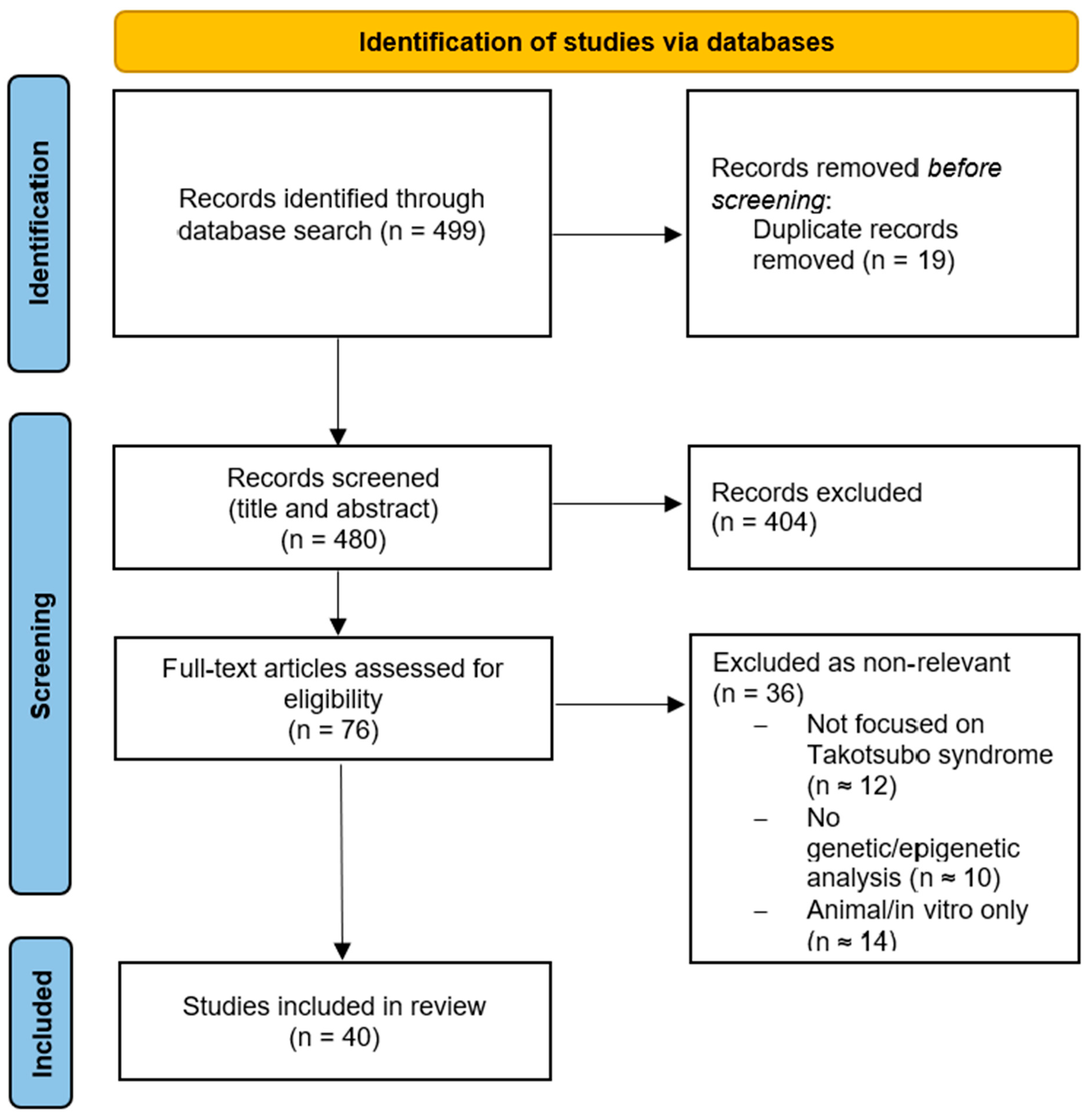
For each included study, data extraction encompassed study design, sample size, population characteristics, genetic or epigenetic targets, and main findings. Given the heterogeneity of study designs, limited sample sizes and absence of replicable associations across studies, a formal quantitative meta-analysis was not feasible. Risk of bias was therefore assessed qualitatively, considering sample size, methodological approach and population stratification. The study selection process is summarized in a PRISMA flow diagram (Figure 1).

3. Familial Cases and Association with Genetic Syndromes

Although TTS is mainly regarded as a sporadic and stress-induced condition, several familial cases have been documented in the literature. These family clusters often involve first-degree relatives affected by TTS without shared environmental or acute emotional/physical stressors, indicating a possible heritable susceptibility [11].
One of the earliest reports of familial clustering came from Pison et al., who described two sisters with documented TTS despite differing emotional and physical triggers [12]. Similarly, other case series have identified multiple affected relatives within the same family, often postmenopausal women, suggesting a potential interplay between hormonal influences and genetic predisposition, despite the absence of a clearly defined and reproducible genetic signature [13,14].
Although rare, familial cases of TTS offer an important biological clue that genetic factors might influence or predispose individuals to the disease, especially in those who develop TTS after mild or no identifiable stressors. However, the lack of a consistent genetic signature in these cases supports the concept of genetic heterogeneity, where each person may carry a unique set of low-penetrance variants that affect susceptibility to catecholamine surges or hinder myocardial survival during stress [12].
Although TTS has not been directly linked to specific genetic syndromes, some overlaps with genetically mediated disorders have been observed. For example, a novel SCN5A missense variant (c.1127G>T, p.Arg376Leu) identified in a patient with both TTS and Brugada-like ECG features showed loss-of-function effects on Nav1.5 channel currents. This reinforces the hypothesis that rare variants in sodium channel genes may predispose individuals to both syndromes and influence arrhythmic risk during catecholaminergic stress [15].
Similarly, a case series reported by El-Battrawy et al. [16]. documented five TTS patients with underlying channelopathies—including KCNQ1 mutations associated with LQTS type 1 and KCNH2 mutations associated with LQTS type 2—who developed life-threatening arrhythmias during the acute TTS phase, including ventricular fibrillation and torsade de pointes, suggesting that in a subset of patients TTS may unmask latent electrical disorders, or alternatively, that subclinical channelopathies may act as substrates for catecholamine-induced repolarization abnormalities [16].
In another report, a patient with TTS was found to carry a heterozygous titin truncating variant (c.1489G>T, p.E497X), previously unrecognized and not associated with skeletal myopathy. Over time, the patient developed dilated cardiomyopathy and ventricular arrhythmias requiring ICD implantation. This supports the possibility that rare mutations in structural cardiomyopathy genes—particularly titin—may represent a latent substrate that is destabilized by acute adrenergic surges during stress, contributing to both myocardial dysfunction and arrhythmogenesis [17].
These findings collectively highlight that rare genetic variants in ion channel and sarcomeric genes may contribute to a subset of TTS cases with a high arrhythmic burden. Identifying them could provide new insights into individualized risk stratification, especially in patients with recurrent TTS, persistent QT prolongation, or a family history of sudden cardiac death.
Consistent with their established role in Brugada syndrome, long QT syndrome, and dilated cardiomyopathy, the identification of pathogenic variants in SCN5A, KCNQ1, KCNH2, or TTN in patients with TTS should not be interpreted as evidence of a causal genetic basis. Rather, these findings most likely reflect the coexistence of known inherited arrhythmia syndromes or cardiomyopathies, or the presence of genetic backgrounds that may modulate arrhythmic risk or clinical presentation during acute stress.

4. Proposed Pathophysiological Mechanisms in Takotsubo Syndrome

The most widely accepted hypothesis focuses on a catecholamine surge in response to physical or emotional stress, causing direct myocardial toxicity and microvascular dysfunction [18]. Plasma catecholamine levels in TTS patients during the acute phase have been found to be significantly higher than those seen in myocardial infarction, implicating both central sympathetic discharge and peripheral adrenergic sensitivity [6,19]. This adrenergic overstimulation is believed to induce myocardial stunning through intracellular calcium overload, oxidative stress, and mitochondrial dysfunction [6].
A key role has been attributed to the distribution and density of adrenergic receptors in the myocardium. The apical segments of the left ventricle are believed to have higher β2-adrenergic receptor density and different G-protein coupling characteristics compared to basal regions. Under high epinephrine concentrations, β2-receptors may switch from Gs- to Gi-protein coupling, exerting a negative inotropic effect and contributing to the regional wall motion abnormalities typical of TTS [20].
Microvascular dysfunction is another key feature of TTS pathophysiology. In vivo studies using cardiac magnetic resonance and myocardial contrast echocardiography have shown impaired coronary flow reserve and myocardial perfusion defects without epicardial stenosis [21]. Endothelial dysfunction, coronary spasm, and altered nitric oxide signaling have been implicated as factors contributing to transient ischemia and regional hypokinesia [22].
A growing body of evidence supports a role for inflammation and immune dysregulation in both the acute and recovery phases of TTS. Inflammatory biomarkers, including C-reactive protein, interleukin 6, and tumor necrosis factor α, are often elevated [23], and recent cardiac imaging studies have demonstrated myocardial edema and macrophage infiltration indicative of a systemic inflammatory response. These findings may help explain the delayed recovery of systolic function and support a potential autoimmune component in susceptible individuals [24,25].
Furthermore, sex hormones, particularly estrogen, seem to play a cardioprotective role, which may explain the significant predominance in postmenopausal women. As estrogen has been shown to influence endothelial function, autonomic tone, and myocardial response to catecholamines, declining levels after menopause might worsen the harmful effects of stress hormones on the heart, thereby increasing the risk of TTS [26].
Importantly, the pathophysiological mechanisms proposed for Takotsubo syndrome provide a coherent biological framework for the genetic and epigenetic findings discussed in the following sections. Alterations in adrenergic signaling, myocardial stress-response pathways, and sex hormone modulation represent key nodes through which individual susceptibility to catecholamine surges may be determined. Genetic variability affecting adrenergic and estrogen receptors, intracellular stress-response proteins such as BAG3, and epigenetic regulators including stress-responsive microRNAs may therefore modulate the myocardial response to acute stress, without constituting a primary cardiomyopathic substrate.
Within this framework, genetic and epigenetic factors are best interpreted as modifiers of stress sensitivity and myocardial resilience, linking the clinical and pathophysiological features of Takotsubo syndrome to interindividual molecular variability.

5. Evidence from SNP Studies in Takotsubo Syndrome

According to these pathophysiological pathways, the search for a genetic basis underlying TTS has prompted numerous investigations of SNPs within genes involved in adrenergic signaling, myocardial stress response and sex hormone pathways.
Indeed, polymorphisms in adrenergic receptor genes (β1, ADRB1; β2, ADRB2; α2c, ADRA2C) and their intracellular regulatory mediators, such as G protein-coupled receptor kinases (e.g., GRK5), cytoprotective proteins (e.g., Bcl2-associated athanogene 3, BAG3), and genes for estrogen receptors ESR1 and ESR2, may affect myocardial and microvascular responses to stress as well as susceptibility to catecholamine-induced injury [8,9].
Early candidate gene studies have demonstrated that substituting glycine with arginine in ADRB1 (Gly389Arg) and glutamic acid with glutamine in ADRB2 (Gln27Glu) was significantly more common in patients with TTS than in controls [27].
However, afterwards Sharkey et al. analyzed ADRB1 (including variants previously explored) and ADRA2C polymorphisms in Caucasian patients with familial TTS and found no significant enrichment of such variants, although the sample size was small and not sufficiently powered for the purpose [28]. Similar findings came from a study on Australian patients with TTS, excluding possible confounding factors related to ethnicity and highlighting the challenge of extrapolating from monogenic candidate genes to a complex phenotype like TTS [29].
Because of its role in desensitization and negative regulation of the intracellular signaling of beta-adrenergic receptors, it has been speculated that G protein-coupled receptor kinase 5, which is highly expressed in the myocardium, may play a part in the transient myocardial dysfunction caused by catecholamine surge in TTS. Indeed, in 2010, Spinelli et al. identified a significant association between the GRK5 rs17098707 polymorphism (Gln41Leu) and TTS [30], and similar results were reported by another Italian group in 2015. However, both studies were limited by enrolling a small cohort of TTS patients [31]. Therefore, it was not surprising that these findings have not been replicated in larger, independent cohorts or in studies using the more advanced exome sequencing technique [29,32,33].
Given its key role in adaptive responses to stressful stimuli, supporting muscle survival and contractile activity [34], BAG3 polymorphisms have been evaluated, and Citro et al. described significant differences for SNP rs35434411 (Arg71Gln) and rs3858340 (Pro407Leu) between 29 TTS patients and more than 1000 healthy controls [35].
The two missense mutations examined in this study appear to disrupt the cardioprotective role of certain members of the heat shock protein family and disturb intracellular calcium homeostasis, promoting myocyte apoptosis. These mutations represent promising therapeutic targets that warrant further investigation.
Furthermore, given the evident female predominance, the estrogen pathway has consistently been a fundamental aspect of genetic susceptibility. In 2017, two variants (rs2234693 and rs9340799) in the ESR1 gene and two (rs1271572 and rs1256049) in the ESR2 gene were studied in 81 consecutive white women: 22 with TTS, 22 with acute myocardial infarction, and 37 asymptomatic healthy controls. Women carrying the T allele at the rs2234693 locus of the ESR1 gene and the T allele at the rs1271572 locus of the ESR2 gene had a higher risk of developing TTS [36]. However, these findings are limited by the small sample size and require further validation in multicenter cohorts of TTS patients.
Across all studies, several important limitations become apparent:
  • Most studies included fewer than 100 cases, leading to limited power for reliable statistical inference;
  • Phenotypic heterogeneity (e.g., apical versus midventricular ballooning) may further limit comparability across studies;
  • Ethnic and genetic backgrounds vary between studies, complicating cross-comparisons;
  • Confounding environmental factors (e.g., type of stressor, hormone status) are seldom considered.
A comprehensive summary of genetic and epigenetic studies investigating Takotsubo syndrome is reported in Table 1.
Overall, despite several initially reported positive associations, the genetic evidence derived from candidate gene and SNP-based studies remains weak, as most studies were underpowered, rarely replicated in independent cohorts. At present, no common genetic variant can be considered a robust or clinically actionable susceptibility marker for Takotsubo syndrome.
Therefore, the field is now transitioning towards WES and GWAS, which enable the detection of rare variants and structural alterations that may exert greater phenotypic effects. Combining SNP data with transcriptomic and epigenomic profiles could eventually lead to the identification of clinically relevant biomarkers for susceptibility and recurrence.

6. Contributions of Epigenetic Studies in the Pathophysiology of TTS

Beyond genomic predisposition, epigenetic mechanisms, particularly involving non-coding RNAs such as miRNAs, are increasingly recognized as vital modulators in the pathophysiology of TTS. Epigenetic regulation provides a dynamic and reversible layer of control over gene expression, potentially bridging the gap between environmental stressors and the genetic architecture underlying individual susceptibility to TTS [9].
MicroRNAs are short, non-coding RNA molecules that regulate gene expression post-transcriptionally by binding to complementary sequences in target mRNAs, leading to degradation or translational repression. In the cardiovascular system, miRNAs are known to influence cardiac remodeling, inflammation, apoptosis, and catecholaminergic signaling [40].
Several studies have identified different expressions of miRNAs in patients with TTS, suggesting their role in stress-induced myocardial dysfunction. Jaguszewski et al. conducted a prospective miRNA profiling study in TTS patients and found that miR-16 and miR-26a were significantly upregulated in the early phase of the syndrome [41].
Animal studies further confirm the role of miRNAs. Ueyama et al. demonstrated that in rats subjected to immobilization stress (a model of emotional stress), myocardial expression of stress-responsive miRNAs was altered, particularly those regulating β-adrenergic signaling and apoptosis pathways [26], while Couch et al. showed that miR-16 and miR-26a were co-overexpressed in rats with TTS induced with an adrenaline bolus [39]. Bioinformatic profiling of these miRNA targets, followed by expression assays and functional experiments, identified reductions in CACNB1 (L-type calcium channel Cavβ subunit), RGS4 (regulator of G-protein signaling 4), and G-protein subunit Gβ (GNB1) as underlying these effects [39], providing valuable clues for further pathophysiological investigation and therapeutic targets.
Among the identified miRNA targets, the BAG3 gene has once again emerged as a potential player. D’Avenia et al. demonstrated that miR-371a-5p targets BAG3 mRNA, increasing protein expression—an unusual mechanism for miRNAs—and described a significantly more frequent polymorphism g2252c in the BAG3 3′-untranslated region in TTS patients, which impairs miR-371-5p binding [37].
However, conflicting results from another SNP study using 258 TTS patients and more than 400 controls from the Swedish Coronary Angiography and Angioplasty Register failed to confirm the pathogenic relevance of previously described BAG3 3′UTR variants, calling for further investigations [33].
Overall, these data indicate that miRNAs could act both as biomarkers and as therapeutic targets. However, translating them into clinical practice faces obstacles. Most studies so far are constrained by small sample sizes, variability in miRNAs quantification methods, and a lack of standardization in sample collection timing. Additionally, many of the observed changes may represent secondary responses to myocardial injury rather than primary causal events.
Although epigenetic and miRNA-based mechanisms represent an attractive explanatory framework for stress responsiveness in Takotsubo syndrome, the current evidence remains preliminary. Altered expressions of miR-16 and miR-26a are broadly implicated in cellular stress response and myocardial injury rather than being specific to TTS [42]. Moreover, most available human studies are limited by small sample sizes, the absence of adequate disease control groups (such as acute myocardial infarction or myocarditis) and have not been consistently replicated. Therefore, epigenetic findings should currently be interpreted as hypothesis-generating signals rather than definitive disease mechanisms.
Nevertheless, integrating miRNA profiling with genetic, clinical, and imaging data offers a promising frontier for personalized medicine in TTS. Prospective multi-omics studies with longitudinal follow-up are required to validate candidate miRNAs and understand their mechanistic significance.

7. Discussion and Future Directions

Current evidence supports the hypothesis that genetic and epigenetic factors contribute to individual susceptibility to TTS, a condition previously attributed almost exclusively to acute stress triggers. The presence of familial clustering, recognition of rare and common gene variants and emerging insights from epigenetic studies, particularly miRNA regulation, have gradually reshaped the understanding of this complex syndrome from a purely functional disorder to a potentially heritable, stress-responsive cardiomyopathy [6].
Although these advances have been made, many questions remain unanswered. First, findings from candidate gene and SNP studies, although biologically plausible, have largely failed to reach genome-wide statistical significance or consistent replication in independent cohorts.
Recognizing the limitations of candidate gene studies, Eitel et al [38]. conducted a genome-wide association study enrolling 96 TTS cases and 475 controls and although no SNPs reached genome-wide significance (p < 5 × 10⁻⁸), several loci showed suggestive associations, including variants in genes related to cell adhesion, inflammatory signaling, and cardiac development [38]. However, the authors emphasized that the study was underpowered and that larger, multicenter GWAS would be needed to detect common variants with modest effect sizes.
Furthermore, most existing genetic studies have not considered phenotypic subtypes of TTS (such as apical versus midventricular ballooning), nor have they stratified patients by sex, menopausal status, or type of triggering event. These unaddressed variables may obscure genotype–phenotype relationships and diminish the effectiveness of association studies. A more detailed phenotypic classification is essential for identifying subgroups with shared genetic or epigenetic features.
Alongside genomic analysis, miRNA profiling has become a promising approach. Specific miRNAs such as miR-16, miR-26a, and miR-371a-5p have been linked to TTS pathophysiology by influencing adrenergic signaling and stress-response proteins like BAG3 [37,41]. As mentioned earlier, these small RNA molecules are appealing both as mechanistic mediators and early disease biomarkers; however, current data remain preliminary and mostly descriptive. Standardized methods, long-term sampling, and integration with transcriptomic and proteomic data will be essential to confirm their diagnostic and prognostic value.
A key limitation of current research is the lack of multi-omic integration. Most studies isolate genetic, transcriptomic, or epigenetic data without comprehensive, system-level analyses. Emerging technologies now allow the simultaneous profiling of DNA variants, RNA expression, methylation patterns, and proteomic signatures, enabling deep phenotyping and mechanistic modeling. Such approaches are well-suited to capturing the complex and multifactorial nature of TTS, particularly in identifying gene–environment interactions and stress-sensitive regulatory networks [43].
Another promising direction involves sex-specific genetic and epigenetic research, considering the notable female predominance in TTS. Estrogen receptor polymorphisms (ESR1, ESR2) and estrogen-responsive miRNAs warrant further investigation, especially in relation to postmenopausal hormonal shifts and their influence on myocardial stress resilience and microvascular function [44].
Interestingly, mitochondrial dysfunction has also been suggested as a contributing factor. Considering the female predominance and potential matrilineal transmission, the role of mitochondrial DNA variants and metabolic signaling abnormalities remains an active area of research, although no specific mitochondrial mutations have yet been convincingly linked to TTS [45].
Finally, clinical translation remains a future objective. Although genetic and epigenetic discoveries have not yet influenced current diagnostic or management protocols, their integration into risk prediction tools—especially for high-risk groups such as cancer patients undergoing chemotherapy or individuals with psychiatric conditions—could enable personalized risk stratification and preventive interventions. Targeted therapies, like miRNA antagonists or stress response protein modulators, may also develop as therapeutic innovations [41].

8. Conclusions

Takotsubo syndrome remains a complex and not fully understood clinical condition at the crossroads of acute stress, neurohormonal activation, and inherent myocardial vulnerability. While its dramatic clinical presentation and spontaneous reversal have long intrigued clinicians, the variability between individuals in susceptibility and outcomes indicates that more than just environmental triggers are involved.
Current evidence supports a contributory role of genetic and epigenetic factors in modulating individual susceptibility to Takotsubo syndrome, although no definitive disease-causing variants have been identified. Available genetic and epigenetic signals appear to act primarily as modifiers of myocardial stress-response pathways rather than as primary determinants of disease.
The overall strength of evidence remains limited by small sample sizes, heterogeneous study designs, and lack of replication, underscoring the need for large, well-phenotyped cohorts integrating genomic, epigenomic, and clinical data. Future multi-omics approaches may help clarify the molecular basis of stress susceptibility and its potential clinical implications in Takotsubo syndrome.

Author Contributions

Conceptualization, G.L.R. and G.S.; methodology, F.C. and S.C.; validation, F.C. and S.C.; formal analysis, G.L.R.; investigation, G.L.R.; resources, F.C.; data curation, G.S.; writing—original draft preparation, G.L.R. and G.S.; writing—review and editing, F.S., G.P. and S.C.; supervision, F.S. and G.S.; project administration, G.L.R. and G.S. All authors have read and agreed to the published version of the manuscript.

Funding

This research received no external funding.

Institutional Review Board Statement

Not applicable.

Informed Consent Statement

Not applicable.

Data Availability Statement

No new data were created or analyzed in this study. Data sharing is not applicable to this article.

Conflicts of Interest

The authors declare no conflicts of interest.

Abbreviations

The following abbreviations are used in this manuscript:
TTSTakotsubo syndrome
SNPsingle-nucleotide polymorphism
WESwhole-exome sequencing
GWASgenome-wide association study
miRNAmicroRNA
UTRuntranslated region

References

  1. Ghadri, J.-R.; Wittstein, I.S.; Prasad, A.; Sharkey, S.; Dote, K.; Akashi, Y.J.; Cammann, V.L.; Crea, F.; Galiuto, L.; Desmet, W.; et al. International Expert Consensus Document on Takotsubo Syndrome (Part I): Clinical Characteristics, Diagnostic Criteria, and Pathophysiology. Eur. Heart J. 2018, 39, 2032–2046. [Google Scholar] [CrossRef]
  2. Templin, C.; Ghadri, J.R.; Diekmann, J.; Napp, L.C.; Bataiosu, D.R.; Jaguszewski, M.; Cammann, V.L.; Sarcon, A.; Geyer, V.; Neumann, C.A.; et al. Clinical Features and Outcomes of Takotsubo (Stress) Cardiomyopathy. N. Engl. J. Med. 2015, 373, 929–938. [Google Scholar] [CrossRef]
  3. Lyon, A.R.; Bossone, E.; Schneider, B.; Sechtem, U.; Citro, R.; Underwood, S.R.; Sheppard, M.N.; Figtree, G.A.; Parodi, G.; Akashi, Y.J.; et al. Current state of knowledge on Takotsubo syndrome: A position statement from the task force on Takotsubo syndrome of the Heart Failure Association of the European Society of Cardiology. Eur. J. Heart Fail. 2016, 18, 8–27. [Google Scholar] [CrossRef] [PubMed]
  4. El-Battrawy, I.; Santoro, F.; Stiermaier, T.; Möller, C.; Guastafierro, F.; Novo, G.; Novo, S.; Mariano, E.; Romeo, F.; Romeo, F.; et al. Incidence and Clinical Impact of Recurrent Takotsubo Syndrome: Results From the GEIST Registry. J. Am. Heart Assoc. 2019, 8, e010753. [Google Scholar] [CrossRef] [PubMed]
  5. La Rosa, G.; Pelargonio, G.; Narducci, M.L.; Pinnacchio, G.; Bencardino, G.; Perna, F.; Follesa, F.; Galiuto, L.; Crea, F. Prognostic value of the Tpeak-Tend interval for in-hospital subacute ventricular arrhythmias in tako-tsubo syndrome. Rev. Española Cardiol. 2023, 76, 353–361. [Google Scholar] [CrossRef]
  6. Akhtar, M.M.; Cammann, V.L.; Templin, C.; Ghadri, J.R.; Lüscher, T.F. Takotsubo syndrome: Getting closer to its causes. Cardiovasc. Res. 2023, 119, 1480–1494. [Google Scholar] [CrossRef]
  7. Pelliccia, F.; Kaski, J.C.; Crea, F.; Camici, P.G. Pathophysiology of Takotsubo Syndrome. Circulation 2017, 135, 2426–2441. [Google Scholar] [CrossRef]
  8. Limongelli, G.; Masarone, D.; Maddaloni, V.; Rubino, M.; Fratta, F.; Cirillo, A.; Ludovica, S.B.; Pacileo, R.; Fusco, A.; Coppola, G.R.; et al. Genetics of Takotsubo Syndrome. Heart Fail. Clin. 2016, 12, 499–506. [Google Scholar] [CrossRef] [PubMed]
  9. Ferradini, V.; Vacca, D.; Belmonte, B.; Mango, R.; Scola, L.; Novelli, G.; Balistreri, C.R.; Sangiuolo, F. Genetic and epigenetic factors of takotsubo syndrome: A systematic review. Int. J. Mol. Sci. 2021, 22, 9875. [Google Scholar] [CrossRef]
  10. Page, M.J.; McKenzie, J.E.; Bossuyt, P.M.; Boutron, I.; Hoffmann, T.C.; Mulrow, C.D.; Shamseer, L.; Tetzlaff, J.M.; Akl, E.A.; Brennan, S.E.; et al. The PRISMA 2020 statement: An updated guideline for reporting systematic reviews. PLoS Med. 2021, 18, e1003583. [Google Scholar] [CrossRef]
  11. Subban, V.; Ramachandran, S.; Victor, S.M.; Gnanaraj, A.; Ajit, M.S. Apical ballooning syndrome in first degree relatives. Indian Heart J. 2012, 64, 607–609. [Google Scholar] [CrossRef]
  12. Pison, L.; De Vusser, P.; Mullens, W. Apical ballooning in relatives. Heart 2004, 90, e67. [Google Scholar] [CrossRef] [PubMed]
  13. Musumeci, B.; Saponaro, A.; Pagannone, E.; Proietti, G.; Mastromarino, V.; Conti, E.; Tubaro, M.; Volpe, M.; Autore, C. Simultaneous Takotsubo syndrome in two sisters. Int. J. Cardiol. 2013, 165, e49–e50. [Google Scholar] [CrossRef] [PubMed]
  14. Schultz, T.; Shao, Y.; Redfors, B.; Sverrisdóttir, Y.B.; Råmunddal, T.; Albertsson, P.; Matejka, G.; Omerovic, E. Stress-Induced Cardiomyopathy in Sweden: Evidence for Different Ethnic Predisposition and Altered Cardio-Circulatory Status. Cardiology 2012, 122, 180–186. [Google Scholar] [CrossRef]
  15. Frederiksen, T.C.; Calloe, K.; Geryk, M.; Jensen, H.K. Takotsubo cardiomyopathy and Brugada syndrome in a patient with a novel loss-of-function variant in the cardiac sodium channel Nav1.5. Hear. Case Rep. 2022, 8, 325–329. [Google Scholar] [CrossRef]
  16. El-Battrawy, I.; Erath, J.W.; Vamos, M.; Aweimer, A.; Mügge, A.; Lang, S.; Ansari, U.; Gietzen, T.; Akin, I. A Case Series of Concomitant Cardiac Electrical Disease among Takotsubo Syndrome Patients and Literature Review. J. Cardiovasc. Dev. Dis. 2022, 9, 79. [Google Scholar] [CrossRef]
  17. Keller, H.; Neuhold, U.; Weidinger, F.; Gatterer, E.; Stöllberger, C.; Huber, K.; Finsterer, J. Takotsubo as Initial Manifestation of Non-Myopathic Cardiomyopathy Due to the Titin Variant c.1489G > T. Medicines 2018, 5, 80. [Google Scholar] [CrossRef]
  18. Borchert, T.; Hübscher, D.; Guessoum, C.I.; Lam, T.-D.D.; Ghadri, J.R.; Schellinger, I.N.; Tiburcy, M.; Liaw, N.Y.; Li, Y.; Haas, J.; et al. Catecholamine-Dependent β-Adrenergic Signaling in a Pluripotent Stem Cell Model of Takotsubo Cardiomyopathy. JACC 2017, 70, 975–991. [Google Scholar] [CrossRef]
  19. Wittstein, I.S.; Thiemann, D.R.; Lima, J.A.C.; Baughman, K.L.; Schulman, S.P.; Gerstenblith, G.; Wu, K.C.; Rade, J.J.; Bivalacqua, T.J.; Champion, H.C. Neurohumoral Features of Myocardial Stunning Due to Sudden Emotional Stress. N. Engl. J. Med. 2005, 352, 539–548. [Google Scholar] [CrossRef]
  20. Lyon, A.R.; Rees, P.S.C.; Prasad, S.; Poole-Wilson, P.A.; Harding, S.E. Stress (Takotsubo) cardiomyopathy—A novel pathophysiological hypothesis to explain catecholamine-induced acute myocardial stunning. Nat. Clin. Pract. Cardiovasc. Med. 2008, 5, 22–29. [Google Scholar] [CrossRef] [PubMed]
  21. Elesber, A.; Lerman, A.; Bybee, K.A.; Murphy, J.G.; Barsness, G.; Singh, M.; Rihal, C.S.; Prasad, A. Myocardial perfusion in apical ballooning syndrome: Correlate of myocardial injury. Am. Heart J. 2006, 152, 469.e9–469.e13. [Google Scholar] [CrossRef]
  22. Patel, S.M.; Lerman, A.; Lennon, R.J.; Prasad, A. Impaired coronary microvascular reactivity in women with apical ballooning syndrome (Takotsubo/stress cardiomyopathy). Eur. Heart J. Acute Cardiovasc. Care 2013, 2, 147–152. [Google Scholar] [CrossRef]
  23. Santoro, F.; Tarantino, N.; Ferraretti, A.; Ieva, R.; Musaico, F.; Guastafierro, F.; Di Martino, L.; Di Biase, M.; Brunetti, N.D. Serum interleukin 6 and 10 levels in Takotsubo cardiomyopathy: Increased admission levels may predict adverse events at follow-up. Atherosclerosis 2016, 254, 28–34. [Google Scholar] [CrossRef]
  24. Scally, C.; Abbas, H.; Ahearn, T.; Srinivasan, J.; Mezincescu, A.; Rudd, A.; Spath, N.; Yucel-Finn, A.; Yuecel, R.; Oldroyd, K.; et al. Myocardial and Systemic Inflammation in Acute Stress-Induced (Takotsubo) Cardiomyopathy. Circulation 2019, 139, 1581–1592. [Google Scholar] [CrossRef]
  25. Bonanni, A.; Pedicino, D.; Vinci, R.; D’Aiello, A.; Ponzo, M.; Ciampi, P.; Pisano, E.; Canonico, F.; Di Sario, M.; Conte, C.; et al. Takotsubo syndrome: A way to reach a straightforward diagnosis. Eur. Heart J. 2021, 42, ehab724.1392. [Google Scholar] [CrossRef]
  26. Ueyama, T. Emotional Stress-Induced Tako-tsubo Cardiomyopathy: Animal Model and Molecular Mechanism. Ann. N. Y. Acad. Sci. 2004, 1018, 437–444. [Google Scholar] [CrossRef]
  27. Vriz, O.; Minisini, R.; Citro, R.; Guerra, V.; Zito, C.; De Luca, G.; Pavan, D.; Pirisi, M.; Limongelli, G.; Bossone, E. Analysis of β1 and β2-adrenergic receptors polymorphism in patients with apical ballooning cardiomyopathy. Acta Cardiol. 2011, 66, 787–790. [Google Scholar] [CrossRef]
  28. Sharkey, S.W.; Maron, B.J.; Nelson, P.; Parpart, M.; Maron, M.S.; Bristow, M.R. Adrenergic receptor polymorphisms in patients with stress (tako-tsubo) cardiomyopathy. J. Cardiol. 2009, 53, 53–57. [Google Scholar] [CrossRef] [PubMed]
  29. Figtree, G.A.; Bagnall, R.D.; Abdulla, I.; Buchholz, S.; Galougahi, K.K.; Yan, W.; Tan, T.; Neil, C.; Horowitz, J.D.; Semsarian, C.; et al. No association of G-protein-coupled receptor kinase 5 or β-adrenergic receptor polymorphisms with Takotsubo cardiomyopathy in a large Australian cohort. Eur. J. Heart Fail. 2013, 15, 730–733. [Google Scholar] [CrossRef] [PubMed]
  30. Spinelli, L.; Trimarco, V.; Di Marino, S.; Marino, M.; Iaccarino, G.; Trimarco, B. L41Q polymorphism of the G protein coupled receptor kinase 5 is associated with left ventricular apical ballooning syndrome. Eur. J. Heart Fail. 2010, 12, 13–16. [Google Scholar] [CrossRef]
  31. Novo, G.; Giambanco, S.; Guglielmo, M.; Arvigo, L.; Sutera, M.R.; Giambanco, F.; Evola, S.; Vaccarino, L.; Bova, M.; Lio, D.; et al. G-protein-coupled receptor kinase 5 polymorphism and Takotsubo cardiomyopathy. J. Cardiovasc. Med. 2015, 16, 639–643. [Google Scholar] [CrossRef]
  32. Goodloe, A.H.; Evans, J.M.; Middha, S.; Prasad, A.; Olson, T.M. Characterizing genetic variation of adrenergic signalling pathways in Takotsubo (stress) cardiomyopathy exomes. Eur. J. Heart Fail. 2014, 16, 942–949. [Google Scholar] [CrossRef]
  33. Mattsson, E.; Saliba-Gustafsson, P.; Ehrenborg, E.; Tornvall, P. Lack of genetic susceptibility in takotsubo cardiomyopathy: A case-control study. BMC Med. Genet. 2018, 19, 39. [Google Scholar] [CrossRef] [PubMed]
  34. Nef, H.M.; Möllmann, H.; Troidl, C.; Kostin, S.; Böttger, T.; Voss, S.; Hilpert, P.; Krause, N.; Weber, M.; Rolf, A.; et al. Expression profiling of cardiac genes in Tako-Tsubo cardiomyopathy: Insight into a new cardiac entity. J. Mol. Cell. Cardiol. 2008, 44, 395–404. [Google Scholar] [CrossRef]
  35. Citro, R.; D’aVenia, M.; De Marco, M.; Giudice, R.; Mirra, M.; Ravera, A.; Silverio, A.; Farina, R.; Silvestri, F.; Gravina, P.; et al. Polymorphisms of the antiapoptotic protein bag3 may play a role in the pathogenesis of tako-tsubo cardiomyopathy. Int. J. Cardiol. 2013, 168, 1663–1665. [Google Scholar] [CrossRef]
  36. Pizzino, G.; Bitto, A.; Crea, P.; Khandheria, B.; Vriz, O.; Carerj, S.; Squadrito, F.; Minisini, R.; Citro, R.; Cusmà-Piccione, M.; et al. Takotsubo syndrome and estrogen receptor genes. J. Cardiovasc. Med. 2017, 18, 268–276. [Google Scholar] [CrossRef]
  37. D’Avenia, M.; Citro, R.; De Marco, M.; Veronese, A.; Rosati, A.; Visone, R.; Leptidis, S.; Philippen, L.; Vitale, G.; Cavallo, A.; et al. A novel MIR-371a-5p-mediated pathway, leading to BAG3 upregulation in cardiomyocytes in response to epinephrine, is lost in Takotsubo cardiomyopathy. Cell Death Dis. 2015, 6, e1948. [Google Scholar] [CrossRef] [PubMed]
  38. Eitel, I.; Moeller, C.; Munz, M.; Stiermaier, T.; Meitinger, T.; Thiele, H.; Erdmann, J. Genome-wide association study in takotsubo syndrome—Preliminary results and future directions. Int. J. Cardiol. 2017, 236, 335–339. [Google Scholar] [CrossRef] [PubMed]
  39. Couch, L.S.; Fiedler, J.; Chick, G.; Clayton, R.; Dries, E.; Wienecke, L.M.; Fu, L.; Fourre, J.; Pandey, P.; A Derda, A.; et al. Circulating microRNAs predispose to takotsubo syndrome following high-dose adrenaline exposure. Cardiovasc. Res. 2022, 118, 1758–1770. [Google Scholar] [CrossRef]
  40. Small, E.M.; Olson, E.N. Pervasive roles of microRNAs in cardiovascular biology. Nature 2011, 469, 336–342. [Google Scholar] [CrossRef]
  41. Jaguszewski, M.; Osipova, J.; Ghadri, J.R.; Napp, L.C.; Widera, C.; Franke, J.; Fijalkowski, M.; Nowak, R.; Fijalkowska, M.; Volkmann, I.; et al. A signature of circulating microRNAs differentiates takotsubo cardiomyopathy from acute myocardial infarction. Eur. Heart J. 2014, 35, 999–1006. [Google Scholar] [CrossRef] [PubMed]
  42. Kong, A.S.-Y.; Lai, K.-S.; Lim, S.-H.E.; Sivalingam, S.; Loh, J.-Y.; Maran, S. miRNA in Ischemic Heart Disease and Its Potential as Biomarkers: A Comprehensive Review. Int. J. Mol. Sci. 2022, 23, 9001. [Google Scholar] [CrossRef] [PubMed] [PubMed Central]
  43. Babu, M.; Snyder, M. Multi-Omics Profiling for Health. Mol. Cell. Proteom. 2023, 22, 100561. [Google Scholar] [CrossRef]
  44. Pérez-Cremades, D.; Mompeón, A.; Vidal-Gómez, X.; Hermenegildo, C.; Novella, S. miRNA as a New Regulatory Mechanism of Estrogen Vascular Action. Int. J. Mol. Sci. 2018, 19, 473. [Google Scholar] [CrossRef] [PubMed]
  45. Wang, T.; Xiong, T.; Yang, Y.; Zuo, B.; Chen, X.; Wang, D. Metabolic remodeling in takotsubo syndrome. Front. Cardiovasc. Med. 2022, 9, 1060070. [Google Scholar] [CrossRef] [PubMed]
Figure 1. Article selection flowchart according to PRISMA statements.
Cardiogenetics 16 00005 g001
Table 1. Summary of major genetic and epigenetic studies investigating Takotsubo syndrome.
Study (Ref.) Year Study Type Patients Variants Findings
Citro et al. [35]2013Case–control (genetic association)29 TTS; >1000 controlsBAG3 3′UTR rs8946 (g.31131G>C; g2252c)Association signal between BAG3 variants and TTS in a small cohort.
D’Avenia et al. [37]2015Case–control + functional (in vitro)70 TTS; 81 controlsBAG3 3′UTR rs8946 (g2252c) → loss of miR-371a-5p bindingVariant rs8946 more frequent in TTS; abolishes miRNA control and alters epinephrine response.
Goodloe et al. [32] 2014Targeted WES (adrenergic pathway)28 TTS; 28 controlsPRKCA (missense), ADH5 V346E, EPHA4 G180W, CACNG1 L123FNo recurrent variant; heterogeneous, likely polygenic predisposition.
Figtree et al. [29]2013Multicenter case–control92 TTS; compared with population cohortsADRB1 rs1801252/rs1801253; ADRB2 rs1042713/rs1042714/rs1800888; GRK5 Q41L; COMT; ESR1No significant association between these polymorphisms and TTS.
Mattsson et al. [33]2018Case–control (SCAAR registry)258 TTS; 407 controlsADRB1 rs1801253; GRK5 rs2230345; BAG3 rs8946No difference in allelic frequencies between TTS and controls.
Eitel et al. [38]2017GWAS (preliminary)96 TTS; 475 controls68 candidate loci, with best associated SNP rs12612435 (p = 5.24−7, OR = 0.32) No variant reached genome-wide significance in this Caucasian population; larger cohorts needed.
Couch et al. [39]2022Biomarker/epigenetic (in vivo & in vitro)Human cardiomyocytes + animal modelsmiR-16 and miR-26a (non-genetic)miR-16/26a amplify apical–basal gradient; link between stress and cardiac response.
Ferradini et al. [9]2021Systematic reviewADRB1/ADRB2/GRK5, BAG3 rs8946, rare adrenergic variantsLimited and non-univocal evidence; multifactorial, polygenic nature with epigenetic effects.
Disclaimer/Publisher’s Note: The statements, opinions and data contained in all publications are solely those of the individual author(s) and contributor(s) and not of MDPI and/or the editor(s). MDPI and/or the editor(s) disclaim responsibility for any injury to people or property resulting from any ideas, methods, instructions or products referred to in the content.