Article

Characterizing Flexibility Potential and Activation Effects of a Workplace EV Charging Facility from a CPO Perspective †

Department of Transmission and Distribution Technologies, Ricerca sul Sistema Energetico S.p.A., Via Rubattino, 54, 20134 Milan, Italy
*
Author to whom correspondence should be addressed.
This article is a revised and expanded version of a paper entitled “Assessing Flexibility Potential of a workplace EV charging infrastructure”, which was presented at the 38th Electric Vehicle Symposium and Exposition Conference, Goteborg, Sweden, 15–18 June 2025.
World Electr. Veh. J. 2026, 17(5), 260; https://doi.org/10.3390/wevj17050260
Submission received: 27 February 2026 / Revised: 14 April 2026 / Accepted: 2 May 2026 / Published: 12 May 2026

Abstract

This paper presents a comprehensive methodology for evaluating the flexibility potential of Electric Vehicle (EV) charging infrastructures from the perspective of a Charge Point Operator (CPO). The proposed framework is general and applicable to different types of charging infrastructures, provided that a set of operational assumptions is satisfied. These include unidirectional smart charging (V1G), AC charging sessions, preservation of user energy delivery when providing flexibility, and explicit modeling of rebound effects induced by temporal load shifting, requiring subsequent recovery of the shifted energy. The methodology is then applied to a real-world workplace charging facility to quantify the amount and temporal distribution of flexibility under different baseline charging strategies and levels of on-site photovoltaic integration. The analysis shows that a significant share of daily energy demand (i.e., between 20% and 36%) can be made available for flexibility services within the considered assumptions. Furthermore, the results highlight a strong operating cost trade-off between local optimization strategies and participation in system-level flexibility markets in the considered case study.

1. Introduction

Electric Vehicles (EVs) have been increasingly adopted in recent years across Europe as a sustainable alternative to internal combustion engine vehicles. This transition comes from the European Union (EU)’s commitment to reducing greenhouse gas emissions, notably through initiatives like the so-called “Fit for 55” package [1], as well as from increasing consumer interest in such sustainable and technologically advanced products. A variety of technological solutions have been proposed to decarbonize the road transport sector, including Battery Electric Vehicles (BEVs), Fuel Cell Electric Vehicles (FCEVs), Plug-in Hybrid Electric Vehicles (PHEVs), and low-carbon fuels such as biofuels and synthetic fuels [2,3]. While each technology presents specific advantages depending on the application, a growing body of evidence indicates that BEVs and, in a transition phase, PHEVs currently represent the most effective solutions for decarbonizing passenger transport, particularly in the private mobility sector [4,5,6]. As a matter of fact, Battery Electric Vehicles (BEVs) and Plug-in Hybrid EVs (PHEVs) accounted for 21% of new car registrations in the EU in 2024, marking a significant increase from previous years [7]. However, widespread and uncontrolled EV charging poses a significant risk of overloading distribution networks, with potential adverse consequences for grid stability and security [8,9,10]. Vehicle–Grid Integration (VGI) has emerged as a key strategy to facilitate transport electrification while supporting the sustainable development of energy infrastructures, by coordinating the charging demand with electric grid constraints and enabling the provision of new ancillary services [8,11]. VGI encompasses a spectrum of control paradigms, ranging from unidirectional schemes, i.e., the unidirectional Vehicle-to-Grid (V1G) smart charging strategy, to bidirectional schemes, i.e., the bidirectional Vehicle-to-Grid (V2G) smart charging strategy. V1G allows a unidirectional power flow from the grid to the EV, whereas V2G-based control techniques support bidirectional power exchange: from the grid to the EV and vice versa [12].

1.1. Extracting Flexibility in EV Charging Infrastructures

Smart charging is becoming a central enabler for extracting flexibility from EV charging infrastructures by dynamically adjusting the power taken (delivered) from (to) the grid and scheduling it in response to economic parameters [13]. Nonetheless, extracting flexibility via EV charging control presents many differences compared to a conventional power plant [14]. First, significant amounts of flexibility arise from the aggregation of many geographically dispersed charging points, making the flexibility evaluation a bottom-up process, i.e., starting from the single transaction level. Second, the flexibility provision is limited by end-user charging needs, which require the achievement of a desired battery State of Charge (SoC) within a certain time. Third, multiple energy actors with distinct roles and interests are involved, from the Charge Point Operator (CPO) to the Balance Service Provider (BSP) to the Distribution System Operator (DSO) or Transmission System Operator (TSO). These aspects define a decentralized, multi-actor, and user-constrained framework impacting the estimation of aggregate EV flexibility potential [15].
Another relevant factor is the overall modeling framework adopted for estimating EV flexibility, particularly regarding the representation of technical constraints and the interactions among stakeholders. EV charging is most often modeled as an optimization control problem, where the energy supply is optimized to achieve specific goals such as peak load reduction, congestion alleviation, increased renewable source utilization, or overall system cost minimization [16,17]. In such a problem, flexibility is usually modeled as a decision variable rather than as an explicit system output, and its availability is often assumed to be a priori [18]. However, recent works focusing on aggregate EV charging demonstrate that the amount of deliverable flexibility depends on multiple factors, such as arrival and departure patterns, charging power limits, and infrastructure constraints. This makes flexibility quantification challenging and highly context-specific [19,20].
In the existing literature, the flexibility offered by EVs is investigated using a wide range of methodological approaches, covering various analytical viewpoints and considering multiple aspects of how vehicles are integrated into the energy system. For example, in [16] EV charging stations are modeled as flexible resources whose charging power profiles are centrally optimized to enhance grid responsiveness and reduce operational costs. Similarly, ref. [17] proposes a centralized control framework where the flexibility of large EV fleets is activated to provide ancillary services to the power system. Further, ref. [21] presents a distribution grid framework in which a DSO optimizes the amount of deliverable energy flexibility coordinated across multiple BSPs to satisfy network constraints. Aggregated charging optimization minimizing system residual load (i.e., the gap between demand and renewable generation [22]) is proposed in [23], demonstrating lower grid impact than uncontrolled charging. Londono et al. [24] point out how grid-unaware aggregate control strategies lead to higher grid impact, and therefore propose a centralized control strategy for a high-level controller capable of optimizing the charging schedule of various EV pools based on wholesale energy prices while considering grid transformer limits. Other studies focus on large EV aggregators, proposing load management approaches to maximize overall system flexibility [25] or to maintain energy balance in the grid [26]. Finally, a nationwide scenario of transport electrification is analyzed in [27], where a huge number of sparse charging sessions are simulated, and aggregated flexibility potentials are derived, assessing various benefits in terms of reduced grid constraint violations and renewable curtailment. Such system-level perspectives are widely adopted to comprehensively evaluate large-scale EV flexibility benefits; however, they often lack an explicit representation of the actors directly involved in charging session management and implicitly assume that EV charging is centrally controlled by an aggregator—such as a BSP—with full authority over all individual charging sessions.
Nonetheless, in real-world scenarios, the various stakeholders interact at different levels, each with a distinct role and objective. At the system level, the BSP oversees and participates in ancillary service markets, offering flexibility to network operators (TSOs or DSOs) which are responsible for grid constraints and reliability. Conversely, the CPO controls the charging infrastructure and possibly implements smart charging strategies based on local conditions—such as on-site renewable generation or electricity billing considerations, but generally lacks visibility into broader market dynamics and grid states [28,29]. In addition, CPOs tend to give high priority to EV users’ needs, operating smart load management accurately within the discomfort acceptability limits of their clients [30]. This operational fragmentation suggests that, in most system-level studies, the CPO is often hidden within aggregated or centrally coordinated entities. This overlooks the explicit representation of CPOs’ local decision-making procedures, as well as the technical and operational limitations of the charging infrastructure, whose relevance has instead been highlighted in field-based works [28,30,31]. This highlights the need for explicit methodologies capable of characterizing EV flexibility starting from local priorities and constraints, ensuring reliable estimation of flexibility potential and subsequent service provision at the system level. This paper aims to provide a more realistic representation of EV flexibility provision by explicitly modeling the role of the CPO as the decision-making entity responsible for load modulation, thereby differentiating it from centralized approaches that possibly neglect local constraints and priorities that shape the actual deliverable flexibility.

1.2. Paper Contribution

This paper proposes a CPO-centric methodology to characterize the flexibility that can be provided by an EV charging infrastructure. The proposed methodology is then applied to a specific real-world case study of a workplace charging facility, and the corresponding results are discussed. Before describing the calculation methodology, it is useful to explicitly define what is meant by “flexibility”. In this work, we adopt the following definition found in References [15,32]:
“The ability of power system operation, power system assets, loads, energy storage assets and generators, to change or modify their routine operation for a limited duration, and responding to external service request signals, without inducing unplanned disruptions”.
In addition, throughout the manuscript we refer to flexibility potential. By this term, we mean the maximum variation with respect to a predetermined energy generation (or consumption) schedule that a generic resource can achieve within a specified time interval and within technical and operational constraints. This distinction is introduced because a resource may provide only a fraction of its total flexibility potential to the system. In the present work, the considered resource is an EV charging infrastructure, and flexibility consists in the modification of the baseline recharge schedules.
Flexibility potential of the real-world case study is evaluated with respect to different local load management strategies that the CPO itself could implement, analyzing how the resulting baseline charging profiles influence the magnitude, type (i.e., upward and downward), and temporal distribution of flexibility. In contrast to aggregator-driven models, in the proposed framework the CPO acts as the owner of the charging infrastructure, first defining its charging baselines and then offering the resulting local flexibility to an external aggregator. Consistent with the CPO’s prioritization of end-users’ charging requirements and with the objective of a reliable flexibility estimation, a transaction-level flexibility assessment method is introduced, capable of accounting for activation effects and session-specific constraints. The key modeling assumptions consequent to this positioning are detailed in Section 2.1 to clearly define the scope of applicability of the proposed methodology. A key contribution of this study is that the method is applied to a real-world charging infrastructure, whose flexibility is quantified using experimentally observed charging sessions, rather than relying on synthetic or purely simulated profiles. Furthermore, activation costs are estimated using actual energy supply cost structure. As a result, the presented analysis is intended to provide a realistic benchmark of the flexibility potential of a specific resource—such as a corporate workplace charging infrastructure—relative to alternative flexibility options.
The present work builds upon and extends two previous studies. The first study investigated the techno-economic benefits of local smart charging strategies, without considering the possibility of flexibility services provision to the power system [33]. The second study introduced a preliminary formulation of a flexibility potential evaluation method for EV charging infrastructures and presented initial results based on real charging data [34]. The present work provides a formal and comprehensive description of the flexibility evaluation methodology, updates the analysis using an extended dataset, and, for the first time, investigates the operating cost trade-off between local load optimization and flexibility provision for the considered EV charging infrastructure.
The rest of the paper is structured as follows. Section 2 presents the proposed approach for flexibility evaluation, and introduces the procedure for operating cost assessment of the charging infrastructure. The results obtained from the application of the proposed method to the selected case study are presented in Section 3. Finally, Section 4 provides concluding remarks and discusses future works.

2. Materials and Methods

The flexibility evaluation method presented in this paper explicitly accounts for the interaction between local charging scheduling strategies and the provision of flexibility services, and subsequently assesses the associated cost implications. The whole methodology is applied starting from single charging session data, consisting of start time, energy delivered, and stop time, and an overall assessment of the selected infrastructure is carried out as an ex post analysis based on historical, field-collected data. First, the main modeling assumptions are introduced; next, the flexibility estimation model is formally presented; finally, the case study is described, together with the calculation algorithms used to obtain the reported results.

2.1. Modeling Assumptions and Scope

The proposed methodology is developed under a set of modeling assumptions that define its scope of applicability. These assumptions are formally introduced here and are subsequently referred to throughout the manuscript:
  • Charging process: The analysis considers unidirectional smart charging (V1G only), excluding bidirectional power flows (V2G). Charging is operated in AC mode using the vehicle onboard charger, allowing us to assume a constant maximum charging rate throughout each transaction.
  • User constraints: The total energy delivered within each charging session must remain unchanged when a flexibility service is activated, in order to always satisfy the user’s energy needs within the vehicle connection time, which represents a hard constraint for load rescheduling.
  • Operational perspective: The methodology is developed from the perspective of a CPO that offers flexibility margins based on a predefined baseline consumption. The CPO prioritizes local load management strategies and user satisfaction, while considering flexibility remuneration as a potential secondary revenue stream. The CPO provides its flexibility margins to an aggregator (BSP), which operates in flexibility markets to address system-level needs (e.g., network constraints) beyond the charging infrastructure ones.
  • Flexibility margin reliability: Flexibility is delivered in two phases. In the first phase, the CPO offers its flexibility potential to the BSP. In the second phase, such flexibility may be activated. To ensure reliable flexibility margins that account for user constraints, the post-activation energy compensation must be considered when evaluating flexibility potential. This compensation, commonly referred to as the rebound effect [35], is explicitly modeled by defining two separate periods: one for flexibility actuation and one for rebound management. This concept is further developed in Section 2.2.
Overall, these assumptions define a constrained but realistic operational framework, representative of many current AC charging infrastructures. The results presented in this work should therefore be interpreted within these boundaries.

2.2. Flexibility Potential Evaluation Method

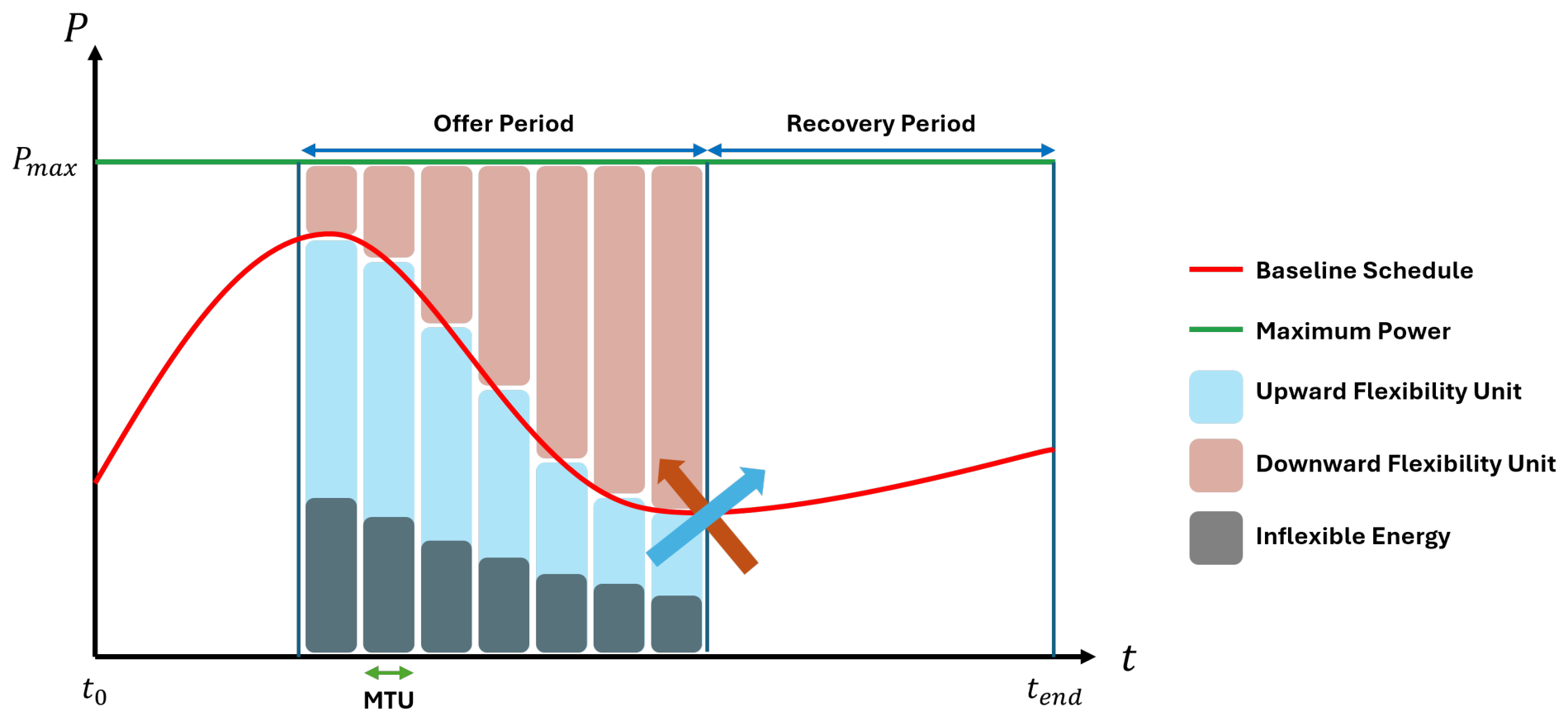
The general model for flexibility potential estimation of a single EV charging session is illustrated in Figure 1. Specifically, the red line represents the baseline charging profile determined by the load management logic, while the green line is the maximum charging power determined by vehicle’s onboard charger. Flexibility directions (upward or downward) are expressed in accordance with the standard generator-oriented reference system.
Three time periods are introduced for a precise definition of the flexibility potential:
  • Transaction Period: the overall duration of the charging session, starting from the EV connection to the charging infrastructure (i.e., t 0 ) and ending with its disconnection (i.e., t end ).
  • Offer Period: the time interval during which the CPO is willing to modify the EV charging baselines to provide flexibility services.
  • Recovery Period: the time interval in which energy modifications made during the Offer Period are compensated to ensure that the total energy delivered in the session remains unchanged.
The definition of these periods, combined with the session’s maximum power limit, identifies various areas within the power–time graph corresponding to specific energy quantities.
Recalling Section 2.1, the Offer Period is the time interval over which flexibility can be actuated, while the Recovery Period is dedicated to rebound effect management. Accordingly, energy reallocation is only allowed between a given Offer Period and its associated Recovery Period, thus preventing any intra-period energy shifting. This modeling choice explicitly accounts for rebound-effect constraints and ensures that multi-hour flexibility profiles remain feasible under activation. If the rebound effect were (even partially) managed within the Offer Period, the resulting load profile at the infrastructure level would not exhibit the deviation from the baseline required by the system.
By first analyzing global energy quantities we introduce the concept of bulk flexibility as the total amount of energy that can be shifted within a given multi-hour time interval, without accounting for its temporal distribution within that interval. Within this framework, the upward bulk flexibility ( E Bulk up ) and the downward bulk flexibility ( E Bulk dn ) are the maximum amount of energy that can be respectively postponed or advanced between the Offer Period to the subsequent Recovery Period. Energy shift occurs between specific areas of the power–time graph of Figure 1 and it is visualized using blue and brown arrows for upward and downward flexibility respectively. E Bulk up and E Bulk dn are equal to the smallest of the two areas linked by the respective arrow.
As the Offer Period could span over multiple hours, it is possible to view the upward and downward bulk flexibilities as composed of many flexibility units, corresponding to the maximum amount of energy that could be theoretically moved within a single 15 min MTU. These flexibility units are represented by blue and brown rectangles for upward and downward flexibility, respectively. Moreover, since bulk flexibilities constitute a cap on the total amount of energy that can be moved between the Offer and Recovery Periods, it is not always the case that all the flexibility units can be activated completely. This concept is clearly explained by the gray areas representing a certain amount of inflexible energy, whose distribution is a matter of assumption. As in the present analysis there is no incentive to provide flexibility at different moments in time, each flexibility unit gets equally rescaled by a certain reduction factor, ensuring that the summation of the flexibility units equals the bulk flexibility. The reduction factors for the upward and downward bulk flexibilities are evaluated according to Equations (1) and (2), where E unit up / dn represents the upward/downward energy unit.
K corr up = min E Bulk up E unit up , 1
K corr dn = min E Bulk dn E unit dn , 1
The relations between flexible and inflexible energy units are determined by Equations (3) and (4), where E unit , flex up / dn and E unit , inflex up / dn are the upward/downward flexible and inflexible energy units, respectively.
E unit up / dn = E unit , flex up / dn + E unit , inflex up / dn
E unit , flex up / dn = K corr up / dn E unit up / dn
The 15 min flexible energy units are the maximum variation in energy consumption profile that an already scheduled EV charging process can achieve along a specified time interval. This profile can be aggregated across concurrent transactions, thereby yielding a flexibility potential profile at the infrastructure level. Therefore, a unique Offer Period will be identified for the whole infrastructure. It is assumed that this aggregate flexibility potential is entirely offered to ancillary service markets through an aggregator, from which the term “Offer Period” is derived.

2.3. Flexibility Activation and Opportunity Cost Evaluation

Once offered to the markets, the flexibility potential may be either partially or fully activated upon an aggregator’s request. Activation requests consist of a time series of energy variations that, at any discrete time step, are constrained to be less than (or equal to) the corresponding values of flexibility potential time series. In order to investigate the maximum consequences of flexibility activation, in this work we assume that the aggregator systematically demands the complete activation of the available flexibility to provide ancillary services. Flexibility provision induces two modifications to the baseline profiles:
  • During the Offer Period, at each MTU, the power absorbed by the EV is adjusted in order to achieve the requested energy variation at the infrastructure level.
  • During the Recovery Period, all the remaining energy that has not been delivered during the Offer Period gets rescheduled in accordance with the selected load management strategy.
Local charging scheduling approaches therefore have a twofold influence. First, by shaping the baseline charging profiles, they determine a different flexibility potential amount and time distribution before the flexibility activation. Second, by managing the rebound effect, they determine how new charging profiles should be reshaped after flexibility activation.
We also assume that the aggregator always requests to activate exclusively either the upward or the downward flexibility over the entire time horizon under investigation, so as to reveal possible behavioral asymmetries associated with this particular flexibility resource. Under this assumption, for each baseline transaction, two alternative profiles are derived, corresponding to the total activation of the upward and downward flexibility potentials, respectively. Subsequently, two aggregate power exchange profiles with the grid are computed, associated with the upward and downward flexibility activation scenarios. The resulting deviation of the power exchange profile with the grid from the baseline-determined profiles affects the overall operating costs linked to the energy supply contract. Billing schemes relative to energy supply contracts significantly vary across different countries and selected energy retailers. Therefore, it is important to remember that cost analysis relative to flexibility activation like the one presented in Section 3 of this manuscript is highly dependent on the analyzed case study.

2.4. Infrastructure Case Study Description

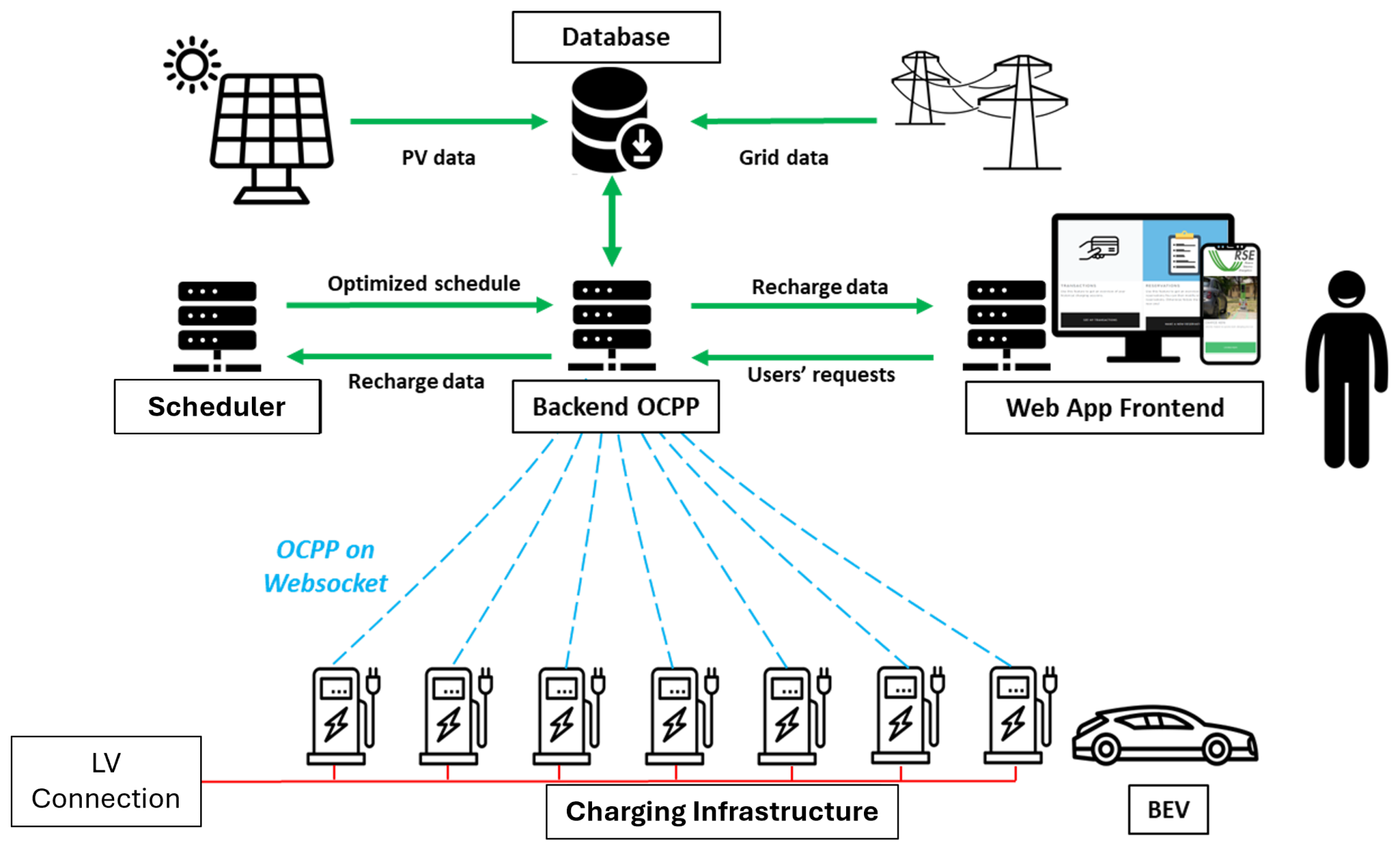
The proposed flexibility evaluation model is applied to a real workplace charging infrastructure located at RSE S.p.A. headquarters, in Milan (Italy). The facility consists of 24 charge points of 22 kW Alternating Current (AC) nominal power, connected to the Low-Voltage (LV) distribution network and serving a fleet of 28 BEVs and 8 PHEVs. As observed in [36], workplace recharging typically exhibits long dwelling times with respect to the time required to fulfill the energy needs of EVs and therefore constitutes an interesting case study for VGI using smart load management techniques. Charging data are collected via a multi-modular digital platform, a scheme of which is depicted in Figure 2. The back-end module implements the Open Charge Point Protocol (OCPP) v1.6 [37], allowing charging session monitoring and load modulation commands. All the charging data, along with other field variables such as the photovoltaic (PV) production and grid power exchange are collected and saved inside a database. A web application module allows end-users to monitor their recharging sessions and to specify their charging needs in terms of energy to be charged and leaving time. Finally, a scheduler module is responsible for implementing various automatic EV load management strategies. By continuously acquiring field data and users’ energy requirements as inputs, the system generates a baseline charging program for each connected EV, dynamically updating the power setpoints via the OCPP-based back-end. The scheduling routine is executed at 15 min intervals and produces charging schedules composed of 15 min setpoints, thereby aligning with the Market Time Unit (MTU) of the Italian electricity markets [38].
To date, the system supports three different scheduling strategies, which are described below:
  • Free Power: The scheduler delivers the EV’s maximum admissible power to meet the user energy request as quickly as possible.
  • Minimum Power: The scheduler supplies constant power, just enough to fulfill mobility needs within dwelling times, thus reducing the peak power component of the bill.
  • Optimal Power: The scheduler solves a Mixed Integer Linear Programming problem to minimize operating costs, factoring in local renewable production, peak power minimization, variable energy prices, and user needs.
All the strategies described above take into account the user-specific energy constraint, thus preventing partial charge issues. The energy request to be delivered within the dwelling time is either specified by the user via the web application or automatically inferred from historical charging sessions using a clustering algorithm inspired by [40]. Further details on the whole charging infrastructure, the implemented charging scheduling approaches, and their techno-economical effects are given in our previous works [36,41].
In this paper, an ex post analysis is performed based on historical transaction data consisting of arrival and departure times, charged energy, and maximum observed power. This implies that uncertain quantities in real-time operation (i.e., user energy requests and departure times) are assumed to be deterministically known in the flexibility analysis presented in Section 3. The charging data over which the analysis is performed include all the transactions that occurred at RSE headquarters from June 2023 to December 2025. Details on the considered charging session dataset are reported in Table 1.

2.5. Framework for Techno-Economic Analysis of EV Flexibility

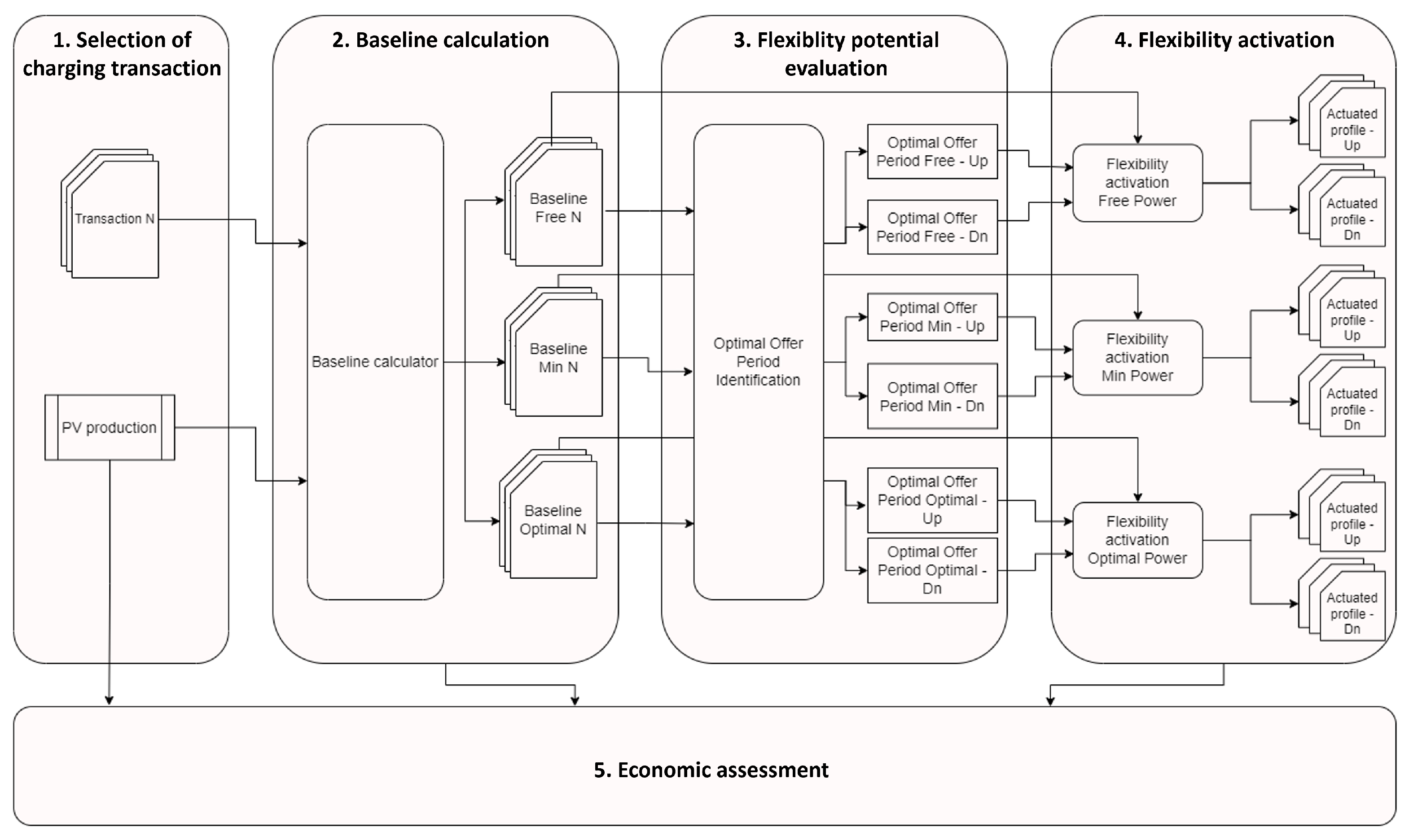
The whole method is applied under the assumption that only a single Offer Period is selected in a given day for the entire charging infrastructure. As highlighted in our previous work [34], this choice reflects the most common workplace infrastructure usage, where all the transactions initiate and terminate within the same day. As a consequence, only charging sessions whose Transaction Period comprehends the selected Offer Period will contribute to the overall flexibility potential of the infrastructure. In the following, we explain how the best daily Offer Period is selected. To study different levels of integration with local renewable energy sources, the nominal power of the PV system at the RSE facility is parameterized, ranging from 0 to 40 kW in 10 kW increments. The PV panels are assumed to be optimally tilted for the plant location (i.e., Northern Italy), and the time series of electricity production is reconstructed using open solar radiation data from [42]. In accordance with the bottom-up approach, the calculations follow the steps below, which are also illustrated in Figure 3:
1.
Selection of charging transactions. All the charging sessions within a selected period are extracted. Each transaction is characterized by EV connection time, EV disconnection time, total energy delivered, and maximum charging power.
2.
Baseline calculation. For each transaction, the baseline charging profiles are reconstructed according to three smart charging strategies (i.e., Free Power, Minimum Power, and Optimal Power). Only for Optimal Power there is a different baseline for each considered PV plant size.
3.
Flexibility potential evaluation. For each reconstructed baseline, the bulk flexibilities are computed, varying both the starting time and the duration of the Offer Period. For each charging strategy, the Optimal Offer Period is identified as the time window wherein the infrastructure exhibits, on average, the maximum bulk flexibility potential. Two distinct Optimal Offer Periods are determined for each strategy, corresponding respectively to the upward and downward flexibility services.
4.
Flexibility activation. For each baseline charging profile, the two corresponding profiles resulting from the full activation of upward and downward flexibility are computed.
5.
Operating cost assessment. The resulting overall infrastructure consumption is overlapped with PV production in order to get the power exchange profile at the connection point and calculate the total operating costs. Operating cost variations relative to flexibility activations are calculated for each analyzed case and according to the energy supply contract.
The total operating cost associated with profiles of power exchange with the grid is derived under the assumption of a standard LV energy supply contract applicable to a typical industrial company in Italy. A flat energy supply cost of 120 €/MWh is assumed for consumption, while 50 €/MWh is considered for solar energy injected into the grid, under the “Ritiro Dedicato” remuneration scheme [43]. Transmission, distribution, and other system charges follow a trinomial structure, composed of a fixed annual cost (€/year), a consumption-related cost (€/MWh), and a monthly peak-related cost (€/kW/month). These values are defined periodically by ARERA, the Italian authority for energy and the environment [44]. Table 2 gathers their values for 2025.
Finally, the average unit cost of flexibility provision is obtained by dividing the increase in operating costs by the total amount of delivered flexibility.

3. Results and Discussion

This section presents the results of the flexibility evaluation analysis described above using real charging data retrieved from the RSE workplace infrastructure between June 2023 and December 2025. First, the flexibility potential of the infrastructure upon different charging management strategies is analyzed, focusing on its temporal variability at daily, weekly, and annual scales. In this context, the question we try to answer is about how much flexibility and at what time of the day (or the year) such an infrastructure is capable of contributing to the power system. Second, the operating costs implications of flexibility service provision are assessed from the CPO’s perspective under various operating scenarios.

3.1. Infrastructure Flexibility Potential

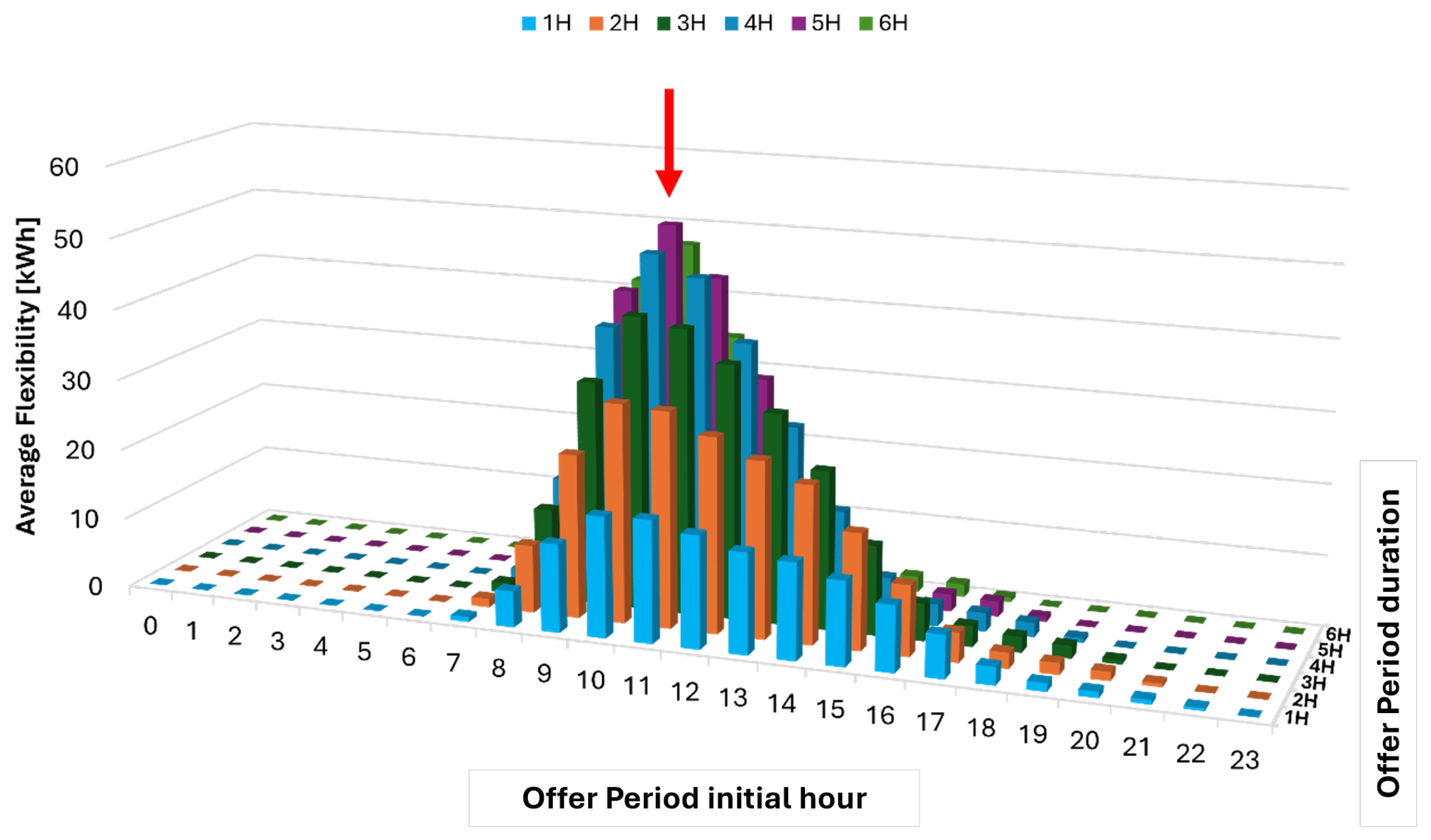
The daily average bulk flexibility potential with variations in the initial time and duration of the Offer Period is shown in Figure 4. The values are related to the upward flexibility evaluated with the Minimum Power control logic, highlighting the individuation of the Optimal Offer Period (indicated by the red arrow), as the combination for which the average potential is the highest.
Table 3 reports all the Optimal Offer Periods and the daily average flexibility potentials for each control logic identified with this method. For the Optimal Power strategy, both the magnitude and timing of the available flexibility depend on the PV plant size, because its baseline profiles are directly influenced by solar production. It is important to note that the daily average flexibility does not consider the weekends, holidays, and days without EV consumption due to company closures or maintenance activities, providing a more accurate representation of the actual flexibility potential during availability days. Independently of the underlying baseline charging logic, the maximum flexibility is consistently observed from 10:00 a.m. onward, i.e., after the majority of employees have arrived and most charging sessions are still far from completion. The Free Power logic presents highest amounts of upward flexibility, but zero downward, as it always charges at maximum power. Also, it provides a shorter Optimal Offer Period due to the rapid charge completion. Conversely, the Minimum Power and Optimal Power exhibit more balanced flexibility between the upward and downward bulk potential. Moreover, because of their slower charging patterns, they are also characterized by a longer Optimal Offer Period of five hours, from 10:00 a.m. to 3 p.m.
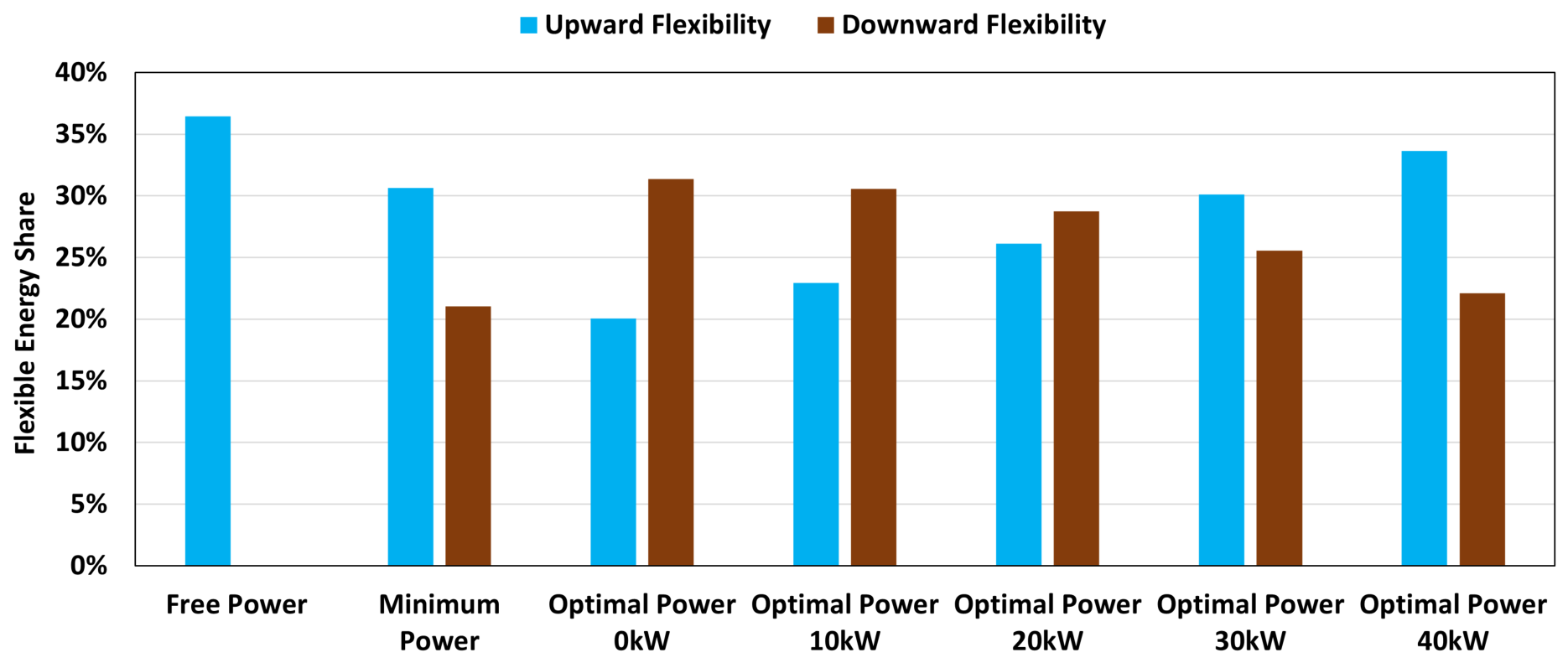
Figure 5 shows, for each control logic, the daily average share of flexible energy with respect to the total energy required by the infrastructure to charge the EVs. The results show that the charging infrastructure is capable of mobilizing, on average, between 20% and 36% of its energy consumption every day, depending on the specific charging strategy adopted. Overall, control approaches characterized by higher charging rates exhibit larger upward flexibility potential, whereas those with slower charging rates exhibit greater downward flexibility potential.
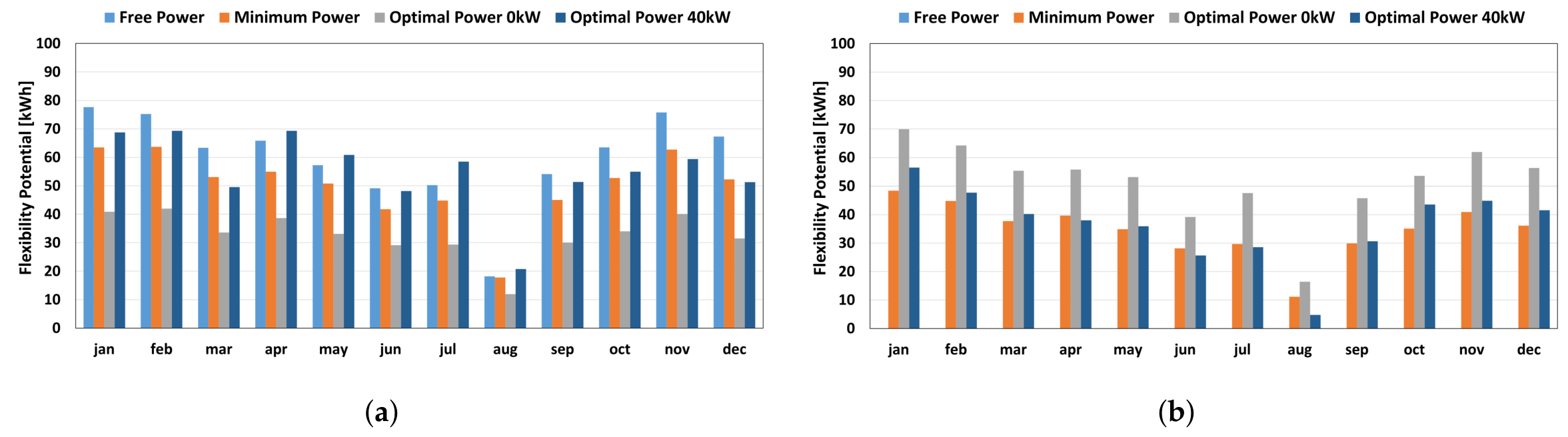
Another interesting result to account for is the variability between the different months within a year, as well as the days within a week. Assessing such variability is particularly important to identify possible patterns for more accurate characterization of the infrastructure flexibility’s contribution to the electricity system. Figure 6 depicts the daily average flexibility potential observed by month. For the Optimal Power, only the cases of 0 kW and 40 kW PV are reported, in order to evaluate possible seasonal effects of PV production on flexibility potential. It is easy to see that August exhibits the lowest upward and downward flexibility potential margins over the yearly flexibility potential, as shown in Figure 6a and Figure 6b, respectively. This reduction is mainly attributable to the under-utilization of the charging infrastructure during the summer holiday period, when the number of active users is significantly reduced. More generally, a mild seasonal trend can be observed, with higher flexibility potential during colder months compared to warmer ones. This behavior is linked to the increased electricity consumption of Electric Vehicles in cold conditions, which leads to higher charging demand and, consequently, to a larger amount of controllable load. Moreover, the upward flexibility potential achieved with the Optimal Power control strategy, for a 40 kW size PV production, exceeds that of the Free Power approach during the periods characterized by high solar irradiation. This result is given by the ability of the Optimal Power strategy to temporally concentrate the charging demand during periods characterized by high PV generation, increasing the margin for upward modulation of power. Conversely, during months with an average lower solar irradiation, the downward flexibility potential provided by the Optimal Power strategy is higher than that of the Minimum Power case. In this scenario, the optimized charging schedule effectively reduces grid peak withdrawals by lowering charging power when on-site PV production is insufficient, thus preserving a larger downward flexibility margin.
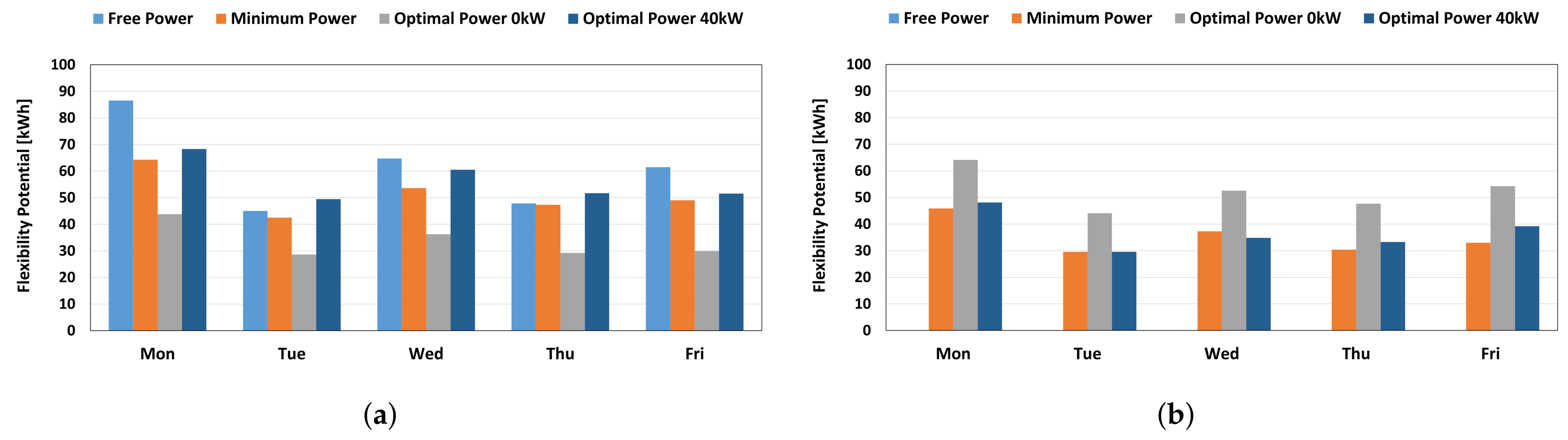
As for distribution of flexibility potential across the week, Figure 7 shows the average upward and downward daily potential observed at the RSE infrastructure from Monday to Friday in Figure 7a and Figure 7b, respectively. Note that the weekends are excluded due to lack of access. It is worth noting that in our previous work [34] the observed intra-week variability was greater than the intra-month variability (excluding August). On the contrary, now the intra-week variability exhibits flatter behavior, while intra-month variability remains similar and a seasonal pattern has emerged. This evolution is linked to dataset extension until December 2025, and to the increase in BEV users from 19 (in mid-2024) to 28. Further, it is significant to observe that the main infra-week pattern is given by a slightly higher flexibility potential on Mondays, due to higher infrastructure utilization after the weekend.

3.2. Flexibility Provision Effects and Cost Evaluation

While the previous subsection discusses how the flexibility potential is temporally distributed, the results presented here explore the consequences of the flexibility potential activation by evaluating the variation in power exchange profiles between the infrastructure and the grid and the resulting operating cost impact. As previously recalled, the factors affecting the system’s operating costs are the net energy exchange with the grid, accounting for power consumption and injection, and the monthly peak power consumption (see Table 2). Flexibility provision in V1G mode shifts EV consumption in time: upward services delay consumption, whereas downward services anticipate it. In the presence of PV generation, this temporal redistribution modifies self-consumption levels, possibly leading to increased electricity withdrawals from the grid, accompanied by corresponding higher energy injections.
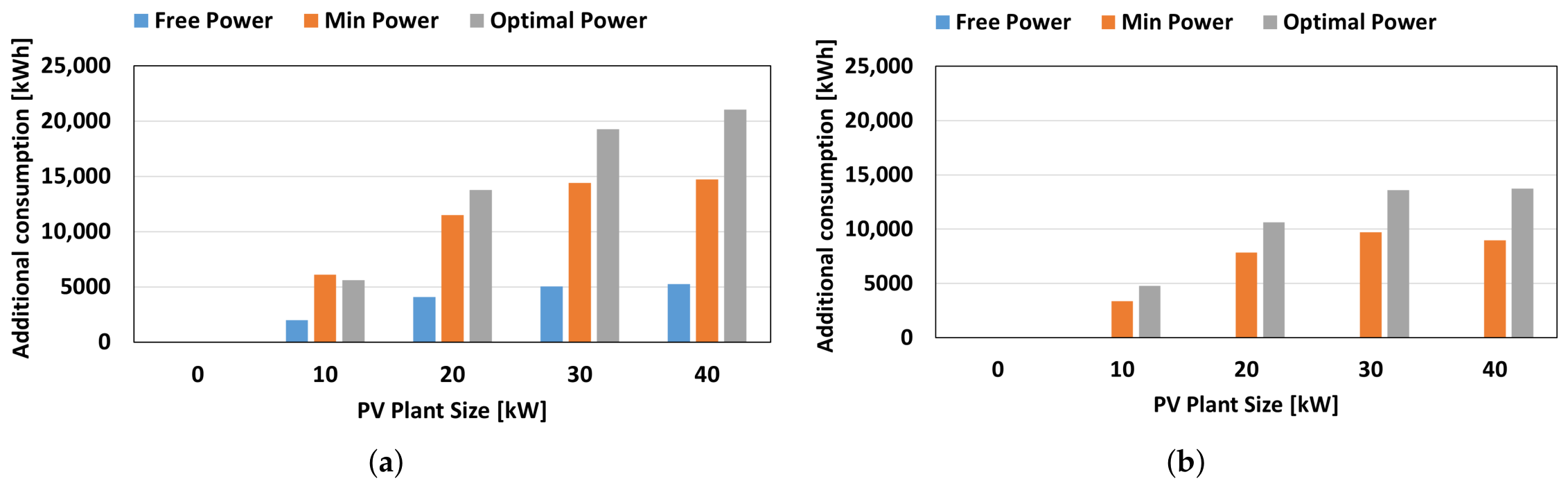
Figure 8 shows the variations in energy drawn (injected) from (to) the grid under the assumption of the upward (a) and downward (b) flexibility provision. As a first observation, the overall energy consumption increases for all the considered cases, meaning that flexibility provision always worsens self-consumption rate for the RSE infrastructure. For all the considered charging scheduling strategies, substantial variations are observed when providing upward flexibility, whose main action is to shift the consumption from the central hours of the day to the afternoon, after the Optimal Offer Period ends, i.e., when the PV production begins to decrease. Thus, this effect is amplified when considering larger sizes of the PV plant. The Optimal Power logic is the most affected by imbalance increase, as the baseline profiles start from a condition of maximum self-consumption. In contrast, variation in energy exchanges is more limited in the case of downward services. The causes for this are twofold. Firstly, the flexibility potential is generally lower than in cases in which upward services are provided (see Figure 1). Secondly, on days characterized by low infrastructure utilization, advancing consumption to the central hours of the day may actually lead to an increase in the self-consumption share. This phenomenon is confirmed by the fact that grid consumption increases for the Minimum Power strategy are smaller for a 40 kW size PV plant, when compared to a 30 kW one.
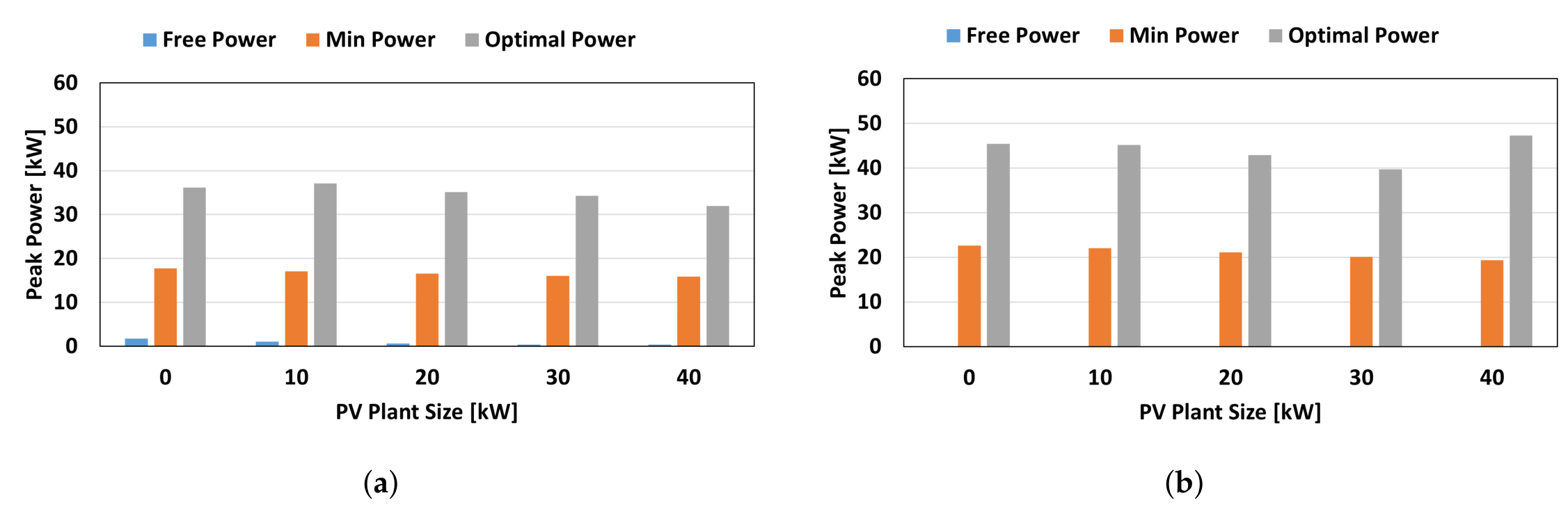
Flexibility activation’s effects on average monthly peak power is reported in Figure 9. All the analyzed cases are subjected to peak increases, with no significant differences between upward and downward services, respectively, as depicted in Figure 9a and Figure 9b. It is interesting to note that the Free Power logic has the lowest peak increase, as its baseline profiles are already characterized by concentrated consumption in the morning, while the upward flexibility activation simply delays the peak consumption just after the end of the Offer Period. The most affected strategy in terms of peak power increase is the Optimal Power, as it is the most effective at creating baseline profiles with minimized peak withdrawals from the grid [33].
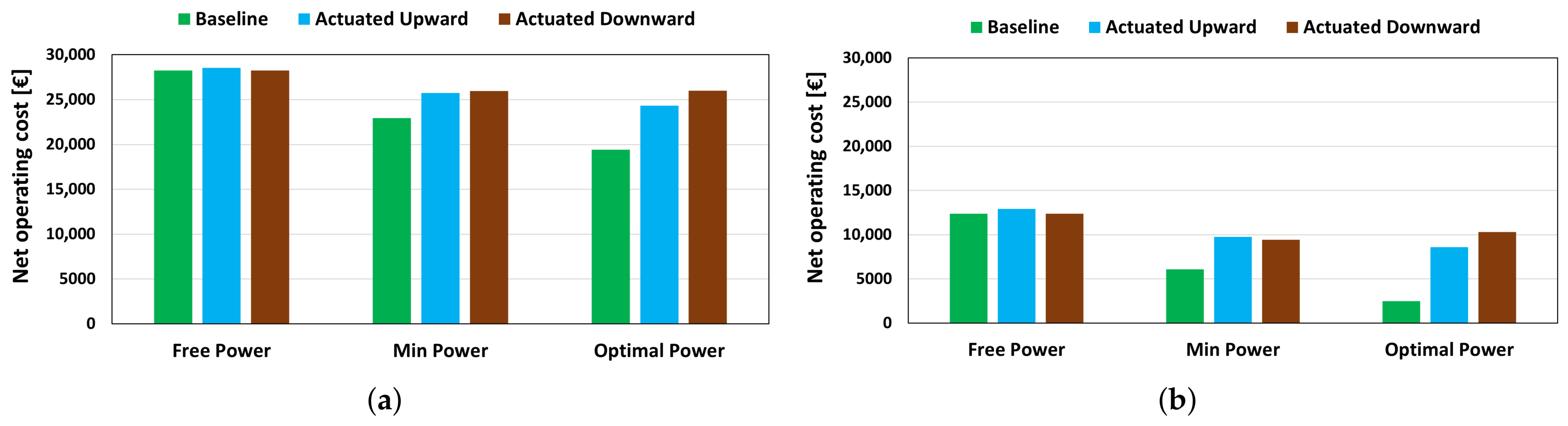
Figure 10 illustrates the impact of the total flexibility activation on the overall operating costs of the RSE charging infrastructure over the analyzed period, distinguishing between the configuration without PV generation (a) and the case for a 40 kW size PV production plant (b). For both configurations, the Free Power strategy is only marginally influenced by the flexibility provision, and the cumulative costs associated with the upward services amount to just a few hundred euros over the 2.5-year observation window. Conversely, the Minimum Power approach shows a more noticeable cost variation, although no significant difference emerges between the upward and downward flexibility activation. As for the Optimal Power strategy, it exhibits the largest increase in operating expenses under flexibility provision scenarios, consistently with its more optimized baselines. Nevertheless, downward flexibility results in a higher cost penalty than upward flexibility. This is due to its stronger impact on monthly peak consumption under this control approach. Overall, the integration of on-site PV power plant generation at the grid connection point confirms its key role in limiting total operating expenses, even when the infrastructure participates in ancillary service provision.
As previously stated, the unitary flexibility provision costs are estimated by dividing the total operating cost increase by the total amount of flexibility provided. Table 4 reports all these values, gathered by charging scheduling approaches for each PV plant size and flexibility type. These results represent the minimum level of average remuneration that the CPO would need to ensure the economic viability of flexibility provision. It is easy to see that the values exhibit substantial variability across the analyzed cases. In the absence of any load management strategy, the cost of flexibility activation is almost negligible, whereas when flexibility is provided starting from already locally optimized baseline profiles, the resulting activation costs are approximately twice the average wholesale electricity price in the Italian market for 2025 [45].
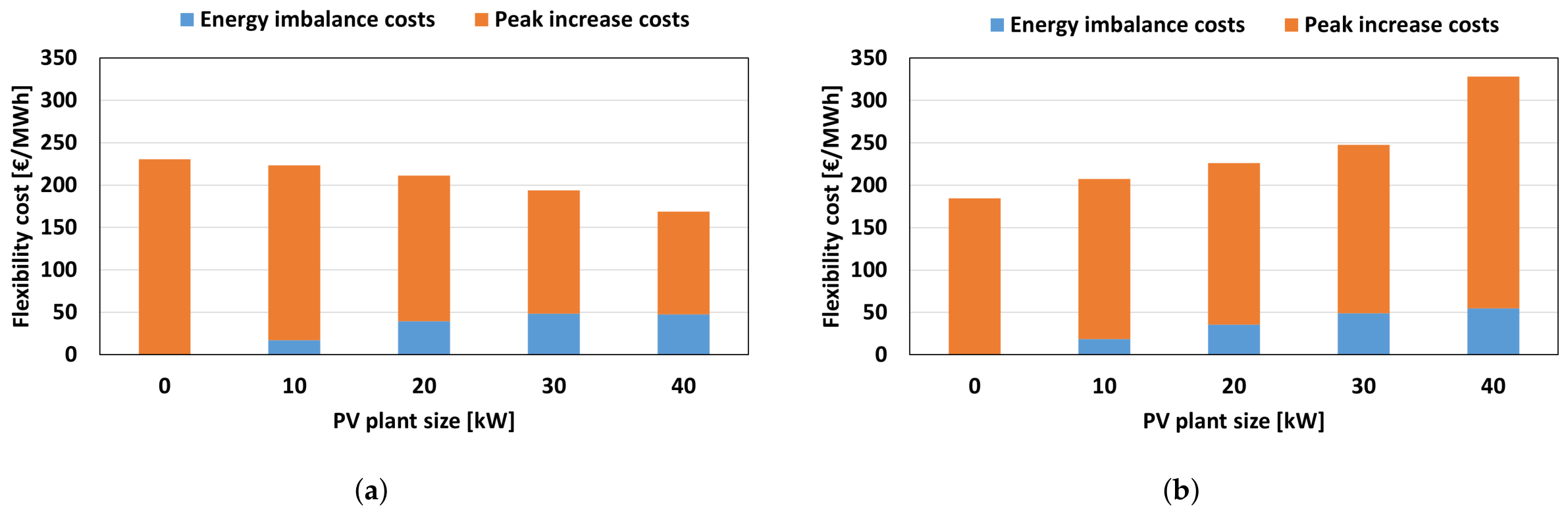
Solar generation exerts the greatest influence on flexibility costs when the Optimal Power logic is activated. The dependence of upward and downward flexibility on the installed PV plant capacity is illustrated in Figure 11, where the two cost components are distinguished. The former is associated with reduced self-consumption (i.e., “Energy Imbalance costs”), while the latter is associated with the monthly peak power (i.e., “Peak Increase costs”). It is worth noting that, for the upward flexibility (Figure 11a), the unit cost decreases as the PV plant capacity increases, primarily due to the diminishing relative contribution of peak-related costs. This occurs because the peak cost is determined by a single peak hour within the month; thus, configurations with larger PV plants distribute this peak-related cost over a greater volume of provided flexibility. In contrast, the cost of downward flexibility (Figure 11b) increases with the PV plant size, since the total downward flexibility potential decreases. Overall, for both the upward and downward flexibility, the energy imbalance cost systematically increases with the solar generation capacity, as the baseline self-consumption rate is higher for larger PV installations.

4. Conclusions

This paper presents a comprehensive methodology for evaluating the flexibility potential of Electric Vehicle (EV) charging infrastructures from the perspective of a Charge Point Operator (CPO). The proposed framework is general and can be applied to different types of charging infrastructures, provided that a set of operational assumptions is satisfied. In particular, the methodology is developed under the assumption of unidirectional smart charging (V1G), AC charging sessions, and willingness to preserve energy delivery to the charging vehicle. Flexibility is therefore modeled as temporal rescheduling of charging demand subject to user connection times, onboard charger constraints and users energy demand. As a result, flexibility activation inherently induces rebound effects, as the energy consumption schedule is shifted in time. Credible flexibility potential over a multi-hour time horizon is guaranteed by a separate Offer Period and Recovery Period, which, on the other hand, impose additional operational constraints on the system. The methodology is then applied to a real-world workplace charging facility, which serves as a representative case study to quantify both the amount and the temporal distribution of flexibility under different baseline charging strategies and levels of on-site photovoltaic (PV) integration. The analysis shows that a significant amount of daily energy demand (i.e., between 20% and 36%) can be provided in the ancillary market as a result of flexibility, without any compromise on user energy delivery. The highest flexibility potential concentrates between late morning and early afternoon (i.e., 10 a.m. to 2–3 p.m.) on working days. The achievable flexibility, as well as its opportunity cost, strongly depend on the adopted local charging control strategy and the presence of PV generation. Flexibility activation, while beneficial for grid support, is associated with rebound effects, resulting in shifted grid withdrawals and increased peak power consumption, thus significantly impacting the CPO operating costs, which are assessed considering current Italian billing schemes. A clear trade-off is observed between local optimization strategies and the opportunity costs associated with the provision of flexibility. The analysis revealed that the unitary cost of delivering flexibility from pre-optimized baselines can exceed wholesale market prices, underscoring the necessity for sufficiently high flexibility remuneration to render flexibility provision economically viable. The flexibility activation costs estimated in this work are useful for comparison with alternative distributed resources, although this insight is limited to the current Italian energy framework. The importance of explicitly modeling local operational constraints, end-user mobility requirements, and real charging behavior to support reliable and scalable integration of decentralized workplace flexibility resources into future ancillary service paradigms is underscored. It is important to emphasize that the obtained results should be interpreted within the boundaries of the adopted modeling assumptions and the selected case study. For example, reported seasonal variability and PV plant effects are highly linked to the selected infrastructure location, and their impact could be different when the method is applied to other infrastructures. On the other hand, the findings on the amount and distribution of daily flexibility potential are quite significant for many workplace charging infrastructure case studies.
Future work will focus on extending the proposed framework by relaxing some of these assumptions, including the integration of bidirectional charging, more flexible user constraints, and participation in emerging local flexibility markets. Also, effects of flexibility provision on charging rate variation could be considered in the future in order to include battery degradation effects in opportunity cost analysis. These developments will allow for a more comprehensive assessment of the role of EV charging infrastructures in supporting power system operation.

Author Contributions

Conceptualization, P.M. and A.B.; methodology, P.M.; software, P.M. and A.C.; validation, P.M. and F.C.; formal analysis, P.M.; investigation, P.M.; resources, F.C.; data curation, P.M. and A.C.; writing—original draft preparation, P.M. and A.B.; writing—review and editing, P.M. and A.B.; visualization, P.M.; supervision, F.C.; project administration, F.C.; funding acquisition, F.C. All authors have read and agreed to the published version of the manuscript.

Funding

This work was financed by the Research Fund for the Italian Electrical System under the Three-Year Research Plan 2025–2027 from Italian Ministry of Environment and Energy Security (MASE, Decree n.388 of 6 November 2024), in compliance with the Decree of 12 April 2024.

Data Availability Statement

The datasets presented in this article are not readily available due to technical and privacy limitations. Requests to access the datasets should be directed to piersilvio.marcolin@rse-web.it, andrea.cazzaniga@rse-web.it, or ricarica.ev@rse-web.it.

Acknowledgments

This article is a revised and expanded version of a paper entitled “Assessing Flexibility Potential of a workplace EV charging infrastructure”, which was presented at the 38th Electric Vehicle Symposium and Exposition conference in Goteborg, Sweden, 15–18 June 2025 [34]. During the preparation of this manuscript, the authors used Microsoft 365 Copilot GPT-5.2, for the purpose of grammar checking and stylistic revision. The authors have reviewed and edited the output and take full responsibility for the content of this publication.

Conflicts of Interest

Authors Piersilvio Marcolinwere, Augusto Bozza, Andrea Cazzaniga and Filippo Colzi were employed by the company Ricerca sul Sistema Energetico S.p.A. All authors declare that the research was conducted in the absence of any commercial or financial relationships that could be construed as a potential conflict of interest.

Abbreviations

The following abbreviations are used in this manuscript:
ACAlternating Current
ARERAAutorità di Regolazione per Energia Reti e Ambiente
BEVBattery Electric Vehicle
BSPBalance Service Provider
CPOCharge Point Operator
DSODistribution System Operator
EUEuropean Union
EVElectric Vehicle
FCEVFuel Cell Electric Vehicle
LVLow-Voltage
MTUMarket Time Unit
OCPPOpen Charge Point Protocol
PHEV   Plug-in Hybrid Electric Vehicle
PVPhotovoltaic
RSERicerca sul Sistema Energetico
SoCState of Charge
TSOTransmission System Operator
V1GVehicle-to-Grid (unidirectional)
V2GVehicle-to-Grid (bidirectional)
VGIVehicle–Grid-Integration

References

  1. European Union (EU). Communication from the Commission to the European Parliament, the Council, the European Economic and Social Committee and the Committee of the Regions. 2021. Available online: https://eur-lex.europa.eu/legal-content/EN/TXT/?uri=celex:52021DC0550 (accessed on 8 January 2026).
  2. European Academies Science Advisory Council. Decarbonisation of Transport: Options and Challenges. Available online: https://easac.eu/publications/details/decarbonisation-of-transport-options-and-challenges (accessed on 31 March 2026).
  3. Ministero delle Infrastrutture e della Mobilità Sostenibili. Decarbonising Transport. Available online: https://www.mit.gov.it/comunicazione/news/decarbonising-transport-scientific-evidence-and-policy-proposals (accessed on 31 March 2026).
  4. International Council on Clean Transportation. Life-Cycle Greenhouse Gas Emissions of Passenger Cars in Europe. Available online: https://theicct.org/publication/electric-cars-life-cycle-analysis-emissions-europe-jul25/ (accessed on 31 March 2026).
  5. International Energy Agency. Breakthrough Agenda Report 2025: Road Transport. Available online: https://www.iea.org/reports/breakthrough-agenda-report-2025/road-transport (accessed on 31 March 2026).
  6. Togun, H.; Basem, A.; Abdulrazzaq, T.; Biswas, N.; Abed, A.M.; Chattopadhyay, A.; Slimi, K.; Paul, D.; Barmavatu, P.; Chrouda, A.; et al. Development and comparative analysis between battery electric vehicles (BEV) and fuel cell electric vehicles (FCEV). Appl. Energy 2025, 388, 125726. [Google Scholar] [CrossRef]
  7. International Energy Agency (IEA). Global EV Outlook 2024. 2024. Available online: https://www.iea.org/reports/global-ev-outlook-2024 (accessed on 8 January 2026).
  8. ENTSO-E. ENTSE-E Position Paper: Electric Vehicle Integration into Power Grids. 2021. Available online: https://eepublicdownloads.entsoe.eu/clean-documents/Publications/Position%20papers%20and%20reports/210331_Electric_Vehicles_integration.pdf (accessed on 24 February 2026).
  9. Knezović, K.; Marinelli, M.; Codani, P.; Perez, Y. Distribution grid services and flexibility provision by electric vehicles: A review of options. In Proceedings of the 2015 50th International Universities Power Engineering Conference (UPEC); IEEE: New York, NY, USA, 2015; pp. 1–6. [Google Scholar]
  10. Calearo, L.; Thingvad, A.; Suzuki, K.; Marinelli, M. Grid loading due to EV charging profiles based on pseudo-real driving pattern and user behavior. IEEE Trans. Transp. Electrif. 2019, 5, 683–694. [Google Scholar] [CrossRef]
  11. European Union (EU). Directive 2019/944 of the European Parliament and of the Council of 5 June 2019 on common rules for the internal market for electricity and amending Directive 2012/27. J. Eur. Union 2019, 158, 125–199. [Google Scholar]
  12. Deb, S.; Pihlatie, M.; Al-Saadi, M. Smart charging: A comprehensive review. IEEE Access 2022, 10, 134690–134703. [Google Scholar] [CrossRef]
  13. Bogdanov, D.; Breyer, C. Role of smart charging of electric vehicles and vehicle-to-grid in integrated renewables-based energy systems on country level. Energy 2024, 301, 131635. [Google Scholar] [CrossRef]
  14. Graditi, G.; Di Somma, M. Distributed Energy Resources in Local Integrated Energy Systems: Optimal Operation and Planning; Elsevier: Amsterdam, The Netherlands, 2021. [Google Scholar]
  15. Sevdari, K.; Calearo, L.; Andersen, P.B.; Marinelli, M. Ancillary services and electric vehicles: An overview from charging clusters and chargers technology perspectives. Renew. Sustain. Energy Rev. 2022, 167, 112666. [Google Scholar] [CrossRef]
  16. Abdelilah, R.; Nouriddine, H.; Moahmed, B.; Mohamed, L.; Mohammed, K.; Abdelhadi, R.; Amine, A. Towards Smart EV Charging: Assessing the Flexibility Provision Potential of Electric Vehicle Charging Stations for Cost-Effective Grid Responsiveness. IFAC-PapersOnLine 2024, 58, 466–471. [Google Scholar] [CrossRef]
  17. Caminiti, C.M.; Brigatti, L.G.; Spiller, M.; Rancilio, G.; Merlo, M. Unlocking Grid Flexibility: Leveraging Mobility Patterns for Electric Vehicle Integration in Ancillary Services. World Electr. Veh. J. 2024, 15, 413. [Google Scholar] [CrossRef]
  18. Panda, N.K.; Tindemans, S.H. Efficient quantification and representation of aggregate flexibility in Electric Vehicles. Electr. Power Syst. Res. 2024, 235, 110811. [Google Scholar] [CrossRef]
  19. Hao, X.; Gong, F.; Liu, L.; Wang, R.; Wang, H.; Li, Y.; Chen, X. Quantifying electric vehicle-grid-integration potential by behavior heterogeneity. J. Renew. Sustain. Energy 2025, 17, 055701. [Google Scholar] [CrossRef]
  20. Wang, X.; Chen, Y. Carbon-aware quantification of real-time aggregate power flexibility of electric vehicles. IEEE Trans. Smart Grid 2025, 16, 4906–4920. [Google Scholar] [CrossRef]
  21. Baharvandi, A.; Nguyen, D.T. Coordinated Deliverable Energy Flexibility from EV Aggregators in Distribution Networks. In Proceedings of the 2025 IEEE Green Technologies Conference (GreenTech); IEEE: New York, NY, USA, 2025; pp. 1–5. [Google Scholar]
  22. European Environment Agency (EEA). Flexibility Solutions to Support a Decarbonised and Secure EU Electricity System; Technical Report; EU Agency for the Cooperation of Energy Regulators: Ljubljana, Slovenia, 2023. [CrossRef]
  23. Bong, A.; e Faria, L.A.C.; Leier, E.; Vertgewall, C.M.; Kortmann, S.; Ulbig, A. Grid Impacts by Providing Flexibility of Electric Vehicles Based on Simultaneity Factors. In Proceedings of the 2024 International Conference on Smart Energy Systems and Technologies (SEST); IEEE: New York, NY, USA, 2024; pp. 1–6. [Google Scholar]
  24. Diaz-Londono, C.; Maffezzoni, P.; Daniel, L.; Gruosso, G. Comparison and analysis of algorithms for coordinated EV charging to reduce power grid impact. IEEE Open J. Veh. Technol. 2024, 5, 990–1003. [Google Scholar] [CrossRef]
  25. Schlund, J.; Pruckner, M.; German, R. Flexability-modeling and maximizing the bidirectional flexibility availability of unidirectional charging of large pools of electric vehicles. In Proceedings of the Eleventh ACM International Conference on Future Energy Systems; ACM: Virtual Event, Australia, 2020; pp. 121–132. [Google Scholar]
  26. Giordano, F.; Arrigo, F.; Diaz-Londono, C.; Spertino, F.; Ruiz, F. Forecast-based V2G aggregation model for day-ahead and real-time operations. In Proceedings of the 2020 IEEE Power & Energy Society Innovative Smart Grid Technologies Conference (ISGT); IEEE: New York, NY, USA, 2020; pp. 1–5. [Google Scholar]
  27. Rancilio, G.; Cortazzi, A.; Viganò, G.; Bovera, F. Assessing the nationwide benefits of vehicle–grid integration during distribution network planning and power system dispatching. World Electr. Veh. J. 2024, 15, 134. [Google Scholar] [CrossRef]
  28. Secchi, M.; Zepter, J.M.; Marinelli, M. Centralised smart EV charging in PV-powered parking lots: A techno-economic analysis. Smart Cities 2025, 8, 112. [Google Scholar] [CrossRef]
  29. Leippi, A.; Fleschutz, M.; Davis, K.; Klingler, A.L.; Murphy, M.D. Optimizing electric vehicle fleet integration in industrial demand response: Maximizing vehicle-to-grid benefits while compensating vehicle owners for battery degradation. Appl. Energy 2024, 374, 123995. [Google Scholar] [CrossRef]
  30. Giraldo, J.S.; Arias, N.B.; Duque, E.M.S.; Hoogsteen, G.; Hurink, J.L. A compensation mechanism for EV flexibility services using discrete utility functions. In Proceedings of the 2022 IEEE PES Innovative Smart Grid Technologies Conference Europe (ISGT-Europe); IEEE: New York, NY, USA, 2022; pp. 1–6. [Google Scholar]
  31. Malkova, A.; Striani, S.; Zepter, J.M.; Marinelli, M. Distributed Hierarchical Control with Cost Optimization and Priority-Based Dispatch for Workplace EV Charging: A Field Study. Energies 2025, 18, 5581. [Google Scholar] [CrossRef]
  32. Degefa, M.Z.; Sperstad, I.B.; Sæle, H. Comprehensive classifications and characterizations of power system flexibility resources. Electr. Power Syst. Res. 2021, 194, 107022. [Google Scholar] [CrossRef]
  33. Marcolin, P.; Cazzaniga, A.; Salamone, S.; Mauri, G. EV Smart Charging Strategies for reduced operating costs and grid impact: A case study on workplace charging infrastructure. In Proceedings of the IET Conference Proceedings CP922; IET: Geneva, Switzerland, 2025; Volume 2025, pp. 2579–2583. [Google Scholar]
  34. Marcolin, P.; Cazzaniga, A.; Colzi, F. Assessing Flexibility Potential of a Workplace Electric Vehicles Charging Infrastructure. In Proceedings of the EVS38 Conference Proceedings, Gothenburg, Sweden, 15–18 June 2025. [Google Scholar]
  35. De Zotti, G.; Guericke, D.; Pourmousavi, S.A.; Morales, J.M.; Madsen, H.; Poulsen, N.K. Analysis of rebound effect modelling for flexible electrical consumers. IFAC-PapersOnLine 2019, 52, 6–11. [Google Scholar] [CrossRef]
  36. Cazzaniga, A.; Mauri, G.; Colzi, F. Smart recharging infrastructure for companies’ EVS fleets: Technical realization and load balancing potential. In Proceedings of the IET Conference Proceedings CP823; IET: Rome, Italy, 2023; Volume 2023, pp. 1972–1976. [Google Scholar]
  37. Open Charge Alliance. Open Charge Point Protocol (OCPP). Available online: https://openchargealliance.org/my-oca/ocpp/ (accessed on 20 February 2026).
  38. Italian Energy Market Manager (GME). 15-Minute MTU in SDAC Was Implemented. 2025. Available online: https://www.mercatoelettrico.org/en-us/Home/TIDEDocPreview (accessed on 15 March 2026).
  39. Terruggia, R.; Maldarella, A.; Dondossola, G.; Webber, G. Enhancing the Detection of Cyber-Attacks to EV Charging Infrastructures Through AI Technologies. Electronics 2025, 14, 4321. [Google Scholar] [CrossRef]
  40. Genov, E.; De Cauwer, C.; Van Kriekinge, G.; Coosemans, T.; Messagie, M. Forecasting flexibility of charging of electric vehicles: Tree and cluster-based methods. Appl. Energy 2024, 353, 121969. [Google Scholar] [CrossRef]
  41. Marcolin, P.; Cazzaniga, A.C.M.; Celaschi, S.F.; Sozzi, M.; Salamone, S.; Amaranto, L.; Veroni, A. Analisi Strategica e Test di Soluzioni Avanzate per la Ricarica dei Veicoli Elettrici e la Fornitura di Servizi di Flessibilità; Technical Report; Ricerca sul Sistema Energetico S.p.A.: Milano, Italy, 2024. [Google Scholar]
  42. European Commission. Photovoltaic Geographical Information System. 2025. Available online: https://re.jrc.ec.europa.eu/pvg_tools/en/tools.html#PVP (accessed on 20 January 2026).
  43. GSE. Ritiro Dedicato. 2026. Available online: https://www.gse.it/servizi-per-te/fotovoltaico/ritiro-dedicato (accessed on 20 January 2026).
  44. ARERA. Autorità Regolazione per Energia Reti e Ambiente, Prezzi e Tariffe. 2025. Available online: https://www.arera.it/area-operatori/prezzi-e-tariffe (accessed on 20 January 2026).
  45. GME. Esiti Mercato del Giorno Prima. 2025. Available online: https://www.mercatoelettrico.org/it-it/Home/Esiti/Elettricita/MGP/Esiti/PUN (accessed on 9 February 2026).
Figure 1. Flexibility calculation strategy for a single EV charge.
Wevj 17 00260 g001
Figure 2. RSE digital platform for monitoring and control of Electric Vehicle Charging sessions (image revised and updated from [39]).
Wevj 17 00260 g002
Figure 3. Proposed algorithm for the flexibility evaluation and activation of a workplace EV charging infrastructure.
Wevj 17 00260 g003
Figure 4. Infrastructure daily average bulk flexibility with variations in the initial time and duration of the Offer Period.
Wevj 17 00260 g004
Figure 5. Flexible quotas: average daily amount of flexibility potential with respect to charged energy. Amounts reported refer to upward and downward flexibility with variations in baseline charging logic.
Wevj 17 00260 g005
Figure 6. Infrastructure average daily upward (a) and downward (b) flexibility potential grouped by month and with different baseline charging logic.
Wevj 17 00260 g006
Figure 7. Infrastructure average daily upward (a) and downward (b) flexibility potential grouped by weekday and with different baseline charging logic.
Wevj 17 00260 g007
Figure 8. Total energy consumption increase over the considered period after upward (a) or downward (b) flexibility provision with variations in charging logic and PV plant size.
Wevj 17 00260 g008
Figure 9. Average monthly peak power increase after upward (a) and downward (b) flexibility provision with variations in charging logic and PV plant size.
Wevj 17 00260 g009
Figure 10. Total operating cost effect of flexibility provision by baseline control logic for a 0 kW (a) and 40 kW (b) PV plant.
Wevj 17 00260 g010
Figure 11. Upward (a) and downward (b) flexibility activation costs for the Optimal Power charging strategy with variations in PV plant size, divided by energy imbalance and peak power component.
Wevj 17 00260 g011
Table 1. Summary of charging session dataset.
MetricValue
Total number of sessions5330
Total energy charged113,619 kWh
Share of BEV sessions64.90%
Share of PHEV sessions35.10%
Average BEV energy charged per session27.77 kWh
Average PHEV energy charged per session9.44 kWh
Average session duration7 h 40 min
Table 2. Tariff and charges for the Italian Electrical Energy Market [44].
ComponentFixedConsumedPeak
Measure Tariff19.69 €/year0.00 €/MWh0.00 €/kW/month
Transmission Tariff0.00 €/year118.90 €/MWh0.00 €/kW/month
Distribution Tariff5.69 €/year7.10 €/MWh35.25 €/kW/month
Charges Asos11.94 €/year0.00 €/MWh14.44 €/kW/month
Charges Arim3.03 €/year14.80 €/MWh3.67 €/kW/month
Table 3. Optimal Offer Period and daily average bulk flexibility potential.
Baseline Logic (PV-Size)Offer Period UpMean Flexibility UpOffer Period DnMean Flexibility Dn
Free Power10:00–14:0063 kWh-0 kWh
Minimum Power10:00–15:0053 kWh10:00–13:0036 kWh
Optimal Power (0 kW)10:00–15:0034 kWh10:00–13:0054 kWh
Optimal Power (10 kW)10:00–15:0039 kWh10:00–13:0052 kWh
Optimal Power (20 kW)10:00–15:0045 kWh10:00–13:0049 kWh
Optimal Power (30 kW)10:00–15:0052 kWh10:00–13:0044 kWh
Optimal Power (40 kW)10:00–15:0058 kWh10:00–12:0038 kWh
Table 4. Average flexibility provision cost by PV size and control strategy.
PV SizeUpward FlexibilityDownward Flexibility
Free PowerMinimum PowerOptimal PowerFree PowerMinimum PowerOptimal Power
0 kW7 €/MWh85 €/MWh227 €/MWh133 €/MWh194 €/MWh
10 kW8 €/MWh94 €/MWh223 €/MWh143 €/MWh207 €/MWh
20 kW12 €/MWh106 €/MWh211 €/MWh154 €/MWh226 €/MWh
30 kW13 €/MWh111 €/MWh194 €/MWh155 €/MWh247 €/MWh
40 kW13 €/MWh111 €/MWh169 €/MWh148 €/MWh328 €/MWh
Disclaimer/Publisher’s Note: The statements, opinions and data contained in all publications are solely those of the individual author(s) and contributor(s) and not of MDPI and/or the editor(s). MDPI and/or the editor(s) disclaim responsibility for any injury to people or property resulting from any ideas, methods, instructions or products referred to in the content.