1. Introduction
The transition toward low-carbon energy systems in Europe and globally is increasingly depending on the availability of flexible resources capable of balancing variable renewable electricity generation. As wind and solar power continue to replace conventional fossil-based generation, power systems face heightened challenges related to intermittency, peak demand, and frequency stability. In this context, the electrification of transport—and, in particular, the rapid diffusion of electric vehicles (EVs)—presents both a challenge and an opportunity for energy system operation. While unmanaged EV charging may exacerbate local grid congestion and peak loads, the same vehicle batteries can, if properly coordinated, provide valuable flexibility services to the electricity system.
Vehicle-to-Grid (V2G) technology enables bidirectional power flows between EVs and the grid, allowing vehicle batteries to function as distributed energy storage assets [
1,
2,
3]. Through controlled charging and discharging, EVs can support frequency regulation, peak shaving, congestion management, and improved integration of renewable energy sources. Consequently, V2G has attracted growing attention in research and policy as a potential contributor to grid stability and decarbonization objectives. A substantial body of literature has explored the technical feasibility of V2G, including impacts on power system operation, battery degradation, communication standards, and market participation mechanisms. These studies demonstrate that, under appropriate conditions, aggregated EV fleets can provide significant system-level benefits [
4,
5].
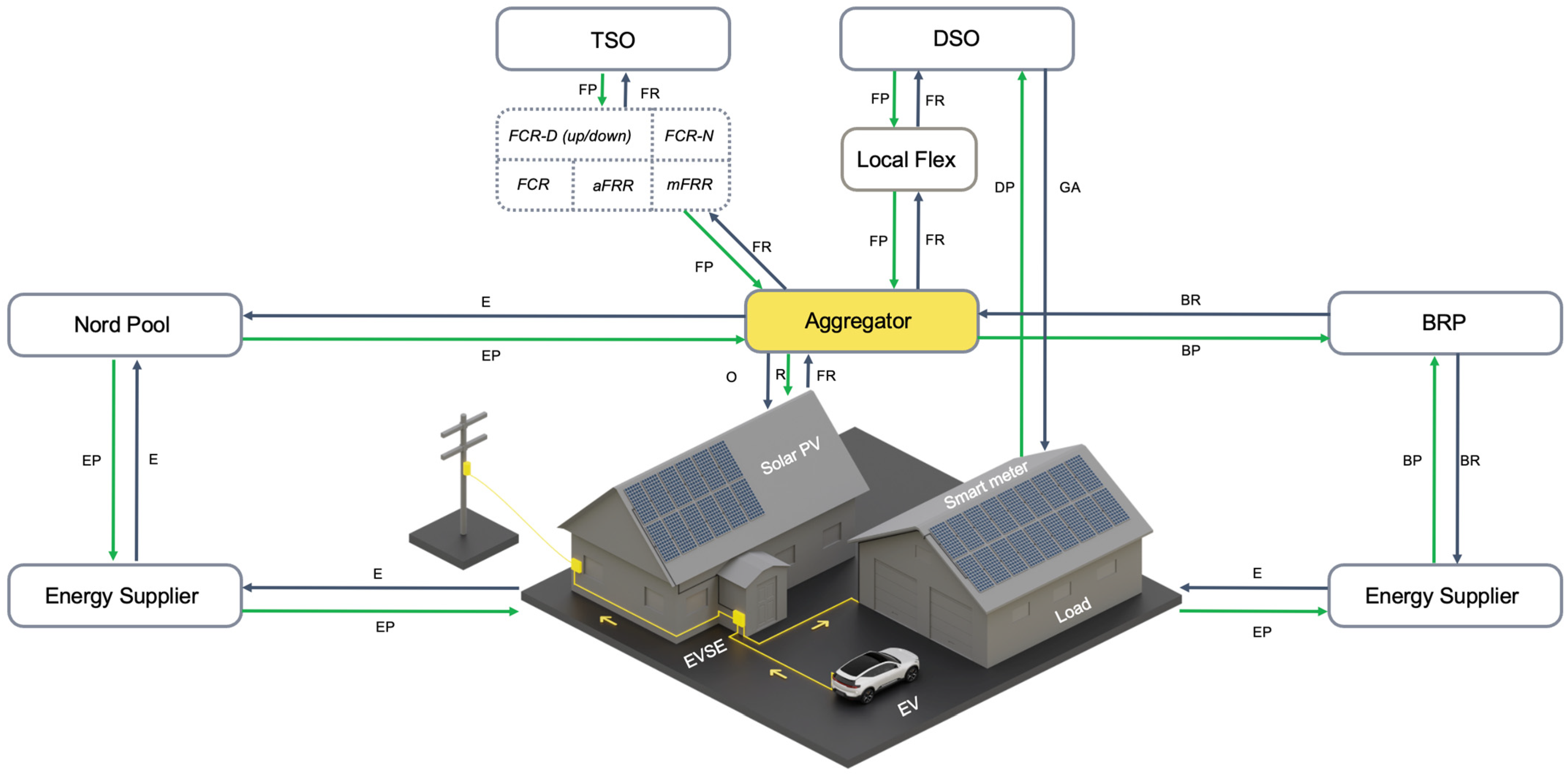
The V2G system interaction is shown in
Figure 1, where an EV owner can use their car’s battery to interact with the power grid. The system relies on a bidirectional charger—Electrical Vehicle Supply Equipment (EVSE)—and optionally works alongside home solar panels (Solar PV) and a smart meter. A key player is the Aggregator, which acts as an intermediary, managing the EV’s charging and discharging to participate in energy markets (like Nord Pool in Scandinavian context [
6]) and offer services to grid operators. Specifically, the Aggregator enables the EV to provide crucial grid-balancing services, such as Frequency Containment Reserves (FCR) and Frequency Restoration Reserves (aFRR/mFRR), to the Swedish TSO. This usually requires the Aggregator to function as, or partner with, a Balancing Service Provider (BSP). Additionally, the Aggregator can offer the EV’s flexibility to the local DSO to help manage grid congestion, participating in local flexibility markets. In essence, this system uses the EV’s battery, coordinated by an Aggregator, to support the stability of both the national TSO and local DSO power grids while potentially earning revenue for the EV owner through market participation. Potential value flows (indicated by dark blue arrows) include the supply of electricity to the user, the provision of the EV’s flexibility resource to the Aggregator, and the offering of balancing capabilities to grid operators. Corresponding potential revenue streams (indicated by green arrows) flow in return, such as payments from the energy supplier for consumed electricity (to the supplier), payments from the Aggregator or market/grid operators to the EV owner (via the Aggregator) for providing grid services like FCR and aFRR/mFRR to TSO, and for offering flexibility to the local DSO. Thus, the system leverages the EV battery to create value for the grid (stability, congestion management) while generating potential revenue for the participant through market mechanisms.
The present study investigates V2G not only as a technical configuration, but as a multi-actor service system requiring coordination across users, service providers, and grid-related actors. The study pursues three main objectives:
- (1)
To develop a V2G service blueprint for privately owned EVs in the Swedish context through a multi-stakeholder co-design process;
- (2)
To map and clarify the main service stages, stakeholder roles, frontstage and backstage interactions, and communication flows involved in V2G service delivery;
- (3)
To identify key operational, organizational, and user-related challenges that may affect the implementation and scalability of V2G services.
2. Background
Despite this growing technical evidence base, the real-world deployment of V2G services remains limited and largely confined to pilot projects and experimental demonstrations. This discrepancy between technical potential and practical implementation has been increasingly recognized as a critical bottleneck. Recent research suggests that the barriers to V2G scaling are not primarily technological, but rather sociotechnical and institutional in nature. These include uncertainties around business models, regulatory frameworks, stakeholder coordination, user acceptance, perceived risks related to battery health and data privacy, and the complexity of integrating actors across traditionally separate sectors such as automotive manufacturing, electricity markets, digital platforms, and grid operation.
Most existing V2G research approaches these challenges from a system optimization or market design perspective, often abstracting away from the operational realities experienced by end-users and service providers. As a result, there is limited understanding of how V2G functions as an end-to-end service: how users encounter, evaluate, adopt, and interact with V2G offerings over time, and how the diverse actors involved coordinate their activities to deliver grid services while maintaining a positive user experience. This gap points to the need for analytical frameworks that can capture V2G not only as a technical infrastructure, but as a complex service system embedded in a broader sociotechnical context.
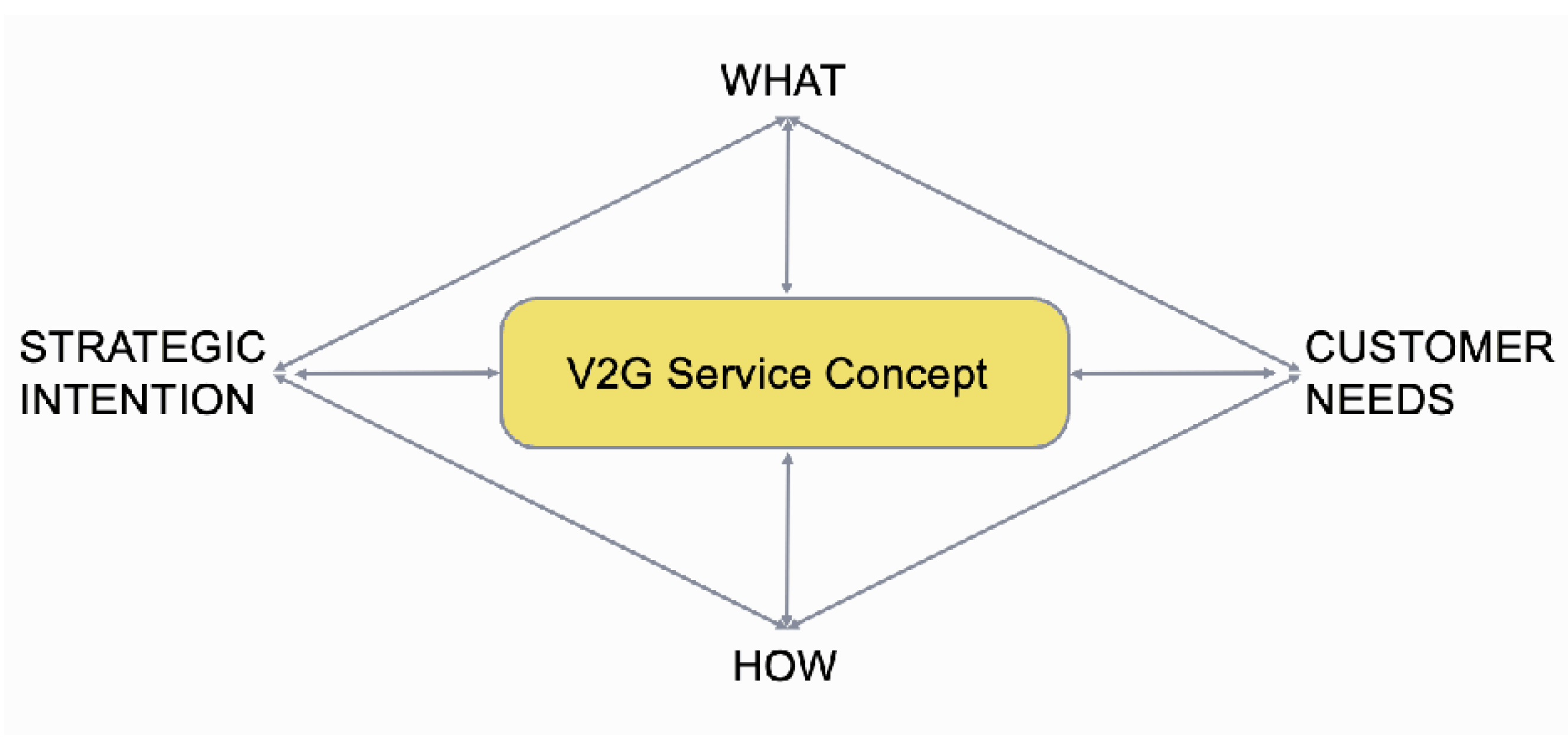
Traditional energy models often rely on Goods-Dominant Logic, where electricity is a commodity delivered from a central utility to a passive consumer. V2G necessitates a shift toward Service-Dominant (S-D) Logic, which posits that value is not delivered, but rather co-created through the integration of resources by multiple actors. In an S-D context, the EV owner is no longer just a customer; they are a partner providing a critical flexibility resource (the battery) to the system. The Aggregator facilitates co-creation by acting as an intermediary, aligning the user’s preferences for vehicle availability with the TSO’s need for Frequency Containment Reserves (FCR). Value co-creation is evidenced by the bidirectional flow of both energy and revenue. The user provides grid stability and receives compensation, while grid operators (DSO/TSO) gain a decentralized storage solution that reduces the need for costly infrastructure upgrades. The V2G Service Concept serves as the mediating bridge, aligning the Strategic Intent of providers—such as grid balancing and renewable integration—with the Customer Needs for financial benefit and vehicle readiness,
Figure 2 [
7,
8].
Methodologies from service design, such as Service Blueprinting [
9,
10], are crucial for mapping out these complex ecosystems, identifying critical touchpoints, and aligning stakeholder activities [
11]. This study specifically utilizes V2G Service Blueprinting, a technique proven useful for service innovation [
12], to systematically visualize, analyze, and structure the V2G service delivery process, building on the recognized need for user-centric approaches to provide a clear roadmap for deployment and enhance the overall V2G service experience.
The co-design process involved iterative workshops and data triangulation feedback sessions where stakeholders engaged in discussions to clarify their roles, identify critical service processes, and pinpoint the necessary technological and policy requirements for effective V2G service delivery [
13,
14]. This study addresses the need for a structured, collaborative approach by presenting a case study from Sweden focused on the co-design of a V2G Service Blueprint for privately owned EVs with V2G functions. Through active engagement with key stakeholders within the Swedish V2G ecosystem, this research aimed to develop a comprehensive blueprint that maps the necessary interactions, processes, and touchpoints for effective V2G service delivery. The primary objective is to detail this co-design process and the resulting blueprint, highlighting its components and the insights gained. This Swedish case study serves as a model for developing V2G Service Blueprints in other regions and V2G applications, emphasizing the importance of a collaborative approach in addressing the operational and strategic complexities of V2G. By actively involving diverse stakeholders in the design process, this study not only facilitates the exchange of domain-specific knowledge but also fosters a shared understanding of the V2G ecosystem’s challenges and opportunities.
3. Materials and Methods
To frame the methodological approach, we first position this research within new service development theory, as it relates to the purpose of co-creating service concepts. Johnson et al. define new service development (NSD) as the overall process of developing new service offerings, covering all steps from idea generation to market introduction [
15]. Service design (SD), in contrast, aims for a service concept and overlaps only partly with NSD, primarily contributing to areas such as user orientation, contextualization, and strategic design [
8]. The initial stage of the service design process often involves service concept development. Edvardsson et al. define the service concept as a detailed description of customer needs, how they are to be satisfied, what is to be done for the customer, and how this is achieved [
15]. The service concept plays a key role not only as a core design element, but also as an important initial stage for bridging involved actors and defining their needs and expectations, mediating between customer needs and the organization’s strategic intent. This theoretical grounding in NSD and SD informs the specific methodology chosen for this study. To translate the abstract service concept into a tangible, operational plan, particularly for complex, multi-actor services like V2G, specific tools are required. The Service Blueprint, introduced by Shostack [
9] and recognized as a practical technique for service innovation and design [
10], provides such a tool. It allows for the detailed visualization of the service process, mapping of customer actions, frontstage and backstage interactions involving different stakeholders, and the underlying support systems. Therefore, adopting the Service Blueprint methodology enables this research to systematically structure and analyze the co-created V2G service concept, clarifying roles, processes, and touchpoints essential for its successful implementation. The service blueprinting technique utilizes a structured diagrammatic format, typically organized into parallel lanes, each representing a distinct category of service activity or component. While variations exist, the blueprint in this study includes the following core elements:
Customer Actions: This topmost lane chronologically maps the steps, choices, activities, and interactions that the EV owner performs as they experience the service.
Frontstage Actions: These represent the actions of service contact employees, systems, or physical elements that are directly visible to the customer during the interaction.
Backstage Actions: This lane captures the essential activities performed by service employees or systems that are invisible to the customer but are crucial for supporting the frontstage actions and overall service delivery.
Support Processes: These are the underlying internal steps, systems, or activities that support the service providers (both frontstage and backstage) in delivering the service.
The V2G ecosystem inherently brings together stakeholders from traditionally disparate fields, including automotive manufacturing, energy utilities, information technology, software development, regulatory bodies, and installation services. Each group possesses its own technical language, operational paradigms, and strategic priorities. In such a multi-disciplinary environment, establishing a shared understanding of the end-to-end service process is paramount yet challenging. Service blueprinting addresses this by providing a common visual language. The blueprint diagram acts as a shared artifact that transcends domain-specific terminology, allowing engineers, marketers, grid operators, policymakers, installers, and customer service representatives to collectively visualize the service flow, understand their respective roles within it, identify critical interdependencies, and engage in constructive dialogue about design, potential issues, and improvement opportunities. This facilitation of cross-disciplinary communication and alignment is particularly valuable in the rapidly evolving V2G field, where roles, responsibilities, business models, and technical standards are often still under development or subject to change. The blueprint serves as a stable reference point for navigating this dynamic landscape. Applying this methodology to V2G involves mapping the entire service lifecycle, starting from customer awareness and acquisition, moving through enrollment, hardware installation, system configuration, ongoing V2G participation (charging, discharging, responding to grid events), performance monitoring, billing, and customer support. The resulting blueprint visually articulates how the diverse actors within the V2G ecosystem—Customer, Wallbox Installer, EVSE, Aggregator, DSO, TSO, Energy Supplier, BSPs and Insurance provider—contribute actions and interact at different stages. It provides a holistic view that clarifies the distinction between the relatively simple customer-facing interactions and the highly complex, multi-party coordination happening behind the scenes to enable grid services.
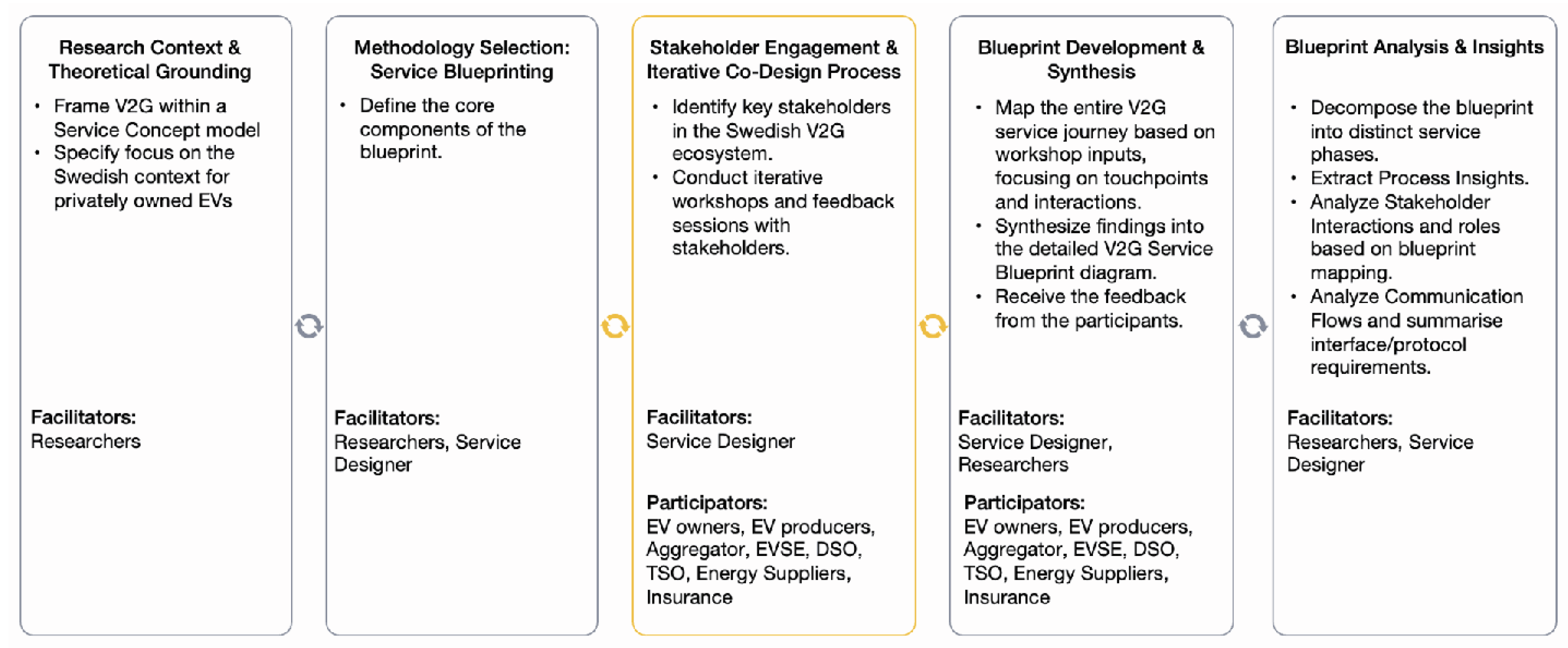
The methodological core of this study involved an iterative co-design process, guided by facilitators from the research team and service design experts, as conceptually illustrated in
Figure 3. This collaborative approach was crucial for navigating the complexities of the V2G ecosystem and brought together a purposefully selected group of 18 participants. These participants represented the critical nodes of the Swedish V2G value chain, including EV owners (8), EV producers (1), EVSE manufacturers (1), service operators (2), DSO (2), TSO (1), Insurance (1) and academia (2). Over a series of structured workshops and feedback loops, these stakeholders actively engaged in co-creation activities. Facilitators guided discussions aimed at clarifying stakeholder roles and responsibilities, mapping the end-to-end service processes from multiple perspectives, identifying crucial technical and policy requirements, and uncovering potential operational challenges.
To strengthen the analytical traceability of the findings, workshop materials and facilitator notes were iteratively reviewed to identify recurring themes, tensions, and convergences across stakeholder groups. The resulting insights were not treated as statistically generalizable findings, but as qualitatively grounded patterns emerging from repeated discussion across the co-design and feedback sessions.
4. Results: The V2G Service Blueprint
The insights reported in
Section 4.1,
Section 4.2,
Section 4.3 and
Section 4.4 were derived from iterative co-design workshops, facilitator notes, and stakeholder feedback sessions conducted during the development and refinement of the V2G service blueprint. The analysis was interpretive and synthesis-oriented, aiming to identify recurring themes, coordination challenges, and perceived barriers across stakeholder groups.
4.1. V2G Service Blueprint Insights
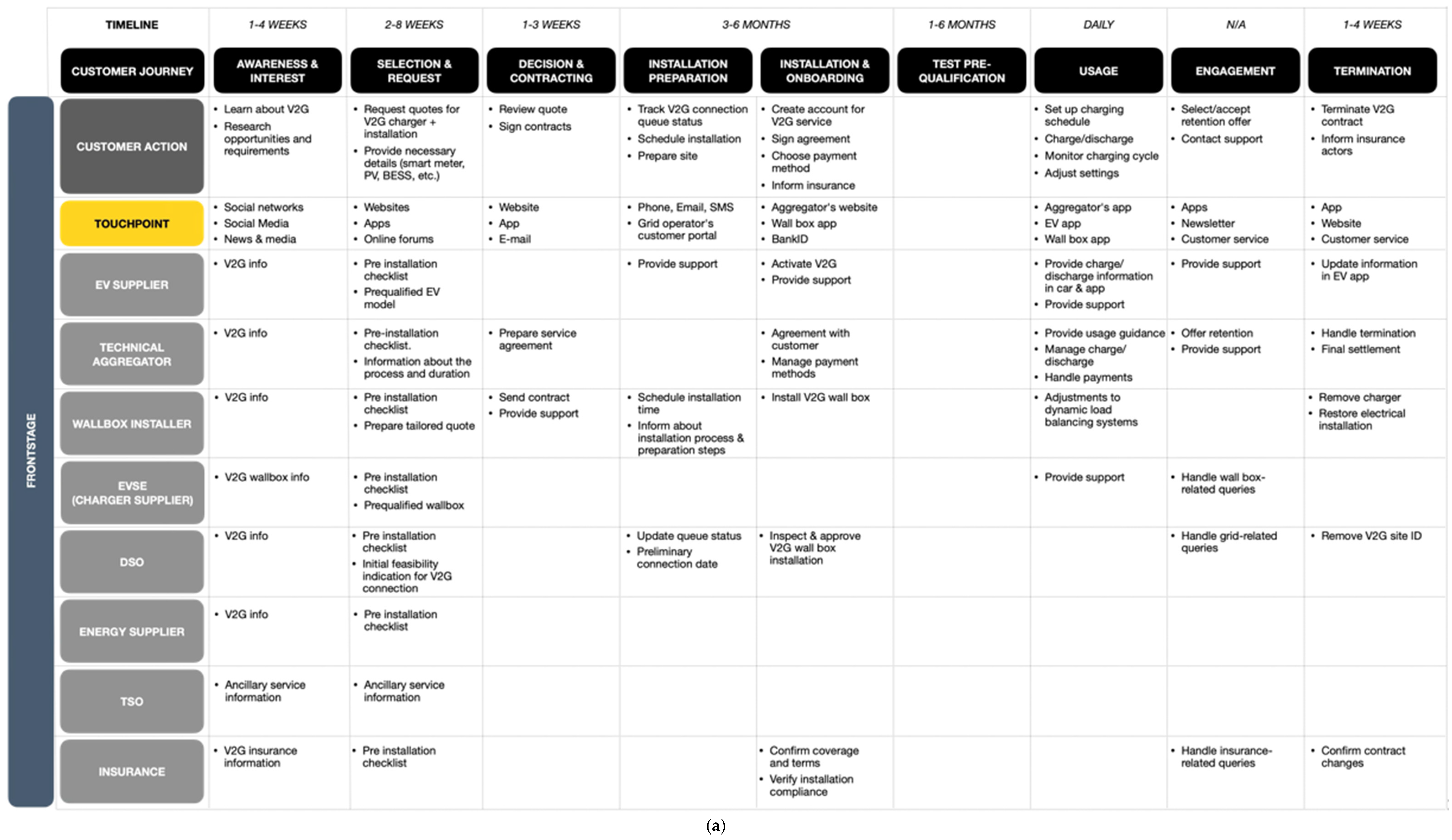
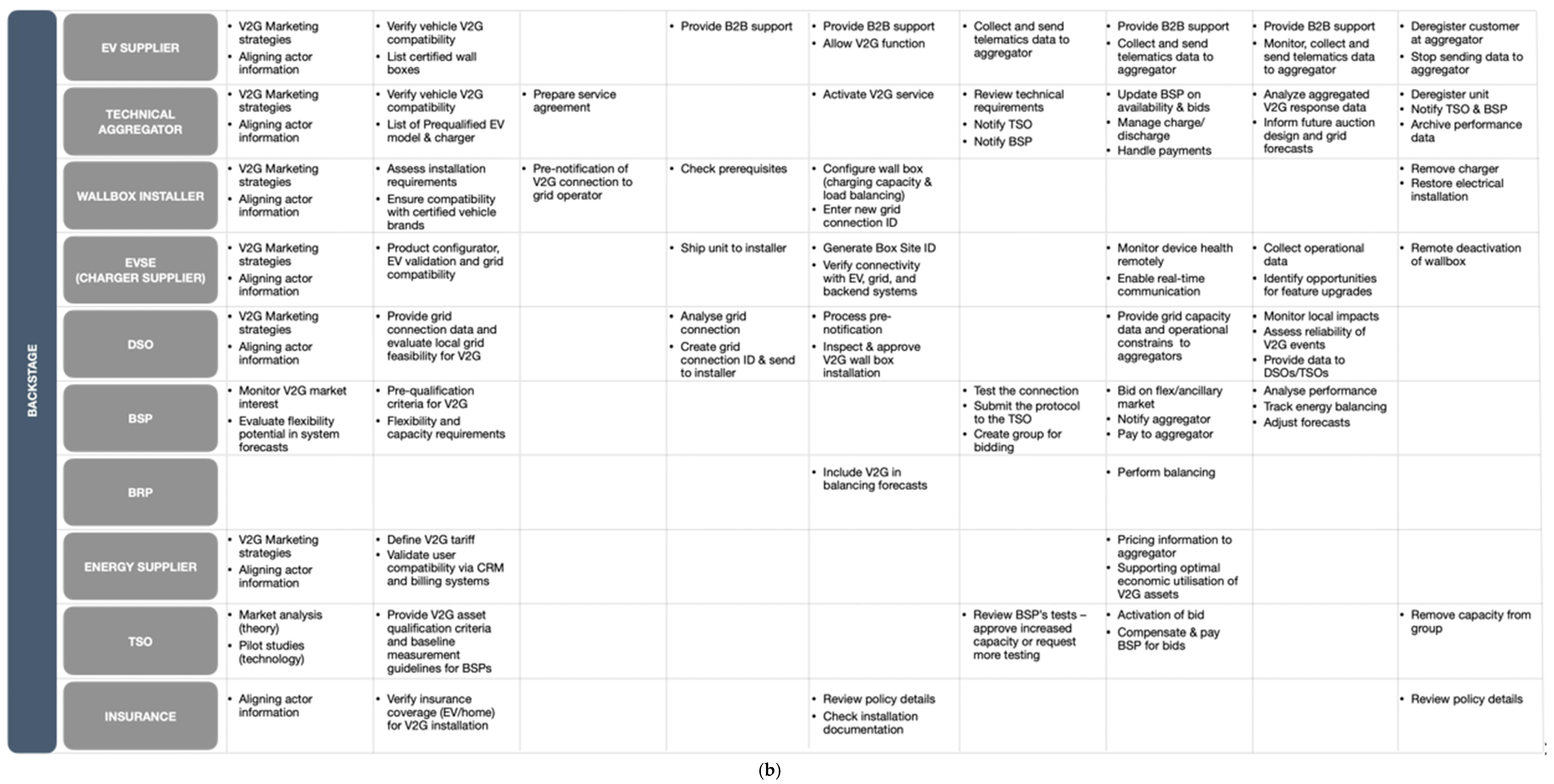
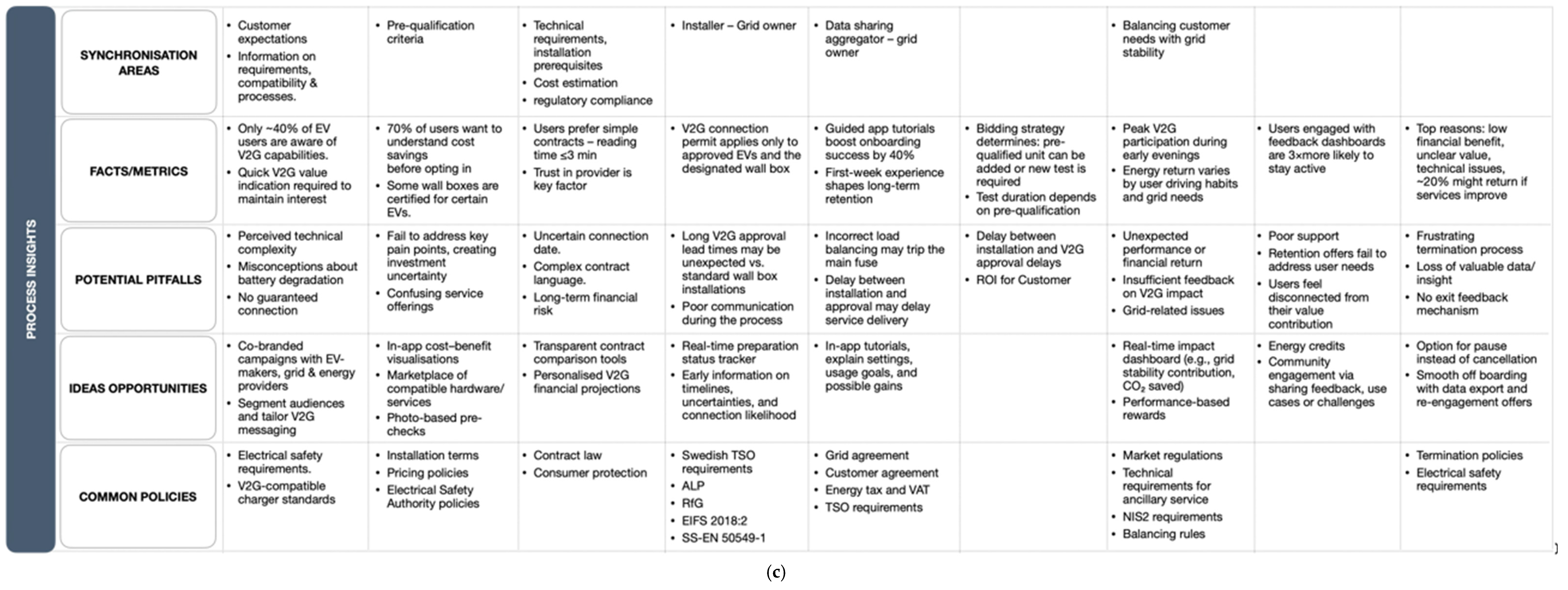
The collaborative co-design process was synthesized into a detailed V2G Service Blueprint, which is presented in
Figure 4a–c. This blueprint serves as the primary outcome of the study, mapping the intricate V2G service ecosystem for privately owned EVs in the Swedish context. It visualizes the customer journey alongside the orchestrated frontstage and backstage actions of the multi-stakeholder network, revealing the operational complexities and interdependencies required for service delivery. The blueprint systematically decomposes the V2G service into distinct phases:
Awareness & Interest: This initial phase involves the customer (EV owner) becoming aware of V2G services, often through marketing efforts by Aggregators, Wallbox Installers, or Energy Suppliers. Key touchpoints include websites and informational materials. Backstage, stakeholders refine marketing strategies and define value propositions.
Selection & Request: The customer actively seeks information, comparing offers from different V2G Aggregators. Touchpoints involve V2G info portals, pre-qualification checks (involving DSOs backstage for grid capacity assessment), and direct inquiries. Stakeholders like Aggregators provide detailed service information and eligibility criteria.
Decision & Contracting: The customer selects a provider and enters into a service agreement with the Aggregator. This phase involves critical frontstage interactions like signing contracts and agreeing to terms with an Energy Supplier. Backstage, Aggregators, and partner BSPs finalize contractual details and initiate onboarding processes.
Installation preparation: This phase focuses on the physical setup. The Wallbox Installer performs a site inspection (frontstage) and coordinates with the customer. Backstage activities involve the Aggregator, Installer, and possibly the DSO ensuring that technical requirements are met and scheduling the installation.
Installation & Onboarding: The certified Wallbox Installer installs and configures the bidirectional EVSE (frontstage touchpoint). Backstage, the Installer confirms successful installation, and the Aggregator integrates the new asset into their platform, involving communication checks with the DSO and TSO systems.
Test Pre-qualification: Before active participation, the Aggregator performs tests to ensure the EV and EVSE meet technical requirements for grid services (e.g., FCR, aFRR/mFRR). This is primarily a backstage process involving the Aggregator, BSP, and coordination with the TSO to ensure compliance with grid codes. The customer may be informed upon successful qualification (touchpoint).
Usage: This is the operational phase where the customer uses the V2G service via an app or portal (touchpoint) to manage charging preferences and view earnings. Frontstage, the customer experiences automated charging/discharging based on grid needs and their settings. Backstage, the Aggregator’s platform dynamically manages the EV’s energy flow, interacting with energy markets and grid operators to provide flexibility and ancillary services. This involves complex data management and communication protocols. Billing and payments (touchpoint) are handled, often involving the Energy Supplier and Aggregator.
Engagement: Ongoing interaction occurs through customer support channels for troubleshooting or inquiries, managed primarily by the Aggregator. Backstage, stakeholders monitor system performance, provide maintenance, and offer service upgrades or educational resources to retain the customer.
Termination: If the customer chooses to end the service, this phase involves final billing settlements (touchpoint) and deactivation procedures. Backstage, the Aggregator, Energy Supplier, and grid operators update their systems to reflect the termination.
4.2. Stakeholder Interaction Analysis
An important contribution of the V2G service blueprint is its capacity for systematic role clarification within the complex stakeholder network. By assigning specific frontstage and backstage actions to each identified actor’s lane, the blueprint moves beyond abstract stakeholder lists to provide a granular and unambiguous definition of who does what at each specific stage of the service lifecycle. This structured mapping details operational involvement, clarifying responsibilities in a way that verbal descriptions or high-level diagrams often fail to achieve. Furthermore, the blueprint visually maps the sequence, direction, and nature of interactions between these actors as the service unfolds over time. This interaction mapping is important for understanding the operational dynamics of V2G.
The blueprint can clearly delineate the Wallbox Installer’s frontstage activities, such as the physical installation of the charging equipment at the customer’s premises and the initial customer handover or training. Concurrently, it maps the Aggregator’s backstage activities, which include receiving installation confirmation, remotely configuring the charger for V2G communication, registering the asset within their platform, and initiating communication exchanges with the relevant DSO or TSO systems to validate the grid connection point and perform initial eligibility checks. While some reports mention installers, they often lack this level of detail regarding specific interactions with other actors like Aggregators or DSOs during the setup phase. During ongoing V2G operation, the blueprint visualizes the EV owner interacting with a mobile app to set charging preferences or monitor performance (Customer Actions & Frontstage). Simultaneously, it shows the Aggregator’s platform executing backstage actions: receiving real-time data (e.g., state-of-charge, connection status) from the EV/charger, processing grid signals (e.g., price fluctuations, frequency deviations, capacity requests), calculating optimal charging/discharging schedules based on algorithms that balance grid needs, user constraints, and economic incentives, and sending commands back to the charger. Critically, it also maps the essential backstage data exchanges between the Aggregator’s platform and the systems of the DSO and TSO. These exchanges are vital for the Aggregator to understand grid conditions, for the DSO to manage potential local distribution network impacts, and for the TSO to procure and verify the delivery of ancillary services or flexibility. This detailed mapping provides empirical grounding derived from the service design itself, complementing and operationalizing insights from broader stakeholder analyses found in research. Studies identify the Aggregator as a key intermediary, managing fleets of EVs to participate in various energy markets and provide services. Research also highlights the crucial, and sometimes complex, coordination required between the Aggregator, the DSO (focused on distribution network integrity and local services), and the TSO (focused on transmission system balance, frequency control, and wholesale market operations). The blueprint allows for the visualization of specific interaction patterns reflecting different coordination models discussed in the literature, such as DSO-managed schemes versus more integrated TSO-DSO hybrid models. To synthesize this information, the following
Table 1 connects key V2G stakeholders identified in research with their roles and interactions as mapped within a detailed V2G Service Blueprint.
4.3. Communication Flows and Defining Interface Requirements
Effective communication and data exchange constitute the operational bedrock of V2G systems, enabling the intricate coordination and control required to leverage distributed EV battery capacity for grid stabilization and ancillary services. Service blueprinting provides a methodology to map and analyze these critical communication flows within the complex V2G ecosystem. This visualization encompasses not only communication acts, such as user interactions with interfaces or support personnel, but also data exchanges occurring within the backstage and support layers. These implicit flows, fundamental to V2G functionality yet typically invisible to the end-user, include EV telemetry transmission (e.g., state-of-charge, connection status) to aggregators, the dissemination of grid signals (e.g., pricing, frequency deviations, capacity requests) from TSOs and DSOs to aggregators, the issuance of control commands (e.g., charge/discharge instructions) from aggregators to EVs/chargers, and the exchange of settlement data among relevant parties. Analyzing these potential communication pathways via the blueprint facilitates a preliminary assessment of the V2G information architecture. It allows for the preliminary definition of data exchange requirements, including the specific information content, the identities of the communicating entities (e.g., EV-Aggregator, Aggregator-DSO, TSO-Aggregator) and necessary performance characteristics such as reliability, throughput, and security. This process-grounded analysis is essential for identifying critical system interfaces, uncovering potential communication gaps or bottlenecks in the service design, and directly informing the technical requirements for the V2G communication infrastructure. Consequently, it provides the necessary context for specifying and implementing robust, interoperable communication protocols—such as ISO 15118 [
16] for high-level EV-EVSE communication including bidirectional power transfer and OCPP for EVSE-Central Management System interactions, alongside other relevant standards like, IEEE 2030.5 [
17], OpenADR [
18], or IEC 61850 [
19] depending on the specific interaction mapped—as well as defining standardized data formats, shared digital platforms or APIs, and implementing stringent cybersecurity measures across all communication channels to ensure operational integrity and data privacy. To further clarify the communication infrastructure implied by the service blueprint,
Table 2 outlines selected communication protocols and their relevance to specific V2G interactions and blueprint stages.
4.4. Critical Operational and Behavioral Insights
Analysis of the multi-stakeholder Vehicle-to-Grid (V2G) service blueprint reveals several critical operational and sociotechnical insights that significantly influence the transition from experimental pilots to commercial scalability. These insights delineate the friction points between technical requirements and user-centric service delivery.
Temporal Disparity and the Implementation “Dead Zone”: A profound operational challenge identified in the service journey is the significant temporal gap between physical infrastructure deployment and functional service activation. While the commissioning of bidirectional hardware typically follows a 3–6 month trajectory, the subsequent “Test and Pre-qualification” phase can introduce additional administrative and technical delays of 1–5 months. This results in a “dead zone” where early adopters are burdened with significant capital expenditure without the immediate ability to recoup investments through flexibility markets. Such latencies risk diminishing user momentum and highlight a need for streamlined pre-qualification protocols between aggregators and Transmission System Operators (TSOs).
Cognitive Thresholds and Contractual Complexity: Contractual complexity emerged as a recurrent concern in the co-design workshops, where participants emphasized that V2G agreements need to be simple, transparent, and easy to understand from the user perspective. This observation is consistent with prior research shown that perceived complexity, uncertainty about loss of control, and concerns about reduced vehicle availability remain important barriers to V2G acceptance [
20,
21,
22,
23,
24]. Rather than interpreting these issues as fixed behavioral thresholds, the present study suggests that they should be understood as service design challenges that influence willingness to participate and the overall user experience. Recent acceptance studies also support the broader point that perceived risk and attitudes toward V2G significantly shape adoption intentions.
Divergent Value Propositions: There exists a notable misalignment between the technical objectives of grid operators and the primary motivations of end-users. Stakeholder discussions suggested that financial clarity and tangible personal benefits were perceived as more salient user motivations than abstract grid-oriented benefits. Users place the highest value on features that highlight financial benefits and monitor battery state-of-health (SOH), whereas social comparisons and abstract environmental metrics appear less persuasive. This necessitates the integration of “Value Visualization” dashboards that provide real-time financial projections alongside technical performance data.
Operational Risk and Load Management: The blueprint identifies a critical physical risk categorized as “Incorrect Load Balancing.” Backstage signals from an aggregator must be perfectly synchronized with local building loads to prevent exceeding the capacity of the household’s main fuse. Without robust local “fail-safe” mechanisms or smart inverters capable of autonomous load shedding, high-frequency V2G events could induce localized power outages, severely undermining user trust in the system’s reliability.
Lifecycle Persistence and Administrative Friction: Current service designs often treat termination as a binary exit, which triggers heavy administrative deregistration processes at the TSO and aggregator levels. Insights from the Swedish context suggest a strategic advantage in transitioning from a “Termination” model to a “Pause” or “Vacation Mode”. Maintaining asset registration during periods of inactivity prevents the loss of longitudinal battery health data and reduces the friction of re-onboarding, which is critical for long-term fleet management and retention.
Trust Architecture Through Transparency and Feedback: Trust remains a central pillar of V2G adoption, particularly as 18% of potential users cite data privacy and cybersecurity as major barriers. The blueprint emphasizes that transparency in the “Usage” phase is improved through immediate micro-interactions. Users require clear confirmation—such as haptic pulses or visual status indicators—to verify that their energy preferences have been registered by the backstage optimization engine. Providing this real-time feedback loop mitigates the “black-box” nature of automated grid services and fosters a more resilient social contract between the vehicle owner and the aggregator.
4.5. Ideas and Opportunities for V2G Service Expansion
The synthesis of the V2G Service Blueprint and contemporary literature reveals multiple strategic opportunities to enhance the commercial viability and technical resilience of bidirectional services. These opportunities bridge the gap between abstract grid needs and tangible user value propositions.
Enhancing Market Penetration through Cross-Sectoral Synergy: Stakeholder discussions further suggested that awareness of V2G among prospective users remains limited and that this constrains broader market uptake. This is broadly aligned with earlier Nordic research, which found that V2G was still relatively unfamiliar not only to members of the public but also to some actors across the electric mobility ecosystem [
17]. More recent work likewise indicates that V2G deployment continues to be shaped by limited user familiarity, trust concerns, and uncertainty regarding the personal value proposition [
20,
25].
User-Centric Interface Design and Personalized Value Delivery: To address the primary motivators of financial gain and battery health concern, next-generation V2G applications should transition from technical monitoring to Personalized Value Dashboards.
Interfaces should prioritize financial projections, CO2 saved metrics, and grid stability contributions to build a sense of personal agency.
Utilizing AI-driven agents that learn a user’s daily routine can ensure vehicle availability while optimizing for SOH.
Technical Resilience and Administrative Optimization: Operational efficiencies can be gained by addressing the “Dead Zone” between installation and service activation.
Developing digital twins of local grid segments could allow aggregators to perform “one-click” pre-qualification during the contracting phase, potentially reducing wait times by months.
Expanding use cases to include Vehicle-to-Home (V2H) and Vehicle-to-Building (V2B) for emergency backup provides a tangible safety benefit that financial-only models lack, particularly in regions prone to outages.
Replacing binary service termination with a “Pause” state preserves the asset’s registration in the balancing forecast while allowing users to temporarily opt-out without losing historical battery performance data.
5. Discussion
This study advances research on V2G systems by explicitly framing V2G not merely as a technical grid solution, but as a complex, multi-actor service system whose success depends on the orchestration of sociotechnical, organizational, and experiential dimensions. By applying service design theory—specifically service blueprinting—within a NSD context, this study responds to long-standing calls in the V2G literature to move beyond technology-centric analyses toward approaches that account for stakeholder coordination, user experience, and institutional alignment.
5.1. Positioning V2G as a Service System Rather than a Technology
A recurring theme in the V2G literature is the persistent gap between technical feasibility and large-scale deployment. While numerous studies demonstrate the grid benefits of V2G in terms of frequency regulation, renewable integration, and peak shaving, real-world adoption remains limited. Scholars increasingly argue that this gap is not primarily technological, but institutional and behavioral in nature, involving trust, incentives, governance structures, and user acceptance. The findings of this study empirically reinforce this perspective.
By operationalizing V2G through a Service Blueprint, this research aligns with S- Logic, which conceptualizes value as co-created through interactions among multiple actors rather than delivered unilaterally by a provider. Within this framing, the EV owner is repositioned from a passive consumer to an active resource integrator, contributing battery flexibility while retaining agency over mobility needs. The Aggregator emerges as a pivotal orchestration actor, mediating between grid imperatives (DSO/TSO) and user preferences. This relational framing complements and extends existing conceptual models of aggregators as flexibility intermediaries by explicitly embedding them within a user-facing service architecture.
The blueprint thus provides a concrete operationalization of abstract S-D Logic principles within an energy systems context, addressing a gap in prior research where value co-creation is often theorized but rarely mapped at the process level.
5.2. Insights into Governance, Coordination, and Institutional Friction
Beyond its descriptive role, the service blueprint can also be used as an analytical tool for examining how different governance and coordination arrangements shape the practical viability of V2G services. Much of the V2G literature has focused on technical feasibility, charging control, market participation, and grid impacts, while giving less attention to how these arrangements are operationalized through end-to-end service processes. Recent review work confirms that V2G research remains strongly oriented toward technical integration and system performance, even though implementation depends on broader institutional, organizational, and user-related conditions [
25]. In this respect, the present blueprint complements existing deployment frameworks by making visible the sequencing of actions, communication dependencies, and inter-organizational interfaces required to translate technical capability into an operable service.
The blueprint also helps illuminate alternative coordination models between aggregators, DSOs, and TSOs. Recent studies show that flexibility provision can be organized through different governance logics, including TSO-managed, DSO-managed, and hybrid TSO–DSO approaches, and that these alternatives have different consequences for congestion management, information exchange, operational responsibility, and market outcomes [
26,
27]. From a service perspective, these are not merely abstract institutional choices; they imply different backstage workflows, response times, accountability structures, and user-facing consequences across the lifecycle of onboarding, pre-qualification, operation, and settlement. The blueprint therefore contributes by linking governance arrangements to their concrete service implications.
Finally, the analytical value of the blueprint lies in its ability to identify operational bottlenecks that may constrain efficiency and scalability. Research on V2G acceptance and deployment increasingly emphasizes that implementation success depends not only on technical readiness, but also on trust, clarity of value propositions, simplicity of participation, and perceived reliability [
28,
29,
30]. Seen in this light, the delays, coordination frictions, and interface dependencies identified in the blueprint can be interpreted as early indicators of where larger-scale roll-out may encounter resistance or inefficiency. Accordingly, the blueprint is useful not only for mapping who interacts with whom, but also for diagnosing which governance choices, process designs, and coordination mechanisms are likely to support—or hinder—the operational scaling of V2G services.
5.3. User Experience, Trust, and Behavioral Dimensions
The blueprint-based analysis offers nuanced insights into the behavioral dynamics of V2G participation. Consistent with prior studies on consumer skepticism toward V2G, the findings confirm that financial clarity and perceived control outweigh abstract environmental motivations for most users. Importantly, the service blueprint reveals where and how these concerns manifest within the service journey—particularly during contracting, usage, and troubleshooting phases.
The emphasis on real-time feedback, transparency of automated decisions, and battery health information aligns with emerging research on trust in algorithmic and automated services. By identifying specific frontstage touchpoints (e.g., app interfaces, confirmation signals) that can mitigate the “black-box” perception of V2G, the study contributes actionable insights to debates on human-centered automation in energy systems.
5.4. Practical Implications for V2G Deployment
From a practical standpoint, the findings suggest that successful V2G deployment requires simultaneous attention to:
Technical interoperability, ensured through standardized communication protocols;
Service coherence, achieved by aligning installer practices, aggregator platforms, and grid operator procedures;
User-centered design, prioritizing clarity, predictability, and perceived fairness.
The blueprint provides a transferable framework that can support utilities, aggregators, and policymakers in stress-testing service concepts before market rollout. In particular, it can inform procurement strategies, partnership agreements, and regulatory sandboxes by clarifying role distributions and data responsibilities.
5.5. Limitations and Directions for Future Research
Despite its contributions, this study has limitations. First, the blueprint reflects the Swedish regulatory and market context, characterized by advanced digital infrastructure and relatively high institutional trust. Applying the framework in other national contexts may require significant adaptation. Second, the blueprint represents a designed service rather than an empirically validated operational system; real-world implementation may reveal additional frictions or emergent behaviors. In addition, the study draws on a comparatively small, purposively selected sample of 18 stakeholders. While this was appropriate for an exploratory co-design process, it limits representativeness and may introduce bias in stakeholder representation as some actor perspectives may have been more prominent than others in shaping the resulting service blueprint. Although the service blueprint was developed within the Swedish V2G context, its relevance extends beyond this specific national setting. The broader transferability of the framework lies in its methodological structure rather than in the exact institutional configuration it depicts. Core blueprint elements—such as the mapping of customer actions, frontstage and backstage activities, support processes, stakeholder dependencies, and communication interfaces—are likely to remain relevant across many V2G contexts. However, the detailed allocation of roles, the design of contractual arrangements, the procedures for technical pre-qualification, and the relationships between aggregators, DSOs, TSOs, and market actors are likely to vary across regulatory environments and energy markets. As a result, the blueprint should be understood as an adaptable framework that can support service design and coordination analysis in other contexts, provided that it is re-specified to reflect local market rules, governance arrangements, technical standards, and user conditions. Comparative applications across national settings would therefore represent an important next step for testing the robustness and transferability of the approach.
Future research should therefore pursue longitudinal validation through pilot deployments, comparative studies across regulatory regimes, and integration with quantitative modeling of grid and economic impacts. Further work could also explore how service blueprints interact with emerging concepts such as energy data spaces and digital twins, extending the approach to broader smart energy ecosystems.
6. Conclusions
This study contributes to V2G implementation by developing a structured service blueprint for privately owned EVs in the Swedish context that makes explicit the key stages, stakeholder roles, communication flows, and coordination dependencies required for service delivery. In practical terms, the blueprint provides an implementation-oriented framework that can support the design of onboarding procedures, installation and pre-qualification workflows, stakeholder responsibility allocation, and user-facing service interfaces. By identifying critical bottlenecks—such as delays between installation and activation, coordination frictions between actors, and communication complexity—the study also offers a basis for improving service readiness and reducing implementation uncertainty. Although the present work does not quantify grid impacts or operational performance, it provides a concrete foundation for future pilot validation and for the development of more efficient, scalable, and user-centered V2G services.
Future work should focus on validating and refining this blueprint through pilot implementations and further iterative feedback cycles with stakeholders. Comparative studies applying this methodology in different national contexts or V2G applications (e.g., commercial vehicle fleets) would be valuable to assess the framework’s adaptability and generalizability. Further research is also warranted to delve deeper into specific challenges highlighted by the blueprint analysis, such as developing effective strategies to enhance user engagement and trust, refining technical interface standards for seamless data exchange between all actors, and exploring solutions to the identified regulatory hurdles. Finally, integrating the qualitative insights from the blueprint with quantitative modeling could provide deeper understanding of the economic viability and grid impact of different V2G service configurations.