Article

Towards Sustainable Urban Freight: A Collaborative Business Model Framework for Last-Mile Consolidation Centres

by
Tatjana Apanasevic
* and
Anna Fjällström
RISE Research Institutes of Sweden, Isafjordsgatan 22, P.O. Box 1263, SE-164 29 Kista, Sweden
*
Author to whom correspondence should be addressed.
World Electr. Veh. J. 2026, 17(4), 202; https://doi.org/10.3390/wevj17040202
Submission received: 25 February 2026 / Revised: 1 April 2026 / Accepted: 8 April 2026 / Published: 14 April 2026

Abstract

Urban freight transport generates significant negative externalities in the form of noise, congestion, and environmental impacts. Freight consolidation centres could be seen as a potential solution, offering benefits such as shorter delivery distances and fewer delivery routes. However, implementation of freight consolidation centers requires collaboration between actors with conflicting interests and goals. This study proposes a collaborative business model framework for freight consolidation centres. The novelty of the study lies in conceptualising collaboration as an outcome-based partnership and extending the Business Model Canvas with collaboration-specific components. This framework was empirically tested and refined through a pilot project in Gothenburg, applying the principles of engaged scholarship. The results indicate that last-mile consolidation can significantly improve operational efficiency and enable sustainability gains. At the same time, structural, economic, and organisational barriers need to be addressed to realise all benefits of the collaborative business model. The findings particularly highlight the need for deeper institutionalisation of collaborative practices, including the integration of new norms, procedures, and policies into the business models of the individual actors involved.

1. Introduction

This article extends and further develops a concept originally presented by the authors at the 38th International Electric Vehicle Symposium (Gothenburg, 15–18 June 2025) in the paper entitled “Towards a framework for a collaborative business model for a freight consolidation centre” [1].
Freight transport has a significant impact on the climate, accounting for 25 per cent of road transport emissions in the EU [2]. While urban freight transport fosters the economic development of a city, it also contributes to negative transport externalities such as emissions, congestion, and noise. For example, around 17 per cent of traffic on Gothenburg’s Event Route (Evenemangsstråket) comprises freight vehicles, with freight accounting for 5.5 million vehicle kilometres annually compared to 27 million vehicle kilometres travelled by cars within the same zone [3].
In response to climate targets, municipalities are increasingly adopting ambitious strategies aimed at achieving climate-neutral cities by 2050. These strategies include reducing traffic and noise, improving air quality and making urban areas more liveable for citizens. To achieve these goals, there needs to be a shift towards greener vehicles and new logistics solutions that would help to mitigate the negative impacts of last-mile urban freight transport. One possible solution is to establish consolidation and distribution nodes for the last mile in or near urban neighbourhoods. Using electric vehicles (EVs) further contributes to reducing emissions in urban freight systems [4].
However, urban last-mile logistics systems are complex, involving multiple stakeholders with conflicting interests and organisational constraints. Implementing consolidation and distribution nodes poses several challenges, particularly related to coordination and collaboration among logistics service providers (LSPs) and the other parties involved. While collaboration could improve operational planning and capacity utilisation, reduce empty running, and deliver environmental benefits, achieving it in practice remains difficult due to competitive market structures and operational misalignments [5]. Furthermore, the coexistence of traditional and EVs for last-mile delivery introduces cost and pricing disparities, which complicates the development of viable business models and can lead to increased competition [6].
Previous research has highlighted the limited adoption of collaborative approaches in the freight sector, which is often attributed to strong competition and low profit margins [5]. At the same time, studies addressing business models in urban freight transport, particularly in the context of sustainability transitions and electromobility, remain scarce [4,7]. This indicates the need for new approaches to the business model that explicitly incorporate collaboration between the involved actors while addressing economic, environmental, and social objectives [6].
Against this background, this study aims to propose a framework for a collaborative business model applicable to freight consolidation centres, addressing the following research questions:
(RQ1) What benefits and challenges does collaboration bring to stakeholders in the freight consolidation centre ecosystem?
(RQ2) How can the collaborative component be conceptualised and included in the business canvas?
This study contributes to the academic literature on urban freight logistics by proposing a novel framework for a collaborative business model for last-mile consolidation centres. The novelty of this study lies in conceptualising collaborative business models as outcome-based partnerships, in which all parties are mutually invested in the success of the common business model goals [8]. Building on this perspective, we extend the business model canvas [9] by introducing additional building blocks, such as Form/Models of collaboration, Pricing model with incentives, and Non-monetary benefits and value.
Furthermore, the study incorporates the principles of Vested agreement [8] to operationalise collaboration within the context of a multi-actor logistics ecosystem. In doing so, the study provides a structured approach to integrating collaborative elements into business model design and addressing a gap in the existing literature, where such integration remains limited.
The empirical contribution of this study lies in the fact that the proposed framework is applied and refined through a real-world pilot project of a freight consolidation centre, following the principles of engaged scholarship. This allows to generate practical insights into how the benefits and value of collaboration can be translated into the business models and operational practices of the involved actors. In addition, this study extends the existing academic literature by providing knowledge about the challenges associated with implementing a service that combines traditional and EV fleets for the last-mile delivery.
Finally, the study makes practical contributions by providing important guidelines for practitioners developing urban last-mile consolidation centres. The proposed framework can be used as a tool to translate the benefits of the collaborative business model into the tactics of each collaborating organisation, which is a subject for future research.
In the next section, we provide an overview of the relevant academic literature, followed by a description of the conceptual background, the concept itself, and the methodology used. Finally, we present and discuss our findings and draw conclusions.

2. Related Work

In this section, we provide a brief overview of the literature on freight consolidation centres, collaboration, and business models in freight logistics. It can be concluded that academic research in this area is rather scattered and fragmented and requires further investigation.

2.1. Freight Consolidation Centres

The academic literature discusses Urban Consolidation Centres (UCCs), which can be defined as logistics facilities that decouple long-distance and last-mile transport, typically located within the urban areas that they serve, whether this is a city centre, an entire town, or a specific location, and using vehicles designed for urban transport [4,10,11]. UCCs can be operated by one or multiple companies and facilitate the collection of goods from multiple shippers, their transshipment, and consolidation for last-mile delivery to goods receivers [11,12]. To achieve this, LSPs can split their supply chains into multiple tiers. This requires significant effort to synchronise goods and establish the necessary transportation infrastructure. For the purposes of this research, we use the terms “freight consolidation centre” and “consolidation centre” interchangeably.
Benefits include a reduced environmental footprint through the use of greener, electric vehicles for last-mile delivery [13,14,15]. Other benefits include fewer freight vehicles, less congestion and noise, and an improved quality of urban life [13,14]. Businesses receiving freight can benefit from fewer deliveries [16]. Logistics operators can benefit from reduced vehicle-kilometres and trips across the city, less time spent on congested roads or waiting at loading docks, the use of UCCs for storage and transhipment, shorter distances travelled, and less driving of empty vehicles [5,13,14,16].
However, UCCs may face challenges such as conflicting interests among the parties involved, unsustainable operations, low profitability, regulatory obstacles, and difficulties in achieving economies of scale [13,14]. Furthermore, many city logistics initiatives focus primarily on technical, environmental, and operational feasibility, rather than on business aspects [17].

2.2. Collaboration in Freight Logistics

The question of collaboration in transportation has been at the forefront of research for several decades. Its importance has grown as LSPs face a complex set of challenges such as high competition within the industry, inefficient load capacity utilisation, congestion-related delays, low margins, and the need to reduce environmental impact and CO2 emissions [5,18,19,20]. To address these challenges and increase operational efficiency, a collaborative approach is needed in which all parties pursue shared objectives, achieving more effective overall outcomes and benefits rather than focusing solely on individual benefits [20].
Researchers [5,11,18,21] have identified three types of collaboration that are specific to the transport sector:
  • Horizontal collaboration implies collaboration between two or more competing organisations at the same level of the logistics network and sharing information or resources. For example, operations may be synchronised to reduce the overall number of vehicles needed for urban transportation.
  • Vertical collaboration involves “collaboration between two or more organisations acting at different levels of the logistics chain, such as a receiver, a shipper, and a carrier” [5] (p. 4). These actors share responsibilities, resources, and data. In this form of collaboration, LSPs can decompose transportation routes into multiple tiers, enabling each partner to serve specific segments.
  • Lateral collaboration enables greater variation in the combination and sharing of responsibility, resources, and data both vertically and horizontally.
Coordination structures for collaboration can be centralised, where decisions are made at a higher level and then synchronised at lower levels, or decentralised, where collaboration is based on consensus, agreement of objectives, indicators, and equality rules between partners [5]. Vargas et al. [5] identify the following strategies or forms of collaboration in freight distribution:
  • Route scheduling/planning to optimise routes.
  • Backhauling to reduce empty running on the return journey.
  • Freight exchange to match freight demand with available capacity.
  • Consolidation centres to increase load factors and enable last-mile delivery using cleaner EVs.
  • Delivery and servicing plans, where a designated lead supplier reduces the number of trips required to serve multiple organisations in certain premises or areas.
  • Joint optimisation of vehicles and depots across two or more fleets through sharing a large proportion of their resources.
Collaboration and coordination within the freight industry can improve operational planning, reduce operational expenditure, minimise empty running, and reduce environmental impact while increasing capacity utilisation [5]. However, a neutral third party is needed to facilitate this collaboration. Nevertheless, due to high competition and low margins, the experience of collaboration in the industry is limited [5].
Collaboration between actors is widely discussed in the literature [5,13,14,22]. Xu et al. [23] apply a platform economy perspective to collaborative logistics networks, emphasising win-win outcomes, enhanced efficiency, and cost reductions. de Bok et al. [15] identify a key barrier to UCC implementation: stakeholders’ (carriers, receivers, and local authorities) reluctance to meet the associated costs despite shared benefits. Their findings demonstrate that the greatest reductions in vehicle kilometres occur in scenarios involving full collaboration between LSPs. Additional barriers to collaboration include data-sharing constraints, legal restrictions such as competition law, lack of trust and shared goals, and the absence of fair rewarding mechanisms [5]. Load compatibility issues and unclear allocation of responsibilities further limit collaboration [5].
Sustainable solutions involve the integration of traditional and green transport modes to address inefficiencies in last-mile delivery, which is an important research gap [6]. Perboli and Rosano [6] highlight the risk of potential price wars and emphasise the need for strategic collaboration to maintain service quality and efficiency in systems combining traditional and green vehicles such as EVs, bikes, and cargo bikes. Macário et al. [24] argue that logistics operators lack incentives to adopt sustainable solutions because the associated costs are partly covered by society as a whole in the form of externalities. The researchers suggest that public regulation could incentivise sustainable logistics.

2.3. Business Models in Freight Logistics

Academic research on urban freight transport, collaboration, and associated business models is rather limited, particularly in light of sustainability trends and electromobility [4,5,7]. There is a clear gap in understanding of how traditional models can adapt, highlighting the need for research on sustainable and smart urban logistics solutions.
A number of researchers have analysed various aspects of business models for urban freight transport. In particular, attention has focused on comprehensive analyses of cost structures and revenue streams [25,26]. Additionally, Björklund and Gustafsson [14] identify critical factors for viable business models in UCCs, such as scalability, continuous development, and innovative service offerings.
Vargas et al. [5] propose a framework for a freight collaborative business model, emphasising operational coordination and revenue sharing to improve efficiency and reduce environmental impact. Vargas et al. [22] further elaborate on a gain-sharing model for collaborating logistics operators in terms of operations, economics, and benefits.
Another critical research area concerns the financial viability of last-mile urban logistics, where adaptable business models and sufficient critical mass are essential conditions for long-term sustainability [14,27]. Strategies for economic sustainability include value-added services and alternative revenue streams, such as joint freight strategies, cost-efficient solutions, and value-based services, including selling storage space and warehousing, as well as reverse logistics or backhauling [13,16].
The use of EVs in the logistics domain introduces additional challenges. High upfront costs, lack of charging infrastructure, and instability of electricity prices make their use less attractive [4].
Furthermore, there is a substantial body of literature on Collaborative Transportation Management (CTM), vehicle routing, and logistics optimisation in urban freight transport. This literature addresses inefficiencies in transportation planning and execution through mathematical simulations of different types of collaboration [18,21]. It also includes studies on advanced freight transportation systems in congested urban areas, dynamic vehicle routing under uncertainty, and optimisation-based approaches to improve logistics efficiency [28,29,30]. More recent work has also examined collaborative vehicle routing problems, addressing coordination and workload balancing among multiple actors [31].
These approaches demonstrate the potential gains achievable through the optimisation of transport operations. However, their focus is primarily on algorithmic and operational efficiency. In contrast, the present study addresses the organisational and business model challenges associated with implementing collaborative solutions in real-world settings. By focusing on stakeholder alignment, value creation, governance structures, and success factors, this study complements existing optimisation-oriented research by offering a practice-oriented perspective on collaboration in the urban freight industry.

3. Conceptual Background

In this section, we outline the theoretical background. Specifically, we discuss business models, collaboration, and sustainable business models, as well as collaborative outsourcing. This is followed by a proposed framework for collaborative business models.

3.1. The Business Model Concept: An Overview

The concept of a business model first emerged during the e-commerce and internet-based service boom [32,33,34]. A business model concept is commonly used to articulate how an organisation creates, delivers, and captures value from a product, service, or technology [33,35,36,37].
Although widely used, the concept remains ambiguous and complex, as it is strongly related to business strategy, innovation management, and supply chains [38]. This is reflected in the variety of business model conceptualisations. For example, a business model can be described as: (i) a mediating device between technology and economic value [35]; (ii) a narrative that explains how an enterprise operates [36]; (iii) the logic of a firm, the way it operates and how it creates and delivers value [37,39]; (iv) a conceptual tool [40]; or (v) a detailed conceptualisation of an enterprise’s strategy [41]. However, the core emphasis remains on value creation and capture through the use of resources and capabilities [32,34,35,36,40,42].
While cross-organisational collaboration with key partners is a core component of a business model, the concept has predominantly focused on individual firms [34]. Zott and Amitt [43] argue that a business model comprises interdependent activities that extend beyond boundaries of the focal firm and embed it in its environment; moreover, Zott et al. [44] further highlight the importance of value creation in networks.

3.2. Collaboration and Collaborative Business Models

Collaboration is a complex, multi-stage process. Glasbergen [45] has synthesised this process in the concept of the Ladder of Partnership Activity (see Table 1), illustrating how collaboration evolves over time from trust-building to the development of shared goals and collaborative advantage. Each stage requires a higher degree of interdependence in terms of resources, decision-making capacity, and risk-sharing among public, private, and civil actors. The concept also suggests that greater joint investment in assets leads to greater interdependence among the actors.
Emerging social and environmental challenges, such as climate change, environmental degradation, and digitalisation are transforming society and business activities and require systemic sustainable solutions [38,46,47]. These solutions cannot be provided by individual actors alone and require cross-sector collaboration, where value is co-created with external stakeholders. Accordingly, collaborative business models have attracted increasing attention in the recent academic research.
A significant research stream focuses on the concept of “sustainable business models” or “business models for sustainability” [46,47,48,49,50]. These types of business models aim to transform and reorganise value chains by enabling circular resource flows, thereby reducing negative environmental and social impacts [48]. In this way, sustainable business models move beyond the creation of economic and customer value to include non-monetary social and environmental value, in contrast to traditional business models driven solely by economic and financial value creation [47,48,51]. This shift requires collaborative efforts of stakeholders involved.
Another important research stream examines alliances and inter-organisational collaboration [8,52,53]. For example, de Man and Luvison [52] identify three types of collaborative business models based on value creation, capture, and delivery, which are: sharing, specialisation, and allocation. Operationalisation of each business model type requires specific approaches to managing incentives, building relationships, accountability, the role of top-level management and reporting. Kringelum and Fredriksen [38] conceptualise collaborative business model development as a process involving negotiation, commitment and execution, highlighting key considerations, such as alignment between value creation and capture, coordination mechanisms, and contextual factors.
The involvement of multiple stakeholders in collaborative business models increases complexity and requires careful alignment of their diverse and sometimes conflicting goals [46]. Cross-sector collaboration is affected by structural, organisational, and contextual factors and often face significant challenges in aligning internal processes and day-to-day practices with the articulated partnership aspirations [46,54,55].

3.3. The Concept of Collaborative Outsourcing

From an implementation-oriented standpoint, the collaborative outsourcing framework proposed by Vitasek et al. [8] reflects the critical success factors of successful collaboration. Its principles are therefore incorporated into the proposed collaborative business model framework.
Collaborative (or vested) outsourcing is conceptualised as “a systematic, collaborative outsourcing relationship in which companies and service providers become “vested,” or mutually committed to each other’s success, creating a long-term win-win relationship based on achieving mutual determined goals” [8] (p. 6). Instead of prescribing detailed transactions, vested agreements articulate a limited set of shared, measurable outcomes while granting the service provider the autonomy to determine how those outcomes are achieved [8].
The five interlocking design principles that underpin vested outsourcing are as follows:
  • Focus on outcomes rather than transactions. Traditional transaction-based agreements prioritise risk aversion, liability-limitations, and the lowest possible cost. In contrast, the Vested model encourages continuous improvement and innovation by rewarding actual outcomes, such as improved customer service, efficiency gains, and reduced CO2 emissions [8]. This implies mapping and documenting an outsourcing business model and the development of a shared vision that will guide actors during their collaboration.
  • Governing the what instead of the how. A Statement of Objectives (SOO), which describes intended results, not tasks, replaces traditional prescriptive contracts [8]. This approach gives suppliers the freedom to optimise their processes and technologies, and encourages continuous innovation, development and improvements. Collaborative SOOs enable business model actors to pursue objectives that are more complex than those in traditional models. Furthermore, business actors gain the ability to adapt and reconfigure resources to secure a sustainable competitive advantage and innovate to achieve new competitive positions.
  • Define clear and measurable joint goals. A limited number of high-level Key Performance Indicators (KPIs), directly aligned with the shared vision, are monitored through an integrated performance management system. Using formative KPIs instead of quantitative ones allows the business model actors to adapt to changes over time.
  • Designing a pricing and incentive model that balances cost and service. This model combines a baseline fee (e.g., per transaction) with outcome-based incentives (known as “gain-share”), ensuring mutual benefits from efficiency gains and revenue growth [8]. This approach is labelled “What’s in it for We.” The pricing principle requires that the incentive model, cost, value and service are balanced fairly or equally. If these factors are unclear, it will be difficult to forecast the expected business model results.
  • Steering through insight rather than oversight. A flexible governance architecture encompasses relationship governance (shared policies, culture and behavioural norms), transformation governance (continuous improvement and innovation), exit and entry governance (a pre-emptive plan for potential disengagement and engagement), and compliance with regulatory or market-specific requirements [8].
Establishing governance mechanisms among collaborating actors across different sectors or industries is essential for the long-term success of both the business model and the collaboration, as emphasised by Zott and Amitt [43] and subsequent research [38,45].

3.4. Proposal of a Framework for a Collaborative Business Model

The business model canvas [40] is a widely used tool for developing a business model, consisting of nine building blocks. In this study, these blocks are extended to include additional elements relevant to collaboration.
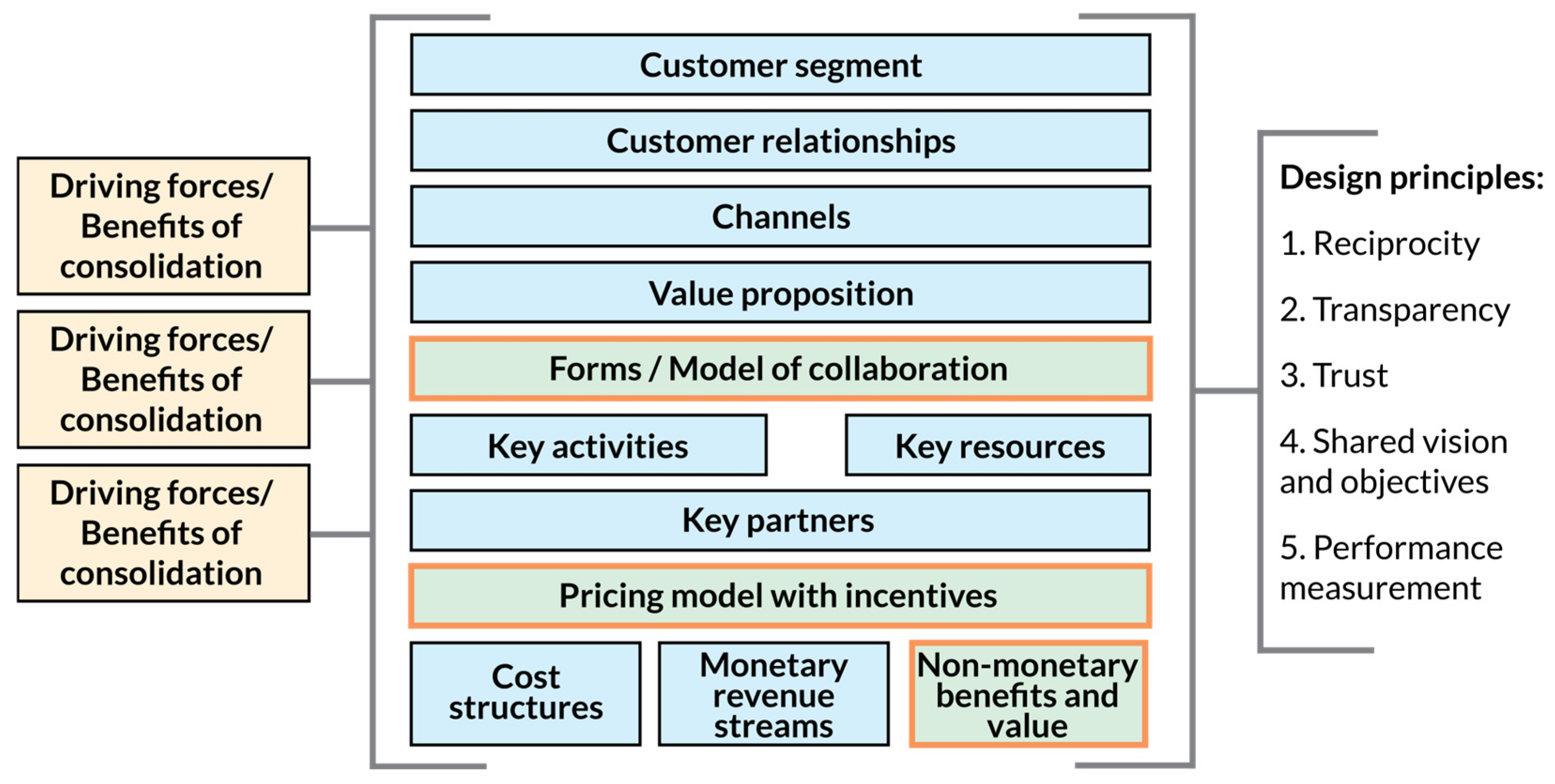
Following Vargas et al. [5], a new block—Forms/Model of collaboration—is introduced (see Figure 1). It covers collaboration forms (horizontal, vertical, or lateral) and strategies (backhauling, freight exchanges, consolidation centres, as well as others listed in Section 2.2).
A key element is the Pricing model with incentives, which refers to the fourth principle of vested agreement [8] and ensures a fair and balanced distribution of costs and gains among stakeholders. Mechanisms that enable the sharing of risks, costs, and value are expected to encourage appropriate behaviours, promote the ability of the parties to innovate, and create new values and change together. This will encourage actors to exceed expectations and continuously contribute to shared goals and objectives.
Building on the literature on sustainable business models, we divide the original building Revenue Streams block into two elements:
  • Monetary revenue streams related to earnings from a service activities [9]. For example, in a freight consolidation centre, these streams are driven by operational activities and efficiency gains (e.g., saved time, shorter distances travelled, and reduced empty trips) [5,13,14,16].
  • Non-monetary benefits and value related to societal and environmental benefits [47,48,51]. In the context of a freight consolidation centre, the examples include a reduced environmental footprint, reduced noise levels, and decreased congestion [13,14].
Building on the framework for collaborative outsourcing [8] and the literature on collaboration, we propose the following design principles or success factors for collaboration. These should be considered when discussing the components of a collaborative business model:
  • Reciprocity: At the core of collaboration is reciprocity [52,53]. Business relationships should be built on mutual benefit, ensuring that all involved parties benefit while considering each party’s unique circumstances [5,8]. However, benefits and rewards need not be equal but should be fairly distributed according to each party’s contribution or investment in the relationship [5,8,20,45]. Rewards may also be non-monetary and long-term in nature [20]. This fosters continuous improvement towards shared goals.
  • Transparency: Transparency is crucial in collaborative contracts. By sharing information, data, and processes openly [50], parties can build trust and understanding, which are essential for managing uncertainties and create joint strategies to overcome challenges.
  • Trust: Trust is a fundamental prerequisite [45,53]. It is not given automatically but built over time through consistent and reliable behaviour by the parties involved [45]. Fair pricing, transparency, and consideration of each actor’s circumstances contributes to trust-building [5,8]. A high level of trust is a pre-requisite for effective collaboration and innovation.
  • Shared vision and objectives: Parties should jointly define shared long-term goals and a common vision [5,8,45]. This ensures coordinated efforts towards achieving complex objectives.
  • Performance measurement: Both formative and quantitative performance metrics (KPIs) are important for assessing the success of the collaboration. These metrics must be designed to encourage appropriate behaviours and support common goals [5,8].

4. Materials and Methods

4.1. Methodology

The findings presented in this article are a work in progress, resulting from a qualitative approach based on the principles of engaged scholarship [56], spanning approximately two years. Engaged scholarship is defined as “a participative form of research for obtaining the different perspectives of key stakeholders (researchers, users, clients, sponsors, and practitioners) in studying complex problems” [56] (p. 9). In this study, collaborative research was adopted, enabling the co-production and co-creation of knowledge between industry partners and researchers.
To obtain stakeholder perspectives on a freight consolidation centre, we collaborated with two logistics operators, two goods receivers, a municipality, and a science park, which acts as a neutral platform for collaboration and innovation in transport and logistics. This multi-actor configuration reflects the complexity of urban freight systems and provides a suitable context for studying and testing the collaborative business model approach.
Data were collected using multiple qualitative methods aligned with the engaged scholarship approach. First, a series of structured, three-hour multi-stakeholder workshops were conducted on a monthly basis between April 2024 and January 2025. Each workshop followed a predefined agenda, focusing on specific aspects of the collaborative business model, such as shared vision and objectives, success factors, governance structures, value proposition, pricing mechanisms and incentives, revenues, and non-monetary value. The workshops were facilitated and systematically documented by the researchers.
Second, a semi-structured interview was conducted with a science park representative who was directly involved in negotiating the pilot project agreement. The interview focused on the details of the contractual agreements and implementation conditions of the freight consolidation centre.
Third, iterative online project meetings were held biweekly to discuss ongoing project development, validate intermediate findings, and refine the conceptual framework. In addition, quarterly project consortium meetings provided further input on pilot progress. Complementary interviews with project partners were conducted to understand organisational perspectives on strategic and tactical objectives.
Combining these data collection methods enabled triangulation of perspectives and provided a comprehensive understanding of the collaborative dynamics and requirements associated with the development of a collaborative business model for a freight consolidation centre.

4.2. Data Analysis

The data analysis followed an iterative approach, combining empirical results with conceptual development. Initially, the key actors within the freight consolidation centre ecosystem were identified and mapped, along with their respective roles, relationships, and interdependencies.
Data collected from workshops, interviews, and project interactions were reviewed and structured based on recurring themes related to current business models, existing services, partners, needs, value propositions, pricing models, and approaches to collaboration. Particular attention was paid to capturing challenges and enabling factors for collaboration.
In parallel, the researchers introduced and discussed a set of conceptual design principles for the collaborative business model—such as reciprocity, transparency, trust, shared vision and objectives, and performance measurement—with the key actors. These insights were used to iteratively refine the conceptual framework and its practical applicability.
The collaborative business model framework was applied and tested within the context of the pilot project. Insights from this application were synthesised to further refine the framework. Overall, the analysis combined empirical insights with concept development, enabling the development of a framework that is both practice-oriented and theoretically informed.

4.3. Practical Application of the Framework for a Collaborative Business Model

To illustrate the practical applicability of the proposed framework, we applied it to the pilot of the REDIG project. The collaborative business model was operationalised through discussions that aimed at aligning the interests and objectives of multiple actors around a freight consolidation centre. The framework was used to discuss and define a shared vision and objectives for the freight consolidation centre, as well as ways to build trust, ensure transparency, determine appropriate governance and collaboration forms, and identify suitable pricing models with incentives. Monetary and non-monetary values were also identified for the participating actors. During the pilot, these insights were iteratively refined based on the outcomes.
This example demonstrates how the proposed framework can be translated into practice, highlighting key challenges related to coordination, cost-sharing, and institutional alignment. This is discussed in Section 5.

4.4. Description of the Project’s Test Pilot

The aim of the REDIG project is to create a system demonstration of a fossil-free, open, and scalable logistics system for a freight consolidation centre serving the Event Route (Evenemangsstråket) in Gothenburg. This district has a high concentration of event venues, museums, exhibition centres, and arenas. Due to new construction and increasing numbers of business tenants, the number of businesses in the area is expected to grow, leading to increased transport demand, congestion, CO2 emissions, and noise.
To test this logistics solution, the project implemented a small-scale pilot of a freight consolidation centre using fossil-free last-mile transport. The pilot is scheduled to take place between April 2025 and April 2026. The core strategy is to optimise logistics processes through freight consolidation and to reduce truck deliveries by up to 30 per cent. The pilot provides an opportunity to generate insights for scaling up future logistics solutions, with particular focus on stakeholder collaboration, benefits realisation, and potential scalability.
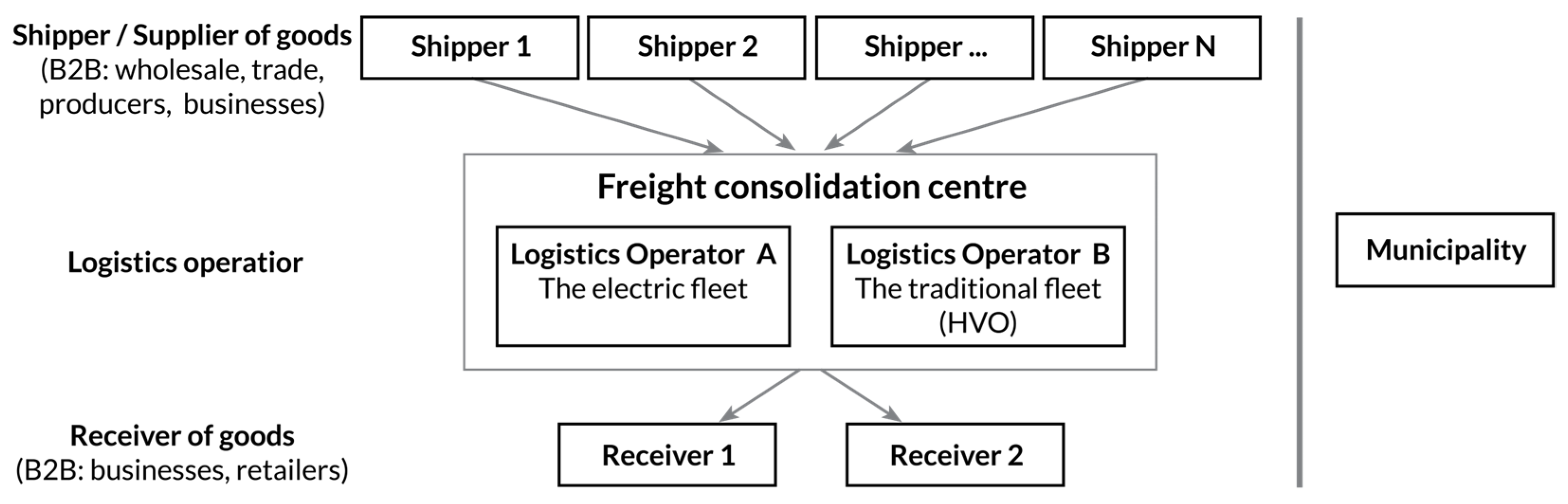
The business network around the freight consolidation centre pilot includes the following actors (see Figure 2):
  • Shippers/Suppliers of goods: The pilot started with five to six suppliers representing the business-to-business (B2B) and intra-business segments, delivering goods to customers.
  • Two logistics operators:
Logistics Operator A manages an electric fleet and is responsible for transporting different types of goods. However, the EV fleet required a significant investment, resulting in higher operating costs and service prices compared to traditional fleet operator (in this case, Logistics Operator B).
Logistics Operator B is a traditional fleet manager, providing transport and logistics services and handling all goods except food products.
3.
The two receivers of goods are large Event Route actors representing the B2B and intra-business segments. These actors are located in close geographical proximity.
Receiver 1 is an event organisation that runs a variety of activities, including entertainment, hotels, and restaurants. At certain times of the year, this actor operates daily and requires a large supply of seasonal goods, while at other times, it remains closed. It is a municipality-owned organisation.
Receiver 2 is also an event organisation that runs a range of activities, including entertainment, hotels, theatres, restaurants, and exhibition and meeting facilities. This organisation requires the delivery of large quantities of event supplies/goods, but not on a daily basis. This receiver has no on-site storage capacity.
4.
The Municipality of Gothenburg is an important actor in this ecosystem. It seeks to achieve zero environmental emissions and to make the city more attractive to its citizens. This actor is responsible for setting regulations and requirements for transport and logistics services across the city.
Initially, the idea behind the pilot was that both logistics operators would be involved in the freight consolidation centre, with goods delivered at night, during off-peak hours. This collaboration was seen as essential for operating the consolidation centre and enabling it to scale up and include additional logistics operators.
As discussed during the initial stage of the project, the expected benefits of the freight consolidation centre were as follows:
  • Potential to reduce transport costs over time by consolidating transport, optimising logistics processes, and organising logistics flows more efficiently, leading to time savings, increased vehicle load factors, and greater LSPs’ efficiency.
  • Improved routines for collaboration and optimised logistics processes.
  • Environmental impacts, including CO2 emissions, congestion, and noise can be reduced through the use of more sustainable EVs and fewer routes.
  • Initial costs can be high due to investments required for EVs.
  • Consolidated CO2 emissions reports can be offered as a value-added service for receiving companies.
  • By centralising deliveries at a freight consolidation centre, receiving companies can free up more space, which is particularly valuable where space is limited or can be repurposed.

5. Results

In this section, we present the interim results from the first six months of the pilot. The implemented services include terminal service, consolidation, and last-mile delivery. Additional services include handling returns (e.g., empty pallets) and short-term storage, enabling receivers to benefit from economy of scale when purchasing larger volumes.
During this period, the number of suppliers shipping their goods through the consolidation centre increased from five or six to 60, with three of these accounting for the majority of goods. Deliveries from the consolidation centre to the receivers were scheduled for two days a week during off-peak hours (unmanned night deliveries), with expansion to a third day under consideration. During this time, a total of 576 deliveries were made to the consolidation centre, and 68 last-mile deliveries were made to the receivers. This improved the efficiency of receivers’ internal logistics.
To illustrate the operational and environmental implications of the pilot’s preliminary results more clearly, indicative quantitative estimates are derived from the observed data. The consolidation of 576 inbound deliveries into 68 last-mile deliveries corresponds to a reduction of 508 trips (88 per cent), representing an average consolidation ratio of approximately 8.5:1, and indicating a substantial increase in load factor and route efficiency.
Assuming an average urban delivery distance of 10 km per trip, this equates to around 5080 fewer vehicle kilometres during the first six months of the pilot. Using a conservative emission factor of 0.2 kg CO2 per kilometre for diesel delivery vehicles, this corresponds to an estimated reduction of around one tonne of CO2 (see Table 2). If EVs are used (0 kg CO2 per kilometre), the total CO2 reduction would increase to approximately 1.15 tonnes of CO2. Although approximate, these estimates demonstrate the substantial potential of freight consolidation centres to enhance operational efficiency and reduce environmental impacts.
The operational estimates reflect a shift from multiple point-to-point deliveries towards more optimised, aggregated routing structures. While no formal vehicle routing optimisation was performed in this study, the results are consistent with well-established findings in the field of last-mile logistics, where consolidation strategies have been shown to significantly reduce the number of trips and enhance vehicle utilisation. These observations provide an initial empirical indication of the potential efficiency gains that could be explored further through quantitative modelling in future research.
However, certain challenges have arisen during the negotiation process for the temporary pilot agreement, as well as during the pilot period.
Protective behaviour. A significant challenge was obtaining permission to consolidate transport with one of the largest wholesale shippers. Discussions with this actor took time, and they eventually decided not to participate in the consolidation. This delayed the negotiation process and resulted in a significant change to the pilot, as this wholesale shipper had initially been expected to participate in the pilot.
Competition. An unexpected competitive situation arose when the same wholesale shipper showed interest in taking on the function of a freight consolidation centre, which challenged the existing distribution of roles, where Logistics Operator A and Logistics Operator B were intended to act as the main centres.
Increase in service price due to EVs. There were economic challenges, particularly regarding the use of EVs in the pilot. Logistics Operator A advocated the use of EVs to increase environmental benefits. However, the cost of the transport service was higher than Receiver 1 and Receiver 2 were initially willing to pay. Their financial situation, including ongoing restructuring and cost constraints, influenced their decision.
Directing deliveries to the consolidation centre. Due to hygiene requirements, Logistics Operator B could not handle food. Therefore, the facilities of Logistics Operator A were used as the consolidation centre for the pilot. This resulted in the practical challenge of ensuring that all deliveries were routed to the address of the freight consolidation centre. However, some deliveries were shipped directly to the receivers or arrived too late to be delivered in time. This challenge is related to lock-in within existing business relationships. Extensive dissemination of information and coordination among all parties were required to avoid misunderstandings and delays.
A lack of integration between the IT systems. A lack of integration between the IT systems of the receivers and Logistics Operator A created operational issues. The logistics operator lacked information on which goods would be shipped, when they would be shipped, or who had ordered them. Parcels were often received without order numbers or labels because the necessary information was lost in IT systems along the value chain. Management of goods flows was handled manually via chat with the receivers, which was time-consuming and increased workload and costs.
Uncertainty in goods delivery times. There was uncertainty about the delivery time of goods when suppliers reported them as dispatched or delivered, but the organisation had not received them. Due to uncertainty about delivery times, some businesses began ordering goods well in advance or requested direct delivery. Handling last-minute orders was also difficult due to limited capacity in the delivery vehicle.
Low volumes/low load factor. After six months of operation, volumes remained an issue despite the increased number of shippers, with two delivery days.
Pricing. Pricing was based on the number of pallets used by each receiver. This approach allowed everyone benefits from everyone’s volumes. However, the receivers differed significantly in volumes and package size, meaning that this pricing model penalised the receiver generating higher volumes. Additional costs arose when a receiver generated more driving hours than freight volume. Furthermore, participating in the pilot introduced additional costs for both receivers because the shipping price was already included in the goods’ prices following existing delivery agreements.
Sourcing and procurement process. Receiver 1 is a municipal corporation where only part of the sourcing and procurement is administrated by the corporation itself whereof the major part is handled by the municipality. This created two challenges: (i) the contract durations typically range from four to eight years, and (ii) Receiver 1 must coordinate with another organisation to implement changes in current and new contracts.
Adjustment to new routines. For the pilot to operate effectively, all actors had to adapt and adjust their routines, which proved challenging in practice. Issues included pallets consisting of mixed packages; incorrectly sorted packages, deliveries to a wrong receiver; delivery disruptions and deviations during holiday periods. These factors led to uncertainty and complaints. Clear procedures are required to address these issues and build trust in the service.
Long-term management of a consolidation centre. When discussing the future development of the pilot, stakeholders considered several consolidation centre’s management alternatives, including operation by logistics operators or receivers. However, the need to share sensitive operational data was seen as a barrier. The parties agreed that introducing an independent third party would be the most suitable solution.
Summarising, the interim results demonstrate that a freight consolidation centre can significantly reduce the number of delivery trips and improve logistics efficiency, demonstrating clear environmental and operational benefits. However, the pilot also revealed key challenges, including pricing imbalances, low volumes, the need for IT integration and improved freight handling processes, and constraints related to existing contracts and routines. These findings highlight the strong potential of consolidation, but emphasise that its long-term success depends on improved coordination, fair pricing and cost-sharing mechanisms, and an appropriate governance structure.

6. Discussion and Conclusions

In this study, we examine the opportunities and challenges of stakeholder collaboration around a freight consolidation centre and conceptualise the collaborative business model. The analysis highlights the significant efficiency and sustainability gains enabled by coordinated last-mile consolidation, as well as structural, economic, and organisational barriers that complicate implementation. These findings are discussed below.

6.1. Benefits and Challenges of Collaboration in the Context of a Freight Consolidation Centre

The core function of freight consolidation centres is to enable freight consolidation from local shippers and goods suppliers and distribute it within a defined urban area. This research is based on a pilot freight consolidation centre implemented in the REDIG project in Gothenburg. The study explores the benefits and challenges that collaboration around such a freight consolidation centre brings to stakeholders (addressing RQ1).
Two logistics operators participated in the project: one managing a traditional fleet and the other managing an electric fleet. The expected benefits of collaboration for both operators were time savings, increased efficiency, shorter distances travelled, and an increased load factor of vehicles. The pilot results showed the potential to significantly increase efficiency and decrease the number of last-mile delivery routes (in this case by 88 per cent) when delivering from the consolidation centre to receivers. The logistics operators save time by delivering goods twice a week. Deliveries were made during off-peak hours, meaning that the drivers did not waste time in traffic or waiting for their turn at receivers’ loading docks. This is in line with the findings of previous research [5,13,16].
The reduction in last-mile deliveries from the consolidation centre, coupled with fewer off-peak deliveries and the use of more sustainable vehicles, addresses a number of social and non-monetary effects. These include reduced CO2 emissions, noise, and congestion, as well as increased attractiveness of the city, which supports previous research [13,15]. Reflecting these non-monetary social and environmental values in the business model connects our concept to sustainable business models [47,48,51]. The last-mile delivery industry is highly competitive and generates low margins. Some researchers [24] have noticed that LSPs have low incentives to engage with sustainable solutions. However, one way to encourage them to do so might be to find ways to reflect non-monetary social and environmental value in organisational reports. Another way is for the municipality to use policy and regulation as instruments.
Due to the optimisation of delivery routes, urban freight receivers experienced fewer deliveries, which resulted in improved internal logistics. This was perceived as a benefit, which is consistent with previous research [16].
Several researchers have emphasised the importance of added-value services for the sustainability of consolidation centres [13,16]. The pilot provided added-value services such as warehousing and reverse logistics for empty pallets, thereby addressing the storage space issue experienced by the receivers. Furthermore, the manager of the freight consolidation centre has the potential to generate a consolidated yearly CO2 emissions report based on the number of deliveries and routes, saving the receivers time and money.
We have also identified some challenges related to collaboration within the context of a freight consolidation centre. The REDIG project focuses entirely on questions of collaboration; however, we observed competition between stakeholders during the pilot.
Combining and integrating the services of traditional and electric fleets proved to be very challenging, as the operational costs and prices of electric fleet operators are much higher, than those of traditional fleet operators. There was hesitation among LSPs regarding whether their interests were being considered fairly, which challenged collaborative efforts. Therefore, including EVs alongside traditional vehicles when developing a business model for a freight consolidation centre presents additional challenges for collaboration. This confirms and further elaborates on the findings of previous research [4,6].
Achieving a critical mass is necessary for the long-term viability of a consolidation centre [14,27], and this is evident in the pilot. Due to the small scale of the pilot, low goods volumes and load factors remain problematic.
In addition, it was challenging for participants of the pilot to adapt existing work routines and processes for the context of a consolidation centre, which confirms findings from research focused on sustainable business models [46,54,55]. This is an even greater challenge for municipal organisations, whose activities are more strictly regulated by the public procurement and long-term contracts. These actors are locked into their existing agreements, contracts, and business models, which can be difficult to change due to industry operating traditions, industry culture, conflicting interests, and different perceptions of processes. In this way, our research highlights the additional challenges that arise from public–private collaboration around a consolidation centre.
Furthermore, the findings point to several practical and operational challenges that are critical for scaling consolidation centres. First, reluctance to share data and protective behaviour create critical barriers for collaboration between actors. Second, IT system integration is essential for effort coordination and ensuring consolidation centre-related efficiency gains as well as establishing clear procedures for handling goods orders throughout the entire value chain. Otherwise, additional manual work outside IT-systems results in increased costs, reduced efficiency, and uncertainty about delivery times. Third, effective governance structures are critical to support collaboration, particularly in public–private settings, where responsibilities, decision-making authority, and coordination need to be clearly defined, and where conflicting interests need to be managed over time. In this context, the role of a neutral third-party coordinator is important to facilitate collaboration, ensure trust, and support the long-term operation of a consolidation centre. This is in line with previous research [5]. Addressing these challenges also requires institutional alignment among stakeholders.
Summarising, our findings from the pilot indicate that the main driving forces and benefits of consolidation are the optimisation of goods flows, time savings, reducing empty running, and increased vehicle load factors, which is in line with previous research [5,13,14,16]. The description of business model building blocks is summarised in Table 3. In the table, we also propose a possible solution for a future consolidation centre, additionally marked “For a future service”.

6.2. Role of EVs in the Collaborative Business Model

Given the focus of this study on collaboration among multiple stakeholders, the role of EVs within the collaborative business model requires further consideration. Although the pilot project was limited in duration and scale, it provided valuable insights and lessons learned that form an important foundation for the future transition from traditional to fully electric fleets.
From an environmental perspective, the use of EVs can significantly reduce CO2 emissions and noise, particularly in the context of off-peak and night-time deliveries in urban areas. These characteristics make EVs well-suited to supporting the sustainability objectives of municipalities and enhance the overall value proposition of freight consolidation centres.
At the same time, the adoption of EVs introduces notable operational and economic challenges. Compared to traditional fleets, electric fleets are associated with substantial initial capital investment, which lead to higher service prices. This may create tensions among stakeholders, particularly when receivers are unwilling or unable to accept these additional costs. Moreover, such cost differences create asymmetries between different LSPs, thereby complicating pricing model and cost-sharing mechanisms.
These challenges have important implications for the collaborative business model. In particular, they highlight the need for pricing and incentive mechanisms that account not only for higher service costs but also for the societal and environmental benefits associated with EV use. Potential approaches may include public support, as well as the integration of non-monetary value in the form of environmental benefits into the business model.

6.3. Proposal for Further Development of the Framework of a Collaborative Business Model for a Freight Consolidation Centre

We have conceptualised a collaborative business model and incorporated a collaboration component into the business canvas in the form of design principles or success factors (addressing RQ2). However, based on our findings, the challenges observed, and lessons learnt, it is evident that the process of establishing partnerships and building mutual trust requires time.
We also conclude that, in order for collaboration to reach a higher level in the context of a freight consolidation centre, organisational change is required. Based on Glasbergen [45], this implies a need for deeper institutionalisation of new norms, procedures, policies, and regulations between collaborating actors in both the overarching collaborative and individual business models. This process involves increasing the interdependence of resources, decision making, and risk sharing between public, private, and civil society actors.
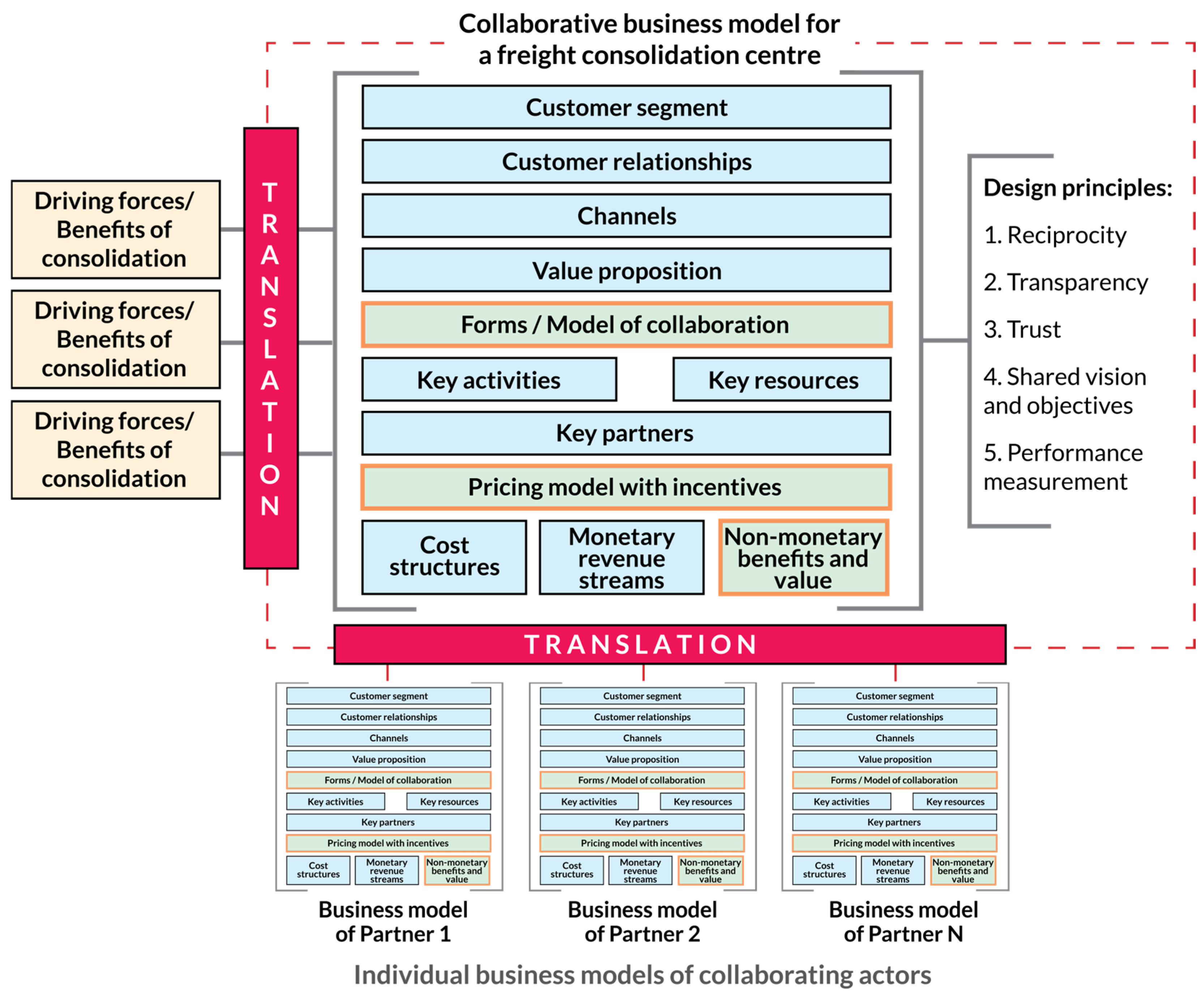
This means that the proposed framework needs to be further elaborated (see Figure 3). The collaborative business model for a freight consolidation centre can be seen as an umbrella business model for a diverse constellation of actors collaborating to provide and receive services. At the same time, all partners involved have their own business models, diverse and sometimes conflicting interests, different industry operating traditions, norms, and routines.
In order to reach true co-creation of a collaborative business model, a neutral third party is needed to orchestrate and coordinate the collaboration of the different actors [5,22]. In addition, collaboration among these diverse actors requires not only clarifying each actor’s roles, responsibilities, and actions, but also the institutionalisation of routines and norms across both the collaborative business model of the freight consolidation centre and the individual business models of the actors involved [45]. In order to move towards this level of collaboration, it is necessary to translate the monetary and non-monetary gains of the collaborative business model for a freight consolidation centre into the business models of the individual actors.
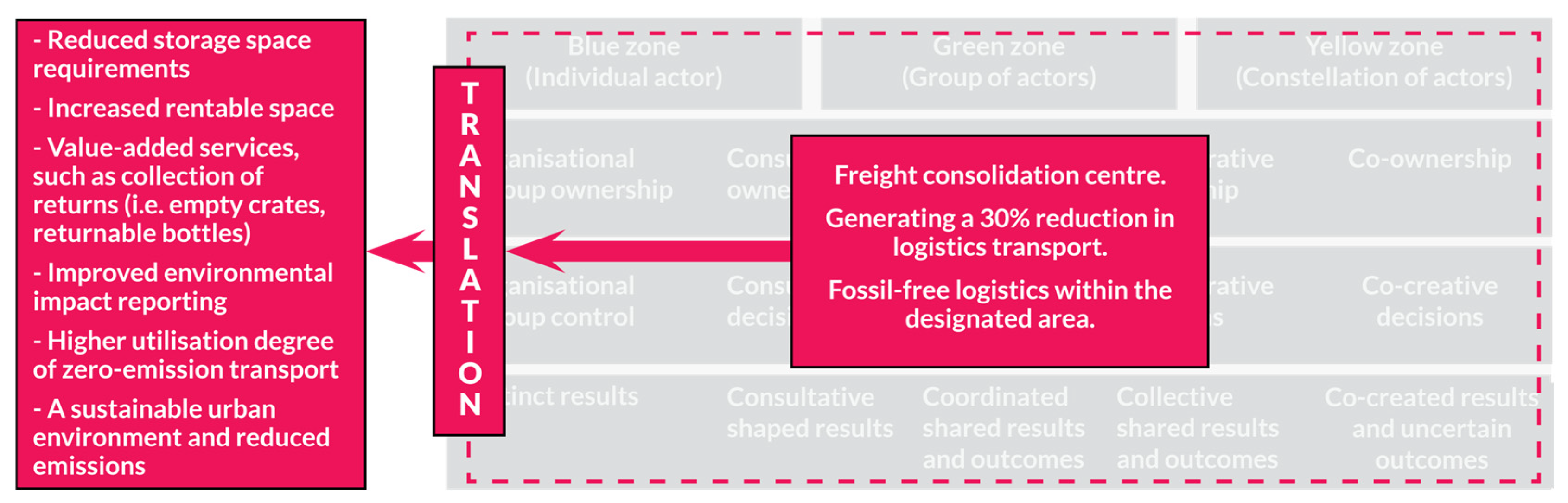
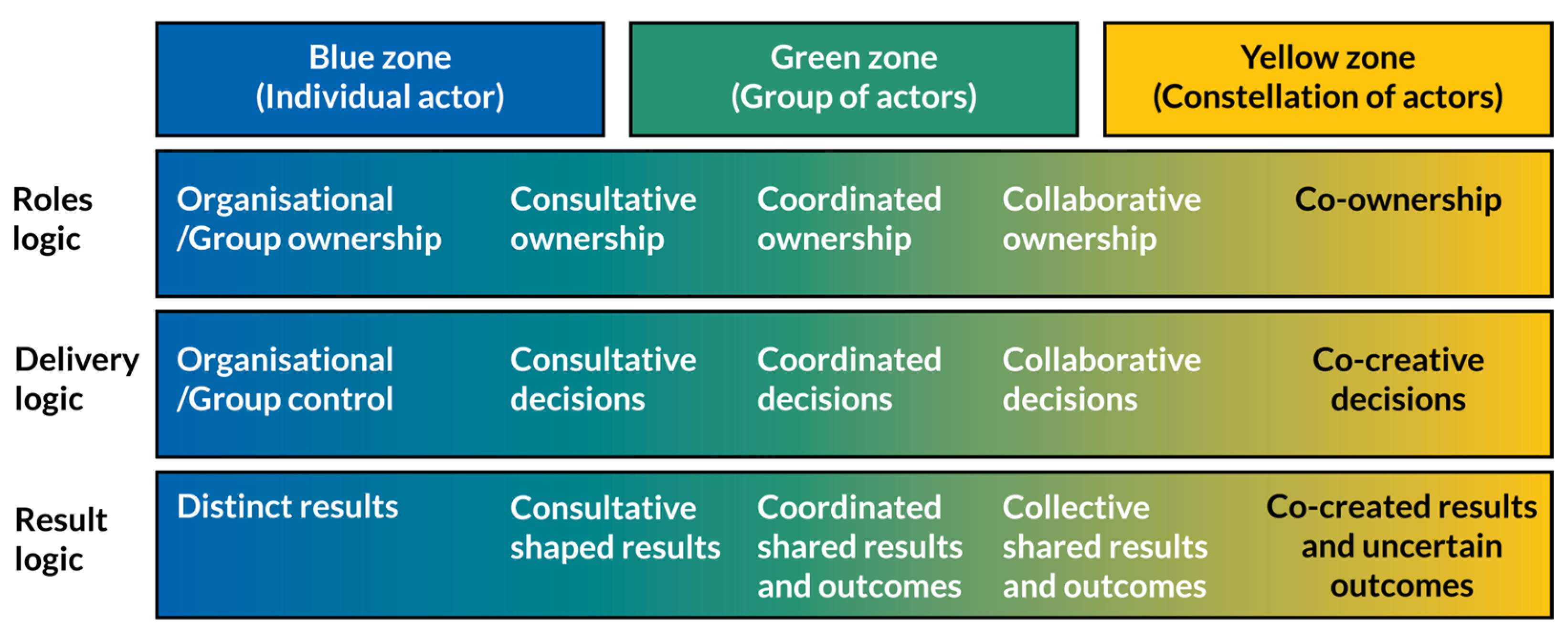
We propose making such a translation using the Lund FBL model for innovation ecosystem portfolio tracking [57]. The FBL zone model (see Figure 4) illustrates these co-existing logics through three integrated processes: roles, delivery, and results. The model describes a scale of collaboration ranging from an individual organisation to a constellation of actors. The tactics, results, and outcomes change as one moves along the scale. The ability to effectively translate the co-owned business model across different zones is crucial for empowerment, agency, and implementation within the organisation. This process involves a structured progression from individual ownership and control to fully shared ownership and co-creative agency. A structured approach to translating results and effects is required to ensure that they are clearly articulated and aligned with the organisation’s goals and strategy.
For this translation to be effective, the results and impacts of the collaborative business model must be articulated in a way that clearly demonstrates how and through which mechanisms they contribute to each participating organisation’s goals and strategy. This requires not only specifying the expected outcomes but also a clear understanding of the underlying mechanisms and drivers that generate them. In practice, the collaborative business model must be translated into tactics in each organisation. The overarching objectives, value proposition, and outcomes therefore need to be granulated and explicitly linked to benefit results, performance, and outcomes of each organisation involved.
In Figure 5, we provide an example of such a translation between the Yellow and Green zones applied to the collaborative business model of the REDIG freight consolidation centre. However, a more detailed translation is the subject of further research and conceptualisation.

6.4. Contribution, Practical Implications, Limitations and Further Research

This study makes several theoretical contributions to existing research on last-mile urban freight logistics. Firstly, it explores the benefits and challenges of collaboration among different actors in the ecosystem of a freight consolidation centre, and how the overarching business model could strengthen this collaboration.
Secondly, this study proposes a conceptual framework for a collaborative business model for a freight consolidation centre, which incorporates five success factors: (i) reciprocity; (ii) transparency; (iii) trust; (iv) shared vision and objectives; and (v) performance measurement. This framework has been tested and further refined based on the findings of this study. Further research is proposed to examine how the benefits of the overarching business model can be translated into benefits for the individual business models of the actors involved and institutionalised within their organisations.
Thirdly, this research addresses the identified research gap concerning the coexistence of traditional and electric fleets by examining challenges observed in the pilot project. The findings suggest that a fair monetary and non-monetary gain-sharing mechanism should be incorporated into the overarching business model and further distributed among the involved actors.
This study has important practical implications for practitioners involved in last-mile freight logistics. The proposed collaborative business model framework can be used as a tool to develop business models for services requiring collaboration between actors representing different industries.
One of the most important insights is that time is needed for collaboration to develop effectively. Establishing shared objectives, building trust, and aligning operational practices are time-consuming processes that need to be actively supported, for example, through structured coordination mechanisms and continuous stakeholder engagement.
From a governance perspective, the findings highlight the importance of a coordinating entity—a neutral third party—that can orchestrate and coordinate collaboration between actors with conflicting interests. The role of this third party also involves information sharing, ensuring transparency, and managing joint decision-making processes.
Another practical consideration is that an electric fleet requires substantial investment and has higher operational costs. This can create tensions between collaborating stakeholders, particularly with regard to the fair distribution of cost and benefit among them. Hence, from a broader perspective, when society aims to achieve zero environmental impact, an important discussion is: who should bear the cost of the transition to more environmentally friendly urban freight transport, given the low margins in this sector?
A major limitation of this paper is that it only considers findings from a small-scale pilot project. This may influence and bias the results of the study. However, the proposed framework is a flexible tool that can be applied in other urban contexts. It is particularly relevant in cities where multiple stakeholders are involved in last-mile logistics and collaboration between private and public stakeholders is needed to reduce environmental impacts.
Nevertheless, the transferability of the framework depends on factors such as stakeholder readiness for collaboration, infrastructure availability, IT system integration, and freight demand. Although specific practical and operational contexts may vary across use cases, the underlying design principle—trust, transparency, a fair pricing model with incentives, a shared vision and objectives, performance measurement, and governance mechanisms—are expected to remain relevant. Future work could validate and refine the framework further by applying it in a wider array of urban settings.

Author Contributions

Conceptualization, T.A. and A.F.; methodology, T.A. and A.F.; formal analysis, T.A.; investigation, A.F. and T.A.; writing—original draft preparation, T.A.; writing—review and editing, T.A. and A.F.; visualization, T.A.; supervision, A.F. and T.A.; project administration, A.F.; funding acquisition, A.F. All authors have read and agreed to the published version of the manuscript.

Funding

This research was funded by VINNOVA, grant number 2023-02596.

Institutional Review Board Statement

Ethical review and approval were waived for this study due to Swedish Ethical Review Act (2003:460) (https://www.riksdagen.se/sv/dokument-och-lagar/dokument/svensk-forfattningssamling/lag-2003460-om-etikprovning-av-forskning-som_sfs-2003-460 accessed on 24 February 2026).

Informed Consent Statement

Informed consent was obtained from all individual participants included in the study.

Data Availability Statement

The original contributions presented in this study are included in the article. Further inquiries can be directed to the corresponding author.

Acknowledgments

We would like to thank the REDIG project consortium partners for participating in the workshops and sharing their thought on collaboration, and design principles for a collaborative business model.

Conflicts of Interest

The authors declare no conflicts of interest.

Abbreviations

The following abbreviations are used in this manuscript:
B2BBusiness-to-Business
CTMCollaborative Transport Management
EVElectric Vehicle
KPIKey Performance Indicators
LSPLogistics Service Provider
SOOStatement of Objectives
UCCUrban Consolidation Centre

References

  1. Apanasevic, T.; Fjällström, A. Towards framework for a collaborative business model for a local freight consolidation centre. In Proceedings of the 38th International Electric Vehicle Symposium and Exhibition (EVS38), Gothenburg, Sweden, 15–18 June 2025. [Google Scholar]
  2. ALICE. Urban Freight. Research and Innovation Roadmap. Available online: https://www.etp-logistics.eu/wp-content/uploads/2022/08/Urban-Freight-Roadmap.pdf (accessed on 20 February 2026).
  3. Eriksson, A.; von Wieding, A.; Gestrelius, S.; Lyrberg, M.; Ranäng, S.; Carlén, V.; Hansson, M. REDIG—Regional Goods Hubs in Gothenburg. RISE and CLOSER Report, 2023. Available online: https://www.drivesweden.net/sites/default/files/2023-11/rise_slutrapport_redig.pdf.pdf (accessed on 10 January 2026).
  4. Alarcon, F.E.; Mac Cawley, A.; Sauma, E. Electric mobility towards sustainable cities and road-freight logistics: A systematic review and future research directions. J. Clean. Prod. 2023, 430, 138959. [Google Scholar] [CrossRef]
  5. Vargas, A.; Patel, S.; Patel, D. Towards a business model framework in increase collaboration in the freight industry. Logistic 2018, 1, 22. [Google Scholar] [CrossRef]
  6. Perboli, G.; Rosano, M. Parcel delivery in urban areas: Opportunities and threats for the mix of traditional and green business models. Transp. Res. Part C 2019, 99, 19–36. [Google Scholar] [CrossRef]
  7. Vluegel, J. Modelling goods city distribution in the Netherlands. Eur. Transp. 2004, 28, 20–30. [Google Scholar]
  8. Vitasek, K.; Ledyard, M.; Manrodt, K. Vested Outsourcing: Five Rules That Will Transform Outsourcing; Palgrave Macmillan: New York, NY, USA, 2010. [Google Scholar]
  9. Osterwalder, A.; Pigneur, Y. Business Model Generation: A Handbook for Visionaries, Game Changers, and Challengers; John Wiley & Sons: Hoboken, NJ, USA, 2010. [Google Scholar]
  10. Browne, M.; Sweet, M.; Woodburn, A.; Allen, J. Urban Freight Consolidation Centres; Final Report; University of Westminster: London, UK, 2005; Available online: https://ukerc.rl.ac.uk/publications/project_report/RR3_Urban_Freight_Consolidation_Centre_Report.pdf (accessed on 25 January 2026).
  11. Cleophas, C.; Cottrill, C.; Ehmke, J.F.; Tierney, K. Collaborative urban transportation: Recent advances in theory and practice. Eur. J. Oper. Res. 2019, 237, 801–816. [Google Scholar] [CrossRef]
  12. Egger, D.; Ruesch, M. Best Urban Freight Solutions I. 2001. Available online: https://trimis.ec.europa.eu/system/files?file=project/documents/20060821_161755_24060_BESTUFS%20Best%20Practice.pdf (accessed on 18 April 2025).
  13. Katsela, K.; Günes, S.; Fried, T.; Goodchild, A.; Browne, M. Defining urban freight microhubs: A case study analysis. Sustainability 2022, 14, 532. [Google Scholar] [CrossRef]
  14. Björklund, M.; Gustafsson, S. Toward sustainability with the coordinated freight distribution of municipal goods. J. Clean. Prod. 2015, 98, 194–204. [Google Scholar] [CrossRef]
  15. de Bok, M.; Giasoumi, S.; Tavasszy, L.; Thoen, S.; Nadi, A.; Streng, J. A simulation study of the impact of micro-hub scenarios for city logistics in Rotterdam. Res. Transp. Bus. Manag. 2024, 56, 101186. [Google Scholar] [CrossRef]
  16. Andruetto, C.; Gillström, H. A system dynamics perspective on the willingness of freight receivers to pay for city hubs. Clean. Logist. Supply Chain. 2025, 14, 100202. [Google Scholar] [CrossRef]
  17. Björklund, M.; Abrahamsson, M.; Johansson, H. Critical factors for viable business models for urban consolidation centres. Res. Transp. Econ. 2017, 64, 36–47. [Google Scholar] [CrossRef]
  18. Okdinawati, L.; Simatupang, T.M.; Sunitiyoso, Y. Modelling collaborative transportation management: Current state and opportunities for future reseach. J. Oper. Supply Chain. Manag. 2015, 8, 96–119. [Google Scholar] [CrossRef]
  19. Ergun, O.; Kuyzu, G.; Savelsbergh, M. Reducing truckload transportation costs through collaboration. Transp. Sci. 2007, 41, 206–221. [Google Scholar] [CrossRef]
  20. Mason, R.; Lalwani, C.; Boughton, R. Combining vertical and horizontal collaboration for transport optimisation. Supply Chain. Manag. Int. J. 2007, 12, 187–199. [Google Scholar] [CrossRef]
  21. Chan, F.T.C.; Zhang, T. The impact of Collaborative Transportation Management on supply chain performance: A simulation approach. Expert Syst. Appl. 2011, 38, 2319–2329. [Google Scholar] [CrossRef]
  22. Vargas, A.; Fuster, C.; Corne, D. Towards sustainable collaborative logistics using special planning algorithms and a gain-sharing business model: A UK case study. Sustainability 2020, 12, 6627. [Google Scholar] [CrossRef]
  23. Xu, X.; He, Y.; Ji, Q. Collaborative logistics network: A new business mode in the platform economy. Int. J. Logist. Res. Appl. 2022, 25, 791–813. [Google Scholar] [CrossRef]
  24. Macário, R.; Galelo, A.; Martins, P.M. Business Models in Urban Logistics. Eng. Dev. Univ. Norte 2008, 24, 77–96. [Google Scholar]
  25. Cagliano, A.C.; De Marco, A.; Mangano, G.; Zenezini, G. Assessing City Logistics: A Business-Oriented Approach. In Proceedings of the XXI Summer School “Francesco Turco” 2016—Industrial Systems Engineering (SSD ING-IND/17), Napoli, Italy, 13–15 September 2016; pp. 204–208. Available online: http://porto.polito.it/2650720/ (accessed on 22 January 2026).
  26. Katsela, K. Viable business models for city logistics: Exploring the cost structure and revenue streams of fourteen European cases. Transp. Res. Procedia 2025, 82, 3889–3899. [Google Scholar] [CrossRef]
  27. Gevaers, R.; Van de Voorde, E.; Vanelslander, T. Characteristics and typology of last-mile logistics from an innovation perspective in an urban context. In City Distribution and Urban Freight Transport; Macharins, C., Melo, S., Eds.; Edward Elgar Publishing: Cheltenham, UK, 2011; Available online: https://EconPapers.repec.org/RePEc:elg:eechap:14398_3 (accessed on 28 April 2025).
  28. Crainic, T.G.; Ricciardi, N.; Storchi, G. Advanced freight transportation systems for congested urban areas. Transp. Res. Part C Emerg. Technol. 2004, 12, 119–137. [Google Scholar] [CrossRef]
  29. Liu, K.; Li, N.; Kolmanovsky, I.; Girard, A. A vehicle routing problem with dynamic demands and restricted failures solved using stochastic predictive control. In Proceedings of the 2019 American Control Conference (ACC), Philadelphia, PA, USA, 29 August 2019; pp. 1885–1890. [Google Scholar]
  30. Kim, M.; Jinkyoo, P. Learning collaborative policies to solve np-hard routing problems. Adv. Neural Inf. Process. Syst. 2021, 34, 10418–10430. [Google Scholar]
  31. Mancini, S.; Gansterer, M.; Hartl, R.F. The collaborative consistent vehicle routing problem with workload balance. Eur. J. Oper. Res. 2021, 293, 955–965. [Google Scholar] [CrossRef]
  32. Al-Debei, M.M.; Avison, D. Developing a unified framework of the business model concept. Eur. J. Inf. Syst. 2010, 19, 359–376. [Google Scholar] [CrossRef]
  33. Amit, R.; Zott, C. Value creation in e-business. Strateg. Manag. J. 2001, 22, 493–520. [Google Scholar] [CrossRef]
  34. Mason, K.; Spring, M. The sites and practices of business models. Ind. Mark. Manag. 2011, 40, 1032–1041. [Google Scholar] [CrossRef]
  35. Chesbrough, H.; Rosenbloom, R.S. Role of the business model in capturing value from innovation: Evidence from Xerox Corporation’s technology spin-off companies. Ind. Corp. Change 2002, 11, 529–555. [Google Scholar] [CrossRef]
  36. Magretta, J. Why business models matter. Harv. Bus. Rev. 2002, 80, 86–92. [Google Scholar] [PubMed]
  37. Teece, D.J. Business models, business strategy and innovation. Long Range Plan. 2010, 43, 172–194. [Google Scholar] [CrossRef]
  38. Kringelum, L.B.; Frederiksen, D.J. Mechanisms for establishing collaborative business models: A longitudinal case study. Scand. J. Manag. 2026, 42, 101446. [Google Scholar] [CrossRef]
  39. Casadeus-Masanell, R.; Ricart, J.E. From strategy to business models and onto tactics. Long Range Plan. 2010, 43, 195–215. [Google Scholar] [CrossRef]
  40. Osterwalder, A.; Pigneur, Y.; Tucci, C.L. Clarifying business models: Origins, present, and future of the concept. Commun. Assoc. Inf. Syst. 2005, 16, 1–25. [Google Scholar] [CrossRef]
  41. Camponovo, G.; Pigneur, Y. Business model analysis applied to mobile business. In Proceedings of the Fifth International Conference on Enterprise Information Systems (ICEIS), Angers, France, 23–26 April 2003; pp. 173–183. [Google Scholar]
  42. Wirtz, B.W.; Pistoia, A.; Ullrich, S.; Göttel, V. Business models: Origin, development and future research perspectives. Long Range Plan. 2016, 49, 36–54. [Google Scholar] [CrossRef]
  43. Zott, C.; Amit, R. Business model design: An activity system perspective. Long Range Plan. 2010, 43, 16–226. [Google Scholar] [CrossRef]
  44. Zott, A.; Amit, R.; Massa, L. The business model: Recent developments and future research. J. Manag. 2011, 37, 1019–1042. [Google Scholar] [CrossRef]
  45. Glasbergen, P. Understanding partnerships for sustainable development analytically: The ladder of partnership activity as a methodological tool. Environ. Policy Gov. 2011, 21, 1–13. [Google Scholar] [CrossRef]
  46. Pedersen, E.R.G.; Lüdeke-Freund, F.; Henriques, I.; Seitanidi, M.M. Toward Collaborative Cross-Sector Business Models for Sustainability. Bus. Soc. 2021, 60, 1039–1058. [Google Scholar] [CrossRef]
  47. Lüdeke-Freund, F.; Gold, S.; Bocken, N.M.P. A review and typology of circular economy business model patterns. J. Ind. Ecol. 2019, 23, 36–61. [Google Scholar] [CrossRef]
  48. Bocken, N.M.P.; Short, S.W.; Rana, P.; Evans, S. A literature and practice review to develop sustainable business model archetypes. J. Clean. Prod. 2014, 65, 42–56. [Google Scholar] [CrossRef]
  49. Martina, R.A.; Oskam, I.F. Practical guidelines for designing recycling, collaborative, and scalable business models: A case study of reusing textile fibers into biocomposite products. J. Clean. Prod. 2021, 318, 128542. [Google Scholar] [CrossRef]
  50. Kerstens, A.; Rick, A.M.; Gilsing, R.A.M.; Christina, M.; Bidmon, C.M.; Ciulli, F.; Berkers, F.T.H.M. Laying the foundation: Value capture in collaborative, digitally-enabled business models for sustainability. Technol. Forecast. Soc. Change 2025, 217, 124165. [Google Scholar] [CrossRef]
  51. Schaltegger, S.; Lüdeke-Freund, F.; Hansen, E.G. Business cases for sustainability: The role of business model innovation for corporate sustainability. Int. J. Innov. Sustain. Dev. 2012, 6, 95–119. [Google Scholar] [CrossRef]
  52. de Man, A.P.; Luvison, D. Collaborative business models: Aligning and operationalizing alliances. Bus. Horiz. 2019, 62, 473–482. [Google Scholar] [CrossRef]
  53. Todeva, E.; Knoke, D. Strategic alliances and models of collaboration. Manag. Decis. 2005, 43, 123–148. [Google Scholar] [CrossRef]
  54. Austin, J.E.; Seitanidi, M.M. Collaborative value creation: A review of partnering between nonprofits and businesses: Part I. Value creation spectrum and collaboration stages. Nonprofit Volunt. Sect. Q. 2012, 41, 726–758. [Google Scholar] [CrossRef]
  55. Austin, J.E.; Seitanidi, M.M. Collaborative value creation: A review of partnering between nonprofits and businesses. Part 2: Partnership processes and outcomes. Nonprofit Volunt. Sect. Q. 2012, 41, 929–968. [Google Scholar] [CrossRef]
  56. Van de Ven, A.H. Academic-practitioner engaged scholarship. Inf. Organ. 2018, 28, 37–43. [Google Scholar] [CrossRef]
  57. Wise, E.; Hjorth, C.L.; Scott, K. Strengthening governance of place-based ecosystems—Lund model for innovation ecosystem portfolio tracking (LIEPT). In Proceedings of the University Industry Innovation Network Congerence, Budapest, Hungary, 9–11 May 2023. [Google Scholar]
Figure 1. Conceptual framework of a collaborative business model. The new elements proposed are indicated by green blocks with an orange borderline.
Wevj 17 00202 g001
Figure 2. Business network of freight consolidation centre in REDIG pilot.
Wevj 17 00202 g002
Figure 3. Elaborated framework of a collaborative business model for a freight consolidation centre.
Wevj 17 00202 g003
Figure 4. The FBL zone model [57].
Wevj 17 00202 g004
Figure 5. Example of translation explaining the REDIG freight consolidation centre use case (using the FBL zone model).
Wevj 17 00202 g005
Table 1. The Ladder of Partnership Activity (based on [45]).
LevelDescription
Level 1.Building trust. Trust is built over time. The process must be managed by a set of rules ensuring security, equity and fairness, and it must be supported by positive experience.
Level 2Exploring collaborative advantage. Each of the parties can connect its own interests with common goals, a shared vision, and clear mandates.
Level 3Constituting a rule system. Structures, roles, and rules are established, agreements are written to regulate responsibilities; and a neutral coordinator is appointed.
Level 4Changing a market. Joint decisions are translated into action, results are measured, and the parties learn from the process. A follow-up plan is developed and data is shared openly for continuous improvement.
Level 5Changing the political order. A partnership is established as part of governance, creating new regulations, policies, and norms, and securing long-term financing.
Table 2. Illustrative estimation of CO2 emissions using a conventional diesel delivery van.
Illustrative Estimation
CO2 emissions produced680 vehicle kilometers × 0.2 kg CO2 per km = 136 kg CO2
Reduction in CO2 emissions5080 vehicle kilometers × 0.2 kg CO2 per km = 1016 kg CO2
Table 3. A collaborative business model for a freight consolidation centre.
Business Model Building BlockDescription
Value PropositionFor LSPs: Optimisation of the flow of goods, saving time, reducing empty running, and increasing the load factor of the vehicles.
Fair distribution of revenue streams and costs.
For receivers: Improved efficiency of receivers’ internal logistics due to fewer deliveries.
Reversed logistics of empty pallets.
Warehousing: offering storage space to receivers.
Generation of a yearly CO2 emissions report.
For city and municipality: More attractive city, less congestion, noise, and CO2 emissions.
Customer SegmentB2B sector: large and small goods receivers including businesses, hotels, retailers.
Customer
Relationship
Close relationship between collaborating actors to provide an optimum service.
For a future service: Managed by an independent third party.
ChannelsIntegrated IT systems or an integrated common digital platform, mobile app, webpage.
Key PartnersFor the pilot: Logistics operators sharing resources and consolidating freight.
Suppliers of goods.
Municipality regulating, supporting and planning traffic in the city.
For a future service: An independent third party managing the consolidation centre and
ensuring long-term sustainable collaboration between different partners.
Key ActivitiesTerminal consolidating freight from different goods suppliers for last-mile delivery.
Delivering goods in off-peak time (unmanned night deliveries).
Short-term storage service for receivers.
Collecting empty pallets for reversed logistics.
Key ResourcesLogistics terminal, traditional and electric fleets, personnel.
Digital platform or integrated IT systems of receivers and LSPs.
Forms/Model of
collaboration
Vertical lateral collaboration between operators and receivers for the pilot, which could take any form after the pilot is over.
Collaboration strategy: Consolidation centre, route planning, joint optimisation of routes, backhauling.
Pricing model with incentivesFor the pilot: Pricing is based on the number of pallets used by each receiver.
For a future service: Pricing should be based on the share of contribution to monetary and non-monetary value as well as share of costs.
Cost structuresFixed costs: facilities, infrastructure, fleet (vehicles, trucks), IT-systems.
Operational costs: administration, personnel, transport running costs (fuel, electricity, maintenance, repair, fees, insurance), facility running costs (utilities, maintenance), package handling reverse logistics.
Monetary revenue streamsService price.
Short-term storage service.
Yearly CO2 emissions report.
Reversed logistics (including more options, e.g., empty aluminium cans and PET bottles).
Non-monetary
benefits and value
More attractive city, less congestion, noise, and CO2 emissions.
Indirect benefits for receivers: more efficient internal logistics, more free space.
Disclaimer/Publisher’s Note: The statements, opinions and data contained in all publications are solely those of the individual author(s) and contributor(s) and not of MDPI and/or the editor(s). MDPI and/or the editor(s) disclaim responsibility for any injury to people or property resulting from any ideas, methods, instructions or products referred to in the content.