Article

Design and Experimental Verification of a Lightweight Pure Electric Agricultural Robot Chassis Supported by Real-Time Tension Monitoring

1
School of Automobile and Rail Transit, Luoyang Polytechnic, Luoyang 471000, China
2
College of Engineering, China Agricultural University, Beijing 100083, China
*
Author to whom correspondence should be addressed.
World Electr. Veh. J. 2026, 17(4), 194; https://doi.org/10.3390/wevj17040194
Submission received: 5 March 2026 / Revised: 30 March 2026 / Accepted: 3 April 2026 / Published: 7 April 2026
(This article belongs to the Section Vehicle Control and Management)

Abstract

In order to investigate the application potential of lightweight agricultural robots utilizing carbon fiber-reinforced polymer (CFRP) as the primary structural material, this study developed a dedicated rubber-tracked chassis tailored for peanut pest and disease monitoring robots. The chassis design is anchored to the widely applied “single ridge with double rows” cultivation pattern in peanut production and incorporates a real-time track tension monitoring mechanism integrated with pressure sensors. The overall structural configuration of the chassis fully conforms to the standard ridge parameters of mechanized peanut planting while fully considering the intrinsic material properties of CFRP. Additionally, a sprocketless drive wheel structure is specifically adopted to realize higher-precision motion control performance. A mathematical model was constructed to quantitatively characterize the tension correlation between the tight side and slack side of the rubber track, as well as the variation law of initial tension influenced by multiple factors including the total mass of the robot platform. With the curb weight of the robot platform set at 45 kg, the theoretical initial tension is calculated to be 24.5 N (equivalent to approximately 2.5 kg, taking the gravitational acceleration g = 9.8 m/s2). The prototype shows potential for maintaining consistent tension, though a mechanical weakness was identified and will be addressed in future work. Performance validation tests show that the chassis maintains stable operation with no sprocket slippage during field visual inspection.

1. Introduction

The chassis, which integrates motion, driving, transmission, steering, and braking, is an integral part of self-propelled agricultural machinery [1]. Agricultural mobile platform chassis are mainly classified into wheeled and tracked types. The track chassis can provide better mobility and reliability, higher contact with the ground, and lower ground pressure. Therefore, it is suitable for moving on mountains and complex fields [2]. X. Mou et al. [3] constructed a kinematic and dynamic mathematical model for the track chassis; studied the traversability of the hilly or mountainous orchard platform in the actual terrain; and validated the correctness of the theoretical and simulation models via simulation and field test results. G. Molari et al. [4] analyzed the traction performance of tractors using different configurations: the full-track tractor provides better traction efficiency and reduces soil compactness. D. Li et al. [5] established an agricultural robot system based on an adaptive tracked chassis and selective spraying. Y. Chen et al. [6] designed a potato combine harvester with a tracked chassis for mountainous terrain. Z. Wang et al. [7] proposed a cotton harvester based on a tracked chassis. Z. Wu et al. [8] proposed a dual-track electric self-propelled chassis for a tea plucking machine. T. Zemánek et al. [9] showed that tracked systems minimize soil damage compared to wheeled platforms.
The rubber-tracked locomotion device is the central part of the tracked chassis. It consists of a rubber track, a sprocket (drive wheel), an upper roller (support roller/top roller), a road wheel (lower roller), an idler wheel (guide wheel), a tensioning device, a locomotion mechanism, and a chassis frame [10,11,12,13,14,15]. Usually, upper rollers, road wheels, and the tensioning device were fixed to the chassis frame. The sprocket was connected to the vehicle’s transmission system. The idler wheel, mounted on the tensioning device, can move relatively to the chassis frame and adjust track tension. The rubber track is wrapped around all the wheels, allowing them to roll continuously, driven by the sprocket. The chassis frame was generally made by welding or assembling metal parts [16,17,18,19,20,21,22]. Metal-made frames are hefty, which reduces the endurance of full-electric agricultural robots and makes them inconvenient to transport. To lower the weight is a standard approach in the automotive industry to enhance fuel consumption and reduce emissions [23,24,25]. As car light-weighting progresses, CF structure materials with good properties are more broadly used for car bodies than metal frames [26,27]. To the best of our team’s knowledge, no work has used a CFRP structure robot to monitor pests and disease while the peanut grows. Thus, this paper applies CFRP structures to build the robot’s body (frame), intending to lose weight. It uses many mass-produced CFRP sheets and tubes to assemble the robot frame, which lowers its total price. The electrification of agricultural machinery has also gained significant momentum. Yang et al. [28] provided a comprehensive review of electric tractor development in China, highlighting advances in motors, drive systems, batteries, and energy management technologies. This trend toward electrification further motivates the development of electrically driven agricultural robots like the one presented in this study. The following sections introduce the basic parts and their functions of this robot. It helps to inspect plant growth during the cultivation of peanuts precisely and to control their pests and diseases exactly. Track tension force affects the dynamic performance of the tracked chassis heavily [29,30]. If there is insufficient track tension, tracks will vibrate more easily and may even derail [31]. Adding more tension will significantly accelerate the wear of parts such as tracks, rolling bearings, and wheels, causing a tremendous reduction in their lifetime [32]. Therefore, the necessary track tension should be added, making its adjustment inescapable since the chassis uses a CF structure. An electronically controlled tensioning device is needed, requiring the addition of force feedback and proper regulation of the track tension.

2. Materials and Methods

2.1. Overall Design of the Tracked Robot

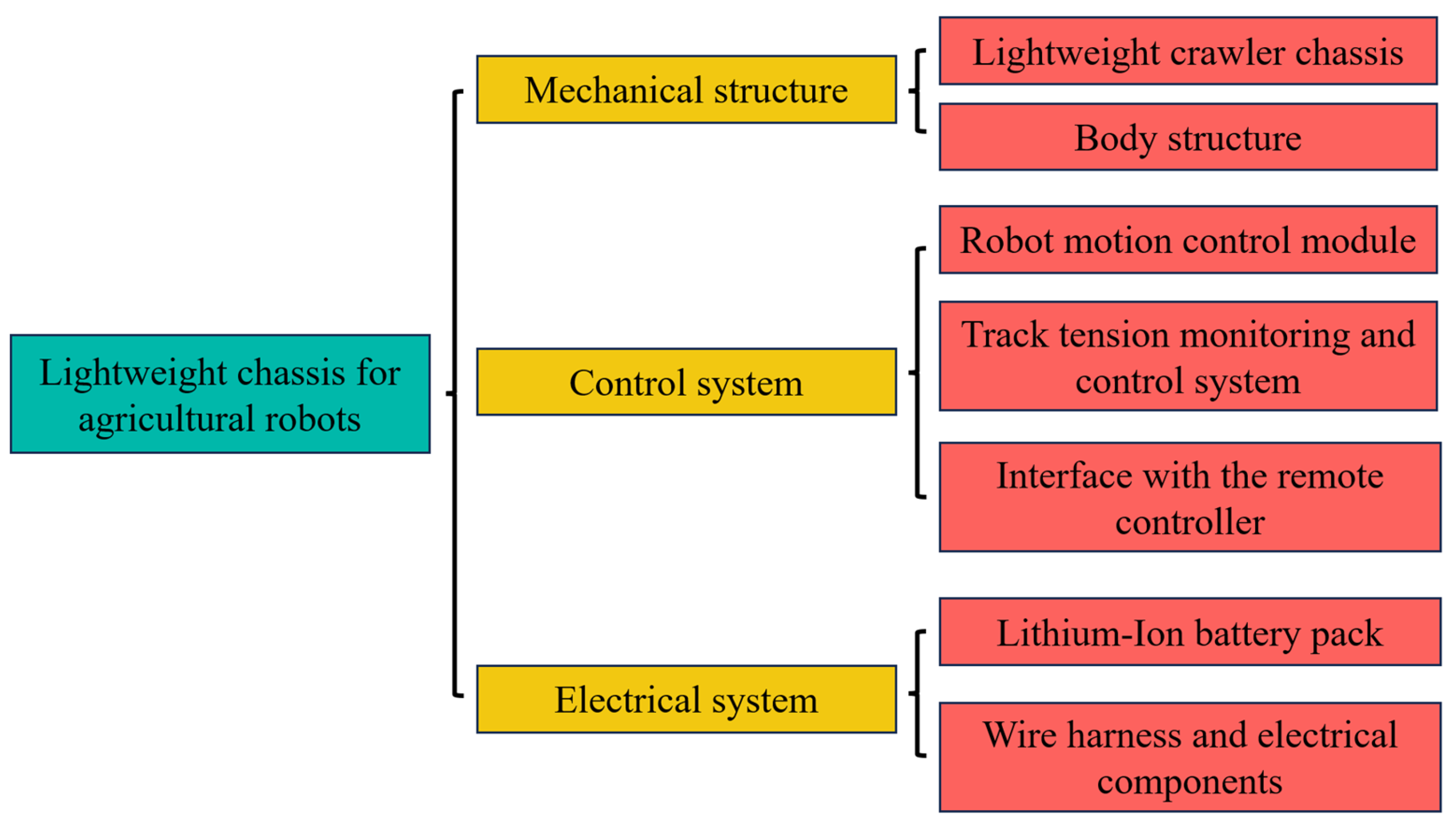
The lightweight tracked agricultural robot chassis consists of three parts: the mechanical structure, the control system, and the electrical system. The mechanical structure includes the lightweight tracked chassis and the main robot body. The control system uses an embedded development board based on the STM32F407 microcontroller to perform functions such as robot motion control, track tension measurement and adjustment, and communication with the remote controller. The electrical system includes a lithium battery pack, drive motors, motor drivers, lights, cooling fans, wiring harnesses, a fuse box, and other components. The composition of the robot chassis is shown in Figure 1.

2.2. Design and Analysis of the Tracked Robot Chassis

2.2.1. Mechanical Structural Design of the Chassis

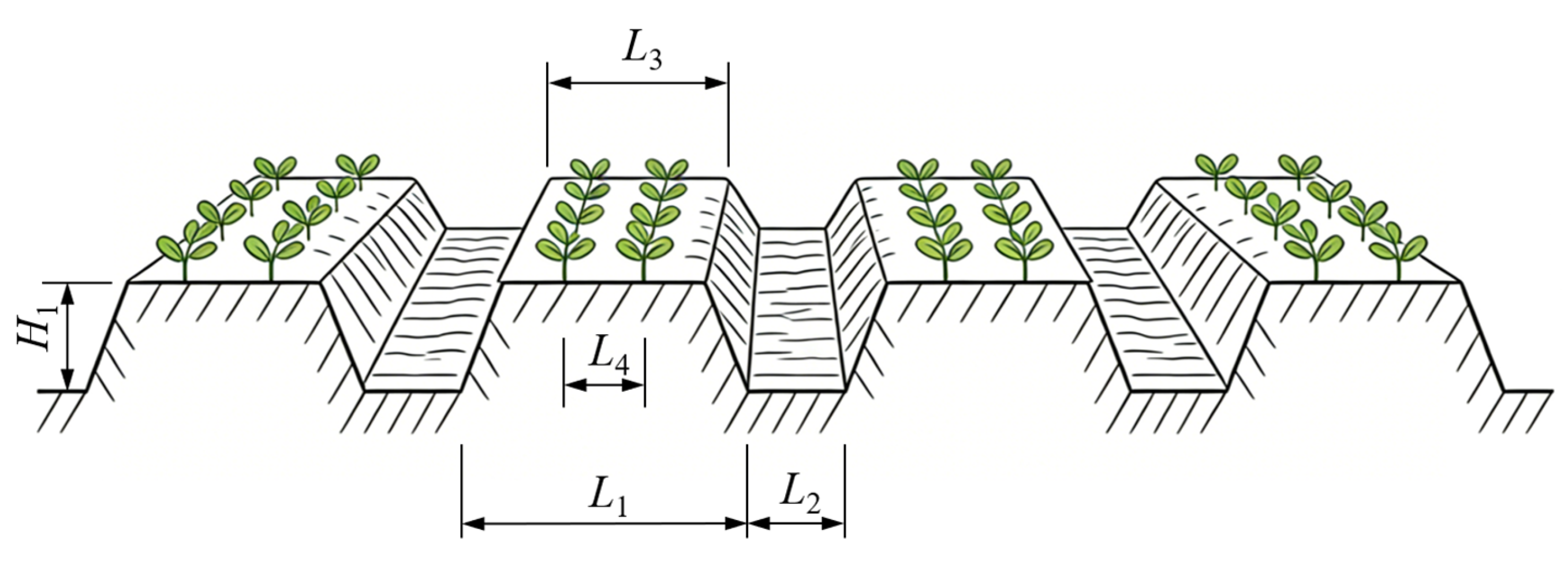
Mechanized peanut planting is currently mainly promoted in Henan Province, China. To facilitate drainage and ensure peanut growth, the peanut operation pattern “double rows on a single ridge” is usually adopted, i.e., two lines of peanuts can be planted in a single ridge [33,34]. The peanut planting operation pattern is shown in Figure 2, where L1 represents the bottom width of the ridge (600~700 mm), L2 represents the width of the furrow (100~200 mm), L3 represents the top width of the ridge (450~600 mm), L4 represents row spacing (150~300 mm), and H1 represents the ridge height (120~150 mm). From planting to harvesting, due to the influence of wind and rain, the ridge height will generally be decreased. Yuhua [35] is an efficient peanut cultivar developed in Henan Province. At maturity, this peanut variety only has an average stem above-ground length of about 314.4 mm [36].
To avoid damaging peanut plants during field operations, the tracked robot chassis must have greater ground clearance, allowing its rubber track to move within the furrows of the ridges. After planting, the peanut plant grows and develops, becoming taller on the ridge. When designing the structure of a tracked vehicle for practical shooting by a camera at the peanut plant, the mounting position should exceed about 465 mm due to the plant’s extremely tall height; otherwise, the machine’s operation path may be affected. Due to the flexible peanut plant and possibly decreasing ridge height, the tracked chassis is designed for worker convenience during inspections or the peanut plant’s flowering stage, such as when hindering peanut pegs from entering soil holes for growth, etc. It also requires higher ground clearance. So, the ground clearance should be higher than about 315 mm. Moreover, due to the wide furrow width, a rubber track width of 100 mm was selected. Additionally, due to the easy speed adjustment of the DC geared motor drive, the required field working travel speed of the robot is not too high. By using toothed belts to transmit motor-driven power to the sprocket, the system can maintain ground clearance.
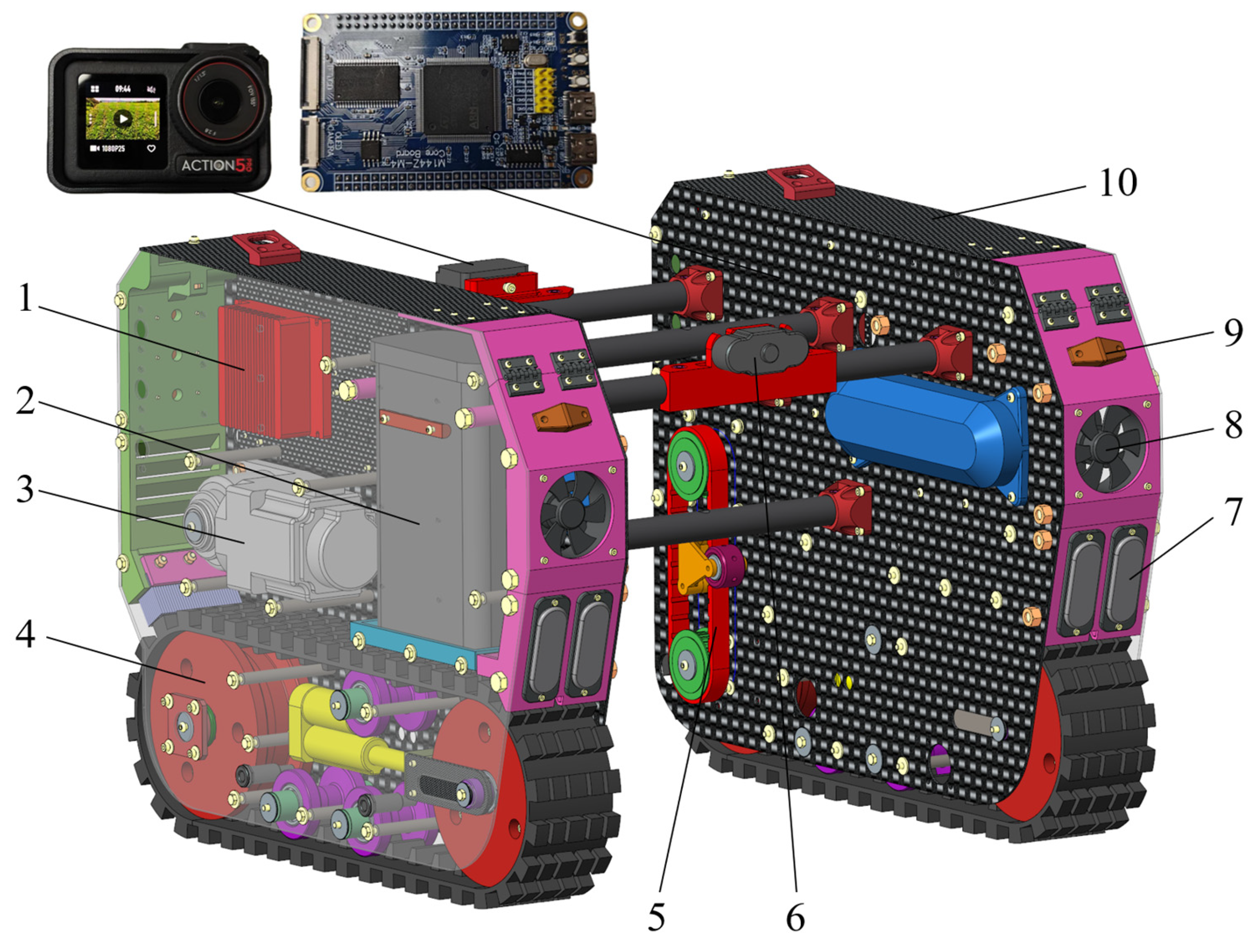
The design of the chassis body structure of this robot was based on an integrated structure that combines a chassis body and rubber-tracked locomotion, utilizing CFRP’s high strength and light weight to the maximum extent. Figure 3 shows a 3D model for the entire robot chassis, fabricated by Pro/E software. The whole platform is built in two modules made of a CFRP panel connected with five CFRP tubes that are plugged into bolts with preloads. Each CFRP module has one rubber-tracked locomotion system, a battery compartment, and a control system compartment enclosed with CFRP. Moreover, a motor driver that can convert signals from the motion controller (STM32F4) is also inside a motor driver case, connected with each robot leg drive motor fixed with bolt fixings. Five CFRR tubes connect these two moving modules, each with an outer diameter (OD) of 30 mm and an inner diameter (ID) of 24 mm, and are provided with a mounting seat. The track gauge can be changed by replacing different lengths of these CFRP pipes, which are connected between plates. Moreover, we have also adopted a case that can externally attach equipment to these CFRR tubes.
Components like the drive motor and the lithium battery powerpack are placed into the mobile modules. Power is transmitted from the drive motor through the toothed belt to the sprockets. We used belt-tensioning devices for connecting a drive motor through toothed belts. There was no backlash during forward and backward movement since the feedback from the sprocket about the rotation shaft would affect the actual rotation. To avoid problems induced by the wear and slurry generation of traditional drive teeth due to friction power transmission to driving wheels attached by the rubber track over time, we had adopted a sprocket without any driving teeth, i.e., a smooth drum, which only provides accurate movement feedback during motion as the power transmission happened under pressure contact force between the driving wheel and rubber track, and the change in torque direction would automatically adjust. The material used for CFRP was 3KT300 (Datong Precision Manufacturing Co., Ltd., Datong, China). The whole chassis measured 720 mm long, 760 mm wide, and 615 mm high. An action motion camera, OSMO ACTION5Pro (DJI, Shenzhen, China), was used for obtaining video data inside the peanut field.
Detailed component model numbers (drive motor, motor driver, battery pack, STM32F4 development board, 3D printer filament, electric linear actuator, pressure sensor, remote controller, etc.) are provided in Appendix A. All moving parts, including the sprocket, upper roller, road wheel, idler wheel, and covers, were manufactured using a 3D printer (X1-Carbon, Bambu Lab, Shenzhen, China). The rubber tracks are installed over each track with a slight tension applied by an electric linear actuator (24 V-1000 N-12 mm/s, LONGXIANG, Changzhou, China). A small pressure sensor (DYMH-103, DAYANG SENSOR, Bengbu, China) was used to monitor the slight tension of the rubber track. For platform operation, a remote controller (H12, SKYDROID, Quanzhou, China) was used for commands.

2.2.2. Design Calculations for the Chassis

Since the drive wheel on the tracked chassis of the lightweight robot lacks drive teeth, its effectiveness in driving must be confirmed. When the power of the drive motor is immense, an enormous tension on a rubber track will cause the driven wheel to slip; hence, it is necessary to determine the correct traction force through both theoretical analysis and experiments in this paper. In consequence, a belt drive system model is presented here, and the relevant mathematical model for this system is formulated. Additionally, a small pressure sensor is installed on the electric linear actuator to measure various conditions related to the tension force of tracks during the operations of tracking devices. Once the rubber tracks are mounted onto the lightweight robot, it is essentially similar to belt drives, which transfer motion and torque through contact between the belt and pulley. This setup implements relative movement between two objects rotating together and simultaneously drives rotation around its axis. Generally, a belt drive will usually contain a driving pulley, a driven pulley, and a continuous belt wrapped over the pulleys. As with belt drives, the pulley connected to the shaft generally receives rotational motion that transmits power. This causes the other pulley mounted on a different output shaft to rotate and then transfer force further via the pulley to other pulleys, continuing the process. In this paper, the sprocket, idler wheel, and rubber track also form a belt drive system. They differ from those mentioned earlier in that the idler wheel does not generate any torsional force and that the force to move forward comes from the ground and road wheels rather than the belt drive mechanism.
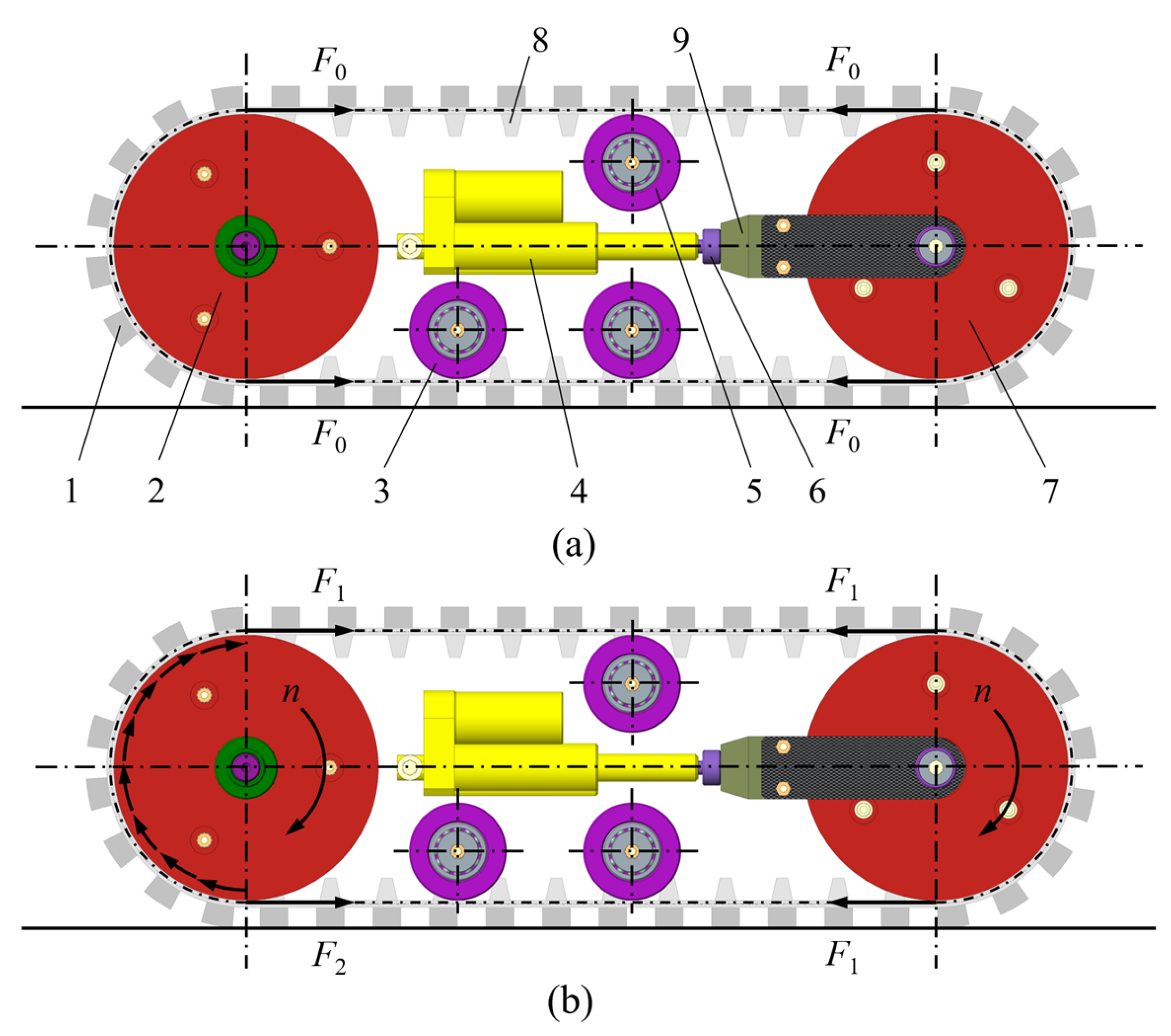
In the former type of friction belt drive, during the placement of rubber tracks into the idler wheel, they would become stretched on the groove due to the tension from the tracks applied to the sprocket and idler wheels on a rubber track, as controlled by the stretching tension from the electric linear actuator. The initial tension due to stretching on a rubber track is called F0. Consequently, all parts on the track before operations are stretched to equal distances with force F0, as shown in Figure 4a.
Let Fc be the initial tension force from the electric linear actuator. Since the extension direction of the electric linear actuator is along the center line connecting sprocket and idler wheel, we have:
F c = 2 × F 0
The operating friction between the rubber track and wheels makes the side entering the sprocket (the drive wheel) tighter to some extent and forms the tight side where the rubber track tensile force across the track in the figure section increases from F0 to F2, as shown in Figure 4b. The other side loosens and forms the loose side, where the tensile force across the track in the figure section reduces from F0 to F1, as shown in the exact figure. Let Fg be the working tension force generated by the electric linear actuator. Their relationship is as follows:
F g = 2 × F 1
Assuming the material of the rubber track obeys Hooke’s Law and that its total length remains constant when in operation, i.e., the extension on the tight side equals the compression on the loose side, the increase in the tensile force of the tight side equals the reduction on the loose side. Namely:
F 2 F 0 = F 0 F 1 F 1 + F 2 = 2 F 0
Let Fk represent the effective tension force. The effective tension force Fk equals the difference between the tension on the tight side, F2, and the tension on the slack side, F1, namely:
F k = F 2 F 1
The relation between the effective tension force, Fk, N, and the power P, kW, conveyed by the rubber track and speed v, m/s, is
P = F k × v 1000  
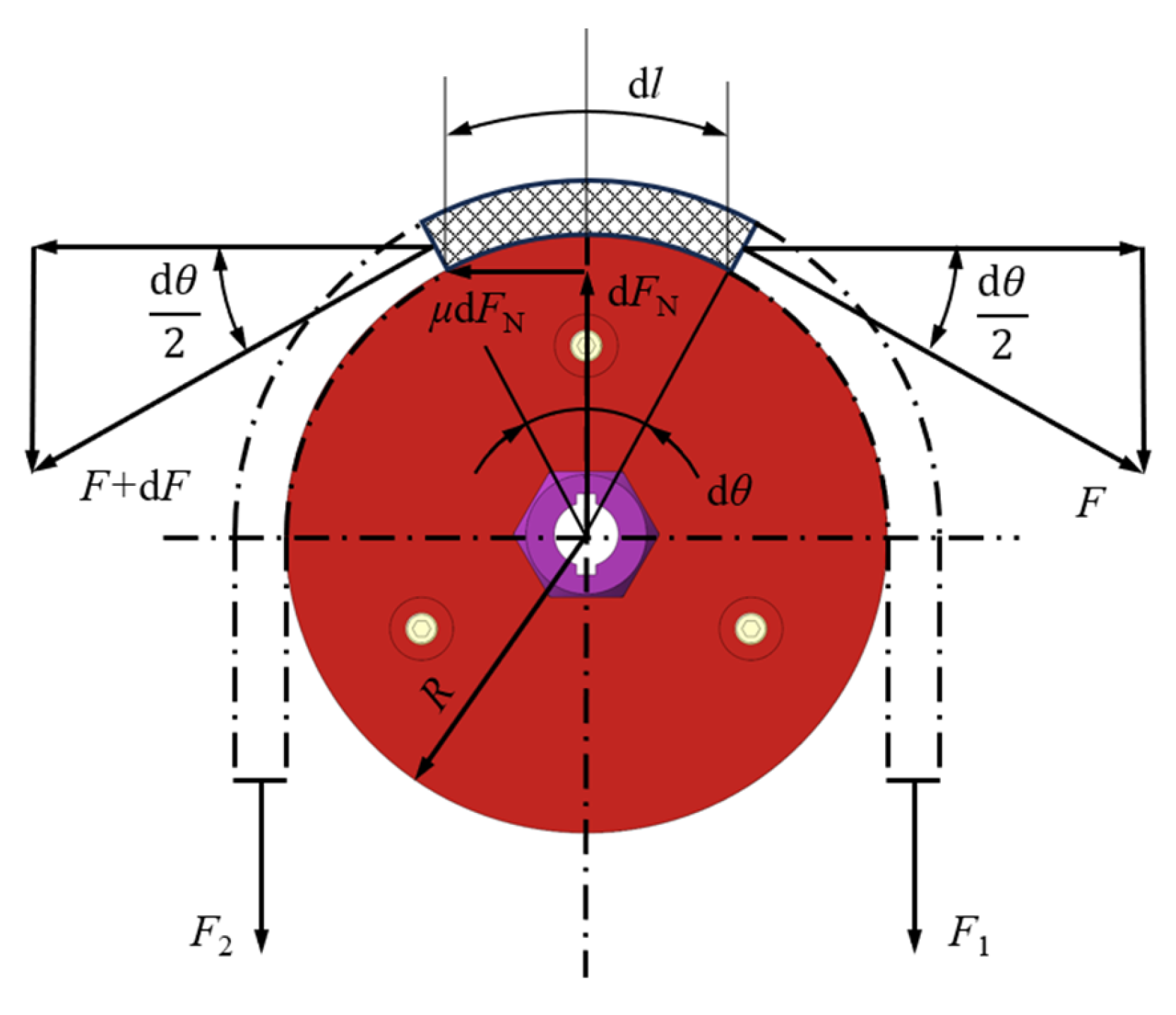
Similarly with friction-type belt drives, the effective tension force Fk of the rubber track is the operating load exerted by the static friction between the rubber track and the sprocket. There exists a definite value limit for the static friction of the rubber track and sprocket under different conditions of work. Suppose the power P of the rubber track overpasses a critical value, meaning that the effective tension force (Equation (5)) surpasses the limiting force of friction. In that case, their mutual relative slide occurs. This relative slide is called sprocket slip, and the slippage occurs between the sprocket and the track. At this phase, the track cannot effectively run with the sprocket, and severe wear is evident on both the sprocket and the track. Therefore, it should not be permitted as one of the drive failure types; hereby, we give a schematic diagram, and then the relation of tension of the tight side and slack side of the rubber track is shown in Figure 5.
Vertical direction:
F sin d θ 2 + F + d F sin d θ 2 d F N = q d l v 2 R
Horizontal direction:
F + d F cos d θ 2 F cos d θ 2 μ d F N = 0
where:
dθ—the central angle corresponding to a section dl of rubber track (rad);
dF—incremental tension force on the tight side under effective tension force Fk (N);
dFN—normal force produced by the sprocket on a segment dl of the rubber track (N);
q—mass per unit length of the rubber track (kg/m);
R—radius of the sprocket (m);
μ—friction coefficient between the sprocket and the rubber track.
Taking sin d θ 2 d θ 2 and cos d θ 2 1 and ignoring the second-order infinitesimal term dF·dθ, replacing into Equation (7) and rewriting Equation (7), we get:
d F F q v 2 = μ d θ
The equation can be obtained by integrating the above equation in the contact area between the rubber track and the sprocket:
F 1 F 2 d F F q v 2 = 0 θ μ d θ
Solving the equation yields:
F 2 q v 2 F 1 q v 2 = e μ θ
where:
e—base of the natural logarithm, 2.718;
θ—wrap angle, i.e., the central angle that corresponds to the contact arc of the rubber track and sprocket, respectively.
Equation (10) represents the tight side F2 tension and slack side F1 tension when the belt slips enough to slip between the sprocket and rubber track. qv2 in the formula here refers to the tight side rubber track centrifugal force tension FW from that running together with rotating the sprocket; this is called centrifugal force tension FW, so:
F W = q v 2
FW runs along the entire length of the rubber track, acting as part of the tight side F2 tension force and the slack side F1 tension force, respectively. It might be overlooked to consider in Equation (10) when the belt speed v < 10 m/s [37]. In this work, taking into account the highest mobility speed, which does not exceed 3 m/s, only for moving forward of the platform, if neglecting the centrifugal force tension FW, Equation (10) can be written as:
F 2 F 1 = e μ θ
And because taking into account that the rubber track about to slip state with respect to the sprocket at the maximal slippage critical state is the maximum effective tension condition, through the rearrangement of Equations (4) and (10), the maximal effective Fkmax tension force is:
F k m a x = F 2 q v 2 1 1 e μ θ
Additionally, reorganizing Equations (3), (4), and (10) gives
F k m a x = 2 × F 0 q v 2 1 e μ θ 1 + e μ θ
Substituting into Equation (1) yields:
F k m a x = F c 2 × q v 2 1 e μ θ 1 + e μ θ
From the above equation, it is clear that the key factors influencing the maximum effective tension of the rubber track include: the initial tension force Fc, the wrap angle θ, the friction coefficient μ between the rubber track and the sprocket, and the belt speed v, among others.
When the rubber track reaches the maximum effective tension, the mobile robot overcomes the ground friction through the rubber track to move forward; thus:
2 × F k m a x = μ k · m g
where:
μk—friction coefficient between the rubber track and the ground;
m—total mass of the mobile robot;
g—gravitational acceleration, taken as 9.8 m/s2.
We obtain the initial tension force Fc corresponding to the total mass m of the mobile robot as follows from the equation above:
F c = 1 2 μ k · m g 1 + e μ θ 1 e μ θ + 2 × q v 2
The friction coefficient μ was assumed based on standard values for dry rubber on steel, typically 0.4–0.5. The wrap angle θ is 160° according to the geometric layout. These values were not measured in actual field conditions but served as design inputs. Their influence is discussed in Section 4. The curb mass of the tracked chassis is 45 kg, and the wrap angle is 180° with a maximum speed of 3 m/s. According to Equations (1), (10), and (17) and experimental tests, we can calculate the initial tension force Fc to be 24.5 N, equivalent to 2.5 kg (acceleration of gravity). When determining the optimal design value, the significant friction coefficient ensures it does not cause too great a loss of initial energy. However, the relationship between the working tension force and the initial tension force when the tracked chassis moves forward is still complicated to calculate theoretically. We cannot further derive changes in the working tension force, and an accurate method for detecting test results is needed.
The derivation is based on the following assumptions: (1) the rubber track is linearly elastic (Hooke’s law); (2) its total length remains constant; (3) centrifugal force is negligible because v < 3 m/s; and (4) the Euler–Eytelwein formula for belt friction applies.

2.2.3. Tension Force Detection

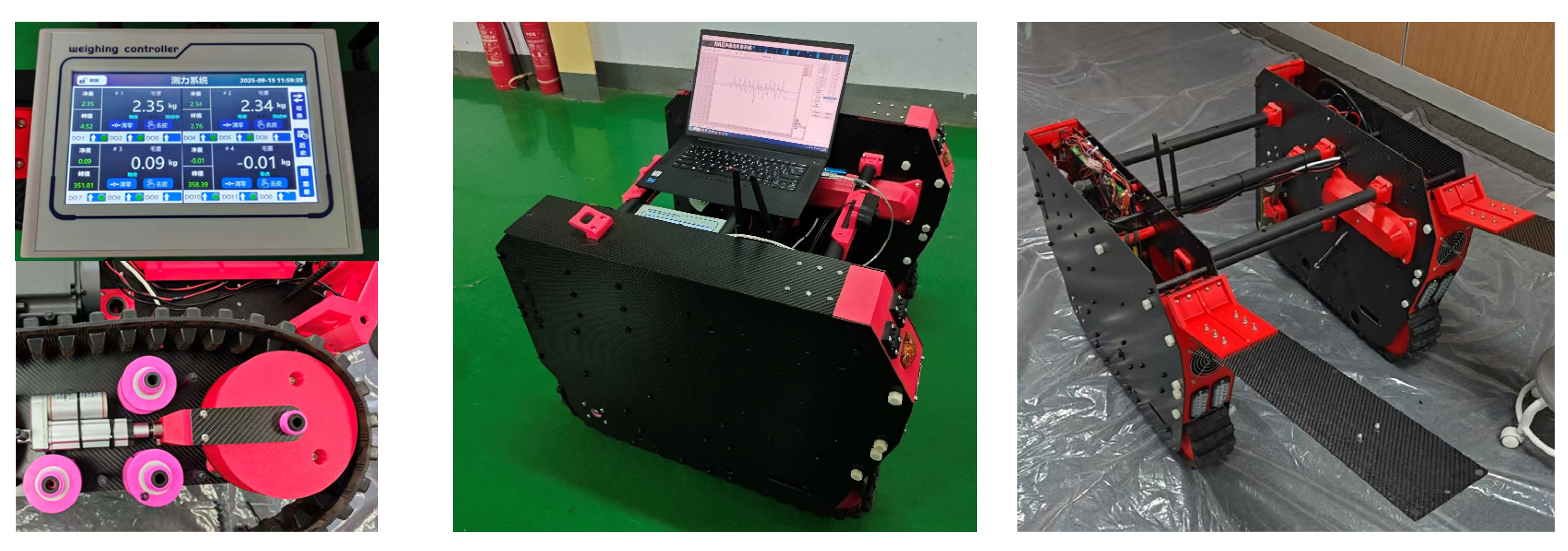
Before the mobile platform works, the initial tension force of the rubber track can be set by expanding the electric linear actuator. Force sensors detect the change in an object’s state instantly, providing an effective way to measure tension [38]. At the same time, force feedback is often used in vehicle performance tests [39,40,41], revealing the mechanical properties of the vehicle and its parts as they are pulled during movement, which may serve as effective indicators to monitor the state of a traction mechanism. Therefore, this paper uses the force sensor to analyze the variation in the tension force of the rubber track during travel. The main hardware modules of the unit used for tension force testing of tracked chassis include a small pressure sensor, a multi-channel weighing force meter (D700-4, DAYANG SENSOR, Bengbu, China), and a mobile computer, as shown in Figure 6. Specifically, a small pressure sensor is threaded mounted in the front end of the electric linear actuator. When the latter expands, the former will convert pressure from being pulled into electrical signals being emitted outwardly. Then, the received signals from the left and right ends’ electric linear actuators per sensor via the CAN line are input into the analog–digital conversion device (four channels, with signal transmission channels one and two only here). After the analog signal is digitized, multi-digit data indicating the weight in kilograms appear on the unit’s screen. Correspondingly, the software plots data into curve lines and stores the pressure value in the mobile computer. And since the idler wheel rotates freely but undriven, the tension force of the rubber track follows along Equation (1).

2.2.4. Control System

The mobile platform chassis uses the STM32F4 development board for control, featuring a core control chip, the STM32F407ZET6 (ST Microelectronics, Geneva, Switzerland), and the following modules: drive motor control module, electric linear actuator control module, electrical control module, and wireless signal reception module. The main parts of the wireless signal reception module are the remote controller and the signal receiver. The remote controller outputs digital signals for joystick and button movements, which are generated on each and transmitted to the receiver via 2.4 GHz wireless. Meanwhile, the receiver receives these signals from the remote controller and sends them to the STM32F4 development board through USART communication mode (the Universal Asynchronous Receive–Transmit Serial Port). The drive motor control module regulates the travel speed and motion mode for the tracked robot’s mobility function (forward motion, reverse motion, differential steering, spot turning, and other methods). To keep the left and right tracks coordinated, the STM32F407 uses a PID controller. Hall-effect encoders on the drive motors supply real speed feedback. The PID compares the desired speed (from the remote) with the actual speed for each track and adjusts the PWM signals separately. The discrete PID control law is u ( t ) = K p e ( t ) + K i e ( t ) d t + K d d e ( t ) d t . The electric linear actuator control module regulates the usage of the actuators on the left/right. In fact, two toggle switches, namely the switch in the remote controller (a toggle button used for the extension, stop, and retraction operation modes), are used for left and right, respectively.
The operator watches the real-time tension values displayed on the mobile computer (from the pressure sensors) and toggles the actuators manually. So, the current setup is a human-in-the-loop closed-loop system, not fully automatic. An automatic control algorithm has been designed but not yet fully implemented. The specification parameters for electric linear actuators include a 24 V/1000 N max thrust, a stroke of 50 mm, and a speed of 12 mm/s. The electrical control module is related to the switching of the front light, the cooling fan, the right turn, and the brake lamp. While fans dissipate heat from control system parts and battery pack components, air flows into the framed box from the frontend to the backend and then exits, preventing component failure due to overheating from high-temperature electronics. Our project group code independently compiled projects using Keil μVision5 (software from Keil Software in Munich, Germany).

3. Results

3.1. Experimental Protocol

The tests were conducted indoors on a clean and flat painted concrete floor. The room temperature was 25 ± 2 °C, with humidity being 40–50%. The robot’s total mass was 45 kg. Initial tension on both tracks was set to 24.5 N (2.5 kg). The robot ran straight for 20 m: 2 s acceleration, constant speed (1 m/s or 2 m/s), then 2 s deceleration. Pressure sensors sampled at 10 Hz, and data were filtered with a 5-point moving average.
To investigate the change in tension force while the platform was moving and understand its dynamic mechanism, we conducted a tension force test. There are two main modes adopted in this experiment: (1) applying an initial tension force at the stationary state; and (2) after applying the initial tension force, moving in a straight line. We conducted tests at maximum speeds of 1 m/s and 2 m/s, respectively, for linear travel in this test. To satisfy the exact condition of ground contact, the tests were carried out indoors on a clean and flat painted floor. The total length of the ground track is about 20 m. When the platform was traveling along a straight line, it would convert from a stationary state to a movement state and back to a stationary state during the course. At that time, the remote controller would be used to apply the tension force to control the platform’s motion state and movement velocity. The pressure sensor would send an analog voltage to a multi-channel weighing force meter for an A/D transformation. Then, through CAN communication, it would send signals to the computer, where the software would record the values output from both channels.

3.2. Initial Tension Force Application Test

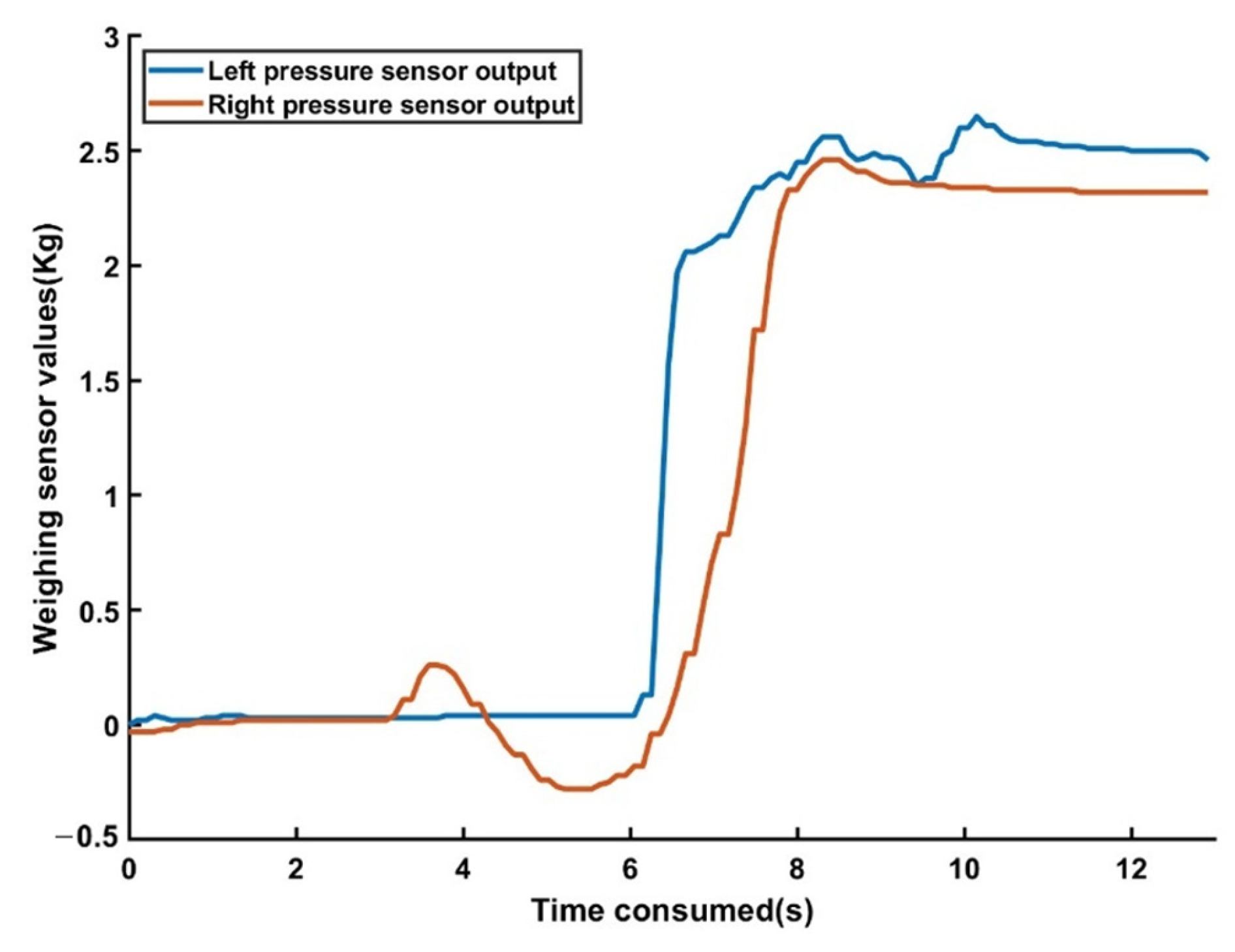
When a tracked chassis moves, the rubber track needs tension. In this test, initially, when applying tension, the platform was not yet moving. Therefore, during the process of tensioning the electric linear actuator, it should be zeroed when extended, and its pressure value should be reset. Then, it is necessary to observe how the tensile force changes as it is applied until it reaches its maximum. In this paper, the direction of forward movement of the mobile platform indicates that the module on the right-hand side is named the right mobile module. Meanwhile, another module is known as the left mobile module. The pressure sensor inside the right mobile module is called the right pressure sensor, and that within the left mobile module is referred to as the left pressure sensor. Figure 7 shows the curve of pressure values before loading the initial tensile force. At first, using the remote controller, the initial force to tension was sent into two electric linear actuators. Two electric linear actuators were first moved forward step by step from a zero-length extended position. During this momentary operation, the tension force had gradually and steadily risen from nothing to the targeted intended value of 2.5 kg or 24.5 N (g = 9.8 m/s2). The change in the rubber track’s tensile tension force was continuously monitored by installing two pressure sensors at both ends of the front side of the two linear actuators. The results were indicated by a curve similar to the one depicted in Figure 7. Figure 7 illustrates the discrepancy in force between the left and proper pressure sensor recordings as the loading tensions are applied to both electric linear actuators. Initially, while stretching the electric linear actuator, the force to the left pressure sensor remained steady, with only minor changes until then, and then suddenly increased sharply. Afterwards, however, namely on reaching the point that had the value of being about 2.06 kg, the changing rate became smaller and slightly bounced, with stabilization eventually reached at a target tension force of 2.5 kg; meanwhile, the loading process for the right pressure sensor fluctuated wildly: initially, the force went upwards at the right pressure sensor, reaching about 0.26 kg; soon afterwards, it went downward, dropping to nearly −0.28 kg once more. After having reached that point, namely the one being around the set target tension force, which had a value of 2.5 kg, the load to the right again went jumping backwards and was instantly there.
There is a considerable difference between the forces received by the left and right pressure sensors during this period. During the tension process, the electric linear actuator exerts a pushing force on the idler wheel. The idler wheel first contacts the lugs of the rubber track, followed by contact between the idler wheel body and the rubber track. The engagement between the idler wheel and the lugs of the rubber tracks is random, while the number and position of the contacting lugs are variable. Moreover, due to the inclined surfaces of the lugs of the rubber track, the idler wheel can be locked or slid from two sides of the V-shaped central groove. The force may initially increase and then decrease; however, there was a significant difference during the tension process between the left and right mobile modules, which have identical structures. Later inspection showed that the left sensor’s mounting base had a lower infill ratio (15%) than the right one (100%). This caused cracking and deformation under load. So, the left sensor readings are not reliable. The right mounting base with 100% infill remained intact.

3.3. Dynamic Tension Force Test

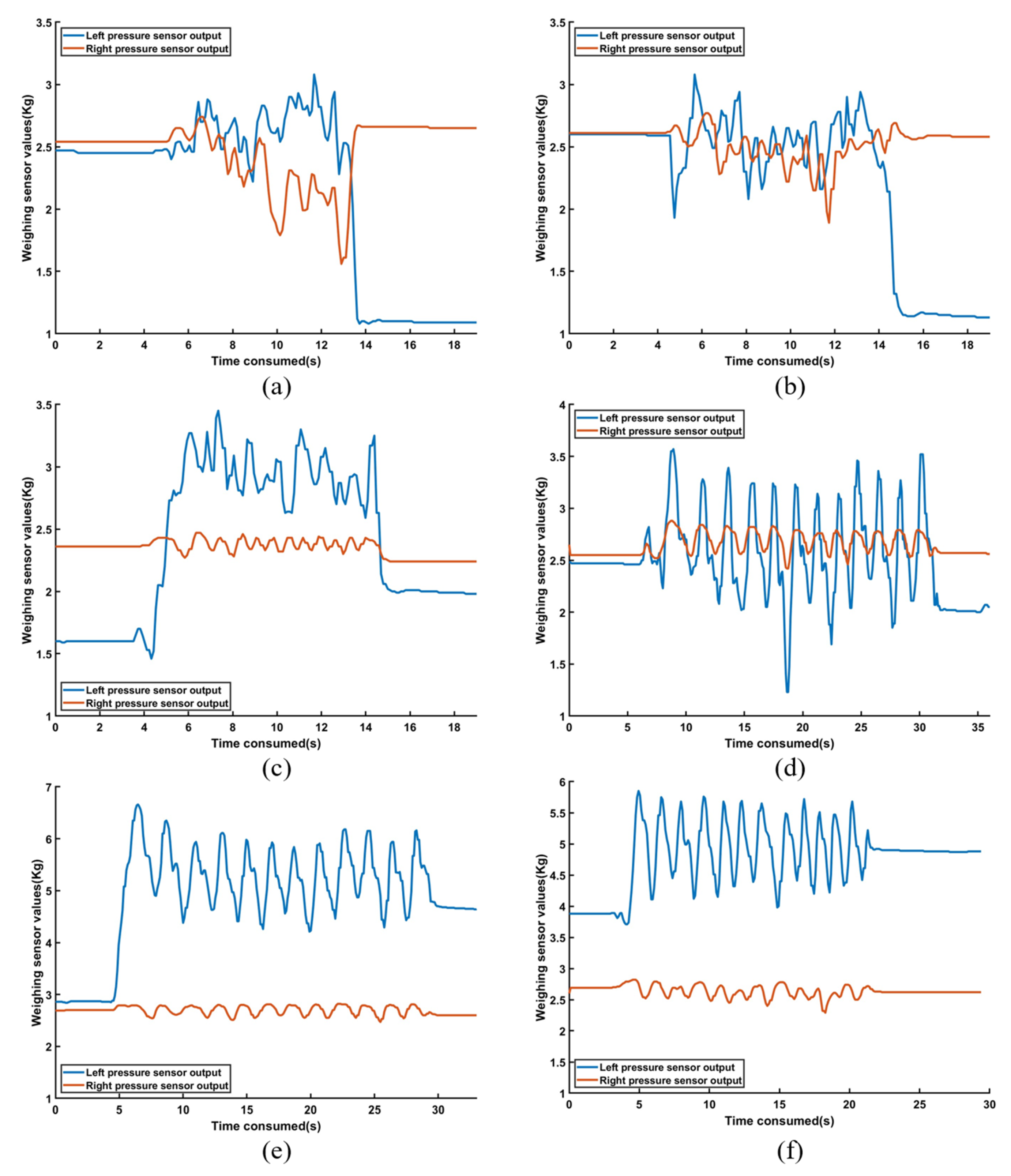
The tension of platform movement could be derived from Equation (17), but determining the value of dynamic tension is challenging because it is influenced by many factors and difficult to calculate theoretically. Some questions about dynamic tension, which could not be answered at first, are listed as follows: Is the tension of the rubber track unvaried when the platform moves forward? How does the track tension change according to the changing speed at which the platform travels? In addition, a necessary check-up would be required through testing in some cases to identify any hidden defects or flaws in the parts during the production and assembly of the prototype model. For the answers to those questions, this study will select a method to detect the real-time tension force between track sides using two pressure sensors mounted on the platform as it moves forward. In Section 2.2.2, we mentioned the tension of the rubber track when the platform remains still. However, how much tension would there be when moving forward? We discussed in Section 2.2.2 that for the platform to run normally, the initial tension force should be applied before starting the mobile platform operation by pulling the electric linear actuators to their full stretch outward. This could ensure no slip failures and frictional engagement between the sprocket and the entire rubber track during forward rotation, allowing the latter to transfer full traction to the front one effectively. Then, all rubber tracks could roll actively with continuous tension. In our experiments, the platform’s initial tension force equals 24.5 N or 2.5 kg, assuming a standard gravitational acceleration of g = 9.8 m/s2. The test aims to accelerate the platform motion from zero velocity to a maximum speed and then decelerate until stopping, executing the test three times at a single speed. It requires two types of speed values in the test: the platform speed for maximum travel, set at 1 m/s and 2 m/s. There is a total of six test times available for speed selection. The total test platform length is 20 m. The collected curve pressure values for the dynamic tension force test are given in Figure 8.
The pressures, after adjusting for the initial pre-tension forces, are shown in Figure 8a,b, with the platform’s maximum speed set at 2 m/s. One may find that the initial tension forces on the left and right sides were equal and then changed afterwards. For instance, the readings on the right-side pressure sensor initially increased and fluctuated upward and then downward to 2.7 kg before finally returning to around 2.5 kg as the platform stopped and started moving again. Whereas the reading on the left-side pressure sensor initially rose with fluctuations, reaching 2.9 kg, it then fell back down and eventually stopped fluctuating. As the platform stops, the value returns to about 1.1 kg. Figure 8a shows that the pressure of the two sensors on the right side starts from roughly the same original value while varying with fluctuations along a particular curve shape, consistent with the experimental result in Figure 8b. In comparison, Figure 8c shows the test result of not adjusting for the initial tension force, where the right pressure sensor’s reading began at 2.4 kg. When the platform moved, the pressure fluctuated within the region, ranging from low to high. After finalizing, the platform stops. The read values stabilize at 2.3 kg. At the same time, the initial reading of the pressure sensor on the left is 1.6 kg. During movement, it quickly rises to 3.5 kg, and after some fluctuations, it settles and stops at 2.0 kg. Figure 8d,e show the pressure value curves after adjusting for the initial pre-tension force. The platform’s maximum speed of 1 m/s is selected here. The initial tensions on the left side and right side were nearly identical at first but changed later. For comparison, the platform’s test result without correction on the initial pre-tension at a speed of 2 m/s was provided, as shown in Figure 8f.
The tension force dynamic test result is shown in Figure 7, demonstrating how the track tension changes as the platform moves. After several fluctuations in the platform’s movement, it reads the data from the right pressure sensor and returns to the original level of track tension. In contrast, the left pressure sensor never returns to its initial level of tension force. Also, rubber track tension varies with the platform’s top speed. In Figure 8a,b, we find a significant change in the right pressure sensor’s readings. The most crucial difference in the right sensor readings from the pressure sensor in Figure 8a is 1.1 kg. In Figure 8d–f, the reading on the right side of the pressure sensor reaches a maximum at some point and then decreases slowly; after this peak period, it rises rapidly, maintains steadiness, and then increases continuously. The most significant difference in Figure 8d is 0.4 kg, compared to 0.3 kg in Figure 8e and 0.5 kg in Figure 8f. This implies that the change in the tension force on the runway rubber track is more remarkable as the platform’s top speed increases. It can be observed that the final result recorded by the right-side pressure sensor, known as the post-motion value, still approaches the original one, even if the platform is speeding up. There are also differences in the pre- and post-motion tension forces for the pressure sensor on the left side, as the sensor does not have a chance of returning to its original spot. As for the post-movement ones on both sides, compared to the original motion measurement, they are sometimes bigger and other times smaller. The most remarkable difference is on the left side, which could be as large as 1.5 kg.
The difference between the right sensor and the left sensor is the variation in material, as shown in Figure 4. Two mounting bases were used. Two sensor mounting bases are the same in shape, made of materials with high density (3D printing with PETG, model: PETG-Basic, Bambu Lab, Shenzhen, China), but the internal structure is different. To compare and determine if there will be a significant change in performance when using materials with different densities for the mounting base, the bases were printed with an infill ratio of 15% on the left side only. In comparison, the right side had an infill ratio of 100%. Then, there was the initial force after applying the tension force, which showed that the surface of the top of the left mounting base was clearly cracked and deformed. Because the mount failed, leading to a significant error in reading the value of the pressure sensor on the left reading by the tensile stress sensor during motion, we can see in the experiment that the test has significant reading errors and the readings of the pressure sensor on the left side, with the right mount, which uses an infill ratio of 100%, pass the mechanical experiments and do not fail even when the initial tension is applied, which shows the right sensor can still read the tension before and after motion remains consistent. Therefore, this experiment confirmed that we should mount the sensors on the mounting base using infill ratios of 100% for the right sensor. This finding also explains the inconsistency between left and right sensor readings: the left side’s mechanical failure compromised its data.

3.4. Field Testing

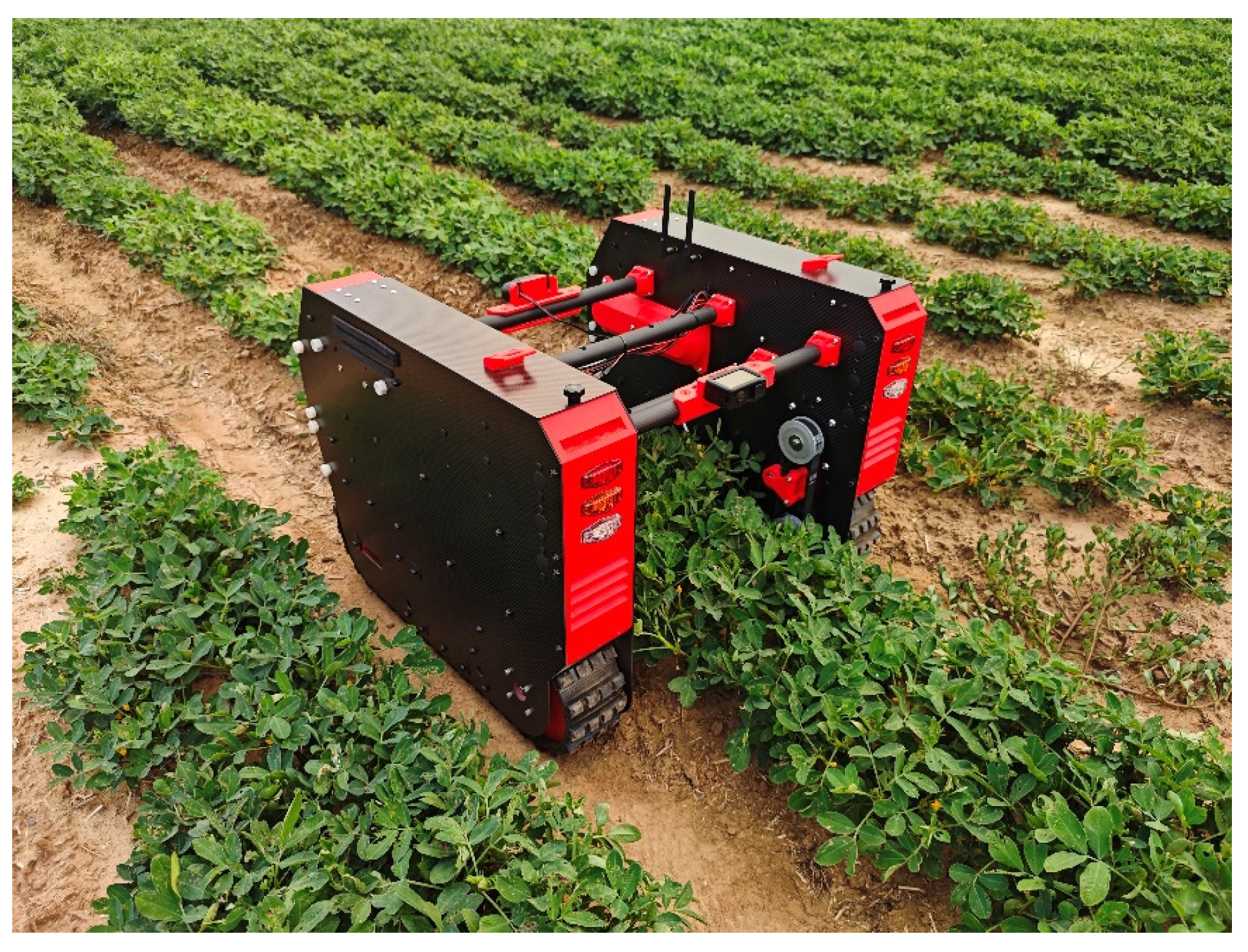
The field testing of the rubber-tracked robot chassis took place in September 2025 at the Peanut Experiment Station in Suiping County, Zhumadian City, Henan Province, China. The primary purpose was to perform a qualitative visual inspection of the platform’s basic passability and maneuverability. For this test, both sensor mounting bases were fabricated with 100% infill. During testing, a motion camera captured images of peanut plants. The platform’s rubber tracks moved along the furrows, while the CFRP tubes crossed the peanut ridges. A remote controller controlled movement, with an initial tension of 2.5 kg applied before the test. The fully battery-powered platform lasted more than six hours continuously on a single charge. The platform demonstrated good passability, differential steering, and spot turning capability. No sprocket slippage was observed throughout the tests. It is important to note that this field test was only a visual inspection; no quantitative data (such as slip ratio, traction efficiency, or tension dynamics on soft soil) were recorded due to the seasonal constraints of peanut cultivation. Quantitative field tests are planned for the next growing season. In summary, the rubber-tracked mobile platform designed for the “double rows on a single ridge” pattern met the requirements for stable field operation. Field experimental results of the rubber-tracked undercarriage are presented in Figure 9.

4. Discussion

This paper presents a CFRP rubber-tracked robot chassis. To reduce weight, CFRP was mainly applied. An online detection method for rubber track tension based on force sensors is adopted. However, this research is still in the prototype phase.
(1)
The original tension force tests were conducted on flat ground indoors. However, the actual peanut field environment is uneven, weak, and slippery. In Equation (17), the friction coefficients μ and μk will vary under different soil conditions. We acknowledge that the parameters μ and θ were theoretically assumed based on standard values and geometric design and not measured under actual operating conditions. The theoretical model is presented as a design guideline, not as a validated predictive model for all conditions. Precise identification of these parameters under actual soil and dust conditions is planned for future work.
(2)
The dynamic tension tests showed that with a properly functioning right-side mounting base (100% infill), the rubber track maintained tension close to the initial value after movement, supporting the assumption that the rubber track obeys Hooke’s law. However, the left-side sensor failed due to the low infill ratio (15%) of the 3D-printed mounting base, causing cracking and deformation. Therefore, we retract the strong claim of “favorable tension consistency” from the original abstract and conclusion. Instead, we conclude that the system concept is valid, but the current prototype suffered from a manufacturing defect. The experimental results are presented as a case study of system diagnostics, where the sensor successfully identified a mechanical fault. Future work will use uniformly high-infill (100%) mounts made of either reinforced CFRP or machined aluminum.
(3)
The current validation is limited to controlled flat and hard surfaces. Field tests were only preliminary passability checks. A lack of data on the slip ratio, traction efficiency, and performance on soft, wet, or uneven soil is a major limitation due to the peanut growth season. A dedicated follow-up study will quantify these metrics.
(4)
To provide a quantitative reference for the lightweight design, we compared our chassis weight (14 kg) with the total machine weights of three agricultural robots reported in the literature: Eceoğlu and Ünal [16] (150 kg), Duan et al. [17] (250 kg), and Hu et al. [42] (600 kg). Although chassis weight and total machine weight are conceptually different (the chassis is only a part of the total machine), a chassis weight of 14 kg is significantly lower than these total machine weights, which, to some extent, reflects the advantage of our lightweight design. The rapid development of electric tractors in China, as reviewed by Yang et al. [28], further supports the trend toward electrification and lightweighting in agricultural machinery. A qualitative comparison between the proposed CFRP chassis and a conventional metal chassis is summarized in Table 1.
The present prototype platform has not yet developed automatic closed-loop tension adjustment. In the future, we aim to dynamically adjust the electric linear actuators based on actual terrain conditions to achieve optimal tension and extend track life.

5. Conclusions

(1)
The paper proposes the mechanical structure of a rubber-tracked robot chassis, tests its electronically assisted rubber track tensioning system with real-time monitoring and manual feedback control, and explores dynamic changes in tension force during movement. Due to the seasonal constraints of peanut cultivation, quantitative field tests were not possible; only qualitative visual inspection was performed. Future work will include AI-based autonomous navigation, obstacle avoidance, and real-time pest and disease detection.
(2)
Using Pro/E for 3D mechanical design, a three-dimensional model of the lightweight rubber-tracked robot chassis was made. The basic framework mainly adopts CFRP material. The chassis weighs approximately 14 kg. Compared with the total machine weights of agricultural robots reported in the literature (Eceoğlu and Ünal [16]: 150 kg; Duan et al. [17]: 250 kg; Hu et al. [42]: 600 kg), the CFRP chassis in this study is significantly lighter. It uses rubber tracks of 100 mm width, suitable for the “double rows on a single ridge” peanut planting pattern.
(3)
To achieve accurate motion control and avoid backlash from sprocket tooth wear, the lightweight robot chassis uses a sprocket without drive teeth, conveying driving power by friction. A mathematical model was used to derive the tight-side and slack-side tension forces. Given a platform curb weight of 45 kg, the calculated initial tension is 24.5 N (2.5 kg). The theoretical model assumes μ = 0.4–0.5 and θ = 160° as design inputs; these parameters require future calibration under actual field conditions.
(4)
Tests evaluated the initial tension, dynamic tension, and field passability. The dynamic tension test revealed that a properly functioning system (right side) maintains tension close to the initial value after movement, while a system with a damaged mounting base (left side, 15% infill) does not. Therefore, the claim of “favorable tension consistency” is moderated: the system demonstrates the potential for consistent tension, but the prototype revealed a critical mechanical vulnerability. The experimental results serve as a case study in system diagnostics. Field visual inspection confirmed good passability and maneuverability with no sprocket slippage. Quantitative field tests (slip ratio, traction efficiency, and tension dynamics on soft soil) are planned for the next growing season.

Author Contributions

Conceptualization, K.Y. and C.M.; methodology, X.Z.; software, K.Y.; validation, K.Y., X.Z. and C.M.; formal analysis, K.Y.; investigation, K.Y.; resources, C.M.; data curation, X.Z.; writing—original draft preparation, K.Y.; writing—review and editing, K.Y.; visualization, X.Z.; supervision, C.M.; project administration, K.Y.; funding acquisition, K.Y. All authors have read and agreed to the published version of the manuscript.

Funding

This work was supported by the Key Scientific Research Project Plan of Henan Province Higher Education Institutions (25A416007) and the Luoyang Polytechnic School Fund Program (2024056).

Data Availability Statement

The original contributions presented in this study are included in the article. Further inquiries can be directed to the corresponding author.

Conflicts of Interest

The authors declare no conflicts of interest.

Appendix A. Detailed Component Specifications

  • Drive motor: Z6BLD750-48GU-300S (ZD, Ningbo, China);
  • Motor driver: YS-BLD2T100A (ZD, Ningbo, China);
  • Lithium battery pack: ZYB-DL48-30C (ZHUANGYUANBANG, Shenzhen, China);
  • STM32F4 development board: M144Z-M4 (ZHENGDIANYUANZI, Shenzhen, China);
  • 3D printer filament: PETG-Basic (Bambu Lab, Shenzhen, China);
  • Electric linear actuator: 24V-1000N-12mm/s (LONGXIANG, Changzhou, China);
  • Pressure sensor: DYMH-103 (DAYANG SENSOR, Bengbu, China);
  • Remote controller: H12 (SKYDROID, Quanzhou, China);
  • Multi-channel weighing force meter: D700-4 (DAYANG SENSOR, Bengbu, China).

References

  1. Wang, W.; Chen, L.; Yang, Y.; Liu, L. Development and Prospect of Agricultural Machinery Chassis Technology. Trans. Chin. Soc. Agric. Mach. 2021, 52, 1–15. [Google Scholar] [CrossRef]
  2. Zhao, Z.; Zhang, G.; Luo, C.; Liu, W.; Tang, N.; Kang, Q.; Wang, W. Path tracking algorithm of the dual motor tracked chassis considering skid and slip. Trans. Chin. Soc. Agric. Eng. 2024, 40, 46–54. [Google Scholar] [CrossRef]
  3. Mou, X.; Luo, Q.; Ma, G.; Wan, F.; He, C.; Yue, Y.; Yue, Y.; Huang, X. Simulation Analysis and Testing of Tracked Universal Chassis Passability in Hilly Mountainous Orchards. Agriculture 2023, 13, 1458. [Google Scholar] [CrossRef]
  4. Molari, G.; Bellentani, L.; Grazioso, A.; Walker, M.; Sedoni, E. Performance of an agricultural tractor fitted with rubber tracks. Biosyst. Eng. 2012, 111, 57–63. [Google Scholar] [CrossRef]
  5. Li, D.; Gao, F.; Li, Z.; Zhang, Y.; Gao, C.; Li, H. Design of a Leaf-Bottom Pest Control Robot with Adaptive Chassis and Adjustable Selective Nozzle. Agriculture 2024, 14, 1341. [Google Scholar] [CrossRef]
  6. Chen, Y.; Wang, Z.; Zhang, H.; Liu, X.; Li, H.; Sun, W.; Li, H. Investigation of the Traveling Performance of the Tracked Chassis of a Potato Combine Harvester in Hilly and Mountainous Areas. Agriculture 2024, 14, 1625. [Google Scholar] [CrossRef]
  7. Wang, Z.; Kong, F.; Xie, Q.; Zhang, Y.; Sun, Y.; Wu, T.; Chen, C. Design and Testing of a Crawler Chassis for Brush-Roller Cotton Harvesters. Agriculture 2024, 14, 1832. [Google Scholar] [CrossRef]
  8. Wu, Z.; Chen, L.; Wang, Y.; Luo, K.; Lai, X.; Zhang, X.; Cao, C. Design and Experiment on Traversibility of Traveling Chassisof Crawler Self-propelled Tea Picker. Trans. Chin. Soc. Agric. Mach. 2025, 56, 474–483. [Google Scholar]
  9. Zemánek, T.; Neruda, J. Impact on the Operation of a Forwarder with the Wheeled, Tracked-Wheel or Tracked Chassis on the Soil Surface. Forests 2021, 12, 336. [Google Scholar] [CrossRef]
  10. Chen, B.; Ma, K.; Liu, Y.; Feng, Z.; Zhao, T.; Sun, Z. Dynamic Track Tension Control System Based on Fuzzy PID. J. Vib. Meas. Diagn. 2023, 43, 872–879, 1035. [Google Scholar] [CrossRef]
  11. Szpaczyńska, D.; Łopatka, M.J.; Krogul, P. Susceptibility Modeling of a Rubber Track for Lightweight Mobile Robots. Appl. Sci. 2023, 13, 10533. [Google Scholar] [CrossRef]
  12. Liang, K.; Tu, Q.; Shen, X.; Fang, Z.; Yang, X.; Zhang, Y.; Xiang, H. An improved LuGre model for calculating static steering torque of rubber tracked chassis. Def. Technol. 2022, 18, 797–810. [Google Scholar] [CrossRef]
  13. Guan, Z.; Li, H.; Jiang, T.; Xing, L.; Zhang, M.; Jiang, D.; Jin, M. Effect of rubber-tracked chassis roller on soil surface vertical stress distribution based on finite element method. J. Terramech. 2025, 120, 101080. [Google Scholar] [CrossRef]
  14. Wang, B.; Zhu, J.; Chai, X.; Liu, B.; Zhang, G.; Yao, W. Research status and development trend of key technology of agricultural machinery chassis in hilly and mountainous areas. Comput. Electron. Agric. 2024, 226, 109447. [Google Scholar] [CrossRef]
  15. Yang, K.; Zhou, Y.; Shi, H.; Yao, R.; Yu, Z.; Zhang, Y.; Peng, B.; Fan, J.; Hu, Z. Research and Experiments on Adaptive Root Cutting Using a Garlic Harvester Based on a Convolutional Neural Network. Agriculture 2024, 14, 2236. [Google Scholar] [CrossRef]
  16. Eceoğlu, O.; Ünal, İ. Optimizing Orchard Planting Efficiency with a GIS-Integrated Autonomous Soil-Drilling Robot. AgriEngineering 2024, 6, 2870–2890. [Google Scholar] [CrossRef]
  17. Duan, L.; Kang, K.; Chen, S.; Du, Z.; Zhang, L.; Liu, Z.; Yang, F.; Wang, Z. Analysis and Verification of a Slope Steering Model of TRVs in Hilly and Mountainous Environments. Agronomy 2025, 15, 147. [Google Scholar] [CrossRef]
  18. Zhu, X.; Zhao, X.; Liu, J.; Feng, W.; Fan, X. Autonomous Navigation and Obstacle Avoidance for Orchard Spraying Robots: A Sensor-Fusion Approach with ArduPilot, ROS, and EKF. Agronomy 2025, 15, 1373. [Google Scholar] [CrossRef]
  19. Šlajpah, S.; Munih, M.; Mihelj, M. Mobile Robot System for Selective Asparagus Harvesting. Agronomy 2023, 13, 1766. [Google Scholar] [CrossRef]
  20. Sabiha, A.D.; Kamel, M.A.; Said, E.; Hussein, W.M. ROS-based trajectory tracking control for autonomous tracked vehicle using optimized backstepping and sliding mode control. Robot. Auton. Syst. 2022, 152, 104058. [Google Scholar] [CrossRef]
  21. Ospina, R.; Noguchi, N. Real-time work progress estimation based on GIS remote monitoring system for agricultural robot vehicles. Comput. Electron. Agric. 2025, 234, 110313. [Google Scholar] [CrossRef]
  22. Li, Z.; Chen, L.; Zheng, Q.; Dou, X.; Yang, L. Control of a path following caterpillar robot based on a sliding mode variable structure algorithm. Biosyst. Eng. 2019, 186, 293–306. [Google Scholar] [CrossRef]
  23. Zhang, S.; Song, H.; Xu, L.; Cai, K. Application Research on the Lightweight Design and Optimization of Carbon Fiber Reinforced Polymers (CFRP) Floor for Automobile. Polymers 2022, 14, 4768. [Google Scholar] [CrossRef] [PubMed]
  24. Pu, Y.F.; Ma, F.W.; Zhang, J.Y.; Yang, M. Optimal lightweight material selection for automobile applications considering multi-perspective indices. IEEE Access 2018, 6, 8591–8598. [Google Scholar] [CrossRef]
  25. Taub, A.; De Moor, E.; Luo, A.; Matlock, D.K.; Speer, J.G.; Vaiya, U. Materials for automotive lightweighting. Annu. Rev. Mater. Res. 2019, 49, 327–359. [Google Scholar] [CrossRef]
  26. Han, S.; Guang, X.; Li, Z.; Li, Y. Joining processes of CFRP-Al sheets in automobile lightweighting technologies: A review. Polym. Compos. 2022, 43, 8622–8633. [Google Scholar] [CrossRef]
  27. Marszałek, J. Experimental Investigation on Bending Properties of DP780 Dual-Phase Steel Strengthened by Hybrid Polymer Composite with Aramid and Carbon Fibers. Polymers 2024, 16, 3160. [Google Scholar] [CrossRef]
  28. Yang, H.; Wu, F.; Gu, F.; Xu, H.; Shi, L.; Zhou, X.; Wang, J.; Hu, Z. Electric Tractors in China: Current Situation, Trends, and Potential. World Electr. Veh. J. 2025, 16, 486. [Google Scholar] [CrossRef]
  29. Wong, J.; Huang, W. Approaches to improving the mobility of military tracked vehicles on soft terrain. Int. J. Heavy Veh. Syst. 2008, 15, 127–151. [Google Scholar] [CrossRef]
  30. Wong, J.; Huang, W. Evaluation of the effects of design features on tracked vehicle mobility using an advanced computer simulation model. Int. J. Heavy Veh. Syst. 2005, 12, 344–365. [Google Scholar] [CrossRef]
  31. Huh, K.; Cho, B.; Choi, J. Development of a track tension monitoring system in tracked vehicles on flat ground. Proc. Inst. Mech. Eng. Part D J. Automob. Eng. 2001, 215, 567–578. [Google Scholar] [CrossRef]
  32. Mȩżyk, A.; Czapla, T.; Klein, W.; Mura, G. Numerical simulation of active track tensioning system for autonomous hybrid vehicle. Mech. Syst. Signal Process. 2017, 89, 108–118. [Google Scholar] [CrossRef]
  33. Chen, K.; Liu, L.; Liu, D.; Sun, Q.; Qian, K.; Wang, D.; Sun, W.; Li, X. Design and Test of Peanut Fine Tillage Ridge Seeder. J. Agric. Mech. Res. 2025, 47, 100–106. [Google Scholar]
  34. Gu, F.; Hu, Z.; Chen, Y.; Wu, F. Development and experiment of peanut no-till planter under full wheat straw mulching based on “clean area planting”. Trans. Chin. Soc. Agric. Eng. 2016, 32, 15–23. [Google Scholar]
  35. Wang, S. Research on Key Technologies and Equipment for Peanut Pickup Combine Harvest. Ph.D. Dissertation, Zhejiang University, Hangzhou, China, June 2024. [Google Scholar]
  36. Su, L. Design and Test of Peanut Digger for Directional Laying of Stalks and Pods. Master’s Thesis, Henan Agricultural University, Zhengzhou, China, June 2024. [Google Scholar]
  37. Li, J. Machine Design, 4th ed.; China Machine Press: Beijing, China, 2007; pp. 131–133. [Google Scholar]
  38. Yang, K.; Yu, Z.; Luo, W.; Fan, J.; Li, Y.; Gu, F.; Zhang, Y.; Wang, S.; Peng, B.; Hu, Z. Experiment and Study of Garlic Root Cutting Based on Continuous Force Feedback. Agronomy 2023, 13, 835. [Google Scholar] [CrossRef]
  39. Zhao, D.; Gong, M.; Wang, Y.; Zhao, D. A Position–Force Feedback Optimal Control Strategy for Improving the Passability and Wheel Grounding Performance of Active Suspension Vehicles in a Coordinated Manner. Processes 2025, 13, 1241. [Google Scholar] [CrossRef]
  40. Song, J.; Zhang, L.; Zhu, D.; Liang, H. Active Control of Shimmy in Articulated Single-Axle Straddle-Type Monorail Train. Machines 2024, 12, 854. [Google Scholar] [CrossRef]
  41. Shi, X.; Zhao, D.; Zhong, Y.; Chang, J.; Ni, T.; Chen, X. Auxiliary Steering Control of Vehicle Driving with Force/Haptic Guidance. Sustainability 2023, 15, 12366. [Google Scholar] [CrossRef]
  42. Hu, Y.; Xian, J.; Xiao, M.; Cheng, Q.; Chen, T.; Zhu, Y.; Geng, G. Design and Experiment of a Greenhouse Autonomous Following Robot Based on LQR–Pure Pursuit. Agriculture 2025, 15, 1615. [Google Scholar] [CrossRef]
Figure 1. Schematic diagram of the lightweight tracked agricultural robot chassis.
Wevj 17 00194 g001
Figure 2. Schematic diagram of mechanized peanut planting operation.
Wevj 17 00194 g002
Figure 3. CFRP mobile platform equipped with a motion camera and an STM32F4 development board. 1. Motor driver; 2. lithium battery pack; 3. drive motor; 4. electronically tension-controlled rubber-tracked locomotion system; 5. toothed belt; 6. video transmission camera; 7. front light; 8. cooling fan; 9. turn signal; 10. CFRP cover panel.
Wevj 17 00194 g003
Figure 4. Schematic diagram of the rubber crawler walking system. (a) Schematic diagram of track tension force before operation; (b) schematic diagram of track tension force during forward movement. 1. Rubber track; 2. sprocket (drive wheel); 3. road wheel; 4. electric linear actuator; 5. upper roller (carrier roller); 6. miniature pressure sensor; 7. idler wheel (guide wheel); 8. rubber track lug; 9. sensor mounting base.
Wevj 17 00194 g004
Figure 5. Schematic diagram for calculating the tension relationship between the tight side and slack side of the rubber track (the integration limits in this figure are from F1 to F2 and from 0 to θ, where θ is the wrap angle).
Wevj 17 00194 g005
Figure 6. On-site testing of the rubber track tension force. Note: The Chinese labels on the instrument interface are translated as: 测力系统 (force-measuring system), 毛重 (gross weight), 净重 (net weight), 峰值 (peak value), 清零 (zero-reset), 去皮 (tare).
Wevj 17 00194 g006
Figure 7. The pressure value curve during the initial tension force application.
Wevj 17 00194 g007
Figure 8. Pressure value curves from dynamic tension force tests. (a) Corrected initial pre-tension force, maximum speed 2 m/s, both pressure sensors; (b) corrected initial pre-tension force, maximum speed 2 m/s, both pressure sensors; (c) uncorrected initial pre-tension force, maximum speed 2 m/s, both pressure sensors; (d) corrected initial pre-tension force, maximum speed 1 m/s, both pressure sensors; (e) corrected initial pre-tension force, maximum speed 1 m/s, both pressure sensors; (f) uncorrected initial pre-tension force, maximum speed 1 m/s, both pressure sensors.
Wevj 17 00194 g008
Figure 9. Field testing of the rubber-tracked robot chassis.
Wevj 17 00194 g009
Table 1. Qualitative comparison between the proposed CFRP system and a hypothetical conventional metal chassis.
FeatureProposed CFRP System (This Study)Hypothetical Conventional Metal System
Chassis Weight14 kgEstimated 30–45 kg (typical range)
Tension ControlReal-time monitoring + manual adjustmentTypically none or fixed spring
Sensor IntegrationIntegrated (pressure sensors)Not standard
Mechanical Durability (Prototype)Limited by 3D-printed parts (left side failure)Higher (welded steel)
Estimated Energy Consumption per kmLower (due to weight reduction)Higher
Disclaimer/Publisher’s Note: The statements, opinions and data contained in all publications are solely those of the individual author(s) and contributor(s) and not of MDPI and/or the editor(s). MDPI and/or the editor(s) disclaim responsibility for any injury to people or property resulting from any ideas, methods, instructions or products referred to in the content.